






Abstract
Traditional juvenile justice approaches in the United States have failed to adequately consider adolescent developmental needs and broader social contexts, potentially undermining healthy psychosocial development. In response, the juvenile justice system has been working toward a significant shift to developmentally informed approaches, including in a midwestern urban county in the United States, where prosecutors and others have been trained on bringing the science of adolescence into their decision-making. Yet limited research exists on how practitioners operationalize these principles in practice. This qualitative study examines how practitioners in juvenile justice understand and apply concepts of adolescent development and restorative justice when determining accountability pathways for youth. Semi-structured interviews were conducted with six members of the Collaborative Review Team (CRT), a group of diverse decision-making practitioners (i.e. community members, public defenders, and assistant county attorneys) who make decisions about youth cases. The results from qualitative analysis indicate a gap between theoretical knowledge and application in practice. Analysis also indicated a nuanced and complex approach to assessing need and harm. Participants emphasized the necessity of examining each youth’s individual background, stressing the importance of understanding the environmental influences affecting decision-making processes. Another recurring theme underscored disparate access to information and information gaps related to the assessment of need; participants often relied on professional experience to fill these holes, speculating or making inferences about the type and acuity of need. Results from this research are particularly timely as jurisdictions across the United States increasingly adopt models that balance accountability with developmental science and restorative approaches.
Keywords
Introduction
The US juvenile justice system has undergone significant changes in recent decades, with the number of youth involved in the system decreasing substantially since its peak in the mid-1990s. According to the Office of Juvenile Justice and Delinquency Prevention (OJJDP, 2022), the number of youth in residential placement declined by 70% between 2000 and 2020, from approximately 108,800 to 36,479 youth. This dramatic reduction reflects shifting approaches to juvenile justice, including greater emphasis on diversion programs focused on restorative practices, community-based alternatives, and a growing recognition of developmental science. Despite these advancements, racial disparities persist. Black youth are still more than four times as likely as white youth to be detained or committed to juvenile facilities, while Native American youth are nearly five times as likely as white youth to be detained (OJJDP, 2022). In some states, like Minnesota, Native American youth are nearly 19 times as likely, compared with white peers, to be committed to juvenile placement facilities (OJJDP, 2022; The Sentencing Project, 2021).
The term “juvenile justice” is used throughout this article as the standard US legal designation for systems addressing offending by minors. Internationally, equivalent systems are referred to by various terms, including “youth justice” (England and Wales, Australia), “child justice” (South Africa, Ireland), and “children’s hearings” (Scotland). While these systems differ in structure, jurisdiction, and philosophy, they share a common concern with responding to offending behavior by children and young people in developmentally appropriate ways. Where possible, this article uses “youth justice” as an inclusive term when discussing concepts applicable across jurisdictions. For international readers, key US terminology includes “juvenile delinquency court” (the specialized court handling offenses by minors); “adjudication” (the equivalent of conviction); “disposition” (the equivalent of sentencing); and “diversion” (alternatives to formal court processing).
The juvenile justice system has experienced what some call “cyclical” approaches to transformation (April et al., 2023), with shifts between rehabilitative and punitive-focused reform efforts occurring across its history. The decline in US youth incarceration represents a pivot from the “tough on crime” era of the 1980s and 1990s. More recently, it is increasingly recognized that youth crime and rehabilitation must be understood through a developmental lens (Cavanagh, 2022a). This shift represents a significant departure from traditional punitive approaches that focus primarily on the offense, rather than the complex interplay between adolescent development, social context, and coping behavior (Cavanagh, 2022a). The inclusion of perspectives on development and call for more effective intervention strategies that prioritize rehabilitation over punishment have been credited for today’s juvenile justice system landscape (Steinberg, 2009). However, few empirical research studies describe the challenges of implementing this shift, given legal system practitioners do not receive training in developmental science. This article will explore the use of a collaborative decision-making model in an urban area in a Midwestern US state and the ways in which practitioners recognize and apply adolescent development principles when determining accountability pathways for youth involved in juvenile delinquency court proceedings.
Impacts of punitive approaches on juveniles
Punitive approaches from the 1990s led to an “adultification” of youth through harsh sentences, despite declining juvenile crime rates (Benekos and Merlo, 2008). Judicial waivers that transfer youth from juvenile to adult criminal court peaked in 1994 at approximately 13,000 cases, more than double the number in 1985, and have since declined dramatically. By 2020, an estimated 3000 cases were judicially waived, representing a 77% decrease from the 1994 peak (OJJDP, 2023). However, judicial waiver data alone underplay the scope of youth prosecution in adult courts. Statutory exclusion laws and filing mechanisms coming from prosecutors remain significant pathways; a 2019 national estimate placed the number of juveniles entering adult court through these mechanisms at approximately 8900, with an additional 40,800 ending up in adult court due to state age-of-jurisdiction laws that define the upper boundary of the juvenile system below age 18 years (OJJDP, 2024).
Despite these ongoing trends, the overall trajectory has been toward fewer youth in the adult system, driven in part by “Raise the Age” (RTA) legislation. Since 2007, 11 states have raised the age of criminal responsibility to 18, returning over 100,000 youth per year to juvenile court jurisdiction (The Sentencing Project, 2025). Research from states implementing RTA reforms has found no statistically significant effect on juvenile crime rates (Circo and Scranton, 2020; Loeffler and Chalfin, 2017), while the number of youth held in adult facilities declined by 83% from its peak of 14,500 in 1997 to approximately 2500 in 2023 (The Sentencing Project, 2025). Indeed research consistently demonstrates that processing youth through adult systems does not increase public safety; a systematic review found a 34% median increase in recidivism among youth transferred to adult court compared with those retained in the juvenile system (McGowan et al., 2007).
Youth in adult facilities face severe consequences. Research demonstrates that transferred youth experience higher rates of physical and sexual victimization compared with those in juvenile facilities, elevated suicide risk, and limited access to age-appropriate programming (Cauffman et al., 2015; OJJDP, 2024). A systematic review concluded that there is sufficient evidence that processing youth through adult systems has a negative impact on public health, including increases in pretrial violence and victimization (McGowan et al., 2007). These youth also lack access to age-appropriate rehabilitation programs, medical care, and educational opportunities needed for healthy development (Redding, 1999, as cited in Benekos and Merlo, 2008). In response to these harmful outcomes, developmental science and restorative justice principles have increasingly transformed how juvenile justice systems approach youth offending (Cavanagh, 2022a).
Integrating developmental science and restorative approaches into juvenile justice
Developmental science contributes to a fundamentally altered understanding of adolescent responsibility and competence within the US justice system. After the “get tough on crime” era of the 1990s, developmental science was implemented in several high-profile juvenile cases in the early 2000s, marking a shift in the model of best practice in juvenile delinquency cases (Cavanagh et al., 2021). Research consistently demonstrates that adolescents differ from adults in ways that directly impact their decision-making capacities and behavior. As Cauffman et al. (2015) highlight, while adolescents may develop cognitive abilities that are similar to those of adults by age 16, their psychosocial maturity—encompassing responsibility, perspective, and ability to reason—continues developing well into young adulthood. This “gap” between cognition and psychosocial maturity helps to explain why adolescents engage in risky behaviors despite seemingly understanding potential consequences (Cauffman et al., 2015). Adolescents show heightened reward sensitivity, greater susceptibility to peer influence, and still-developing impulse control, all factors that contribute to risk-taking behaviors that can lead to involvement in the juvenile justice system (Cauffman et al., 2015).
These developmental insights have influenced legal understandings of adolescent responsibility. In several cases, including Roper v Simmons (2005), Graham v. Florida (2010), and Miller v. Alabama (2012), the Supreme Court drew on developmental science to recognize that the diminished maturity and heightened vulnerability of youth, along with their greater capacity for change, warrant less severe punishment than is imposed on adults (Cauffman et al., 2015). These rulings acknowledge that adolescent offending is typically transient, as most adolescents who engage in criminal behavior desist as they mature into adulthood (Cauffman et al., 2015) note, “. . . the vast majority of adolescents who commit crime desist from such activity as they mature into adulthood”. This recognition that delinquency in adolescence more often reflects developmental immaturity rather than fixed criminal tendencies has prompted reconsideration of punitive approaches that might inhibit positive development. While developmental science offers insights into adolescent behavior and culpability, restorative justice provides a framework for addressing harm that aligns with developmental needs.
Restorative justice has been defined as “a unique policy framework for dealing with youth crime . . .” which “. . . aims to facilitate repair and promote healing among the responsible youth, victim, and the community more generally” (Kimbrell et al., 2023: 162). Restorative justice prioritizes repairing harm, stakeholder involvement, and transforming community–government relationships rather than simply focusing on whether a crime was committed and what the punishment should be. Restorative justice takes multiple forms in juvenile justice settings, including victim-offender conferencing (VOC), family group conferencing (FGC), and hybrid approaches combining multiple restorative elements (Kimbrell et al., 2023). Restorative programs typically involve face-to-face meetings that are facilitated by an outside party and center on the impact of wrongdoing and a collaborative approach to development agreements for making amends.
Evidence exists for positive outcomes for both developmental and restorative approaches in juvenile justice. A 2023 meta-analysis of 57 studies found that restorative justice programs show “a small-to-moderate reduction in future delinquent behavior relative to more traditional juvenile justice processing” (Kimbrell et al., 2023: 185). Similarly, Schwalbe et al. (2012) examined 28 diversion programs, some of which incorporated restorative justice elements, and found significant reductions in recidivism compared with traditional processing. Implementation of these principles has also shown promising results across multiple jurisdictions. For example, Beckman et al. (2023) found youth who participated in restorative justice diversion immediately after arrest were less likely to experience rearrest in the following year compared with those processed traditionally. Wong et al. (2016) found that youth participating in restorative conferences demonstrated improved empathy, stronger community connections, and lower rates of future offending compared with youth in traditional court processing. Youth participating in restorative programs also reported significantly higher perceptions of fairness compared with traditional processing (Kimbrell et al., 2023). Promising evidence also suggests that restorative approaches may enhance perceptions of procedural justice, which can encourage future legal compliance and help-seeking behaviors. This aligns with developmental science perspectives that emphasize the importance of fair treatment during adolescence. Implementation of restorative justice practices can vary by jurisdiction with a common approach being collaborative decision-making circles (Kimbrell et al., 2023).
Collaborative decision-making in juvenile justice
Narrow definitions of harm have historically focused solely on legal violations and may overlook broader social and developmental impacts on youth, families, and communities. Traditional case processing methods have also failed to adequately consider adolescents’ developmental needs, including their heightened sensitivity to social reward, difficulty with impulse control, and evolving capacity for future planning when making accountability pathway and treatment intervention decisions (Casey et al., 2022). A collaborative review process represents a shift from these traditional methods, with multidisciplinary teams typically comprised of representatives from various agencies and disciplines, including juvenile court personnel, prosecutors, defense attorneys, probation officers, youth corrections officials, mental health professionals, social service providers, and representatives from cities, school districts, and law enforcement making intervention decisions (Unnithan and Johnston, 2012). This approach allows youth to engage in accountability while potentially remaining in their communities, offering coordinated treatment options such as multi-systemic therapy, restorative justice, graduated sanctions, and early intervention. Funding agencies have promoted these models by privileging collaborative programs, reflecting widespread recognition that multidisciplinary approaches can achieve better outcomes for youth in the system (Unnithan and Johnston, 2012).
This shift toward collaborative decision-making raises important questions about how different professional perspectives and knowledge bases inform case outcomes (Christenson, 2021; Haight et al., 2014). Research suggests that how practitioners conceptualize and assess youth needs and harms can significantly impact case outcomes (Hannah-Moffat, 2005; Maurutto and Hannah-Moffat, 2008). Legal practitioners bring expertise in law and process, while community members contribute cultural and local contexts, and public health professionals emphasize developmental and trauma-informed approaches. How these diverse perspectives are integrated within collaborative review processes remains understudied. The role of practitioner decision-making is particularly critical given evidence that system contact itself can either support or undermine healthy psychosocial development (Cavanagh, 2022b). However, limited research exists on how collaborative teams operationalize concepts of need and harm in their case reviews, especially in newer models that aim to balance accountability with developmental science and restorative approaches.
Collaborative case review in an urban midwestern US County
The collaborative case review site had a population in 2022 of about 547,000 people and implemented an initiative to address systemic issues in their juvenile justice system (Beckman et al., 2023; Data USA, 2024). At the heart of the [Re]Imagining Justice for Youth (RJY) effort is a CRT that brings together diverse perspectives from community members, public defenders, and county attorneys to determine appropriate responses for youth referred to the legal system. The CRT’s process aims to intentionally humanize young people by considering their lived experiences and developmental capacities within social contexts also shaped by systemic inequities. Rather than relying solely on legal professionals, this approach intentionally incorporates community voices and expertise to create more culturally responsive and developmentally appropriate interventions and accountability pathways. The process examines not only the immediate circumstances of an incident but also considers broader systemic factors, including educational experiences, family dynamics, and community resources that may influence youth behavior and development. The collaborative review process explicitly examines cases through lenses of “harms, needs, and obligations,” highlighting the paradigm shift in practice from traditional punitive approaches to effort to meet need and rehabilitate. A structured process facilitates group decision-making about accountability pathways for young people who fall into four categories: (1) no traditional court involvement and no referrals for services, (2) no traditional court involvement and referrals to community and family support, (3) traditional court involvement deferred based on engagement with referrals to community and family support, and (4) traditional court involvement and proceedings (Ramsey County Attorney’s Office, 2021).
The CRT reviews cases involving youth between the ages of 10 and 17, who have been referred to the County Attorney’s Office for juvenile delinquency proceedings. In Minnesota, the juvenile court has jurisdiction over individuals who commit offenses before their 18th birthday.
Cases ineligible for CRT review include any case resulting in death, any case involving a firearm, first or second-degree assault, first or second-degree aggravated robbery, criminal sexual conduct, and any case deemed an “immediate public safety risk” (Beckman et al., 2023). In 2021–2022, law enforcement referred 1004 total cases to the County Attorney’s Office for juvenile delinquency court proceedings, with the most frequent cases involving theft, assault, aggravated robbery, domestic assault/abuse, motor vehicle theft, and weapon possession. Of the total of 1004 referrals, only 330 cases went for CRT review (Beckman et al., 2023).
External evaluation highlighted promising results for youth across different accountability pathways (Beckman et al., 2023). Of cases referred to community accountability (CA), 66% were successful, with 51% were successful in their initial referral, and the remaining referrals succeeding after the CRT made a referral to a second CA provider (Beckman et al., 2023). In addition, 81% of CA cases documented family engagement in accountability processes (Beckman et al., 2023). Success in CA was defined as “having developed and completed an accountability plan that repaired harm caused and initiated actions to address other needs that might prevent similar behavior in the future” (p. 32). Importantly, the proportion of youth who succeeded in CA who were Black, Indigenous, younger, and not on their first referral to the Attorney’s office increased compared with diversion data from years prior to the new process, highlighting the efficacy of CA accountability pathways for youth with previous system involvement and for youth who are chronologically younger and potentially in different developmental stages (p. 54). Qualitative evidence also suggested that when providers successfully engaged young people, the accountability processes created meaningful opportunities for youth to “address their mistakes, learn, grow, and heal with the support of family and community members” (Beckman et al., 2023: 54). Preliminary indicators of recidivism are that rates remain stable even as more youth get access to CA, with 6-month re-referral rates staying at or below 14% across 2-year periods before and after implementation of RJY (Ramsey County Attorney’s Office, 2022).
The current study
Despite promising evidence for positive outcomes of the CRT process and other collaborative decision models, what is missing is an understanding of how integration of adolescent development and restorative justice frameworks was operationalized within the RJY initiative. Knowing how CRT members define and apply core concepts of developmental science and restorative practices and approaches is essential for several reasons. First, their working definitions likely shape which factors are prioritized in decision-making about accountability responses. Second, variation in how different practitioners conceptualize needs and harms, and how they understand and apply adolescent development principles, may influence the CRT’s ability to reach consensus. Finally, examining these definitions can help evaluate whether current practices align with the RJY initiative’s goals of supporting youth development while addressing underlying causes of behavior and whether these practices can be applied to more serious cases.
The current study was shaped by three research questions that supported a qualitative exploration of how practitioners participating in a CRT incorporate developmental principles in their decision-making. First, does adolescent development knowledge and training influence practice decisions? Second, what types or categories of need are captured by CRT members when conceptualizing needs and harm? Finally, what shapes agreement and disagreement in CRT case reviews? The findings will contribute to the growing literature on implementing developmentally informed juvenile justice transformative efforts.
Methods
This exploratory study employs a qualitative research design to examine the decision-making processes within the CRT at a County Attorney’s Office located in an urban area in the midwest of the United States. A qualitative approach is appropriate because it allows for “understanding phenomena within their context, uncovering links among concepts and behaviors, and generating and refining theory” (Braun and Clarke, 2006: 77). For example, the second research question regarding how professional training and experiences influence collaborative decision-making requires deep and “thick descriptions” that qualitative methods are uniquely suited to provide (Rouse, 1989). Qualitative inquiry is also particularly valuable when investigating real-world phenomena like the CRT’s operations, as it allows researchers to capture nuanced perspectives, while contextualizing experiences that might be missed through quantitative approaches alone (Bradley et al., 2007).
Participants
At the time of the study (January–March 2025), there were seven current members of the CRT, who served on rotating three-member teams in which one public defender, one assistant county attorney, and one community member were present to decide how a case should proceed after referral to the County Attorney’s Office. All were invited to participate by email and six members accepted. This resulted in interviews with two people representing each CRT perspective (i.e. public defender, county attorney, community). This convenience sampling approach aimed to capture perspectives across all stakeholder groups involved in CRT decision-making. Participants had varying degrees of experience and all had received training in adolescent development and restorative justice principles as part of CRT orientation, though the depth and frequency of this training varied by role. Because of the small sample size, we are not naming the source of quotes by role or other demographics to protect the confidentiality of participants.
Procedures
Both in-person and virtual interview options were offered. Most participants requested virtual Zoom sessions. Two participants asked for in-person sessions to accommodate work schedules and venue preference.
Data collection
The interview protocol used a semi-structured approach, consisting of a set of open-ended questions designed to explore participants’ experiences and perspectives. The protocol included introductory questions to build rapport and prompts for further explanation. Researchers maintained a balance throughout the interviews between following the guide questions and exploring emergent themes. They typically started with broad, open-ended questions before moving to more targeted follow-up inquiries. When participants mentioned unexpected but relevant topics, researchers temporarily deviated from the guide, making brief notes to ensure connection back to the research questions. By using verbal and nonverbal cues to encourage elaboration while covering all core topics (regardless of order), this flexible approach allowed for the collection of both anticipated and unexpected data while maintaining the interview’s overall structure and purpose. The semi-structured interview guide was developed by the research team and reviewed by the CRT leadership. The interview process began with rapport-building strategies, including obtaining recording permission and asking participants about their professional journeys, such as “What are (two) professional experiences that led you to working within this youth justice space?” Key questions included “What is the current environment within the CRT? How would you describe the culture?” and “Can you describe a case where you had trouble distinguishing between low and high need?”
Semi-structured interviews were conducted between January and March 2025. Each interview lasted approximately 60 minutes. All interviews were recorded using Zoom’s audio and video recording function, and transcripts were stored using the secure “Box” storage platform. Recorded interviews were transcribed verbatim, and quality checks occurred with the lead researcher comparing randomly selected interview transcripts and their recordings, checking for accuracy with corrections made to transcription errors. Transcriptions were then uploaded into Dedoose, a web-based application that allows for various types of qualitative analyses.
Human subject protections
The University of Minnesota’s Institutional Review Board determined that this study was not considered as human subject research because inquiry was specific to professional contexts.
Analysis
The analytical approach followed Braun and Clarke’s (2006) six-phase thematic analysis framework, which provides a systematic method for identifying, analyzing and reporting patterns within qualitative data. The analysis began with creating a codebook, using deductive analysis processes and developing codes a priori that aligned with the study’s purpose and research questions (Bingham, 2023). Next, familiarization with the data occurred through multiple readings of the transcripts (uploaded into Dedoose), followed by memo writing that highlighted meaningful themes related to research questions. Initial coding to identify meaningful excerpts related to the research questions occurred. A codebook was developed using both deductive and inductive approaches. Deductive codes were created a priori based on the study’s research questions and theoretical framework (e.g. “developmental understanding,” “harm assessment,” “power dynamics”). Inductive codes emerged from the data itself (e.g. “information gaps,” “speculation in decision-making”). Initial coding involved systematically working through each transcript to identify meaningful units of text related to the research questions. This was followed by the exportation of coded excerpts from Dedoose and memoing to support analysis writing.
The analysis followed the systematic approach beginning with immersive familiarization through multiple readings of transcripts alongside audio recordings to capture vocal inflections and ensure accuracy. Initial coding employed both deductive codes derived from research questions and theoretical frameworks (such as “developmental understanding” and “power dynamics”) and inductive codes emerging from the data itself (including “information gaps” and “speculation in decision-making”). Coded excerpts were then organized into potential themes through iterative memo writing and pattern examination, followed by a two-level review process that ensured both internal coherence within themes and accurate representation of the overall dataset. The process concluded with clearly defining and naming final themes before producing the analytical report that wove together compelling extract examples to address the research questions. To enhance trustworthiness, the research team engaged in regular debriefing sessions throughout the analysis process, including an extended debriefing session.
Reflexivity statement
Our research team is comprised of researchers and practitioners with experience working with young people involved in the youth criminal legal system and restorative justice efforts. Our diverse backgrounds within this work offer multiple perspectives, and we acknowledge the need for continual self-examination to recognize when our shared professional culture may limit our interpretive range or inadvertently reproduce systemic biases we aim to challenge. This reflexivity acknowledges that we approach this research not as detached observers, but as professionals deeply invested in transforming systems we have experienced from multiple positions.
Results
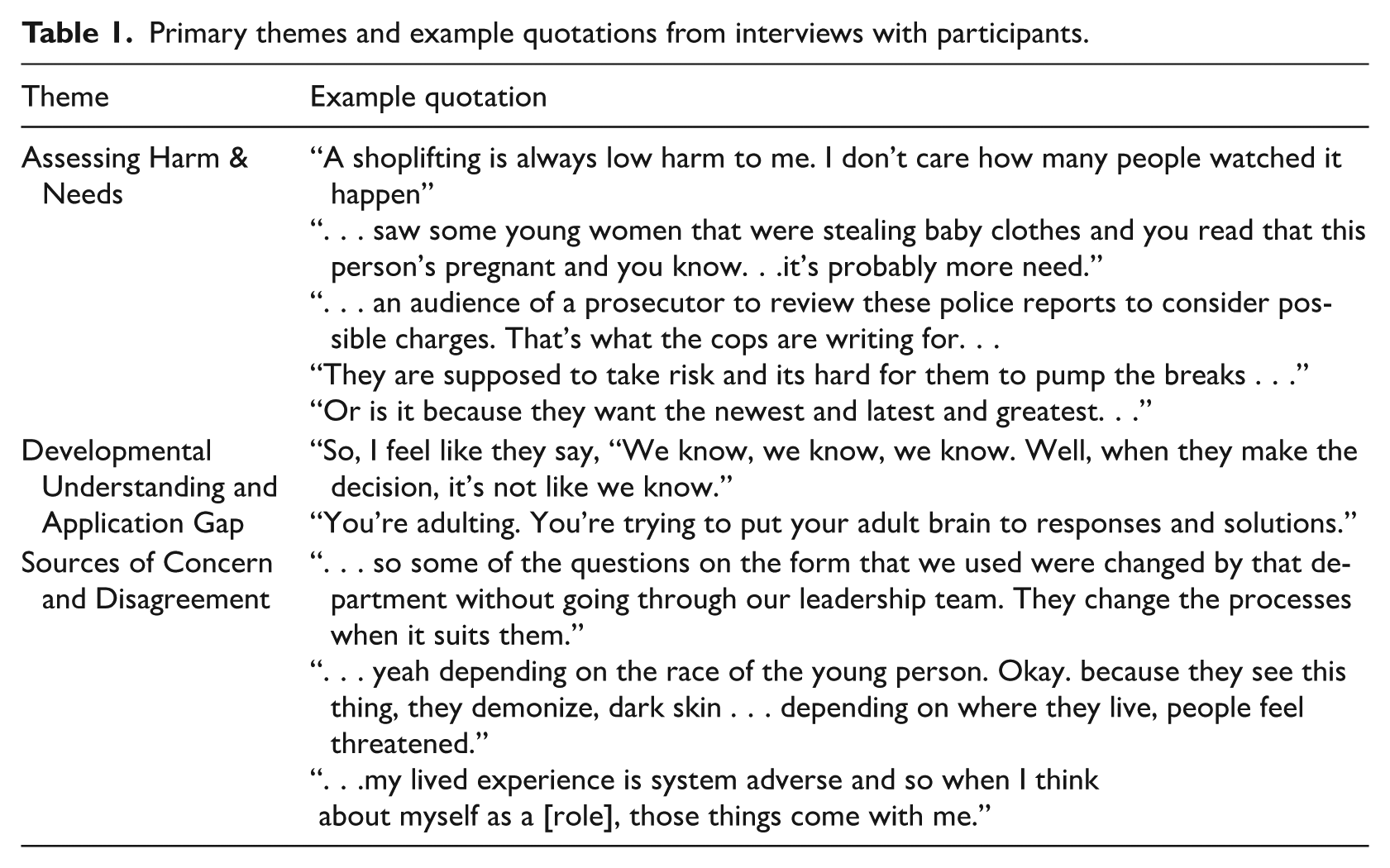
Our analysis was driven by three research questions: (1) How does adolescent development knowledge and training influence practice decisions? (2) What types or categories of need are recognized by CRT members when conceptualizing needs and harm? (3) What shapes agreement and disagreement in CRT case reviews? The analysis revealed three interconnected themes (Table 1) that highlight the complex dynamics of decision-making, conceptualizations of youth behavior, and system transformation efforts. These themes collectively offer insight into both the promising aspects and the challenges of implementing developmentally informed, community-based, restorative approaches to juvenile justice.
Primary themes and example quotations from interviews with participants.
Theme 1: Developmental understanding and application gap
CRT members are expected to incorporate assessments of harm and need when determining appropriate accountability pathways during collaborative decision-making circles, interpreting youth behavior through developmental and restorative justice frameworks. When asked to discuss how CRT members individually assessed harm in their youth cases, participants rarely emphasized the role of adolescent development. Instead, when conceptualizing harm, participants emphasized the importance of considering context, including examination of behaviors within their environmental circumstances. As one participant noted, “identical behaviors could result in vastly different harm levels depending on circumstances, impact, and context.” For instance, a car theft might have dramatically different consequences based on the victim’s socioeconomic status, insurance coverage, and personal situation. Other factors that influenced how participants conceptualized harm included physical versus nonphysical harm, risk versus actual outcomes, victim vulnerability, and whether the harm affected individuals or corporations and organizations. Many participants distinguished between organizational and individual victims, with harm to corporate entities often considered less severe regardless of monetary value. According to one professional, “A shoplifting is always low harm to me. I don’t care how many people watched it happen.”
CRT members’ reflection on how they assessed needs was more likely to elicit considerations about development, and the need to distinguish between typical adolescent behavior and indicators of potentially serious underlying issues. Mental health and chemical health concerns were frequently identified as key areas requiring focused attention, while basic survival needs—such as youth stealing necessities like food or winter clothing—were viewed as clear indicators of high needs requiring support. CRT members identified during interviews that it was a challenge to accurately assess needs with limited information. Participants noted that police reports and other formal documentation often provide limited information and fail to capture the underlying contexts and needs of youth and their families: . . . I think “need” is probably a little harder for us to distinguish if we don’t have a lot of information. I think usually the more information we have, the better we do . . . we are forced to speculate a lot . . .
Throughout the interviews, participants highlighted that the information in police reports focused mostly on harm and rarely uncovered broader contexts or possible drivers of behavior. Participants underscored that this created structural inequities between access to information and understanding the context of the pending case; practitioners may fill information gaps with assumptions based on their own experiences and biases.
When subsequently asked about how they incorporated an understanding of adolescent development into their assessment of needs and harms, interviewed CRT members consistently demonstrated a basic understanding of adolescent development, with particular emphasis on knowledge that brain development extends into the mid-twenties. This understanding served as a foundation for interpreting and contextualizing adolescent behavior, particularly regarding risk-taking, boundary testing, and impulsivity. As one participant noted, “You’re going to test things, you’re going to try things over and over again.” When assessing cases, professionals attempted to determine whether behaviors stemmed from typical developmental processes—“impulsivity, immaturity, bad judgment”—or whether they signal deeper issues requiring intervention. This distinction seemed to guide the intensity and pathway deemed appropriate. Yet practitioners struggled to apply this knowledge, highlighting a divide between theoretical knowledge and practical application in decision-making processes within the team. Participants frequently expressed frustration that while system actors claim to understand developmental science, “We know, we know, we know,” their actual decisions sometimes failed to reflect this understanding, “. . .until we have to make a decision, and then it’s like we don’t know.” Another practitioner highlighted, “You’re adulting. You’re trying to put your adult brain and responses and situations.”
Theme 2: Categories of need recognition—Physical, relational, and developmental domains
Despite a lack of details available for assessing needs, practitioners’ conceptualization of youth needs included three distinct but interconnected categories: physical, relational, and developmental. However, significant gaps emerged in practitioners’ ability to identify and articulate specific needs within each category, particularly developmental needs. Physical needs represented the most concrete and immediately recognizable category of need in the transcript excerpts. These excerpts focused primarily on basic survival requirements and material necessities that young people lack. The most prominent themes within physical need recognition include basic hygiene and cleanliness, as evidenced by multiple references to young people purchasing or needing soap, underwear, and other personal care items. Food security emerges as another critical physical need, with reference to young people stealing food when hungry. Clothing needs, particularly during inclement weather, represent another dimension of physical need that practitioners recognize as likely drivers of legitimate motivation for shoplifting behavior.
Relational needs focus on young people’s requirements for connection, boundaries, and supportive relationships with others. Sexual exploitation represented one of the most serious relational need deficits discussed in the interview excerpts. Practitioners described cases involving “young girls with older men” where the young people are “not in control of that,” recognizing that sexual exploitation often stems from unmet needs for connection, security, and resources. Family and peer relationship dynamics emerged as another critical area of relational need. References to situations where caregivers are “not giving them what they need” suggest that some young people’s behaviors stem from inadequate family relationships or support systems. However, needs for strong peer relationships and social belonging were less explicitly named even in cases of behaviors that happened among peers, such as group fights, suggesting a lower understanding of how the need for peer acceptance and social connection can influence behavior.
Developmental needs encompass the psychological and emotional requirements necessary for healthy adolescent growth and identity formation. While excerpts throughout interviews highlighted a recognition that impulse control and judgment development are emerging skills for adolescents, practitioners did not name these explicitly as developmental needs and did not identify any other type of developmental need. For example, participants did not mention needs related to identity formation and exploration, autonomy development and practicing decision-making, peer relationships and social belonging, future orientation and goal-setting skills, or emotional regulation development. These missed elements of adolescent development represent critical limitations in how practitioners operationalize developmental science, potentially leading to interventions that address symptoms (e.g. behavior) rather than attempts to meet underlying developmental needs.
Theme 3: Sources of agreement and disagreement
As CRT members explored how they assessed cases, several talked about harder cases, power imbalances, racial and social equity in decision-making, and how their own history or professional role impacted their decision-making or their perceptions of others’ decisions. The implementation gap between developmental understanding and application seemed to be more present when cases involved higher harm or harder issues, such as those related to sexual health. Participants reported feeling as though sexual and reproductive health topics were hard to talk about and that members of the CRT often put on their “adult brains” to interpret adolescent behavior in these cases, highlighting an incongruence between their training and application or an absence of adolescent sexual health training altogether. As one participant explained, . . . [the youth had hickeys] and she [the attorney] looked at me so appalled that someone would voluntarily choose the marking of the “beast” of like sexual abuse. And I thought to myself, “if this is your perspective of an unhealthy relationship and what hickeys mean, I don’t even know to start” . . . kids screw around.
This suggests that while practitioners may understand general principles of adolescent development, they may lack specific training in normative adolescent sexual development, leading to pathologizing of typical adolescent behaviors in this domain.
Specifically, interviews revealed the perception of persistent power imbalances between system representatives (county employees, attorneys) and community members within the collaborative framework, which may impact the team’s ability to function as intended and significantly shape agreement and disagreement in decision-making. Community representatives on the CRT described feeling that their expertise and perspectives were undervalued compared with those of legal professionals. As one participant explained, “The county doesn’t feel the need to neutralize the power. I feel like they want to use it.” Another observed, “I feel like they think that their training is more important than restorative training.” These power imbalances are created by differences in access to information where system representatives have access to background information, records, and resources that community members do not, and these disparities frequently were referenced during discussions about need. Participants with access might share the information they obtain in an effort to add context; however, as one community member noted, “They all have access to all this other information that I don’t know,” which contributes to feelings of inequity and may undermine the collaborative intent of the CRT model and create tension in decision-making processes.
Related to concerns about power was the presence of a perception that developmental understanding is applied unequally across youth based on race. Participants consistently noted that Black and other minoritized youth are denied the same allowances for developmental behavior that might be extended to white adolescents. As one participant directly stated, “Black children are looked at as more criminal, older . . . more of a threat than they actually are,” while another observed that Black youth “don’t get to” engage in the normal boundary testing behaviors that are part of adolescent development. This concern extended beyond just developmental frameworks to broader decision-making processes. Participants identified perceptions around patterns of bias in how families of color are perceived, with one noting that, “parents of color are not as responsible as white parents” in the eyes of some CRT members. These concerns seem to create significant tension in decision-making, especially when cases involve youth from different racial backgrounds who engage in similar behaviors but face potentially different system responses. This finding suggests that despite training in developmental science and restorative practices, implicit racial biases continues to influence how these frameworks are applied in practice and shapes both agreement and disagreement within the collaborative team.
Finally, a salient sub-pattern emerged in this theme that indicated professionals’ own history and identity may override knowledge about adolescent development in relationship to harder cases. Many participants described bringing their “whole selves” to their work and discussed how they integrated their personal identities, lived experiences, and professional functions in their work rather than compartmentalizing their professional roles from their personal backgrounds. Specifically, several described formative experiences that led them to their current work and continue to shape how they view youth and systems. Participants noted that these personal perspectives were outside of those formed by professional development and often seemed to be more influential in decision making: “. . . right . . . depending on where you were socialized, the [norms] are different. And then you interpret everything through that norm or that lens, right. . .” This finding suggests that understanding practitioners’ personal backgrounds and belief systems may be crucial for understanding how collaborative teams function and make decisions.
Discussion
This qualitative study explores the complex processes through which members of the CRT operationalize principles of adolescent development, harm, and need in their decision-making practices. Our findings reveal both promising advances and persistent challenges in implementing developmentally informed approaches within juvenile justice contexts. The results highlight four key dimensions that shape practitioner decision-making in regard to juvenile cases: developmental understanding, harm and needs assessment, professional identity integration, and power dynamics within the collaborative team. Each are briefly discussed in context with previous research below.
Developmental understanding: Knowledge without application
The developmental understanding demonstrated by participants reflects a significant shift from traditional juvenile justice approaches that often fail to account for adolescent development (Cavanagh, 2022a). Participants consistently articulated an understanding of adolescent brain development and its implications for behavior, particularly regarding impulsivity, risk-taking, and decision-making capacities. This aligns with Casey et al.’s (2022) emphasis on the importance of recognizing adolescents’ sensitivity to social rewards and their evolving capacity for future planning. However, our findings also reveal a concerning implementation gap between theoretical knowledge and practical application, resonant with Hannah-Moffat’s (2005) observation that system ideals often diverge from operational realities. While practitioners broadly endorsed developmental frameworks, they reported frustration that these principles were not consistently reflected in final decisions. This was particularly evident when cases involved behavior deemed sexual in nature. Several participants explicitly highlighted the challenges they faced when attempting to assess cases involving sexualized behavior, expressing uncertainty about how to distinguish between typical sexual development and problematic sexual behavior requiring intervention. This uncertainty may have led to more conservative decision-making, with prosecution becoming the default consequence in such cases. This default toward prosecution reflects the traditional legal system’s focus on punishment and retribution, potentially limiting opportunities for developmentally appropriate responses that could address underlying needs while supporting community safety.
The critical gap in developmental needs recognition
Significantly, our findings reveal that while practitioners understand general principles of adolescent development, they lack knowledge of specific developmental needs that require support during adolescence. This gap represents a limitation in how developmental science is operationalized within the CRT. Without recognizing specific developmental needs, practitioners may miss opportunities to prescribe interventions that support healthy adolescent development while addressing concerning behaviors. This finding aligns with previous research regarding implementation gaps between theoretical knowledge and training, and practical application (Cauffman et al., 2024; Hannah-Moffat, 2005; Skowyra and Cocozza, 2021).
Adolescence involves crucial developmental tasks including identity formation, autonomy development, and peer relationship navigation that are essential for healthy psychosocial development (Cavanagh, 2022a; National Research Council, 2013). Research consistently demonstrates that identity development and autonomy-seeking are core tasks of adolescence, with youth requiring opportunities to explore their emerging identities while maintaining connectedness with peers and supportive adults (Branje, 2021; Sherman et al., 2018). When practitioners fail to recognize these specific developmental needs, they may miss critical opportunities to design interventions that support healthy adolescent development rather than merely addressing behavioral coping symptoms. Effective juvenile justice interventions should help adolescents acquire not only educational and vocational skills but also social skills for intimate relationships, group cooperation, and autonomous decision-making (National Research Council, 2013). This finding suggests that training programs must move beyond general developmental science to include specific understanding of adolescent developmental tasks and how system responses can support rather than hinder these normative processes.
Practitioners also reported difficulty with cases involving sexual behavior, reflecting a broader gap in understanding normative adolescent sexual development, which research shows includes increased sexual interest and activity as part of typical sexual health and brain development processes (Cavanagh, 2022a; National Research Council, 2013). The complexity of addressing youth sexual behavior problems requires specialized training and multidisciplinary approaches that many practitioners lack, potentially leading to either over-criminalization of normative behavior or under-response to genuine concerns (OJJDP, 2016). This gap represents a critical area where the implementation of developmental science falls short, as practitioners may default to adult-centered interpretations of adolescent sexual behavior rather than applying developmentally informed frameworks that distinguish between typical adolescent sexual development and behaviors requiring intervention and support.
Harm and need assessment: Context matters, but information gaps exist
The assessment of harm and need emerged as particularly complex domains requiring nuanced judgment. Participants rejected simplistic categorizations, instead emphasizing contextual understanding that considers behaviors within their complete environmental circumstance and seemed to suggest significant interconnectedness between need and harm. This contextual approach aligns with Beckman et al.’s (2023) findings that successful youth accountability pathways must address broader systemic factors shaping youth choice and behavior. Particularly important was participants’ recognition that identical behaviors could result in vastly different levels or felt impacts of harm depending on circumstances and context, suggesting progress toward a more individual, context-inclusive decision-making.
The information gaps identified by practitioners create structural conditions that facilitate biased decision-making, as research demonstrates that subjective decision-making stages are where selection bias and racial disparities are most likely to occur (Bishop, 2005; Leiber and Jamieson, 1995). When practitioners lack adequate information, they are forced to rely on limited data and personal experience to fill gaps, which research shows can lead to inconsistent and potentially biased outcomes (Grisso et al., 2005; Skowyra and Cocozza, 2021). While system actors may access information beyond police reports to minimize speculation, this creates differential access to information that can reinforce power imbalances within collaborative teams. This speculation-based decision-making is particularly problematic because implicit bias operates below conscious awareness, affecting how practitioners interpret ambiguous information and potentially leading to disparate treatment of youth based on race and other characteristics (National Center for Juvenile and Family Court Judges, 2021; Wedding, 2016). When practitioners fill information gaps with assumptions based on their own experiences and biases, there is substantial risk that similar cases will be handled differently based on the particular practitioners involved rather than the specific circumstances and needs of the youth. The structural inequality in information access between system actors and community members further compounds these issues, creating conditions where well-intentioned collaborative models may inadvertently reproduce the very disparities they aim to address.
Professional and personal identity integration: Strengths and risks
Professional identity and role integration emerged as significant factors in how practitioners approached their work within the CRT, representing both a strength and a potential risk. Rather than compartmentalizing their professional responsibilities from personal backgrounds, many participants described bringing their “whole selves” to their work, with personal experiences often informing and enriching their professional perspectives. This integration enabled participants to move beyond traditional adversarial positions to embrace more solution-focused approaches, supporting Christenson’s (2021) argument that diverse professional perspectives can enrich collaborative juvenile justice practices when effectively integrated.
However, the finding that practitioners’ personal experiences significantly influence their decision-making aligns with research showing that practitioner attitudes and stereotypes can lead to differential treatment, particularly affecting youth of color who face documented bias in juvenile justice processing (Leiber, 1994; The Sentencing Project, 2023). While bringing personal experience to professional practice can enhance cultural responsiveness, it also creates risks when these experiences are not explicitly examined and integrated with evidence-based practice principles (OJJDP, 2021). Research demonstrates that when decision-makers operate without structured protocols, individual biases and attitudes are more likely to influence outcomes, potentially creating systematic disadvantages for certain youth populations (Bishop, 2005). This suggests that professional development efforts should not only provide technical training in developmental science but also create structured opportunities for practitioners to examine how their personal experiences and belief systems interact with their professional responsibilities, particularly in collaborative models where diverse perspectives must be genuinely integrated rather than simply represented.
Power imbalances: Barriers to collaboration
Our findings also reveal perceptions of persistent power imbalances that undermine the collaborative intent of the CRT model and shape agreement and disagreement in decision-making. For example, members frequently described feeling that their expertise was undervalued compared with legal professionals, reflecting broader patterns of professional hierarchy within legal systems. This power differential was then exacerbated by disparities in information access, with system actors having privileged access to background information and records unavailable to other members of the team. Along with disparate access concerns, the team makeup itself might contribute to implicit power imbalances, with the majority of system actors identifying as white and both community partners as Black women. These findings align with Haight et al.’s (2014) observations regarding the challenges of integrating diverse stakeholder perspectives in juvenile justice contexts and highlight the need for intentional strategies to name and balance power differences in collaborative decision-making spaces. Addressing these perceptions will require intentional power-sharing mechanisms that go beyond individual training and center structural changes.
Integration of restorative justice principles
The integration of restorative justice principles within the CRT model appears to have created space for more humanizing approaches to youth accountability, as evidenced by participants’ emphases on understanding the full context surrounding youth behavior and their reluctance to engage in simple binary assessments of harm. This aligns with promising quantitative Year I outcomes documented by Beckman et al. (2023), particularly regarding successful CA processes and increased family engagement. However, our qualitative findings suggest that full implementation of restorative approaches remains constrained by institutional structures and power dynamics that continue to privilege traditional legal perspectives over community wisdom. True restorative justice requires authentic participation by all stakeholders, including meaningful input from community members and, ideally, from youth and family themselves. The current structure appears to limit this authentic participation.
Limitations
Several limitations must be acknowledged when interpreting these findings. The small sample size, while appropriate for qualitative exploration, limits the generalizability of the results. In addition, participant self-reports may reflect aspirational behavior rather than actual practices, underscoring the benefit of observational studies that directly examine decision-making processes within the CRT (Balcom et al., 2021). Despite these limitations, this study offers valuable insights into how juvenile justice practitioners navigate the complexities of implementing restorative and developmentally informed approaches within traditional system structures.
Implications for practice and policy
These findings have implications for both practice and policy. For practitioners, they highlight the need for structured processes such as standardized information-sharing protocols, developmental needs assessment tools, and regular debriefings to identify speculation-based decision-making. For policymakers, they underscore the importance of addressing structural power imbalances through mechanisms such as compensation parity, rotating community leadership roles, and formal processes that prevent community perspectives from being dismissed without justification.
Conclusion
In conclusion, this small exploratory study revealed both the promise and the persistent challenges of implementing developmentally informed collaborative approaches within juvenile justice contexts. While practitioners demonstrate an understanding of adolescent development and restorative principles, their ability to fully operationalize these concepts remains constrained by critical limitations. Addressing these constraints will be important to realize the full potential of models like the CRT to transform juvenile justice practices in ways that support healthy adolescent development while addressing the underlying causes of coping and behavior.
International parallels and global implications
While this study is situated within the US juvenile justice context, the challenges and opportunities identified resonate with collaborative, developmentally informed models operating in jurisdictions across the globe. The CRT model shares structural and philosophical parallels with several established international approaches to youth justice as described briefly below.
In England and Wales, multi-agency Youth Offending Teams (YOTs), established under the 1998 Crime and Disorder Act, bring together representatives from probation, education, health, children’s services, and police to address offending by children aged 10–17 (Gray, 2016; Smith and Gray, 2019). Like the CRT, YOTs are tasked with integrating diverse professional perspectives into collaborative decision-making. Research on YOTs has identified similar tensions to those found in the present study, including challenges in meeting children’s welfare needs within a framework oriented toward risk reduction (Gray, 2016), power imbalances among multi-agency partners (Day, 2023), and implementation gaps between policy aspirations and practice realities (Smith and Gray, 2019). Similarly, the Youth Justice Board’s recent adoption of a “Child First” approach, in England and Wales, emphasizing that children should be treated as children, supported to develop pro-social identities, and diverted from stigma that criminal system involvement can create (YJB, 2024), aligns closely with the developmental principles underpinning the CRT model and highlights a shared international trajectory toward developmentally informed practice.
Scotland’s Children’s Hearings System offers an even more distinctive parallel. Grounded in the Kilbrandon principles of the 1960s, this system integrates care and justice for children, prioritizing the child’s best interests as the paramount consideration (Scottish Government, 2021). Scotland’s Whole System Approach (WSA), implemented since 2011, utilizes multi-agency partnerships to divert youth from criminal justice processing, an approach that has contributed to a 75% reduction in children referred on offense grounds, an 85% reduction in youth prosecutions, and a 93% reduction in custody for 16- and 17-year-olds (Scottish Government, 2021). Research on the WSA has revealed that information-sharing across agencies was a key mechanism for moving beyond siloed decision-making (Centre for Justice Innovation, 2022), echoing the present study’s findings about the consequences of disparate information access within the CRT.
New Zealand’s Family Group Conference (FGC) model, established under the Children, Young Persons, and Their Families Act 1989, represents perhaps the most widely referenced international example of collaborative, family centered youth justice (Maxwell and Morris, 2006). FGCs bring together young people, families, victims, police, and other professionals to make consensus-based decisions, explicitly drawing on Māori cultural traditions of collective decision-making. While the FGC has been celebrated internationally, critical scholarship has identified similar implementation challenges to those found in this study, including questions about whether power imbalances between professionals and families genuinely allow for equitable participation, and concerns about racial disparities in outcomes for Māori youth within the system (Cleland and Quince, 2025).
These international comparisons suggest that the core challenges identified in this study—the gap between developmental knowledge and application, information asymmetries, power imbalances among stakeholders, and the influence of practitioner identity on decision-making—are not unique to the US context but represent recurring features of collaborative youth justice models globally. This suggests that solutions must extend beyond individual training programs to address the structural and relational dynamics inherent in multi-agency decision-making.
Implications for implementation across jurisdictions
As jurisdictions in the United States and across the globe increasingly adopt collaborative decision-making models, several key implementation considerations emerge from this study. First, training programs should move beyond general developmental science education to include specific recognition of adolescent developmental needs and how to address them through system responses. This recommendation aligns with international shifts toward “child first” approaches that center developmental needs rather than risk factors (Day, 2023; YJB, 2024). Second, jurisdictions should establish structured processes to minimize information disparities among team members and reduce reliance on speculation when assessing youth needs, a challenge documented in both US and international contexts (Centre for Justice Innovation, 2022; Gray, 2016). Third, collaborative models require intentional power-sharing mechanisms that genuinely value community perspectives alongside legal expertise. International evidence suggests that models prioritizing community and family voice, such as New Zealand’s FGC and Scotland’s Children’s Hearings, can achieve meaningful participation, but only when structural supports are in place to counterbalance professional hierarchies (Maxwell and Morris, 2006; Scottish Government, 2021). Fourth, professional development should explicitly address how practitioners’ personal experiences and belief systems influence decision-making, creating space for reflection and discussion about these dynamics. Finally, the absence of direct youth and family voice in the CRT process represents a notable gap when viewed against international standards; the United Nations Convention on the Rights of the Child (UNCRC) emphasizes children’s right to participate meaningfully in matters affecting them (Article 12), and international models increasingly center youth participation as foundational (UN Committee on the Rights of the Child, 2019). Our findings suggest that bridging this gap requires not just better training or good intentions, but systematic attention to the structural, relational, and organizational factors that shape how knowledge is applied in real-world settings. As youth justice systems worldwide continue to evolve toward more humane and effective approaches, understanding and addressing these implementation dynamics will be essential for realizing the potential of developmentally informed, collaborative practices.
Footnotes
Acknowledgements
We extend our deepest gratitude to the members of the Collaborative Review Team who generously shared their time, experiences, and insights for this research. Their commitment to transforming juvenile justice practices and willingness to engage in reflective dialogue about their work made this study possible. We thank the Attorney’s Office and the initiative leadership that we partnered with for their support and collaboration throughout this research process. We also acknowledge the young people and families whose experiences with the juvenile justice system continue to drive efforts toward more just and developmentally informed approaches. Finally, we are grateful to the Leadership Education in Adolescent Health Fellowship, at the University of Minnesota’s Department of Pediatrics for funding and institutional support.

Ethical considerations
This study was reviewed by the University of Minnesota’s Institutional Review Board and determined not to constitute human subjects research as the inquiry focused specifically on professional practices and decision-making contexts rather than personal information about individuals. All participants were interviewed in their professional capacity regarding their work experiences and practices.
Consent to participate
All participants provided informed verbal consent to participate in this study after being provided with information about the research purpose, procedures, and their rights as participants. Participants were informed that their participation was voluntary and that they could withdraw at any time without penalty.
Consent for publication
All participants provided informed consent for publication of their anonymized responses. Participants were informed that their responses would likely be used in academic publications and that identifying information would be removed to protect confidentiality.
Author contributions
K.R. led the conception and design of the study, conducted all interviews, performed data analysis, and led manuscript writing and revision. B.M. provided supervision throughout the research process, contributed to study design and methodology, participated in data interpretation, and provided critical review and editing of the manuscript. K.B. contributed heavily to study conceptualization, performed data analysis and supported with data interpretation, provided expertise on the RJY initiative context, and participated in critical review and revision of the manuscript. All authors read and approved the final manuscript.
Funding
The authors disclosed receipt of the following financial support for the research, authorship, and/or publication of this article: Kayla Richards and Barbara McMorris’ time for this research was supported by funding from the Health Resources and Services Administration (HRSA) of the U.S. Department of Health and Human Services (HHS)(T71MC00006-40-00; Sieving, PI). The content and conclusions are those of the authors and should not be construed as the official position or policy of, nor should any endorsements be inferred by HRSA, HHS, or the U.S. Government.
Declaration of conflicting interests
The authors declared no potential conflicts of interest with respect to the research, authorship, and/or publication of this article.
Data availability statement
The qualitative interview data supporting the findings of this study are not publicly available due to confidentiality agreements with participants and the potential for identification given the small sample size and specific professional context. The interview protocol and data analysis framework are available from the corresponding author upon reasonable request. Participants did not consent to public sharing of raw interview transcripts, consistent with standard practices for qualitative research involving professional interviews in small, identifiable communities.