






Abstract
There is relatively little research exploring culturally focused approaches in programs that support Native survivors of violence. This paper explores the use of culturally honoring services (CHS) among tribal advocacy programs that support Native and non-Native survivors of intimate partner violence and sexual violence as well as related crimes. With support from a statewide tribal domestic violence and sexual assault coalition, we conducted semi-structured interviews with 19 individuals working in 10 federally recognized tribes in Michigan. Drawing on data, we define CHS as a culturally grounded, trauma-informed approach; describe how these approaches are utilized by Native and non-Native practitioners; and examine resources and challenges for doing so. Four themes related to the use of CHS were identified: (a) following survivors’ leads with openness, flexibility, and respect; (b) historical and contemporary disconnection; (c) financing systems and the influence of granting mechanisms; and (d) the importance of support networks. We conclude with recommendations for victim advocacy programs and for researchers that hope to collaborate with Native communities in delivering victim advocacy services.
Keywords
Introduction
Research has demonstrated that intimate partner violence (IPV) 1 is a serious public health issue for Native 2 communities. In one national survey, 55.5% of American Indian and Alaska Native women had experienced IPV, 56.1% experienced sexual violence, and 66.4% had experienced psychological aggression in their intimate relationships (Rosay 2016). In that same survey, 43.2% of Native men reported experiencing physical violence by an intimate partner. Research suggests culturally focused services are needed to meaningfully address IPV in Native communities, as help-seekers may experience a lack of cultural understanding from providers that discourages them from utilizing services (Gameon and Skewes 2020; Luebke et al., 2023; Panofsky et al., 2021).
American Indian and Alaska Native (AI/AN) people have unique cultural experiences that may not be compatible with interventions or approaches that implicitly center Eurocentric cultural norms and values (Panofsky et al., 2021; Walker and Bigelow 2015). Programs lacking cultural relevance may have issues with engagement, retention, and efficacy in supporting Native communities (Allice et al., 2022; Gameon and Skewes 2020; Panofsky et al., 2021). In a sample of Native IPV survivors, Luebke et al. (2023) found that some women felt social service providers lacked cultural awareness of how they experienced family and community. These experiences, or fear of such experiences, discouraged them from seeking help for IPV (Luebke et al., 2023). There is evidence of the promise and need for culturally focused IPV services for Native communities. However, there is limited research on facilitators and challenges to integrating culturally focused programming within victim services. This paper responds to this special issue’s call for research that explores healing and repair from IPV, particularly for marginalized communities. The present study explores how tribal advocacy programs working with survivors of violence are conceptualizing culturally honoring services, including facilitators and challenges to providing these services.
Culturally focused services among native communities
Multiple terms are used to describe a range of programming that integrates culture as a key feature in program or intervention development and service delivery. We use the term culturally focused because it includes general approaches to considering culture in service delivery, and describes both culturally adapted and culturally grounded programs (Gondolf and Williams 2001; Okamoto et al., 2014). Studies exploring culturally focused approaches usually describe discrete programmatic interventions that have either: (1) culturally adapted evidence-based practices (EBPs), or (2) developed interventions grounded in discrete cultural beliefs and practices. Cultural adaptation amends existing evidence-based interventions to incorporate features to make them more approachable or relevant for specific cultural groups (Okamoto et al., 2014). Culturally grounded interventions are developed starting with the norms, values, and worldviews of a specific culture (Okamoto et al., 2014).
Settler colonial policies targeted the disruption and erasure of Native cultural practices. These policies included forced displacement from traditional lands and those that sought to suppress Native language, sever family ties, and outlaw spiritual ceremonies (Echo-Hawk 2018). Boarding schools and other policies that sought to dispossess Native people of their family structures, lands, language, and cultural practices continue to impact the health and wellbeing of Native peoples (Evans-Campbell et al., 2012). This collective harm has been termed historical trauma, the “…cumulative emotional and psychological wounding across generations, including the lifespan, which emanates from massive group trauma” (Brave Heart et al., 2011). Research on culturally focused services has found improvements across a range of outcomes for Native study participants including reduced substance abuse, decreased symptoms of trauma, and increased positive coping skills (Gameon and Skewes 2020; Venner et al., 2016). Culturally focused interventions typically emphasize strengths and prioritize partnerships between researchers and communities to ensure alignment with the cultural context of specific tribes (Gameon and Skewes 2020; Walters et al., 2020). For example, Skewes et al. (2019, 2024) describe a multi-year partnership with a reservation-based tribal community to adapt a generalist substance use intervention to reflect cultural practices which included Native language lessons and other activities to foster cultural reconnection and pride. Other culturally focused interventions include reconnection to traditional land-based teaching; education on how clan structures can guide morals and behavior; and interventions that build intergenerational relationships between tribal role-models and youth (Walters et al., 2020).
Culturally focused approaches and IPV services
There are relatively few studies exploring the application of culturally focused approaches in IPV services for Native survivors. However, those that do exist provide helpful insights into the importance of investigating this issue further. Varcoe et al. (2017) examined the acceptability of a culturally adapted intervention, and the extent to which educators’ roles (nurses vs Elder or both) impacted participant engagement. They identified a need for greater education for facilitators on trauma-informed care and engaged nurses who had a greater understanding of Native women’s experiences. Holder (2025) interviewed Native violence advocates serving Native survivors of IPV to identify successful service strategies. They found that advocates working with Native survivors of violence utilized shared cultural experiences to connect with clients and combined Native cultural teachings with practices that were not explicitly Native to facilitate engagement and relationship building (Holder 2025). These studies provide insight into the important role practitioners play in providing culturally focused IPV services for Native communities. However, there remains limited research that explores practitioners’ perspectives on how they successfully implement these services and the challenges they may encounter in doing so.
Current study
This study explores the use of culturally honoring services (CHS) in tribal advocacy programs. CHS is a term used and shared by Uniting Three Fires Against Violence (UTFAV), a statewide tribal domestic violence and sexual assault organization that seeks to support tribes through capacity building and resource sharing initiatives. CHS has also been broadly adopted by the tribal advocacy programs included in our study. This research is guided by the question: What are the facilitators and barriers tribal advocacy programs experience in providing culturally honoring services in their work?
Methods
This study used a community-engaged research approach, which seeks to involve community representatives in prioritizing research topics of importance (Israel et al., 2008). The principal investigator (second author) began consulting with UTFAV in 2019 to determine research questions of interest to their organization and the tribal programs they serve. After pausing during the COVID-19 pandemic, the co-authors re-engaged UTFAV in 2022. UTFAV expressed interest in describing how tribal advocacy programs were integrating CHS into their work. The co-authors drafted research questions and proposed a study based on these initial conversations before presenting at a quarterly tribal advocate gathering hosted by UTFAV to gather feedback on the questions and study design. Individuals in attendance approved of the proposed questions and expressed support for the project. UTFAV met with and advised the co-authors throughout the course of the study, facilitating connections with program staff, supporting recruitment, reviewing findings, and hosting a meeting to report back to tribal advocates. 3 All research was reviewed and approved by a university Institutional Review Board.
Research team
The research team consists of the co-authors of this manuscript who were responsible for all data collection and analysis. The first author is a Latina woman who identifies as a non-tribally affiliated Indigenous person. She conducted most of the interviews and led analysis and authorship of this manuscript. The second author, a citizen of the Choctaw Nation of Oklahoma, was the principal investigator of the study. She conducted some interviews and subsequently supported analyses and community engagement. Analysis was shaped by the researchers’ training as social workers, giving them insight into service delivery and other direct practice aspects described by participants. For example, the second author has experience working as an advocate in IPV and sexual assault services. Their tribal and Indigenous identities shaped interpretations of data on cultural strengths as well as cultural disruption. Finally, the researchers’ identities as academic social work scholars explicitly shaped their understanding and framing of CHS. For example, their definition of CHS incorporates principles from social work such as Cultural Safety even though participants did not use that specific term when describing CHS. Thus, we use data to ground CHS as a framework rooted in participant descriptions and experiences while also situating it within relevant social work concepts.
Sample
This qualitative study used a purposive sampling strategy. Researchers sought to recruit two to three individuals working with advocacy programs from each of the 12 federally recognized tribes in the state of Michigan. The final study sample included 19 individuals working in 10 tribes. In three of those tribes, we were able to recruit only one participant and for another tribe we interviewed five participants. Twelve participants were Native and nine of them worked for their own tribe.
The term advocate typically refers specifically to tribal victims’ advocates, but the term was also used by staff with different job titles and roles. Therefore, anyone working directly with victims in tribal victim advocacy programs were eligible to participate. UTFAV provided contact information for potential participants and the researchers reached out with information on the study. The researchers also worked with UTFAV to identify individuals working with tribal advocacy programs who had a particularly high level of insight into the research questions. These individuals received targeted outreach emails. In some instances, program staff suggested additional contacts or forwarded recruitment materials to colleagues.
Study participants served in a variety of roles including as social workers, case managers, cultural specialists, and advocates. Most participants reported primarily serving survivors of IPV or sexual violence and related crimes (e.g., human trafficking and stalking), with some describing their service population more broadly (e.g., ‘victims of crime’). Thus, most provided services tied directly to interpersonal violence including safety planning, crisis intervention, and personal advocacy and support, as well as financial assistance and emergency shelter placement. All programs served Native and non-Native survivors through victim services and other capacities (e.g., cultural education for a non-Native IPV survivor parenting Native children). Study participants reported a range of years serving their organizations, from one to more than 20 years. Given the small, regionally focused sample and to maintain confidentiality, details on individual participants are not provided.
Data collection
Interviews were conducted over Zoom, a video conferencing platform, to accommodate flexibility in scheduling across the state. Verbal informed consent was documented, and participants were offered a $45 gift card for completing the interview and a short survey. The survey asked about practice experience and services their programs provided. Interview questions asked about job roles and responsibilities, how CHS was integrated into that work, and perceived barriers and facilitators to that integration. Interviews lasted between 20 minutes and 1 hour.
Analysis
Interviews were transcribed, cleaned, and de-identified before coding. Coding included deductive codes based on study questions and the interview guide and inductive codes developed from the data. The researchers reviewed and coded transcripts independently, making memos of interpretations, questions, or notable patterns that could warrant additional codes or other revisions to the codebook. They met regularly to discuss analytic decision making several times, and the development of the codebook was an iterative process. Coding was completed using Dedoose, an application for qualitative analysis. A reflexive thematic analysis approach (Braun and Clarke 2021) was used to develop themes. This approach emphasizes the researchers’ engagement with the situated and subjective nature of qualitative data analysis (Braun and Clarke 2021). The researchers discussed data interpretations with UTFAV leadership and tribal advocates, including several study participants, for feedback on the definition of CHS and thematic findings. UTFAV leadership, advocates, and other program staff affirmed interpretations with no revisions.
Results
Results suggest that factors across individual, interpersonal, and community and systems levels contribute to practitioners’ utilization of CHS with Native survivors of violence. Four themes related to the use of CHS were identified: (a) following the client’s lead with openness, flexibility, and respect; (b) the role of historical loss and contemporary disconnection; (c) financing systems and the influence of granting mechanisms; and (d) the importance of support networks.
Following the client’s lead: Openness, flexibility, and respect
Study participants approached services with a sensitivity to clients’ diverse familiarity and comfort with cultural practices and knowledge. In some cases, this included lack of knowledge or cultural disconnection. Study participants were sensitive to varied relationships clients had related to cultural knowledge and did not assume that engagement with cultural practices would always be assumed in their interactions with clients: … a lot of our clients, even though they're from the community, they're not much into the culture, but yet they want to be. They just don't know how to get started. So we try to work with them at whatever level they're at, bring in whatever services and whatever programs that they would like to see that would be healing to them. – Barbara, Native Staff Member
4
Study participants practiced with the knowledge that Native people are not monolithic and may have varying preferences for cultural practices throughout this process. They took an open-minded approach and prioritized clients’ preferences: …there are young people that are starting to do cultural practices that were lost for many years. And then you have folks that still have ties to the church, and so you have to be respectful of what their belief system is, just like anywhere. And that's how they guide us. – Trixie, Non-Native Advocate
In addition to being responsive to personal experiences and preferences, this approach also affirmed clients’ agency. Some study participants saw similarities between the denial of control often present in violent relationships and denial of clients’ choices about cultural engagement: … part of that victimization process is feeling like you have a lack of control over what you're doing. You can't do or say the things that you really want to do. And I think just allowing people the space to make the choice. What does my own meaningful engagement of the culture look like…what do I want it to look like? – Sheila, Native Advocate
This reflection offers insight into the trauma-informed facet of CHS. Practitioners are aware they are often working with survivors coming from situations of extreme control. As a result, participants we spoke with emphasized a commitment to a service framework where survivors had opportunities to assert their autonomy in all facets of care, including cultural engagement.
Historical loss and contemporary disconnection
In some cases, historical loss influenced how study participants and their clients related to cultural knowledge and practices. When asked about barriers to integrating CHS, many participants reflected on a lack of knowledge and familiarity with cultural practices among clients. As one described, “…people who have a lot of historical trauma or are coming back to the community for the first time and they’re thirsty for that cultural knowledge, but they don’t necessarily know how to access it” (Sheila, Native Advocate).
Study participants also described disconnection due to boarding schools or other historical trauma, “…because of historical trauma, not all of us fit the proper mold. Not all of us have all of our cultural teachings. Not all of us know our family or know our history” (Sheila, Native Advocate). This lack of knowledge could lead to uncertainty or discomfort among survivors: I think at first, it’s a little bit scary. Like, “Oh, my God. I don’t know anything about that. I don’t want to sound stupid.” I had this one lady [say], “I don’t know if I should do that. I don’t know anything about my own culture.” … we’re very understanding of the fact that not everybody has grown up in a cultural way, and maybe you choose not to. That’s totally fine.” – Barbara, Native Staff Member
Several Native staff members who were raised with their traditional teachings recognized that not all Native people have access to those experiences. One Native advocate shared, “I’m very blessed and fortunate that I do know… I do have a very strong sense of who I am and who I come from and what my teachings are. But I know that not everybody has that” (Sheila, Native Advocate). In cases like these, staff were able to draw upon their personal experience to provide support and education (e.g., teaching clients about medicines or how to smudge). In other instances, staff less familiar with cultural practices relied upon colleagues, learning as they went. As this advocate, who was in the process of learning more about their culture shared: …I definitely lean on my coworkers who are more traditional and know more about the language or like I mentioned before, the survivor kits [that include traditional plant medicines]. I had a client ask me, “What are all of these medicines and stuff for?” And I told her, “Honestly, I'm not sure. I don't know.” – Linda, Native Advocate
This participant later shared, “My coworker made those little signs for me [referencing explanatory notes] so that I could help the clients understand better, and so that I could learn too.” This reflection demonstrates uncertainty about cultural knowledge, but also how these services could prompt cultural education and reconnection for both advocate and client. Both Native and non-Native individuals working in these programs expressed a high level of investment in learning about and providing CHS to survivors.
Grants facilitate and constrain culturally honoring services
Funding for CHS was a complex issue. Grants were credited for allowing programs to integrate cultural practices in a variety of ways, including culturally focused programs and staff positions. For example, some tribes were able to hire cultural specialists who provided educational support for survivors of violence, staff and the surrounding community. These positions were especially important in developing individualized approaches to cultural connection for survivors, “...bringing on the cultural specialists, we were able to do programs that were just geared towards clients. So we’ve done shawl making. We’ve done beadwork. We’ve done a lot of medicine walks… have them access resources safely” (Sheila, Native Advocate).
Granting terms also presented challenges, which often precluded culturally normative practices such as gifting: …when we approach somebody and ask them to do a cultural teaching. We like to offer them tobacco, and then when they come do it for us we like to give them a gift thanking them for their time. And it's kind of hard because money is what grants will let you gift as a stipend, but money isn't what an Elder wants when you go to give them something.
– Christina, Native Advocate
Using grant funding to pay for food was another commonly cited challenge, “I know in a couple of grants we tried to put food, and that’s like a big no-no in any [funder] grant…but food also in our culture is so important. Feasting is so important” (Layla, Native Advocate). There is generally a misalignment between funding requirements and cultural practices, “Grant funders do not understand the notion of gifting and its importance within our communities… And tribal people like to get gifts. I mean, we’ll try to gift something to the feds, “Oh, I can’t accept that.” Do you know how insulting that is to a Native American person?” (Katrina, Native Advocate).
The importance of support networks
Working within a tribal context offered opportunities for practitioners working with Native survivors of violence to connect with multiple departmental and community resources, and vital peer networks. For example, some cultural centers or language departments supplement victims’ services education efforts, “We can reach out to our history and culture departments and plug into whatever existing events they have going on because not everybody has the same set of skills and the same set of teachings and knowledge” (Sheila, Native Advocate). Study participants also relied upon other resources in the community, including tribal elders: ...my approach is not being afraid to reach out to our elders or our boarding school survivors who have gone through so much, that have all this knowledge that has been locked away... [before] I would just only look for the information in text. I now reach out to my community... – Tanya, Native Cultural Educator
Supportive peer networks of advocates within tribes and across the state were frequently described. Intertribal networks, some facilitated by UTFAV, supported relationship building with other tribes and provided capacity building support for securing grants: ...[UTFAV] has the advocate meetings...so being able to ask those questions of other advocates like, “Hey, how have you done this in the past?” Or, “I'm kind of stuck on this issue. How have you all done this?” Or, “Do you have any input or advice?” Having that sense of, again, community and knowing that we're not alone in doing this work. There's other tribal programs out there that I'm sure are experiencing some challenges and barriers, and we can all learn from each other. – Layla, Native Advocate
This quote exemplifies reflections we heard across interviews that having a centralized resource that programs could go to with questions about grant requirements, funding challenges, or general support was incredibly helpful to their success in practicing CHS. While participants in our sample were located across the state, often in rural areas, they communicated utilizing resources internal to their tribal communities, as well as robust peer-networks. These elements supported their ability to integrate CHS and respond to funding limitations.
Discussion
…connecting with your culture, your spirituality… even just knowing your background… that can make you stronger too and have a stronger sense of wellbeing and your identity. Because a lot of that is lost being a victim, a survivor. Domestic violence too, you lose who you are. And so finding that again I think is so important for that healing. – Layla, Native Advocate
This study sought to address a gap in research by exploring factors that support and hinder CHS. Results reveal two overarching sets of facilitators and challenges. The first is related to approaches to integrating CHS by individuals working in tribal advocacy programs. The second captures programmatic elements that are essential to understanding how programs can support CHS and challenges they face integrating these practices in grant-funded projects. We provide a definition of CHS in relation to these results, and explore several potential implications for practice and research.
Defining culturally honoring services
We began interviews without a set definition of CHS and developed one based on how participants conceptualized and used cultural teachings and practices in service settings. Staff sometimes noted using EBPs adapted or grounded in Native culture as part of how they were integrating CHS. More often they described CHS as an overarching approach in their work. Integrating CHS included incorporating cultural practices into services for survivors (e.g., sweat lodges or medicine kits), but also included a broad, flexible approach that included prioritizing client preferences for service engagement and education related to cultural practices. We did not identify significant differences in language or framing around CHS between Native and non-Native practitioners. A concise definition of CHS is that it is service delivery that recognizes and accounts for historical and contemporary trauma by: (1) integrating cultural practices that survivors find supportive and grounding, (2) promoting respect for clients’ cultural practices and how they choose to integrate them into healing, and (3) taking a flexible and relational approach to collaborating with survivors.
Intersections with existing concepts
CHS intersects with other practice concepts, specifically cultural safety and trauma-informed care (see Figure 1). Researchers have advocated for culturally grounded trauma-informed approaches in domains of social services for Native groups such as child welfare and substance abuse (Froyd et al., 2021; Rides At the Door and Trautman, 2019). It could be helpful for both tribal and non-Tribal organizations to consider how they are, or could be, practicing in culturally focused trauma-informed ways with Native survivors of violence, and what facets of CHS might present opportunities for application in their own organizations. CHS’ conceptual intersections.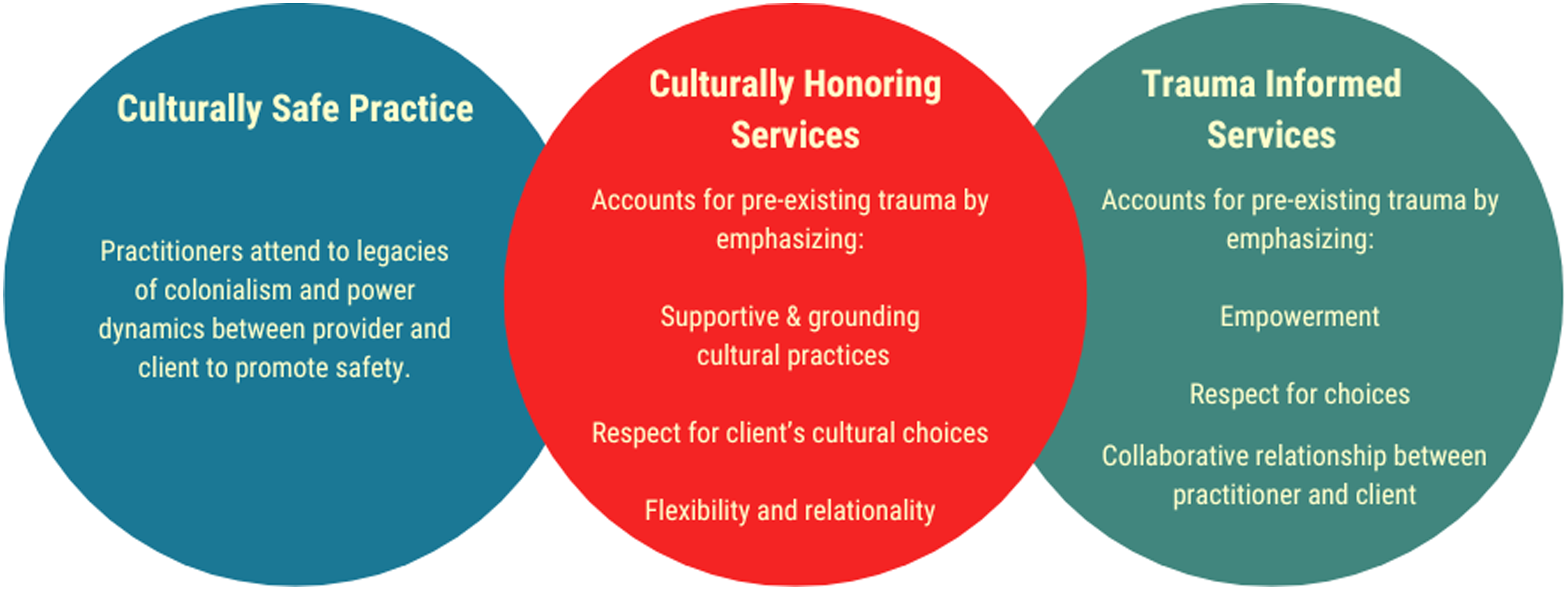
Cultural Safety, first conceptualized by Dr Irihapeti Ramsden, a Māori nurse and scholar, calls for practitioners 5 to reflect on the power dynamics inherent in the provider-client relationship. Cultural Safety requires practitioners to consider how their own cultural conditioning, especially the influences of colonialism, shapes the clinical encounter, and to take steps to reduce bias or prejudice those preconditions have on the experience of the client (Ramsden 2002). Cultural Safety is concerned less with how the provider views the interaction or their level of knowledge about their client’s customs and is more concerned with whether the client views the interaction as safe or non-threatening to their culture (Curtis et al., 2019). Where CHS is practiced by non-Native practitioners, it appears to align with the spirit of Cultural Safety. These practitioners are attending to the power imbalance inherent in the client-provider relationship and seek to establish trust and show their respect for their clients’ culture, particularly the ways in which colonial legacies have impacted Native communities. Where it is utilized by Native practitioners, CHS may present a broader concept than Cultural Safety because it is used by those who are culturally similar to their clients. Ramsden (2002) acknowledged cultural variation among Māori and asserted that it should not be assumed that Māori nurses practice in a culturally safe manner. Komene et al.’s (2025) study of how Māori nurses approach patient safety found that their practice heavily utilized elements of a Culturally Safe approach, including the integration of cultural practices and traditional knowledge. This aligns with how some of our Native participants worked with CHS, but does not fully speak to the experiences of Native practitioners who were less familiar with cultural practices. Our data suggests that CHS is a bridging concept that practitioners from a variety of positionalities could utilize.
Our definition of CHS also reflects practitioners’ trauma-informed approaches. Trauma-informed approaches vary, but are typically characterized by principles prioritizing empowerment, choice/agency, respect, and collaboration, accounting for potential pre-existing trauma in an individual’s lifespan (Elliott et al., 2005; Harris and Fallot 2001). Findings highlight how practitioners’ use of CHS incorporates an acknowledgement and understanding of how trauma shapes the lives of their clients and at times their connections to culture. Practitioners in our sample center CHS as an approach that can empower clients in services and promote healing. CHS expands upon a trauma-informed approach because it synthetically incorporates a cultural lens.
Implications for practice
A trauma-informed approach to culturally honoring services
Findings from this study suggest that historical and contemporary experiences of trauma can affect how Native survivors of violence engage with culturally focused services. The conceptual framework of CHS can help practitioners be aware of historical legacies that may have influenced cultural connection, as well as contemporary experiences of violence. It also prioritizes the client’s ability to exercise control over the services they received and reinforced their autonomy. Thus, CHS exemplifies an awareness of exposure to trauma and an emphasis on client’s expertise and agency. It could provide a framework for other practitioners working in the IPV field seeking to more effectively serve Native survivors.
Organizations should consider ways to promote education and training in engaging Native clients with accommodation for a range of practitioner cultural backgrounds. Taking a trauma-informed-systems approach, organizations can consider how Native advocates’ personal experiences may impact their comfort and familiarity in using cultural practices with clients. It is important to attend to the specific needs of Native providers who may also be navigating complex legacies of cultural disruption. Organizations should consult with staff to identify what forms of support may be helpful in incorporating culturally focused approaches and should not assume Native staff will have knowledge of cultural practices or be comfortable discussing them with clients. Given the sometimes painful experiences associated with these cultural histories, these conversations should be undertaken with sensitivity. Organizational leaders and program developers should respond to the spectrum of knowledge that providers bring to this work while offering multiple ways of learning and engaging in these practices. Further, being new to learning about cultural practices should not be considered a deficit. While staff who had well-established cultural connections were able to be supportive to clients in their confidence and comfort with cultural knowledge, those who were newer to learning about cultural connections could use those experiences of learning to relate to clients. Practitioners’ reflections on cultural re-connection may also be helpful to clients.
Investing in supportive networks, partnerships, and education
Study participants noted the importance of supportive resources that allowed them to effectively integrate CHS. UTFAV played a significant role in facilitating relationship building, particularly across programs and among peers. Participants repeatedly highlighted the utility of those relationships in problem solving and navigating day-to-day practice. Further, programs benefitted from collaborations with departments within their tribes, particularly those focused on varying aspects of cultural education. Findings suggest investments in developing a range of supportive relationships and cultural education partnerships will benefit programs hoping to serve Native survivors of violence.
Organizations seeking to effectively integrate CHS into their work should build or support opportunities for supportive networks for their staff. This might include connecting with other organizations that are implementing CHS and supportive spaces for staff engaged in culturally focused efforts. Organizations might also develop or strengthen connections with departments focused on cultural education (e.g historical or language departments) within or across tribes. Participants that had multiple cultural resources to work with, inclusive of peer support, were better equipped to prioritize CHS than those that did not. This appears to be in part because they could seek out education for both themselves and clients. Staffing cultural specialist positions may be another way of investing in the types of CHS services described, particularly given how much our participants credited their work in being able to offer tailored services.
These findings highlight the important role of cultural education for both clients and staff. Organizations could benefit from explicitly engaging staff and client populations in determining the extent to which cultural education initiatives should be pursued and included in services offered. Organizations seeking to develop their own trauma-informed culturally focused approach may not have the institutional resources to offer cultural education themselves, or it may not be culturally appropriate for staff to provide such education. Some of our non-Native participants spoke to specific instances in which they did not provide education because it would have been culturally inappropriate and instead referred clients to cultural specialists or other resources. If organizations lack resources to offer direct education, or if Native clients will be primarily served by non-Native staff, organizations should identify opportunities to partner with relevant groups or programs. These partnerships can serve as referral resources or offer consultation and education to program staff.
Addressing funding at the systems level
Our results indicate funding was a critical resource required to provide culturally honoring programming. This included in at least one of the programs included in our study, enabling tribes to hire cultural specialists. However, staff we spoke with often described frustration and challenges when they encountered grant constraints on spending. They especially highlighted the burden of restrictions on gifting and on purchasing food. Gifting and offering food are common tribal practices often expected by community members. Offering gifts, rather than monetary incentives, for cultural services is a culturally appropriate compensation often restricted by granting agencies. While study participants were often able to navigate these challenges by using other funding sources or seeking exceptions, this was described as a time-consuming process that diverted staff attention from other work. Funders supporting tribal advocacy programs and other victim services should modify policies to align with cultural practices. This includes allowing gifting as recognition for labor instead of strict financial remuneration and purchasing food or gifts for community events.
Implications for research
Provider insights
This study adds to literature on how practitioners’ actions and positionality influence their service approach with Native clients (Holder, 2025; Varcoe et al., 2017). While this study offers important insights into how practitioners conceptualize and apply a trauma-informed, culturally focused approach, more research is needed to understand implications across practice settings. Research on how practitioners’ positionalities as Native or non-Native, as well as the extent to which Native practitioners are culturally connected could be especially additive, as research often focuses exclusively on only one of these groups or does not represent the spectrum of Native providers’ relationships to cultural practices (Holder 2025; Komene et al., 2025). Future research should also consider exploring how providers navigate provision of CHS when they may be new to knowing or engaging with these cultural practices. The present study demonstrates a need to focus on the role of education about cultural practices in service delivery for providers and clients alike.
Additionally, future research should avoid assumptions that Native providers relate to culturally focused programming in a monolithic way based solely on their tribal identity. Future research could strengthen understanding of how Native practitioners navigate legacies of historical violence, including cultural genocide, in their practice with Native survivors of violence. Key to these investigations will be exploring how Native practitioners with diverse relationships to their culture approach cultural interventions. Our study demonstrates that not all Native practitioners will have the same relationship to Native cultural practices, or culturally focused programming, and that this should be accounted for in the provision of CHS. Given the spectrum of cultural knowledge and practices among both practitioners and clients, our findings suggest that programs should include opportunities for cultural learning, even when both client and practitioner may share a Native cultural identity.
Research has suggested that programs serving Native communities provide training to staff on historical trauma to improve culturally focused services and protect against experiences of discrimination clients may face (Holder 2025; Luebke et al., 2023). Findings from this study provide insight into the range and depth of culturally focused approaches organizations are able to offer when such recommendations are reality – both Native and non-Native staff are aware of historical trauma, and programs often employed many Native practitioners (often serving tribes of which they are members). Staff we spoke with felt they were able to provide sensitive, trauma-informed care, and in most cases to feel prepared to meet clients’ cultural practice needs. Future studies examining programs with diverse (both Native and non-Native) staff compositions could support our understanding of how service-provider dynamics may vary across practice settings.
In addition, studies that sample both providers and clients could support deeper understanding of how providers perceive their efforts in offering culturally focused services, and how clients experience those efforts. We do not yet know if clients in environments such as those in our sample feel their cultural needs are being met, or the impact they perceive these services have on their ability to cope with experiences of violence. Capturing the perspectives of both providers and clients can support our understanding of the efficacy of CHS and other culturally focused approaches in improving survivors’ experiences with services.
Diverse practice settings and service populations
While there are exceptions, to date research on culturally focused approaches with Native communities has largely focused on samples that are homogenous in key areas. For example, studies pursue exclusively rural or urban populations, focus on a single tribal community, or focus only on tribal members (Varcoe et al., 2017; Skewes et al., 2019; Walters et al., 2020; Bagwell-Grey et al., 2022). The present study illuminates how diverse practitioners applied CHS across a range of rural and urban environments, and with clients who had a range of experiences with cultural connection. Findings suggest that this multi-faceted diversity requires flexibility and a range of approaches to CHS delivery. Findings may be applicable to other similarly situated tribes and tribal programs. Future research should consider multi-tribal, multi-setting sampling to investigate variability in CHS delivery to optimize acceptability and effectiveness. Future research could also extend the present work by exploring the extent to which diverse client population dynamics influence the provision of culturally focused services. Some of our participants noted that clients who had not grown up or lived near tribal lands were less likely to be connected to Native cultural practices. The programs we spoke with also sometimes served mixed populations of both Native and non-Native clients (given scarcity of other service providers in rural areas).
This study focused on tribes in Michigan, a culturally and linguistically related group. However, our sample was not exclusive to tribal members and included Native participants with other tribal affiliations. Participants did not frame CHS as exclusive to their tribal context. This suggests transferability across diverse service contexts for Native communities. Exploring what is similar or different between these participants’ contextualization of CHS, and applications could usefully spur consideration of similar trauma-informed, culturally focused approaches across other contexts.
Strengths and limitations
Scholars have long called for researchers to meaningfully collaborate with Native communities in researching issues pertinent to those communities (Walters et al., 2020). This study’s findings were strengthened by our engagement with community collaborators throughout the design, implementation, analysis and dissemination phases. Our purposive sampling approach prioritized the engagement of participants with rich insights into research questions. Individuals worked across a range of tribes and programs that operate in urban and rural areas and with varying levels of resources for this type of work. We were also able to speak with both Native and non-Native participants with a range of life experiences and practice approaches.
Qualitative methodologies utilize sampling logics distinct from quantitative approaches that rely on generalizability and replicability (Small 2009; Staller 2021). The purpose of this study was not to produce findings that were representative of any population, but instead to identify findings that could be transferable across practice contexts as is appropriate in qualitative research. This research does not seek to represent or speak for the experiences of all tribal advocates working with survivors of violence. However, it does contribute to empirical knowledge of how culturally focused programming functions in the contexts presented and provides insights that can be used to inform practice with potential transferability to other tribal communities with similar contexts.
Given the nature of our sampling strategy, we cannot say how findings might apply to organizations that are not functioning within a tribal system, or who do not serve significant numbers of Native clients. Lastly, our study participants in general were generally aware of the impacts of historical trauma on Native communities, were generally supportive of the integration of CHS, and many prioritized educating themselves on cultural practices (if they were not already well-versed) including most of our non-Native participants. We cannot know how our findings might apply in organizations where staff do not similarly prioritize cultural knowledge and education.
Conclusion
There is still much to learn about how service providers employ culturally focused approaches with Native survivors of violence. In this study we highlight what we can learn from a diverse sample of practitioners and practice settings in the delivery of CHS in tribal advocacy programs. We emphasize the importance of accounting for a spectrum of cultural knowledge and degrees of connection. The findings from this study demonstrate that it is not simply a matter of offering culturally focused services to Native survivors, but offering them in a way that responds to a complicated historical and contemporary landscape of trauma and violence. Moreover, organizations seeking to support Native survivors of violence cannot assume that employing Native staff or encouraging the use of culturally focused services on their own will be sufficient to meet community needs. Adequate accounting for a diversity of cultural connection among Native staff and clients should be respected and honored in developing culturally focused approaches. Integrating CHS will likely differ even within regions or tribes that have providers and clients who come with a range of cultural knowledges and connections – awareness, familiarity, and comfort. We hope that the integration of CHS includes the opportunity to work with providers and clients regardless of what previous knowledge and connections they have. Additionally, researchers should continue to partner with tribal social service providers and networks and seek to learn from their unique service approaches.
Footnotes
Acknowledgements
The authors would like to thank the leadership team at Uniting Three Fires Against Violence for their essential support in making this project possible. We would also like to extend sincere appreciation to our participants. Their commitment to supporting survivors of violence is inspiring, and we are honored to represent their reflections in this paper.

Ethical considerations
The University of Michigan Institutional Review Board approved our research activities (approval: HUM00221590) on October 07, 2022. Respondents gave verbal consent, which was documented by the study team before engaging in research activities.
Author contributions
Sherise McKinney: contributed to design, data collection, data analysis, and writing
Katie Schultz: conceptualized study, contributed to design, data collection, data analysis, and writing
Funding
The authors disclosed receipt of the following financial support for the research, authorship, and/or publication of this article: This study was supported by the Curtis Center for Health Services Research and Innovation, Signature Programs Initiative (U0700399)
Declaration of conflicting interests
The authors declared no potential conflicts of interest with respect to the research authorship, and/or publication of this article.
Data Availability Statement
In order to offer maximum confidentiality to participants we will not be making transcripts publicly available.