







Abstract
Recent policy discourse suggests that arts and humanities research is seen as being less useful to society than other disciplines, notably in science, technology, engineering and mathematics. The paper explores how this assumption’s construction has been built and whether it is based upon an unfair prejudice: we argue for a prima facie case to answer in assuming that arts and humanities research’s lower societal value. We identify a set of claims circulating in policy circles regarding science, technology, engineering and mathematics research and arts and humanities research’s differences. We find two groups: arts and humanities research is less useful than science, technology, engineering and mathematics, and arts and humanities research is merely differently useful. We argue that empirical analysis is necessary to disentangle which ones are true to assess whether policy-making is being based on rational and evidence-based claims. We argue that debates about public research value should recognise that humanities have different (but equally valid) kinds of societal value.
Introduction
There have been a number of recent policy signals that arts and humanities research (AHR) is seen as being less useful to society than other disciplines, notably science, technology, engineering and mathematics (STEM) as well as the life sciences and medicine. The recent public funding crisis has seen an argument emerging that driving recovery means targeting research funding on those most immediately societally useful areas defined in terms of generating economic growth (Directorate General Research, 2011). This increasing pressure to demonstrate the ‘value for money’ of public research expenditure (Martin, 2011) seems to systematically disadvantage AHR because of their apparent lack of usefulness: Academics in the humanities are targeted by politicians for the allegedly ‘futile’ or ‘wasteful’ character of their research. This kind of populist attack on the value and relevance of academic research does a disservice to the university sector and to the broader Australian community. (Sinnerbrink, 2013) Imagine a civil servant responsible for the distribution of the research budget. Imagine them saying ‘I don’t lose any sleep at night over the spending of taxpayers’ money on medical research, but I do lose sleep over the spending of it on humanities research; I like riding my horse, but I don’t expect the taxpayer to pay for me to do so’. (Bate, 2011: 7)
We start from three important questions:
Do arts and humanities disciplines contribute to socio-economic development? Does the output generated through their research have a public value? If arts and humanities have a public value, is it worth funding research in these fields?
We revisit the construction of the discourse about research utility to question whether this has inadvertently squeezed the humanities out of definitions of which research is valuable, suggesting cases in which humanities research is useful. This counter-evidence suggests that policy-makers’ constructs regarding research utility might constitute unfair prejudices, which raise the worrying prospect of irrational policy making. Thus, we argue that there is a ‘case to answer’ in assuming that humanities research has a lower societal value. Both sides offer many arguments, but one side dismisses the other as exclusively special-interest pleading, that because humanities is different to STEM, that it is less useful, then it does not have a duty to be useful. We find that whilst some arguments imply that humanities are less useful than sciences, others imply that humanities are simply differently – and not less – useful. .We tease out these two strands to present a series of stylised claims which could be empirically tested to resolve this issue of humanities research’s value in particular national cultural contexts. We conclude by reframing the debate about humanities research’s value through this lens of different – but equally valid – societal utility.
The role of humanities in the endless frontier
Our starting point is that policy-makers’ understanding of the societal value of humanities research has been framed over time by past policy debates. This has left humanities and arts (‘humanities’) research regarded as less useful than other kinds of research, particularly STEM disciplines. A particular knowledge economy discourse emerged from the Organisation for Economic Co-operation and Development (OECD), where humanities are accorded the role of a driver of creativity. However, exploring this model more closely reveals that it assumes a very linear, economistic model of how society uses knowledge. As a result, humanities research has been squeezed to the margins of what Kenney (1986) called the university-industrial complex. The remainder of this section addresses how the discourse about research value has emerged, identifying humanities’ roles within this policy construct.
The centrality of university-based technology to the USA’s World War II effort shaped their post-war attitudes to research and development (R&D) investments: America’s particular post-war university–society ‘compact’ was defined by Vannevar Bush’s influential report (1945), Science: the Endless Frontier. In Bush’s model, Federal funds for excellent research were allocated via peer review, to develop fundamental technologies to drive industrial development (Etzkowitz et al., 2000). In 1945, expediency dictated investments would focus on sciences in the first instance rather than the social sciences and the humanities (accompanying letter to Bush, 1945).
Popp Berman (2011) charts how this social compact came under increasing strains from the late 1960s: US competitiveness declined with Japan’s rise and two oil shocks. Financial investment regulations were changed creating the venture capital industry, whilst universities mobilised to pressure state governments to fund their technology transfer offices, culminating in the 1980 Bayh–Dole Act. Popp Berman argues that a revived university–state–society compact emerged in the 1980s, involving the emergence of a new kind of higher educational professional, the ‘technology transfer manager’.
In response to America’s competitiveness crisis, American universities adopted a very specific set of activities (technology transfer offices – TTOs, industrial research centres – IRCs, and university spin-off companies – USOs). Universities mobilised a discourse of ‘academic science as an economic engine’ arguing that sciences (and by implication not humanities) contributed to society (Berman, 2011). Their response became generalised by the Paris-based think-tank, the OECD, as a much wider solution to contemporary science and higher education policy challenges (Represa-Sánchez et al., 2005). A very place-specific set of activities were elided to general principles of research’s societal value, reducing humanities’ contribution to that captured in TTOs, IRCs and USOs.
Two further OECD decisions reinforced a framing of technology policy as relating exclusively to STEM and life sciences. First, a 1987 pan-European Community survey of ‘sectoral technological intensity’ included only manufacturing sectors, excluding the service sector, giving a definition where technology intensity was exclusive to manufacturing, and helped by sciences contributing patents and licenses.
The second was an ad hoc technology transfer indicator set that became elided into measures of societal value. In 1987, the US-based Association of University Technology Managers (AUTM) surveyed its members to quantify public funding’s ‘benefits’, using a number of ad hoc, easy-to-gather quantitative measures, including the numbers of licenses, patents and spin-offs and the income generated through these activities. These indicators quantified the claims of benefit from a very limited set of easily counted research activities involving only knowledge readily codified, protected and sold (Zomer and Benneworth, 2011). These changes did not necessarily squeeze humanities research out of definitions of societal value, as long as the measures’ partiality was acknowledged. Indeed, academic and policy interest in ‘cultural industries’ can be identified since the 1970s (O’Connor, 2011), demonstrating a pluralist reading of the societal value of research – useful to national cultural endowment or promoting economic growth.
However, from the 1980s onwards that conceptual plurality withered away, framing universities as doing research with directly measurable economic benefits. This focus on this extremely reductionist set of economic growth-related benefits systematically excluded arts and humanities research’s outcomes. This withering was the consequence of two emerging policy paradigms: innovation and new public management. The innovation paradigm emerged in the 1980s, based on the belief that economic growth was increasingly dependent on the capacity of different parties – firms, universities, government and support agencies – to cooperate to develop new products, processes and services (Gibbons et al., 1994). New public management was a shift in governmental philosophy from central state direction to funding by results (Kickert, 1997). These two ideas challenged governments to better understand and measure universities’ contributions to innovation (Kline and Rosenberg, 1986). AUTM indicators hence became accepted as the best available indicators for measuring universities’ contribution to innovation performance and hence as proxy measures of universities’ societal value. These indicators gave governments the comfort of quantifying how their university R&D expenditures drove social and economic development.
The pernicious effect of this confluence cannot be overestimated, effectively redefining universities’ social duties as undertaking activities which measurably contributed to economic development (cf. Molas-Gallart, 2015). Defining societal benefit in terms of particular measures facilitates judging the value of units – including disciplines – against the production of measured outputs. However, if what matters is not measured, then all these value judgements represent are underlying measurement techniques rather than disciplines’ real societal value. We contend what are now dominant are oversimplified indicators intended for counting technology transfer activities, and systemic disadvantage to AHR has come from using them to judge disciplinary performance and value (cf. Molas-Gallart, 2015).
The case to answer in assuming AHR less useful
Many claims have been made regarding humanities’ difference from sciences that are rapidly elided into an assumption that humanities have a lower societal value compared to the sciences. This has implications, especially in time of economic crisis. The pressure for publically funded research to demonstrate ‘value for money’ has obliged policy-makers to revisit their approaches to research funding on the basis of those kinds of research that are most useful: ‘some held that in straitened times all public funding should go to research in science, technology, engineering and medicine’ (O’Neill, 2011: v). This means that even if arts and humanities have real impacts (Benneworth, 2015), they may lose out in favour of STEM research.
Within the struggle to demonstrate humanities’ wider utility beyond the purely economic, governments and AHR funding councils have rushed to commission research projects developing alternative indicators and arguments as to why humanities research is still societally important (AHRC, 2009; British Academy, 2004), and to ensure that its benefits can effectively be compared with the ‘hard sciences’ (Benneworth, 2011). As noted in a British Academy report: ‘although there has been a tendency to see STEM subjects […] as the key to the success of universities and to national economic recovery, the humanities and social sciences also play a crucial part’ (British Academy, 2010: 3). Additionally, the evidence base suggests that arts and humanities researchers are just as connected to society as their STEM colleagues (cf. Hughes et al., 2011), and individual academics are able to demonstrate substantial economic, social, cultural and democratic benefits (Bate, 2011).
We style this dissonance of policy assumptions and evidence base as a ‘case to answer’ that policy-makers’ understanding is illogical: their narrow constructs of public value run the risk of slashing AHR funding based on the prejudice that they are ‘useless frills’: At a time when nations must cut away all useless things in order to stay competitive in the global market, they are rapidly losing their place in curricula […] nations prefer to pursue short-term profit by the cultivation of the useful and highly applied skills suited to profit making. (Nussbaum, 2012: 2)
The dilemma of difference and the sense of less use
As academics our contribution comes through bringing logical analysis to these various claims. We therefore seek to take a first step in analysing whether humanities research is indeed less useful than sciences, exploring the various arguments and claims circulating about the differences of humanities research from STEM. There is a conceptual confusion that hinges on a notion of ‘difference’, that differences in sciences and humanities mean that science research is more useful than humanities research. The evidence base shows clear difference in their rates of production of particular output classes (e.g. licenses), but these clearly do not capture all the things that matter for society. To address this conceptual confusion, we organise the various claims around this issue of ‘difference’, to see whether there is indeed simply a disagreement between arts and humanities researchers who argue they should be allowed to be less useful, and policy-makers, who do not.
We distinguish two main groups of claim, first the argument that humanities research is locked away in an ivory tower too remote from the problems of the societies that fund their dilettante pleasures (the ‘ivory tower’ argument, cf. Shapin, 2012). The ‘ivory tower’ argument is that humanities research is less societally useful than sciences because of its fewer and less intense productive user interactions. A second group of claims indicate that humanities are concerned with societal problems, and that current measures cause under-recognition of that value. The ‘under-recognition’ argument is that there are particular characteristics that hinder measuring its usefulness, giving it due recognition and acknowledging its societal linkages. To sort out the various claims and stylised facts – often presented in very ideal and weakly evidenced ways – we develop a framework of propositions that could be empirically tested to establish the truth of the matter.
A second important clarification we make is that public value is often assumed to be financial, but following Bozeman’s (2002) concept of ‘public value failure’, there are many situations in science policy where optimum market outcomes generate negative public outcomes. With human immunodeficiency virus (HIV) drugs, pharmaceutical companies used patent law to generate profits for their R&D investments (incorporating knowledge generated by public funding) by setting prices unaffordable for sub-Saharan countries with high infection rates facing genuine public health crises. Instead, we argue that value is revealed through use. Spaapen et al. (2011) talk of ‘productive interaction’: knowledge being transferred to a user indicates that someone beyond the academy values that research and thus the notion of productive interactions transcends the tyranny of market value.
Third, we disregard several types of claims which appear to be salient to the debate but whose scope and complexity here obscure the clarity we are seeking. Some claim humanities’ hermeneutic method prevents it from being useful because the only useful kinds of knowledge are reliable and produced with deductive approaches (e.g. Sokal, 2000, cited in Bérubé, 2003). To justify this exclusion we point to disputes, even within deductive knowledge production, about what constitutes valid experimental knowledge, noting far greater variation within sciences (between for example biomedical science and materials engineering) than between sciences and humanities (given that history can be regarded as effectively a deductive science: Bérubé, 2003). We also disregard, following Belfiore (2002), claims made about intrinsic value justifying humanities research value. ‘Knowledge for its own sake’ is produced without being beholden to external interests, but the sciences, as much as humanities, guard their independence from external control. Finally, we avoid claims that humanities’ research value primarily comes through teaching: it seems unreasonable to root research’s public value exclusively in teaching when these claims are absent in the sciences, where education value is also high (Bigelow, 1998).
‘Humanities are different in ways that make them less useful’
The stylised facts of the differences (implying less usefulness) between the societal value of humanities and sciences.
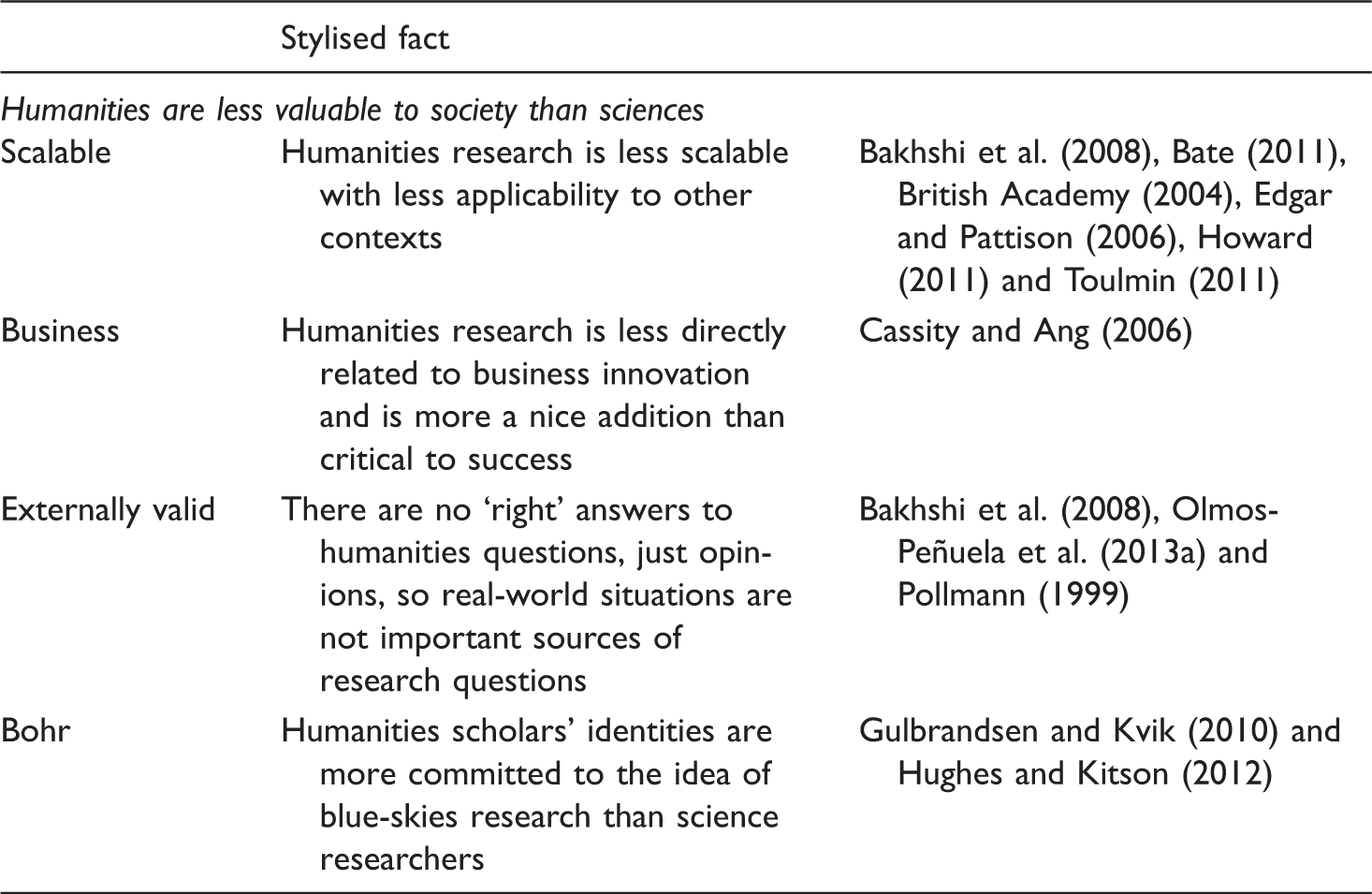
The first claim (scalable) is that humanities research is parochial and tends to be much less universal than sciences (inter alia Bate, 2011; Edgar and Pattison, 2006; Howard, 2011; Toulmin, 2011). Humanities are more particularistic (Bakhshi et al., 2008: 15), often strongly anchored to their territory or local community (British Academy, 2004), and their findings are not readily transmitted and transferred to other situations. Put simply, humanities have a scalability problem since they address specific topics not easy to generalise from and with a limited attraction for others: they ‘still appear to speak in the voice of particular communities and about issues that concern particular communities’ (Edgar and Pattison, 2006: 98). The implication of this claim is that the lower scalability of humanities can reduce its societal value, making the humanities less useful for society than sciences.
The second claim (business) relates to a difference in the relationship between academic research and corporate innovation. Sciences engage innovating firms directly via license deals, spin-off companies and consultancy activity, whilst humanities’ relationships are much less direct (Cassity and Ang, 2006). Sciences can thus claim that innovation depends on academic research, whilst humanities research is more discretionary, certainly having use on occasion but never being crucial to the development of new products (whilst being more related to non-technological innovations). Humanities are more self-referential and less open to users defining their problems: this effect might well lead to academic excellence but it reduces humanities’ societal relevance and value. This implies that whilst scientific research is essential for technological innovation, humanities research is merely elective, adding marginally to innovation, a material difference in the societal use of these two fields.
Third are claims relating to researchers’ and users’ relationships in testing and validating their findings as opposed to relying on consensus within academic disciplines (externally valid). Humanities are seen as more interpretative (Bakhshi et al., 2008), studying things that are value laden, with the consequence that as scholars’ own values change – for example through the various ‘turns’ through which disciplines evolve – academics’ answers to questions change (Bérubé, 2003; Pollmann, 1999). Where two humanities scholars study the same issue and evidence base, yet reach wildly divergent conclusions, a policy-maker would be extremely foolhardy to use that divergent academic research for their own decision-making, thereby justifying the claim that it is less useful in policy-making. The basis of this claim is that humanities scholars are more concerned with internal intellectual validity within their disciplinary field and less concerned with the external validity of their findings in the real world and for users (Olmos-Peñuela et al., 2013a).
The final set of claims (Bohr) relate to researchers’ orientation, scientists’ identities being more open to societal relevance. Stokes (1997) typologised researcher identities in Pasteur’s Quadrant along two dimensions, scientific excellence and societal relevance. Stokes classified scholars exclusively interested in academic excellence as the ‘Bohr’ identity, and those in exploitation as the ‘Edison’ identity. He argued for a third identity, of researchers who felt excellence and relevance were both important (the ‘Pasteur’ identity, echoing Pasteur’s dual role in founding modern micro-biology and solving production problems in a brewery). The claim is often made that whilst science researchers aspire to both Pasteur and Edison identities as well as the Bohr pure research identity, humanities scholars are most frequently committed to the Bohr identity (Gulbrandsen and Kyvic, 2010; Hughes and Kitson, 2012).
‘Humanities are different in ways that do not make them less useful’
The stylised facts of the differences (but not less usefulness) between the societal value of humanities and sciences.
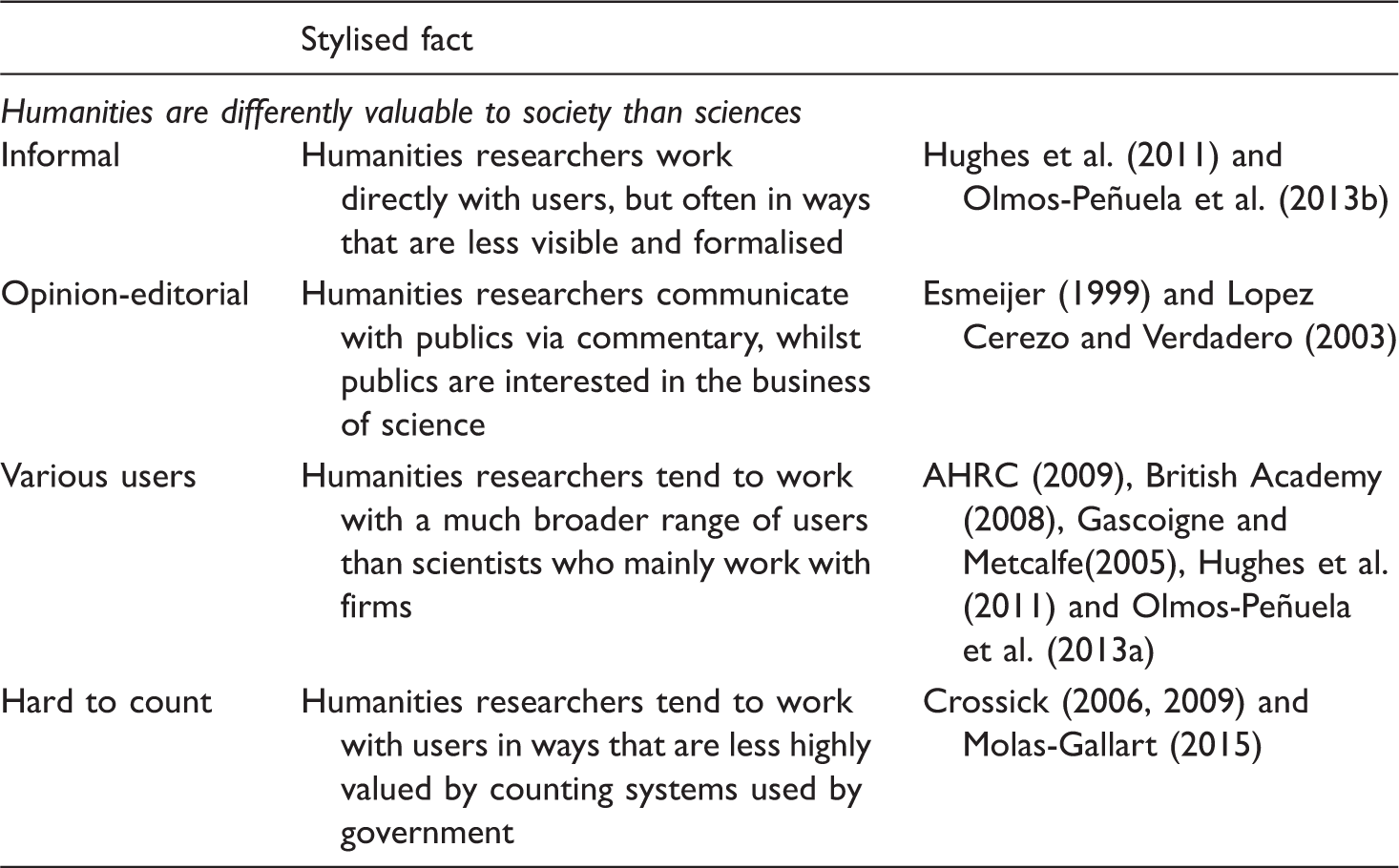
The first claims (informal) relate to differences in the nature of collaborative pathways: the counterclaim to claims that science works more directly with users is that humanities researchers work as closely with users, but in ways that are not easily formalised (Olmos-Peñuela et al., 2013b). Universities' formal structures (TTOs) ensure universities and their scientists are rewarded for collaborations, through contracts, patents, licenses, income sharing and shares. By contrast, much humanities research relates to ideas and thinking not easily codified and best transferred through more informal relationships such as meetings, spontaneous conversations and even the media (Castro-Martínez et al., 2011; Hughes et al., 2011). Although the prevalence of formal (countable and visible) relationships in STEM and their absence in the humanities might explain why some believe that sciences are more useful, neither countability nor visibility are necessarily properties which matter to users, or indeed affect the application and use of knowledge.
The second set of claims (opinion-editorial) relate to relationships between research and communications, which differ greatly between sciences and humanities (Lopez Cerezo and Verdadero, 2003; Olmos-Peñuela et al., 2014). ‘Science communications’ involve conveying scientific breakthroughs and scientists’ achievements to publics, and are well developed, with different names such as the public understanding of science (UK), vulgarisation scientifique (France) or divulgación científica (Spain). The humanities are more often involved in articulating opinions about situations. The search for the Higgs Boson put high energy physics under the media spotlight for several weeks, making the scientists the story. In humanities, although there is arguably far more and more regular involvement of scholars in the media, they are often commentators on other stories rather than themselves being the story (cf. Esmeijer, 1999). Humanities’ lower likelihood of being a story compared to sciences might create a perception that humanities are less useful than sciences, whilst a difference in mode of involvement in stories (commentator not subject) is not necessarily a difference in societal value to those users, the media and their audiences.
A third set of claims (various users) relate to the ease with which humanities and science researchers work with firms and are acknowledged for that (inter alia AHRC, 2009; British Academy, 2008; Gascoigne and Metcalfe, 2005). Arts and humanities researchers interact primarily with a very diverse set of groups, including public agencies, voluntary/non-profit organisations, direct public users and to a lesser extent, firms (Hughes et al., 2011), particularly in creative/arts disciplines. The converse of this is that humanities researchers are relatively less engaged with one kind of user than STEM – firms – which could in turn engender a belief that humanities are less useful (Olmos-Peñuela et al., 2013a). But if humanities are merely working with different kinds of users who nevertheless themselves benefit, then the relative utility remains to be empirically determined.
A final set of claims (hard to count) note that when research value is defined in terms of commercialisation and technology transfer indicators, then humanities tend to underperform sciences. Certainly, evaluation systems to count impact for policy purposes tend to rate sciences more strongly than humanities. England’s Higher Education Innovation Fund allocates resources to universities based on income generated, a narrow metric in which humanities may perform weakly due to their very diverse and diffuse way of generating value (Molas-Gallart, 2015). This may engender a sense of humanities being less useful simply because they score lower against particular resource allocation metrics. But there is clearly widespread dissatisfaction with the use of narrow metrics: Crossick (2006, 2009) has written compellingly on metrics’ limitations from his experience as both head of the UK’s Arts and Humanities Research Council and Provost of an English arts-based university (Goldsmiths). The simple fact that humanities do not produce a narrow output indicator set does not make them less useful than sciences.
Conceptual clarity in policy debates: Classifying the arguments about differences between sciences and humanities
The proposed operationalisation of differences between the societal value of humanities and sciences.
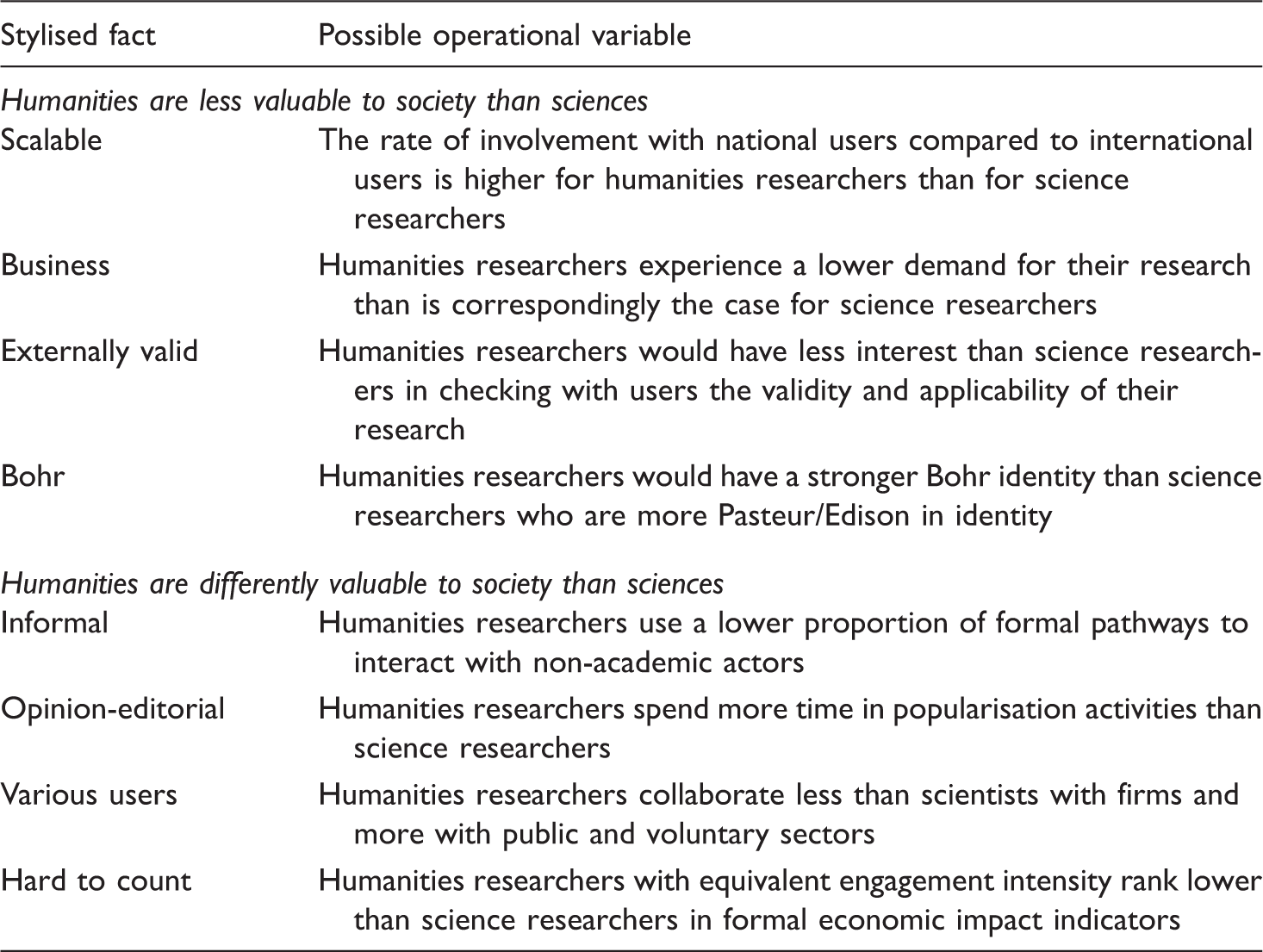
We start the operationalisation with the ‘researcher’ rather than the ‘transaction’ or ‘user’, because we are dealing here with differences between disciplines, and disciplines are communities of researchers. We do not, for example, consider the claim that humanities are less useful because firms in culture and the creative media sector are not very good at using the research, or that governments fail to develop the right policy instruments for knowledge exchange between humanities researchers and users (although both these arguments are made in other contexts). Our reasoning is that if humanities research is less useful, this should somehow be reflected in the scholar’s characteristics, practices and identity (cf Olmos-Peñuela et al., 2013a).
We have segmented claims that humanities are different to sciences in ways that make them less useful to society into four distinct categories. First are the arguments that humanities research is less universally applicable than sciences; humanities scholars’ user engagement would thus be more context restricted, and social engagement more closely geographically located. Second, humanities research is not as necessary for innovation as sciences are: if true, we would expect that humanities researchers would experience a lower user demand. Third, claims that humanities are relativistic and lacking objective answers would suggest humanities scholars to be less interested in verifying their findings against real-world observations than scientists. Finally, if humanities scholars were overly committed to the ivory tower that would be manifested as a stronger commitment to the Stokes’ ‘Bohr’ identity at the expense of ‘Pasteur’ and ‘Edison’ identities.
The claims that humanities are different but not necessarily less useful can similarly be operationalised. The first set of claims, that humanities researchers work with users in less formalised ways, suggests we would expect to see humanities researchers using a lower proportion of formal approaches to collaboration (R&D contracts, licenses, spin-offs, patents, consultancy) and more informal approaches (such as seminars, placements, informal discussions and voluntary work). Second, humanities researchers communicating with the media as commentators rather than regarding their research findings being the main story, suggests humanities researchers would be more active in the media (because they have more occasions when the public could be interested in their opinions). Third, if humanities users had a much wider range of collaborators than scientists, there would be clear evidence of working with a broader type of users including the public and voluntary sector. Finally, if humanities researchers’ interactions tend not to be valued by governments’ business engagement counting systems, then humanities’ researchers would rank lower than STEM researchers when measured with a limited set of output indicators rather than in terms of the number or diversity of interactions. This is summarised in Table 3.
The public value of the humanities
We are not arguing that the proposed framework constitutes a fool-proof test to definitively settle whether humanities or science research is the more societally valuable, because this depends on where and when data are gathered. However, it does provide an additional perspective to policy discussions about humanities research’s value. Reinterpreting existing research in the above framework suggests the answer is more nuanced than is reflected in the policy discourse. Abreu et al. (2009) demonstrate compellingly on the basis of their UK-wide survey that humanities scholars are as engaged as science researchers, whilst not having an appreciably higher commitment to exclusively blue skies research. This suggests that – in the case of the UK – humanities research is different without being less societally useful. More generally, usefulness is more a function of academic behaviour and linked to institutional and national than disciplinary factors. More empirical research is necessary to advance this framework, so as to better understand those contexts in which humanities research is useful or a mere luxury.
But this framework also allows – distinguishing those various arguments and claims – insights into our three research questions. Firstly whether humanities can contribute to socio-economic development, it is clear that the answer is yes. Humanities have a direct economic impact through the cultural sector, for example, representing 1.7% of total European Union employment (2009), with the highest percentage of persons with tertiary education (European Commission, 2011). Additionally, from the ‘productive interactions approach’, all claims concede that in certain ways, humanities research is ‘useful’; clear pathways can be traced from humanities researchers to users, and impact can be identified, whether in many small changes (such as in watching a TV programme: Toulmin, 2011), or a few big changes (policy makers who change their systems, thereby influencing a much wider public: Szreter, 2011). Humanities research may use intermediaries, such as the media or policy-makers, but that is not conceptually different to sciences where discoveries are embedded in commercial technologies; the scientist’s contribution may be more tangible, but that does not make it more valuable (cf Benneworth, 2015).
Secondly, in asking whether those socio-economic effects have a public value we see that the various claims are congruent with public value. The virtual absence of a specific discipline of humanities communications – akin to that of science communications – is partly because communication is core business for humanities researchers (via reasoned comment). Scientists limit their communications to their specific areas of expertise, and ideally to peer-reviewed evidence (Bensink, 2012). Conversely, humanities researchers both codify their research into products for public consumption and are also invited by commercial media platforms’ owners to use their expertise and reasoning to attract readers to these platforms. These characteristics are not necessarily the exclusive preserve of humanities scholars. There are scientists who are skilled media commentators: in the Netherlands, the President of the Royal Academy of Sciences and Arts appears monthly on a TV chat-show to discuss scientific topics. But such commentary is much closer to the core business of the humanities researcher than to that of the scientist – and the relatively low academic prestige that accrues to these efforts seems entangled with sciences’ generally accepted higher prestige.
The final question relates to whether humanities research is a luxury and worth funding. This is at one level a political decision, yet our analysis highlights that there is no reason why humanities should be a priori less useful: they may be less useful in particular circumstances but that is partly a function of the users, including the research funders. Whilst the claim might be made that investing in sciences is closer to business, that claim is not a priori true: science research may appear to be closer to business, its connections may be more countable and more formalised, but they are not necessarily more numerous or ultimately beneficial. This means that a euro invested in sciences will not automatically boost economic growth (the assumed priority in crisis times) by more than a euro invested in humanities. Reframing understanding of research’s benefits and impacts moves research away from the easy heuristic of the pharmaceutical spin-off to a more diverse ecological view: this is a critical challenge for academics and policy-makers alike, critical in ensuring that research investments across all disciplines continue to drive socio-economic development even beyond the latest crisis.