






Abstract
Traditionally, assessment for university students in the humanities has been in an essay format, but this has changed extensively in the last decade. Assessments now may entail auditory and visual presentations, films, mind-maps, and other modes of communication. These formats are outside the established conventions of humanities and may be considered as creative works. Exploring definitions and research in the field of assessment of creativity, highlighting ways to explicitly assess the creative aspects of student work. An obligatory first year common unit titled “Cultural intelligence and capability” is examined as a model of how creative assessment can be used to extend engagement with subject material. Implications of considering creative aspects, in an explicit way, are reviewed. The underpinning argument is that in the current learning settings, creativity should be seen as an intrinsic part of appraisal criteria in the humanities as much as in the arts.
Introduction
Many academics in the humanities are confronted with the need to adjust the way they assess students’ knowledge about the subject matter being presented as desirable knowledge. Formerly, assessments were primarily in an essay or report form: a predictable structure with introduction; body; conclusion asking for considered analysis on a set theme. This written form is highly dependent on coherent argument, mastery of words, and an agreement that deductive logic constitutes academic ways of knowing. Undeniably, this continues to be a valid and indispensable way to ascertain the depth of student understanding of complex ideas and readings. However, practices and expectations of assessment methods have radically altered in the 21st century in pretertiary and tertiary levels of education. This shift is due to extended ideas about what constitutes knowledge (Banks, 2007; Ford, 2005); changing access to multimedia technology (Deger, 2006; Ginsburg, 1991) as well as the transformation of the way that people communicate about issues in universities using graphic and audiovisual media forms (Deegan, 2014; May and Hearn, 2005). All these aspects impact an educator in arts and humanities when including more creative or nontraditional assessment items to assess knowledge.
The dilemma for lecturers in the humanities is that, while the use of power points, films, mind-maps, photographs, recorded narratives, and other “creative” forms of communicating ideas enhances the experiences of a student studying within arts focused areas, there is little tradition in the written disciplines of assessing the use of these media forms. Lecturers are asking for a creative expression of an idea and will appreciate some subtle use of visual metaphor linked to words, but this aspect may be considered a minor part and only the content in the response will be assessed based on criteria that are similar to that traditionally used for written formats. Creativity in a response may not be defined explicitly as part of overall grading criteria and so will be subsumed by the other expectations of communicating understanding such as paraphrasing ideas, analyzing data, presenting argument. Here I contend that these patterned forms of assessment criteria need to acknowledge and more explicitly integrate “creativity” as a desirable attribute in assessment.
Creative styles of assessment have shifted beyond the realm of the “arts” into subject areas that have previously dealt with primarily the academic written word. At postgraduate level, research using images and performance in creative ways is accepted and encouraged as communicative acts and valid expressions of collected data (Denzin, 2010: 424; Grbich, 2004; Netzer and Rowe, 2010). This shift has not been followed by the expectation that creativity should be clearly defined in a university context, acknowledged, and assessed as a primary aspect of communicating knowledge. I suggest that these new ways of communicating must also push academics to consider how creative expression of ideas should be assessed in the first year of university study. As this is not a straightforward process, it needs greater discussion in the forums related to teaching and learning in higher education.
This paper explores ideas about how creativity may be defined and measured in areas where undergraduate students are being asked to apply less conventional forms of expression. It is a response to many occasions where I have had to justify including creativity as a criterion of assessment to peers outside of creative practice areas. The notion that including assessment of creativity is important is based on literature in the field as well as my own experiences, which stem from working in academic literacy, cultural studies as well as in visual arts, especially in the first year and postgraduate years of university study. The experience of working in these levels of study has motivated an interest to define and recognize the need for explicit assessment of creative, particularly audiovisual elements, in assessment tasks early in a student’s academic journey. This is a means to encourage students to communicate in modes that are relevant to ways of seeing and knowing in the 21st century.
For lecturers, implications arise in assessing creativity. How can one balance the effectiveness of creative forms of communication against the need to assess traditional skills in written argument and analysis? The complexity of assessing “creative work” in situations where the main area of study is not in a creative field raises a number of issues. If something is valued in the minds of students and lecturing staff, it must be measured in some way. A broader conversation is needed about how creativity can better be integrated into assessments and how lecturers untrained in creativity assessment can value the benefits of encouraging students to take such an approach to assignments. This discussion aims to clarify the role that creativity increasingly takes in university studies as this phenomenon of learning becomes a “mainstream” consideration through assessments for academic work, rather than something that is an “add-on” to the serious occupation of study. Before moving to an example where creativity is encouraged in learning, some underpinning definitions and issues need to be considered.
Aspects of creativity
Research and definitions
Creativity may be defined in a number of ways. In examining Runco’s (2007) as well as Hennessey and Amabile’s (2010) extensive analysis of what constitutes creativity, synonyms such as imagination, originality, innovation, inventiveness, discovery, serendipity, adaptation, flexibility, artistry, resourcefulness, ingenuity, and inspiration extend the interpretation of what this word means. Teasing out what creativity means in the context of university students, Heene (cited in Freeman, 2006: 92) considers the creative adult personality to have “conceptual flexibility, tenacity and perseverance; self-discipline and self-control; ability to integrate controversial content and controversial processes; preference for the new and the unconventional.” Creativity is a concept with a broad brush for interpretation and application, but a principal interpretation is one where a person takes an approach outside established conventions to express a view or an idea that is not predictable.
When trying to identify this capacity in a university student, the definition of creativity is not especially linked with art or beauty. It is linked to a way of thinking and approaching questions, or even forming questions themselves. The term has been closely associated with the unfathomable capacity of some people to think outside the box or to be artistic or innovative, different to the norm. Berrett (2013) argues that turning away from the idea of creativity being an inherent, unlearnable quality is essential to build a student body that has the capacity to bring new ideas into the world. Within the business studies area, he has sought to build creativity and innovation into courses to provide a “competitive edge” for students. “Creative tasks are, by their nature, ambiguous, with no clear right or wrong answer. Such tasks require taking intellectual risks, trying, evaluating, and discarding ideas, and making connections” (Berrett, 2013: 18).
In humanities studies, creative thinking must be closely tied to divergent, rather than convergent thinking. To step outside the writing of experts and to reflect on what may be missing in a line of thinking require an openness to consider other viewpoints. This can be encouraged by providing students with opportunities to explore open-ended tasks that step outside the predicted views of personal capacities (Silviac et al., 2009) and allow other ways of seeing and exploring world views to emerge (Gunn, 2014). Lecturers who seek strategies to enhance divergent thinking, within the constructs of academic rigor, can stimulate new ideas and consideration of other ways of knowing.
Researchers of creativity accept problems with both the definition and measurement of creativity. Hennessey and Amabile (2010) present a summary of the diversity of views about how creativity could be measured and assessed. They highlighted that creativity is a field in psychological research that is growing, but that the conclusions about measurement of creativity from various research areas are becoming more and more fragmented as ways of defining creativity expand. Their research noted that because the exploration into creativity is so diverse, there is rarely interdisciplinary communication about what has been found. Their annotation of the literature strongly suggests that much of the research conducted about creativity sits within a number of levels. These levels diagrammatically can be centered on the neurological and extending out to affect, cognition, and training; the individual and personality; group dynamics; social environment; culture and society; and finally as a systems approach. Their conclusion is that an overview with a “systems approach” of creativity is needed before more cohesive and informative understanding of this human phenomenon can be extended (Hennessey and Amabile, 2010: 271). This analysis guides ways to look at creativity in the system of a university setting.
In the measurement of intellectual capacity, creativity is linked to divergent thinking where a number of possible ideas are generated.
The importance of leaving a space for creativity in learning
The value of creativity for adult learning is well researched. Bailey and Desai (2005) provide extensive justification for including creative practices in their university programs, emphasizing the need for students to develop the capacity to work effectively in community- and education-based careers. They also highlight the value of arts practices in exploring cultural values and developing intercultural understanding as well as resolving dissonance in an emotional way. “A picture is worth a thousand words” seems like a trite cliché, but this has become very much the art of communicating through media. In addition, bell hooks (1994, 1995) highlights how creativity can challenge the established norms of communication in more subtle ways than the written word. Learning by doing at an adult level can build the capacity to communicate complex ideas.
The diversity of student cohorts highlights the need to open possibilities for other forms of communicating understanding of ideas. Many students come from nontraditional and non-English-speaking backgrounds and by taking a sociocultural approach, lecturers can build learning communities by including creative activities in a program (Northedge, 2003). Olson (1996) highlights that the discourse of academia is not easily accessible to first-year students and other ways of engaging with ideas can be developed. However, Fee and Budde-Sung (2014) warn that relying too heavily on audiovisual forms of communication is not always accepted and appreciated in the ways that lecturers expect by students from diverse backgrounds.
At another level, there is the need to recognize that the education system tends to discourage or dismiss creative efforts after a certain age. Guides to include creativity in educating preliterate and early literacy children are abundant (Gregerson et al., 2013; Ranja and Gabora, 2013). People may be traumatized by negative responses to their childhood drawings or have had little experience of being encouraged to develop this side of their character, as Kelley (2012) reflects, drawing empathy for his experiences. To overcome these inhibitors to creativity, there are many strategies that can be applied and implemented. Surprisingly, the steps can be mostly related to just opening that space to dream and create (Kelley and Kelley, 2012). Programs to extend written literacy for young people in low literacy environments are strongly supported, but rarely is this seen in supporting creative efforts. There are many reasons why integrated development of creative capabilities as seen in children’s education is rarely seen in adult education programs.
Clearly it is best to look toward the areas where creativity assessment has traditions that may inform this discussion. Looking at design training, creativity is a skill that is taught alongside innovation. It is encouraged as a way to expand analogies, metaphors, and reframing a problem to see it in a different way. A visual art advocate, Sheridan-Rabideau (2010: 54), passionately argues for the need to include an arts-based curriculum into broader subject areas, considering that curiosity, creativity, and collaboration are essential skills to have when seeking solutions to various issues. While this may be dismissed as an art-centric view of saving the world, there is a growing body of research that supports the value of creativity that may help with developing effective assessment of this area.
Within Australia, there have been extensive studies of the role and assessment of creativity in particular areas such as architecture and design where conclusions were drawn about the need to encourage cross-pollination of ideas between students across disciplines (Parker, 2014; Williams et al., 2012). Within creative arts and humanities, Miles and Rainbird (2013) also focus on the importance of collaborative exercises to develop new creative ideas. Essentially, their research supports that assessment of creativity relies on encouraging opportunities for students to think “outside the box” through new activities such as performative collaborations and linking across disciplinary fields.
This need for a collaborative experience in terms of creativity can be problematic for the “distance education” modes of delivery. If students are not in the same physical location and need to study online in various time zones, other means of extending the capacity to absorb and present knowledge in a creative, way need to be considered.
Creativity and academic expectations in the humanities
In their cross-institutional study of exiting expectations, Bath et al. (2004: 315),highlight that there is a standard anticipation across most graduate attributes “communication and problem-solving (CPS) which includes oral and written communication, problem-solving ability, creativity, teamwork, independence, critical thinking and analytic skills.” This research emphasizes that within graduate attributes in many universities, “creativity” is listed as a quality that students would build and develop during their studies. However, studies may avoid measuring this aspect of progression in desired attributes through a degree, preferring to focus on aspects such as critical thinking, interpersonal understandings, problem solving, and written communication (Badcock et al., 2010). This may be closely related to the idea that creative practices are essentially part of an “art” perspective and subject specialist’s wish to concentrate on their area of expertise alone, which is seen to exclude creativity.
While the siloed approach to learning may seem justified as students have chosen particular areas, the world of academic learning and the space students will inhabit after completion has changed. Clegg and Bryan (2006: 222) contend that students can be better prepared for the “unknown” by fostering their creative capacities. The broad study of creativity variability between science and arts students by Furnham et al. (2011) found that there was little variation in individual creative capacity between arts and science students. They suggested that this may be related to the type of education they experience before university, but I also suggest this is related to modern-day exposure to creative events in the public domain. This notion that creativity is somehow limited to art practice and design studies is extensively disputed in the underpinning literature and definition of creativity (Hennessey and Amabile, 2010; Runco, 2007). Extending the capacity of university students to value and apply their imaginative perspectives to their studies gives them another arrow to include with a diversity of approaches to transform knowing (Cranton and Wright, 2008; Dall’Alba and Barnacle, 2005; Groen and Hyland-Russell, 2011).
Including the assessment of creativity
Being pragmatic and busy people, students prioritize their efforts based closely to assessment criteria. What is highlighted and given importance in the eyes of lecturers and tutors is often what is valued in the efforts to achieve best performance by the students.
The context in which this reflective study takes place is at Charles Darwin University, which is a regional university in the Northern Territory (NT) of Australia. The NT has a population of only 260,000 people with a high proportion of indigenous and non-native English-speaking migrant populations (Australian Bureau of Statistics, 2014). The university relies on growth through enrolment by external students and over 85% of the students learn at a distance from all areas of the country. The majority of students are over 21. The institution has a growing international student cohort and multiple national backgrounds are represented in both external delivery and on-site classes at the central campus in Darwin and its outlying campuses in Alice Springs, Sydney, and Melbourne. “Cultural Intelligence and Capability” is an obligatory “common unit” for all first-year students to complete across all disciplines, bringing together science, humanities, law, nursing, and all other students in a face-to-face or online class. The unit aims to develop skills for academic literacy as well as intercultural communication in a way that integrates reflection and develops practical embedded understanding of how to approach cultural similarities and differences in professional life. It has maintained a high approval rate in the formal evaluation categories for two years.
In constructing the unit, the writers wanted to extend ways that students may reflectively engage with ideas by including creative elements that ask learners to express positions using images, sounds, and drawings. They determined that students should complete a mind-map (constituting 10% of final grade) as well as a three-minute audiovisual media production (constituting 25% of the grade). The other two assessments remain written and constitute the major part of the overall assessment. Here the two more creative assessments will be described and analyzed for the value they add to the student experience. These assessment tasks will also be considered in terms of some of the difficulties of attributing grades for creativity in the student’s work. Adjustments needed from lecturers to modify and define ways of assessing creative work are also contemplated.
Example 1: Mind map—Reflecting on personal culture
A mind-map is a way of expanding ideas in a visual and nonlinear way. Popularized by Tony Buzan in the 1970s, the idea of a creating a mind map to “tap into creativity” is used extensively in the business world (Buzan et al., 2012: C1). This is also a relevant process used to find connections in areas of the arts and humanities. As the first assessment that students are asked to complete, it requires self-analysis in terms of their cultural self being determined by knowledge, experience, and behavior. They are asked to be creative in this task: Construct a mind map as a visual representation to show your understanding and analysis of your personal culture. You should first identify at least 4 key elements of your personal identity/culture. Next, draw up a mind map that includes these four elements and shows how knowledge, experience and behavior have all contributed to make up your personal culture. (Charles Darwin University, 2015)
As a coordinator of the unit, I hesitated to include an example of the task as this could limit the variety of possible responses and restrict the individual creativity that students may present. On the other hand, providing an example gave students and staff members a way to understand the task more clearly. After discussion with the teaching staff and approval from the students who had completed the work, we included a model of two reasonably well-completed responses to the task description as in Figure 1 and 2. After including these, the students were also asked to assess these assignments in terms of the assessment criteria and were provided with the actual assessment of the task for Figure 1.
Sample of student computer generated mind-map. Source: Student work semester 1 2012 CUC107 Cultural Intelligence and Capability. http://learnline.cdu.edu.au/commonunits/cuc107/images/mindmap1.jpg. Sample of student hand-drawn mind map. Source: Student work semester 1 2012 CUC107 Cultural Intelligence and Capability. http://learnline.cdu.edu.au/commonunits/cuc107/images/mindmap2.jpg.
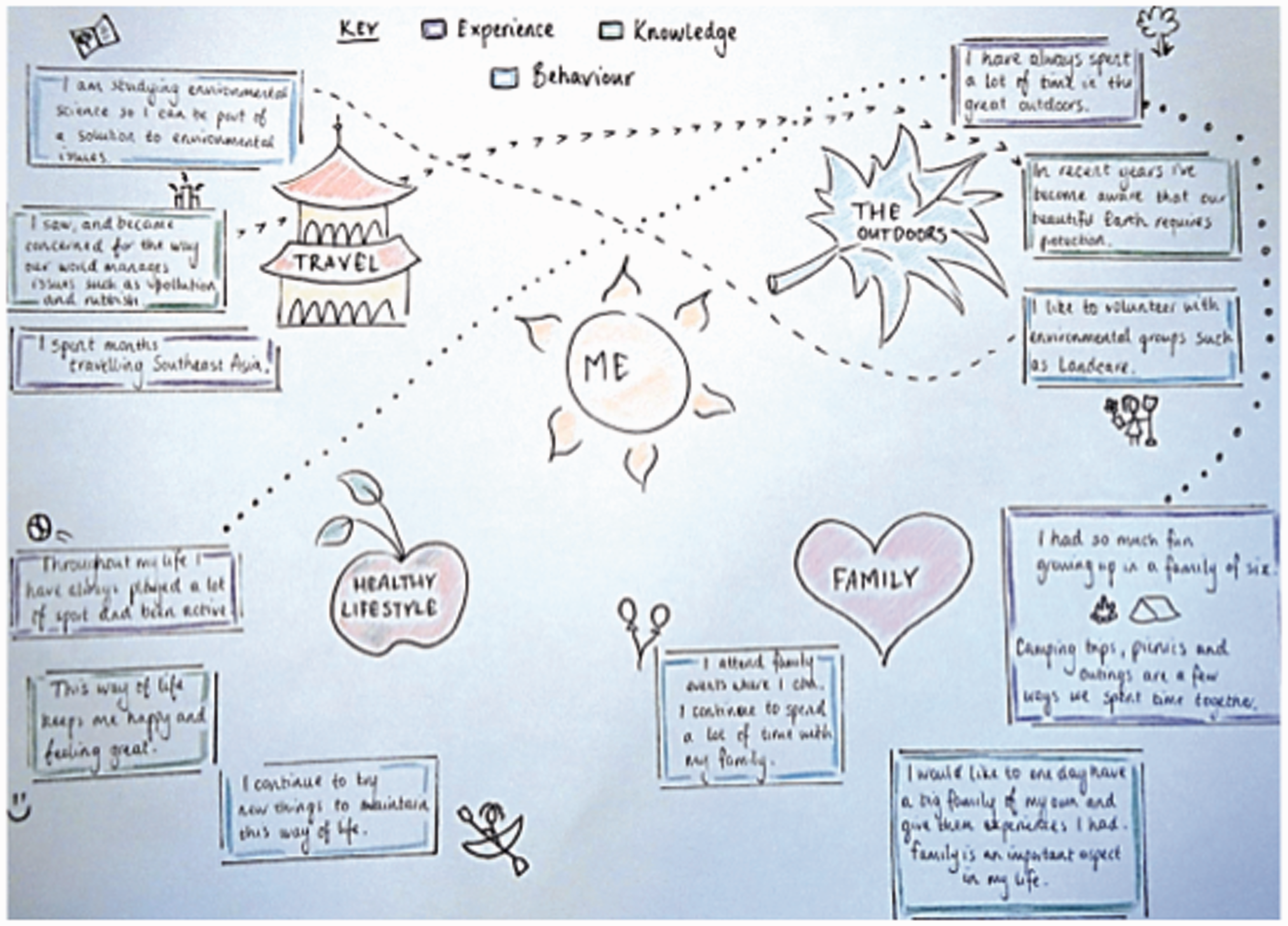


The model examples have been helpful as students from various disciplines do experience a quandary when confronted by this task. While Freeman (2006: 97) considers that providing a model (albeit in performance art) may “provide intellectual and creative paradigms for the student to plunder,” at the first-year level with a broad range of students, it seems practical to balance access for those more and less confident with this form of communication. Some students creatively innovate their own experiences carefully basing their work on the examples given; others try new and different ways to represent their cultural self, while keeping to the criteria of the assessment task. A variety of skills and knowledge of design programs are brought into play by many students. Others prefer to hand draw and scan their work. This variety of acceptable formats allows for different levels of comfort with notions of creative expression.
Example 2: Movie making—Cultural intelligence in context
The second assignment in the unit, which encourages a creative approach is one where students are asked to: “Prepare a three-minute audio-visual presentation that informs an audience about what cultural intelligence is and how it can be applied in either a community, university or workplace environment” (Charles Darwin University, 2015).
This assessment task does not make assumptions about student capacity to utilize power point and voice-recording tools, directing students to a number of training videos and providing supportive resources to assist in the task. Throughout the earlier part of the unit, power point examples are used to teach material in a way that explicitly show how images can be used to highlight a point of view and illustrate an idea in a metaphorical sense. In spite of some difficulties and hesitations with the technological demands of the task, students have commented in a positive way overall in the evaluation of these parts of the unit. Comments include that it has been “challenging but rewarding” and “a way to learn how to communicate in a different way” (comments from unit evaluations Semester 2, 2014). If students struggle with recording the sound files for assignment 3, they may submit work as notes to accompany the presentation, but very few choose this option. There is a requirement to present this with academic references to support ideas, which students integrate.
Discussion
The assessment items described above ask students to present information outside of academic writing in two different and creative ways. The mind-map task is asking for contemplation about self and opening of possibilities about how to communicate ideas in a cultural setting. It asks for critical reflection and an illustration of this in graphic form with open-ended interpretations encouraged. The other “movie-making” task requires the student to show they have developed the capacity to communicate their ideas and understanding about contextualized cultural intelligence in a performative way using audiovisual tools. Students are asked to illustrate and define knowledge about an aspect of contextualized human behavior in a way that uses images metaphorically and words succinctly and symbolically, preferably with their personal voice included in the presentation. Both assessments seek a response that shows a student has understood and considered cultural concepts presented as content. These tasks also require the student to interpret their ideas outside the written format commonly expected in academic assignments, providing opportunities to be creative, innovative, and outside the conventions of academic communication in their response.
As mentioned earlier, there are many influences in how activities such as these can assist with the assessment of the creative capacity of the student. These assessments are not engaging with the neurological component or analyzing individual levels of creativity at a deep psychological level, where a creativity test, such as designed by Torrance (1974), could be engaged. However, two considerations about creativity in a humanities teaching focus are very relevant here. Predominantly, how do students and lecturers bring previous experiences and expectations of creative activity to these tasks? Secondly, how does the sociocultural context and study situation in which these assessments of creativity take place influence the result?
First, let us consider previous experiences and expectations for both tasks described above. Creative activity, as experienced as a child or an adult, can influence how confident a student may feel in depicting information through a graphic or an audiovisual representation. Many of the “digital natives” (Bennett et al., 2008; Kennedy et al., 2008; Margaryan et al., 2011) who inhabit the university sector as students have extensive experience in using computers to communicate visually and graphically, albeit too often as consumers of articles produced rather than creators. Engaging with ideas using imaginative forms of expression may be allocated to the “arty” people, but this must not preclude others working in the humanities to encourage self-expression in communicating ideas in a way that involves affective notions of seeing the world (Aydede and Fulkerson, 2014; Slovic et al., 2007; Tuan, 1978). This approach needs to be valued alongside more utilitarian considerations linked to innovation (Gulbrandsen and Aanstad, 2015). When considering how a student approaches a creative task, multiple influences come into play that include disposition, direction in study as well as confidence in the mode of communication.
In addition, closely linked to this personal response to the creative task is the sociocultural context of the tasks. The focus on individual creativity may vary across subject areas in a university. As an overlay to this institutional perception, external values in culture impinge on how creative aspects are approached. This is of concern in a teaching context where students come from a great variety of subject areas as well as linguistic and cultural backgrounds in the humanities. From general observations of international students, exposure to modern communication technologies is equal to, if not above, those of Australian students. It is more age and socioeconomic background that may influence the expectation of what university learning constitutes. For the student with English as an additional language, the capacity to express ideas outside the essay format is sometimes more accessible for communicating ideas than to complete long pieces of writing. There may, however, be a dissonance with what the expectation of academic work is. Even so, there are many students for whom an opportunity to express ideas outside the conventions of academic writing is “like a breath of fresh air” (student comment, 2014). Equally, it may be argued, it is a relief for the academic to view and respond to work that attempts to sit outside the norms of academic argument and extends means of communication.
Academic lecturers are asked to change their teaching practice to integrate online learning modes that resonate with students and give access to them off the university site. Salmon and Wright (2014) argue for ways to engage lecturers with new ways of approaching digital communications. They suggest this cross between technological aptitude and knowledge depiction needs to be balanced for both the lecturer and the student to gain a meaningful experience. “Creativity” as a component of this learning to adapt and adjust with modes of communication of ideas is essential.
Interpreted through the eyes of a person with generalist knowledge, one considers how assessment of this phenomenon may be applied in a broad academic setting. While it is clear there are multiple directions that research into creativity is taking, this may start to confuse the issue of how creativity may be assessed in the academic zone. I return consistently to a rather pragmatic response to this. By including the notion of creativity in the assessment criteria, the discussion around this phenomena gains value.
Cultural paradigms that value creativity will vary across nations and institutions. This is of concern in a teaching context where students come from a great variety of linguistic and cultural backgrounds. When asked to develop the components of the graphic representation of their ideas, some find it difficult to bring these ideas onto a diagrammatic form. Equally, lecturers have found difficulties with assessing this work, especially in terms of recognizing and quantifying the value of creative responses to the task. “Creativity” is mentioned alongside and its value is allocated within the 5% toward presentation. This may seem minimal in relation to effort required to be a little different to the normal response, but by adding this criteria as a word, it pushes both lecturer and student to recognize the value of tasks such as these; to think “outside the box,” bringing in metaphorical and diagrammatic interpretations of experiences and also to try to define what creativity means in the academic context.
Conclusion
The concept that representation of developed knowledge in the humanities can be done in a creative way is not new, as evidenced by such public communication items as sociocultural films, political paintings, collaborative art projects, and online games in historical contexts. How far this capacity to communicate creatively in the general humanities undergraduate degree will be determined by extended conversations within that academic domain. The definition of creativity and the measurement of this, seemingly nebulous, characteristic of learning, raises questions whether this is truly part of the general academic pathway or something that should remain in the domain of the “creative arts.”
On a broader level, this may be answered by how much an academic institution or system recognizes and values creativity. If creative people are considered nonconformist and outside the norm of everyday practices, then there will be resistance to encouraging the use of this criteria in many faculty areas of universities outside of designated “arts” areas. However, if creativity is seen as an essential characteristic for the academic learner, as defined in so many graduate attribute descriptors, space needs to be made in assessment within all subjects, including the humanities.
As communications are encouraged by most workplaces into an increasingly auditory and visual, digital domain, developing skills in intuitive and metaphorical interpretation of ideas needs to be encouraged. Equally, on a less utilitarian level, the inspiration of finding new ways to represent complex, abstract knowledge, whether in audiovisual, performative or written modes has many rewards in communicating with others. Ways to encourage and develop excellence in being creative need to become part of the conversation within academic fields generally, but especially in the humanities where communication is about social ideas and characteristics. Representing knowledge with creativity valued as assessment criterion extends graduate attributes to prepare a student to communicate with others during and after their studies.
Footnotes
Declaration of conflicting interests
The authors declared no potential conflicts of interest with respect to the research, authorship, and/or publication of this article.
Funding
The authors received no financial support for the research, authorship, and/or publication of this article.
Author biography
 ; she can be contacted at birut.zemits@cdu.edu.au.