







Abstract
Collaboration is not a core practice in humanities teaching and learning, despite convincing arguments that it should be. To encourage collaboration in classrooms and with communities, DePaul University has developed its Experiential Humanities Collaborative. The Collaborative connects faculty, community partners, and students to co-design and implement new community-engaged, project-based humanities courses. This article outlines several rationales for collaboration in the humanities, situates the approaches of the Experiential Humanities Collaborative among those of similar initiatives, and shares outcomes from the project’s early years. While teaching and learning the humanities will always involve independent reading, reflection, and writing, the Collaborative demonstrates the value, as well as the challenges, of adding collaboration to these core practices.
Keywords
If you have never been to an engineering design studio on a university campus, picture a large open space in a basement, cluttered with tools and half-assembled wood and foam prototypes. The hum of 3D printers fills the air, punctuated by the occasional whir of a drill. Some students huddle around laptop screens, and a professor peeks over one group’s shoulders. Other groups stand with industry coaches, writing on whiteboards covered with sketches and equations. Everyone in the studio is preparing for a series of design critiques that will culminate in a final public presentation. Now, ascend the stairs and cross the campus to Humanities Hall. Lone students sprawl on chairs, books in hand. Behind partially open office doors, faculty squint at student papers on their computer screens, annotating them with margin comments. At a seminar table inside a classroom, students scroll through documents, searching for passages to bring into the discussion, some venturing to speak an idea that is perhaps tentative, perhaps urgent.
These ways of teaching and learning both have value. One is hands-on, experiential, and collaborative; the other is reflective, textual, and often solitary. On most campuses, students have come to expect that humanities courses will reflect what is happening in Humanities Hall. However, at DePaul University, we have recently experimented with something different. In 2020, we launched HumanitiesX, DePaul’s Experiential Humanities Collaborative. In the proposal for the grant that funded the project’s launch, the Collaborative was described as “a vibrant learning and scholarly environment in which liberal arts and social sciences faculty, local community organization leaders, and DePaul University students work together to co-design and implement project-based courses to tackle significant issues through interdisciplinary collaboration in the humanities.” In other words, we proposed a concerted effort to develop structures and tactics for collaboration.
The Collaborative has since been enacted as a 10-month fellowship program called HumanitiesX, which brings together an annual cohort of three teams, each composed of two faculty from different academic disciplines, a community partner from a local nonprofit organization, and two students who join the cohort several months in. These HumanitiesX fellows, who are generously compensated for their time and expertise, participate in a series of joint activities over the academic year, with a primary goal that each team develop a new interdisciplinary, community-engaged, project-based course in the humanities that they teach during the final academic quarter of the year. These HumanitiesX courses engage students in interdisciplinary inquiry about a pressing social challenge and enlist them, in teams, in public humanities projects with and for partner organizations.
During a typical year of the Collaborative, you can find those participating in its activities—both the fellows co-designing new HumanitiesX courses and the students in HumanitiesX courses—working in ways that look more like what’s happening in an engineering design studio than in Humanities Hall. Two faculty members and their community partner might be in a community center in Chicago’s Uptown neighborhood, talking with a muralist who has returned recently from Guatemala, planning the artist’s visit to their upcoming course. Student Fellows might be sitting around a conference table on campus, their laptops open to the same shared document, discussing how to craft a more student-friendly project description for an upcoming course assignment. Later in the year, students in HumanitiesX courses can be found working in spaces across the city, interviewing community members about their migration experiences, planning book discussion events and film screenings with public engagement professionals, or putting the finishing touches on exhibits in neighborhood gallery spaces.
We have completed three full years of HumanitiesX fellowships and courses and are now at a place to take stock. Where does our project fit in the landscape of collaborative teaching and learning in American colleges and universities? What structures and tactics emerged as important for supporting collaboration? What did HumanitiesX fellows and students value about collaborative approaches to teaching and learning in the humanities? What did they find challenging? What lessons can we, and other universities, carry forward?
In this article, I first outline the rationales for and approaches to collaboration in humanities pedagogy, describing several well-documented collaborative efforts in American university settings. I then describe the Experiential Humanities Collaborative, focusing on three structures and tactics that characterize our approach: a social fellowship that engages diverse teams, direct engagement with pressing social challenges, and a shared goal to execute ambitious public humanities projects. Next, I describe the value and the challenges of collaborative approaches, sharing notable trends from surveys of HumanitiesX fellows and students. Finally, I summarize the lessons other institutions might take from our efforts.
Like an engineering design studio, the Experiential Humanities Collaborative is ambitious and resource-intensive. For universities with the will and means to develop what the education writers Bain and Bain (2021) have called “super courses,” it might serve as a model. But even for institutions with limited resources, our lessons should be instructive, providing motivation and ideas to make collaboration a core practice in humanities teaching and learning.
Collaboration in the humanities: Rationales and approaches
In our work at DePaul, we describe the humanities not with a unifying definition, although we often return to one offered by Berkowitz and Gibson (2022: 78): “[T]he humanities involve the examination of history, values, culture, and beliefs… [They are] a means of understanding the experiences and perspectives of others.” Nor do we define the humanities as a list of specific academic fields, which might include English, history, or philosophy but exclude political science or sociology. Instead, we locate the humanities in any teaching or research that foregrounds humanities methods of inquiry and understanding. These methods include but are not limited to interpretive work that applies critical, aesthetic, or culturally grounded theory to historical, literary, or artistic texts; listening, talking, and learning across cultures and generations; storytelling as a form of sensemaking; building or engaging with archives; and those creative and artistic practices that are not better classified as the fine arts or performing arts.
“Collaboration” we define according to the word’s constituent parts, meaning “to work together,” or “co-labor,” on a shared project. In higher education, collaboration is not entirely uncommon in the humanities; it happens when faculty co-teach a course or do research together, or when students complete a paper on teams or pursue a research project with a faculty mentor. However, collaboration is a core practice in only a few humanities fields, such as oral history, public history, community writing, archaeology, digital humanities, and the public humanities. 1
There are several rationales for expanding collaboration more broadly across humanities teaching and learning, some grounded in claims about collaborative knowledge-making, others in arguments about collaboration’s benefits for students, faculty, and community partners.
Rationales grounded in claims about knowledge-making insist that complex social challenges like climate change, racial injustice, or forced migration—often referred to as “wicked problems” or “grand challenges”—cannot be understood or addressed without the input of many stakeholders, including those who work in the humanities (Bostic, 2016). When the humanities are imagined not simply as disciplinary fields but rather as a set of methods, we can see how those methods play an important role in addressing complex social challenges. We cannot, for example, fully conceive of the need for racial justice initiatives in American cities today without understanding the history of migration and redlining. Indigenous approaches to the land and posthuman theories have decentered people as the only stakeholders in environmental decisions, enriching natural resource management strategies. Stories, myths, and songs have long inspired and guided collective political action.
The belief that those working in the humanities are essential collaborators for those working to address complex social challenges has informed several high-profile collaborative initiatives, including the Global Urban Humanities Initiative and Future Histories Lab at UC Berkeley (Moffat, 2024), the X-Labs project at James Madison University (McCarthy et al., 2018; McMurtrie, 2019), and the Humanities Action Lab, headquartered at Rutgers University (Pawlicka-Deger, 2020). Many such initiatives have a “humanities lab” approach, which Pawlicka-Deger (2020: 19) has described as a “collaborative infrastructure for turning ideas into action.” The lab approach is characterized by several features, including: the focus on a locally grounded global problem undertaken from a broad perspective; interdisciplinary and vertically integrated projects; the application of participatory and prototyping techniques; strong collaboration across disciplines, institutes, and sectors; and a pedagogical mission realized through innovative lines of inquiry and new ways of engaging students and scholars with public audiences. (Pawlicka-Deger, 2020: 10)
Other collaborative initiatives have centered knowledge exchange between those with academic expertise and those with expertise derived from lived experience. Orellana and Chaitanya (2020: 86), for example, have described a model for collaborative course design and teaching at the University of Massachusetts Boston, the Practitioner Scholars Program, where community practitioners are engaged as “knowledge assets, educational agents, cocreators, experts, and connectors of social capital.” In this program, community practitioners are compensated to participate in a cohort-based fellowship program and partner with a faculty member to design and teach a course together. This close collaboration is also central to the Baltimore Field School at the University of Maryland Baltimore County (King et al., 2024: 67), which operates as a fellowship program that brings faculty, students, and community members together to collaboratively learn and develop “collective ethical principles for collaborating on public humanities work in Baltimore.” These principles and relationships, developed collaboratively, serve as the foundation for future public humanities teaching and research.
While the first rationale for expanding collaboration more broadly across humanities teaching and learning is rooted in the belief that complex social problems demand collaboration, other rationales are grounded in arguments for collaboration’s professional, civic, or personal benefits. Balliesen and Chin (2022: 139), writing about Duke University’s Bass Connections program and the HistoryLabs courses at the University of Michigan, have emphasized that collaborative research and learning develop in students “… capacities that matter greatly in the 21st-century world of work, such as leadership, collaboration with diverse colleagues, and versatility in communication.” Students leave these programs with what the authors describe as (2022: 147) “a notable ‘X’ factor when they enter job markets or seek other competitive post-degree opportunities.” In a field I identify closely with, community writing, scholars such as Flower (2008), Higgins et al. (2006), and Grabill et al. (2018) have articulated the civic benefit for students and community members of engaging in collaborative, community-engaged learning. The pedagogical and engagement methods these scholars have developed, such as community writing projects and structured public dialogues, are grounded in rhetorical theory and often in the philosophy of John Dewey (2016) and aim to develop in participants the rhetorical skills necessary in a participatory democracy.
In addition to the professional and civic benefits of collaboration, collaborative work is personally enriching, motivating, and often a richer, more dialogic experience than working alone. Research on the “students as partners” approach (Bovill et al., 2011; Matthews et al., 2018, 2019) has found that when students collaborate closely with faculty in course and curriculum design, they can develop agency and confidence, and faculty can be re-invigorated and renewed about their teaching. Kimme Hea and Shah (2016) and Shah (2020) have explored community partners’ experiences of collaborative writing projects with students, reporting that partners highly value the energy and new perspectives brought to their work by students.
These rationales for collaboration in humanities teaching and learning are not uncontroversial. Many humanities scholars value solitary reflection and are far more at home guiding students through textual analysis and writing than they are orchestrating collaborative projects. There is danger also, as Judith Butler (2022) has warned, in using neoliberal rhetorics of progress, utility, and professional preparation—central to several of the rationales for collaboration described above—to justify the humanities. The humanities are not engineering, nor should they aspire to be. Additionally, Hiro and McDaneld (2022) have argued that while the humanities have much to contribute to interdisciplinary initiatives, their unique contributions may be diluted in partnerships or collaborations with other disciplines. Ultimately, however, given the compelling reasons to support more collaboration in humanities teaching and learning, these critiques serve best to remind us to be cautious about how we frame and approach our collaborative efforts.
The Experiential Humanities Collaborative at DePaul
DePaul University is a large, undergraduate-focused institution in Chicago, one of the largest and most diverse cities in the US. The idea for an Experiential Humanities Collaborative at DePaul first emerged from a series of group conversations among faculty in our College of Liberal Arts and Social Sciences, facilitated by an associate dean, about the strengths and areas for growth in our existing community-engaged teaching. These conversations led to modest funding from a local philanthropic foundation to support small-scale collaborations in community-engaged courses. For example, faculty could invite a colleague to help them revise an assignment or guest lecture on a topic of their expertise, compensating this colleague with a small stipend. Also funded were student internships to assist faculty with project-based work in existing community-engaged courses. In our subsequent successful proposal for funding to the Mellon Foundation, submitted two years after we had our first conversations in the college and written by the associate dean who facilitated those conversations, the Experiential Humanities Collaborative was described as a logical extension of the sort of teaching and engagement long-happening at DePaul. However, the 2 years of experiments had given us more concrete ideas about how to support collaboration. After our launch, we further refined our model by learning from other collaborative initiatives.
We now describe the Collaborative and its HumanitiesX fellowship program as having three core features, a mixture of the structures and tactics presented in Figure 1: (1) a social fellowship that engages diverse teams, (2) direct engagement with pressing social challenges, and (3) a shared goal to execute ambitious public humanities projects. Three core features of the Experiential Humanities Collaborative.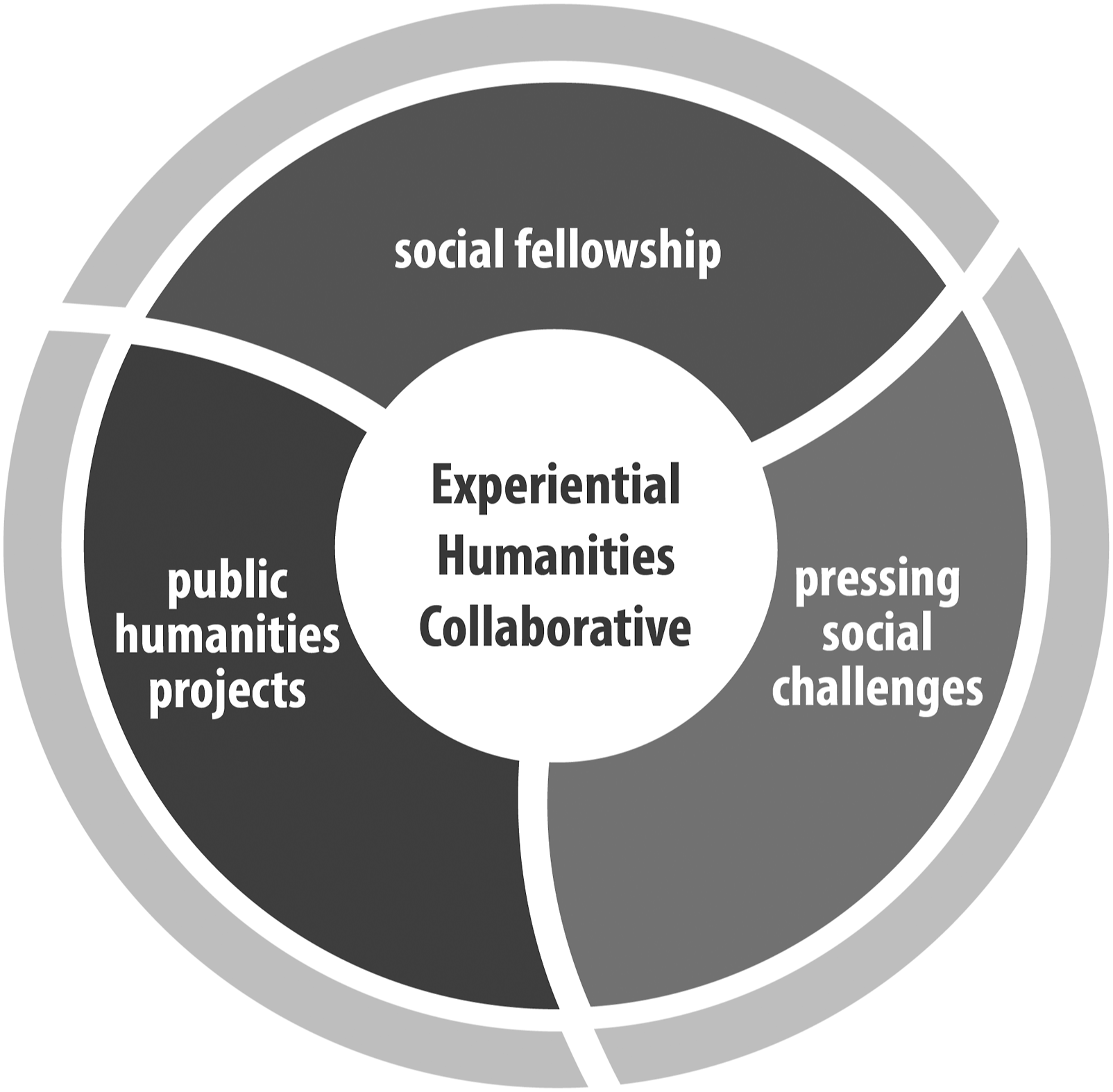
Core feature 1: A social fellowship that engages diverse teams
Like many collaborative initiatives described above, the Experiential Humanities Collaborative engages fellows from diverse roles, including faculty, students, and community partners. All fellows are generously supported to participate: Faculty Fellows are released for up to half of their courses each term during the fellowship year, Community Fellows’ organizations receive a sizeable pass-through grant, and Student Fellows are paid a competitive hourly wage for 10–15 hours of work per week over seven months.
In addition to the diversity of fellow types in the fellowship cohort, fellows engage in collaborative activities. Traditionally, university fellowship awards exempt faculty from collaborative work on campus so that they may pursue writing and research in solitude. To create an Experiential Humanities Collaborative that could bring a diverse group of fellows together to learn and collaborate, we knew from the start that our model should be a social fellowship, with frequent in-person meetings and joint activities.
Figure 2 presents the structure of the entire fellowship year. In the 10-week autumn quarter, the Faculty Fellows and Community Fellows meet four or five times as a cohort, and we encourage all teams—each pair of faculty members and their community partner—to meet independently to begin designing their courses. Our full-cohort meetings are of three sorts: visits from experts in project-based pedagogy and the public humanities, who spur ideas and build fellows’ confidence to teach courses that incorporate these practices; pedagogical discussions centered on the fellows’ emerging course designs; and trips off campus to learn about the work of the Community Fellows and their organizations, which we call “Community Partner Field Trips.” The structure of the Experiential Humanities Collaborative fellowship year. (Note: FCP team = “Faculty and Community Partner team”; HX = HumanitiesX).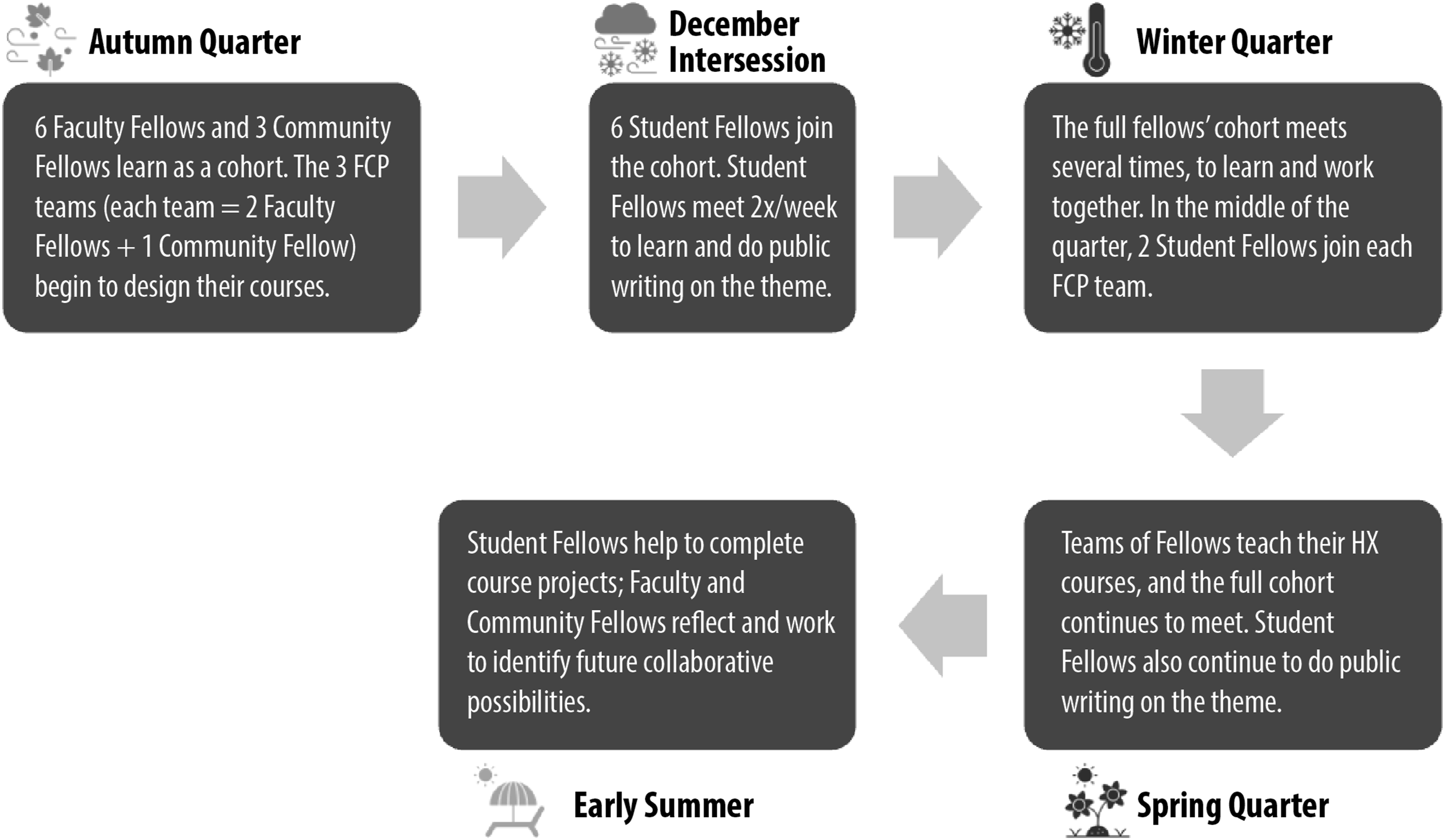
In the winter quarter, six Student Fellows join the cohort, first working with the HumanitiesX staff on public writing about the annual theme. Near the mid-point of the quarter, a pair of Student Fellows joins each of the three faculty and community partner teams. The entire cohort meets several more times, and the teams begin to put the Student Fellows to work on testing assignments and other preparatory tasks for their upcoming HumanitiesX courses, which run in the spring quarter.
This fellowship approach echoes that of the Practitioner Scholars Program at the University of Massachusetts Boston and the Baltimore Field School at the University of Maryland Baltimore County, both of which encourage collaboration by proximity, shared tasks, and the understanding that a wide range of stakeholders have something valuable to contribute. It is always not apparent to HumanitiesX Faculty Fellows what Student Fellows, and sometimes even Community Fellows, can contribute to designing a course, so we have focused on developing joint activities that clarify these contributions. For example, Community Partner Field Trips are a core activity in the autumn quarter, in which each of our three Community Fellows organizes a trip to their organization or another community site to share their wisdom about community engagement methods or the annual theme with others in the cohort. These trips allow partners to teach others about their work and foreground the knowledge and experience they, their organizations, and their communities bring to the cohort and its new courses. Student Fellows, likewise, are positioned as having valuable insights to share on course design, and they give all teams feedback on draft HumanitiesX course descriptions, assignments, and syllabi.
Core feature 2: Direct engagement with pressing social challenges
A second core feature of the Experiential Humanities Collaborative is direct engagement with pressing social challenges, both in our HumanitiesX fellows’ collaborative learning and their HumanitiesX courses. This focus emphasizes the earlier rationale that the humanities are essential in addressing these challenges. Each year, the HumanitiesX advisory council selects a social challenge that is culturally and historically complex, involves pressing matters of social justice, and is likely to feel urgent to our students. The themes to date have been immigration and migration (year 1), environmental crisis and action (year 2), and democracy and rights (year 3).
Because each fellow and team within a cohort engages with the annual theme differently, given their different expertise and roles, Faculty and Community Fellows have an authentic opportunity to learn and share resources. This exchange is encouraged through full-cohort meetings to discuss pedagogical approaches to the year’s theme and activities like the Community Partner Field Trips. For students—both the Student Fellows and the students in HumanitiesX courses—these pressing social challenges direct their learning to topics that many students are highly motivated to tackle personally and professionally.
Core feature 3: A shared goal to execute ambitious public humanities projects
The final element of the Collaborative’s approach is a shared goal to execute ambitious public humanities projects in HumanitiesX courses. Like the pressing social challenges these projects respond to, public humanities deliverables are complex and require engagement from many stakeholders. Over the three years of the Experiential Humanities Collaborative, we have moved from calling these projects “public facing” to “public humanities” projects. This language keeps humanities methods and goals at the center of our work, as Hiro and McDaneld (2022) have advocated. To conceive of public humanities projects that students can take the lead on and that benefit either our community partners and their constituents or the broader public, all fellows read and engage with Daniel Fisher’s (2019) essay, “Goals of the Publicly Engaged Humanities,” which presents five distinct goals for public humanities projects: to inform contemporary debates, amplify community voices and histories, help individuals and communities navigate difficult experiences, expand educational access, and preserve culture in times of crisis and change. Students in HumanitiesX courses also read and discuss this essay, with each course’s Student Fellows leading the discussion. Among the public humanities projects created in HumanitiesX courses are public exhibits, film screenings, public conversations, oral history collections, and digital productions for public audiences, all aligned with one or more goals articulated in Fisher’s essay. 2
As I will discuss, while ambitious and public-facing deliverables can be stressful to produce on a ten-week timeline, they can also be a source of enormous pride. In their ambition, HumanitiesX course projects show what people working together can accomplish. They provide a sense of joint accomplishment for students, faculty, and community partners, which we hope will encourage them to seek future collaborative opportunities.
Methods for evaluating the HumanitiesX fellowship and courses
Throughout the Experiential Humanities Collaborative initiative, we have assessed our fellows’ learning and growth through pre- and post-surveys. Pre-surveys have helped us better understand the fellows’ backgrounds and expectations at the fellowship’s start, and post-surveys have given us valuable feedback on the fellows’ experiences. We have also collected anonymous end-of-course feedback from students in all HumanitiesX courses. The outcomes discussed in this article draw on retrospective, qualitative analysis of fellows’ post-surveys and students’ end-of-course surveys. I used standard qualitative research methods (Merriam and Tisdell, 2015) to code and analyze the surveys. The DePaul University Human Subjects Institutional Review Board approved using these surveys for research purposes.
Data collected and data analysis
Two questions guided the analysis: 1. What did the HumanitiesX fellows (Faculty, Community, and Student Fellows) value about collaborative approaches to teaching and learning in the humanities? What did they find challenging? 2. What did students in HumanitiesX courses value about the collaborative structure and collaborative work in these courses? What did they find challenging?
To explore the first evaluation question, I analyzed the fellows’ post-survey data; the surveys asked between nine and ten questions, depending on the fellow type. The most valuable data were the open-ended responses to questions such as these: (1) Please share the top 2-3 ways you grew, personally or professionally, through your participation in the HumanitiesX fellowship. (2) Would you recommend the fellowship to other faculty/colleagues/students? Please explain your answer to the prior question. (3) What suggestions do you have for how we can improve the HumanitiesX fellowship for future cohorts?
We also asked fellows to self-report their confidence in pre- and post-surveys in three to four key growth areas, such as their ability to use project-based learning in courses (Faculty Fellows) and to engage students in their organizational work (Community Fellows). The fellows’ open-ended responses in post-surveys, which described their growth and impediments to their growth in these areas, were also analyzed.
The post-survey response rates for the fellows were as follows: for Faculty Fellows, 11 of the 12 total fellows across the first two HumanitiesX cohorts; for Community Fellows, five of the six total fellows across the first two HumanitiesX cohorts; for Student Fellows, 10 of the 12 total fellows across the first two HumanitiesX cohorts. Surveys from the third cohort of fellows were not available for analysis at the time of this evaluation.
To explore the second evaluation question, I analyzed the end-of-course surveys administered in the final week of all HumanitiesX courses. Our survey questions were created using resources from the National Humanities Alliance (Oliver, 2023). Students attentively completed these surveys, with most writing thoughtful open-ended responses to the eight questions that asked for written elaboration. The questions that yielded insights relevant to the evaluation were: (1) Would you recommend this course to other students? Why or why not? (2) HumanitiesX courses include opportunities to engage in communities, learn from community partners, and work on projects that have public audiences. What do you think you gained by doing these kinds of community-engaged and public-facing work? (3) What did you learn from, enjoy about, or find challenging about the collaborative project in this course?
The response rate for HumanitiesX students was 78 out of 98 students across the first six HumanitiesX courses. As with the fellows, student surveys from the third year’s courses were not available for analysis at the time of this evaluation.
The HumanitiesX courses
HumanitiesX fellows created and taught nine new courses over the initiative’s first three years. These courses typically enrolled between 18 and 21 students. Because all HumanitiesX courses fulfill a general education experiential learning requirement, students represented many academic majors and minors from across the university, although most students had either a major or minor in the College of Liberal Arts and Social Sciences.
HumanitiesX courses taught 2021–2024: Faculty fields, partner organizations’ foci, and major projects.
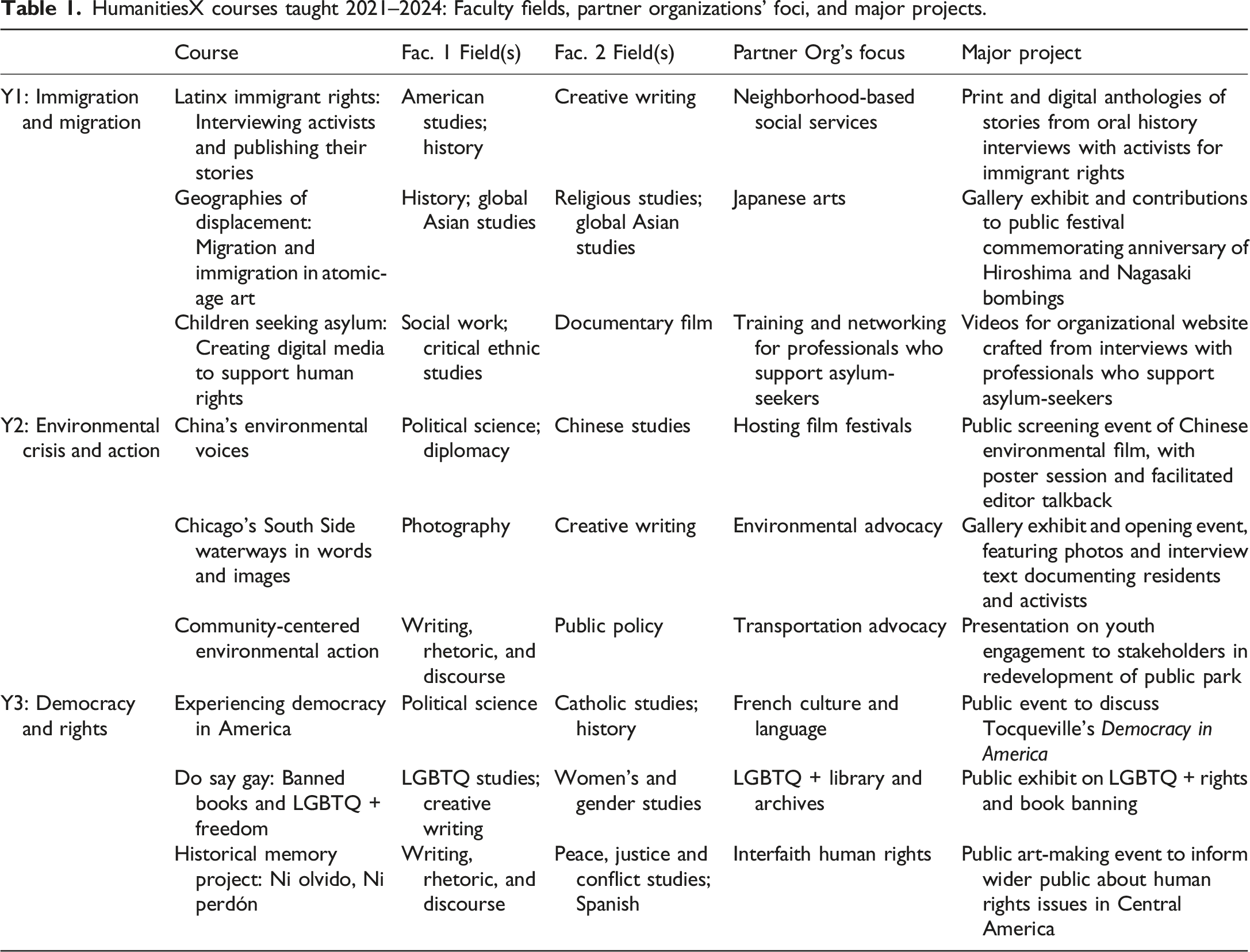
I’ll not describe the details of these courses here, but I will point to a few trends. First, all the courses, in their focus and subject matter, reflect the interdisciplinary, community-engaged collaboration at the heart of the HumanitiesX fellowship and its course-design process. Second, the courses all directly engage specific and pressing social challenges, such as how to document the stories of those fighting for immigrants’ rights, how to engage communities in environmental action, or why not to ban books. Finally, the major projects in the courses are all public-facing, ambitious, and require students to collaborate. These projects draw on a wide range of humanities methods of inquiry and understanding, including interpretation, listening and talking across cultures and generations, storytelling, archive-making, and the creative arts, and in doing so, achieve a range of public humanities goals (Fisher, 2019), especially informing contemporary debates, amplifying community voices and histories, and helping individuals and communities navigate difficult experiences.
The value and challenges of collaboration
I now share some of the key insights from our surveys of HumanitiesX fellows and students.
What faculty fellows valued: Learning together and more reciprocal community partnerships
HumanitiesX Faculty Fellows described several key benefits from the fellowship and teaching their new HumanitiesX courses: they valued learning with faculty colleagues and community partners, especially about pedagogy, and they were pleased by the more reciprocal community partnerships they cultivated in the Collaborative. Through the joint professional development sessions, many faculty learned about new humanities fields, such as the public and environmental humanities; they also learned new disciplinary and professional approaches to the year’s theme from cohort members and their teams. Notably, the ongoing conversations with peers about the humanities gave many Faculty Fellows a new or renewed commitment to teaching the humanities in ways that demonstrated their value beyond the classroom. Said one faculty member, “I developed a much better understanding of … how engaged humanities can be instrumental in serving both our students’ long-term growth and our community.”
The collaborative course-design process led to still other pedagogical insights. As one Faculty Fellow said, “My colleagues/co-instructors challenged my pedagogy, and I gained an expanded repertoire of tools for teaching that is more engaging with students.” Another Faculty Fellow clarified the pedagogical insights they gained: “I became much more reflective and intentional about the layers of work it takes to build community partnerships relevant to student learning, and the layers of work required to facilitate quality group work as well. These practices will serve all my classes well.” These outcomes are valuable for both early-career faculty, who are relatively new to teaching, and those who have taught for decades. More experienced faculty are often comfortable with their pedagogical approach but may seldom have this approach challenged or enlarged.
Faculty described the experience of co-teaching with another professor as “humbling,” “rewarding,” and “enjoyable,” harkening back to one of the key rationales for more collaboration in humanities teaching and learning: collaboration is personally rewarding. The fellows traced their positive feelings to both the social fellowship and day-to-day co-teaching. One Faculty Fellow highlighted their satisfaction with having the time to plan with such care: “We rarely have the luxury of developing a course slowly and getting lots of input from colleagues along the way. I usually feel like I don’t have time (or an incentive) to experiment with a new course/ approach/ activity.” Faculty also learned from working alongside their co-teachers in the classroom, an experience that helped clarify their own pedagogical values. As one Faculty Fellow said: “Co-teaching was very beneficial. My partner and I did not always have the same ideas about what or how to teach. I learned a lot from our discussions and from watching her.”
Faculty Fellows also valued the reciprocal nature of the collaboration with community partners. This was a benefit especially to faculty with extensive experience with community-engaged teaching. Said one Faculty Fellow, I have taught these kinds of courses for YEARS, but this felt more like a partnership than other kinds of courses, wherein it has sometimes felt like we are performing a service/project for an [organization], and they will receive it at the end of the quarter, without always the interaction in the middle (one doesn’t want to be a burden on the community partner — and this felt different because they had the pass-through grant).
The core features of the Collaborative’s approach, including the social and compensated fellowship and the chance to work in new ways with other faculty and community partners, were key to the value that Faculty Fellows took from their collaborative experiences.
What community fellows valued: Improving their collaborative skills and engagement with students
Community Fellows, likewise, enjoyed and learned from the deeply collaborative and social fellowship. They described the fellowship activities as “stimulating” and “refreshing.” Those who worked at small organizations with little opportunity to collaborate in their daily work especially appreciated the collaborative opportunities. Said one Community Fellow, who ran a small nonprofit organization largely alone: “All in all, after this positive fellowship experience, I believe I am a better team player, [I] learned how to better delegate and trust those tasked with certain responsibilities while honing my skills in supervising people—in this case the 20 students in the planning and organization of the [course’s culminating] event.”
Not all the Community Fellows spent a lot of time in the classroom during their HumanitiesX course, but for those who did, the experience was meaningful. One Community Fellow said, “Experiencing classroom teaching was amazing. My [work] usually allows for a few hours with individuals, sometimes a few hour-long classes. Getting ten weeks to build relationships and real engagement [with students] was wonderful.” One unanticipated benefit for Community Fellows who worked directly with students in HumanitiesX courses was how students reminded them about the urgency and importance of their work. A Community Fellow in the immigration and migration cohort, speaking to our HumanitiesX coordinator, had this to say: “[It was] refreshing, seeing things through the students’ perspective. For me, this [the injustices of the asylum system] is old. I’m constantly replaying this; we’re used to the everyday abuses of people. The students’ questions and comments—‘Are you serious? That’s allowed? How is that ok?’—bring that fresh consternation” (Siegel-Acevado, 2022).
What student fellows valued: Improving their collaborative skills and developing a new appreciation for interdisciplinary humanities work
The primary positive outcomes for Student Fellows were an improved ability to work collaboratively and a new appreciation for the interdisciplinary approaches required to address pressing social challenges and complete complex projects. Those Student Fellows who identified themselves as learning to be better collaborators linked this growth to feeling needed as a contributor to their team. One Student Fellow described their growth as follows: “I learned how to work with a group that was dependent [on me] and wanted my feedback/participation. I felt valued … and I learned how to respond quickly, since most of the tasks were timely.”
Another Student Fellow’s comment shows how the interdisciplinary collaboration of the HumanitiesX cohort was meaningful: Being a part of a large multi-disciplinary group made me more aware of how some of the most successful academic initiatives I’ve experienced have been cross-disciplinary. I am coming out of this fellowship with a heightened sense of approaching anything I’m doing with a lens of combining it with other initiatives that might not seem like clear pairings. I’m certainly leaving HumanitiesX feeling reaffirmed that my career can consist of multiple disciplines and many interests.
The feedback shared by these two Student Fellows is exciting. It shows that intentionally designed collaborative experiences like the HumanitiesX fellowship can support the rationales for collaboration in the humanities discussed above. These experiences can show students how collaboration across disciplines and sectors is necessary to address pressing social challenges, plus provide them with professional skills and a positive, enriching social experience.
Collaboration’s challenges: Role ambiguity, too many cooks, difficult to make hard choices
Despite the support and training provided through the HumanitiesX fellowship, collaboration between so many types of fellows proved challenging. The Student Fellows, in particular, were used to being in a subordinate role to faculty, and some were uncomfortable giving faculty pedagogical feedback. The Faculty Fellows, likewise, were not always clear on appropriate tasks for their Student Fellows. One Student Fellow in the first HumanitiesX cohort summarized an extreme manifestation of this feeling: “When things were productive and we were contributing, it was great, however a good amount of time, I found myself feeling like I was not contributing nor being needed by my team.” Each year, the HumanitiesX staff worked to develop activities and routines to counter these problems. Still, the need to proactively scaffold and consistently support collaboration across diverse groups was a clear takeaway from fellows’ feedback.
Along with role ambiguity, the feeling of having too many people involved to make necessary hard decisions emerged with some frequency in the fellows’ post-fellowship surveys. As one Faculty Fellow said, “Although I enjoyed co-teaching with my colleague, two faculty members, one community leader, and two students might be too many cooks to make broth.” The consensus approach to course design often resulted in oversaturated courses, as no one wanted to hurt their teammates’ feelings by insisting that someone’s reading, guest speaker, or topic be cut out of a too-busy week on the syllabus. A Community Fellow summarized this problem frankly: “I think we were ambitious and crammed a year’s worth of learning into 10 weeks.”
Additionally, although the teams were diligent about meeting regularly and working on the course, they often delayed making final decisions about content and activities. One Faculty Fellow stressed that while he personally liked his faculty collaborator, … we wound up reworking the course several times, and that stressed me out to no end. I think the revisions helped make the course stronger as it evolved in the [autumn], but by [winter], I was ready to really dig in and develop course readings, daily activities, and major grade items. I think we spent too much time wondering about the ‘why’ and the ‘how’ didn’t receive the focus it deserved.
What students in HumanitiesX courses valued: Fulfilling teamwork, ambitious projects, aiding in the fight
The vast majority of the end-of-course surveys completed by students in HumanitiesX courses had very positive feedback. One of the clear trends in these surveys was that doing project-based work on teams felt purposeful. Students characterized the teamwork in HumanitiesX courses as “rewarding,” “my favorite group work thus far,” and “a great experience.” One student from a 2022 HumanitiesX course said, “I enjoyed working with peers whose separate skill sets and knowledge worked alongside my own.” Student feedback suggested that the example of professional and collegial teamwork set by the HumanitiesX fellows was a model for students’ team collaboration. They also appreciated faculty members’ attention to creating balanced student teams with clearly defined tasks that contributed to the broader project goals. Students were happy to collaborate on student teams that were, by and large, functional and productive.
The ambitious public humanities projects to which these group efforts were directed, as outlined in the right-most column of Table 1, were motivating for many students. As one student said, “I enjoyed the sense of responsibility I was able to take on for completing a project that was relevant to our wider city community, rather than going through motions of event setup in school settings.” The combination of learning about pressing social challenges and doing so in a way that engages an audience beyond just the teacher can be powerfully instructive.
Furthermore, learning from the Community Fellows and their organizations and communities provided, as one student said, “opportunities to envision how [one’s] coursework can apply to wider community action.” Another student from a 2022 HumanitiesX course evocatively described the community collaboration: “It felt really good to be able to contribute to the work … Often we hear about injustice in lecture, but have little way to aid in the fight.” The traditional ways students learn in humanities classrooms—reading, listening to lectures, engaging in class discussions, and writing papers—can prime them for action, developing students’ “capacity for empathy” (Heiland and Huber, 2015: 266) or their sense of “imaginative possibility” (Hiro and McDaneld, 2022: 333). But it was rewarding for students in HumanitiesX courses to move one step further, into collaborative, community-engaged action that both applied and further complicated ideas that had just come into focus in the classroom. Notably, many of the students spoke in their surveys of leaving the course “eager” or “motivated” to seek out additional collaborative community work directed at addressing the social challenge foregrounded in their courses.
Challenges for students in HumanitiesX courses: Hectic, too ambitious
Student feedback on HumanitiesX courses also shows the challenges of collaborative teaching and learning. First is the problem of “too many cooks.” In the minority of comments, but present throughout the surveys, were comments about HumanitiesX courses that felt “muddled” or “hectic.” A student in one of the 2022 courses expressed this sentiment: “I appreciate that they [the two faculty instructors and community partner] have different backgrounds in the topic, but having so many people in leadership positions made the class feel hectic.”
Logistically, students frequently said that these courses required a lot of work outside of class time, and they wished the high-stakes final public projects were started earlier in the term. There was a notable preference among students for having class time to do group work on the course projects, which some faculty were reluctant to accommodate, especially those new to project-based or community-engaged learning. “I don’t think,” one student in a 2022 course said, “I would have the time to put this much work into a regular requirement class again.” Student Fellows often reported that time for group work on projects would be scheduled for the end of class sessions, but that lecture or discussion would run long, leaving little or no time for in-class group work. For DePaul University’s largely commuter- and working-student population, coordinating complicated group work outside class time was very challenging.
Besides confusion about courses with overly ambitious goals, some students found the weeks leading up to their course projects’ completion and public presentation too stressful. One student in a 2023 course said, “I feel like this course has the potential to be great [but] just needs more structure and a better timeline to set students up for success.” Over time, the HumanitiesX staff team has adjusted the fellowship activities to head off these problems; for example, we now require a community-engaged activity early in each course, to encourage an earlier start on the major course project; we lead a professional development session for fellows focused on how to support productive and functional student teams; and we work directly with teams of fellows to trim their syllabi and scale back too-lofty project ambitions. However, there is some truth to the conventional wisdom that the most important lessons about community-engaged, project-based learning come only through firsthand experience.
Lessons for other universities: Why and how to make collaboration a core humanities practice
As this review of collaboration in humanities teaching and learning and close look at the Experiential Humanities Collaborative demonstrate, universities can incubate and support collaborative courses and collaborative learning in the humanities. Without a doubt, collaboration is complicated and holds more risks of disappointment than the lecture and seminar pedagogies we are used to. However, the rationales for collaboration discussed here—that today’s pressing social challenges call for collaborative inquiry and action and that collaboration has professional, civic, and personal benefits for faculty, students, and community partners—along with the many positive sentiments and outcomes expressed by students in our HumanitiesX courses, make a strong case for adding more collaboration to the humanities’ pedagogical repertoire.
One lesson from the Experiential Humanities Collaborative is to put collaboration at the center of initiatives designed to support humanities faculty. To do so means creating authentic occasions and motivations for collaboration, such as opportunities to co-design new courses or launch community-engaged projects. It also means offering cohort-based social learning activities and teaching strategies for collaboration. Existing campus sites of collaboration between humanities faculty and community partners, like humanities centers or community engagement centers, are promising conveners for these initiatives. While the incentives we provided for collaboration, including course releases for faculty and pass-through grants for community partner organizations, were essential to encouraging full and reciprocal participation, interested faculty and partners may be content with less generous and more institutionally feasible incentives, especially given the intrinsic rewards of collaboration.
Another lesson is to anticipate and make explicit challenges and problems related to collaboration, such as oversaturated courses and stressful ramp-ups to public-facing projects. These have seemed to us to be manageable, not insurmountable, challenges. We now kick off the joint activities of the HumanitiesX fellowship cohort by sharing anonymized evaluation feedback from past cohorts of fellows and students and discussing with the new fellows the value of and challenges to collaboration. We also have grown increasingly directive with fellows about the need to prune back readings and begin project-based work early in the term. One clear insight about collaboration is that it often requires extending beyond one’s comfort zone, which makes it particularly important to prepare people to navigate new roles and to give them clear collective goals to work toward.
It is difficult to know if the three core features of the Experiential Humanities Collaborative are all critical to successful collaboration or the degree to which these features depend on each other. Could collaboration be encouraged through a social fellowship without a shared annual theme? Is a public humanities project necessary to focus students’ collaboration? As of this writing, we are experimenting with HumanitiesX fellowship approaches that are less logistically complex. In addition to co-teaching teams, we now recruit solo-instructor teams, and all teams now have one rather than two Student Fellows. We have also scaled back incentives for all fellows, with an eye toward future sustainability, and trimmed a few in-person meetings from the fellowship. This year is also the first that the annual cohort will not have a common theme.
Also important to advancing collaborative teaching and learning in the humanities is that humanities researchers continue to open the black boxes of collaborative course design, collaborative teaching, and the collaborative work of student teams, to clarify for others interested in this work which structures and tactics for collaboration work best and the challenges and potential problematic aspects of this work. Most researchers who study and publish on collaborative teaching and learning are not humanities scholars, nor do they imagine humanities faculty as their audiences. Finally, another important focus for future research is a better understanding of the long-term effects of collaborative practices on individuals, institutions, and communities. Balliesen et al. (2024) have begun to report the lasting impact of Duke University’s Bass Connections program on students, but there are few other examples of such research. Understanding the impact of collaboration on community partners and their organizations is also a priority for future research.
Three years of collaborative activities in the Experiential Humanities Collaborative have yielded courses and public humanities projects that are more visible and ambitious than what typically happens in humanities courses at our university. The project has fulfilled its aim to showcase the possibilities for deeply collaborative teaching and learning in the humanities. The voices of the students, faculty, and community partners captured in this article suggest that it is well worth the effort to make collaboration a core practice in teaching and learning in the humanities.
Footnotes
Acknowledgements
Thank you to the three cohorts of HumanitiesX fellows for being so curious, committed, and fun. Thank you also to professor and associate dean Margaret Storey, whose ongoing intellectual exchange with me has stimulated and refined many of the ideas in this article.
Declaration of conflicting interests
The author(s) declared no potential conflicts of interest with respect to the research, authorship, and/or publication of this article.
Funding
The author(s) disclosed receipt of the following financial support for the research, authorship, and/or publication of this article: This work was supported by grant No. 1807-06020 from the Mellon Foundation and DePaul University’s College of Liberal Arts and Social Sciences.
Consent to participate
Consent to participate in this study was waived by the DePaul University Institutional Review Board.
