







Abstract
Calls to rethink our ethical and political responsibilities with nonhuman others abound recent work in cultural geography. Such work unpacks the more-than-human agencies reshaping and rematerialising our bodies and subjective knowledges. This article uncovers the coproduction of human knowledges and urban spaces by examining the problematic migration of the Australian White Ibis into Australian urban localities. We put forth a storied approach to human-ibis relations, capturing the multiple and situated experiences materialising our urban relations with the species. Drawing on ibis ethology, media narratives, personal and interviewee stories, we explore how ibis take part in the co-constitution of urban spaces and identities. In particular, we examine how the ibis as a pest narrative is mobilised and reproduced in public and media discourses that shape the species identity and influence modes of relating. Both the publics and our own personal intra-actions with ibis shed light on conceptions of nonhuman belonging, death and human desires for living-with. This article forwards a cosmopolitical approach to provoke a reconceptualisation of our ethical and political responsibility with urban ibis. We question the narrative of ibis-as-pest to forward ideas of living-with that provokes new modes of relating, uncomfortable for either party. Within these precarious relations, possibilities open for nonhierarchical modes of cohabitation, challenging our political and ethical responsibilities in living-with uncomfortable others.
It baffles the mind as to why the ibis have chosen there [Lake Annan] . . . there aren’t so many preferable habitats for them, there aren’t these natural wetlands, but even where there are some wetlands they’re not considered desirable because they are considered a species that will outnumber and outcompete some of the natives, where there isn’t necessarily any evidence of that.
1
Along the east coast of Australia, White Ibis have migrated into urban locations in response to drought and habitat loss in their traditional locations along the wetlands of the Murray-Darling Basin. In making this move, ibis have provoked the consternation of local residents and municipal authorities earning them the title of ‘urban pest’, making them the target for various eradication strategies. Ironically, artificial lakes meant to bring placid surrounds for local residents have instead provided ideal habitat for ibis, forcing neighbouring residents into undesirable modes of cohabitation. A tension remains between those concerned with the plight of the ibis as it migrates from declining wetlands, and those claiming that ibis do not belong in the city. It is within this array of human and nonhuman bodies and encounters that we begin.
The dismantling of the symbolic borders separating the city from nature has led to an examination of the more-than-human agencies shaping urban design and influencing human and nonhuman performances. 2 Recent debates in cultural geography recognise cities as intrinsically materialised through both human and nonhuman actors. However, questions of human-nonhuman cohabitation are far from resolved. This article explores our political and ethical responsibilities with nonhumans rendered ‘unwanted’. Drawing on a more-than-human ontology, we examine human-ibis encounters that position the Australian White Ibis as a pest, and ask how this framing influences modes of relating. We query the cosmopolitical to understand how through the subject- and object-shaping dance of encounters new relations are forged – raising questions of who belongs where and what flourishing means for whom? 3
The Australian White Ibis migration is met with intrigue and ambivalence. We argue that ibis presence in the city disrupts human positions of control as ibis challenge their placement and disrupt the conceptions of domesticated urban wilds. In this article, we use the term ‘storying’ to capture the various actors taking part in human-ibis relations and the coproduction of urban identities. Drawing on van Dooren and Rose, we explore places as becoming ‘co-constituted in processes of overlapping and entangled “storying” in which different participants may have very different ideas about where we have come from and where we are going’. 4 The article adopts a multi-method approach to understand the migration of ibis, their interactions in urban spaces and how narratives of pest and victim emerge and are reproduced in public discourse. First, we review ibis ethology literature documenting the species’ migration to cities, and how ibis use anthropogenic resources. Second, we outline the history of ibis representation in the media to provide a brief overview of how the ibis became framed as a pest. Furthermore, we piece together media narratives in concert with interviewee and personal stories to capture the situated experiences of human-ibis relations.
Finally, this article calls for an ethics of conviviality with ibis, knotting together regard and respect – entering a ‘world of becoming-with, where who and what are is precisely what is at stake’. 5 Such collectives are unpredictable and challenge modes of relating that are never fully comfortable. A cosmopolitical approach requires novel ways of relating with ibis to articulate these divergent worlds of open possibilities. 6 We aim to bring forth questions of living and dying, nurturing and killing to provoke the messy asymmetries of cosmopolitical futures.
Storying intra-action
Nonhumans inhabit cities in diverse ways, giving rise to complex urban relations that coproduce space and urban identities. This article adopts a storied approach to more-than-human intra-actions capturing the material and the discursive processes in the meaning-making of places and urban relations. We grapple with the question of how to tell complicated stories of multi-species intra-action – apprehending multi-species narratives eliciting human-ibis relations of power/powerlessness, pest/victim and killing/nurturing. This resonates with Haraway’s and van Dooren & Rose’s multi-species story-telling practices, showing the complex intertwinings of bodies, stories and place in constituting the world. 7 To bring forth multi-species stories offers a means towards convivial cohabitation – illuminating the shared places we inhabit as more-than-human.
Nonhuman life in urban spaces is far from straightforward. Rather, what species belong/do not belong is tied within conceptions of order and naturalness. In Australia, nature-in-the-city is frequently portrayed through a post-colonial vision, forcing nonhumans to conform to a domesticated and regulated version of wildlife. 8 Furthermore, the subject of animal belonging is not so much about individual species, but other categories with real consequences for who lives, who dies and how. 9 Primarily, the native/non-native classification has been mobilised to signal what species belong and what are out-of-place. 10 However, such classifications are ‘accused of being historically arbitrary, geographically ambiguous, ecologically unsound, culturally insensitive, socio-politically dubious and economically futile’. 11 Following Van Dooren, we aim to not only problematise the constructed categories of nonhuman animals, but to think critically about the kinds of nonhuman relations we wish to foster and why. 12
The pest category is a powerful narrative influencing modes of relating and demarcates positions of belonging. Urban pests are unwanted species positioned as out-of-place and whose presence is met with discursive and material reaction. Pest animals are ‘neatly identified, delimited and positioned so as to be separate from and not overlapping with other urban natures that are positioned to belong’. 13 Furthermore, such classifications deny the ‘heterogeneous multiplicity of the living’ that animals possess. 14 Pest animals become fixed abstractions ‘cleaved apart from the messy time-space context . . . in which these animals actually live out their lives’. 15 Work in cultural geographies critiques the border-making practices these discourses enable, not as purely social constructions, but as multi-species achievements. For example, Power’s work on suburban residents’ living-with brush tail possums revealed the bordering of homes as an exclusionary practice separating the domestic space from nature, wildness and nonhumans as ‘outside’. 16 However as Power suggests, ‘home is also porous in ways that exceed human design, becoming host, for example, to a diversity of nonhuman “pests”’. 17 In this context, nonhuman pests emerge as those unwanted species transgressing their (human) placement and unsettling human desires of control and security. Furthermore, Escobar explores the politics of exclusion in removing pigeons from Trafalgar Square. 18 As Escobar states, ‘the controversy was not merely about the material presence of pigeons in the square and hence about the politics of place concerning urban animals, but also about the place of pigeons in the pursuit of civility’. 19 Nonhuman recalcitrance actively unsettles human conceptions of control and order, engendering a range of actions that aim to mark human positions of power, and enact a more desirable nature.
Moreover, nonhumans do not just exist in cities, but more importantly are entangled in complex processes of becoming as they shape and are shaped by their urban relations. For example, Collard reveals how cougars continually upset the ‘orders and delimitations through their adaptability and variability’. 20 Human-cougar entanglements transform space and modes of relating made and remade through the face-to-face encounters, and those movements we do not witness. 21 Processes of bordering, eradication and killing emerge through human-animal entanglements coproducing pests, making their lives (at times) ‘killable’. 22 To understand pests as coproduced offers a new challenge in thinking through the political and ethical implications of living-with unwanted species.
The relational turn captures how ‘diverse human and nonhuman forms, minds and bodies, emerge from specific, lively and sentient ecologies’. 23 Recent scholarship draws attention to intra-actions that bring together human and animal bodies shaping identities and relations. 24 Intra-action provides a framework for enriching a more-than-human ontology; it seeks to delve into the complex intertwinings of animal agency, identity, human subjectivities and place. Such an approach furthers Hayles’ question of ‘what happens if we begin from the premise not that we know reality because we are separate from it, but that we can know the world because we are connected with it’. 25
Intra-action provides a framework to reconceptualise our relations as something more fluid and temporal – recognising matter as a product of its relatings. 26 Here, subjectivity and agency are rematerialised through the intra-actions between humans, nonhumans and the broader spaces of which they are a part. Furthermore, Barad’s concept of material-discursive practices enlivens the materiality of identity, agency and discourse as emergent properties. Material-discursive practices are both ontic and sematic and continued via agential intra-activity, that is, reproducing material reconfigurings of the world that enact our reality. This echoes Haraway’s claim that ‘once “we” have met, we can never be “the same” again’. 27 The concept of intra-action ruptures subject/object divisions opening possibilities for uncertain futures where lives fall in-and-out of purview. For Barad, our embodied placement ‘is a matter of not being specifically situated in the world, but rather of being of the world in its dynamic specificity’. 28 The world and the objects around us are continually made and remade through intra-actions. Our conceptualisations of reality and bodily performances do not pre-exist, but emerge through specific intra-actions.
Such reconfiguring of matter and agency necessitates a reconceptualisation of how we relate to and engage with nonhumans. Stengers’ cosmopolitics offers an alternative, which seeks to unbound contemporary human-human modes of political engagement to include nonhuman life.
29
‘It creates the question of possible nonhierarchical modes of coexistence among the ensemble of inventions of nonequivalence, among the diverging values and obligations through which the entangled existences that compose it are affirmed’.
30
As Paulson argues, . . . It is not enough to decide to include nonhumans in collectives or to acknowledge that societies live in a physical and biological world as useful as these steps may be. The crucial point is to learn how new types of encounter (and conviviality) with nonhumans, which emerge in the practice of the sciences over the course of their history, can give rise to new modes of relation with humans, i.e. to new political practices.
31
Intra-action draws out the complexity of our more-than-human relations. The point is not to celebrate complexity but to become worldly and to respond. 32 Cosmopolitics opens the possibilities to grapple with those nonhuman animals, estranged and familiar, loved and loathed, pulling us into the unpredictable world-makings of multi-species intra-actions.
These intra-actions do not necessitate harmonious futures. As Haraway posits, ‘cosmopolitical questions arise when people respond to seriously different, felt and known, finite truths and must cohabit well without final peace’. 33 However, to take such relations seriously opens our political imaginations and commitments. Stengers notes such relations as a form of symbiosis involving ‘two heterogeneous ways of being, both needing the other because without the other none of them would be able to achieve its own pathways and goals’. 34 If the lives of living beings are entangled with each other, and in the spaces provisioning them, then how can this symbiosis translate into new modes of relating?
Unsettling the anthropocentric city as something more-than-human forces us to question what constitutes a multi-species city and how it may be shared. This task poses a challenge in conducting politics with those entities beyond current frameworks that prioritise human expertise and knowledge. 35 We need to not only mark the presence/absence of species, 36 but also offer an inclusive platform for nonhumans. Thus, cosmopolitics involves a double injunction: to take risks in allowing others (of all categories) to object to the discourses we circulate about them, and to allow them to intervene in our processes as much as we intervene in theirs. Rather than being concerned with subtle epistemological shifts, cosmopolitics involves questions of ontology, attempting to unravel constructivist divisions that delegate what knowledge is valuable and for whom.
In what follows, we aim to explore what kinds of life-affirming togetherness may emerge in the urban entanglements of ibis, humans and others. 37 Ibis life in urban settings induces ambivalence as they unsettle positions of human power and desired natures. However, such negotiations of power and control are never autonomous, but achieved in the dance of ‘becoming-with’. 38 We question the modes of becoming-with that shape our attitudes and actions and influence human-ibis relations. In coastal settings along the east coast of Australia, ibis rupture the city as a multi-species site, where modes of living-with are far from resolved. Within this uncomfortable space of multi-species mixing, ibis are positioned as a pest, resulting in material consequences for ibis bodies that are rendered disposable. Reducing ibis numbers is seen as necessary practice in order to coexist in the city. However, such coexistence remains fixed to human priorities of what life belongs where, and for whom. We aim to think through the multi-species city as a site for mutual cohabitation with ibis where modes of living-with are never fully comfortable. Such an endeavour requires an investigation of bodily practices, leading to greater understandings of more-than-human relations and how we may envisage living-with unwanted ibis.
Exploring human-ibis intra-actions
To explore human-ibis entanglements, we gathered media, participant and personal stories of encounter, focussing on sites of human-ibis conflict in urban areas. In total, four sites were chosen: two from New South Wales (NSW) – Lake Annan (Mt Annan) and Lake Gillawarna (Bankstown) (both Sydney local government areas (LGAs)), and two from Queensland – Russell Hinze Park (Oxenford) and Black Swamp Wetlands (Cleveland) (located in south east Queensland) (see Figure 1). At these sites, ibis colony size, current and past management strategies and reporting of human-ibis contestation were investigated.
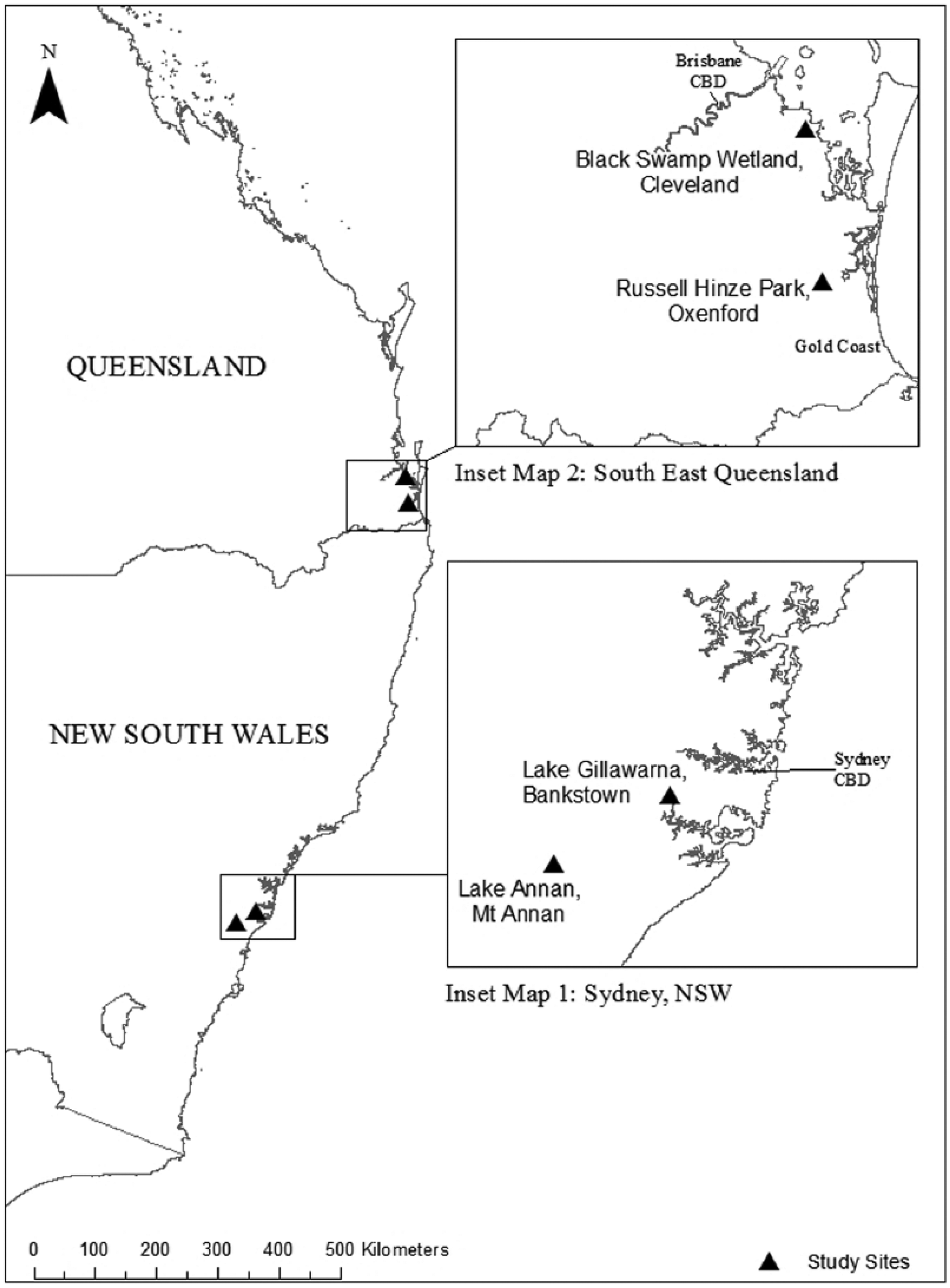
Map of study sites in Sydney NSW and South East Queensland.
We began the study by gathering public stories sourced from Australian newspapers, from 1998–2012. In total, 68 articles were collected with the majority of articles sourced from NSW and Queensland publications. We examined the factual presentation as well as connotative and anthropomorphic language in the articles’ categorisation of ibis. The connectivity of these articles was investigated by examining their intertextuality – that is, how certain texts were shaped by others in composing an overall tone. 39
Next, we talked to three key participants who were selected on the basis of their public and professional reputation in urban ibis management and scientific study. We were interested to obtain their insights into ibis behaviours, how ibis are perceived publicly and issues of ibis belonging and management. We were also concerned with local ibis history; reactions of local residents to ibis population increases; local councils’ perceptions of ibis, and what, if any, ibis management has been implemented.
Finally, overt and covert encounters provided a means to unravel the affective capacities of human-ibis intra-actions. These two approaches offer a method to become entangled with ibis in an attempt to ‘map into knowledge’ human-nonhuman intra-actions and how they are performed. 40 Mapping into knowledge highlights the ontological indeterminacy of intra-actions by acknowledging the iterative nature of the research processes. From this perspective, knowledge does not pre-exist enquiry, but is reconstituted through engagements between the researcher and the researched. This approach follows Kirksey and Helmreich as we seek to bring ‘organisms whose lives and deaths are linked to human social worlds’ closer into focus as living co-constitutive subjects, rather than simply relegating them to ‘part of the landscape, as food for humans, (or) as symbols’. 41 Our purpose was to attempt to become immersed in the human-ibis intra-actions teasing out the diverse ways ibis inhabit the cities and relations with other beings.
Fourteen site visits were conducted for a total of 28 hours of overt and covert encounters. More specifically, overt encounters involved walking ethnographies of the sites, taking photographs and recording notes on nonhuman encounters. Similar to Candea, this also involved a form of inter-patience whereby inaction attempted to detach the researcher from the researched to enable mutual habituation. 42 Our task was to understand how specific intra-actions influence the knowledge produced as researcher and researched respond to each other’s actions, ‘including their pace, gestures, comportments and bodily orientations’. 43 As a result, covert encounters were used to understand how the researcher’s practices and actions influenced the behaviours of other nonhuman actors. As opposed to overt, covert encounters were discrete: the researcher concealed camera and notebook, ensuring all recording of field activities was not witnessed by other actors.
Finally, as human geographers our experiences in ibis ethology is absent. We are unable to articulate from an ecological stand-point the ibis behaviours and whether they are common or rare. However, our purpose was not to document ibis behaviour patterns, how they nest, breed and so on, but to experience human-ibis relations, and to gain insight into these modes of relating in an urban setting. We aimed to take part in these processes to gain a more enriched understanding of how the public come to relate to the ibis, and vice versa, and whether our personal experiences relate to circulating pest narratives. How we experience such encounters is unique in the intra-active process of becoming-with. As a result, we do not aim to project our experiences as representative of others; rather we intend to tell stories that matter for enacting forms of human-ibis conviviality in urban places. Our ambition is to shed light on how our experiences shaped us, flirting with the possibility of translating our experiences beyond simplistic anthropomorphic reflections.
Ibis and the city
The Australian White Ibis (Threskiornis molucca) is an Australian native species, protected under New South Wales and Queensland legislation. 44 Ibis are identifiable by their large white bodies, featherless black heads and long black downward-curved bill (see Figure 2). The White Ibis’ traditional habitat is inland wetlands, particularly the Murray-Darling Basin – a region encompassing much of Australia’s prime agricultural land and water storage. However, the past 25 years have seen a drastic decline in wetland bird populations with Murray-Darling annual aerial transect surveys revealing a variability in ibis population ranging from 1986 counts of 24,000 to 3,000 from 1998 to 2006. 45 This decline reflects the environmental impacts of drought and human encroachment – through damming, weirs and water distraction and diversion in eastern inland wetlands. Over the last 25 years, ibis populations have shifted their core distribution to urban centres along the east coast of Australia, which provide reliable food, water and habitat. 46
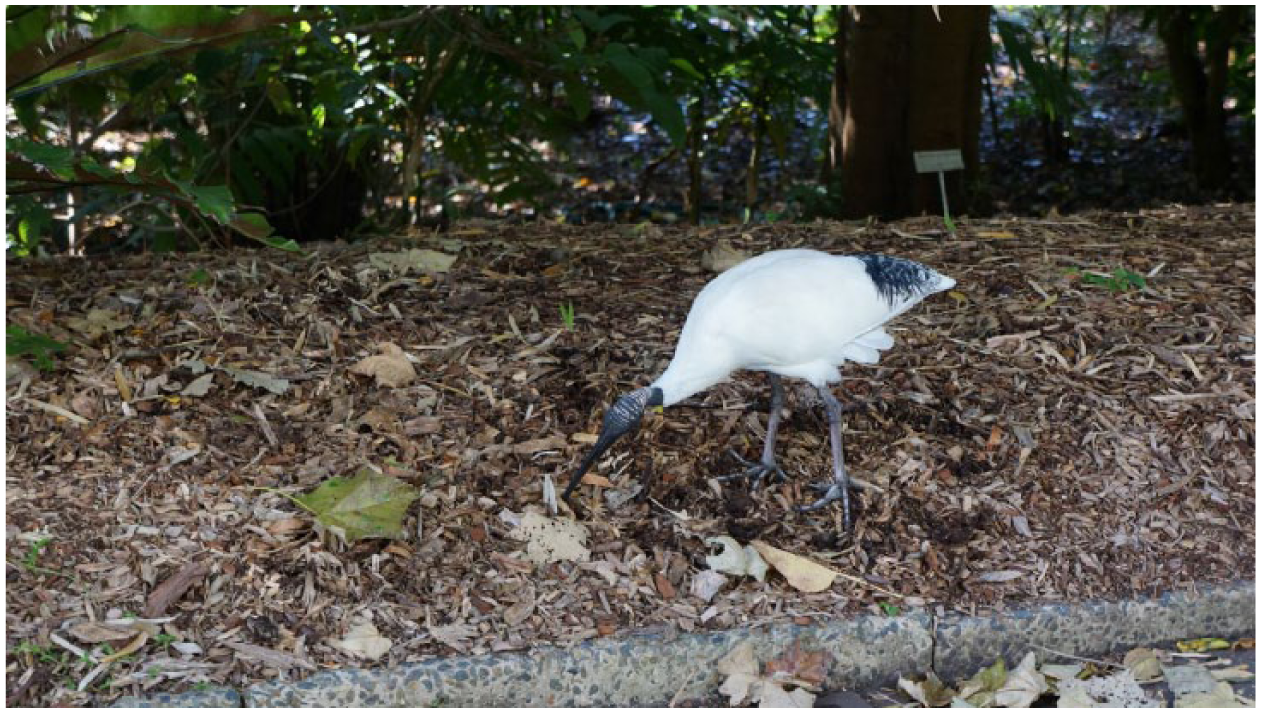
Australian White Ibis (Threskiornis moluccus).
Research demonstrates ibis’ ability to occupy a wide range of habitats and to be commensal with humans. 47 Ibis use a range of resources across urban landscapes (e.g. parks, wetlands, landfills and street trees), rather than occupying exclusive areas to forage and nest. 48 As a result, ibis’ foraging range can be up to 35 km to source anthropogenic resources, most commonly landfills. For example, a radio-tracking study found 85 per cent of multiple Sydney ibis colonies forage at landfills, with some birds making multiple trips per day. 49 Furthermore, a study of a Sydney ibis population observed numbers doubling between 2006 and 2008, from 4,200 to 8,900. 50 Increasing breeding seasons and population growth highlight the need to critically engage with human-ibis relations in urban environments.
Human-ibis conflicts are common in areas where ibis colonies are in close proximity to residential houses. Ibis smell, noise and excrement are issues prompting calls for their removal. Furthermore, concerns of disease transfer to humans, fauna displacement and flora degradation fuel management operations. However, the primary catalyst for ibis management has been the risk of aircraft strike following several million dollars’ worth of damage when an ibis was drawn into a jet engine. Ibis are now listed as the second highest avian threat to aircraft safety in Australia. 51 As a result, management practices predominately aim at reducing population size and creating species dispersal. Several strategies are used to control the growth of ibis populations including ‘habitat modification, nest and egg destruction, waste management at landfills and to a lesser extent shooting’. More recently, egg oiling is implemented whereby eggs are coated in canola oil to prevent incubation, and because the egg remains intact, ibis continue to incubate the non-viable egg. 52
To date, urban ibis management has largely been ad hoc with focus placed on single colonies, resulting in a lack of coordination and understanding of the long-term consequences for a long-lived species (26 years). Martin et al. observe that ibis which have been discouraged via egg and nest removal are likely to establish new or re-establish existing colonies within a 10 km radius. 53 Similarly, ibis exclusion from food sources is more likely to broaden daily foraging than lead to the birds abandoning established colonies. Thus, management practices need to consider the regional, state-wide and national implications.
Ibis presence in urban environments is expected to grow with global climate predictions and water-use patterns in traditional ibis habitat. Ibis’ reveal themselves to be highly adaptive to untraditional environments as they learn to live-with humans – gaining food from human waste and sourcing habitat from human constructions. However, this ability to adapt to the urban environment increases human-ibis conflicts and subsequent management actions. The following sections will detail in greater depth these conflicts, focussing on how ibis become pests. Ibis ethology tells part of the story, detailing the reasons for their migration to cities and their proliferation. However, there remains the need to consider human-ibis intra-actions, shaping how we value and relate to this urban coloniser.
Narrating the ibis as pest and victim
We turn to media stories to help unravel how the material agency of the ibis might ‘prise questions about the cultural norms that determine who belongs into the public and who does not, and about the ways in which such norms are secured, challenged and redefined’. 54 Ibis drew little public attention until the early 2000s (see Figure 3) when headlines such as: ‘Thousands checking in at ibis resort’ 55 and ‘Evolution at play in our back yards’ 56 began reporting ibis population increases in cities. These articles were largely neutral in portraying ibis, drawing on scientific explanations of ibis migration, as well as surveys of population size. This brought attention to ibis populations in cities, marking the beginning of a migration that continued into the next decade. However, as ibis populations expanded into cities along the east coast of Australia, media coverage began to frame the species as a pest. Ibis pest status marked a shift from appreciating ibis as a novel guest to a native pest. From 2003 onward, pest narratives became a common discourse. These centred on ibis causing fauna displacement, damaging flora and being a public nuisance. In particular, citing ibis as damaging existing flora positioned the species as detrimental to existing urban natures. This discourse was often mobilised in strategies to manage ibis numbers. In 2003, the article, ‘Ibis cull to start in Sydney’, detailed Bankstown Council beginning a cull of 1,000 White Ibis occupying Lake Gillawarna due to the birds ‘stripping vegetation in the area’. 57 This marked an early example of ibis management, as ibis colonies began transforming existing urban spaces. As ibis populations continued migrating to cities, media narratives of human-ibis conflicts followed. This narrative drew on public concerns of ibis smell, noise and scavenging habits as problematic for urban residents. An article titled, ‘clipping the wings of ibis’, not only positioned ibis in Lake Gillawarna as ‘detrimental to the lake’s well-being’ but also drew on resident complaints about the ‘noise, smell, unsightliness and health risks posed by the colony’. 58 Ibis were now positioned as conflicting with human desires of what nature in the city ought to be. This continued with media reports eliciting residents’ personal encounters with ibis. The article, ‘Rain brings ibis relief’, draws on a local resident’s complaint in living-with ibis: ‘Ibis destroyed everything in my garden, they are awful birds I have never seen [them] before. They make air pollution because of their feathers and their waste. They also made noise from midnight to early in the morning’. 59 It is in the everyday lives of urban residents where ibis became unwelcome. These narratives report the inability to live-with, as ibis management becomes necessary and justified in order to control this overabundant nuisance.
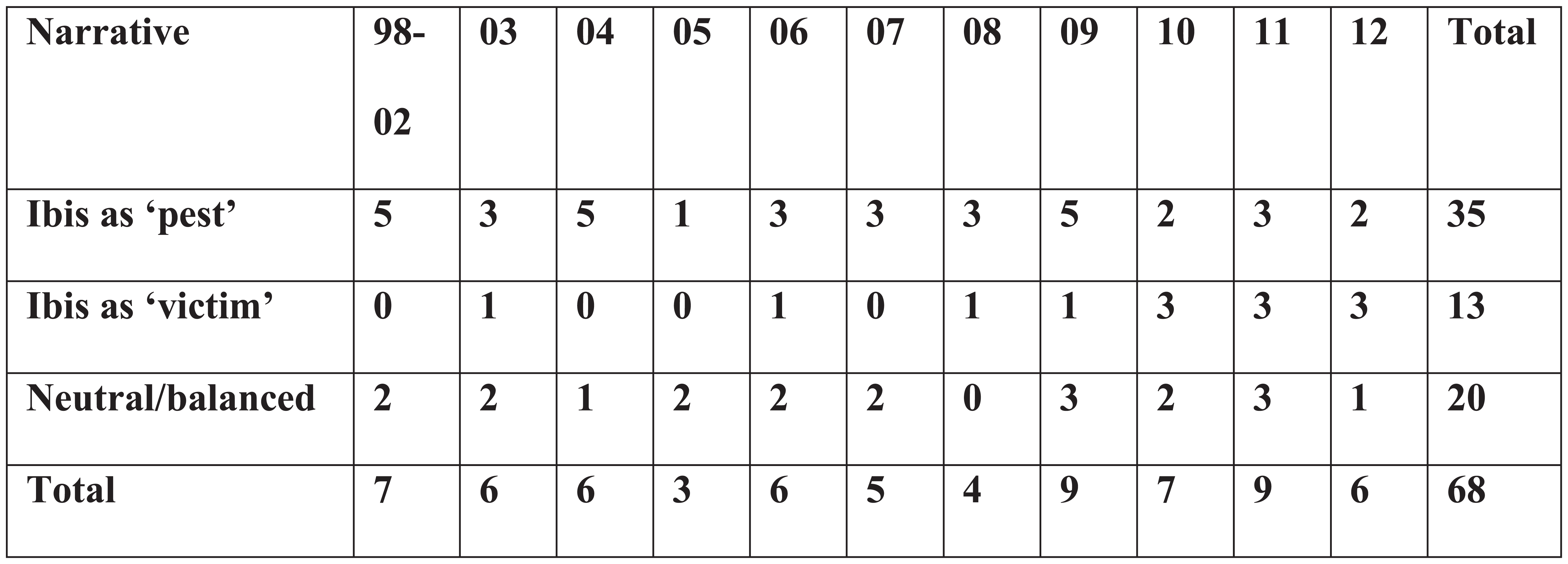
Overview of ibis representation from 1998–2012.
However, increasing ibis numbers and severe drought in the 2000s stimulated a counter narrative of ibis as an environmental victim and refugee. Partly a response to increasing ibis management, these narratives began to call for social understanding towards the plight of ibis. In 2003, a Sydney Morning Herald article titled, ‘Drought refugees chased out of town’, 60 positioned ibis as environmental refugees fleeing drought that has destroyed their traditional habitat. While the ibis as a victim remained marginalised, in 2006, a steady increase in coverage recognised the effects of inland drought on ibis populations. Consequently, ibis as a victim became the most common narrative in 2010 with articles such as ‘Hatching a fresh approach’ documenting the ‘sad plight of a species regard by some as a pest’. 61 The increase in the victim narrative may have emerged as a result of renewed effort in the scientific community to understand the reasons for ibis inhabiting the city, as well as the challenges of managing urban ibis. The focus shifts from how to remove this pest to whether it is possible to live-with this victim. The rise of the victim narrative also coincides with an increase in total ibis articles from 2009–2011. The growth in media interest corresponds with increased flooding events in NSW inland wetlands and the end of the long drought. During this period, stories focussing on the pest narrative called for ibis to return to inland wetlands. Simultaneously, the victim narratives questioned whether a suitable habitat even remained.
Both narratives provide a snapshot of the ambivalent history of ibis in Australian coastal cities. In what follows, we aim to further embed media narratives throughout our personal and interviewee stories to position the city as a metabolic site inhabited by various human and nonhuman entities. Entangling ibis stories unveils the intra-actions giving rise to ibis as a pest or victim, compelling us to think through the city as a shared multi-species site.
Entangled stories 62
How do we relate to the ibis outside a dualistic frame of either pest or victim? How do we transform the usual narrative of eradication to a story of entangled human-nonhuman neighbourliness? To enrich and extend the media narratives and ibis ethology literature, we map into knowledge personal, interviewee and media stories, further unravelling the position of ibis in the urban lives of humans and nonhumans. We highlight the diverse potentials of ibis relations, understanding the affective capacities of ibis as emerging in their intra-activity.
Lake Gillawarna
We begin with Lake Gillawarna, an artificial freshwater wetland created in 1973, located in Georges Hall, NSW. Situated in the Bankstown LGA, Lake Gillawarna is approximately 20 km south-west of Sydney’s central business district (CBD), set in close proximity to residential housing. The lake consists of three islands covered with a mix of native and exotic flora, now a nesting place for ibis (see Figure 4). Furthermore, Lake Gillawarna’s proximity to Eastern Creek landfill (approx. 20 km) provides a food supply well within the daily foraging distance of ibis. Ibis history in Lake Gillawarna has been met with angst since the establishment of their colony in 2001. The Bankstown Councillor describes the problematic arrival of ibis to Lake Gillawarna: Well my role started when they became a problem and invaded our lake down there in Lake Gillawarna. We have 4000 ibis take over the lake and they disturbed all the wildlife that were there, the ducks, the swans, little birds they virtually left and that was the start for me to try to get something done to alleviate the problem they’ve caused.
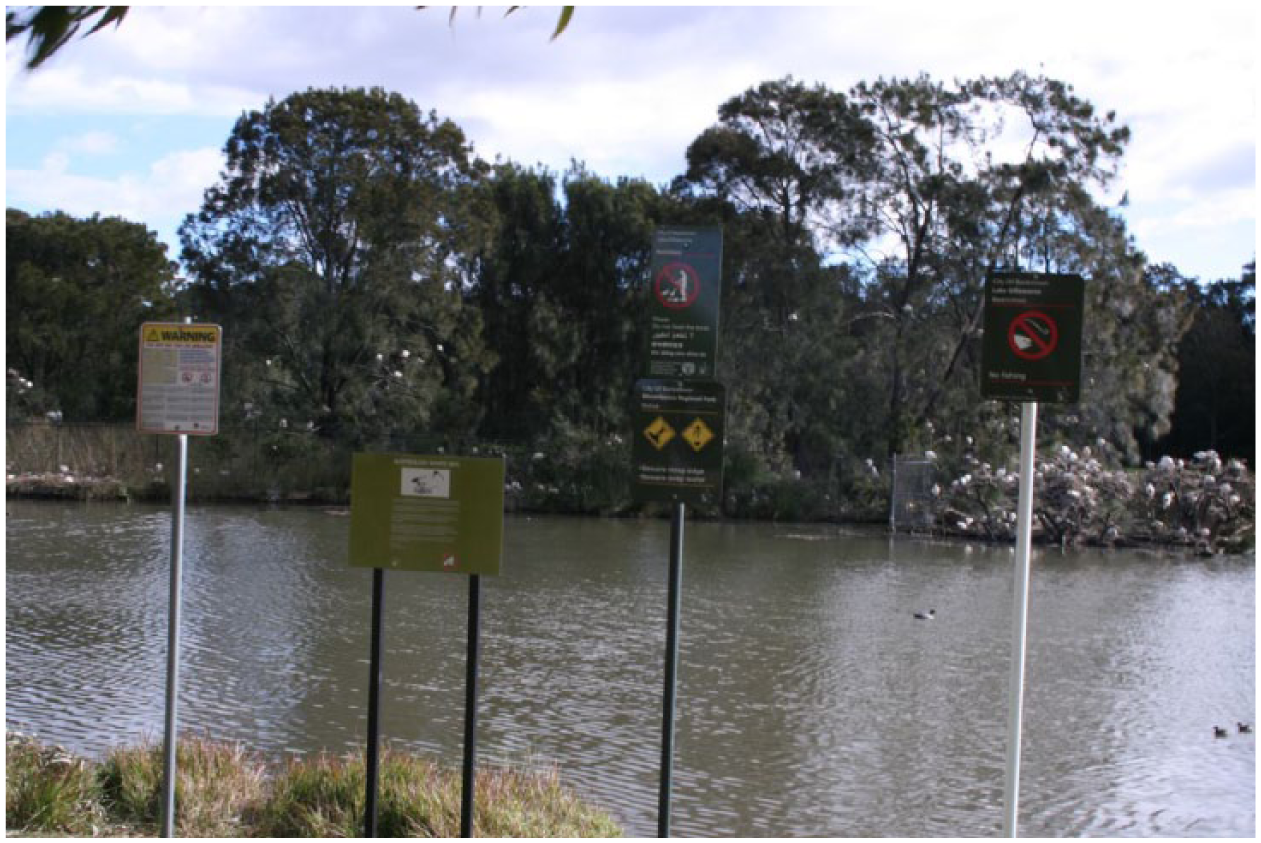
Ibis colony Lake Gillawarna.
Bankstown Council issued a management plan in 2012 documenting ibis problems such as: noise and odour; reducing water quality; causing fauna displacement and damage to vegetation; being a public nuisance; risk of aircraft strike and threat to public health. 63 The plan suggests nest and egg destruction once the colony population exceeds 1,000. Thus, ibis hold a tenuous position on the lake as their ability to colonise the site and shape its design unsettles original plans for the lake’s function, and what nature is desired.
Diary entry site visit 1: Lake Gillawarna (14 June 2012, Overt)
When first visiting Lake Gillawarna I was unsure what to expect. Immediately ibis bodies were visible from other bird species. Ibis colonies nest on the Lake’s island, which are covered in a mix of blackberry and coral trees. Hundreds of ibis nest on the three islands of Lake Gillawarna, while a minority of ibis forage for food on the lake’s edge. As I move closer to the ibis to take a photograph they immediately fly to island; a sanctuary securing them from both human contact and the dogs sharing this space. Ibis presence is illuminated through the various signs explaining the history of the colony, plans for future management and also deterring people from feeding the birds.
Lake Gillawarna has become co-constituted by humans, ibis and other nonhuman bodies, as islands are transformed, behaviours are co-shaped and ideas of belonging are challenged. What emerges is a tension between ibis seeking refuge and human perceptions of the birds’ environmental and social impacts. Media coverage framing the ibis as a victim addresses this tension, promoting the plight of ibis and the need to live-with. As one article describes, ‘If you ask the average urban resident chances are they’ll complain the birds have reached pest proportions . . . the truth is, however, that many of these urban birds are environmental refugees’. 64
Lake Gillawarna offers a platform to question ideas of killing and cohabitating with uncomfortable others. The seemingly arbitrary number of 1,000 ibis justifies management due to perceived overpopulation. However, ibis as environmental refugees complicates management strategies assuming a ‘rational or natural dividing line that will settle the life-and-death relations between human and nonhuman animals’. 65 Designating 1,000 as the threshold to make ibis killable not only results in ibis death, but also reveals deliberate valuing practices dictating what life is meant to flourish, and what life is disposable. For Haraway, ‘there is no way of living that is not also a way of someone, not just something, else dying differentially’. 66 However, how may ibis be represented in a cosmopolitics where actions are not purely driven by human desires? The refugee narrative forces us to think beyond a simple rolling-over of ibis killing in Haraway’s life/death inevitabilities, challenging us to live-with the urge to kill.
Lake Annan
Lake Annan provides an example of conflictual cohabitation between ibis and surrounding residents. Lake Annan is an artificial wetland located in Mount Annan in the broader Camden Council LGA, approximately 52 km south-west of Sydney CBD. Media coverage of Lake Annan ibis frequently reports resident complaints about the colony. Headlines such as ‘stench imprisons residents’, and ‘Pong goes on: birds of a feather stink together’ 67 highlight the tension between domestic space and urban wilds. Ibis’ ability to effectively colonise the site and human inability to manage the population has led to unwanted nature occupying this urban space.
Diary entry site visit 1: Lake Annan (20 June 2012, Overt)
Arriving at Lake Annan I was immediately struck by the proximity of the ibis colony to residential houses. The site contains many of the same features as Lake Gillawarna: ibis nest on the Lake’s island and a minority of ibis feed on the edge and gather nesting material. It is clear ibis proximity to neighbouring houses creates hostility. Soon after my arrival I witness a man hurl a tree branch at an ibis that was on his front lawn. Ibis presence within Lake Annan is far from discrete. Ibis feathers and droppings cover the grass and surrounding footpaths and ibis smells and sounds fill the morning air.
Shaun’s personal account in Lake Annan highlights the emotive potential of human-ibis cohabitation portrayed in the media articles. The Camden-Narellan Advertiser, for example, frequently reports on residents’ conflictual relations with ibis in Lake Annan: They have stripped away vegetation, there is a strong smell, depending on which way the wind is blowing, their poo is everywhere, they make a lot of noise, ruin antennas and fossick through people’s garbage.
68
The stench is terrible . . . There’s times here of a day when we have to completely lock the house up because of the smell.
69
Resident Melanie Pearce said the birds have spoiled the lake.
70
Ibis’ presence in the lake brings about unfamiliar and problematic smells, sounds and sights leading to the vitriolic attitudes of surrounding residents. Both Shaun’s personal account and media articles highlight the problematic relations between humans and ibis – unsettling this domesticate space as something more-than-human. Lake Annan exposes the difficulties in living-with species beyond the grasp of human control. Ibis confront human ideals of urban nature, as their movements, sounds and smells open the site as something more-than-human. Ibis’ occupancy of the lake forces modes of cohabitation never fully comfortable or controllable. Questions emerge as to whether we can embrace this multiplicity without receding into attempts to sterilise nature to conform to human desires.
The two site visits narrated above position ibis as timid, avoiding encounters with humans. However, ibis as aggressive and threatening was a common theme in media and interviewee accounts, portraying the species as problematic in urban parks and cafés. During the interviews, ibis behaviour around food in public settings was discussed:
they get quite aggressive if there’s food around.
I’ve seen ibis steal food from café tables, when babies are there, they wait for the parents to leave, and then they jump on the table and snatch the food.
if you go to Centennial Park, or Royal Botanic Gardens or Hyde Park in Sydney where the birds are day in day out getting food from people or from café tables or things like this then they have a very different behavior . . . I do see the exact same birds at both of those sites, so I can see the same animal at Centennial Park that I saw at Lake Gillawarna and they have different behaviours at those sites.
In this narrative, ibis forage uncomfortably close to picnickers, diners and at times toddlers in the ‘hunt’ for food. Shaun’s previous encounters with reclusive ibis raise questions of how ibis become aggressive and the effect of material-discursive practices when intra-acting with ibis. The RBGS researcher describes a potential reason for ibis reclusiveness: I think that both behaviours occur within the same individuals and what you perhaps saw is what I regularly see, which is that I’m looking at the birds and I’m paying them attention, and they seem to know this and they seem to be wary of me.
Russell Hinze Park
Russell Hinze Park is a migratory bird habitat located in Oxenford, in the Gold Coast LGA. Ibis population at the site peaked at 5,000 in 1999 leading to the implementation of management practices by ibis management company, Ecosure, reducing the ibis population to 70 by 2008. 71 However, ibis numbers have steadily returned and the ibis are now the dominant bird species in the artificial wetland.
Field diary site visit 2: Russell Hinze Park (18 July 2012, Covert)
On my second visit to Russell Hinze Park I decided to conduct a covert walk-through in order to witness whether ibis behaviour may change. I decided to conceal my camera and notepad and follow other park users bringing bread to feed the birds. I began by circling the lake of Russell Hinze Park throwing bread to the delight of geese, ducks, purple swamp hens and waterfowls. The ibis appeared uninterested remaining poised on the island. In an attempt to arouse their interest I walked away from the other birds throwing bread toward ibis at a distance trying not to scare them away. As the first slice of bread hit the ground immediately the loud sounds of ibis honks filled the air. Hundreds of ibis circled overhead and ravaged the few slices of bread thrown. The experience was intense with hundreds of ibis flying overhead and encircling me on the ground. Positions of power shifted, as I was left searching for my sanctuary.
Shaun’s account offers a glimpse into the aggressive and frightening modes of encounter present in participant and media stories. The ibis-as-pest narrative depicts ibis as aggressive in public settings, as ibis ‘takeover and push everything else out’. 72 However, ibis are individual beings whose placement in the city cannot be restricted to circulating narratives that render them pestilent. Overt and covert encounters highlight the situated intra-actions with ibis producing novel ways of relating. Human-ibis relations are unpredictable, contingent on both the actions of ibis and humans. The fluidity of ibis behaviours highlights the multiple ways ibis and humans live together. Acknowledging ibis’ behaviours as bound within situated intra-actions moves us beyond broad qualifiers such as pest – unpacking the material relations influencing both human and ibis performances. To embrace convivial cohabitation with ibis requires thinking critically about how we may learn from each other; to not only understand the reasons behind ibis migration to cities, but also the diversity of our relations.
Black Swamp Wetland
Flying foxes and ibis share conflictual histories. Their living-together has brought into question ibis’ ability to live-with other nonhumans, advancing claims that ibis create fauna displacement. However, ibis-flying fox relations are diverse and situated, and in Black Swamp Wetland an intriguing tale unfolds of ibis discovery and cohabitation in the face of encroaching displacement. Black Swamp Wetland is located in Cleveland in the broader Redland City Council LGA, between Brisbane and the Gold Coast. It is a 13ha remnant of wetlands that were widespread prior to recent settlement and encroaching urbanisation. Ibis colonisation of the site rendered the species pestilent due to perceived fauna displacement. In 2004, Redland City Council in collaboration with Ecosure conducted management practices in order to reduce the ibis population. 73 Both the management practices as well as the receding water level contributed to a steady decline of Black Swamp Wetland ibis.
Field diary site visit 1: Black Swamp Wetland (22 July 2012, Overt)
On entering Black Swamp Wetland the presence of ibis was ‘hidden’ . . . no obvious smell, no telling ibis honk, and no sight of the bird. Contrary to other sites where ibis colonies stood-out from the surrounding landscape, Black Swamp ibis were far more reclusive. After 30 minutes I noticed ibis flying in the distance away from the prescribed wetland paths. Circling the fence of the wetland I stumbled across flying foxes nestled in the thick canopy. A sign states the colony as a marquee species – flying foxes endangered status engenders increasing protection efforts. However, what emerges from the flying fox colony is an unexpected discovery of cohabitation. Within the dense canopy ibis nest atop tree branches alongside the flying foxes. The appearing mutual cohabitation is intriguing given previous media accounts of ibis displacement of flying foxes.
Subsequent visits further uncovered ibis-flying fox cohabitation. A potential reason for this cohabitation was discussed by the Managing director of Ecosure when he explains: ‘It seems as if the ibis know that the flying foxes are protected and we cannot manage their eggs when they are nesting in the same trees’. The protected status of flying foxes prevents human encroachment on their habitat – fostering an uncomfortable cohabitation for those seeking to remove ibis. This example counters previous media reports detailing the consequences of flying fox-ibis relations. For example, the article, ‘Council wages war on ibises – Birds’ toxic droppings killing off thousands of flying foxes’, problematises this cohabitation: Hundreds of ibises have colonised a three-hectare reserve at Cabramatta . . . they share the trees with a colony of vulnerable grey-headed flying foxes, which are being killed by the birds – ibis droppings are toxic to the flying foxes.
74
In this example, ibis are positioned as a direct threat to the flying fox population, as the site is framed as ‘not big enough for the two’. Ibis are accused of being the main cause of the decline in the flying fox population: ‘numbers have slid from 30,000 to 50,000, because of the ibises’. 75 This example echoes Foucault’s claim that killing under biopower is condoned if the entity killed is considered a biological danger. 76 Here, ‘killing for conservation’ becomes justified when a species of least concern becomes disposable relative to the desirability of others. This is achieved in the name of ecological preservation, or at times through human aesthetics. Ibis-flying fox relations reveal ideas of ‘killing well’ amid ‘mortal companion species entanglements’ from which we have no obvious escape route’. 77 In this instance, ibis death is required for flying fox life to be protected.
When asked whether it is possible to live-with ibis in cities, the Managing Director of Ecosure states: ‘Co-habitation with the ibis may be possible if properly managed to ensure numbers remain at a suitable level’. This response highlights how ibis value is bound within human dispositions of suitability. Ecosure plays a vital role in propagating ibis pestilence and management. Established in 1994, Ecosure is the largest private company managing ibis populations. Ecosure operates in Queensland and NSW as a consultancy firm with local councils – predominately focussing on urban ibis populations. For Ecosure, the pest narrative is profitable; they are in the business of making ibis killable. The commodification of ibis-as-pest traps ibis in a tenuous position as their living-with is positioned against desired urban wilds and other native species. Ibis become an object for human management rather than a resident of urban spaces. For Ecosure, ibis life is devalued when positioned against human and nonhuman others. However, in the Black Swamp Wetland, ibis life transgresses their desired placement, complicating strategies of management and living-with that assume a rational and static dividing line. Ibis-as-pest inhibits critical questions of why ibis are in cities and how they relate with different species and environments – deadening any strategy of living-with promoted in victim narratives. Embracing the complexity of ibis life acknowledges the diverse modes of relating – forcing us to take seriously what ibis do beyond how it may impinge simply on our desires.
The combination of field experiences, media and interview stories reveal urban spaces as never fully settled, or human, but more-than-human achievements. The situated and shared multi-species stories uncover ibis discourses as emerging through human and nonhuman intra-actions. If we understand our bodies and subjectivities as produced through intra-active processes, then our conceptualisations of space and performances within them are intrinsically rematerialised through these more-than-human encounters. Living-with ibis challenges ideals of wanted and unwanted urban nature. As Ginn et al. notes, ‘becoming less uncomfortable with vulnerability and seeking to put ourselves at risk can be a productive ethical practice’. 78 Such practices decentre human positions of control, opening possibilities to understand ibis agency and subjectivity as a constituent part of the urban fabric.
The ibis as a partner
We have sought to strengthen understandings of city spaces as not pre-given, absolute and fixed, and more importantly not bounded and demarcated by humans alone. This section explores ways of living less destructively and more ethically with ibis. Amid the intra-actions between humans and ibis, accountability, caring and responsibility come to matter. We aim to put forth a cosmopolitical experiment questioning the extent to which suffering, encounter, aesthetics and/or vulnerability represent channels from which ethical recognition can flow. 79 We further Lorimer’s call to ‘allow irreducible human and nonhuman differences to flourish in tight confines with fraught histories’. 80 Our endeavour is speculative: there are no assured outcomes for humans or ibis. We aim to journey into an unknown coproduced by multiple, diverse entities.
Rethinking ibis in this sense opens up space for the ‘divergent actualisation of the host of virtual possibilities inherent within an ecological complex’. 81 Such an approach challenges past tendencies to shortcut politics with science and demands work, speculative intervention and ontological risks. 82 As Haraway explains, ‘No one knows how to do that in advance of coming together in composition’. 83 Following Latour, composition is the work of building a common world where the ‘continuity of all agents in time and space’ must be achieved ‘slowly and progressively . . . from disjointed pieces’. 84 Such a task involves unsettling notions of nonhuman belonging and human centeredness, and engaging in practices never fully comfortable for either party.
The RBGS researcher offers a suggestion for a potential form of cohabitation: One of the things we have talked about in the Sydney region is establishing refuge habitats, so where there is nuisance breeding or ibis behaviours become inappropriate. It would be appropriate to try to get these birds, at least the major aggregates to these refuge habits and then if you manage these smaller isolated incidents it is going to appease the general populous more so.
This example proposes a detached form of coexistence whereby ‘life is not drawn together, but pulled apart’. 85 Following Ginn, ibis sanctuaries as detached and distinct from human space raise ethical dilemmas of cohabitating – materialising a desire to distance ourselves from an unattractive species. Sanctuaries enforce detachment, as ibis leaving the bounds of the sanctuary face management. However, human-ibis bodies can never always be detached. After all, ibis are themselves agential meaty beings continually transgressing their (human) desired placements – forcing unwanted and unpredictable modes of attachment. In spaces of undesired attachment, ibis become problematised and acts of killing and removal are enforced. Such actions raise questions of the life and death of nonhuman others, and whether practices of killing are justifiable, or perhaps inevitable in our more-than-human relations.
But where does the ibis fit into all of this? Patiently waiting on the sidelines, how are we to know what is best for the ibis? Luckily, ibis have already spoken. Ibis in living-with humans and nonhuman others reveal their desired habitat and food sources. What is left is for humans to speak with ibis. To attune and respond to such differences require new modes of thinking capable of summoning life in convivial spaces where all the actors and expertise count. 86 There is no one universal solution. Rather, cosmopolitics requires paying attention to specific and inter-specific differences, experiences and potentials. It requires taking ibis life seriously, whereby living-with is not a proxy for detachment and killing. The pest narrative needs to be disempowered to promote the plight of ibis, forcing critical endeavours to cohabit no matter how uncomfortable.
At Lake Gillawarna, neighbouring residents are not in favour of the species. A Bankstown Council survey of the local community in 2004 found that 82 per cent of respondents were in favour of reducing the colony size. Similarly, 52 per cent of Marrickville Council (Sydney, NSW) indicated they dislike ibis nesting in suburban trees, although 29 per cent enjoyed ibis presence. 87 Ibis’ capacity to use anthropogenic resources has made it unlikely that the species will return to inland wetlands, or that urban populations will reduce significantly. Martin et al. suggest the need for a community education platform explaining the importance of urban refuges; the reasons driving ibis populations to cities; and encourage tolerance of urban wildlife. 88 This strategy creates possibilities for ethical relations with the unwanted and unloved, providing an opening for living-with otherness. How humans can embrace uncomfortable others is unclear, however pushing ourselves into messy relations encourages new understandings of the city as a site for multi-species cohabitation.
Uncomfortable futures
A cosmopolitical future does not necessitate harmony, and perhaps a strategy of isolation and containment is the most appropriate to appease the greater population. However, ibis management needs to think differently and recognise the broader context of management practices. This includes consideration of: killing mindfully; avowing the violences of our actions; acknowledging the limits of our capacities to bend space to our will and imagination; being willing to recognise and be open to the vulnerability of non-human others and, perhaps, to be transformed by that recognition.
89
To attune and respond to such differences require new modes of thinking capable of summoning life in convivial spaces, where all the actors and expertise count. There is no one universal solution. What emerges are new ethical dilemmas of how to pay attention to specific and inter-specific differences, experiences and potentials.
Our multi-storied approach sheds light on the circulating narratives and relations capturing the lives of urban ibis. Ibis ethology, media articles, interviewee accounts and personal encounters offer insight into how ibis are positioned in the city, what urban natures are valued and how lives are made-to-matter. The ibis-as-pest storyline emerges as a common discourse positioning the species as unable to cohabit urban spaces with humans and nonhuman others. This is further compounded in interviewee and personal stories as ibis smells, sounds and behaviours unsettle the city as something never purely human. However, storying human-ibis intra-actions reveals the material relations producing diverse understandings of ibis belonging. Within these knotted and dynamic urban ecologies, ibis are opportunistic, and it is without surprise this native species is able to adapt to environments outside their traditional bounds. Research indicates ibis are a permanent resident of urban spaces. Therefore, we need to rethink how we position the ibis and ourselves in the city to forge novel modes of mutual cohabitation.
To unburden the city from its anthropocentric footings opens space for the flourishing of more-than-human life. As van Dooren & Rose state, ‘conviviality requires that we make an effort towards inclusiveness, that we endeavour wherever possible to make room for that other in our activities in shared places’. 90 Ibis expose city spaces and design as never closed and purely human, but offering obstacles, delights and disasters for nonhuman others. Cosmopolitics offers a framework for encapsulating the desires of ibis, not simply in the form of scientific discourse, or bounded reserves, but in thinking through how cities are built and lived in by nonhumans. A cosmopolitical ‘push’ opens space to go beyond linear modes of ibis management and eradication to recognise ibis as partners in the ongoing historicity of urban environments. This ethic is never settled, but unsettling, as we venture into a future that takes seriously multi-species lives, past and present.
Footnotes
Acknowledgements
We are grateful for the invaluable contribution from the participants. Thanks also to two anonymous reviewers whose comments on previous drafts greatly enhanced this paper. We are also appreciative to Charles Gillon and David Clifton for their constructive feedback on a draft.
Funding
The author(s) received no financial support for the research, authorship, and/or publication of this article.