







Abstract
This piece blends prose, poetry, and drawings in a geopoetic approach to bycatch in the Gulf of California shrimp trawling fishery. We briefly communicate some of the ecological effects of the trawling industry and reflect on our collaboration as an art–science practice that draws on our multiple disciplinary backgrounds, one as a geographer-poet and the other as a marine ecologist–visual artist. We present two poems and drawings addressed to specific individuals of bycatch – a Pacific snake-eel and a Shame-faced crab. We focus on specific individual marine bodies as an act of witness to the more-than-human bodies so often the casualties of this fishing practice. The poetic trope of direct address to an individual eel and crab allows us to work from specific embodied encounters as a site of cultural geographic and geopoetic practice. We aim to convey what it feels like to be on a trawler and to allude to geographic concerns implicitly in the poetry and text. We present this to readers as a piece of creative writing and invite them to bring their own interpretations to the text.
Keywords
In Mexico’s Gulf of California, from mid-September through mid-March, shrimp trawlers traverse the water. Each night, hundreds of boats drag their 100-ft long nets across the seafloor in search of shrimp. Along with shrimp, they pull up over 200 other species. In fact, the vast majority of life that is trawled from the bottom of the Gulf is not shrimp. By weight, 85.9 percent of what is captured is bycatch in some regions. 1 In Spanish, it is called ‘basura’, trash. There is an ecology, of course, to the trawler slicing through the Gulf: Sea lions trail the boat, waiting for bycatch to be shoveled off the deck. Pelicans arrive in the early night, followed by gulls in the hours after midnight and before sunrise and by frigatebirds when daylight breaks.
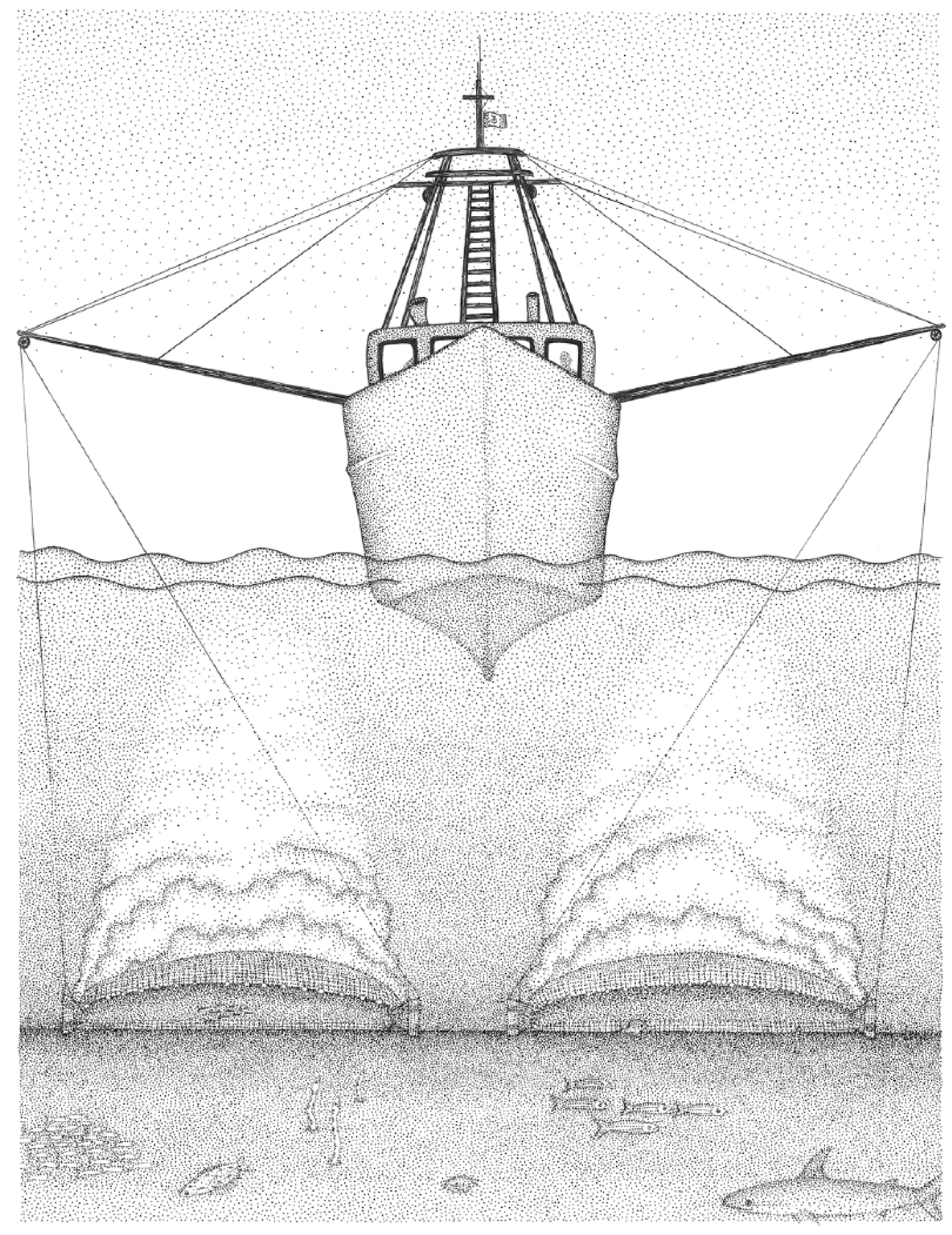
Shrimp trawler illustration by Maria Johnson.
Four to six times each night, the nets are raised and the contents are dropped on the boat’s deck. Each of these drops is called a set. Fishermen toss shrimp into baskets, eel writhe with fish in their mouths, crabs scurry to the edges, octopuses climb the legs of fishermen, and fish mouths gape for underwater breath only to find the unforgiving air of the international seafood trade .
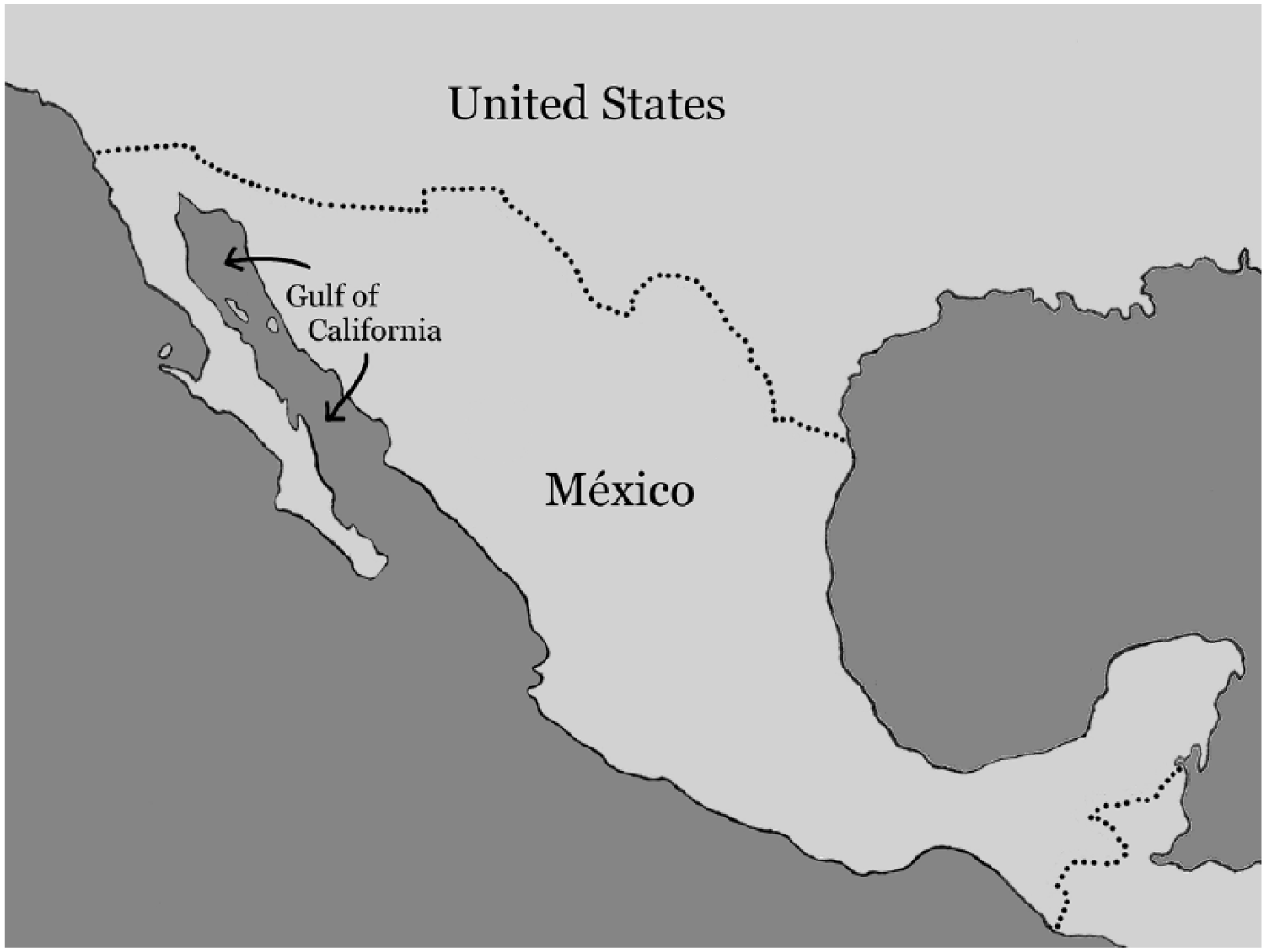
Gulf of California map by Maria Johnson.
The trawling season lasts for 6 months, and the crew is out for about 40 days at a time. We arrived just for the night, ferried to the trawler by a panga, a small skiff used locally, and boarded at 5 p.m. On this particular night in November 2015, we stayed through 11 a.m. the next morning. We are here to study bycatch – to calculate the ratio of shrimp to bycatch, to record all the species captured throughout the night, and to take data on any species of particular concern, such as endangered species or those of high commercial importance. The data we gather are part of a research project that has been ongoing for close to two decades, based out of the Prescott College Kino Bay Center for Cultural and Ecological Studies. We are here particularly for an art–science investigation of bycatch. 2 We present the drawings and poems included in this piece as a form of geopoetics, which works as much through allusion as it does through explanation. 3
A brief and partial inventory of the scene: the boat, chains, rope, wood, baskets, a frozen hull, winch, six crew men, multiple Virgin Mary paintings, fishing gloves, barrels for shrimp heads, and shovels to scrape the bycatch overboard.
that the night falls into a rhythm shrimp heads shoveled into 50-gallon barrels the night boat grunts & all hands sort that so easily we fall to labor that so easily we gather life up in front of us, dying, writhing benthic
How can we make sense of this vessel pushing through the Gulf as we are knee deep in writhing sea life hauled up from the benthic zone (sea floor), our gloves stained through with fish slime? As we sort, the hull underneath is a repository of flash-frozen shrimp destined for international markets. The lens of political ecology helps make sense of what is happening here: In this frame, the boat slicing through the Gulf is a manifestation of capital, and the interactions that we witness on the boat are driven as much by global economic processes and markets as they are by other factors. The lens of marine ecology also helps us understand how extensive the impact of this practice is, particularly the removal of juvenile fishes and invertebrates, as well as benthic habitat destruction. The Gulf, dubbed ‘the world’s aquarium’ by Jacques Costeau, is one of the most biodiverse areas on the planet, and it is under great threat through this practice and other perils.
New materialist trajectories and assemblage theories help us pay attention to nonhumans as actants in the socio-ecological processes and practices we observe on the trawler. Within cultural geography, an assemblage approach has been applied to fisheries to think through the heterogeneous materialities that make up the sea (currents, fish, dolphins, etc.) as co-productive. 4 In approaching the interactions we witness on the trawler, we also pay attention to the multiple co-productive bodies and processes, including the crewmembers, who, along with the captain, do not own the boat; to technology’s role in the fishing practice, including the regulatory ‘Turtle Excluder Devices that trawlers are required to use but do so inconsistently; to the boat’s location in the Gulf, skirting the boundary between Mexican and Indigenous Comcaac waters; to the water currents and weather affecting the boat’s path; to the birds and sea lions whose behavior changes in response to the trawler’s presence; and to our own positionality as researchers.
And what about the role of shrimp-eating humans? Is there something in that moment when shrimp, the number one seafood
5
in the United States, melts in a human mouth, a sense of pleasure of eating, that partly drives this assemblage? We hold these cultural geographic questions and approaches in our mind when drafting the poems that are part of our art–science collaboration, allowing cultural geographic concerns to implicitly find their way into the poems:
I remember a lot of the fish just eating each other. each set perhaps an organism an assemblage that so easily raked, scraped from the bottom the nets indiscriminate sea lions lobos alongside waiting for our shovels to push piles of discarded …
Throughout this particular night on the trawler in November 2015, the rain came and went. The lightning illuminated the surrounding islands from behind, creating mountainous silhouettes and a reminder of the world outside the deck. At one point, we were in the midst of the storm, the lightning ornamenting the sky around us – an electric pink that faded to a pale purple as we boated onward.
When a set is first dropped upon the deck, it is one squirming mass. The difference between individuals caught in the net collapses under the weight of the pile. The method for calculating bycatch involves shoveling a random sample of the catch from the set into a 2.7 ft3 bin, and then setting it aside to weigh and inventory as representative of the set. After the sample is complete, we begin to differentiate, raking through the pile to identify and record all species present, placing those of concern to the side to later measure, weigh, and sex. All along, we toss shrimp into the baskets as well, becoming part of the boat’s labor.
Our individual encounters with bycatch become a hinge for our collaboration, which includes a series of poems and drawings addressed to particular individuals. In the following months, we draft these poems and illustrations. 6 In what follows, we include pieces to the Pacific snake-eel and the Shame-faced crab. 7 Each poem, each illustration, is, in a sense, a snapshot or winnowing of the interactions on the boat. The poems begin filtered through an individual human subjectivity – through a direct second-person ‘you’ address – but then open out into multiple allusions and references to some of the many bodies interacting on the boat. As both a creative and cultural geographic practice, this conceit of writing directly to the individuals allows us in a pragmatic and focused way to pay witness to the trauma on the boat.
Pacific snake-eel
Ophichthus triserialis
by Eric Magrane your ambidextrous burrowing sand and mud makes you seldom seen they say but here on deck you’re curling a question mark, then an S, then some other shape fluid twirl your spots slippery through my hands here you stand out wrapped around some other fish, another in your mouth and still writhing away, your tubular nostrils what are they sensing is it the opening on the edge of the deck where the bycatch will be shoveled to waiting mouths of sea mammals or the affect, the emotion of the pile is it fear or instinct or is there no distinction just life and non-life survival and your spots you’re slipping out of my hands again
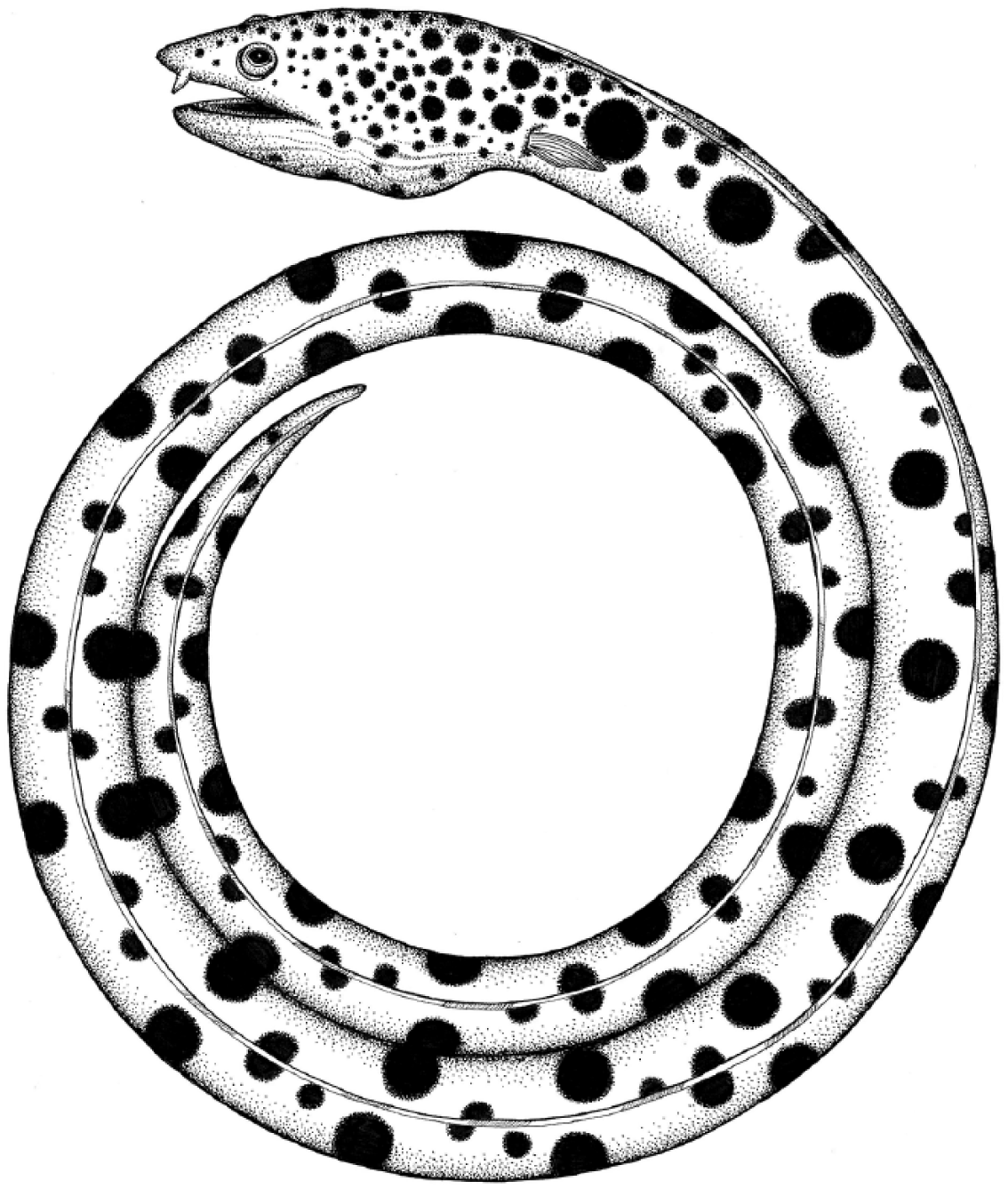
Pacific snake-eel by Maria Johnson.
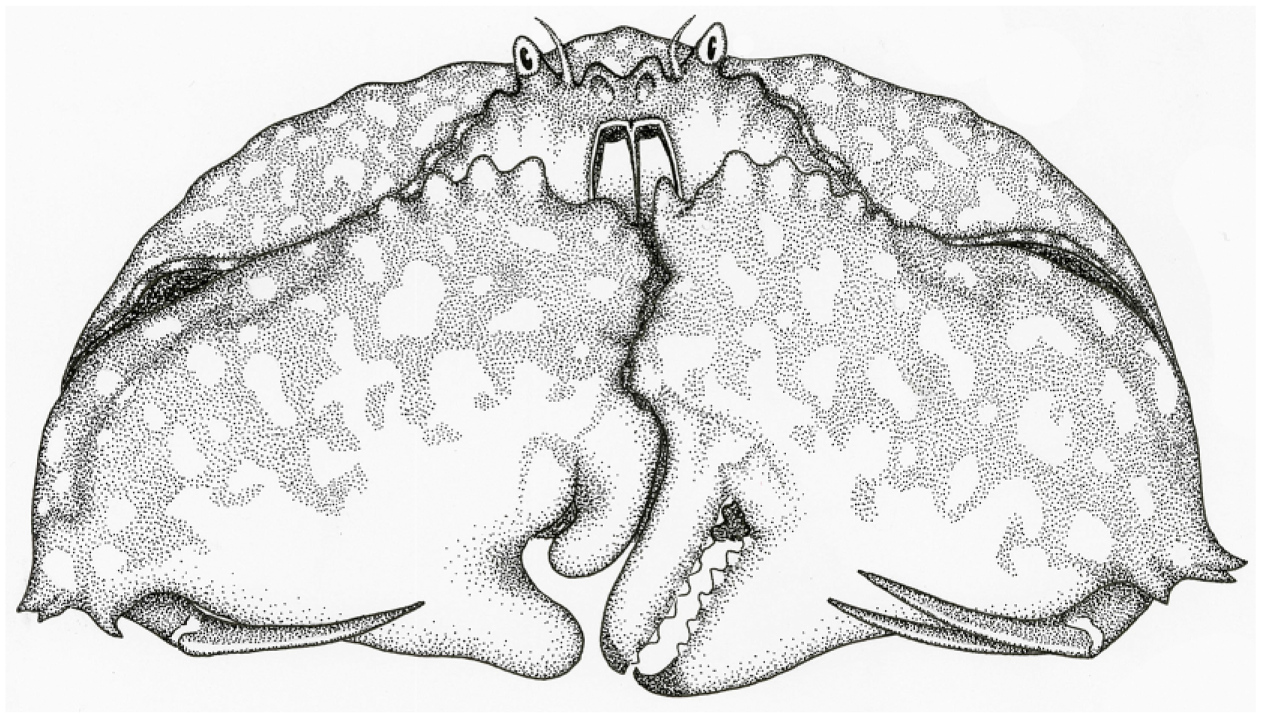
Shame-faced crab by Maria Johnson.
Experiencing bycatch of this magnitude can be a sublime and overwhelming experience. Through applying the technique of writing and drawing to a specific bycatch individual, however, we are able to work from single encounters as a way into other interactions on the trawler. These two poems and drawings are among a series of over a dozen we are working on addressed to specific individuals, which will be included in a multimedia art exhibit in Spring 2017 and which we intend to publish in book form. In this sense, thinking with assemblage, as well as being a theoretical framework that we implicitly draw on in our creative work, is also a creative geographic method for compiling geopoetic work, for moving between poetry, prose, and drawings. Our geographic and theoretical concerns become embedded in the poems, through the associations that poetic language can make. The poem that follows to the Shame-faced crab, for example, alludes to questions of subject/object and discrete versus relational ontologies, two concerns in new materialist and assemblage geographies.
More than anything else, however, we consider each poem and drawing an act of witness, a way to bring some acknowledgment and respect to the individual nonhuman bodies that are the discarded leftovers of this process.
Shame-faced crab
Calappa convexa
by Eric Magrane you arrive with your claws grasping triggerfish rather than over your face, the old aesthetic question does a certain quality reside in subject or object either way this is certainly sublime, and either way you still have more life than lots of the fish already dead, knee-deep but to return to the question shame is a projection though when your arms curl in it’s hard not to, yes, anthropomorphize though the object philosophers may reject the premise of you being the object and I the subject, that doesn’t even begin to get at the intricacies of the lightning off the stern of the boat and the moment I pick you up and toss you back into dark water wishing you good luck
Footnotes
Acknowledgements
We would like to thank the Prescott College Kino Bay Center for providing lodging, logistical support, and years-worth of data for this project. We are incredibly thankful to the Next Generation of Sonoran Desert Researchers and their 6&6 art and science initiative, of which our Bycatch project is part. We are also grateful to Wendy Burk, who offered insights on an earlier version of this article.
Funding
The author(s) received no financial support for the research, authorship, and/or publication of this article.