







Abstract
The notion that the Earth has entered a new epoch characterized by the ubiquity of anthropogenic change presents the social sciences with something of a paradox, namely, that the point at which we recognize our species to be a geologic force is also the moment where our assumed metaphysical privilege becomes untenable. Cultural geography continues to navigate this paradox in conceptually innovative ways through its engagements with materialist philosophies, more-than-human thinking and experimental modes of ontological enquiry. Drawing upon the philosophy of Gilbert Simondon, this article contributes to these timely debates by articulating the paradox of the Anthropocene in relation to technological processes. Simondon’s philosophy precedes the identification of the Anthropocene epoch by a number of decades, yet his insistence upon situating technology within an immanent field of material processes resonates with contemporary geographical concerns in a number of important ways. More specifically, Simondon’s conceptual vocabulary provides a means of framing our entanglements with technological processes without assuming a metaphysical distinction between human beings and the forces of nature. In this article, I show how Simondon’s concepts of individuation and transduction intersect with this technological problematic through his far-reaching critique of the ‘hylomorphic’ distinction between matter and form. Inspired by Simondon’s original account of the genesis of a clay brick, the article unfolds these conceptual challenges through two contrasting empirical encounters with 3D printing technologies. In doing so, my intention is to lend an affective consistency to Simondon’s problematic, and to do so in a way that captures the kinds of material mutations expressive of a particular technological moment.
Introduction
The following article draws upon the philosophy of Gilbert Simondon as a means of exploring a particular question, namely, in what sense does technology constitute a problem for cultural-geographical thought today? My aim, in posing this question, is to show how Simondon’s explicitly ontological approach to technology provides geographers with a prescient conceptual vocabulary, indeed, one that is adequate to the kinds of existential problematics that are currently reconstituting life in the ‘Anthropocene’. 1
As an interdisciplinary buzzword, the concept of the Anthropocene is no doubt complex, multifaceted and open to contestation. 2 Yet, there remains a sense in which the idea of an epoch marked by the ubiquity of anthropogenic change requires a significant transformation in the way we think of ourselves as human beings and as cohabitants of planet Earth. Citing the geographical contributions of Nigel Clark and Kathryn Yusoff, Noel Castree notes an emerging resonance linking the kinds of planetary entanglements presupposed by the idea of the Anthropocene with cultural geography’s criticality towards metaphysical categories. Axiomatic dualisms, Castree explains, are ‘seen by some to have created a false sense of separation between the people [sic] and the non-human world, as if what we by convention call ‘nature’ were a stable backdrop or mere tabula rasa for our desires’. 3 This, then, is the paradox of the Anthropocene: the point at which we recognize our species to be a geologic force requires, simultaneously, the rejection of our metaphysical separation from nature.
Yet, a rejection of humanity’s metaphysical privilege also demands a radical reconceptualization of technological processes. Bubbling beneath the Anthropocene’s surface is an almost unthinkable prospect, namely, that human beings and their cultural milieus exist not in their capacity to transcend nature through the application of knowledge but by expressing an immanent materiality common to all modes of existence. Pushing Castree’s intimations further, the Anthropocene is symptomatic of a more profound realization that thought itself vibrates with the vicissitudes of non-living nature, a nature that humanity has long opposed itself to through misplaced fantasies of technological mastery. The challenge that geographers now face regarding technology is thus to reconsider what it means to be such significant agents in light of these materialist provocations.
It is with this challenge in mind that I turn to the philosopher and thinker of technics, Gilbert Simondon. As commentators have noted, the impact of Simondon’s thinking is often illustrated by way of its influence upon the philosophy of Gilles Deleuze, 4 who described Simondon’s project as an attempt ‘to work out the genesis of the individual and the knowing subject’. 5 In more recent years, cultural theorists have begun to re-read Simondon on his own terms, a process that has been promoted by a number of well-known philosophers and cultural theorists including Brian Massumi, Elizabeth Grosz and Erin Manning. 6 Indeed, the implications of the recent turn towards Simondon are already being articulated through conceptually challenging geographical research, including Ash’s research into the production of technically mediated affects, 7 Lapworth’s explorations of the transformative role of bio-art encounters in the production of subjectivity 8 and Woodward et al.’s engagement with the technosocial collaborations made possible by visualization technologies. 9
This article advances these geographical engagements by situating Simondon’s philosophy within the specific metaphysical constraints engendered by the materiality of the Anthropocene. My contention is that Simondon’s conceptual vocabulary provides cultural geographers with a means of apprehending technological processes within a thoroughly naturalistic philosophical framework; in doing so, it allows us to grasp the sense in which the emergence, evolution and modes of functioning of machines generate new lines of ontological enquiry in relation to contemporary material processes. Simondon’s insistence that the very existence of machines should disrupt our existing ontological frameworks in this way is highly significant within the context of the current debates concerning the Anthropocene, and it is precisely this aspect of his thought that I wish to emphasize here. In this regard, my engagement with Simondon provides something of an alternative to the restrictively ‘geologic’ image of materiality currently dominating geographical conceptualizations of the Anthropocene. 10
Thinking machines through Simondon’s concepts, it becomes possible to apprehend technological processes without affording metaphysical privilege to human beings. The radical implications of such an approach cannot be overstated here, for it is no longer possible to appeal solely to the mind of an individuated human subject in our attempts to understand processes of technical invention. Rather, Simondon’s philosophy allows us to understand moments of technological emergence in naturalistic terms, that is, as relational processes capable of individuating the divergent forces of materiality in particular ways. This is a challenging notion to grasp, not least because so much of our conventional understanding of technology remains tied to the assumption that, as thinking beings, humans enjoy a unique exemption from the rules that govern non-thinking nature.
To take Simondon’s oft-cited example as an initial interjection, the process of moulding a brick from a piece of clay is never reducible to an imposition of form originating solely in the mind. 11 Rather, what takes place in this moment is a process of individuation, a process that assumes its consistency through an iterative modulation of material forces. What I want to take forward in this article is Simondon’s insistence that there can be no imposition of form independent of a process of individuation that modulates between disparate material forces. The locus of technical agency is not, therefore, the human mind, but refers in the final instance to the individuating process itself. 12 This is much more than a semantic reconfiguration: learning to apprehend technological processes in ways that do not assume the transcendence of the human over nature will be entirely necessary if we wish, paraphrasing Deleuze, to become worthy of the Anthropocene-event. 13
Taking inspiration from Simondon’s brick, the article unfolds these conceptual challenges in relation to a technological process that appears, at least at first glance, to merely reinforce the metaphysical distinction between acting human subject and passive material substrate: additive manufacturing or, as it is more commonly known today, 3D (three-dimensional) printing. Yet, in bringing Simondon’s concepts to bear on this emerging technology, I consider the possibility of thinking 3D printing in the absence of such metaphysical constraints. At this point, I must emphasize that my interest in 3D printing and its relationship to the Anthropocene is not at all motivated by the prospect of finding a technical solution to the problem of environmental change. On the contrary, my aim is to show how Simondon’s conceptual landscape implicates a particular technological threshold within a broader ontological problematic, namely, a concern for materiality that is capable of situating human life within, rather than outside of, nature. While I do not wish to claim a privileged status for 3D printing as a world-altering technology, nonetheless, it is in the singular provocations generated by such contemporary processes that the conditions for new modes of thought might be found. 14
My conceptual explication is interwoven with images and empirically generated vignettes, dispersed throughout the main body of the text with the aim of amplifying the affective resonance of the philosophical problematic that Simondon’s philosophy articulates. 15 These empirical reflections emerge from two very different encounters with 3D-printed matters: an industry demonstration held in London in 2012 and a research visit to the Chair for Computer Aided Architectural Design, ETH Zurich, undertaken in 2013. The first of these encounters evokes the conceptual and practical limitations that emerge when framing 3D printing technology in the instrumental terms characteristic of humanist ontologies, whereas the second takes a more speculative tone to consider the new kinds of thinking that such technologies make possible.
The conceptual bases that motivate these reflections are laid out in more detail in the following section, which establishes some of the broader lines of resonance between current debates in cultural geography and Simondon’s radical reconceptualization of technological processes. In this section, I place particular emphasis upon three interrelated themes: the resurgence of materialist thinking, the on-going interest in non- or more-than-human 16 life, and the ontological turn within the social sciences and humanities. Taking each in turn, I outline the relevance of Simondon’s problematic for cultural geography, focusing upon the place of technology within these developing trajectories.
The third section brings Simondon’s conceptual vocabulary into dialogue with the first of my empirical reflections, fleshing out the important relationship between technological processes and the broader problematic of individuation that animates Simondon’s ‘ontogenetic’ philosophy. 17 In order to do this, I introduce the notion of ‘hylomorphism’, a term used by Simondon to describe those modes of thought that presume a metaphysical distinction between form and matter. The presumptions inherent within hylomorphism are, Barthélémy notes, a key target for the philosophy of individuation. 18 Indeed, it is through an understanding of these presumptions that we can better appreciate what Simondon was trying to achieve through his encounter with technology: to situate the becoming of thought itself within the individuation of technical processes.
The implications of this profound idea are taken up in greater detail in the section ‘Transduction and the individuation of technical relations’, which introduces Simondon’s concept of transduction as a means of grasping technical relations in and through the very process of their individuation. Drawing upon my second empirical encounter, I show how transduction complicates our understanding of individuality in relation to nature’s technical domain. Machines – or ‘technical individuals’ – demand a new understanding of individuality, one that does not entirely coincide with the individuation of either living organism or physically individuated body. Neither subject nor object, technical individuals bring disparate material forces into a common milieu of articulation through an elaboration of transductive relations.
What Simondon’s philosophy provides, therefore, is an approach to materialism that affirms the immanence of technology in such a way that what we commonly think of as ‘natural’ forces are as much an expression of emerging technical processes as they are biological and physical. I draw the article to a close with some tentative speculations regarding the practical implications of such an assertion, and reflect upon the kinds of trajectories that this might initiate for future geographical research.
Thinking technology for the Anthropocene
The question of technology’s significance for cultural-geographical thought cannot be articulated without reference to those events that constitute its present, however fragile this duration may be. My interest in Simondon’s philosophy, then, is not a matter of solving ‘the technological question’ once and for all. At the very least, such a dogmatic approach contradicts the inherently speculative tenor of Simondon’s philosophical constructions, as commentator David Scott has recently pointed out. 19 What I do want to illustrate, however, is the way in which Simondon’s thought taps into a broader set of contemporary metaphysical concerns regarding the cultural geographies of the Anthropocene and, in doing so, provides a means of re-articulating the problem of our relationship with emerging technological processes (Figure 1).
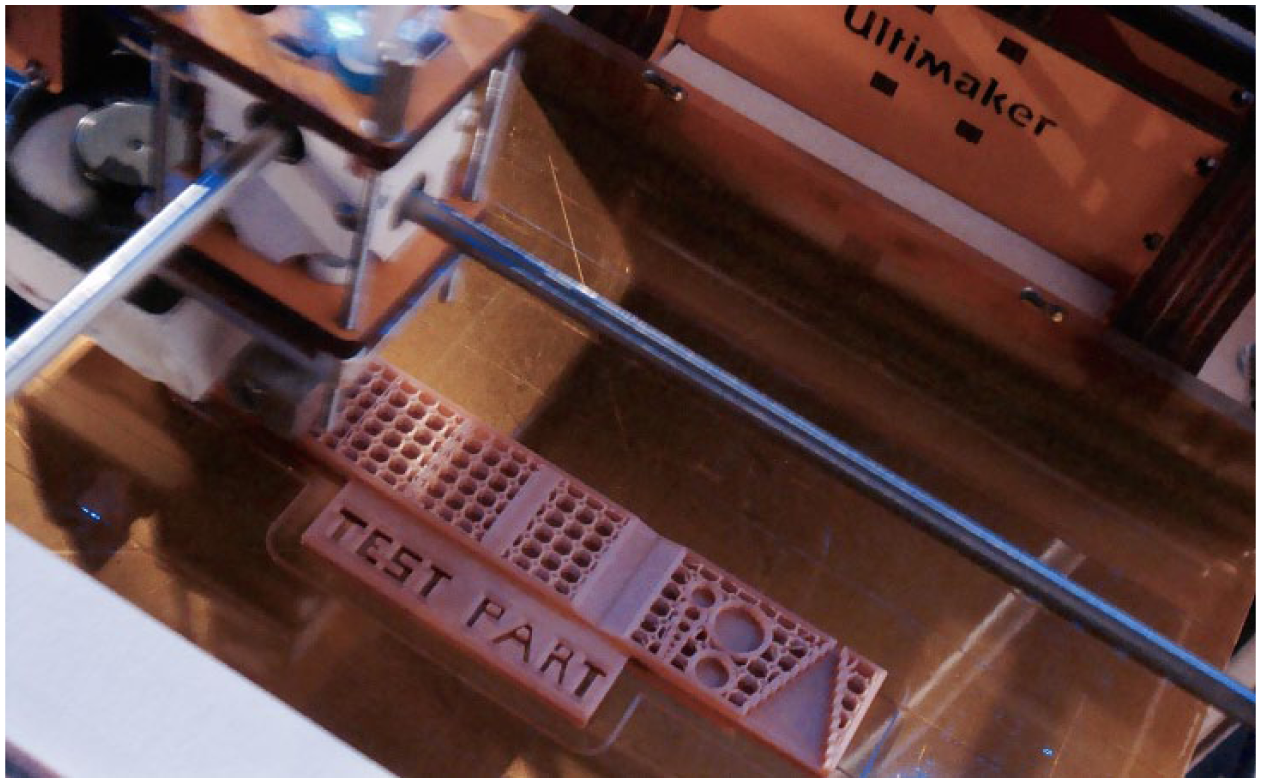
An emerging technological process (photographed by the author at The 3D Print Show, London, 2012)
There are three main characteristics of Simondon’s philosophy that bring his approach to technology in line with contemporary geographical problematics: a commitment to materialism, a foregrounding of the non- or more-than-human processes constitutive of human life, and an emphasis upon the value of ontological enquiry. Beginning with materialism, it is clear that materialist thinking has, in its various guises, played an important role in animating cultural-geographical concerns, particularly over the last decade. 20 As Braun and Whatmore explain, geography’s deep concern for questions of materiality stems from the discipline’s ‘historical insistence on understanding human life in relation to its material environments’. 21 Indeed, the complexity of geography’s materialist tradition testifies to the impossibility of reducing the concept of materiality to a coherent academic lineage, and includes insights from political ecology, 22 studies of material culture 23 and phenomenologies of embodied practice. 24
While it is important to acknowledge this diversity, cultural geography’s engagement with materiality has, in recent years, been inflected by an interdisciplinary movement of ‘new materialist’ theory, 25 and it is in this moment that I situate the significance of Simondon’s philosophy. One of the central tenets of the new materialist approach is the idea that all matter, living or otherwise, remains pregnant with potentialities for becoming otherwise. 26 In re-articulating vitalist vocabularies through the materiality of non-living processes, the new materialisms call into question any metaphysical distinction between living entities and the materiality of non-living forces. In the words of cultural geographer Nina Williams, new materialist theory ‘seeks to enrich discussions of matter by accounting for the agential capacities of stuff, within and outside of anthropocentric concerns’, 27 thus spotlighting the affective resonances that propagate through our everyday entanglements with materiality. 28
Simondon’s approach to technology can be situated within this movement, provided that we articulate its implications within the context of the Anthropocene-event. To pose the question of materialism today requires, as Hasana Sharp argues, a critique of the kind of human exceptionalism ‘that erects an illusory wall between the human world and the natural world’. 29 Indeed, the power of the new materialisms lies not in a naive return to physicalist doctrines but in their very openness to what materiality might become. By situating machines firmly within nature, Simondon opens materialist enquiry to a domain of technical materiality that remains irreducible to either physical or biological processes. This peculiar characteristic distinguishes Simondon’s philosophy from the kinds of materialism that ground their ontological claims upon the physics of quantum theory 30 while revealing the shortcomings of the figure of the cyborg in its inability to distinguish machines from biological organisms. 31
It is in this precise sense that I refer to Simondon as a naturalistic philosopher, for his is a materialism that broadens our understanding of materiality by situating technological emergence within – rather than outside of – nature. Moreover, Simondon’s philosophy provides a means of re-articulating the commitments of naturalistic philosophy in and for a technological age, in such a way that we can no longer assume that it is technology that distinguishes human beings from nature. Technology, Simondon suggests, is a part of us: each machine ‘has something of the human locked within, unrecognized, materialized, enslaved, but human nonetheless’. 32 What Simondon’s philosophy illustrates, however, is the sense in which such an assertion demands a naturalistic approach to technological processes themselves, in such a way that the relationship ‘between’ humans and machines precedes the individuality of either term.
Cultural geography’s engagement with new materialist debates has also found resonance with its long-standing commitment to understanding the ‘more-than-human’ aspects of cultural, socio-economic and political life. 33 More-than-human geographies resituate ethico-political accountability by emphasizing the constitutive role played by nonhuman entities in all aspects of human life. These interleaving ecologies of human and nonhuman lives are often understood in terms of nonhuman agency (or even subjectivity), whether of animals, 34 plants 35 or even non-living things. 36 Indeed, cultural geographers have begun to incorporate technological processes into their more-than-human accounts by exploring the ways in which spatio-temporal relations are themselves mediated by technical objects. This is something that Ash addresses through the atmospheres generated by mobile devices and ‘their potential for shaping action in the environments in which humans live’. 37
While I am keen to situate his philosophy within these more-than-human trajectories, Simondon does not stop at affirming the agency of technical processes. What makes Simondon’s philosophy so challenging is the way that it situates the nonhuman within that which appears to be most intimately human: our capacity to think. If technology raises a problem within the context of the Anthropocene, this is the problem of affirming the mutual immanence of thought and matter within a naturalistic framework. Simondon asks his readers to confront thought’s irreducibility to the individuated human subject and to really grapple with the idea that, in Combes’ words, ‘what constitutes thought is not different from what constitutes being’. 38 While this might seem like an abstract approach to the question of the nonhuman, it remains a crucial one for cultural geography, for, as Simondon’s conceptual reinventions make clear, our capacity to articulate concerns that push beyond the limited purview of humanist ontologies requires new ways of thinking when it comes to technological processes.
It is for this reason that I situate Simondon in relation to a third and final theme: geography’s engagement with explicitly ontological modes of enquiry. 39 The ‘ontological turn’ 40 is certainly not limited to cultural geography. Indeed, it is perhaps at the confluence of anthropological and philosophical research that this shift towards ontology has been most provocative. Ontological enquiry is articulated within these contexts in terms of the need to situate an understanding of human cultures within a divergent plurality of worlds. These worlds, however, are not reducible to the epistemological or phenomenological variations presupposed by the notion of differing ‘worldviews’. As anthropologist Eduardo Kohn explains, thinking ontologically means acknowledging that ‘seeing, representing, and perhaps knowing, even thinking, are not exclusively human affairs’. 41 The challenge raised by Kohn’s ontological anthropology is to understand humans through the imbrication of worlds, each endowed with its own irreducible reality.
Simondon’s philosophy speaks to these concerns because it allows for an understanding of technological processes in ontological terms. This does not mean that we should evaluate Simondon’s conceptual landscape on the basis of its capacity to define technology, once and for all. To critique ontological enquiry for being a definitive representation of reality is to overlook the possibility that thought itself emerges transformed in the very process of enquiring. This kind of critique has been mounted by Joronen and Häkli, who express their concern that the vogue for ‘ontology building’ within cultural geography ‘creates conceptual and ontological lock-ins that narrow down what the political can mean under the new ontology’. 42 While this critique has some validity, it ignores the impetus that draws humans into an experiment with what thinking can do. Following Dewsbury, 43 we might imagine a more generous approach to ontological enquiry, one that emphasizes the importance of ‘thinking through the ontological, of having a sense of what being as such is and that this is different from our actual existence in the world’.
An uncertain leap into ontological enquiry is thus entirely necessary if we are to pose the question of technology in/for the Anthropocene. This is precisely the kind of approach that Simondon’s concepts allow us to explore. Indeed, Simondon’s ontological experimentalism acknowledges that while technology and human beings remain inextricably entangled, technological processes remain strangely autonomous from human worlds. Technical objects have their own ‘mode of existence’, even if they require the existence of human beings as a precondition of their emergence. For Simondon, then, there is nothing shocking in the idea that technologies make use of human beings, that they entice thought along unforeseeable trajectories in the very process that we coax them into being.
Individuation and the limits of hylomorphism
There is something undeniably hypnotic about the printing process. The printer head shuttles back and forth, depositing its molten plastic with the dexterity of an arachnid constructing its web, accompanied by the whirring-whistling symphony of a thousand mechanical components. I feel myself captivated in a way that is difficult to articulate given the simplicity of the task at hand: printing a humanoid figurine. The material object is, it seems, being ‘downloaded’ before my eyes (Figure 2), the plastic’s formless materiality made meaningful through the imposition of a digitally mediated idea. Witness the mastery of the human mind over its material environment! But there are hints of something else, a feeling – perhaps a thought – that troubles the linear relationship between the designer and the designed, the agent and the object, form and matter. It’s not the relationship between (human) input and (material) output that captures my attention here, spinning out my thoughts and feelings along this strange new yarn. No, it is something else, an unspoken choreography that modulates disparate energies through the assemblage of a new reality and that beats to the rhythm of the whirring and the whistle.
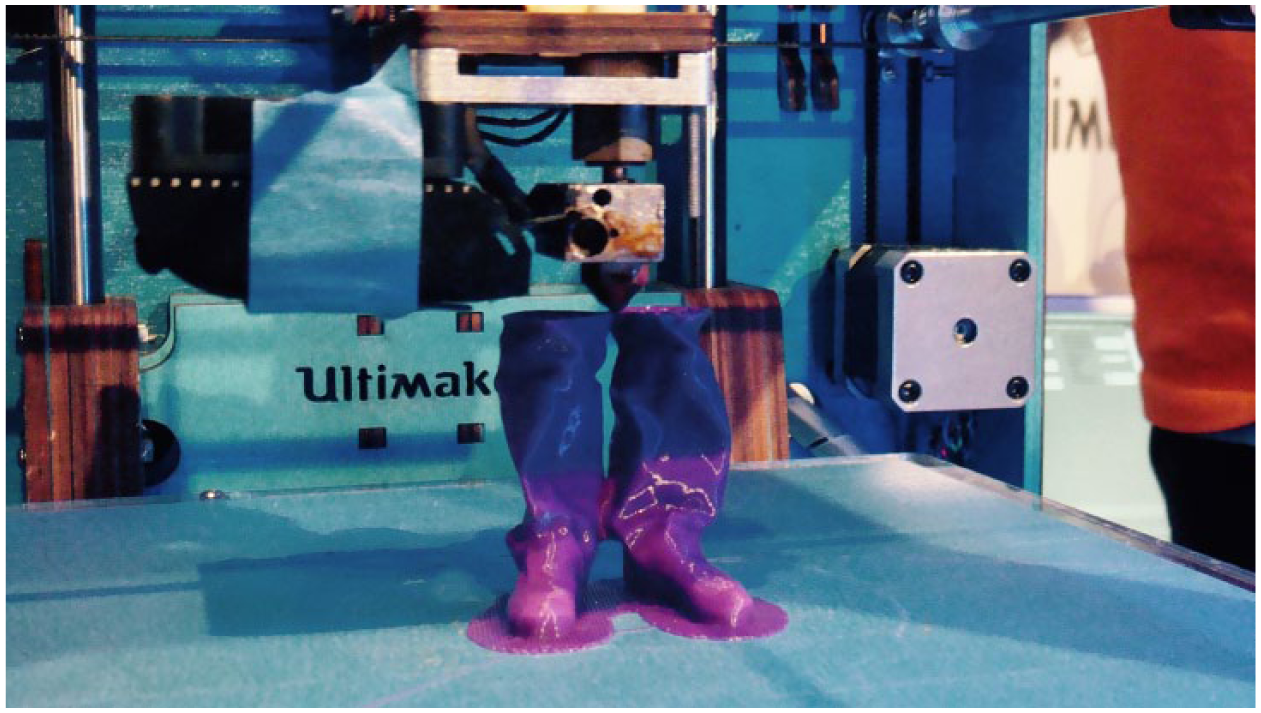
Downloadable objects (photographed by the author at The 3D Print Show, London, 2012).
If there were one problem animating the entirety of Simondon’s philosophy, this problem would have to be the persistence of hylomorphic thinking throughout the intellectual tradition of Western philosophy. Indeed, it is through an understanding of the hylomorphic tendencies of ‘Modern’ thought that we can best appreciate the sense in which technological processes, including 3D printing, present a problem for the Anthropocene. Simondon describes hylomorphism as a way of thinking in which ‘the individual is considered to be created by the coming together of form and matter’. 44 As Barthélémy notes, Simondon often attributes the origins of the hylomorphic model to Aristotle, yet its reverberations can also be felt in the transcendental-idealist philosophy of Immanuel Kant, the ‘thinker of the “form” and “matter” of knowledge’. 45 As Combes explains, Simondon positions his philosophical critique not only against Aristotle but also ‘against the Kantian hylomorphism that separates a priori forms from the sensibility of matter given a posteriori’. 46
Yet, it is in relation to Aristotelian metaphysics that the implications of Simondon’s critique for thinking technology are felt with most force. As Barthélémy suggests, Simondon’s critique draws attention towards the technical aspects of taking-form, ‘of which the molding [sic] of the brick is the classic example’. 47 According to the hylomorphic model, the process of moulding that produces the brick represents the union of some matter (in this case, the clay) and a form (the mould itself). This example is, Barthélémy explains, paradigmatic for Simondon because it assumes that humans are metaphysically unique in their capacity to impose form upon inert matter through the technological mastery of their material environments. The logic of hylomorphic thinking is based, therefore, upon a metaphysic of transcendence that grants human beings an exceptional status vis-a-vis non-thinking nature.
Remaining with Simondon’s example of the brick, hylomorphism perpetuates the assumption of an ontological dualism between non-thinking matter and the inventive capacities of the human mind, conceptualized as an incorporeal repository of form. The originator of the brick is, ultimately, always a mind, for hylomorphism can only comprehend the technical event of taking-form in terms of the materialization of a designer’s intentions. The origins of technological processes are thus regarded as thoroughly human affairs: they are, in Massumi’s words, ‘entirely internal to the human thinking subject’. 48 The problem with this way of thinking, however, is that it cannot function without postulating humans as metaphysically exceptional beings. It assumes, in other words, that technological processes find their reasons in a realm of mental activity that transcends non-thinking nature. The brick, when understood as a paradigmatic example, becomes an expression of our metaphysical privilege: thinking subjects cast adrift within a world of objective matter.
Understanding the brick in this way also overlooks the possibility that there might be un-thought elements within the very process of its taking-form, nonhuman elements that endow even the most functional of technologies with an uncertain allure. For this reason, questioning hylomorphism and the human exceptionalism it implies requires a consideration of technical objects as ‘modes of existence’ in their own right. 49 Simondon’s critique is remarkably subtle in that it does not deny the constitutive entanglements between human cognition and technological processes. What Simondon does refute, however, is the idea that technology’s ontological conditions can be located entirely ‘within’ the minds of subjects. Thus, while the process of producing a brick may certainly require the rationalizing capacities of a human mind, this does not legitimate a reduction of the brick’s ontological consistency to the realization of human intentions. This is because the brick realizes its existence in a process that implicates the capacities of human beings without ever being entirely reducible to them.
The concept that Simondon develops as a means to think technology beyond the limits of the hylomorphic model is ‘individuation’. The problem with hylomorphism, Simondon maintains, is that it cannot apprehend the production of individuals as a truly genetic process, that is, as a process that makes the reality of individuality happen. 50 It is this reality of individuated beings and its ontogenetic production that Simondon’s philosophy attempts to understand. For Simondon, then, ‘it is the individual, as a constituted individual, that is the interesting reality, the reality that must be explained’. 51 The hylomorphic model fails in this regard because it subordinates an understanding of the process of individuation to the already-individuated realities of forms (subjects) and matters (objects). On the contrary, the problem of thinking technology in and for the Anthropocene is ‘to know the individual through the individuation, rather than the individuation through the individual’. 52
In order to account for individuation as a genetic process, Simondon introduces a radically different understanding of reality as ‘preindividual’. What this notion implies is that it is in the nature of Being that it necessarily exceeds the actuality of individuated entities: reality is, Simondon explains, always ‘more than a unity’ by virtue of the fact that it undergoes individuations. 53 In Combes’ words, ‘[it] is only possible to think the formation of individuated beings if we think of them as a function of preindividual being understood as “more-than-one,” that is, as a metastable system laden with potentials’. 54 Each actually existing individual is produced in relation to a field of preindividual potentials, and it is these potentials that are expressed through the process of individuation, whether of physical, biological or technical beings. It is the ubiquity of these potentials relative to the distinct domains of individuation that makes Simondon a naturalistic philosopher, for it is in the nature of all beings that they are expressed through individuating processes.
Simondon’s theory of individuation applies as much to the emergence of inorganic entities and living beings as it does to technical objects. Crystallization, Simondon argues, is an individuation powered by – and expressive of – the energetic disparities latent within metastable systems: the physical individual is ‘an individuation which creatively resolves the tension between the disparate reals of mother-liquor and the seed’. 55 Living individuals express the same metastable system of energetic disparities but through a different mode or ‘domain’ of individuation, one that functions through the forms of spatial organization made possible by membranes and the polarizations that they articulate. The technical domain, in its individuation of the preindividual field, is no different in this regard: like crystals and organisms, technical objects do not depend upon the transmission of a pre-existing form for their existence; rather, they come into being through a process of individuation that articulates energetic disparity through new kinds of material relation.
As a paradigmatic figure, Simondon’s brick illustrates the persistent tendency towards hylomorphic thinking in relation to technological processes. Today, this tendency might be grasped more readily through the figure of the 3D-printed object, materializing before our very eyes through the manipulation of various substrates. Indeed, it seems that much of the commercial hype surrounding the emergence of this technology gravitates around a thoroughly hylomorphic narrative, namely, that its raison d’être lies in a linear transmission of form from the human mind to non-thinking matter. The problem with this kind of hylomorphism, Combes notes, is that it ‘retains the process only in its final terms (i.e. form and matter), obscuring the important point, the operation of taking on form itself’. 56 For Simondon, then, it is only by foregrounding the process of individuation that we can hope to grasp the emerging entanglements of human beings and technical processes without assuming that we are unique beings.
Transduction and the individuation of technical relations
A brief period of empirical research brings with it a chance encounter with printed matters of a radically different kind. Envisioned by architects Michael Hansmeyer and Benjamin Dillenburger, Digital Grotesque (Figure 3) is a speculative investigation into the architectural implications of 3D printing technologies, based around the design concept of an ornate sandstone grotto. 57 The design for the elaborate façade was generated digitally through the use of customized recursive algorithms, creating a surface riven with complex, multi-scalar symmetries at an almost imperceptible level of resolution. In the lab, a test print has arrived: a cubic metre of synthetic sandstone assembled, layer-by-layer, by a 3D printer. Sunlight streams in through the window and falls upon the piece’s printed surface, coaxing its algorithmic spatialities into being. The effect is immediate: the object’s somewhat disturbing aesthetic articulates an emerging resonance of disparate potentialities, modulating the materialities of geologic and computational forces through the reverberation of its genesis. Indeed, the distinction between (digital) form and (physical) matter is no longer quite so clear-cut, as the printed surface weaves its tortuous thread between the speed of silicon and the inertial tug of sandy particles. In this encounter with algorithmic sand, the limits of the hylomorphic scheme are laid bare, for the object before me is not so much the incarnation of a computationally derived form as it is a carboniferous experience of computation. At the same time, the algorithmic process explores new rhythms of materiality through its computational capture of gravitational, luminous and perceptual forces . . .
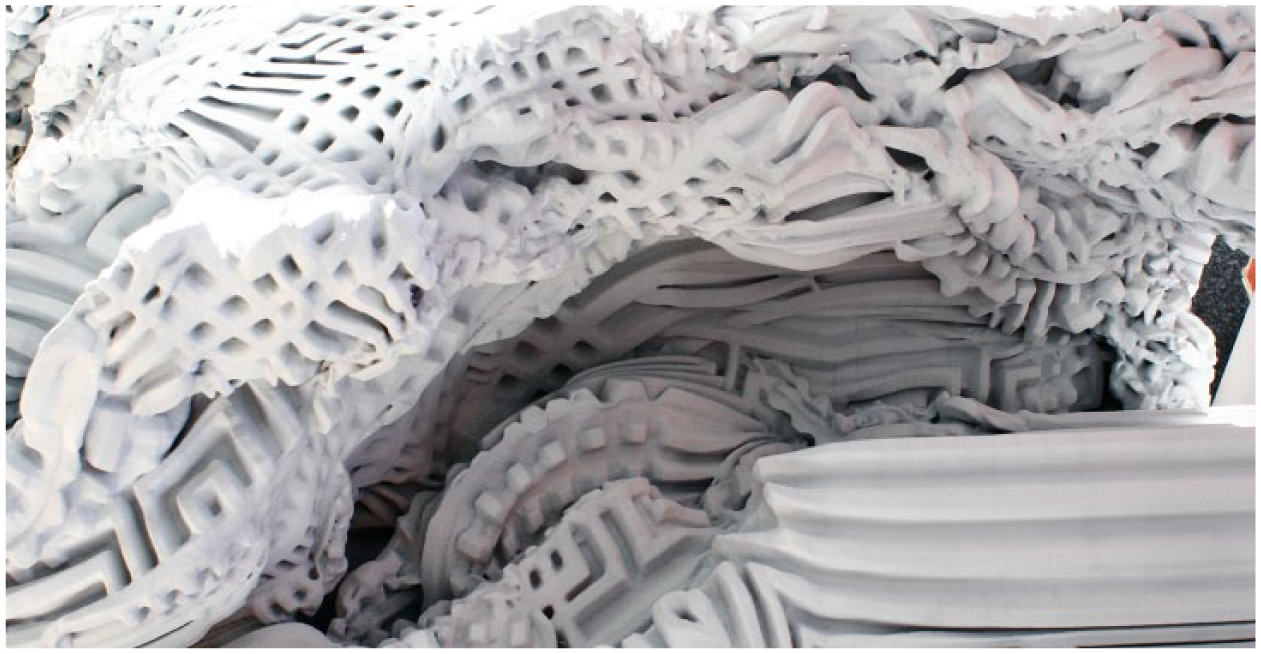
Detail of a test print for Hansmeyer and Dillenburger’s ‘Digital Grotesque’ project (photographed by the author at the Chair for Computer Aided Architectural Design, ETH Zurich, 2013).
When considering the genesis of technical beings in terms of individuation, there remains a temptation to interpret Simondon’s notion of a technical individual in the manner of an object, that is, as a spatially bounded ‘thing’. 58 It is tempting to assume, in the case of moulding, that the process of individuation that produces the brick is reducible to the materiality of the finished product, in such a way that it is the brick alone that undergoes the individuation. Yet, this is not how Simondon understands processes of technical individuation and the individuals that they produce. The physical individuality of the brick is brought into being through a process of individuation that articulates potentialities across disparate energetic fields. The brick, in other words, is an effect, produced through individuation, but its physicality should not be confused with the individuation of the technical process itself.
We can appreciate the significance of this Simondonian constraint through Combes, who provides a nuanced reading of the brick’s genesis:
The clay can eventually be transformed into bricks because it possesses colloidal properties that render it capable of conducting a deforming energy while maintaining the coherence of molecular chains, because it is in a sense ‘already in form’ in the swampy earth. In such a description, the individuation of a clay brick appears as an evolving energetic system, which is very different from how hylomorphism sees it, as a relation between two terms that are alien to one another.
59
It is through the individuation of an underlying energetic system, imbricating the materiality of the clay with that of the mould, that the brick undergoes its taking-form. We might, for instance, compare this process of individuation with that generated through the rotations of the potter’s wheel. In each case, the materiality of the clay lends itself to the individuation of a particular energetic system. In the case of pottery, however, the centrifugal force introduced through the movement of the potter’s wheel enables a different kind of relation to emerge, entangling the clay’s colloidal properties with the electrochemical impulses of the potter’s nervous system: fingers feeling the give and take of rotating molecular chains.
Simondon describes the individuation of these relations as ‘transductive’, where transduction is defined as any process ‘by which a structure appears in the domain of a problematic, that is, as that which provides the resolution of the posed problems’. 60 The processes of individuation that give rise to bricks, pots and printed matters involve a transduction of forces that were previously incompatible. Individuation is transductive, Grosz argues, ‘in so far as it cuts across many forces, strata, dimensions to generate momentary or longer alignments that temporarily structure the chaos of the preindividual’. 61 Crucially for Simondon, transduction does not generate solutions through the negation of a system’s incompatibilities. Rather, incompatibilities are re-articulated – and thus affirmed – through the individuation of a new level of reality. The solution, as far as transduction is concerned, is no more than – but also no less than – a creative re-articulation of the problem.
What this means, therefore, is that the object of any individuation is never simply a ‘thing’; rather, individuation is an operation that realizes itself in, through, and as transduction. In the case of organic individuation, Simondon states that it is in the very nature of living beings that they are the transductions that their lives enact:
A vegetable institutes a mediation between a cosmic order and an infra-molecular order, sorting and distributing the chemical species contained in the ground and in the atmosphere by means of the luminous energy received from photosynthesis. It is an inter-elementary nexus, and it develops as the internal resonance of this preindividual system made of two layers of reality that are primitively without communication.
62
Technical individuations also achieve their consistency through the transductions they make possible, yet they do not achieve this feat through biological means. An aeroplane is a transduction that, by crossing an energetic threshold, is able to articulate gravitational forces within a milieu of flight: its solution is a relation that, rather than defying gravity, affirms the weight of matter through aerodynamic means.
Thinking in these transductive terms requires an entirely different approach to the question of technology’s functionality. From a Simondonian perspective, what makes a technological process like 3D printing functional is never reducible to its instrumental utility. Rather, the motor of technical functionality – referred to by Simondon as ‘technicity’ 63 – resides in the transductive capacities of the individuating process itself. Understood in terms of technicity, then, the functionality of a brick or a printed object is never entirely reducible to its actualizations: technicity is an expression of the disparate forces that a given individuation brings into transductive relation, in excess of the object’s instrumental significance. It is for this reason that Simondon shifts the question of our relationship with technology away from anthropocentric narratives, troubling any sense of a clear-cut binary between the natural (object) and the technical (subject). Our entanglements with technology express the potentiality of preindividual forces, exceeding all distinction between ‘natural’ processes and the realization of human dreams.
If 3D printing is an expression of technical emergence, if it makes us wonder with the sense of something new, then this is only indirectly related to its instrumental value. Indeed, if we follow Simondon’s argument, then the only way of capturing the potentiality of an emerging technology is to apprehend it as an individuation of transductive relations: we arrive at its utility only indirectly, by contributing our thinking to its individuating process. There is, I would suggest, an element of this approach to Hansmeyer and Dillenburger’s Digital Grotesque project, which provides an empirical alternative to the hylomorphic fantasy of the downloadable object. As the architects note, their experiment shows that 3D printing has the capacity to shift the resolution of the design process from the scale of the brick to that of individual sand-corns. 64 Yet, there is also a sense in which there is much more than a change of scale at stake, for the question of the sand’s architectural potential is re-articulated in relation to the imperceptible pulsations of computational processes. What Digital Grotesque allows us to grasp, therefore, is the individuating consistency of a new kind of transductive relation, one that introduces a new differential into the feeling of our thoughts.
Conclusion
The materiality of the Anthropocene, notes Head, ‘projects into the lifetimes of current young people almost unimaginable scales of change, certainly rendering many aspects of our current modes of living impossible’. 65 Given the magnitude of these imminent transformations, it might seem somewhat irresponsible to be indulging in the kind of conceptual acrobatics that an encounter with Simondon’s philosophy demands. Indeed, looking to Simondon for some kind of practical solution to humanity’s (future) woes ends, somewhat inevitably, in frustration: all life, human or otherwise, is but a momentary alignment, a contingent structuring of chaotic tendencies with no hope of an existential guarantee. It is precisely this persistent sense of frustration, tied to our inability to master the fate of our species and its ecological milieu that Simondon spotlights in his re-articulation of the technological problematic. In many respects, the crisis of the Anthropocene stems from the disturbing realization that we are not the autonomous agents we have long assumed ourselves to be. Framed in this way, there is no reason to believe that it will be possible to change the trajectory of our planet through an informed decision to act.
Yet, Simondon shows us that there is perhaps another way through this frightening impasse, a path that acknowledges that the conditions of the new are only ever reached through a re-articulation of the problem itself. My argument, then, is that Simondon’s philosophy provides a means of re-articulating technology as a problematic in and for the Anthropocene, precisely because it seeks to avoid the ‘exceptionalist’ tendencies of hylomorphic thought. The dynamism of Simondon’s thinking is such that his concepts tend to exceed the boundaries of a watertight metaphysical system. This is something that I have attempted to embrace in my reading, for it is in articulating the dynamism of the underlying problem that we sense the force of his concepts. Put simply, Simondon’s argument is that we will continue to misunderstand the significance of technological processes unless we question the assumption of a metaphysical distinction between thinking beings and non-thinking nature. Appeals to technical solutions only serve to mask the fact that the problem of our relationship with technology remains badly posed. 66
To this end, Simondon’s concepts allow cultural geographers to sidestep a particular contemporary deadlock, namely, the false choice between hubristic narratives of techno-scientific progress and reactionary appeals to organic authenticity. The first of these choices has been targeted explicitly throughout this article; it assumes that humans are unique beings by virtue of their capacity to dominate nature through technological means. Simondon refutes this approach through his critique of hylomorphism, as I have shown. The second choice is perhaps not quite so obvious; it posits that the evolution of machines has disrupted a more authentic relationship between Man and Earth, and thus strives to reconstruct this relationship from the ruins of what we have become. This argument is rehearsed in the work of Timothy Ingold, which, bolstered by a nostalgia for artisanal practice, tends to reduce Simondon’s critique of hylomorphism to a critique of technicity tout court. 67 The problem with this misreading is that, in its inherent suspicion towards machines, it overlooks the sense in which Simondon approached the emergence of technological processes as an opportunity for thinking beyond the constraints of the hylomorphic model.
On the one hand, hubris, on the other, suspicion. Neither approach is appropriate within the context of the Anthropocene, for each is predicated upon the ontological privileging of a universal human-nature relation. Whether our uniqueness stems from our will to control and dominate nature through technical means or from our singular capacity to forget a more authentic relationship to Being matters little in this regard. What distinguishes Simondon’s philosophy from both of these options is therefore its refusal to situate the technological problematic within a framework that gives metaphysical priority to the subject–object relation. The task at hand – and this is a challenge that Simondon embraces through his notion of a preindividual field – is to recompose the thought of nature’s immanence in response to the individuation of technological processes, thus resisting the tendency to make technology immanent to humans alone: a manoeuvre that only serves to re-instate the illusion of our own transcendence. 68
The philosophical problem of immanence is, I would suggest, the animating concern for contemporary materialist thought, and cultural geography is well placed to take this argument further in its appreciation of our ‘more-than-human’ world. It is for this reason that I have chosen to emphasize the ontological tone of Simondon’s philosophical explorations, over and above its phenomenological implications for cultural geography. This is not to deny the significance of Simondon’s philosophy for understanding the transformative impacts of technological processes in relation to perceptual experience. Yet, what Simondon’s philosophy also makes clear is a need to broaden the question of the relationship between technology and human life beyond a concern for the conditions of lived experience, for is it not the case that technology forces thought beyond a territory that it is able to recognize through an appeal to possible experience? Exceeding the possible experience of subjects, technological individuation explicates the continuous envelop of thinking and being: it is both the thought of materiality and the materiality of thought, simultaneously and without contradiction, that technology forces us to think.
Footnotes
Acknowledgements
I thank the anonymous reviewers for providing me with such detailed and constructive feedback. I am also very grateful to J.D. Dewsbury, Mark Jackson and my former colleagues at the University of Bristol; Benjamin Dillenburger, Michael Hansmeyer and Manuel Kretzer at ETH Zurich; and Lesley Head at the University of Melbourne.
Funding
The author(s) disclosed receipt of the following financial support for the research, authorship, and/or publication of this article: This research was funded by an Economic and Social Research Council (ESRC) PhD studentship.