







Abstract
There is a difference between theory and theorizing. One way or another, theory is central to the organization of most academic disciplines: for example, as a framework of concepts that expresses preoccupations, that codifies linkages, that relates discoveries, that raises questions. But theorizing is the becoming of theory: for example, running into problems, feeling perplexity, creating space, forming concepts, finding time, condensing frameworks, forcing conclusions – a living reality that is (for reasons explored below) neglected as a topic of inquiry. I address this deficiency here by engaging with theorizing as a legitimate, perhaps inescapable theme, albeit one that remains elusive and that must as far as possible be grasped directly as it occurs. In developing this engagement, I suggest that the philosophy of Deleuze and Guattari offers an appropriate point of departure and – through a reading of Difference and Repetition and What is Philosophy?, and through a synthesis of this with the experience of theorizing – I draw out the components of a Deleuzian theory of theorizing.
Introduction
One way or another theory is central to the organization of most academic disciplines – from the natural and the social sciences to the humanities and the arts. Each strand of human geography, for example, is imbued with a series of assumptions and preoccupations that are conveyed in a body of theories, and each strand implies a series of themes and questions that expand upon these theories: ‘thinking about theory is not an optional extra but a necessary part of doing geographical research’. 1 Beyond the academy, however, theory is also central to the development of contemporary culture, not only through the impact of science and technology but also through the theories that are invoked by practitioners in accountancy and finance, business and child care, politics and marketing, literature and the arts. It may no longer be possible to believe in the idea of progress, or to credit the rationalization of society, but it is both possible and necessary to acknowledge the rise of theory as a form of cultural power.
In the Cartesian tradition, the power of theory lies in the capacity of theorizing to reach across the dividing line between two mutually exclusive realms – between mind and matter, or subject and object. More specifically, this power lies in the capacity of reason as a transcendental reality (the ‘inner light’ of the soul) to grasp the logic that informs a transcendent reality (the world beyond sensations) and to convey this logic to the empirical subject. 2 The Cartesian image of theory is by no means unproblematic, however, and has provoked on-going re-examination through a second round of theorizing that is applied to theory itself, and that – as critique – produces the characteristic forms of contemporary meta-theory. Critique was, for example, the method used by Descartes to perceive that truth is revealed in clear and distinct perceptions. It was also the method used by Kant to theorize the necessary limits of theoretical reason. Even Nietzsche, who took a hammer to Cartesianism, did so through a reasoned critique of reason and theory: ‘Learn from out of this fool’s book, how reason can be brought – “to reason”’. 3 During the 20th century, the method of critique migrated to the social sciences where it produced waves of critical theory – dialectical, phenomenological, structuralist, poststructuralist, feminist, postcolonial – that addressed reason and theory as historical, cultural or linguistic artefacts. 4 But, whether in philosophy or in the social sciences, critical meta-theories have responded to an image of theorizing-as-transcendence – asking, for example, whether theory as a social construct can really represent a transcendent(al) reality.
The rediscovery of Hegel and Nietzsche in the 1960s was, however, accompanied by the rediscovery of Spinoza. The starting point for Spinoza is not a dichotomy between mind and matter that is mediated by reason, but a unified God or nature to which mind and body, thought and extension, belong as attributes. The faculty of reason no longer supervenes mysteriously upon sensation and understanding from a realm beyond, but belongs to nature and imbues both thought and extension with an inherent intelligibility. Indeed, for Spinoza, reason is not a faculty at all, but a practice that is aligned to the pursuit of virtue: the more we think, the more adequate our ideas; the more adequate our ideas, the more powerful our actions; the more powerful our actions, the more joyful and ethical our lives. From this perspective, the power of theory is secured not by developing a critical meta-theory that regulates the process of theorizing, but by expressing and explicating the intelligibility of theorizing itself as a practice. 5 To paraphrase Montag, ‘[theorizing] does not represent . . . a more primary reality; it is itself fully and irreducibly real’. 6 The philosophy of Spinoza therefore creates the potential for another kind of meta-theory, one that responds to an image of theorizing-as-expression – asking, for example, how theories form in the course of theorizing, and what truths are thereby expressed. The influence of Spinoza is evident in Althusser’s concept of ‘theoretical practice’, but it is also evident in Deleuze’s treatment of thought and of philosophy. 7
My project in this article is to address the experience of theorizing as a living reality, as a style of reasoning and as the becoming of theory. So far, this project has been introduced here by locating a deficiency in the meta-theoretical landscape, a deficiency to which the article offers a response. But another starting point would be to describe the moments of intellectual disturbance and engagement from which the project emerged. One such moment occurred, for example, at the Annual Meeting of the American Association of Geographers in 2014, where I noticed that most of the presentations faced simultaneously in two directions – offering a theory of their chosen subject that was supported by an account of the production of this theory, or by a simulation of this production that implied such an account. The purpose of such self-accounts was in each case to provide a rationale for the theory that was being presented – for example, a deficiency to which the theory responded. It was this vein of reflexivity that prompted my initial question here: if the presentation of most theories is accompanied by allusions to their genesis, what is the relationship of a theory to the circumstances of its genesis? 8 Subsequently, this question was expanded by drawing upon remarks made by Anderson and Harrison in their account of non-representational theory, where they explained that they required a plausible ‘origins myth’ for this theory. 9 The scepticism that these authors directed towards standard self-accounts suggested that there may be a divergence between the theory that is produced, the manner of its production and the account that is given of this production. The issues that emerge here are various, including
The adequacy of the embedded self-accounts of the genesis of theories;
The ways in which theorizing can be accounted for adequately;
The genesis of the embedded self-account of the genesis of a theory;
The consistency between the genesis of theory, the self-account of this genesis and the theory that is generated.
In this article, the deficiencies of the meta-theoretical landscape, and these four points of intellectual disturbance, are approached through an inquiry into the becoming of theory. Although elusive, the reality of theorizing involves a series of open-ended events – for example, running into problems, finding time, reading books, long conversations, mind wandering, drinking coffee, articulating questions, crystallizing strategies, making space, consulting friends and foes, recording thoughts, dreaming of solutions, condensing frameworks, collecting data, cutting corners, playing with connections, cleaning up results, removing stepping stones, selecting conclusions. To study theorizing as a living reality, an approach is required that captures this reality directly as it occurs – which, in the present context, suggests that I must try to capture the theorizing that is occurring here, in the preparation of this article. Such an approach may seem improbable, but it builds upon the Spinozan or Deleuzian view of knowledge as true when it explicates its own intelligibility. 10 It also suggests that different accounts of theorizing will emerge from different styles of theorizing – accounts that are, for example, differently gendered and racialized. 11 In the next section, I describe the development of thinking around theorizing, and I explore certain problems associated with meta-theory as currently constituted. Deleuze does not distinguish between theory and philosophy, but from a reading of Difference and Repetition and of What is Philosophy?, and from the synthesis of this reading with the experience of theorizing, I draw out such a distinction, and I present the contours of a Deleuzian theory of theorizing.
Theorizing-as-transcendence
In the language of ancient Greece, the theoroi were pilgrims who witnessed a sacred spectacle, while theorein was the illumination that they received and communicated. The meaning of theoria was, however, generalized at the hands of early philosophers to include all encounters with a transcendental reality from which illumination could be derived. In the allegory of the Cave, for example, Plato suggests that theorizing involves a detachment from the ignorance of everyday life and the passage towards a transcendental realm of pure forms or Ideas that shape the world of experience and that can be grasped by intellects with the capacity for reason. 12 In the Cartesian tradition, the idea of theorizing was, however, complicated by the distinction that was drawn between transcendental ideas, transcendent objects and the empirical subject or ‘I’. The classical image of theorizing-as-transcendence was therefore expanded to encompass the journey of reason across these three realms. This image was by no means unproblematic, however, and was indeed vulnerable to the twin dangers of scepticism (radical doubt regarding experience) and dogmatism (exorbitant claims reflecting beliefs). A second round of theorizing was therefore required that would, through the self-examination of reason, review and revise the foundations of theory.
In the Cartesian tradition, theory is therefore not only the product of a daemonic reason that travels across transcendent(al) realms but also the product of a reason that encounters itself in making this journey. However, the effect of such an encounter is to divide theory into ‘higher’ and ‘lower’ tiers, a higher meta-theoretical explanans and a lower theoretical explanandum. In responding to the vulnerabilities of the Cartesian paradigm, the second tier of theorizing – known as critique – has evolved over time through three overlapping phases: from the regulation of theory (in, for example, Kant and Husserl), through the rejection of theory (in, for example, Nietzsche and Heidegger), to the reduction of theory (in, for example, Foucault and Derrida). In this section, I discuss these phases in turn, and I identify their problematic consequences.
Regulation
The purpose of Kant’s first critique was to defend the power of reason and theory against the dangers of scepticism and dogmatism. This task was approached by theorizing knowledge, including science, as the product of a cooperation between faculties of the subject – in particular, the faculty of sensibility (with its a priori forms of intuition) and the faculty of understanding (with it’s a priori concepts and categories). 13 However, although these faculties both belong to the subject, according to Kant, they are dependent for their efficacy on, on one hand, the transcendent and unknowable thing-in-itself and, on the other hand, the transcendental and regulative ideas of reason (such as ‘God’). 14 Kant arrives at this meta-theory through a self-examination of reason that involves an internal division between higher and lower – critical and speculative – tiers of theory, in which the former both explains and regulates the latter. 15 ‘Speculatio’ is a Latin translation of ‘theoria’ and, although this performs an important role, it is also a source of illusions: ‘theoretical cognition is speculative if it pertains to an object . . . to which one cannot attain in any experience’. 16 It is only by developing the critical branch of theory, as Kant does, that reason can achieve the self-knowledge it requires to represent reality, and to rein in its own speculative tendencies. However, as Hegel points out, the process of critique itself presupposes the very foundations – the self-knowledge of Reason – that it is supposed to provide. 17
Rejection
In his attack upon the tenets of Cartesianism, Nietzsche’s thinking is necessarily informed by these tenets. Indeed, his philosophy can be regarded as a radicalization of Kant that retains a central role for the subject in the production of knowledge. But this subject is now a fragmentary body that is motivated, not by transcendental reason, but by a series of ignoble drives and instincts. 18 At the same time, both the realm of transcendental ideas and the realm of transcendent objects are overtly abandoned. As his philosophy evolves, Nietzsche offers a range of meta-theories by which to expose Cartesian reason – for example, presenting this as a repository of lies (such as the stability of ‘being’) that are useful to the struggle for survival. 19 In an early work (The Birth of Tragedy), Nietzsche criticizes Socrates for presenting the ‘theoretical man’ as a new ideal, and he argues that Socratic intellectualism is an expression of the decadent will to power. 20 In a later work (Thus Spoke Zarathustra), Nietzsche presents the positive scientist as a ‘pedant of the spirit’ who loses sight of higher knowledge. 21 Nietzsche’s goal is to replace reason with instinct, concept with metaphor and theory with poetry; but in pursuing this goal, he himself relies upon reason, concept and theory. This tension is managed by dividing theory into higher and lower tiers – Nietzsche’s and other people’s – and by pursuing a critique of the latter that, if applied even-handedly, would also encompass the former. 22
Reduction
Like Nietzsche, Foucault diverges from the Cartesian paradigm in ways that are marked by this paradigm. His goal is to challenge the Kantian claim to have discovered the universal conditions of knowledge production. Foucault pursues this goal by extending the Nietzschean critique of the subject and its reason, removing these from the centre of knowledge production and presenting them both as historical artefacts. He develops a style of critique that is ‘Archaeological – and not transcendental – in the sense that it will not seek to identify the universal structures of all knowledge’. 23 In his later genealogies, such as Discipline and Punish, Foucault presents meta-theories that challenge the authority of repressive concepts (such as ‘discipline’) by revealing their origins in historical contingency. 24 However, despite his rejection of transcendentalism, history plays a role in Foucault’s meta-theories which resembles that of the subject for Kant – as the transcendental source of a priori categories that articulate our thinking. There is also a division in Foucault’s philosophy between ‘lower’ and ‘higher’ tiers of theory – between cultural theories that derive their authority from their supposed universality, and Foucauldian meta-theories that dispute this claim to universality. But if, as seems likely, Foucault’s meta-theories present historical relativism as itself a relative truth, then the authority of these meta-theories can be no greater than the authority of the theories they seek to challenge.
Despite their different orientations, during each of these phases the Cartesian critique has had two unfortunate consequences. First, while the division of theory into higher and lower tiers has allowed the problems with theorizing-as-transcendence to be exposed, this division has in the same move also reproduced these problems at a higher, meta-theoretical level. Secondly, scepticism towards the transcendental aspirations of theory has obscured the experience of theorizing as the becoming of theory and has produced the occlusion of this experience as a topic of inquiry. Over time, the influence of critique has extended across all branches of cultural knowledge and has, for example, urged the replacement of grand theory by minor theory, and strong theory by weak theory. 25 But rarely if ever has it addressed theorizing directly as an experience and as a practice. 26 In the next section, I explore the possibility of a different kind of meta-theory, one that conceptualizes theorizing-as-expression.
Theorizing-as-expression
The influence of Spinoza on Deleuzian thought is evident from his commitment to immanence, and to expression as the power that articulates attributes and modes. 27 In Difference and Repetition and in What is Philosophy?, this power is explicated further as a circuit of genesis that gives rise to thought and extension, and to individuated subjects and objects. 28 Although different from one another in focus and scope, these books present similar architectures, and although neither offers an account of theorizing, they analyse thought and philosophy in ways that permit such an account.
Circuit of genesis
Towards the beginning of his career, in Difference and Repetition, Deleuze focuses on the problem of thought, but he departs from the dualistic treatment of this that he finds in Kant. 29 In the Kantian system, our understanding of the world is grounded on an active relationship in which the evidence of the senses is assimilated to pre-existing identities – objects and subjects – under the guidance of the categories, a process that Kant calls ‘representation’. The generality of Kant’s categories means, however, that his method can only account for possible experience, and it is to overcome this limitation that Deleuze proposes an alternative approach that can investigate the grounds of real experience. 30 Deleuze locates these grounds not in a transcendental unity patterned after God, but in a dimension of virtuality that is immanent within the real, that expresses difference rather than identity, and that operates affectively upon consciousness. Beneath the active syntheses of Kant, Deleuze therefore discovers layers of passive synthesis, in which both the understanding and the sensibility are constituted out of the encounter with sensible forces – energetic differences between differences that are given to pre-subjective experience.
For Deleuze, everything, including thought, follows from such encounters, which initiate a circuit of six syntheses (three passive and three active) that lead from the apprehension of differences and repetitions, through the release of problems (and the production of time and space) to the individuation of objects. 31 During the passive syntheses, sensible encounters provoke the emergence of a nascent subject that moves from seeing itself in objects to contemplating itself directly, becoming the faculty of thought. 32 In the absence of the Kantian unity of apperception, however, this subject disintegrates, and there follows a hiatus in which differences are freed from the nascent subject to become a cloud of virtual problems. Deleuze appropriates Kant’s concept of the Idea as an irreducible web of problems that exceeds knowledge. But unlike Kant, Deleuzian problems are not transcendental in origin but emerge immanently as virtual pressures that are latent within the actual world of experience. 33 Three active syntheses complete the circuit by combining intensities with Ideas to determine problems and to produce solutions in the form of individuated objects and subjects. 34
At the end of their careers, in What is Philosophy?, Deleuze and Guattari narrow their focus to the genesis of philosophy. But this genesis is itself located within the wider genesis of thought, and their account follows a similar trajectory to the one presented above – from three passive syntheses (Art), through a liberating hiatus (Philosophy), to three active syntheses (Science). 35 Art in this context is the product of pre-reflective encounters with forces that draw the sensed (percept) and the sensing (affect) together, and that order the resulting sensations. This ordering is, however, dissolved by the subsequent detachment of sensations from their material forms, and there is a hiatus in which a web of free-floating problems emerges and is engaged by philosophy. We are told that philosophy is ‘the art of forming, inventing, and fabricating concepts’. 36 The philosopher is a friend of the concept who releases its potential by engaging its components in responding to problems, but the desire of the philosopher implies a claim to wisdom that entails both friendship and rivalry with other thinkers. It is the process of agonism (the hand-to-hand combat of energies in response to a web of problems) that gives rise to concepts. 37
The completion of this circuit then involves a sequence of active syntheses, in which virtual concepts intersect with a web of problems (plane of immanence), and are selected by these in the production of extended objects, the functions of science and the subjectivities of scientists.
38
There is, however, a coda to this discussion. In his book on Foucault, Deleuze criticizes philosophy for ignoring the dependence of thinking on the intrusion of an outside.
39
In What is Philosophy?, Deleuze and Guattari also tell us that beneath every plane of immanence is THE plane of immanence . . . that which must be thought and that which cannot be thought. It is the nonthought within thought. . . . an outside more distant than any external world because it is an inside deeper than any internal world: it is immanence.
40
As immanence, the Outside comprises a productive limit that operates before, during and after the circuit of genesis.
Scale of genesis
The accounts sketched above share broadly the same model of expression, involving a circuit of three moments – Art, Philosophy and Science. This circuit is initiated by the encounter with virtual forces, and moves through a series of passive syntheses to produce a nascent subject (Art). The failure of these syntheses and the disintegration of this subject leads to a hiatus in which a milieu of problems and Ideas is revealed, and concepts are created in response (Philosophy). Finally, there follows a series of active syntheses that brings conceptual frameworks into conjunction with a web of problems, and that produces individuated objects and subjects (including theories and theorists) as solutions (Science). But the abstract nature of this model raises questions about the scale at which it is supposed to operate. It might, for example, be thought to describe genesis on an historical scale, through successive episodes of world evolution; or it might describe a progressive awakening of the faculties, through stages of psychological development on a biographical scale. In the present context, however, I suggest that the model is a description of the on-going (re)creation of the world on a moment-by-moment or ontological scale. This interpretation is more consistent with Deleuze’s other writings, and implies, for example, that there is a plurality of coexisting circuits at different stages of completion that can interact with one another. 41
The genesis and structure of theorizing
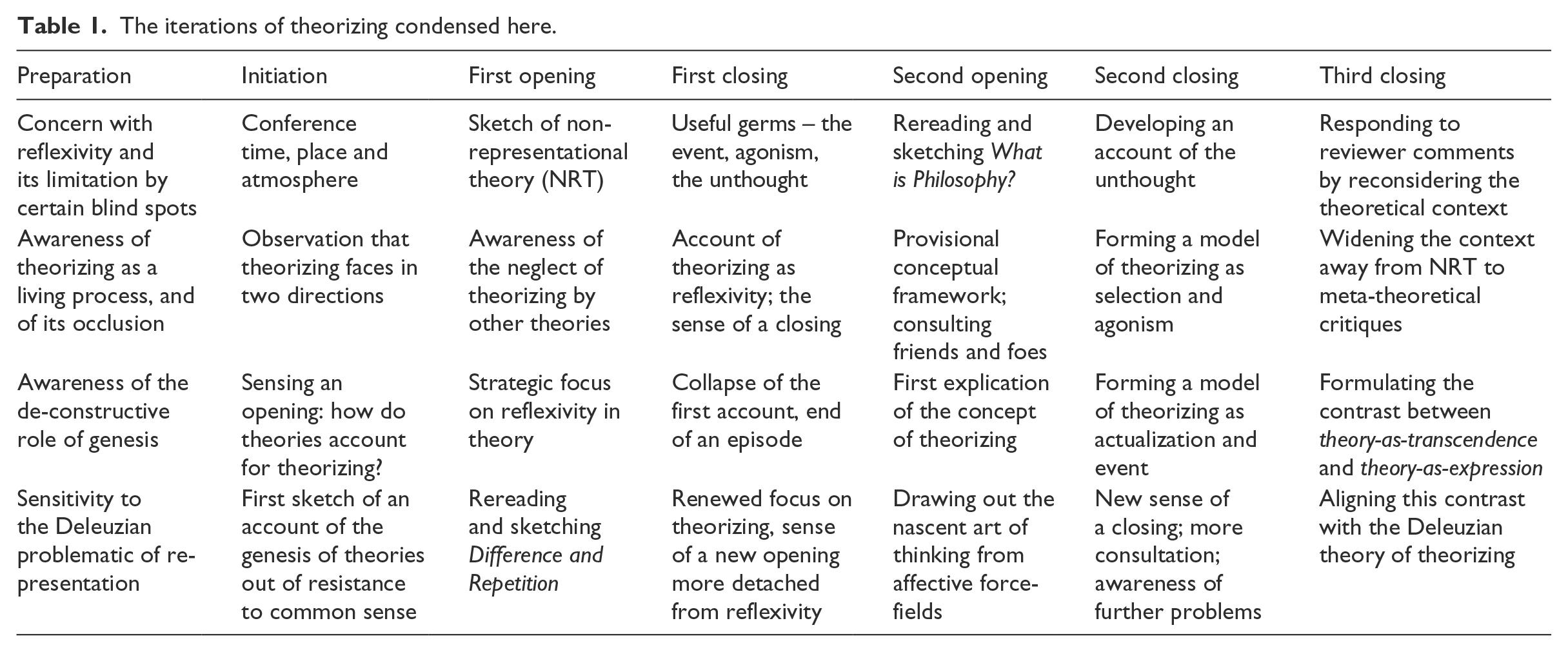
An important moment during the theorizing that is condensed here was the encounter with Deleuzian philosophy, an encounter that is to some extent reprised in the above conceptual framework. Although focussing on common sense, thought and philosophy, this framework is presented here because, in a modified form, it offers a perspective on the different but related subject of theorizing. The framework itself suggests, however, that conceptual frameworks are produced and modified in a circuit of genesis that involves the three moments of Art, Philosophy and Science, and that the third of these involves the encounter between concepts and problems. To produce a theory of theorizing my next step is, therefore, to bring the framework into conjunction with the events of the theorizing expressed here, starting with the genesis of theorizing in Art and Philosophy, and proceeding to the structure of theorizing in Science. Table 1 lists some of the events that occurred in building towards the present theory.
The iterations of theorizing condensed here.
Art
The Deleuzian framework suggests that thinking originates in a series of three passive syntheses that emerge from pre-conceptual encounters. As implied at the beginning of this article, one starting point for the present work was the sensory milieu created by an international conference, an experience that fostered a climate of thinking. The combination of an unfamiliar downtown and a bright airy hall worked subliminally to produce a receptivity and an engagement that allowed new associations to be imagined. 42 However, although fleeting, the world of the conference was already populated by tacit problems and ambient theories that arrived, with the delegates (including myself), from earlier circuits. In Deleuzian terms, such theories subsist as percepts and affects that retain experience aesthetically as well as conceptually. 43 Theories, like paintings and sculptures, are therefore felt – as powers and frailties, as beauties and monstrosities – before they are thought, and they convey a force field of problems that colours the landscape and comprises a plane of immanence. 44 The concept of style describes this pre-conceptual context, ‘style is not the external or accidental adornment of a message; it is the creation of affects from which speakers and messages are discerned’. 45 The aesthetic impulse is an important driver in the production of knowledge, and a further starting point for the present thinking was the aesthetic impact of pre-existing circuits across the conference.
Philosophy
Problems for Deleuze are irreducible dilemmas that belong to objects as well as to thoughts, while Ideas are relations between reciprocally determined problem elements that subsist as virtual pressures within a plane of immanence. 46 Ideas are sometimes conflated with concepts in commentaries on Deleuze, but I retain the distinction here between Ideas as bundles of problems, and concepts as solutions to problems. The thinking that was facilitated by the sensations described above was initiated by an observation of reflexivity that was expressed in my initial question: what is the relationship of a theory to the circumstances of its genesis? The Deleuzian framework suggests that, while all thinking responds to virtual problems, thinking becomes philosophy when it responds to problems by creating concepts. One consequence of my problematic has therefore been the quest for a new concept of ‘theorizing’, one that avoids the Cartesian daemon and falls naturally out of the Deleuzian framework.
It can be deduced from the Deleuzian framework that thinking, common sense, philosophy and theorizing are all concepts in the Deleuzian sense – assemblages with irregular boundaries that are coordinated with one another, and with other concepts (such as art and science) that respond to the same plane of immanence. 47 However, to modify the framework to include theorizing, I need to explore more closely the relationships among these concepts. It can reasonably be suggested that theorizing occurs within the horizon that is provided by thinking, as a kind of thinking; that philosophy occurs within the horizon that is provided by theorizing, as a kind of theorizing; and that common sense occurs within the horizon that is provided by both of these as a kind of thinking or of theorizing. Thinking therefore includes theorizing, but is a wider concept that also includes, for example, the common sense negotiation of problems encountered in everyday life. Likewise, theorizing includes philosophy, but is a wider concept that includes not only philosophy but also, for example, common sense, science and social science. Theorizing can therefore be articulated as a Deleuzian concept by its insertion as a middle term into this ecology, and by its interpretation as the expression and explication of intelligibility, or of sense, through the articulation of concepts and frameworks (Figure 1).
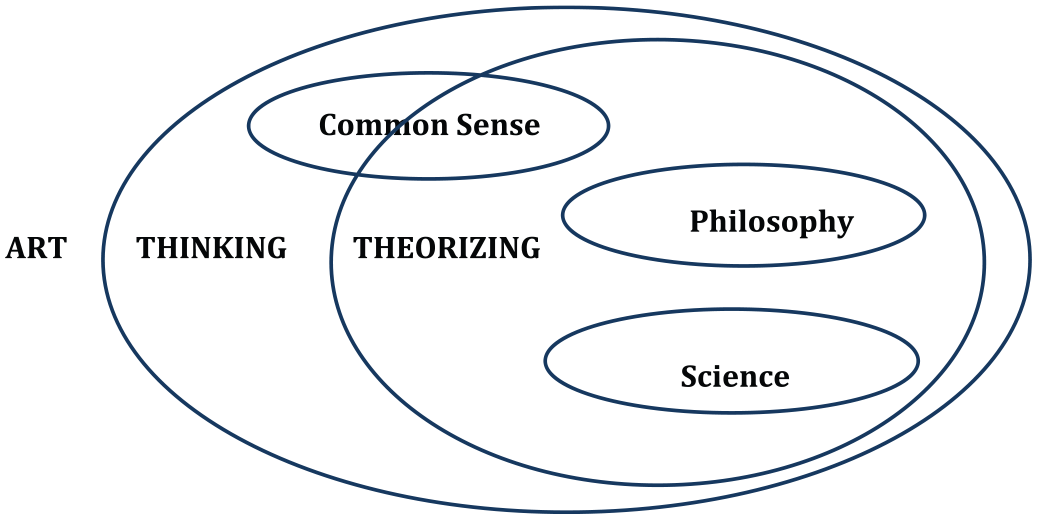
The concept of ‘theorizing’.
So far, the conjunction of the Deleuzian framework with the experience of theorizing suggests that, although thinking emerges from Art, theorizing proper is sparked by the engagement of thinking with Ideas, and it emerges first in the form of Philosophy, second in the form of Science. This account can, however, be expanded by moving the conjunction from the philosophical to the scientific phase, and from considerations of the genesis of theorizing to a consideration of its structure.
Science
The Deleuzian framework suggests that during the third, scientific, moment the concepts forged by philosophy will intersect with the web of problems that emerge from art. In the present case, it is the Deleuzian conceptual framework itself that intersects with the problem of theorizing experienced here. This intersection reveals three interwoven dimensions of synthesis that are hinted at in Table 1 – of theory and theorizing (actualization), of agonism and the plane of immanence (selection) and of opening and closing (event). It also reveals the limitation imposed by a fourth dimension – of the unthought – that is both within and beyond theorizing.
Actualization
As indicated in the introduction and in Table 1, this article concerns the relationship of theory to theorizing. A distinction is drawn by Deleuze between two levels of the event – between ‘real events on the level of engendered solutions, and ideal events embedded in the conditions of the problem’, with the ‘real’ being actual and the ‘Ideal’ being virtual. 48 From this perspective, thinking and knowledge are therefore events which occupy these two levels: the virtual event of thinking or theorizing and the actual event of knowledge or theory:
Thinking is conduct that exposes and solves problems (differentiation). It is a childlike force that occurs at the intersection of different knowledge platforms (such as books and unconscious beliefs), which expresses the knowledge recorded across these platforms, and that adds to this knowledge in the solution of problems.
Knowledge is the determination and solution to problems that is embodied as capacities across different platforms (memories, bodies and habits, DNA, tools and language, networks and archives, landscapes and urban systems) (differenciation). In its expression, existing knowledge conditions the creation of new thinking.
The interchange between theorizing and theory is that between the virtual and actual levels of the event. In this context, it is, however, possible to draw a distinction between embodied and enacted knowledge, and also between implicated and explicated knowledge. 49 Knowledge is embodied as a capacity in, for example, tools: the form of a boat embodies a series of provisional solutions to the problem of sailing under different conditions (the boat knows how to sail in different waters), knowledge that, through the capacities it offers, facilitates the conduct of sailing when sailor and boat, water and wind, intersect. Likewise, the form of a book embodies a series of provisional solutions to the problem of reading under different conditions (the book knows how to read in different lights), knowledge that facilitates the conduct of reading and thinking. However, the text of a book also embodies a series of provisional solutions to other problems such as sailing (the book also knows how to sail), knowledge that can be read and put to work in other circumstances. The knowledge that is embodied in boats and books is enacted in conduct such as sailing and reading (including theorizing), activities that express these latent capacities. Knowledge is also, however, implicated in boats and books – knowledge of the design, manufacture and distribution of these and the improvements of contemporary over past solutions to problems going back to the dawn of time. The knowledge of sailing that is embodied in boats is different to the knowledge of boat building that is implicated in boats – boats know how to sail but not how to make other boats. However, close examination of tools allows us to explicate, through reverse engineering, some of the knowledge that is implicated there. Theorizing is a conduct that enacts the knowledge embodied in pre-existing theories to create new concepts in which pre-existing theories and the knowledge of theorizing are both implicated. The theory presented here is an attempt to explicate and embody the knowledge of theorizing that is implicated in theories.
Selection
In the present theorizing, conversations with friends and colleagues have played a formative role, as indicated in Table 1. Theories form out of an engagement with the problems that emerge from planes of immanence, but there are two sides to this:
1. First, the formation of each theory is propelled by a process of agonism – a combat of energies that creates forces of friendship and rivalry, of engagement and detachment, of attraction and repulsion, among frameworks. 50
In the development of his theories, for example, Deleuze engages a series of Ideas (such as that of the Idea) that he discovers in Kant, while rejecting the common sense image of thought that he also finds in Kant – producing a philosophy that ‘finds its difference or its true beginning’ in a struggle against this image. 51
2. Second, however, each plane of immanence is a ‘sieve’ or ‘logos’, a force field of problems and Ideas that selects concepts and frameworks, causing some to be taken up into theorizing while others are allowed to fade away. 52
It is in the articulation between propulsive agonisms (such as moments of intellectual engagement) and selective planes (such as deficiencies in the theoretical landscape), an aleatory articulation that exceeds the consciousness of any theorist, that theorizing occurs. This articulation will involve different kinds of evidence – case study, fieldwork, survey – and it will argue for solutions that may or may not suit the planes of immanence concerned.
Event
A distinction is revealed in Table 1 between two phases of the event, between opening and closing. From this perspective, theorizing is the passage between these phases, each of which imposes different requirements en route towards a finished theory. At the outset, theorizing pursues the expansive logic of opening, where problems present themselves and the hunt for solutions is opened up. Towards the end, theorizing conforms to the contractive logic of closing, finalizing solutions and presenting these as inevitable. The logic of closing is a predominantly reflexive logic, which includes the presentation of a theory that negotiates friends and rivals, and that plots a viable pathway through ambient selection pressures. The conditions of viability will not, however, have been met throughout the theorizing, which will have included episodes that were inconclusive or regressive. In the present case, for example, the genesis of this theory followed a sequence that is approximated in Table 1, while the presentation of the theory follows a different sequence. The closure of theorizing therefore involves the imposition of a retrospective teleology which suggests how theorizing could have occurred if its sense – its place in an evolving plane of immanence – had been known in advance. This teleology creates an image that informs the presentation as a whole, but is focussed particularly on those strands of reflexivity embedded within the presentation.
It is therefore likely that a finished theory will occlude the real events of its theorizing, presenting a false image of these events – a genesis myth – that is embedded within the presentation. But Deleuze argues against this occlusion: ‘The event . . . must be understood, willed, and represented in that which occurs . . . to become worthy of what happens to us, and thus to will and release the event’. 53 Deleuze is therefore suggesting that all events should exhibit a reflexivity of this sort. So, how can a viable account – one that explicates its sense – be produced that also meets Deleuze’s injunction? Perhaps this is possible in a presentation that
Responds to the imperative to reveal the event of theorizing in the presentation of a finished theory;
Manages the imperative to conceal the event of theorizing within the presentation of a finished theory;
Acknowledges the tensions within the theorizing between concealing and revealing its eventfulness.
There is indeed a history of attempts to reveal the traces of becoming within the become, from the dialectics of Plato and Hegel to the art of Jackson Pollock. Tension between revealing and concealing eventfulness is a feature of the tension between opening and closing in all theorizing. But the responsibility to acknowledge this tension will be particularly acute for a theorizing that explicates the practice of theorizing, and that must acknowledge the passage between the phases of opening and closing while itself passing between these phases.
The unthought
For Deleuze, the ‘outside’ is the source of an unthought that also lies at the very heart of thought. Despite the opacity of the outside, it is possible to draw a distinction between two types of unthought, both of which are to be found within Deleuze’s (if not Foucault’s) conception:
The de facto unthought includes both pre-reflective sensations and distributed events (such as planes of immanence) that, although resistant to consciousness, are open to exploration and create problems that invite solution.
The de jure unthought includes values (such as
The unthought within thought that Deleuze highlights is, however, that of immanence itself, which inheres within thought as the event inheres at the surface of mixtures, and as sense inheres at the surface of propositions. The immanence of theorizing, whereby concepts emerge from a pre-reflective milieu, therefore eludes theory as a de jure unthought that sets limits to theorizing.
Conclusion
Towards the beginning I asked, if the presentation of most theories is accompanied by allusions to their genesis, what is the relationship of a theory to the circumstances of its genesis? This question has been approached here through a study of theorizing that draws upon the resources of Deleuze and Guattari in the production of a conceptual framework. The conjunction of this framework with the experience of theorizing has allowed me to redefine theory and theorizing, and to sketch the outlines of a theory of the genesis and structure of theorizing. As regards genesis, this theory suggests that thinking, which is a precursor for theorizing, emerges from the stimulus that is provided by the sensations associated not only with a conducive time and place, but also with the aesthetics of pre-existing theories (Art). The theory also suggests that theorizing as a concept articulates the differences among a series of other concepts including art, thinking, common sense, philosophy and science, and that as a practice it is the expression of concept-creation and sense-articulation, which imbues both philosophy and science (Philosophy). Finally, while the theory claims that thinking emerges from sensation, it argues that theorizing proper is sparked by the engagement with problems, and that it emerges first in the form of philosophy, then in the form of science (Science). During its scientific phase, theorizing is, in particular, the product of three interwoven syntheses – actualization, selection and event – that, together with the dimension of the unthought (immanence) determine the sense and structure of theorizing as follows (Figure 2):
Actualization. Theorizing occurs in the exchange between two levels of the event, between virtual theorizing and actual theory. Theorizing is the exposing and solving of problems that expresses and extends theory, while theory is the solution to problems that is discovered through and informs theorizing, and that is embodied and enacted, implicated and explicated in different platforms.
Selection. Theorizing occurs in the encounter between propulsive agonisms and selective planes of immanence. Agonism is the productive difference between friendly and rival theories in response to the problems expressed in a plane of immanence. The plane of immanence produces selection pressures that cause the influence of some theories to wax and others to wane.
Event. Theorizing occurs in the passage between two phases of the event, the expansive phase of opening, and the contractive phase of closing. The presentation of a theory is concerned less with the reality of theorizing, more with presenting a teleological image that situates a theory retrospectively in the context of other, agonistic theories around the same plane of immanence.
Unthought. Finally, theorizing occurs around an irreducible blind spot – a de jure unthought – at its edge and at its heart, an opacity that derives from an inescapable immanence that inheres within the events and sense of thinking and knowledge, and that sets limits to these and to the powers of immanence itself.
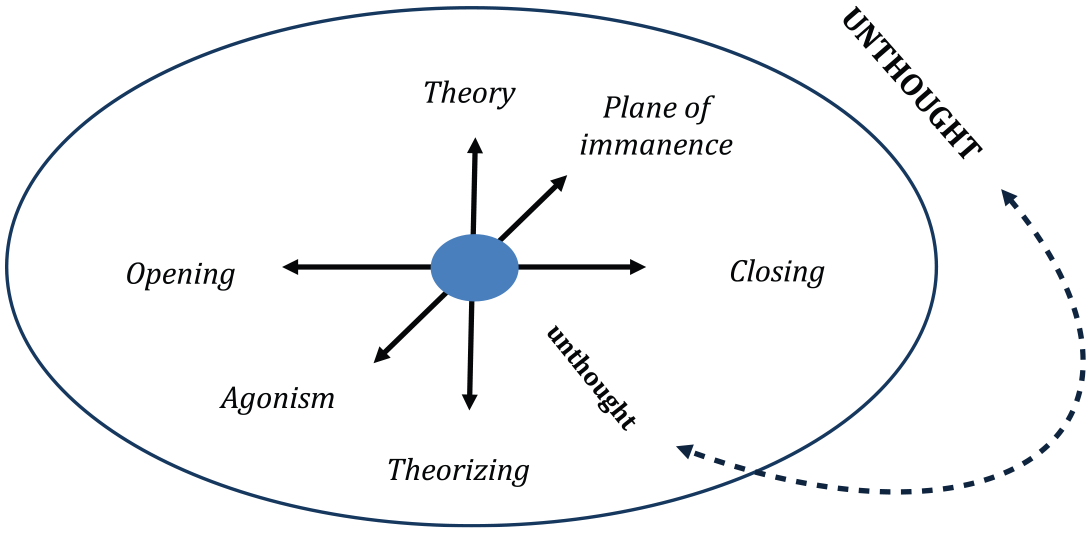
The four-dimensional structure of theorizing.
Four issues were posed earlier concerning the adequacy of the embedded account of the genesis of a theory; the ways in which theorizing can be accounted for adequately; the genesis of the embedded account of the genesis of a theory; and the consistency between the genesis of theory, the self-account of this genesis and the theory generated. The second of these issues is addressed in the theory of theorizing that is presented above. The first, third and fourth issues are addressed in the account of the articulation of agonism and selection, and of the tension between revealing and concealing the event of theorizing. At the beginning, I argued that traditional meta-theory has been preoccupied with (securing or challenging) the image of theorizing-as-transcendence. I pointed out that, while the resulting division of theory into higher and lower tiers has exposed the problems with this image, it has at the same time reproduced these problems at a higher, meta-theoretical level. I also noted that this preoccupation has obscured the experience of theorizing as the becoming of theory, and has produced the occlusion or repression of this experience as a topic of inquiry. In this article, I have argued that, by drawing upon the philosophy of Deleuze and Guattari, and upon the Spinozan perspective that they channel, another kind of theory can be developed that involves an image of theorizing-as-expression.
Footnotes
Acknowledgements
Alan Blum’s remarkable book on Theorizing, to which I was introduced by my friend Kent Palmer, has been a continuing source of inspiration here. I would like to thank Mark Saunders, Anna Secor, and three anonymous reviewers for the exceptional quality and helpfulness of their comments.
Funding
The author(s) received no financial support for the research, authorship, and/or publication of this article.
