







Abstract
The infrastructure-led development model initiated by China under the Belt and Road Initiative (BRI) has faced domestic and international challenges. By focusing on a national travelling art exhibition featuring Chinese railway construction in Africa in 2023, this paper examines the role that curatorial and exhibition practices can play in (re)shaping public geopolitical understandings of China-Africa relations. Exhibiting over 200 artworks collected from both China and Africa, this art programme not only forms a nuanced, personal and storied narrative of China’s overseas development work in Africa but also tactically responds to current internal and external criticism of the Chinese government’s global ambitions channelled through the BRI. This work extends the ongoing interest geographers have at the intersection of the visual arts and critical geopolitics.
Have you heard the conversation of those audience [members] who stopped in front of the work of that Zhongshan Jacket (Figure 1)? They mentioned, for the first time they felt that ‘the community of shared future for mankind’ 1 was kind of actual thing rather than an empty rhetoric.
Absolutely! Your job has changed the way people think about politics.
Well, technically, it’s not our job! These ideas, including these works, do exist! We just collected them, spread them, and inspired the audience.
I agree! A thousand Hamlets for a thousand men! Everyone has his own opinion about certain things. But some of them are encouraged and therefore in an advantageous position to spread, while others are suppressed.
This may be the value of this exhibition. It encourages us to reflect, to seek multiple interpretations of things.
The above excerpt originates from a panel discussion conducted by the authors of this article during Using the Road as a Medium, a visual art exhibition exploring the Chinese government’s railway building in Africa. 2 The panel conversation reflected on how artistic practices can prompt audiences to form multiple interpretations of China-Africa relations, particularly concerning China’s extensive infrastructure activities in Africa driven by the Belt and Road Initiative (BRI). Liu Weidong, an influential Chinese scholar and prominent defender of the BRI, describes the initiative as a ‘Chinese solution’ for an inclusive model of economic globalization 3 whilst consolidating China’s relations with participating countries. 4 Over the past two decades, mainstream discourse surrounding the BRI within China has been dominated by the enthusiasm of Chinese elites and its overseas infrastructure-led development model. However, the BRI has been challenged in China. There continues to be dissenting and critical voices from grassroots organisations, artists and intellectuals. 5 Criticism has circulated beyond China as well, including countries that have received Chinese infrastructure investment, which has been described by some as a new form of ‘neocolonialism’, ‘new imperialism’ and ‘extractionism’. 6
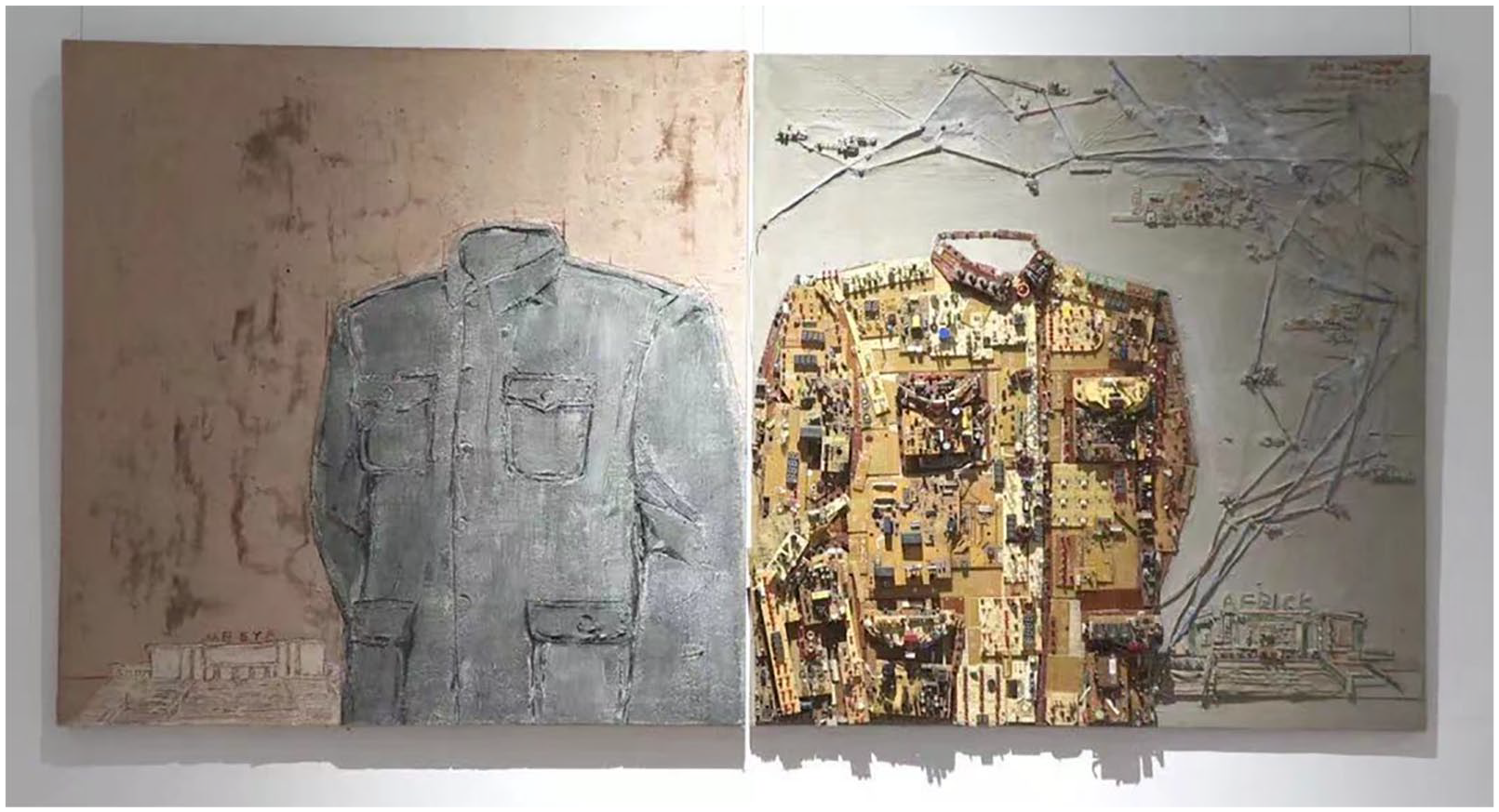
Zhongshan Jacket. Hong Shuyun, Yang Zhongwei, from Wang Lei Studio, 2023. Photograph by the authors.
In this writing, we reflect on Using the Road as a Medium, a contemporary visual exhibition which toured to Guangzhou, China in July 2023 (Figure 2). Including over 200 individual art works, the exhibition was curated in a partnership between by Professor Liu Hongwu from the African Research Institute at Zhejiang Normal University (ZJNU) 7 and Professor Xu Huaying from the Fine Arts College at ZJNU. The exhibition also came together through transnational partnerships with several other institutions, including the Chinese Cultural Center in Tanzania, the Cultural Office of the Chinese Embassy in Ethiopia and the China Civil Engineering Group. This national travelling exhibition toured locations in Shanghai, Ningbo, Jinhua, Fuzhou and Guangzhou where it was open to the public from March to July 2023.
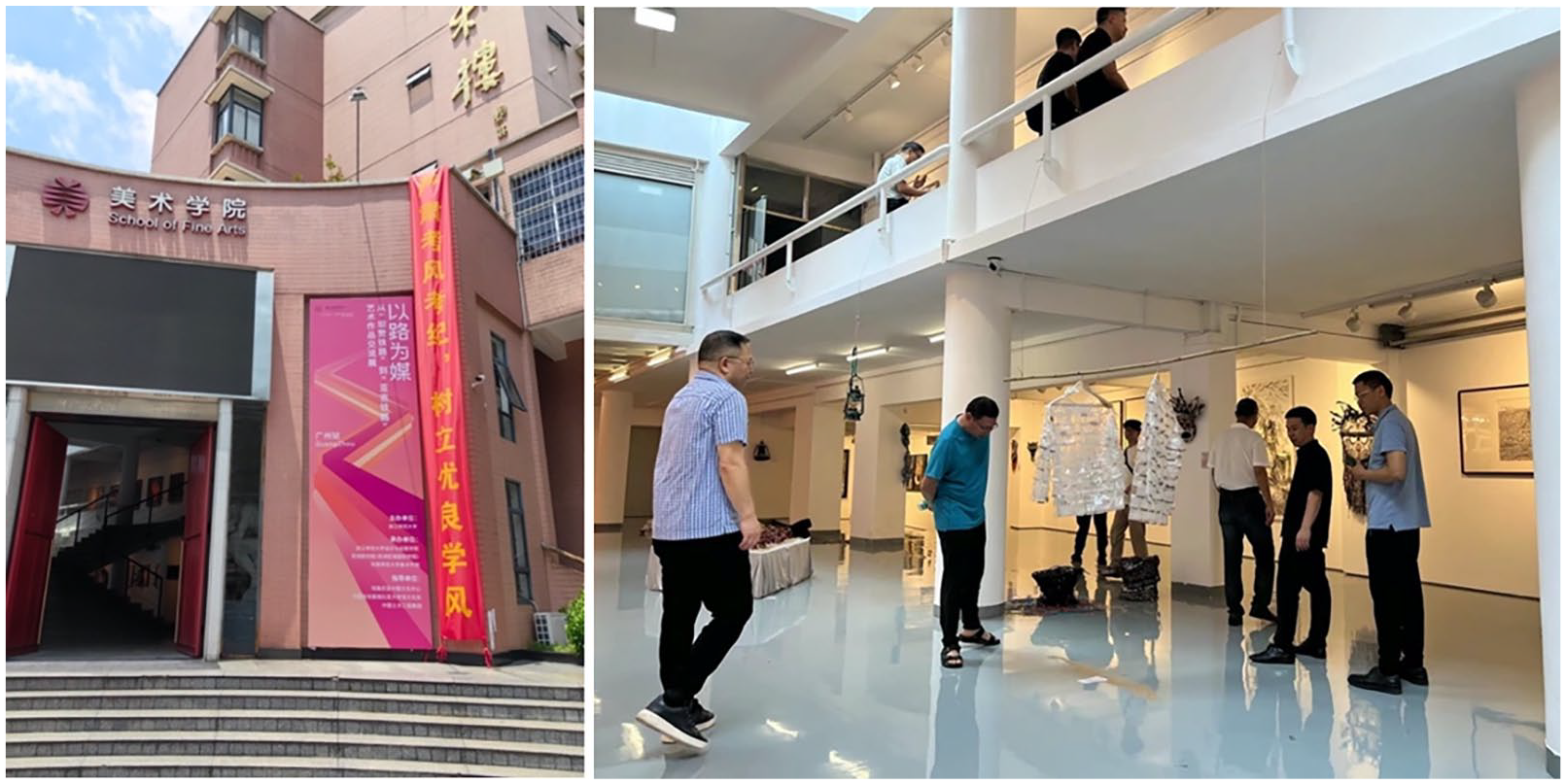
The Using the Road as a Medium exhibition at Guangzhou. Photograph by the authors.
During the exhibition in Guangzhou, we conducted a panel discussion and observed and recorded the reflections of audience members. We were interested in how the exhibition might prompt people to think differently about China-Africa relations and the Chinese government’s infrastructure development model. In this writing, we reflect on the exhibition to extend the interest of cultural geographers in the wordly work of critical creative practices, including art exhibitions, 8 performing arts, 9 and other experimental arts, like documentary theatre, 10 performative installations 11 and scenographics. 12 We add to this body of work by discussing how the exhibition has offered a vehicle through which to generate more nuanced, less binary understandings of overseas Chinese infrastructure development.
Understanding China’s BRI discourse through artistic practices
The central subject of Using the Road as a Medium was a comparison of the Tanzania-Zambia Railway (TZR; built in the 1970s) and the Addis Ababa-Djibouti Railway (AADR; built in the 2010s). The exhibition attempts to animate the significant socio-economic changes which these rail lines have prompted in east Africa. When the exhibition was being organised in 2022, curators Professor Liu Hongwu and Professor Xu Huaying put out an open call for art works, 13 and more than 300 works of art from Africa-based photographers, African scholars and ordinary people worldwide were submitted. Approximately 200 of these works were curated into the exhibition, with nearly a quarter of works originating from African institutions or artists. The exhibition featured an incredible array and diversity of artistic mediums, from traditional Chinese painting and oil painting to printmaking, watercolour painting, documentary photography, composite material painting, experimental art and folk art. 14
Showcasing ordinary people, events and activities involved in China’s railway construction in east Africa, the exhibition offered a storied and personalised account of China’s overseas infrastructure development. On the one hand, many curated works offered a sanctioned and elite discourse celebrating Chinese activities in Africa. For instance, the exhibition features a documentary photo by China Civil Engineering Zambia Company entitled Celebration, which shows a Chinese-made train slowly pulling out of the railway station, with Celebration of the completion of the TZR written in Chinese characters on the background wall (Figure 3). This artwork implies that China’s infrastructure activities in Africa are welcomed. Another example of state-sanctioned narrative is Xuan Haifeng’s Chinese painting combination of Sunflowers by the Tracks and China-Africa Railway Friendship (Figure 4). This artwork connects the China-built railway with the forward-looking and prosperous life of African people, depicted through the joyful expressions on their faces and symbols such as the sunflower and eagles. There is also the sketch of Chinese artist Song Yongjin entitled The Power of Steel (Figure 5), which depicts a rail track emblazoned with the Chinese words People’s Republic of China. It seems to bluntly praise China’s overseas railway construction.
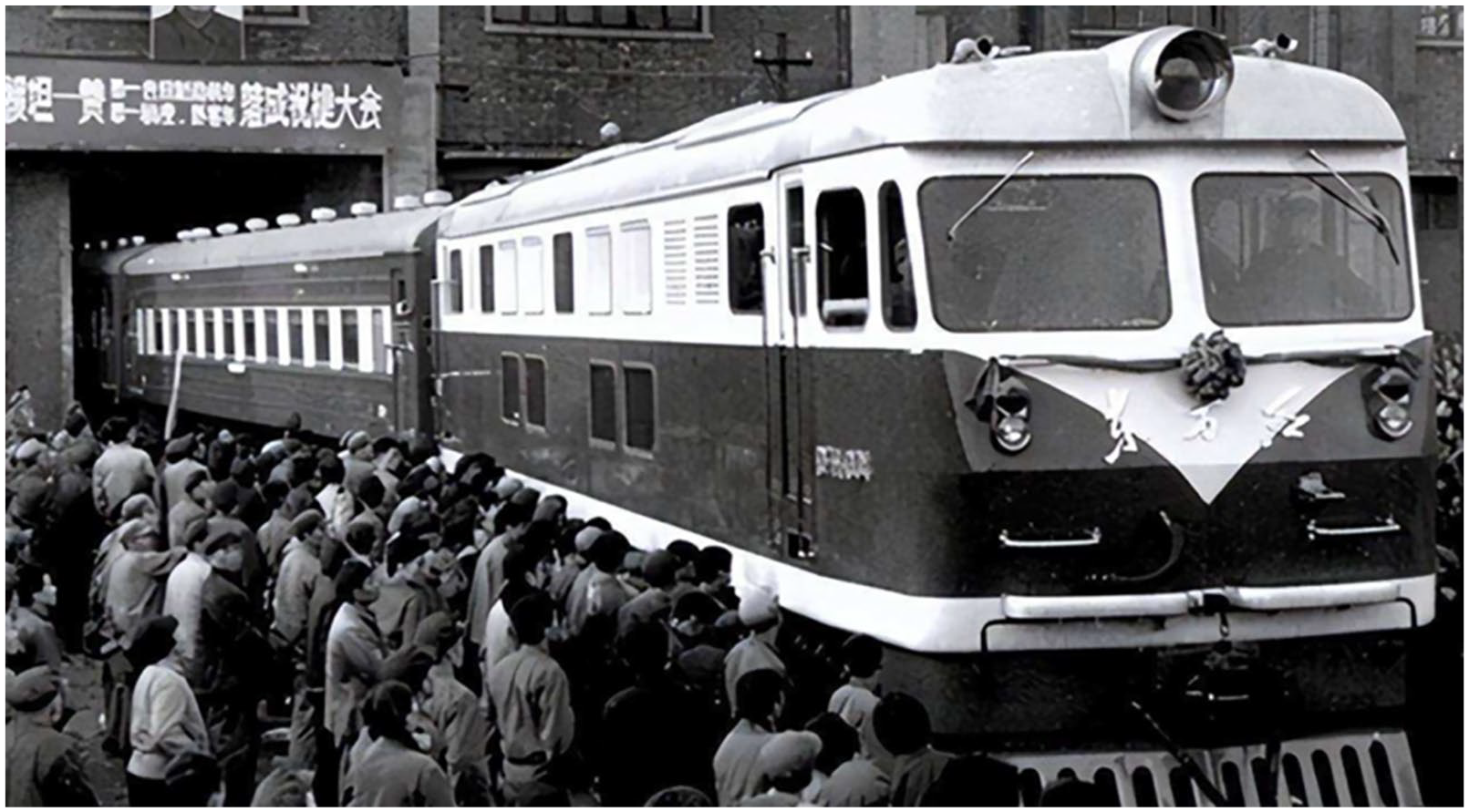
Celebration. China Civil Engineering Zambia Company. Photograph by the authors.
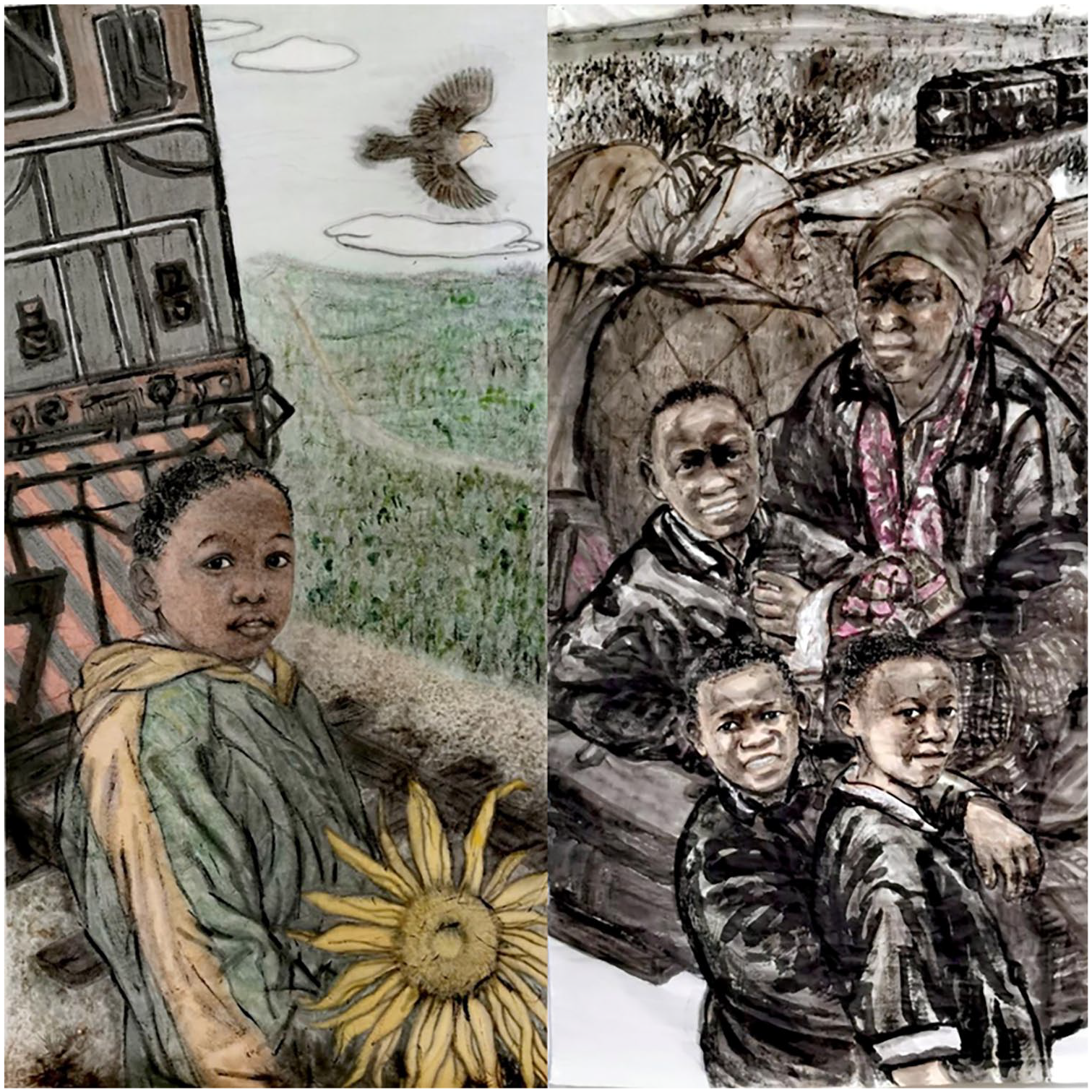
Sunflowers by the tracks/China-Africa Railway Friendship. Xuan Haifeng, 2022. Photograph by the authors.

The power of steel. Song Yongjin, 2019. Photograph by the authors.
Many exhibition works attempted to provide a sanguine depiction of China-Africa relations and China’s overseas railway construction. Many did so by capturing and circulating a more personal, intimate understanding of China’s development work in east Africa. For instance, Liang Fengliang’s documentary photographs Greetings from Eid al-Adha, which capture the joy and hope on the faces of African railway workers on the AADR (Figure 6). They sit, posing while waving flags of the People’s Republic of China. Similarly, Chen Yiting’s experimental art piece, Falling, features a transparent garment made of sand collected from the AADR, packed into plastic bags (Figure 7). The sand in these plastic clothes continues to leak out, symbolising and invoking the selfless dedication of Chinese engineers and railway workers.
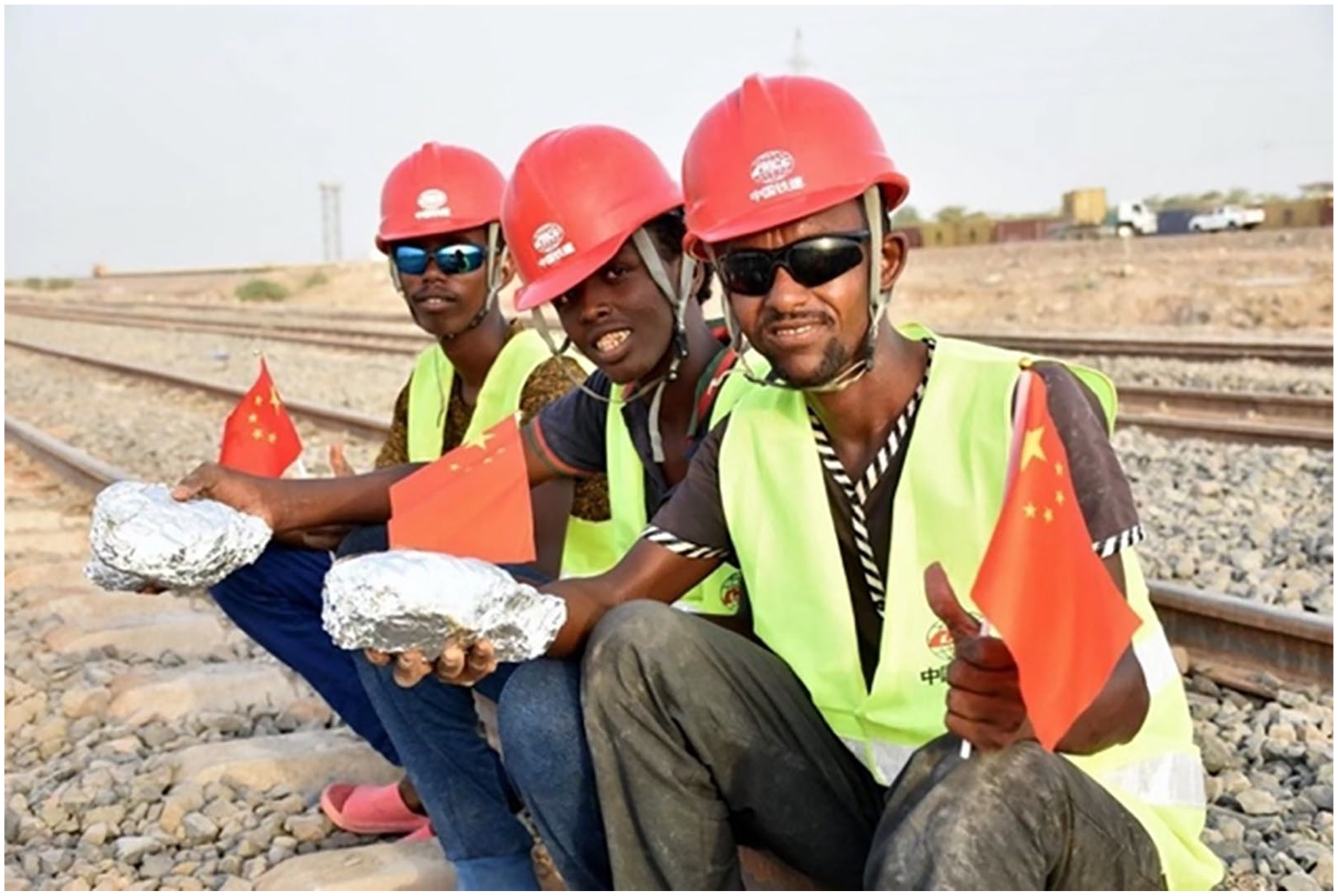
Greetings from Eid al-Adha. Liang Fengliang, 2023. Photograph by the authors.
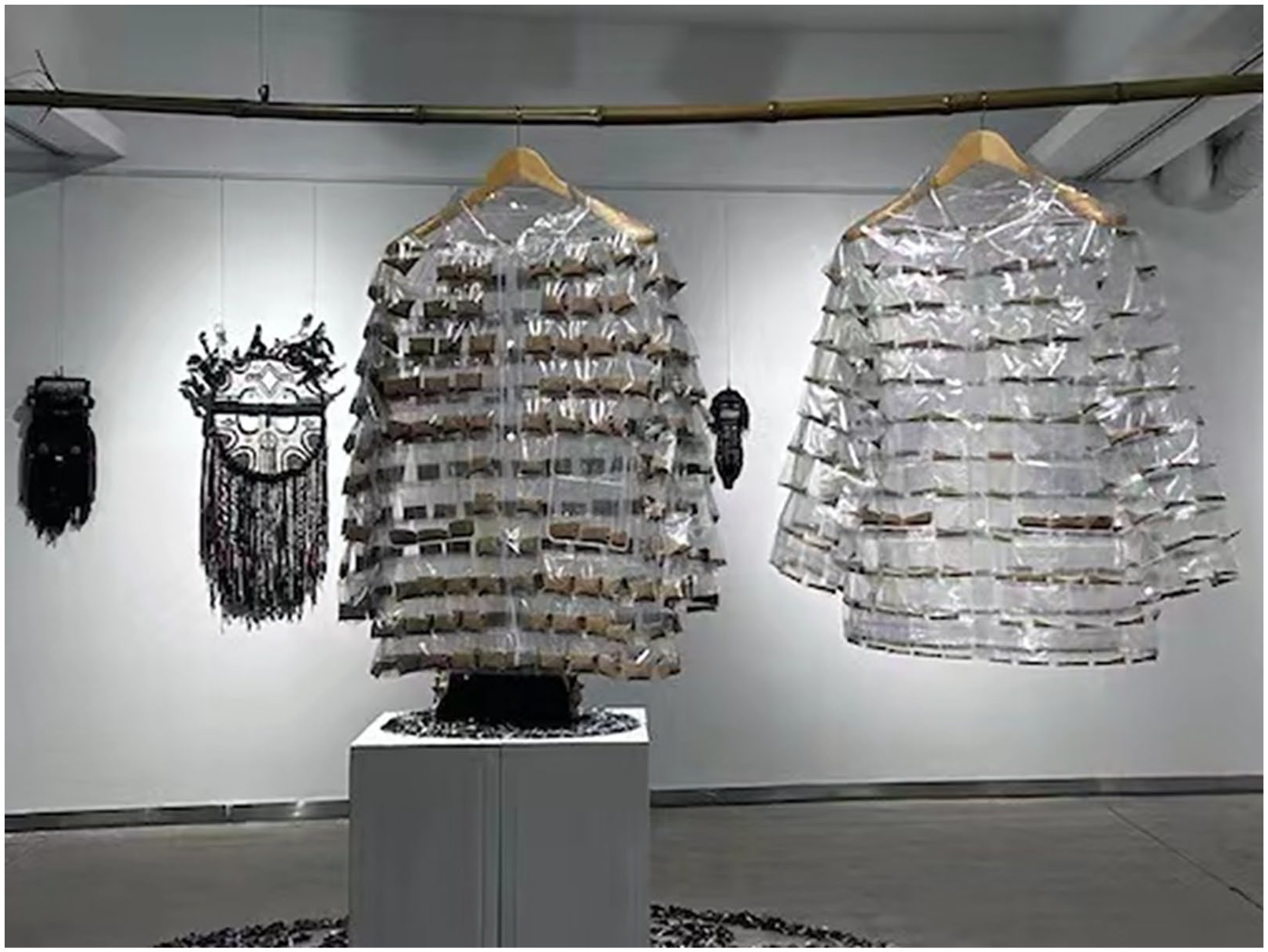
Falling. Chen Yiting, from Wang Lei Studio, 2023. Photograph by the authors.
It is also possible to view the curatorial vision and organisation of the art programme as an effort to circulate new narratives countering the internal and external criticism of the Chinese government’s overseas development model. For example, the exhibition’s curators deliberately framed the exhibition as a historical comparison between the TZR built by China in Africa in the 1970s and the AADR built in the 2010s. In the exhibition’s introductory text, curators repeatedly described the AADR as the new TZR for a new era, drawing a direct relationship between the two infrastructures. However, the sociopolitical contexts of the two railway projects are radically different: the TZR was a landmark aid project for China to establish solidarity and relations with impoverished countries in Africa during the founding of the People’s Republic of China. The AADR was a product of China’s efforts to project its imperial power in Africa. Given the widespread recognition of the TZR as an important and successful geopolitical symbol, 15 the juxtaposition of the TZR and the AADR can be seen as a conscious attempt to counter criticism within China. 16
Lastly, the exhibition can be interpreted as a response to current international critique and concern regarding China’s overseas infrastructure activities. Terms like ‘neocolonialism’, ‘new imperialism’ and ‘extractionism’ are often deployed by Western academics to portray the BRI as a radical attempt by the Chinese government to rewrite power relations in today’s geopolitical landscape. 17 Many works in the exhibition seem to highlight the positive impact of China’s railway construction in east Africa. For example, we see this in Zhongshan Jacket fashioned from circuit boards and chips (Figure 1). The circuit board and chip, all remnants of the AADR, symbolise science and technology, while the Zhongshan jacket, an emblematic garment with distinct Chinese attributes, unequivocally represents China. The work undermines the image of China as a colonising nation, its infrastructure work merely a disguise for resource exploitation and sowing geopolitical influence in Africa. Instead, China is portrayed as a catalyst for technological and economic progress. Similarly, Josepha Richard Lyombo’s oil painting titled Travelling (Figure 8) and Tan Jin’s oil painting titled The TZR, China-Africa Friendship (Figure 9) offer celebratory images depicting the joy and expectations of the African people.
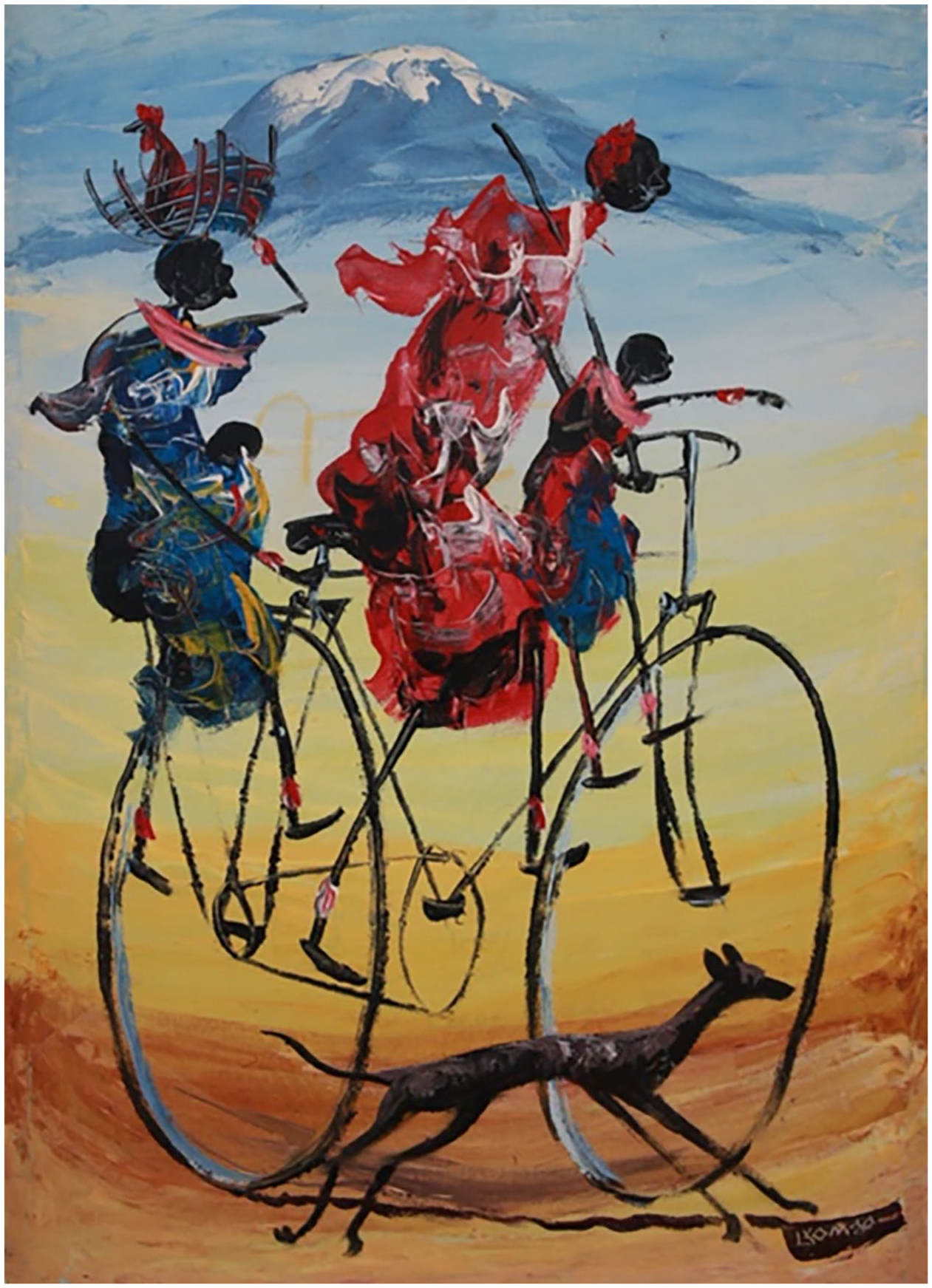
Travelling. Josepha Richard Lyombo. Photograph by the authors.
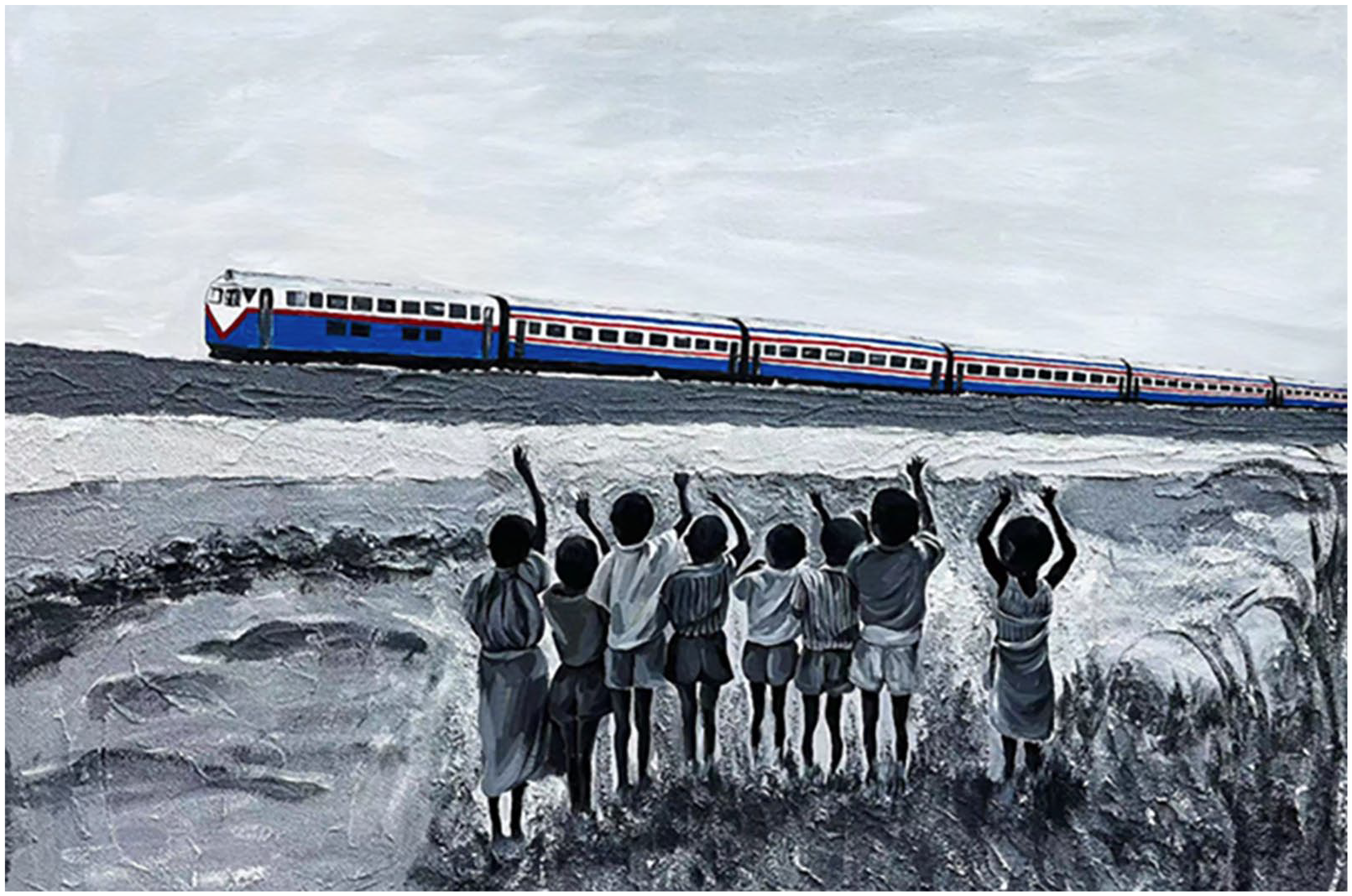
The TZR, China-Africa Friendship. Tang Jin. Photograph by the authors.
Reflections
Using the Road as a Medium worked to produce a more nuanced, personal and storied geopolitics regarding the Chinese government’s global infrastructure development strategy. Ignited in 2013, the BRI is said (in 2023) to have channelled approximately USD 1 trillion of investment in over 150 countries. 18 This global state-led investment strategy is a highly contested government agenda both within China and well beyond. We offer this work in the hope of extending the interests of cultural geographers in curation and exhibition. We argue that exhibitions can produce important discursive effects. They circulate meaning. They bring people close to the issues in their attempt to convince and cajole. As such, they hold great capacity in the circulation of geographic knowledge and for a more situated geopolitics.
Footnotes
Funding
The author(s) disclosed receipt of the following financial support for the research, authorship, and/or publication of this article: This work was supported by the National Social Science Fund of China [23BH161] and the National Natural Science Foundation of China [42171226].
