







Abstract
The potential to fail exists within all our endeavours. Although we may take steps to mitigate against it or limit its likelihood, the possibility of failure can never be entirely removed. Yet, while failure may be something we feel inclined to avoid, geographers have sought to reveal its productive capacity. In this article, I take this position a step further to argue that failure can itself be part of skill. Within the article, I narrate my own encounters with failure during the Living Quiver Project – an effort to re-design pieces of archery equipment to foreground their agential vitality. I reflect on three encounters – each mapped onto a different design in the project – and seek to show that failure, far from a hinderance, became a critical component of the design process. Drawing together literature on skill, failure and craft, the article illustrates how failure gave presence to my materials, encouraged reflections and expanded the skilled ecology of my practice. Through this, I argue that failure need not be something to ‘overcome’ and that where we endeavour to develop skill, we should also be making space for failure to be permissible.
Introduction
I wake to silence. The blunt
It was a familiar sight when I first set out 3D printing. Small knocks mid-print, incorrect calibration or poor adhesion onto the build plate can all cause a model to come loose. The printer, unable to register this disruption, continues its set routine, extruding filament into open air. The model cannot be re-adhered, nor the print adjusted, once this has happened. The only option is to stop the print early to conserve material, resolve the issue and start again – if you aren’t asleep, that is (Figure 1).
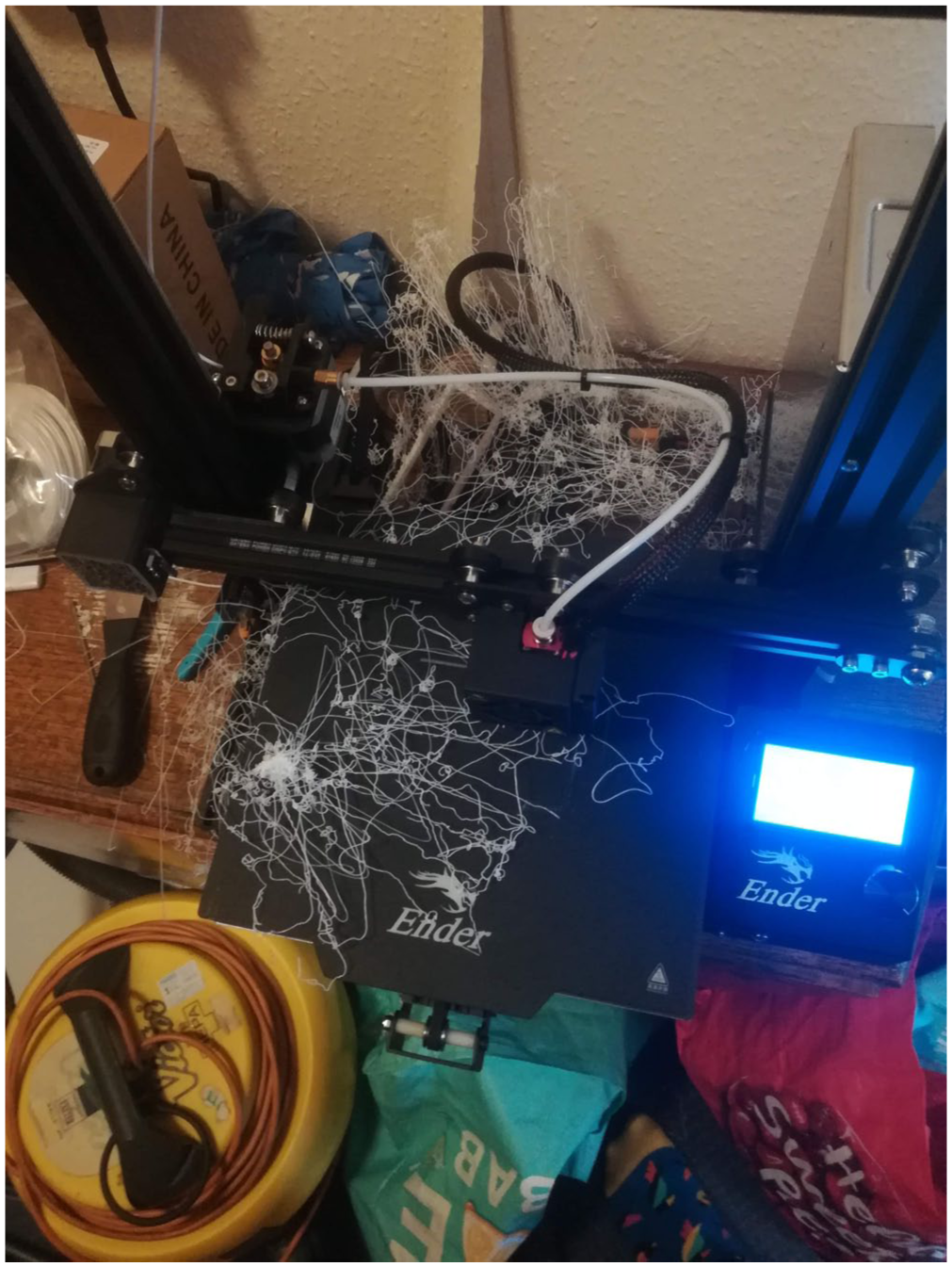
A photograph of a contorted web of extruded filament on a 3D printer located in a storage cupboard. Photo by Eliott Rooke.
The potential to encounter failures like mine shadows any creative or skilled practice. No level of skill, simplicity of task or depth of experience can eliminate the possibility in its totality. As such, scholars have turned their attention to recognising the nuanced role that failure does play as both a subject of study 1 and as part of the research process itself. 2 Many of these accounts have gone some way to reclaim failure as something with the capacity to be productive, even if still undesired, but prevalent accounts of skilled making remain centred on narratives of mastery, quality and ‘making things well’. 3 Even where these accounts do recognise the value of failure in skilled performance, it is often as something to be overcome.
This paper seeks to further claims that failure is generative, arguing that not only can failure enhance skill, failure can itself be skillful. In this paper, I illustrate this through my own experiences of failure when (re)designing an archer’s quiver in the Living Quiver Project. Through three designs – the Sci-Fi Quiver, Plant Quiver and Collapsible Quiver – I show how my progress was made possible by my failures and how failure reshaped and extended my skills. I begin by reviewing the existing literature on skill and failure, grounding this in craft geographies, before introducing the Living Quiver Project and my designs.
Theorising skill
Skill has been used by geographers to engage with a broad variety of practices and processes, including, but not limited to, craftwork and making. 4 As a conceptual lens, skill focuses research on the dynamic interplay of more-than-human actors across micro- and macro- scales, centring the ‘doing’ of an act without losing sight of the rules, knowledges and contexts within which it occurs. 5 Despite this, skill itself is rarely the subject of study in geography 6 with most influential theorisation of skill coming from outside of the discipline. 7 Two of the most prominent of these theorisations are Dreyfus and Dreyfus’ Five-Stage Model of Adult Skill Acquisition 8 and the ecological approach stemming from Ingold’s work in cultural anthropology. 9 While there is overlap between the approaches – in terms of focus, influence and understanding – they provide distinct conceptualisations of skill and failure. Here, I contrast how the two approaches present skill and mastery, before moving to discuss failure and craft skills.
Stuart and Hubert Dreyfus created their first version of the five-stage model for the US Air Force’s Office of Scientific Research in 1980. 10 Despite the critiques that would later follow, their model presented a novel reversal of traditional thinking 11 : rather than depicting beginners as working with specific cases and gradually learning abstract rules that could be generalised for application, they argued that the application of rules was the initial step. As a practitioner moves through the stages– novice, competence, proficiency, expertise, mastery – the model proposes that they become more immersed in their task and rules give way to an intuitive responsiveness to the specifics of the scenario. So strong is this association between rule-following and novice performance, an expert who consciously returns to rule-following may find their performance deteriorate. Rule-following, therefore, is more than just the hallmark of the amateur, it is ‘parasitic’ to skilled performance. 12 The Dreyfusian model has continued to be updated, most notably with a new stage – advanced beginner – being inserted between novice and competence 13 shifting mastery into a sixth stage that is not always included in the basic model.
Influences for the Dreyfusian model include the works of Heidegger, Merleau-Ponty and Polanyi. The Dreyfuses saw phenomenology as providing a path to describing highly-skilled performance in a way that they believed cognitivist approaches were failing to do – namely by recognising the embodied and non-representational elements of skillful performance. 14 Yet, despite the departure from cognitivism, the Dreyfusian model has been critiqued by geographers for maintaining a human-centric focus. Lea, for example, critiques the Dreyfusian model for failing to appreciate the broader context within which skilled performance takes place claiming it instead sees this context as something to be ‘overcome’. 15 Linear and rule-bound, the Dreyfusian model is ill-equipped to handle the particular and peculiar, instead conflating skill with the elimination of variability as is evidenced by their succinct summary of expertise as being when the expert performer simply ‘does what normally works and, of course, it normally works’. 16
This is a significant point of divergence between the Dreyfusian model and Ingold’s approach. Sparked by the influence of James Gibson’s ‘affordances’ and exemplified by his declaration that the study of skill ‘demands an ecological approach’, 17 Ingold sees skill as being inherently relational. Skill, for Ingold, results from performers continually attuning to the context within which they act. 18 While Ingold occasionally engages with the Dreyfuses’ work, he is generally wary of ‘mechanical’ depictions of skill. 19 Instead, he argues that skill is not built or accumulated but ‘grown’. 20 The organic framing of growth cascades into discussions of the characteristics of a skilled performer. Care, 21 understanding 22 and communication 23 are seen to be essential components of skilled ecologies. Notably, these are fundamentally relational acts which require an appreciation of the complex positioning of agency within the performance. While the Dreyfusian model is linear and human-centric, ecological skill is a tangled mess – or, perhaps, mesh 24 – of interaction.
Despite their differences, the two approaches share similarities in their grappling with the idea of ‘mastery’. In the original Dreyfusian model, mastery was discussed only briefly as a fifth stage obtainable by a rare few who had already achieved expertise and continued to work beyond this. 25 Even then, mastery was not presented as a stage comparable to the four that proceeded it as mastery was only ever fleetingly grasped while a performer was ‘in the flow’. The stage was characterised by total immersion into the task and a silencing of the ‘analytic mind’. 26 Later versions of the model expanded on this with Dreyfus and Dreyfus arguing that expertise is, generally, a stage available to all, given the time and experience 27 but that mastery is far more elusive. They present is as the result of the ‘unsatisfied’ expert 28 seeking to innovate not only their practice, but the domain of the practice itself. In this sense, mastery is an experimental act which presses at the established rules and boundaries of a practice. To do so, however, the aspiring master courts failure as they must revert from the intuition of an expert back to intentional deliberation to identify new opportunities. 29
Mastery is not so central a part of Ingold’s writing, but, where he does attend to it, he similarly recognises this relationship between growth and risk of failure. For Ingold, mastery and vulnerability are two sides of the same coin. 30 Although he says little of what mastery looks like in practice, he retains the same emphasis on responsiveness as being central. This again marks a divergence between the two approaches. The Dreyfusian model treats mastery as not only a distinct stage but a distinct form of skilled practice wherein a practitioner chooses to engage with uncertainty. For Ingold, this uncertainty is always already there, and mastery is thus a difference in degree, not in kind. Yet in both cases, a willingness to accept the potential of failure is seen as a necessary price on the path to mastery.
Failure
Contrary to the Dreyfuses’ claim that all can become experts with time, Lea reminds us that skill is never guaranteed. 31 Whether a temporary ‘ebb and flow’ 32 or a more enduring disruption 33 the dynamism of skill is exemplified by its ability to escape us. Within geography, early examples of this can be seen in feminist writing, such as England’s account of unrealised research plans 34 and Rose’s experience of an uncomfortable joke in an interview. 35 In both cases, the moment in which failure was experienced – the unanswered call to potential collaborators, the interviewee’s joke – was not the point from which the ‘failure’ originated, but rather the moment in which it surfaced. Like much writing on failure, Rose and England’s accounts are grounded in personal reflections as they grapple with the feelings that surrounded their perceived failures. The evocative nature of much of this writing alludes to the lived intensity of failure. While failure can leave us numb, 36 it also drives us to ask ‘why?’ as we seek to trace those feelings back to their cause.
In this, failure possesses a revelatory power that draws forward our attention. Failure can serve to highlight our reliance on others, 37 reveal gaps in our awareness, 38 and facilitate encounters with new experiences. 39 Payne, 40 drawing on Ingold’s ecological perspective, argues that failure can promote a rethinking that leads to innovation, reversing the Dreyfusian understanding of mastery by seeing innovation as a response to failure, rather than a cause. However, failure’s ability to illuminate is neither ubiquitous nor complete. Failure is often repeated, complex and disparaging. In their reflection on motorcycle restoration, DeLyser and Greenstein attribute the ability to persevere in the face of repeated failure to a sense of devotion. 41 Devotion enables ‘persistence through frustration’, 42 by providing the encouragement to continue that otherwise may be drawn from success, but it is not itself an antidote to failure; even the most devoted restorer is constrained by the availability and suitability of parts and materials. In pursuing the origins of their sense of failure, Rose and England both examined the (power) relations on which their work was built and interrogated the ways aspects of their identity shaped how they, and their intentions, were perceived in their research. For both, this offered new direction and insight, yet it offered neither neither resolution to their supposed failure.
Where Rose and England’s sense of failure prompted introspection, others have traced these feelings back to the academy itself, where they have argued that neoliberal institutions construct and cultivate a sense of failure amongst staff 43 and students. 44 This discussion extends existing strands of literature on the ‘messiness’ of academic work 45 while moving beyond this ‘euphemistic’ terminology. 46 Through engagement with experiences of failure, scholars like Horton 47 identify the myriad factors that coalesce to create our sense of failure and invite us to consider the social, political and cultural structures that underpin it. These structures means that attempts to ‘reclaim’ experiences of failure are fraught with difficulty. Not all can, nor want to, find utility in their failures 48 and Martinez and Stager 49 urge us to tread carefully in using the term, recognising the historical connotation it may have as a means to marginalise vulnerable groups. Failure is not experienced – nor permitted – evenly, with those who are already marginalised or in precarious positions disproportionately negatively affected. 50 Similarly, when it comes to being failed, for example by government policy, this too is not experienced evenly. 51 Indeed, the very definitions of what constitutes failure intersect with these power structure. Turner, for example, highlights that many UK undergraduate students perceive a grade of 40%–59% to indicate ‘failure’ – despite the official pass mark being 40% – due to the social and economic consequences of graduating with a ‘worse’ degree. 52
We must, therefore, be alert to the fact that failure is not singular and ensure that the narratives of failure we promote within the academy recognise this. Horton identifies six diverse forms of failure 53 ranging from the subtle to the explicit and measurable, including those that we, as active participants in the neoliberal academy, designate ourselves as arbiters of. Within this taxonomy, Horton cautions us to avoid creating a ‘right kind of failure’ (p. 4), typified by a failure-to-redemption arc. This is challenging. The career benefits of publication mean that any writing on failure will always be tinged with an element of success. To speak of failure, therefore, will always mean gaining something from it. But even so, failure can work to do undo more than just those of us failing. Halberstam, for example, algins failure with queer theory, presenting it as a challenge to dominant (capitalist, heteronormative) regimes of power 54 and arguing that ‘all our failures combined might just be enough, if we practice them well, to bring down the winner’ 55 suggesting that even if narrating a failure-to-redemption arc, our failures can redeem more than just ourselves.
Looking beyond academia, geographers have engaged with failure through recent work on negative geographies. 56 Here, the negative is understood to refer to ‘a manner of describing the coming apart or breaking down of concepts, passions, reasons, bodies, ethics, lives, and more besides’ 57 Through a negative geographies of skill, geographers have identified that the limits to skill are not purely defined by its absence but may also arise from the presence of various negative phenomenon, such as exhaustion 58 and social and economic pressures. 59 This draws attention to the disharmony in skilled performance. Skilled ecologies are not united in intent, but are an array of intersecting actors, processes and contexts which can be more or less conducive to the success of the performance.
Drawing these points together, we see that failure is no less distributed than skill. It exists within, and shapes, the same ecologies. Just as the (social, political, economic) context within which we perform can guide us to succeed, it can also push us towards failure and add weight to that failure. I turn now to consider how geographers have studied the intersection of craft and skill and how craft gives presence to the non-human actors in a skilled ecology.
Craft skills
Over the past decade, geography has developed an ‘increasingly vibrant’ relationship with making 60 that shows no sign of diminishing. 61 Through this, geographers have shone a light on a range of craft and creative practices including beekeeping, 62 lacemaking, 63 taxidermy 64 and hairdressing. 65 The attention paid to both the spaces of craftwork 66 and the life of the craftwork piece itself – from conception to finished product, and then on to eventual degradation and repair 67 – has helped geographers avoid the pitfall often seen in academic engagements with technology: that ‘mere things get explanations; persons get stories’. 68 Geographical accounts of making practices have situated the crafted object at the centre of the story and less as a ‘prop’ 69 in the narrative of the crafter. In doing so, engagement with craft and making has provided one avenue for geographers to delve beyond what Tolia-Kelly calls ‘surface geographies’ 70 to attend to the politics of materiality. For Tolia-Kelly, getting beneath the surface of material geographies requires recognising the power and, after Bennett, 71 ‘vibrancy’ of materials to understand their role in configuring the world we live in. It is no coincidence that much of this literature approaches craft through skill (and vice versa), as recognising – and giving voice to – the agential vitality of the material world is necessary to understanding skill, and failure, as existing within complex more-than-human relations. By de-centring the human performer, craft geographers are well equipped to attend to the whole ecology of the practice, including the broader socio-political contexts within which it is performed.
By situating craft and making amongst technological innovations and shifting labour markets, geographers have explored how traditional craft skills can come under threat from mass-production and mechanisation. However, these accounts go beyond surface-level descriptions to show that, even under such conditions, craft and making practices adapt and translate. Through their storying of the Cluny Lace factory, Fisher and Botticello 72 dispute that mechanisation is the demise of craft skill. Instead, they argue, it has led to a re-articulation of the skilled ecology to incorporate the machinery. For the workers at Cluny Lace, the interactions with machinery are part of the skilled practice. Other crafts have endured because the unique skills and knowledges they require are seen as valuable – as part of a heritage, for specialty products, or both – have afforded them some degree of protection. 73 Elsewhere, craft, manufacturing and making skills have been translated into entirely new settings. This has included work in and on the home, making use of machinery acquired from factories that have been decommissioned or upgraded 74 or adopting a ‘make-do-and-mend’ attitude in response to austerity measures 75 ; hobbies and informal work in leisure and community spaces, such as the emergence of ‘fabrication labs’ 76 ; and online, where the internet has enabled crafters to reach broader audience through e-marketplaces such as Etsy. 77 These accounts all trouble the simplistic notion that modernisation and mechanisation have rendered craft and making skills obsolete, instead recognising the transformational ways that material interactions permeate our society and the resilience of skill itself.
These understandings of craft as ecological, dynamic and materially-engaged lie at the core of this paper as both subject and method of research. The Living Quiver Project used making as a means to investigate human-technology relations but, in doing so, drew my attention to a much more complex set of relations between making, materiality and skill that ran parallel to the project’s intended aims.
The Living Quiver Project
The Living Quiver Project was part of a creative reimagining of the design of archers’ equipment that began as an offshoot of my PhD fieldwork. I was observing a local archery club and studying how human-technology relations changed as users’ skill developed and found that, as archers became more skilled in using their equipment, they increasingly perceived it as a collaborator. Bows and arrows were given nicknames, personalities and consideration to their aesthetics. Quivers, despite being one of the first piece of equipment an archer bought, were afforded no such special status and were often overlooked. The Living Quiver Project sought to bring the level of aesthetic detail and conscious awareness offered to other pieces equipment to the quiver by altering its design in ways that would encourage archers to interact with it directly – both on and off the range.
The project’s design briefs were intentionally open. I wanted to convey a sense of agency which could reflect the ‘vibrancy’ 78 of the quiver’s materiality but I also wanted to leave space for the quiver to tell its own story. Each concept approached this differently. For the Sci-Fi concept I embedded programmable lights into the body of the quiver. Using a microcontroller, the user could customise the lights’ colour and make them blink, flash, fade or follow any instructions they could code. The Plant Quiver concept incorporated living plants that required ongoing care and gave it a second life off-range as a houseplant. Finally, the Collapsible Quiver conveyed agency through motion and transformation. Using a retracting mechanism, this quiver could transition between an open/in-use and closed/in-storage mode.
The purpose of the project was in the design and making itself, rather than the finished project. The designs were never considered ‘complete’ in any conventional sense. What ‘finishing line’ existed was determined by a combination of the limits of my ability, materials, tools and the agency of the design itself. For the three designs discussed below, I created prototypes of their signature elements, but only the Plant Quiver was ever built in full. As may become clear in the following narrative, I possessed little skill in making. Much of what I knew, I learnt while working with the designs. Furthermore, the advent of the COVID-19 lockdowns quickly and seriously limited my ability to access materials or support. I failed often. However, far from a hinderance, these moments of failure proved vital to my progression. In the following, I describe three encounters with failure, starting with experimentation.
The Sci-Fi Quiver
The heart of archery’s aesthetic is paradoxical. Despite using cutting-edge materials – graphene foam, carbon fibre, Vectran – and precision manufacturing methods which offer tolerances measured in hundredths of a gram, 79 the appearance of archery equipment has primarily emphasised its history. During my time as an archer, the most common alternative to generic, mass-produced contemporary quivers were leather designs intended to pay homage to (European) archery’s ‘heyday’ in the Middle Ages or draw inspiration from popular historical fantasy fiction franchises such as Lord of the Rings and Game of Thrones. For my first concept, I wanted to strip back this veneer of nostalgia and offer a commentary on the pairing of high-tech bows with ‘traditional’ quivers by designing a futuristic quiver to pair with a longbow.
Mirroring the influence of historical fantasy fiction, I sought to ground this design in the imagery of science fiction – notably cyberpunk. Cyberpunk is characterised by its juxtaposition of advanced technology with social deprivation in a combination famously described as ‘low-life and high tech’. 80 This narrative reflected what I saw in archery – and later came to see in the design process itself: that ‘progress’ is nonlinear, unequal and multidirectional. The discordant temporalities embodied in the design of archery equipment were echoed in the retro-futurism of cyberpunk aesthetics. Cyberpunk stories use light as a tool for atmospheric world-building. Sprawling urban metropolises – seen at night, lit by neon signs and holographic billboards – are a staple trope of the genre. Geographers have similarly observed light’s capacity to evoke emotion and configure spatial experience. 81 This power and vitality of light arises from its ability to not just illuminate, but to do so ‘in a particular way, through shadows, tones, contrasts, darkness, etc’. 82 With clear connections to both imaginary futures and (im)material agency, light soon became the focus of my Sci-Fi design (Figure 2).
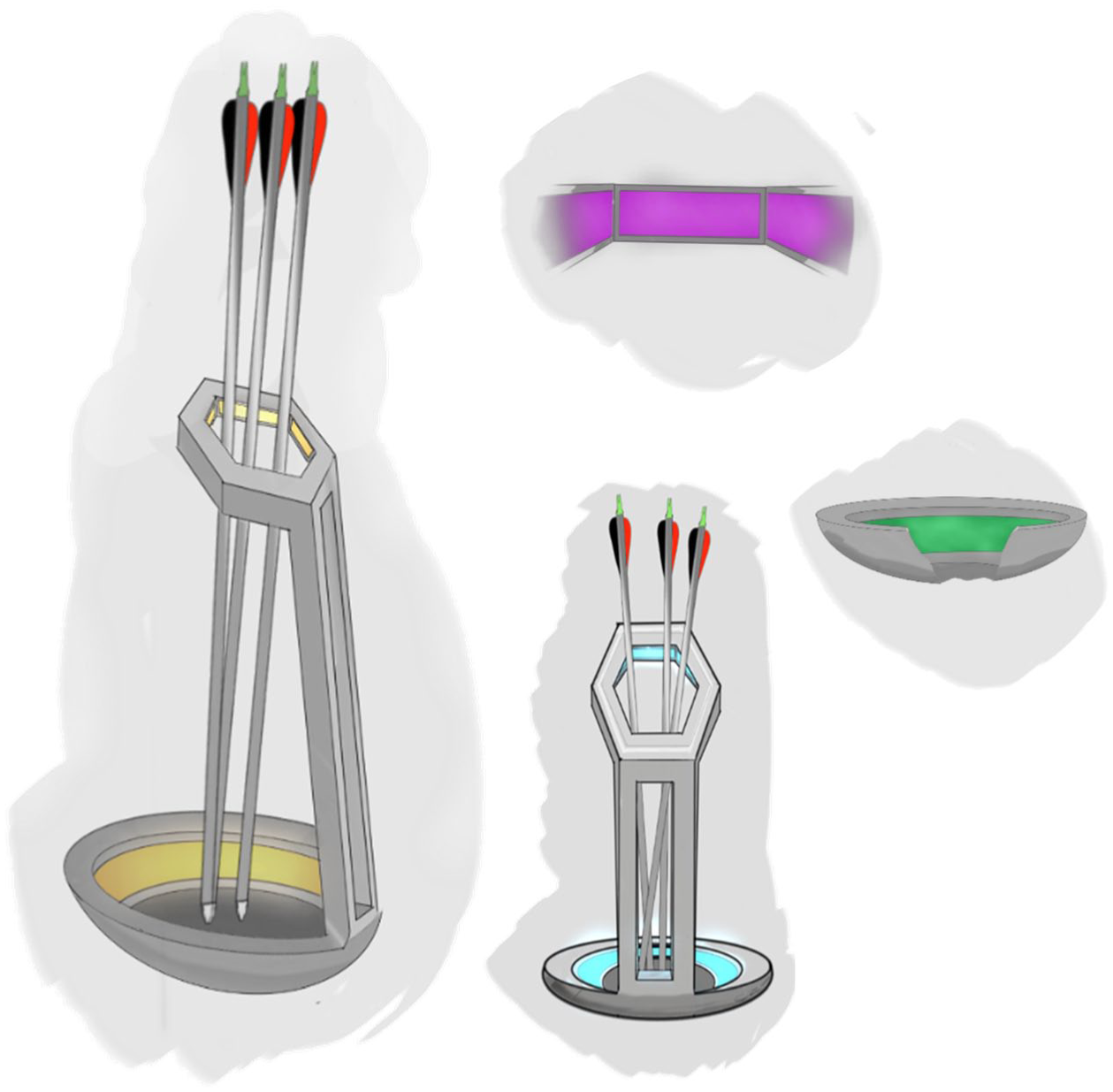
A selection of sketches for the Sci-Fi quiver design demonstrating customisable lighting. Photo by Eliott Rooke.
Bound within the freedom this approach entailed was a persistent uncertainty: I sought to create a design which evoked ideas of imagined futures and technological agency but attempts to manufacture atmospheres – particularly with light – can never truly predict how they will be experienced. 83 The agential vitality of light became a double-edged sword. At once it allowed me to conjure stories of possible futures through a high-tech façade and yet it obscured its own future behind that very same nebulous cloud of possibility. Theory alone was insufficient for me to understand how different colours, intensities and patterns of light would intersect with the body of the design. I needed to see the design, to experience it. To achieve this, I assembled a mock-up design (Figure 3) using programmable LEDs and a 3D printed case with a piece of translucent plastic to diffuse the light. The tester unit meant I could ‘stop divorcing theory and empirics’ 84 and experiment with each design directly.
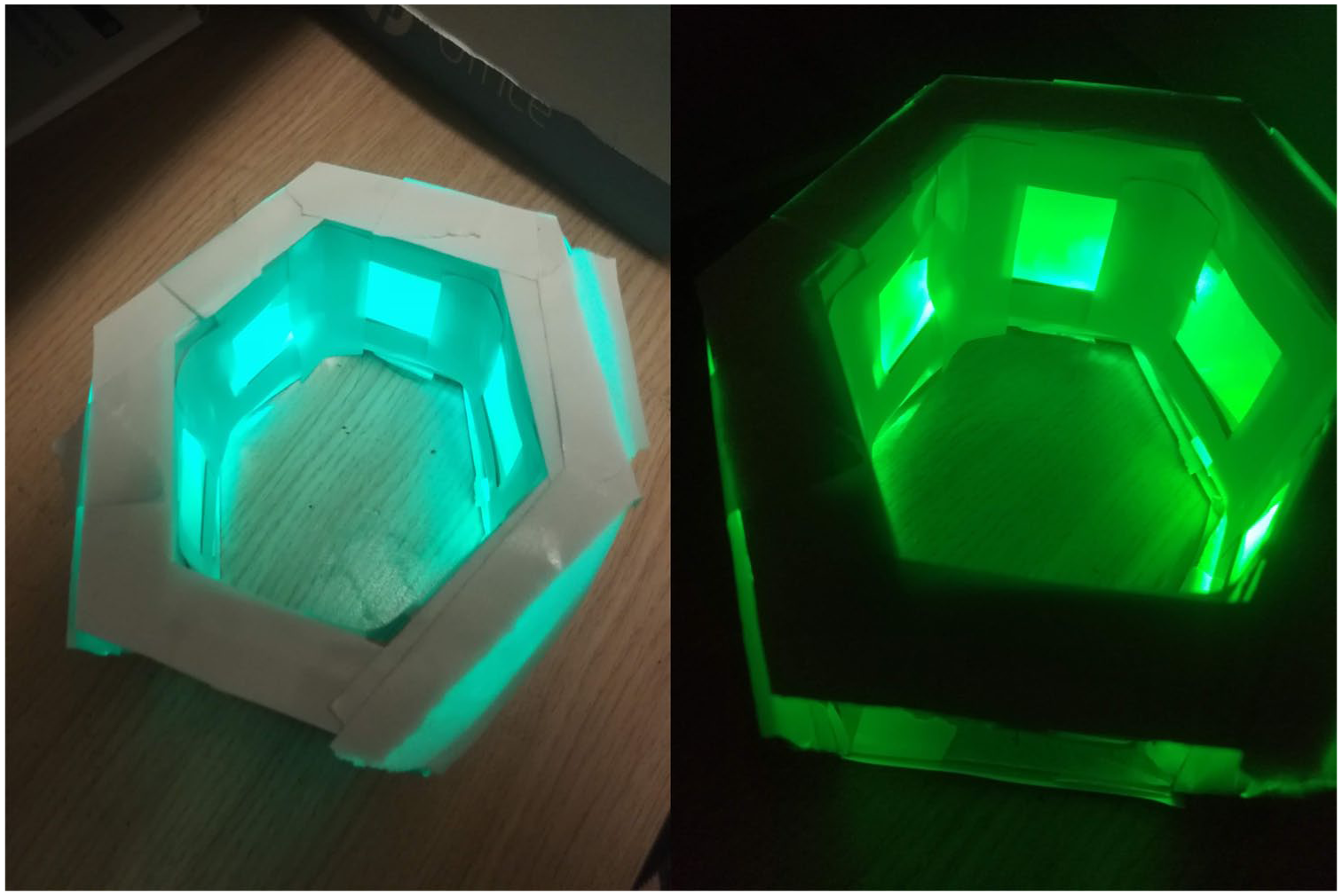
The mock-up design for the Sci-Fi quiver to test the lighting. Photo by Eliott Rooke.
In recent decades, experimental methods have become one route for geographers to grapple with the unknown and unknowable. 85 These methods entail confrontations with risk, uncertainty and failure which can be a far cry from the perception of experiments as controlled, ‘non-haphazard’ processes. 86 The resultant shift in how we understand what constitutes ‘experimentation’ has led to some distinguishing between ‘Experiments’ and ‘experiments’, 87 where the former is an institutionally embedded practice of inquiry and hypothesis testing and the latter describes a kind of experience-driven discovery. 88 While Pickerill cautions that un-reflexive adoption of experimentation can re-produce modalities of thinking rooted in geography’s exploitative and colonial past, 89 ‘playful experimentation’ offers a path to methodological and pedagogical innovation that is grounded sensorily-engaged and embodied ways of thinking that also de-emphasise the need to avoid failure. 90 While experimentation may bring uncertainty and risk, these approaches need not lack rigour. Rather they seek to recognise the limitations of human control 91 and provide space for non-human and inhuman voices.
This recognition of the need to embrace vulnerability to advance echoes how Dreyfus and Ingold represent mastery. Yet I was far from mastering my craft. Experimental approaches can lead to materials being assembled in ways which produce unexpected, and sometimes unintended, results which feedback into the creative process 92 regardless of skill level. Indeed, playful experimentation blurs the line between success and failure entirely. While experimenting with LED colours, I quickly found that the on-screen representations in my sketches did not align with the reality of what was in front of me (Figure 4), but discovering this divergence did not feel like failure. Instead, my pursuit to understand why deepened my understanding of the materials I was working with. This meant that the evolution of the design was co-established with the material thing itself – folding product and process together – with experimentation forming a recursive feedback mechanism.
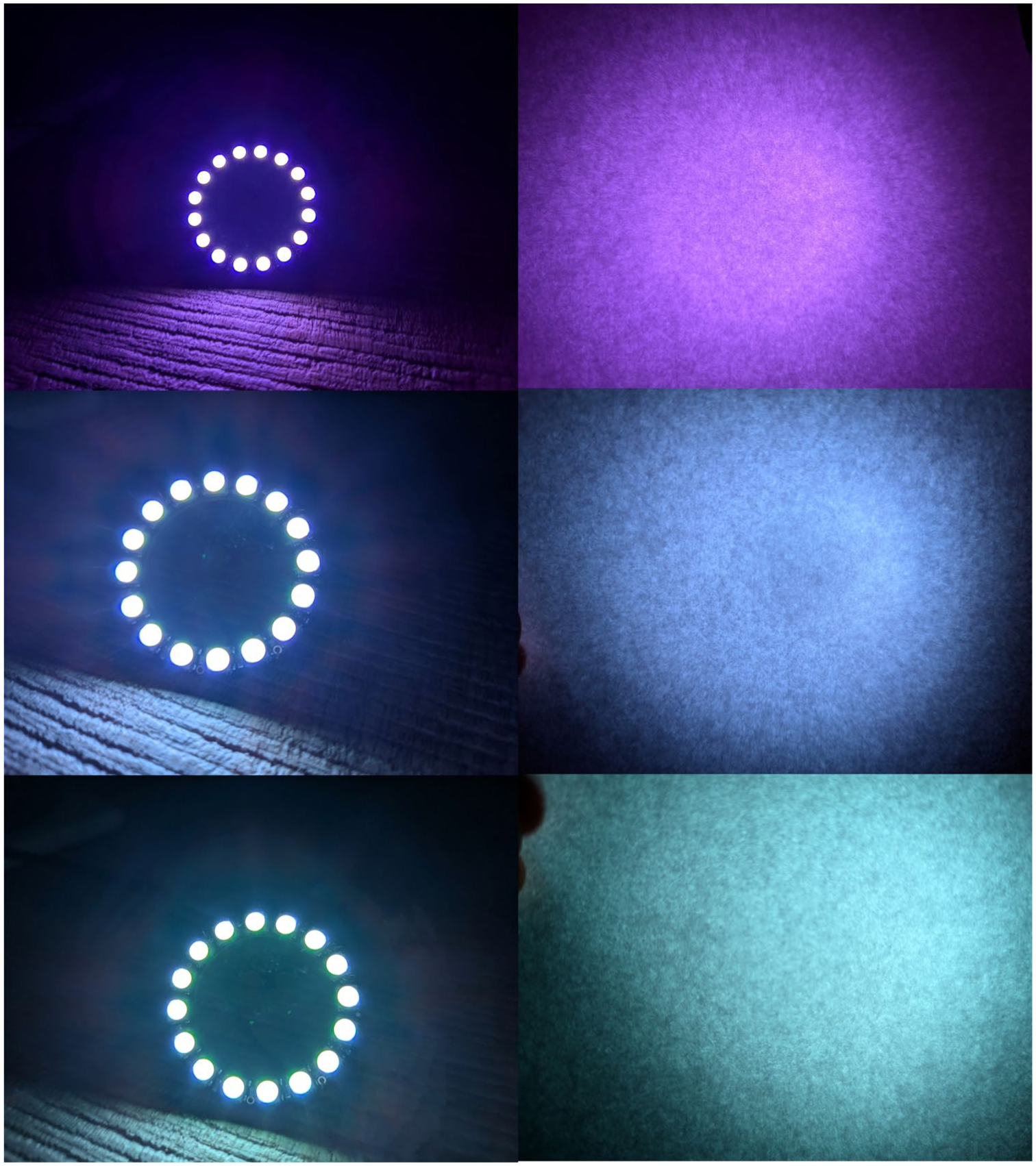
A selection of photos of the tester unit using including two (top and bottom) using colour settings from the sketches in Figure 2. Each is shown without (left) and with (right) the diffuser in front. The difference in colour between the drawing and the built unit results from a lot of interacting factors, including the LEDs themselves and the faint colour of the diffuser. Photo by Eliott Rooke.
As I experimented, the Sci-Fi Quiver was refined and defined through my failures. Each experiment cultivated a more intimate relationship with the materials, revealing the ways they would (and would not) interact. These moments were less my failure and more the materials’ assertion of agency, a disharmony to the ecology pushing it towards a new equilibrium. These moments did not impair my skilled making, but nor were they simply impetus to advance it. Rather, they were an act of communication to establish understanding across the ecology.
The Plant Quiver
With playful experimentation, my failures were not experienced as failures replete with all the negative connotations the word can carry. 93 The idea of experimentation itself acted as a buffer, solidifying failure as an intended and expected part of the process. However, there were times where my encounters with failure did feel substantial. The most prominent of these occurred during the design of the Plant Quiver.
The Plant Quiver design was inspired by Ingold’s interpretation of skill as distributed and ‘grown’. I wanted to design a quiver that was created the same way that I saw ecological skill as being developed: through care and recognition of material vitality. A plant-based design would be alive, organically shaped and require maintenance. But I also wanted it to have a life off-range and seamlessly transition between ‘houseplant’ and ‘quiver’ without undergoing material change. I began the design process by creating a stripped-down quiver. This ‘Skeletal Quiver’ (Figure 5) was the simplest a quiver could be while fulfilling its purpose and consisted only of a base to hold arrows, a top ring to keep them in, supports to attach the two, and a loop to be hooked onto an archer’s belt. For it to hold plants, I needed to add some kind of support for them to grow along and a deeper base to hold the roots.
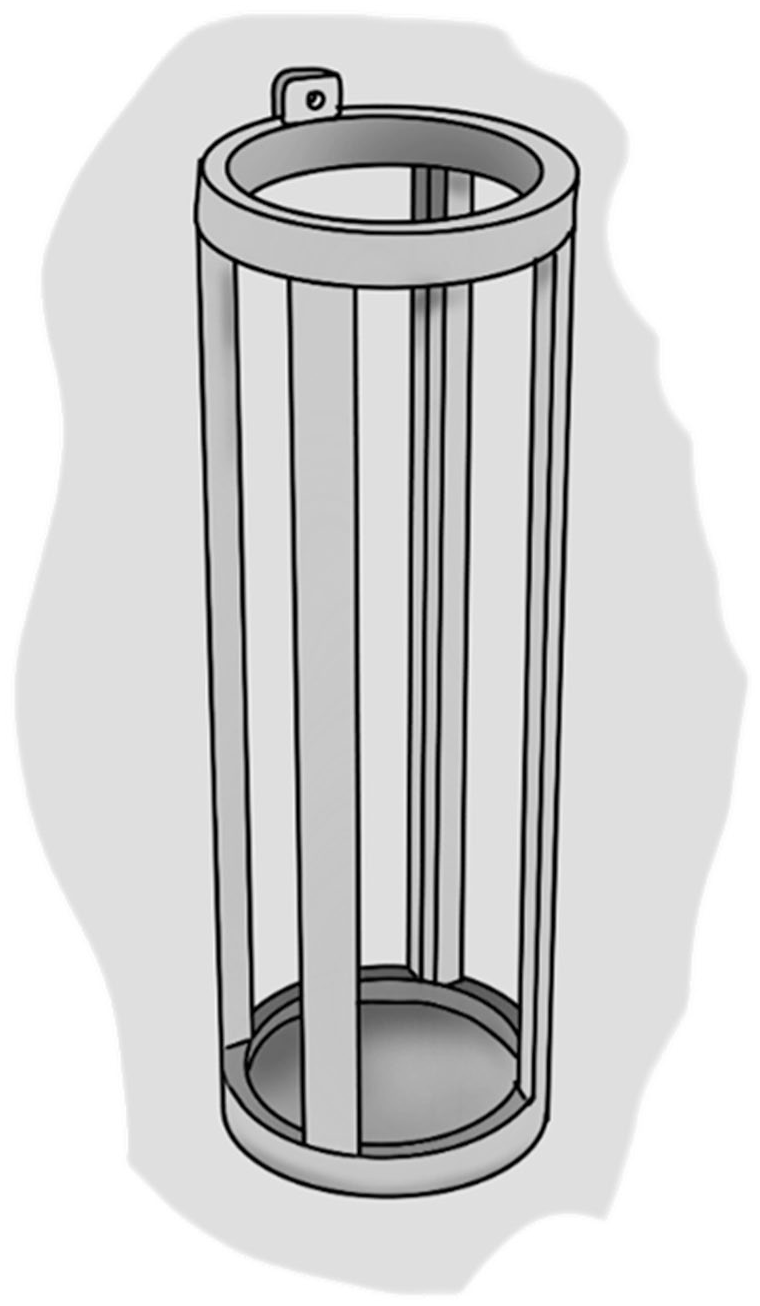
The skeletal quiver outline. Photo by Eliott Rooke.
Playful experimentation was deployed once more to identify suitable materials. Plants would require water and support as they grew. This ruled out cloth, which was too flexible and porous and instead led me to combining purpose-built gardening materials. I wove a mesh out of gardening twine, glued this to a light-weight aluminium plant pot, and suspended the construct from a homemade macramé plant hanger. I added a small amount of soil to the pot and then replanted ivy, winding it through the lattice to give it stability and shape. The result (Figure 6) met the needs of the brief – it operated as both a plant and a quiver – and yet was nothing like what I had envisioned. As O’Connor reflects following her unsuccessful attempt to make a goblet: ‘in the end everything had seemed to fall together, but these memories and impressions were at odds with what I held in my hand. How did I go wrong?’ 94
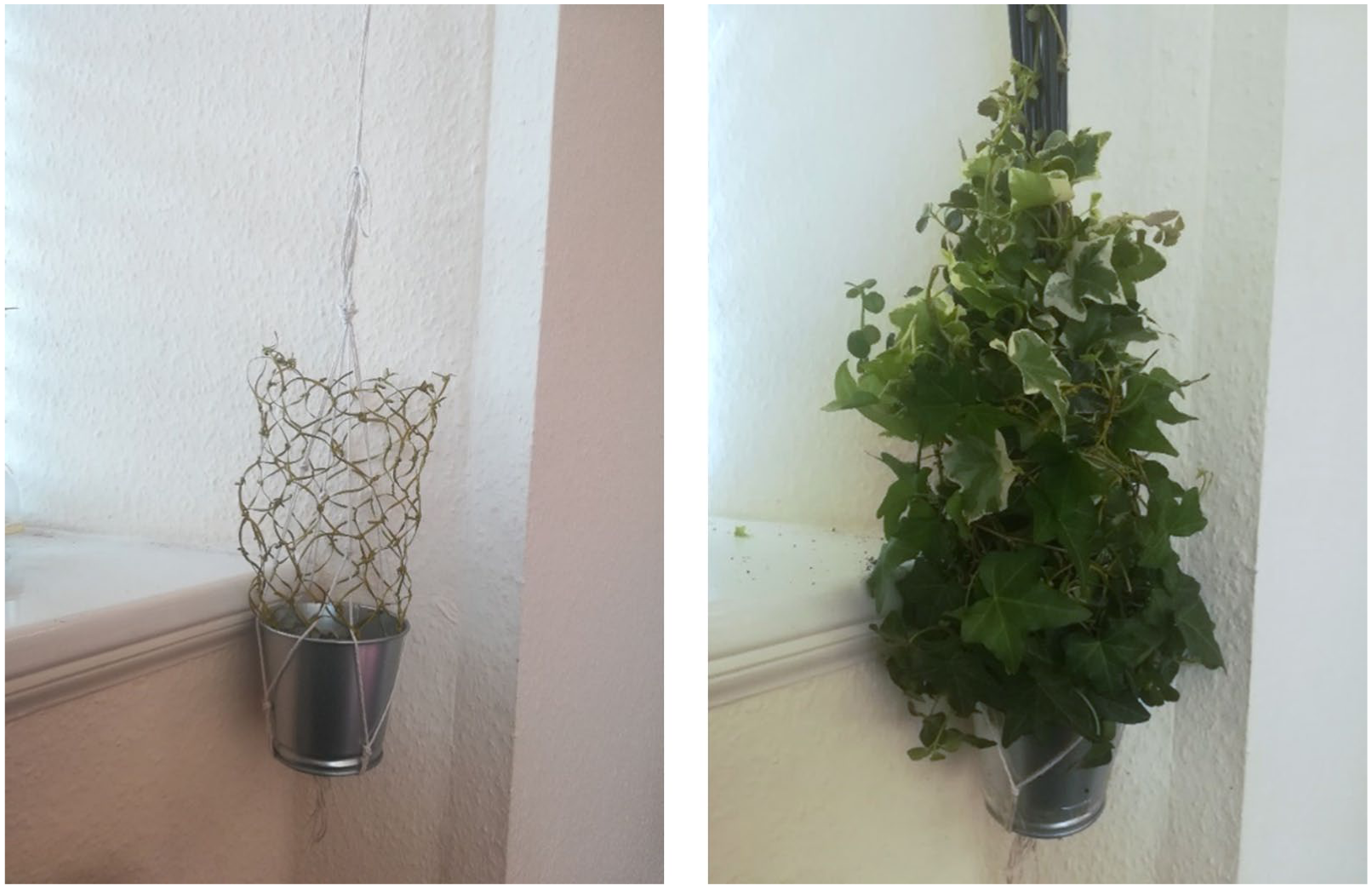
Plant Quiver version 1 before (left) and after (right) planting. Photo by Eliott Rooke.
When experimenting, I had assumed failure was inevitable. At times, it was an intentional way to test limits. But this felt different. It was unexpected. I was following a process that I had anticipated would work. And yet, still I could not say exactly why I felt the design constituted a failure. The concept met my intentions, the making process was straightforward, and the finished product performed the desired functions. There were imperfections, undeniably, and the design lacked elegance, but this was neither unexpected nor detrimental at this stage of design. This un-ascribable sense that I had failed mirrors prominent ideas about skill resisting explication 95 while also highlighting that, as with Turner’s discussion of undergraduate students, 96 the sense of failure can spill over into categorisations of success. One may feel they have failed not because they did not succeed but because success came too slowly, in a way other than that anticipate, or was in some way a ‘lesser’ success than that of others.
Although I could still not say why the first design was a failure, I found that I could, in that moment, understand the design – and what I wanted from it – in a way that I could not before. Drawing on Stengers’ work, Michael proposes the concept of the idiotic object to describe how objects can defy our intentions and, in doing so, open us up to new ways of thinking of them. 97 The idiotic object – here my quiver – defies expectations through a kind of passive independence or indifference. There was no evident struggle against the materials that would make my encounter feel like an act of resistance on the behalf of the quiver, but nonetheless the quiver ‘refused to play ball’ in a much more ontological sense: it simply was what it was, which was not what I wanted. For Michael, the non-cooperation of objects provides a moment of reflection and of revelation. The shortcomings of my initial design provided me with space to reconsider my approach which eventually led to the final design (Figure 7).
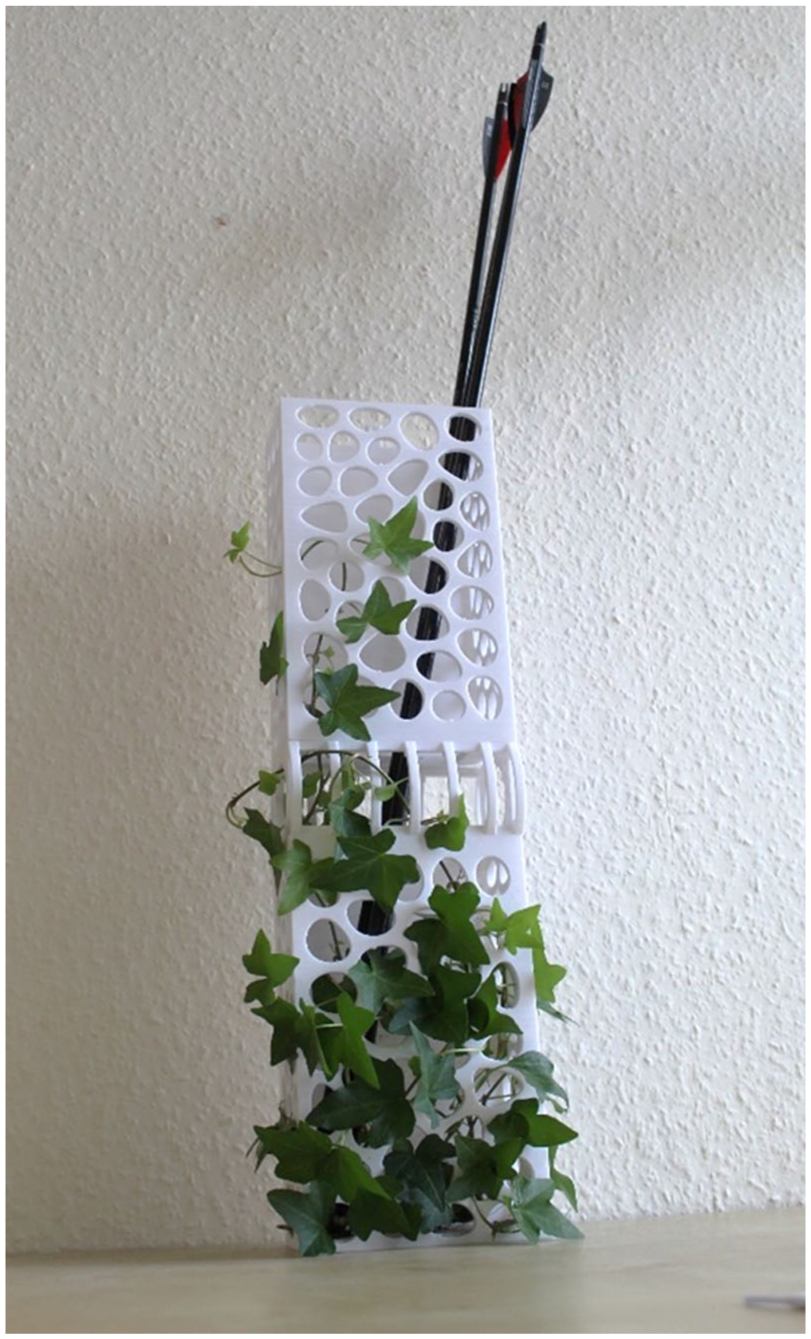
Plant Quiver version 2 after initial planting. Photo by Eliott Rooke.
Here the design process is shown to be itinerative, rather than simply iterative. For Ingold, all making is itinerative; acts that may seem purely repetitious actually require continuous adaptation. 98 Although these changes may be subtle, they create a forward momentum that distinguishes itineration from iteration. 99 Thus, to say my design process was itinerative is to say that the each step led from the preceding and into the succeeding. Through an itinerative approach, what might be otherwise viewed as failed designs – including apparent ‘dead ends’ – can instead be reframed as ‘drafts’ 100 which help (re)orient the process. Moreover, it was in the pursuit of understanding why I felt as though I had failed that I was pulled forwards. The feeling of failure surfaced uncertainty around my designs, and in responding to it I was forced to (re)articulate my expectations and ambitions for the quiver. While both itinerative design and experimentation use failure as a recursive feedback process, this is where they are distinct. Experimentation taught me of the material properties with which I worked, while itinerative design clarified my own objectives.
Although I focus here on one specific failure, many smaller failures – the macramé hanger holding the pot at an angle, stems snapping as plants were re-potted, and the ever-present failed print – were scattered throughout the project. At times these failures were demotivating, but they invariably prompted a moment of reflection that guided me forwards.
The Collapsible Quiver
Scavenging – the act of retrieving and/or repurposing an object, idea, skill or process – was crucial to the success of the Living Quiver Project. The advent of the COVID-19 pandemic saw my already-limited access to communal making spaces, in-person training and specialist stores disappear. Although the term is often applied in such a context, things need not have been discarded, damaged or forgotten to be scavenged. This distinguishes it from other, similar practices such as salvage, 101 restoration, 102 repair 103 and mending. 104 The Living Quiver project involved designs that were both scavenged – repurposing skills, materials and ideas from elsewhere – and scavenged from as the borders between projects blurred. Here, I use my own experiences of scavenging in the design of the Collapsible Quiver to reflect on how scavenging re-opens failure, unravelling its finitude, while extending the skilled ecology.
The Collapsible Quiver began with a scavenged concept – the skeletal outline from my plant quiver. Noting that much of the quiver’s size is in its height, I wondered whether I could design a quiver that could be compressed for storage. This would be advantageous for all archers, but especially for clubs who may store dozens of communal quivers. The movement of retraction would also fit the project’s brief of conveying agency. This was an unexpected reconfiguring which transformed the skeletal outline, not through any physical alteration to its structure, but by recontextualising it.
The project seemed straightforward. The skeletal outline was almost sufficient; I just needed to incorporate the retraction mechanism. I experimented once more. Telescopic poles, ropes, chains and origami-like folds were all tested. While functional, these prototypes felt muted. They were collapsible, but passively so as they required external input. I wanted something more autonomous, leading me to explore spring-loaded mechanisms. I had never worked with springs before and knew little about how to implement them. I needed to incorporate a locking mechanism to prevent the quiver unexpectedly collapsing and expelling the arrows, and I needed springs that didn’t permit lateral movement so the base and top stayed aligned. I had a clear idea of what I needed but could not find a path forwards. Experimenting proved fruitless and, feeling defeated, I eventually shelved the project and moved on to other things.
Months later, while measuring something for an unrelated project, I found my solution. The exact mechanism I needed existed in the retractable tape measure I was using (Figure 8). This was a two-fold blessing: I had my answer, and it was in a form that would require little skill to implement. I purchased two keyring tape measures and transplanted the spring mechanisms into a 3D-printed case (Figure 9). The resultant design not only exceeded my expectations but exceeded my technical know-how too. By repurposing a built device, I had re-opened and expanded the skilled ecology. Integrating these springs into my design, drew attention to the fact these designs were not mine alone. My work was only possible because others had created that spring mechanism, written the open-source code I had used to print the case, produced the YouTube tutorials that guided me through the process, and so on. But this was an act of ‘non-concurrent collaboration’ 105 – the other actors in this web knew nothing of my work.
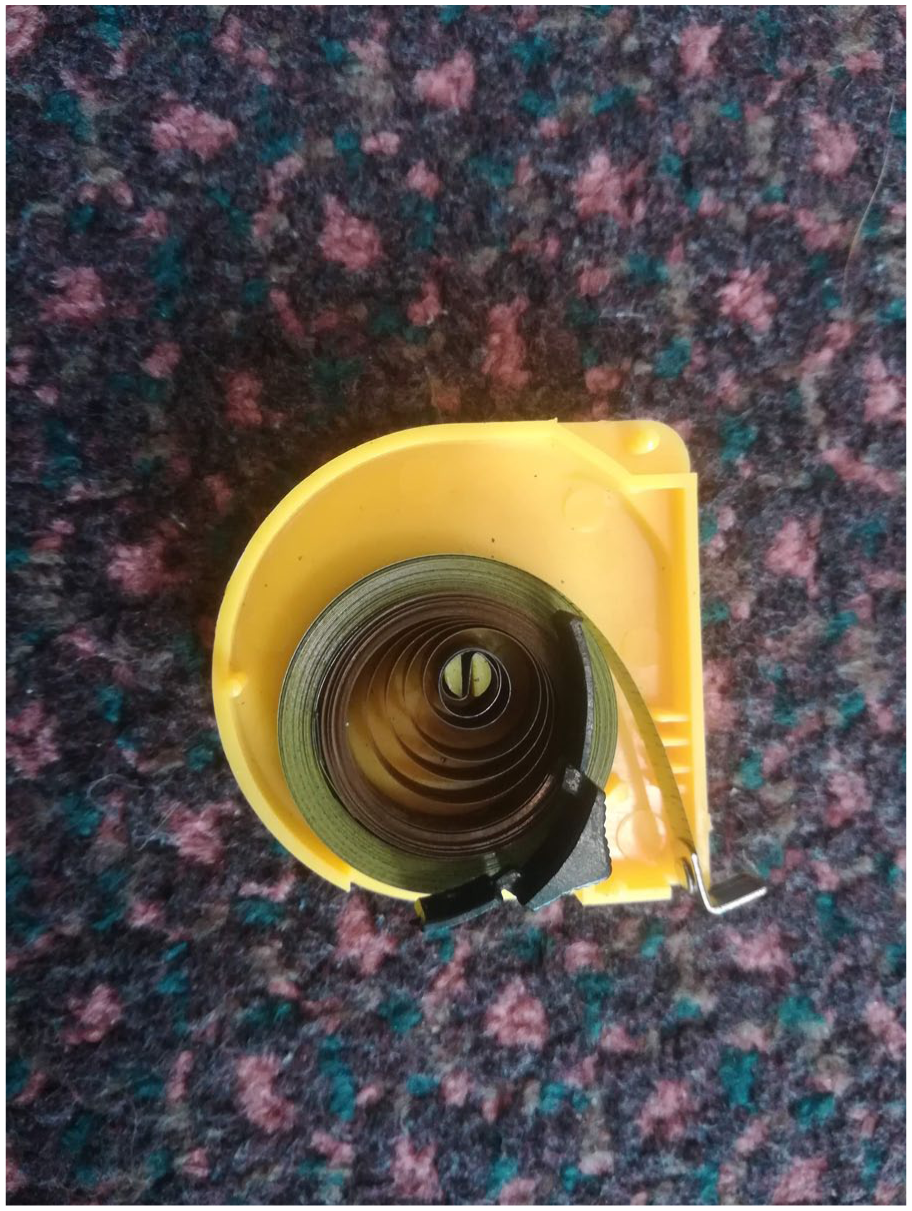
The insides of the retractable tape measure that inspired my solution to the Collapsible Quiver issue. Photo by Eliott Rooke.
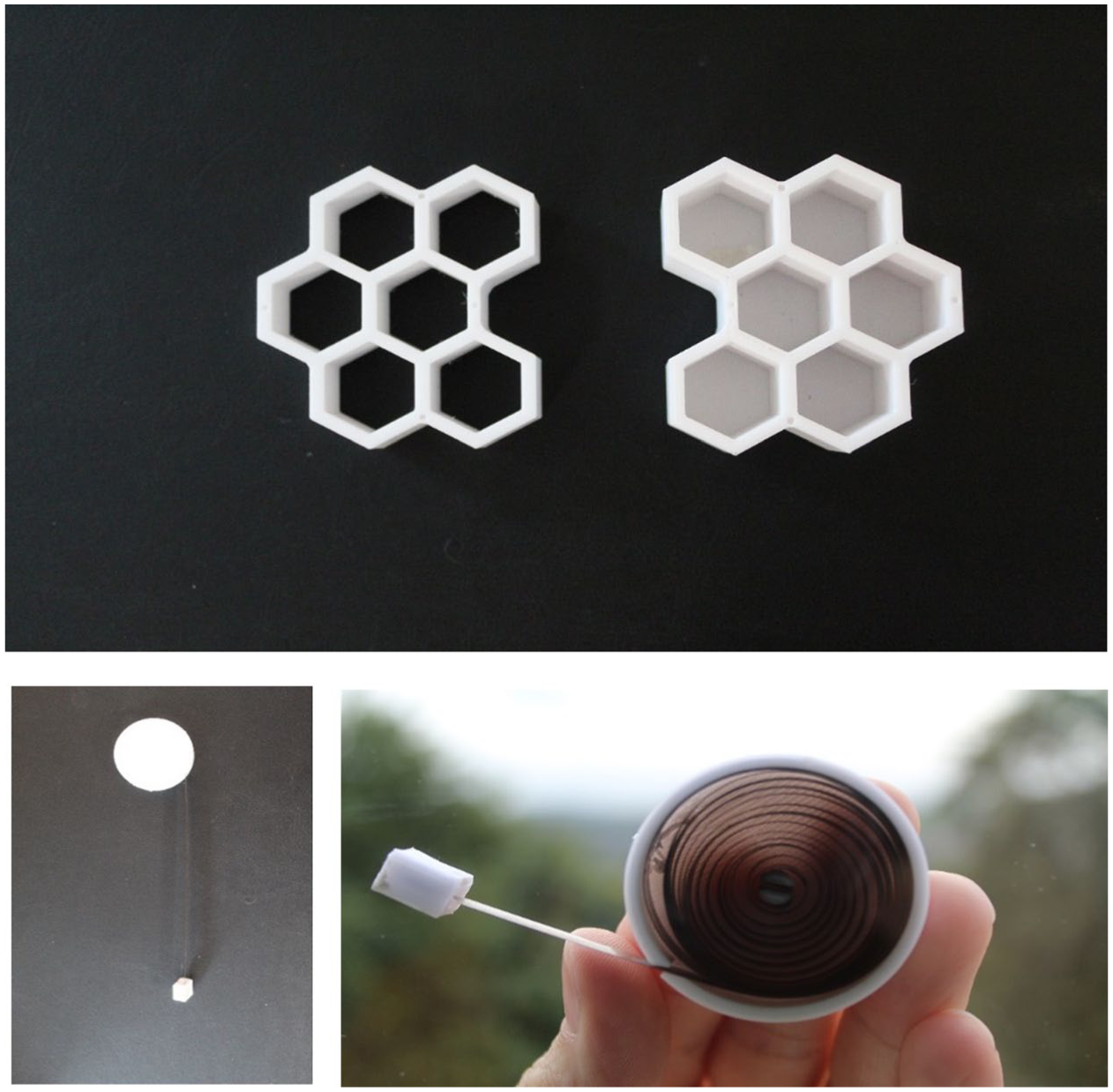
Collapsible Quiver components: body (top) and retraction mechanism (bottom). Photo by Eliott Rooke.
Scavengers are often marginalised in popular discourse as the practice is seen as an act of necessity rather than choice. 106 However, the decision to re-use materials may be rooted in many factors, such as concern for the environment, 107 the unsuitability of commercially available products, 108 or, as in my own account, limited access to formalised making spaces. Scavenging and other ‘DIY’ approaches can be construed as producing inherently lower-quality work, 109 but in practice can provide fertile ground for innovation and creativity by renegotiating the material identities of scavenged things. 110 Scavenging requires a ‘repertoire of reuse practices’ and a deep attentiveness to the materials being used 111 – and, likewise, a thorough appreciation of skills, ideas and processes which are scavenged.
Scavenging quickly became a skilled part of my making process. It represented a failure in that it indicated an apparent limit to my skill. However, through scavenging, I could reach across disciplinary boundaries, material lives, technical know-how and space to engage in collaborative ventures through the repurposing of others’ work. Scavenging thus offered a particular response to failure by opening the ecology to these new collaborators and revealing that the skill was not mine alone. Furthermore, scavenging gave failed designs ‘after-lives’, opening them up to new applications in future.
Conclusion
I had, for the most part, not set out with the intention to fail. Yet, failure always found me. Through these three accounts, I have sought to show my gratitude for this. Through experimentation, failure familiarised me with my materials and their limits. These were often different to my expectations and so failure enabled innovation. Through itinerative design, my failures encouraged reflection and slowed progress enough for me to be forced to articulate my desires and intentions. Through scavenging, failure provided an opportunity to break apart the established skilled ecology to incorporate new components and collaborators. In each case, failure was generative. While these failures may well have made me a more skillful maker, their role was greater than simply providing ‘teachable moments’. These failures were themselves skillful acts.
As noted in this paper, and by others, 112 failure is not something permitted of everyone. To claim that failure is a skillful act is therefore to recognise that these very same mechanisms of exclusion may also render skill inequally accessible. Elements of my identity may have meant that failure was less consequential to me during this project, while others may have made it more so. However, the nature of the project itself – an individual piece of work with flexible goals and timelines – was also integral to enabling me to fail well, highlighting the possibility for the same structures that make failure damaging to instead be used to create space for failure to be skillful. Furthermore, the value I gained from failing highlights the importance of challenging the infrastructures that condemn it.
Horton calls for us to share more stories of failures that do not have ‘happy endings’ of overcoming adversity, 113 but, equally failure is not necessarily something that should, or can, be overcome. My failures were not undone or erased by the subsequent successes, nor did those successes occur isolated from the failures that came before them. I cannot tell the story of one without the other and so I cannot speak of skill without speaking of failure. While Ingold and the Dreyfuses recognise the value of failure in skill development, it lingers on the fringes of their conceptualisations. It bounds and encapsulates skill, denoting limits that a performer may transgress due to inexperience or in pursuit of mastery. This presents failure as being other-than-skill. However, as my experiences illustrate, failure cannot be so readily assigned to the peripheries.
Footnotes
Acknowledgements
I’d like to express my thanks to Professor Dydia DeLyser for guiding this paper through the submission and review process, as well as the anonymous peer reviewers who shared their comments. Their constructive and patient suggestions have been greatly appreciated. I’d also like to thank Dr Jennifer Lea and Professor John Wylie for supervising the PhD project, some time ago now, on which this paper is based.
Ethics statement
This study was approved by the University of Exeter Geography Department Research Ethics Committee.
Funding
The authors disclosed receipt of the following financial support for the research, authorship, and/or publication of this article: This article was developed based off research funded by an ESRC SWDTP PhD Studentship [grant number S/J50015X/1].
