






Abstract
A growing body of scholarly work acknowledges the importance of attending to the entanglements of human and more-than-human lives, including the importance of affect for how we come to understand other organisms. However, to date, little work has been done on the affective aspects of how more-than-human beings come to be understood in policy. Environmental humanities approaches including expert engagement with affective storytelling, attention to ‘unloved others’ and the material aspects of coming to care for other beings, are in a prime position to think about creative modes of policy engagement in which other ways of making unloved – even illicit unloved – organisms present in policy discussions. Using Jamie Lorimer’s three-part typology of charisma as a lens, we reflect on our own experiences of coming to know cannabis the plant differently by learning new ‘arts of noticing’ during photo-elicitation interviews with people growing cannabis in Canberra, Australia. This paper explores the ways the ecological, aesthetic, and corporeal charisma of the cannabis plant emerged in our explorations of plant care through the stories and pictures of our research participants. Reflecting on our own experiences and shifting understandings of and care for cannabis, we explore the idea that making better representations of more-than-human lives in policy requires consideration of how we come to be affected by, and know, other organisms – approaches that we argue invite the environmental humanities to play a stronger role in policy.
Introduction
At the intersection between the sciences of nature and the sciences of culture, a new model is afoot, the key characteristic of which is multi-species love. Unlike earlier cultural studies of science, its raison d’être is not, mainly, the critique of science, although it can be critical. Instead, it encourages a new, passionate immersion in the lives of the nonhuman subjects being studied.
During the course of completing a series of in-person and online photo elicitation interviews with people who grow and love cannabis sativa, for two of our authors, (LM and LB), cannabis became an obviously beautiful and charismatic plant, something anyone might want to grow for its sheer charm. We met enthusiastic consumers of the plant and also those who had stopped or only rarely consumed the plant, but variously continued to grow cannabis for a love of the plant and cannabis cultivation and/or a hope to share harvests with those in need. LB already held a nascent appreciation of the plant, perhaps due to previous good times with the plant’s products. For LM, fondness for the plant emerged without any prior (or subsequent) appreciation for the product of the plant – indeed, even a degree of aversion. For both researchers, however, by the end of the interview process, the plant was undoubtedly charming, and something desirable to grow and know for its own sake. So, it was a surprise to read Michael Pollan’s description of visiting a cannabis plantation in Amsterdam:
There was nothing of beauty in this garden. Should legalization ever come, no one is going to grow cannabis for the prettiness of the flowers, those hairy, sweaty-smelling, dandruffed clumps.
2
We were startled. How could Pollan, a self-described ‘plant nut’, not have understood the obvious beauty of trichomes, the joy that can be found in its propensity for abundance, or its comforting smell? On consulting with our colleagues, however, it seemed that they had not all equally succumbed to the charms of this plant, with one co-author agreeing with Pollan that cannabis is indeed an ugly and smelly plant. The assumption that no-one would ever want to grow cannabis purely for the prettiness of its flowers or any other aspect of its planty charm was also apparent in recent cannabis legislation in Australia’s Capital Territory (ACT), where the Australian capital city of Canberra is located. Here, the plant itself was virtually absent in legislative discussions except those concerned with ‘legitimate’ forms of cannabis cultivation, and the perceived intersection of certain modes of cultivation and criminality. 3
Reflecting on our own personal experiences of having been affected by cannabis the plant, we have come to question the ways in which other-than-human beings may be present in only limited ways in legislation and to consider the role that the environmental humanities – with its attendant interest in affective and material aspects of storytelling – as well as the position of some beings as ‘unloved’ – might have for policy work. 4 The notion of ‘unloved others’ foregrounds the ethical asymmetries that shape which beings are allowed to matter. As Rose and van Dooren argue, species deemed unattractive, ordinary, or illicit are often disregarded or actively vilified. 5 This neglect is not neutral: it is a mode of exclusion that constrains the possibilities for multispecies flourishing. Against this backdrop, cannabis offers a compelling case. Its legislative framing as an illicit commodity positions it as an ‘unloved’ organism, absent from policy except as a problem to be controlled. 6 Environmental humanities approaches, with their emphasis on affect, materiality, and the ‘arts of inclusion’, invite us to consider how passionate immersion in the lives of nonhumans – rather than abstract, technocratic logics – might open space for more-than-human presence in policy. 7 Such arts of noticing challenge anthropocentric governance and call for modes of care that extend to the disregarded, unsettling the boundaries and opening space for new possibilities to emerge in policy.
Approaching these issues as authors informed by perspectives across work in cultural geography, environmental humanities, science and technology studies (STS), and critical policy analysis, we conceptualize policy not as a static set of authoritative decisions, but as a productive network of relations and material–discursive practices. 8 This approach foregrounds the performative nature of policy – how it enacts realities and shapes what counts as evidence – rather than treating it as a neutral instrument of governance. In this sense, policy is an ontological intervention, assembling particular worlds and excluding others. 9 It is notable that advocates and scholars have highlighted the need for drug policymaking to be more inclusive and create pathways for participation of people who use drugs, challenging the historical exclusion of such voices 10 in ways that broadly correspond with what has been characterized as a ‘participatory turn’ in contemporary governance and statecraft. 11 Our analysis offers a vantage point for considering the ways in which policy work entails the cultivation and maintenance of particular affective dispositions together with the ways in which more-than-human beings and processes, are enrolled in, subject to, and active shapers of policy processes and outcomes. 12
Thinking with the potential participation of cannabis and other multispecies beings in policy, we draw here on Lea’s ecological approach to critical policy analysis, that is attentive to ‘more-than-human entanglements, conceptual and material inheritances, and the aftermaths lingering beyond the official life of any “particular policy or related group of policies”’. 13 We argue there remains a need to remake policy participation in more expansive ways, interrupting established and often exclusionary claims as to ‘what counts’ as evidence as well as who and what participates and how. 14 This includes non-human participation in drug policy participation, with the possibility of policy processes better attuning to and being affected by the realities and needs of non-human policy actors, including plants. Attending to the means through which the cannabis plant is both shaped by, while also participating in (and occasionally disrupting) drug policy work, gestures toward Lea’s insistence that ‘policies do not emerge miraculously without multiple human and more-than-human enrolments’, 15 but rather approaching policy relationally suggests that ‘subjects and objects are not self-enclosed, and neither is policy’. 16
The ways plant materialities shape policy assemblages and deliberations, forms an important, if unacknowledged, dimension of contemporary policy work. This work draws particularly on analyses of political participation and deliberation as characterized and shaped by more-than-human entanglements current in fields such as cultural geography and STS. 17 As we will argue below, this is particularly significant in the case of cannabis, which in many jurisdictions is the focus of a substantial shift in the focus of regulatory and policy attention. As states have begun to adopt a range of decriminalization and legalization measures, the figure of ‘cannabis as plant’ in addition to ‘cannabis as drug’ has begun to emerge in regulatory and policy thinking, promoting questions of what it means to grow cannabis well. 18 Recent scholarship on vegetal agency and plant geographies underscores the active roles plants play in shaping human practices and imaginaries. 19 Our work extends these insights into the domain of drug policy which so often entirely overlooks the living beings who provide the raw ingredients for a number of illicit substances, arguing that attending to plant charisma can unsettle anthropocentric policy logics.
Reflecting on the affecting nature of our participants’ particular modes of storytelling, we were drawn to Jamie Lorimer’s thinking on the entangled representational, material and social aspects of more-than-human charisma 20 and Anna Tsing’s work on the particular human-mediated ‘arts of noticing’ that lead us to love some species (or not). 21 Utilizing these frames we raise the question of the potential role of affecting stories in countering traditional drug policy narratives that, at present, seem much more able to create abstract notions of ‘bad’ plants and ‘illicit’ cultivation practices (i.e. unloved others), rather than reflecting the vibrant reality of plantiness. By ‘plantiness’, we refer to the material and biological qualities of cannabis, what Head et al describe as ‘what it means to be a plant, how plants act in their worlds’. 22 In other words, the growth rhythms, morphology, and sensory affordances of cannabis, all things that exceed its framing as a ‘drug’. 23 To be clear: we are not arguing for any particular policy outcomes. We hold a range of positions ourselves about how plants with intoxicant properties should be legislated. What we are arguing, is for the need to take storytelling seriously, and for greater attention to be paid to how legislators meet the subjects of policy matters.
It is also important to acknowledge that existing drug policy narratives and assemblages of cannabis as an ‘unloved’ species cannot be disentangled from the deeply complex history of cannabis. This history spans thousands of years and includes racial prejudice, orientalist exotism, colonialism and stigma, as well as cultivation for fiber, spiritual, medicinal, and recreational purposes. 24 As noted by Lawrence, it is vital to situate human-plant relations within relevant historical and cultural contexts to ‘acknowledge and critique the structures of power that determine which modes of relation tend to dominate’. 25 So that even while many countries relax or even legalize access to cannabis, and a new era of post-prohibition is argued to provide openings for new objects and concepts of cannabis to be created, 26 previous social, cultural, and political contexts continue to ‘haunt’ and delimit contemporary meetings and interactions. 27 This is evident in the US where even the naming of cannabis as ‘marijuana’, drug prohibition and the ‘war on drugs’ are deeply embedded in structural racism that have stigmatized both people who use cannabis and the plant itself, 28 and where drugs laws have been used to criminalize and brutalize black communities. 29 The haunting of deeply embedded racist structures within drugs policy can be seen in the harmful effects of prohibition and policing continuing to be directed at communities of color. 30 Australian contexts, histories and patterns of cannabis are somewhat distinct from the US (see below), but entangled in and haunted by our own racist colonial structures.
For cultural geography scholars, the role of attunement and in particular, attuning to vegetal agencies holds potential to trouble such contexts and embedded histories, and to create new opportunities for exploring ontological ‘otherness’. 31 If we are able to pay attention to other means and modes of being and doing, outside of the well-trodden lens of the war on drugs and other historical assemblages of cannabis, what becomes possible? Even if it is ultimately impossible for human-crafted policy to diverge from an anthropocentric view, being stuck in human bodies as we are, our experiences of coming to know cannabis differently and the policy absences this revealed, led to the question that underlies the explorations in this paper: what sorts of more-than-human attunements might be able to enter into policy processes, and with what consequence? 32
Cannabis regulation in Australia and the Australian Capital Territory
Cannabis cultivation was introduced into Australia by British colonial invaders in the 1700s hoping to create a hemp colony to supply ropes and sails to British navy ships. 33 Its cultivation, use and possession was criminalized across Australia in the 1960s and 1970s following international United Nations drug treaties. But in 1987 Australia became one of the first countries to adopt a civil penalty scheme for cannabis in the state of South Australia through the South Australian Cannabis Expiation Notice scheme. 34 While some Australian politicians were influenced by the US ‘war on drugs’, adopting similar rhetoric and policies promoting a hardline approach to drugs during the 1970 and 1980s; toward the end of the 1980s onwards, Australian states and territories progressively adopted policies that allowed a non-criminal response to cultivation, use and possession of small amounts of cannabis.
Notable in Australian histories of cannabis cultivation is its embeddedness in white communities, with cultivation and distribution in the 60s and 70s occurring within white middle-class hippy communities which were subsequently replaced by white outlaw motorcycle clubs. 35 Broader Australian histories of drug policies and policing beyond cannabis are complex and enmeshed in the British colonial project including ongoing subjugation and dispossession of Aboriginal and Torres Strait Islander peoples from their lands, and the ‘White Australia Policy’ that limited immigration to Australia from non-European countries. 36 The history of drug prohibition, laws and policing have often times been used as a tool to target different racial minorities within Australia including people of southeast Asian descent 37 and First Nations peoples in particular, who continue to be targeted and criminalized for drug use resulting in overrepresentation in crime statistics. 38
At time of writing, all Australian states and territories have some form of schemes in place for police to offer a non-criminal response to cannabis possession for personal use, 39 but the Australian Capital Territory (ACT) became the first jurisdiction in Australia to legally allow cannabis cultivation alongside possession. The ACT is geographically small, but politically important as it is home to Australia’s capital city, Canberra, the national parliament, and is the location of many national government agencies. It has also been the first jurisdiction to adopt a number of progressive policies which have then been taken up either nationally or by other states and territories. Under the new cannabis laws in the ACT, households are allowed to grow up to a maximum of two cannabis plants per person (maximum of four per household), with possession capped at 50 g of dried cannabis and 150 g of wet or freshly harvested cannabis. Purchasing, selling, and other distribution of cannabis products (including swapping or sharing) remains banned. ‘Artificial cultivation’, defined as hydroponic cultivation or cultivation ‘with the application of an artificial source of light or heat’ 40 also remains banned, with provisions on growing emerging from debates that framed cannabis primarily as a drug commodity, overlooking its material and relational realities as a plant. 41 This narrow framing underscores our argument: that policy assemblages often exclude the multispecies entanglements they seek to govern.
Research methods
Within the context of a larger project on participation in drug policy, our initial motivation in spending time with people growing cannabis in Canberra had been to understand how cannabis the plant participated (or not) in recent legislation on cannabis that allowed for home cultivation and possession and use of small quantities of cannabis in the ACT. We were interested in how the realities of growing cannabis and the nature of cannabis plants challenged policy concerned with regulating cannabis as a drug.
As noted by Rowsell ‘co-experiencing photographs is a relational act’ 42 with the telling and sharing intimate stories, emotions, joy and love through pictures having affective pull that acts as an invisible ephemeral force, fundamentally altering the interaction. Such visual mediation can move interviews beyond a one-sided interaction to a shared situated affective practice that affords space to explore, produce, and share emotional, relational and social connectivity and material entanglement with the world. 43 Given our concern with ‘plantiness’, Tsing’s theories on human-mediated ‘arts of noticing’ and the role of affecting stories, photo elicitation therefore appeared particularly relevant, and a method that has been used previously in multi-species research as a means of better exploring more-than human processes and subjectivities. 44
Recruitment took place via posters placed on community noticeboards in suburbs throughout Canberra, and via postings in online ACT-based cannabis groups (on Reddit and Facebook) inviting anyone growing cannabis to contact the research team. Interviews took place in May and June of 2022. Except for one interview that lasted 30 minutes and one interview that lasted over 3 hours, all other interviews averaged 2 hours, creating space for rich and deep conversations and mutual explorations. Five of these interviews took place on Zoom, four were in people’s home (one of which still had cannabis plants present that we were able to meet), and one took place in a coffee shop. The home interviews provided opportunities to see in-person the growing spaces used, and to be introduced to different harvested products that participants had made, although this also occurred on Zoom where participants held up products and apparatus to camera or picked up their device and walked us through their homes and growing spaces.
The participants included six men and four women. Although we did not inquire directly about ethnicity or if participants were Aboriginal and/or Torres Strait Islanders, all participants presented as white. Neither did we inquire about participants’ background or occupation, although it emerged within interviews that two were postgraduate students and four others were either current or retired public servants (occupation of the other participants did not emerge during the interview). The relatively small sample size reflects the small population size of the ACT (under 500,000 people) and the well-documented difficulties in recruiting hidden populations of cannabis cultivators and people who use illicit drugs in qualitative research 45 (noting that cultivation had been sanctioned for 2 years in Canberra at the time of research but remains banned in all other states and territories in Australia). This study follows similar sample sizes of peer-reviewed studies utilizing photoelicitation 46 which prioritize depth over breadth, including those involving populations of people who use illicit drugs 47 and is, to our knowledge, the first photo method study with cannabis cultivators to be undertaken in Australia. Participants ranged in age from their 20s to 60s, with varied motivations for growing – ranging from personal use to creation of medicinal products for others.
Participants were sent a guide of the types of photos they could choose to bring to interviews to help tell their story and show how they ‘do’ growing. As we discuss, most participants had already been avidly documenting their cannabis cultivation prior to being contacted by us, and only one participant took photos especially for the interview. Some opted to send photos via email prior to the interview. Others preferred to bring them along on the day either in hard copy, or digitally in the case of in-person interviews or through screen sharing or showing to the camera during Zoom interviews. Although we had an outline of topics we wanted to cover in interviews, we were led in conversation by the participants, using photos to mutually explore the stories of their plants, care and cultivation techniques and plant-human relationships. These methods surprised us by being unusually affecting, as we found ourselves not only revisiting our previously held opinions of cannabis but also coming to share in the perspective of cannabis as a charming plant in its own right.
Cannabis charisma
To explore how cannabis charisma emerged through this storytelling and unfolding of entangled practice, relationships, meanings and agency, we make use of Lorimer’s tri-partite approach to other-than-human charisma. 48 While some evolutionary theorists, such as Wilson and Kellert 49 saw the attractiveness of various landscapes and species as being directly related to their evolutionary affordances for humans, Lorimer points out that the charms of other species cannot be so functionally explained. 50 Instead, for Lorimer, charisma ‘emerges within particular social and material contexts’. 51 Lorimer identifies three possible aspects of non-human charisma, the ecological – that is, the ease by which humans can identify the organism; the aesthetic – or how non-humans are represented; and the corporeal – the physical sensations one has had in the presence of the other. 52 While, as Lorimer notes, in practice there is overlap between such ‘factors’, we find them useful as a set of analytical lenses. In particular, they helped us to focus on how the relational and embodied, cultural, and experiential aspects of how our participants viewed cannabis as a plant, as well as also how they were able to communicate it to us.
Ecological charisma shifts
The first of Lorimer’s tri-partite frame, an organism’s ‘ecological charisma’ rests on the ease with which a human ‘in possession of all their senses and with limited technological assistance’ can sense the organism. 53 For example, writing of corncrakes, 54 Lorimer notes that, ‘in spite of its elusive diurnal behavior’, the male corncrake is reasonably charismatic, ecologically, on account of its nocturnal call being one that is easily heard and identified by humans. 55 In many ways, this charisma – based on whether or not we can perceive another – is the foundation for having any sort of relationship with another being, whether positive or negative.
Cannabis is a distinctive and highly-identifiable plant – potentially highly ecologically charismatic in terms of its physical visibility as well as its scent. However, due to previous laws that prohibited the cultivation of cannabis, it is one that has, for some, remained hidden and not commonly encountered. Through this study, the basic ecological charisma of cannabis shifted for us as we got to see the plant in images, and on one occasion in person. For the majority of our participants, the change in law meant that they too got to see and meet cannabis plants for the first time through the act of growing them. Many observed that they found the plant to be novel, extraordinary and not like other ‘normal’ plants due to its complex life-cycle and the labor and knowledge required for harvesting and curing cannabis.
Ecological charisma relates to not just the ability to see another species, but the ability to sense it more generally. Lorimer describes recognition of the corncrake call as an important aspect of its ecological charisma for British birders, allowing it to be identified as a particular species among others.
56
For cannabis, the most distinctive aspect of ecological charisma aside from its visual appearance was its distinctive smell. Smell was a clear indicator for participants of ripening flower bud and for some, flagged a sense of readiness to be moved from a protected indoor environment to outdoors, such as Patrick
57
who knew when this moment arrived when their (teenage) kids started saying ‘dad the plants stink!’. Patrick elaborated on the smell being an aspect of seasonality, waxing and waning during different parts of the growing process noting they ‘didn’t have as much this year in terms of aroma, but then again, I didn’t have as much successful cropping this year’ (Patrick). Both developing a sense of the meaning of particular cannabis scents – as well as people’s relationships with the smells – was something that shifted with time and experience. Holly, for example, noted initially not liking the plant ‘stink’ as it was something they had not encountered before. However, they came to like the smell due to its connection to successful flowering:
It’s the smell of success really because it means that your plants have gone into flower and you’re going to get a nice harvest and that sort of stuff (Holly).
For some cultivators, the positive visual ecological charisma of cannabis was enhanced by the use of the simple technology of magnifying their plants using their phones or enlarging photos on their computers to examine the plant more carefully. The use of technology provided performative and transformative work here. 58 Firstly the ability to zoom in on the trichomes led to participants’ literal ability to see differences in the trichomes, enacting cultivation and care through monitoring and tracking the physical development of trichomes, (the small glandular globes that are the main source of cannabinoids). 59 Trichome development was something keenly watched by participants, as the feel and color change in the trichomes conveyed how ‘ready’ or ‘ripe’ the plant was to harvest. At the same time as this productionist practice, technologies also presented opportunities to see and experience cannabis differently. Under magnification, the psychoactive substance of cannabis transformed into lively aesthetics, with participants variously describing trichomes as ‘like dandruff’ or something of remarkable beauty. One participant who described their approach to cannabis cultivation as scientific and provided a markedly rational/scientific description of trichome ripening, was also not unaffected by the beauty of trichomes which they described as ‘sparkly’ (Ryan; Figure 1). Charisma was therefore also conveyed by participants in using words that themselves were evocative of the lively and beautiful life worlds of the cannabis plant.

‘Sparkly trichomes’ (photo supplied by Ryan).
Aesthetic charisma shifts
For Lorimer, the aesthetic charisma of an organism relates to the emotional responses humans have to the being’s appearance or behavior, whether such encounters are in the flesh or textual. 60 In this, Lorimer notes that human attraction and revulsion tends to be variously oriented toward both nonhuman difference and similarity. 61 That is, while organisms that are experienced by humans as domestic and/or cute can have a charm for some, radical difference, ‘feral transgression’, ‘unpredictability and autonomy’ of nonhumans can appeal to others, so that both the panda and the giant squid have aesthetic charisma. 62 For Lorimer, such responses are naturecultural, in that nonhuman charisma is intimately tied up with both the ‘agency of the nonhuman being witnessed and the social structure in which the witness is enmeshed’. 63 For aesthetic charisma, this inseparability of the physical presence of a particular being on humans and the sociocultural worlds in which the subject and witnessing creatures find themselves can be seen in the ways in which certain people actively dislike ‘cute’ species, tending to care instead for the grotesque or other-worldly. 64 While biological and physical propensities do seem to play a part in people’s fondness for one species over another, in practice, a vast array of stories, social pressures and personal experiences play into the ways in which one comes to care for others. 65 The tendency for rats to proliferate in particular ways, or for snakes to bite, or dogs to be useful, or roses to smell as they do, however, does seem to play some part in the responses of people to such species, but people can and do still come to respond in affectively varied ways to these different kinds of beings. 66
In the stories told by our participants, we met cannabis as both a charming and decidedly ‘cute’ part of the family, as well as an organism respected for its radical otherliness. There was exuberant charisma to these plants that was fundamentally about their precise too-much-ness – the exuberant vitality of cannabis, its tendency to overflow spatial and regulatory confines; the stories that emerged in concert with the images were of growers trying to discreetly grow their crops, but the plant growth quickly exceeding fences and privacy shields and becoming a huge plant visible (in a visual and olfactory sense) to others. Charisma was present in participants’ wonder of the plants. In contrast to the affective seriousness of law-and-order framings, cannabis emerged as hilarious, charming, and surprising. Reflecting on a photo of seedlings on a window ledge in little pots (Figure 2), for example, one participant described the experience of those seedlings emerging:
And how did it feel the first time that [seedling] kind of came up?
Awesome. I don’t know. It’s embarrassing to say really, but you know, it’s like, wow, I’ve germinated and grown something and, you know, this is going to grow up to be a plant and similar to, so my partner grows tomatoes, not as successfully as I grow these, but she loves that feeling of we’re making a plant, it’s the same sort of thing (Francis).

New arrivals (photo supplied by Francis).
Here, (as in other photos with their arising stories), we found ourselves pulled into a world marked by relationship and care. There was a level of symbioses to these relationships – part of the love and joy experienced was due to the plants responding to the love and care provided.
67
Several participants noted that this relationship between cannabis and grower was marked as more than, or other than, ‘normal’ gardener- plant relationships. For some participants, the extraordinariness of cannabis and care that this entailed was due to the extraordinary nature of the plant product. As one participant noted – in fond contrast to the more laisse-faire gardening approaches of his partner – he was more ‘committed and more invested . . . more passionate’ because he was not growing an ordinary foodstuff (like tomatoes), but was in fact, growing a psychoactive drug:
. . . I’m more a nurturing kind of father whereas she’ll water them a couple of times a week and she might go out and have a look and that sort of stuff, but yeah, I guess, we have a different view on it. She’s just growing tomato plants, but I’m growing marijuana (Francis).
Across these responses, there appeared a gendered dimension to the relations and practices of care. A familial and loving tone was echoed in the language used by many of our participants toward their female plants, who were anthropomorphized as ‘my babies’, ‘my girls’, ‘big lady,’ or ‘my ladies’ with the gendered use of language reflecting the fact that it is only the female cannabis plants that produce the sought after cannabis ‘bud’. By contrast, male plants were framed as threats due to their ability to fertilize female plants and thus divert energy away from resin production, reducing potency, yield and creating seeds (that are not smokeable) within the cannabis bud. Male plants were often ‘culled’ to protect the crop. ‘You get rid of the boys’ stated Francis, although their removal of male plants was described as both necessary and emotionally fraught. Francis continued, ‘When you’re confident it’s a boy, it’s quite a sad feeling . . . one of your girls, she’s going, she’s getting voted out’. Others, like Blair, tried to keep males separate from females to avoid fertilization, but the failure of this approach (and subsequent fertilization of his entire crop) led him to commit to a more pragmatic approach: ‘Next year, hang on, the boys will be dead as soon as they’re identified. That’s the only way of doing it’.
Such relations and practices resonate with Lorimer’s notion of nonhuman charisma as a relational property that emerges through always-entangled embodied encounters and cultural frames. 68 Here, female plants exhibit a form of corporeal charisma – their affordances and usefulness trigger care and attachment. For all the charms of cannabis that were not directly about consumption, the possibility of consumption, and what Lawrence refers to as the ‘utilitarian valuation of productive life’ 69 loomed large; ‘good’ crops were valued and played into the valuing of female plants. This gender-based valuing of plants remained true for participants who were not particularly interested in consuming cannabis themselves. In such instances, the possibility of sharing products with friends, or at least not destroying the crops of others in the neighborhood, played into the killability of male plants – positioning them as disposable within regimes of care and control. 70 This disposability is particularly apparent in Francis mourning his recognition of a plant as being male as the loss of a female plant, rather than the impending death of that male. While more than a commodity, the commodity element of cannabis is a vital aspect of the cultural ground within which it is made sense of. For Blair, male plants performed a kind of ‘feral charisma’ 71 for a season of experimentation. However, the realities of the presence of male plants and their reduction of crop quality shifted male plants into the category of the ‘killable’, 72 to be made ‘dead as soon as they’re identified’.
Plant-cultivator relationships often unfolded within broader familial and domestic dynamics between partners, flat mates, adult children, pets and parents, who moved in and out of the interview spaces, or emerged in photos, memories, and stories. The framing used by participants in describing their experiences of care and cultivation was also situated in family relational dynamics. One participant describing the joy of seeing their plant grow and change noted ‘Like it’s always super exciting. It’s like, oh my little baby’s grown up, you know’ (Holly), and another likened the need to re-pot their plants to kids needing new clothes:
They’re growers, you know. It’s like small kids. They want bigger clothes, so they can keep growing, you know. So, you need to re-pot them (Toby).
The photos shown to us by participants who had been documenting their growing journey were also reminiscent of a family photo album with participants noting that they were moved to capture particular life stages or moments in growing that were emotional, joyful or otherwise meaningful. We suggest that the form of the images also had effects, with the typically chronologically ordered nature of the photos leading to discussions with participants at times feeling reminiscent of poring over family photos. When we asked one participant about a photo of some coffee jars of cannabis on a gravel road (Figure 3), Toby explained that:
This was one of those Marie Kondo photos where I stopped to take this photo because I was full of pure joy just in this moment . . . So, I stopped to take this photo because I had this feeling like, wow, this is like . . . again, you know, the seed tray is the start of a journey. This is like the end of a journey and its sort of like, you know, it’s being harvested, it’s ready to consume, and now it’s something that’s grown at the side of my house and now I’m walking it to my friend’s house.
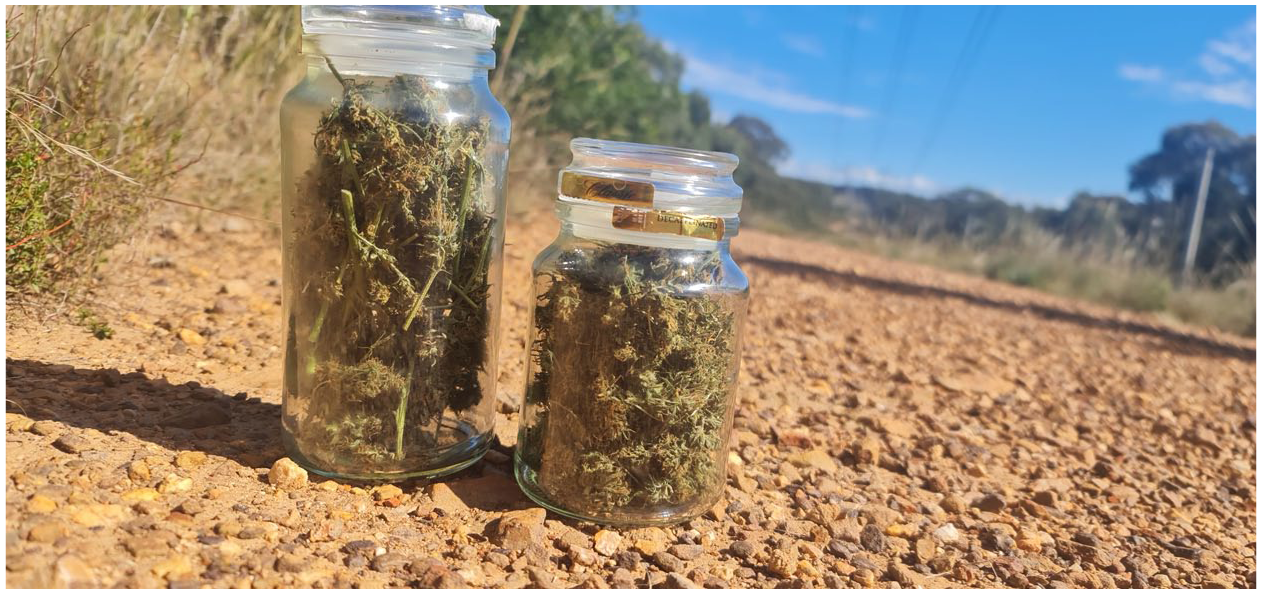
On the road (photo supplied by Toby).
Other photos and stories attempted to capture the excitement (and sometimes fear) of the plants as wild and transgressive. One participant told of the pure joy of a self-sown plant that ‘just exploded’:
The pure joy about this, is [that] this is from the same seeds that I’ve been growing. So, it’s from that same original batch. The person got this stuff, and this seed is pure joy because this was spontaneous growing. This came from him sitting on the patio, mulling up, and seeds, just like dropping the seeds because there’s so many, just dropping the seeds through his like wooden decking (Toby).
In this and other interviews, cannabis emerged as a delight, not so much in spite of its unruly nature, but because of it. Indeed, several participants had also grown the fast-growing but lower yield ‘auto’ flowering cannabis species but expressed disappointment in these much smaller ‘not very thankful’ (Holly) plants and returned to the rambunctious ‘photo flowering’ varieties.
So, I had her [photo of flowering plant – Figure 4], she’s a big girl, but behind her there you can’t even see, I had an auto planted as well, which I never bothered taking photos of, it was never spectacular (Holly).
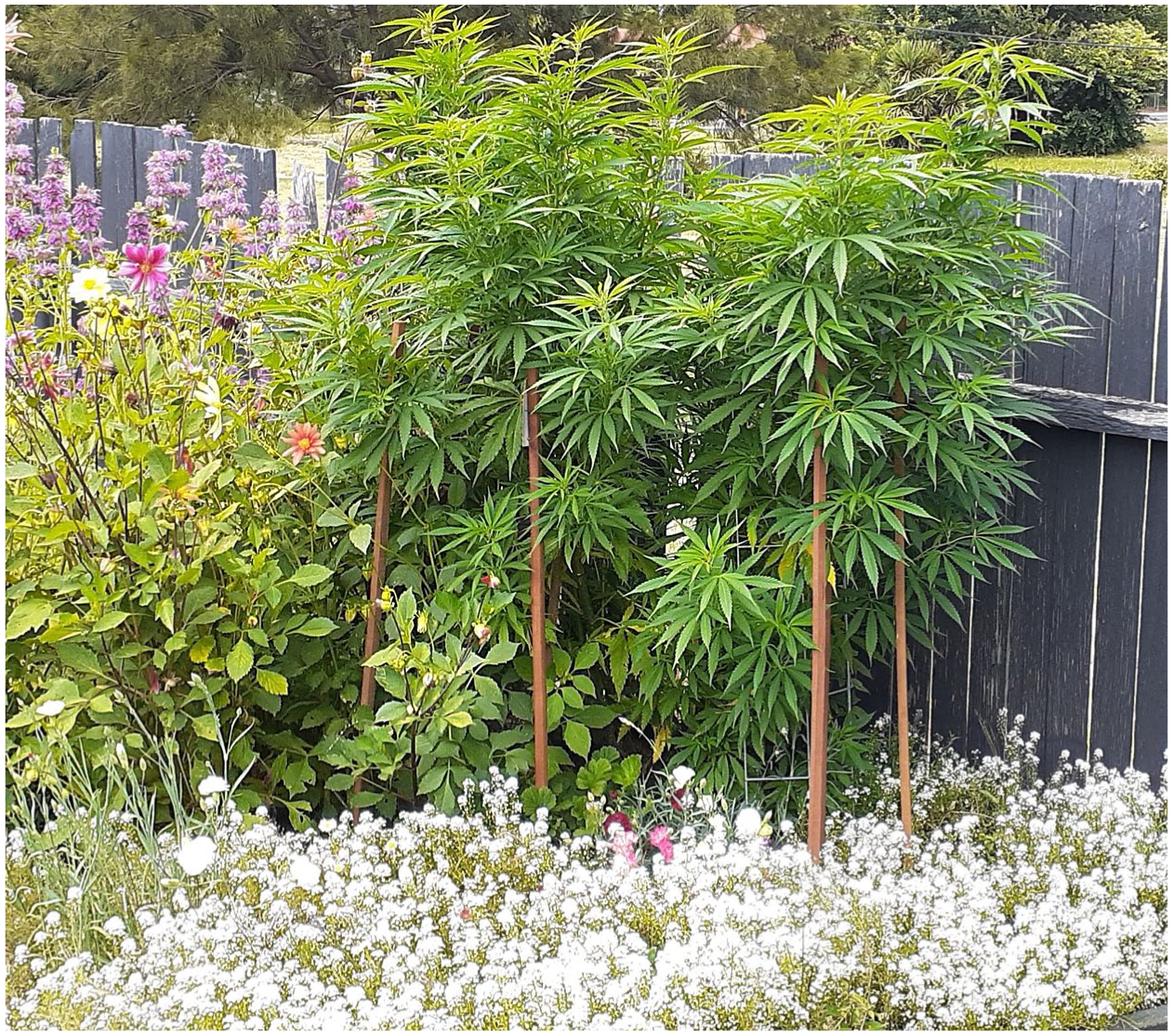
Thankful plants (photo supplied by Holly).
In line with Lorimer’s acknowledgment that some people celebrate ‘nonhuman tricksters’,
73
the unruly growth of cannabis was framed as something that was valued precisely for its non-domestic, wild, properties. For some, this inclination for plants to grow so large and wild was also a thrill of the plant being rebellious and sneaking outside of its provided confines. Describing a photo of one person’s partner grinning broadly beside their cannabis plants, Will notes:
She’s [partner] 1.65 meters. This one [plant] just grew like a monster, like a big Christmas tree . . . Easily over 2 meters. It’s probably 2.1. Yeah, so it did poke out a bit. It looked like a, you know, Christmas tree actually.
It does. It looks very Christmas tree shaped. It comes up to a point up at the top and it’s poking up over the fence as well.
Yeah. [chuckles] Yeah (Will).
Several participants noted that, considering their usually ordered lives (many of our participants had been or were working in government jobs; a common occupation in Canberra, where Australia’s federal government is located), this rambunctiousness of the plant was a particularly important aspect of its charm.
Corporeal charisma shifts
Charisma, Lorimer argues, also includes aspects of felt experience in the presence of the other. Lorimer defines such ‘corporeal charisma’ as ‘the feelings engendered in proximal, multisensory encounters’ with a target organism. 74 This includes not just the organism, but the broader ecology in which the organism exists, and the feelings encouraged in its presence. As noted by Huff et al., the way human actors interpret objects often goes beyond language to ‘expressive’ capacities including shape, color, taste, smell, and other ‘sensory cues’. 75 However, these experiences should not be thought of as unmediated by cultural practices or personal histories. Instead, the feelings that emerged within these multisensory meetings were also influenced by people’s views of the plants, love of learning and perhaps also enjoyment of a degree of mastery. While coming to share in aspects of these experiences did seem to also require being in the presence of the actual plants, in others, being enthusiastically told about the experience – particularly with visual cues – did give us a taste of experiences of cannabis’ corporeal charisma.
Smell was one such sensory experience. As described earlier, plant smells often signaled specific plant needs or plant success, but participants also described the smell as a site of joy and pleasure, including the ‘pungent’ but ‘beautiful’ smells that drew comparisons with herbal tea, lemon, pine, and grass clippings and even cheese as described by Amy below:
Well, they all smell so different. Like my friend gave me a variety and it was called Blue Cheese and it absolutely stank, like blue veined, like a Roquefort or something. It was really pungent, but they all do have . . . like the Nightingale, I guess, you associate it with something pleasurable. So, yeah, I really like the smell from it (Amy).
The surprising differences in the olfactory registers of different plants and products was also a site of interest and intrigue, one that we as researchers were drawn into when were introduced to some dried cannabis product and encouraged to smell the product ourselves, LB excitedly exclaimed ‘it smells a bit like milk!’. One participant also noted that the smell had elicited a psychological response as one might expect from essential oil – ‘it just perks me up’ (Will).
Lorimer notes that, particularly for those studying such organisms, corporeal charisma often involves both experiences of jouissance – or the joy in the presence of meaning – or epiphany – experiences that leave one opened in new ways.
76
As Lorimer notes, one aspect of jouissance is that of the delight in learning about the other. For some participants, this was present in coming to understand the lifecycle of the plant. For others, perhaps curiously, it was in developing the skills to navigate cannabis disease and illness. Certainly, there were unique challenges associated with growing cannabis that set it apart from other plants, such as the propensity to turn into a hermaphrodite, and skill needed to sex plants and determine optimum ripeness. Mastering these challenges brought great satisfaction to some participants. For example, as Blair (below) noted:
From a botanical perspective, it’s one hell of an interesting plant because, hang on, you’ve got male and female, but also it is highly seasonal, as in you have your growth patch. When the sun changes, right, and the days become shorter after Christmas, then it goes into reproductive stage and so you’ve got these two, and I’ve got a little plant out there that would be that tall, what’s that, 6 inches at the most. Hang on, it’s got bugs on it (Blair).
People also told a range of tales of delight of being in the presence of these plants:
Okay. I know it sounds cliched, but I really love these plants and I’ll actually hug them. I know it sounds really cliched and you probably think I’m a tree-hugging hippie, but I genuinely think they look really, really cool. I just like the presence of them. I feel they are like a really spiritual plant. Like I know, you know, it sounds a bit wishy-washy, but I genuinely really appreciate growing these and I would hug them. So, all the way through the whole life cycle, you know, I’ll look at them every day, just they look so cool. I like the geometry (Will).
Here, both the aesthetic and sensory aspects of the plant – as interpreted through specific cultural understandings of the plant – were fundamental to this sense of felt meaning in the presence of the plant. The greenness and vitality of the plant were also sources of comfort and jouissance for other participants, with the dark green color of leaves being associated with plant health and being ‘soothing’ (Marie), and something nice to look at (Holly; Figure 5).
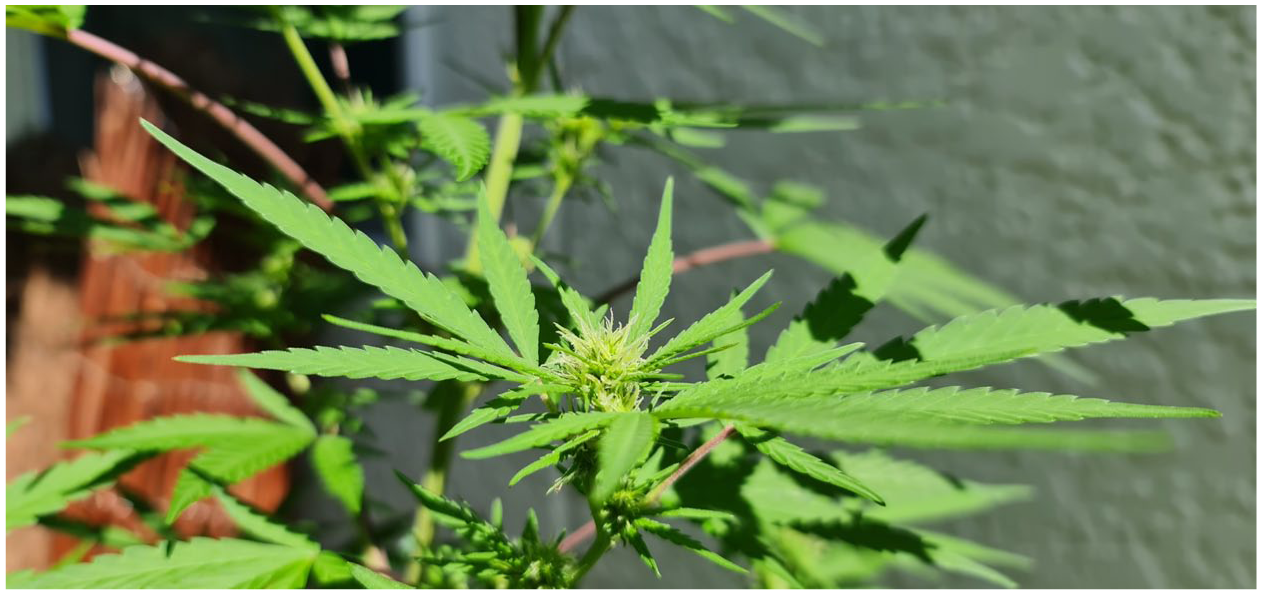
Geometric pleasures (photo supplied by Toby).
Reflections/discussions
Material-storying
The materiality of a species is a vital aspect of its charisma. Yet, as Lorimer notes, it never acts alone: the detectability (ecological charisma), aesthetic charisma, and corporeal charisma of another species are all entangled with human relationships and meanings. 77 In distinguishing his work both from the functionalist accounts of human fondness for other organisms, as well as from those that emphasize the only socially-constructed aspects of charisma, Lorimer argues that charisma is always relational – emerging in the relationships between the material and social aspects of our lives with others.
Environmental humanities scholarship has amplified our understandings of how stories matter – that a ‘good story’ can inspire acceptance ‘beyond self and species’, 78 and that storying offers insights to and opens up alternative modes of being 79 with the potential to ‘speak into existence alternative worlds and ontologies’. 80 Part of the particular charm of these stories is, however, that they were not just made of words, but instead allowed the affordances and charisma of the plants to be part of the tale. As noted by Van der Veen, while there may be a tendency to view plants as passive objects, there are complex webs of entanglements when plants and people interact, creating dynamic relationships in which plants act as agents alongside the varying materialities and meshworks that exist. 81 As found in our research, visual storying allows these meshworks to unfold, connecting the unknown and the ‘out there’ of policy to the here and now, while also connecting people to practices and ways of being that have material consequences. 82
As Anna Tsing notes, relationships with other-than-human species are mediated by other humans and the type of mediation that occurs can call us to care. In her work with the matsutake mushroom group, for example, Tsing charts the various ways in which people have come to fall in love with the mushroom. 83 For some, it was curiosity about the little-understood ways in which the mushroom emerged, the invitation to contribute to scientific understandings; for others it was the taste that was used to encourage people to come to tend to the red pine forests in which matsutake emerge. In many instances, such meetings had particular human guides, forest guides, field guides, scientist-teachers, and artists. In this work, the talents of humans and their arts to call us to care – including through cooking, storytelling, poetry, painting, and even taxonomy. For Tsing, these arts of noticing are ‘a way of teaching . . . open yet focused attention’ and can be a means of creating ‘passionate immersion in the lives of the nonhumans’. 84
In this particular human-mediated, and material-storied setting, cannabis emerged as a plant that was full of personality, obviously beautiful and valuable beyond and apart from any drug/product that it might produce. For both researchers, the sensory storytelling enabled us to experience and share in the jouissance of people through their delight in coming to know the plant well, including being able to care for the plants responsively, being able to recognize when a plant was well and to know what to do about it. Participants’ sensory experiences of color, beauty, and touch and their sharing in the relational aspects of cannabis cultivation allowed us to think about cannabis in these sensory ways. Thus, positioned within close familial relationships and every day domestic situations, cannabis emerged as something markedly different from the techno-rational and legal policy framings we were more familiar with as drugs policy researchers. In this new web of relationships, one made of human connections, particular biological realities, and cultural and socioeconomic contexts, the very idea of what cannabis is and might be – shifted, as it emerged as something more than a commodity.
What’s love got to do with it? Feeling, knowing, and affect in cannabis policy
Having come to meet cannabis differently, the way the plant was enacted and accounted for in policy-processes shaping cannabis legislation in Canberra seemed extremely limited, reducing cannabis plants to their drug products and seeking to regulate the plants through this narrow plant-as-drug lens. In our earlier analysis 85 we had already suspected that the legislation overlooked much of the reality of growing cannabis. But following this brief yet passionate immersion in cannabis lifeways, the legislation – ostensibly intended to govern the conditions allowing for cannabis cultivation – began to look strikingly barren of a whole world of planty reality; cannabis the plant, with all of its rambunctious charm, simply was not there.
As Tsing notes, love is not separate from knowing, even if, for many natural scientists, a vital condition until recently has been that ‘the love didn’t show’ and that relationships with scientific subjects could be presented as purely ‘rational’. 86 As evolutionary biologist Stephen Jay Gould notes, love is part of what animates both biological sciences and people’s willingness to fight for particular species. 87 Indeed, ethologist Konrad Lorentz argued that regarding science as value-free is a dangerous self-deception, noting that ‘all of the biologists I know are undeniably lovers of their objects of study’. 88 Knowing other organisms is, as Jamie Lorimer argues, ‘a passionate and embodied practice’. 89 In dismissing the vital importance of sentiment to how we think and care and what we think and care about, we are coming to know such others only in limited ways. 90
Loving another is not the only way in which to know it. Indeed, as Maria Puig de la Bellacasa notes, love may be trouble: much violence is carried out in order to protect those one loves. 91 Holding a love for cannabis does not offer a truer version of cannabis than others, but it does offer an additional lens on its realities, rather than closing them down. While we do not argue that coming to love cannabis – or other currently unloved organisms – is necessarily needed for policy makers, we do argue for the importance of recognizing that feeling and knowing are not separate processes. Providing the means through which to acknowledge the entangled relations through which we come to know other species may be especially important for areas like drug policy where, as previously noted, etymology, history, culture and values have long shaped perceptions, understandings and narratives, and limited the scope of what is deemed acceptable or even possible in terms of policy response. 92 Highly constrained ways of recognizing other beings are common across many policy approaches. 93 Without the passionate evidence of those who love an organism told or shown in ways that allows a ‘crack’ through which legislators can meet the being differently, how can it escape ‘commonsense’ framings of organism-as-commodity?
Making space for people to be affected by those or that about which they are legislating potentially has a transformative role in policy given its ability to engage people emotionally and make us care by influencing what we feel, testing moralities, and shifting values. 94 In a world where facts and figures may have the opposite intended effect by digging people further into their own beliefs and moral framings, 95 affective power has the potential to not only expand the ways we think about things but to also generate empathy and move people. 96 The importance of storying for coming to understand has seen story-based methods integrated into a number of policy-making processes, for instance in climate science, where storying has been used to better illustrate impacts of climate change on communities to politicians. 97 Storying and truth-telling processes provide a platform for survivors of state based and/or institutional violence to tell their stories and bring to light hidden injustices. 98 Durbach documents how local Khulumani workshops in South Africa used drawing and arts practice to share individual and collective memories, stories, ideas, and solutions, with the creative process primarily functioning to ‘register and hold the emotion of participants’ and a form of psychosocial healing process. 99
But what kinds of stories can be told, or accepted as credible evidence in policy, and how do they frame the other and our relationships or talk to our entangled and enmeshed ways of knowing and being? Through our experiences we have become curious about what might happen when people are given the power to tell deeply affecting love stories. With illicit organisms in particular, the types of autobiographical reference points that policymakers bring to bear may be muted or restricted in terms of the experiences of jouissance, epiphanies, or even simple aesthetic appreciation, that may help to appreciate another organism. They also tend to have little haptic quality. Traditional policy making processes do not so readily allow for these aspects of ecological charisma to enter into discussion, with plants and other beings tending to remain out of sight and unscented, and with no well-placed human mediators to direct policy makers to such charms. In situations where different objects and realities of drug policy are opened up, diverse knowledges and experiences can be taken into account, as well as different modes of evidencing. 100 By making space for affective and material stories, policy processes might better account for the beings they seek to govern.
How might policy change in the face of successful meetings? Our research found a legal policy shift that enabled domestic cultivation of cannabis revealed something of the relational charisma of the cannabis plant itself. In as much as contemporary drug policy – and indeed policy work more generally – is shaped by notions of public participation and participation of affected communities, 101 one outcome of our work is to explore the ways in which the cannabis plant itself might participate in these meetings. We are ultimately unable to predict the outcomes when policy decisions are made in the presence of a greater range of beings who are affected by them. However, urges to mastery and control will likely not remain unmoved when a being has been met in their more-than-instrumental charms. Shifts in aesthetic representation constitute a political struggle, as Dixon notes, through the attempt to ‘reconfigure the place not only of particular groups, but also the social order within which they are embedded’. 102 We are not saying to throw caution to the wind about the affects of cannabis as a drug. Indeed, many of our interviewees held concerns about cannabis as a consumable, particularly for young people. What we are arguing for, instead, is modes of policy making and presencing of others that give a greater range of possibilities for what another being might be.
Conclusion
As noted at the beginning of the paper, cannabis the plant is by no means universally loved, with even Michael Pollan – otherwise a plant enthusiast – unenamored by the plants’ aesthetics or smell. However, in the process of the storytelling of our participants – supported by both photographs and in-person meetings with cannabis as a plant, we found ourselves feeling and thinking differently about the plant and in ways not reflected in current Australian drug policy. This included coming to care both for the plant and plant caretakers, and recognizing it as a species full of charm, value and agency separate to its association with cannabis as a drug product. Such shifts in affective orientation are often overlooked – dismissed as ‘soft’ or feminized forms of knowledge. 103 Yet, as Anna Tsing reminds us, these modes of knowing can make a difference to which sorts of others are recognized as mattering, even which species are allowed to exist. 104 Our argument is not that policymakers must ‘love’ cannabis, but that recognizing the entanglement of feeling and knowing can broaden what counts as evidence in policy. This is not to overlook concern and the potential for controls: we are not advocating an unreflective celebration of conviviality. There are also threats to attend to. What we do argue for, however, is that attending more fully to the (necessarily complex) material and affective realities of plants – rather than reducing them to commodities – has the potential to open up more responsive and ecologically-attuned policy practices. For cultural geographers, this work underscores how spatial, material, and affective relations shape governance, and how geographical scholarship can contribute to reimagining policy as a multispecies practice.
While our enquiry was focused on drugs policy, our findings are relevant to any policy field dealing with stigmatized, hidden, illicit, value-laden, or commodified multispecies subjects. As noted by Brown, we live in storied landscapes and the narratives we tell and ways of knowing are constituted within particular systems. 105 Thus, in policy, the environmental humanities has a particularly important role to play – that of considering policymakers’ relationships with more than human organisms, as well as how those relationships might be shifted through modes of storying that pay attention to the biological and the human-mediated aspects of coming to care for other beings.
This study demonstrates how attending to the ‘unloved’ status of cannabis opens broader questions about the affective dimensions of policy. While our analysis is situated within the specific socio-legal context of the ACT, the conceptual framing has wider relevance for governance domains where certain beings – whether plants, animals, or ecological processes – are disregarded or vilified and which features of their beings are able to be recognized and, potentially, appreciated. 106 Environmental humanities approaches, with their emphasis on affect, materiality, and arts of noticing, offer tools for reimagining policy as a relational practice rather than a purely technocratic exercise. 107 We position this work not as a universal prescription but as an invitation to experiment with more-than-human attunements in policy-making – approaches that remain sensitive to context, scale, public health priorities, and the complex entanglements of life and law.
Footnotes
Acknowledgements
We would like to acknowledge and extend our deep gratitude to all of the participants in this study for so generously sharing their time, experience, and knowledge with us. We also pay our respect to the Ngunnawal on whose land this research was carried out, and to the Bidjigal people of the Dharawal Nation and the Gadigal and Wangal people of the Eora Nation on whose lands this paper was written.
Author contributions
Laura McLauchlan: Conceptualization, Methodology, Investigation, Formal analysis, Writing (original draft, review and editing)
Liz Barrett: Investigation, Conceptualization, Formal analysis, Project Administration, Writing (original draft, review and editing)
Matthew Kearnes: Conceptualization, Methodology, Formal analysis, Writing (review and editing)
Kari Lancaster: Conceptualization, Methodology, Writing (review and editing)
Richard Mellor: Conceptualization
Alison Ritter: Conceptualization, Writing (review and editing).
Data availability statement
The qualitative interview transcripts are not publicly available due to privacy and ethical restrictions; the data that support the findings are available within the article.
Ethical approval
The study received ethics approval from the UNSW Human Research Ethics Committee (UNSW no. HC200911).
Funding
The authors disclosed receipt of the following financial support for the research, authorship, and/or publication of this article: This research was funded through an Australian Research Council grant (DP200100909). Professor Alison Ritter is a recipient of a National Health and Medical Research Council Fellowship (APP1136944).
Informed consent
Participant consent and information forms were provided to all participants some days prior to the interview. Informed consent was collected prior to conducting interviews. All participants consented to participate in the study, for interviews to be recorded and transcribed and to publish the study. Consent was collected in writing where interviews were conducted in-person and collected verbally where interviews were conducted online (via Zoom). Consent was also sought to use images in publication. Not everyone provided consent for images to be used. This publication only contains images from those participants who provided consent for images to be used in publication and supplied images to the research team.
