







Abstract
This paper presents a doing of cultural geography through a walking research-creation project on a remote trail in arid Australia. Critical walking methodologies were engaged in fieldwork that in and through its doing generated a friction in which the awkward, unequal, unstable and creative qualities of interconnection across difference were laid bare. The paper shares glimpses of a ‘fieldwork fail’ through a retrospective assembly of moments that shed light on the practical application of creative walking methodologies – methodologies that changed unexpectedly during the fieldwork. In the beginning I was a researcher setting off on a group hike with a clear programme of fieldwork, and in the end, I was separated from the group and alone in a formidable landscape with an entirely new set of concerns. Four years later, my original expectations of the fieldwork have been thoroughly overwritten by the lived experience of its relational entanglements and ongoing reconfigurations of knowledge. Written with an awareness of being a small part of a larger equation, the paper advances the doing of cultural geography through reflection upon the displacement and lively extension of creative walking methodologies, resulting in the creation of new and surprising artworks.
In mid-2022, I travelled to Alice Springs in central Australia to undertake fieldwork for a walking research-creation project. My intention was to investigate minimal forms of shelter with a view to establishing how much architecture – or how little – is enough to support everyday life on a multi-day hike through a remote landscape. I adopted an autoethnographic methodology in which I cast myself into a scenario of my own making with three principal companions: a tent, a pack and a pair of walking sticks. To grapple with the projected sequence of daily walking and camping events, I planned to film the making and breaking of my camp each day over 18 days. This sequence would yield a wealth of raw visual data for me to work with in the production of a new video artwork featuring the repetitious appearance and disappearance of transient architecture. The risks of the fieldwork would be mediated primarily by walking with a well-equipped group in moderate weather. Every aspect of the walk was planned in granular detail and at the time, it did seem simple enough. The clarity of my intention, however, was quickly disrupted on the ground with an unexpectedly complex group dynamic that progressively deteriorated over several days. This dynamic would ultimately compromise my research plan and methods and send the project onto a different trajectory altogether. This text, written after the situation exploded and eventually settled, operates within the schism between the intended and realised creative work, and exposes the productive volatility of research-creation. It situates ‘failure’ as a catalytic agent in the doing of cultural geography in this particular instance and provides insight into how unexpected intersections of people and environment can prompt novel modes of artistic production.
This is the scenario:
A group of walkers from a highly urbanised context, largely unknown to each other and brought together through an online community
+
A group leader, highly attuned to the very real dangers of walking in a remote arid landscape with a potentially unpredictable group
+
A disjointed preparatory programme complexified through COVID infections and rolling lockdowns
+
A research-creation plan involving daily video documentation of making and unmaking my individual campsite
+
A shared ambition to walk a 223 km trail from ‘end to end’ over 18 days, carrying all supplies including additional water of up to 6 l on occasion, with 3 pre-arranged food drops and a total of 17 campsites.
Narrative 01: Tent + Pack + Stick − Kindle
I am at the hostel prior to departure, and the group leader has asked us to assemble in the central courtyard. The group of eight gather around as the leader inspects the contents of our packs. One person has a book. The leader declares it unnecessary and removes it. I quietly − secretly − dig out my Kindle before the leader can publicly extract it. I am somehow compelled to mask this act of removal, as if it were something illegal or controversial. I slip the Kindle into to a pile of things I have already decided to leave behind. My behaviour puzzles me, even as I am behaving that way.
Next, gas canisters are presented for scrutiny. We have each tested the cooking times of our meals to determine precisely how much gas to carry. The calculations are fine-grain and we are all absolutely sure that we are not carrying anything excess to our needs. One walker mentions that he is carrying a stove fuelled with methylated spirits. The leader loudly declares this choice as misguided. Clutching his stove, the walker looks sheepishly at the ground.
. . .
We had each prepared a spreadsheet that calculated (down to the very last gram) how much our packs weighed. Through detailed individual research processes in the months preceding the walk, every item on every list had been determined as being essential. As an example of this research process, I spent an entire week conducting web searches to determine the most suitable type of tent to carry. I ordered several tents and subjected them to rigorous testing procedures. I evaluated the weight of each tent, the efficiency and autonomy of structure, ease and time of construction and deconstruction, entry and egress, packability, location and scale of storage pockets, general durability, symmetry, general feeling of ‘space’ and − crucially − colour. In the clear and penetrating light of arid Australia, the experience of waking up in an orange tent would be profound.
This level of detailed research was conducted not only with the tent, but with every single item in my pack. I was fascinated with the design innovation evident in even the tiniest items. At the core of these intense processes, however, there was just a very practical set of considerations of what I would need and what I could carry. It was a strangely complex process until I realised that I was effectively devising a personalised life-support system that would enable my passage and survival in a remote landscape. Each piece of equipment had to perform in a variety of predictable and unpredictable situations. The daily rituals of camping, cooking, cleaning and care were mutually dependent because many pieces of equipment would serve more than one purpose. For example, walking sticks would also serve as tent poles, a down jacket would also be a pillow, a protective dry bag would also be a kitchen sink. In the event of an accident or other catastrophe, everything would be up for creative re-purposing.
When I quietly removed the Kindle from my pack, I undermined my own expertise by elevating the expertise of another. The removal of the Kindle was not only the removal of reading material, but of a whole intellectual dimension of my life-support system, including my capacity to confidently make decisions. In practical terms, it was also the removal of a small flat surface in lieu of a table, an emergency source of light and a back-up torch and a structural component in the compartmentalisation of my pack. The Kindle, I realised too late, was an integral part of the life-support system whose removal triggered the collapse of a range of associated systems (Figure 1).
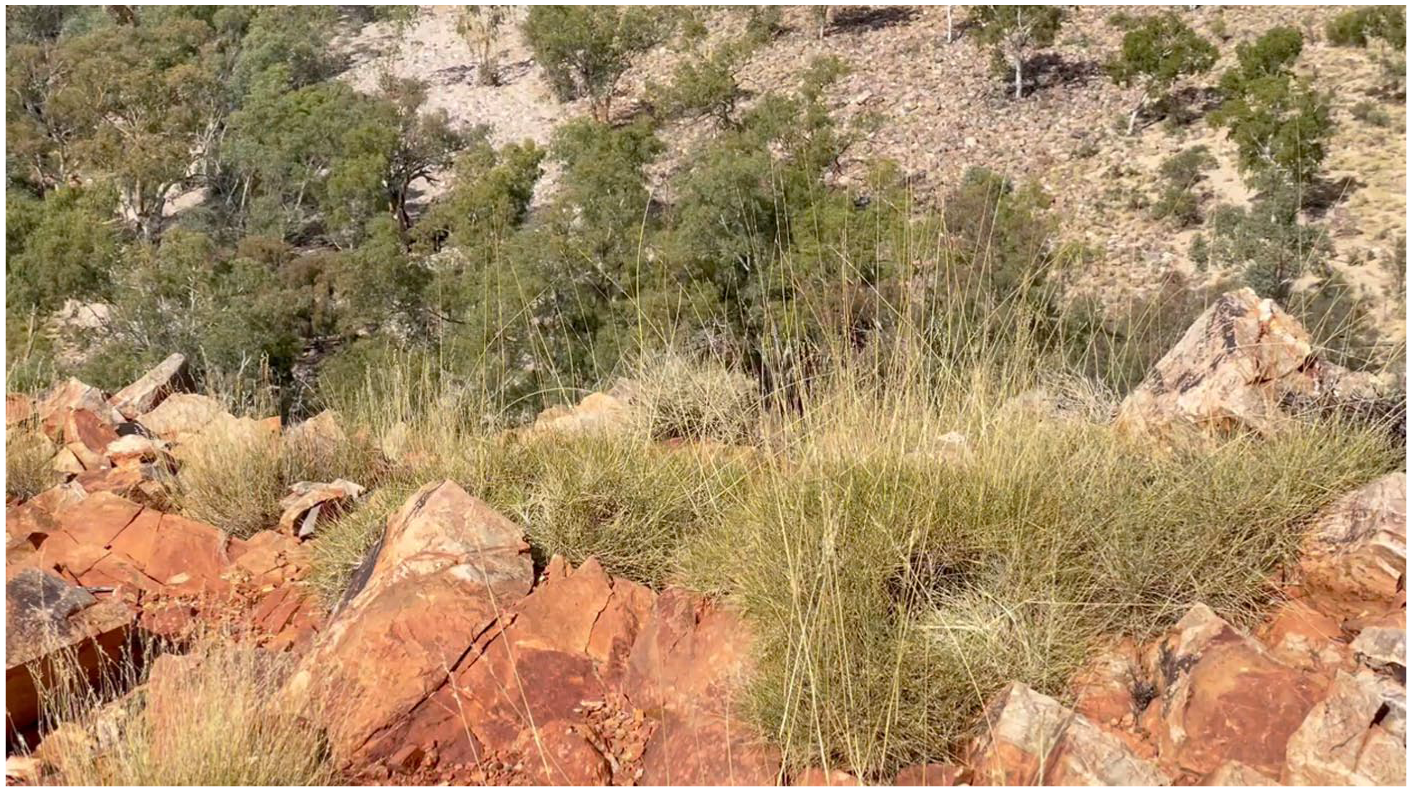
Difference. Photograph by Ainslie Murray.
Narrative 02: Tent + Pack + Stick − Kindle + Stickfall
After two days and two nights on the Larapinta Trail, we are now walking to Hilltop Lookout, one of the highest points on the trail. It is a stunning walk across a flat plain. The light is clear and I am walking with a conviction enabled by the right balance of pace and energy and terrain. It is a kind of flow that walkers know, in which locomotion and cognition are inseparable 1 and knowledge is simultaneously perceived and produced as a trail is blazed or a path is followed. 2
Soon, through the heat haze, I can see the ascent and a set of exposed switchbacks. As we approach, the ground shifts from sand to rock. There is a feeling that the group prefers to minimise the time spent in this hardened landscape, and they push fast up the steep incline. A recent COVID infection however has impacted my capacity to breathe properly. I climb fitfully with increasing nausea and distress at the impossible lack of air in my lungs. At the same time, the pressure from the group to keep going is causing me to unravel. I need to take it slowly, and I know it, and I grapple with my own needs versus the needs of the group. The group does not wish to pause. I do. The group wishes to reach the summit. I am just trying to breathe. It is admittedly extremely hot, and pausing in fragile patches of shade is unhelpful. Some group members complain that stopping and starting on an incline with a heavy pack is exhausting. The group leader insists that if one of us stops then all of us must stop. We are a camel-train. I do feel bad. I am a problem.
By the time we reach the top, the hostility is palpable and my own anger has also risen. I retreat behind a spindly bush and call home on the satellite phone. I say I don’t think I want to walk with these people. No one in the group speaks about what is happening. I dimly recall a clause in the pre-walk agreement that I was required to sign: ‘I will not seek to split the group in any way or deviate from the walking itinerary’ and ‘I will follow the pace set by the walk leader who will take into account the difficulty of the terrain and the capacity of each walker’. 3 Leaving the group will not be easy; it is a difficult and dangerous decision in this place.
As we go on, the leader is unable to accommodate the varied continuities and discontinuities of individual walking practice, and this prompts repeated conflicts between the varied intents, trajectories and capacities of the group. What to do? I simmer, for hours, and I then choose rhythm; rhythms of curses and words and rocks and steps and ultimately of walking sticks. These extensions of my body that spread the load and hold me onto the hill now measure the cadence of my fury as I navigate the terrain. I chant silently. I play games with the words. The sticks are my metronomic collaborators, ‘sounding’ the earth, as a tool of correspondence; they ‘impress’ upon the earth as my sticks and I go along together. 4 The sticks are ‘earthing devices’ that transfer emotion between body and ground. 5 With each step I see that my challenge in all of this is to stay grounded, knowing that the ground is shifting. 6
After some kilometres, the rubber tips on my walking sticks dislodge in the rocky terrain and are lost somewhere on the path. The group complains about the sound of my sticks on the rocky path − a metallic stickfall that rings out my failing walk over loose rock. I cannot stand this. I weigh the risks and decide to leave the group at the next camp. I am literally in the middle of nowhere, hundreds of kilometres from any settlement, but in the morning, I pack my tent and I walk to a road. After six hours of waiting, I manage to catch a ride with an itinerant priest and his wife (Figure 2).
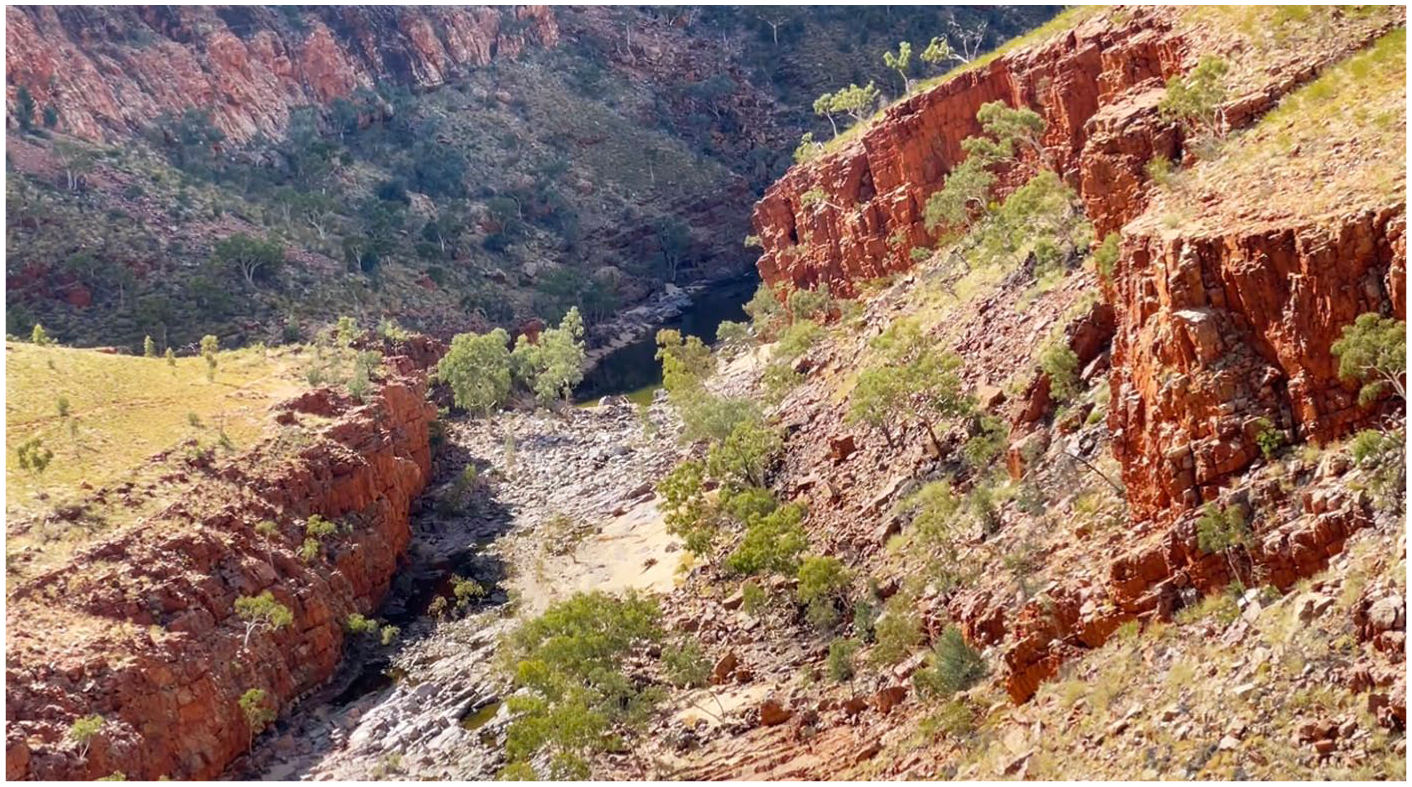
Fracture. Photograph by Ainslie Murray.
Narrative 03: Tent + Pack + Stick − Kindle + Stickfall − Group
Walking alone, free of the camel-train, I was somehow restored to myself as I walked and walked and walked, and I thought, thought, thought, thought in my mind, as I walked and walked. 7 When I camped in the evening, I thought of how tents assemble experience and how that experience is diversified by the screens of the tent; of how the walls are not walls at all, but permeable networks of openness to wind and openness to spirit. 8 A tent simultaneously stores and produces experience, like the woven structures that Ingold speaks of: the ‘meshwork’ that is the site of existence and endeavour. 9 This humble structure, which I had carried, protected, assembled and disassembled daily, over and over, had dipped into comprehensive invisibility. It had become a mundane architecture in the sense of it being so perfectly of and in its situation that it had disappeared amid the repetitive daily rituals of packing and unpacking, folding and unfolding, rolling and unrolling, clipping and unclipping, day in, day out. I did not think ‘tent’; I registered only orange light and the constant undulation of air.
Days too late − or not − I saw that my research-creation methodology had shifted, and that I had failed to document the making and unmaking of my campsite as I had initially set out to do. The fact that I had forgotten entirely what I had meant to do felt at the time like a second layer of failure. How was it possible that I could forget what I had suffered for? What sort of researcher forgets about ‘data?’ Upon reflection, I saw the fault in the original methodology. I had set the fieldwork in motion in order to disrupt, to agitate, to cut across, to forget, and I had placed myself there in the thick of it because ‘we don’t obtain knowledge by standing outside the world; we know because we are of the world’. 10 It was not really a forgetting at all; it was a method ‘generated speculatively and in the middle of research’ 11 as a response to failure; a genuine entanglement that surpassed my initial intent to document walking and camping practice to enable a ‘thinking-in-movement’ 12 in which the research method became the practice of being inside the research event 13 precisely as it fractured and changed. The fluid interiority of this scenario highlights the importance of methodological agility in the doing of cultural geography, and may actively inform creative practice across a range of disciplines.
. . .
Here on Brinkley Bluff, the highest ground of my walk, I can see the wind coming. Plumes of dust and debris sweep across the plain below, whipping the still terrain into motion with sequences of small tornadoes that we call willy-willys. And then suddenly it is here, a wild and relentless assault on me, my clothing, the bluff. The tent flaps wildly in the wind and the silence of the landscape is replaced with the deafening impact of air. The textile surface of the tent is hauled out of its mundanity as it registers and loudly announces every push, pull, spin and swirl of the atmosphere, flexing and flapping and snapping into tension before easing off in tiny moments of silence between gusts. The work makes itself known and is inscribed later in the tent walls − burnt, in fact, in gestures of renewed conviction (Figure 3).
x
=
+
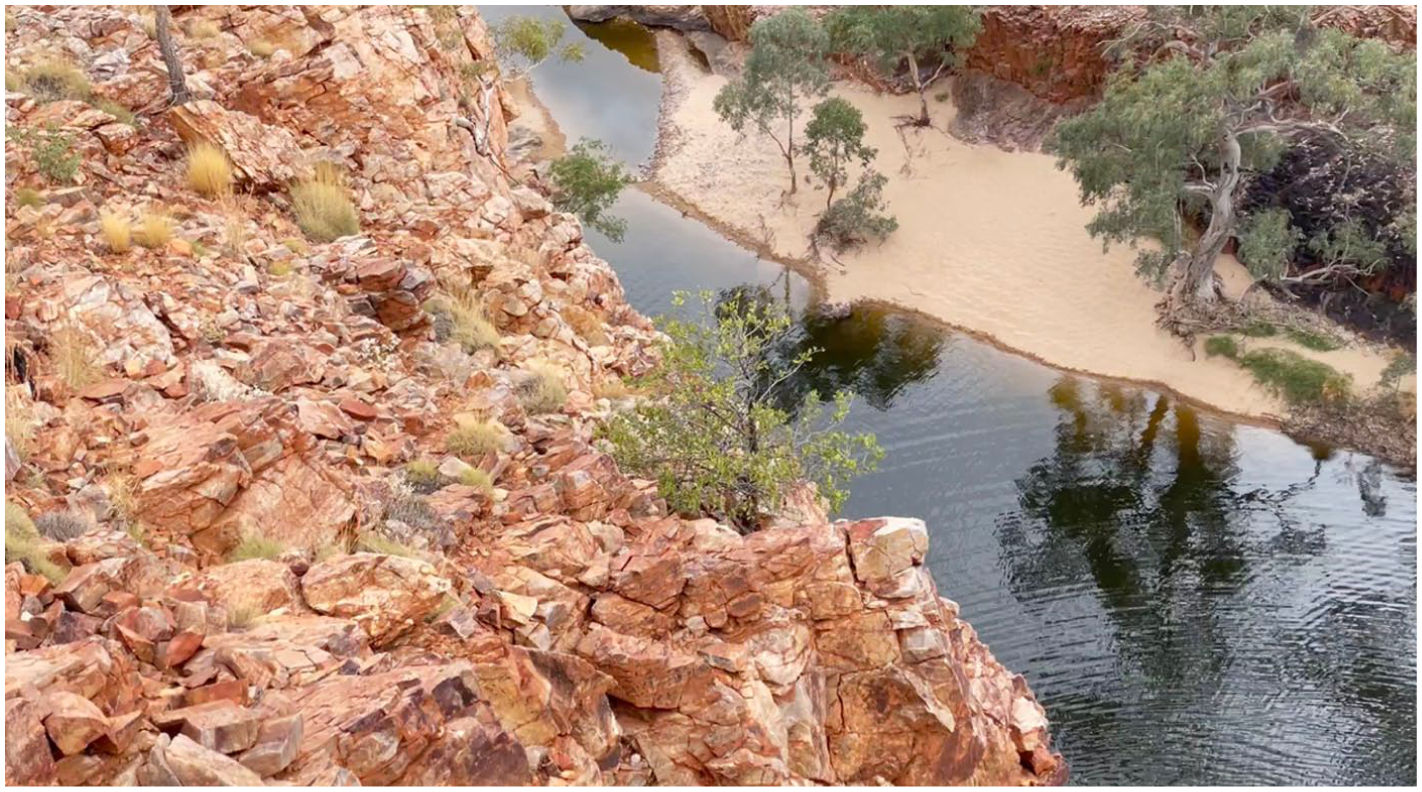
Reflection. Photograph by Ainslie Murray.
Footnotes
Acknowledgements
This research was conducted on Arrente, Cammeraygal, and Gadigal Country, on the unceded lands known now as Australia. I acknowledge the Traditional Custodians of these lands and pay my respect to Elders past and present.
Data availability statement
Data generated through this research-creation project comprises original creative production, primarily in the form of video documentation and written notes. This documentation is not publicly available unless it is developed in, with or for new artworks. Selected artworks may become publicly accessible following exhibition through collaborating galleries and cultural institutions. Once exhibited, selected works may also be made available via the UNSW Sydney institutional repository UNSWorks. Enquiries regarding access to specific materials may be directed to the author.
Ethics statement
Formal ethical approval was not required for this research-creation project. Details regarding the timing and location of the walk have been removed to protect the anonymity of the walking group.
Consent to participate
Informed consent was not required for this research-creation project. Details regarding the timing and location of the walk have been removed to protect the anonymity of the walking group.
Funding
The author received no financial support for the research, authorship, and/or publication of this article.
