






Abstract
Rural settlements in northwest Bulgaria are often portrayed as emptying spaces marked by ageing populations, derelict infrastructures and policy neglect. Yet many of these villages sustain lively digital afterlives. The article examines how residents, seasonal returnees and emigrants use social media to narrate, contest and endure the abandonment of two small villages. A qualitative digital ethnography of Facebook groups, messaging exchanges and visual material, combined with on site visits and interviews, shows how specific visual grammars, practices of memory and mourning, and patterned rhythms of posting organise a shared sense of time in place. The article argues that platformed practices extend the social life of depopulating rural places by making abandonment visually repeatable, affectively archived and rhythmically reactivated through moments of attention and silence.
Introduction
Rural regions across Europe are experiencing profound demographic and socio economic transformations. Within Bulgaria these processes are especially intense in the Northwest planning region, where demographic decline, ageing populations and constrained labour markets combine with fragile infrastructures and persistent poverty. 1 Regional demographic analyses highlight rapid population loss in rural municipalities, negative natural growth, and sustained out migration which erode local economic capacities and everyday social reproduction. 2 Studies of Bulgarian rural demography and connectivity show that migration flows and digital coverage are tightly intertwined, as improving internet access and social media use both enable mobility away from villages and sustain translocal ties after departure. 3 Digital geographies scholarship argues that contemporary spatial experience is saturated by digital devices, platforms and data infrastructures, such that any analysis of place must now consider the digital as constitutive rather than external. 4 Work on spatial media shows how location aware platforms and user generated content reorganise access to and visibility of places through mutable digital representations layered over material landscapes. 5
Research on Sweden shows that online campaigns can reframe the countryside as both dying and vibrantly alive, foregrounding struggles over closure of services, public investment and rural recognition. 6 Analyses of online community groups demonstrate how residents perform rural belonging and negotiate local conflicts in what have been described as digital front porches and backyard arenas, where everyday politics and neighbourly surveillance coexist. 7 Work on rural digital initiatives across Europe further explores how digital projects seek to foster attachment to marginalised places and mobilise emotional bonds as resources for regional development. 8 In agrarian contexts beyond Europe, studies document how mobile phones and platformed media reorganise agrarian knowledge, aspirations and political claims, giving rise to digitally mediated ‘villages’ that stretch beyond their physical boundaries. 9 Digital geographies have shown that digital systems organise everyday life through specific temporalities, from always available interfaces to archived data traces that can be reactivated long after events have passed. 10 Feminist digital geographies highlight how these temporalities are unevenly distributed and experienced, emphasising the need to study digital practices from the situated standpoints of marginalised users and places. 11 Work on geospatial memory argues that digital mapping, images and narratives attach past events to specific locations, creating layered memoryscapes in which histories are continually re edited and recirculated. 12
This article addresses this gap by examining how inhabitants and diasporic villagers from two marginalised rural settlements in Northwest Bulgaria use digital tools to articulate, contest and endure the temporalities of abandonment that shape their lives. It is guided by three research questions: how do residents, seasonal returnees and emigrants use digital platforms to narrate rural abandonment; how do images, comments and posting rhythms organise different temporal relations to ruined or declining village infrastructures; and what do these practices reveal about the relationship between ruination, digital rurality and place based futures in postsocialist rural Europe? I use the concept of platformed temporalities of abandonment to describe how digital infrastructures organise abandonment through visual circulation, archived memories, comment threads, bursts of attention and periods of silence. The concept advances existing work on ruination, temporality and digital rurality by treating abandonment as a digitally mediated temporal process through which places are repeatedly mourned, claimed, repaired and re ended.
Literature review
Cultural geographical research has long treated time as a lived and contested dimension rather than a neutral background, emphasising how temporal experience is bound up with power, memory and material landscapes. Recent work on ruins and abandonment pushes this line of thought by showing that derelict or unfinished sites are not simply remnants of the past but key locations where competing temporal projects are negotiated. This study approaches ruination not as a fixed object or final condition, but as an ongoing process through which social, material and political relations continue to act in the present. Stoler’s 13 account of ruination is especially useful here because it shifts attention from ruins as evidence of what has passed to ruination as an active condition that unevenly distributes vulnerability, memory and responsibility. DeSilvey’s 14 work on decay further helps to frame abandonment as a matter of care, exposure and managed loss rather than simply neglect, while Edensor’s writing on industrial ruins shows how derelict spaces gather memory, affect and alternative temporal orders. In a study of digital ruins, Miller and Garcia 15 argue that abandoned virtual worlds reproduce many of the affective and existential qualities associated with industrial ruins despite lacking material decay, since they linger in an uncanny present while indexing lost futures of connection and creativity. Souza 16 develops this concern with temporal multiplicity in research on war ruins in Mostar, showing how people’s narratives about unreconstructed buildings braid trauma, nostalgia, commodification and modernist aspirations into different temporal configurations of the same landscape. Taken together, this study suggests that ruins do not merely represent endings. They organise relations between unfinished pasts, damaged presents and unevenly imaginable futures.
These debates intersect with a broader interest in the temporalities of postsocialist transformation. Kay et al. 17 describe how rural spaces across the former socialist bloc have been repeatedly re scripted through projects of modernisation, collectivisation, restitution and marketisation, which layer different promises and disappointments into local landscapes. Pfoser 18 shows how residents of post industrial Estonian towns narrate their locations as peripheral not only in spatial terms but as places ‘out of sync’ with national and European trajectories of progress, a condition that is experienced unevenly across generations. Jucu 19 similarly traces the shift from state socialist ambitions for industrialised rural development to dereliction and demographic shrinkage in Romanian villages, arguing that abandoned factories and housing estates condense stalled futures and broken development scripts. These studies are important for the present study because they show that postsocialist abandonment is temporal as well as spatial: it is lived through delayed repairs, broken promises, interrupted infrastructures and memories of collective futures that did not arrive.
Bulgaria appears as a paradigmatic case of structural abandonment that is both material and demographic. Using long term remote sensing, Kabadayı et al. 20 demonstrate extensive agricultural land abandonment between 1950 and 1980, linked to collectivisation, subsequent decollectivisation and the fragmentation of land ownership. Yarkova and Mutafov 21 analyse contemporary rural Bulgaria and identify intertwined demographic and economic pressures, including ageing populations, declining services and limited non agricultural employment, that underpin a persistent narrative of rural crisis. Slavova 22 situates recent depopulation trends within attempts to promote digital and precision agriculture, noting that policy discourse often imagines technological upgrading as a way to ‘save’ declining regions while leaving structural inequalities and social reproduction largely unaddressed.
These material and demographic dynamics are increasingly read through the lens of smart and digital futures. Cowie et al. 23 argue that debates about the fourth industrial revolution are dominated by urban perspectives and risk reproducing rural regions as residual recipients of innovation rather than key sites of digital transformation. Their call for ‘smart rural futures’ emphasises that digital infrastructures, automation and data driven agriculture will reshape countryside livelihoods and identities in ways that are not yet fully understood. Building on such concerns, Zhang et al. 24 use a computational review of rural digital research to show that rural areas are often framed through a deficit narrative that emphasises connectivity gaps and digital divides, while underplaying the diverse ways rural actors appropriate digital tools to rework their marginality. This article builds on that critique by asking how digital media are used not only to imagine rural development, but also to endure and narrate rural decline.
A growing body of work on digital rurality explores the cultural politics of these transformations. Lundgren and Johansson 25 examine Swedish social media campaigns through which residents and activists curate alternative images of rurality that challenge dominant stories of decline, showing how online narratives re stage countryside places as desirable and vibrant while still haunted by fears of closure and loss. Fisker et al. 26 study online community groups and argue that rurality is performed through everyday digital interactions that mobilise particular symbols, memories and boundary work between insiders and outsiders. He synthesises these strands by proposing planetary rural thinking in digital geographies, arguing that digital mediation is reconfiguring rural futures at multiple scales and that rural experiences of digitalisation must be central to debates about planetary transformation. 27 Recent work on digital ecologies also widens this field by showing how digital mediation reworks relations among humans, environments, infrastructures and more than human worlds, while studies of social media, memory and futurelessness point to the role of platforms in sustaining affective relations to damaged or uncertain places. 28
This question also connects to wider debates on digital spatiality and space time relations. Massey’s 29 relational understanding of space as open, unfinished and constituted through interrelations is useful for thinking about villages whose social life exceeds their shrinking material population. Kitchin and Dodge’s 30 work on code/space similarly shows that software and spatial practice are mutually produced, while Graham’s work on digital geographies highlights the uneven ways online representation becomes attached to material places. These perspectives help position the study’s central concept: platformed temporalities of abandonment refers to the ways digital infrastructures, interfaces and user practices organise abandonment through archived traces, visual repetition, comment threads, notifications, seasonal returns and silences.
The methodological and epistemic implications of studying such distributed sites have been central to debates on digital ethnography. Duggan 31 notes that geographers have been slow to adopt the term digital ethnography in comparison with neighbouring disciplines, partly because longstanding concern with space already challenged simple online and offline divides. Burns and Wark 32 push this conversation further by proposing database ethnography as a way to study open data infrastructures, conceptualising the database itself as a field site where social relations, exclusions and classifications are materialised. More recent methodological reflections foreground the tensions and ethical dilemmas that arise when research subjects, platforms and researchers are all embedded in shifting digital ecologies. Grigoryan 33 outlines current issues in digital ethnography, including algorithmic opacity, platform volatility and the emotional strain of prolonged engagement with polarised or marginal online communities. He identifies a drift towards multi sited and multi scalar designs that follow phenomena across platforms, devices and offline settings, yet warns that this can dilute attention to grounded place based dynamics if not carefully situated. In parallel, digital geography scholarship has sought to clarify how digital ethnography can enrich understandings of spatial relations. Ash et al. 34 argue that the digital turn in geography involves recognising both the material infrastructures and the experiential dimensions of digital systems, including their temporal rhythms and interruptions. For depopulating rural settlements, this means that digital ethnography must follow posts, images and interactions without detaching them from roads, houses, churches, former cooperative buildings and other material sites through which abandonment is lived. The study’s contribution is therefore not simply to show that abandoned villages are represented online, but to theorise how platforms help produce abandonment as a lived temporal condition: visually repeated, affectively archived, rhythmically reactivated and never quite closed.
Methodology
The study adopts a qualitative digital ethnographic design that foregrounds the entanglement of temporality, abandonment and place in depopulating rural settlements in northwest Bulgaria. Digital ethnography is suited to the investigation of cultural meaning making in and across online environments and to the study of how digital traces extend or reconfigure local worlds. 35 At the same time, scholarship shows that digital media are not abstract infrastructures but material systems embedded in and productive of particular spatial formations. 36 Bringing these approaches together, the research mobilises digital ethnography as a way of accessing how villagers, seasonal returnees and diasporic publics narrate abandoned places through social media. 37
Study area and case selection
Case selection follows a purposive sampling strategy oriented to theoretical replication rather than statistical representation. Northwest Bulgaria is one of the most persistently marginalised regions in the European Union and has experienced intense rural depopulation and agricultural restructuring since the late socialist period. 38 The region is characterised by small settlements dispersed across agricultural lowlands, declining public transport provision, uneven road connections to municipal centres and long standing dependence on nearby towns for health care, administration and secondary schooling. Here, abandonment is experienced through distance from services, interrupted mobility and the gradual withdrawal of infrastructures that once connected villages to wider state and cooperative systems.
Within this region, the study focuses on two small settlements, here given the pseudonyms Belograd Plain and Vidin Ridge. Both are former collective farm centres that have lost most of their permanent population and now consist mainly of elderly residents, scattered second homes and degraded socialist infrastructures. They were selected because they exhibit high levels of land abandonment in the surrounding territories 39 but also maintain active digitally mediated connections through Facebook groups, messaging channels and local history pages frequented by migrants and seasonal returnees. Comparing these two sites makes it possible to examine how different local trajectories of deindustrialisation and agrarian change shape the ways temporal loss and endurance are articulated in digital space. 40 To preserve anonymity, the article uses pseudonyms and avoids precise village coordinates.
Data collection
The digital field is conceptualised not as a single platform but as a constellation of overlapping contextual and meta fields in Airoldi’s terms. 41 Contextual fields are anchored in specific local communities, such as village Facebook groups dedicated to Belograd Plain and Vidin Ridge, municipal information pages, and YouTube channels documenting local events. Meta fields are constituted by dispersed digital traces that coalesce around shared tags, toponyms or visual motifs that refer to the two villages and their surroundings but are posted across platforms by geographically dispersed users. 42 These fields were identified through iterative keyword searches in Bulgarian, snowball exploration of linked groups and pages, and recommendations from participants. This approach follows recent methodological reflections that treat digital fields as fluid yet empirically traceable configurations rather than static locales. 43
Data collection combined sustained online participant observation, semi structured interviews and on site ethnographic visits. The digital component involved twelve months of engagement, from January to December 2023, within the two main village Facebook groups, associated Messenger chats and selected public pages. The researcher created a research profile, introduced the study to group administrators, and requested permission to join closed spaces where appropriate, following best practice in digital ethnography. 44 Daily observation cycles followed discussions around topics such as abandoned houses for sale, photographs of overgrown fields, invitations to memorial services and nostalgic reminiscences of socialist era collective life. Field notes documented not only textual content but also posting rhythms, comment dynamics and the affective tones of interaction. 45 Screenshots and platform export tools were used to archive posts and comment threads, while avoiding the indiscriminate harvesting of data that has been criticised in digital trace research. 46
Online engagement was complemented by semi structured interviews with thirty two participants who were recruited through a combination of direct messaging, referrals from group administrators and snowball sampling. Participants included current residents, seasonal returnees, former cooperative workers now living in Bulgarian cities and emigrants in other European countries. Interviews were conducted via video calls, voice messages and text chat, depending on participant preference and connectivity constraints. They focused on personal trajectories of departure or return, everyday experiences of living with abandonment, practices of digital participation and interpretations of specific posts or images from the observed groups. This multi modal interview strategy reflects recent innovations in digital ethnography that seek to align methods with participants’ own communicative repertoires. 47 Interviews were not treated simply as supplementary evidence but as interpretive material that helped explain how participants understood the posts, images and silences observed online.
Two extended field visits to Belograd Plain and Vidin Ridge took place during the spring and autumn of 2023. During these visits the researcher stayed in locally rented accommodation, participated in everyday routines such as market days and church festivals, and undertook walk along interviews that followed participants’ preferred paths through abandoned farm complexes, empty housing streets and overgrown irrigation canals. These embodied encounters allowed the researcher to attend to material textures and sensory atmospheres that are only partially visible online and to compare them with the visual framings circulating in digital space. 48 Field visits therefore provided a spatial check on the digital material, allowing online representations of ruined buildings, empty streets and repair efforts to be situated in relation to actual infrastructures, distances and everyday routes.
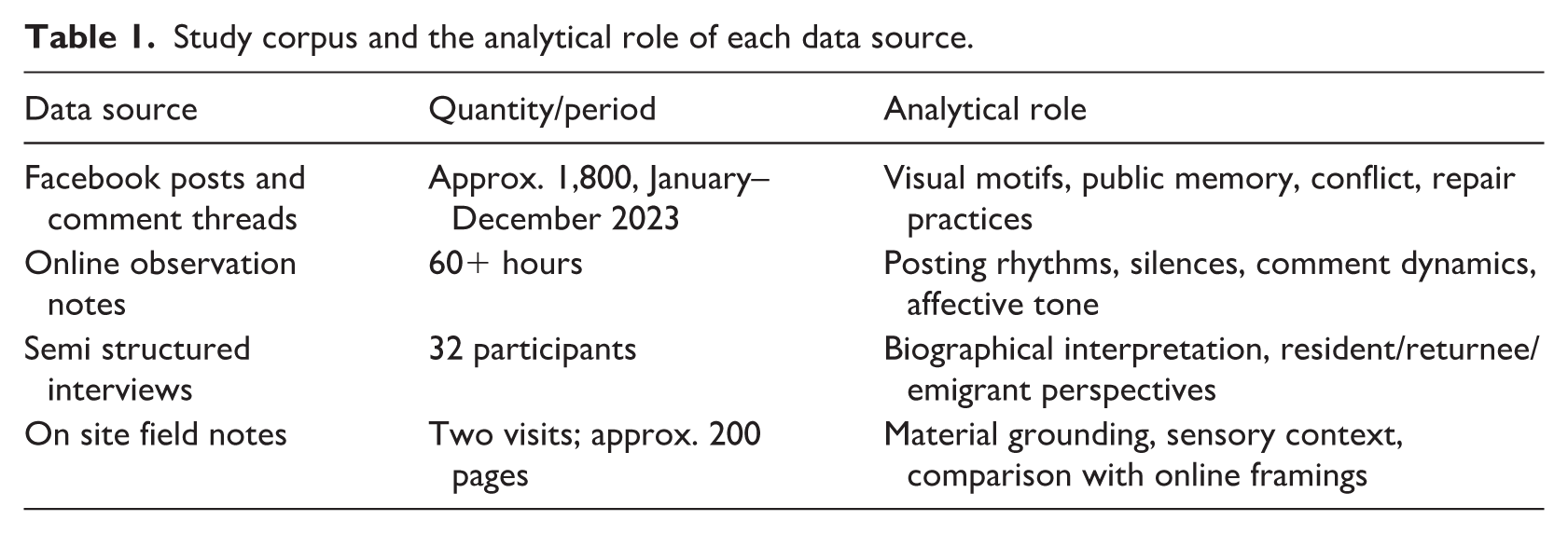
The resulting corpus (Table 1) consists of approximately eighteen hundred archived social media posts and comment threads that explicitly reference the two settlements, more than sixty hours of online observation notes, thirty two interview transcripts and two hundred pages of field notes from the on site visits. Data management followed a case centred strategy. All materials were imported into qualitative analysis software and organised into project folders for each village, with cross cutting folders for thematic domains such as memories of socialist modernity, narratives of decline, digital repair practices and visual aesthetics of abandonment. 49
Study corpus and the analytical role of each data source.
Data analysis
Data analysis employed reflexive thematic analysis as articulated by Braun and Clarke 50 and further elaborated in methodological discussions of rigour and trustworthiness in qualitative research. 51 Initial familiarisation involved repeated reading of interview transcripts and field notes and the sequential review of archived posts, while making analytic memos about emergent patterns and surprising disjunctures between online and offline accounts. A first cycle of coding attended to descriptive features such as temporal markers, spatial references, affective language and visual motifs. A second cycle developed more interpretive codes that captured relational processes, including negotiations over responsibility for abandonment, contests over the value of socialist infrastructures and practices of digitally mediated caretaking. Themes were gradually constructed by clustering codes across data types, with explicit attention to how certain motifs stretched across platforms while others remained anchored in specific places or social groups. 52 Reflexive memos documented how the researcher’s own assumptions shaped coding decisions, in line with recommendations for transparent and trustworthy thematic analysis. 53
The coding process generated three overarching themes that structure the findings: visual grammars of abandonment, memory and mourning, and platformed temporal rhythms. These themes were developed by comparing how similar objects and events, such as schools, cooperative buildings, deaths, festivals, service visits and media attention, appeared across posts, interviews and field notes. Visual grammars emerged from repeated images and captions of damaged infrastructures and empty streets. Memory and mourning emerged from posts and interviews that linked people, buildings and socialist era practices to present loss. Platformed temporal rhythms emerged from attention to recurrence, acceleration and silence in the groups. The themes were therefore not treated as isolated topics but as three dimensions of platformed temporality: visual repetition, commemorative recurrence and rhythmic reactivation.
Ethics, positionality and limitations
Throughout the project, particular care was given to positionality and ethics in a small region where online spaces are tightly interwoven with dense social networks. Reflexive work involved continuous reflection on how this position facilitated certain disclosures while limiting others, especially in relation to contentious recollections of socialist collectivisation and post socialist privatisation. 54 Ethical practice followed evolving guidance on digital ethnography with vulnerable populations and contentious online communities. 55 For public Facebook pages and open groups, posts were treated as publicly accessible but still subject to contextual integrity, meaning that potentially identifiable content was paraphrased rather than directly quoted unless explicit consent was obtained. For closed groups and private chats, informed consent was sought from administrators and individual participants, pseudonyms were used for both persons and places, and identifying details were obscured. The researcher announced their presence and role in group descriptions and periodically reminded participants of the ongoing study, thereby resisting purely observational lurking and aligning with arguments for transparent and situated digital ethnographic practice. 56
The study also has methodological limitations. Because the digital field was centred mainly on Facebook and related messaging practices, it necessarily privileges actors who are digitally connected, socially visible and willing to participate in online village publics. The perspectives of residents who do not use social media, who rely on relatives for digital communication, or who avoid public discussion are less fully represented. Platform algorithms, group moderation and uneven connectivity may also have shaped which posts became visible and which silences were interpreted as meaningful. The anonymisation of the two villages protects participants but limits the geographical specificity that can be provided. These limits mean that the study does not claim to represent rural Bulgaria as a whole; instead, it develops an analytically grounded account of how abandonment is digitally mediated in two closely studied postsocialist rural settlements.
Findings
Visual grammars of abandonment in Belograd Plain and Vidin Ridge
This section examines the first dimension of platformed temporality: the visual repetition through which ruined or declining infrastructures become evidence, memory objects and aestheticised signs of abandonment. The visual material circulating around Belograd Plain and Vidin Ridge does not simply document decline. It organises who and what is seen, and it stabilises a particular way of knowing these villages as abandoned yet still claimed. Across platforms, photographs and videos repeat a restricted set of motifs, but these motifs are arranged differently by current residents, dispersed villagers and outside visitors. The result is a shared but contested visual grammar that locates the villages within a specific temporal order and distributes responsibility for abandonment across different actors.
Images posted by remaining residents are dominated by close views of concrete damage. Cracked walls, broken water taps, the empty bus stop, the locked doors of the former cooperative office appear again and again. These photographs often crop out the larger landscape and emphasise immediate obstacles to everyday life. One resident of Belograd Plain sends a picture of a collapsed bridge over the irrigation canal and writes simply, ‘This is why the ambulance does not come.’ Here the image functions as evidence in an ongoing claim, tying visible deterioration directly to a present injury rather than to an abstract story about the past. In comment threads under similar posts, neighbours extend the frame verbally by adding dates of closure, recounting who last tried to repair the structure and predicting when the next failure will occur.
Dispersed villagers and seasonal returnees tend to post wider shots that situate the village in a broader landscape. Panorama views show the whole settlement from a nearby hill, or drone footage glides over the main street at sunset. These images rarely focus on specific broken objects. Instead, they stage a contrast between the beauty of the surrounding fields and the emptiness of the built environment. A widely shared drone video of Vidin Ridge begins with mist over the river plain, then descends over the roof of the abandoned school before panning across a line of houses with closed shutters. The accompanying caption reads, ‘Everything is still and nothing moves, only memories.’ In such posts, the visual grammar shifts from documenting immediate obstacles to tracing a more expansive sense of temporal distance. The emptiness of the street is emphasised by the absence of people, parked cars or animals, and the image invites viewers to remember earlier, livelier scenes that are no longer visible.
Urban visitors and amateur explorers contribute a different strand to this visual field. Their photographs concentrate on interiors and details that are less accessible to older residents, such as peeling murals in the school, rusting machinery in the former cooperative yard or a coat still hanging in a wardrobe in an abandoned house. The camera lingers on textures, colours and traces of former domestic life. Captions often foreground feelings of fascination or melancholy wonder. One visitor writes under a picture of a deserted classroom, ‘As if the pupils left only yesterday, but the spiders are already in charge.’ These images detach the ruins from immediate local grievances and fold them into a broader aesthetic of discovery and decay that circulates through online communities beyond the region.
Across all three groups of producers, a shared visual vocabulary emerges. Certain objects become iconic markers of abandonment. The school building, the cooperative silo, the memorial monument and the shop with a permanently closed metal shutter appear so frequently that their depiction no longer requires explanation. At the same time, each group uses these objects to tell a different temporal story. For residents, the worn school steps are evidence in ongoing complaints about the loss of public services. For dispersed villagers, the same steps are a trigger for layered recollection of childhood and youth. For visitors, they become a symbol of a different era, often presented without reference to current struggles in the settlement. The same material sites thus carry overlapping yet distinct temporal burdens, and conflicts surface when these burdens are perceived to be misused or ignored. The same ruin is therefore platformed as present injury, remembered past and aesthetic object. Abandonment appears here not as a stable visual condition but as a contested temporal framing produced through circulation, captioning and response.
Memory, mourning and small futures in digital village life
The second dimension of platformed temporality is commemorative recurrence: the repeated return to people, buildings and events that slows disappearance by naming, archiving and reactivating attachments. Nostalgic posts rarely present memory as a simple return to a golden past. A common format is a photograph from a school celebration or harvest festival, uploaded by someone who has long since moved to Sofia or abroad, accompanied by a prompt such as ‘Who remembers the grape harvest in eighty eight’ or ‘Write your class and year.’ Responses quickly extend beyond reminiscence. In one thread, former classmates begin by identifying themselves and end up reconstructing the chronology of the school’s decline, debating whether the decisive moment was the closure of the boarding section or the dismissal of a beloved teacher. Others use the same image to insist that ‘we were not poor then’ or that ‘life was hard but full.’ Through these exchanges, the past is sorted and evaluated. Socialist era collective practices, the cooperative canteen, the cultural centre and the village football team are alternately framed as symbols of dignity, hardship or state control.
Digital mourning practices intensify this temporal labour. Almost every death of an elderly resident is marked in the groups by an image of the person, often at a family table or in front of their house, accompanied by a short text about their contribution to village life. Comment threads fill with candles, prayer emojis and brief stories that locate the deceased within wider webs of kinship and labour. When one of the last permanent shopkeepers in Vidin Ridge died, a member now living in Germany wrote, ‘Without him the street will never be the same, he kept the light on for all of us.’ Others responded by recalling credit notebooks, late night conversations and informal care for children whose parents worked abroad. Through such posts, the passing of an individual is scaled up to signify the passing of a particular way of holding the village together. At the same time, these acts of commemoration refuse the idea that the dead simply vanish into statistics of depopulation. They are named, remembered and reinserted into a shared narrative, even when mourners are scattered across several countries.
The groups also host forms of anticipatory mourning that focus on buildings and infrastructures rather than people. Members speak of the school, the cultural centre or the church as if they were ageing relatives whose decline must be watched and dignified. Photo updates on the condition of these structures tend to attract comments such as ‘Every year I fear this will be the last time I see it standing.’ In these conversations, attachment is expressed through a mix of sorrow and resigned care. People acknowledge that they cannot stop the rain from entering through broken roofs, yet they insist on bearing witness and on recording each stage of deterioration. The digital record becomes a way to accompany the slow dying of the village and to reassure one another that this dying is seen and shared, not suffered in isolation.
Alongside mourning, there is persistent work of small repair and future making that circulates almost entirely through digital channels. Fundraising posts for the repainting of a war memorial, the repair of a chapel roof or the installation of a new bench in the square appear regularly, often initiated by migrants or seasonal returnees rather than by current residents. The amounts requested are modest and the goals concrete. In Belograd Plain, a group of former pupils organised a collection to fix the broken bell in the school yard so that it could ring again on the village holiday, even though the building itself remains closed. Participants described this as ‘doing something so the children of our children know we were here.’ These initiatives rarely promise a full revival of the village. Instead they sketch very specific futures, such as a safer cemetery path for elderly residents or a restored cross that will outlive the last believer. These practices do not overcome abandonment, but they alter its duration and moral texture. Through repeated acts of remembering, mourning and modest repair, the groups produce custodial futures in which the village is not restored as a whole but particular people, objects and places are kept within a shared horizon of care.
Platformed temporal rhythms of abandonment
The third dimension of platformed temporality is rhythmic: abandonment becomes perceptible through cycles of return, ordinary routines, sudden accelerations and unsettling silences. Temporal rhythms in the digital life of Belograd Plain and Vidin Ridge are shaped by a patterned alternation between intense activity and long stretches of quiet. These rhythms are not random. They reflect how people distribute attention, care and anxiety across the calendar and across different stages of abandonment. The groups feel most alive at certain moments of the year, during specific local events and at points when outside interest briefly turns toward the villages. At other times, the absence of posts becomes itself a sign that life is thinning out. Platform features, personal habits and infrastructural constraints combine to produce a distinctive sense of time that is hard to perceive from the material landscape alone.
Annual cycles are especially visible around religious and civic holidays, as well as around the village patron saint days. In the weeks before these dates, the groups fill with practical questions, invitations and logistical updates. People ask who will come back and who can offer transport from cities or from airports. Old photographs of processions, dances and communal meals circulate, followed by new images when the events finally take place. Even those who cannot travel mark their presence digitally, writing comments such as ‘I will light a candle here at the same hour’ or ‘Send us videos from the square.’ These periods condense multiple temporal layers. Participants recall what festivals looked like in earlier decades, describe the more modest present celebrations and project hopes that the tradition will continue at least one more year. The group timeline mirrors this layering, with older posts resurfacing through platform reminders, prompting people to compare this year to those archived memories.
There are also weekly and daily rhythms that relate to the routines of those who still live in the villages. Residents post more often on days when public services or mobile shops arrive. A photograph of the minibus that brings groceries every Thursday, or a short video of the nurse visiting the health post on Monday morning, can attract a cluster of comments from former residents who remember similar routines or who worry about how long such services will continue. In interviews, elderly inhabitants describe posting in the evening, after the television news, as a way to signal that they are still there. One woman in Belograd Plain explained, ‘If I put a picture of the sunset, my son writes to me and I know he saw that I am fine.’ Here, the digital rhythm of daily posting renders visible a fragile continuity of life in the village and organizes cross border care.
Taken together, the findings show that platformed temporalities of abandonment operate through visual, commemorative and rhythmic forms. Images make ruins legible as evidence, memory and aesthetic object; posts of mourning and repair keep people and infrastructures socially present; and rhythms of activity and silence make abandonment feel accelerated, paused or temporarily reversed. The villages therefore appear not simply as depopulated places represented online, but as places whose unfinished endings are actively organised through platformed social life.
Discussion
Platformed temporalities of abandonment
The findings show that abandonment in Belograd Plain and Vidin Ridge is not a simple state of loss but an ongoing, contested temporal process that is organised through digital as well as material forms. Work on ruination has emphasised how ruined infrastructures condense overlapping temporalities of modernist promise, crisis and residual hope, especially in sites where futures have been repeatedly deferred. 57 Building on this literature, the article has proposed the concept of platformed temporalities of abandonment to describe how digital infrastructures, interfaces and everyday practices organise the timing of rural decline. The concept refers to three interconnected processes: visual repetition, through which damaged infrastructures become evidence, memory objects and aestheticised ruins; commemorative recurrence, through which people, buildings and events are repeatedly named and reinserted into village life; and rhythmic reactivation, through which holidays, service routines, media attention and silences make abandonment feel accelerated, paused or temporarily reversed.
In the Bulgarian case, those temporalities are rearticulated through social media practices that stage the villages as both finished and unfinished. Visual grammars of cracked bridges, closed schools and empty streets align with classic images of rural decline, yet the comment threads and circulation of these images keep open a horizon of accountability and attachment. Platforms therefore do not simply represent abandonment after it has occurred. They help produce abandonment as a lived temporal condition by shaping when decline becomes visible, who is called to respond, and how long people and infrastructures remain socially present after their everyday functions have weakened.
Rethinking ruination through digital rurality
This argument builds on but also extends cultural geographic accounts of ruination. Stoler’s understanding of ruination as an active and ongoing condition is useful for interpreting abandonment in these villages as something continually reproduced through infrastructural withdrawal, demographic ageing and uneven responsibility rather than as a completed end point. 58 DeSilvey’s 59 work on decay further helps to understand the forms of care that accompany loss, while Edensor’s work on ruins clarifies how derelict spaces gather affect, memory and alternative temporal orders. De Jong and Valente Quinn 60 describe temporalities of ruination and regeneration in African infrastructures as a constant recapitulation of modernist futures that never fully arrive yet are never fully abandoned. Kovač and Ramella 61 describe promised and suspended futures in Kenyan urban ruins, where people inhabit rubble as both a reminder of broken commitments and a resource for alternative future making.
In Belograd Plain and Vidin Ridge, similar tensions emerge, but they are mediated by digital images and platforms that allow absentees to participate in local ruination from afar. Drone panoramas, interior ruin photography and resident snapshots organise who can define what the ruins mean. Residents use close images of damaged infrastructures to assert ongoing claims on state institutions, while returnees frame wide panoramas as invitations to nostalgic recollection and visitors aestheticise interiors for broader online publics. The contribution here is to show that ruination is not only encountered in place but also circulated, archived and contested across platformed publics. Digital rurality is therefore not only about rural visibility, identity or development. In depopulating villages, it is also about the mediated duration of endings.
This pluralisation of ruin meaning complicates the distinction between material and digital ruins. Miller and Garcia 62 conceptualise digital ruins as abandoned virtual environments that remain visually intact but have lost their social vitality, existing in what they call an eternal present of disconnection. The cases examined here invert that relation. The ruins are materially decaying, but their social vitality is intermittently extended through digital circulation. A collapsed bridge, a closed school or a shuttered shop becomes more than a sign of loss when it is photographed, commented on, remembered, disputed or attached to a repair campaign. Memory and mourning practices observed in the groups also extend debates on place attachment and digitalisation in rural regions. Birnbaum et al. 63 show that digital projects can translate and transform place attachment by allowing dispersed publics to curate narratives and images of rural areas, often with the aim of fostering regional identity. These practices suggest a form of digitalised place attachment that is oriented as much to the dignified ending of a way of life as to its revitalisation.
The small repair projects and fundraising campaigns circulating through the groups speak to ongoing debates about digital rural futures. Reviews of digital rural studies note that research has often focused on connectivity, hubs and entrepreneurial innovation, while downplaying the everyday and affective dimensions of digital participation in marginal regions. 64 In the Bulgarian case, digital participation is oriented less to economic innovation and more to what might be called custodial futures. Initiatives to repaint a monument, repair a chapel roof or make a cemetery path safer do not aspire to reverse depopulation or attract investment. Instead they seek to secure specific, limited futures for certain sites and practices, often justified with reference to past generations and imagined descendants. This shifts the question of rural digital futures away from revival alone and toward modest practices of maintenance, witnessing and selective repair.
The rhythmic patterns of posting, which intensify around holidays, village festivals, deaths and media attention, contribute to the growing discussion of the digital mundane in geography. Leszczynski 65 argues that the digital mundane consists of ordinary digital practices that both shape and are shaped by everyday spatialities, and calls for attention to those routine interactions that rarely appear in spectacular narratives of platform power. Lundberg 66 extends this by showing how mundane engagements with digital technologies co produce public space, often without actors explicitly noticing the digital dimensions of their experience. The findings here act as temporal anchors that reassure distant relatives, confirm that basic services still operate and signal that the village has not yet crossed an imagined threshold of final abandonment. In this sense, platformed temporality is also made through low intensity practices of checking in, reposting, commenting and waiting.
Conclusion
This article has argued that abandonment in northwest Bulgaria is an ongoing temporal process that is continually reworked through digital practices. The concept of platformed temporalities of abandonment captures this configuration, in which abandonment is made durable, intermittent and morally charged through everyday practices of posting, commenting, remembering and falling silent. The article contributes to cultural geography in three ways. First, it extends work on ruination and decay by showing how rural ruins are not only materially encountered but digitally circulated, archived and contested. Second, it contributes to digital rurality scholarship by shifting attention from connectivity, development and representation toward the temporal organisation of decline, care and modest repair. Third, it adds to postsocialist rural geographies by showing how abandoned infrastructures and depopulating settlements remain socially active through dispersed, platformed relations. More broadly, abandoned rural places are unfinished temporal formations, repeatedly made visible, mourned, disputed and partially repaired through platformed social life.
Footnotes
Funding
The author received no financial support for the research, authorship, and/or publication of this article.
