







Abstract
Frailty Syndrome is one of the key health problems in geriatrics, strongly affecting poor prognosis. There is a growing interest in the relevance of this syndrome in cardiovascular disease. The diagnosis of Frailty Syndrome in the elderly cardiac population is essential for an accurate risk stratification and for making therapeutic decisions. Most risk assessment systems used in cardiology are based on chronological age, which does not always reflect the biological age of a patient, therefore making an inadequate risk estimation. This paper discusses the definitions of Frailty Syndrome and research tools used to identify it. We specifically address the role of Frailty Syndrome in cardiovascular disease and the diagnostic and therapeutic difficulties in patients with Frailty Syndrome, emphasizing the role of the identification of Frailty Syndrome in making therapeutic decisions and the stratification of cardiovascular risk in patients with cardiologic conditions.
Introduction
Cardiovascular disease is the most common disorder among the elderly population, and Frailty Syndrome, also referred to as frailty, is recognized as one of the key health problems in geriatrics.1,2 The term ‘frail’ is semantically related to the French ‘frele’ (meaning ‘low resistance’) and the Latin ‘fragilis’ (‘easily broken’). 3 Frailty is defined as a multidimensional physiological syndrome which mainly occurs in people older than 65 years, and is characterized by vulnerability to stress-related factors and a decrease in physiological reserves (physical capability, mobility, cognitive function). 4
People with Frailty Syndrome are at a higher risk of falls, limited mobility and problems with daily activities, which often results in frequent hospitalizations, and higher mortality rates. 5 Moreover, Frailty Syndrome is known to negatively affect the quality of life of patients with cardiovascular disease. 1
The identification of frailty in the elderly population can be important in making therapeutic decisions and the stratification of cardiovascular, pre-operative and bleeding risks. Most risk assessment systems in cardiology are based on chronological age, for example in cardiovascular risk assessment (e.g. SCORE and the Framingham Risk Score),6,7 predicted operative mortality in cardiac surgery (EuroSCORE), 8 mortality risk in non-ST segment elevation myocardial infarction (NSTEMI; GRACE risk score) 9 or bleeding risk in patients with atrial fibrillation (HAS-BLED score). 10 However, chronological age does not always reflect biological age of a patient and might, therefore, lead to an incorrect risk assessment. Including identification of frailty might yield more accurate and relevant results.
In the first part of this review, we discuss various definitions of Frailty Syndrome, its clinical presentation and pathogenic pathways. In the second part, we centre around diagnostic criteria and instruments that can be used to identify this condition. The third part is devoted to the management of frail patients, with particular emphasis on individuals with various cardiovascular conditions, and related diagnostic and therapeutic challenges. In the conclusions section of this article, we discuss serious limitations of the frailty concept and resultant directions of future research.
We have searched the literature for the frailty instruments in the year 2012–2013, and in this review we have included measures that were described from 2000 to 2012.
Frailty Syndrome – definition and pathophysiology
One of the first, and still frequently used, definitions of Frailty Syndrome was developed on the basis of a randomized clinical research trial, ‘The Cardiovascular Health Study (CHS)’ by Fried et al., 5 performed in the USA between 1989 and 1993 in a group of 5317 respondents aged 65 years or older. The authors identified the Frailty Phenotype, which incorporated such elements as: body build, nutritional status and psychomotor status. Symptoms suggesting Frailty Syndrome included: weight loss, sarcopenia, nutritional status, lowered physical activity and limited physical abilities. 5
According to Fried’s definition, 14% of people aged 65 years have Frailty Syndrome. In the population aged between 64 and 74 years, Frailty Syndrome is more common in women (8.5%) than in men (4.1%). Furthermore, Frailty Syndrome occurs more often in people with lower levels of education and low income. Frail people are also characterized by a higher index of concomitant diseases and lower health self-assessment scores. 5
The causes of Frailty Syndrome are still not fully understood. The pathophysiological pathways are similar, but not identical, to those of the aging process. Chronic inflammatory processes, dysfunction of the immune system, neuroendocrine dysregulation and metabolic disorders were proposed to take part in the pathomechanism of Frailty Syndrome.11,12 Frail persons show lower levels of growth hormone and sex hormones (oestrogen and testosterone). Inflammatory processes promote a catabolic state (including lowering of anabolic hormone levels), consequently leading to loss of muscle mass, which is an important component of frailty. Furthermore, the loss of weight, the loss of muscle mass (sarcopenia), slow gait, impairment of physical activity and deterioration of cognitive functions are elements of Frailty Syndrome. 5
Frailty Syndrome – clinical significance for cardiovascular disease
Frailty Syndrome is three times more common in people with cardiovascular disease than in the general population, and entails higher mortality rate and recurrent hospitalizations.13,14 Frail patients more often suffer from ischaemic heart disease, heart failure and hypertension.15,16 This probably results from the fact that frailty and cardiovascular disease share common pathophysiological pathways, with the activation of a chronic inflammatory process playing the main role. CHS revealed that people with Frailty Syndrome had higher levels of C-reactive protein (CRP), factor VIII and fibrinogen. 15
People with Frailty Syndrome more often suffer from myocardial infarction (15.4% vs. 7.4%), angina pectoris (30% vs. 14%), heart failure (14% vs. 1.8%), intermittent claudication (4.7% vs. 1.5%) and haemodynamically significant carotid artery stenosis (1.6% vs. 0.3%). Frail patients without previous symptoms of cardiovascular disease were more often diagnosed as having features of subclinical atherosclerosis, such as increased intima-media thickness of common carotid artery (1.08 mm vs. 1.02 mm; odds ratio (OR) 1.46, 95% confidence interval (CI): 1.00–2.14) and internal carotid artery (1.51 mm vs. 1.31 mm; OR 1.09, 95% CI: 1.02, 1.18), and lower ankle-brachial index (ABI) values (≤0.8). Furthermore, they showed major electrocardiographic (ECG) changes, greater left ventricular mass in echocardiography, and a higher degree of ischaemic changes in the central nervous system documented on magnetic resonance imaging (MRI). 14
Frailty Syndrome and heart failure
The relation between Frailty Syndrome and heart failure deserves special attention. Patients with heart failure are mainly of advanced age (over 65 years), and often have multiple co-morbidities and polypharmacy. The Cardiovascular Health Study showed that the prevalence of heart failure was higher in a group of Frailty Syndrome patients than in the group at a risk of Frailty Syndrome. 14 Similarly, women with heart failure suffered from Frailty Syndrome six to seven times more often than their counterparts without this condition. 16 Furthermore, in the population of patients with heart failure, Frailty Syndrome was observed more often among women and people aged 70 years or older. 17 The coexistence of Frailty Syndrome and heart failure (HF) may result from common pathological pathways that involve inflammatory processes, and metabolic and autonomic disturbances. 18 Inflammation is known to play an important role in the development of cardiovascular diseases (CVDs), including HF. Inflammatory disturbances also seem to be involved in the pathogenesis of frailty. Frail patients show elevated levels of inflammation markers: white blood cells, interleukin 6, CRP, factor VIII and fibrinogen, as well as blood clotting markers, for example, D-dimer. 19 Elevated concentrations of inflammatory markers, especially TNF-α and its soluble receptors, lead to decline in muscle mass and strength, probably through promoting catabolic processes in muscle cells. 20 The inflammatory nature of frailty was proved in the results of the Women’s Health and Aging Studies I and II; the risk of frailty was shown to increase with the number of coexisting inflammatory diseases, and is highest in the presence of at least three of the following conditions: CVD, chronic kidney disease, anaemia, pulmonary disease, depressive symptoms, diabetes mellitus, peripheral artery disease or rheumatoid arthritis. 21 Moreover, the link between frailty and CVD may lead to endothelial dysfunction. The analysis of results from the Toledo Study for Healthy Aging 22 revealed that endothelial function, evaluated by asymmetric dimethylarginine levels, is impaired in frail patients. As mentioned before, autonomic dysfunction appears to be a common finding in both HF and frailty. Frailty Syndrome in patients with heart failure increases the one-year mortality rate13,23 and may significantly complicate diagnosing heart failure.24,25
Frailty Syndrome and acute coronary syndromes
Around 50% of acute coronary syndrome (ACS) patients are aged 75 years or older. 26 Age is a strong predictor of adverse events in ACS 27 and the elderly population is more susceptible to haemorrhagic complications, renal insufficiency and central nervous system (CNS) incidents. 28
Ekerstad et al. 29 described a group of 307 ACS patients who were assessed as frail, with frailty being strongly and independently associated with in-hospital mortality, one-month mortality and prolonged hospital care. Patients with frailty and co-existing diseases more often reached the clinical endpoint defined as an increased risk of death, recurrent myocardial infarction, revascularization, hospitalization, heavy bleeding and stroke. 29
Current guidelines of the European Society of Cardiology (ESC) for NSTEMI treatment 30 highlight the advantages of referring elderly patients for invasive diagnostics and possible revascularization. The identification of Frailty Syndrome should also result in the modification of the pharmacological treatment. The definition of Frailty Syndrome includes age (usually over 75 years) and low muscle mass, resulting in low weight; the latter two represent well-known risk factors of haemorrhagic complications, considerably worsening the prognosis in ACS patients. Therefore, anticoagulants of choice should be those with a lower potential for haemorrhagic complications (e.g. fondaparinux in conservative treatment, and bivalirudine in percutaneous revascularization). While selecting an antiplatelet drug, one should weigh the benefits of platelet inhibition and the risk of haemorrhagic complications. The latter should be additionally reduced by the use of the transradial approach for cardiac interventions, and the protection of the alimentary tract mucosa.
The American Heart Association Council recommends that one should take into account Frailty Syndrome, cognitive functions and co-existing diseases while estimating risk and choosing ACS therapy. These factors were revealed to influence the post-ACS prognosis, and proved essential for the choice of a therapy in patients with NSTEMI. 26
Patients with Frailty Syndrome qualified for cardiac surgery
There is increasing evidence that older patients may also benefit from cardiac surgery. 31 However, patients with severe frailty have significantly decreased physiological reserves and lower resistance to stress-related factors (e.g. surgical procedures). Lee et al. 32 evaluated 3826 patients, including 157 individuals with Frailty Syndrome (4.1%), who had undergone cardiac surgery. Frailty Syndrome was an age-independent predictor of in-hospital mortality (non-frail 4.5% vs. frail 14.7%), reduced mid-term survival and the necessity for prolonged post-operative care. This was also reported by Sundermann et al., 33 who found that both Comprehensive Assessment of Frailty (CAF) score and its simplified version, Frailty predicts death one year after Elective Cardiac Surgery Test (FORECAST), were efficient at predicting mid-term (one-year) mortality, and had advantage over such commonly used scores as the European System for Cardiac Operative Risk Evaluation (EuroSCORE) and the Society of Thoracic Surgeons (STS) score, both meant to evaluate perioperative mortality, but not frailty. FORECAST in particular can be easily applied in everyday practice. This user-friendly score consists of five elements with documented high predictive value: 1) chair-rise test, 2) subjectively reported weakness, 3) stair climb test, 4) clinical frailty scale (CFS), and 5) serum creatinine level. 8
In addition, slow gait is an independent predictor of mortality in the elderly referred for coronary artery bypass graft (CABG) and valve implantation surgeries. This seems to confirm the relevance of Frailty Syndrome diagnosis in older patients referred for cardiac surgeries. On one hand, such evaluation can be useful for determining both perioperative and mid-term risk associated with surgery, and may help patients to make conscious decisions. On the other hand, it may encourage the search for alternative, minimally invasive treatment methods in some patients, especially those with severe frailty.
About 80–90% of patients referred for transcatheter aortic valve implantation (TAVI) are frail (according to the definition of frailty phenotype). The identification of frailty is of great predictive significance. Green et al. 34 proved that in 159 patients aged 86 ± 8 years referred for TAVI, Frailty Syndrome had not involved perioperative complications, but entailed one-year mortality after the procedure.
Patients with Frailty Syndrome and atrial fibrillation
The ESC updated guidelines for the management of atrial fibrillation advise antithrombotic therapy with vitamin K antagonist (KVA) or one of a group of novel oral anticoagulants for patients who obtained at least two points in the CHA2DS2-Vasc score, and consideration of the above-mentioned agents for patients with one point in the CHA2DS2-Vasc score. 35 Age is an important element of this score, as patients aged 65–74 years and those over 75 years of age obtain one and two points, respectively. Thus, by virtue of age every atrial fibrillation patient older than 75 years is a candidate for antithrombotic therapy.
More advanced age and the co-existence of Frailty Syndrome enhance the risk of bleeding. It is recommended that the risk of bleeding be determined using the HAS-BLED score, 35 which takes into account the age of a patient (individuals older than 65 years get one point).
Elderly patients with Frailty Syndrome usually obtain high results in both the CHA2DS2-Vasc score and the HAS-BLED score. Other potential difficulties include problems with the monitoring of the international normalized ratio (INR), resulting from patients’ limited mobility and difficult access to laboratory, as well as impaired cognitive function leading to limited comprehension of antithrombotic therapy principles and poor compliance. Therefore, it is presently recommended that before antithrombotic therapy, elderly people are subjected to geriatric evaluation with the Mini Mental State Examination (MMSE), paying special attention to the cognitive functions. 36
Perera et al. 37 reported on the influence of Frailty Syndrome on prescribing oral anticoagulants to patients over 70 years old with a diagnosis of atrial fibrillation. They concluded that Frailty Syndrome diagnosis was the strongest negative predictor of the recommendation on the use of oral anticoagulants (OACs). A potentially negative contributor to the chronic use of anticoagulants by Frailty Syndrome patients is the need for regular control of blood coagulation parameters (INR), which is a real inconvenience for patients with problems with daily activities and concomitant dementia.
Novel oral anticoagulants (NOACs) can be an alternative to KVAs. Their administration does not necessitate regular controls of the coagulation profile. However, NOAC therapy also requires systematic monitoring of a patient. According to the latest recommendations of the European Heart Rhythm Association (EHRA), the parameters of renal function in Frailty Syndrome patients receiving NOAC should be controlled every six months (it is also recommended for patients with estimated glomerular filtration rate (eGFR) of 30–60 ml/min per 1.73m2 and people older than 75 years taking dabigatran), which is twice as often as for other patients. 38 It is also worth emphasizing that people in advanced age (older than 80 years) should receive lower doses of dabigatran, that is, 110 mg twice a day. 39 Age itself is not an indication for reducing doses of rivaroxaban or apixaban.
Identification of Frailty Syndrome
There are many tools to identify Frailty Syndrome, relevant for both research and clinical purposes. In general, a distinction can be made between instruments with criteria based on physical frailty5,40–42 and instruments based on a broad definition of the condition.43–45 The latest recommendation regarding frailty measures is included in the Frailty Consensus, published in 2013, which identified the Frail Scale, the Cardiovascular Health Study scale and the Tilburg Frailty Indicator (TFI) as well validated instruments. 46
Criteria based on physical frailty
The most popular diagnostic criteria for Frailty Syndrome are those based on the CHS described by Fried et al. 5 The five described frailty markers are based on the narrow definition of frailty. The CHS scale includes five items: 1) slowness, measured with 5-m gait speed, 2) weakness, measured by handgrip strength, 3) physical inactivity and 4) exhaustion, both measured by a questionnaire, and 5) unintentional weight loss >10 lb over one year, measured by self-report. 5 Three or more positive items classify the patient as frail, and one or two positive items as pre-frail.
Broad definition
Instruments based on the broad definition are usually more extensive and include physical, cognitive, psychological and/or environmental factors. The Edmonton Frail Scale, which combines cognition, balance and mobility, mood, functional independence, medication used, social support, nutrition, healthy attitudes, continence, burden of illness, and quality of life, is an example of such an instrument. 47 It consists of 10 domains, and a maximum score of 17 points suggests severe frailty. Other examples of general tests are the Clock Test, used to assess the cognitive function, or the Timed Up and Go (TUG) Test, used to estimate balance and mobility. Other domains refer to mood, self-reliance, medication use, social support, nutritional status and quality of life. 47
Recently, Gobbens et al. 47 developed the TFI, which distinguishes three interrelated types of frailty: physical, psychological and social. The total frailty score is determined by adding up the individual scores of each question. The maximum score is 15, which reflects the highest level of frailty. People are frail when they achieve TFI scores of 5 or more. 47
The International Association of Nutrition and Aging proposed a simple questionnaire, a so called FRAIL scale, which predicts functional status, as well as hospitalization and mortality rates. 48 The FRAIL scale evaluates five components: fatigue, endurance, mobility, disorders and weight loss (Figure 1).
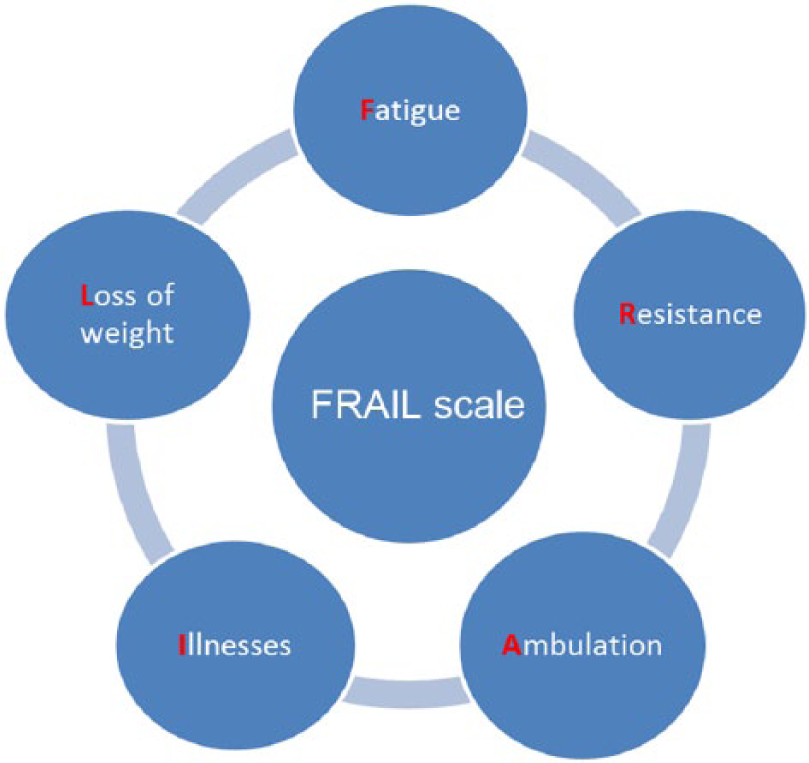
Elements of FRAIL scale. 35
Another approach that is widely used is the Frailty Index, which was constructed as a composite measure of deficits and was evaluated for its predictive capacity for morbidity and mortality. 49 The Frailty Index was based on impairments in cognitive status, mood, motivation, communication, mobility, balance, bowel and bladder function, daily activities, instrumental daily activities, nutrition and social resources, as well as a number of comorbidities.49–50
Therapeutic interventions in patients with Frailty Syndrome
Methods of preventing and treating Frailty Syndrome have not been developed thus far. Physical activity is one way to avoid losing muscle strength, and there is evidence that it can prevent, postpone or even reverse the frailty process. Physical activity might be more advantageous for older people with a diagnosis of Frailty Syndrome than any other intervention. 51 It is recommended that frail patients do resistance training before aerobic exercise, with 30–45-minute training sessions at least three times a week for more than five months. 52 In addition, the recently published Frailty Consensus recommends a number of interventions which could support treatment of frailty, such as exercise (resistance and aerobic), energetic and protein support, vitamin D intake and reduction of polypharmacy. 46
Summary
The diagnosis of Frailty Syndrome in the elderly population is essential for making therapeutic decisions and the stratification of cardiovascular risk. Most risk assessment systems are based on chronological age. However, chronological age does not always reflect the biological age of a patient, therefore using it as an indicator may lead to incorrect risk estimation. Scientific societies highlight the role of biological age in making medical decisions. Hence the need for research instruments measuring biological age, the latter being easier established by means of the identification of Frailty Syndrome. Even though there are no consistent and commonly accepted Frailty Syndrome definition and universal validated research instruments, the assessment of Frailty Syndrome should be taken into consideration while estimating risk and making therapeutic decisions in cardiovascular disease. The American Nutrition Association has established guidelines which not only show the necessity for paying attention to general health state, co-existing diseases, cognitive functions, life span and age in older patients, but also underline the relevance of ‘frailty’ in people with cardiovascular disease.
Despite profound interest in this issue, Frailty Syndrome still needs further studies and standardized research instruments. This condition is necessary for the implementation of ‘frailty’ assessment in clinical evaluation. Moreover, patients should be diagnosed and treated according to available guidelines, and educated in regard to their condition. We believe that the identification of frailty based on available tools could be supported by the nursing staff, and in addition could be a key to successful education and care of patients who are frail.
Footnotes
Conflict of interest
The authors declare that there is no conflict of interest.
Funding
This research received no specific grant from any funding agency in the public, commercial, or not-for-profit sectors.
It is greatly important that special attention is paid to the specific needs of frailty patients with cardiovascular disorders, in order to improve their functional and mental independence and their quality of life.