






Abstract
Background:
Patients with heart failure experience not only impaired physical condition, but also their physical activity, moods, and quality of life may be diminished.
Aims:
The purpose of this study was to investigate the effects of 12-week walking with breathing program on physical activity tolerance considering time-dependent physiological factors and time-independent interoceptive awareness, as well as psychosocial factors.
Methods:
This randomized controlled trial recruited 90 heart failure patients and randomly assigned them. The walking with breathing group received the walking and breathing intervention for 12 weeks but the control group did not. Outcomes included activity tolerance measured by 6-minute walk distance, moods assessed by the Hospital Anxiety and Depression Scale, quality of life determined by the EuroQol 5-Dimensions, oxygen saturation by pulse oximetry, and interoceptive awareness by the Multidimensional Assessment of Interoceptive Awareness scale. Data were collected before the intervention at baseline and at Weeks 2, 4 and 12.
Results:
The results of the generalized estimating equation showed the 6-minute walk distance in the walking with breathing group was significantly different across time (p<0.001) compared with the control group at baseline. Oxygen saturation by pulse oximetry (p=0.04) and Trusting on the Multidimensional Assessment of Interoceptive Awareness scale (p=0.001) significantly and positively correlated with results of the 6-minute walk distance. There were significant between-group differences at Week 12 in anxiety (p=0.03) and quality of life (p=0.02) but not depression (p=0.06).
Conclusions:
Walking with breathing improved heart failure patients’ tolerance of physical activity, probably because of improved oxygen saturation and trusting interoceptive awareness. Walking with breathing also improved patients’ anxiety and quality of life.
Heart failure, the final stage of most diseases afflicting the heart, occurs when cardiac muscle is damaged and can no longer deliver sufficient blood to supply the body’s demands. Although heart failure treatments have rapidly improved, the associated mortality rate remains high. Currently, the hospitalization and mortality rates for patients with heart failure are 44% and 17%, respectively. 1 Moreover, heart failure refers to the structural or functional impairment of ventricular ejection or filling with blood that results in clinical disorders. 2 Therefore, medical treatment mainly focuses on alleviating symptoms and prolonging life. With patients living longer, cardiac function, exercise tolerance, anxiety, depression, and quality of life (QoL) are affected,3–5 which can be improved by planned exercise training. Patients with heart failure who suffer from low cardiac output typically decrease physical and daily activities, which thus causes progressive muscle atrophy. 6 These patients also have breathing difficulties because the energy required to perform these activities exceeds the oxygen supplied by the body. 7 Therefore, tolerance to physical activity is a common problem in patients with heart failure.
Physical activity has been shown to reduce mortality associated with heart disease by 25%. 8 Exercise tolerance, walking distance, and maximum oxygen uptake can be promoted by physical activity, 3 but this benefit is not sufficient for patients with heart failure. 9
Breathing control could be beneficial to patients with heart failure, because the lack of oxygen exchange is the main cause of pulmonary insufficiency. 10 Since patients with heart failure have reduced respiration rates, they can benefit from improving their oxygen exchange and breathing capacities at rest and during exercise. Slow breathing increases oxygen concentration, lung ventilation and perfusion, and exercise tolerance; it also reduces the chemoreflex response of sympathetic nerves. 10 In particular, controlled breath rates between 6–10 beats per min improve ventricular injection volume, pulmonary artery pressure, and cardiac function. 11
Self-perceived physical and psychological feelings are reflected by an interoceptive awareness, which affects an individual’s adaptions to disease and life. 12 Bodily self-awareness is a pressure detection tool that explores body clues. A growing number of medical and behavioral science studies have revealed that increased self-awareness can predict a patient’s potential inner health problems such as stress and maladaptation. 13 Properly applied, interoceptive awareness allows patients to improve their moods and motivate their efforts toward recovery. Interoceptive awareness interventions can enhance the self-regulation of attention 14 and emotional function. 15 If awareness of breathing status and regulation of respiratory rates and breathing patterns are understood, patients with heart failure can increase physical activity.
Mortality of patients with heart failure has decreased because of the progress made in medical treatment development, but patient moods and QoL remain poor. A study reported that among patients with heart failure, 25.3% were anxious, 41.8% were depressed, and 63% required psychological therapy. 16 The severity of heart failure was revealed to be associated with anxiety and depression.17,18 QoL is an important indicator for the evaluation of heart failure treatments.5,19 However, research evidence and practice guidelines for the provision of more comprehensive care for patients with heart failure are insufficient. This study investigated the effects of walking with controlled breathing (WwB) among patients with heart failure in terms of exercise tolerance and physiological factors during a specified intervention period. Interoceptive awareness and psychosocial outcomes were also assessed at the end of the intervention period.
Methods
Research design and participants
This randomized, controlled trial consisted of four repeated measurement time points (baseline, Week 2, Week 4, and Week 12). A convenience sample of patients with heart failure was consecutively recruited from the cardiology ward of the 1000-bed Cheng Hsin General Hospital in Taiwan. Participants in the WwB group were given a structured intervention about walking and breathing for 12 weeks; those in the control group received usual care for heart failure during the same study period. A randomization procedure was performed offsite by two registered nurses who hold master’s degrees and were not involved in this study. Permuted-block randomization, with every block comprising four participants, was used to achieve balanced numbers in the two groups. The randomization was based on computer-generated random sequences that were separately placed in opaque, sealed envelopes to ensure random allocation and concealment of the participants’ identities. Patients were asked to draw an envelope that determined assignment into either the WwB or the control group.
Participants included in this study were aged ⩾20 years, were diagnosed as having heart failure (International Classification of Diseases, Ninth Revision, Clinical Modification code 428.0) and classified in the New York Heart Association (NYHA) class I–III range by cardiologists in the study hospital, were able to communicate, and could ambulate. Exclusion criteria were long-term use of oxygen or breathing apparatus, regular dialysis, limb movement disorders, and serious conditions such as aortic balloon pump placement and severe arrhythmia, which were all confirmed by the cardiologists. Effect size determined from one previous study; 20 however, this study conservatively use a lower value of effect size because of the severity of heart failure and the intervention period. On the basis of the primary outcome of a 6-minute walk distance (6MWD) with a 0.3 effect size and an 80% power at 5% significance determined using four repeated measurement times and G-power software, a minimum of 90 participants (45 in each group) were required. Figure 1 presents the flowchart for the research design and participant allocation.
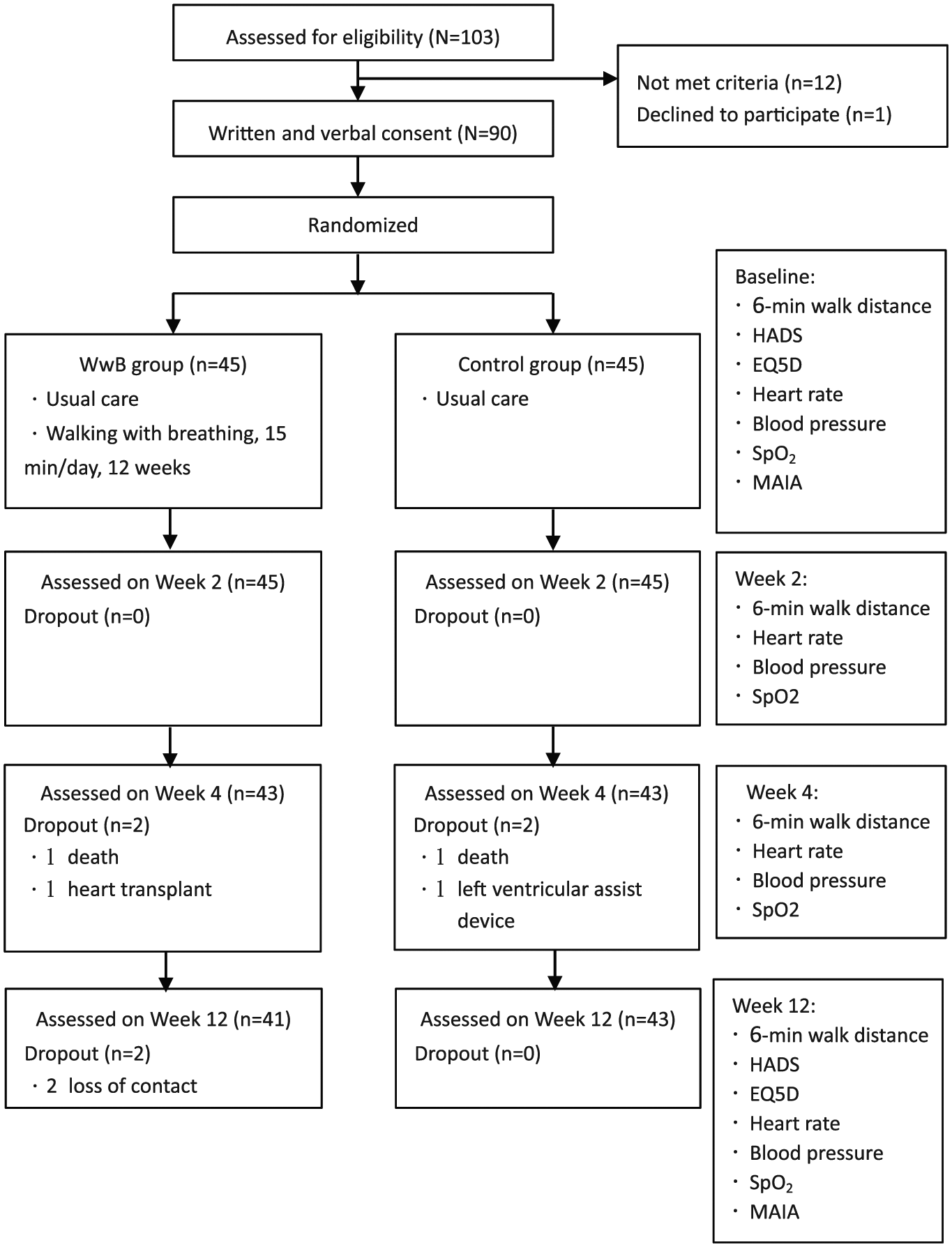
Flow chart of research design and participants.
Intervention
The WwB intervention consisted of a warm-up, main course, and cool-down, performed twice daily in the morning and afternoon, for 12 consecutive weeks. To begin the intervention, a warm-up was performed for five minutes before walking and included stretching the head and neck, turning the shoulders forward and backward, shaking the hands, and lifting each foot. Abdominal deep breathing patterns were designed and taught; inhalation and exhalation times were targeted at a 1:2 ratio, and breathing rates were allowed to decrease to <10 times per min before walking would begin. Then, the WwB main course was performed for 15 min. In the hospital, participants walked in the corridors of the cardiology ward, accompanied by a researcher while continuing the abdominal breathing patterns. To maintain walking intensity, the rating of perceived exertion was used as a controlling principle. The goal was to hold the rating of perceived exertion between 12 and 13, indicating that a patient is using little effort to breathe but is becoming slightly tired. 21 Finally, a cool-down movement was performed for five minutes. Participants slowed their walking speed, stopped walking, and returned to their normal breathing rate.
All participants received the usual hospital care, including routine medications and guidance about diet, daily activity, weight control, and water restrictions. In addition to the usual care, the intervention group practiced WwB. Participants in the WwB group began interventions when they finished the acute phase and were becoming stable without the use of intravenous infusion of inotropic agents. For safety and as the standard required by the study hospital, heart rate, blood pressure, and oxygen saturation were assessed in patients before and after the WwB intervention to ensure stable conditions. During WwB, signs and symptoms of discomfort and falls or other accidents were documented by the researchers. After patients were discharged, they continued engaging in WwB in places that were near and suitable for walking. An exercise diary was designed for the participants to use at home, which could record their daily practices. Weekly phone calls were also made to confirm WwB intervention performance. 6MWD and physiological factor data were collected at the baseline, Week 2, Week 4, and Week 12 during the WwB intervention. In addition, the Multidimensional Assessment of Interoceptive Awareness (MAIA) scale, Hospital Anxiety and Depression Scale (HADS), and EuroQol 5-Dimensions (EQ-5D) scale questionnaires were used to collect data at the baseline and Week 12.
Ethical consideration
Ethical approvals were obtained from the institutional review board of the study hospital (CHGH-IRB No. (411) 102-58-2). Written informed consent was obtained from all participants after they received a full explanation of the study. Participants were free to withdraw at any time during the study without affecting their care. Data remained confidential at all times.
Instruments
The demographic and clinical characteristics monitored included age, sex, education, marital status, smoking, diabetes diagnosis, time to diagnosis of heart failure, heart failure functional class, left ventricular volume injection, and cardiovascular medications. The primary outcome was exercise tolerance measured by the 6MWD test. Participants walked the 160 m long cardiology ward corridor, and the longest distances walked were measured at six minutes. If participants had cold sweats, pallor, difficulty breathing, chest tightness, dizziness, or other symptoms during the test, the test was immediately stopped. The 6MWD test is a simple and safe method assessing movement. An increase or decrease of ⩾50 m represents a significant change. 22 The reliability and validity of the 6MWD test have been tested, and good agreement was found in patients undergoing cardiac rehabilitation. 23
Physiological factors included heart rate, blood pressure, and oxyhemoglobin saturation. Heart rate was measured using a stethoscope (Littmann Class II; 3M, St Paul, Minnesota, USA), specifically recording precordial auscultation in the apical pulse. The normal range of heart rate was 60–100 beats per min. Blood pressure was measured by a mercury sphygmomanometer (Model N-300, Rudolf Riester GmbH, Germany) that was certified by the Bureau of Standards, Inspection, and Metrology Correction. The normal ranges of systolic and diastolic blood pressures were 120–139 over 80–89 mm Hg, respectively. Oxyhemoglobin saturation (SpO2) was examined by a pulse oximeter (Model 9560, Nonin, USA) on the left index finger. The normal percentage of the hemoglobin that carries oxygen is between 90–100%.
Interoceptive awareness was measured by the MAIA scale. 12 The 32-item MAIA scale is categorized into eight scales: Noticing, Not Distracting, Not Worrying, Attention Regulation, Emotional Awareness, Self-Regulation, Body Listening, and Trusting. Each item is scored on a six-point scale ranging from zero (“never”) to five (“always true”), with higher scores indicating greater self-awareness. The MAIA has nee reported to have good reliability and validity.12,24 Cronbach’s alpha measures of internal consistency at pre- and post-test were determined to be 0.89 and 0.90, respectively.
Negative moods were measured by the HADS, 25 which assesses the mood disorder severity through 14 questions, seven for anxiety and seven for depression. Anxiety and depression scores are recorded separately, and each score ranges between 0–21 points (with higher scores indicating higher degrees of depression or anxiety). Scores of <7 points do not indicate anxiety or depression; 8–10 points indicate borderline cases; and ⩾11 points indicate a tendency toward anxiety or depression. Cronbach’s alpha was determined to be 0.77 for anxiety and 0.63 for depression in this study.
Health-related QoL was measured by the EQ-5D scale including two parts. 26 The EQ-5D Index has the five dimensions, namely mobility, self-care, usual activities, pain/discomfort, and anxiety/frustration; scoring ranges from one point (the best situation) to three points (the worst situation). The EQ-5D is a visual analog scale (VAS) that uses a total length of 20 cm in a vertical ruler from point 0 (the worst health status) to 100 (the best health status). EQ-5D has been extensively used to assess patients with cardiovascular disorders. 27 Cronbach’s alpha of the EQ-5D was 0.75 in this study.
Statistical analysis
Data were analyzed using SPSS 20.0 for Windows (IBM, Chicago, Illinois, USA). Categorical variables are reported as the number of samples and percentages, and continuous variables are reported as means and standard deviations (SDs). The 6MWD data violated the assumption of normal distributions; therefore, the differences in the effects between the groups at repeated measurements were analyzed using the generalized estimating equation (GEE) method. A robust estimate of variance in the GEE models and an exchangeable working correlation structure were used to determine the between-group differences; time was treated as a categorical variable that was represented by three dummy-coded variables. Control variables were time-dependent physiological factors and time-independent interoceptive awareness that was the score that changed between the baseline and Week 12. The t-test was used to analyze the effects of anxiety, depression, QoL, and interoceptive awareness between the two groups. This study considered a value of p<0.05 to be statistically significant.
Results
Ninety participants were included (mean age 52 years, SD 12.98 years), 45 in each group. Finally, 84 participants completed the study: 41 in the WwB group and 43 in the control group. Six patients dropped out of the study, yielding an attrition rate of 6.6%. Table 1 presents the demographic and clinical characteristics that were homogeneous between the two groups (p>0.05).
Homogeneity of demographic and clinical characteristics at baseline.

ACE inhibitor: angiotensin-converting-enzyme inhibitor; ARB: Angiotensin II receptor blocker; HFpEF: heart failure preserved ejection fraction; HFrEF: heart failure reduced ejection fraction; SD: standard deviation; WwB: walking with breathing.
Multiple-choice question.
Figure 2 shows the trend of the 6MWD results across time points for individuals and groups. On average, the participants in the WwB group increased their walking distance by 53.27 m from 295.38 up to 348.65 m. A summary of the 6MWD GEE results is presented in Table 2. The between-group difference in the 6MWD results was not significant over time (p=0.16). Trend differences (interactions between time and group) in the 6WMD results were significant at each time point (p<0.001) compared with the control group at the baseline, indicating that WwB had a time-dependent effect of increased tolerance to physical activity. The results of the SpO2 (p=0.04) and the Trusting scale (p=0.001) were positively and significantly correlated with the results of the 6MWD test. Moreover, Table 3 presents the results of the 6MWD and SpO2 measurements. Compared with the baseline, walking distance in the WwB group significantly improved from 47.25 m at week 2 to 53.27 m at week 12, whereas that in the control group decreased from 17.05 m at week 2 to 1.10 m at week 12. In the WwB group, the SpO2 values significantly improved by 0.32 units at week 4 and 0.49 units at week 12 compared with baseline values; in the control group, the SpO2 values improved by 0.21 units at week 2 and −0.2 units at week 12. Figure 3 shows the trends of the SpO2 results across all time points for all groups. Table 4 presents a comparison of the two groups in terms of anxiety, depression, QoL, and interoceptive awareness, with no significant between-group differences at the baseline. At Week 12, there was a significant between-group difference in the HADS Anxiety scale (p=0.03), EQ-5D Index (p=0.02), EQ-5D VAS (p<0.001), and Noticing scale (p<0.001), but not the HADS Depression scale (p=0.06).

The trend of 6-minute walk distance (6MWD) across the intervention period: (a) individual lines; (b) group mean with standard deviation. ‡Comparisons between two groups.
Results of generalized estimating equations in 6-minute walk distance (n=84).
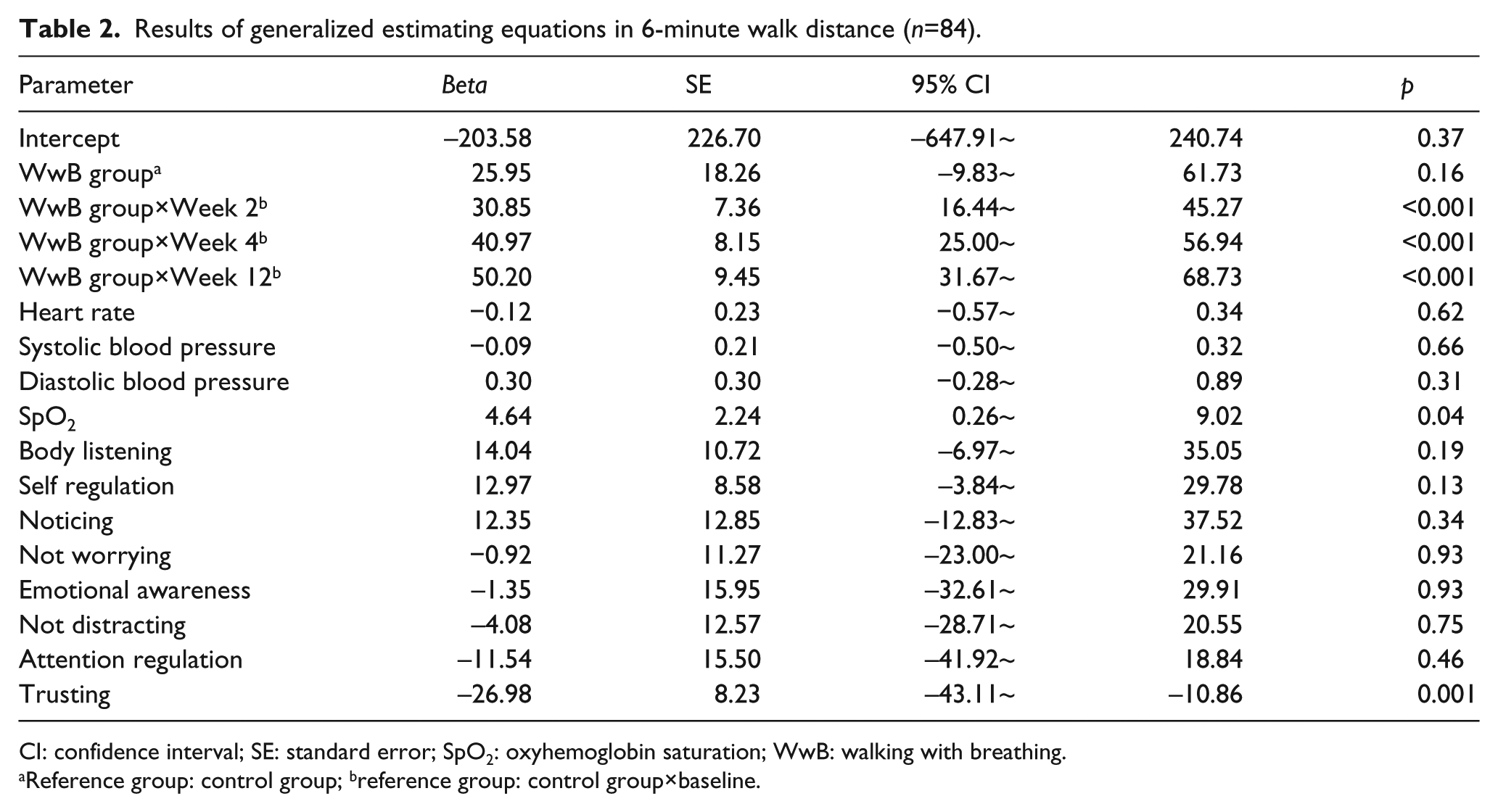
CI: confidence interval; SE: standard error; SpO2: oxyhemoglobin saturation; WwB: walking with breathing.
Reference group: control group; breference group: control group×baseline.
Time-dependent effects of 6-min walk distance and oxyhemoglobin saturation (SpO2).
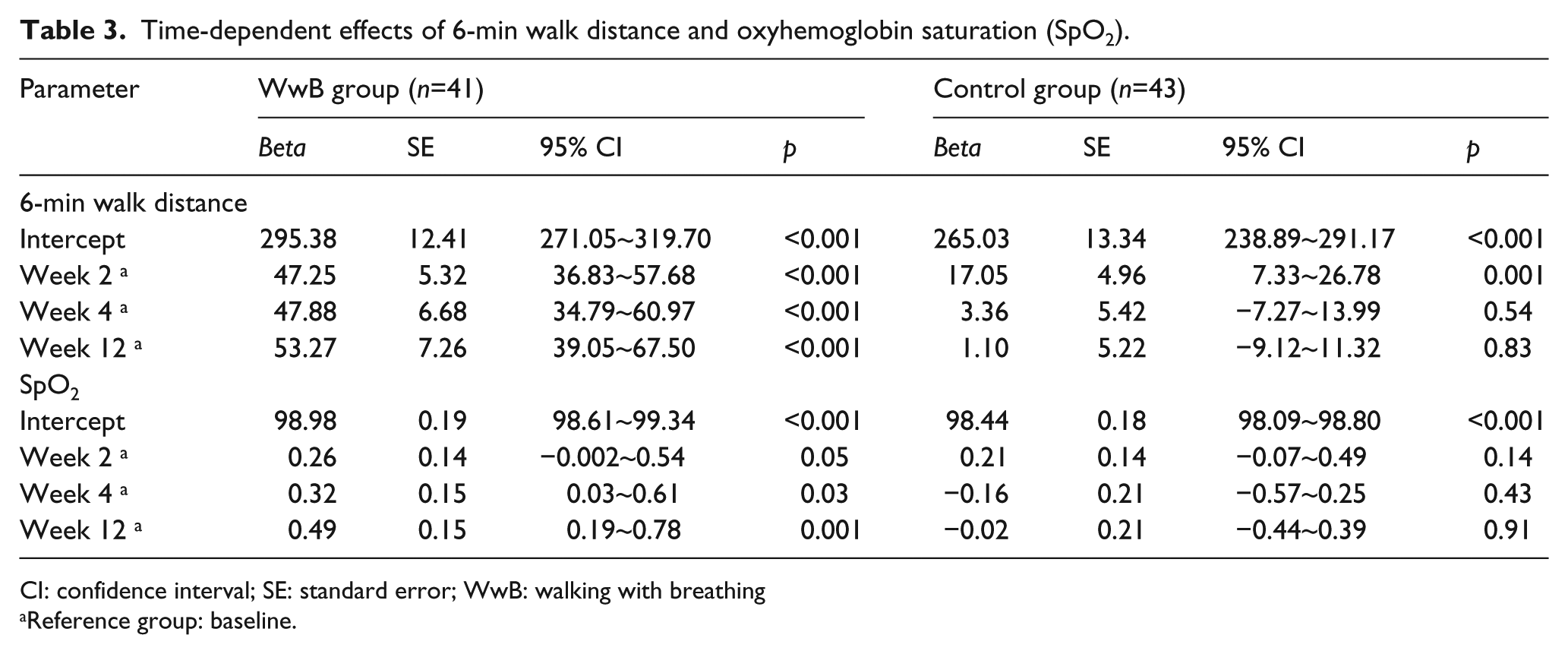
CI: confidence interval; SE: standard error; WwB: walking with breathing
Reference group: baseline.

The trend of oxyhemoglobin saturation (SpO2) across the intervention period, ‡Comparisons between two groups.
Comparisons on moods and quality of life (n=84).

VAS: visual analog scale; WwB: walking with breathing.
Calculated by the population value set of Japan; bWwB group; ccontrol group.
Discussion
The results of this study support that the WwB intervention effectively improved exercise tolerance in patients with heart failure showing a simultaneous and continuous positive association with oxygen saturation improvements. This intervention also demonstrated an increase in trust identified through interoceptive awareness, as well as improvements in anxiety and QoL. No adverse events were associated with WwB during this study. The findings of this study provide evidence that more comprehensive heart failure care, which involves physical, physiological, social, and spiritual aspects, is beneficial. The results presented here are similar to the results of a meta-analysis of 35 randomized controlled trials that found that exercise enhanced tolerance to physical activity. 28 However, the meta-analysis found no improvement in oxygen uptake during exercise training. The effect of the intervention could have been underestimated, and the interactions among the variables regarding measured outcomes could have been inadequately reported. In addition, exercise using breathing patterns may be superior to exercise or breathing alone.
The WwB group increased the average walking distance by >50 m, which confirms meaningful progress. 22 During the second week of the WwB intervention, participants in both the WwB and the control groups increased their walking distances because the patients with heart failure were weaned off of intravenous infusions of inotropic agents as part of a recovery program. With time, among the WwB participants, a gradual and continuous increase in walking distances was seen until the end of the intervention. It appears that a 12-week period of physical activity is required to achieve a meaningful improvement in walking distance, which represents improved tolerance to physical activity. However, the walking distances of the control group participants did not improve, which is in agreement with the findings of a previous study. 3
In this study, oxygen saturation improved and significantly influenced exercise tolerance in patients who practiced WwB, whereas those in the control group had decreased oxygen saturation. These findings are similar to one study. 11 WwB improves oxygen exchange during exercise. 29 In addition, participants’ trust, based on self-interoceptive awareness, significantly influenced their tolerance to physical activity. To the best of our knowledge, this study is the first to show the benefits of enhanced interoceptive awareness during physical activity such as WwB in patients with heart failure. As exercise tolerance improved in these patients, their confidence and self-control were positively adapted, 12 and they learned to trust their bodies, improve their moods, and motivate their abilities. When patients with heart failure become aware of their breathing status and learn to regulate it, they find these skills helpful in promoting physical activity. Studies have found that the benefits of attention and emotional self-regulation were present in interventions related to interoceptive awareness.14,15 However, for self-regulation to be most effective, patients must learn to trust self-interoceptive awareness gained during the WwB intervention.
By the end of the study, WwB intervention participants showed an overall improvement in anxiety levels, which supports studies that found that physical activity improved anxiety levels in almost half of patients with heart disease 30 and that teaching patients to walk with controlled breathing showed benefit. 4 However, the WwB intervention did not improve depression in patients with heart failure, which is inconsistent with the findings of a systematic review that reported improvements in depression after 12–26 weeks of exercise interventions in patients with heart failure. 31 In our study, the WwB intervention was conducted for only 12 weeks, which may not have been optimal to notice improvements in depression. A study demonstrated that to notice improvements in depression, long periods of intervention are required; however, anxiety usually improves in a short period. 32 The WwB intervention also improved patient QoL in this study, which is similar to the findings of other studies on breathing control11,29 and is consistent with review articles on exercise training. 28 QoL can be enhanced, breathing difficulties can be ameliorated, and exercise tolerance can be increased in patients with heart failure who undergo WwB interventions.
Limitations
This study has a few limitations. First, the convenience sample of patients with heart failure was recruited from one hospital, which may limit the generalizability of the study findings. Second, due to the nature of the WwB intervention, a blinded study was not possible. Third, a detection bias could have been introduced because the same researcher who performed the intervention also collected the study data. Fourth, young, male participants with heart failure were included in this study, who may find it easier to practice the WwB intervention. Therefore, the generalizability of the study findings to female individuals is limited. Finally, patient medication data were not collected at the baseline; therefore, the actual risk of confounding results due to the differences in medications taken among the groups during the intervention period remains unclear.
Conclusions
The findings of this randomized, controlled study indicate that a 12-week WwB intervention effectively improved tolerance to physical activity and oxygen saturation in patients with heart failure. The findings also reveal that as patients began to trust their interoceptive awareness, their anxiety and QoL were improved. WwB is easily and rapidly learned by patients, who are likely to practice it on a more regular basis in daily life. Patients in this study also learned to be aware of their inner body by engaging in WwB. As the patients gained more trust, tolerance of the activities they performed improved. To provide high-quality care to patients with heart failure, nurses should be provided with adequate and comprehensive evidence that their intervention strategies improve the physical, physiological, psychological, social, and spiritual attributes of these patients. Finally, this study provided a WwB intervention for 12 weeks in patients with heart failure, but the effects of this intervention over longer periods are not known and should be studied further.
Footnotes
Conflict of interest
The authors declare that there is no conflict of interest.
Funding
This research received no specific grant from any funding agency in the public, commercial, or not-for-profit sectors.
The intervention of 12-week walking with breathing improves heart failure patients’ tolerance of physical activity and oxygen saturation. Patients with heart failure began to trust their interoceptive awareness through walking with breathing interventions. In addition to the physical and physiological benefits, the 12-week walking with breathing intervention improves anxiety and quality of life in patients with heart failure patient.