






Abstract
Background and purpose:
Among members of the health care team, nurses play a large role in actively engaging stroke survivors in secondary stroke prevention programs. This systematic review and meta-analysis examines the effectiveness of interventions in which nurses have a primary role on modification of risk factors among stroke survivors.
Methods:
We systematically searched for randomized controlled trials in relevant databases investigating the role of nurses in secondary stroke prevention. Meta-analyses were conducted using Cochrane Review Manager Software. The mean pooled effect size, a 95% confidence interval (CI), and I-squared (I2) for heterogeneity were calculated.
Results:
Sixteen randomized controlled trials were included with a total of 3568 stroke and transient ischemic attack patients. After removing one outlier, the models demonstrated a statistically significant effect on reducing systolic blood pressure (SMD = −0.14 (95% CI = −0.23, –0.05), I2 = 0%; p = 0.002, six studies, n =1885) and diastolic blood pressure (SMD = −0.16 (95% CI = −0.27, –0.05), I2 = 0%; p = 0.003, four studies, n =1316). The interventions also significantly improved physical activity (five studies, n=1234), diet (three studies, n=425), medication adherence (two studies, n=270), and knowledge of risk factors (three studies, n=516). However, there was no effect on smoking cessation or reduction in use of alcohol.
Conclusion:
We found that interventions in which nurses had a primary role were effective on improving medical and behavioral risk factors, as well as knowledge of risk factors as part of secondary prevention of stroke.
Introduction
Patients with stroke or transient ischemic attack (TIA) are at increased risk for new events. The annual risk for recurrent stroke after an ischemic stroke or TIA is approximately 3–4%, and the long-term risk of all stroke is approximately twice the risk of all cardiac events. 1 These high rates of recurrence reinforce the need to optimize modifiable risk factors including hypertension, dyslipidemia, smoking, diet, physical activity, alcohol consumption, psychosocial stress, and depression. 2 Moreover, evidence-based guidelines recommend the importance of multimodal approaches for secondary prevention of stroke/TIA. 3 Recommendations for secondary stroke prevention should be addressed at all appropriate health-care encounters, including in the emergency department, and during acute inpatient care, rehabilitation, reintegration into the community, and follow-up by primary care practitioners. 4
There is an increasing focus on people living with various chronic conditions and self-management support programs emphasizing the patient’s active role in managing their illness. 5 All members of the health-care team are expected to facilitate engagement of stroke survivors in stroke prevention programs. However, nurses play a larger role in informing stroke survivors and their caregivers on various aspects of their disease process and actively engaging them in stroke prevention programs at each encounter in various clinical settings. As stated by the Registered Nurse’s Association of Ontario, 6 registered nurses help clients to address risk factors influencing their health by applying various behavioral and psychological interventions, linking them to community supports, and collaborating with other team members.
A comprehensive review of all studies where nurses are primarily employed in assisting with secondary stroke prevention interventions will help to summarize the current state of knowledge about the impact of nurses in optimizing the multiple aspects of secondary prevention and will help to identify knowledge gaps. Additionally, how nursing skills are used for secondary prevention is not well characterized, and clarification may help to direct future interventions.
We examined the effectiveness of secondary prevention programs with a primary role for nurses in risk factor modification for the prevention of stroke. We performed a systematic review and meta-analysis of relevant randomized controlled trials (RCTs). This study (1) explored the strengths and gaps in the literature on the role of nurses in secondary stroke prevention, and (2) quantitatively assessed the effects of interventions in which nurses have a primary role on the modification of medical risk factors (blood pressure, cholesterol, low-density lipoprotein, high-density lipoprotein, blood glucose), behavioral risk factors (e.g. physical activity, smoking, alcohol, diet, medication adherence), and improvement in knowledge of risk factors among stroke survivors.
Methods
The investigation conforms with the principles outlined in the Declaration of Helsinki. 7 The study protocol was predefined, proposed, and approved as part of a formal doctoral proposal open to the public with oversight from three senior researchers prior to any literature searching. We followed the steps outlined in the Cochrane handbook for systematic reviews 8 as a guide to establish the participants, interventions, comparator, outcomes, and the search strategies, and undertake the meta-analysis. We utilized the more detailed Physiotherapy Evidence Database (PEDro) scale, 9 rather than the Cochrane Risk of Bias Tool.
Eligibility criteria
We determined participants, interventions, comparator, and outcomes prior to initiating the study. The question for this study is: among adult patients diagnosed with stroke/TIA, do secondary prevention programs where nurses have a primary role affect risk factor modification? Included RCTs had secondary stroke prevention interventions where the role of a nurse was defined (e.g. supporting patients with individual goal-setting). Studies needed to have baseline and post-intervention results with continuous data to calculate standardized mean difference (SMD), or post-intervention categorical results to calculate odds ratios (ORs). We included interventions at any time after the stroke/TIA and analyzed the first set of outcomes collected after the end of the intervention (it was not common to have a second longer follow-up). The comparator was usual care, or in some studies, a control with fewer activities (e.g. a single lifestyle counseling session, educational materials).
The main outcome measures included in this review were: 1) medical risk factors, 2) behavioral risk factors, and 3) knowledge of risk factors among stroke survivors. Medical risk factors included both systolic (SBP) and diastolic blood pressure (DBP), HbA1c, lipids and cholesterol, while behavioral risk factors included dietary changes, physical activity, medication adherence, smoking cessation, and alcohol use. We excluded studies focusing only on the spouses or caregivers, studies comparing two types of interventions without a true control group, and studies where more than half of the study participants did not have a diagnosis of stroke.
Search strategies
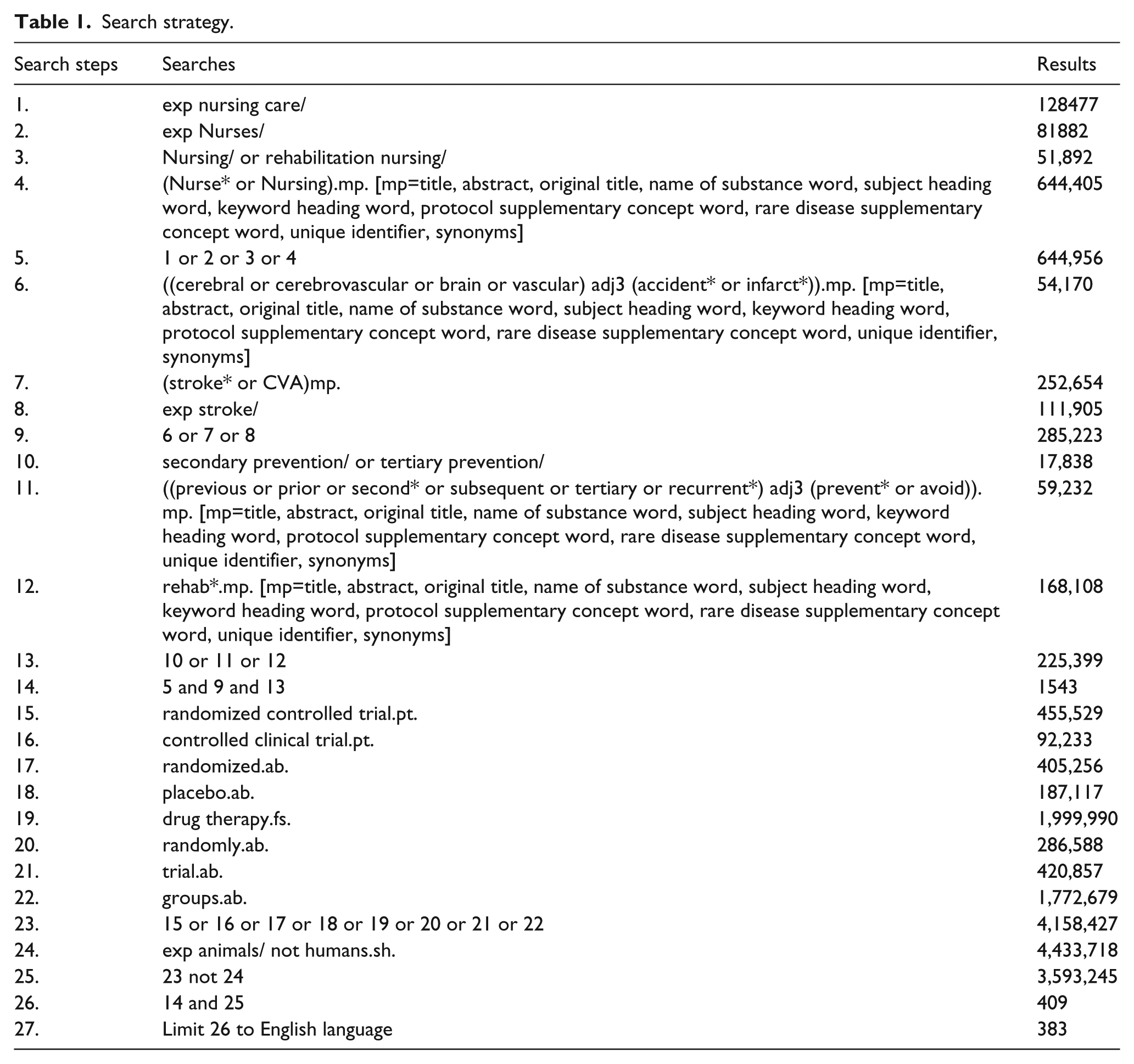
We finalized a comprehensive literature search for English language articles published in peer-reviewed journals using major electronic databases (Medline, CINAHL, EMBASE, PsychINFO, Cochrane Database of Systematic Reviews, Web of Science, Proquest Dissertation) and including articles published until the end of 2017. Our Medline search strategy is summarized in Table 1. Some of the MeSH terms and keywords included “stroke”, “secondary prevention,” and “nursing.” The studies were screened for redundant articles by entering them into a computer-based reference management system (RefWorks). 10 A second reviewer (BMS) screened abstract titles and abstracts. Full texts of selected studies from the initial screening were obtained. When there were discrepancies, two reviewers (BPP and BMS) discussed the study to reach a decision. The reference lists of these articles were hand-searched for additional relevant references. We attempted to contact researchers to learn about unpublished trials to reduce publication bias and also to clarify additional data-related questions during analysis.
Search strategy.
Data extraction
Data from selected studies were extracted into a study specific data extraction table by two reviewers (BPP and BMS) (se Supplementary Material online). The Physiotherapy Evidence Database (PEDro) scale 9 was utilized to assess for the potential bias involved in the methodology of the studies. When available, we used the scores posted on the PEDro website. PEDro scores range from 0 to 10 and trials with scores ⩾ 6/10 on the PEDro scale are indicative of moderate to high quality trials. 9 When scores were not available, both reviewers assessed the study quality independently.
Statistical analysis
Studies reporting continuous data were meta-analyzed using the SMD. 11 SMDs were pooled across studies for each outcome to obtain the pooled effect size. When medians and interquartile ranges were reported, the data were converted to means and standard deviations. 12 We characterized the magnitude of the SMD as small (0.20), moderate (0.50) or large (0.80). 13 With dichotomous data, pooled ORs and 95% confidence interval (CI) were estimated using the Mantel–Haenzel method. We estimated the effects of continuous data by finding the differences between the pre-intervention and immediate post-intervention results. The I-squared (I2) value was used to quantify the statistical heterogeneity. 14 I2 values of 25%, 50%, and 75% were considered low, moderate, and high heterogeneity, respectively. When statistical heterogeneity was 0% to 50%, the fixed-effects model was utilized. The random-effects model was used when I2 values were over 50%. The p value was set at 0.05. Forest plots were created to graphically illustrate the results. All meta-analyses were conducted using RevMan 5. 11
Sensitivity analysis
Sensitivity analyses were undertaken as part of assessing the robustness of the results. For this we excluded studies of lesser quality (less than 6 on the PEDro scale). 9
Results
Search results and study description
Of 895 titles, 16 studies met inclusion criteria (Figure 1). Sixteen studies (14 independent trials) meeting inclusion criteria are included, with a total of 3568 stroke and TIA patients. Four works15–18 reported findings based on two studies. Sample sizes ranged from 36 19 to 533. 17 Below we present the quality of the evidence using the PEDro scores and summarize key elements from the Template for Intervention Description and Replication checklist to describe the interventions. 20

Flow diagram of the search and selection process.
Quality of evidence
PEDro scores ranged from 4 21 to 8.16,17,22,23 Five studies had low quality PEDro scores of less than 6.19,21,24–26
Where the intervention took place
The studies were undertaken in the United Kingdom,22,23 Sweden,21,27 Denmark,15,16 the USA,19,28 Canada,24,29 China,25,30 Israel, 31 Australia,17,18 and Taiwan. 26 Most patients had just been discharged from hospital following their event, although some were three months 22 or nine months 23 post-event. In seven studies15,17,19,21,27,28,30 researchers enrolled hospitalized patients, followed by interventions and outcome measurements in the community, while a few initiated studies from home, 25 through stroke prevention clinic22–24,26,29 or rehabilitation centre. 31
Who provided the intervention
Interventions were conducted by stroke nurses,21,29 senior nursing students, 31 stroke nurse specialist, 22 Advanced Practice Nurse, 28 Clinical Nurse Specialists and Nurse Practitioners specialized in stroke and with special training in motivational interviewing, 24 stroke trained nurses with training in motivational interviewing, 19 stroke nurses with no formal training in motivational interviewing,27,30 and trained study nurses.15,17,23,25,26
In six studies, nurses acted alone in delivering the interventions and therefore it was a new role for the nurses,15,22,23,25,26,30 although some worked in collaboration with physicians.17,19,21,27,28
A few studies included other allied health disciplines, including a dietitian and an exercise physiologist, 19 physical therapist, 28 nutritionist and social worker, 29 physical therapist, occupational therapist, and social worker. 31
Most nursing interventions included specialized skills such as motivational interviewing and providing individual education on lifestyle changes including diet, physical activity, tobacco and alcohol use, the importance of medication compliance and its relevance to secondary prevention.15,17,19,21–31 In some studies, nurses supported patients with individual goal-setting and action planning to facilitate risk factor modification in alignment with chronic disease management principles.17,19,25,29,30 All studies focused on multiple components such as education, care planning, collaborating with physicians and other health team members, providing written and verbal information, medication review, arranging GP appointment, and sending discharge summary to the GPs.
Two studies25,29 adapted stroke knowledge questionnaires from other studies and two studies26,28 developed questionnaires for their study. We included questionnaires focused on the knowledge of risk factors for this meta-analysis, although one study 29 combined knowledge of stroke symptoms, risk factors, and actions taken.
The modes of delivery of the intervention
The mode of delivery of interventions varied across the studies. Most studies focused on face to face meetings for delivering the interventions15,17,19,21,22,26,28,31 and a few had telephone based only,27,30 both individual and telephone based interventions,23,24 group sessions, 25 and individual and group sessions. 29 Three studies involved both patients and their caregivers in the interventions.23,29,31
The control group received only usual care in eleven studies.15,17,19,21–23,25–27,30,31 Some studies provided some additional aspects, although they were not of the same magnitude as the intervention (e.g. single lifestyle counseling session; 16 educational materials; 28 or physician assessment. 24 ) No studies provided a true attention control where the amount of time and attention of the control group were matched with the intervention group.
Intensity of the interventions
The timing of the interventions ranged from 1–2 months 25 to 12 months after discharge.19,27 The duration of each intervention session ranged from 30 minutes to three hours.
Tailoring of the intervention
All studies followed a specific protocol in terms of interventions and follow-up assessments; however, care plan and the focus of the interventions were individualized to match the risk factor profile of the participants.
Adherence and fidelity
Most studies did not explain whether they assessed intervention adherence or fidelity. One multicenter study 24 did describe the use of motivational interview scripts and investigator team meetings to facilitate consistency in recruitment and follow-up processes by the case managers.
Adverse events
In general, adverse events or deaths over the study were similar between groups. Six studies recorded vascular events and/or deaths and found similar events between groups.15,17,21,23,27,28 Four studies had small numbers of serious adverse events (1–2) in one group or the other.19,24,29,30 Some vascular events or hospitalizations are expected when stroke patients are followed over several months given the age and multi-comorbidities that these patients have. One study 31 reported no hospital admission for either group over the study and another study 25 reported that 25% and 19% had dropped out in the intervention group and control group respectively, citing hospitalization as one of the reasons for dropping out. Adverse event information was not reported in two studies.22,26
Effect of interventions involving nurses on controlling medical risk factors
Meta-analysis of seven studies (n=1941)15,17,19,22–24,27 found no significant effect on SBP (SMD = −0.03 (95% CI = −0.26, 0.21), I2=82%; p=0.83) using a random-effects model (Figure 2). Pooled results from five studies (n=1372)15,22–24,27 demonstrated no significant effect on DBP using a random-effects model (SMD = 0.22 (95% CI = −0.20, 0.641); I2=93%; p=0.31) (Figure 2). However, one study 24 was an outlier, with a large effect size favoring the control group for both SBP and DBP, while the other studies had small effect sizes favoring the experimental group. In addition, this study 24 may have been weighted by outlier data; mean SBP and DBP increased by 7.2 and 22.2 mmHg, respectively, but median SBP and DBP decreased by 22 and 10 mmHg, respectively. After removing this study, the model produced a small but significant reduction of both SBP (SMD = −0.14 (95% CI = −0.23, –0.05), I2=0%; p=0.002) and DBP (SMD = −0.16 (95% CI = − 0.27, –0.05), I2=0%; p=0.003) using a fixed-effects model.
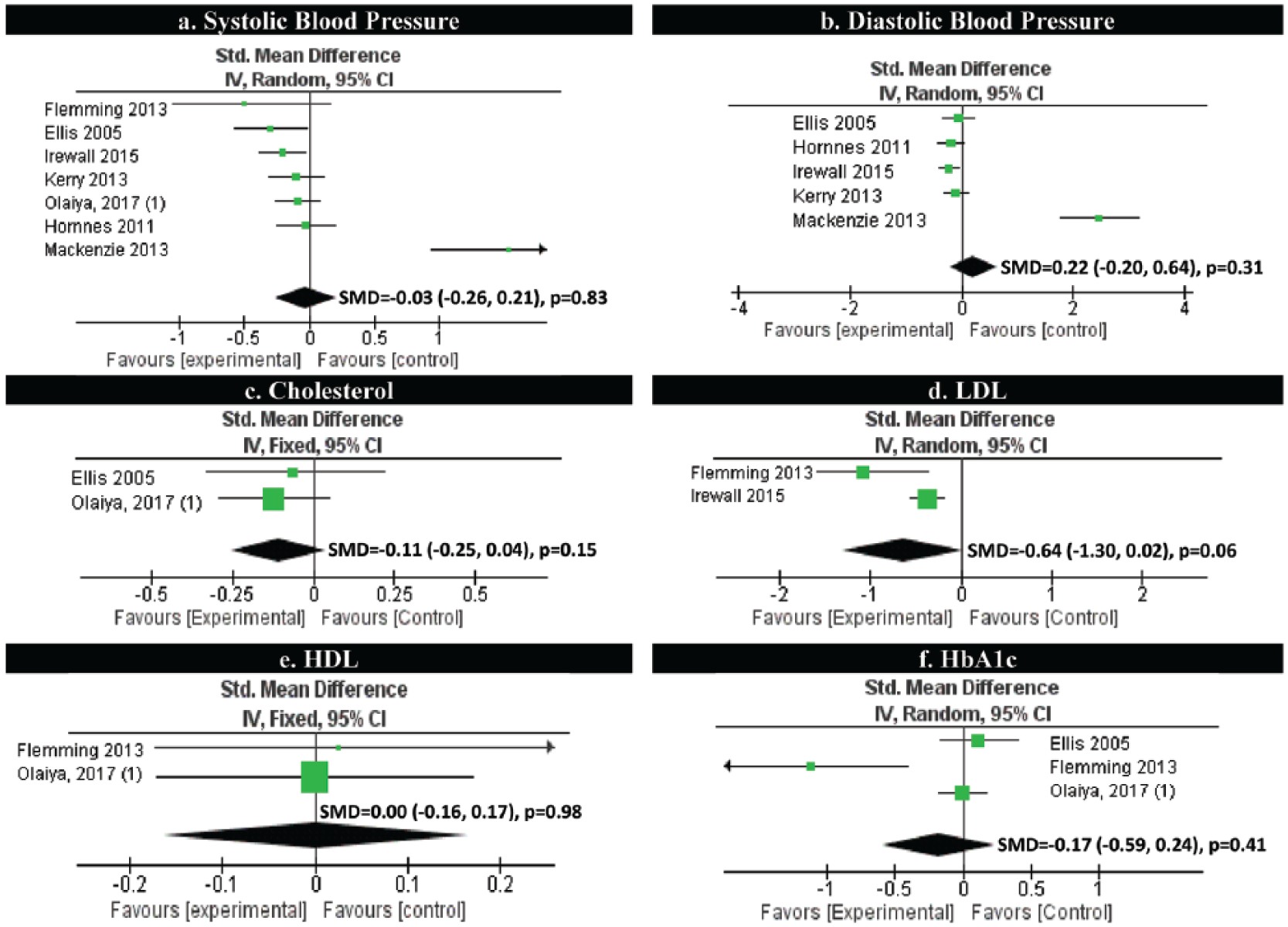
Medical risk factors: effect sizes, standardized mean differences and forest plots.
Effect of nursing interventions on controlling behavioral risk factors
Three studies (n=425) using continuous data showed that the interventions had a small, significant effect on improving diet in a fixed-effects model (SMD = −0.21 (95% CI = −0.40, –0.02), I2=33%; p=0.03)25,30,31 (Figure 3). Five studies (n=1233) reported on the number of physically inactive people post-intervention.17,19,25,28,29 A pooled random-effects model found that the intervention reduced the proportion of physically inactive people (OR = 0.60 (95% CI= 0.37, 0.97), I2=56%; p=0.04). Two studies (n=270) reported that the interventions had a significant effect on improving medication adherence in a fixed-effects model (SMD=0.41 (95% CI=0.17, 0.65), I2=0%; p=0.0009).25,30

Knowledge and behavioral risk factors: effect sizes, standardized mean differences, odds ratios and forest plots.
The role of nurses in smoking cessation through education and counseling was explored in six studies.16,17,19,21,28,29 A fixed-effects model including these six studies (n=1592) found no significant effect on smoking cessation (OR = 1.12 (95% CI= 0.87, 1.45), I2=0%; p=0.36). The role of nurses in reducing the use of alcohol was explored in three studies and found no significant effect (OR= 0.86 (95% CI= 0.46, 1.60), I2=0%; p= 0.63).
Effect of nursing interventions on improving knowledge of risk factors of stroke
A random-effects model of three studies25,26,29 (n=516) on the role of nurses in improving the knowledge of stroke risk factors found a significant effect (SMD = 0.73 (95% CI= 0.28, 1.18), I2=83%; p=0.001) (Figure 3).
Sensitivity analyses
Sensitivity analysis was undertaken by eliminating two studies19,24 that scored less than 6 on the PEDro scale for blood pressure outcomes. This resulted in significant fixed-effect models for SBP (SMD = −0.13 (95% CI −0.22, −0.04), I2=0%; p=0.004) and DBP (SMD = −0.16 (95% CI −0.27, −0.05), I2=0%; p=0.003). However, these results are likely a result of removing one study 24 which was an outlier with a large effect supporting the control group. After excluding two studies of lower methodological quality19,21 for the outcome of smoking cessation, the model (four studies, n=1165) still did not demonstrate a significant result (OR = 1.15 (95% CI 0.86, 1.54), I2= 0%; p=0.35).
Effect of nursing interventions on controlling other risk factors
SMDs and OR for other outcomes with two studies are shown in Figures 2 and 3 and are considered less robust results due to the small number of studies. Costs were not assessed in any of the studies.
Discussion
This systematic review and meta-analysis highlights the finding that interventions involving nurses are effective and play an important role in the secondary prevention of stroke. Nurses played a primary role in interventions that resulted in significant reductions in both SBP and DBP, as well as improvement in diet, physical activity, medication adherence, and knowledge of stroke risk factors. The common interventions where nurses played a major role included: 1) education and counseling on lifestyle modifications, medical risk factors, and medication adherence, 2) individual goal-setting and action planning, 3) encouragement of patients to visit their family physicians and collaborating with physicians, and 4) providing written and verbal information to patients. It was clear that nurses were facilitating complex interventions that often required individual tailoring and progression; however, little detail of the tailoring was documented in the studies. Registered nurses and nurse practitioners have the highest proportion of direct interaction among all health-care providers and play a key role in managing chronic illnesses, health promotion and disease prevention. 32 This places nurses in an ideal position to reinforce self-management skills at each encounter to influence stroke survivors to make healthy lifestyle changes.
Importantly, interventions involving nurses in this study led to the reduction in blood pressure. The mean difference of SBP from six studies in this study was found to be 2.84 mmHg and the mean difference of DBP from four studies was found to be 2 mmHg. A review of cohort studies and meta-analysis of trials of the effects of blood pressure-lowering drugs on stroke indicate that a 10 mmHg reduction in SBP is associated with a reduction in risk of stroke of 31%. 33 Thus, interventions involving nurses in this meta-analysis have the potential to reduce recurrent stroke substantially and thus improve quality of life for stroke survivors.
From this review, it is evident that interventions involving nurses that had an impact on reducing blood pressure involved a number of key tasks including counseling, education, medication review, and collaborating and communicating with physicians, rather than a single responsibility, such as managing pharmacotherapy for blood pressure control. Thus, utilization of nurse-led programs in the community may be a cost-effective approach to multimodal chronic disease management, and may have merits over depending upon primary care practitioners and other more costly resources.
Lifestyle interventions carried out primarily by nurses, or by nurses in collaboration with other team members, had a significant impact on improving physical activity, diet, medication adherence, and knowledge of stroke risk factors in this study. An interdisciplinary team combined with nursing interventions such as education, counseling, goal-setting, and action planning may have helped to achieve these results.
In contrast, nursing interventions did not appear to help patients to quit smoking or reduce use of alcohol. Although the nurses participating in this analysis had dedicated stroke training, only one study specifically stated that the nurses who provided the interventions had specialized training in motivational interviewing. Only one study included caregivers in the intervention, and this may be essential in supporting stroke survivors in their efforts with smoking cessation and alcohol use.
Readiness to initiate and sustain changes may be enhanced in recovery for both stroke survivors and their caregivers, and may enhance receptiveness to nursing interventions. As one study 34 noted, trust and communication developed between professional and patient may be essential for behavioral change. Additionally, a systematic review and meta-analysis exploring the influence of the patient–clinician relationship on healthcare outcomes suggests that the patient–clinician relationship has a small, but statistically significant, effect on healthcare outcomes. 35 Nurses’ interactions with stroke survivors in the recovery phase provide an opportunity to establish trust and develop rapport with survivors, which in turn facilitates acquisition of self-management skills for chronic illness.
Limitations
Methodological differences, which highlight the breadth of possibilities in which nursing interventions may be implemented, limit comparisons between studies in this review. There is variation in study design, interventions, mode of delivery, frequency and duration of intervention and follow–up, sample sizes, instruments used, involvement of caregivers, and variability in the members of the team and training and experience of the nurses. Individual studies may be biased by a lack of an attentional control group. The heterogeneity of the study populations, which include those with TIA, ischemic stroke and/or hemorrhagic stroke with a spectrum of functional impairments and in different phases of recovery, may further impact our study’s conclusions.
Conclusion
This meta-analysis shows the benefit of interventions involving nurses on improving blood pressure, diet, physical activity, medication adherence, and knowledge of risk factors of stroke as part of secondary stroke prevention. The education and leadership skills of nurses should be employed in designing programs that reinforce active self-management skills through education and counseling, goal-setting, action planning, and collaborating with other team members in supporting stroke survivors with lifestyle changes. While this study demonstrates the role of nurses in secondary stroke prevention, the cost-effectiveness of nurse-led programs, as well as the effectiveness of other interdisciplinary team members and how they may complement nursing interventions, needs to be explored in future studies.
Supplemental Material
Online_Supplement_May_8 – Supplemental material for Effectiveness of interventions involving nurses in secondary stroke prevention: A systematic review and meta-analysis
Supplemental material, Online_Supplement_May_8 for Effectiveness of interventions involving nurses in secondary stroke prevention: A systematic review and meta-analysis by Beena P Parappilly, Thalia S Field, William B Mortenson, Brodie M Sakakibara and Janice J Eng in European Journal of Cardiovascular Nursing
Footnotes
This meta-analysis shows the benefit of interventions for secondary stroke prevention involving nurses on improving blood pressure, diet, physical activity, medication adherence, and knowledge of risk factors of stroke. The study also demonstrates the importance of the nursing role in actively engaging stroke survivors in making lifestyle changes for secondary prevention. The education and leadership skills of nurses should be employed in designing programs that reinforce active self-management skills for stroke survivors through education/counseling, goal-setting and action planning, and collaborating with other team members in supporting stroke survivors in lifestyle changes.
Declaration of conflicting interests
The authors declare that there is no conflict of interest.
Funding
This work was supported by the Canadian Institutes of Health Research (CIHR) (FND-143340) and the Canada Research Chairs Program (to JJE) and a CIHR New Investigator Award (to WBM).
References
Supplementary Material
Please find the following supplemental material available below.
For Open Access articles published under a Creative Commons License, all supplemental material carries the same license as the article it is associated with.
For non-Open Access articles published, all supplemental material carries a non-exclusive license, and permission requests for re-use of supplemental material or any part of supplemental material shall be sent directly to the copyright owner as specified in the copyright notice associated with the article.
