






Abstract
Introduction:
Ambulatory blood pressure monitoring (ABPM) is fundamental to diagnosing and monitoring arterial hypertension (HTN), yet it is not known how effective training could be in improving knowledge of ABPM.
Purpose:
The purpose of this study was to evaluate ABPM knowledge before and after a training activity.
Methodology:
A before-and-after intervention study of 116 professionals. Data was collected on age, sex, occupational category, work setting, and work experience. ABPM knowledge was determined by a questionnaire to evaluate expertise in understanding and interpreting ABPM results.
Results:
Multivariate regression analysis showed that, pre-intervention, having more than 20 years’ experience (odds ratio (OR): 5.9; 95% confidence interval (CI): 1.3–33.9; p = 0.049) and being a doctor (OR: 5.7; 95% CI: 1.8–18.3; p = 0.004) were associated with greater ABPM knowledge. Training increased the number of professionals with adequate ABPM knowledge: 85.3% after training vs 26.7% before training. Training increased the questionnaire mean (SD) score by almost 3 (1.7) points: 9 (2.2) after training vs 6.3 (2.2) before training (p < 0.05). Of the 116 professionals, 90.5% achieved a higher overall score after training. The impact of the intervention was greatest on women nurses older than 45 years and with more years of experience, employed in primary care, and with prior experience of ABPM.
Conclusions:
Knowledge of ABPM is deficient but can be easily improved by training that is most effective in primary care and among nurses.
Introduction
Arterial hypertension (HTN) is a major health problem, given its high prevalence, 1 and it constitutes a known risk factor for developing cardiovascular disease. 2
Increasingly being used to diagnose and monitor HTN is ambulatory blood pressure monitoring (ABPM) or home blood pressure monitoring (HBPM). 3 Both these methods have acquired increasing importance due to the growing number of studies that indicate that blood pressure (BP) measurements are highly correlated with organ lesions and are better indicators of cardiovascular morbidity and mortality than single BP measurements taken in a clinical setting.4,5 HBPM is measured at home, usually mornings and evenings on the days indicated by the healthcare professional. Training is necessary for HBPM, which also has the limitation that no resting BP values are available. 6
ABPM is a measurement over 24 h; the healthcare professional fits the device and removes it after 24 h. The advantage of ABPM is that many readings are obtained and for all levels of activity, including sleep.4,5 Patients receive an information sheet and are informed that, for 24 h, they will wear a device that will record BP values periodically (every 20 min by day and 30 min by night). A buzzing sound will alert them to BP recording: the cuff will inflate and they will need to keep their arm still and relaxed to allow correct BP measurement. They are also informed that they should carry out daily activities with absolute normality and which activities they should avoid. They are asked to record in a diary the time when they take medication, their daily activities, the time they go to bed and get up and the hours of sleep. 7
ABPM, which is recommended by a number of societies,4,8 is the gold standard for accurate BP monitoring for a variety of situations, in particular: to rule out white-coat HTN, i.e. isolated clinical hypertension (ICH);9,10 for masked HTN; to obtain resting BP values, 11 for which there is growing evidence of a correlation with cardiovascular outcomes, 12 as also is the case for nocturnal BP patterns; 13 and, finally, to support general clinical decision making.
ABPM has come to be widely used in recent years and practical recommendations are available to guide use and results interpretation. 14 Although ABPM software can be programmed to provide results in the form of a report, suitable knowledge is required to be able to interpret the data. HTN is often monitored in specialist units but is most frequently monitored in primary care (PC) settings, with nurses participating, along with doctors, in diagnosis and monitoring,15,16,17 but also in patient education and in requesting complementary tests. 15 Given the progressive increase in ABPM use, therefore, it is necessary to ensure that adequate training in the interpretation of results is provided to healthcare professionals. To determine the kind of training needed, it is also useful to determine pre-training knowledge of ABPM among both doctors and nurses.
An increased use of ABPM – as a key complementary test in the diagnostic and therapeutic management of HTN, a major risk factor for cardiovascular morbidity and mortality in our setting – needs to be promoted as a new helping tool for family doctors and nurses. 6
Although knowledge of HTN, 18 and of HBPM,19,20 has been studied generically, as far as we are aware, no studies are available regarding ABPM, whether for a population of doctors and nurses or in terms of training outcomes. Our primary objective was to assess the effect of a training program on knowledge of ABPM among nurses and doctors. The second objective was to identify the factors associated with knowledge of ABPM.
Methodology
Study design, place, and setting
This before-and-after intervention study was based on two ABPM workshops, one each run at National Conferences on Arterial Hypertension held in Barcelona in 2015 and 2016. Inclusion criteria were to be a doctor or nurse, to work in a PC or hospital setting in Catalonia (Spain), to participate in the workshop as a student, and to give consent to take part in the study. No sample size was calculated.
Intervention
The educational activity took the form of workshops each lasting two hours and based on predominantly practical content (Table 1). Training was designed to ensure that the healthcare professionals could read and interpret ABPM outputs according to the latest HTN guidelines of the European Society of Hypertension. The activity – developed by a multidisciplinary team consisting of a doctor and a nurse and tested in our own setting – was rather unusual in that it was short and predominantly practical. It included a theoretical component, a video that showed the different ABPM steps and a discussion of real-life clinical cases – including ICH, masked HTN, resistant HTN, pseudo-resistant HTN, and masked poor control of HTN – so as to review normal values for each situation.
Description of the ABPM training intervention.

Questionnaire
We used the Knowledge of Ambulatory Blood Pressure Monitoring (KABPM) questionnaire, 21 a specific questionnaire that was developed, designed and validated to assess knowledge of ABPM according to current psychometric recommendations. 22 In the validation study, 21 based on a sample of 103 healthcare professionals who participated in National Conferences on Arterial Hypertension held in Barcelona in 2013 and 2014, internal consistency and temporal stability for the questionnaire and scores were evaluated. Internal consistency according to Cronbach’s alpha was 0.76 and interclass correlation on administering the KABPM twice to 20 respondents not included in the sample was 9.98 (95% confidence interval (CI): 0.94–0.99).
The KABPM questionnaire (Table 2) assesses capacity to interpret ABPM test results according to the latest European guidelines.6,14 It consists of 10 items encompassing four aspects: test validity (1 item), indications (2 items), normal parameters (3 items), and clinical situations (4 items). Each item has four possible responses, only one of which is correct. Responses are scored 0 if incorrect and 1 if correct and the minimum and maximum scores, calculated by adding up the score for each item, are 0 and 10, respectively.
KABPM questionnaire (correct responses indicated in bold).
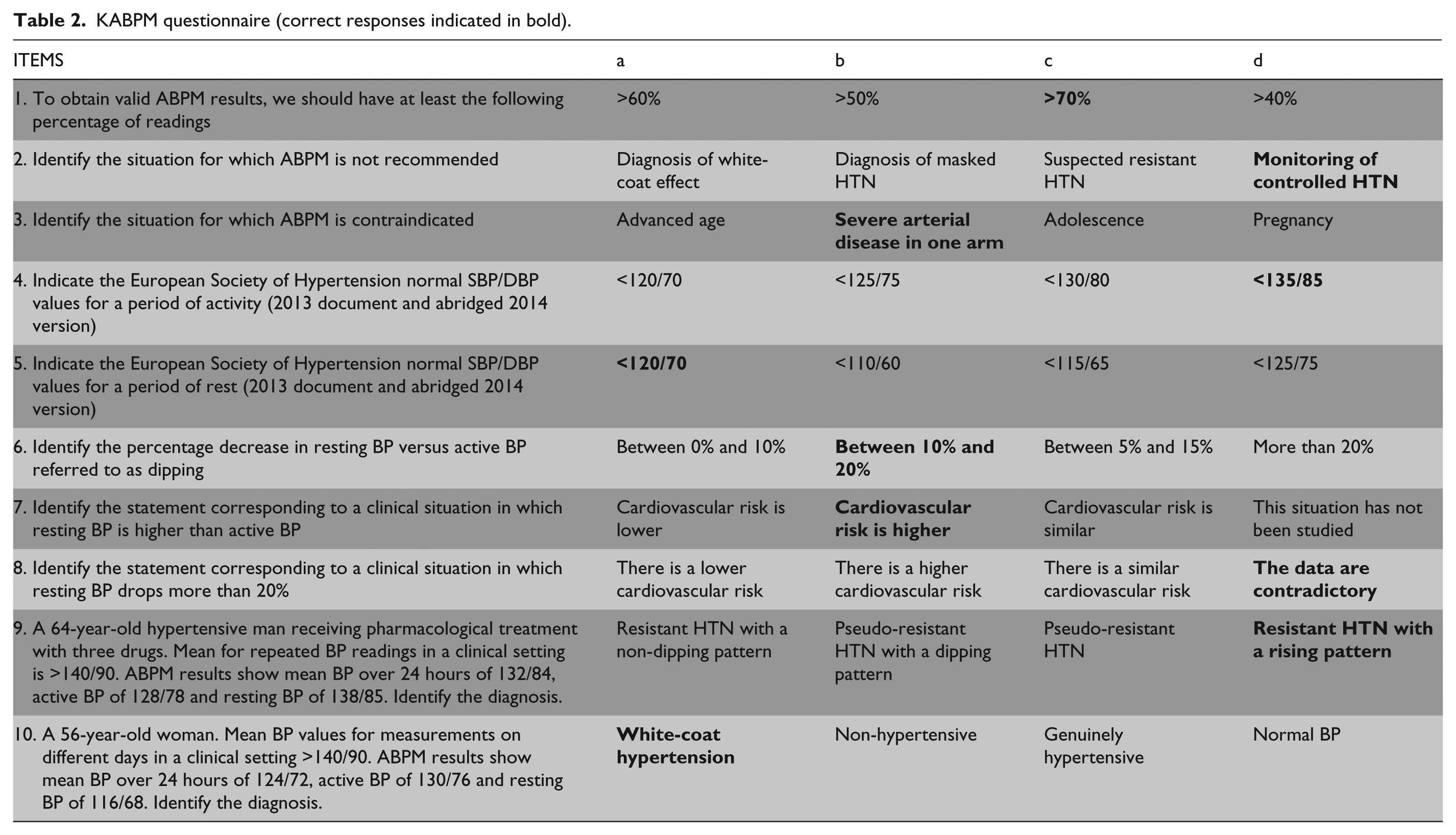
Adequate and inadequate knowledge of ABPM were defined as eight or more correct responses and seven or fewer correct responses, respectively. This cutoff was chosen as the cutoff used in other recent studies that have evaluated knowledge of HTN, 23 of breastfeeding, 24 and of heart failure. 25
This self-administered and anonymous questionnaire was completed at the beginning and end of the training activity.
Data collection
Data collection took place in December 2015 and 2016. Sociodemographic variables (age and sex), professional category (doctor/nurse), year when formal education was completed (to calculate years of experience), occupational setting (PC or hospital), prior experience (if any) of ABPM and KABPM questionnaire score were recorded.
The study complies with the principles of the Declaration of Helsinki, 26 and was approved by the Clinical Research Ethics Committee of the University Primary Care Research Institute (P17/177).
Statistical analysis
Qualitative variables were reported as frequencies and percentages. Quantitative variables and total scores were reported as means and standard deviations (SDs).
Univariate analysis and multivariate logistic regression were used to identify factors associated with knowledge of ABPM. Factors considered for the regression model were age, sex, professional category, years of experience, setting and experience (if any) with ABPM. The age cutoff (<45 and ≥45 years) and professional experience cutoff (<20 and ≥20 years) were chosen as the mean and median values for both variables, which were normally distributed.
Odds ratios (ORs) were calculated for a CI of 95% and the level of statistical significance was set to p < 0.05.
To evaluate the impact of the intervention, the effect size was calculated as differences in mean values before and after the intervention divided by the pre-intervention SDs.
No sample size was calculated. Statistical analyses were performed using SPSS 22.0.
Results
Participant characteristics
A total of 116 professionals participated in the training provided in the two workshops, 50 in the first workshop and 66 in the second workshop. No participant repeated a workshop. Table 3 summarizes sociodemographic and clinical data for the participants.
Characteristics of the intervention group.

Level of knowledge: questionnaire scores
Figure 1 shows the percentages of correct responses for each of the ten items before and after the intervention. Pre-intervention, the highest level of knowledge was for item 2 (regarding when ABPM would not be indicated) and item 7 (regarding risk associated with higher resting BP than active BP values), at 91% and 87%, respectively; conversely, the lowest level of knowledge was for item 5 (referring to normal range at rest) and item 8 (referring to risk associated with an increase of >20% in resting BP), at 50% and 20.7%, respectively. In terms of professional category, variation between doctors and nurses was between 54.2% and 45.6% (p = 0.353) for item 5 and between 35.6% and 5.3% (p < 0.05) for item 8.
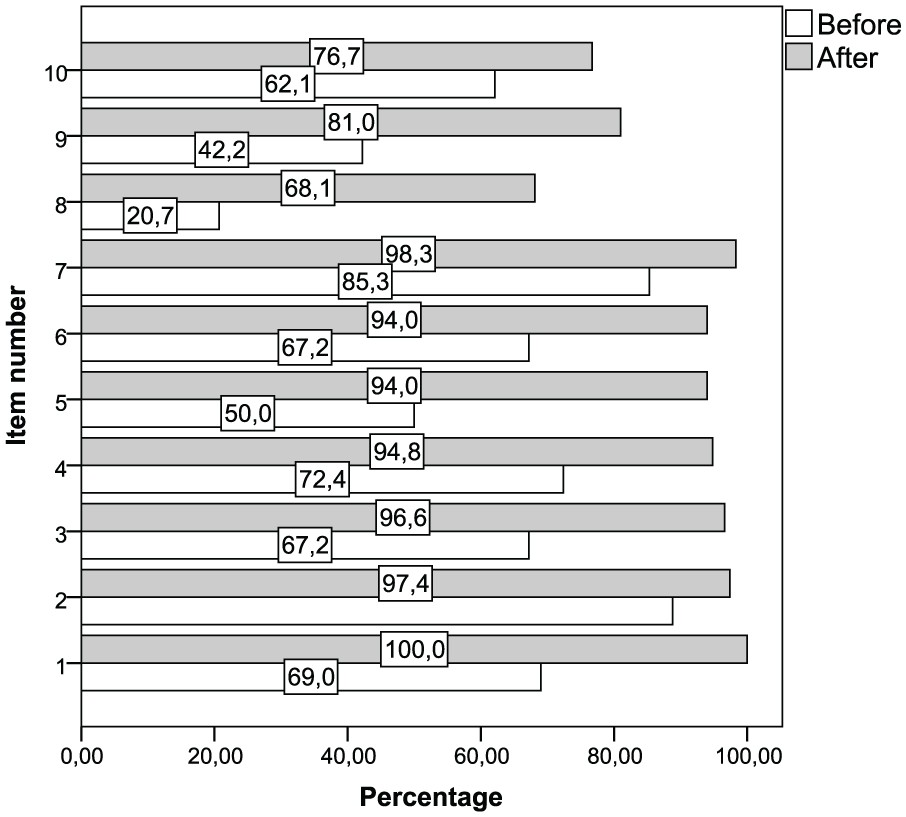
Correct pre- and post-intervention response percentages for each of the 10 items in the KABPM questionnaire.
Correct scores for items post-intervention were over 94%, except for items 8, 9 (a clinical case of resistant HTN with a rising pattern), and 10 (a clinical case of white-coat HTN), at 68.1%, 81%, and 76.7%, respectively. For items 8, 9, and 10, doctors vs nurses scored 84.7% vs 50.9% (p < 0.05), 84.7% vs 77.2% (p = 0.300), and 83.1% vs 70.2% (p = 0.101), respectively.
Factors associated with adequate pre-intervention ABPM knowledge
For the 116 professionals who completed training and responded to the questionnaire, adequate knowledge was defined as a score of at least 8 out of 10 correct responses. Of the 116 professionals, 31 (26.7%) had adequate ABPM knowledge prior to training.
Univariate logistic regression revealed a significant relationship between greater knowledge of ABPM and being a doctor (OR: 3.3; 95% CI: 1.5–7.1; p = 0.001).
Multivariate regression analysis adjusted for the different variables showed that having more than 20 years of experience (OR: 5.9; 95% CI: 1.3–33.9; p = 0.049) and being a doctor (OR: 5.7; 95% CI: 1.8–18.3; p = 0.004) were associated with greater knowledge of ABPM (Table 4).
Factors associated with adequate ABPM knowledge: univariate and multivariate regression analyses.

Adequate knowledge: 8 or more correct responses to the 10 questions in the KABPM questionnaire.
Effect of the intervention
Of the 116 professionals, 105 (90.5%) obtained a higher post-intervention score, for a mean (SD) improvement of 3 (1.7) points, whereas 11 (9.5%) obtained the same pre- and post-intervention score. Adequate ABPM knowledge was demonstrated by 85.3% of professionals after training compared to 26.7% before training (p < 0.05). Table 5 shows the mean (SD) scores obtained before and after training, with a statistically significant improvement observed in all cases: overall, 6.3 (2.2) before training vs 9 (2.2) after training (p < 0.05). The impact of the intervention was greatest on women nurses older than 45, working in PC, with previous ABPM experience and with more experience in healthcare (>20 years).
Pre- and post-training scores, mean differences and effect size.

A significant improvement was noted in the percentage of correct responses for all four aspects of ABPM evaluated (Table 6).
Pre- and post-training scores for specific ABPM aspects.

Discussion
The level of knowledge of ABPM among participants was deficient, even if not especially low. There were disparities between doctors and nurses – most especially in knowledge of the variables that affect normal limits and that have an impact on clinical practice – as evidenced by the lower percentage of correct responses obtained from nurses and by the fact that ABPM is not fully integrated in routine practice.
Regarding the items that received the highest scores, these were item 2 (referring to when ABPM is not recommended), for which the correct response was monitoring of controlled HTN, which can be done initially with HBPM as the most easily accessible method, 27 and item 7 (the clinical situation corresponding to resting BP higher than active BP), for which the correct response was that cardiovascular risk was higher.
The improved mean score overall and across the four aspects of the questionnaire is meaningful, not only because it is statistically significant, but also because of its clinical relevance in terms of better diagnosis and monitoring, especially of active BP, resting BP and nocturnal BP. If BP levels need to be brought under control, appropriate therapeutic measures can be implemented in accordance with the protocols established for each care center.
Since no similar studies are documented in the literature, we were not able to draw any comparisons. One aspect not covered by our study was whether an analysis of responses before training took place could have better targeted training to identified knowledge gaps.
In Spain, nurses are generally responsible for monitoring patients with HTN. 15 In accordance with risk prevention and health promotion guidelines, 28 they make initial BP measurements that they repeat when values are high. In the event of HTN (but excepting emergency cases or extremely high values), 9 nurses may, in the interest of efficiency and bearing in mind differing monitoring considerations for particular circumstances,6,29 request ABPM to rule out ICH. 30 Although there are no clinical trials in recent years that indicate that ABPM reduce morbidity and mortality. 27 Logically, clinical decision making should be based more on BP values monitored outside the healthcare setting, as these better reflect a patient’s real BP. There is, in fact, growing evidence to support ambulatory measurements, 31 and also nocturnal BP measurements, which can only be done using ABPM. 32
At the practical level, a nurse with sufficient training in HTN can interpret ABPM output, while interpretation requires experience of ABPM.33,34 Our study demonstrates that a training intervention can produce excellent outcomes in terms of improved ABPM knowledge, with the associated clinical implications.6,35
Insofar as limitations of this study are concerned, we do not know what results may have been obtained with a different kind of training from the two-hour practical workshop, which was pragmatically considered to be the most suitable form of training in the context of a conference on HTN. There is also a probability of bias arising from the fact that workshop attendees were professionals with a special interest in ABPM; nonetheless, it is undoubtedly important that ABPM implementation be led by motivated individuals. 36 Finally, the reference documentation for our questionnaire was that of the European Society of Hypertension.6,14 If the questionnaire had reflected the criteria of any other guidelines or society, the responses would have been identical in nine of the ten questions, leaving just the first question (regarding the percentage of readings) to possibly be answered differently. 8
To sum up, a short, flexible training activity, like the workshop format we have described, can significantly improve understanding and interpretation of ABPM results among healthcare professionals, most especially among nurses. Improvement can be measured by comparing scores, before and after training, for responses to a questionnaire like the KABPM, which has demonstrated a high level of sensitivity and reliability.
Footnotes
Acknowledgements
We thank the nurses and doctors who participated in the two workshops and gave their informed consent to this study. We also acknowledge the Societat Catalana d’Hipertensió Arterial for its support. Ailish Maher assisted with the English in a version of this manuscript.
Ambulatory blood pressure monitoring is an effective arterial hypertension diagnosis and monitoring tool. Ambulatory blood pressure monitoring knowledge is inadequate among health professionals, and particularly among nurses, who play a key role in monitoring hypertension in Spain. A short ambulatory blood pressure monitoring training activity is an effective way to rapidly improve knowledge of ambulatory blood pressure monitoring outputs and interpretation.
Declaration of Conflicting Interest
The authors declare that there are no conflicts of interest.
Funding
This research received no specific grant from any funding agency in the public, commercial, or not-for-profit sectors.