






Abstract
Background:
Individuals with disabilities have health needs similar to the general population. Smoking and metabolic syndrome have emerged as major cardiovascular risks that contribute to systemic inflammation and mortality. However, few studies have focused on the association between smoking and cardiometabolic risks in adult men with disabilities.
Aims:
This study explored the prevalence of smoking and its association with cardiometabolic risk and associated factors among male adults with disabilities.
Methods:
This study was part of a nurse-led health-promotion program designed to examine the health needs in health programs for adults with disabilities. A community-based, cross-sectional study was conducted between July 2013–December 2014, in Chiayi County, Taiwan.
Results:
Of the total of 964 male participants enrolled in this study, 874 (90.7%) participants had complete data sets. The prevalence of cigarette smoking and metabolic syndrome were 42%, and 33.3%, respectively. More than half (62.7%) had high blood pressure and 43.5% had central obesity. Compared with non-smokers, smokers tended to engage in less frequent regular exercise (p<0.001), eat fewer vegetables and fruit (p<0.05), and drink less water (p<0.05). After adjusting for potential confounding variables, multivariable logistic regression analysis showed that smoking was an independent factor for cardiometabolic risk.
Conclusion:
The present findings show a high prevalence of cigarette smoking, unhealthy lifestyle, and cardiometabolic risk among adult men with disabilities. Clinicians and primary healthcare providers should reduce the consequences thereof by initiating innovative health promotion programs.
Introduction
According to the World Health Organization (WHO), 1 disability includes three dimensions: (a) impairment, e.g. loss of a limb, loss of vision or memory loss; (b) activity limitation, e.g. difficulty seeing, hearing, walking, or problem-solving; and (c) participation restrictions, e.g. engaging in social and recreational activities, as well as obtaining healthcare and preventive services. Over a billion people, about 15% of the world’s population, have some form of disability. Rates of disability are increasing due to population aging and increases in chronic health conditions.1,2 There are more than one million people registered as disabled by the government in Taiwan; 3 the five most common disabilities include physical disability, loss of vital organs, hearing impairment, intellectual disability, and a combination of disabilities. Some studies indicate that health promotion and prevention activities seldom target people with disabilities. 1 Considering human rights and the essence of nursing, individuals with disabilities need healthcare and health programs for the same reasons as non-disabled individuals.
During recent decades, life expectancy at birth has increased in Taiwan; for example, the life expectancy in 2015 for women was 83.6 years. However, men still have a 6−7-year shorter lifespan than women do. 4 In addition to sex-linked genetic reasons, many unhealthy habits are more common in male populations in developed countries.1,5 For instance, the smoking rate for individuals aged 18 years and over in Taiwan was 28.5% for men and 1.9% for women. 6 Furthermore, adults with disabilities are more likely to smoke cigarettes, have a poor diet, and be less physically active than adults without disabilities in the USA and many other countries.1,2 The higher prevalence of smoking among adults with disabilities suggests that this population is at increased risk of death and disease. However, few studies have focused on the association between smoking on cardiometabolic risk in adult men with disabilities.
Cigarette smoking is one of the main risk factors for a number of chronic diseases, including cancer, lung disease, oral disease, and cardiovascular disease, possibly by causing vascular disruption and platelet activation, oxidation and inflammation, endothelial dysfunction, increased vascular stiffness, and changes in vascular structure.7–9 Numerous studies indicate that active and persistent smoking might worsen the degree of disability and disease clusters, including beta cell dysfunction, increased visceral fat, insulin resistance, metabolic syndrome (MetS), and diabetes mellitus.10–17 MetS has been defined as the presence of three or more risk factors, including abnormal waist circumference, and increased blood pressure, high-density lipoprotein-cholesterol, fasting blood glucose, and triglyceride level.11,18,19
In Taiwan, cardiometabolic-related diseases, including heart disease, stroke, diabetes, and hypertension, are the second, third, fifth, and eighth most common causes of death, respectively. 4 A few studies indicate that adults with disabilities exhibit a high prevalence of metabolic syndrome and that this is significantly associated with having a sedentary lifestyle.20,21 However, no study has focused on the association between smoking and cardiometabolic risk in adult men with disabilities in Taiwan.
Methods
Design, sample, and setting
This study was part of a nurse-led health promotion program for a community of adults with disabilities, in collaboration with a local hospital and the Bureau of Health Promotion in Chiayi County, Taiwan. There are at least 37,000 people with disability registered by the local government. 3 Participants were selected by convenience sampling from these records. This program consisted of three phases, comprising needs assessment, individual-tailored care, and evaluation. The first phase took place between July 2013–December 2014, the goal of which was to understand the needs of the health promotion program for adults with disabilities. The present study also collaborated with a local hospital for the annual physical check-up. The inclusion criteria were (a) a certified disability by the Chiayi government and age >20 years, (b) ability to complete the questionnaire with or without assistance, (c) ability to walk to the community centers, and (d) ability to sign an informed consent form. Exclusion criteria were (a) inability to answer questions, (b) severe cognition limitation, and (c) inability to provide informed consent. Considering women have a lower prevalence of smoking habits (n=15, 2%), the smoking aspect of this study only focused on men.
Procedure and ethical considerations
The institutional ethical committee review board approved (No 102-3331B) and conducted in accordance with the principles of the Declaration of Helsinki (2008). The Bureau of Health Promotion sent a letter providing detailed information concerning free health check-ups and inviting individuals to participate in this study. The research team described the purpose of the study to all participants, such as the time required, the drawing of a blood sample, and interview contents prior to its initiation. All participants provided written informed consent. Participants in each district were interviewed privately, in each community center during a health check-up.
Measurements
Demographic characteristics included age, sex, educational attainment (years of education received or level of school completed), and disability classification (based on government classifications, e.g. physical disabilities, intellectual disabilities, hearing- or vision-impaired, or combined). 22
Cigarette smoking was determined by asking each participant “Do you smoke cigarettes?” Participants were classified as “non-smoker” if they reported having never smoked; “smoker” if they reported that they were current smokers or they were previous smoker and had ceased smoking.
Cardiometabolic risk factors and MetS were determined based on the national standard; 19 briefly, the presence of one of the following five biomarkers was classified as a cardiometabolic risk factor: (a) waist circumference >90 cm, (b) systolic/diastolic blood pressure >130/85 mmHg (hypertension), (c) high-density lipoprotein-cholesterol (HDL-C) <40 mg/dl, (d) fasting blood glucose >100 mg/dl, and (e) triglyceride level >150 mg/dl. MetS was defined as the presence of three or more of these risk factors. Blood samples were drawn after an eight-hour fast, and serum biomarkers were measured enzymatically at the central laboratory of the cooperating hospital.
Healthy lifestyle was determined as previously defined.18,19,23,24 Participants were asked questions regarding four lifestyle habits, with responses categorized as “always,” “usually,” “seldom,” or “never.” For evaluation, responses were combined as usually/always and never/seldom. Regular exercise was determined according to whether participants usually/always exercised for >30 min, at least three times per week, or seldom/never engaged in exercise. Adequate vegetable intake was determined by asking “How often do you consume three portions of vegetables (1.5 bowls) per day?" Adequate fruit intake was determined by asking “How often do you consume two portions of fruit (one bowl) per day?" Adequate water intake was determined by asking “How often do you consume at least 1500 ml of water per day?” To consider reducing the measuring error and recall bias, we showed a 500-ml plastic water bottle and a normal-sized bowl (240 ml) as examples on the desk to confirm that they adopted the adequate amount of water, vegetable, and fruit in each day. The example bottle and bowl are ones commonly used in Taiwan.
Data analysis
SPSS 22 (IBM Corp., Armonk, New York, USA) software was used for statistical analysis. The participant’s characteristics were presented as mean±standard deviation for continuous variables, or as frequency and proportion for categorical variables. Student’s t, and the chi-squared test were used to compare continuous, and categorical variables, respectively. To investigate whether smoking is an independent factor for cardiometabolic risk and metabolic syndrome, logistic regression analyses were performed, with adjustment for several confounders. Likewise, the association between smoking and number of components of MetS was tested using linear regression analyses. In Model 1, smoking was the only independent variable. Model 2 adjusted for age, education, and disability level. Model 3 further adjusted for marital status, job level, and exercise frequency, and model 4 further adjusted for consumption of water, vegetables, and fruit. In the fully-adjusted logistic regression model, there were a total of 10 explanatory variables and 291 events (MetS), resulting in approximately 30 events per variable. A value of p<0.05 was considered to be statistically significant.
Results
Demographic characteristics of participants
Of the total 1526 participants who were invited to participate in the first phase, 964 male participants were enrolled in this study, and 874 (90.7%) participants who had complete data sets and met the criteria were analyzed. Table 1 shows that the average education level in the group was 8.7 years. The prevalence of MetS in this study was 33.3%; on average, each participant had two components of MetS. To explore the association between smoking habit and cardiometabolic risk factors, additional analyses were added, in which the smoking habit was categorized into three groups: never smoker (n=507, 58%), previous smoker (n=168, 19.2%) and current smoker (n=199, 22.8%). Mild differences in the characteristics between previous smokers and current smokers were noted. When analyzing the number of components of MetS, both previous smokers (B, 0.35; 95% confidence interval (CI), 0.13–0.54; p=0.002) and current smokers (B, 0.31; 95% CI, 0.11–0.51; p=0.003) had greater numbers than never smokers in the fully adjusted linear regression model. Considering the similar result (data not shown) and limited space, we included previous smokers into the smoker group. Compared to non-smokers group, smokers were slighter older (mean difference, 2.06; 95% CI, −0.28–4.41, p=0.085) and tended to have lower education levels (mean difference, −0.57; 95% CI, −1.15–0.0003; p=0.0501), although this did not reach the level of significance.
Characteristics of the male participants (n=874).
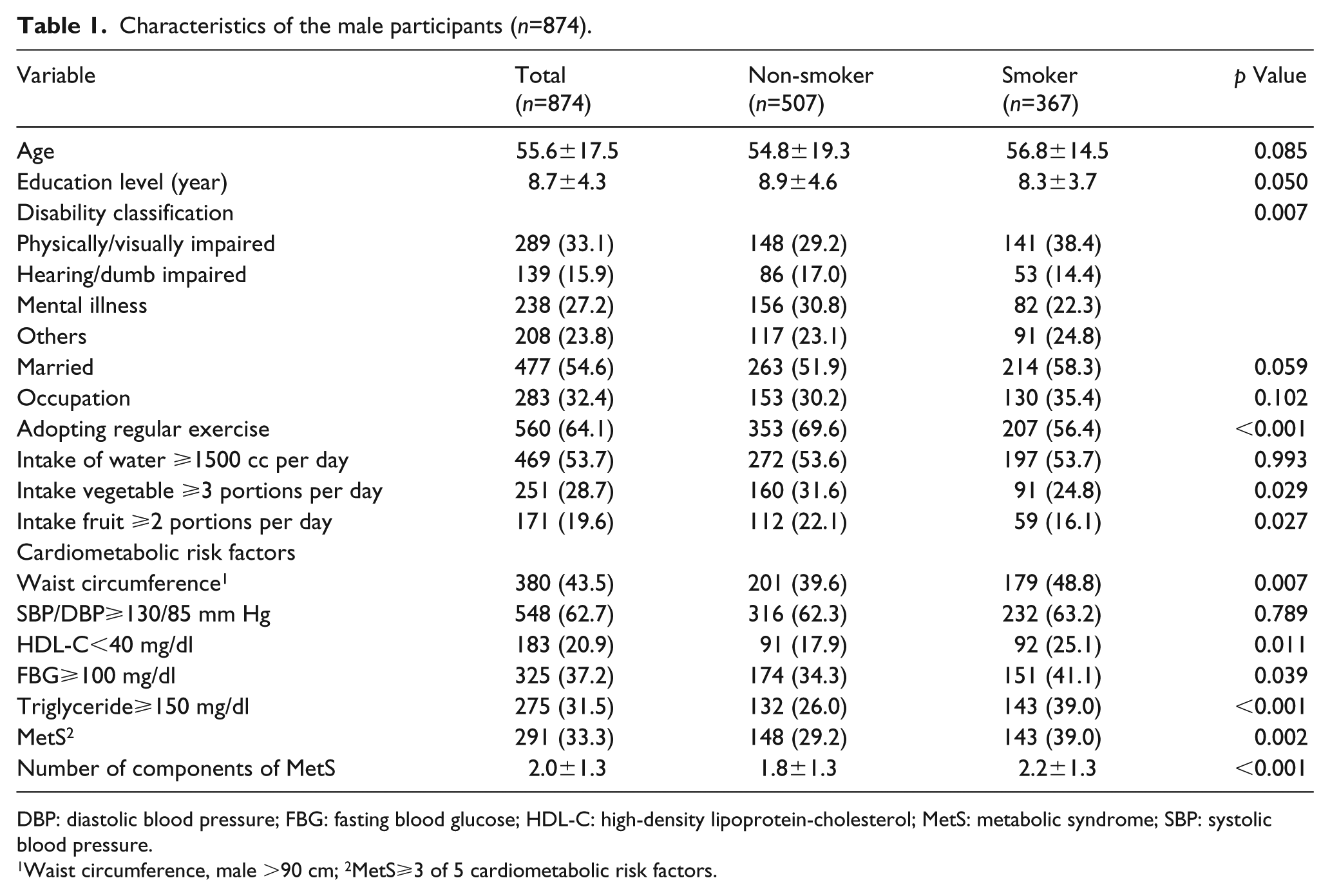
DBP: diastolic blood pressure; FBG: fasting blood glucose; HDL-C: high-density lipoprotein-cholesterol; MetS: metabolic syndrome; SBP: systolic blood pressure.
Waist circumference, male >90 cm; 2MetS⩾3 of 5 cardiometabolic risk factors.
The proportion of physical or visual impairment was higher in smokers, while that of mental illness was higher in non-smokers. Smokers demonstrated a poorer lifestyle, including lower engagement in regular exercise and insufficient intake of both vegetables and fruit. Regarding cardiometabolic risk factors, the prevalence of MetS components (except for hypertension) as well as the presence of MetS was higher in smokers than that in non-smokers (Table1, Figure 1(a)). Figure 1(b) shows that the mean number of MetS components was greater in smokers than in non-smokers (2.2 vs 1.8; mean difference, 0.37; 95% CI, 0.19–0.54; p<0.001).
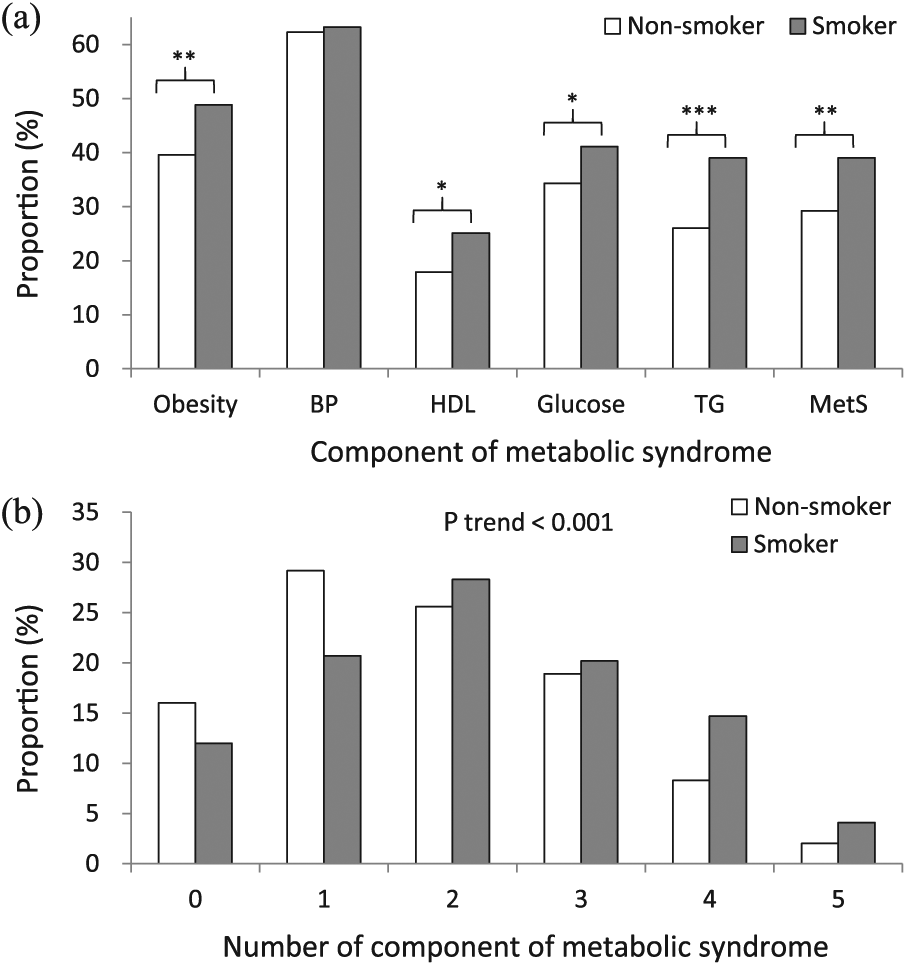
Prevalence of cardiometabolic risk factors and metabolic syndrome (MetS) between the non-smokers and smokers (a) and cross-tabulation between smoking status and number of component of cardiometabolic risk factors (b).
Association between smoking and metabolic syndrome
In the fully-adjusted model (Model 4), the variance inflation factors of explanatory variables ranged from 1.1 (smoking) to 2.0 (age), indicating there was no multi-collinearity among the predictors. Table 2 shows that smoking was correlated with MetS when there was no adjustment for confounders (odds ratio (OR), 1.55; 95% CI, 1.17–2.06). This correlation was still significant after adjusting for age, education, and disability (OR, 1.50; 95% CI, 1.12–2.00). The effect of smoking remained when marital status, employment status, and exercise were further adjusted (OR, 1.51; 95% CI, 1.13–2.03). Finally, smoking was an independent factor for MetS after controlling for intake of water, vegetables, and fruit (OR, 1.49; 95% CI, 1.11–2.01). The Hosmer and Lemeshow goodness-of-fit test of Model 4 showed an insignificant result (χ2=7.86, p=0.447) which indicated the model was well-calibrated. Similarly, in the multivariable linear regression analysis, smoking was associated with a greater number of MetS components (B, 0.33; 95% CI, 0.16–0.51) (Table 3). In addition, no significant interaction effects were detected between smoking and the control variables in either of the logistic or linear regression models (data not shown).
The association between smoking and metabolic syndrome.
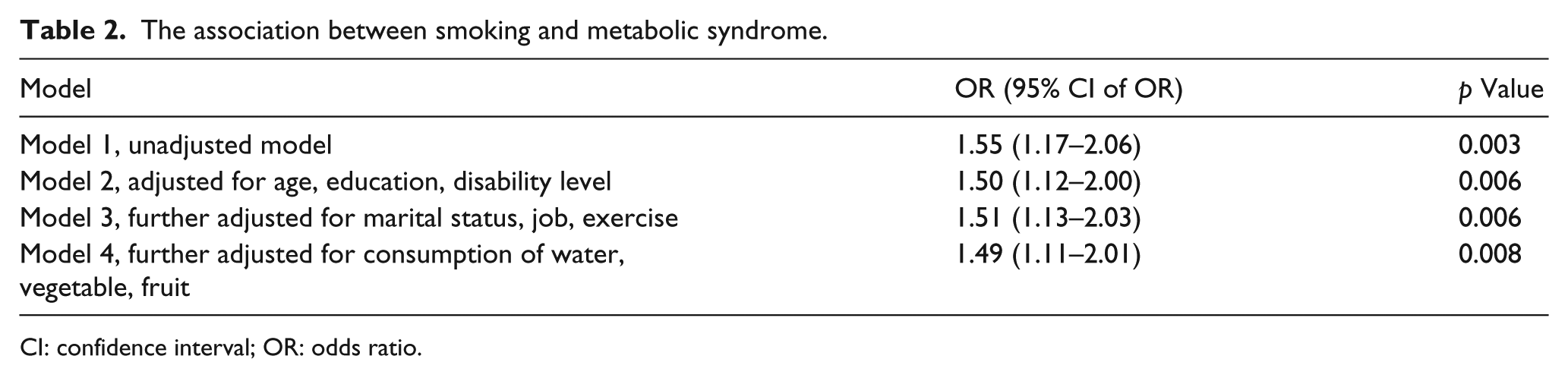
CI: confidence interval; OR: odds ratio.
The association between smoking and the number of component of metabolic syndrome.
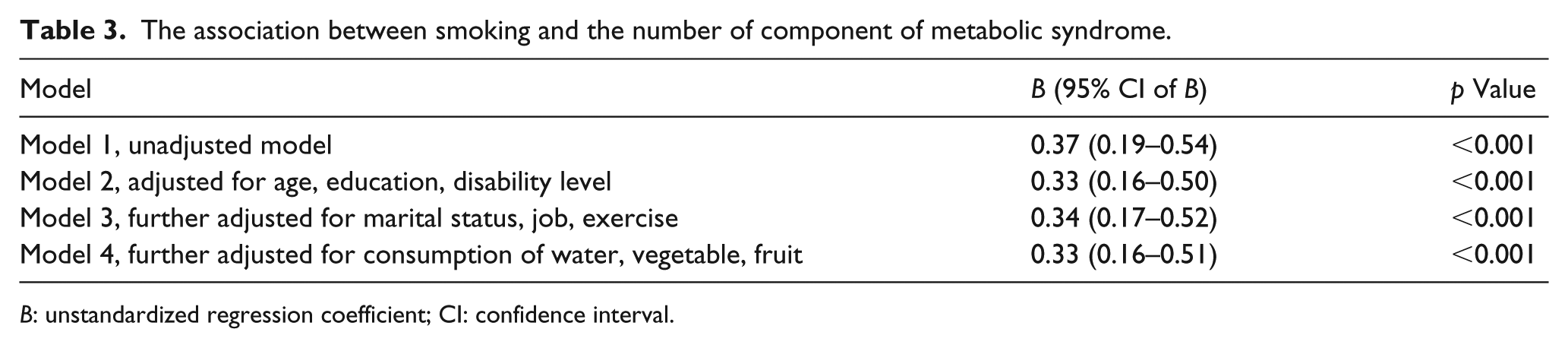
B: unstandardized regression coefficient; CI: confidence interval.
Discussion
The aim of this study was to explore the prevalence of smoking and its association with cardiometabolic risk among male adults with disabilities and to identify the associated risk factors. Three key findings emerged from this study. First, a high prevalence of cigarette smoking and cardiometabolic risk was found. Second, smoking was an independent factor of cardiometabolic risk. Third, smokers tended to adopt an unhealthy lifestyle.
Smoking and cardiometabolic risk
Recently, Taiwan officially reported that cigarette smoking significantly declined among adults from 32.5% in 1990 to 15.3% in 2016. 6 However, the present study showed that 42% of participants reported being current or previous smokers. This rate is higher than that in the adult male population in Taiwan (28.5%) 6 and in male adults with disabilities (25.5%) in the USA.2,25 In addition, this study indicated that smokers received only an average of 8.3 years of education. This finding echoes some previous studies reporting a high prevalence rate of smoking in the population with a low socioeconomic status.6,25,26 The present study found a high prevalence of cardiometabolic risk factors, especially participants who were smokers, including low HDL-C, high fasting blood glucose, and high triglyceride levels. Moreover, one-third of these individuals met the criteria for MetS. These results echoed previous findings that active and persistent smoking might increase visceral fat, insulin resistance, MetS, and diabetes mellitus.10–17
Smoking and lifestyle
The present study showed that many participants did not have healthy habits, including a lack of regular exercise and inadequate vegetable and fruit intake. This phenomenon was worse in smokers, in whom only 16% and 25% ate two portions of fruit, and three portions of vegetable per day, respectively. This finding was similar to a study in the USA, wherein Bly et al. 20 found the MetS rate was higher in individuals with bipolar disorder (33%) and schizophrenia (47%) compared to the matched general population (17% and 11%, respectively). In a series study in a rural environment, our research team 26 also found that smoking in adult men is negatively associated with overall health promoting behaviors, especially with engaging in exercise and consuming adequate vegetables and fruit.
According to some systematic reviews, Noble et al. 27 and Meader et al. 28 found there was a co-occurrence or clustering of unhealthy behaviors, including smoking, poor nutrition, alcohol misuse, and physical inactivity in general adult populations, especially among male adults and socially disadvantaged people. Furthermore, our research team, Pan et al. 29 found tooth loss and edentulism were highly prevalent among adults with disabilities; these adults displayed poor oral hygiene behaviors. This phenomenon might explain part of the reason for a less healthy diet in this population. According to a community-based cohort study, Jacob et al. 30 showed that a healthy lifestyle, e.g. non-smoking, healthy eating, physical activity, and non-obesity, could shorten the period of disability, and delay it until the end of life.
Unlike other health resource-limited countries, Taiwan has implemented national health insurance for more than 20 years, especially aiming at assistance for the underprivileged minority. In addition, the official report indicates that there are more than 2600 clinics and hospitals providing smoking cessation, counseling and free on-call telephone services nationwide. 6 Despite the prevalence of physicians, many of the smoking cessation counselors are nurses who have received a three-level training course. The question remains as to why smoking cessation programs are not completely effective. As the WHO 31 recently recommended, approaching the prevention of chronic diseases should focus on the disease as well as multiple modifiable risk factors. Further studies should consider workable and comprehensive health promotion strategies to increase awareness for the male adults with disabilities, and not just the risk factors independently.
Despite the valuable findings in this study, some limitations should be noted. First, smoking habit was determined by self-report and without confirmation using urinary nicotine levels. Further studies should include the objective assessment of cigarette smoking, e.g. carbon monoxide and nicotine testing. Second, the non-random sampling and limited geographical scope limit the generalizability of these findings. Third, recall bias must be considered because the participants had different durations of disability, nor did we control for other health conditions. Finally, due to the lack of history-taking for cardiometabolic risks, e.g. taking medications for hypertension or diabetes, the present findings might underestimate the prevalence of cardiometabolic risks.
Conclusion
Despite these limitations, the findings reveal a high prevalence of smoking, unhealthy habits, and cardiometabolic risk factors among male adults with disabilities. Reducing health disparities is an important goal for public and private health agencies in Taiwan. Considering human rights, early initiation of innovative smoking cessation programs, combined with comprehensive health promotion strategies, such as combining the unhealthy behaviors of SNAP together for these disadvantaged people, is an important issue. Community nurses and clinicians could reduce the consequences of smoking-induced cardiometabolic-related diseases by initiating innovative programs for adult men with disabilities.
Footnotes
Acknowledgements
The authors would like to thank the individuals who participated in this study for their support in making this study possible. They would like to acknowledge the staff of the Chiayi County Health Bureau and the public health nurses for providing administrative support.
Disabled men exhibited more smoking and greater cardiometabolic risk. Disabled men have inadequate vegetable/fruit intake and regular exercise. Smoking is an independent factor associated with cardiometabolic risk, after adjustment for potential confounders. A nurse-led community health promotion program for disabled men is needed.
Declaration of conflicting interests
The authors declare that there is no conflict of interest.
Funding
The study was supported by a grant from the Chiayi Bureau of Health Promotion (GZRPF3C0191) and Chang Gung Memorial Hospital (BMRP148).