







Abstract
As English-Medium Instruction (EMI) becomes increasingly prevalent in higher education, faculty members are expected to teach complex content knowledge in English without pedagogical training to develop EMI teaching competencies, which remains an underexplored issue. This qualitative case study investigates EMI teaching experiences/approaches, pedagogical backgrounds, and professional development practices of 12 Architecture, Engineering, and Science faculty members at a Turkish EMI university. Data from in-depth interviews reveal that although faculty members support EMI’s long-term academic/professional benefits, students’ insufficient English proficiency often hinders classroom interaction and comprehension, urging them to code-switch and simplify the course content through extra explanations/examples. Besides, the faculty members tend to follow a lecture-based and teacher-centered approach, with limited use of interactive strategies and instructional diversity. Those who received several pedagogical courses during their doctoral studies demonstrate a broader pedagogical awareness, yet still struggle with implementation. Finally, the absence of pre-service and in-service professional development forces faculty members to refine and develop their teaching methods through limited self-directed learning practices and trial-and-error. Findings are discussed within the framework of essential lecturer competencies in EMI. The implications address the need for EMI-specific professional development programs and institutional support/policies to foster pedagogic, linguistic, and socio-emotional competencies for effective EMI teaching.
Keywords
Introduction
Many universities increasingly adopt English as a medium of instruction to attract more international and domestic students, enhance the global competitiveness of their graduates, and improve their status through university ranking, academic and scientific progress, and internationally prestigious projects (Hu et al., 2014; Lasagabaster, 2018). English-medium instruction (EMI) is becoming a global educational phenomenon, and its rapid growth is more visible in higher education (HE) settings since many universities have started to offer both undergraduate and postgraduate programs where the content is taught through EMI (Dearden, 2014). According to Macaro et al. (2018), there are several reasons for the increasing tendency of HE institutions to offer EMI programs, such as internationalization of higher education, institutional prestige that EMI is assumed to confer, more foreign and domestic student enrollment, and the role of English as an international language in scientific publications. Recruitment of foreign academic staff and learners through EMI policies can also contribute to the university’s prestige, funding opportunities, and better employability for domestic EMI learners (Coleman, 2006).
However, when it comes to the implications, attitudes and practices of the stakeholders in various educational settings may differ. In addition to instructional challenges stemming from the English proficiency of learners and lecturers (Başıbek et al., 2014), there is an increasing realization that EMI lecturers’ teaching approaches might also lead to pedagogical challenges in EMI settings (Bradford, 2018). Hence, there is an emerging need for reconsidering EMI lecturers’ teaching approaches/practices and their professional development to create a pedagogical change for more inclusive and effective EMI practices (Di Sabato et al., 2024). In this sense, scoping the previous studies with respect to the takeaways and impediments of EMI practices and pedagogical training for EMI globally and locally, this study mainly aims to probe into what faculty members teaching in EMI programs experience, how they teach subject matter, and how they construct their pedagogical approaches reflected in their classrooms, which is still underexplored in the literature on EMI.
Background
EMI: Takeaways and challenges
EMI can be perceived as beneficial in HE environments for multiple reasons. For instance, students consider EMI an instrumental motivation tool for future job opportunities (Bozdoğan and Karlıdağ, 2013) and language development (Chapple, 2015). Considering the future job opportunities, globalized market needs, and professional expectations, both EMI lecturers and learners think EMI is a must and key to the global market (Earls, 2016). In addition, EMI can also be seen as a mediating tool that enhances social mobility and communication across different cultures by EMI lecturers (Hu et al., 2014). Likewise, adopting EMI as an intrinsic motivation tool can facilitate the development of intercultural competence and intercultural sensitivity/flexibility among instructors and students (Dearden and Macaro, 2016).
Despite EMI’s benefits for instructors and students, as mentioned above, EMI content teachers and learners might face substantial challenges impeding their teaching and learning practices. One major challenge is learners’ inadequate English proficiency in many different contexts where English is not spoken as a first or official language, such as China, Korea, Türkiye, Gulf countries, and most European countries (Belhiah and Elhami, 2015; Çankaya, 2017; Jiang et al., 2019; Kim, 2017; Margić and Vodopija-Krstanović, 2015). EMI learners’ low proficiency in English is reported to cause a struggle to learn the subject matter (Belhiah and Elhami, 2015). While some students might improve their language skills incidentally as they study scientific subjects through EMI (Cicillini, 2024), according to Soruç and Griffiths (2018), language inadequacy can be a prominent threat to EMI effectiveness since “many students are simply being set-up to fail” (p. 46).
Besides, EMI content teachers’ lack of proficiency in English might inhibit teaching quality since the teacher may have difficulties explaining complex and abstract concepts and answering higher-order thinking questions from the learner, which leads to a transmission-based lecture teaching (Yip et al., 2007). In addition to linguistic barriers, EMI content teachers can face substantial challenges impeding their competence in teaching due to the lack of pedagogical training to teach in EMI programs (Briggs et al., 2018; Macaro et al., 2020).
Lack of professional development for EMI
EMI content teachers’ lack of professional development, which is critical to adopt convenient conceptual tools and approaches for effectively delivering pedagogical content knowledge, can be one of the main reasons for not developing linguistic competence and pedagogical skills required for possible EMI outcomes (Dearden, 2014). Many faculty members could feel the urge to teach through English “in order to survive in the academic environment” (Cots, 2013, p. 116). However, having no access to voluntary or obligatory pedagogical training programs in many countries can be a vital setback for EMI content teachers’ pedagogical and professional growth (Macaro et al., 2018). Despite the recent trend toward a global expansion of EMI programs in HE, EMI faculty members are not offered enough pre-service or in-service professional development programs to help them implement effective pedagogical practices (Lasagabaster, 2018). A few organizations and universities offer EMI certification programs and training, but these programs might be restricted to a single institutional level or have little local awareness (Macaro et al., 2020).
As a result of appealing opportunities of globalization and internationalization trends in HE (Altbach and Hazelkorn, 2017), many universities tend to prioritize and incentivize productivity in research/projects and scientific inventions by ignoring the role of high-quality education (Stensaker et al., 2017). However, the emerging needs and growing number of EMI universities worldwide make EMI pedagogical training, which is not confined to language proficiency, vital for faculty members (Yuan, 2020). Lack of EMI professional development may prevent faculty members from developing complementary teaching competencies by shifting the focus of their lessons from information transfer to a more pedagogical methodology (Ismailov et al., 2021). Hence, lack of training might hinder learner comprehension/interaction, multilingual/multicultural practices, and scaffolded learning opportunities in EMI environments (Cots, 2013; Fortanet-Gómez, 2010). Accordingly, the multifaceted nature of EMI requires faculty members to develop a blend of core competencies, such as linguistic, pedagogic, and socio-emotional competencies, to design/deliver courses effectively, foster linguistic clarity, and address empathy (Ismailov et al., 2025).
The Turkish context
The number of EMI programs in Turkish higher education institutions is gradually increasing nationwide (Macaro and Akincioglu, 2018). Tertiary-level students can choose to study either in an EMI or in a Turkish-medium instruction program; however, they have to either pass a proficiency exam developed by the university offering the EMI program or a nationally or internationally recognized proficiency exam (Macaro and Akincioglu, 2018). If students fail to pass the exam, they are required to take the preparatory year program, which aims to equip them with sufficient linguistic skills to comprehend English lessons in their programs (Macaro and Akincioglu, 2018). As for the faculty members teaching in EMI programs, they are expected to document their English proficiency based on a central examination recognized by the university before being accepted to give English lectures. Besides, faculty members are not required to complete a pedagogical training program or be certified in higher education or EMI pedagogy before or during their teaching careers, which can result in ineffective content delivery, communication, and assessment practices (Taneri and Özbek, 2023; Yürekli-Kaynardağ, 2019).
There is a growing body of research in Turkish EMI settings, focusing on how EMI is perceived and practiced by faculty members and learners (e.g., Karakaş, 2016; Yuksel et al., 2023). In this sense, the studies focusing on EMI effectiveness in the Turkish context address both benefits and concerns regarding academic and linguistic improvement. For instance, faculty members teaching in EMI programs find EMI beneficial because of scholar takeaways, access to resources, and job opportunities for learners despite some challenges such as the lack of English proficiency of EMI learners (Ölçü & Tuğa, 2013; Turhan and Kırkgöz, 2018). Similarly, learners could have significant linguistic and academic takeaways from their EMI experiences (Yuksel et al., 2023). Even though EMI learners might struggle to internalize subject matter knowledge because of their language proficiency (Bozdoğan and Karlıdağ, 2013), they might have positive beliefs about their future careers and employability opportunities (Macaro and Akincioglu, 2018; Ozer and Bayram, 2019).
Faculty members’ perceptions and experiences are not entirely confined to positive takeaways from EMI since they face numerous inhibitory factors. Faculty members themselves may be deprived of adequate language proficiency and pedagogical content knowledge delivery skills, impacting the quality of instruction (Ekoç, 2020). Lack of sufficient skills to teach in EMI programs is reported to have a detrimental effect on pedagogical delivery and course content. A lack of these skills might result in a lack of spontaneity and improvisation following dynamic classroom needs (Kilickaya, 2006). Students’ linguistic skills can also act as a barrier to effective EMI practices, which can be attributed to students’ not reaching a proficient English level before tertiary-level education in primary and secondary schools (Dearden, 2014). Hence, faculty and learners might strategically resort to translanguaging practices by moving across language boundaries and enacting multilingual linguistic resources/repertoires to construct and interpret meaning (Sahan and Rose, 2021).
Despite a lack of professional development opportunities for EMI faculty members, the scope of the extant studies shows that faculty members’ teaching practices/pedagogical skills in EMI programs and how they constructed their pedagogical approaches have been underexplored. Few studies address the pedagogical practices and needs in some EMI contexts. It can be seen that EMI faculty members utilize various teaching practices in the class to overcome linguistic impediments (Ozer, 2020a). They generally tend to provide a more straightforward explanation, code-switch to recap in Turkish, utilize analogies or real-life examples, and re-explain the content again more slowly to ensure comprehension (Ozer, 2020b). EMI faculty members also have difficulties developing materials/methods, assessment practices, and interactive learning environments (Arslan, 2023). These limited pedagogical inventories address an emerging need for tailored pedagogical training to improve EMI competencies in the Turkish context. However, it is also critical to have insights into how EMI faculty members form and deliver their pedagogical approaches and what they do to improve their instructional practices, which shows a gap in the EMI literature. Despite having no pedagogical training or certification, EMI faculty could accumulate many instructional experiences and perspectives as educational agents (Farrell, 2020). Hence, their experiences regarding negative/positive teaching incidents, successful/unsuccessful practices, and personal practices for their professional growth might also contribute to the design of future EMI training.
The theoretical framework
The current study draws on the framework of essential lecturer competencies for EMI (Ismailov et al., 2025) to guide the analysis of EMI faculty members’ pedagogical practices and their pedagogical background and professional development practices. With this framework, Ismailov et al. (2025) categorize the EMI competencies into three interrelated domains—pedagogic, linguistic, and socio-emotional—based on a study that delineates the essential lecturer capabilities/skills for effective EMI teaching from the perspective of students in EMI social science programs in the Japanese context. According to this framework, pedagogic competencies refer to the ability to design/deliver content effectively and employ interactive and learner-centered approaches to maximize engagement and comprehension. Linguistic competencies encompass the abilities of lecturers to use English flexibly and proficiently to explain complex subject matters, scaffold learning, and manage classroom discourse according to varying levels of learners’ proficiency. Finally, the socio-emotional competencies address lecturers’ capacities to provide a supportive and inclusive learning environment where they demonstrate empathy and sensitivity to linguistic challenges to foster learners’ confidence and motivation (Ismailov et al., 2025).
Considering the lack of comprehensive frameworks of essential EMI teaching capabilities (Ismailov et al., 2025; Macaro et al., 2020), this framework provides the theoretical lens to analyze how EMI faculty members in a Turkish context perform within these domains of competencies. In the absence of structured EMI training, this theoretical lens offers a comprehensive perspective to explore how faculty members navigate EMI’s pedagogic, linguistic, and socio-emotional complexities in their setting. Accordingly, reported pedagogical practices of the faculty members are discussed in light of expected EMI teaching skills within this framework. Besides, the participants’ pedagogical training background and professional development practices are also discussed with a focus on how/to what extent their professional development practices foster or hinder the development of these competencies.
Theoretically, the current study offers a complementary perspective by discussing how EMI faculty members themselves experience, enact, and develop these competencies framed by Ismailov et al. (2025), considering that the original framework derives from students’ perspectives in a Japanese EMI context. Having a dual perspective in another EMI context (a Turkish EMI university and the faculty members from Science, Engineering, and Architecture faculties) might enrich the understanding of pedagogic, linguistic, and socio-emotional dimensions of EMI pedagogies. Besides, reported EMI experiences and professional development practices of faculty members from a contextualized perspective could contribute to the need for establishing a comprehensive framework of EMI competencies for future professional development programs by considering the situated and evolving nature of EMI practices (Farrell, 2020; Macaro et al., 2020).
The current study
The current study aims to probe into an issue that has remained under-researched in the field: the faculty members’ EMI experiences, their pedagogical approaches, pedagogical background, and their professional development practices through in-depth interviews with 12 faculty members from various faculties, including architecture, science, and engineering. Drawing on the framework of EMI lecturer competencies (Ismailov et al., 2025), this study explores the current state of faculty members’ teaching competencies in a particular higher education EMI case, which is crucial given that faculty members have no access to obligatory pedagogical training and only limited access to voluntary programs, either pre-service or in-service (Soruç and Griffiths, 2018). Shedding light on their EMI practices, how they deliver the subject matter, and how they learn to teach, the current study aims to reveal how faculty members teach despite limited opportunities for pedagogical training in Turkish higher education. By putting faculty members’ firsthand practices and experiences as the focal point, this research intends to voice faculty members’ individual experiences and needs to cope with EMI expectations, which can provide contextual insights to project into future pedagogical training contents and policies. In this regard, the current study aims to seek answers to the following research questions:
How do faculty members perceive and experience teaching in full EMI programs in higher education?
In what ways do faculty members reflect on and adapt their pedagogical approaches and practices in EMI classrooms?
What pedagogical backgrounds do faculty members bring to their EMI teaching?
How do faculty members invest in and reflect on their professional development for EMI teaching?
Method
Research design
As the current study aims to depict and interpret how faculty members experience EMI practices and how they construct their pedagogical approaches and practices, the implementation of a qualitative case study methodology enabled me to develop an in-depth, holistic, and contextualized understanding of the EMI programs offered by a state university in Türkiye (Yin, 2009). Considering the complex interrelations and multi-layered realities and practices constituting a particular case, a case study methodology led me to uncover the “how” and “why” of a complex phenomenon (Yin, 2018), including the faculty members’ personal academic and pedagogical profiles, their teaching philosophies, interactions with students, and their beliefs and views on micro and macro-level higher education practices and policies. Hence, this research design helped me to engage with context-informed/dependent realities and experiences, which can offer new insights for other context-dependent realities (Flyvbjerg, 2006) regarding EMI experiences and the plurality of perspectives to handle the issue of EMI.
Research site
I conducted this study at a state university where students learn all the academic content and skills in their undergraduate or graduate programs through EMI. This university, like other universities offering full EMI in Türkiye, adopts a content EMI typology, which is generally adopted by the countries where English is not the official/principal language from a pragmatic stance to attract more international students and faculty members and equip learners with sufficient academic and communicative skills for the globalized economy (Richards and Pun, 2023). Universities adopting a content EMI typology offer a preparatory model requiring students who are not officially proficient in English to attend an in-house English preparatory program before EMI, which is a bridging transition process (Richards and Pun, 2023). In this 1-year intensive preparatory program, as other full EMI universities offer, students who cannot pass the in-house English proficiency exam or are not English-certified by an international (TOEFL IBT) or national examination (YDS, e-YDS, YÖKDİL) are expected to improve their general English skills, such as reading, writing, listening, and speaking.
As for the faculty members, they are expected to be proficient in English before they start to teach in EMI programs, which is assured by achieving the minimum score in national or international central examinations approved by the Council of Higher Education or by having a bachelor’s or PhD diploma or 1 year of teaching experience in an English-speaking country. In addition to English proficiency, faculty candidates are expected to meet specific publication/project criteria, such as having published in prestigiously indexed journals or having completed national/international projects. There is no requirement for pedagogical or teaching-based certification before or after admission. However, the university has a service unit that annually organizes two or three workshops and awards the best course design. The workshops are organized as one-shot events where guest speakers with expertise in a particular educational/pedagogical subject present to the participants, who are volunteering faculty members, and answer their questions in one or two sessions. As for the best course design awards, the faculty members applying for this award are expected to submit their detailed lesson plans and students’ course evaluations based on the template forms provided by the university. After the jury evaluation, participants ranked first, second, and third receive financial awards of specified amounts.
Participants
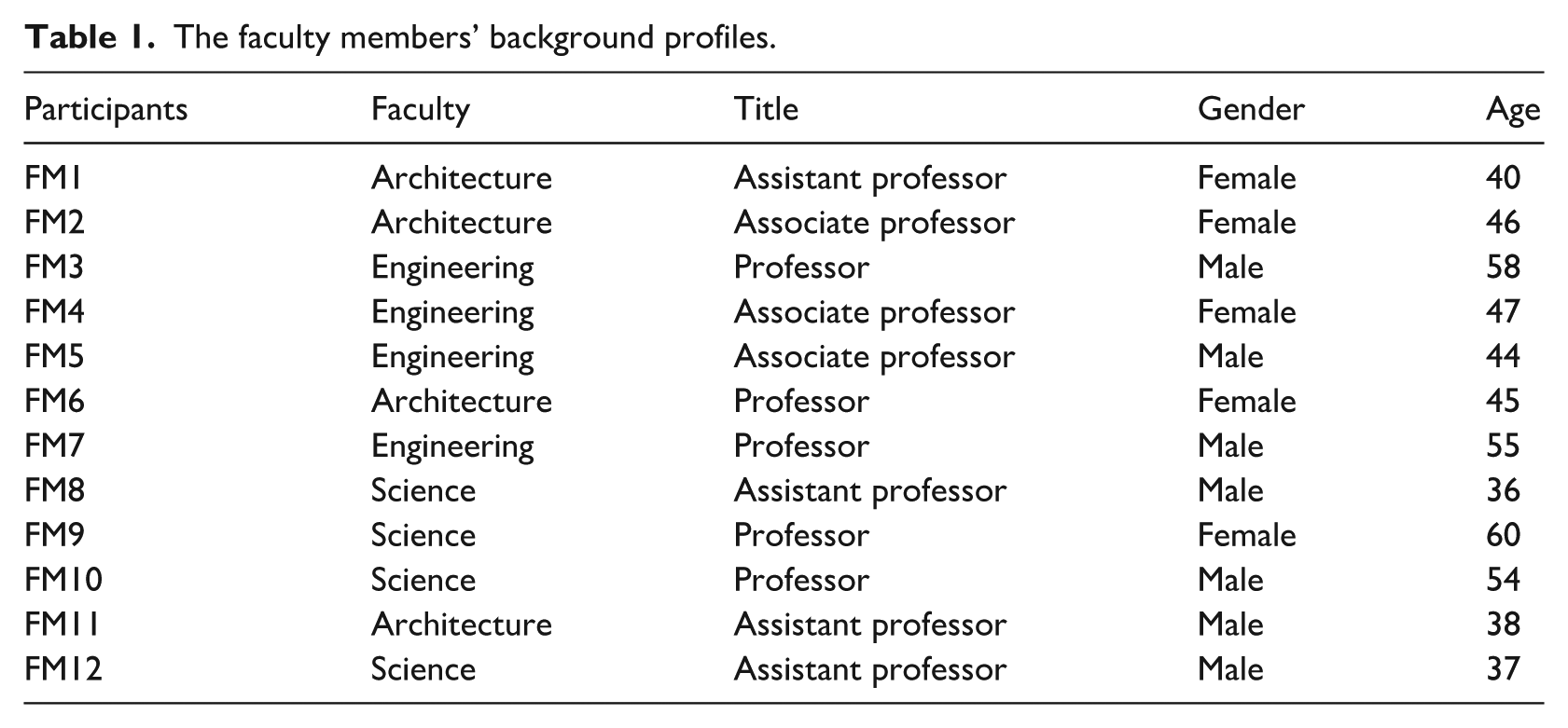
Within the scope of the research context I described above, 12 faculty members volunteered to participate in this study by agreeing to have in-depth interviews regarding their EMI experiences, pedagogical practices, and background. As regards the participants, I first reached out to 40 different faculty members teaching at the Architecture, Science, and Engineering faculties through an email informing them about the scope and purpose of the study, in addition to the ethical permission documents for the study (Institutional Review Board: Issue no:05/03; Date: May 31, 2024). More than half volunteered to participate. Then I focused on several criteria such as gender, academic position, department, and age to make the sample more heterogeneous, providing more differentiating insights into the study from various profiles and experiences (Saldaña and Omasta, 2018). Finally, I arranged face-to-face meetings with 12 Architecture, Science, and Engineering faculty members (see Table 1) for in-depth interviews. All the faculty members were informed about the study’s procedures and scope/aim in detail, and they read and signed the written informed consent forms. Numbers (FM1. . .FM112) were given to the faculty members throughout this article as a confidentiality measure.
The faculty members’ background profiles.
Data collection
I conducted in-depth semi-structured interviews, each lasting approximately 40 minutes, with 12 faculty members individually and face-to-face after we agreed on a time slot that would suit their busy schedules. The interviews were conducted either in faculty members’ offices or in a coffee shop as a natural conversation form of interaction. Six faculty members preferred speaking English, and six spoke Turkish during the interviews. I prepared open-ended interview questions in line with the study’s objectives to probe into four broad thematic areas: (1) the faculty members’ current EMI practices/challenges, (2) their pedagogical approaches/practices, (3) pedagogical training background, and (4) their professional development activities to invest in their competencies. I also used probing and follow-up questions flexibly to encourage deeper reflection and explore emerging topics that the participants raised.
The semi-structured nature gave me the fluidness and flexibility to maximize the scope to construct contextual knowledge while focusing on the relevance of the participants’ shared experiences. I adapted the questions and added new questions depending on the emerging answers, which would not have been possible with strict adherence to structured interview questions (Mason, 2002). Finally, I transcribed the audio-recorded interviews and translated the Turkish ones into English. For member-checking (Barkhuizen, 2018), I selected three participants’ interviews and sent the transcribed versions to the respective participants to cross-check any discrepancies between their original statements and the transcriptions.
Data analysis
From an inductive stance, in the first coding cycle, I began to analyze the transcribed data through a descriptive coding strategy with a particular focus on the topic of the text rather than the details in the message (Saldaña, 2015). Throughout the first coding cycle, I analyzed each transcribed interview iteratively to reconsider or reconstruct the previous codes in light of subsequent interpretations (Saldaña, 2016). Coding all the data from in-depth semi-structured interviews, I initiated the second coding cycle to re-analyze and re-organize the data I coded in the first cycle. Through this iterative and cyclical manner, I aimed to develop a sense of categorical organization from my first array of codes by adding new codes and reconstructing the existing ones (Saldaña, 2016). The second cycle of coding was followed by a thematic analysis to explore how patterns emerge from codes and how they interrelate with one another to end up with overarching themes (Braun and Clarke, 2006). Accordingly, axial coding helped me identify intersecting codes and eliminate similar ones, leading to more comprehensive patterns representing the axial codes. Re-grouping and re-organizing these patterns eventually resulted in overarching themes and sub-themes.
Findings
The findings guided by the four research questions are presented below as four overarching themes. The first theme, including two sub-themes, attempts to answer the first research question (faculty members’ EMI experiences). The second theme seeks to answer the second research question (faculty members’ pedagogical approaches and practices). The third theme, supported by two sub-themes, focuses on the third research question (pedagogical training backgrounds of the faculty members and factors shaping their teaching), and the last theme reflects the faculty members’ insights regarding the last research question (faculty members’ professional development activities).
EMI from the perspective of faculty members: Benefits for the future, challenges for now
The interviews with the faculty members show that despite their positive attitudes toward the essence of English in scholarly and professional life, students’ English proficiency may hinder in-class communication/interaction and comprehension, urging them to adopt a mixed-language approach to ensure better learning, particularly in the first year of undergraduate programs.
Academic/professional and linguistic benefits of EMI for the future
The faculty members have no negative dispositions regarding EMI since they believe that English can play a vital role in students’ future academic/professional careers, and students improve their language skills gradually despite initial challenges.
The faculty believe that delivering content knowledge in Turkish may cause more complexities: “Turkish can bring certain comforts, but ultimately, knowing English is essential to engage with research and international scholarship. Encouraging them to learn English for research is a positive approach” (FM6). Attributing the prevalent role of English in the scientific disciplines, FM8 points out that “Having English as the language of instruction is easier. Because I can’t explain what I’m teaching in Turkish, the terms simply don’t exist in Turkish. There are Turkish textbooks, but it feels like the ‘Tarzan language’ (awkward or incorrect).”
Despite the challenges observed in the initial stages of EMI programs, exposure to the target language and familiarity with the content knowledge can help EMI students improve their linguistic skills and lead to better performance both in receptive and productive skills, and “The difference is noticeable by the time they reach the fourth year, whether in making a presentation or presenting a project” (FM5). According to FM10, students’ proficiency improves because “They become more familiar with the technical terms. Initially, students might not even know some basic terms. Over time, with more exposure, they gradually get used to these terms, and that’s when you start seeing development in their understanding.”
Current challenges in EMI and reported reasons
Faculty members touch upon the challenges regarding EMI practices and the reasons for these challenges, particularly with first-year students. The challenges the faculty address include a lack of teacher-student connection in a foreign language, a lack of course and material comprehension, and difficulties learners face during the initial transition to EMI. According to the faculty, learners face interaction and comprehension-based challenges because they have limited language learning experiences before higher education and their negative dispositions toward the subject matter.
These challenges could lead the faculty members to adopt a mixed-language approach. Especially while giving feedback to students, they want to speak Turkish to “feel the same level of connection” (FM1). In addition to feedback practices in Turkish, faculty members often resort to using Turkish to reinforce complex materials and answer student questions because they “find it necessary to provide Turkish support to ensure better understanding” (FM3). Likewise, considering the difficulties students might have in their initial period of higher education soon after high school, FM8 says, “When teaching the students fresh out of high school, I don’t want them to misunderstand things due to the language. I try to be flexible in this regard.”
The faculty members also delved into the possible reasons for their students’ lack of interaction and comprehension challenges in EMI courses, such as limited language learning opportunities and negative dispositions to the subject matter. In this sense, FM9 highlights the gap between general English taught in preparatory programs and technical English taught in undergraduate programs: “Preparatory programs typically focus on everyday English, but when they transition to their departments, they encounter specialized and technical terminology that creates challenges.” However, the faculty members are also aware that a 1-year preparatory education may not suffice to meet the learning goals expected from EMI students: I don’t believe that someone who has never studied English can reach a level where they can understand the lessons we teach at this university after just one year of preparatory English education. They start improving by the second or third year, but in the first year, they struggle a lot. (FM12)
Apart from the language barrier, the faculty members also point out that students’ emotional distance to some subject matters might hinder the willingness and motivation to learn the course content, as FM12 suggests: “Many students come with a strong aversion to some subjects. So, do you focus on breaking their dislike of these subjects, or do you overcome the English language barrier?.” Likewise, the complexity of the subject matter may also cause a learning difficulty independent of the language barrier, as FM10 mentions: “Almost every time, I explain in English and then repeat it in Turkish to ensure they understand. However, it’s hard to know whether they’re not understanding the content itself or if the language is an extra barrier.”
As for how they cope with these challenges, the faculty members state that strict policies prohibiting Turkish use may inhibit student interaction and comprehension. Hence, they tend to have more flexible approaches and think empathetically, especially when students expect to interact in Turkish, as explained by FM12: “Over the past four years, if I’ve been asked 500 questions, 490 have been asked in Turkish. I speak in English while teaching, but when students ask questions in Turkish, I answer and explain them in Turkish.” Otherwise, they think students may feel completely withdrawn since “They lack the confidence to speak it in class” (FM11).
Faculty members’ pedagogical profiles: How do the faculty members teach in EMI programs?
The faculty members primarily define their teaching approach as traditional, giving lectures and providing multiple examples and practices for students to answer questions, followed by assessment procedures. The reason for traditional practices and the lack of instructional diversity is attributed to the technical and theoretical content of the courses. However, some of the faculty members also pointed out some extra methods and practices they developed to improve the effectiveness of their courses, such as asking questions to engage students, providing real-life examples, and visualizing/concretizing concepts.
Most faculty members report that they do not rely on a particular pedagogical or theoretical framework shaping their teaching practices: as FM3 states, “There’s no particular framework I follow. I use presentation files and slides, explain the material orally, respond to students’ questions, and give assignments or exercises.” Likewise, FM12 describes his teaching style: “The professor writes on the board, and the student passively tries to learn while sitting in their seat. My overall teaching style is more traditional.”
Some faculty members believe that the reason for their traditional approach is related to the technical education they need to provide, as stated by FM7: “I focus on delivering courses we’re responsible for, covering essential technical topics with presentations, problem-solving, example questions, and explanations of technical aspects.” Likewise, FM9 touches upon the conventional delivery of theory-based courses: “Since our subjects are mostly theory-based, I conduct classes through PowerPoint presentations. I use a Q&A format involving the students to make it somewhat interactive.” Even though it is a common approach for theoretical courses, faculty members also believe that the means of delivery is not appealing to students and should change by referring to the generation gap: “A three-hour lecture, where the professor speaks and students listen, shouldn’t be the norm anymore. Our generation’s ‘reading, writing, understanding, and reflecting’ approach doesn’t resonate with these students; their brains work differently” (FM1).
Being aware of students having difficulties engaging with the theoretical content of the courses in a transmission-based lecture, faculty members develop various teaching strategies to promote learner engagement, as FM2 points out briefly: “I focus more on giving examples rather than direct didactic teaching. Even if it’s a theoretical topic, I try to engage students through questions and real-life examples.” Likewise, faculty members might use different means of delivery to improve comprehension and engagement in theoretical courses, as explained by FM8: “I mostly lecture and explain through slides. I also try to visualize the concepts through animations, analogies, or realistic models and simulations.”
Background of pedagogical profiles: How did the faculty members learn to teach?
The faculty members’ reflection on their pedagogical knowledge and skills demonstrate that most of them (seven faculty members) constructed their pedagogical approaches without formal pedagogy education by relying on their previous experiences as a learner (retrieving instructional practices that they were exposed to as a learner before they became a faculty member), their in-class teaching experiences shaped over the years, and their initiatives for pedagogical growth. Some of the faculty members also refer to the role of pedagogical courses they took as part of their PhD process in Türkiye (two faculty members) and in Europe (three faculty members).
Teaching without pedagogical training
The faculty members receiving no pedagogical training constructed their teaching approaches by relying on their previous experiences as a teacher and observations as a learner. Relying on their former experiences, the faculty with no pedagogical background address the challenges like feeling unprepared, making more intuitive decisions, and feeling alone in constructing their own way of teaching.
Having no pedagogical background can make faculty members feel unprepared for teaching. By recalling what their previous teachers/professors did in the class, faculty members could develop similar approaches, as FM1 highlights: “I transfer what I learned from my professors and mentors here. I developed my skills through years of practice and observation of students. It’s somewhat intuitive.” Likewise, FM3 explains how he relates his current teaching practice to his former learning experience: I observed and adopted it while I was still a student. In graduate studies, we often used PowerPoint slides for presentations, and if we wanted more details, we would refer to books and other sources. I adopted this summarizing method with slides, directing students to additional resources for more information.
Learning experiences of faculty members can also intersect with their current teaching experiences and yield new forms of teaching, as FM8 elaborates: “By observing and evaluating the good and bad aspects of my past experiences as a student, I developed my own way of teaching. Each time I teach a course again, I feel that I present it slightly differently.” Thus, lacking a pedagogical background forces faculty members to draw on both their experiences as learners and their reflections on current teaching experiences, as FM11 illustrates: As faculty members, during our long journey through undergraduate, master’s, PhD, and post-doc programs, those fortunate could take courses from good professors. This is because pedagogical training is not provided in our country. The education given to teachers is more scientific, teaching them what a good teacher should do and how they should do it. However, I am an architect. My entire life has been about calculations, drawings, measurements, etc. I never received any pedagogical education during any period of my life. However, after completing my PhD and meeting specific criteria, people expect me to teach a class of 100 students. No one has ever told me how I should explain things. We do things based on personal experiences.
Teaching with a pedagogical background
However, some faculty members consider themselves more fortunate since they could receive some pedagogical courses during their PhD journeys. Even though no participants had long-term pedagogical training within a pedagogical program, two faculty members took several pedagogical courses during their PhD in Türkiye, which was stated to be mandatory at that time for a very short period. Three faculty members completing their PhD studies in Europe also stated that they were required to take several pedagogical courses during their PhD studies. The participants with a pedagogical background emphasize the benefits of these courses since they think they have a better understanding of the psychology of learners and learning, assessment practices, course design, feedback, and classroom communication.
Two faculty members taking several courses (developmental psychology, learning psychology, and assessment) in Türkiye address the substantial impacts of this experience on their teaching approaches and beliefs, as FM7 states: “Although it seemed unnecessary at the time, even now, I see its benefits.” Likewise, FM6 feels fortunate and elaborates on how educational psychology and assessment courses impacted her conceptualization of teaching: I feel fortunate because I broadened my perspective on structuring exams and preparing clear instructions. It was like discovering the existence of a whole new world. I thought, “Yes, such things exist, and people work on these.” These insights, which I might not have discovered otherwise, were invaluable, and I believe such training is crucial for those pursuing academic careers.
Three faculty members completing their PhD studies in Europe also refer to those pedagogical courses they took and the impacts of these courses on their current beliefs and practices. In this sense, FM12 reflects on one teaching in a higher education course he took as a PhD student in Europe: “I learned about things like learning objectives, learning outcomes, peer learning, and collaborative learning. I think it wasn’t enough, however. I feel like I’m still lacking in this area; I wish to take that course again.” Likewise, FM5 shares his pleasant experiences regarding the pedagogical seminar courses he took during his PhD studies in the United Kingdom: “I did my PhD in the United Kingdom, where, if you want to teach a higher education course, you must undergo a certification process. The seminars we received in this regard were really beneficial. I attended many of them.” One of the faculty members who had this kind of pedagogical course underlines the need for these courses in Türkiye by giving a pedagogically wrong example: We don’t receive any formal pedagogy training here. Some of what I apply is instinctive, but I think it would be better if professors received formal pedagogical training. I notice mistakes that some of my colleagues make—like how they speak or behave with students, and I internally critique their methods. I had professional development courses during my doctoral studies in Europe. For example, there were courses on handling stress or dealing with students with substance abuse problems. (FM2)
Opportunities for professional development: How do faculty members invest in their pedagogical inventories?
While reflecting on their pedagogical knowledge and skills, the faculty members also emphasize that they have limited opportunities to improve their teaching. Even though their institution offers yearly seminars/workshops organized as conference speeches by experts, faculty members address the need for pedagogically sound practices, leading them to lean on personal initiatives for their development or take no action because of their workload. Having limited options for professional growth forces the faculty to create learning opportunities on their own. Besides, some faculty members underline the potential of student evaluations/feedback and the best course design awards organized by the university. They report that these practices enabled them to reflect on and reconstruct their usual practices.
The workshops offered by the university are not considered adequate, as mentioned by FM4: “They offer some presentations related to teaching development, but honestly, they don’t provide any valuable insights. I’m unsure how helpful they are.” Similarly, FM9 criticizes these workshops’ practical aspects: “If the topics are interesting, I participate in the workshops at the university. They can be useful for understanding general trends, but they weren’t particularly impactful in practice.”
Inefficient workshops led faculty members to develop their own learning pathways by having transformative takeaways from different activities. In this regard, FM5 reflects on how a pedagogical seminar on flipped learning enabled him to transform his teaching style: “I used to follow a very conventional teaching style. I’ve been applying flipped learning since the seminar. It’s more of a question-and-answer format in class, and I encourage peer learning through joint projects or assignments.”
As a different practice, FM8 also refers to the role of student evaluation in his courses: “I prepare anonymous surveys for my students. Students can respond honestly. I do this on my own to improve as an educator.” Likewise, FM11 emphasizes the essence of student feedback, especially to pitch the lessons in accordance with the diverse learner profiles after he realized the students were not homogeneous in their learning process: “I started to have short feedback sessions at the end of each class, asking students to share their thoughts for about 5 minutes. These conversations helped us improve both as instructors and as students.”
Besides, the university organizes the best course design competition every year by announcing the criteria and the relevant documents, such as lesson plan details and student evaluation forms, which encouraged two participants to end up with two successful course designs and solid changes in their practices. In this vein, FM11 explains how the preparation process and his teaching experiences, based on many trials and errors, helped him to develop professionally: It was the first time in my life that I had heard anything related to educational sciences. I enjoyed filling out the application form for the Best Course Design award. There are many aspects of social/educational sciences that we are pretty lacking in. There’s a scientific reason behind what you say works better, and you may not know it. You discover it on your own, and in a sense, you are rediscovering America. If someone had told me it works this way, I wouldn’t have had to experiment and make mistakes for three years to find it again. Maybe I could have been more helpful to the students who took the course in the first three years. I might be considered lucky because, over these three years, I’ve had the opportunity to develop myself, but it’s been through trial and error. (FM11)
Likewise, FM8 redesigned a course for this award and aimed to teach students a challenging subject. However, the redesigned version of the course yielded better student reactions, as explained by FM8: “We used a program with toy datasets unrelated to their field to teach them how to code. I gave frequent weekly assignments. This was a learning experience for me, too. What began as a challenge became a progressively easier exercise.”
Discussion
The findings concerning each research question are discussed in relation to the extant studies in the field and future projections based on the faculty members’ reported realities and needs for pedagogically sound EMI practices. The findings are also discussed within the framework of essential lecturer competencies for EMI.
Regarding the first research question exploring the perceptions and experiences of faculty members about EMI, the findings imply that the faculty members are content with the EMI university policies. They believe EMI can promote learners’ academic and professional growth, considering the role of English as an international language in science and research (Macaro et al., 2018). The faculty members’ perceptions also resonate with Ölçü and Tuğa’s (2013) study, highlighting the academic takeaways of the EMI, and Turhan and Kırkgöz’s (2018) research, referring to the role of instrumental motivation in EMI settings. Based on their observations regarding learners’ linguistic development, the faculty members also state that learners can improve their proficiency gradually since they can have better receptive and productive skills in English by the time they graduate, which signals EMI as a language development opportunity (Chapple, 2015).
However, this development takes a long time, so the faculty members address their dissatisfaction with the inadequate proficiency level of the students, causing learning impediments and the need for extra effort to teach the subject matter (Belhiah and Elhami, 2015; Çankaya, 2017). Notably, for the first-year students, they point out that EMI can induce substantial learning handicaps since the subject matter could be hard to understand in English, which is also common in various higher education EMI contexts, such as Japan (Aizawa & Rose, 2019), Europe (Cicillini, 2021; Coleman, 2006), and South America (Martinez and Fernandes, 2020).
The faculty members also believe that students starting an EMI university with a low proficiency level may not equip themselves with adequate skills in a 1-year English preparatory program, which is also related to the lack of English proficiency in primary and secondary education and the limited opportunities to advance English skills before tertiary-level education (Cicillini, 2021; Dearden, 2014). Students’ aversion to the subject or dislike of the course due to the complexity of the content and mental barrier, rather than a language barrier, is also highlighted as an impediment in the EMI context. To cope with these challenges, they generally resort to code-switching flexibly and using Turkish (Ozer, 2020a), especially when interacting with the students for their questions or feedback. The faculty members believe they develop a bond with students and engage them in the lesson by doing so. Otherwise, according to the faculty members, they might stop asking questions since they may not feel comfortable communicating in English. Learners’ feeling uncomfortable because of either language barrier or emotional distance/aversion to the course addresses the need to develop socio-emotional competencies, enabling EMI faculty members to utilize diverse inventories to cope with these challenges (Ismailov et al., 2025).
The second research question examined how faculty members reflect on and adapt their pedagogical approaches in EMI programs. It revealed that most adopt traditional teaching methods, presenting the subject matter as information transfer rather than pedagogical content knowledge (Dearden, 2014) and responding to students’ questions. These practices highlight a lack of delivery skills, a finding also reported in Ekoç’s (2020) study. This approach adopted by faculty members does not resonate with pedagogic competence for EMI teaching, which requires teachers to be able to deliver well-structured content, plan effective lessons, and enrich interaction and learner-friendly approaches (Ismailov et al., 2025). A transmission-based approach also does not meet contemporary EMI pedagogical needs, such as conceptual tools for pedagogical content knowledge, communication/in-class interaction skills, material development skills, scaffolded learning, English for specific purposes, pedagogical diversity, and multilingual/multicultural literacy (Cots, 2013; Dearden, 2014; Fortanet-Gómez, 2010). It can also prevent teachers from utilizing spontaneity and improvisation skills in line with dynamic classroom needs (Kilickaya, 2006). Relating the traditional nature of their lessons to their courses’ theoretical and technical content, the participants know that employing this approach does not yield effective learning.
As the faculty members are aware that they may need extra actions when their conventional practices inhibit learner comprehension, they consider using in-depth explanations, real-life examples and analogies, code-switching, question-answer sessions with students, and visualizations, which also resonates with Ozer’s (2020b) findings. The faculty members’ reflection on their pedagogical approaches and practices underlies the lack of pedagogical and conceptual tools/approaches customized in accordance with disciplinary context and learner needs (Briggs et al., 2018; Dearden, 2014). Considering the faculty members’ questioning the effectiveness of their methods, pedagogical support addressing the need for instructional diversity and communication/interaction-based learning practices can alleviate this problem (Arslan, 2023).
The third research question sheds light on the pedagogical learning backgrounds learning of faculty members and will be discussed in light of the third theme. The third theme shows that seven faculty members received no pedagogical training before their teaching career. As they have no pedagogical background, they rely on their previous higher education experiences as a learner, which can also be conceptualized as the apprenticeship of observation (Borg, 2004; Lortie, 1975). Relying on good teaching practices performed by their previous professors and avoiding the negative teaching practices they observed as a learner, faculty members tend to synthesize a teaching approach between their apprenticeship of observation and reflections on their current teaching practices/experiences, which becomes a vital setback for EMI practices (Macaro et al., 2018). Not being required to receive pedagogical training, neither for higher education pedagogy (Taneri and Özbek, 2023; Yürekli-Kaynardağ, 2019) nor EMI pedagogy (Soruç and Griffiths, 2018), deprives faculty members of teaching competencies to promote learner comprehension, enhance classroom interaction, and adapt proper resources (Cots, 2013). Hence, it is evident that the lack of pre-service and in-service opportunities to be capable of teaching in EMI contexts (Soruç and Griffiths, 2018) urges faculty members to find their way out alone despite the increasing demand for teaching methodology skills in higher education EMI (Gay et al., 2020).
Unlike those faculty members, three faculty members took pedagogical courses during their doctoral studies abroad, and two took pedagogy-based courses as part of their doctoral programs in Türkiye. Even though no faculty member had long-term and process-oriented pedagogical training addressing contemporary higher education and EMI pedagogies (Fortanet-Gómez, 2010), taking these courses was found to be very effective for their future careers. Those who had their PhDs abroad stated they were required to take courses on course/lesson design, collaborative learning, and coping with stress. Likewise, two faculty members taking pedagogical courses (psychology of learning, developmental psychology, and assessment) in Türkiye reported that their universities mandated those courses for all PhD students, which does not exist now. Having taken such courses during their doctoral studies, which is not found to be enough, and seeing the benefits in their teaching, the faculty members could become more aware that having expertise in subject matter knowledge in their disciplines does not guarantee an effective delivery of pedagogical content knowledge (Ericsson et al., 2018) and development of pedagogic competence (Ismailov et al., 2025). In addition to pedagogical challenges, the participants underline how some faculty members fail to communicate effectively with learners and discourage them. Lack of sensitivity in these practices can be attributed to the lack of pedagogical background and socio-emotional dimension of teaching (Ismailov et al., 2025).
Viewed through Ismailov et al.’s (2025) framework, some faculty members could not receive professional development support to invest in the pedagogic, linguistic, and socio-emotional teaching skills required for effective EMI teaching. However, those with limited training through several courses found them beneficial for their pedagogic (course design, assessment, collaborative learning) and socio-emotional (coping with stress, psychology of learning, developmental psychology) competencies. In this respect, it is seen that faculty members had no opportunities to promote their linguistic skills through professional development, and the limited engagement with pedagogic and socio-emotional dimensions of teaching is not sufficient to sustain effective EMI practices.
Regarding the faculty members’ continuous professional development practices based on the final research question, the fourth theme examines limited institutional opportunities, which can urge them to find their way out. Despite the top-down policies of the institutions to adopt an EMI policy, faculty members’ being left alone without any institutional support and pedagogical guidelines creates a crucial gap in EMI practices (Farrell, 2020). For instance, one-shot workshops offered two or three times annually are not found to be effective since they do not provide bottom-up, practical, contextualized, and reflective tools for professional growth (Farrell, 2020). Despite the limited opportunities, the faculty members’ professional development practices outside the university context, such as attending a flipped learning seminar or taking a foreign language course, helped them reflect on their practices and develop new instructional perspectives.
Likewise, “best course design awards,” a professional development event organized by the university once or twice a year, seems to have positively influenced two faculty members who attended this organization since they could have the chance to reflect on and improve their pedagogic competencies (Ismailov et al., 2025) through locally-determined materials such as lesson plan, learning objectives, and evaluation materials (Farrell, 2020). Besides, utilizing these materials as a means of mediation for learning and staying tuned to their learners’ needs through learner reflections and learner course evaluations can offer a sociocultural and responsive learning space for faculty members (Johnson and Golombek, 2016). Staying attuned to learners’ perspectives and providing a responsive learning environment can also function as a tool to develop socio-emotional competencies of EMI faculty (Ismailov et al., 2025).
Overall analysis of the findings from the framework of essential EMI lecturer competencies (Ismailov et al., 2025) addresses the gaps in pedagogic, linguistic, and socio-emotional dimensions of EMI teaching. Considering the intersected and complementary roles of these competencies to provide effective EMI teaching through pedagogically sound, linguistically efficient, and socio-emotionally responsive practices, having no pedagogical training background or limited opportunities for professional development prevents EMI faculty from investing in these dimensions of effective EMI teaching. While the faculty members recognize the significance of pedagogic competencies (interactive and student-centered teaching), their reliance on transmission-based instruction and limited use of diverse instructional practices underlines the gap between their current capabilities and expected professional growth for effective EMI teaching. Even though the faculty do not report a need for support for their linguistic competencies, their code-switching and simplification practices could be supported with a translanguaging pedagogy perspective for more situated and fine-tuned linguistic practices (Jiang and Zhang, 2023). Not being strict with using the native language for teaching and learners’ questions, and taking student evaluation/feedback into consideration for future courses, can be interpreted as practices related to socio-emotional competencies to place value on empathy. However, some faculty members’ failure to demonstrate sensitivity while interacting with learners and enact diverse strategies to create an inclusive learning environment emphasizes the need to develop the socio-emotional dimension of EMI teaching (Ismailov et al., 2025; Trinidad, 2019). In addition to a lack of institutional support, the gaps between expected capabilities in EMI teaching and faculty experiences could leave EMI faculty dependent on self-directed learning and trial-and-error. Hence, pre-service and in-service professional development programs encompassing these core EMI competencies in a contextualized, sustained, and reflective way are needed to prepare them for diverse instructional scenarios in EMI contexts (Farrell, 2020; Morell et al., 2022).
Conclusion and implications
The faculty members’ insights into their EMI practices reveal no negative dispositions about EMI policies, considering the long-term benefits for learners and access to international sources and networks despite students’ language-related comprehension challenges (Kim, 2017). The faculty members report coping with these challenges by switching the language to Turkish and providing further explanations and examples. The faculty members tend to employ traditional teaching methods by transferring the subject matter knowledge in a lecturer-centered way and answering students’ questions during or after their lectures.
The lack of pedagogical diversity can be attributed to not having a pedagogical background and limited and ineffective resources for professional development, urging the faculty to rely on their intuitions and experiences to form their teaching approaches. The faculty members construct their pedagogical approaches and practices by relying on their higher education experiences as a learner and their teaching experiences as a teacher. They report that they have limited opportunities for pedagogical training and professional development. Some faculty members took several pedagogical courses during their doctoral studies and engaged in personal development activities such as designing award-winning courses and attending seminars. Despite limited opportunities, these experiences demonstrate the potential impacts of pedagogical training and highlight the need for a transformative perspective on EMI faculty development that is not seen merely as a series of workshops or seminars. The faculty’s experiences show that current practices and culture of professional development in higher education do not necessarily help the faculty invest in their pedagogical growth. However, creating institutional opportunities for both initial and continuous professional development might create a new culture of EMI practices.
Several implications can be proposed to promote EMI efficiency in higher education ecosystems. First, macro-level policies guaranteeing linguistic improvement of learners before tertiary education are essential to sustain EMI since 1-year preparatory programs might not be enough to reach a proficient level in EMI and cause comprehension challenges. Similarly, initial and in-service EMI faculty training opportunities to develop EMI teaching skills could be considered a threshold criterion for teaching in EMI programs. However, the set of policies and components of these programs, such as content, assessment, training, course materials, etc., should be well-planned and adapted to various conditions after a qualified preparation process. Utilizing a comprehensive framework of EMI competencies and considering the contextual realities, needs, and expectations can be the basis of a preparation process.
While universities can provide pre-service training as part of doctoral studies of faculty candidates or as a recruitment process before EMI teaching, in-service training can be incentivized, considering the academic load of faculty members. Micro-level policies and professional development activities developed by each higher education institution can also create more contextualized and pedagogically relevant practices for faculty members. Prioritizing faculty members’ actual needs, developing inter-institutional collaborations for faculty development opportunities, and providing continuous professional development tools, such as reflective, collaborative, and inquiry-based learning tools (Farrell, 2020), can help faculty members promote their pedagogical inventories, diversify their teaching, and better respond to contemporary EMI needs in higher education.
Limitations and future research directions
Despite offering in-depth insights into the pedagogical realities of a Turkish EMI context based on an EMI university and 12 faculty members from three faculties, the localized nature of participants’ EMI experiences might reflect institutional and cultural characteristics that might differ in other EMI contexts. Also, semi-structured interviews rely on the participants’ self-reported EMI experiences. Hence, comparative studies focusing on multiple institutions or countries and other data sources such as faculty material analysis, student perspectives, and faculty member candidates might help to capture a more comprehensive understanding of higher education EMI practices and faculty EMI development.
Besides, as the current study does not systematically explore faculty-based disciplinary differences despite having faculty members from three faculties, further studies can be conducted to shed light on discipline-specific pedagogical challenges and strategies employed by faculty members, which can offer insights into more institutionalized and discipline-specific EMI training opportunities. Additionally, enacting a longitudinal or narrative perspective to examine the pedagogical trajectories and developmental process of EMI faculty members could lead to a better understanding of how EMI lecturers navigate their learning and how they accumulate their teaching experiences. Insights from such a perspective can also offer new ideas for the design and content of EMI training programs for initial and continuous professional development. Finally, future research focusing on EMI training programs’ design, implementation, and impact for beginning and experienced faculty members can contribute to future plans for policy decisions and teaching quality in EMI.
Footnotes
Consent to participate
All the participants were informed about the study’s procedures and scope/aim in detail, and they read and signed the written informed consent forms approved by the Social and Human Sciences Scientific Research and Publication Ethics Committee of İzmir Institute of Technology (Approval No. 05/03).
Consent for publication
All the participants were informed that their anonymized interview data would be transcribed, analyzed and published, and they read and signed the written informed consent forms approved by the Social and Human Sciences Scientific Research and Publication Ethics Committee of İzmir Institute of Technology (Approval No. 05/03).
Data availability
Transcribed interview data and processed data, including preliminary codes and categories, are preserved confidentially; however, the data will not be shared with third parties because the participants have no consent for sharing raw data.
Declaration of conflicting interests
The author declared no potential conflicts of interest with respect to the research, authorship, and/or publication of this article.
Funding
The author received no financial support for the research, authorship, and/or publication of this article.
Ethical considerations
This study was approved by the Social and Human Sciences Scientific Research and Publication Ethics Committee of İzmir Institute of Technology (Approval no. 05/03).
