







Abstract
This article examines, from a comparative subject didactic perspective, the use of digital platforms in Swedish upper secondary schools, focusing on the significance in three school subjects: Swedish, mathematics, and history. Based on video recordings from 47 lessons, the analysis compares recontextualization of subject knowledge across the three subjects. Departing from Bernstein’s concepts of the pedagogic device and horizontal versus vertical knowledge structures, the analysis focus on how dimensions of textualization and templatization play out differently in the three subjects. The analysis reveals that the learning platforms become integrated into the established subject practices of Swedish, mathematics and history respectively and is thereby shaped by the different subject traditions. At the same time, the platform structure in itself also influences how knowledge can become organized, accessed, and presented. Findings point at similarities and differences in relation to planning and expectations of school performance, classroom interaction, text practices, and the broader digital context in relation to the learning platform. The results emphasize the importance of teacher agency in platform-based subject teaching, where platforms seem to push toward increased individualization of school work that might constrain deeper explanations and support for students’ critical thinking.
Introduction
This article examines, from a comparative subject-didactic perspective, the role of digital platforms in Swedish upper secondary schools, focusing on their significance in Swedish, mathematics, and history. Within the European research agenda on didactics and curriculum studies, comparative didactics has become a strong field over recent decades (Ligozat and Almqvist, 2018). This field spans theoretical comparisons of research traditions across European regions (Hudson, 2007; Meyer and Rakhkochkine, 2018), analyses of educational systems and policies, and – as in this article – comparisons of classroom practices across subjects (Ågerup, 2024; Ligozat and Buyck, 2024). This study specifically investigates how platformized learning in contemporary education in a European country shape teaching practices in upper secondary schools. This focus rests on the understanding that such influences differ according to the practices and teaching traditions within each subject (cf. Almqvist et al., 2023). By adopting a comparative perspective on the digital learning context across subjects, using the same digital platform as a common reference point, we explore how the platformization of teaching affects instruction and learning.
In Sweden, as in other European countries, various digital platforms are integral to daily school life for teachers and students (c.f. Bergviken Rensfeldt and Player-Koro, 2024; Cone, 2023; Grönlund et al., 2023; Kerssens, 2023; Misfeldt et al., 2018; Richter et al., 2025). There is a growing research field focusing on platformization of education, where the mentioned and other educational studies have contributed with highly valuable insights and critical discussions about how platformization and digital infrastructures condition and shape schooling at all levels (Decuypere et al., 2021; Kerssens and van Dijck, 2022; Richter et al., 2025). Further on, there is a growing interest in critical studies on the pedagogical consequences of platformization on the classroom level. Drawing on Bernstein’s (2000) model of “the pedagogic device,” Sefton-Green and Pangrazio (2021) introduce the concept of platform pedagogies as a new research agenda, arguing that pedagogical theories are important for education to address critical questions regarding platformization processes and prepare students for navigating an increasingly platformized society. In line with this, Kerssens (2023) calls for more classroom-based, ethnographic studies to critically examine the role of platforms in teaching, and analyze the framing role of technology in relation to teachers’ pedagogical considerations and content handling.
However, few studies have addressed questions about digitalization and platforms from subject didactic perspectives regarding their impact on how subject knowledge is addressed and transformed on the classroom level. The present study takes such a perspective with an interest in the digital learning context that emerge in three different subjects using the same generic learning platform, Itslearning, to structure and administrate teaching and learning. Given the same learning platform in all classrooms, we are interested in how it becomes connected to other digital resources into broader platform contexts and how this can be understood from a subject didactic perspective. Inspired by the concept of platform pedagogies, we advocate that a comparative subject didactive analysis can make visible the complexity of how different knowledge traditions and structures interplay with the platform structure. Itslearning, and other platforms with similar functions (e.g. Google Classroom, Teams classroom, Canvas, Blackboard etc.), take a central role in teaching and create a unified, potentially guiding structure, where students engage with assignments, feedback, and assessments from teachers in different subjects. Our focus is the digital ecology that emerges in relation to this generic platform, as teachers and students engage with subject content in different school subjects.
Sefton-Green (2022) discusses educational platforms in terms of Bernstein’s concept the pedagogic device, a social mechanism exercising power in transitions of knowledge where users are schooled into certain pedagogies regarding three key dimensions: textualization, templatization, and trainability. Here, we explore how digital platforms organize and frame subject teaching in terms of “the pedagogic device,” which encompasses systems for recontextualizing knowledge through classroom interactions, teaching content, and today also online communication. Drawing on this concept and the dimensions identified by Sefton-Green, we here explore the role of the platform and additional digital resources in relation to how different text practices develop, as well as how the functions and structures within the platform become guiding elements in the classroom by generating expectations for the learning and teaching processes.
Bernstein originally describes the pedagogic device as “a set of hierarchical rules, distributive, recontextualizing, evaluative, which constitute its internal grammar” (p. 200). Distributive rules refer to the specialization of knowledge reproduced within a specific context or field, such as different subject traditions. Further on, Singh (2002) describes this process as “the ordering and disordering principles of the pedagogisation of knowledge” (p. 2), through which different types of knowledge are converted into pedagogical communication.
The current study is based on an extensive video ethnographic project in upper secondary education, using cameras and screen recordings in the classroom to follow teachers’ and students’ use of a platform in the contexts of Swedish, mathematics, and history. By comparing processes of knowledge transformations in three subjects, we aim to make visible features that illuminate the structuring role of the platform as a pedagogic device. The purpose is, from a subject didactic perspective, to deepen understandings of the role of digital learning platforms in teaching Swedish, mathematics, and history. We ask:
How do teachers and students engage with subject content on the digital platform and the broader digital context, across the three subjects?
How is the students’ oral and written communication structured by the digital learning platform and its interface in the three subjects?
What similarities and differences regarding the role of the platform can be discerned through a comparative analysis across the three subjects?
Comparing digital platforms in three subjects
The context for the study is Swedish upper secondary education, where subjects Swedish, mathematics, and history are studied by all students though to varying extents across different study programs. They are also subjects that have distinct knowledge structures and traditions (Bernstein, 1999), making them interesting to compare since they differ in how their academic traditions are implemented in teaching discourse.
Bernstein uses the concept of recontextualization to explain how subject knowledge is transformed between academic contexts and school-specific discourse in teaching. Recontextualization of knowledge (i.e. recontextualization rules) involves regulating the transformation of discourses between fields and contexts (Bernstein, 1990; Singh, 2002). Different school subjects are related to distinct academic contexts, described as having vertical and horizontal knowledge structures (Bernstein, 1999). Vertical knowledge structures, found in natural sciences and mathematics, are characterized by theoretical knowledge and hypothesis testing, organized hierarchically with clear progression. Horizontal knowledge structures, prominent in the humanities, involve knowledge that does not build on itself as clearly; instead, progression broadens perspectives, and increases the complexity of arguments. Viewing digital platforms as framing structures and part of the pedagogic device of teaching (Bernstein, 2000), we are interested in how knowledge structures and traditions interplay with the use of platforms and related digital resources in subject teaching.
The school subject Swedish is interdisciplinary and is primarily based on two academic parent disciplines with partly different starting points: Comparative literature and Swedish language studies. This means that different elements of the subject exhibit different characteristics in terms of horizontal and vertical knowledge structures (Krogh and Penne, 2015; Ongstad, 2015; Sjöstedt, 2013). In the academic linguistic discipline, grammatical knowledge is an example of content that are of a more vertical nature, where different content elements build on each other. Literary studies, where personal reflexions and experiences are central, do not necessary rely on certain predetermined prior knowledge, and is therefore of a more horizontal nature. However, as a whole, the school subject Swedish can be described as a subject mainly characterized by a horizontal knowledge structure. In a study of Swedish teachers’ attitudes to digitalization in the subject of Swedish, Magnusson (2022) found a discourse of uncertainty and challenges in integrating digital technology from a subject perspective. Also, Green and Erixon (2020) point out how the global techno-cultural change and digital transformation of the social world give rise to several problem areas in connection with new media and genres imposing new demands on teaching classical subject content in language and literature.
Mathematics as a school subject is closely related to the academic subject, considered a humanistic creation within a social system, with unusually stable objects (Hersh, 1997). Mathematics has a clear vertical character (Bernstein, 1999), with elements building on each other in a specific order, starting with basics in school and progressing to higher mathematics in the academic discipline. The current Swedish curriculum for upper secondary education (Swedish National Agency for Education, 2022) emphasizes mathematics as a tool, language, logic, and means to express patterns and relationships. Since 2018, programming and digital tools have been integral to mathematics teaching. Mathematics is a subject with a tradition of textbooks as a core of the teaching practice (Fan et al., 2013), where today digital textbooks have come to be common in many classrooms. Utterberg Modén (2021) shows that different digital textbooks feature different degrees of adaptivity and flexibility in their structure, but generally build on an individualized approach.
The school subject history is closely related to its academic parent discipline, with a mainly horizontal knowledge structure (Samuelsson and Wendell, 2024; Swedish Institute for Educational Resarch, 2023). The forms of knowledge in history include experiencing, interpreting, and orienting with the help of history (Olofsson, 2019). History didactic research focuses particularly on interpretation through conceptual thinking (Seixas, 2017) and orientation through historical consciousness and the use of history (Swedish Institute for Educational Research, 2023). Further, the experiential aspect historical knowledge also includes various content concepts (Lee and Ashby, 2000). Research on digitalization and platforms in history teaching is sparse, but there are indications from for instance Spain, Netherlands, and the United States that digital tools have potential to enhance historical learning and complex conceptual thinking (Miguel-Revilla et al., 2021; Miller and Toth, 2012; Ter Beek et al., 2019).
To compare recontextualization processes within the wider platform context across subjects, we draw on Sefton-Green’s (2022) reasoning about platform pedagogies. He points at three key dimensions regarding the platforms as pedagogic device: textualization, templatization, and trainability. Textualization involves how the transforming of lived experiences and knowledge is made into electronic text within the platform’s structure. In our case, we think with this dimension in relation to the text practices in each subject, focusing on how students’ and teachers’ engagement with texts is shaped differently as the digital context comes in play with the different subject traditions. The notion of text is here understood in a multimodal sense (Cope and Kalantzis, 2000), encompassing alphabetic text as well as other semiotic resources like images, color, animation, and sound effects. Templatization (templates, formats) concerns the significance of the platform’s interface. One side of this is how the platform’s structure, through links, dialog boxes, checkboxes, etc., creates expectations for students’ and teachers’ actions and behavior. Another aspect concerns how the platform is used to organize and administer teaching and school work. We use the concept of templatization to discern expectations of certain learning and teaching processes created by and with the platform and its associated resources in three different subjects. Trainability involves a constant readiness to learn and adapt to platform updates and new features. In our analyses, which focus on selected lessons, this aspect is less prominent than the first two but can be discerned in indications of how students are expected to continuously adapt to new applications and software programs as part of their school work.
Method and material
This study is part of the Teaching with LMS project, aimed at deepening the understanding of learning platforms’ impact on teaching and learning in subjects Swedish, mathematics, and history. The empirical material was collected in the aftermath of COVID-19, which led to some disruptions in the fieldwork due to pandemic-related policies at the schools. It was gathered over three periods between November 2021 and February 2023, and consists of video recordings of classroom interactions from five upper secondary classes at two schools in the same medium-sized Swedish city. The classes follow higher education preparatory programs, and they all used the learning management system Itslearning as their digital learning platform. In each subject, interactions were observed during three lessons and recorded with two video cameras aimed at the teacher and some of the students. Additionally, some students consented to be focus students, allowing their computer screens to be recorded to track their digital activity. The parallel recordings were edited together, enabling researchers to follow the same event from three angles simultaneously (Figure 1). The material allows us to analyze both what happens on the computer screen, including how the platform is used, and the students’ interactions with peers and teachers in the classroom surrounding.
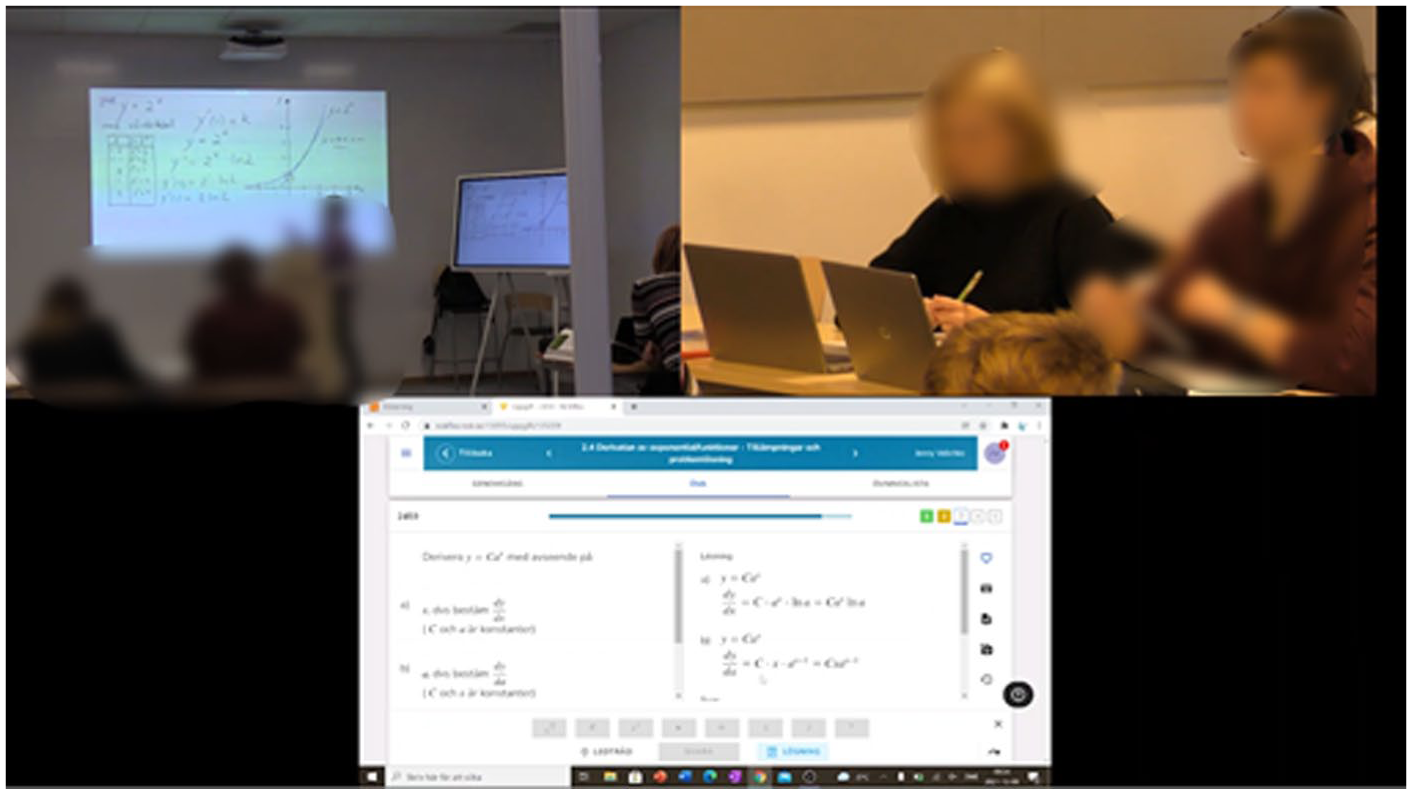
Example of the edited video recordings, showing three camera angles simultaneously.
Using video recordings, including individual students’ screen recordings, requires careful ethical considerations regarding participants’ privacy. All participants – teachers and students – were informed both verbally and in writing about the project to ensure informed consent. Students could consent to being recorded by the classroom video cameras and also had the option to volunteer as focus students, having their computer activity screen recorded. The classroom cameras were positioned to avoid recording the entire classroom, allowing non-participating students to stay outside the cameras’ capture area. Focus students controlled the screen recordings and could choose when to start and stop the recording program. After each lesson, the screen recordings were collected, and the researchers discussed with the focus students to ensure they felt comfortable sharing the material.
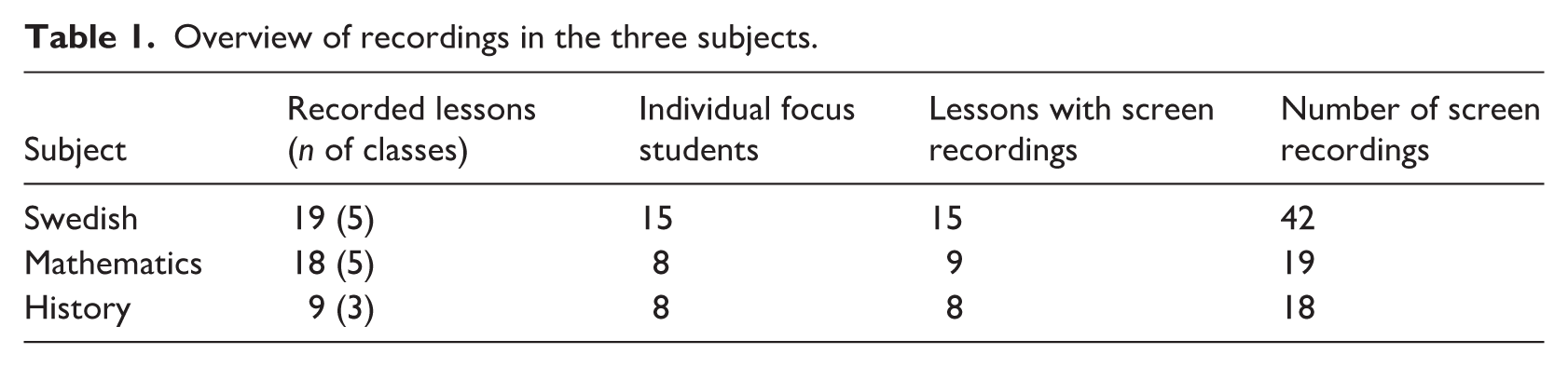
The data collection generated a total of 47 lesson recordings, which are distributed across the different subjects in accordance with Table 1. Not all focus students participated in all subjects, or on all lessons. During a few lessons there were no screen-recordings at all, at some lessons only one and at others up to six parallel screen recordings.
Overview of recordings in the three subjects.
Our comparative subject didactic approach means that different subjects are compared to discern common patterns and distinguishing features regarding for example subject, content, relation to academic discipline, different countries, and educational levels (Ligozat et al., 2015; Stolare et al., 2023). Through comparisons, subject didactic phenomena in classroom practice can be identified and related to other subjects to discern common and unique features. This makes it possible to discern the distinctiveness of the subjects as well as the considerations and actions of teachers and students, as teachers differ between subjects (for similar studies, see Almqvist et al., 2023; Jakobsson et al., 2023; Ligozat et al., 2018; Randahl et al., 2023).
Initially, a comprehensive analysis was conducted of how the learning platform was used across different subjects, including the integration of additional digital resources. All video material (Table 1) was reviewed multiple times and coded, focusing on the duration of teachers’ and students’ actions in relation to different teaching formats (i.e. whole-class instruction, individual work, or group work; see Table 2), as well as which digital resources were activated (Figure 2). All recordings were also transcribed to capture the trajectory of each lesson from both the teachers’ and the students’ perspectives. Based on these analyses, we selected, within each subject, one lesson that best illustrated the recurring patterns regarding the use of digital resources, the nature of school assignments, and classroom interaction. As an additional selection criterion, each chosen lesson also needed to include a learning challenge relevant to the students, enabling us to observe how digital resources were mobilized in relation to subject-specific knowledge structures.
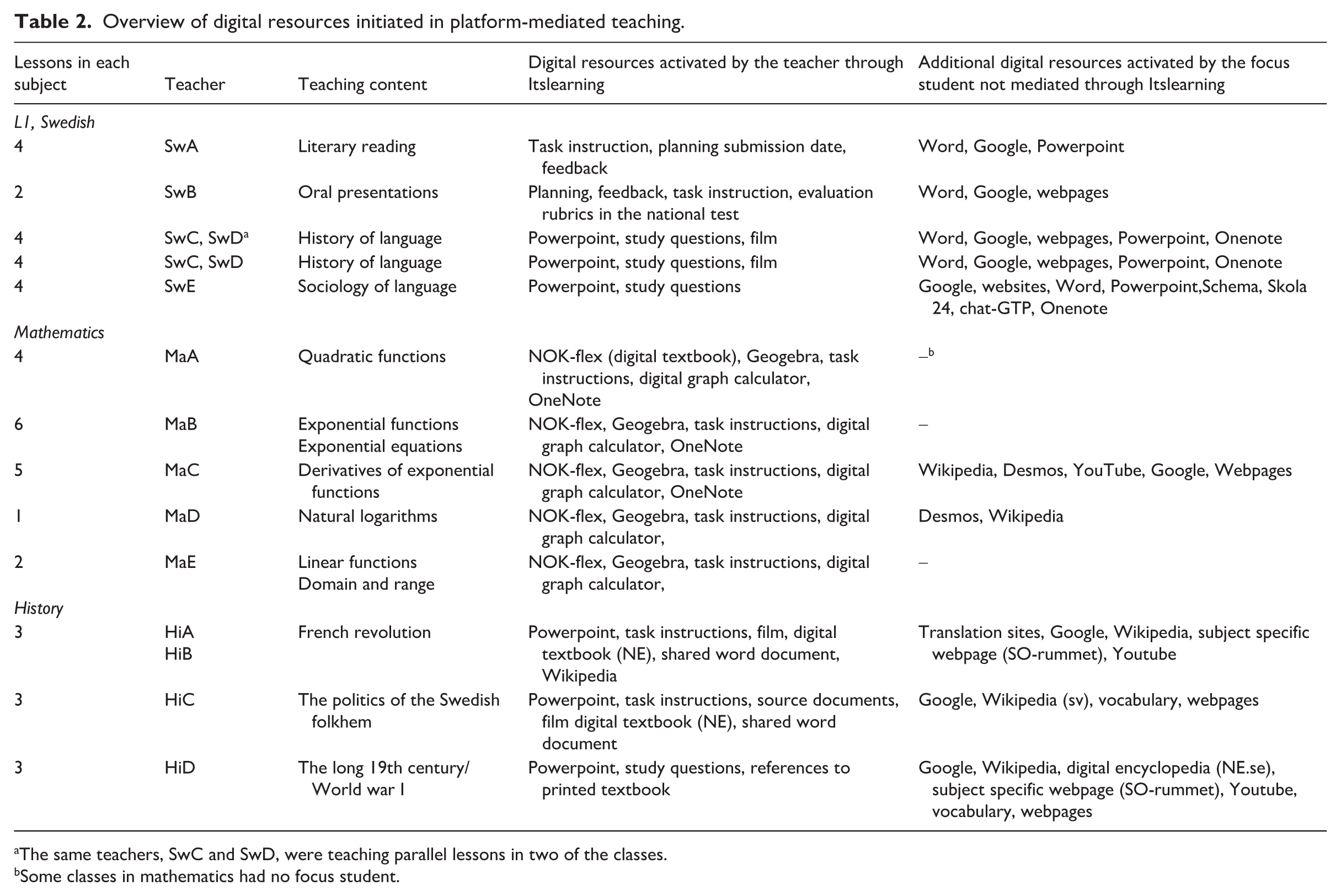
Overview of digital resources initiated in platform-mediated teaching.
The same teachers, SwC and SwD, were teaching parallel lessons in two of the classes.
Some classes in mathematics had no focus student.
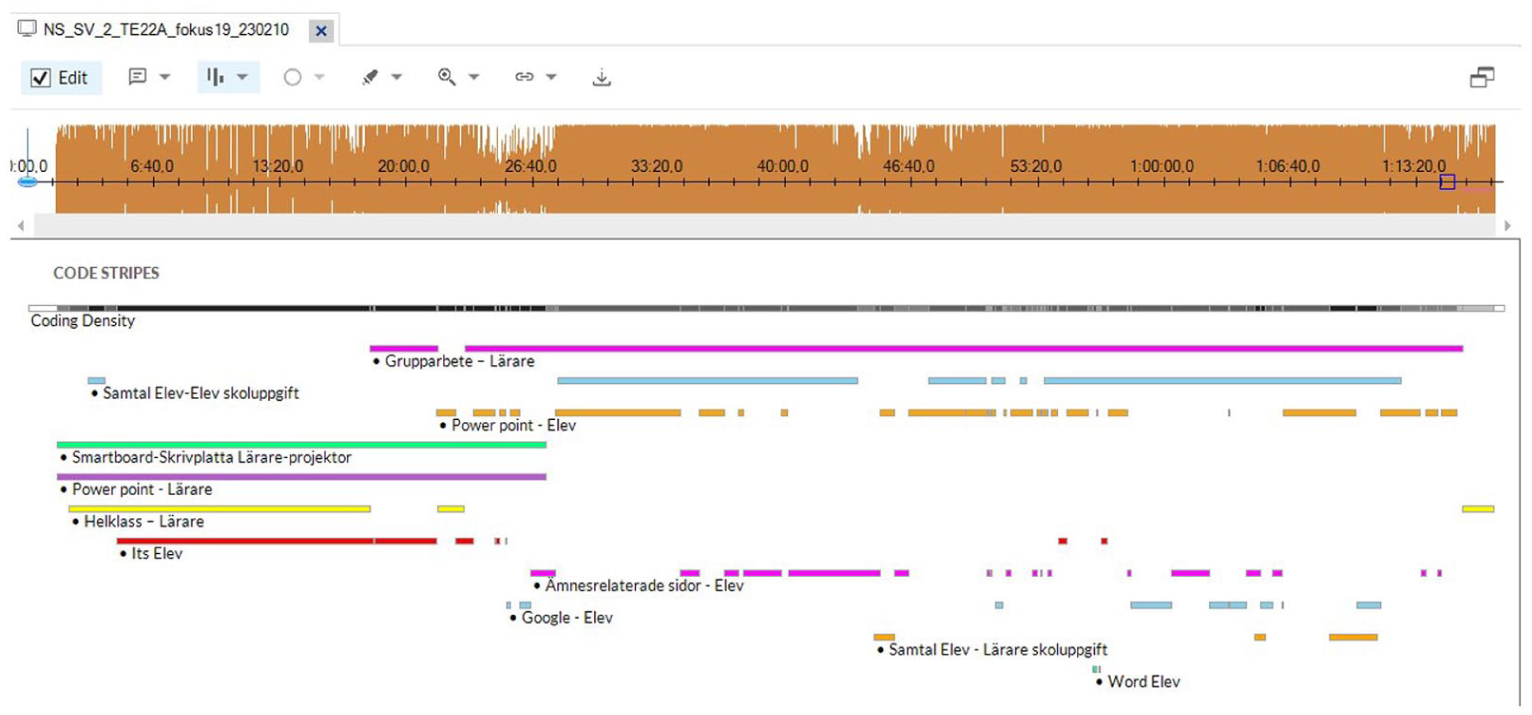
Example of overview of lesson coding in Nvivo.
The three selected lesson were then analyzed again with focus on classroom interaction as well as the role of the platform in the digital context, guided by Sefton-Green’s (2022) concepts of textualization and templatization. In his work, these concepts operate on a conceptual level, and to operationalize them in our analysis, we examined manifestations of subject-specific text practices within the digital learning context (i.e. textualization), as well as how the platform’s interface and structure influenced engagement with subject content during classroom interaction (i.e. templatization). Focusing on how subject knowledge is recontextualized within a platform-based environment, we maintained a critical lens on the platform’s role. A final comparative analysis across subjects examined emerging text practices and transformations, linked to a discussion of vertical and horizontal knowledge structures.
The platform context in the three subjects
As a first step, we examined the content themes and subject knowledge in three subjects, along with digital resources used by teachers and focus students during school tasks. We listed all teacher-activated resources in Itslearning and then identified additional student-initiated resources integrated into the platform during assignments (see Table 2).
All three subjects are characterized by the teacher offering a range of common digital resources via the platform, framing the teaching and thus constituting part of the pedagogical device. Thus, while there are some shared characteristics in the use of teaching resources across subjects, there are also differences that underscore the relevance of a comparative study (c.f. Ågerup, 2024). Differences between the subjects include the use of publisher-produced textbooks in mathematics and history, which are not used in Swedish lessons. This suggests that mathematics and history are more structured with the help of textbooks than Swedish (cf. Olsson, 2014; Utterberg Modén, 2021). In history and Swedish, teachers offer PowerPoint presentations on Itslearning as common resources, which function as important teaching materials in students’ schoolwork. Previous studies indicate that mathematics is largely framed by publisher-produced materials (Fan et al., 2013; Lester and Cai, 2010), but our examples show that this is complemented by teacher-led reviews using the interactive board or whiteboard to explain and create narratives around central concepts. This may explain that teacher-produced PowerPoints on Itslearning are less frequent in mathematics. In mathematics, teaching also comprises subject-specific applications, for example Geogebra and digital graph calculators, whereas there are no subject-specific applications in Swedish and history. In history, however, we find frequent use of films or pods on various historical alongside other digital resources.
In addition to the digital resources activated by the teacher through Itslearning, students add other digital resources in their school work. In Swedish and history, a wider variety of digital resources are used compared to mathematics, reinforcing the impression that mathematics is more structured around the digital textbook accessed via the platform. In mathematics, students use instructional videos on YouTube, where many educational videos are produced and uploaded by mathematics teachers on their own channels (Randahl et al., 2024). Swedish and history subjects show similar patterns regarding student-initiated resources, possibly due to the similarities between the teaching content in Swedish (language history and sociology of language) and the areas covered in history. However, usage patterns differ as students in Swedish are more engaged in writing tasks, such as essays, written answers to study questions or presentations, typically created in word processing programs like Word or Powerpoint. The writing process in Swedish is largely supported by students searching for information via Google, reading factual texts on Wikipedia, or other websites found during their work. In some cases, students also use generative AI via the chat-GPT service, which was introduced broadly during the time of our last recordings. In all subjects, the common learning platform was usually available in its own window on the student’s computer during the lesson, easily accessible for checking tasks when needed, but not always actively used for longer periods.
Below follows an in-depth analysis of selected examples from one lesson in each subject, where the platform is used as a resource in teaching. In response to research question two, the focus is on how the students’ oral and written communication is structured by the digital learning platform and its interface in the three subjects.
Swedish – A lesson on the sociology of language
In a Swedish lesson in year one, students work on the theme of sociolinguistics, which, according to the instructions published on the platform Itslearning, “deals with how language can vary from person to person.” The theme spans four lessons, and here we will focus on the second lesson, which begins with a lecture by the teacher (SwD) and continues with group work where students prepare a presentation for the next lesson. Using a Powerpoint presentation, the teacher introduces concepts such as dialect, sociolect, ethnolect, sexlect (i.e. relations between gender and language), and chronolect. In the Swedish lessons, classes often start with a review of the task on Itslearning, but in this lesson, the teacher directly shows the presentation from his computer. Our focus student (FE1), who is in a group with two other peers, opens Itslearning at the beginning of the teacher’s lecture, navigates to the Swedish course, and accesses the theme “sociology of language.” The focus student keeps the Itslearning page open for most of the teacher’s lecture, even if the teacher does not at this occasion explicitly orients to Itslearning. The platform already contains an overall plan with information about important dates for the theme, a general description of the theme’s content, and presentation formats. Below this, there is a reference to the learning objectives in the national curriculum that the theme aims to achieve, and that the theme is coordinated with another theme called “informative speech.” Students are expected to learn both knowledge about sociolinguistics and skills in delivering a fact-based oral presentation.
After the teacher’s lecture, the focus student (FE1) and his two peers (E2 and E3) start their group work, choosing to delve into the theme of “foul or fine language” for their presentation. FE1 opens a new Powerpoint document via an app in Onedrive, names it “Foul and fine language,” and invites E2 and E3 to collaborate in a shared document. They initially discuss how to structure the presentation and agree to find three examples, using one slide for each. This leads to a lively discussion where the conversation ranges from discussions about the overall structure of the text to an engaged debate on specific linguistic expressions to include. During this phase, they use various web resources as support; they search on Google, use Wikipedia, and repeatedly use the website “synonymer.se” to find alternative words.
The students quickly agree on two examples for their presentation but encounter a problem finding a third example (which they need as they each want one to present). FE1 turns to Itslearning to find information from the teacher’s initial presentation but only finds a previous presentation from the last lesson. He catches the teacher’s (SwC) attention and asks if they can access today’s presentation. The teacher, who has forgot to update the presentation on Itslearning, which is the common routine, quickly does so from his computer, replacing the previous presentation with an updated version containing slides from both lessons one and two. FE1 updates opens the PowerPoint presentation, and reviews the plan for the upcoming lessons with instructions on how they are expected to present.
The students then go through several slides in the teacher’s presentation, stopping at the question “what is male and female language?.” E3 suggests writing something about “needing a male banter” but struggles to explain the English word “banter” in Swedish to the others. E3 searches the web for explanations and finds an English explanation they are satisfied with: “the playful and friendly exchange of teasing remarks.” However, they feel the Google Translate suggestion in Swedish (“det vänliga och retsamma utbytet av retfulla kommentarer”) doesn’t sound right and when the second teacher (SvD) passes their desks, they ask:
What is the Swedish word for ’banter’?
battle?
Banter, well you know . . . banter
I don’t even know what banter is?
Here
Explain exactly what it is
((reads from the screen in Swedish)) “det vänliga och retsamma utbytet av retfulla kommentarer”
eh?
That is what I (unaudible)
Where does it say?
Here. That is what banter is
Or wait banter here ((reads from the screen in English)) “The playful and friendly exchange of teasing remarks”
Well, you joke a little with someone like this and (unaudible)
Well mocks? But mock sounds a bit harsh
more friendly
you are like macho
one makes fun of each other
Can you not say banter in Swedish? It feels like I’ve heard it.
Can you not write what the English word banter means bla
((the teacher nods))
Means roughly that people are joking with each other.
Yes, that people joke with each other on equal terms, kind of. Because it feels like when you mock someone, it’s usually on your terms, but when you joke, both can joke, it’s a bit more on equal terms.
yes
This example shows how the platform, Itslearning, is primarily used as a framing structure in this Swedish lesson, setting goals and guidelines for the upcoming presentation. The reaction from the focus student as the Powerpoint has not been uploaded in Itslearning as usual, shows that there are clear expectations and routines that all material should be found there. To solve the task, students add other resources for digital writing, such as shared documents and web-based sources.
To solve learning problems that come up, students’ oral discussions often focus on clarifying the meanings of various concepts encountered in their work. Here services like Wikipedia, Google, Google Translate, and synonymer.se are frequently used. This usage pattern is common in several Swedish lessons, especially in various writing tasks where students search for information through Google and other services. The example illustrates the predominantly horizontal character of the school subject Swedish, where the subject content in focus (sociolinguistics) can be applied to a wide range of examples that are difficult for the teacher to predict. The students encounter a learning problem when they search online for an expression they believe is related to the theme of foul–fine language. Thus, the digital learning environment enables them to find resources to in part solve the school task, but because the expression is difficult to translate fully into Swedish the resources available on the platform are insufficient. As a result, they require oral support from the teacher to recontextualize the information they find in relation to the task at hand. Although the students engage creatively with the digital platform, they still depend on the teacher’s support to effectively benefit from this resource.
Mathematics – a lesson about quadratic functions
In a first-year class in mathematics, students work on quadratic functions over three lessons. The digital textbook NOK-flex is a central structuring resource, accessed via the Itslearning platform. Students work on tasks in the digital textbook and use physical graph calculators along with written calculations on paper. The interface of the textbook is designed so that students enter their answers in a text box that turns green if correct and red if incorrect, providing immediate visual feedback. However, the calculations leading to the answer are not covered in the textbook, only the answer.
This example highlights a lesson, aiming to help students understand the significance of the symbols a, b, and c in the quadratic function y = ax2 + bx + c, and how these variables affect the graph’s appearance. The teacher (MaA) opens Itslearning at the beginning of the lesson, where the day’s instructions are available. After a brief introduction, the teacher instructs students to click on the link to Geogebra, an application primarily used in algebra, analysis, and geometry, provided on Itslearning. By clicking the link, students access a prepared Geogebra task where they explain in words what happens to the graph when the variables a, b, and c are changed. They then describe key parameters such as zeros, the axis of symmetry, and the vertex, and consider any relationships between them. While students explore the graph using sliders, the teacher circulates to assist those with questions, like student E4:
If you pull on c, the zeros move up and down.
Yes, exactly, that’s right
Along the y-axis
Yes, so it is
if you change a, what happens the? Yes, what happens in a?
Now it looks like this, and when you pull it the other way, it changes like this ((demonstrates on the students’ computer)).
Depending on if it is positive or negative
Yes, exactly we will repeat that later
Several students discuss their findings with the teacher while experimenting with the graph, and the teacher asks follow-up questions to help them articulate their discoveries. After some time, the teacher pauses the activity to summarize the students’ findings with the whole class. He writes the summary in OneNote, which is simultaneously displayed on the smartboard, while explaining the significance of the parameters (Figure 3):
The line of symmetry is a vertical line, parallel to the y-axis
((puts his hand up))
Yes
It always passes through the extreme value
Yes, great, you can also see that since the extreme value is either at the top or bottom and the line of symmetry would divide it into equal parts, the line of symmetry and the extreme value must share the same x-value. We can write, as you said, it passes through the extreme value ((writing it as he speaks)).
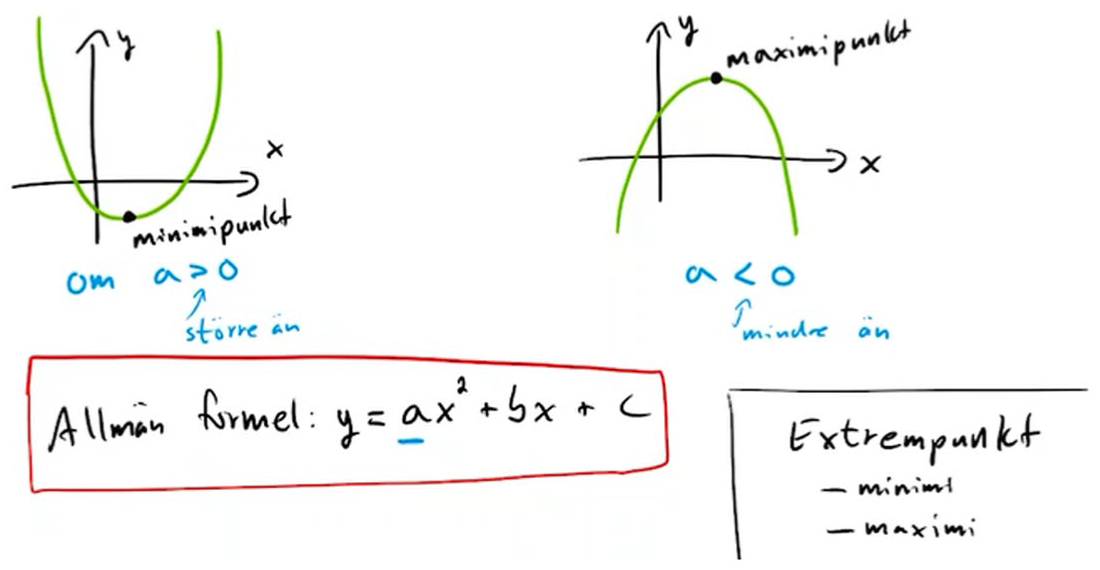
Teachers’ notes on the whiteboard, later shared with students on the platform.
In this lesson, Itslearning is used in a similar way to most mathematics lessons in our material, serving as a central structure for the lesson’s activities. Students find the materials, textbooks, or tasks prepared by the teacher on the platform. Various types of messages, such as test results, are also published there, and all lesson reviews are saved. The platform includes links to the digital textbook, NOK-flex, and OneNote, where students can write notes. There is also a link to Geogebra, which all mathematics teachers consistently use to demonstrate different mathematical representations and explain the mathematical significance of the focused area. Teachers also post lesson plans on the platform, detailing the tasks students should work on. In this example the teacher uses OneNote during the review, allowing for posting the lecture notes on the platform, thus creating a shared text based on a common discussion that the students can return to.
History – A lesson about Sweden in the 1930s
In history, a teacher (HiB) instructs a class over three lessons on the theme “Swedish welfare society [‘folkhem’] politics” which covers the development toward a welfare society that began as an idea in Sweden in the 1930s. In this subject, there is significant variation in how different teachers use the Itslearning platform, ranging from primarily using an analog textbook (HiD) to allowing the platform and digital teaching materials to play a larger role (HiA, HiB, and HiC).
This example is from the first lesson where students are introduced to the question: “Did Swedish folkhem politics lead to Sweden becoming a better society?.” The teacher presents, via Itslearning, a structured material for students to work with aiming to answer the main question. The material consists of sub-questions for which the teacher has provided various types of source material. The first question is “What problems existed in 1930s Sweden?.” Four historical sources are presented for this question: a newsreel, an excerpt from a 1930s debate book, a contemporary report, and an excerpt from a modern textbook. All material is available to students on Itslearning and is structured by the teacher in a shared document that students can download and write their answers in, so that the teacher can view their answers. The teacher presents the material and workflow during the first lesson, and encourages the students to stick to the provided material: Don’t Google what problems existed in 1930s Sweden, you’ll end up with incorrect information. Just like before, you should only use the source material I provide.
The statement indicates that this is a familiar method for the students and reflects the teacher’s intention for them to answer the questions using only the provided source material, to avoid going off track. This lesson aims to train students in the concept of historical evidence or source interpretation. The teacher elaborates on the reasoning by explaining: Then you read these two paragraphs. And try to answer the question ‘What problems existed in 1930s Sweden’ based on that source, and then work your way down in this manner (showing on screen at the same time). And when you are done with all sources, all four sources in this case, try to formulate a short answer based on all these stations. You can think that this plus this plus, that is, the answer to this plus this plus this will be a slightly more detailed answer.
In the teacher’s description, the task appears to be a compilation of information from various sources. However, this instruction is given during lesson 1, and the complexity of the task becomes evident later in lesson 3 when students begin working independently in groups. Our focus student (FE1) is in a group with four other students (E2-E5). Since all material is available on the platform, they must continuously use it during their work. The group watches the film together and discusses it while FE1 takes notes in the shared document. When they move on to the texts, they take turns reading aloud, and those not reading follow along via the platform. After reviewing the text, they discuss the source in relation to the question and formulate a joint answer in the shared document. The group works independently with most sources but encounters a problem with one source, an interview with a contemporary Swedish musician who mentions his grandfather was sold at a child auction. When the teacher passes by, they discuss their interpretation with the teacher, who notes a problem in their understanding of the source:
Listen, I see that you are at this one now . . . and a problem is that they sell children.
mm
Read this part carefully
Those who offered least could take him. They gave children away.
They were sold as helpers, or. . .
Think about this sentence
They were orphans, there was no one who could take care of him.
The one that offers least . . .
orphan
what do you say [name]?
It’s about his grandfather. He was auctioned off. He was an orphan, and that’s what they did with boys back then. The one who offered the least got to take him as a helper.
/. . ./
It’s just that they wanted to get rid of the, or?
But they would still take the one who bids the highest as the winner in such cases.
But no one would bid in that case.
Could it be that the price started high and then dropped to the lowest?
If you need to, search for some additional information as well, if you need it to understand this.
The students note that children were sold at auctions as helpers, but a learning problem arises regarding the true nature of child auctions. The teacher intervenes, and when the source material doesn’t provide enough information for students to understand why the person offering the least compensation took care of a child, he suggests (contrary to previous instructions) that they seek information from other sources. By searching online, students quickly find a Wikipedia article explaining the concept. They discover it was a “reverse auction,” not about selling children, but where the person accepting the lowest compensation to care for the children received custody. With this new understanding, they can proceed with the task.
The example illustrates the predominantly horizontal character of the school subject Swedish, where the subject content in focus (sociolinguistics) can be applied to a wide range of examples that are difficult for the teacher to predict. The students encounter a learning problem when they search online for an expression they believe is related to the theme of foul–fine language. Thus, the digital learning environment enables them to find resources to in part solve the school task, but because the expression is difficult to translate fully into Swedish the resources available on the platform are insufficient. As a result, they require oral support from the teacher to recontextualize the information they find in relation to the task at hand. Although the students engage creatively with the digital platform, they still depend on the teacher’s support to effectively benefit from this resource.
Comparative analysis: The role of learning platforms in three subjects
This section presents from a subject specific perspective, a comparative analysis focusing on the similarities and differences in the learning platform’s role, in this case the platform Itslearning, as a pedagogic device in the three subjects. In Bernstein’s terms, this refers to regulatory structures in relation to the distribution and recontextualization of the teaching content. The analysis is based on an overview of our entire data material and in-depth analyses of the three teaching examples. The analytical starting points for the comparative analysis are the concepts of templatization and textualization (Sefton-Green, 2022). The concept of templatization draws attention to how various functions and structures within the platform become guiding elements in the classroom by creating expectations for the learning and teaching processes. The other central aspect we focus on in our analysis, textualization, concerns the significance of the platform in relation to the text practices of the three subjects, including text production, use of learning materials and other types of texts.
Planning and expectations for school performance
In all three subjects, we see how the platform, Itslearning, is used to frame and structure various subject content over shorter or longer periods. In both Swedish and history, teachers post comprehensive plans for several weeks at a time, with clear information on when different teaching moments will be covered and how the learning objectives will be assessed through various graded assignments. In mathematics, the platform is also used for information about upcoming lessons and test dates. However, the textbook’s structure seems to serve as the primary resource for framing the teaching. Further, in all three subjects, references to curriculum goals and sometimes assessment rubrics related to grading are provided. Our analysis of the entire data material shows that students, especially in Swedish and history, often keep the teacher’s plan open on a tab on their computer to quickly check during their work. The way the platform is used in the three subjects, but perhaps most clearly in Swedish and history, which do not follow a textbook as closely as mathematics, makes it an important planning tool for the teacher and provides criteria for students regarding the expectations for their performance. Thus, the platform works as a regulating tool regarding how subject content is recontextualized in the classroom context.
Platform pedagogies and classroom interaction
The lessons in the three subjects follow well established patterns of classroom interaction, and typically begin with teacher-led instruction, followed by individual or group work. The oral instruction is often supported by a projected image, showing the platform or a slideshow. When students participate, a pattern of the so-called IRE-structure (Mehan, 1979) often follows, where the teacher initiates a question, a student responds, and the teacher evaluates and follows up. When students work independently, they may stay at their desks in the classroom or use workstations outside, where they can access all necessary materials via the platform and their computers.
The analysis of our examples illustrates that students expect all information to be available on the platform. This is evident in Swedish when a student points out that the teacher forgot to update the latest slideshow. In mathematics, the teaching differs slightly, as students primarily use publisher-produced materials. While the platform enables independent work, it becomes clear that the digital interface is insufficient when learning problems arise related to the students understanding of the content. At these occasions, merely searching for information through various web sources is often insufficient and needs to be discussed in oral interaction with teachers or peers. For teachers, an important implication is the need to look beyond the platform’s structure as a tool for planning and organizing instruction, so as not to overlook the significance of the arrangements in the physical classroom, including the conditions for oral interaction.
Text practices in three subjects
A central aspect of the text practices in these subjects is how the platform relates to the common texts used in teaching. Mathematics relies heavily on the digital textbook, which guides content progression, pace and conceptual ordering. In contrast, the Swedish subject does not use a common textbook, aligning with its tradition. The mainly horizontal knowledge structure in Swedish, where different content can be addressed without a specific order, fits well with the digital context’s capabilities for information retrieval, various text types, and digital writing. This structure places significant demands on students’ ability to recontextualize content that they find through web resources to the specific school task. In our study, we observe that wide range of various internet resources that come up in the Swedish lessons, is counterbalanced by a clear framework of teacher-produced presentations, study questions, and reporting forms that guide students. The text practices in history share many similarities with those in Swedish, but relies less on students’ own information retrieval and more on teacher-selected resources. History also features a greater variety of text types and extensively uses audio-visual materials like films, podcasts, and other multimodal texts selected by the teacher and posted on the platform.
Another aspect of interest is the platform’s significance for writing practices in the three subjects. The analysis reflects different teaching traditions, with varying implications. Both Swedish and history subjects are largely characterized by digital writing, while mathematics develops a hybrid practice combining digital writing for solutions and paper-and-pencil calculations. Although all subjects use multimodal texts, mathematics to a larger extent build on visualizations through semiotic expressions, symbols, and graphs. The digital interface changes how visualizations and simulations are made using applications like Geogebra, and how teachers share board notes via the platform. In Swedish, students are expected to produce a lot of text, mostly in digital form, often linked to oral presentations and submitted via the platform. History also predominantly uses digital writing but requires more oral dialog and relates primarily to teacher-selected text sources.
Itslearning in the broader platform context
The analysis highlights how Itslearning is part of a complex ecology, linking to various digital resources such as other platforms, word processing programs, subject-specific applications, teaching materials, and internet resources (Table 2). In Swedish and history, the platform is used to gather and organize subject content, while in mathematics, it primarily links to other digital resources like digital teaching materials and applications such as Geogebra and Desmos. This difference can be understood in the context of the subjects’ knowledge structures. The horizontal nature of Swedish and history allows for greater flexibility in content selection and order, fitting well with the platform’s generic infrastructure where the teacher can collect and present tasks and learning material. Particularly in Swedish, the students’ online information seeking results in a wide range of content being brought into the classroom, with varying degrees of relevance to the shared task. History, though similar to Swedish in many ways, appears in our examples as more concept centered, offering a clearer instructional frame even when students draw on the wider digital context. In contrast to the other two subjects, the vertical knowledge structure of mathematics emphasizes the platform’s potential for multimodality and interactivity rather than content selection. Hence, mathematics seems to benefit most from the affordances of digital resources – such as GeoGebra – which have introduced new possibilities for exploring mathematical problems. This also illustrates the dimension of trainability, demonstrating how teachers and students have adapted to the new resources.
Discussion
Within the European research community, comparative didactics has developed a strong knowledge base − both theoretically and empirically − regarding subject didactics (c.f. Ågerup, 2024; Almqvist et al., 2023; Hudson, 2007; Ligozat and Buyck, 2024; Meyer and Rakhkochkine, 2018). While Hudson (2007) already highlighted the need to pay greater attention to rapidly developing, technology-centered personalization processes, digital technology has not been placed at the center of most subject-oriented comparative studies. This study builds on previous European research focusing on comparative analyses of how the institutional boundaries shaping learning are consequential for different school subjects (Ågerup, 2024), by additionally conceptualizing the platformization of education as part of the pedagogic device that shapes institutional conditions. It places itself in the tradition of comparative didactics, while also drawing on influential European research on the platformization of teaching (Bergviken Rensfeldt and Player-Koro, 2024; Cone, 2023; Decuypere et al., 2021; Kerssens and van Dijck, 2022; Richter et al., 2025).
Our analysis is informed by the critical conceptualization of platform pedagogy proposed by Sefton-Green and Pangrazio (2021) and further developed by Sefton-Green (2022). In the studied classrooms, the learning platform is present during all lessons and serves as a common structure applied for all subjects during the school day. Although our study is limited to two secondary schools in Sweden, this is not an isolated case but rather an example of the platformization processes that are now a reality in many European schools (Richter et al., 2025). It can therefore serve as a starting point for further investigations of digital platforms from a comparative didactic perspective in other European contexts.
The comparative analysis reveals both similarities and differences in how the role of the learning platform plays out differently in the three subject contexts. In all three subjects the learning platform’s efficiency in planning, organizing, and structuring schoolwork over extended periods of time is evident. With the platform’s generic functions, teachers can create instructions, assignments, and text materials in advance, making the teaching predictable for students over short or long work periods. Obviously, this predictability can lead to increased instrumentalization of teaching, which, while beneficial for planning and overview, may limit flexibility and the possibilities to adapt to emerging needs during the process. Another aspect of this is also the push toward individualization of students’ school work, as content and tasks can be reached anytime and anywhere and in different order and pace for different students.
Despite the large opportunities to use different media in teaching and assignments (films, podcasts, slideshows, etc.), our analysis shows a high proportion of submissions based on individual written texts, especially in Swedish. The work areas presented on the platform are often explicitly framed in relation to curriculum goals and assessment criteria, reinforcing performativity demands within a strong assessment discourse dominant in Swedish schools (Bergviken Rensfeldt and Player-Koro, 2024; Grönlund et al., 2023), whereas the collective experiences in the whole class often is limited to introductory lessons followed by individual work.
Our analysis of the 47 lesson recordings reveals that the use of learning platforms is integrated into the established subject practices of Swedish, mathematics and history respectively and is thereby shaped by the different subject traditions. At the same time, the platform structure in itself also influences how knowledge can become organized, accessed, and presented, and thus recontextualized, through its interface. This function of the platform is most significant in subjects with a horizontal knowledge structure, such as Swedish and history, where teachers have more flexibility in selecting texts and designing tasks. In contrast, mathematics, with its vertical structure and progression, relies more on publisher-produced materials, making the platform mostly into a mediating resource to reach the digital textbook.
Another important aspect concerns the platform’s different roles in shaping subject-specific text practices within a broader digital context. In mathematics, this involves adding specific applications for visualization, calculation, and simulation that can be reached through the learning platform. In Swedish and history, digital writing based on different sources is prominent, and here the platform guides and limits students’ navigation through a vast amount of internet texts. These differences relate to the different knowledge structures of the subjects, with vertical structures requiring depth and exploration in a certain order, while horizontal structures allow for content expansion that fits well with the internet sources.
Finally, we find it important to highlight the digital platform’s significance in relation to the physical space of the classroom. With instructions, assignments, and materials constantly accessible via the platform, teaching is less tied to the physical classroom. Students can work outside the classroom or from home and still access the same information through the learning platform. This facilitates the distribution of teaching across time and space, favoring individualized work forms and reducing the need for physical meetings. However, our analysis consistently shows that oral interaction is crucial for resolving comprehension problems that occur in all subject teaching. Our comparative analysis shows that this is particularly important to consider in relation to horizontal knowledge structures with weak conceptual framing, as illustrated in our example from the subject Swedish and, to some extent, also history. This finding aligns with previous subject specific research on digitalization (Asplund et al., 2018; Juvonen and Nilsberth, 2021), but is particularly important to highlight in relation to generic learning platforms as comprehensive infrastructures, which seems to promote individual work where the teacher is not always present.
To conclude, the results of our study underscore the importance of teachers’ agency and awareness in relation to platform-based subject teaching. Our findings suggest that platforms, from a didactic perspective, do not in themselves enhance the content or implementation of these subjects. Rather, they tend to reinforce established subject traditions and, within those traditions, promote a shift toward individual work tasks distributed through the platform. In terms of recontextualization of subject knowledge, this is a development that might lead to increased differences between students’ possibilities since the teachers’ possibilities to explain and challenge students’ critical thinking become more limited. At the same time, we can see a variation between teachers, in the same subject but also across the different subjects, in the way they use the platform, which can counteract the limiting and controlling tendencies that platforms also have been shown to push for (Cone, 2023; Decuypere et al., 2021; Kerssens and van Dijck, 2022).
In a platformized school, where demands on accountability, assessment, and efficiency is always a factor, it is more important than ever to raise the awareness of the quality of the subject content in education and the development of platform pedagogies that can prepare students with the knowledge and critical thinking needed for participation in a changing world. From a subject didactic perspective, platform pedagogy means that teachers should be aware of how platforms seem to facilitate certain social processes while hindering others without falling into a deterministic understanding of them as always constraining teaching.
Footnotes
ORCID iDs

Ethical considerations
The project underwent ethical peer review according to Karlstad University’s local guidelines (Dnr. C 2020/282).
Consent to participate
All research participants gave written consent for review and signature before starting the study.
Funding
The authors disclosed receipt of the following financial support for the research, authorship, and/or publication of this article: This research was funded by the Swedish Research Council, UVK 2019-03760.
Declaration of conflicting interests
The authors declared no potential conflicts of interest with respect to the research, authorship, and/or publication of this article.