







Abstract
Since 2006, the enrollment of African students in Chinese universities has been increasing steadily. A majority of the students have been recruited through the China Scholarship Council. Cast against that background of growth in the number of African students in Chinese universities, it is important that their educational experience in a country whose cultural landscape and political orientation are significantly different from those of their homelands be examined for evidence on their overall well-being. A total of 110 students from 32 African countries enrolled in six public Chinese universities responded to a questionnaire on their satisfaction with and adjustment and adaptation to their new cultural and academic environments. Results indicated that the students’ over-expectation of China and natural factors, particularly China’s weather as a barrier to adjustment, had negative associations with their overall satisfaction and with their adaptation to their environment. A broad network of friends, prior cross-cultural experience, and prior knowledge of cultural differences had positive associations with satisfaction and adaptation. The implications of these results for developing campus programs for acculturating the students, as well as other international students in Chinese universities, are presented.
The Forum on China–Africa Cooperation plans to roll out a wide range of projects over the next three years … 100 African postdoctoral students given funding to do research in China … 2,000 Africans trained in agricultural technology, including animal breeding, irrigation and fisheries management.
In the decades since 1950, political, social, and technological barriers have been diminished by globalizing forces that are fueling the economies of high-growth nations such as Brazil, Russia, India, China and South Africa (commonly referred to as BRICS), leading to a worldwide convergence in economies and narrowing the asymmetries between advanced and developing countries (Spence, 2011). Education is a formidable pivot in that convergence, which has been further accentuated by the global flows of students and by the pervasive dissemination of core knowledge, which Badaracco (1991) delineates as migratory and embedded. Such flows have major implications for the well-being and competency of participants on the global landscape, particularly those in higher education.
The purpose of this study is to examine issues in the cross-cultural adaptation of African students in Chinese universities and to identify factors that could explain the students’ satisfaction or dissatisfaction with their experience there, particularly in light of their growing numbers in the People’s Republic of China (PRC). In a period when the nation’s Communist Party is calling for more attention to be given to Africa by the United Nations (‘China Calls’, 2011) and when China is capitalizing on its designation of 2006 as the ‘Year of Africa’, it is important that its support for the continent be manifested in a continuing government interest in the well-being of international students, particularly those from Africa, where China’s influence and investment are growing significantly (Andrews, 2011; Cheru and Obi, 2010; Christensen, 2015; Foster et al., 2009; Michel and Beuret, 2009; Taylor, 2009; Zhao, 2015). As Michel and Beuret (2009) note, China’s success in Africa reinforces its superpower status and offers proof that it is ‘capable of economic miracles both at home and in some of the least developed corners of the planet’ (p. 4). And the nation’s expanding strategic interest in the ‘Chinese dream’ translates into its efforts to rejuvenate its global stature.
The Forum on China–Africa Cooperation (FOCAC) in 2006 organized one of the largest gatherings in China, attracting 48 delegates of African governments and more than 1500 business people (Naidu, 2007). That forum was encouraged in part by the burgeoning, diverse relationships between the PRC and Africa, which continues to send a large number of its students to the PRC. And the growing number of African students in the PRC provides a beachhead for including Africa’s youth in the development of the continent and the building of stronger ties between it and the PRC. Furthermore, it is plausible that the PRC’s interest in sharing its culture and language on the African continent through its youth, enrolled through the China Scholarship Council (CSC), is that China-trained Africans may in the long run serve as volunteer ambassadors of Chinese culture. Anshan (2005) categorized the contact between the PRC and Africa into four periods: sensing Africa (1900–1949), supporting Africa (1949–1965), understanding Africa (1966–1976), and studying Africa (1977–2000). To those periods, we add attracting Africa (2001 to the present), which indicates the PRC’s interest in recruiting, under the aegis of CSC, international students (Figure 1), who have been intensely recruited to China since 1997. Beyond political pronouncements and global business investments, the enrollment of African students on the Chinese Government Scholarship Program (CGSP) in Chinese universities has been increasing steadily since 2006: the number of African students was the third largest in 2006, second largest among students from all world regions in 2007, largest in 2008, and second largest again in 2009 (CSC, 2006, 2007, 2008, 2009). In 1950, the PRC welcomed its first group of international students – all 33 of whom came from then-Eastern Europe (Yu, 2010).
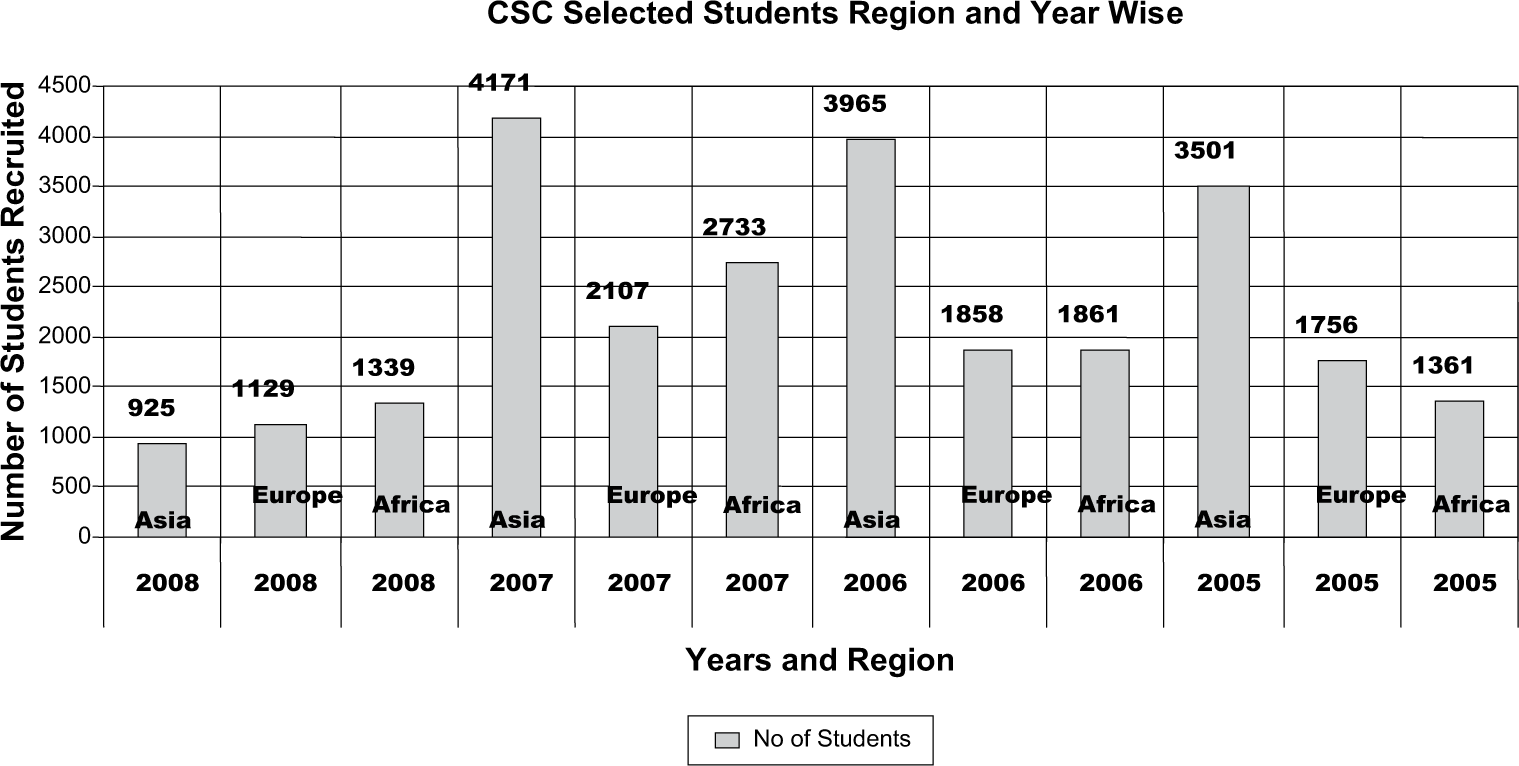
China Scholarship Council–selected students, by region and year.
Since the early 1960s, when the first cohort of African students arrived in China (Sullivan, 1994) under the auspices of the CGSP and the Ministry of Education, which offered full scholarships to citizens of developing nations, there have been tensions in the relations between some African students and some of their Chinese counterparts. The first widely known such campus conflict began on 3 July 1979, when Chinese students complained about loud music being played by Africans during an examination period on the campus of the Shanghai Textile Engineering Institute, resulting in Chinese students referring to their African counterparts as ‘black devils’ (Sautman, 1994: 415). A similar incident occurred nearly a decade later when, on 24 December 1988, two African students and their Chinese girlfriends were stopped at a Hohai University campus security checkpoint as they were about to enter a building in which a Christmas Eve party was being held. A security guard asked the students to sign in, but disallowed entry to their female guests on the presumption that they were prostitutes. A scuffle and an argument ensued. The pandemonium attracted party attendees and, in the mêlée, dozens of Chinese and African students at the university were injured, scores terrified. Those inauspicious encounters morphed into anti-African demonstrations that called on the PRC to prosecute the riotous African students and to reform a scholarship-award system that the demonstrators perceived as offering international students more rights and benefits than it did Chinese students. In the aftermath of those incidents, a Chinese scholar wrote, ‘In China, “black” is a totally acceptable metaphor for ugliness and evil, and people can’t conceive of it in any other way’ (Yuan, 1989: A23). Such a viewpoint is consistent with the findings of an analysis of race in China, where sordid assumptions about race have deep historical roots, where physical characteristics and the aesthetic premium of the lightness of skin color are common, and where the formation and composition of racial stereotypes are idealized, and portrayals of the Han Chinese as descendants of the mythical Yellow Emperor are pervasive and tenacious, even as the Communist Party works diligently to build racial harmony and unity (Dikötter, 1992; Sullivan, 1994).
Even with those tension-laden relationships as a backdrop, the epigraph at the beginning of this article demonstrates China’s continuing efforts to boost its ties with Africa – particularly in education. As universities worldwide strive to develop their distinctive qualities and attributes, globalization has become a mantra of choice for establishing and strengthening their brands and for nurturing and expanding their reputations. Nearly five decades ago, McLuhan (1962) coined the term ‘global village’ (p. 31) and observed that we were living in a ‘world of simultaneous events and overall awareness’ (p. 40). People keep moving across geographical borders for various reasons, and China has become a focal point because of its increasing world-class infrastructure, its improving profile on the world stage of geopolitics, its growing economy – it is now the world’s second largest – and its mammoth global investment interest, not least in Africa. All of those developments have major implications for China’s higher education system: ‘Academic exchanges are going on between China and the world, gradually bringing China into international academia’ (Anshan, 2005).
Thus, globalization is compressing time and space, flattening the world, and raising consciousness across the globe, interconnecting societies for economic purposes but also to attain social, cultural, and academic goals (Friedman, 2005; Monge, 1998; Straubhaar, 2007).Consequently, the omnipresent interest among universities worldwide to increase international student enrollment has resulted in four discernible trends in higher education, particularly in the United States.
The first is setting up branch and satellite campuses abroad, including Michigan State University in Dubai (now closed); Temple University in China (law program at Tsinghua University School of Law), Japan, and Rome; University of Nevada in Singapore; Johns Hopkins University in Nanjing, China; New York University in Shanghai, Tel Aviv, Buenos Aires, Abu Dhabi, and Singapore; University of Chicago in Beijing and Paris; Georgetown University School of Foreign Service in Doha, Qatar; and Weill Cornell Medical College in Doha, Qatar. No Chinese university has, to date, undertaken such an outreach, although economically and culturally China’s presence and influence are palpable around the world.
The second trend is increasing opportunities for study-abroad programs by which a university sponsors its own students to take courses in another country. Some universities have established area-studies centers – for example, African or Asian studies centers – to promote such international experience. The University of Wisconsin–Madison, for example, has established area initiatives for Brazil, China, India, and Korea under the auspices of the university’s East Asian Studies Center to support exchanges with other universities.
The third is linkage or liaison programs by which universities in different world regions (including China) exchange students and faculty, and students from one region will enroll in, say, a US-sponsored program in another country – a three-party arrangement.
Finally, universities in one part of the world are developing partnerships with those in far-flung places; hence, there are, for instance, the Australian College of Kuwait; American University of Yola, Nigeria; American University of Beirut, Lebanon; American University of Kuwait; and the American University of Cairo.
Worldwide, China has become the fifth largest country to enroll international students (Hvistendahl, 2008); it is the top country in Asia for international student enrollment (Institute of International Education, 2010). Because these cross-border movements have drawn migrants and students from different sociocultural, psychological, and environmental backgrounds, adaptation stressors are increasingly evident. Such stressors underscore the importance of host institutions and governments establishing coping mechanisms to enable their international students and scholars to accomplish their scholarly goals and objectives with fewer distractions. As a deep-rooted, traditionally high-context culture, China poses far more challenges to its international students than do low-context Western cultures. As Adler (1975) observed decades ago, ‘The transitional experience begins with the encounter of another culture and evolves into the encounter with the self’ (p. 18). So, it can be said that encountering another culture can create a new sense of understanding for the students and their approach toward life on a new cultural landscape.
As Asian countries, particularly (mainland) China, Korea, India, Japan, Hong Kong (Special Administrative Region of China), and Malaysia, attract international students in high numbers to their colleges and universities (Marginson, 2010), such students are the best ambassadors and can serve as bridges between different cultures and resources (Eide, 1970; Paige, 1990; Rienties et al, 2012). Data indicate that the number of African students on CSC sponsorship in Chinese universities increased from 2005 to 2007, declined in 2008 (Figure 1), but increased in 2009. The minuscule resources for international students in countries other than China have encouraged the PRC to invest in Africans by preparing them to assume leadership roles on their return to their home countries and to serve as liaisons in developing close cultural ties between the PRC and Africa.
The first author’s experiences as a former doctoral student in China, and his informal interactions with African students in Chinese universities, inspired him to propose a systematic study of the African student’s experience there. Strictly by non-systematic observation, Southeast Asian students in China tend not to have experiences similar to those of Africans, perhaps because of the commonality between Southeast Asian culture and that in the PRC.
Literature review
The growing literature on the acculturation process of international students points to the stress and other forms of adjustment problems that they experience in a different culture (e.g. Chavajay and Skowronek, 2008; Furukawa, 1997; Hamboyan and Bryan, 1995; Lee et al., 2004; Misra and Castillo, 2004; Randall et al., 1998; Ying, 2005). Chinese international students, whose expectations and educational needs are different from those of local students, have acculturation challenges: acculturative stress and maladaptive perfectionism predicted depression among them (Pan et al., 2007; Wei et al., 2007; Yan and Berliner, 2009), and they demonstrate an inclination toward conformity, passivity, and dependence on authority figures (Chen et al., 2008; Turner, 2006; Volet and Renshaw, 1996).
For international students in the PRC, language and social adjustment difficulties are apparent (Baohua and Watkins, 2006; Liu, 2010). Yet, the PRC is the fifth most popular destination of international students worldwide – after the United States, the United Kingdom, France, and Germany (Institute of International Education, 2010). As recently as 2001, China was not a destination for international students. Because post-Mao China is a relatively nascent player in international circles, there is a paucity of published student-focused research in international education, which is a growing interest among anthropologists, sociologists, and, most recently, mass communication researchers.
Noteworthy, however, are the results of a comparative study of African and Western college students in China: both groups had similar frequency scores in four areas associated with stress, with the African students indicating slightly more difficulties, although differences were not statistically significant (Hashim, 2003; Hashim and Zhiliang, 2003): (a) academic, for example, earning lower grades as an indicant of their Chinese-language proficiency; (b) interpersonal, for example, conflict with room-mate; (c) intrapersonal, for example, financial difficulties; and (d) environmental, for example, living in an unfamiliar environment. The study concluded that although stress among international students could not be eliminated, it is important that they be prepared to manage it to maximize their experiences during their study abroad. Gudykunst and Kim (2003) note that the cultural-adaptation process is not driven by a single factor, but by many factors that can accelerate or decelerate that process among sojourners, that is, ‘short-term visitors to new cultures’ (Church, 1982: 540). They assert that a broad social circle of host nationals is an important variable of a ‘sojourner’s cognitive learning’. Decades earlier, Morris (1960) found the same association. Students who have close interaction with host nationals have greater satisfaction in various aspects of host society. Several studies have identified factors such as students’ competence in the language of the host culture, their social circle, cultural awareness of the host society, prior international experience, and over-expectation of a new culture (Castro, 2003; Martin et al., 1995; Ward, 1996; Ward and Rana-Deuba, 1999).
In sum, the literature affirms the multiplicity of factors – for example, linguistic competence, broad social circles, length of stay in the new culture, prior overseas experience, students’ expectations of China, and knowledge of host culture before arriving in a host country – that underpins the satisfaction or dissatisfaction that international students experience in a culturally different environment (e.g. Miglietta and Tartaglia, 2009).
Theoretical framework
Kim’s (1988) theory of cross-cultural adaptation provides the conceptual background for this study. That theory posits that cross-cultural adaptation is a ‘dynamic process by which individuals, upon relocating to new, unfamiliar, or changed cultural environments, establish (or re-establish) and maintain relatively stable, reciprocal, and functional relationships with those environments’ (p. 31). The theory also emphasizes that when newcomers reside in a different culture, they will naturally go through a cross-cultural adjustment process. In this context, adaptation refers to ‘the entirety of the evolutionary process an individual undergoes vis-à-vis a new and unfamiliar environment’ (Kim, 2005: 379). Similarly, Gudykunst and Kim (2003) defined adaptation as ‘The process of adapting to a new and unfamiliar culture [that] is essentially a journey of personal change in which strangers who are socialized in one culture (enculturation) cultivate an inroad into another culture’ (p. 373). Castro (2003) noted that adaptation is the label for those skills through which a newcomer interacts with a host culture easily and understands its values and taboos. It has been suggested that when individuals are culturally and socially proficient, they can achieve their aims and objectives in a host society (LaFromboise et al., 1993), resulting in health benefits for the individual (Castro, 2003).
A more frequently studied approach to adaptation suggests that adaptation can be broadly divided into two categories: psychological and sociocultural (Ward and Kennedy, 1993). Ward (2001) suggests that psychological adaptation is best understood from stress and how to cope it, while sociocultural adaptation occurs within the framework of cultural learning. She further points out that psychological and sociocultural adaptations are influenced by different sets of variables. Psychological adaptation is based on personal characteristics, coping strategies, social support, and social circle, while sociocultural adaptation is based on span of time of the sojourner in a host culture, his or her cultural knowledge and understanding, and his or her competency in the language of the host culture (Ward, 1996).
Church (1982) reports that (a) a majority of international students, as sojourners or short-term visitors to a new culture, adjust reasonably to new cultures and institutional demands; (b) the percentage of satisfied students varies from one host country to another; and (c) satisfaction with academic or professional aspects of one’s responsibilities is generally higher than satisfaction with non-academic or social aspects.
Studies that investigated predictors of students’ experiences have found, on the one hand, positive relationships between satisfaction and overall adaptation to a host country (e.g. Kagan and Cohen, 1990; Yang et al., 1994; Zimmerman, 1995). Sewell and Davidsen (1961) reported that offering proper assistance to international students and having knowledge of the host society before arriving in a host society have positive effects on international students’ adjustment and satisfaction levels. If, on the other hand, expectations are not met, then the adjustment process in a host society is decelerated (Rogers and Ward, 1993). Proficiency in language is also directly related to the adaptation of short-term visitors (i.e. international students) and to their satisfaction level (e.g. Barratt and Huba, 1994; Crano and Crano, 1993).
Cast against the backdrop of the preceding analysis, this study proposes the following hypothesis:
Awareness of cultural differences, availability of a social circle of friends, and prior cross-cultural experience will influence positively and significantly the overall satisfaction of African students in select Chinese universities, whereas weather conditions and students’ over-expectation of China will have a negative effect.
The rationale for the hypothesis is guided by findings of related studies that concluded that short-term visitors’ experience in a host culture is a function of multiple factors. Thus, to the degree that no single factor can explain fully the adjustment difficulties of international students whose experiences vary from person to person and from region to region, it is important that higher education administrators have a clearer understanding of the African student’s plight in a country that has developed robust programs to enhance the educational development of the citizens of the least developed continent. A test of this hypothesis will be tantamount to identifying key factors that explain the adjustment difficulties that confront some international students and enabling higher education administrators to develop programs to address them.
Method
Questionnaire design
A two-part questionnaire was developed and content-validated to determine and analyze factors responsible for overall satisfaction of African students in Chinese universities. The 15 items in Part I sought information on respondents’ demographics. Part II comprised 62 items anchored on a 5-point, Likert-type scale. To access the maximum possible number of African students, the original survey instrument was developed in English, then translated to three additional languages, and back-translated to English to ensure linguistic precision and consistency. The translation and back-translation were conducted by students whose language-translation skills were authenticated by the international student office on campus. The translators and back-translators worked independently of each other. As a hedge against translational errors, the translated version was forwarded to other language experts for cross-checking and for correcting of any grammatical errors or changes in intended meanings of each questionnaire item.
Sampling
The sample comprised African students enrolled in six public Chinese universities. Selection of the universities was guided by two overarching realities: (a) the ease of access to the African students on those campuses, where 88% of them lived; and (b) the relatively high number of African students on those campuses.
Given the sensitivity of expressing publicly one’s opinions – however benign – on Chinese university campuses, let alone outside of campus, it was important that reassurance be offered to prospective respondents. Perhaps more important, African students are generally most willing to express their opinions on even sensitive issues in a forthright, down-to-earth manner. Part of this predisposition may be underscored by the boisterous, cacophonous environments in which engagements tend to take place on educational campuses on the continent and in their social milieu.
The study used a non-probability sampling technique in an attempt to emphasize the personalization criterion for effective questionnaire distribution and study participation in a cultural setting in which motives were amenable to being questioned and where professional intent was commonly conflated with strategic intentions. The distribution of copies of the questionnaire was enabled by the high clustering of Africans in international student residence halls. 122 questionnaires were delivered to the students’ rooms and picked up within 7 days; 110 were completed, for a 90% response rate. That high response was largely attributed to the iterated assurance of respondent anonymity.
Findings and discussion
The 110 respondents originated from 32 African countries. In all, 6% were younger than 21 years, 62% between the ages of 21 and 30 years, 29% between 31 and 40 years, and 3% were older than 41 years. More than 74% of the students were on Chinese government scholarship. Of the 110 respondents, 52% were Christian, 41% Muslim, and the rest of reported faiths, including Buddhism and Hinduism, with 1% reporting atheism. In all, 64% said that they had international experience before arriving in China, while 36% were having first-time exposure to another national culture. Regarding foreign-language expertise, 20% of the respondents said that they studied Chinese language before coming to China. Of the total respondents, 19% said they did not study the Chinese language, 30% were proficient in oral Chinese, 24% in both speaking and reading, and 27% in reading, writing, and speaking; 31% said that the instructional medium in their program was Chinese, 34.5% English, and 34.5% said it was bilingual (Chinese and English). By education level, 23% of the students were in their first year of study, 51% in second year, and 17% in third year, while only 9% had more than 4 years of college study in China. More respondents were enrolled in postgraduate programs (72%, including 25% in PhD programs) than in undergraduate programs (28%).
Student satisfaction
More than 59% of the African students said that they were satisfied with their life experience in China; 34.5% were neutral on that variable, while more than 6% disagreed (Table 1). Responses thus clearly showed that a majority of the students were satisfied with their experience in Chinese universities. Similarly, more than 76% students agreed that one should be familiar with basic cultural differences while staying abroad; surprisingly, more than 17% were ambivalent on that variable, while more than 6% disagreed with it. After all, because cultural awareness is a desideratum for the effectiveness of individuals and organizations as they engage an increasingly global community, the literature is rife with concepts such as Hall’s (1976) low- and high-context cultures, Hofstede’s (1979, 1983, 2001) and Hofstede and Bond’s (1987) cultural variability, Kluckhohn and Strodtbeck’s (1961) value orientations, and Parsons’ (1951) pattern variables.
African students’ (N = 110) responses (in %) on seven adaptation variables.
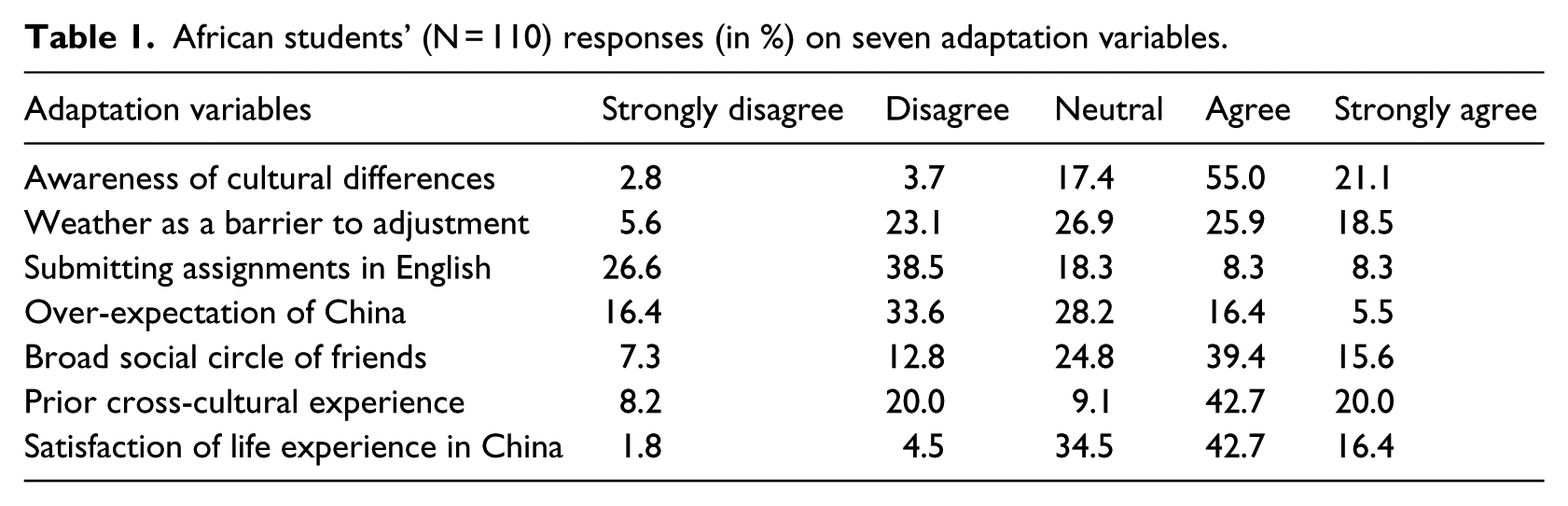
More than 62% of the sample students said that they had prior overseas experience, meaning in effect that they had some knowledge of cultural expectations and practices.
In response to the question on whether submitting assignments in English language related to their satisfaction, only about 16% said that was possible, although research indicates that language anxiety plays a very important negative role in both sociocultural adaptation and academic adaptation (Yu, 2010). It is plausible that a reason for the low affirmation of that variable was that a majority of the students were proficient in French or Arabic, but very few in English. Thus, submitting assignments in the English language did not affect their satisfaction level.
In all, 50% of the students rejected the notion that they came to China with over-expectation of that country; nearly 22% agreed that they did. More than 55% reported that they had a broad social circle of friends in the host society, a situation that can engender a smoother social (and academic) adjustment of short-term visitors to China.
Correlation analyses
The associations among the seven adaptation variables indicate strong positive associations between satisfaction of life experience in China and awareness of cultural differences (Table 2). International students who are aware of cultural differences abroad are more likely to be satisfied with a host culture. But there is significant negative association between natural conditions (i.e. weather) (r = −.245, p < .05) and satisfaction of life experience in China. In other words, the association is inverse if one increases and the other decreases – and vice versa. Satisfaction of life experiences in China and submitting assignments in English have a non-significant and also positive association (r = .123). Over-expectation (r = −.305, p < .01) of China has a significantly strong negative association with satisfaction. This means that the greater the over-expectation of the host country, the lower the satisfaction level – and vice versa. Satisfaction of life experiences has a significant positive association with having a broad social circle of friends (r = .286, p < .05) in a host society. Similarly, satisfaction has also a positive association with prior cross-cultural experience (r = .184, p < .05). The more the international students have cross-cultural experience, the more likely they are to adjust to their new culture.
Pearson correlation coefficients for adaptation variables among African students (N = 110) in Chinese Universities.
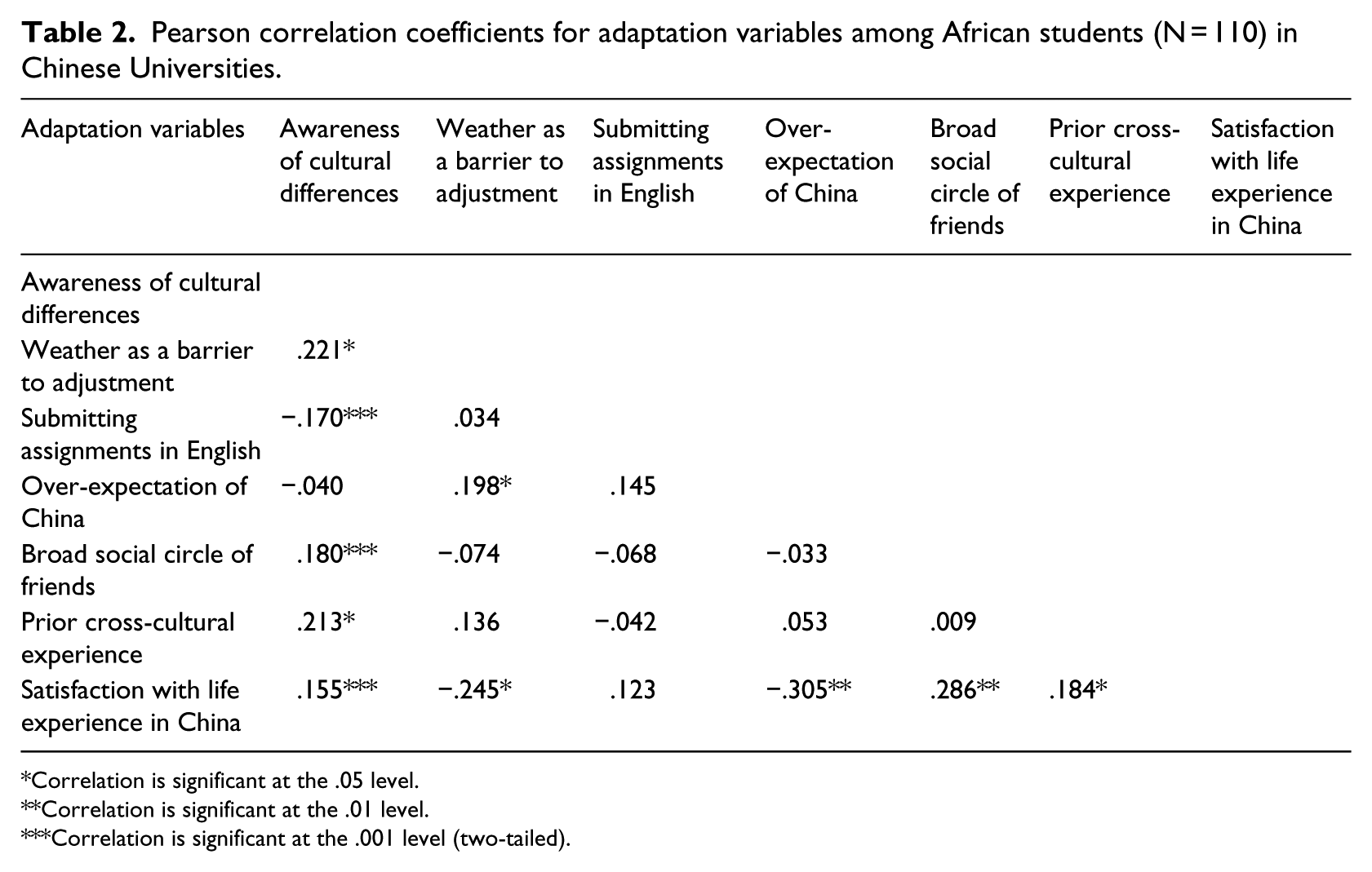
Correlation is significant at the .05 level.
Correlation is significant at the .01 level.
Correlation is significant at the .001 level (two-tailed).
Regression analyses
A correlation analysis shows association between two random variables but does not clarify the direction of those relationships or strength of regression analyses (Table 3). The regression analysis of the linear relationship between satisfaction of life experiences in China, as dependent variable, and six independent variables is presented and found significant (F = 8.116, p < .001, R2 = .332). The regression model is presented as follows

where SEC stands for satisfaction of life experiences in China (dependent variable), as reported by the African students; HCCE for the students’ overseas experience before arriving in China; BSC for broad social circle of local friends; WHA for weather as a barrier to adaptation to the new environment; OE for African students’ over-expectation of China; ASEG for the submission of class assignments in English language; ABCD for the awareness of cultural differences before going abroad; and µ is the disturbance term of the specified model.
Regression of adaptation variables on satisfaction with life experience in China (N = 110).
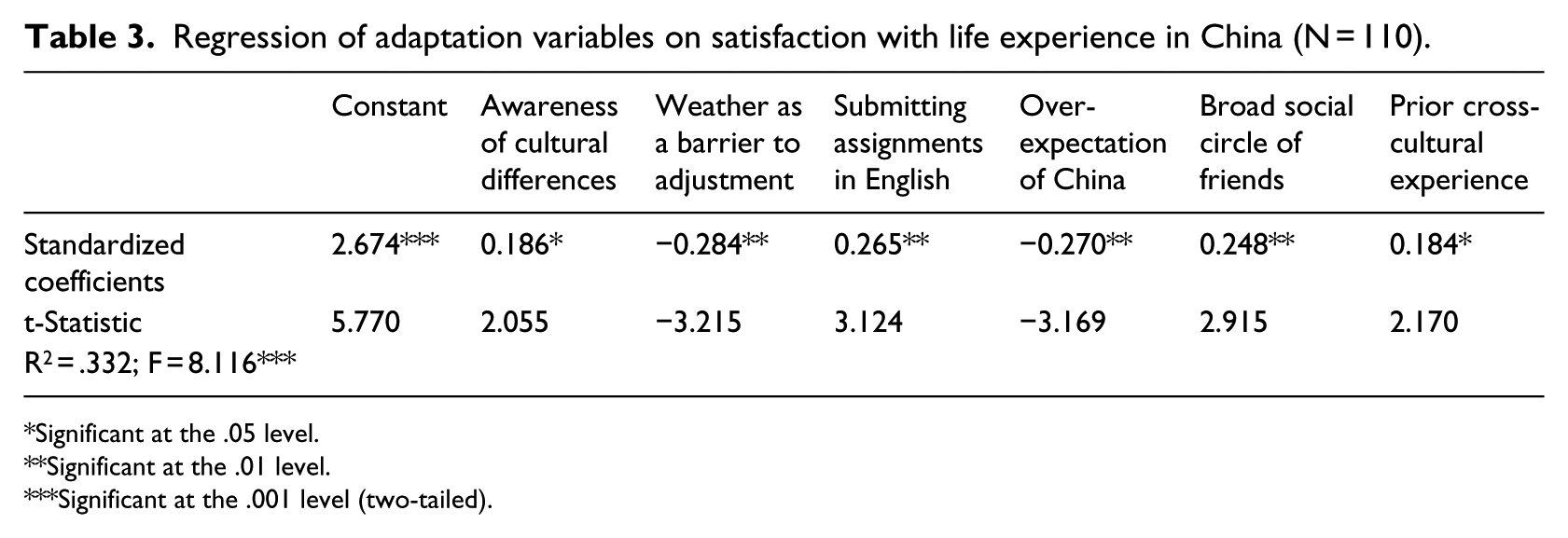
Significant at the .05 level.
Significant at the .01 level.
Significant at the .001 level (two-tailed).
The negative relationship with weather indicates that an increase in satisfaction by one unit means decrease in one unit of weather and of over-expectation. Put differently, weather and over-expectation are inversely proportional to the reported satisfaction with the students’ experiences in China. In this regression model, both weather (β = −.284, p < .01) and over-expectation (β = −.270, p < .01) have negative impact on satisfaction level. These results are consistent with those of Rogers and Ward (1993) who explained that if expectation did not materialize for sojourners in a host society, its lack may result in psychological anxiety rather than in a smooth adjustment. Similarly, Carlson et al. (1990) identified climate or weather as one of the primary barriers to adaptation and satisfaction and a barrier to sojourners’ adaptation.
The positive association of having prior cross-cultural experience (β = .184, p < .05) and a broad social circle (β = .248, p < .01), submitting assignments in English (β = .265, p < .01), and being aware of cultural differences (β = .186, p < .05) indicate that if one unit of these independent variables increases, it will positively affect the adaptation and satisfaction level of academic sojourners. Prior cross-cultural experience has an 18% impact on the dependent variable. Such an effect has been indicated in earlier studies, which found that previous international cultural experiences mitigate the level of anxiety, enabling adaptation (Basu and Ames, 1970; Bochner, 1972). The results of this study indicate that 64% of the African students have prior international experience; thus, the more the academic sojourners are exposed to other cultures, the more easily they will adjust to a new culture. Broad social circles also have a 24% influence on satisfaction. This significant relationship between adjustment and host friends has also been identified by studies on cross-cultural adaptation of international students (Chapdelaine and Alexitch, 2004; Furnham, 1988; Ward and Kennedy, 1992; Ward and Searle, 1991; Zimmerman, 1995). Morris (1960) related the satisfaction of academic sojourners with their close ties to host nationals. In other words, the more and greater the number of international students’ circles of friends in a host society, the more they will enjoy their experience in that society.
Submitting assignments in English also has a positive significant association with satisfaction of African students in China. It means that the more options they have to submit their class assignments, the more they will feel at ease in their new academic environment. This study shows that 80% of our sample students did not study Chinese before going to China and only 27% of students had the ability to speak, read, and write in Chinese. The regression results also show that prior knowledge of cross-cultural differences has an 18% impact on the satisfaction of the students. That result is consistent with that of Gannon and Poon (1997) who found that cultural awareness is one of the perceptual variables and plays an important role in positive adaptation. Ward and Kennedy (1993a) also had a similar finding: general knowledge of the host culture is one of the significant predictors of smooth adjustment.
On the basis of these regression results, we conclude that having prior cross-cultural experience, having a broad social circle, submitting assignments in English, and being aware of cultural differences have significant positive relationships with satisfaction of the African students in China, whereas weather and over-expectation have significant negative relationships.
Summary results from this regression model are, therefore, twofold: (a) that having awareness of cultural differences, submitting assignments in English language, having a broad social circle of friends, and having prior cross-cultural experience were statistically significant predictors of satisfaction with African students’ academic and social experiences in China; and (b) that weather and having over-expectation of China were statistically significant negative predictors of the students’ experience in China. The hypothesis posed at the outset is supported.
Conclusion and implications for public policymaking
China, with a literacy rate of 94% and with a wellspring of disciplined students, attracts African students to its universities and technical institutes. The objective of this study was to investigate the importance of seven adaptation variables and to quantify the relationships of six of them to an overarching variable: satisfaction with the students’ life experience in China. By analyzing African students’ data within the Chinese context, this study examined satisfaction levels of students from a region that is different from their host country in language, political orientation, culture, and social system. The findings have three major implications for public policies on international student adjustment in Chinese universities. First, it is important that China’s universities engage their international students in cross-cultural activities that bring them into contact with their hosts on a platform from where issues in cross-national education are discussed. Wuhan University, for example, has a volunteer program through which international students exchange cultural information with school-age children and the elderly, and several Chinese universities organize sporting events and musical festivals that seek to bring international students and their hosts into social encounters. It is not particularly helpful, however, to have, say, an ‘Africa Week’ or an international festival on campus. It will be more productive if the exchange is more than episodic and is backed by international participants in a programmatic approach that challenges the students’ imaginations while extending their horizons. That way, the international experience is not only for a handful of Chinese students on campus, but for all students for whom worldviews are vital to improving their educational experience and to enhancing the products of mind-work.
Second, Chinese universities need to commit more resources to expanding their curricula beyond those standard in foreign-language institutes or programs typically geared toward international issues. Curricula need to be structured in a manner that provides opportunities for students to expose themselves to a smattering of courses in intercultural and global practices. Courses such as international communication or global communication or African studies should be as available to social sciences and humanities students as they are to, say, the physics or accounting majors. Chinese universities can also promote strong relationships between international and Chinese students through student organizations and through engaging them in different activities based on language and culture. This will not only bring international and Chinese students closer; they can also find an atmosphere in which they can learn from one another. Thus, awareness about Chinese culture can contribute to positive adaptation of international students.
Third, support facilities to help international students in general cope with cross-cultural stressors need to be expanded and placed in units that will not engender stereotypes among Chinese students and reluctance to use them among African students. Placing such support facilities in a counseling department may trigger resentment among international students and associate negative connotations among their Chinese counterparts. Such support mechanisms can be a part of student services or embedded in workshops and seminars taken for credit and open to all.
Fourth, on the basis of our results, it is suggested that international students need to be cognizant of Chinese culture, the environment, and education system before arriving in China. This requires orientation classes and training workshops offered in and encouraged by Chinese embassies worldwide. Additionally, such embassies can provide video-conferencing and computer-assisted training to help incoming students better adapt to their new cultural milieu. Because most African students have CSC support, it is suggested that Chinese embassies become involved in or organize orientation programs to better help students adjust to their new environment. That way, student over-expectations can be upended, giving way to realistic expectations and making them socio-psychologically prepared for environmental adjustment.
Finally, universities with substantial international student enrollments should provide on-campus orientations in several languages, including Chinese, English, French, and Arabic, to incoming international students. In doing so, a maximum number of students can know more about the local rules, conventions, practices, environment, and education system. University departments need not rely on the university to assist their students; rather, they can provide opportunities for students’ interaction and to create a friendly atmosphere for international students. One possibility is having rotating theme classrooms: in 1 month, the theme may be Germany; in another, England; and yet another, Africa. These rotating themes can also be extended campus-wide to provide enormous opportunities for students to connect much more easily with one another and to build relationships.
In sum, satisfaction level and positive adaptation do not depend on one factor but on a number of factors. Through joint efforts, the students and their respective universities can achieve their basic objectives by creating a home away from home in the host country.
Footnotes
Funding
This research received no specific grant from any funding agency in the public, commercial, or not-for-profit sectors.