







Abstract
Although the rapidly expanding International Baccalaureate Diploma Programme (IBDP) is a well-recognized program perceived to offer best practices in education, including developing international mindedness in students and engaging with the local communities, there is little empirical evidence to support these outcomes. This mixed methods case study investigates if and how a diverse student body in one school (School X) contributes to the achievement of the International Baccalaureate Organization’s aims, and in what ways student participation in the IBDP engages them with the diverse local community. This study concludes that engagement with the diverse local community was not perceived by participants as one of the main outcomes of offering the IBDP whereas the diversity of the school student body was perceived as an integral factor in helping students develop a wider worldview and international mindedness. Allport’s social contact theory was used as a framework to explain the impact of diversity and help to understand it in the context of the IBDP.
Keywords
Introduction
The International Baccalaureate Diploma Programme (IBDP), a rapidly expanding globally standardized program of education, is perceived to offer participating schools and students quality assurance, accountability, and most importantly academic rigor, as well as promoting intercultural understanding (Bunnell, 2011b; Mercer, 2008; Resnik, 2012; Schachter, 2008; Wright, 2016). Part of the IBDP’s uniqueness is that it focuses on promoting intercultural awareness, international understanding and world peace (Doherty, 2009; Drake, 2004; Gehring, 2001; Hayden & Wong, 1997), described by the International Baccalaureate Organization (IBO) as international mindedness (IBO, 2006; Singh & Qi, 2013). Specifically, according to the IBO (2015) and Singh & Qi (2013), international mindedness has three components: multilingualism, intercultural understanding, and global engagement. The development of international mindedness is an idealistic goal of the IBDP that is implied in the mission statement but not directly stated (Singh & Qi, 2013). Mercer (2008) states that the intent to develop international mindedness in students is a characteristic of the International Baccalaureate (IB) that distinguishes it from other programs in education and that “more importantly it is a philosophy students will carry with them through the rest of their lives” (p. 1). The IBDP has an international appeal as universities worldwide recognize the Diploma (Resnik, 2012; Wells, 2011). Another outcome of participation in the IBDP listed by the IBO (2013a) is student engagement with their local communities and global engagement (IBO, 2013/2015), which is achieved through the Creativity, Activity, Service (CAS) component of the IBDP.
With the aim of contributing to research on international education and educational leadership, this study aimed to investigate if and how a diverse student body contributes to the achievement of the IBO’s aims and in what ways student participation in the IBDP engages them, in the school at the centre of the research, with the diverse local community. Although participation in the IBDP is perceived to develop international mindedness in students and engage them with their local communities, I contend that the school’s diversity contributes more to developing this attitude. In addition I argue that, depending on the school, the effect of the IBDP on engaging students with the local communities is limited.
This study was conducted at an international, independent, non-profit Pre K-12 school that is located in Cairo, Egypt, and caters to all nationalities. It does not offer the Egyptian national curriculum but follows a US standards-based curriculum. Founded in 1945, it was a mature and highly regarded school for many years before it began offering the IBDP. It is governed by an elected or appointed Board of Trustees and operates free from Egyptian Ministry of Education directives.
Research context
In the larger context of the Middle East, international schools are growing rapidly, although the IBO’s activity is not increasing proportionally and is limited to about two percent of their worldwide activity (Bunnell, 2011a). Similarly, while the number of international schools in Egypt is growing, the number of schools offering the IBDP has not increased accordingly in the last couple of decades. Initially, one school (British International School, Cairo) started offering the IBDP in Egypt in 1989. According to the International School Consultancy Group statistics of June 2016 and the IBO, there are 188 English-medium international schools nationwide only 13 of which offer the IBDP (out of 2437 schools offering the IBDP globally).
An important aspect of IB related to the development of international mindedness is that students are encouraged to take pride in and learn more about their own culture and national identity as well as to be respectful and understanding of others, thus becoming global citizens (Brunold-Conesa, 2011; Bunnell, 2011b; Culross & Tarver, 2011; Davy, 2011; Hill, 2006a). Culross and Tarver (2011) describe the students’ IB experience as one that helps them become “situated culturally, geographically, historically and personally within the context of being a global citizen” (p. 233). Students lose any cultural superiority in such a program as they gain respect for different cultures and self-awareness, while developing compassion and empathy (Brunold-Conesa, 2011; Bullock, 2011; Hare, 2010; Hill, 2006a; IBO, 2006; Wells, 2011). The IBO (2004) itself states that the IBDP courses are “tolerant of cultural variants as well as encouraging of cultural tolerance” (p. 14).
Lineham (2013) argues that more studies are necessary to determine the effectiveness of the IBDP compared to external factors such as demographic variables in developing values in students. A further clarification of whether the environment or the program affects the development of international mindedness specifically is critical, as some research suggests that the school environment is more important than the program itself in encouraging the development of international mindedness (Halicioglu, 2008; Hayden & Wong, 1997; Hinrichs, 2002; Van Oord, 2007).
The lack of empirical data that supports the outcomes of the IBDP, specifically those related to developing international mindedness and engaging with the local community, led to the initiation of this study. There is also a gap in the research related to study of the outcomes of the IBDP in Egypt and in the Middle East. Above all, the study sought to answer the following research questions:
- Does a diverse student body contribute to the achievement of IBO goals? If so, how?
- In what ways does student participation in the IBDP lead to engagement with a diverse local community?
Literature Review
Internationalization and the IBDP
The IBDP is sometimes perceived as part of the process of globalization, since offering the IB entails the use of the same standards around the globe, although George Walker (Director General of the IBO from 1999-2005) disagrees. He believes that it offers “an education system throughout the world but not FOR the world. It is an unimposed international education whose philosophy and pedagogical approach stem from Western traditions but which legitimizes non-Western modes of expression and thought. This is internationalization, not globalization” (in Hill, 2006a, p. 107).
Walker (2008) asserts that the IBDP develops global citizens who will be able to function effectively by drawing on their global experiences to understand diverse peoples, which is the aim of internationalization.
Internationalization is a reaction to globalization, meaning that internationalized curricula in education, for example, are designed to address our interconnected globalizing world. The IBO is endeavoring to fit into the globalization niche by addressing the development of knowledge, skills and attitudes contributing to the development of effective global citizens mainly through the development of international mindedness (Roberts, 2009). Thus, most outcomes of the IBDP for the students and for the school correspond to those of internationalization.
International education
International education has yet to be defined consistently (Hayden, Rancic, & Thompson, 2000; James, 2005; MacDonald, 2007; Sylvester, 2005). It is important to this study to define international education as it is considered one of the main vehicles by which students achieve outcomes needed for the 21st century (Friedman, 2005), as well as international mindedness (James, 2005). International mindedness is a part of becoming a global citizen that the IBDP focuses on, and encompasses the three components of international mindedness: intercultural understanding, multilingualism and global engagement (IBO, 2015). Richards (2004) suggests that the Holy Grail for international educators is to find a universally accepted definition of international education (in MacDonald, 2007). It is clear that most interpretations of international education are based on reflections of direct experiences rather than on rigorous research. An international education would require contact with students from a number of different countries and learning other languages, followed by learning about and experiencing other cultures, learning about the history and politics of other countries, and intercultural understanding (Hayden et al., 2000; Hill, 2007; James, 2005).
Heyward (2002) suggests that not only contact with diverse students is beneficial but more importantly the “deep, rich, dynamic and diverse cultures of their host environment” (p. 27). International schools often stay aloof from the local host community, which is ultimately to the detriment of the development of their students’ international mindedness (Bunnell, 2005; Heyward, 2002). Engagement with the host environment conflicts somewhat with several of the raisons d’être of an international school, which include offering a curriculum that differs from the perceived inferior quality of the national curriculum and increasing expatriate comfort levels to give the impression of home. Thus, the school may operate in a kind of bubble lacking interaction with the host environment (Heyward, 2002).
International schools
Claims to offer an international education may be made by both public and private schools. Hill (2007) defines international schools as: “independent institutions charging tuition fees or offering scholarships and catering specifically for students of many nationalities, some of whom will be transient; the educational programme is usually different from that of the host country and English is the main language of instruction in most institutions” (p. 253).
Quite often, international schools are schools which are more easily accessed by the wealthier segment of society (Hill, 2006b; MacKenzie, 2009; Resnik, 2012). International education may be more expensive than national schooling partly as a symbol of distinction or eliteness, but also due to the hiring of international teachers fluent in a foreign language, as well as the demands for internationally accredited teaching certification (Lee, Hallinger, & Walker, 2011; Lowe, 2000; MacKenzie, 2010; Resnik, 2012). In many cases in Egypt, international schools recruit students mainly from the host country while the faculty is international, language of instruction is not Arabic but most often English, and the curriculum is not the Egyptian Ministry of Education’s set curriculum (Peterson, 2011). Herein lies an unintentional culture gap which in some cases may be utilized to the best interest of everyone involved and aids in the development of international mindedness, but in other cases is not put to good use and may cause hidden cultural issues to arise (Hill, 2006b).
In so-called developing countries, the cultural gap is widened by economic and political advantage, exclusivity, and the elitism of the clientele of these international schools (Hill, 2006b; Hill, 2007; Resnik, 2012). Disparities in salaries between the international school teachers and the host nation teachers, and the neglect of the local language and culture, do not help resolve the situation (Heyward, 2002). Muller (2012) addresses this issue of exclusivity and eliteness amongst students of these international schools, stating that interaction with local communities is essential, and suggests community service as a vehicle through which students’ feelings of elitism and superiority can be addressed.
An analysis of related literature by Perry and Southwell (2011) noted that higher levels of intercultural understanding, sensitivity or international understanding are found in students from international schools including those that offer the IBDP (Hayden & Wong, 1997; Hinrichs, 2002; Straffon, 2003) compared to non-international schools. The cross-sectional and non-experimental research designs of these studies do not establish a causal relationship between attending an international school or IB school and students developing these desired outcomes. Many uncontrolled variables are not taken into account, such as the students’ non-school experiences, the diversity or lack thereof of the student body, and the different types of curricula on offer. Furthermore, students who choose to participate in IBDP may do so because they are already more internationally minded, for example. The IBO (2008) as well as Waterson and Hayden (1999) summarize that “no research study so far has shown that IB or international schools develop students’ ‘soft skills’, values and attitudes such as international mindedness, intercultural understanding or intercultural competence” (in Perry & Southwell, 2011, p. 459).
International mindedness
International education is professed to be one of the main vehicles by which students are perceived to develop international mindedness (James, 2005). Tate (2013) states that there are legitimate concerns about efforts to develop international mindedness in international schools offering international education: international education produces global cultural convergence instead of encouraging the world’s cultural diversity, it dismisses normal people’s concerns as it is linked with transnational elites, it distances some from local allegiances and tradition, it emphasizes stereotypes through community service, and it is concerned with global citizenship instead of the needs of local and national citizenship. Bunnell (2010) and Doherty (2009) share the same concerns about creating an elite class of individuals with Fox (1985), particularly in developing countries, and about the possibility of perpetuating cultural imperialism.
The IB Diploma Programme
Creativity, Activity, Service (CAS) and the academic courses in the IBDP are the vehicle through which the IBO attempts to focus on learning from direct experience (Peterson, 1983) which helps to promote the development of many of the Learner Profile attributes of the IBDP (Cushner, 2007; Kehl & Morris, 2005; Muller, 2012). Chmelynski (2005) states of the IBDP that “participating students are expected to develop a personal value system that will guide their own lives as thoughtful members of local communities and the larger world” (p. 59); in other words, they will become globally engaged, one of the three components of international mindedness (IBO, 2015).
CAS is part of the IBDP that focuses on engaging students in the arts and creative thinking, and on serving others in their communities, as well as focusing on involving them in physical activity to help them develop a healthy lifestyle (IBO, 2013a). Walker (2007) asserts that the main aim of CAS is a learning experience through interacting with others although, he says, CAS is often interpreted to mean taking part in service activities instead. The benefits of this experience are mostly for the participating students (Walker, 2007).
Billig and Good (2013) conducted a two-phase study using a convenience sample in the United States, Canada, and Argentina, and found that participating in service through the CAS component of the IBDP helped students develop a range of personal and social development outcomes. Students developed a more caring, open-minded, reflective, confident and mature stance, as well as an ethic of service, according to Billig and Good (2013). Brown and Ohsako (2003) describe students completing CAS requirements by interacting with elders in their communities and doing things for them. The experience was positive for both the students and the elders as links were built between individuals that would not otherwise have been formed.
In studying IBDP students in India, Hayden and Wilkinson (2010) concluded that by participating in a global affairs course, the IBDP’s compulsory Theory of Knowledge (TOK) course, student discussions and meetings, CAS, international evenings, the extended essay (also a compulsory component of the IBDP), and the academic program, students change their attitudes in alignment with the Learner Profile attributes. This particular study was limited in that only IBDP students were investigated and there was no control group. However, there may be a positive effect in the development of international mindedness and fulfillment of IBO stated student outcomes related to the IBDP (Hayden & Wilkinson, 2010). Doherty and Li (2011) recommend that assessing some form of global dispositions should in future become part of the IBDP. It appears, however, that the IBO has had no plan to assess attitudes or affective attributes by any form of psychological profiling as part of formal IBDP assessment (IBO, 2004) and has developed nothing thus far.
Hayden and Wong (1997) interviewed a small opportunity sample of IBDP teachers and IBDP alumni, and concluded that the IBDP does not promote an international education as well in a monocultural, monolingual national school as it does in a diverse school environment. They found that the school environment and the informal curriculum have more impact on the development of international perspectives than does the formal curriculum. They caution against attributing the development of international understanding to participating in the IBDP as it is not clear to what extent the IBDP realizes that goal. Keller (2010) examined the relationship between the global mindedness of students and whether or not the students attended a school that offered the IBDP. She investigated students who were participating in the IBDP and those who were not, by administering Hett’s Global Mindedness Scale (GMS) to two groups of high school students, one of which attended a school offering IBDP and the other whose school did not. The results of this quantitative study indicated that there was no significant difference in the level of global mindedness between the two groups.
In contrast, Hinrichs (2002) suggests, from her limited study of matched Advanced Placement (AP) and IBDP students at different schools, that the IBDP curriculum helps promote international understanding, underscoring the importance of the curriculum rather than exposure to diversity alone. Tarc (2009) points out that, as the IBDP is being offered in national as well as international schools, international understanding needs to be promoted within the curriculum rather than depending on the international school environment, and the IBO has in fact made some reforms to make the program more international. School administrators have the flexibility of selecting the courses they offer for the IBDP. Some courses are designed so that they are more inclusive of international perspectives while others by default are not as naturally inclusive of international perspectives (IBO, 2013b).
An important element for the study described in this article is student contact with diverse others as it is perceived by scholars and students alike to help develop international mindedness. Every school varies in the diversity of its student body. Students perceive that exposure to and mixing with students of other cultures is an important factor in the development of international mindedness (Hayden & Thompson, 1995a, 1995b, 1998; Hayden & Wilkinson, 2010). Some scholars such as Hayden and Thompson (1998) and Van Oord (2007) argue that exposure to diversity in an international school environment is more significant than any structured program in the fostering of international understanding, due to the mixing of students of different nationalities that occurs, which leads to an appreciation of other cultures. Hayden and Thompson (1998) found a significant relationship between international education and exposure to diversity. Schwindt (2003) adds that the intentional integration of the whole community in school life which exposes students to diversity, helps with an international education in which a major component is the development of international mindedness. Furthermore, Lineham (2013) identified that the diversity of the student body had a significant effect on students’ attitudes as the diversity added multiple perspectives thus enriching class discussions.
Zhai and Sheer (2004) surveyed summer semester undergraduate agriculture students and found that students who have more contact with diversity have a higher level of global perspectives. Carano (2010) investigated how the use of nationalistic curricula is still prominent and discusses the need for a global education. He used interviews and Hett’s GMS to understand to what self-identifying global educators attribute their global mindedness. Carano chose a purposeful sampling of social studies teachers for his study and found that exposure to diversity was a factor that affects global mindedness positively. A study by Doherty and Li (2011), meanwhile, elucidates the outcomes of IB related to international mindedness. They studied how the IBO interprets international mindedness by conducting teacher and student interviews in three Australian schools. They found that the IBO succeeds in encouraging students to explore differences, build knowledge beyond that of their nation and develop questioning dispositions. However, they found that IBO was not as adept at communicating common humanity, interconnectedness and complexity, encouraging creative active citizenship, convincing students to gain intercultural competence through second language acquisition and disentangling nation/culture/language.
Although some may believe that international mindedness can be developed simply through exposure to people from diverse cultures, Muller (2012) suggests that it is not sufficient to be part of a diverse student body, but that there must be effective intervention to help the students develop international mindedness. Earlier, other authors expressed similar caveats. Otten (2003), Bennett (2009) and Paige (1993) state that exposure to diverse cultures does not guarantee the development of intercultural learning or competence.
In Bennett’s (2009) study about intercultural learning, he asserts that every program of international educational exchange and study abroad contributes to educational cross-cultural contact which provides experiences that could increase intercultural competence and thus develop global citizenship. However, Bennett (2009) claims that research has shown that intervention through the curriculum and by facilitation is necessary in order to help develop intercultural learning. Otten (2003) concludes that reflection is required for intercultural contact to lead to intercultural learning experiences and increased intercultural competence. Paige (1993) suggests that if the experience is not made into a personally relevant learning experience then mere contact is not enough, but could instead reinforce negative stereotypes and prejudice (Otten, 2003). Goeudevert (2002) corroborates that exposure to diversity is not valuable in and of itself as it could lead to intolerance if not effectively facilitated (in Skelton, 2007). To its credit, participating in the IBDP can turn diversity into a positive enriching experience for students.
Methods
This study employed case study methodology, the use of which is prevalent in education (Stake, 1995), in order to obtain an in-depth understanding of a single international school in Egypt. The research questions for this study are inductive in nature, in an attempt to qualitatively explore the key stakeholders’ perspectives. The methods selected for the study were document analysis, interviews and a focus group. The groups (stakeholders) that were studied were purposefully selected based on how information rich they are, but from within those groups, the interviewees or focus group participants were randomly selected. The sampling was from four groups of key stakeholders: students, alumni, teachers, administrators (board member, director, principal, IB Diploma coordinator), in order to gain multiple perspectives which allowed for triangulation of the data.
The document analysis included an analysis of the literature, IBO published marketing documents, websites, and reports both internal and external to the IBO, none of which were produced exclusively for the purpose of this research. While interviews and focus groups provide data that may be filtered by the researcher, documents can be a practical method to check researcher bias and accuracy.
Twenty-two semi-structured interviews were conducted; one each with the board member, director, principal, and IB Diploma coordinator, ten alumni interviews (grouped into two groups: graduates of 2008-2010 and graduates of 2011-2013), and eight student interviews. Semi-structured interviews are used to allow for slight deviations in order to gain in-depth responses from the interviewee, which may bring about new insights on the topic as well as more depth, through exploration and probing (Creswell, 2014). Semi-structured interviews ensure that the interviewees are able to express themselves freely. The questions for the interviews included, but were not limited to, the following: What, in your view, are the most important tangible outcomes of offering the IBDP for School X and for students? What types of skills does the IBDP programme equip students with that they might not get in other programs? How do you think students participating in the IBDP are prepared for global citizenship? How do you think students participating in the IBDP are prepared for local citizenship? In what ways does the IBDP programme engage students with local cultural communities, and how?
One focus group was conducted with IBDP teachers, composed of six participants. Focus groups are more economical than interviews but, more importantly, the researcher experiences the group interactions and the non-verbal expressions in addition to what is being said. Focus groups tend to have high face validity as they usually measure what they intend to. The questions for the focus group included but were not limited to the following: In what ways does participating in the IBDP in an international school in Egypt affect your students’ worldviews? In what ways does participating in the IBDP in an international school in Egypt affect your students’ civic mindedness and related engagement, and involvement with local communities? How is the design of the program suited to promote the development of the Learner Profile traits as well as international mindedness? How does the diversity of the student body influence the implementation of the IBDP?
Voluntary participation and confidentiality was assured. A basic coding system of the responses was used for categorization, after partial transcription and time stamping the recordings. Triangulation of the data gathered from all three methods as well as all the stakeholder perspectives added credibility to this study, in addition to other strategies such as checking back with participants and sharing the researcher’s value premises. Although a limitation of this study is that it is a single case study, and thus only an understanding of this particular school in this particular context results, the uniqueness of this international school and its context offered much to learn from. It is important to note that the school shares many characteristics with other international schools, who may find the study relevant to their own context.
Results
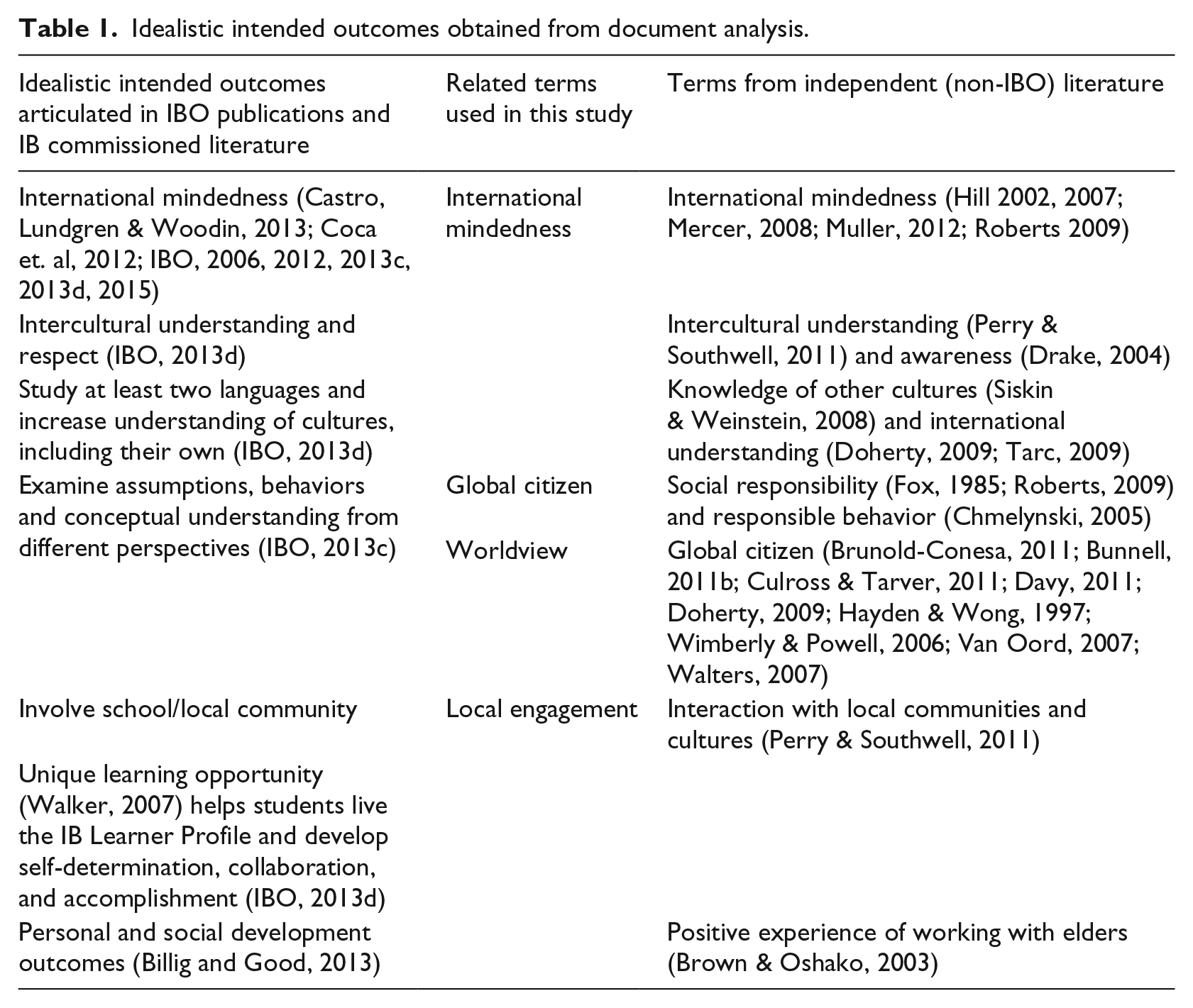
The document analysis showed that the development of an intercultural awareness and an international mindedness that lead to global citizenship is an intended outcome of the IBO (IBO, 2006, 2012, 2013c, 2013d, 2015), and that the students’ engagement with the local community is one of the CAS aims (IBO, 2013d). Table 1 shows the outcomes obtained from the document analysis that are related to this study.
Idealistic intended outcomes obtained from document analysis.
Does a diverse student body contribute to the achievement of IBO goals? If so how?
Document analysis
The IBO documents do not mandate a specific type of student body in order to achieve their stated outcomes. However, Allport’s social contact theory states that contact with diverse others, under certain conditions, can minimize prejudice and discrimination. In Hayden and Thompson’s (1995a, 1995b, 1998) research, they find that diversity is a critical factor for experiencing an international education.
Interview analysis
Administrators
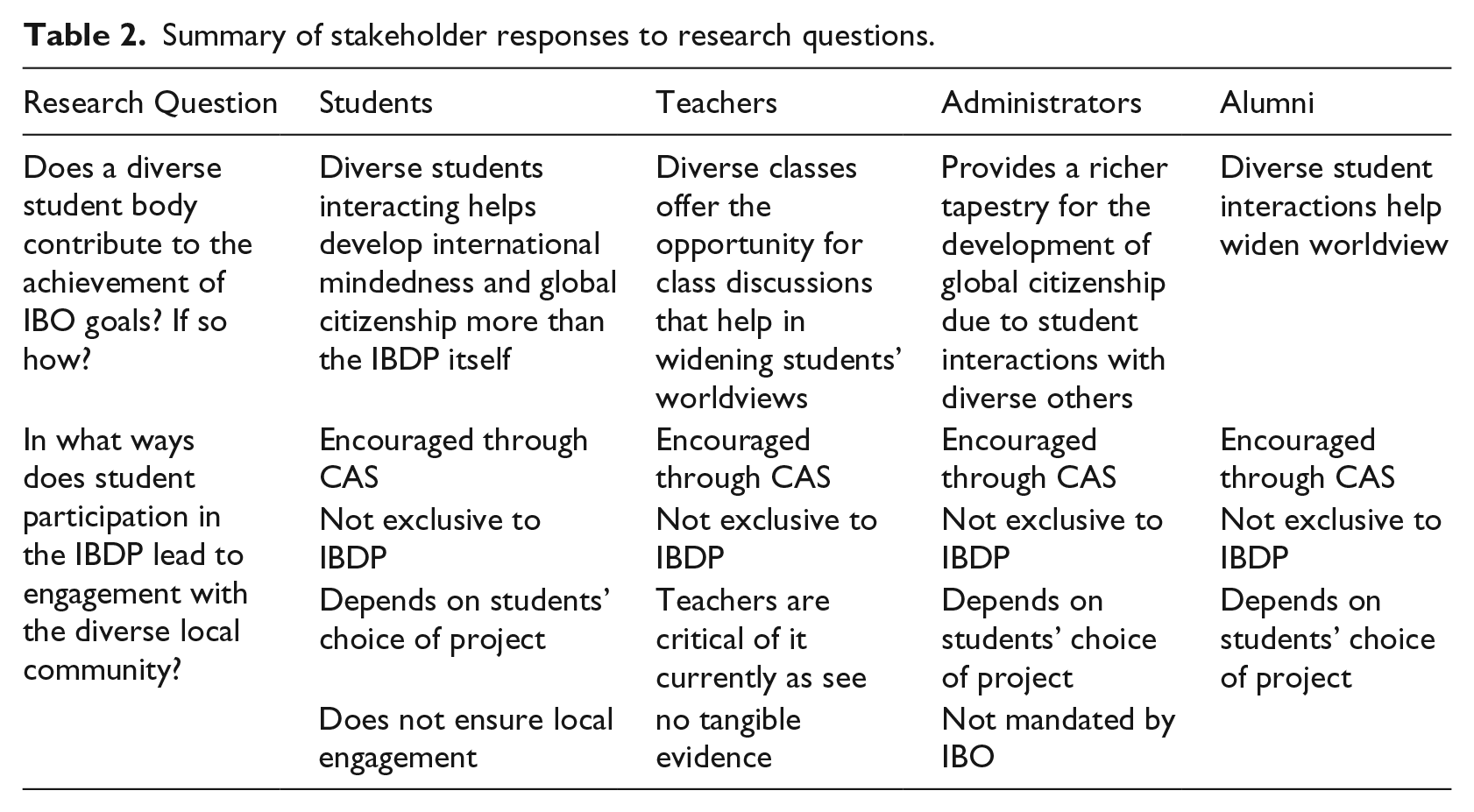
The diversity in the school’s student body was perceived by all of the administration to be more influential in the development of global citizenship than participation in the IBDP. One administrator stated that, “I think our school experience as a truly international school provides a richer tapestry on which that [global citizenship] can be played out.” Interaction between the diverse students on a social level or when playing in a sports team for example, affects their global citizenship more than a specific program does. Another administrator said, “I don’t know that I would say the IB programme prepares them for global citizenship if I’m really honest – I think international schools do – [but] ….. many international schools offer the IB – it’s difficult to separate the two.” Thus, the administrators believed that the diverse student body of an international school such as School X has more to do with developing a sense of global citizenship than does participating in the IBDP.
One administrator seemed to feel that attending a diverse school while participating in the IBDP results in different outcomes than would attending a non-diverse school. This administrator stated: “In principle, the IB does prepare you – especially at a school like School X that has a diverse population. …… again doing the IB in an environment like that [diverse] will definitely bring that out … but again it will depend [on] how the IB is taught and what is done with the diversity of the student body … I think it does [help develop global citizenship]”.
The IBDP curriculum addresses global citizenship in some courses, as well as in their language requirements, state the administrators.
Students
Overwhelmingly, the students felt the internationally diverse student body of the school to be the main factor that helped them develop international mindedness and become more of a global citizen, more so than participating in the IBDP itself – if only by having discussions with students from different cultures in and outside of class. One student said: “I think – in IB too – but I think it’s a whole school thing … not just confined to IB – everybody is internationally minded.” Some students articulated how participating in the IBDP unites students from all over the world, essentially as a support group. To that effect, one student stated that, “Sharing the pain with many other students around the world would help connect you … besides that I really don’t think there’s a global aspect to it”. Some students stated that some of the IBDP courses encouraged them to think about current events in the world, such as economics, history, and TOK, but most asserted that being internationally minded had nothing to do with participating in the IBDP.
One student commented: “Being at School X inherently makes you global… because you are surrounded by an international community – maybe not as much now [since the 2011 revolution] – but definitely before, and you come in touch with different cultures… your teachers may have had different experiences and they often recount them to you and generally the curriculum is pretty wide so you do get exposed to a global way of teaching. So, I don’t know I can say that IB in itself made me a global citizen or if School X already did that.”
Alumni
Both groups of alumni agreed that it was a combination of the school, of which the diverse student body is a part, and participating in the IBDP that helped develop their wider worldview. A 2008 graduate stated: “When I compare to the other Egyptian students [at university] who had only been with Egyptian students [at school], their mindset was not the same. They tended to stick with Egyptian students only. They weren’t very open with meeting students from all over the world.”
However, a 2012 graduate shared that even though the student body was diverse they were also all the same due to their common schooling and program. She stated that, “There are so many different nationalities and stuff but later on it felt more like everyone is sort of the same. We’ve all gone through the international school system.”
Both groups of alumni seemed to feel that some of the IBDP courses helped them develop a wider worldview. A few of the courses listed by the alumni were TOK, geography, history, other languages, and economics. To that effect, a 2010 graduate stated that, “There are no absolutes. There is no right or wrong. Like I wouldn’t have taken a class called Modern Israel before taking TOK because of the whole stigma around Judaism in this country.” Hence, choosing a course that he found interesting in spite of it not being mainstream could be attributable to his participation in TOK.
Focus group analysis
The teachers spoke about widening the students’ worldviews through specific courses: English widens their worldview as they look at literature from different perspectives; history helps them learn to challenge the status quo, think objectively, and relate to current events; and the language courses help them learn to be empathetic and expose them to learning about different cultures. One third of the teachers claimed that diverse classes helped them succeed in having productive discussions. One teacher was skeptical of attributing developing a wider worldview to participating in the IBDP alone.
In what ways does student participation in the IBDP lead to engagement with a diverse local community?
Document analysis
The references to engaging with local diversity are mainly found in the IBO–publicized CAS aims. Otherwise, some reports commissioned by the IBO list the personal and social development outcomes (Billig and Good, 2013) as well as how participating in CAS is a unique learning experience (Walker, 2007). In literature independent of the IBDP, some positive outcomes are reported as a result of working with the local community (see for instance Brown & Ohsako, 2003; Perry & Southwell, 2011).
Interview analysis
Any engagement with local diversity is perceived by all stakeholders to occur through the CAS component of the IBDP.
Administrators
According to an administrator, engaging with the community is a “mindful choice on our part as opposed to something that is mandated by the IB. But I think that’s a huge deficiency here [at School X] - our kids have not a clue of what the real Egypt is like.” In other words, the students attend school in Egypt but in an international elite bubble.
Local community engagement occurs mostly through CAS but depends on the project chosen by the student, as the IBO does not dictate that CAS must involve engagement with the local community. One administrator stated: “The IB doesn’t dictate that. The IB dictates creativity, action, and service but …… it doesn’t say they have to take place right outside your school door”. Due to the volatile political situation in Egypt during recent years (2011-2014) and recent mandatory security regulations that companies impose on expatriate student families, the administrators believed that there was a lack of local engagement at School X. In any case, it is difficult to extricate whether local engagement is a result of the IBDP or School X curriculum.
The CAS component was not perceived to be of particular value as School X already had a longstanding community service program and thus the CAS activities were not exclusive to IBDP. Either way, students seemed to lack a connection with what is outside the school walls. According to one administrator, “not as many students as we’d like to see [are] stretching themselves beyond the walls of the school” and “I can’t say curricularly that we have a place that we can guarantee that every IBDP student is connecting locally.” Some view CAS as a motivator but feel that the students should already be motivated for CAS-like activities before participating in the IBDP.
Students
Engagement with the local community is encouraged through CAS but was definitely not perceived to be exclusive to the IBDP. Some of the students articulated how they already participated in CAS-like activities and that this was not exclusive to the IBDP but more a function of attending School X. A different school, that does not offer such a program to all of its students, may achieve a greater impact on its students by offering CAS through the IBDP.
Specifically, the reflections that students are required to write for CAS enrich the experience, but the impact of CAS on engagement with the local community really depends on the choice of project the students undertake. A student said “IB had nothing to do with local citizenship.” Another student said that the “service aspect of it [CAS] probably inspired some people to work at local orphanages or for local causes but other than that there’s no real incentive to go out and connect with the locals in that sense.” Thus, the outcomes of CAS are student and project dependent.
One student stated that CAS helped them learn some social and organizational skills attributable to projects with which these students were involved. Some students revealed that CAS forced them to stay active which made them more well-rounded as an individual. Several students shared that CAS helps them learn to work with others and become engaged in global issues.
One student said that TOK inspired her to voice her opinion about a local issue, thus engaging her locally. She said that the TOK course: “pushes you to look outside …. When I first came to Egypt and we were doing everything about the [2011 Egyptian] revolution it got me thinking…pushing me to go out and speak about it….I wanted to become involved in the situation because of what I was experiencing in school. TOK actually inspired me to send a message to this BBC reporter about what was going on and the ethics of talking about all these foreigners’ experiences when they really didn’t have their own experiences in here.”
Alumni
One alumnus articulated that CAS consisted of jumping through the necessary hoops and was a burden; while a couple of others said that had it not been for CAS, they would not have been motivated to try or continue participating in an activity. Many others stated that CAS participation did not add value to them as individuals as CAS-like activities were part of their lives anyway. Most of the 2012-2013 graduates reported that CAS was a good idea in theory but not taken seriously by the students as some could just go through the motions of CAS completion.
Both groups of alumni suggested that CAS was the vehicle of the IBDP by which students engaged with their community, but highlighted that this was not exclusive to the IBDP. However, if a student did not otherwise participate in CAS-like activities participating in the IBDP did encourage their local engagement and give them a sense of confidence and independence about doing so. A 2008 graduate commented about her participation in the water polo team: “Honestly, I wouldn’t have motivated myself to do something like this on my own so the fact that CAS forced me to do this helped me.” A 2010 graduate stated, “I wouldn’t have taken an internship at a place called Corporate Accountability International if it wasn’t for the service aspect of IB.” Corporate Accountability International is a non-profit organization that works to end irresponsible corporate actions and increase their accountability.
Conversely, a 2009 graduate said that: “School X was great and I learned a lot, but I wasn’t living in Egypt when I was part of it. I think that the IB in terms of trying to get you outside ...... can encourage some sort of community outreach but at the same time it’s very demanding, which limits your time.”
Both groups of alumni agreed that participating in the IBDP did not help them develop civic mindedness. The 2008-2010 graduates revealed that their participation in the Model United Nations helped the development of their civic mindedness more than did participating in the IBDP.
Focus group analysis
The teachers had no sense of whether or not the students were engaged with their local community and claimed that they did not know if the IBDP affected their engagement. Teachers perceive that the way the school implements the CAS program influences the student outcomes for that component of the IBDP, including their engagement with local diversity. They expressed the view that the implementation of the CAS component seemed to be influenced by the individual teacher involved.
They were critical of CAS, as they did not see tangible evidence of what students have accomplished, specifically recently since the revolution. They felt that the service component of CAS had disappeared, possibly because of security concerns, but that the action and creativity components were still there.
Table 2 summarizes the major points in each of the stakeholders groups’ responses.
Summary of stakeholder responses to research questions.
Conclusion
It is important to pay attention not only to what is stated by the stakeholders but also to what is not stated. The IBO aims to develop international mindedness in students and help them become global citizens. The findings from this study show that the IBDP itself is perceived to do little of that as it was only stated by a few as an outcome of participating in the IBDP. Instead, a theme of student diversity emerged in the data. Many stakeholders articulated that the diversity of the student body played a larger role, or at least set the stage for IBDP to foster international mindedness in students. The administrators, for example, had a difficult time attributing the development of international mindedness, global citizenship, or local citizenship to the IBDP specifically, excluding the rest of the school curriculum or the effect of having an international student body.
The diverse student body being an integral part of the students’ experience at School X is difficult to disentangle and isolate from the impact of participating in the IBDP. One administrator stated: “We value diversity – one of our core values is being a global citizen. I think when you’re in an international school it is hard to really extricate yourself from international mindedness because when you’re sitting in a classroom and you have 20 kids and they represent 10 different nationalities, how do you get away from 10 different perspectives that are coming from a cultural lens… I don’t know if we can lay that at the feet of the IB programme so much as at the feet of being an international school.”
This study also shows that the CAS component of the IBDP is perceived as the main vehicle by which students interact or engage with the diverse local community, though this is dependent on the individual student and on the project itself, so does not ensure engagement with the diverse local community. Some students will opt to conduct their CAS project internally with younger students, for example, which would not involve interaction with the larger local community. Other students, meanwhile, will opt to become involved with a local orphanage which enables them to interact with the local community. One administrator claimed that the IBO does not require that students engage with their local communities, stating that, “it doesn’t say they [CAS activities] have to take place right outside your school door. They could take place during the summer, in Switzerland, at clarinet camp, at Montana wrestling camp, the things that kids can do for those requirements don’t have to happen in your local community. I don’t believe that the IB necessarily supports that and I don’t think they dictate or demand that. I hope that the school facilitates satisfying your CAS requirements in a way that exposes you to your local culture, [which] builds a bridge between your school and the neighborhood around it. It’s up to the school as to how they facilitate students’ CAS work.”
In addition, the students voiced that when the school already incorporates CAS-type elements into its curriculum, the IBDP does not have much additional impact other than encouraging students to continue engaging with the local community.
Engagement with the diverse local community, as well as the development of a wider worldview and international mindedness, can be achieved through consistent efforts by the school to achieve this and not only by offering the IBDP. Developing a wider worldview and international mindedness can at least partly be attributed to having a diverse student body. Perhaps in another school without a history of CAS-type activities or deft integration of diverse students, the IBDP would make a more measurable difference.
Footnotes
Funding
The author(s) received no financial support for the research, authorship, and/or publication of this article.