







Abstract
This article focuses on a case study of internationalisation of education, a process of change pertaining to the mission, vision and delivery of education. Teachers working in international schools can be understood as gearing a student’s disposition towards the ability and preparedness to handle and value differences and diversity. In an effort to cope with a number of challenges from within and outside of the Netherlands, a Dutch school group in Amsterdam embarked on a process of change by adopting an international dimension to the students’ experience. Instead of these schools becoming more similar to each other, i.e. converging towards an internationalising ‘master-viewpoint’, the schools’ alignment under pressure showed a process of ‘anisomorphism’: their education’s primary function, approach, tasks, role and objectives for society were changing into different internationalising directions. However, the pragmatic expectations and actions, particularly of the parents and the students, were creating new boundaries and rationales for the schools as bargaining zones. The ‘shifting borders’ between the schools were becoming more connected with a growing international focus, yet had different pragmatic and ideological implications for each of them. The result was that these borders became permeable, a nominal erosion of differences between the ‘international’ school selectively catering for children of internationally mobile families and the other schools catering for all children in the Netherlands. ‘International schools’ became places where students were trained to engage with difference and diversity and where the students had not necessarily been crossing geographical borders. This raises the issue of the role of education in a multicultural and globalising society, as – in this case – an increase in institutional diversity within the specific Dutch national context, and an increased uncertainty about the multiple aims of education, stretched the educational as well as social boundaries which constrain the futures for which students are being prepared.
Keywords
Introduction
This article takes as its focus Esprit International, an internationalisation of education effort within the Esprit School Group, a consortium of eleven schools in the Amsterdam region of the Netherlands. Apart from the Esprit School Group itself, the Amsterdam municipality also takes an active interest in shaping the Esprit International policy. According to the Esprit board manager the municipality wishes to ‘strengthen and extend its supply of international education services in order to maintain and attract transnational companies (TNCs) by offering good international education to the children of their staff’ (Esprit School Group Archives, 2011a). Furthermore, the Amsterdam municipality wishes the Esprit School Group to contribute to an improvement of the Amsterdam education and youth policy at large (Esprit School Group Archives 2011b: 11). The Esprit policy is expected to help to meet certain trends and challenges in the Amsterdam secondary education arena. Most importantly, it is expected to help reverse a process of segregation and stratification by providing attractive (international) schooling alternatives to children of all backgrounds and abilities in different parts of the city. There is a trend in Amsterdam towards (i) a disproportionate supply of schooling facilities in the more affluent (centre/south) part of the city; (ii) an increasing number of Amsterdam pre-university (VWO) students and a decreasing number of Amsterdam vocational (VMBO) students; and (iii) an increase of viable streamed pre-university education (VWO) schools and a decrease of viable combined vocational to pre-university education (VMBO-HAVO-VWO) schools in Amsterdam (Esprit School Group Archives, 2009: 3-7).
By internationalising all its eleven schools across Amsterdam, Esprit aims at reversing this process of segregation and stratification. Because in the future all eleven Esprit schools – inside and outside of the more affluent centre/south part of the city – would be accessible, attractive, high-quality international schools, they would not only be populated by what can be called the ‘transnational ruling class’ (Lauder, 2006: 446). As a result, Esprit International is designed to increase the access to and distribution of ‘portable forms of education’ from middle to working class symbolic analysts (Reich, 2006; 313). This should avoid partial (middle class) detachment from the Dutch national education system and thus protect a certain level of social cohesion within the Amsterdam society. With the Esprit International policy, Esprit also hopes to offer an attractive alternative for the streamed pre-university (VWO) schools (Esprit School Group Archives, 2011b: 4). The new internationalised schools should increase the mobility opportunities of students with less advantaged backgrounds, especially between vocational (VMBO), senior (HAVO) and pre-university (VWO) secondary education departments (Esprit School Group Archives, 2009: 7 and 2011b:7). So, a successful Esprit International should improve international schooling and career opportunities for larger numbers of Amsterdam students, offer professional development opportunities for Esprit employees, preserve Amsterdam as a socially cohesive society, and make it into an even more attractive place for TNCs to settle and send their workers’ families to.
The aim of this case study (Prickarts, 2016) was to find out whether, in the case of the Esprit School Group, the internationalisation of education process meant that differences were being eroded between the international school (selectively catering for children of internationally mobile families), and the other schools (catering for all children in the Netherlands). Was there a McDonaldisation of education going on, because students were being trained (as opposed to ‘schooled’: Cambridge, 2012; 237) to a canon? Was the ‘body and embodiment’ of learning (Hayden and Thompson, 2013: 17-18; Bunnell, 2008: 388) being ignored? If that was the case, the ‘interest laden nature of knowledge and the situatedness of knowledge production were not fully acknowledged, making it easier to disseminate and impose “one-size-fits-all” educational prescriptions’ (Siddhu and Dall’Alba, 2012: 415). This would be a serious issue, potentially making schools into businesses, predominantly selling standardised services to customers worldwide. Therefore my main question was to research how and why internationalisation of education was being adopted by Esprit students, teachers, parents and policy-makers.
This article starts with a brief discussion about the Esprit International policy and about what research has so far told us about internationalisation of education and of institutions in and outside of the Netherlands. Second, the research design of my case study will be described and explained. Third, a discussion of my research data of the individual schools and of the schools collectively will be provided. The article is concluded by a summary analysis and conclusions from all research data.
Internationalisation of education
The Esprit International policy
In 2004, the Esprit School Group was a secondary school group only. It was largely the result of a perceived need in the 1980s for schools to work together as a group in times of economic downturn. In 2004 its first Dutch International Primary School (DIPS) joined because, a year earlier, the Amsterdam International Community School (AICS) had started as a new Dutch International Secondary School (DISS) in Esprit and obtained a licence to start a DIPS too. DIPS and DISS are state sponsored schools in the Netherlands for internationally mobile students. Only students with a non-Dutch passport or those who have been, or soon will be, be abroad can attend. After the AICS (primary and secondary) school joined Esprit, more (primary) schools followed, making the Esprit School Group a very mixed school grouping.
In 2011, the Esprit School Group adopted a policy called Esprit International. It aims to internationalise all its eleven schools, drawing upon the experience of one of its schools, the AICS. The aims of Esprit International are a mix between market and ideological considerations (Prickarts, 2012: 20). As an integral part of that policy, the Esprit School Group has set up a new international school for migrant students, known as Denise: De Nieuwe Internationale School Esprit (The New International School of Esprit). Its students have so far been following Dutch language immersion programmes before joining national programmes at two Esprit regular VMBO schools.
The Esprit board manager drafted the Esprit International policy document (Esprit School Group Archives, 2011b) after the adoption of an overarching Esprit policy document called the Esprit Education Manifesto (Esprit School Group Archives, 2008), itself a product of a reorientation after she took office in 2006. She produced the Manifesto together with the school leaders of the eleven schools. The aim was to ‘inspire’ the schools, to ‘distinguish’ Esprit from other school groups in Amsterdam, to ‘create development opportunities for individual students and staff’, and to formulate a ‘framework for good governance’ (Esprit School Group Archives, 2008: 3). It was adopted because, according to the new board manager, the Esprit School Group needed a mission.
The Manifesto consists of five ways to inspire and develop Esprit students and employees; to prepare its students to take full part in society as responsible citizens, and to distinguish (and market) education ‘the Esprit way’, developing talent (i); world citizenship (ii); entrepreneurs (iii); professionals (iv) and high achievers (v) (ibid: 5-9). The Esprit International policy mainly espouses the promotion of an active form of world citizenship combined with a responsible entrepreneurial attitude with the motto ‘Think global, act local’. Using this borrowed motto (Ulrich, 1997), it can therefore be seen as an ‘internationalising follow-up’ of the Manifesto (Esprit School Group Archives, 2011b: 3-5).
The Esprit International policy was drafted and revised (Esprit School Group Archives, 2013a) with the input of Esprit senior school leaders, official Esprit community representatives, and Amsterdam Economics and Education Department bureaucrats. The Esprit board manager wants to meet the ‘increasing needs of all those students and parents interested in quality international education; expats, migrants and “Amsterdammers” alike’ (Esprit School Group Archives, 2011a). In other words, although expatriate students have a well-defined status (see DIPS and DISS above) and migrant students/’Amsterdammers’ might technically qualify as expatriate students, they cannot access Dutch International Schools (DIS) – often for financial reasons.
Research
At best an amorphous concept (Chan and Dimmock, 2008: 189), an incomplete identity (Hayden and Thompson, 1995: 327) or, at worst, tokenistic, stereotypical (Grimshaw, 2011: 705-6) and even divisive (Dronkers, 2013), the issue of being and becoming an ‘international’ school is a controversial one. Problem contexts, such as those surrounding international schools as ‘floating signifiers’, can be worked up to construct a story of the past, present and the future (Seddon, 1994: 6). Three discourses framing this issue are a humanist (stressing the importance of an authoritative body of knowledge), a reconstructionist (stressing the importance of a certain society for the future) and a progressivist discourse (stressing the importance of the individual child’s learning). It is important to realise that these discourses help to frame one’s thinking and that they are not mutually exclusive. On the contrary, they supplement one another (e.g. thinking about a peaceful society for the future can be framed as studying from the humanistic notion of learning about one’s own culture, about other cultures and about ways to handle potential conflict). It is also important to realise that attempts to separate the discourse from the concept can lead to long lists of various characteristics and categorisations of international schools or of international students. International schools feature in such lists as places which offer international credentials, increased languages of instruction, displaced national or ‘hybrid’ curriculums, multinational staff, or a curriculum for the ‘internationally minded’. International students could be students who are non-host country citizens, who have several nationalities, who have living experiences in an international setting, who are children of European Union (EU) officials or of transnational company (TNC) workers, or students who need to become western-orientated or ‘internationally minded’ (Canterford, 2009:13-16). Without a problem context, such lists often end up with an author claiming to have found the golden nugget of international schooling; ‘the’ seven types of international schools (Sanderson, 1981), for instance, or the ‘truly international’ schools around the world (Poenisch, 1987).
I suggest that the concept of an ‘international school’ is closely related to how and why people in a school community work together. If absolute characteristics of international schools would not exist but, instead, would be regarded as agents of their own relativistic traits and values, it would then follow that every school has the potential to be an international school (Gellar, 1981). In that case, one could argue that the term ‘international school’ is not useful as a signifier of a particular type of education or perhaps for a particular group of students. Yet, at the level of what is desired (and good) in education, the concept of an international school could instead be regarded as a normative, agentic and institutional translation and sharing of certain ideals pertaining to education in general: what education should be for and what it should be about. Canterford’s redefinition of international schools as places in relation to ‘globalisation and market forces and, in particular, in relation to their credentials and forms of accreditation’ (2009: 17) could be regarded as what any school should not be for and about. One could argue that any good school offers an education for the development of concepts and about the development of attitudes through a well-defined knowledge base. Meijer (2013: 106, 152), based on Arendt’s concept of natality (1954, 2006), argues that any good school avoids a convergent, functional and ‘dyadic’ concept of anticipation (learner and curriculum to achieve goals) and focuses instead on a divergent, relational and ‘tryadic’ activity of translation of ideals into practice (teacher, learner and curriculum to develop dispositions).
With a problem context, such as the lack of understanding between different nations, cultures or ethnicities, an international school has a clear (e.g. reconstructionst) purpose: to solve problems of the world. Gellar (1981) proposes that any school has the potential to be an international school as long as it aims to welcome children from many different backgrounds and adjust its curricula with the purpose of creating a better world. His ‘social imaginary’ (Taylor, 2004) is one of a population who has learned how to ‘build bridges’ and transcend borders to overcome the world’s most pressing problems. Some (see, eg, Dronkers, 1993, 2013; Weenink, 2008; Brown and Lauder, 2006; Lowe, 1999; Cambridge, 2012) problematise the ‘cosmopolitan condition’ (Weenink, 2008: 1103) and regard international schools as particular places where the purpose of aspiring middle class parents is to gain access for their children to an international elite. International school students in that case are students sharing a high degree of ‘sociospheres’ (Albrow, 1997) or ‘intensity of international living’ (Stobart, 1989), giving them an advantage over students at ‘regular’ schools. Alternatively, others (Wing On Lee, 2012; Beare, 2001; OECD, 1996) problematise the lack of preparedness of schools for the knowledge economy and the globalised future in general. They anticipate an increased need for more international schools because ‘every student will have to be encouraged to behave like a global citizen, for education has become part of a borderless world.’ (Beare, 2001: 62).
This position is of concern to those who frame international schools within a problem context of a disappearing well-defined knowledge base in education: a ‘one size fits all’ model of education, lacking contextual sensitivity (Samoff and Torres, 1999: 60; Stromquist, 2005: 11). Also Van der Werf (2005: 29) maintains that a well-defined knowledge base is crucial and that little has come of ‘independent learning, greater emphasis on general skills, greater emphasis on production than on reproduction of knowledge’. According to other authors (eg Oonk, 2007; Tarrow, 1992; Young, 2008), schools exist with a clear (e.g. humanist) purpose of providing young people with the kind of knowledge and cultural legacy that a community deems essential and ‘that is external to a child’s experience in the classroom’ (Furedi, 2009: 143-144). The International Baccalaureate (IB) model would, for example, be ‘less suitable for the European Union (EU) because it passes over European developments as well as national identity’ and it would be making it, with a more developed affective than cognitive domain ‘very appropriate for pupils of various nationalities who are living in a particular country for a limited period of time’ (Oonk, 2007: 59).
The progressivist discourse, framing the issue of being and becoming an international school as a matter of an individual child’s learning, problematises issues such as identity, citizenship, the learning process and access to quality education. Pearce, building on the work of Hannerz (1992), captured identity as a ‘coherent set of values developed in “human minds”, from a multiplicity of “public forms”‘ (Pearce, 2011: 155). Students could thus be perceived as producing (interpreting) and externalising (acting out) meaning through a ‘successful’ learning process, meeting so-called Significant Others (ie fellow students, teachers, parents). ‘International students’ could therefore be understood as students who are not necessarily operating away from their own national systems. The problem context at the heart of this discourse is the tension between the training towards individual, local identification (Banks, 2011: 249) and towards a development of ‘citizens of the world’ (Nussbaum, 2002: 9 and Appiah, 2006: xviii). International schools could thus be a part of national school systems, as long as they are about the elimination of ‘real borders – borders that will not be eliminated so easily’ because they ‘have more to do with cultural differences within the plural society, and less and less to do with differences between countries’ (De Jong and Teekens, 2003: 48).
Dolby and Rahman positioned this approach somewhere between the international school research approach (including those schools aimed also at host country students), the researching the internationalisation of K-12 (school level) education approach (including global and multi-cultural education), and the (critical) globalisation and education studies approach (including quality education for both ‘first- and second-rate expats’) (2008: 677). Dolby and Rahman used the word ‘approach’ to identify a certain core of scholarship producing a more or less coherent body of research. As international schools also operate separately from national school systems and have been framed as such within a progressivist approach, they can also be seen as institutions where particular student problems occur that relate to mobility, bereavement (loss of friends) and distance. These problems can lead to (self-) reflection and what Pearce calls ‘specific communal values’ (2011: 170). The specificity of these values suggests a type of international student who adapts easily anywhere but lacks an identification with one culture (e.g. Third Culture Kids, or TCKs; Useem and Downie, 1976), one concept of home (e.g. Global Nomads; Kingston, 1993) or one language (e.g. Trans-Language Learners; Jonietz, 1991).
Research design
Research questions and tested propositions
This study aimed to find out whether the process of internationalisation of education within the Esprit School Group meant that differences were being eroded between the school catering for expatriate children and the schools catering for all children in the Netherlands. The first sub question (How is an international dimension to education adopted in the different schools within the Esprit School Group?) pertained to the responses that the schools adopt, in order to cope with the perceived challenges arising from within and outside of the Dutch context. From within, social cohesion and educational equality are at stake; from the outside, globalisation, technological developments and a focus on measurement of educational outcomes challenge the basis of the national curriculum, the legitimacy of schools and also the validity of a state monopoly in education.
I wanted to test the proposition that these pressures on the Esprit schools subjected them to some degree of isomorphism (Shields, 2015). This is a ‘constraining process that forces one unit to resemble other units that face the same set of environmental conditions’ (Hawley, 1968, cited by DiMaggio and Powell, 1983: 149), arising from changes within and outside of the Dutch national context, interpreted in terms of institutional theory. This means that there could have been a prima facie case of concerted motion between field structuration and homogenisation within the Esprit School Group. The central idea is that field structuration and homogenisation induce motion, including the striving of the policy agents. This is different from the realist proposition (Archer, 2010) which reduces the effect of the environment to the effect of direct action. Field theory in the social sciences is ‘largely derived from a general scientific trend in early 20th-century Germany that insisted that scientific theory had to “get at” the real world, not simply rearrange observations. This “getting at” the real world implies that the terms of the theory had to be intuitively accessible (anschaulich) as referring to a world we could understand and inhabit.’ (Levi Martin, 2003: 10). Following Spiegel (1961), I put forward a field theoretic analysis of policy diffusion in which a field is formed around the implementation and diffusion of an internationalisation policy, with people dividing into (degrees of) adherents and abstainers depending on the location of the policy in a space of preferences.
Hayden and Thompson (2011: 90) proposed that ‘with the growing international focus in many national schools worldwide, and the increasingly multicultural nature of student populations, it is arguably the case that such differences [between international and national schools] are gradually being eroded.’ I tested whether some convergence was the outcome of the Esprit International policy study and whether the Dutch governance model, caught between ‘rowing’ and ‘steering’ (Ball, 2013: 224) and the role of ‘player’ and ‘guardian’ (Prickarts, 2009: 241), has made this possible in terms of its move ‘from government [of a unitary state] to governance [in and by networks]’ as part of a ‘generic global shift in public service policy discourses’ (Ball, 2013: 48 and 224).
The second sub question (Why is an international dimension to education adopted in the different schools within the Esprit School Group?) pertained to the rationales that policy agents develop regarding their expectations for schooling and actions regarding policy, curriculum and pedagogy. I wanted to test the proposition that in the school selectively catering for children of internationally mobile families (i.e. the AICS), internationalisation of education was perceived as the only existing credible alternative available, because of a lack of programmes in the national context. This could be due to the perceived need for continuity of education in other countries and in other international schools that may offer the same programme. Alternatively, this could be due to the perceived need to evade language barriers and qualifications which are recognised in the home country. I also wanted to test the proposition that internationalisation of education was perceived as a desirable supplement to national education programmes by the other Esprit schools catering for all children in the Netherlands. This could be due to the perceived need to be ready for a global, more competitive knowledge economy. Alternatively, it could be due to the perceived need for forms of global citizenship education beyond the national context and culture. I further wanted to test the proposition that all the researched schools internationalised their education for ideological as well as pragmatic reasons.
Single case study
The policy context of this study was the Esprit School Group. The study covered both internationalisation of education, as the phenomenon of interest and, as its context, the Esprit School Group. The interpretative process of internationalisation of education was reflected in ‘discursive embodiments of the balance of these [internationalising] dynamics as they underlie social relations at particular points in time’ (Olssen et al, 2004: 2). I selected the study of documents, lesson observations, individual and focus group interviews as my data gathering instruments, because they took me very close to the internationalisation of education process, its underlying social dynamics and social relations. I think it would have been more difficult to ‘get at’ this rich, contextual data if a more statistical approach, analysing causalities, had been adopted. Interviews, particularly, ‘are a highly efficient way to gather rich, empirical data, especially when the phenomenon of interest is highly episodic and infrequent.’ (Eisenhardt and Graebner, 2007: 28). A ‘thick description’ (Punch, 2000: 192) was the result of both phenomenon and context in order to enhance the generalisability of my claims.
I chose a case study approach because it has the advantage of facilitating understanding of this contemporary phenomenon and involving its real-world contextual conditions at the same time. Alternative approaches such as for example historical, experimental or surveys do not deal with this ‘entangled nature’ of my research so well: histories are not best suited to investigate contemporary events; experiments separate phenomena from their contexts and a survey’s ability to investigate a context is limited. This overall case study was typified by an embedded single-case design, using the concept of ‘case’ as in an ‘experiment within a main unit, i.e. the organisation as a whole, involving several units of analysis’ (Yin, 2014: 54), because I had access to an internationalisation of education policy diffusion within one and the same consortium – the Esprit School Group – consisting of several Dutch primary and secondary schools. A revelatory case seemed to be at hand (i.e. a situation previously inaccessible to empirical study), as few had been able to observe and analyse this particular phenomenon up to this time. Internationalisation of education policy diffusion had so far been accessible to empirical study of (Dutch) tertiary education (e.g. De Jong and Teekens, 2003; Lewis, 2007; Al Youssef, 2009), of secondary education outside of the Netherlands (e.g. Hayden and Thompson, 1997; Meen Sheng, 2008), or of separate aspects of (Dutch) secondary education such as innovation (Oonk, 2004), parental choice (Weenink, 2008), school managers’ motivations (Weenink, 2009) or teacher recruitment (Canterford, 2009).
Operational measures, theoretical sampling and generalisation
I studied the process and rationales of the internationalisation of education by focusing on (1) the schools as organisational structures, (2) the expectations for schooling and (3) the actions regarding policy, curriculum and pedagogy of the policy agents. Firstly, the degree of discretion, direction or control open to people as social agents varies. Therefore, I selected an institutional definition of a ‘field’ with the Esprit School Group as my first operational measure, in order to establish the degree to which they are subjected to structuration. Secondly, the responses of the Esprit policy actors to perceived needs arising from internationalisation challenges, within and outside of the Dutch context, are closely linked to their expectations for schooling. Generally, a number of aims of education can be distinguished (Hooge, 2013: 15) such as qualifications (e.g. credentials), socialisation (e.g. citizenship), subjectification (e.g. identity), pedagogical development (e.g. autonomy and social engagement) and civic responsibility (e.g. inclusion). The IB Learner Profile (IB, 2013) was selected as my second operational measure because it captures the underpinning attributes and characteristics embodying the plurality of aims and expectations of education in (non-) international schools so well. ‘The [ten] elements of the IB Learner Profile, to which IB students aspire, are to be: inquirers, knowledgeable, thinkers, communicators, principled, open-minded, caring, risk-takers, balanced and reflective. It is hard to argue with that list, though …… it is easy to imagine a parent, student or teacher in many parts of the non-international world looking at the list and asking why that doesn’t apply equally to them’ (Plotkin, 2013: 3). Lastly, the responses of the Esprit policy actors to perceived needs arising from internationalisation challenges are closely linked to their actions regarding policy, curriculum and pedagogy. The professional development initiatives in the Esprit Centre of Expertise, set up in 2008, were selected as my third operational measure because they are closely linked to the Esprit International policy (Esprit School Group Archives, 2013a: 10).
The focus on (1) the schools as organisational structures was intended to test the trustworthiness of two propositions from institutional theory and to also test them against a plausible, rival, realist explanation. The focus on (2) the expectations for schooling and (3) the actions regarding policy, curriculum and pedagogy of the policy agents, was intended to test the trustworthiness of the other propositions. The technique used was pattern matching for non-equivalent dependent variables over the same period of time.
Theoretical sampling for this study meant that a heterogeneity of schools was selected because that is particularly suitable for illuminating possible homogenising relationships and logic among them as constructs (Eisenhardt and Graebner, 2007: 27). If a more homogenous selection of schools had been sampled, there could have been a risk of a selectivity bias on my part (i.e. setting up a homogenous sample that would confirm my own hypothesis of homogenisation). I therefore selected the following five, very different schools: the AICS (a primary and secondary school for internationally mobile students), the Mundus College (a secondary pre-vocational (VMBO) school), the Berlage Lyceum (a pre-vocational (MAVO), senior general secondary (HAVO) and pre-university (VWO) school), the Europaschool (a primary school with extra language programmes and the IPC (International Primary Curriculum) in Dutch, and Denise (a primary and secondary department of the Europaschool and the Berlage Lyceum for migrant students).
Consistent with current case study research designs and methods (Ferlie, Fitzgerald, Wood and Hawkins, 2005; Gilbert, 2005; Yin, 2014: 40-41 and 59), the claims in this study may potentially be generalisable to and an expansion of an analytic or theoretical generalisation (i.e. not to particular populations, universes or a statistical generalisation), using a replication logic (i.e. not a sampling logic), replicating a particular phenomenon, course of events, best through multiple sets of data linking (i.e. not with the aim of extrapolating the best probabilities). So this case was theory oriented and tests the proposition that within the internationalising Esprit School Group a ‘field’ is being constituted, and that a process of organisational definition made the once disparate organisations align in some way. The central notion was to use this case ‘as the basis from which to develop theory inductively. The theory was emergent in the sense that it was situated in and developed by recognizing patterns of relationships among constructs within and across cases and their underlying logical arguments.’ (Eisenhardt and Graebner, 2007: 25)
Research data
Individual schools’ data
The research data pertaining to the individual Esprit schools comprised 35 interviews, ten lesson observations and various documents obtained from the five researched schools of the Esprit School Group between August 2014 and July 2015. The data were grouped around six topics relevant to the internationalisation of education process. These topics followed from three operational measures. I italicised ‘Coping with challenges and concerns’, in topics (i), (ii) and (iii). These topics followed from the first operational measure: selecting an institutional definition of a ‘field’ with the Esprit School Group. Highlighted in bold were ‘Aiming for excellent schooling’ and ‘adopting an international dimension to education’, in topics (iv) and (v). These topics followed from the second operational measure: formulating expectations for schooling, more specifically regarding the IB Learner Profile (IB, 2013). Also highlighted in bold was ‘Developing professionally’, in topic (vi). This topic followed from the third operational measure: initiating actions regarding policy, curriculum and pedagogy, more specifically the professional development initiatives in the Esprit Centre of Expertise.
The six topics were therefore:
Coping with challenges within the Dutch context
Coping with challenges outside of the Dutch context
Coping with internationalisation of education concerns
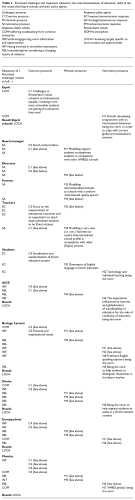
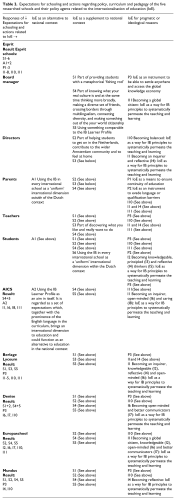
The first three topics were related to the Esprit schools as organisational structures, coping with coercive, mimetic or normative pressures within and outside of the Dutch national context (see Table 1). They focused on a degree of isomorphism. Topics (iv), (v) and (vi) were more related to the policy agents within the Esprit School Group. They focused on the expectations for schooling and the actions of the policy agents regarding policy, curriculum and pedagogy (see Table 2).
Perceived challenges and responses related to the internationalisation of education (IoE) of the five researched Esprit schools and their policy agents.
Expectations for schooling and actions regarding policy, curriculum and pedagogy of the five researched schools and their policy agents related to the internationalisation of education (IoE).
All schools’ data
The research data pertaining to the internationalisation of education across the Esprit schools collectively comprised one interview with the board manager, four multi-level interviews, the minutes of five Esprit International Steering Group meetings, the professional development activities in the Esprit Centre of Expertise, and additional relevant documents. The data were grouped around six topics relevant to the internationalisation of education process, as they had been for the research data pertaining to the individual Esprit schools (see Tables 1 and 2).
In the school year 2014-2015, during the implementation and diffusion of an internationalisation of education policy in the Esprit School Group, with people dividing into (degrees of) adherents and abstainers depending on the location of the policy in a space of preferences.
Expectations for schooling and actions regarding policy, curriculum and pedagogy
A=IoE as an alternative to national context
S=IoE as a supplement to national context
P= IoE for pragmatic reasons
I= IoE for ideological reasons, i.e. as in the IB Learner Profile for students and teachers (see below)
I1= inquirer
I2= knowledgeable
I3= principled
I4= reflective
I5= thinker
I6= open-minded
I7= communicator
I8= caring
I9= risk-taker
I10= balanced
I11=global (world) citizenship
In the school year 2014-2015, during the implementation and diffusion of an internationalisation of education policy in the Esprit School Group, with people dividing into (degrees of) adherents and abstainers depending on the location of the policy in a space of preferences.
Conclusion
A replication of this case study – were it possible to replicate it – could be improved by including a smaller selection of (two or three) schools and by expanding on and deepening the questions about the interviewees’ individual responses to concerns. Some of these questions generally focused on how, through their ‘stances’ and reflexive deliberations as social agents, they could possibly mediate causal power of social forms. It would be interesting to know more about the interviewees’ behaviours and expectations in specific ‘internationalising’ school situations such as learning in a digital classroom with students from all over the world, learning a foreign language in a foreign language, learning what it could mean to be a world citizen, or schooling one’s character by being hungry or in a wheelchair all day.
Educational research should not be reduced to an ‘either-or’ proposition (e.g. either ‘realist’ or ‘relativist’) and these narratives could shed more light on how people learn how to make new choices in an expanding number of local and global arenas for individual choices. Instead of in social agents or institutions and their practices, ‘the source of all productive energy’ might well be ‘in the spaces in which each individual mind engages with other minds’ and ‘in the process’ that ‘creates the collective, intersubjective domain of practices and understandings known as society.’ (Hunt, 2014: 141). No one paradigm can cover the diversity of educational experiences, and a replication of this research would be enriched with the inclusion of more ‘bottom-up’, in-depth narratives about the place of education in an increasingly interconnected and interdependent world. However, experience with the more ‘top-down’ testing of the explanatory power of structuration theory for the data analysis of an internationalisation of education process was a positive one. It allowed me to exercise theoretical generalisation by pattern matching regarding the how and why of an increasingly popular internationalisation of education process in a group of primary and secondary schools in Amsterdam.
The extent of interactions between the Esprit schools and the awareness of a common purpose increased, as the Esprit board manager challenged the school leaders to adopt a more international dimension to education through new patterns of relations. All five Esprit schools adhered to the Esprit International policy at a time when there was an increasing awareness between the schools to contribute to the schooling of migrant students, when more information and opportunities became available to do so, when the number of their interactions was increasing and when the nature of their relations was changing.
The first conclusion arising from this study is therefore that:
1. Under pressures from within and outside of the Netherlands, the schools responded by displaying an increased interest in their own mission and vision, in a process of seeking institutional rapprochement with each other. All the available data shows that the internationalisation of education process was characterised by a field theoretic pattern of organisational redefinition and realignment, affected by structural variables from between and outside of the institutions. The Dutch Esprit schools aligned around the common purpose of contributing to the schooling of migrant students, but remained largely specific to their own local contexts, influenced by their own local interests. This was due to the perceived different needs of students, teachers, parents and school leaders, and due to the schools’ needs for divergence towards a differentiated response to perceived challenges. This created tension for local institutional diversity within a coherent Esprit and Dutch national framework. For example, the normative pressure (see N3, AICS, Table 1) regarding the transferability of education for the sake of continuity of education for the one Dutch international Esprit school (AICS) did not play out at all for the other four Dutch schools. It was more in the interest of the AICS (selectively catering for children of internationally mobile families), compared to the other Esprit schools (catering for all children in the Netherlands), to counter this particular pressure by considering an internationalised school ‘model’, such as the IB. However, all interviewed parents were attracted by such a system (see M3, Parents, Table 1). It remains to be seen whether all Dutch students will be able to follow the entire International Baccalaureate, International Primary Curriculum or International Middle Years Curriculum programmes in a foreign language and to complete these programme’s assessments and final examinations.
My second conclusion is therefore that:
2. Under these pressures, a concerted motion was observed between field structuration and heterogenisation, accentuating the schools’ specific local contexts and indicating a process of anisomorphism. The students, teachers, parents and policy-makers responded by expressing diverging concerns, largely specific to and ‘embedded in’ their own local context.
The emphasis of this research has been on institutional theory. Instead of alignment towards a convergent internationalisation of education response to the different pressures, the schools showed a divergent response particular to their own local contexts and interests. It is clear that students, teachers, parents and directors co-constructed this specifically diverse nature of the internationalisation of education process. Further research, with more emphasis on realist theory, might provide a better idea of how exactly agentic modes of reflexivity influence this diversity or, in Archer’s words, how exactly policy agents ‘mediate social-cultural constraints and enablements in [their] quite distinctive ways’ (2010:165). It might well be that the direct actions of the Esprit students, teachers, parents and directors did constitute their schools’ internationalisation response under pressure more significantly than we can now suspect. After all, the environmental conditions for the schools in a ‘field’ can never be exactly the same, and leave room for alternative modes of explanation. For example, it is still unclear to what extent the Esprit board manager’s three strategic/autonomous responses to the coercive and mimetic pressures (see Table 1) have induced motion to the Esprit internationalisation process. She claimed that she could ‘make a difference in this process’ and that she had ‘the authority to make a strategic difference’, yet she realised also that she had the ‘political tail wind’ (G71:Q3) and acted ‘within a team spirit’ (G71:Q6). In any event, this study shows that the realist interpretation, asserting that policy agents hold ‘causal powers’, still rivals the structurationist interpretation that field structuration induces motion, including the agent’s striving. The integration of structure and agency deserves more attention by researchers in general, and by researchers of the internationalisation of education process in particular. Although different degrees of causal contributions of individual modes of reflexivity and collective action were detected, I subscribe to Archer’s observation that the ‘missing link’ between individual modes of reflexivity and collective action is still missing (Archer, 2010:166).
My third conclusion is therefore that:
3. All the available data shows that the field structuration and heterogenisation of the internationalisation of education process was also characterised by agentic expression and mediation. It suggests, at least in this case study, an ontological acknowledgement of the integration and reciprocity of structure and agency.
The school selectively catering for children of internationally mobile families (i.e. the AICS) did not perceive internationalisation of education as the only existing credible alternative available, because of lacking programmes in the national context. Instead, the Esprit parents in particular considered internationalisation of education as an alternative due to the perceived need for continuity of education in other countries and in other (international) schools that may offer the same programme, and due to the perceived need to avoid language and qualifications barriers which are recognised in the home country. In addition, the Esprit students considered internationalisation of education as an alternative due to the ability to settle anywhere and access the global knowledge economy.
My fourth conclusion is that:
4. The school selectively catering for children of internationally mobile families (i.e. the AICS) perceived the IB Learner Profile as an aim in itself. It was regarded as a set of expectations which, together with the prominence of the English language in the curriculum, brings an international dimension to education and could function as an alternative to education in the national context. However, this school did
The Esprit students also considered internationalisation of education, through for instance the IB, as a ‘uniform’ international dimension within the Dutch context, as an instrument to avoid language or qualification barriers. The internationalisation of education was thus perceived by them, as well as by all Esprit schools and policy agents, as a desirable supplement to national education programmes. The espoused expectations for excellent schooling showed a striking resemblance with the different elements of the IB Learner Profile. In some instances this was due to the perceived need to be ready for a global, more competitive knowledge economy. In most instances this was due to the perceived need for forms of global citizenship education beyond the national context and culture.
My fifth conclusion is that:
5. The internationalisation of education and the IB Learner Profile were considered by all Esprit schools and policy agents to be a desirable supplement to national education programmes and (professional) development of the internationally minded teacher and student. A growing international focus was observed in all Esprit schools, to better serve the needs of a multicultural student population in a multicultural city in a variety of ways.
The specific expectations for schooling and actions regarding policy, curriculum and pedagogy related to the internationalisation of education, run along ideological as well as pragmatic lines. These expectations and actions, particularly of the parents and the students, were creating new boundaries and rationales for the schools as bargaining zones. The borders between the schools were becoming more connected with a growing international focus, yet had different implications for each of them.
My sixth conclusion is therefore that:
6. Within the Esprit School Group, there is a prima facie case of ‘shifting borders’, i.e. an erosion of differences between the school selectively catering for children of internationally mobile families (i.e. the AICS) and the other schools catering for all children in the Netherlands. The nature of this erosion has pragmatic as well as ideological components and means something different for every school.
Footnotes
Funding
This research received no specific grant from any funding agency in the public, commercial, or not-for-profit sectors.