







Abstract
P–12 (pre-school – grade 12) international schools educate increasing numbers of local and expatriate students, who make up a growing proportion of tertiary (university level) international students. Using the transnational social fields framework, this phenomenological study focused on the experiences of 19 students from international schools in China, India, and the United Arab Emirates in order to better understand how these schools contribute to the development of students’ identity and how they experience global learning. Findings include rich examples and narratives of how students gained an appreciation of diversity, found a sense of belonging in differing ways, reflected on their privilege, and developed intercultural understanding through global learning. This study provides further motivation for higher education (university level) institutions to gravitate from a deficit or monocultural perspective of international students, toward acknowledgement of the diverse hybrid identities and knowledge that international students bring to tertiary institutions.
Globalization has shaped the economic and social trajectory of many countries over the last century and has led to increased circulation of peoples, cultures, and languages (Altbach, 2004). With the growth of the English language and international mobility required for work, many societies are grappling with the influence of Western culture in business and education. A response to globalization and mobility has been the rapid development and growth of international schools worldwide that offer an English-medium curriculum with an international focus (Altbach and Knight, 2007; Hayden, 2011). As at 2020, there were 5.65 million students in primary and secondary international schools, up 43.9% in the previous five years (ISC Research, 2020). The growth in global tertiary student mobility has mirrored this growth, which surpassed 5 million in 2016 (OECD, 2019). Students who studied in international schools are a growing sector of the globally mobile university student population (ISC Research, 2020), and many of these students go on to be business leaders, ambassadors, and policymakers who play an important role in continued global development.
Empirical studies that focus on international students at tertiary institutions have surged in the past few decades. Few studies, however, have examined the experiences or journeys of students from P–12 (pre-school – grade 12) international schools, who often have unique life experiences, as they transition to tertiary institutions (Smith and Kearney, 2016). International schools were originally established for students from different cultures who were internationally and transnationally mobile as their families moved for work (Hayden, 2006). Some students from international schools, who may identify themselves as third culture kids (TCKs), are an increasing focus of research at the secondary education level to understand their identities and how they connect with their peers based on their transnational and mobile lifestyles (Hannaford, 2018; Straffon, 2003). Building on this research and growth in tertiary global mobility, the authors of this paper sought to examine these students at the intersection of their secondary and tertiary education experiences, which is often neglected.
Purpose and Research Question
In this paper, researchers seek to move beyond the deficit model, which we argue is based on a misguided mentality that international students in higher education have a monocultural identity embedded in their country of residence and/or citizenship, or are a homogenous group (Heng, 2021; Popadiuk and Arthur, 2005). The purpose of this study was to understand how international schools serve as transnational places, and how students’ identity and global learning may be connected to experiences at their international schools. Students interviewed for the study were continuing on to higher education institutions (HEIs) in a country different from that of their international school. This paper focuses on the results from a series of interviews conducted with students prior to starting at their HEI, with particular interest in international schools and identity development. A larger study, in which the data gathered to inform this paper is located, also delves into students’ higher education decision-making and experiences in college. The study was guided by one multifaceted research question: How do international schools serve as transnational spaces that contribute to the development of students’ identity and global learning?
Students from international schools in this study are referred to not as international, but as transnational, to better describe the multifaceted and complex experiences and identities they have. A commonly accepted definition of international student is a student who crosses a border for the purpose of study. Although all of the study participants became international students at a HEI, the students had experiences that transcended national boundaries, even if it was just within the context of engaging with other diverse students at their school. The term transnational student provides enough flexibility to encompass the broad range of experiences that students at international schools have and create together. This study uses Duff’s definition of transnational students, who are defined as individuals who establish social relations and live their lives across ‘cultural, ideological, linguistic, and geopolitical’ borders within nation-states (2015: 57).
Literature Review, Context, and Framework
This section discusses international schools and students who attend these schools, as well as a brief overview of the main constructs in the study.
International Schools
The first P–12 international schools were founded at least 100 years ago, and their focus and student population have shifted greatly over time. Organizations like International School Services (ISS) and the International Schools Association (ISA) were established in the 1950s to support dozens of schools that had opened worldwide (Hill, 2015). What began as a few scattered schools worldwide for highly-skilled expatriate workers’ children has evolved into a diverse and structured system of over 10,000 primary and secondary schools that enroll millions of local and international students globally (ISC Research, 2020). The number of international schools grew by over 40% in the 10 years up to 2020 and is expected to surpass 12,000 schools and almost 7 million students by 2033 (ISC Research, 2020). Recent growth has been fueled mainly by the growth of local families who send their children to these schools to study through the medium of English and gain an internationally recognized education and qualification (Hayden, 2011), as well as by response to global economic trends (Rahimi et al, 2017). Many students who graduate from international schools continue to pursue tertiary education in another country, and the growth of international schools has paralleled the global tertiary student mobility growth. In 2020, India and China had the largest number of P–12 international schools, and were also the largest senders of international students to higher education institutions globally (ISC Research, 2020; UNESCO, 2020).
In this study, an international school is identified by the following characteristics: (a) it offers a curriculum for primary and/or secondary students, (b) it has an international focus, and (c) it utilizes a primarily English-medium curriculum if located in a non-English speaking country, or an English-medium education different from the country’s national curriculum (ISC Research, 2020). Although there are differing views on the distinctions between international schools and nuances in different schools (such as schools that do not operate through the medium of English or infuse global elements), those three characteristics describe most international schools worldwide (Hill, 2015). International schools typically offer competitive and internationally recognized programs such as those of the International Baccalaureate, A-level (England), or Advanced Placement (USA) (ISC Research, 2020). Some studies have suggested that IB programs, for example, are seen as a sign of legitimacy and a rigorous curriculum, which has been appealing to families of international school students (Hayden, 2011; MacKenzie et al, 2003). Because international schools provide an avenue that facilitates the transition to Western academic standards and culture, international schools tend to attract local and international families who are interested in supporting their children’s pursuit of post-secondary education in a country other than that of their citizenship or residency.
Students at International Schools
According to ISC Research, around 20% of the 5.98 million students attending 11,659 international schools worldwide in 2020 came from expatriate families (Miller et al, 2020). International schools originally emerged out of the educational needs of expatriate families who wanted their children to be educated in the system and the language of their home countries to which they would eventually return (Hill, 2015). Over the years, however, increasing numbers of international schools have accepted students who hold national citizenship of the school’s host country. These students come from families who tend to seek educational opportunities for their children that they believe cannot be acquired in their local school system. In other words, these students’ parents view education at international schools as a way for their children to gain ‘a competitive edge . . . in a globalized market’ (Hayden, 2011: 211).
Regardless of their former or current experiences living abroad, students at international schools enter a space where the language of learning and ways of thinking are often different from that of the local context. Even for students who are from the local area, the global nature of the curriculum and diverse student demographics may lead to similar intercultural outcomes that TCKs and internationally mobile children experience. In this sense, international schools provide a borderless space for students to further nurture or newly develop ‘multiple identities’ (Poonoosamy, 2018: 208).
Identity Development
In order to understand the backgrounds and experiences of students at international schools, it is necessary to contextualize the identity development of these students and the role of international schools in shaping it. Since adolescents spend much of their time at school, Verhoeven et al point to the role of schools in shaping the identity of their students, both ‘unintentionally’ and ‘intentionally’ through daily interactions and curriculums, among other practices (2019: 39). In terms of the curriculum, Tanu argues that international schools need to be critical of how ‘becoming international’ may be equated with Western, English-medium education, which creates a hierarchy in the languages and cultures used in school environments and beyond (2014: 595). Miller et al also emphasize the importance of schools becoming more aware of their influence on students’ identity development, particularly as it relates to students’ well-being (2020: 420). Some schools have moved away from celebrating and discussing a student’s national identity toward cultivation of a global identity, in what be an unintentionally misguided effort which minimizes a student’s experience and background, and pushes students toward an ironically hybrid but homogeneous identity (Pearce, 2014). Many international schools publish statistics that point to the multiplicity of languages, nationalities, cultures, and races of their students in order to highlight the diversity of perspectives in the school, but Pearce (2018) problematizes these ideas by identifying that any one culture or nationality cannot be whittled down to one set of assumptions or norms.
The age range during which students attend international schools overlaps with the developmental stage in which identity development takes place. The importance of adolescence in identity development is well noted in Erikson’s stages of psychological development (Miller et al, 2020). For adolescents, Poonoosamy notes that ‘connecting emotionally to people and places’ matters in their process of identity formation (2018: 209). Nevertheless, compared to students who attend local schools, students who attend international schools often relate to more than one country, whether in terms of their nationalities, relocations, or the cross-cultural environment of the international school. As such, this could make their identity development complex in terms of their sense of belonging and concept of home (Poonoosamy, 2018).
Third Culture Kids (TCKs)
Identity development can be particularly interesting among students at international schools who identify as third culture kids (TCKs). The term TCK emerged in the 1950s when Ruth Hill Useem initially defined them as ‘children who accompany their parents into another culture’ (Pollock et al, 2017: 16). Over time, the definition of the term and related terms evolved, to include global nomads (McCaig, 2002), cultural hybrids (Greenholtz and Kim, 2009), and adult third culture kids – to refer to those who spend their ‘developmental years outside of their parents’ culture but who are no longer children’ (Dillon and Ali, 2019: 80). While the population who may identify with the term continues to grow and diversify, David Pollock’s definition of TCKs appears to be most widely used in the literature on this population (Dillon and Ali, 2019; Fail et al, 2004; Poonoosamy, 2018). Pollock (1989) defines a TCK as: a person who has spent a significant part of his or her developmental years outside the parents’ culture. The TCK frequently builds relationships to all of the cultures, while not having full ownership in any. (in Pollock et al, 2017: 15-16)
While the heterogeneity among this population must be acknowledged, Pollock et al (2017) identified two common characteristics among TCKs to further contextualize their experiences. First, TCKs tend to ‘live in different cultural worlds as they travel back and forth between their passport and host cultures’, an experience that may also happen in transnational spaces that do not involve ‘geographic moves by airplane’ (Pollock et al, 2017: 18). Second, the lives of TCKs are shaped by constant global mobility, in which people who engage in such mobility could be ‘either the TCKs themselves, or those around them’ (Pollock et al, 2017: 18). Because of the highly transient way of life between countries and cultures, some TCKs could be susceptible to ‘rootlessness and restlessness’ (Pollock et al, 2017: 28). At the same time, it is vital to recognize the strengths which some of them may have cultivated as means of survival, including but not limited to cross-cultural interpersonal skills, multilingualism, and an ability to adapt to new countries and cultures with relative ease (Pollock et al, 2017). Furthermore, Fail et al (2004) discussed TCKs’ tendency to identify with people rather than places for their sense of belonging. Impacted by their experiences and environment, TCKs may have a hybrid identity, which Marshall (2009) postulates is connected with a third space, when different cultures or nationalities exist in and create a new kind of space or culture. This could have implications for HEIs when designing events, programs and courses with or about international students, in which conversations often center around students’ nationalities.
Global Learning
Global learning may be understood as encompassing a ‘knowledge of global interconnectedness, inquiry into global issues, open-mindedness, recognition of bias, stereotyping and exotica, intercultural experiences, and intercultural competence’ (Merryfield et al, 2008: 8). Global learning requires students to ‘understand the universal through the particular and the particular through the universal’ (Kahn and Agnew, 2017: 54). Understanding differences is an essential component in global learning.
Many international schools infuse global learning at the core of the curriculum. A primary goal of many international schools is to guide students to develop intercultural understanding, international perspectives, and global learning (Lineham, 2013). In this light, students are encouraged to integrate multiple and diverse perspectives from macro and micro contexts (Kahn and Agnew, 2017). Students at international schools learn open-mindedness and cultural awareness to understand and appreciate the cultures of themselves and others (Bullock, 2011). This often mirrors the global and interconnected world in order to practice and demonstrate cultures, ideas, and values that intersect and cross borders (Kahn and Agnew, 2017). These types of features are relatively common and aspirations of many international schools, whether they use the IB, AP, or A-level structure.
Lifelong global learning also shifts international school students’ identity and perceptions (Kahn and Agnew, 2017). For instance, an American student studying at an international school in the United Arab Emirates might learn to see the world through the eyes of Indian migrants. In this regard, the students’ identity can shift to be more complex and relational. In the global learning environment, students learn to explore their biases and values to be fully involved in sustainable learning and appreciation of differences (Barratt Hacking et al, 2018; Kahn and Agnew, 2017).
Critical thinking is also an important aspect of global learning so that learners can reflect on their reactions to global issues in a critical way (Andreotti, 2014; Bentall and McGough, 2013). In this way, many students from international schools have an opportunity to recognize and acknowledge their own biases, stereotypes, values, beliefs, and identities through learning about the perspectives of others and themselves to confront and respond to any conflicts and differences critically (Kahn and Agnew, 2017).
Transnational Social Fields
This study draws upon the framework of transnational social fields (Fouron and Schiller, 2001; Schiller, 2005) to explore the idea of international schools as transnational spaces and how they may impact students’ experience related to social and educational contexts. For the purpose of the study, a transnational social field is defined as ‘an unbounded terrain of interlocking egocentric networks that extends across the borders of two or more nation-states and that incorporates its participants in the day-to-day activities of social reproduction in these various locations’ (Fouron and Schiller, 2001: 544). The boundaries of the social field are complex and fluid, where students can participate, navigate, and negotiate in a ‘network of networks’ (Schiller, 2005). It is a multidimensional network in which resources, opportunities, and practices are unequally distributed and transformed (Levitt and Schiller, 2004). This multidimensional network and field is structured by power, which means that the social field encompasses ‘structured interactions of differing forms, depth, and breadth’ (Levitt and Schiller, 2004: 9). Despite international schools acting as transnational social fields, the social fields conceptualize different social and economic relations across borders (Levitt and Schiller, 2004). This is also to say that international school students should not all be considered as wealthy and having the same resources.
In this study, transnational social fields shift the focus to the ways in which students from international schools become transnational students who travel across nation-state borders and conduct various cultural, social, and educational activities in their daily lives. This perspective offers a deeper analytical lens to understand the importance of network, citizenship, belonging, and nation-states, particularly for the study participants who continue onto a tertiary institution in another country (Levitt and Schiller, 2004). Within the transnational social fields and global network of international schools, students engage in various social relations and practices within different levels between ways of being and ways of belonging (Levitt and Schiller, 2004; Schiller, 2009). Many students interact in transnational environments, but may not ‘identify with any label or cultural politics associated with that field’ (Levitt and Schiller, 2004: 11) because the identity of these students shifts through navigating and negotiating various situations. They could shift their identity to fit into the school environment and the host country’s culture without a static personal identity (Pollock and Van Reken, 2001). Furthermore, transnational students act on their own behalf to bring about changes in the transnational social fields (Marginson, 2014). Across transnational, geographical, cultural, and linguistic borders, students from international schools participate in different learning processes and negotiate multidimensional identities (Marginson, 2014). According to Levitt and Schiller, ways of belonging refers to ‘practices that signal or enact an identity which demonstrates a conscious connection to a particular group’ (2004: 11). These practices are visible and concrete, combining ‘action and an awareness of the kind of identity that action signifies’ (2004: 11).
Students’ ways of belonging and ways of being are combined within different contexts in transnational social fields (Levitt and Schiller, 2004). They might have social contacts and networks in their home country, but some of them may not feel a sense of belonging to their home countries. Students from international schools often live in a number of different countries throughout their primary and secondary education, which contributes to them having complex cultural and academic backgrounds. Fail et al (2004) note that international school students tend to perceive themselves as cosmopolitan people who like to travel across borders, but lack a sense of belonging to any one. Their identity is fluid and transnational with the flow of time, space, and context, but not static (Fail et al, 2004). For the purpose of this study, international school students’ voices are positioned at the center of their identity development and global learning within the transnational international school environment.
Methodology
Research Design and Paradigm
This study was constructed as a relativist, phenomenological design (Moustakas, 1994) because it sought to explore how people make sense of their experiences, and particularly how they interpret and interact with their surroundings. Researchers used a social constructivist paradigm (Gergen, 2001) to understand the different realities that individuals may experience as they engage with their surroundings in an international school, often embedded within their transnational background and experiences. The social constructivist paradigm also recognizes that knowledge and experience are constructed through interactions with others. This includes not only their experiences of engaging with others in their international school and family experiences, but also how the participants and the researcher interact together through the interviews (Gergen, 2001). As Dillon and Ali describe, identity development is a fluid process of ‘being and becoming’ (2019: 81). Because the focus of this study is the identity of students whose sense of self is growing and multilayered, the researchers value the use of narratives to understand ‘how people make sense of their life stories’ (Fail et al, 2004: 332).
Data Collection and Participants
Researchers utilized convenience and purposeful sampling (Etikan et al, 2016) and chose three countries from which to recruit participants that represented diverse perspectives and robust school systems that provided the opportunity to explore the scope of the research questions in different contexts (Lincoln and Guba, 1985). This paper focuses on the first interviews from a longitudinal study (Creswell and Creswell, 2018). Researchers worked with international school counselors, who advertised the study to students who were planning on attending a tertiary institution in a different country from that of the international school in which they were studying. IRB (Institutional Review Board) ethical approval was obtained, and all participants were 18 years or older and consented to the research study. Confidentiality of data was upheld throughout the collection and analysis process through pseudonym use and encrypted data storage.
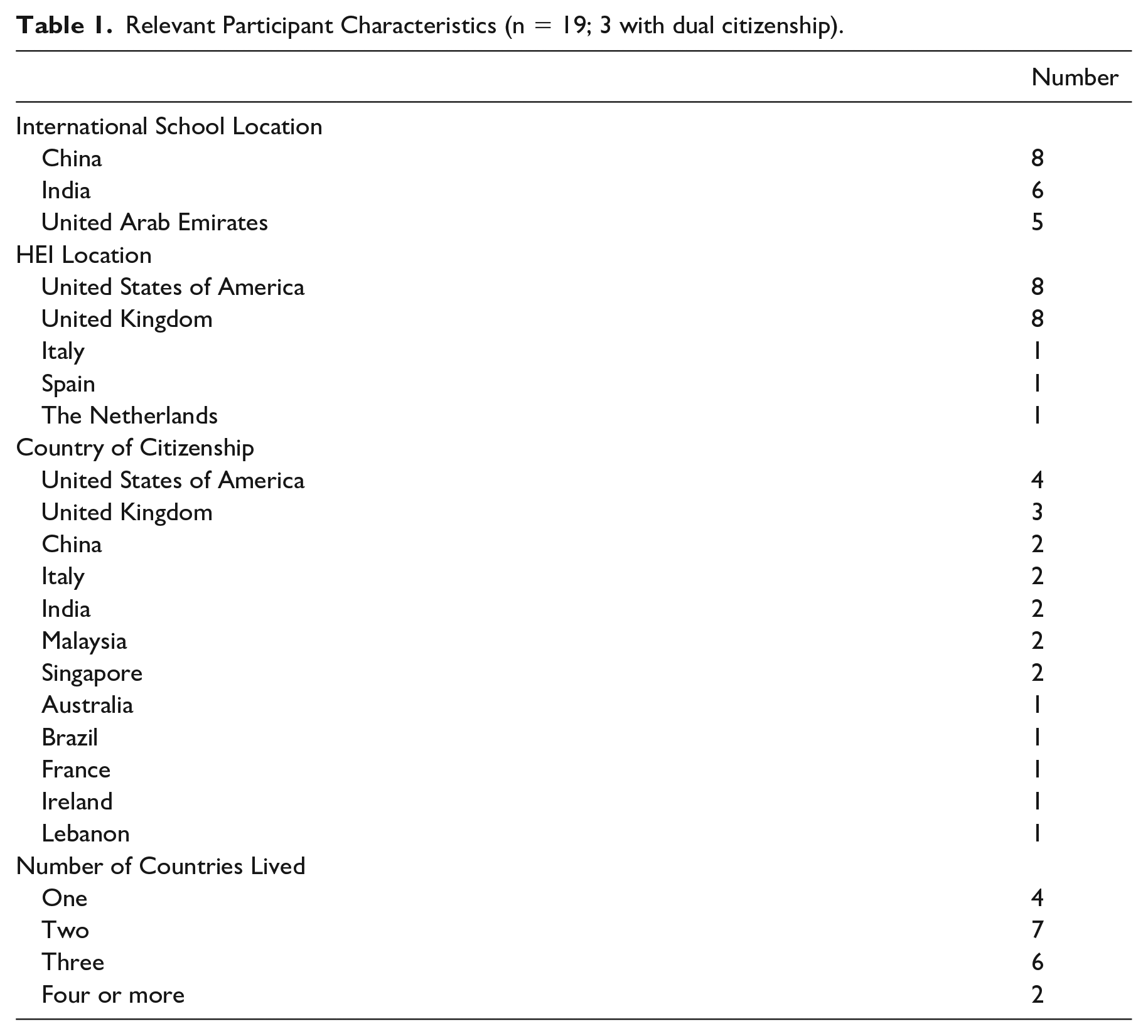
Phase one interviews were conducted with 19 students during the summer of 2019, after they graduated from secondary school. The 19 participants were from ten international schools, six cities, three countries, 12 nationalities, and continued on to universities in five different countries. All of the international schools included in this study specifically highlighted on their website an international or global outlook as a key feature in their curriculum, and most schools boasted at least 30 nationalities. In terms of where students had lived in the past, participants were representative of the many different types of student that today’s international schools attract. Of particular interest is that four of the 19 participants had lived in the same place their entire life, but only one of those four could be classified as a domestic student (ie who had not traveled extensively with family or was a different nationality from the country of the international school). Table 1 provides more detailed participant information.
Relevant Participant Characteristics (n = 19; 3 with dual citizenship).
Semi-structured, in-depth individual interviews lasting approximately 60 minutes were conducted with participants. Interviews took place primarily via Zoom, which is an effective interview tool for participants and researchers because of its ease of use, data collection tools, and security options (Archibald et al, 2019).
Data Instruments
Researchers developed an interview protocol based on the research question, study purpose, and theoretical framework (Schiller, 2005). Questions focused on prior mobility, experiences in international schools, higher education institution decision-making, expectations for college, sense of belonging and identity, and career goals. For this paper, content related to experiences in international schools, sense of belonging and identity, and prior mobility were utilized. (Findings relating to higher education decision-making, career goals, and college transitions are discussed elsewhere). Probing questions were used to clarify and solicit more detailed information when needed. The protocol was revised for clarity as interviews progressed.
Data Analysis
Interviews were transcribed by an online service and then reviewed and edited by the researchers to ensure that the transcriptions were accurate and captured tone and other important elements. All three researchers reviewed and coded the interviews using descriptive and pattern coding techniques to help flesh out the components of the theoretical framework, establish a baseline understanding of the participants’ experiences, and facilitate building themes and groups (Saldaña, 2009). Study trustworthiness was addressed by taking field notes, asking probing questions, member checking, and bracketing the study (Creswell and Creswell, 2018).
Findings
Interviews with student participants allowed a deeper understanding of the under-studied students who attend international schools. This section describes the four main themes that researchers drew out from the interviews. Given the qualitative, phenomenological nature of the study, researchers chose not to quantify how many participants ‘fit’ into a particular category or identity, or shared similar responses. Careful coding and analysis allowed researchers to find some commonalities without aggregating the data and collapsing participants into predetermined groupings. Themes center around the idea of international schools as transnational spaces where students: (a) Gain an appreciation of diversity; (b) Find a sense of belonging; (c) Reflect on privilege; and (d) Develop intercultural understanding through global learning. All student names cited are pseudonyms, to protect confidentiality of their identity.
Gain an Appreciation of Diversity
International schools are multinational and transnational spaces. In this unique environment, some students develop ‘hybrid identities’ (Marginson, 2014; Marshall, 2009) based on the plurality of experiences from more than one culture and country, and international schools offer a space for them to express such identity without fear of stigmatization or exclusion from their peers. For example, the following reflection from Aiden shows how she found a ‘safe space’ to belong to a community that appreciates diversity: You’re able to voice your own opinions because we all know that we’re from different backgrounds and we’re brought up differently . . .. So diversity is one thing that I really care about, . . . that I’m able to see different kinds of people, different voices, different thoughts and what I like as a person because I guess it’s kind of part of the international school scene that’s kind of shaped me that way.
Similarly, Jamaal shared the feeling of belonging to a community that is ‘accepting’ of diversity, where the international school environment normalizes an encounter with people from various cultural and national backgrounds: People were sort of accepting of . . .what makes you unique . . . you [can] sort of just find your . . . space . . . and the community. It was really welcoming and . . . you really meet . . . a lot about different people in different parts of the world.
While the majority of student participants described exposure to diversity in terms of ethnic and racial backgrounds of fellow students and their families, it is also worth noting that some international schools in this study did not have vastly diverse student demographics. For example, Roshni mentioned that ‘the majority of the population is still Indian’ and Ying said that ‘I would say that 80% [of the student body] are Chinese, but some of them hold American passports.’ Therefore, the findings from the interviews suggest that some international schools may not provide the racially and ethnically heterogeneous student body that may be assumed to be the case. In this regard, student experiences may vary depending on each international school and its demographics. Nevertheless, many students become part of the community that values diversity, which creates a personal and intellectual haven for students with multicultural and multinational backgrounds. Several students, including Sami and Aiden, shared how their experience of learning in a transnational and diverse environment was an important piece of their college selection process, because it had become an integral part of their identity and their idea of community.
Find a Sense of Belonging
Not only did the international schools contribute to the students’ appreciation of diversity and help them connect with other diverse and transnational peers, but some students found a sense of belonging in a community where it is normal for people to have more than one citizenship or an identity that is unattached to one’s country of origin. For example, Roshni expressed how although she was originally from India, the country of her international school, she grew up in Europe and had a hybrid identity: So everyone has that sort of similar situation where we’ve all sort of been scattered all over the globe. But that’s what makes it really great because you can connect with people in that sense as well.
Sarah shared how even though she had lived in China for a long time, she did not feel connected to the country or even to Singapore where her family lived. She found her belonging with her school and her physical home. She shared: Even if I’ve lived in China for so long, it never really felt like it’s . . . a home to me. Well, in a way it’s almost like a second home, but it’s not like I would miss it really terribly when I leave or anything. As well as perhaps the fact that . . . I’ve moved before and then people I know are also from different countries, so you never really connect as much with the . . . local scene and everything.
This connects with Fitzsimons’ study which found that students often had what they termed an ‘(inter)national identity’, recognizing that some individuals may affiliate with more than one national identity, or not connect with one at all (2019: 276). Anastasia felt connected not only with her international school, but also with the term ‘third culture kid’ and the idea of students from other international schools with similar backgrounds. When discussing different types of students she may meet in college, she shared:
As third culture kids we’re so used to moving around, so you [are so] used to adapting that being in a new environment . . . wouldn’t really catch us by surprise as someone who’s been in a local school for a long period of time who has to adapt to a new environment, much more than international students do.
Eva felt like she belonged to her school, similar to how she felt that she ‘belonged’ wherever she was and where her family was. Relatedly, she intended to make her university her new ‘home’, demonstrating the flexibility and fluidity that many international school students possess.
While students found a sense of belonging within their school and with similar students, it also brought about challenges where students felt like they did not belong in their home country, or in their local or host country. Aiden shared: So I kind of feel left out when I’m back at home, which I do every single year because I go back every year. And then when I’m in China, I’m part of the international school scene, so I’m not part of the local scene either. So I’m also that minority in the entire country I guess because China is big and there’s only that many . . . international school students . . . in comparison to the Chinese population.
This is similar to the ‘third space’ or hybrid identity described in previous literature (Marshall, 2019). While students overwhelmingly appreciated their international school and oftentimes felt a stronger connection to the school than to the city or country, many students recognized that it was a bubble and led to awkward situations in their local city or when visiting extended family in their ‘home country’. This space of belonging in their international school contributed to their identity, which evolved throughout their secondary educational journey.
Reflect on Privilege
Among the distinctive aspects of the international school environment are the experiential learning opportunities, whether through project-based learning, community service, or international service learning. Many participants shared how these experiences helped them to better understand their place in society, as well as how to interact with people from different socioeconomic backgrounds. One of the experiential learning opportunities which students frequently mentioned was service trips or community service programs. In the interviews, students mentioned how such experiences made them aware of the privileges they hold. For example, Anastasia shared her first experience with a community service project at her school, where they measured shoe sizes and provided shoes for less privileged children. It influenced her way of thinking about herself and her place in India: I think coming to India was different from what we expected. Of course, it’s not something we were used to and we knew we had to do something. I mean in a position of privilege, it’s not fair for us to just sit there and see the things that’s happening around us and not do anything.
Projects like this and getting outside the international school environment influenced her career aspirations. Anastasia wishes to become a lawyer to contribute to society at large. She shared her willingness to know the realities of people of different socioeconomic status than herself so that she could expand her perspectives in becoming an informed lawyer.
While most students said their volunteer experiences in disadvantaged communities expanded their worldviews, interviews illuminated students’ various thought processes that questioned the meaning and sustainability of their actions. For instance, one of the students shared a critical view of the community service program due to its short-sightedness, and mentioned how he wants to think about ways in which he could contribute to a more equitable world by making long-term impacts. The following is an account from Sami: I don’t believe that service trips are the best way to actually give back to the community. I think they’re fairly like a self-serving thing. And then, yeah, it had this good . . . impact on me and it’s changed me as a person, but it may have ended up benefiting me more . . . and from a purely financial perspective too . . . it’s inefficient to . . . transport so many people there just to do this service and then come back.
The service project was eye-opening for Sami in that it highlighted some of the challenges in community service, and it did help him realize that he wanted to be able to influence policy changes that would impact more people globally.
Besides their experiential learning at international schools, some students became aware of their privilege by mingling with their peers and realizing their similarities in terms of socioeconomic backgrounds despite where they are from, or by comparing their livelihoods with others in the country in which they reside. Anastasia reflected on how important it was to get out of the international school bubble to understand what was happening in the world around her. Likewise, Aiden shared her accounts of being in the ‘bubble’ of people who come from similar socioeconomic backgrounds. She spoke about how her worldview may be limited and that she wishes to expand it by venturing out to college life where she hopes to meet with students from various socioeconomic backgrounds: I feel like even though I’ve been . . . in international school, . . . my view is still very limited and I feel like when I go into college I’ll be able to meet people, . . . ‘cause right now, . . . although I’m meeting people from different backgrounds, different cultural backgrounds, . . . we are pretty much on a similar economic background, socioeconomic background because international schools are expensive I guess . . . and to be honest with you, . . . I really want to . . . interact more with people of different socioeconomic backgrounds.
The above accounts exemplify that some of the students in our study may indeed come from middle-class families. The students’ accounts suggest how such privileges are passed on from their families to their children, or their children may gain a different type of privilege than their parents have by attending international schools. These findings illustrate the students’ self-awareness of such privileges that they have or recreate. At the same time, they expressed a sense of humbleness in acknowledging their limited knowledge of the world beyond their community and a will to step outside of their comfort zone in college to interact with people from different backgrounds.
Develop Intercultural Understanding through Global Learning
In addition to the process of their identity development, students also reflected on their cross-cultural interpersonal skills. The opportunity to develop these skills is a critical aspect of global learning as defined by Merryfield et al (2008). Opportunities for such interactions seem to arise organically at international schools where students encounter peers and teachers who tend to come from various parts of the world.
In terms of social skills, some students’ reflections show how international schools offer some space for them to practice empathy towards others who may hold different worldviews. In particular, Jamaal’s account describes his process in thinking about how to work with people with different opinions to come to a mutual understanding, or to begin by acknowledging the differences in their way of thinking with an open mind. He describes his experiences socializing with people at his international school, and how it might be different if he had stayed in his home country of the United Kingdom: So you have a very open mindset, you . . . learn a lot of different things about different people . . . I imagine that it will be something which . . . helps me to get to know people a bit more and . . . understand where different people are coming from. Whereas if I’d stayed in the UK the whole time, then I think you . . . naturally don’t know as much about other cultures, perhaps depending on where exactly you’re living and the specifics of your situation.
Anna left her home country and transitioned to an international school at 16 after attending local primary and secondary schools. She saw the value of intercultural understanding and global learning, and how her school played a big role in that. She stated: ‘My mind is just more open and like now I have a vision of the world that is totally different from what it was before’.
Several important aspects of global learning included perspective consciousness, open-mindedness, and intercultural competencies. Jamaal articulated how his experience at international schools had helped to open his mind to different ways of thinking: I guess it just helps you to stop making assumptions about things and you learn to be more open to different interpretations, different possibilities. . .And you realize that actually there’s different ways of thinking about the same thing and to someone else, something else completely different might be true.
His words exemplify how he learned to have flexibility and accept different values and ways of thinking.
Although Priya had citizenship different from her parents and from where she lived, she attributed her global learning and intercultural understanding to her international school, even beyond her travels and family. She stated: ‘I feel like I’m just more globally aware and culturally aware of different countries and different cultures and like different customs . . . only because . . . I was exposed to them for so long at [international school].’
While such moments of personal development for adolescents could happen outside of international schools, such instances may happen more frequently in international schools where students and teachers tend to have various cultural and national backgrounds. Such experiences would help students to develop an open mind where differences of all forms – racial/ethnic backgrounds, religions, customs to name just a few – are seen as something normal in the diverse learning community that international schools tend to create and sustain. This provides some evidence for the uniqueness of globally-focused international schools in promoting global learning beyond the students’ TCK experiences.
Discussion and Implications
The experiences of student participants in this study affirmed the theoretical interpretations of international schools as ‘transnational social fields or transnational spaces. . .[where there are] networks of networks that stretch the borders of nation-states’ (Schiller, 2005: 442). While students were the beneficiaries of such transnational spaces, there is a reciprocal relationship between the international schools and their students. In other words, students play a role in fueling and sustaining the culture at international schools, by actively learning from one another and forming friendships across cultures and countries. Thus, as Schiller (2005) argues, the findings reiterate the notion that students could also take part in the creation and evolution of transnational spaces. These spaces are inherently transnational because they meld students from different cultures, languages, and backgrounds all within the framework of an international curriculum and a focus on global learning. If the ten schools where the participants studied are any indication of a ‘typical’ international school, then local students with limited mobility experiences are also likely to demonstrate similar thought processes and open-mindedness simply from engaging in their unique educational environment.
The findings of this study demonstrated students’ identity development in a transnational environment where they shaped their fluid sense of belonging and an awareness of their privileges for having access to global learning opportunities at international schools. Many students in this study described a hybrid identity, influenced by similar factors that Marshall (2009: 104) describes as ‘the interplay between globalization, migration, language and identity, which pushes and pulls in many inconsistent directions’. Transnational students come from a diversity of socioeconomic backgrounds, and it is not the intention here to reinforce the stereotype that these students necessarily come from affluent families. In fact, some findings align with postcolonial education concerns, where more families in non-Western countries encourage their children to attain a Western education to retain social status or attain upward social mobility (Hayden, 2011; Waters, 2006). Although the financial cost of international schools may often replicate or parallel what national private schools offer in terms of exclusivity and better resources, international schools need to be conscious to not contribute to the erasure of local languages, customs, and educational systems (Hill, 2015; Tanu, 2014; Waters, 2006).
Despite the growing number of local students at international schools, students in this study predominantly came from middle-class families who had had prior experiences living abroad before attending international schools in different countries. For future studies, there is a need for both empirical and narrative inquiries of local students who attend international schools in their countries of citizenship, and of how some of them become international students as they seek tertiary education abroad.
Research on the lived experiences of students at international schools provides a closer look at the diversity among students who study abroad. HEIs may tend to treat international students as a homogenous group who are assumed to have arrived in the host countries directly from their home countries (Popadiuk and Arthur, 2004). However, findings defy the stereotypes by showing how some international students come with the capacity to navigate cross-cultural learning and living environments, and may even have a transnational sense of identity.
Identity development is interconnected with students’ well-being (Miller et al, 2020). As such, to create truly inclusive learning and living environments for international students, faculty and staff at HEIs are recommended to consider potential harms to these students’ sense of belonging when using international students’ nationalities as a way to identify and invite them to talk about their ‘foreign’ perspectives in and outside of the classroom. There are some US higher education institutions (such as Abilene Christina University, Clark University, Lewis and Clark College, and Wheaton College) that have resources specifically to support TCKs, as well as programs and books by authors including Norma McCaig and Tina Quick that universities may use to support these students. Additionally, a campus environment that does not create a daily divide between international and domestic students would be beneficial for all students who are and will be global citizens to lead the future.
Limitations and Future Research
There are limitations in this study with regards to the type of participants and the focus of the school-bound research site. First, although the study is qualitative and does not aim to make generalizations, the students seem to primarily come from expatriate, middle-class families which may not be typical of the current student body at international schools which are largely composed of students from domestic families. Secondly, while findings are centered around international schools’ unique environment, personal growth and learning can happen in and outside of schools. Thus, future studies could connect both spaces to better capture the holistic picture of the lives of international students who have been educated in international schools. Finally, this study focused on students from international schools regardless of their prior mobility experiences. Future studies could examine the experiences of local students who attend international schools to better understand the intercultural outcomes and global learning that occurs in international schools. Nonetheless, findings add to the current literature on transnational students to further expand understanding of the emerging group of students who study abroad in college with prior international experiences.
Conclusion
This phenomenological study provides insights into the identity development and global learning experienced by students from international schools. Through the lens of the transnational social field framework, the study found that students particularly valued the diversity of thought within their schools, experienced through the curriculum and engaging with fellow students. This aided them in recognizing their own privilege, learning to work with many different types of people, and valuing diversity. This study provides support for the idea that transnational students from international schools incorporate and interpret their global experiences in a variety of ways as they engage with others and develop their identity. As international schools continue to grow in size, expand globally, and increasing numbers of these students seek a tertiary education in another country, future research should aim to better understand students who navigate transnational social fields in a local and international context.
Footnotes
Funding
The authors received no financial support for the research, authorship, and/or publication of this article.
