







Abstract
This study explores the K-12 international school landscape inside the United States. The study identifies 595 international schools in the United States and shows that hundreds of thousands of schoolchildren are enrolled in these schools. Using a quantitative analysis, the research documents trends in the 595 schools, including but not limited to: (a) curriculum offerings, (b) enrollment trends, (c) locations, and (d) themes of mission statements.
A series of takeaways from both the large-n data analysis and the case studies are offered. The market for international schools is particularly robust in the highly populated states such as California and New York. Most of the international schools are located in the urban or suburban areas of the country. The article offers an international school typology adapted for the US market, adding three new categories of schools. Based on the 595 schools identified in this study, some of the schools in the United States are heavily focused on preserving a culture or language within a larger community. Another category of international school in the United States is the school that is designed to heavily emphasize convenience. The final, additional category of schools found in the United States is schools especially geared toward serving English language learning (ELL) students in communities with high immigrant populations.
Introduction
International schooling is now a multi-billion-dollar industry around the world (Bunnell, 2016; Haywood, 2015). With continued globalization, there is growing demand for schools that promise an international education (Keeling, 2015). Today, there are thousands of international schools, attracting growing scholarly attention. Whereas the scholarly literature regarding international schools is blooming, there is a lack of studies that focus on the international school landscape in the United States, with few empirical studies dealing with international schools in the United States (Carber, 2009; Harrison, 2015; Parker, 2011). In fact, to date, there is no current, comprehensive list of these schools across the States. So, an exploratory study of the landscape of international schooling in the United States is overdue.
The general purpose of this study is to increase the scholarly understanding of international schools and schooling inside the United States. An exploratory study in nature, the study seeks to describe the current state of international schooling across all fifty states and Washington, DC. The study is timely. Globalization is in full swing. One need only reference the rise of K-Pop and TikTok to see that as territorial borders remain intact, our imagined borders are falling away. As Harwood & Bailey suggest, ‘This new “scene” transcends the old boundaries which defined culture in previous generations and creates a virtual identity not defined by geographic location or nationality’ (2012: 84). The number of international schools across the globe has increased nearly exponentially in the last two decades (Keeling, 2015). With radical growth in the industry, it is not surprising that such proliferation is happening in the United States as well. Little is known about the US market for international schooling, so to speak, and this study provides an exploratory, and current, characterization of the industry. Further, this study offers an extension of Hayden and Thompson’s (2013) international school typology to accommodate the additional types of international schools in the American market.
Literature Review
A Current Typology of International Schools
After the resounding growth in the international schooling industry over the last two decades, many scholars have adopted Hayden and Thompson’s (2013) scheme for categorizing international schools. Hayden and Thompson suggest there are three types of international schools across the globe: Type A, Type B, and Type C (see Figure 1).
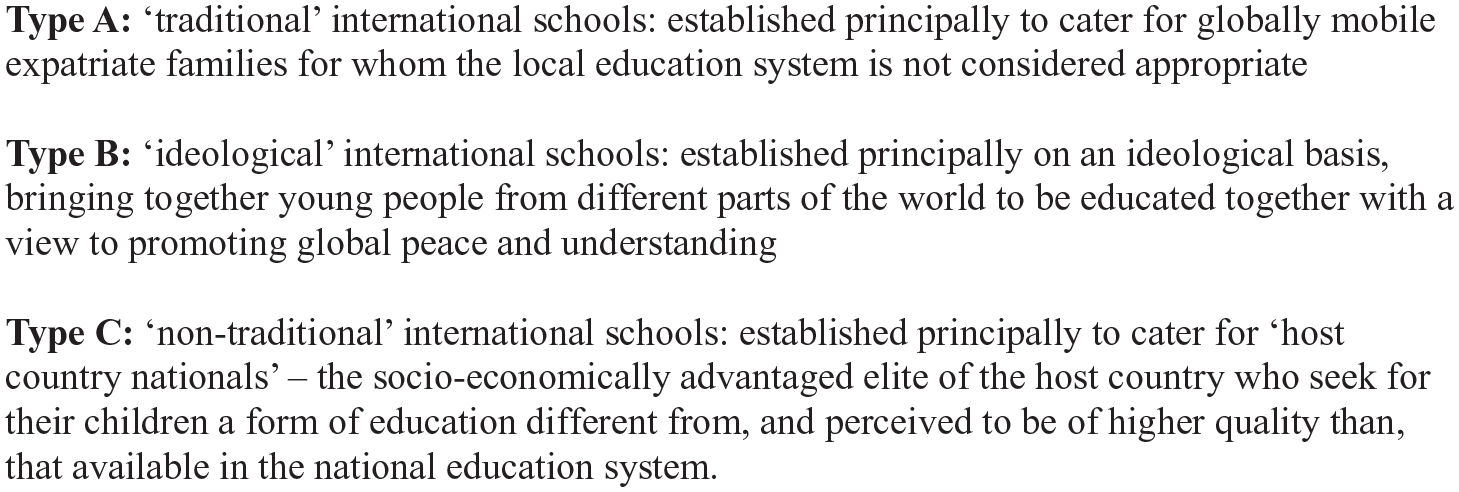
International School Typology. (Hayden and Thompson, 2013).
Type A schools are characterized as being traditional international schools that cater to globally-mobile expatriates for whom the local education system is not considered appropriate (Hayden and Thompson, 2013). For example, Type A schools would include the American School in Bilboa, a school that offers for globally-mobile expatriate children, primarily, English language instruction by American teachers certified in their home states leading to the International Baccalaureate (IB) diploma or an American high school diploma (American School of Bilboa, 2021).
Type B schools, in contrast, are more ideologically oriented, in bringing together students specifically with a view to promoting global peace and understanding. Type B schools would include, for instance, the United World Colleges (UWC).
Type C schools are the most recent additions to the field of international schooling. Type C schools may include those that fall under a number of sub-categories that include schools looking to appeal to a largely domestic, growing middle class audience (Hayden and Thompson, 2016). Type C school subcategories might include, for example, US public, charter schools experimenting with an internationally-oriented curriculum. For example, the International Charter School of Atlanta, a public (tuition-free), charter school in Atlanta, Georgia offers a hybrid curriculum including immersion language instruction and the International Baccalaureate (IB) programmes (International Charter School of Atlanta, 2021).
Hayden and Thompson (2016) suggest that one can only understand international school as an umbrella term that encompasses a number of types of institutions. Since there is no unifying accreditation or official, worldwide designation, it is impossible for one to officially proclaim, or identify, a legitimate international school (Hayden and Thompson, 2016). Scholars have little fundamental understanding of what an international school is inside the borders of the United States in any kind of generalizable sense, despite the growing interest in international education in US public and private schools (Carber, 2009; Harrison, 2015; Parker, 2011). In 2015, Harrison referred to international education in North America as an emerging community of interest. However, his brief survey of international schooling in the United States and Canada only gave us a glimpse of the landscape (Harrison, 2015). The problem here is that scholars have warned about the risk of schools being international in name only (Bunnell, 2014; Bunnell, 2019; Bunnell, 2019a; Bunnell et al, 2017; Hayden, 2011; Hill, 2000). Some schools will adopt the label ‘international’ purely for marketing purposes, while not at all providing an international education (Bunnell, et al, 2017). Stakeholders such as parents, students, and teachers should know what they are getting into when it comes to school (and employment) choice. Scholars and teachers who have a commitment to international mindedness may be disappointed with these schools and their lack of international curricula. In the United States, to date, there is no such research to allow for a classification scheme of American international schools.
Methodology
This study surveys the landscape of international schooling in the US. First, a list of the K-12 international schools inside the United States was compiled. Then, a content analysis of schools’ websites was used to collect information on the following variables: (a) type of school (public or private); (b) tuition cost; (c) curricula offerings; (d) global language offerings; (e) offerings of dual-enrollment or college credit-earning options; (f) predominant themes/content in school mission statements; (g) international school accreditations; (h) enrollment; and (i) location. The data collection occurred between June 2020 and January 2022.
Data Collection
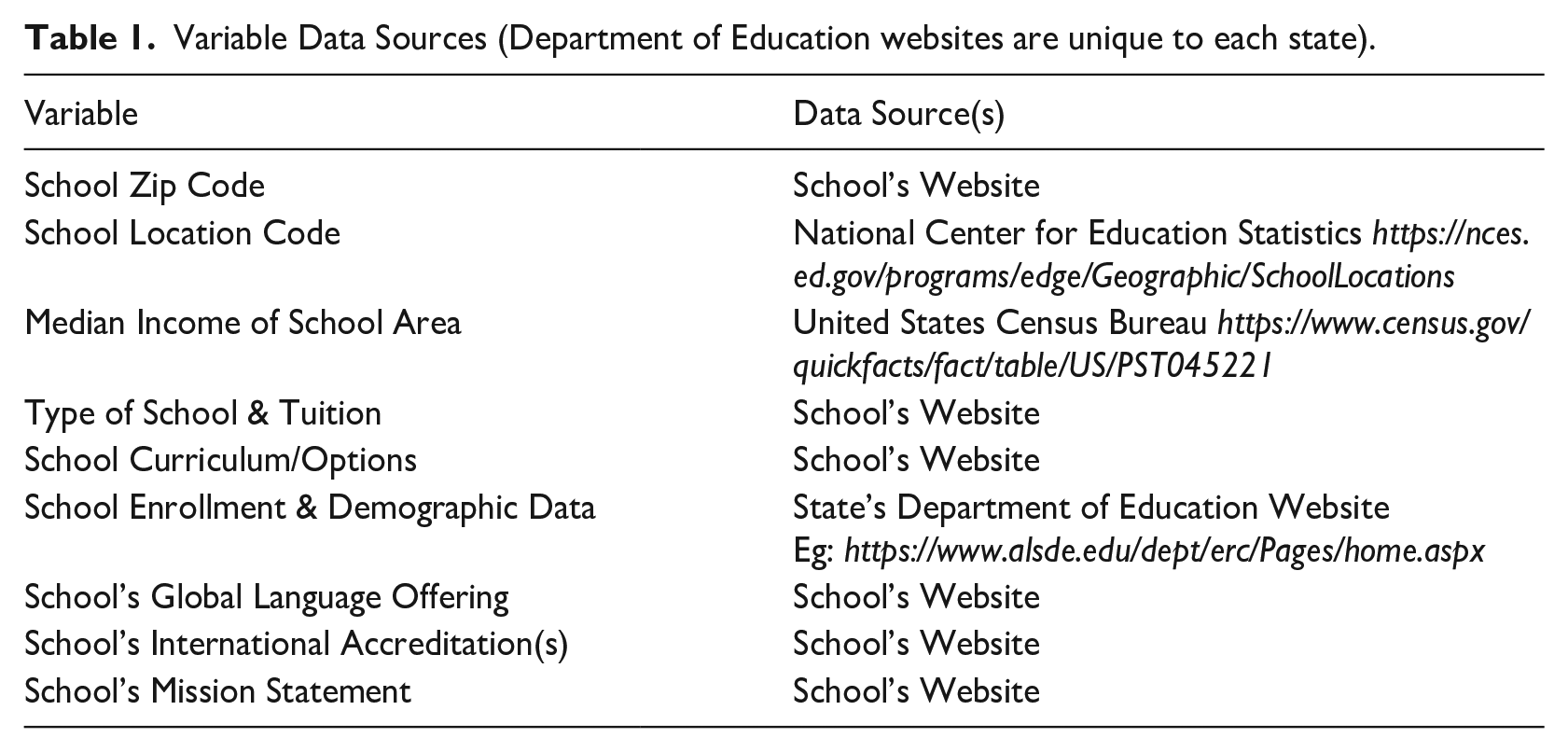
The data collection primarily revolved around publicly available school information from district- or state-level departments of education and schools’ websites. A school’s website is one mechanism schools use to share information about their operations, including curriculum and instruction, learning philosophy, and thematic guiding principles (Kahan and McKenzie, 2020; Yemini and Cohen, 2016). Likewise, websites are available at the leisure of stakeholders, giving the websites great promise for sharing the school’s goals and expectations (Kahan and McKenzie, 2020). Websites can be particularly powerful for private schools for image creation, marketing, and recruitment (Kahan and McKenzie, 2020). For research purposes in this study, schools’ websites provided publicly available information for performing a content analysis to assess the quantity and nature of international schools located inside the United States. See Table 1 for a list of data sources used for each key variable in the study.
Variable Data Sources (Department of Education websites are unique to each state).
Sample: School Selection
For the purposes of this study, international school was operationalized as any K-12 school in the United States that includes ‘international’ or ‘global’ in its name. A similar strategy was used by Carber in his seminal study of international education in US schools (2009), in using a basic web search of US schools with the words ‘international’ or ‘global’ within their names to identify twenty-six international schools (2009: 100, 109). For the present study, the school list was compiled by conducting a series of internet searches resulting in various lists of schools. These lists were then searched for schools’ names containing ‘international’ or ‘global’. When available, both public and commercial websites were used to ensure that no schools were inadvertently excluded. The following websites are among those that were used for the data collection: www.ibo.org, www.privateschoolreview.com, www.charterschoolcenter.ed.gov, https://www.cde.ca.gov/SchoolDirectory/active-or-pending-schools/2 (for California). From these websites, over 600 international schools were identified, from which examination of the schools’ websites identified a total of 595 that were open in the 2020-21 school year.
Variable Data Collection and Treatment: Content Analysis
The following data were collected from each school’s website: (a) school name, (b) city, (c) state, (d) zip code, (e) school type (public, charter, private, etc), (f) school type (coeducational, girls only, boys only), (g) tuition and fees (amount), (h) student enrollment (quantity), (i) median household income in 2019 for school’s zip code, and (j) school type (urban/rural).
In addition, the homepage and informational pages (eg: About Us, Academics, Mission Statement, Accreditation, and Admissions) for each school were examined for the following data related to international schooling: (a) curriculum type (eg IB, AP, dual-enrollment, Montessori, other, mixed), (b) mention of college (or university) prep(aratory) in mission statement, (c) mention of international mindedness, global mindedness, peace, global consciousness, social justice, or competitiveness in global marketplace in mission statement, (d) bilingual or multilingual education (languages of instruction, types of programming), and (e) international school accreditations.
The author was the single coder for the content analysis of the raw data. See Appendix A for the data collection and coding form.
Data Analysis: Tracking the Trends
In presenting the trends in the data, special emphasis is put on the following:
dominant curricular trends;
geographical distribution of schools (by state, urban/rural);
differences between traditional public schools, charter schools, and private schools;
similarities and differences in rhetoric of mission statements; and
enrollment trends (school population size, student enrollment by gender and race or ethnicity).
Quantity and Types of International Schools Identified
Each school was identified as public or private in nature. Of the 595 international schools, there were 438 public schools (73.6%) and 157 private schools (26.4%). Public schools were further divided into the following categories: traditional public, charter, magnet, or fully-online. Traditional public schools are free and open to public enrollment based on geographic restrictions. Charter schools are a type of public school that is open to public enrollment regardless of geographic restrictions. In the United States, charter schools are usually experimenting with curriculum and educational structure that varies from a traditional public school. A magnet school is a public school that draws enrollment from across the city to support a certain, focused curriculum: say, arts or STEM. As noted above, public schools make up 73.6% of all international schools identified in this study. As indicated in Table 2, public charter schools make up 30.4% of the international schools identified in this study.
International Schools by Type—Traditional or Non-Traditional.
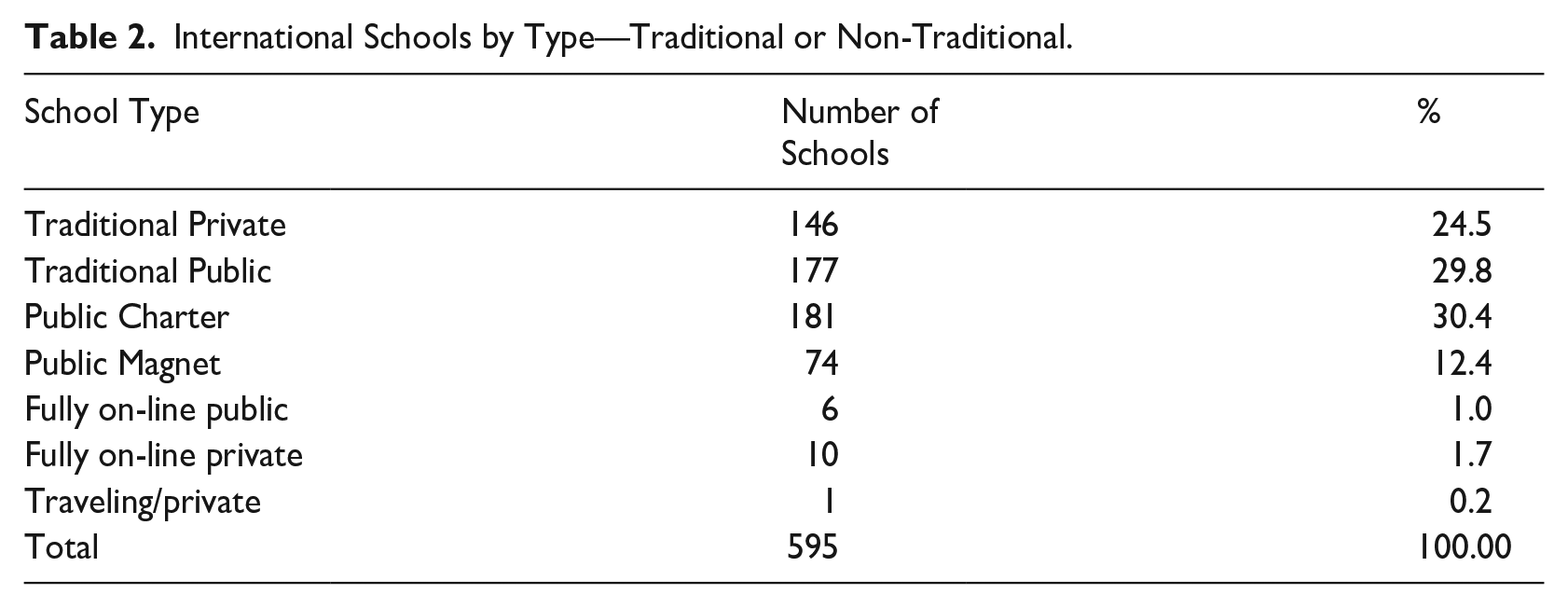
In the United States, private schools are not public and do not have open enrollment for the public. They are private businesses that restrict enrollment and charge tuition. As noted above, private schools make up 26.4% of all international schools identified in this study. Private schools were further divided into one of the following categories: traditional private, fully-online, or traveling (ie a mobile school that travels with working, eg carnival and fair, families). As indicated in Table 2, traditional private schools make up 24.5% of all international schools identified in this study.
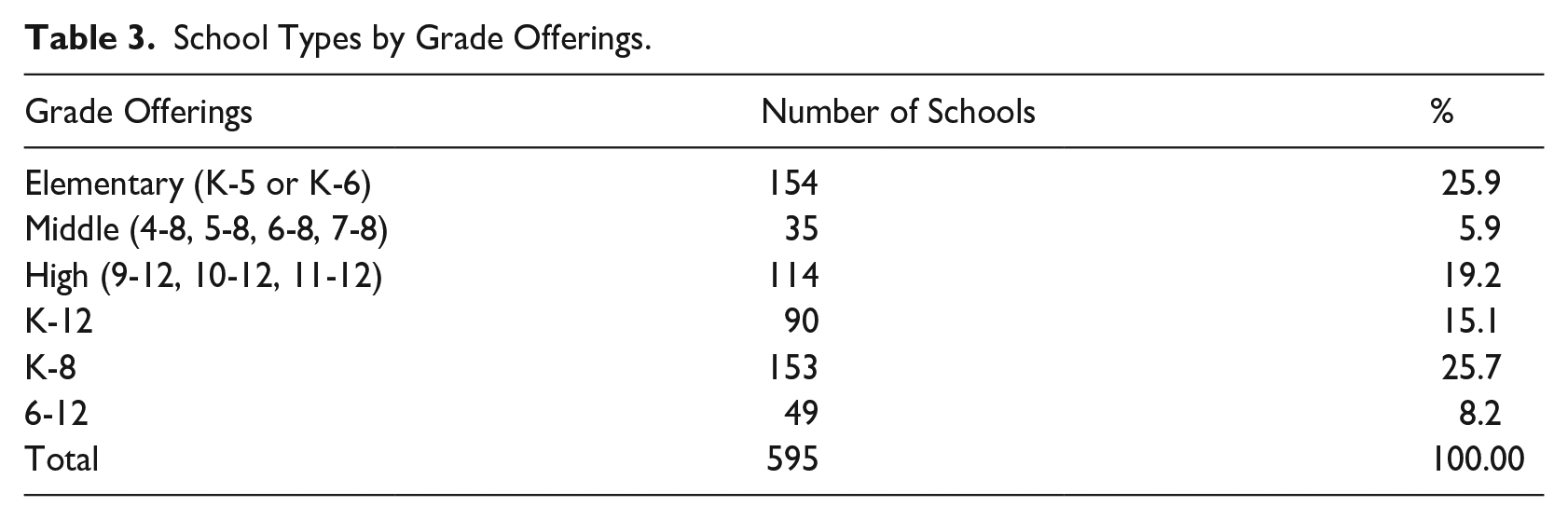
Next, each school of the 595 was identified based on the grades it enrolls. The schools fell into one of six categories: elementary, middle, high, K-12, K-8, or 6-12. These designations were based on the 2020-2021 school year. Many schools’ websites acknowledged planning to expand their programming to additional grades (eg: opportunities for parents to express interest in future enrollment), whereas others did not. Table 3 indicates the number of schools falling into each of the six categories.
School Types by Grade Offerings.
International School Tuition
Next, an effort was made to gauge whether or not the international schools were charging tuition and at what rate. Public schools in the United States, including traditional, charter, magnet, and fully-online, do not charge tuition, though they are legally entitled to charge nominal fees. These fees (eg expenses related to clubs or sports participation) are not accounted for in this study. Private schools in the United States, like elsewhere in the world, do regularly charge tuition. Of the 595 schools, 157 were identified as charging tuition, which amounts to all of the private schools. Of the private schools that charge tuition, ninety-six schools made the tuition publicly available on the school’s website. The schools’ tuition costs ranged from $5,000 to $65,000 per year. Of the ninety-six schools reporting tuition amounts on the school’s website, twenty-six schools charged between $11,000 and $20,000 each year. Thirty of the ninety-six schools charged between $21,000 and $30,000 per year.
International School Curricula and International School Accreditations
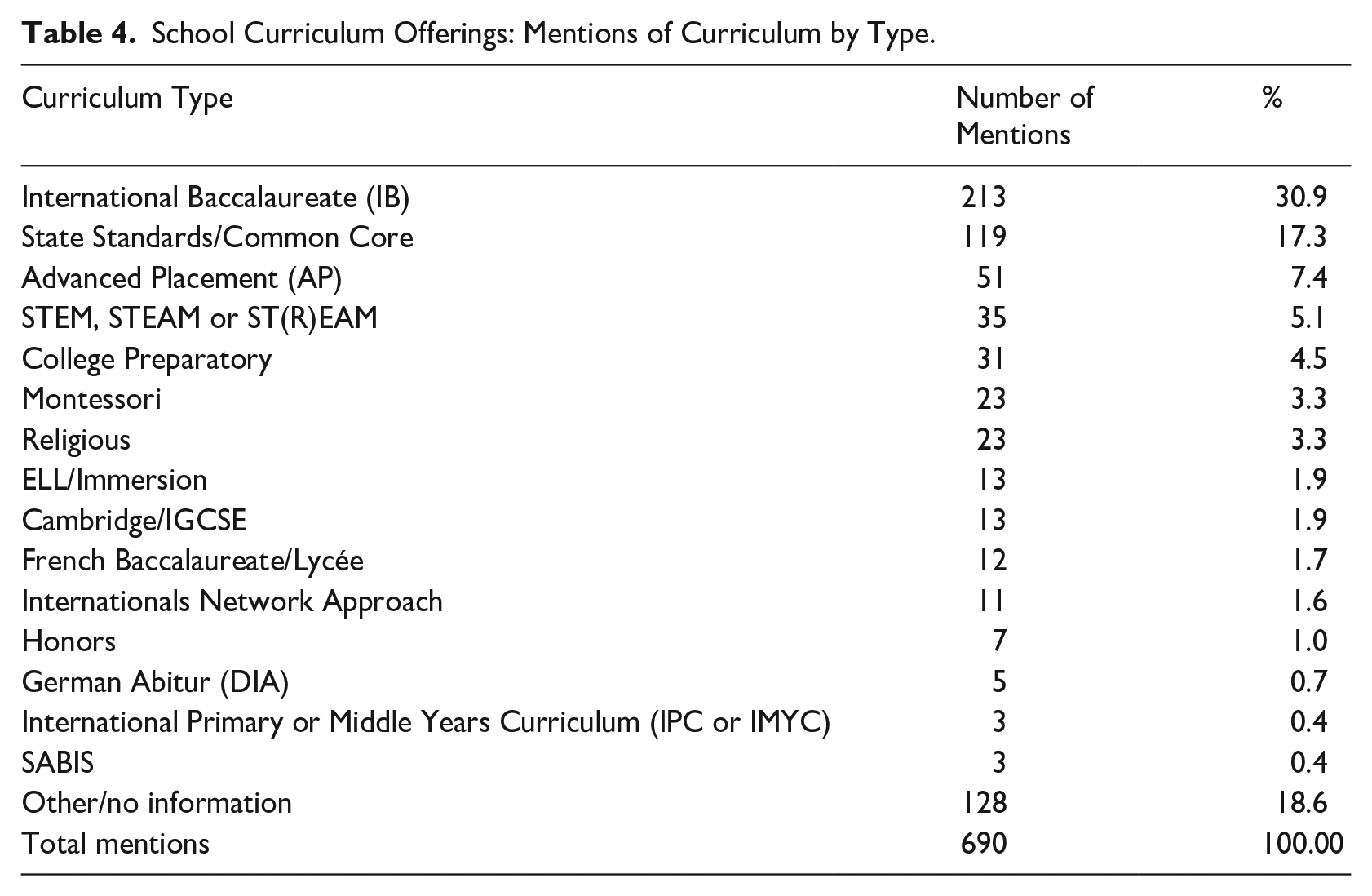
In an effort to determine the dominant curricula adopted by international schools in the United States, the data collection included documenting each school’s listed curriculum. The most popular and common curricula employed by international schools around the world were used as a benchmark for collecting data for schools inside the United States. One or more of the International Baccalaureate (IB) programmes (Primary Years Programme, Middle Years Programme, Diploma Programme, Career-related Programme) was by far the most commonly adopted curriculum among international schools in the United States. The second most frequent curriculum type adopted by international schools in the United States was Common Core or those aligning with individual state standards (eg: California Content Standards). In the United States, Common Core State Standards refers to a set of federally designated, uniform academic standards for K-12 math and English language arts. By 2014, all but five US states had adopted the Common Core State Standards (Bidwell, 2014). One hundred school websites mentioned two or more curriculum types available at the school. Table 4 details the number of mentions of each type of curriculum across the 595 school websites. Curriculum types with two or fewer mentions were counted in the ‘Other/no information’ category.
School Curriculum Offerings: Mentions of Curriculum by Type.
In addition to noting curricula mentions on each school website, it was noted whether or not the school website described opportunities for students to pursue dual enrollment or university course credit while enrolled in the international school. Forty-two school websites (approximately 7%) mentioned dual enrollment or university course credit opportunities for students.
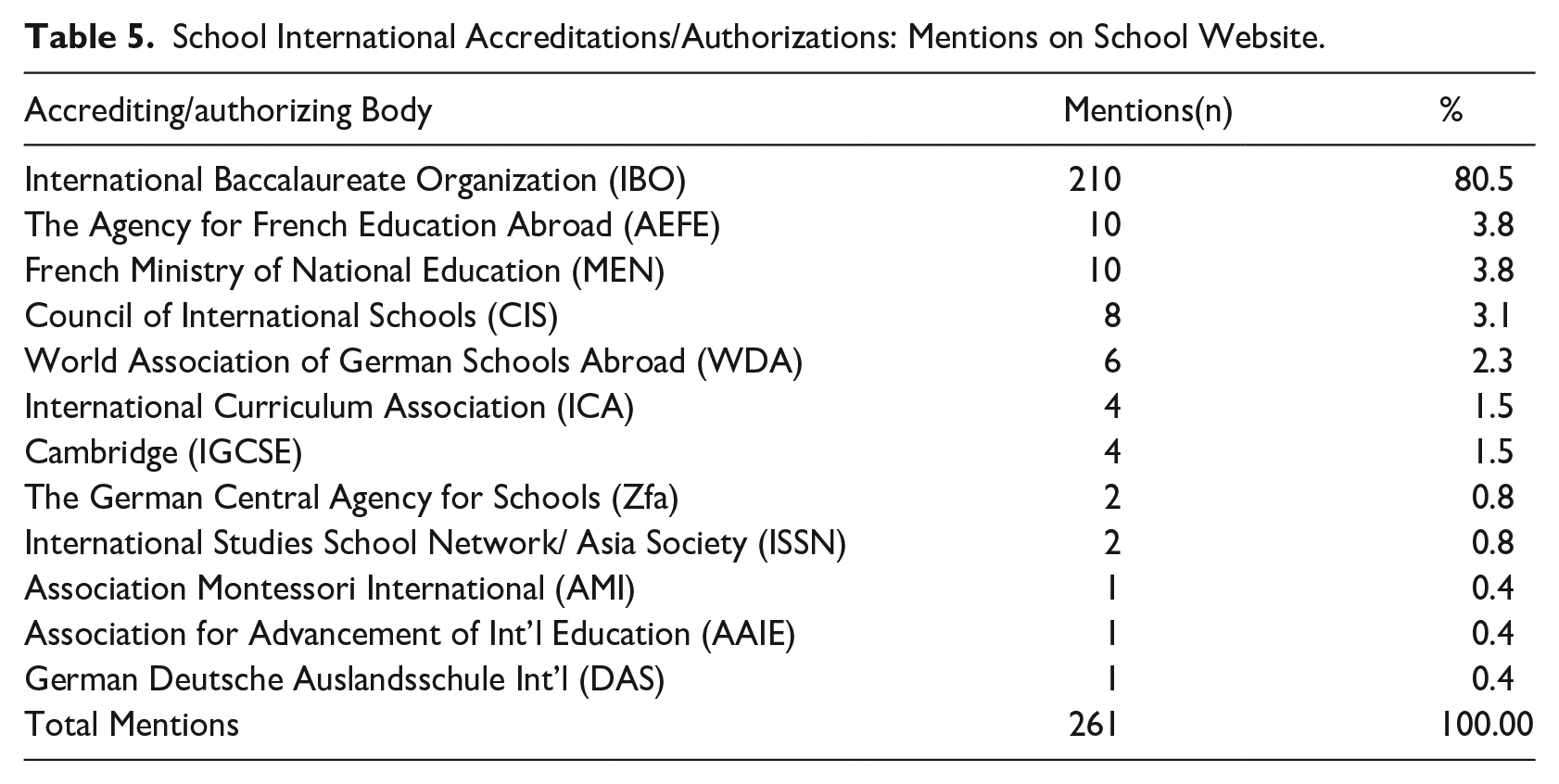
School websites were examined to note mentions of international school accreditations/ authorizations by the most common international school accreditation/authorisation bodies. At least one or more international school accreditations/authorizations were listed on the websites of 235 schools, while 360 schools did not mention international accreditations or authorizations. By far, the most common international school accreditation/authorisation mentioned on school websites was authorisation by the International Baccalaureate Organization (IBO). Table 5 details the number of accreditation/authorization body mentions across the 595 school websites.
School International Accreditations/Authorizations: Mentions on School Website.
Global Language Offerings
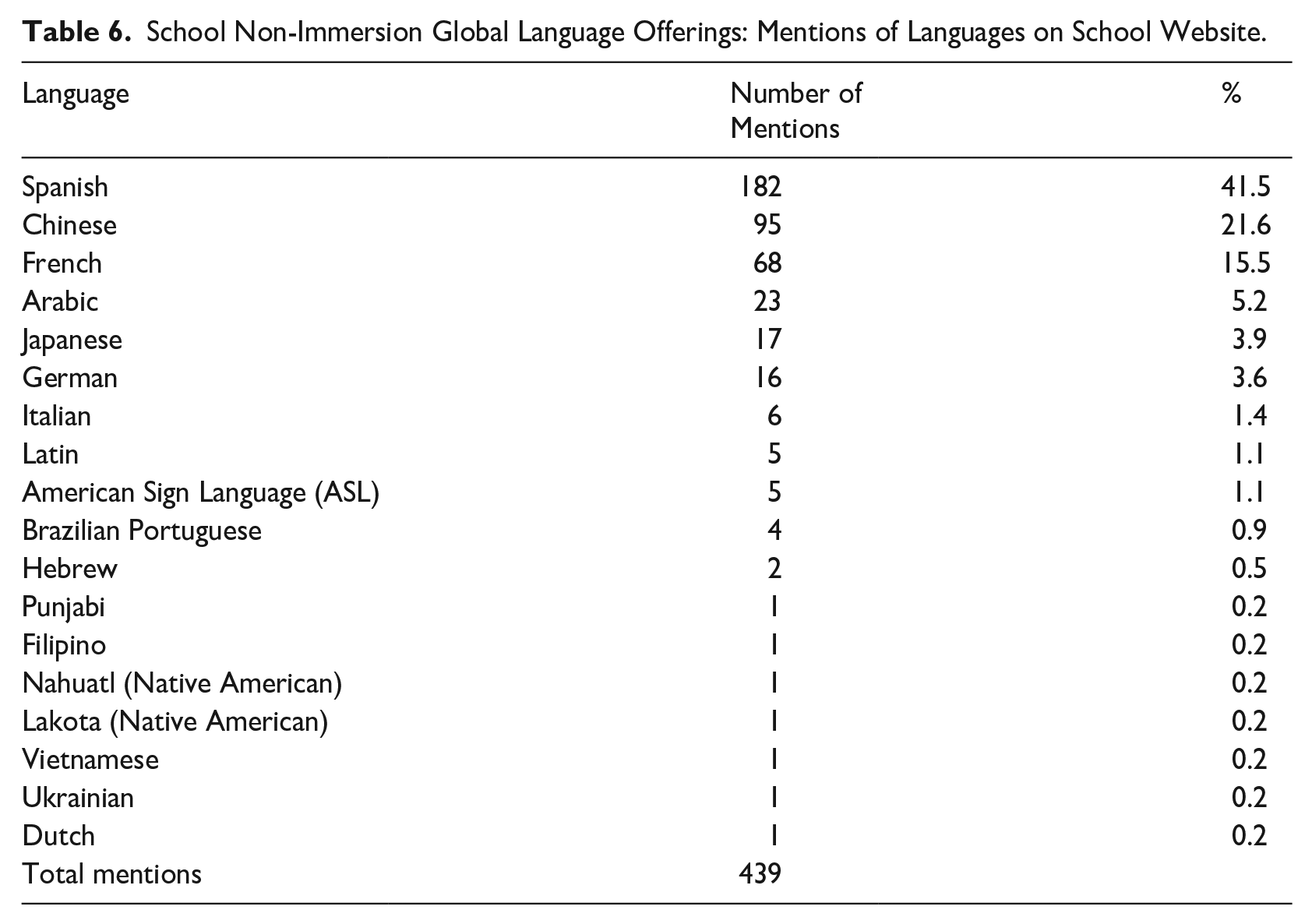
As part of the formal curriculum, many of the international schools offer global language courses (ie courses where students learn a language other than English). School websites were examined to determine which global languages were available at each school. While 119 schools listed two or more global language offerings, 321 schools either did not list the global language offerings or did not offer them at all. Of the 274 school websites that did mention the language(s) offered at each school, it was evident that 21 different languages are taught in international schools across the United States. By far the most commonly-listed language was Spanish, with 182 mentions which accounts for 41.5% of the total mentions of language offerings. Table 6 indicates the number of mentions of each global language offering across the 595 school websites. Some schools listed one or more global language offerings while 274 schools mentioned one or more language: ie 321 schools listed no specific global language offerings on their website.
School Non-Immersion Global Language Offerings: Mentions of Languages on School Website.
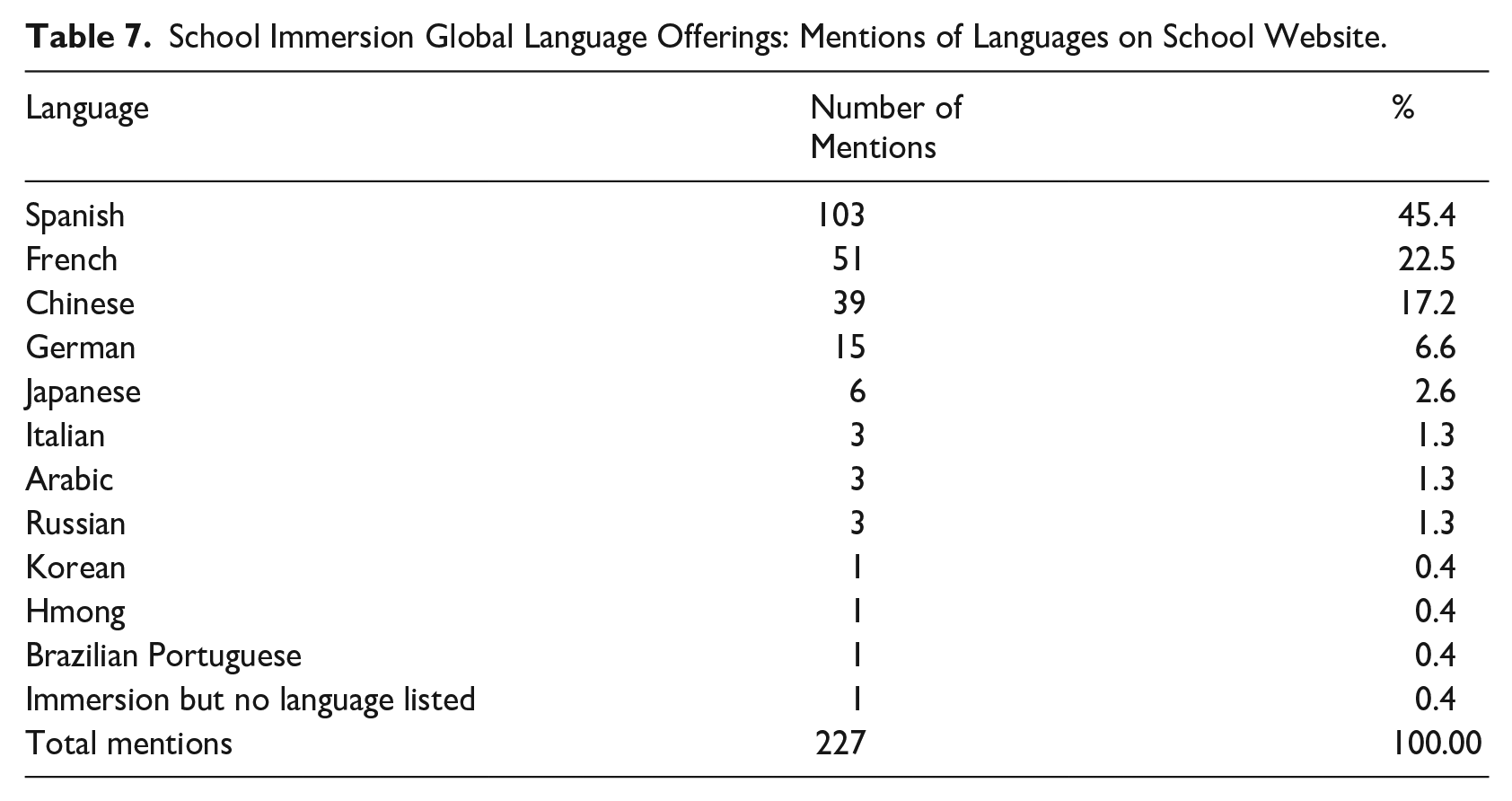
While some schools offer only global language courses, some international schools offer language immersion programming in addition to their stated curriculum. For the purposes of this study, ‘immersion’ is defined as where 50% or more of the instructional time is in a language other than English, and ‘non-immersion’ is defined as programming offered where 49% or less of the instructional time is in the global language.
Of the 595 total international schools, 147 schools reported having immersion global language programming. The number of schools with two or more global language immersion tracks offered was 46. By far the most oft-mentioned immersion language track was Spanish, which accounts for 45.4% of the mentions on the school websites. Table 8 indicates the number of mentions of global language immersion programs across the 595 school websites.
School Immersion Global Language Offerings: Mentions of Languages on School Website.
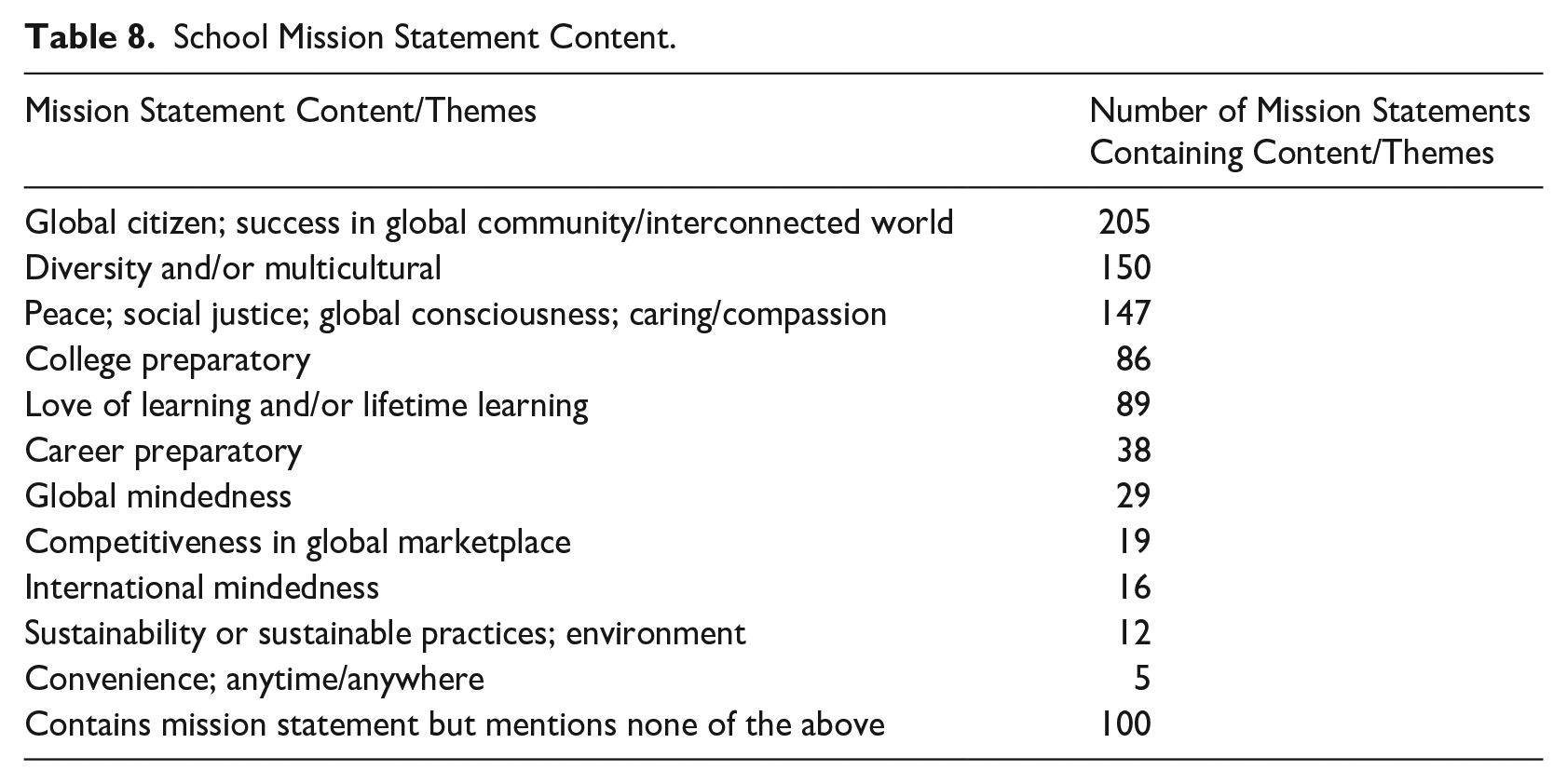
School Mission Statement Content.
International School Mission Statements
A content analysis of schools’ mission statements, when available, was conducted. Of the 595 international schools identified, 527 included mission statements on their websites. The mission statements included several common themes. All of these themes are identified in Table 8, where each mention of the theme is recorded. The predominant themes in the schools’ mission statements were related to global citizenship and diversity/multiculturalism. Over 100 of the school mission statements included references to global languages or multilingualism. Only sixteen schools mentioned ‘international mindedness’ in their mission statements, while twenty-nine mentioned ‘global mindedness’ in their mission statements. Table 8 displays the thematic content trends in the mission statements. Mission statements were not found for 68 schools.
International School Enrollment
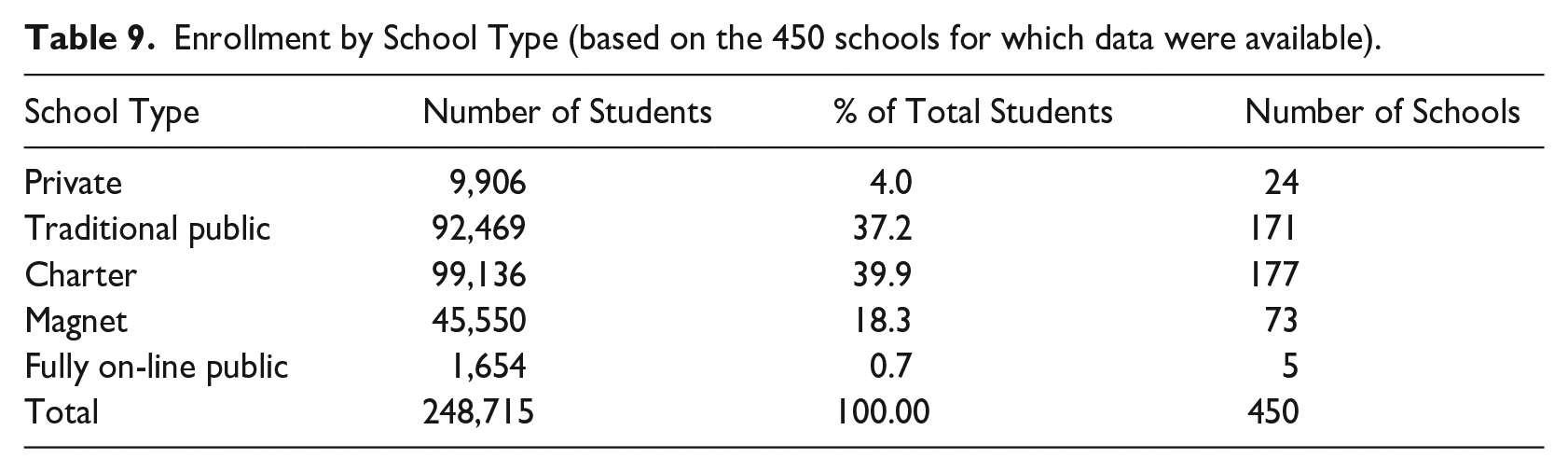
An effort was made to calculate the total enrollment of the 595 international schools identified in the US. Because most private schools do not make their enrollment data public, the enrollment figures presented below largely represent the public schools. Overall enrollment data were available for 450 of the 595 total schools for the 2019-2020 school year. A total of 248,715 students were enrolled at 450 international schools in the United States in the 2019-2020 school year. The smallest school enrolled ten students while the largest school enrolled 2,563 students. The median enrollment for international schools was 447 students.
Due to data availability, the enrollment data presented here largely represent the public schools in the population. When further categorized by school type, it is evident that the majority of schoolchildren enrolled in international schools for which data are available are enrolled in traditional public or public charter schools. Table 9 further delineates the enrollment data to show enrollments based on type of school.
Enrollment by School Type (based on the 450 schools for which data were available).
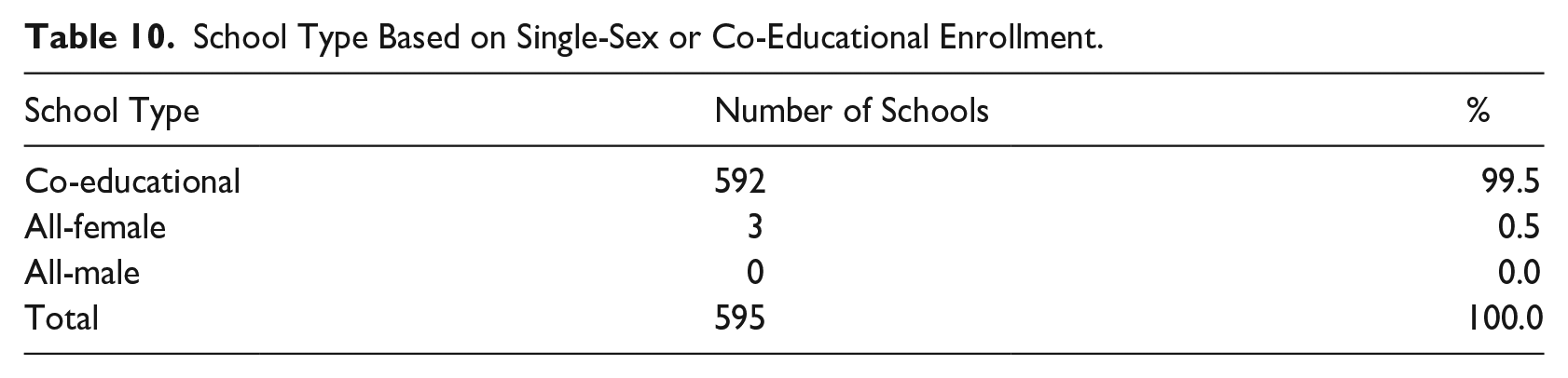
Less than one percent of these international schools are single-sex schools. Three of the 595 schools enroll only girls. There were no single-sex schools for boys in the population and the remaining 592 schools were identified as co-educational. Table 10 indicates the number of co-educational and single-sex international schools.
School Type Based on Single-Sex or Co-Educational Enrollment.
School Enrollments Based on Geographic Locations and Median Income
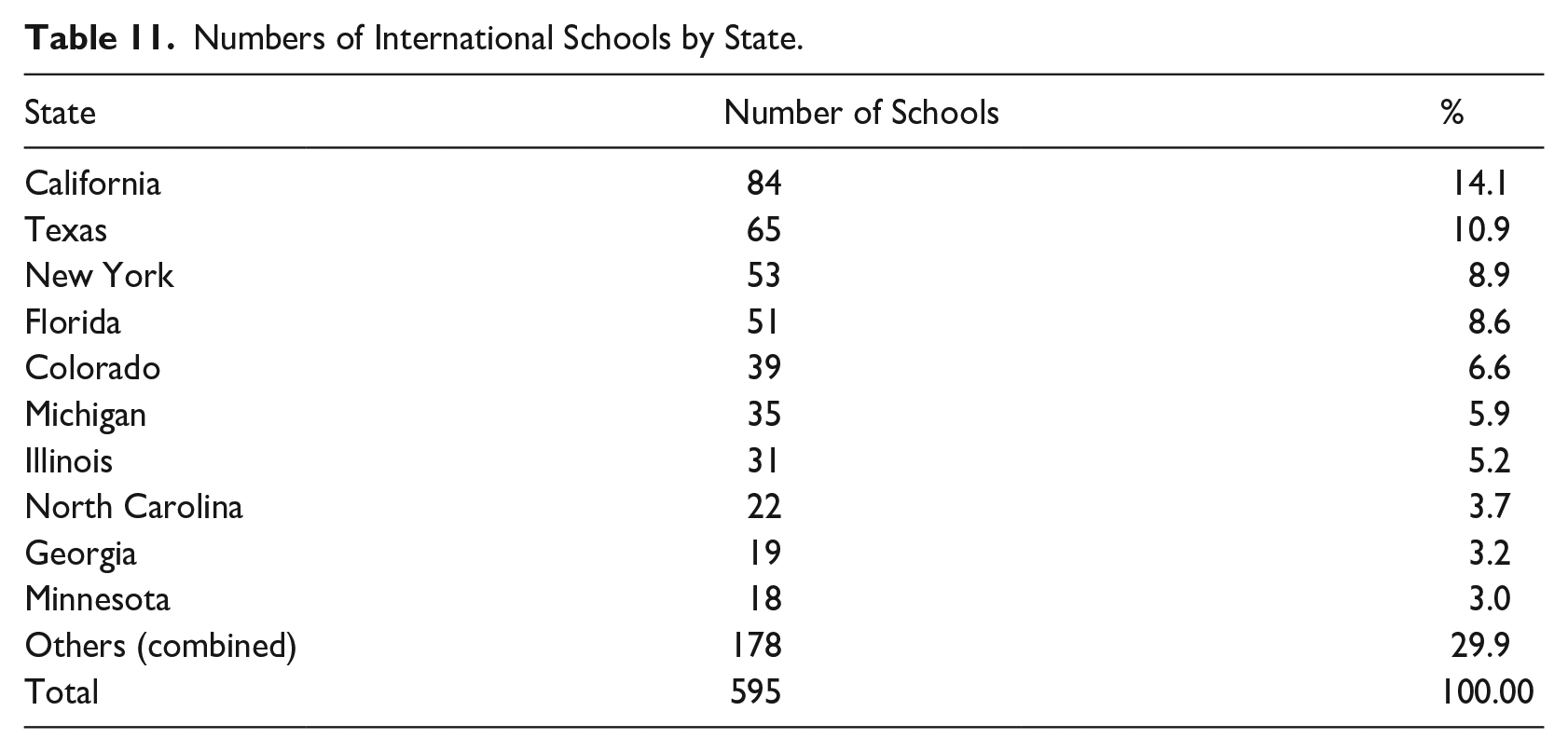
The population of schools in this study represents all fifty US states and the District of Columbia (DC) The states found to have the largest number of international schools in the United States are also the most heavily populated states in the United States. The state with the most international schools was California, followed by Texas and New York. Twelve states had no international schools: Alaska, Delaware, Iowa, Maine, Mississippi, Nebraska, New Hampshire, North Dakota, South Dakota, Vermont, West Virginia, and Wyoming. Table 11 describes these data in further detail.
Numbers of International Schools by State.
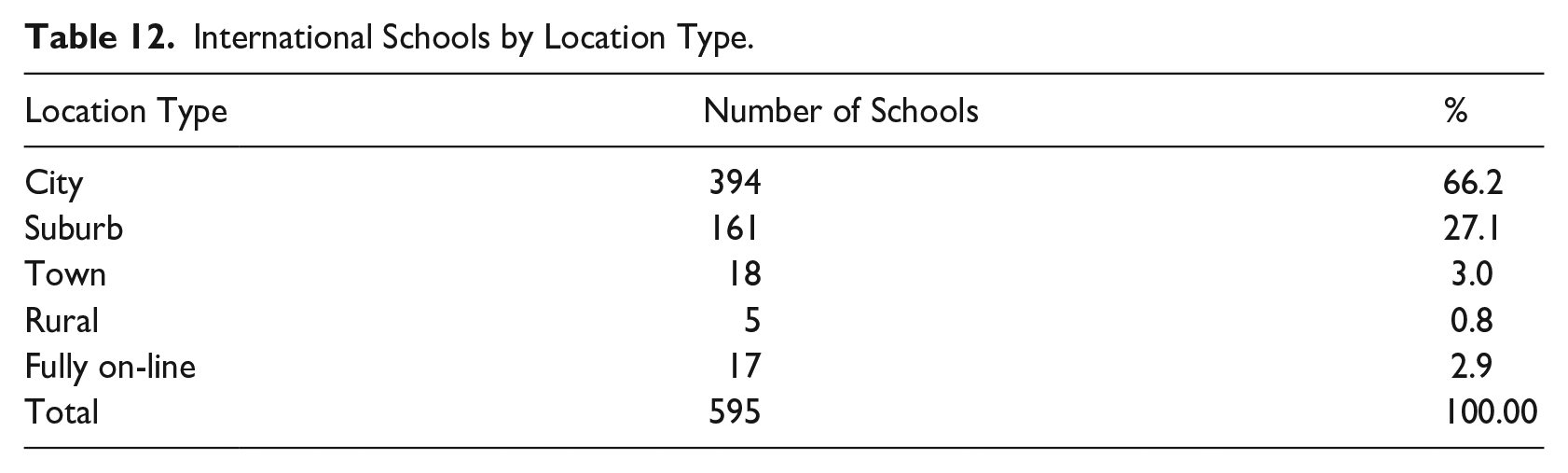
In addition to documenting the location of the international school, effort was made to document the type of location of each school. Most of the 595 international schools in the data set are located in cities or suburban areas, while only five of the 595 schools were located in rural areas. Table 12 describes the distribution of the 595 schools across five categories: city (urban), suburb, town, rural, online/remote.
International Schools by Location Type.
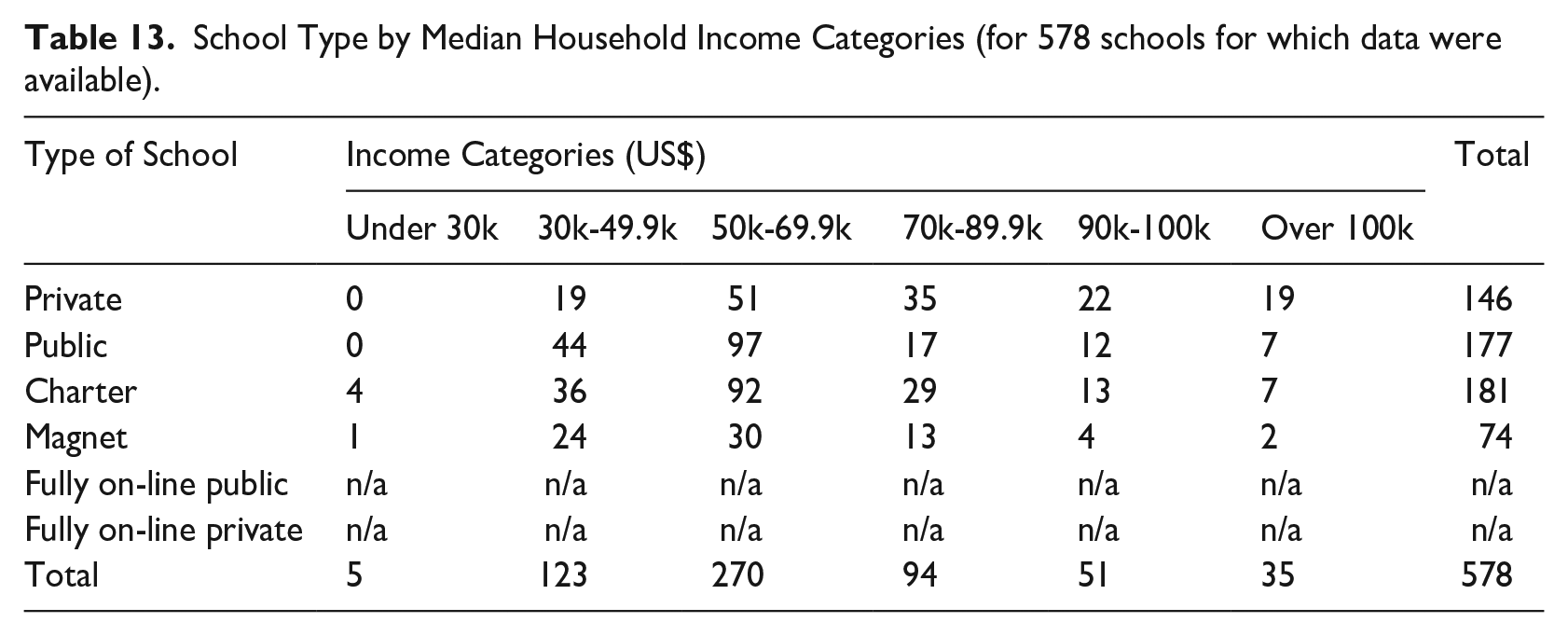
The median household income of the area in which the school is located was determined by the school’s zip code and recorded in the data set. Of the 578 schools for which income data were available, 270 are located in areas where the median household income ranges from $50,000 to $69,999. In 2019, the median household income in the US was $65,712 (US Census Bureau). Table 13 details the number of schools fitting into each income bracket by type of school.
School Type by Median Household Income Categories (for 578 schools for which data were available).
Discussion and Implications: The Landscape of International Schooling in the United States
Five main findings emerged from analysis of the data gathered, as follows.
The Industry is Booming around the United States
The research identifies 595 international schools (in the sense that they include the term international or global in their title) across the United States that enroll hundreds of thousands of schoolchildren. There is no question that the industry of international schooling is burgeoning in the United States, if not flourishing. As a reminder, Carber’s (2009) study identified only twenty six international schools in the US at that time. The market for international schools is particularly robust in highly populated states such as California and New York. Most of the international schools are located in the urban or suburban areas of the country. A majority of the international schools identified in this study are public schools, 73.6%, meaning they are free to attend.
Diversity of American Schools Calls for a Revision of the Classic International School Typology
Hayden and Thompson’s (2013) scheme for categorizing international schools (see Figure 1) suggested there were three types of international schools across the globe: Type A, Type B, and Type C. The international school market in the United States suggests that there are at least three additional types of such school in the United States, which I will describe as Type D, Type E and Type F (see Figure 2).
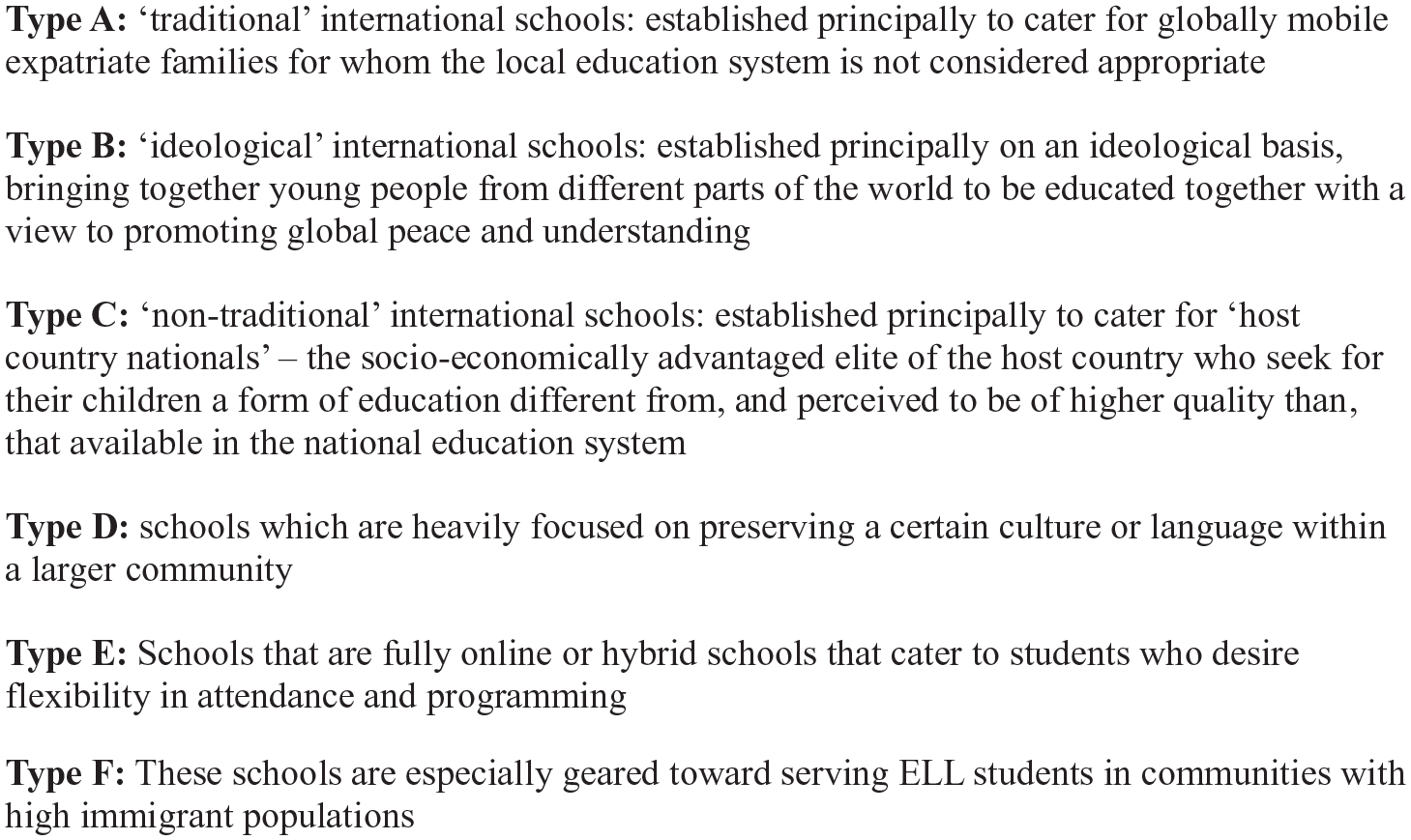
International School Typology Adapted for the US Market (adapted, in part, from Hayden & Thompson, 2013)
Type D: Culture or Language Preserving Schools
Based on the 595 schools identified in this study, some of the schools in the United States are heavily focused on preserving a culture or language within a larger community. One such example is Anahuacalmecac International University Preparatory of North America. This school, located in California, is a public charter school and an IB school that emphasizes indigenous (Native American) and Chicano (Mexican American) cultures as well as the study of the Nahuatl language (Anahuacalmecac International University Preparatory of North America, 2022).
Type E: Flexible Programming Schools
Another type of school that deserves recognition in the landscape of international schooling in the United States is the school that is designed to be fully-online or hybrid in catering to students who desire flexibility in attendance and programming. One such example is The Dwight Global Online School based out of New York. A private school, the programming offered fits the unique needs of each student including fully-online options, hybrid, and residential-based learning (Dwight School: IB World School, 2022). According to the school’s website, the school is committed ‘to being a school without limitations designed to eliminate the need to make binary choices (online/in person or day/boarding) that have historically dominated the educational landscape.’ (Dwight School: IB World School, 2022). Although this particular school is private, there are public schools offering similar levels of flexibility in programming. These schools are referred to here as Type E schools.
Type F: Schools Geared Toward Helping English Language Learners in Immigrant Communities
The additional category of schools found in the United States is schools especially geared toward serving English language learning (ELL) students in communities with high immigrant populations. One such example is The International High School at Prospect Heights in Brooklyn, New York. The school’s website describes its history as follows: The International High School @ Prospect Heights opened its doors in September of 2004 to serve a multilingual student population of recent immigrants by fostering their academic, cognitive, social, cultural, and emotional growth. Our students become proficient at understanding, speaking, reading, and writing in English through language-rich, student-centered learning experiences inside and outside of school. (International School @ Prospect Heights, 2022)
These schools, referred to here as Type F schools, are usually found in very large cities in the most heavily populated states.
International Schools are Not Available in Many American Communities
International schools are not available across all communities in the United States. While most of the 50 states and Washington, DC have at least one international school, twelve states have no schools identified as international schools: Alaska, Delaware, Iowa, Maine, Mississippi, Nebraska, New Hampshire, North Dakota, South Dakota, Vermont, West Virginia, and Wyoming. Additionally, there is a lack of international schools in rural areas. Only 23 of the 595 schools are located in towns or rural areas across the United States. Although there are some international schools in low-income neighborhoods, international schools are more likely to be found in neighborhoods that hover around the median household income in the United States (See Table 13).
International Schools in the United States Emphasize Global Language Acquisition
This research reveals that, at least in the aggregate, international schools in the United States have abundant global language programming. Schools that identified global language offerings on their websites amounted to 274 out of 595. The number of languages identified was twenty-one, ranging from Spanish and Chinese as the most common, to more uncommon offerings including Hmong, Brazilian Portuguese, and Korean (See Tables 6 and 7).
Stakeholders Beware!
As noted above in the literature review, scholars have voiced concerns about the varying rationales for schools employing the ‘international’ label (Bunnell, 2014; Bunnell, 2019; Bunnell, 2019a; Bunnell, et al, 2017; Hayden, 2011; Hill, 2000). The wide variety of international schools identified in this study suggests that potential stakeholders should practice due diligence when investigating a school. Parents will want to know if the curriculum is suited for their children before enrolling, while prospective teachers and school leaders will want to investigate the school’s goodness of fit. Caveat emptor!
Stereotypes Broken Down
The results of this study challenge many common stereotypes associated with international schools and international school students. Contrary to the stereotype that international schools are beacons only for children of the rich and well-connected, the majority of international school students in the United States do not come from wealthy households (see Table 13). Perhaps surprisingly, Spanish is the most widely offered language in the international schools in this study, even though Spanish is not typically a language considered to be associated with social mobility or exclusivity in the United States (see Table 6). It is sometimes argued that international schools are expensive, including those offering IB programmes. While this may be true outside of the United States, this study reveals that the majority of international schools in the United States, including those offering one or more of the IB programmes, are free and open to public enrollment (see Tables 2, 4, and 5).
Limitations
The study has limitations. One limitation is that the inclusion criteria for identifying international schools (the words ‘international’ or ‘global’ in the school’s name) may have inadvertently excluded some schools that are considered international schools or which might claim to be international in nature. The study may therefore under-count rather than over-count the number of international schools. Another limitation to the study is that research was limited due to the ongoing Covid-19 environment at the time. The global pandemic functionally prohibited access to school campuses for observation. A final limitation is the study’s timeline. Because of the volatile and competitive nature of the American K-12 market, it is possible that some schools may have gone out of business or changed their names and curriculum goals since early 2022.
Future Research
Recommendations for future research include the following:
(1) A possible avenue for future research is to replicate and extend the study. It would be quite interesting to see if there are more international schools in 2025 or later, and which of the identified schools in this study’s data set have either 1) closed or 2) taken ‘international’ or ‘global’ out of their names. A particularly fruitful route may be to interview school leaders as to the decision-making behind those changes.
(2) Another possible extension of the research is to assess the appropriateness of the international school typology adapted for the US market (see Figure 2) to the global landscape. Is it the case that the international landscape is diversifying in terms of different types of schools?
(3) A few states have charter school districts in which multiple international schools function under the same umbrella (eg International Leadership of Texas schools). To some degree, these charter school districts function as the private school conglomerates increasingly seen outside the United States (eg Beaconhouse or Nord Anglia). Surely, these entities are worthy of future study.
(4) The data related to accrediting/authorizing bodies offers exciting possibilities for future research. The possibilities for documentary research based on accreditation reports would make an interesting extension to the research and offer even more opportunities for exploratory work.
Conclusion
There is a robust international school marketplace in the United States. The study identified 595 US-located international schools and revealed the enrollment of hundreds of thousands of schoolchildren at these schools. Time and further research will tell if the industry is growing in the post-Covid-19 era. Further, the research provides a snapshot of how international schools in the United States both fit into, and serve to extend, the typology of international schools found around the world.
Footnotes
Appendix A: Codebook and Scheme
Var. 1. ID Number
Var. 2. School Name
Var. 3. City
Var. 4. State
Var. 5. Zip
Var. 6 Loc Code:
Codes: 11) city (large); 12) city (midsize); 13) city (small); 21) suburb (large); 22) suburb (midsize); 23) suburb (small); 31) town (fringe); 32) town (distant); 33) town (remote);41) rural (fringe); 42) rural (distant); 43) rural (remote); 222 (traveling=Conklin 159); .=missing/other
Var. 7. Median income of zip code (amount in dollars)
Var. 8. Type of School (Grades):
Codes: 1) Elem (K-5 or K-6); 2) Middle (4-8; 5-8;6-8;7-8); 3) High (9-10;9-11;9-12) 4) K-12; 5) K-8 or 9; 6) 6-12; 7-12; 8-12
Var. 9. Type of School (Private, Public, Charter, etc):
Codes: 1) traditional private; 2) traditional public 3) public charter 4) public magnet 5) fully-online public 6) fully-online private; 222) traveling (=Conklin 159 (in Florida)).
Var. 10. Type of School (Coed, Girls, Boys):
Codes: 1) coed; 2) boys; 3) girls
Var. 11. Curriculum (a):
Codes: (222) Other; 1) IB; 2) AP; 3) Montessori; 5) Reggio Emilia Approach; 6) Reference to Common Core and/or state standards; 8) CEFR; 9) Reference to Honors curr.; 41) Cambridge international curr. (eg IGCSE); 42) SABIS; 43) ACTFL; 44) German International Abitur (DIA); 46) French Baccalauréat (Lycée); 47) STEAM or STREAM; 48) AVID; 49) Asia Society’s International Studies Schools Network (ISSN) (Sometimes referenced as Global Education); 71) college or university preparatory; 72) Religious (Christian); 73) Religious (Jewish); 74) Religious (Islamic); 75) STEM; 76) Internationals Network Approach (NY); 77) Other: Geared to ELLs and/or immigrant children {76 and 77 can be combined}; 78) Intl Prim Curr (IPC)& IMYC (intl middle years), etc; 79) Intellectual Hearts model; 401) APEX (digital curr.); 403) Global Studies Curr. Out of Penn State; 405) fully on-line/full-time; 406) Waldorf.
Note. All other codes are a combination of the previously-listed codes. Eg: A code of (16) is 1 and 6, or IB and Reference to Common Core and/or state standards.
Var. 12. Dual enrollment opportunities?
Codes: 1) Yes; 2) NA or No
Var.13. Uniforms?:
Codes: 1) Yes; 2) No or NA or missing
Var. 14. Tuition?:
Codes: 0) (zero) or No; (2) Amount in Ks (eg: 42,000= 42K= 42) (222) Yes, but no information provided. Note. Highest amount in range is recorded, rounded to nearest thousand.
Var. 15. Total Student Enrollment (#)
Var. 16. Student Enrollment (by gender where available) Male students (#):
Var. 17. Student Enrollment (by gender where available) Female students (#):
Var. 18. Student demographics (by race/ethnicity where available): Nat. Am./AK Nat. (#):
Var. 19. Student demographics (by race/ethnicity where available): Asian (#):
Var. 20. Student demographics (by race/ethnicity where available): AA/Black (#):
Var. 21. Student demographics (by race/ethnicity where available): Hispanic/Latino (#):
Var. 22. Student demographics (by race/ethnicity where available): Nat. Haw/PI (#):
Var. 23. Student demographics (by race/ethnicity where available): White (#):
Var. 24. Student demographics (by race/ethnicity where available): Multi/Two or more (#):
Var. 25. Majority race at the school if there is one (50%+1 or more):
Codes: 1) AA/Black; 2) Hispanic/Lat.; 3) Asian; 4) Nat.Am/AK; 5) Nat. Haw./PI; 6) White;
7) NONE
Var. 26. Bilingual or multilingual IMMERSION?:
Codes: 1) Yes 2) No/NA
Var.27. Immersion language options (English and ______)
Codes: 1) NA; 2) Spanish 3) French 5) German 6) Mandarin/Chinese 8) Italian 9) Japanese 41) Korean 42) Arabic 43) Hebrew 44) Hmong 45) Filipino 46) Nahuatl (indigenous language North America) 47) Latin 48) Punjabi 49) Russian 71) American Sign Language (ASL) 72) Lakota (indigenous language North America) 73) (Brazilian) Portuguese 77) Vietnamese 78) Ukrainian 444) Dutch. Note. All other codes are a combination of the previously-listed codes. Eg: A code of (25) is 2 and 5, or Spanish and German.
Var. 28. Non-immersion language options:
1) NA; 2) Spanish 3) French 5) German 6) Mandarin/Chinese 8) Italian 9) Japanese 41) Korean 42) Arabic 43) Hebrew 44) Hmong 45) Filipino 46) Nahuatl (indigenous language North America) 47) Latin 48) Punjabi 49) Russian 71) American Sign Language (ASL) 72) Lakota (indigenous language North America) 73) (Brazilian) Portuguese 77) Vietnamese 78) Ukrainian 444) Dutch. Note. All other codes are a combination of the previously-listed codes. Eg: A code of (25) is 2 and 5, or Spanish and German.
Var. 29. International (only) educational accreditations/authorizations (if listed):
Codes: 1) None Noted/Listed; 222) accreditation mentioned but not named; 2) International Baccalaureate Organization (IBO); 3) Council of International Schools (CIS); 5) European Council of International Schools (ECIS); 6)The Agency for French Education Abroad (AEFE); 8) Instituto Cervantes; 9) International Primary Years (IPC), etc; 41) Cambridge; 42) German Zfa; 43) Association Montessori International (AMI); 44) German WDA; 45) French Ministry of Education; 46) Association for Advancement of International Education (AAIE); 49) ISSN (Asia Society) 77) German DAS
Var. 30. Mentions of key terms in mission statement:
Codes: 1) ‘international mindedness’; 2) ‘global mindedness’; 3) ‘peace’ or ‘social justice’ or ‘global consciousness’ or caring/compassionate; 4) ‘competitiveness in global marketplace’; 5) ‘college preparatory’; 6) ‘career preparatory’; 7) ‘sustainability’ or ‘sustainable <practices>‘, environment; 8) diversity and or multicultural; 9) no mission statement found; 10) love of learning/lifetime learn*; 222)convenience anytime/anywhere; 223) multilingual; 444) global citizen; responsible citizen; success in global community/interconnected world (non-financial); 555) mission but none of the above.
Acknowledgements
Professionally, I would like to thank Dr Kelli Bippert, Dr Melanie McMahon, and Dr Kurt Jefferson for their ongoing support of my research. Personally, I would like to thank Patti and Gaby Lazenby for their unconditional support throughout the past decade.
Declaration of conflicting interests
The author declared no potential conflicts of interest with respect to the research, authorship, and/or publication of this article.
Funding
The author received no financial support for the research, authorship, and/or publication of this article.
