






Abstract
Non-axisymmetric geometries, mainly elliptic and rectangular, have been proposed for the reduction of jet noise vis-à-vis round nozzles. Most of the studies of these nozzles are from unheated jets and are restricted to nozzles of very small size. Furthermore, all of them have been carried out at static conditions, thereby rendering their value to insignificance for practical applications. All engines in service with long ducts and a confluent nozzle incorporate an internal lobed mixer. The aeroacoustic characteristics of an elliptic compound nozzle that represents the geometry of an existing low bypass ratio (BPR) turbofan engine, is investigated at 1/7th scale in this study. Typical engine cycle conditions are chosen; data are acquired statically and in the presence of a flight stream. The aspect ratio of the nozzle is 2.0; higher aspect ratios are not suitable for engine applications. The results are compared with a round compound nozzle with the same internal geometry, so as to assess the acoustic benefit, if any, of the elliptic nozzle. Both a simple internal splitter and an in-service lobed mixer have been considered. The elliptic nozzle introduces azimuthal asymmetry even for an unheated jet; the magnitude of azimuthal variation becomes pronounced for heated jets. Typically, the lowest level of noise is observed towards the narrow side of the elliptic nozzle (ϕ = 0°); the noise level gradually increases and reaches a maximum towards the broader side (ϕ = 90°). Though there are some superficial similarities between the elliptic and beveled nozzles, it is shown that the noise characteristics are very different. A systematic study is carried out, with step-by-step build up to realistic geometry, with forward flight. A large noise reduction of ∼3 to ∼4 EPNdB is observed for the splitter nozzle under static conditions. The introduction of a realistic lobed mixer reduces this benefit to close to zero. Finally, there is a noise increase at all azimuthal angles with forward flight. Therefore, the elliptic nozzle does not provide any EPNL benefit for actual nozzle geometry and consequently does not constitute a viable design for noise reduction. The importance of evaluating noise reduction concepts using appropriate geometry and under realistic forward flight conditions is emphasized once again.
Keywords
Introduction
Non-axisymmetric jets have been investigated for over fifty years. Complex nozzle geometries usually lead to high thrust loss. For practical applications, simple cross-sectional geometries such as elliptic nozzles, rectangular nozzles, and nozzles fitted with tabs and chevrons, have received considerable attention. Rectangular nozzles have found application in V/STOL aircraft and for thrust vectoring in fighter aircraft. They have also been of interest for enhancing mixing between the fuel and air in engine combustion chambers, boiler furnaces and gas turbine engines. Experimental measurements have established that elliptic and rectangular nozzles exhibit better mixing characteristics through increased entrainment of ambient air relative to a circular nozzle. The cross sectional shape of the plume changes with downstream distance, with the major and minor axis switching several times before the jet becomes more or less axisymmetric farther downstream. Based on the improved entrainment characteristics, it has been believed widely that non-circular nozzles would generate less noise. A short list of the past studies is included here; see References.11–9 Morris, 10 in his review of experimental and theoretical studies of non-circular jets, has compiled two tables of the significant measurements from subsonic and supersonic jets. A comprehensive list of references may be found in Ref. 10 A majority of the experimental studies concentrated mainly on determining the flow properties and the dynamics of the evolution of elliptic and rectangular jets. Further, supersonic non-circular jets have received the most attention and there are very few noise measurements of good quality from practical geometries. The notable exception is the work of Kantola 11 in which subsonic noise measurements from a rectangular nozzle (aspect ratio, AR = 6.0) were made for realistic jet engine operating conditions. A test of a comparable round nozzle permitted the assessment of the performance of the rectangular nozzle relative to a round nozzle. There have been more recent experimental studies in small scale facilities; see Tam and Zaman 12 and Tesson et al. 13 for example.
The main results of the past studies may be summarized as follows: the mixing characteristics of non-axisymmetric nozzles are superior to that of round nozzles. However, that does not automatically translate to a reduction in noise. Lower aspect ratio nozzles could potentially provide some noise benefit for shock-free operation for supersonic jets. In the context of airplane application, the azimuthal noise radiation characteristics are very important. Even in the well-designed experiments, there is virtually no noise benefit in the direction of the larger nozzle dimension. If the nozzle were mounted with the major axis parallel to the ground, then there would be no benefit in the overhead plane. Any noise reduction potential in the sideline certification location would be minimal.
In this paper, we carry out a careful investigation of the noise characteristics of an elliptic compound nozzle that represents the geometry of an actual low bypass ratio (BPR) turbofan engine. The aspect ratio of the elliptic nozzle is 2.0. The aeroacoustic characteristics are established at realistic engine cycle conditions, statically and in the presence of a flight stream. The results are compared with a round compound nozzle with the same internal geometry, so as to assess the acoustic benefit, if any, of the elliptic nozzle. The emphasis here is to verify the applicability of elliptic nozzles for practical aircraft installation and this study is mainly concerned with noise measurements. Recently, Viswanathan14–17 demonstrated the noise reduction potential of beveled nozzles, both for single-stream and dual-stream jets. Though there are some superficial similarities between the elliptic and beveled nozzles, it is shown that the noise characteristics are very different. Comparable results for a circular nozzle highlight the acoustic signatures of all three nozzle geometries. All the noise measurements in the past from non-circular geometry have been under static conditions and this is the first study to report on flight effects for elliptic nozzles.
Experimental program and nozzle geometry
The aeroacoustic tests have been carried out in the Low Speed Aeroacoustic Facility (LSAF) at Boeing, with simultaneous measurement of thrust and noise. Detailed descriptions of the test facility, the jet simulator, the data acquisition and reduction process, etc., may be found in Viswanathan.18,19 For the sake of completeness, a brief overview is provided here. The jet simulator is embedded in an open-jet wind tunnel, which can provide a maximum free-stream Mach number of 0.32. Bruel & Kjaer quarter-inch Type 4939 microphones are used for free-field measurements. The microphones are set at normal incidence and without the protective grid; this set-up yields a flat frequency response up to 100 kHz. Typically, several linear microphone arrays are used. The microphones in each array are laid out at a constant sideline distance of 15 ft (4.572 m) from the jet axis. Very fine narrow band data with a bin spacing of 24 Hz up to a maximum frequency of 88,320 Hz are acquired and synthesized to produce one-third octave spectra, with a center band frequency range of 200 Hz to 80,000 Hz. Two microphone arrays, 30° apart in the azimuthal plane, at azimuthal angles (ϕ) of 60° and 90° are deployed. The direction towards the ground corresponds to an azimuthal angle of 0° and the angle is measured in the counter-clockwise direction. Note that there are two axes of symmetry and noise measurements in one quadrant are adequate to characterize the azimuthal content of the acoustic field. Two repeat measurements, with the major and minor axes perpendicular to the ground, provide acoustic measurements at azimuthal angles of 0°, 30°, 60° and 90°. The polar angle, measured from the nozzle inlet, covers a range of 50° to 150°. Thus, a complete noise map is generated.
The nozzle geometry evaluated in this program is a 1/7th scale model of an actual low bypass ratio turbofan engine, with a compound flow nozzle. Attention is drawn to the fact that the large size of the nozzle permits the complete resolution of the full-scale range of frequencies of interest in an engine test, from 50 Hz to 10,000 Hz. The internal details of the exhaust geometry of the engine are reproduced at model scale, thereby providing a realistic nozzle model. A 12-lobed internal mixer separates the core and fan flows and induces mixing of the two streams inside the compound nozzle. For the sake of completeness, a simple internal splitter (essentially a round nozzle) instead of the lobed mixer is also assessed, so as to quantify the noise benefit of the lobed mixer. Figure 1 shows an end view of the baseline round nozzle with the simple splitter inside. Figure 2 is a photograph of the elliptic nozzle with a lobed internal mixer; note that the major axis is horizontal to the ground in this particular installation and the microphone arrays are at azimuthal angles of 60° and 90°. Photograph of the baseline round compound flow nozzle with internal splitter. Photograph of the elliptic compound flow nozzle with internal lobed mixer.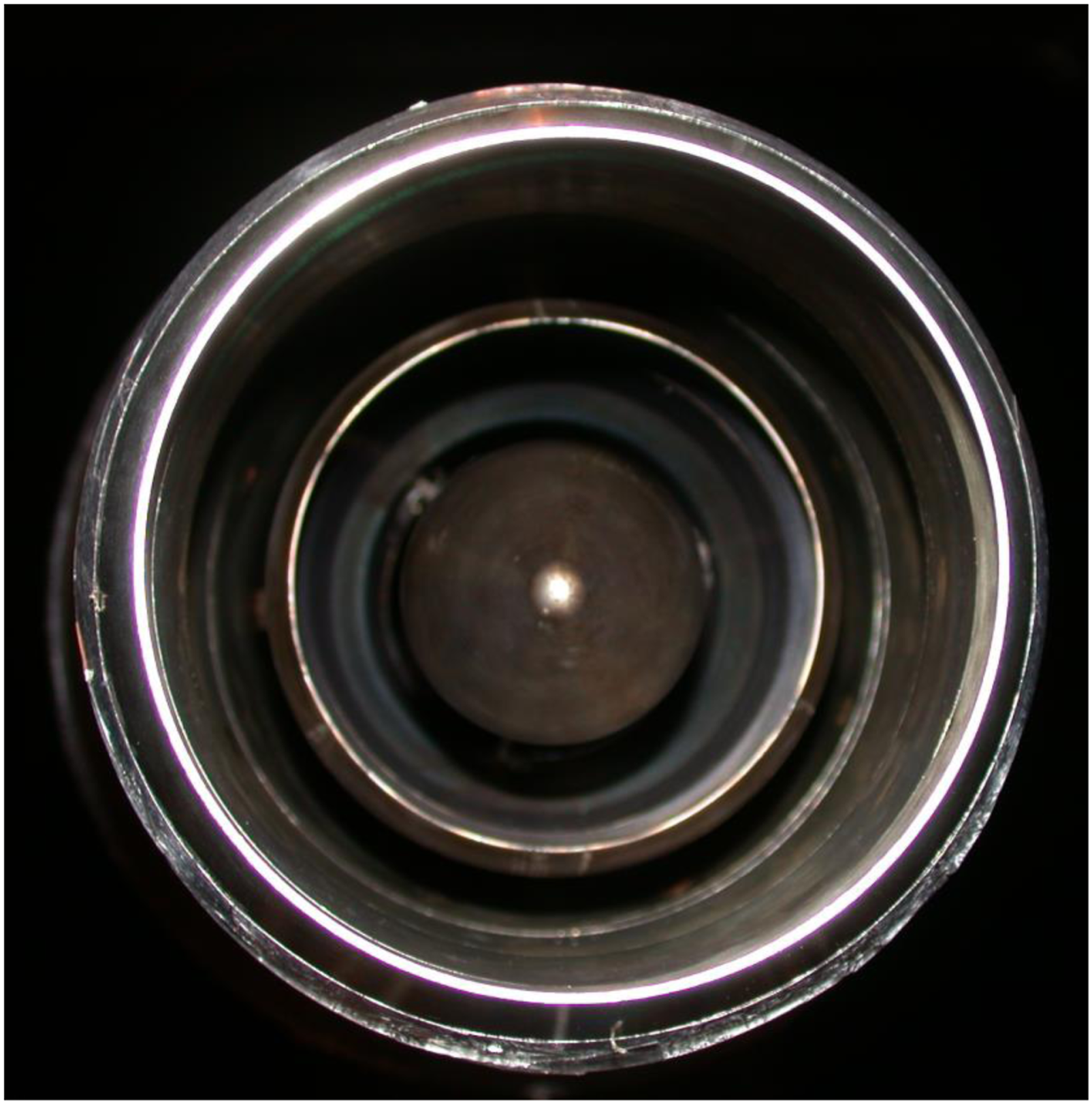
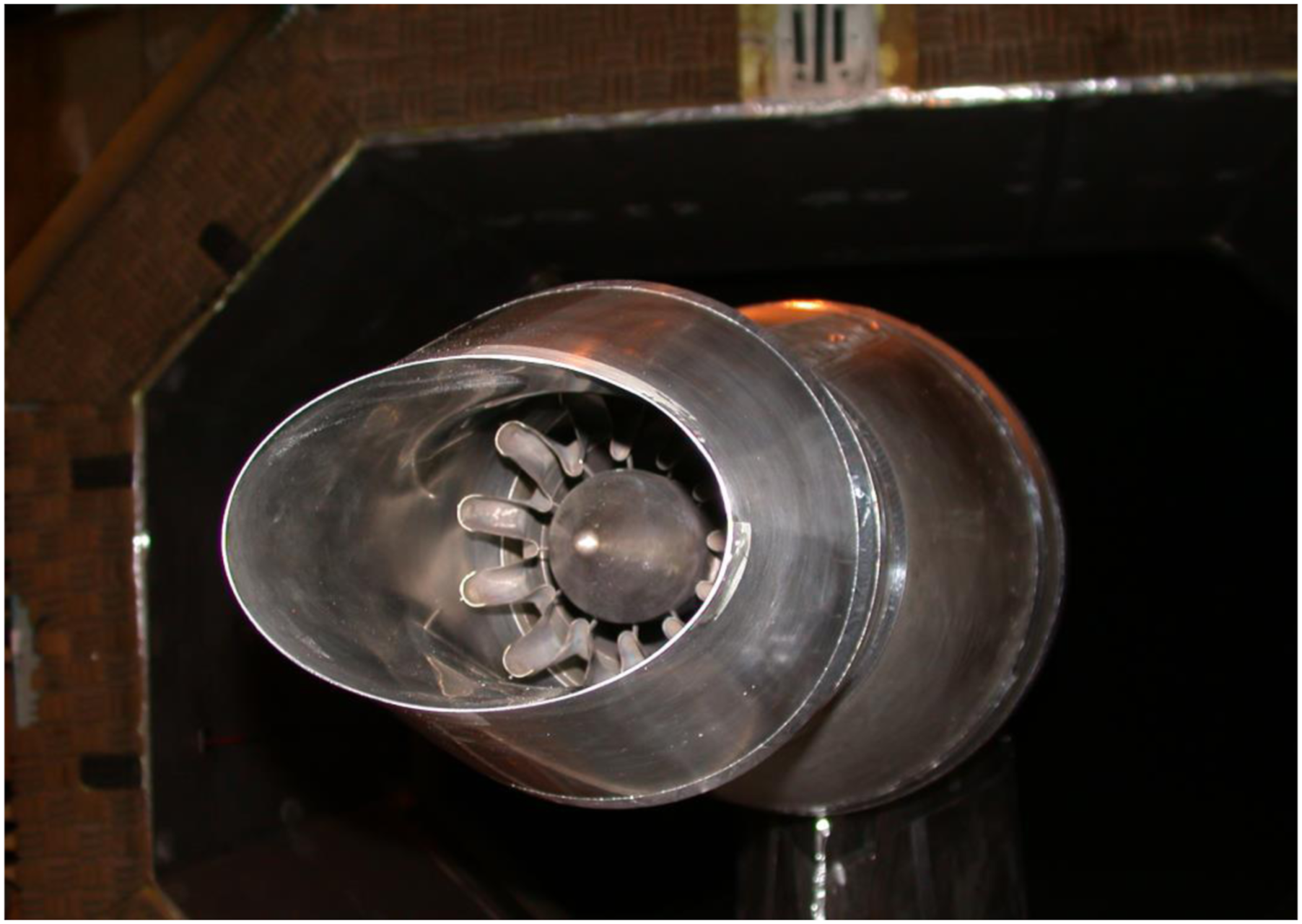
Computational analyses with three-dimensional Reynolds-averaged Navier Stokes equations of different internal contours for the elliptic compound nozzle were carried out to arrive at a geometry that would yield the optimum internal flow and hence good thrust performance. The best design from this exercise was then fabricated. This exercise also revealed that it is not straightforward to design an elliptic compound nozzle and maintain the same flow rates as for the baseline round nozzle. Experimental measurements confirmed that subtle geometric details control the pressure distribution downstream of the axial plane when the core and fan streams first come into contact, thereby influencing the BPR. However, the mass-averaged mixed jet velocity for the elliptic nozzle is higher only by ∼0.5%. The impact of this minor difference in velocity on noise can be estimated to be approximately 0.17 dB [80 x Log10 (1.005)], which is negligible. Therefore, comparisons of the acoustic performance can be taken to be from equivalent nozzles.
Results and discussion
The acoustic characteristics of the different nozzle geometries are now presented. The as-measured spectra are converted to lossless conditions for comparisons at model scale. The method proposed by Shields and Bass 20 is used to calculate the atmospheric absorption coefficients, which are frequency dependent. For the test conditions with forward flight, the method due to Amiet21,22 is employed to correct for the convection of the acoustic rays by the tunnel flow and the refraction due to the tunnel shear layer. The changes in the spectral amplitude and the radiation angle due to the co-flow have been calculated using this procedure. An interpolation of the resulting spectra at the true radiation angles to the radiation angles for the static case (fixed microphone angles) allows the direct comparison of the spectra obtained at various tunnel Mach numbers. For engine scale comparisons, the model scale spectra are extrapolated to full-scale conditions with a level flight for the aircraft at a fixed altitude of 1000 feet.
Jets in static environment
Noise benefit due to internal mixer: Round compound nozzle
First, the noise benefit of the mixer nozzle under static condition is provided as an introduction, for the baseline round exhaust nozzle. The effectiveness of the baseline 12-lobed mixer over a simple splitter, in the reduction of jet noise is shown in Figure 3. The model scale data, extrapolated to full-scale conditions, are displayed at four radiation angles and at two power settings. The cycle conditions correspond to maximum takeoff power of NPR
p
= 2.19, T
p
/T
a
= 2.91, NPR
s
= 1.99, T
s
/T
a
= 1.3, and cutback power of NPR
p
= 1.8, T
p
/T
a
= 2.56, NPR
s
= 1.71, T
s
/T
a
= 1.22, respectively-. In some of the figures, the frequency on the x-axis is denoted by the band number, which is defined as [10* log10( f ), where f is the frequency in Hertz]. The lobed mixer is seen to reduce noise at low frequencies with an increase in the levels at the higher frequencies at all angles. However, there is a substantial reduction of the low frequency noise in the peak radiation angles in the aft quadrant. The magnitude of this reduction for maximum takeoff power is ∼10 dB at 150° over a wide frequency range near the spectral peak. An examination of the directivity of the perceived noise level (not shown) indicates that there is a tremendous reduction of noise in the aft angles, with a noise benefit of 5.5 EPNdB. Similar spectral variations are observed at the lower power setting. However, the increase in noise at the higher frequencies is more pronounced at the lower angles, resulting in higher perceived noise level values up to an angle of 110°. Consequently, the noise benefit due to the mixer drops to 2.2 EPNdB, in spite of the large reduction in noise at the aft angles. In general, the lobed mixer is more effective at high power setting. Spectral comparisons from round compound flow nozzle with internal splitter and lobed mixer. Top: NPR
p
= 2.19, T
p
/T
a
= 2.91, NPR
s
= 1.99, T
s
/T
a
= 1.3; bottom: NPR
p
= 1.8, T
p
/T
a
= 2.56, NPR
s
= 1.71, T
s
/T
a
= 1.22.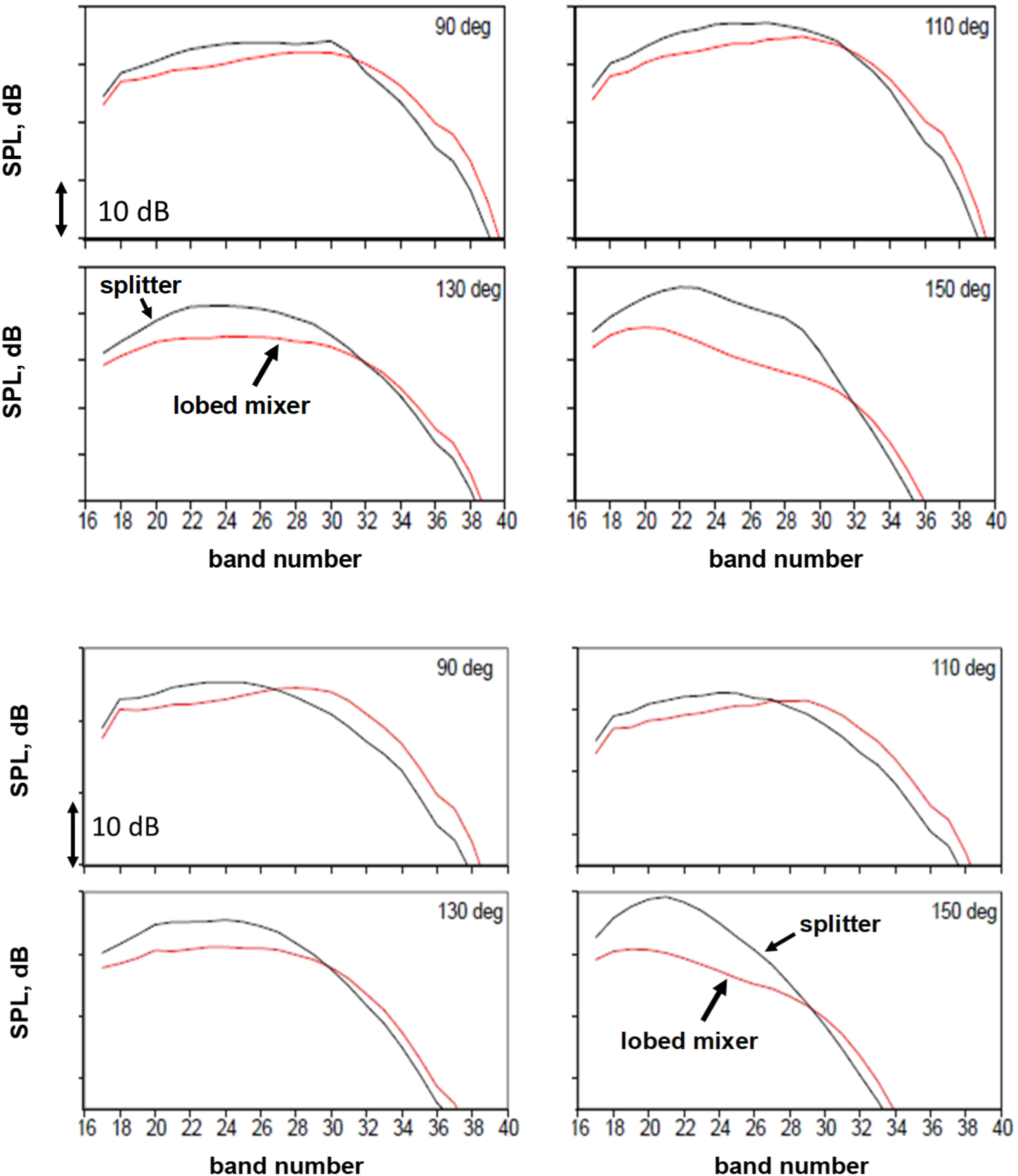
Spectral characteristics of elliptic nozzles: Internal splitter
The elliptic nozzles are expected to introduce azimuthal variations in the spectra. As a sanity check, the azimuthal variations for the round baseline nozzle are first examined to establish the experimental scatter in the data. The azimuthal angle convention used throughout this paper is represented schematically in Figure 4(a). It is worthwhile to examine the inherent azimuthal variations in the measurements, first for a round nozzle. Figure 4(b) shows spectra at three polar angles of 70°, 130° and 140° and at the two azimuthal angles of 60° and 90°. Both an unheated jet with the splitter and a heated jet with the lobed mixer are shown. The jet operating conditions are: splitter, NPR
p
= NPR
s
= 1.89, T
p
/T
a
= T
s
/T
a
= 1.0 (bottom curves); lobed mixer, NPR
p
=1.8, T
p
/T
a
= 2.56, NPR
s
= 1.71, T
s
/T
a
= 1.22 (top curves), respectively. There is good agreement between the two sets of spectra at all the polar angles, with only a small scatter, denoting an axisymmetric noise field for the round compound nozzle with both the simple splitter and lobed internal mixer. This figure also serves to establish the expected degree of variance for the baseline round geometry, before the spectra from the elliptic nozzle are broached. (a) definition of azimuthal angle and reference orientation of elliptic nozzle. (b) Spectral comparison for the round nozzle from the two azimuthal arrays. M
t
= 0.0. Top: lobed mixer, NPR
p
= 1.8, T
p
/T
a
= 2.56, NPR
s
= 1.71, T
s
/T
a
= 1.22; bottom: splitter, NPR
p
= NPR
s
= 1.89, T
p
/T
a
= T
s
/T
a
= 1.0. Solid: ϕ = 90°; chain: ϕ = 60°.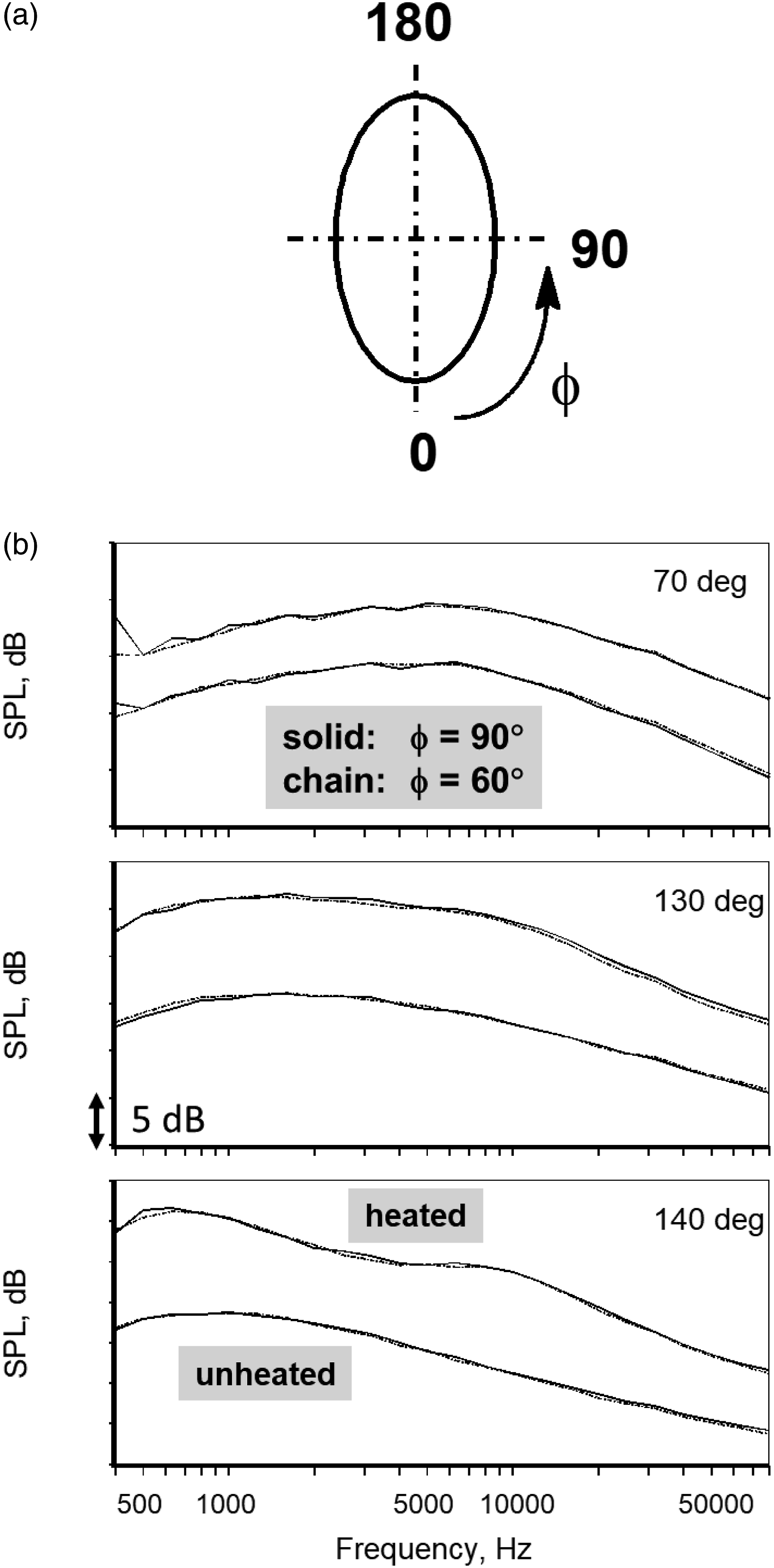
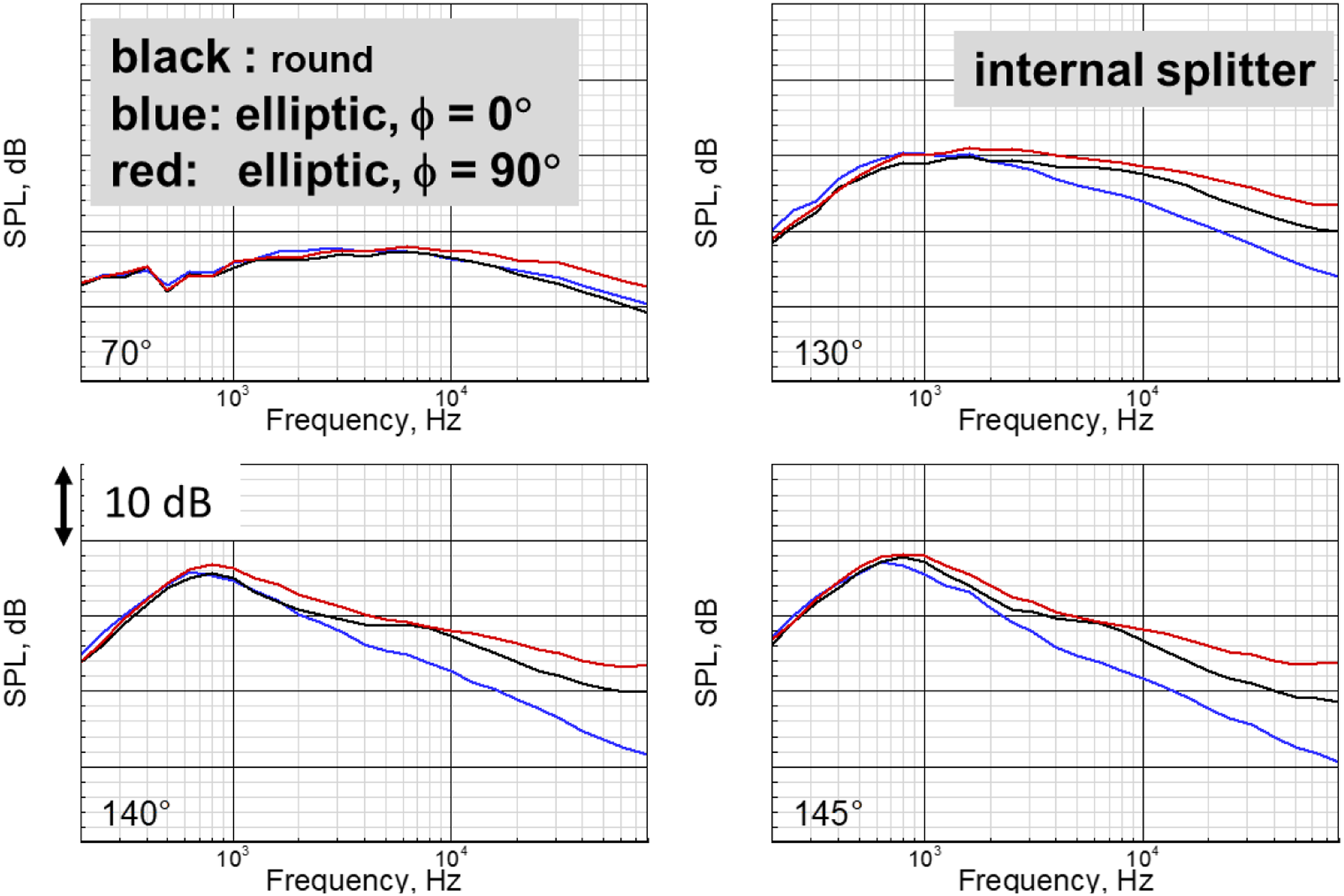
The azimuthal variations introduced by the elliptic nozzle are examined for an unheated jet, with an internal splitter. Lossless spectral comparisons as functions of raw frequency in Hertz are presented in the following figures. The elliptic nozzle is assumed to be oriented with the major axis perpendicular to the ground; the narrower dimension points towards the ground and corresponds to ϕ = 0°. All the noise results will be reported with this nozzle orientation: ϕ = 0° represents noise radiated towards the narrow dimension and ϕ = 90° represents noise radiated towards the broad side of the ellipse. Both the primary (core) and secondary (fan) streams are operated pressured balanced and unheated, with NPR
p
= NPR
s
= 1.89, T
p
/T
a
= T
s
/T
a
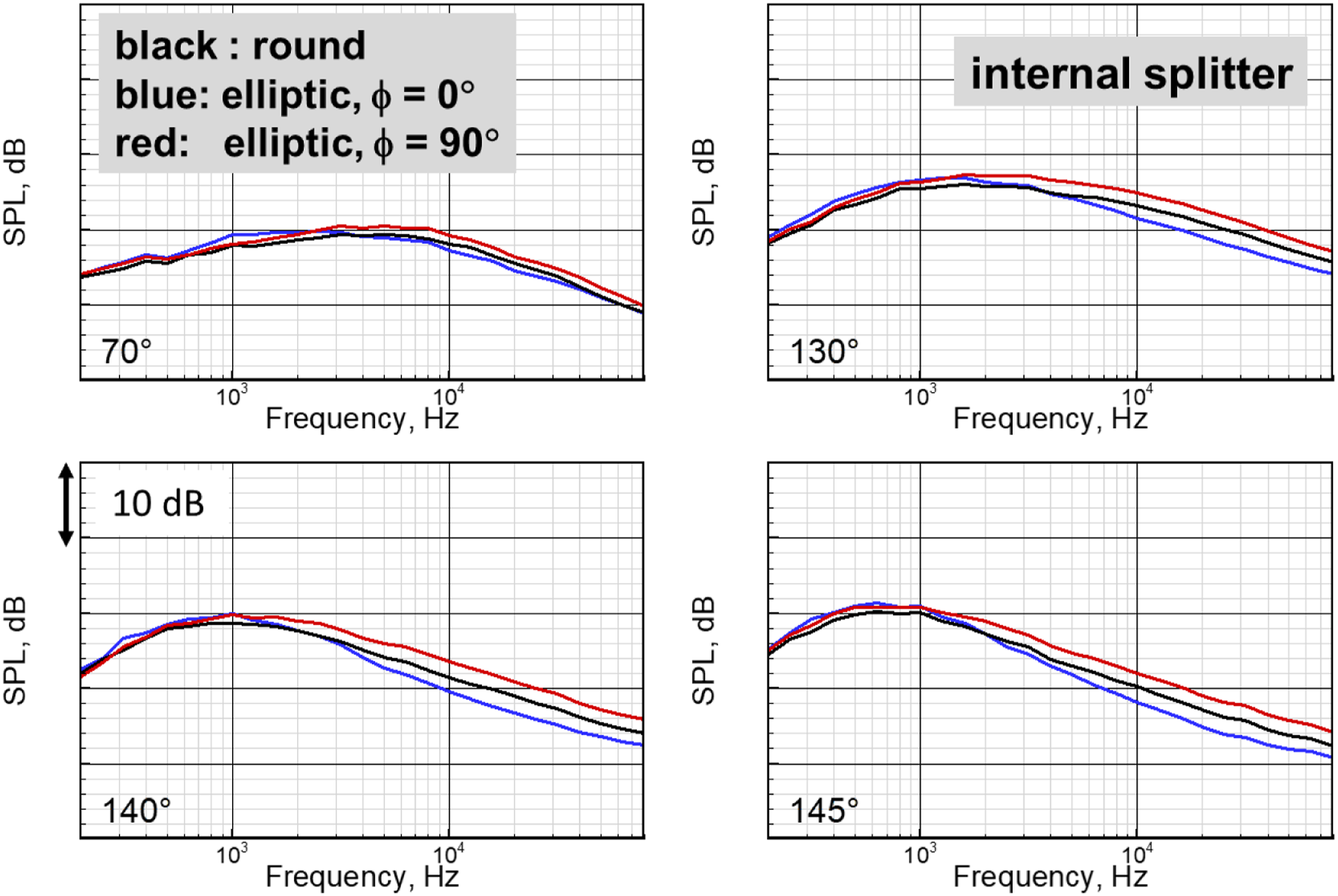
=1.0 in Figure 5. Four different polar angles of 70°, 130°, 140° and 145° cover a wide angular range; the spectral variations at the lower polar angles are quite similar and modest in magnitude; the trends at an angle of 70° therefore represent the entire range of lower polar angles. Three angles are chosen in the peak noise radiation direction, where more interesting trends are observed. There is not much variation in the spectra at 70°. A definitive trend of increasing sound pressure level at the higher frequencies at the aft angles is seen, as ϕ increases from 0° to 90°. The magnitude of noise increase is ∼4 dB over a wide frequency range. Thus, there is a measurable azimuthal effect due to the elliptic nozzle even for an unheated jet. Figure 6 shows a comparison of the radiated noise from the round nozzle and the elliptic nozzle, at ϕ = 0° and 90°, respectively. The jet operating conditions are the same as in Figure 5: unheated and pressure-balanced with a jet Mach number of unity. The spectral changes are minor at all the radiation angles; at the aft angles, there is a slight increase of ∼1.5 dB at the higher frequencies at ϕ = 90°, and a slight reduction of ∼1.5 dB at the higher frequencies at ϕ = 0°. There is a small increase at the spectral peak at both azimuthal angles. It is fair to conclude that the modifications to the spectra introduced by the elliptic nozzle are small for cold jets; this observation is in line with the trend reported in Ref.
12
Azimuthal variation for elliptic nozzle with splitter. M
t
= 0.0. NPR
p
= NPR
s
= 1.89, T
p
/T
a
= T
s
/T
a
=1.0. Black: ϕ = 0°; blue: ϕ = 30°; red: ϕ = 60°; green: ϕ = 90°. Spectral comparison between round and elliptic nozzles, with splitter. M
t
= 0.0. NPR
p
= NPR
s
=1.89, T
p
/T
a
= T
s
/T
a
=1.0. Black: round; blue: elliptic, ϕ = 0°; red: elliptic, ϕ = 90°.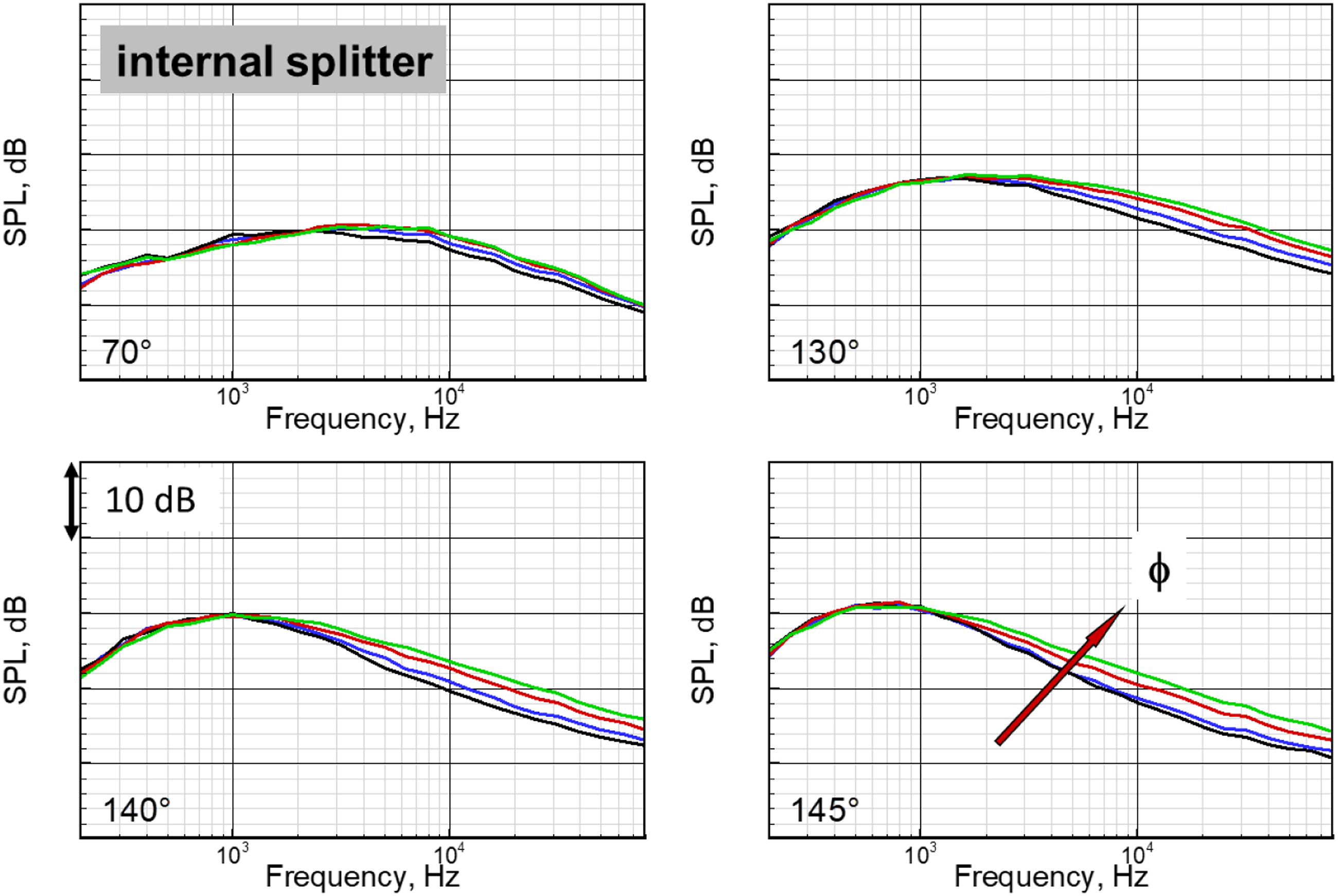
Heated jets, again with an internal splitter, are considered next. The azimuthal variation at the four different polar angles of 70°, 130°, 140° and 145° are depicted in Figure 7. The jet operating conditions are NPR
p
= 1.98, T
p
/T
a
= 2.71, NPR
s
= 1.85, T
s
/T
a
= 1.26. As for the unheated jet, there are only minor variations at 70° and at the lower polar angles (not shown). But there are dramatic differences in the peak radiation sector: between ∼10 dB and ∼15 dB over the entire high frequency regime. Surprisingly, there is virtually no change in spectral level at the lower frequencies and up to the spectral peak. The azimuthal variations are very pronounced for the heated jet at aft angles. Azimuthal variation for elliptic nozzle with splitter. M
t
= 0.0. NPR
p
= 1.98, T
p
/T
a
= 2.71, NPR
s
= 1.85, T
s
/T
a
= 1.26. Black: ϕ = 0°; blue: ϕ = 30°; red: ϕ = 60°; green: ϕ = 90°.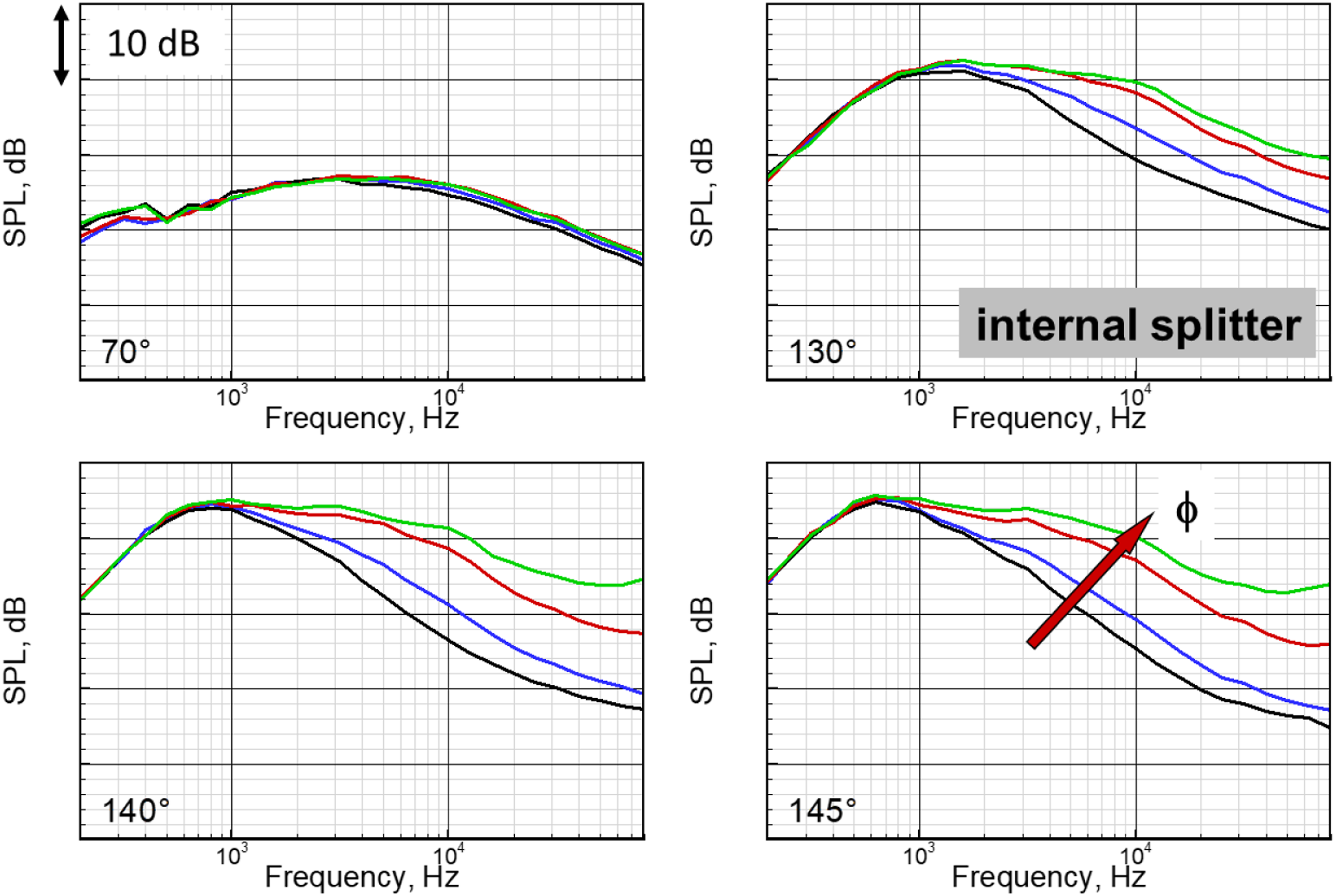
The noise reduction potential of the elliptic nozzle with an internal splitter is examined at three different jet conditions: (1) NPR
p
= 1.46, T
p
/T
a
= 2.29, NPR
s
= 1.44, T
s
/T
a
= 1.16; (2) NPR
p
= 1.98, T
p
/T
a
= 2.71, NPR
s
= 1.85, T
s
/T
a
= 1.26; and (3) NPR
p
= 2.19, T
p
/T
a
= 2.91, NPR
s
= 1.99, T
s
/T
a
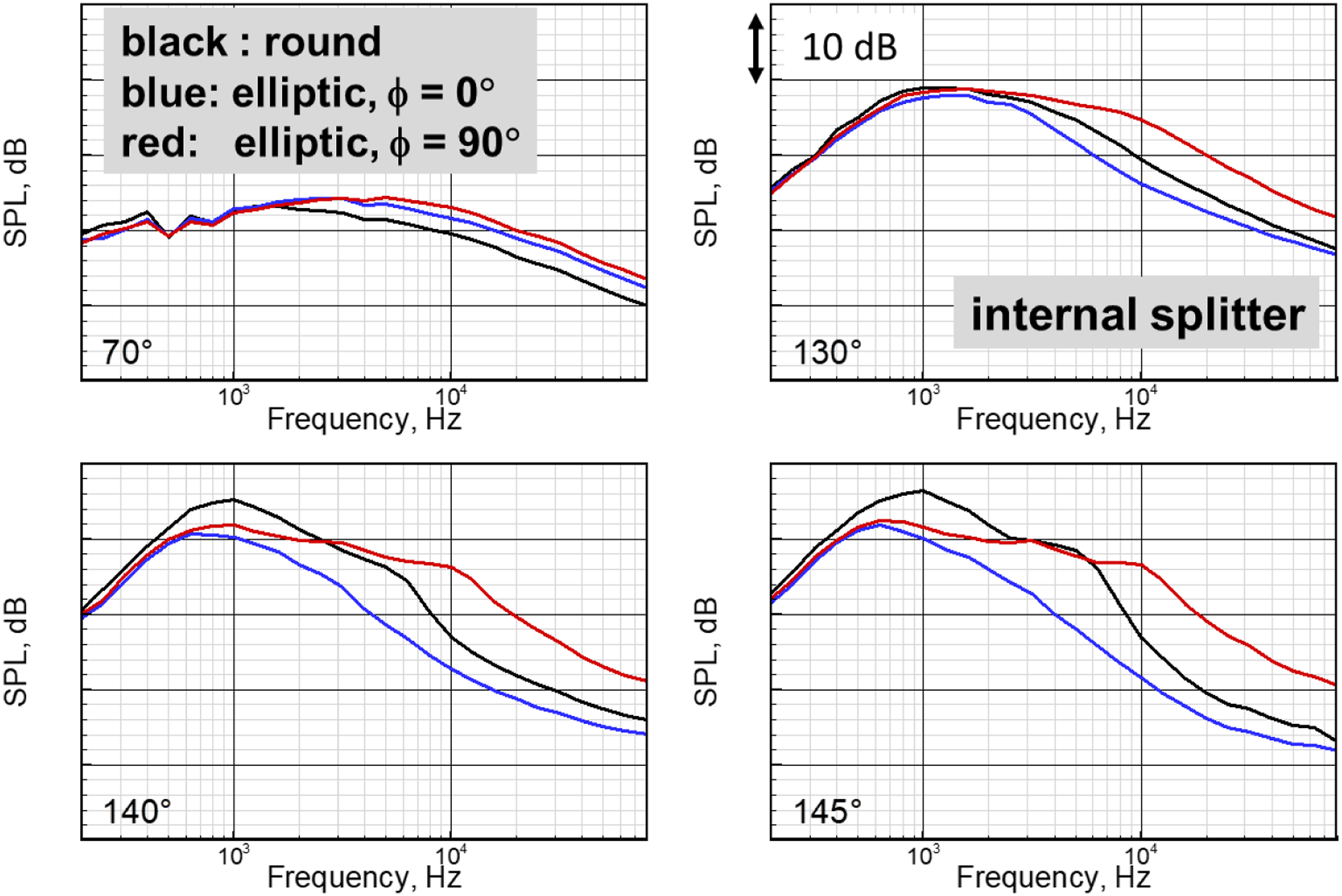
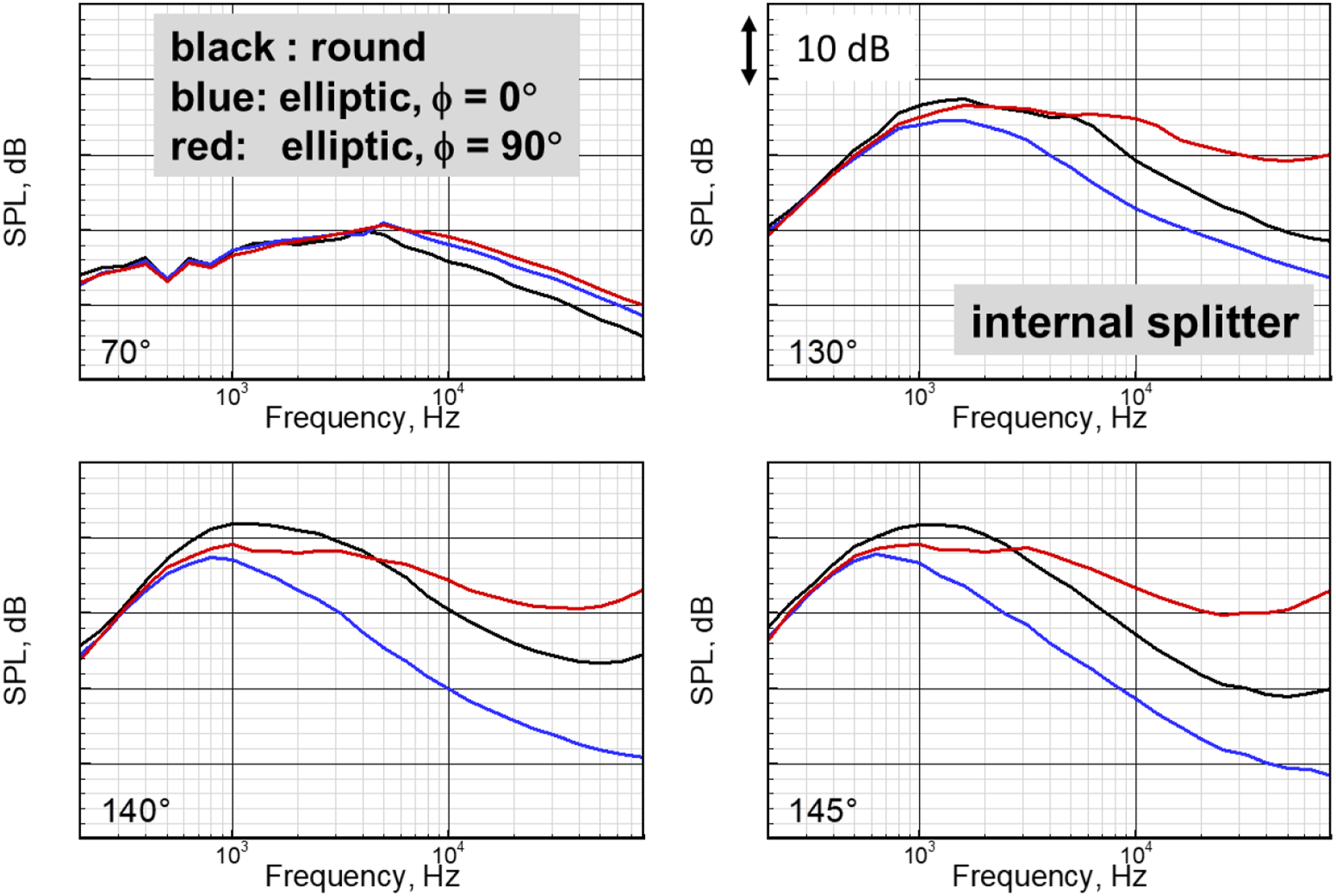
= 1.3. Spectral comparisons with the round nozzle are shown in Figures 8–10, respectively. First of all, there is a ∼3 to ∼4 dB noise increase at the higher frequencies at the lower polar angles, at both azimuthal angles of at ϕ = 0° and ϕ = 90°. As we move aft, the trends gradually change and one observes noise reduction at ϕ = 0° and noise increase at ϕ = 90°. The magnitude of these changes becomes pronounced with increasing power setting and reaches ∼10 dB over a wide range of high frequencies for the maximum takeoff power shown in Figure 10. There is a clear and obvious spectral reduction, anywhere from ∼5 dB to ∼10 dB, at most of the frequencies at the aft angles for realistic high engine power at ϕ = 0°. The directivity of the overall sound pressure level (OASPL) for an unheated and a heated jet are shown in Figure 11. The jet operating conditions are NPR
p
= NPR
s
= 1.89, T
p
/T
a
= T
s
/T
a
=1.0 (bottom curves) and NPR
p
= 1.8, T
p
/T
a
= 2.56, NPR
s
= 1.71, T
s
/T
a
= 1.22 (top curves), respectively. Consistent with the spectral observations, the change in levels for unheated jets with the elliptic nozzle at both ϕ = 0° and ϕ = 90° relative to the round nozzle are minor and almost negligible. For unheated jets, no noise benefit results from the elliptic nozzle. The situation is very different for heated jets. There is a noise increase of ∼2 dB at the lower polar angles and a noise reduction at aft angles. At ϕ = 0°, the magnitude of noise reduction is ∼5 dB at large aft angles ≥140°. Comparable levels of OASPL benefit at ϕ = 0° are seen at other higher engine power settings as well (not shown). Spectral comparison between round and elliptic nozzles, with splitter. M
t
= 0.0. NPR
p
= 1.46, T
p
/T
a
= 2.29, NPR
s
= 1.44, T
s
/T
a
= 1.16. Black: round; blue: elliptic, ϕ = 0°; red: elliptic, ϕ = 90°. Spectral comparison between round and elliptic nozzles, with splitter. M
t
= 0.0. NPR
p
= 1.98, T
p
/T
a
= 2.71, NPR
s
= 1.85, T
s
/T
a
= 1.26. Black: round; blue: elliptic, ϕ = 0°; red: elliptic, ϕ = 90°. Spectral comparison between round and elliptic nozzles, with splitter. M
t
= 0.0. NPR
p
= 2.19, T
p
/T
a
= 2.91, NPR
s
= 1.99, T
s
/T
a
= 1.3. Black: round; blue: elliptic, ϕ = 0°; red: elliptic, ϕ= 90°. Directivity of OASPL, with splitter. M
t
= 0.0. Top: NPR
p
= 1.8, T
p
/T
a
= 2.56, NPR
s
= 1.71, T
s
/T
a
= 1.22; bottom: NPR
p
= NPR
s
= 1.89, T
p
/T
a
= T
s
/T
a
= 1.0.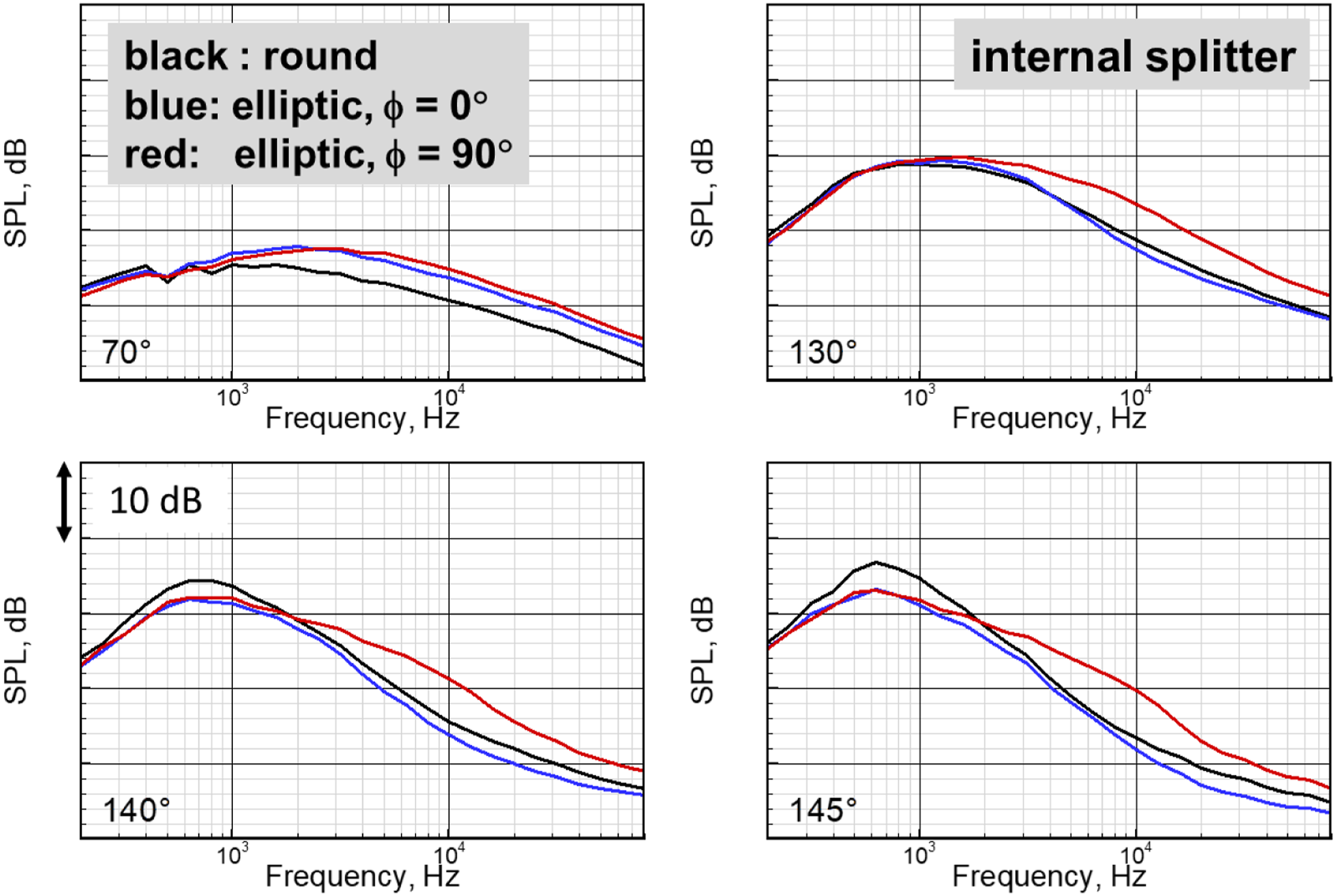

Spectral differences between jets from elliptic and beveled nozzles
It is instructive to compare the acoustic characteristics of the elliptic nozzle with those of the beveled nozzle. For both geometries, there is noise benefit in the azimuthal direction of ϕ = 0° at large aft angles; the magnitude of the noise benefit also increases with jet velocity (engine power). However, there are also distinct differences, which become apparent from a spectral analysis. Some years ago, Tam et al.
23
extracted two universal spectral shapes from experimental data. One of these termed the fine-scale similarity spectrum (FSS) fits the spectra at the lower polar angles; the other, termed the large-scale similarity spectrum characterizes the spectral shape at large aft angles. The overlapping angular range where the contributions from both are important is dependent on the jet temperature and is typically seen from ∼120° to ∼130° for round nozzles. Figure 12 shows model-scale spectra, from the round and elliptic nozzle at ϕ = 0° and ϕ = 90° at three polar angles of 120°, 125° and 130°, overlaid with the similarity spectra. For this heated jet, there is good agreement for the spectra from both the round and elliptic nozzles with the FSS shape at 120°. Similar agreement with the FSS shape is seen at all lower polar angles (not shown). At 125°, spectra from the round nozzle and from the elliptic nozzle at ϕ = 0° are in a state of transition to the LSS shape and correspond more or less to the LSS shape except at the lower frequencies. The spectrum at ϕ = 90° still retains the FSS shape. At 130°, the spectrum for the elliptic nozzle at ϕ = 0° has attained the LSS shape; the spectrum from the round nozzle has almost the LSS shape. But the spectrum at ϕ = 90° still retains the FSS shape! Comparison of data with similarity spectra. M
t
= 0.0. NPR
p
= 1.8, T
p
/T
a
= 2.56, NPR
s
= 1.71, T
s
/T
a
= 1.22. Red: fine-scale similarity; blue: large-scale similarity spectrum.
Similar comparisons for the beveled nozzle with a bevel angle of 45° are shown in Figure 13. These figures have been reproduced from Viswanathan.
14
The jet Mach number is 1.0 and the stagnation temperature ratio is 3.2. Figures 13(a)–(c) show measured spectra and comparisons with the similarity spectra at azimuthal angles of 0°, 90° and 180°, respectively. For the bevel45 at an azimuthal angle of 0° (13a), the measured spectra start deviating from the FSS at a polar angle of ∼120° and a LSS shape is observed at a polar angle of 130°. As we go around the periphery of the beveled nozzle to an azimuthal angle of 90°, we notice that the LSS shape is seen for the spectra at a polar angle of 125° and higher. At an azimuthal angle of 180°, the spectral characteristics are dramatically different from that for the round nozzle. Even at 90° there is a slight hump near the peak; at 100° this hump is more pronounced and there is major deviation from the FSS shape. The most surprising feature is the observation of the LSS shape for the measured spectra at a polar angle of 110°. Comparison of data with similarity spectra. M = 1.0, T
t
/T
a
= 3.2. Symbols: data; solid lines: FSS; dashed: LSS. (a) Bevel45, ϕ = 0°; (b) bevel45, ϕ = 90°; (c) bevel45, ϕ = 180°.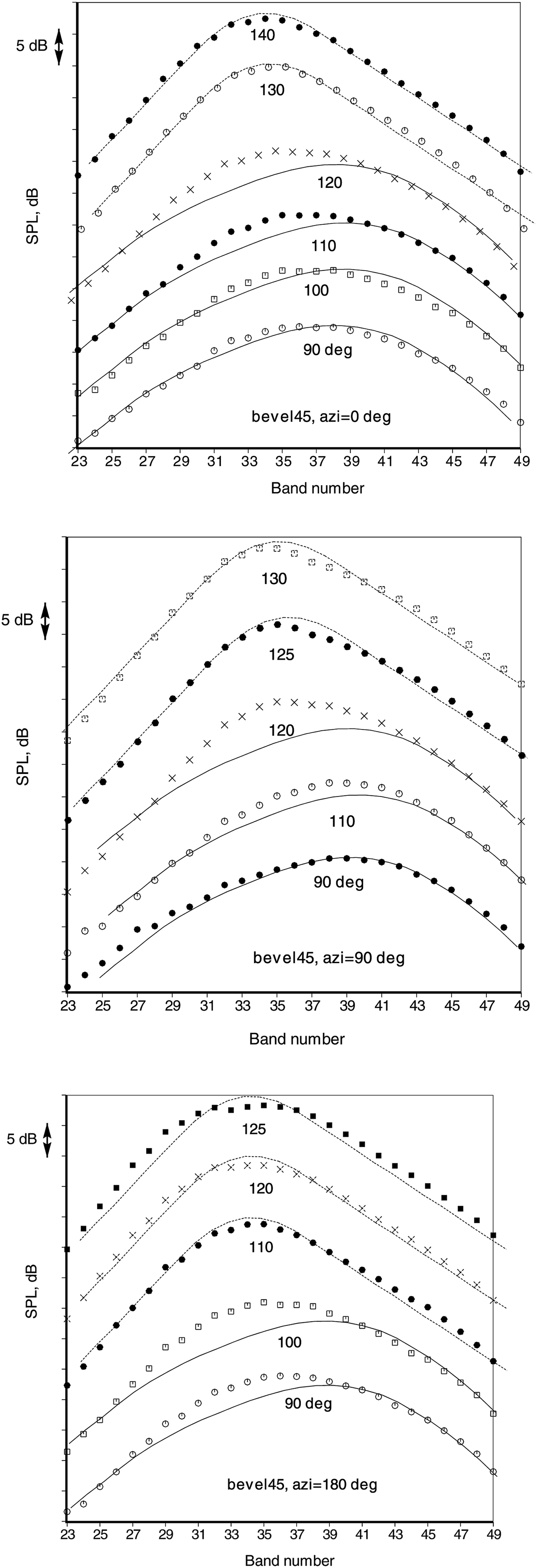
Note that there is only one axis of symmetry for the beveled nozzle, whereas there are two axes of symmetry for the elliptic nozzle. There is a progressive shift to the LSS shape at lower polar angles as the azimuthal angle varies from ϕ = 0° to ϕ = 180° for the bevel nozzle. For the elliptic nozzle, there is a shift to the LSS shape at ϕ = 0° at a polar angle of ∼125°; the rate of change to the LSS shape, however, is only slightly faster than that for the round nozzle as seen in Figure 12. The most drastic difference is seen at ϕ = 90°: there is inhibition of the change in spectral shape and the FSS shape is retained up to 130° for the elliptic nozzle, in contrast to the effects introduced by the beveled nozzle. Therefore, the azimuthal variations introduced by the elliptic and beveled nozzles are radically different in spite of the superficial resemblance between the two geometries.
For noise reduction, the consequences of these spectral observations are profound for the elliptic nozzle at ϕ = 90°, as quantified in the next two sections. The FSS shape has elevated noise levels at higher frequencies compared with the LSS shape, for a fixed peak noise level. The prevention or delay of the spectral shape transition implies that more high-frequency noise will be beamed to the aft angles, where maximum jet noise radiation occurs. Consequently, the broad side of the elliptic nozzle will always be louder than the narrow side, as shown.
Spectral characteristics of elliptic nozzles: Internal mixer
The azimuthal variation for the elliptic nozzle with the internal lobed mixer is shown in Figure 14. The jet operating conditions are NPR
p
= 1.98, T
p
/T
a
= 2.71, NPR
s
= 1.85, T
s
/T
a
= 1.26; a comparable figure for the elliptic nozzle with the internal splitter has already been presented in Figure 7. There are major differences for the two internal geometries in the aft angles: the magnitude of azimuthal variations is much lower and is only ∼4 dB at a frequency of 10 kHz for the mixer, whereas it is ∼10 dB at the same frequency for the splitter. Even at the highest frequency of 80 kHz, it is only ∼8 dB for the mixer, whereas it is ∼15 dB for the splitter. There are only minor spectral variations at the lower polar angles for both internal geometries. Thus, the introduction of a realistic mixer diminishes the large azimuthal variation seen for the internal splitter. This smaller variation will have a direct impact on the noise reduction potential vis-à-vis a round nozzle, as can be appreciated. Azimuthal variation for elliptic nozzle with lobed mixer. M
t
= 0.0. NPR
p
= 1.98, T
p
/T
a
= 2.71, NPR
s
= 1.85, T
s
/T
a
= 1.26. Black: ϕ = 0°; blue: ϕ = 30°; red: ϕ = 60°; green: ϕ = 90°.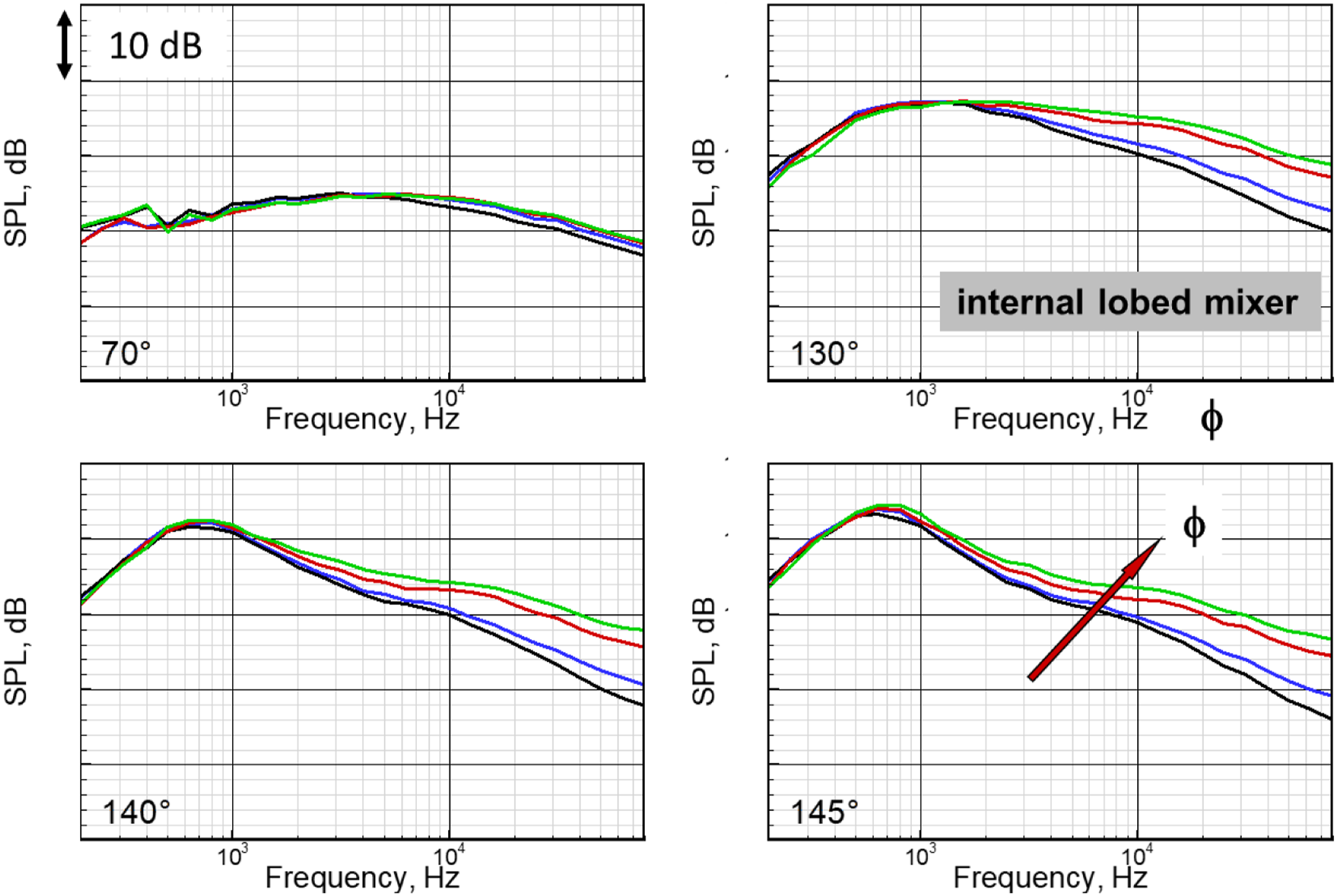
The noise reduction potential of the elliptic nozzle with an internal lobed mixer is assessed now. Spectral comparisons at ϕ = 0° and ϕ = 90° with the round nozzle are shown in Figures 15 and 16. The jet operating conditions are (1) NPR
p
= 1.98, T
p
/T
a
= 2.71, NPR
s
= 1.85, T
s
/T
a
= 1.26; and (2) NPR
p
= 2.19, T
p
/T
a
= 2.91, NPR
s
= 1.99, T
s
/T
a
= 1.3, respectively. Comparable results for the elliptic nozzle with the internal splitter are already presented in Figures 9 and 10. Spectral reductions at the aft angles for ϕ = 0° are drastically lower for the lobed mixer: the reductions over a wide range of higher frequencies are ∼3 to ∼5 dB for the lobed mixer, whereas it is ∼10 dB for the internal splitter for the higher power setting; contrast Figure 16 with Figure 10. It is immediately evident that the noise benefit for a realistic engine geometry with internal mixer is much diminished. Spectral comparison between round and elliptic nozzles, with mixer. M
t
= 0.0. NPR
p
= 1.98, T
p
/T
a
= 2.71, NPR
s
= 1.85, T
s
/T
a
= 1.26. Black: round; blue: elliptic, ϕ = 0°; red: elliptic, ϕ = 90°. Spectral comparison between round and elliptic nozzles, with mixer. M
t
= 0.0. NPR
p
= 2.19, T
p
/T
a
= 2.91, NPR
s
= 1.99, T
s
/T
a
= 1.3. Black: round; blue: elliptic, ϕ = 0°; red: elliptic, ϕ = 90°.
Effect of elliptic nozzles on noise metrics: Internal splitter and mixer
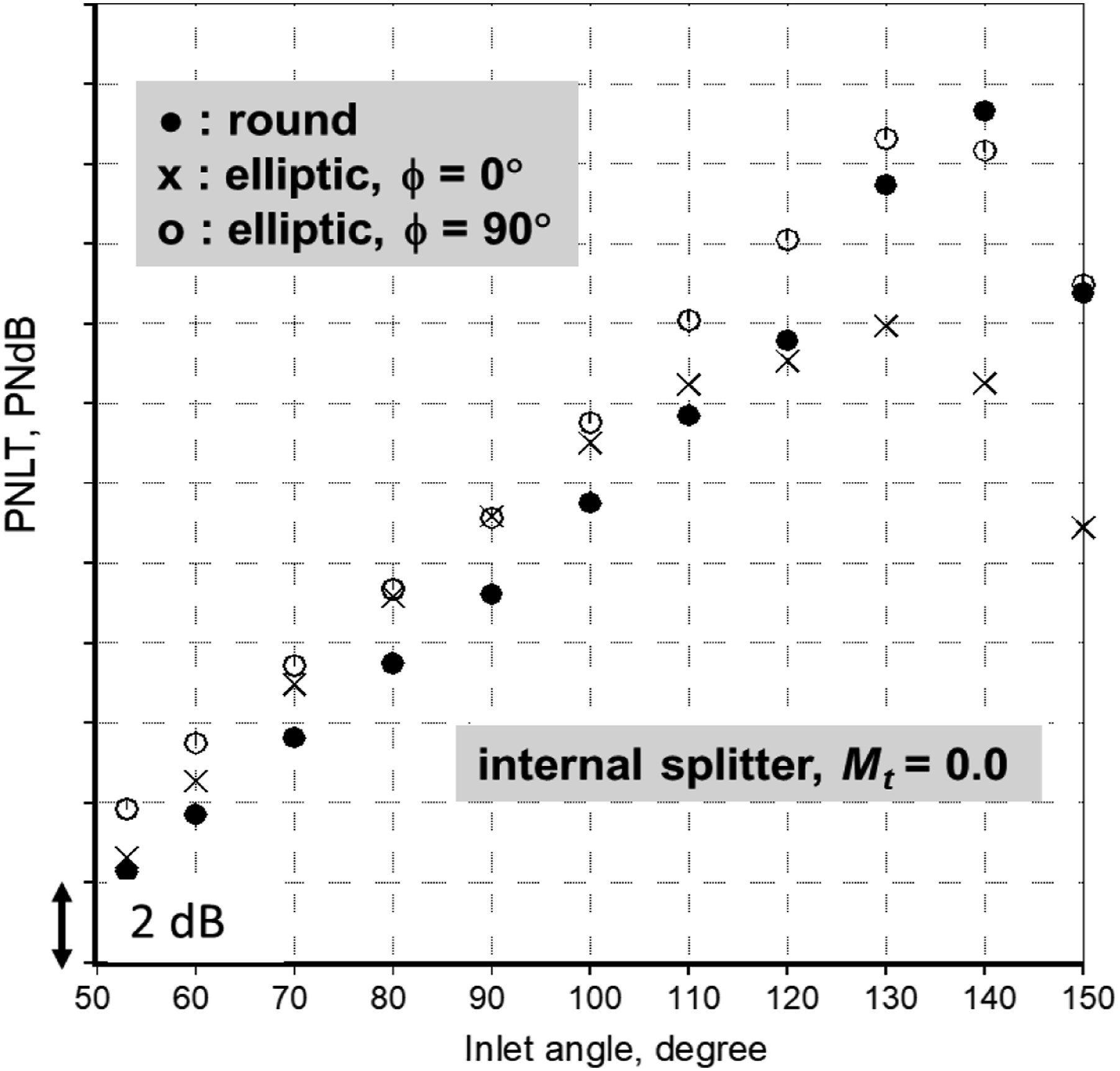
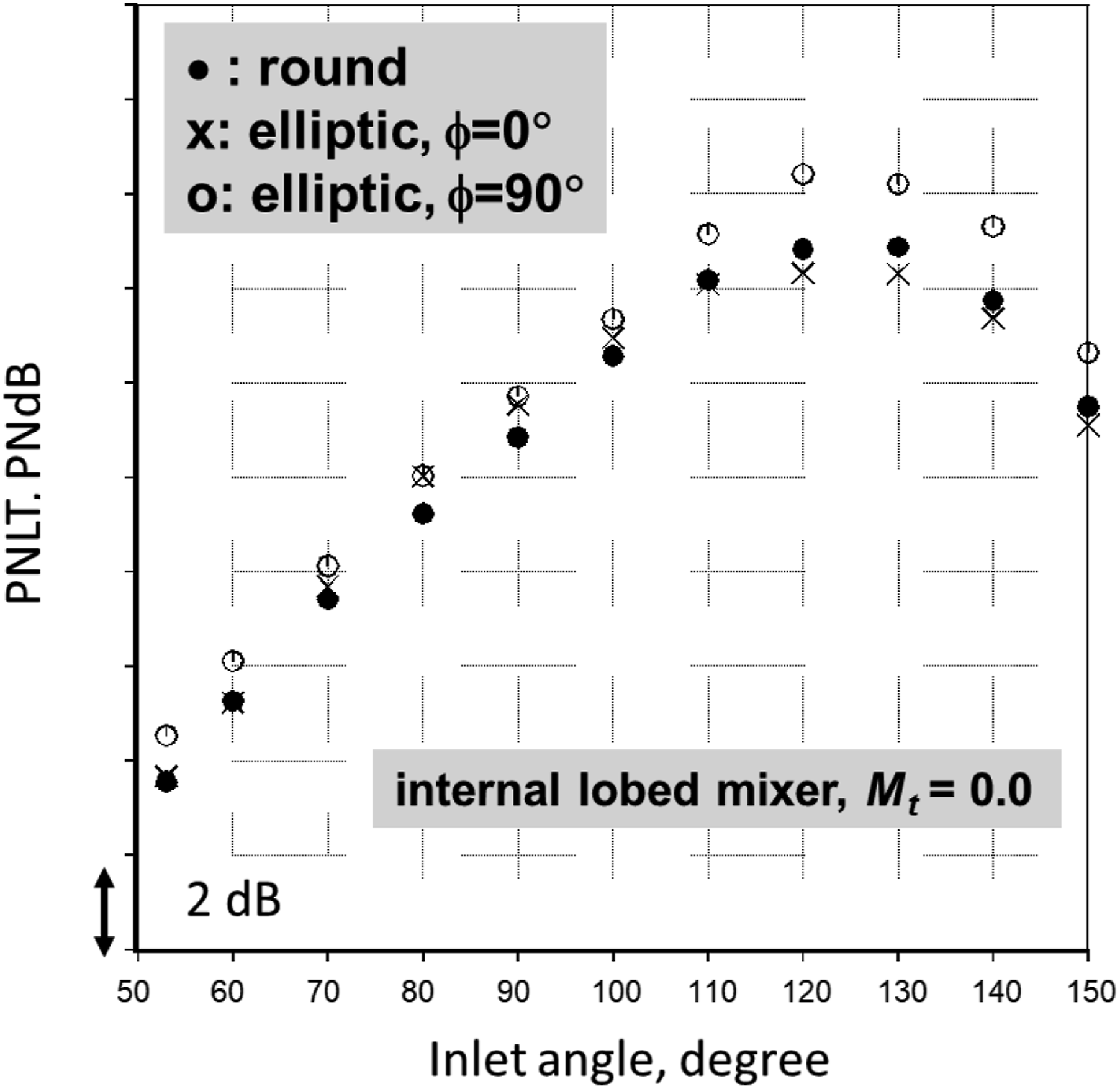
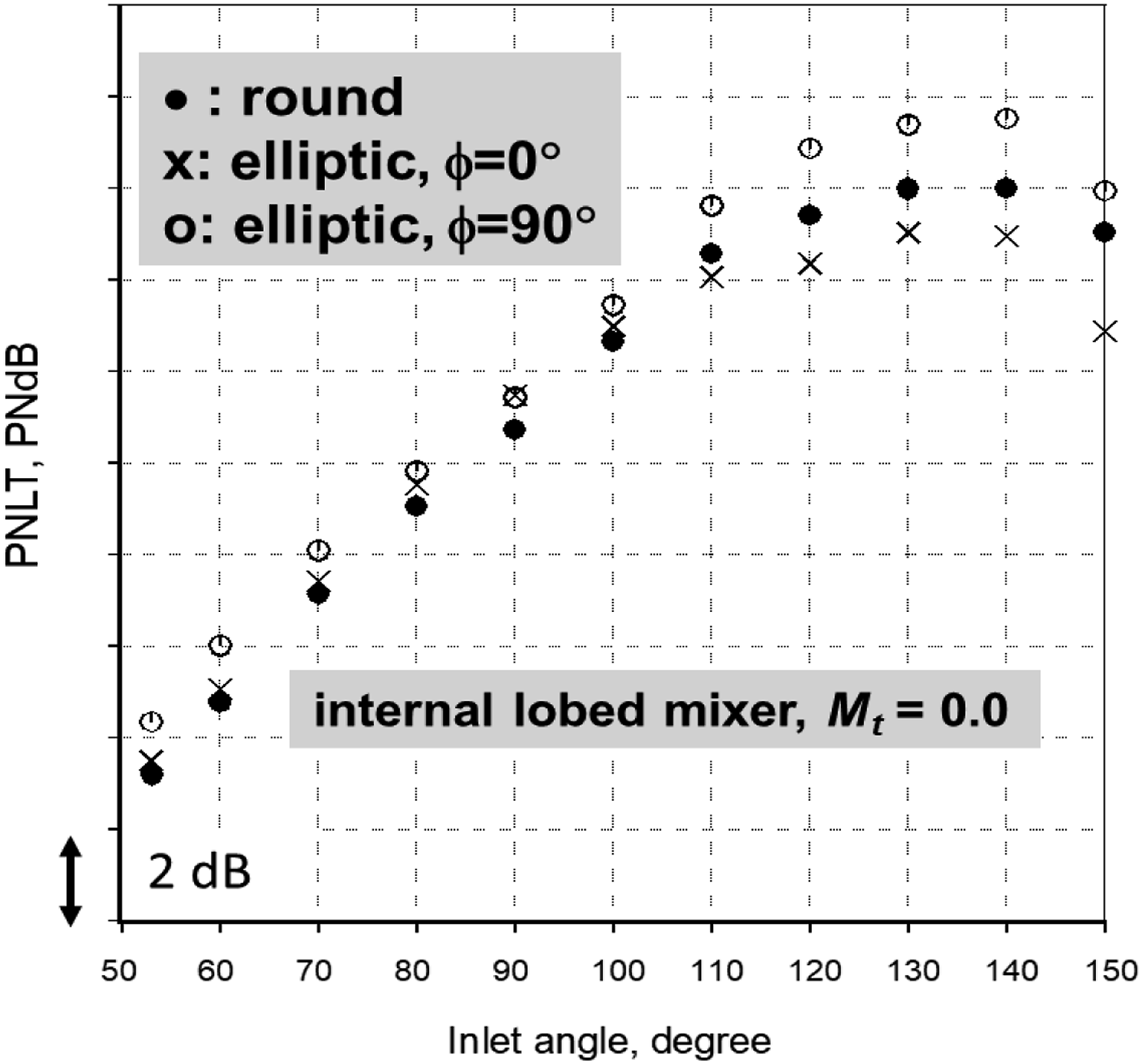
Spectral comparisons have been presented and discussed so far. In order to quantify the noise changes due to the elliptic nozzle in terms of the metric used in aircraft certification, the perceived noise level (PNL, PNdB) and the Effective Perceived Noise Level (EPNL, EPNdB) have been calculated, with the model scale spectra extrapolated to full scale; as stated earlier, a level flight for the aircraft at a fixed altitude of 1000 ft is assumed. The directivities of the PNL for the round and elliptic nozzles with the internal splitter are shown in Figures 17 and 18; the jet operating conditions are NPR
p
= 1.8, T
p
/T
a
= 2.56, NPR
s
= 1.71, T
s
/T
a
= 1.22 and NPR
p
= 2.19, T
p
/T
a
= 2.91, NPR
s
= 1.99, T
s
/T
a
= 1.3, respectively. At both operating conditions, there is an increase in the PNL at all the lower angles and up to ∼120° for the elliptic nozzle at both ϕ = 0° and ϕ = 90°. At larger aft angles, there is a reduction of ∼4 PNdB at ϕ = 0° relative to the baseline round nozzle. This reduction leads to a noise benefit in the EPNL metric of 3.5 EPNdB and 3.4 EPNdB for the two power settings, respectively. Comparable directivities of PNL for the internal lobed mixer are shown in Figures 19 and 20, at the same power settings as for the internal splitter. The trends are markedly different: the increase in level at the lower polar angles is much smaller in magnitude and the noise benefit at large aft angles is drastically reduced at ϕ = 0°. The net result in EPNL is the following: benefits of 0.1 and 1.1 EPNdB at the two power settings. Thus, the noise benefit mostly disappears with the addition of an internal lobed mixer, which represents a more realistic geometry. A composite plot of the relative change in EPNL level at four power settings is shown in Figure 21. Blue represents the internal splitter and red represents the internal lobed mixer; the solid bars correspond to ϕ = 0° and the bars with the slanted lines correspond to ϕ = 90°. Powers 2 and 4 are the same as those shown in Figures 19 and 20 and the engine settings for Power 1 and Power 3 are (1) NPR
p
= 1.7, T
p
/T
a
= 2.45, NPR
s
= 1.63, T
s
/T
a
= 1.19, and (2) NPR
p
= 1.98, T
p
/T
a
= 2.71, NPR
s
= 1.85, T
s
/T
a
= 1.26. First of all, there is a large EPNL benefit for the internal splitter at ϕ = 0°. There is a smaller benefit at ϕ = 90°. Directivity of perceived noise level, internal splitter. M
t
= 0.0. NPR
p
= 1.8, T
p
/T
a
= 2.56, NPR
s
= 1.71, T
s
/T
a
= 1.22. Directivity of perceived noise level, internal splitter. M
t
= 0.0. NPR
p
= 2.19, T
p
/T
a
= 2.91, NPR
s
= 1.99, T
s
/T
a
= 1.3. Directivity of perceived noise level, internal mixer. M
t
= 0.0. NPR
p
= 1.8, T
p
/T
a
= 2.56, NPR
s
= 1.71, T
s
/T
a
= 1.22. Directivity of perceived noise level, internal mixer. M
t
= 0.0. NPR
p
= 2.19, T
p
/T
a
= 2.91, NPR
s
= 1.99, T
s
/T
a
= 1.3. Change in EPNL at four power settings. M
t
=0.0.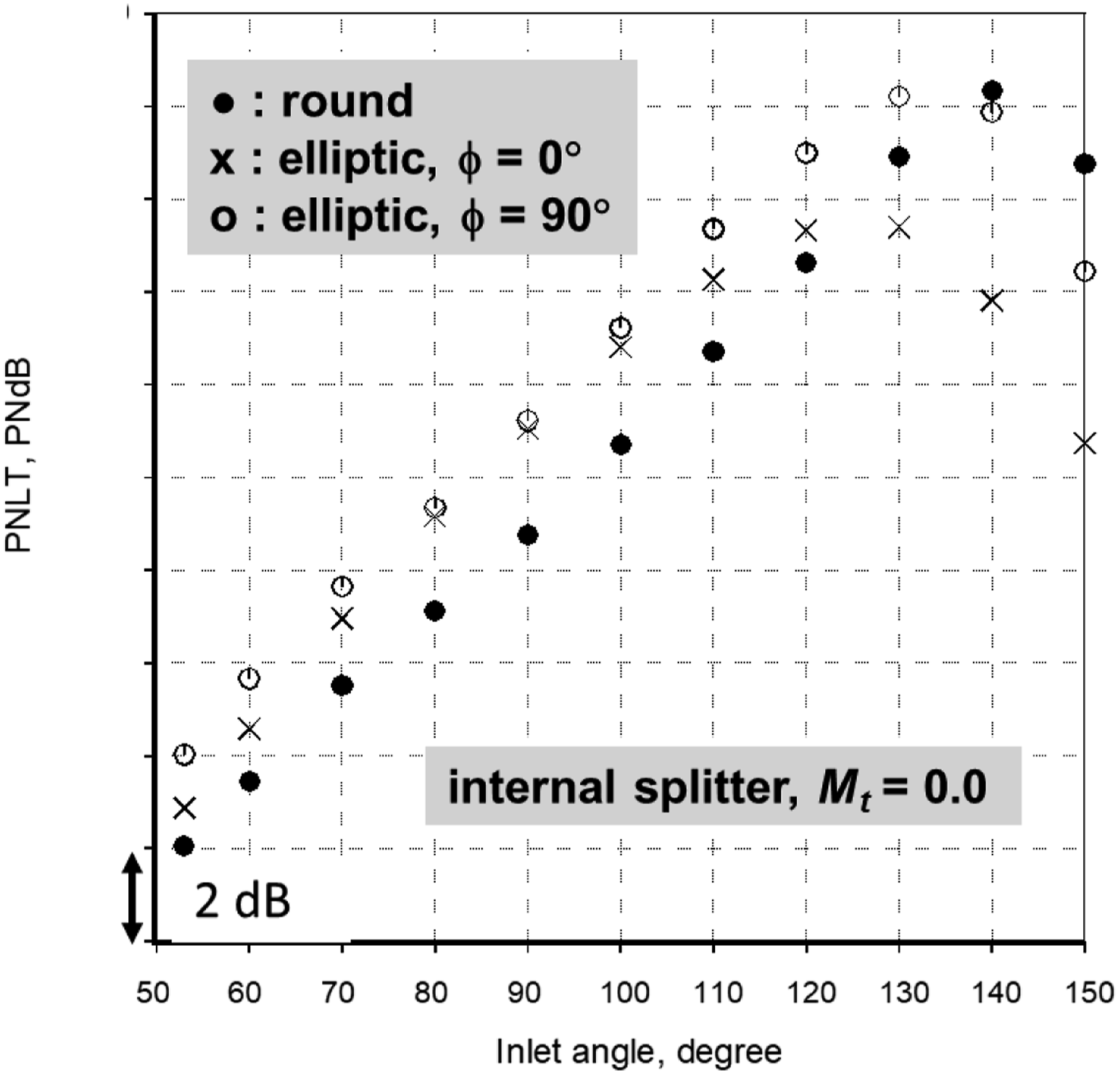

The trends for the internal lobed mixer are different: there is a reduction of 1.1 EPNdB at ϕ = 0° at the highest power, with progressively decreasing benefit as the power setting becomes lower. There is a clear increase in level at all power settings at ϕ = 90°. The main results for the static cases may be summarized as: (1) there is a large EPNL benefit > ∼3.0 EPNdB for the internal splitter at ϕ = 0°; (2) there is a small benefit at maximum power for the internal lobed mixer at ϕ = 0°; this benefit disappears at lower power; and (3) there is an increase in EPNL at ϕ = 90° for the lobed mixer.
All engine exhausts with long ducts incorporate internal mixers: JT-8D, BR-715, RB-211-524 G/H, Trent 700, Rolls Royce F130, etc. There is no net noise benefit for an elliptic nozzle for most engine operating conditions. If the nozzle is mounted such that the major axis is parallel to the ground (longer dimension parallel to the ground), then there is a noise increase at all engine power settings. The nozzle pressure ratios of modern engines are much lower than those for older engines. As seen here, there is a noise increase at all azimuthal angles at lower pressure ratios, even under static conditions.
Effect of forward flight
Spectral characteristics of round and elliptic nozzles: Internal splitter
It is essential to assess the noise reduction potential of any concept in the presence of forward flight because experience tells us that any benefit under static conditions is drastically reduced or even absent with the addition of a flight stream. We first examine and quantify the flight effect for the baseline and elliptic nozzles at a flight Mach number (M
t
) of 0.3. A sample test case, with NPR
p
= 1.98, T
p
/T
a
= 2.71, NPR
s
= 1.85, T
s
/T
a
= 1.26 is considered in Figure 22(a)–(c). Spectral comparisons, with the internal splitter nozzle, is shown for the round and elliptic nozzles at ϕ = 0° and ϕ = 90°. For the round nozzle, there is a uniform reduction of ∼4 dB across the spectrum at 70° and at the lower polar angles (not shown). As we move to aft angles, there is a substantial reduction of ∼8 dB to ∼10 dB at all the frequencies. For the elliptic nozzle at ϕ = 0°, the reduction drops to ∼2 dB at 70°. More interesting changes are observed at large aft angles. At the lower frequencies to the left of the spectral peak, reductions of ∼8 dB still persist; however, there is a drastic drop in the magnitude of noise reduction due to forward flight at the higher frequencies. At aft angles, there is virtually no reduction in levels at the higher frequencies. Recall that a seventh scale model nozzle is used here. The maximum annoyance penalty is imposed for the full-scale frequency range of 1 kHz to 5 Hz; the corresponding model scale frequency range is from 7 kHz to 35 kHz. There is no flight effect at ϕ = 0° in Figure 22, for precisely this frequency range! This is not good news, as most of the noise reduction in PNL for the static case is observed at large aft angles, see Figures 15–18. At ϕ = 90°, Figure 22(c), the large reductions seen for the round nozzle are again observed. Similar trends with forward flight at ϕ = 0° and ϕ = 90° are observed at other jet operating conditions (not shown). Thus, there is a major difference in the effect of forward flight at different azimuthal angles for an elliptic nozzle. This result is highlighted in Figure 23, with presentation of azimuthal variation; the jet operating conditions are NPR
p
= 1.98, T
p
/T
a
= 2.71, NPR
s
= 1.85, T
s
/T
a
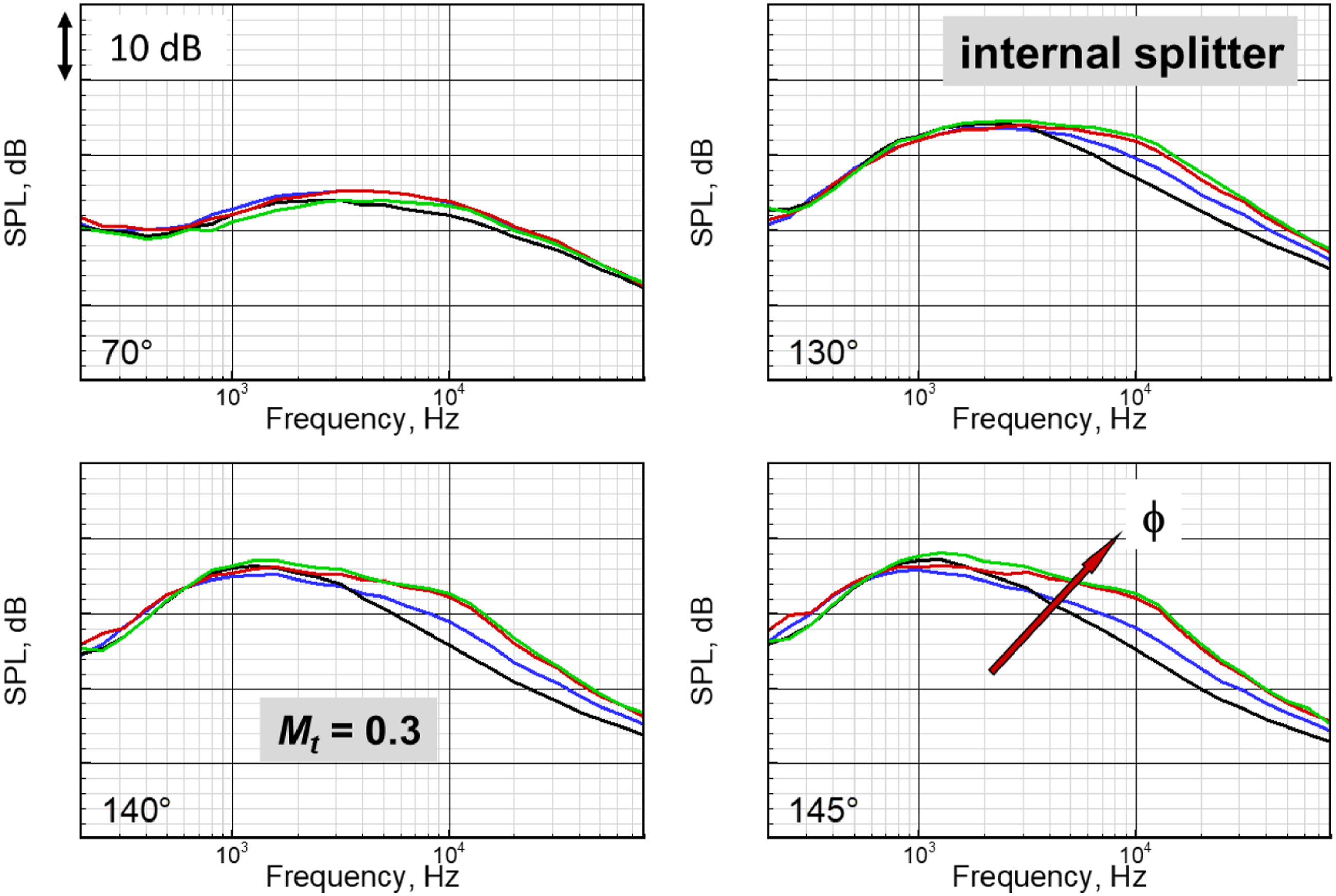
= 1.26. The azimuthal variation for the same test case under static conditions was presented in Figure 7. As for the static case, (1) there are only minor variations at 70°, and (2) at aft angles, there is negligible variation at the lower frequencies to the left of the spectral peak. However, in contrast to the ∼10 dB to ∼15 dB azimuthal variation at the higher frequencies at the aft angles for the static case, there is only ∼3 to ∼5 dB azimuthal variation for the wind-on case. Effect of forward flight on noise. Internal splitter, NPR
p
= 1.98, T
p
/T
a
= 2.71, NPR
s
= 1.85, T
s
/T
a
= 1.26. Azimuthal variation for elliptic nozzle with splitter. M
t
= 0.3. NPR
p
= 1.98, T
p
/T
a
= 2.71, NPR
s
= 1.85, T
s
/T
a
= 1.26. Black: ϕ = 0°; blue: ϕ = 30°; red: ϕ = 60°; green: ϕ = 90°.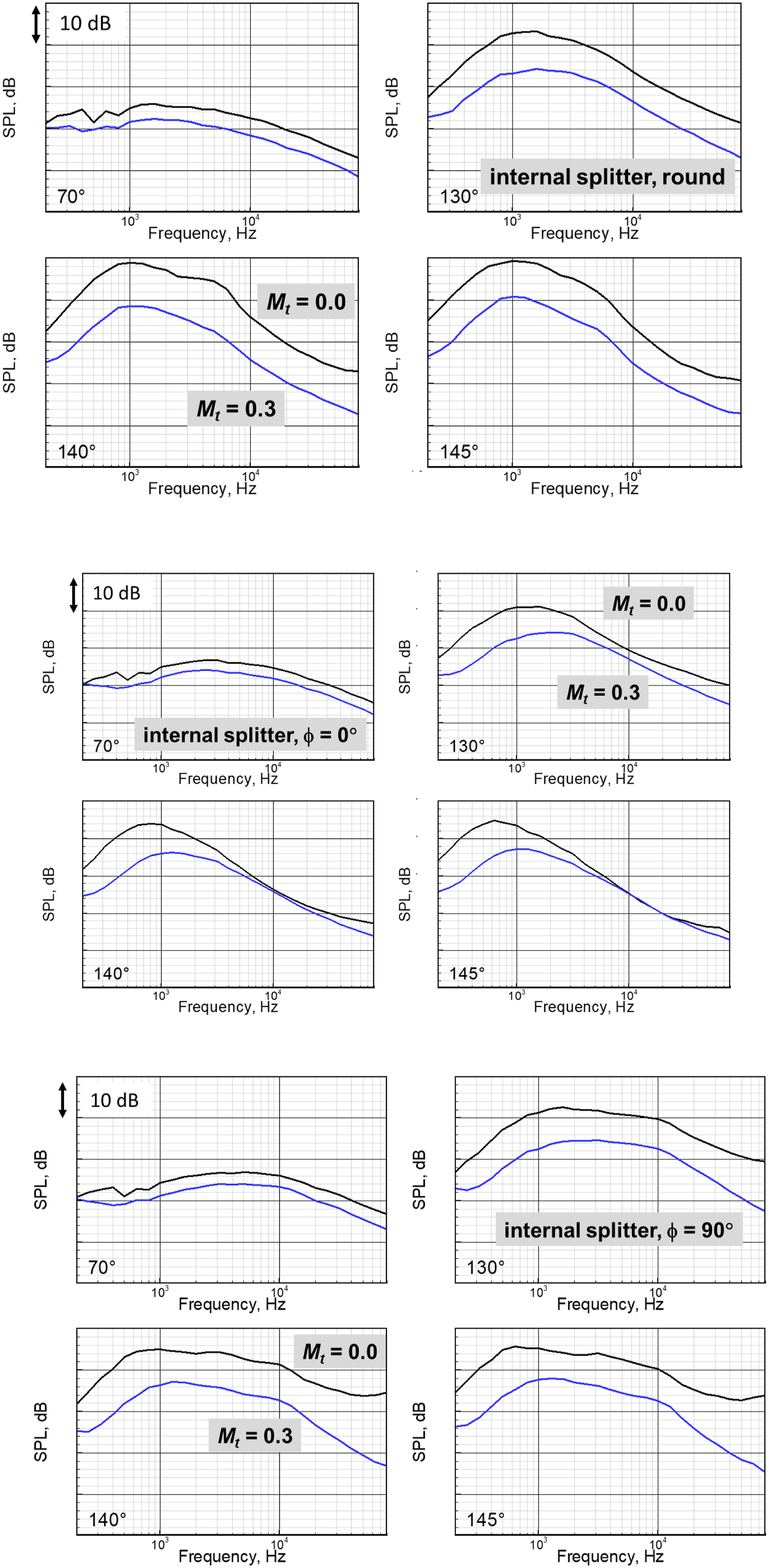
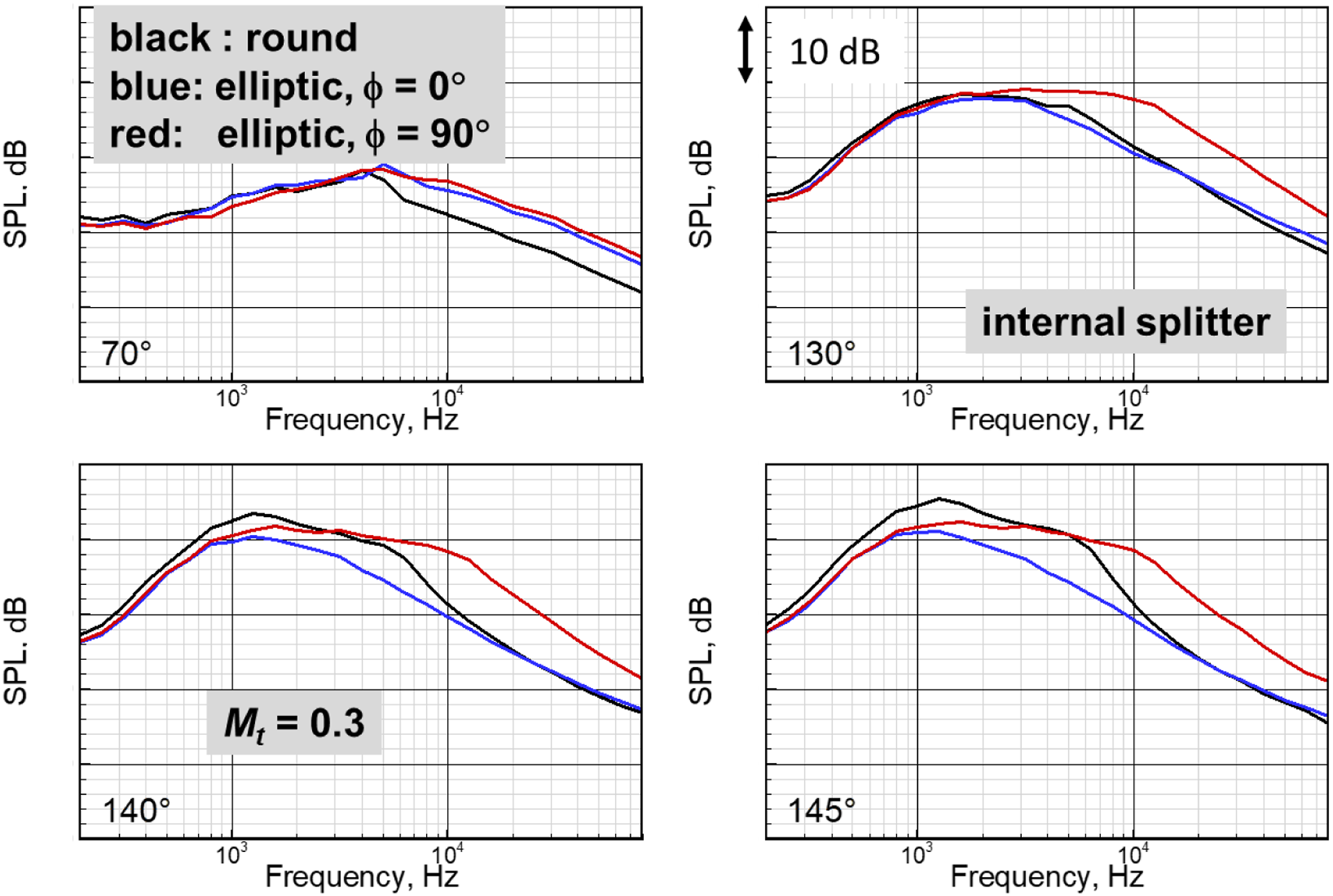
The noise reduction potential of the elliptic nozzle with an internal splitter, with forward flight Mach number of 0.3, is examined at two different jet conditions: (1) NPR
p
= 1.98, T
p
/T
a
= 2.71, NPR
s
= 1.85, T
s
/T
a
=1.26; and (2) NPR
p
= 2.19, T
p
/T
a
= 2.91, NPR
s
= 1.99, T
s
/T
a
= 1.3. As before, spectral comparisons with the round nozzle are shown in Figures 24 and 25, respectively. Similar comparisons under static conditions were presented in Figures 9 and 10. As for the static case, there is a pronounced increase in the high frequency levels at ϕ = 90°. At ϕ = 0°, there is a big difference between the static and flight cases. The large reduction seen at all the frequencies for the lower power is more or less missing and there is even a slight increase in levels at the higher frequencies. At the higher power, there is negligible change at 130° and only a small reduction of ∼3 to ∼4 dB at the lower frequencies and no change in spectral levels at the higher frequencies. In contrast, there is a large ∼10 dB reduction across the entire peak and high frequency regime for the static case. Thus, there is a substantial reduction in noise benefit when a forward flight stream is introduced. Spectral comparison of round and elliptic nozzles, with splitter. M
t
= 0.3. NPR
p
= 1.98, T
p
/T
a
= 2.71, NPR
s
= 1.85, T
s
/T
a
= 1.26. Black: round; blue: elliptic, ϕ = 0°; red: elliptic, ϕ = 90°. Spectral comparison of round and elliptic nozzles, with splitter. M
t
= 0.3. NPR
p
= 2.19, T
p
/T
a
= 2.91, NPR
s
= 1.99, T
s
/T
a
= 1.3. Black: round; blue: elliptic, ϕ = 0°; red: elliptic, ϕ = 90°.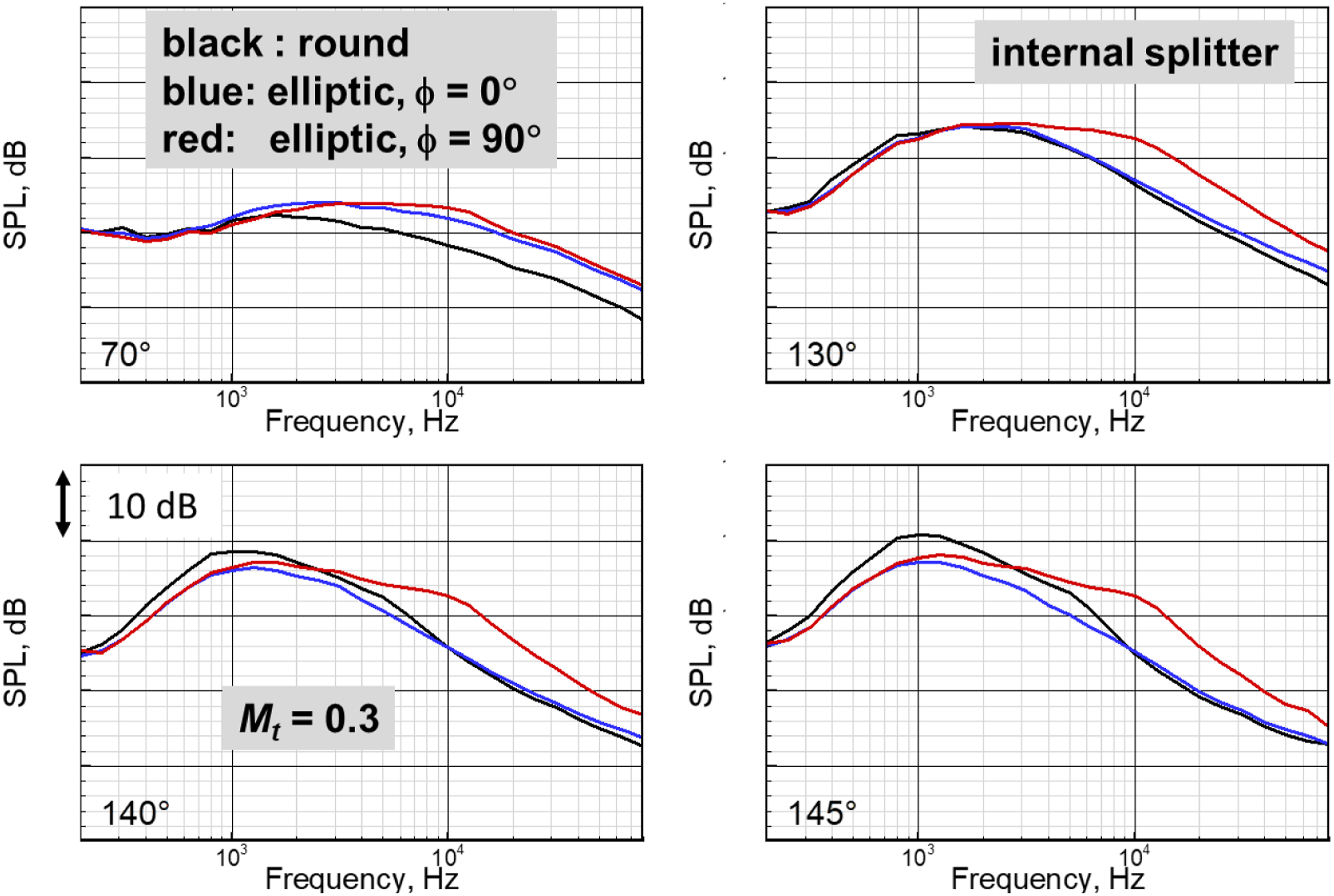
Spectral characteristics of elliptic nozzles: Internal mixer
Next we consider the internal lobed mixer and examine the azimuthal variation in Figure 26; the jet operating conditions are NPR
p
= 1.98, T
p
/T
a
= 2.71, NPR
s
= 1.85, T
s
/T
a
= 1.26. There are only minor variations at 70°. At aft angles, there is negligible variation at the lower frequencies to the left of the spectral peak; at the higher frequencies, there is a ∼3 dB noise increase from ϕ = 0° to ϕ = 90°. The noise reduction potential with an internal mixer is assessed in Figures 27 and 28. The jet operating conditions are again (1) NPR
p
= 1.98, T
p
/T
a
= 2.71, NPR
s
= 1.85, T
s
/T
a
= 1.26; and (2) NPR
p
= 2.19, T
p
/T
a
=2.91, NPR
s
= 1.99, T
s
/T
a
= 1.3, and M
t
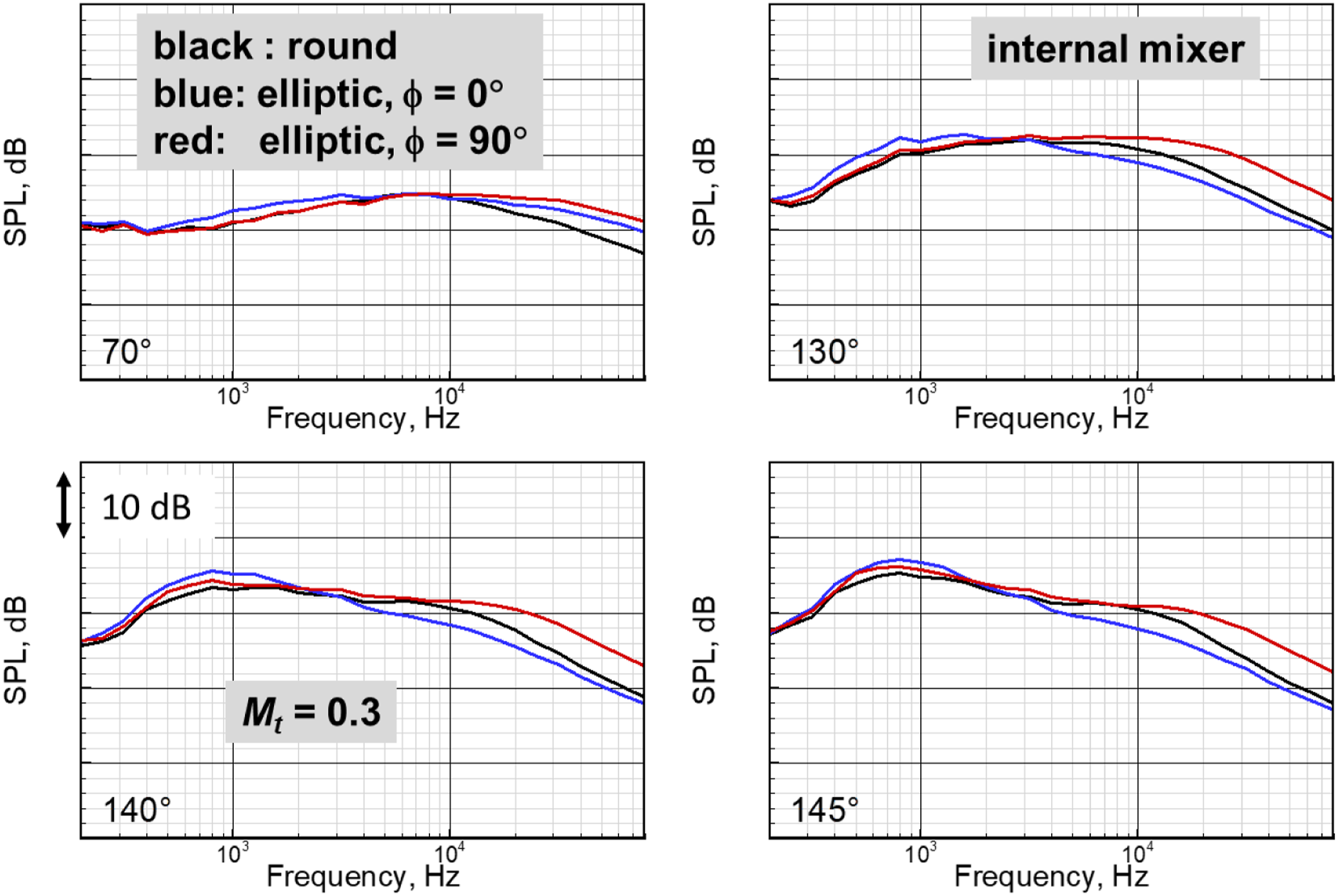
= 0.3. Even at the aft angles, there is only a minor benefit at the higher frequencies at ϕ = 0°. However, there is a slight increase at the spectral peak which would probably offset the small benefit at the higher frequencies. There is perhaps no benefit due to the elliptic nozzle for realistic nozzle geometry and with forward flight. Azimuthal variation for elliptic nozzle with mixer. M
t
= 0.3. NPR
p
= 1.98, T
p
/T
a
= 2.71, NPR
s
= 1.85, T
s
/T
a
= 1.26. Black: ϕ = 0°; blue: ϕ = 30°; red: ϕ = 60°; green: ϕ = 90°. Spectral comparison of round and elliptic nozzles, with mixer. M
t
= 0.3. NPR
p
= 1.98, T
p
/T
a
= 2.71, NPR
s
= 1.85, T
s
/T
a
= 1.26. Black: round; blue: elliptic, ϕ = 0°; red: elliptic, ϕ = 90°. Spectral comparison of round and elliptic nozzles, with mixer. M
t
= 0.3. NPR
p
= 2.19, T
p
/T
a
= 2.91, NPR
s
= 1.99, T
s
/T
a
= 1.3. Black: round; blue: elliptic, ϕ = 0°; red: elliptic, ϕ = 90°.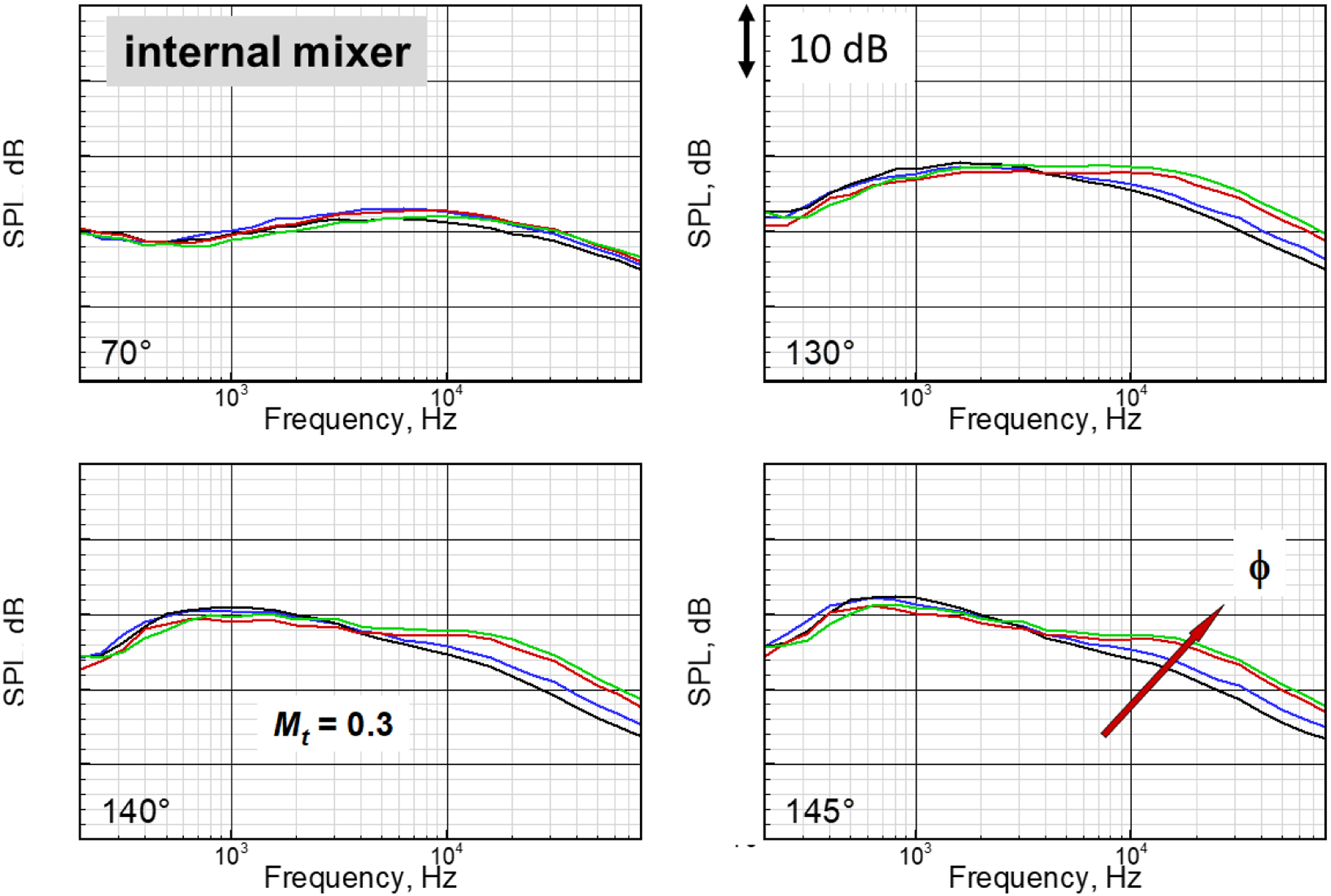

Effect of elliptic nozzles on noise metrics: Internal splitter and mixer
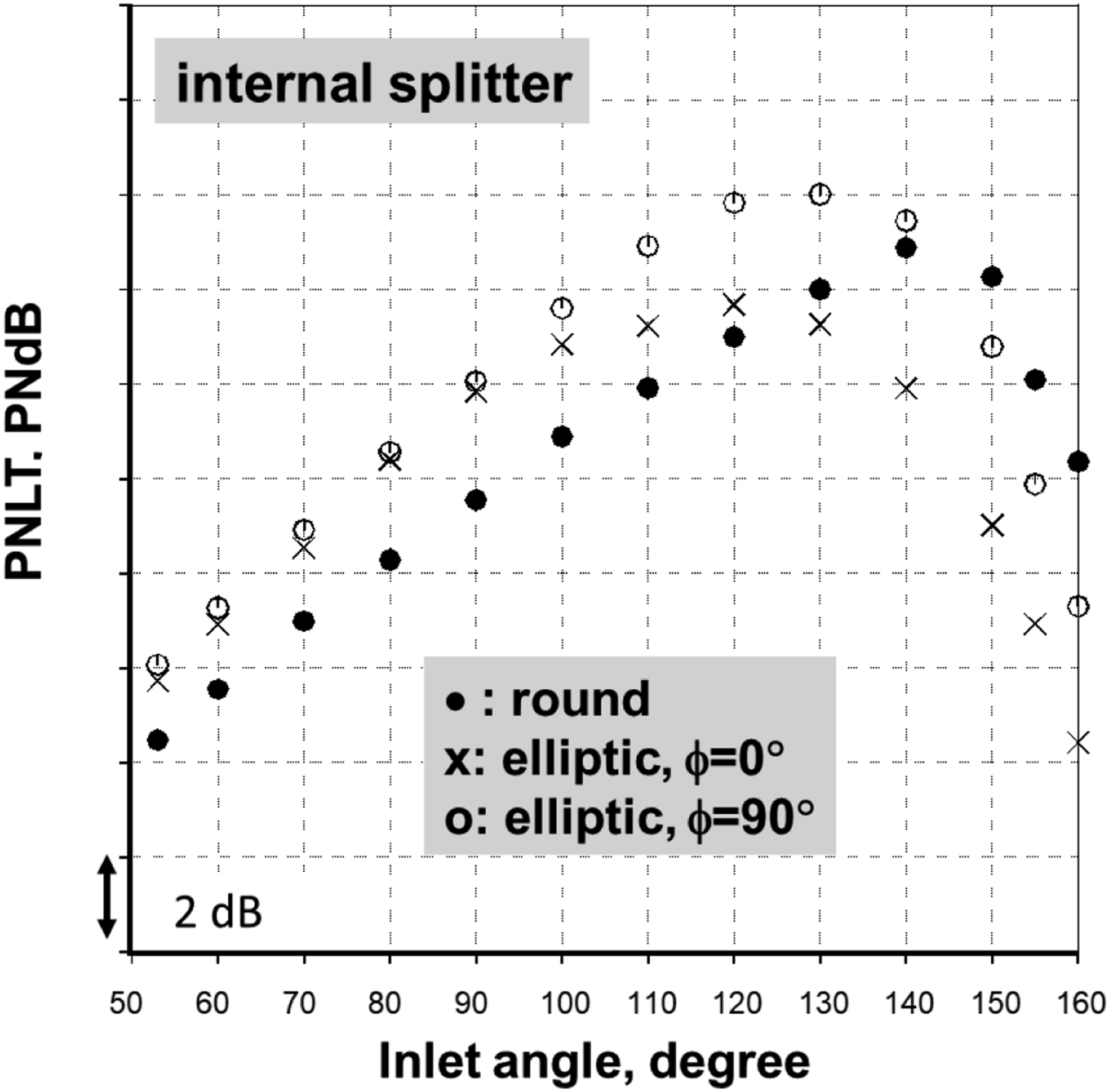
The net noise change due to the elliptic nozzle is evaluated through examination of the directivity of perceived noise level. The directivities of the PNL for the round and elliptic nozzles with the internal splitter are shown in Figures 29 and 30; the jet operating conditions are NPR
p
= 1.8, T
p
/T
a
= 2.56, NPR
s
= 1.71, T
s
/T
a
= 1.22 and NPR
p
= 2.19, T
p
/T
a
= 2.91, NPR
s
= 1.99, T
s
/T
a
= 1.3, respectively. At both operating conditions, there is an increase in the PNL at all the lower angles and up to ∼130° for the elliptic nozzle at both ϕ = 0° and ϕ = 90°. At larger aft angles, there is a reduction of ∼2 to ∼3 PNdB at ϕ = 0° relative to the baseline round nozzle for the lower power. The magnitude of the noise reduction is slightly larger for maximum takeoff power. The net change in EPNL is +0.3 EPNdB and −2.4 EPNdB, respectively, for the two power settings. Directivity of perceived noise level, internal splitter. M
t
= 0.3. NPR
p
= 1.8, T
p
/T
a
= 2.56, NPR
s
= 1.71, T
s
/T
a
= 1.22. Directivity of perceived noise level, internal splitter. M
t
= 0.3. NPR
p
= 2.19, T
p
/T
a
= 2.91, NPR
s
= 1.99, T
s
/T
a
= 1.3.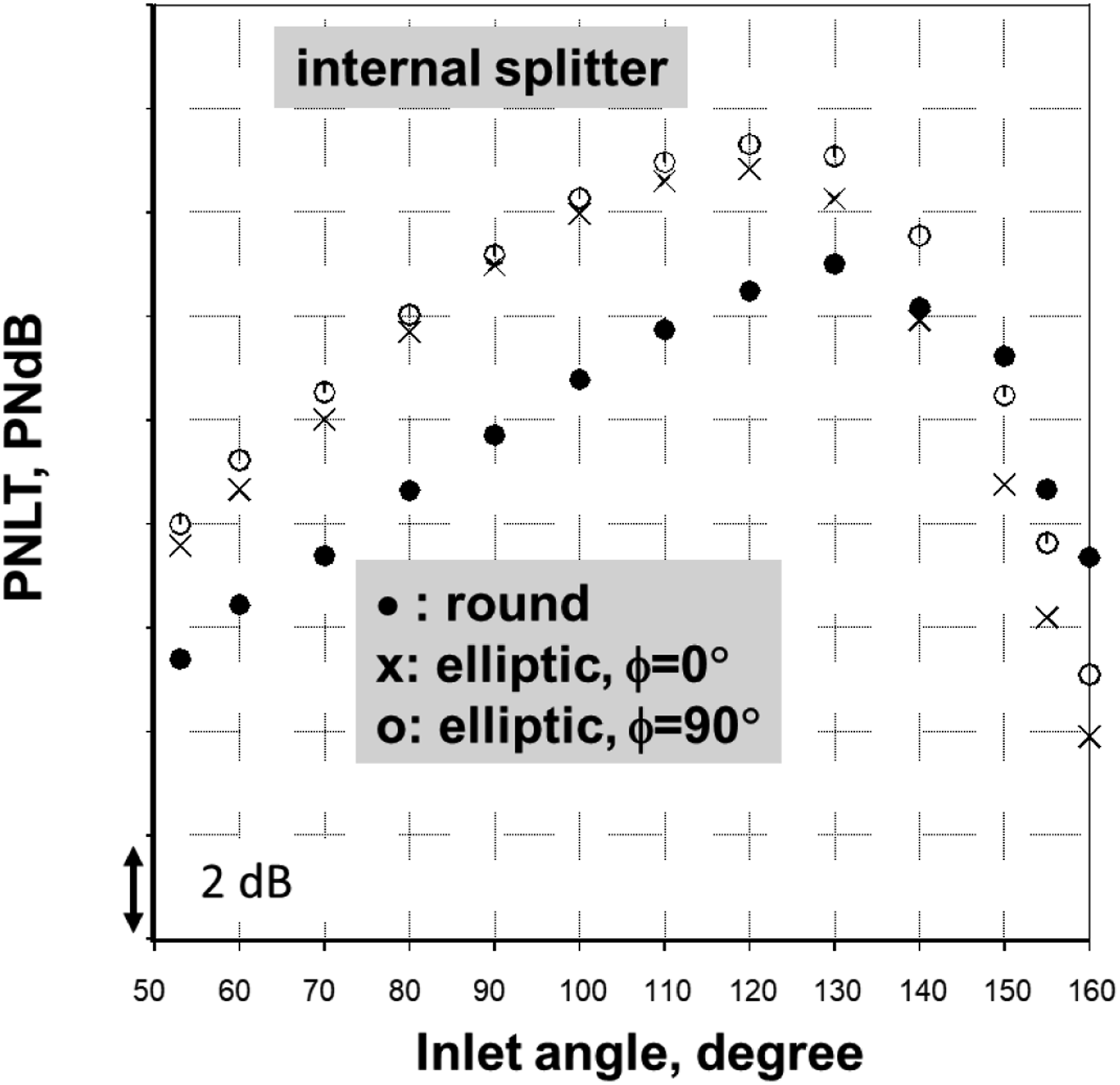
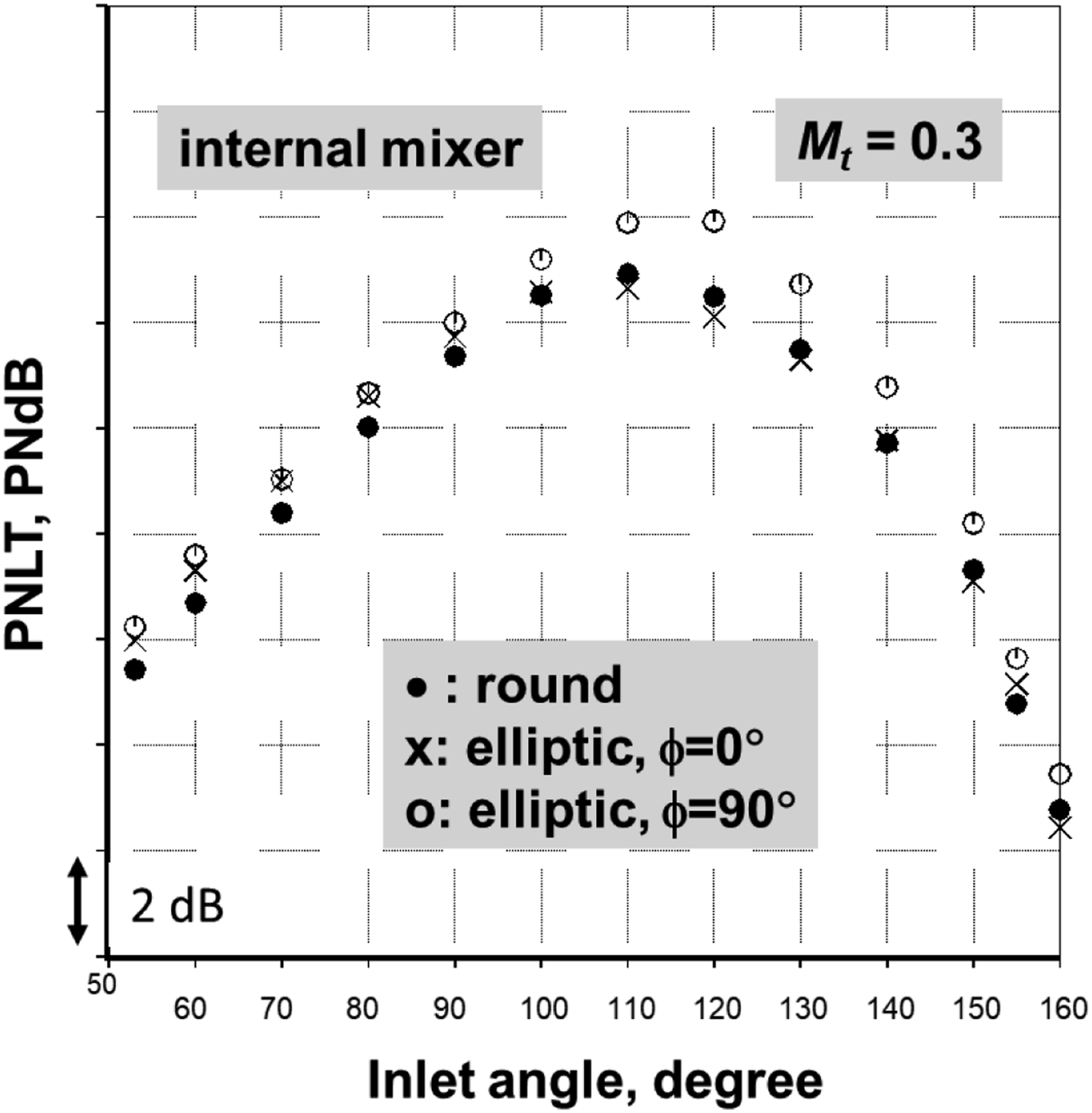
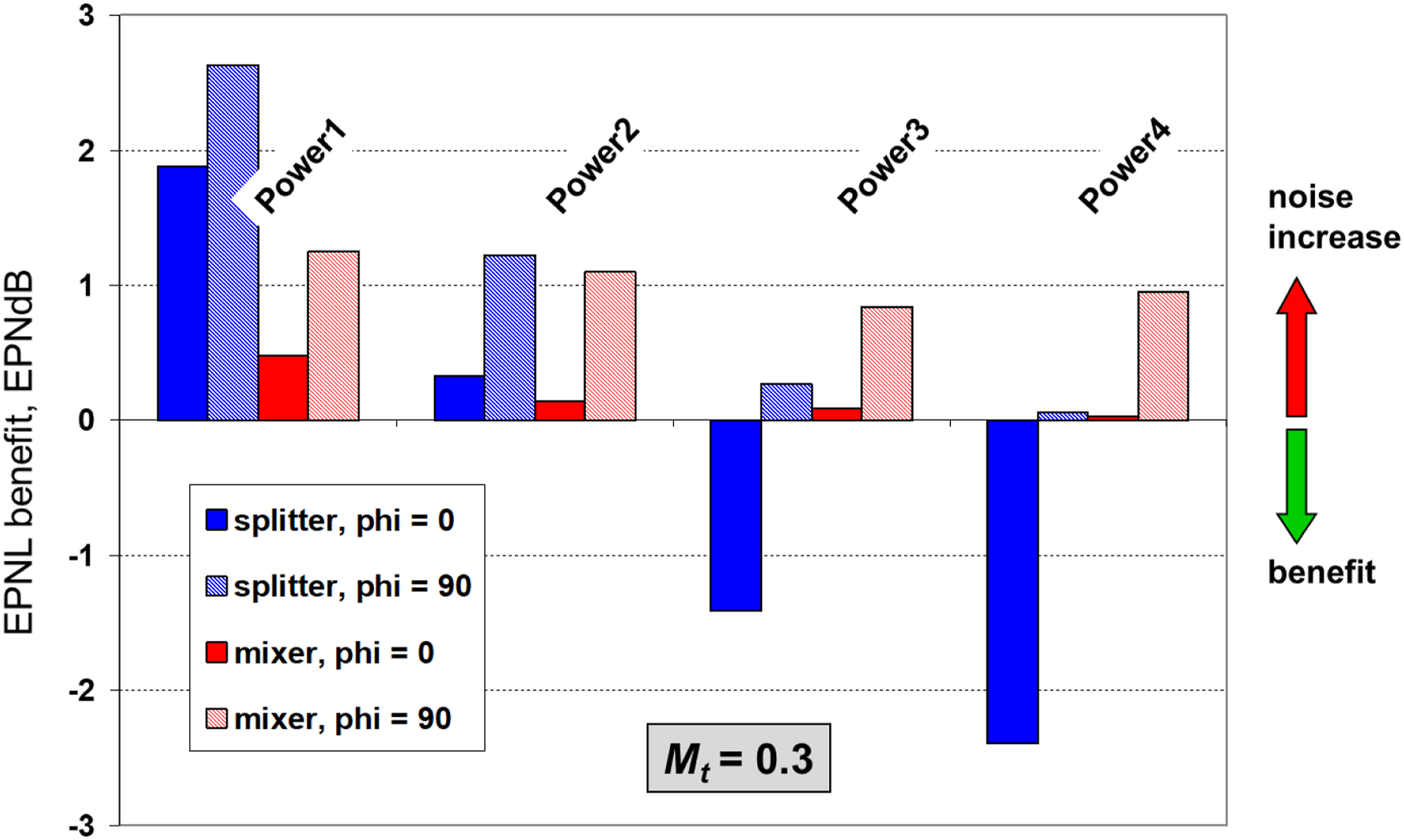
Comparable directivities of PNL for the internal lobed mixer are shown in Figures 31 and 32, at the same power settings as for the internal splitter. The trends are markedly different: the increase in level at the lower polar angles is much smaller in magnitude and the noise benefit at large aft angles is mostly absent even at ϕ = 0°. Thus, the noise benefit mostly disappears with the addition of an internal lobed mixer, which represents a more realistic geometry of several engines in service. A composite plot of the relative change in EPNL level at four power settings is shown in Figure 33. Blue represents the internal splitter and red represents the internal lobed mixer; the solid bars correspond to ϕ = 0° and the bars with the slanted lines correspond to ϕ = 90°. Powers 2 and 4 are the same as those shown in Figures 31 and 32, and the engine settings for Power 1 and Power 3 are (1) NPR
p
= 1.7, T
p
/T
a
= 2.45, NPR
s
= 1.63, T
s
/T
a
= 1.19, and (2) NPR
p
= 1.98, T
p
/T
a
= 2.71, NPR
s
= 1.85, T
s
/T
a
= 1.26, respectively. There is an EPNL benefit for the splitter at the higher two power settings at ϕ = 0°. Otherwise, there is noise increase for all other cases. For the internal lobed mixer, there is a net increase in EPNL at both azimuthal angles for all power settings. Thus, the EPNL benefit obtained at static conditions is either completely reversed for the internal mixer or greatly diminished for the internal splitter, with the addition of forward flight. There is generally no noise benefit for jets with lower subsonic velocities (lower power setting). The importance of evaluating the noise reduction potential with forward flight for any concept is highlighted once again. As seen here, static results tend to magnify the noise benefit and could be highly misleading for practical applications. Directivity of perceived noise level, internal mixer. M
t
= 0.3. NPR
p
= 1.8, T
p
/T
a
= 2.56, NPR
s
=1.71, T
s
/T
a
= 1.22. Directivity of perceived noise level, internal mixer. M
t
=0.3. NPR
p
=2.19, T
p
/T
a
=2.91, NPR
s
=1.99, T
s
/T
a
=1.3. Change in EPNL at four power settings. M
t
= 0.3.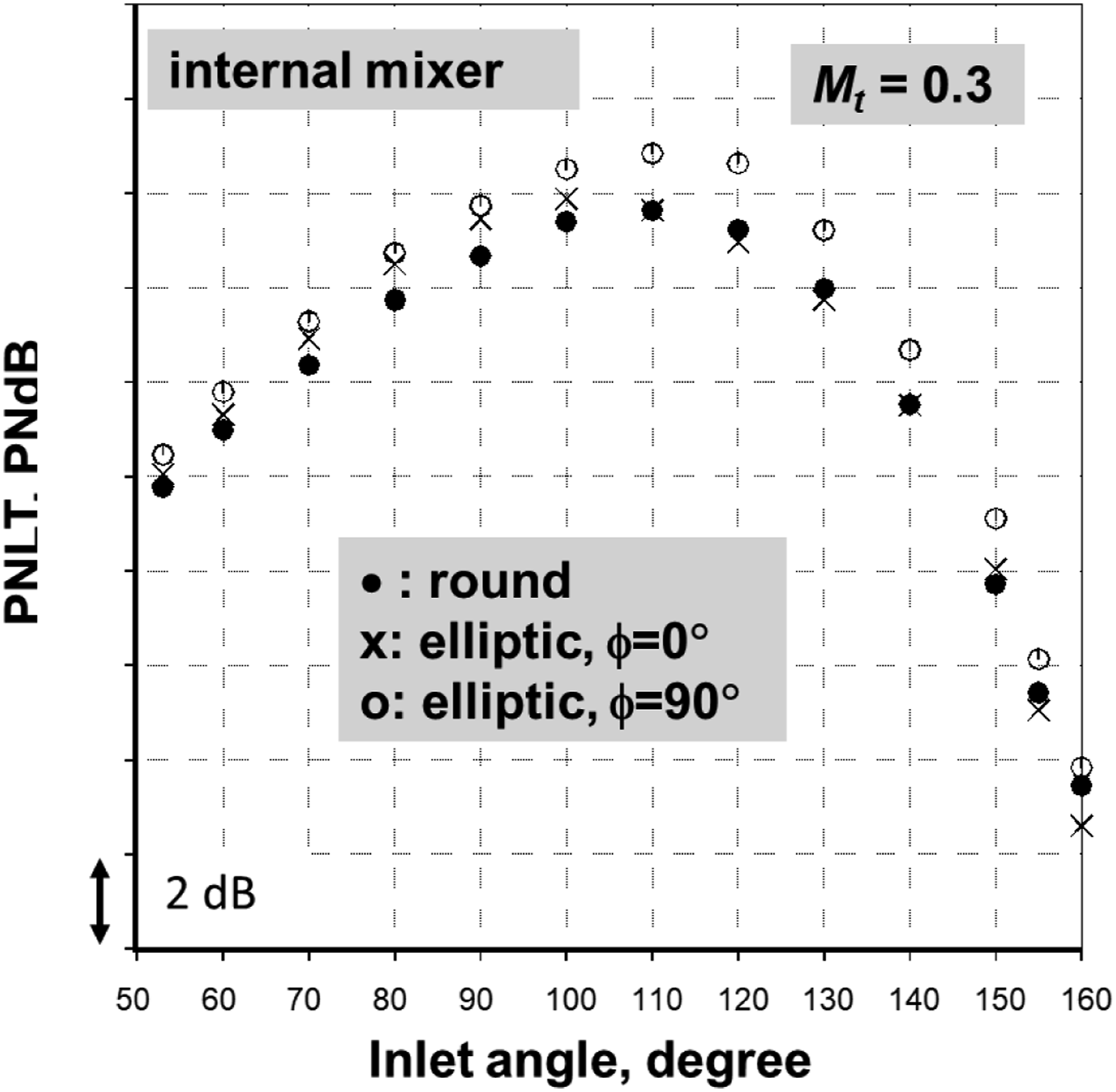
Summary
The acoustic characteristics of an elliptic compound nozzle that represents the geometry of a low bypass ratio (BPR) turbofan engine is investigated in this study. The aspect ratio of the nozzle system is 2.0. The aeroacoustic characteristics are established at realistic engine cycle conditions, statically and in the presence of a flight stream. The results are compared with a round compound nozzle with the same internal geometry, so as to assess the acoustic benefit, if any, of the elliptic nozzle. The emphasis here is to verify the applicability of elliptic nozzles for practical aircraft installation. Both a simple internal splitter and a realistic lobed mixer have been considered. There are some superficial similarities between elliptic and beveled nozzles; however, it is shown that the noise characteristics are very different. All the noise measurements in the past from non-circular geometry have been under static conditions and this is the first study to report on flight effects for elliptic nozzles.
The elliptic nozzle introduces azimuthal asymmetry even for an unheated jet; the magnitude of azimuthal variation is ∼3 dB and is confined to the higher frequencies at large aft angles. Typically, the lowest level of noise is observed towards the narrow side of the elliptic nozzle (ϕ = 0°); the noise level gradually increases and reaches a maximum towards the broader side of the elliptic nozzle (ϕ = 90°). The change in OASPL for the elliptic nozzle is within ±1.0 dB of the levels for the round nozzle at all azimuthal angles, for an unheated jet.
The azimuthal variation for the elliptic nozzle with an internal splitter is very different for a heated jet. As for the unheated jet, there are only minor variations at 70° and at the lower polar angles. But there are dramatic differences in the peak radiation sector: between ∼10 dB and ∼15 dB over the entire high frequency regime. Surprisingly, there is virtually no change in spectral level at the lower frequencies and up to the spectral peak. The azimuthal variations are very pronounced for the heated jet at aft angles. The introduction of an internal lobed mixer reduces the magnitude of the azimuthal variation at the higher frequencies at large aft angles: from ∼10 to 15 dB to ∼4–8 dB.
For both elliptic and beveled nozzles, there is noise benefit in the azimuthal direction of ϕ = 0° at large aft angles; the magnitude of the noise benefit also increases with jet velocity (engine power). However, there are also distinct differences, which become apparent from a spectral analysis. The spectral shapes for the beveled nozzle have the following characteristics: at ϕ = 0°, the measured spectra start deviating from the broad similarity shape (FSS) at a polar angle of ∼120° and a peaky similarity shape (LSS) shape is observed at a polar angle of 130°. As we go around the periphery of the beveled nozzle to an azimuthal angle of 90°, the LSS shape is seen for the spectra at a polar angle of 125° and higher. At an azimuthal angle of 180°, the spectral characteristics are dramatically different from that for the round nozzle. Even at 90° there is a slight hump near the peak; at 100° this hump is more pronounced and there is major deviation from the FSS shape. The most surprising feature is the observation of the LSS shape for the measured spectra at a polar angle of 110°.
For the elliptic nozzle the following characteristics are observed: there is a shift to the LSS shape at ϕ = 0° at a polar angle of ∼125°; the rate of change to the LSS shape, however, is only slightly faster than that for the round nozzle. The most drastic difference is seen at ϕ = 90°: there is inhibition of the change in spectral shape and the FSS shape is retained up to 130° for the elliptic nozzle. In contrast, there is a progressive shift to the LSS shape at lower polar angles as the azimuthal angle varies from ϕ = 0° to ϕ = 180° for the bevel nozzle. Therefore, the azimuthal variations introduced by the elliptic and beveled nozzles are radically different in spite of the superficial resemblance between the two geometries. The prevention or delay of the spectral shape transition at ϕ = 90° would result in the broader side being louder than the narrow side for an elliptic nozzle.
Under static conditions, the following spectral characteristics for the elliptic nozzle, relative to a round nozzle, are observed: (1) there is increase in level at the higher frequencies at the lower polar angles for both the internal splitter and lobed mixer at all power settings and at all azimuthal angles; (2) at aft angles, there are drastic azimuthal variations: large reduction across a wide range of high frequencies at ϕ = 0° and a large increase across a wide range of high frequencies at ϕ = 90°; (3) the magnitude of this azimuthal change, whether decrease at ϕ = 0° or increase at ϕ = 90°, is much smaller for the lobed mixer than for the internal splitter; (4) for the internal splitter, there is a large benefit in EPNL, ∼3 to ∼4 EPNdB at ϕ = 0°, and a smaller reduction of ∼1 EPNdB at ϕ = 90°; (5) for the internal mixer at ϕ = 0°, there is a small reduction of ∼1 EPNdB for the highest power with supercritical nozzle pressure ratios and virtually no reduction at lower power settings; and (6) for the internal mixer at ϕ = 90°, there is a net increase in EPNL at all power settings.
The effects of forward flight are very different at the aft angles for the elliptic nozzle at ϕ = 0°, when compared with those for the round nozzle and the elliptic nozzle at ϕ = 90°. Unlike nearly uniform reduction of ∼10 dB across the spectra for the round nozzle for M t = 0.3, there is no reduction from the mid to high frequencies for the elliptic nozzle at ϕ = 0°. This absence of reduction in level in the precise full-scale frequency range for which there is maximum annoyance penalty has the undesirable effect of decreasing or eliminating the EPNL benefit observed under static conditions. For the internal splitter at ϕ = 0°, a benefit in EPNL of 2.4 EPNdB is observed for the highest power setting; this benefit gradually diminishes with lower power and eventually becomes a net increase. There is a clear increase in EPNL for the splitter at ϕ = 90° and for the internal lobed mixer at all azimuthal angles. Thus, the elliptic nozzle with low aspect ratio of 2.0 does not provide any EPNL benefit for the realistic nozzle geometry of commercial engines and therefore does not seem to be a viable concept for noise reduction. Even though the thrust performance of the various geometries has been concurrently measured, these results have not been presented here because there is no acoustic benefit.
It is obvious once again that any noise benefit observed under static conditions is not realistic, as the benefit usually does not hold up under the effect of forward flight. Proper evaluation of noise reduction concepts is necessary to avoid being misled by any noise reduction potential evident in static tests, especially from non-representative and simplified geometries.
Footnotes
Declaration of conflicting interests
The author declared no potential conflicts of interest with respect to the research, authorship, and/or publication of this article.
Funding
The author(s) received no financial support for the research, authorship, and/or publication of this article.
