







Abstract
This study investigates the effects of nozzle-plate spacing and nozzle pressure ratio (NPR) on the noise characteristics of both free and impinging jets through wind tunnel experiments. For free jets, the results show that when 2.05 < NPR <2.84, the far-field noise overall sound pressure level (OASPL) is stronger in the downstream direction. However, for NPR >2.84, the OASPL in the midstream direction exceeds that in the downstream direction, mainly due to the attenuation of turbulent mixing noise and the increase in broadband shock-associated noise. The free jet noise spectrum also exhibits two main discrete tones and their harmonics, with the transition attributed to the gradual formation of shock cell structures interacting with large-scale vortex structures. For impinging jets, the far-field noise in the upstream direction is similar to that of free jets when 2.89 < NPR <3.1, but midstream and downstream noise levels decrease. This is primarily due to the inclined plate transforming the turbulent mixing region in the fifth and sixth shock cells of the free jet into two distinct regions. One region, located downstream of the plate, generates noise that primarily radiates upstream, while the other is situated in the turbulent mixing zone of the wall jet. Additionally, the primary source region of the screech tone is near the upper edge of the strong vorticity region at the third shock cell, with the second and third harmonics originating from the strong vorticity regions at the fourth and fifth shock cells. The discrete tone at 3737 Hz corresponds to the position where the strong vorticity region on the side of the inclined plate along the flow direction (SVRiP-FD) fully merges with the upper edge of the strong vorticity region at the fifth shock cell.
Keywords
Introduction
Supersonic impinging jets are widely encountered in rocket launches and in the takeoff and landing of carrier-based aircraft.1–4 The associated noise generation is often modeled by simplifying the sound source as the interaction between a supersonic jet and a flat plate or an inclined plate.5–8 The aeroacoustics of supersonic impinging jets can be decomposed into free-jet noise and impingement noise. In general, supersonic jet noise mainly consists of turbulent mixing noise, broadband shock-associated noise (BBSAN), and screech tones.9,10 Turbulent mixing noise is generated by the unsteady turbulent shear layer and typically dominates at downstream angles, whereas BBSAN arises from the stochastic interaction between large-scale turbulence and the quasi-periodic shock-cell structure, producing broadband humps with strong directivity. Importantly, both BBSAN and screech are characteristic of imperfectly expanded supersonic jets; they occur primarily when the jet is under-expanded or over-expanded, where a shock-cell system exists in the near field, and they are weak or absent near perfectly expanded conditions. Screech is a discrete-peak component superimposed on the broadband spectrum and is commonly interpreted as a self-sustained resonance in which downstream-traveling hydrodynamic disturbances and upstream-traveling acoustic waves close a feedback loop.
In free jets, screech tone has been extensively documented and is generally attributed to a feedback-loop mechanism.11,12 Powell 13 identified four discrete frequency stages (A-D) in a round jet. Davies and Oldfield14,15 were the first to use two microphones placed on either side of the jet to characterize the modes: A1 and A2 as axisymmetric, B as sinuous, and C as helical. However, mode D resisted classification. Sinibaldi et al. 16 reported that the dominant sound sources for the lateral and helical modes are located near the downstream edge of the third and fourth shock cells. In impinging jets, the plate acts as a physical edge, allowing pressure fluctuations from the impingement region to propagate upstream and excite the nozzle-lip shear layer, thereby sustaining or modifying the screech tones.
Compared with free jets, impinging jets exhibit more complex flow structures and noise compositions. Romain et al.
17
confirmed the presence of a feedback loop between the nozzle and the plate, which leads to the coexistence of multiple discrete tones and acoustic standing waves. When Abhijit et al.
18
explained the flow and acoustic variations induced by jets impinging on inclined plates, they found that the reduction or enhancement of acoustic radiation depends on the measurement location and the nozzle pressure ratio (NPR). To better illustrate the effect of NPR on the underlying flow field, Figure 1 presents a schematic representation of the time-averaged velocity fields obtained using particle image velocimetry (PIV), clearly illustrating how the formation of shock cells within the potential core of a free jet evolves with increasing NPR.
19
Experimental results from Henderson et al.
20
indicate that jet instability is influenced by the location of the plate within the shock cell structure of the corresponding free jet and the strength of the standoff shock wave, rather than by the occurrence of recirculation zones in the impingement region. Since tonal emission is governed by resonance closure, it is intrinsically sensitive to near-field boundary conditions. Raman
21
emphasized the role of the near-field acoustic environment in screech tone, and Morata and Papamoschou
22
demonstrated that variations in external nozzle geometry can significantly alter screech tone. These results collectively suggest that the impingement surface should be treated as an active element of the feedback environment rather than a passive receiver. Schematic illustration of PIV mean velocity fields in impinging jet under various NPR.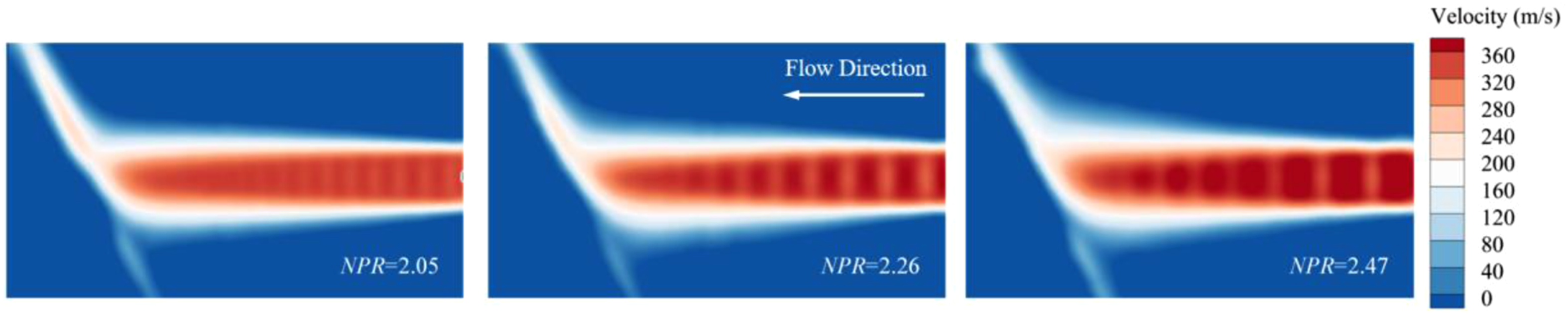
Despite these advances, it remains unclear how, for supersonic jets impinging on inclined plates, the dominant screech tone-related source regions and associated flow features evolve with NPR and nozzle-plate spacing (L/d), and how the feedback environment can be perturbed in a controlled manner. Accordingly, the present study systematically varies NPR and L/d to identify operating conditions that minimize screech tone radiation and to locate the primary acoustic source regions and correlated flow structures.
In parallel, most noise-mitigation efforts have concentrated on nozzle-side modifications intended to enhance mixing or disrupt large-scale coherence, such as V-gutter nozzles or serrated nozzles. By contrast, comparatively less attention has been paid to modifying the impingement surface itself for noise reduction. Dhamanekar and Srinivasan 23 experimentally studied the impact of surface roughness on impinging jet noise suppression. They discovered that increasing the surface roughness of the impinged plate causes a decrease in both the maximum and average flow velocities in the stagnation region and the wall jet region. This reduction subsequently results in a significant decrease in the overall sound pressure level (OASPL) of the impinging jet noise.24–26 Additionally, Clark et al. 27 designed a small fin-fence noise reduction structure inspired by the canopy structure of owl wings. Building on these findings, the present study further explores whether micro-scale groove structures on the surface of an inclined plate can effectively reduce impinging-jet noise.28,29
This paper first discusses the effects of NPR and L/d on the impinging jet, with the objective of identifying the NPR and L/d conditions that minimize screech-tone noise and thereby optimize the noise environment associated with carrier-based aircraft wake impingement on deflector plates. The overall noise control is then pursued through modifications to the micro-scale groove structures on the inclined-plate surface. The experimental results are expected to provide a solid theoretical basis and practical guidance for understanding and controlling supersonic jet impingement noise.
Experimental setup
Test and measurement setup
The experiment was conducted in a fully calibrated anechoic chamber at the China Aerodynamics Research and Development Center (CARDC). The anechoic chamber has dimensions of 12.4 m × 10 m×8.6 m and has been calibrated with a cutoff frequency of ≤100 Hz. The acoustic test setup involved a contracting nozzle with an outlet diameter of 56 mm, a contraction ratio of 12.75, and a lip thickness of 8 mm. The maximum jet velocity in the core region, corresponding to a Mach number of 1.8, was derived from the wind tunnel’s operational specifications rather than direct measurements.
A pictorial view of the experimental acoustic setup is provided in Figure 2. The setup consists of 14 G.R.A.S 46BE free-field 1/4 inch microphones, which have a frequency response range from 4 Hz to 100 kHz. These microphones are positioned along an arc with a 3.55 m distance from the nozzle axis. The array is arranged laterally along the cold free-jet test facility, with microphones numbered from I to XIII in the downstream to upstream direction. The angular spacing between adjacent microphones is 10°. Each microphone has a sampling frequency of 204.8 kHz, with a sampling time of 20 s. Schematic of impinging jet noise measurements. (a) Arrangement of far-field noise monitoring points, (b) picture of a microphone arc array, (c) picture of a microphone.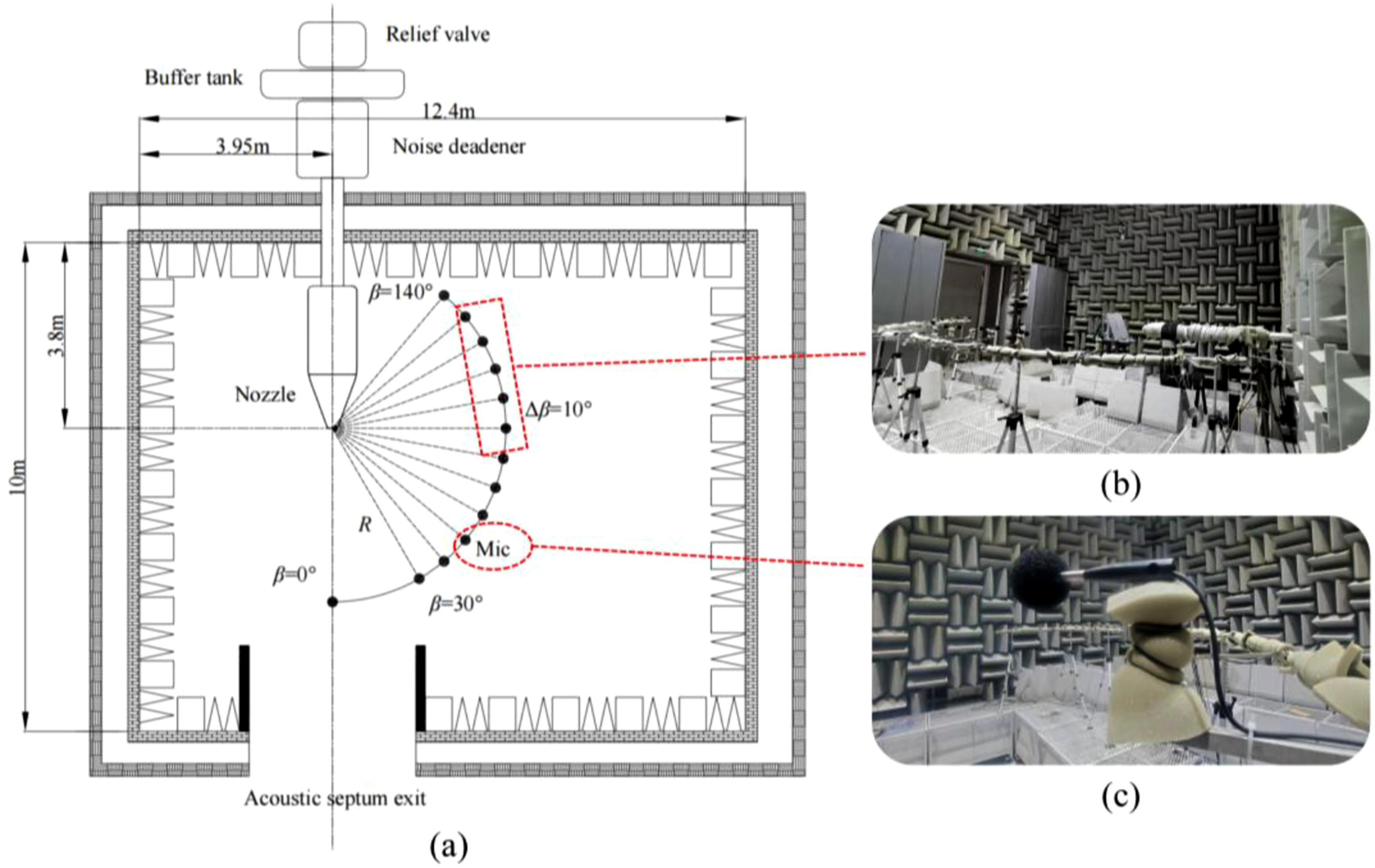
In parallel, a LaVision TR-PIV system was employed for flow field visualization, as shown in Figure 3. The system used a Liquid Particle Generator to produce sub-micron-sized particles (approximately 0.5 µm) for flow tracing. The interval between two consecutive laser pulses was set at 7μs, and the HS5.1 high-speed camera provided a spatial resolution of 2.47 pixels/mm. A total of 2000 image pairs were captured for each test, at a sampling frequency of 8 kHz. PIV set-up. (a) The PIV equipment layout, (b) laser sheet, (c) tracer gas, (d) liquid particle generator, (e) synchronizer.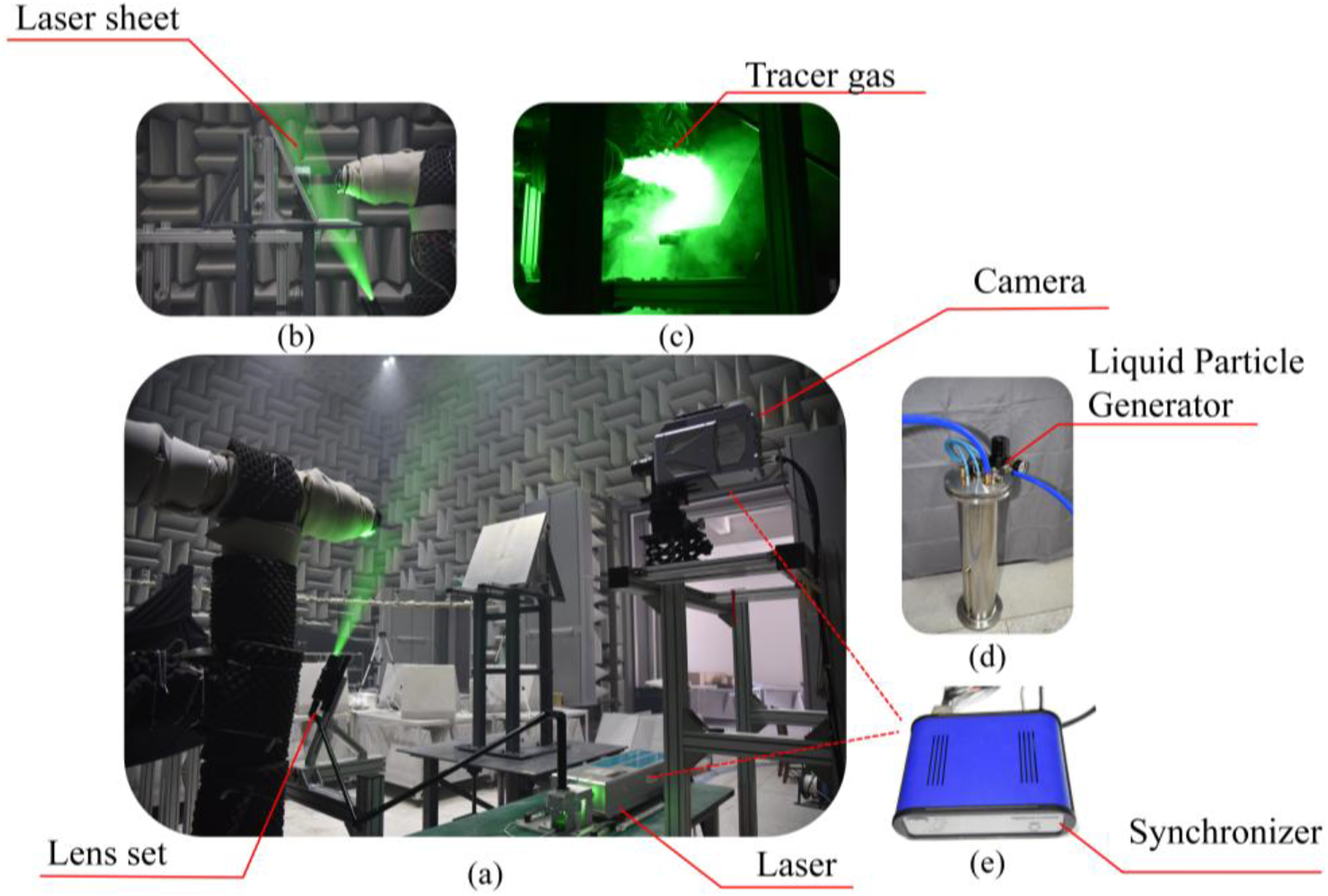
The Particle Image Velocimetry (PIV) image processing was performed using the cross-correlation method in LaVision Davis software. A multi-pass algorithm was used to enhance the accuracy of the measurements, involving two passes with 24 × 24 pixel windows and four passes with 12 × 12 pixel windows, with a 50% overlap factor between successive windows.
The velocity and vorticity field are derived by calculating the velocity of the tracer particles in the PIV experimental results, where Δs is the distance of the tracer particles moving in Δt time. The calculation formula is as follows:

The Ω-criterion vorticity criteria are used to identify the vorticity structures in the impact jet flow field. The corresponding calculation formulas are as follows:


Testing conditions and Inclined Plate Configuration
The experimental was conducted using a jet facility with a nozzle featuring an exit diameter of 56 mm. The spacing distance (L/d) between the nozzle and the inclined plate was varied from 3 to 20, while the Nozzle Pressure Ratio (NPR) ranged from 1.63 to 3.1. The deflection angle of the inclined plate was fixed at 45°. Positioned in front of the jet facility, a 600 mm × 600 mm × 20 mm inclined plate (Figure 4) was mounted on a linear traverse device to facilitate precise positioning during the tests. The surface of the inclined plate was modified with grooves designed to reduce impinging noise. These grooves were based on the “finlet fences” configuration proposed by Clark et al.
32
The grooved surface featured 49 grooves, each with a width (W) of 5 mm and a depth (H) of 5 mm. The overall dimensions of the grooved inclined plate were identical to those of the smooth inclined plate. Coordinate system, geometrical parameters, and inclined plate Configuration.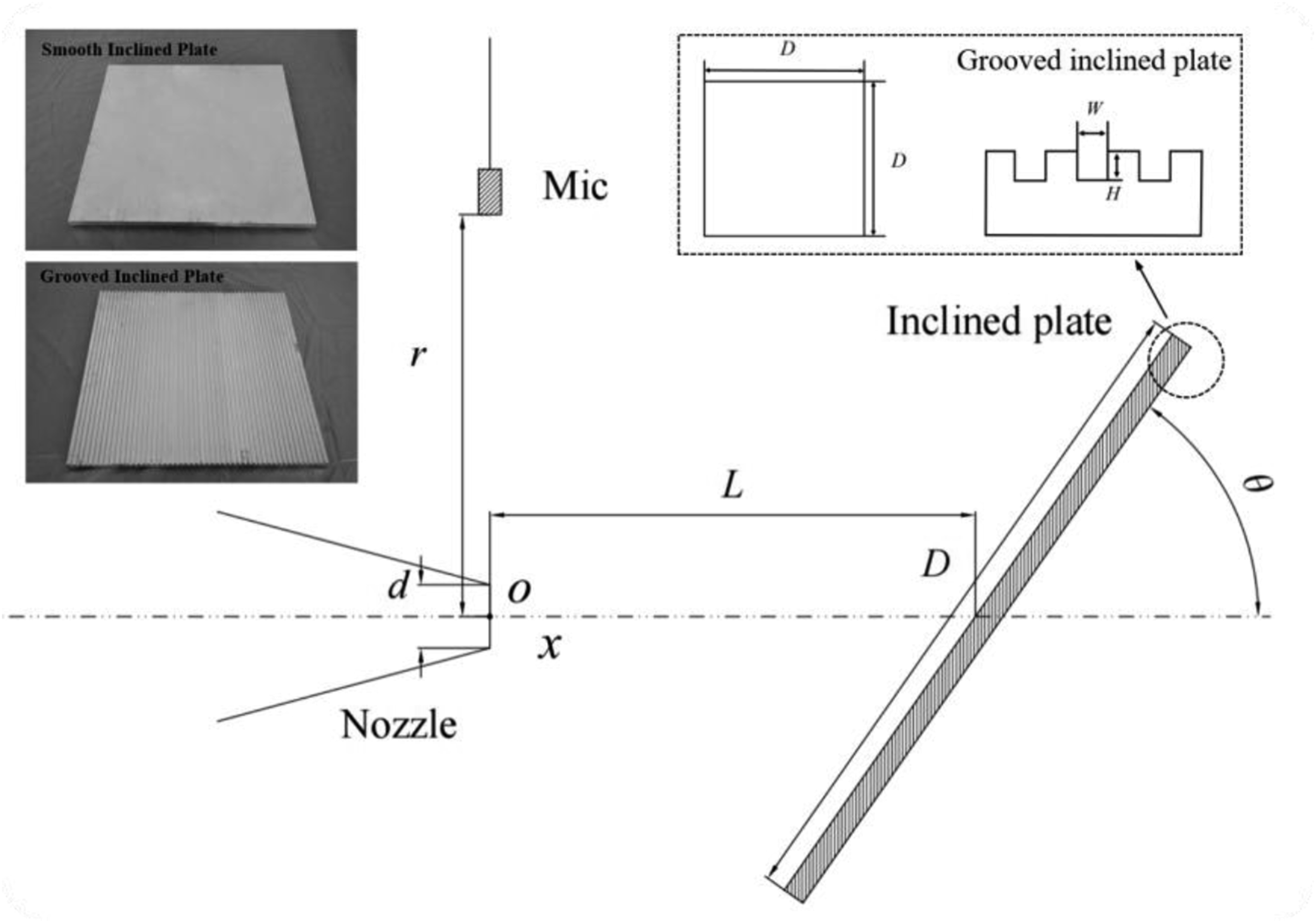
All experiments were conducted in a fully anechoic room, with the internal environment maintained at 25°C and 50% relative humidity, showing minimal fluctuation. The acoustic data measurement error, including repeatability, was within ±1.5 dB (OASPL).
Results
Figure 4 shows the coordinate system (O, x, r), where the origin O is at the intersection of the nozzle exit plane and the jet centerline. The plate center is located at a distance L from O, with the deflection angle θ indicating its inclination relative to the jet axis. Key parameters influencing the impinging jet flow field include the geometric ratio L/d and the nozzle pressure ratio (NPR). The acoustic near field is located at r = 10 d from the jet axis, directly above the nozzle, with the microphone axis perpendicular to the jet axis.
Overall sound pressure level (OASPL)
Noise characteristics of free jet and impinging jet at different NPR
As shown in Figure 5(a), the variation trend of the OASPL of the near field noise and the far field noise in the upper, middle and downstream directions (β = 120°, 80°, 30°) of the free jet is thoroughly analyzed over the NPR range of 2.05 to 3.1. The data indicates that for NPR <2.84, the OASPL of far field noise in the downstream direction is significantly higher compared to other directions, exhibiting a distinct local maximum at NPR = 2.45. Moreover, In Figure 5(b), the far-field noise spectra at the local maximum of OASPL across different noise monitoring angles is compared. It’s evident that in the mid to low frequency range (f < 3000 Hz), the downstream direction exhibits notably amplified levels of turbulent mixing noise, along with discrete tones at specific frequencies of f = 1750 Hz and 988 Hz, as shown in Figure 5(b), when compared to other directions. In contrast, discrete tones at specific frequencies of f = 2750 Hz and 3737 Hz primarily propagate upstream. Conversely, in the high-frequency range (f > 6000 Hz), the upstream direction displays relatively higher amplitudes of broadband shock-associated noise. The findings indicate that for 2.05<NPR <2.84, turbulent mixing noise in the free jet primarily propagates downstream and exerts a dominant influence on the overall noise levels. Variation with NPR of both the OASPL for the near- and far-field noise and the vorticity fields of the free jet.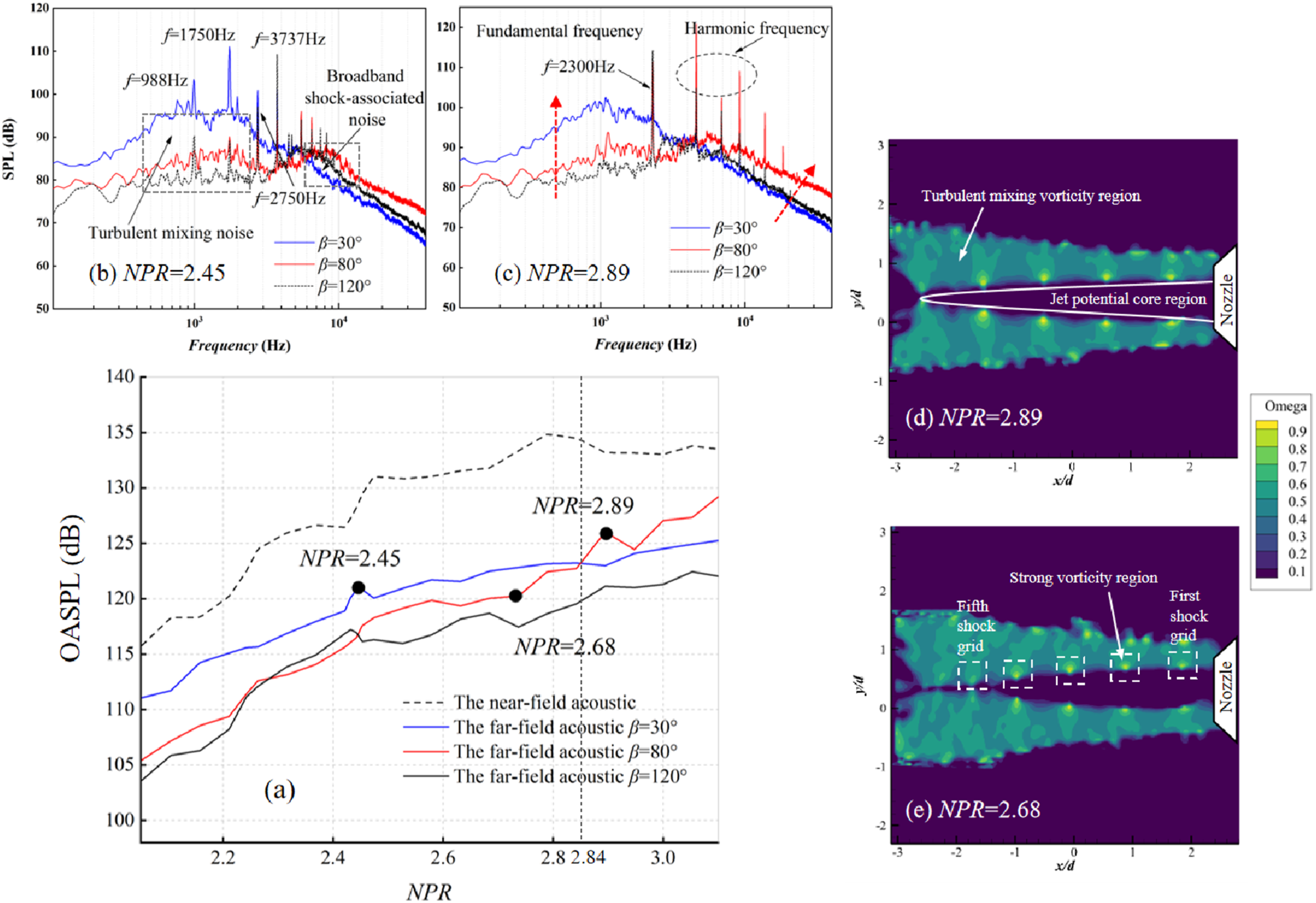
When NPR >2.84, as depicted in Figure 5(a), the OASPL of far-field noise in the midstream direction significantly surpasses that of other directions, reaching its local maximum at NPR = 2.89. Figure 5(c) illustrates the spectrum outcomes of far-field noise in diverse directions at local maxima. The analysis reveals that the discrete tone noise at f = 2300 Hz, along with its harmonic frequencies, primarily propagates toward the upstream and midstream directions. Simultaneously, in the high-frequency region above f = 6000 Hz, broadband shock-associated noise makes a significantly greater contribution to noise radiation in the midstream direction compared to upstream and downstream directions. This is the primary reason why far field noise radiation in the middle direction is notably stronger than that in other directions when NPR >2.84.
To delve deeper, specific points were chosen for analysis: NPR = 2.68 and NPR = 2.89 as depicted in Figure 5(a), and the PIV vorticity fields of free jets under these different NPR conditions were compared and analyzed (refer to Figure 5(d) and (e)). The findings reveal a significant expansion of the potential core region of the free jet with increasing NPR, accompanied by a reduction in the turbulent mixing vorticity region within the shear layer. Moreover, there is an enhancement in the strong vorticity region at the upper and lower edges of the first to fifth shock grids. This transformation in the flow field corresponds to changes in the acoustic field: the downstream-directed turbulent mixing noise radiation gradually weakens, whereas the midstream-directed broadband shock-associated noise radiation significantly strengthens. This is the fundamental reason behind the observation in Figure 5(a) where the OASPL of noise in the midstream direction overtakes that of the downstream direction. This interpretation is consistent with the shock-turbulence interaction, 16 whereby stronger coupling between coherent shear-layer structures and the shock-cell enhances BBSAN at midstream angles and can facilitate tonal components when flow coherence within the shock-cell region is maintained.
Figure 6(a) explores the variation in the OASPL difference between the impinging jet and free jet noise within the NPR range of 2.05 to 3.1. When 2.05<NPR <2.47, the OASPL difference (impinging jet OASPL - free jet OASPL) shows strong similarities in both the middle and upstream far-field noise and near-field noise. This is mainly due to the limited contribution of broadband shock-associated noise in this NPR range, as the shock cell structure is not yet fully formed (Figure 1). In this range, the dominant contribution to the OASPL difference is the broadband impingement noise propagating in the middle and upstream directions. Variation with NPR of both the OASPL difference between the impinging and free jets and the associated vorticity fields.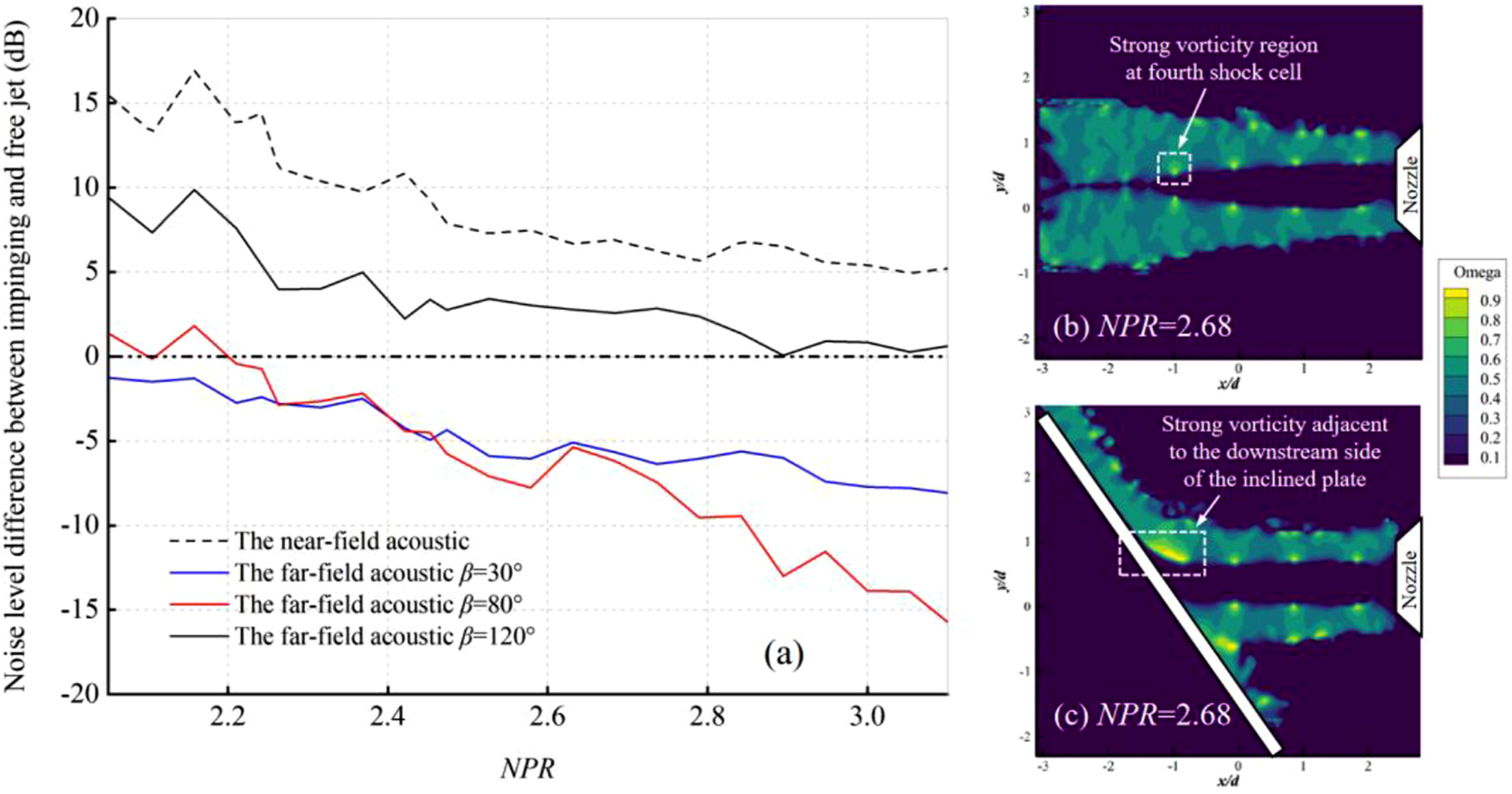
However, when NPR >2.63, the OASPL difference between the free and impact jets no longer exhibits similarities in the midstream direction far-field noise and near-field noise. Instead, the OASPL difference value of midstream direction far-field noise shows a more significant decreasing trend. The presence of the inclined plate converts the broadband shock noise from the fifth and sixth shock cells into broadband impingement noise, as evidenced in Figure 6(b) and (c).
In Figure 6(b) and (c), which show the vorticity fields for the free jet and impinging jet at NPR = 2.68, differences in the flow field structures are highlighted. In the free jet configuration (Figure 6(b)), strong vorticity zones are evident at the upper and lower edges of the first to the fifth shock cells within the potential core, accompanied by substantial vorticity intensity in the turbulent mixing region of the shear layer. This observation is consistent with prior reports 28 that locate the dominant screech tone-related source region approximately between the rear edges of the third and fifth shock cells. Contrasting this with the impinging jet scenario (Figure 6(c)), upon introducing the inclined plate, the turbulent mixing region with strong vorticity in the free jet is transformed into two separate regions: one of strong vorticity adjacent to the downstream side of the inclined plate and another in the wall jet’s turbulent mixing zone. This is also the main reason that the OASPL difference value of the far field noise in the middle and downstream directions is basically negative (Figure 6(a)). Moreover, when 2.89<NPR <3.1, the OASPL difference value of the far field noise in the upstream direction tends towards zero, mainly because the reduction of turbulent mixing noise caused by the presence of the inclined plate is basically the same as the increase of broadband impact noise.
Noise characteristics of impinging jet at different L/d
In the investigation of supersonic impinging jet noise characteristics across a range of nozzle-plate spacing distance (L/d = 3∼20), Figure 7(a) and 7(b) depict the variation of near-field and upstream, midstream, and downstream far-field noise with L/d for NPR = 2.37 and 2.68, respectively. At NPR = 2.37, the shock-cell structure within the jet’s potential core is in an early formation stage, exerting a relatively minor influence on the noise, However, at NPR = 2.68, the shock cells are fully developed, significantly amplifying the noise contribution. Interestingly, at L/d = 20, the difference between the near-field noise of impinging and free jets narrows to within 3 dB, suggesting that the effect of the inclined plate on the overall noise level is negligible at this distance. Variation of impinging jet noise OASPL with L/d under two conditions: (a) NPR = 2.37,(b) NPR = 2.68.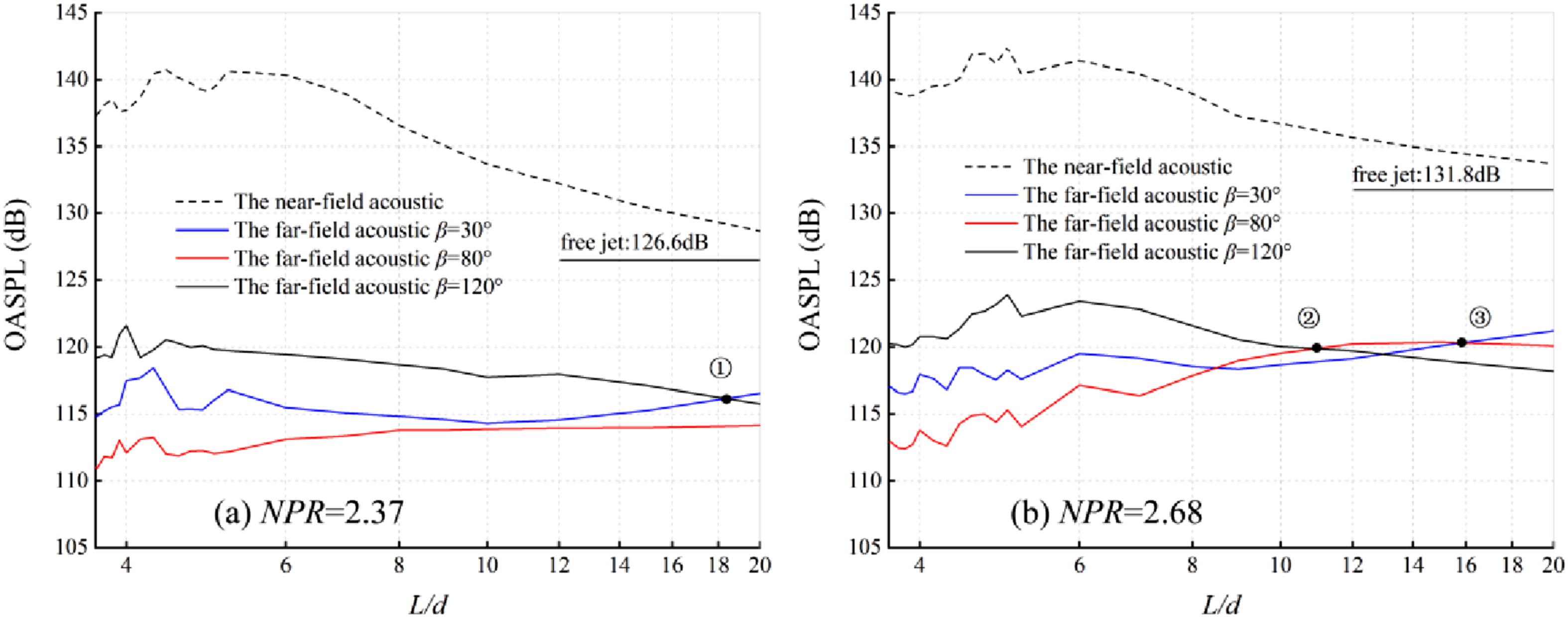
In the L/d range of 3 to 5, the inclined plate is positioned within the domain of the third to fifth shock cells of the impinging jet’s potential core. This placement coincides with the occurrence of multiple peaks in the OASPL. When L/d > 6, there’s a noticeable shift in the acoustic characteristics. Specifically, the OASPL of near-field noise and upstream far-field noise from the impinging jet decreases, while the levels of midstream and downstream far-field noise increases. This alteration signifies the diminishing impact of the plate’s shielding effect on the midstream and downstream far-field noise as L/d increases.
In Figure 7, a consistent ranking of the OASPL for far-field noise emerges for specific NPR conditions, such as when NPR = 2.37, where L/d ranges from 3 to 18, and when NPR = 2.68, where L/d ranges from 3 to 8.5. In these cases, upstream far-field noise consistently exceeds downstream far-field noise, which in turn is higher than the midstream far-field noise. Significantly, between L/d = 8.5 and 11 at NPR = 2.68, there is a noteworthy surge in midstream far-field noise with increasing L/d. This proves 30 that the primary generation of acoustic power in the free jet occurs within the turbulent mixing region around L/d = 8 to 10.
Furthermore, from position ② to position ③, where the impact distance L/d = 11∼16, the midstream far-field noise of the impact jet is notably higher than that in the upstream and downstream directions. This phenomenon primarily arises from the propagation of broadband shock-associated noise, originating from the strong vorticity region at the upper and lower edges of the shock cells, as depicted in Figure 6(c), predominantly along the midstream direction.
Moreover, at larger nozzle-plate spacing distance, specifically after position ① where L/d > 18 and position ③ where L/d > 16, the far-field noise exhibits a pronounced increase in the downstream direction compared to the midstream and upstream far-field noise levels. At these conditions, the influence of the inclined plate on the impinging jet noise is essentially negligible.
Noise reduction effects of groove structure on impinging jet at different L/d
Referring to Figure 7, when L/d = 3∼5, the inclined plate is positioned within the third to fifth shock-cell structures within the impinging jet’s potential core. This placement coincides with the emergence of multiple peaks in the OASPL of the impinging jet.
As shown in Figure 8, to further investigate the noise reduction performance of the grooved surface on the inclined plate at different impingement distances under fully developed shock-cell conditions (NPR = 2.68), it is noteworthy that the grooved surface of the inclined plate demonstrates effective noise reduction in the far-field across all directions within the L/d = 3.7∼5.2 range. This reduction averages approximately 2 dB, attributed to the noise attenuation observed across the entire low-to-mid frequency range below 7000 Hz, with a relatively significant decrease in noise amplitude around the 2387 Hz frequency band. Significantly, the greatest noise reduction of 3 dB is achieved in the downstream direction of the far-field noise at L/d = 5.18. In addition, when the impact distance is further subdivided, it can be seen that when L/d < 4.43, the groove structure has a particularly prominent effect on the far field noise reduction of the impact jet in the middle and upstream directions. Conversely, for L/d > 4.43, the effectiveness of noise reduction becomes more pronounced for the midstream and downstream far-field noise (Figure 8). Effect of the grooved surface on an inclined plate on impinging jet noise reduction with L/d (NPR = 2.68).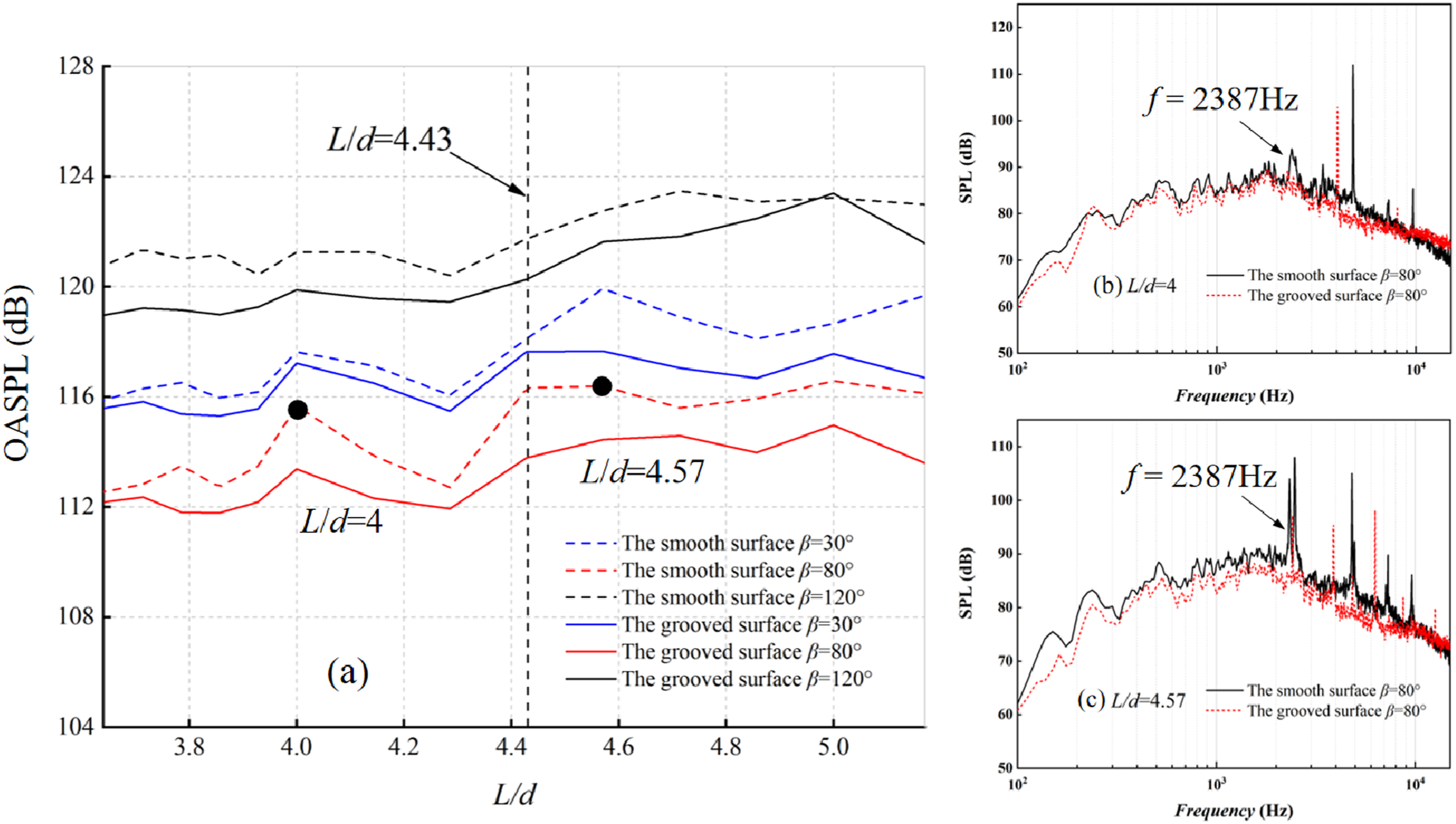
Spectral analysis and directivity
Spectral characteristics of free jet and impinging jet at different NPR
In this model, the temporal period of the screech tone can be understood as the sum of two components: the time required for flow disturbances to traverse one shock cell and the time taken by acoustic waves external to the jet to travel back the same distance toward the nozzle. Accordingly, f
s
denotes the fundamental frequency of the screech tone. The expression for f
s
in this context is given by:

Experimental results of the free jet.

Through the application of Spectral Proper Orthogonal Decomposition (SPOD) to 1000 PIV snapshots of transient velocity fields collected for free jets at NPR = 2.68 and 2.89, the first and second order flow field modes along with the energy spectral densities of the first five order modes were derived (Figure 9). SPOD is particularly suited to the present problem because it yields frequency-resolved, energy-ranked coherent structures, thereby isolating the narrowband dynamics underlying discrete tones.
31
The results show that the first mode overwhelmingly dominates the modal energy, indicating a low-rank organisation of the flow at the discrete-tone frequencies. The dominant mode highlights coherent, large-scale structures in the shear layer, with the strongest signatures concentrated near the upper and lower edges of the third to fifth shock cells within the potential core (Figure 9(a) and (c)). A comparison of the SPOD energy spectra in Figure 9(b) and (d) further indicates that the discrete-tone peaks are associated with essentially the same spatial region for both NPR, suggesting a common underlying noise-generation mechanism. Comparison of SPOD results for free jet flow field at different NPR. (a)NPR = 2.68,(b)NPR = 2.89.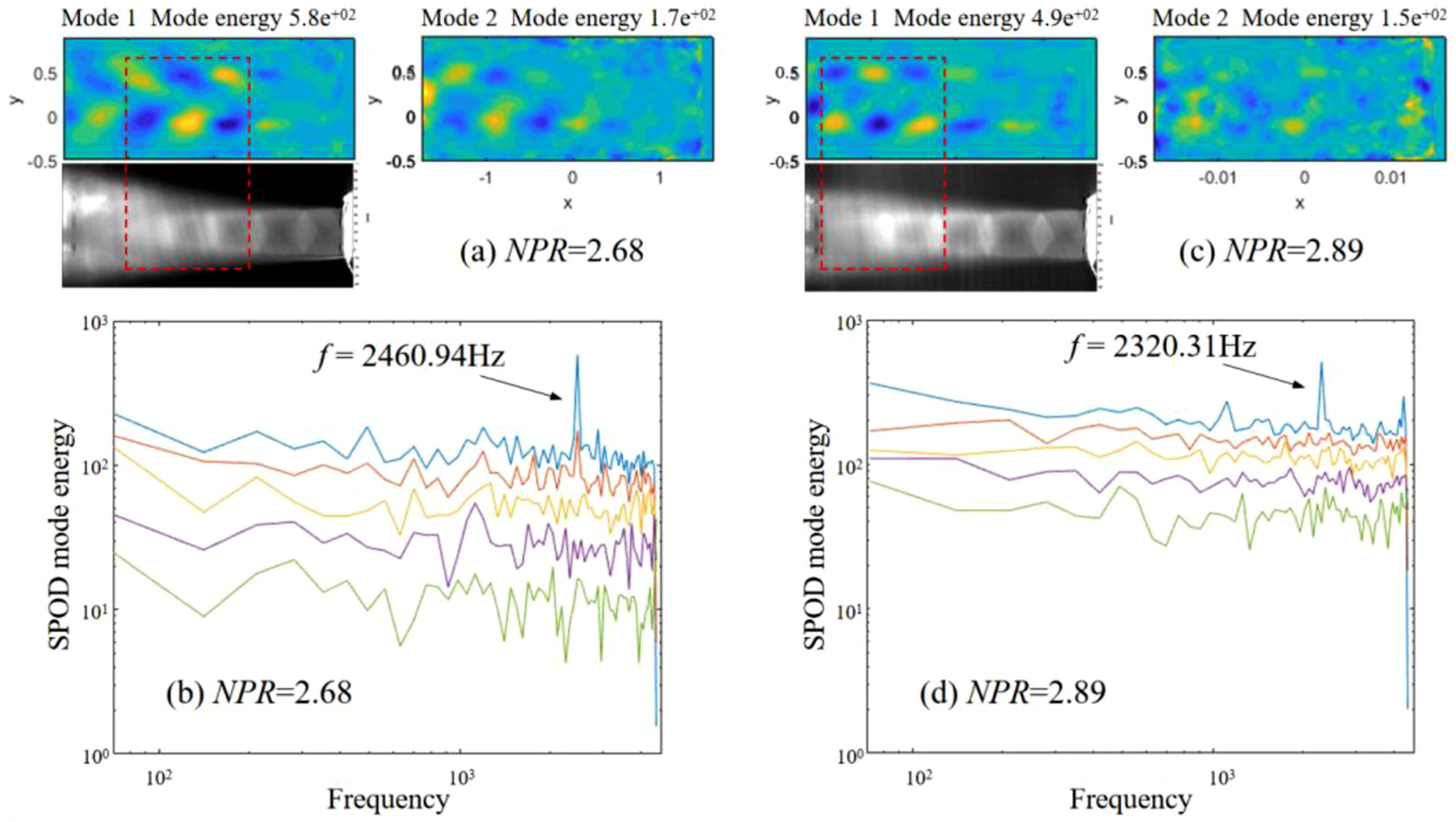
By integrating the information from Figure 9(b) and (d) with the experimental results from Table 1, it can be confirmed that the discrete tone frequencies f spod = 2461 Hz and f spod = 2320 Hz derived from SPOD are in excellent agreement with the predicted screech tone frequencies f s using equation (4). Consequently, it is confidently determined that the discrete tone at f c = 2644 Hz is indeed a screech tone, with its principal acoustic sources localized around the vicinity of the upper and lower edges of the third to fifth shock cells in the jet’s impingement region. This agreement supports the identification of the measured discrete tone at fc = 2644 Hz as a screech component, and it indicates that the dominant hydrodynamic structures responsible for the tone are localised near the shock-cell/shear-layer interaction region around the third to fifth shock cells. These results are consistent with SPOD-based studies of under expanded supersonic jets, 32 which showed that discrete spectral peaks are dominated by first SPOD modes and can be interpreted within a feedback-loop. Unlike the LES-based impinging-jet configuration considered therein, the present work provides experimental PIV evidence for a free jet and identifies the source region. This identification is supported by (i) the invariance of the SPOD peak location with NPR and (ii) the close agreement between fspod and fs.
The near-field noise spectral characteristics of the free jet are investigated within the range of NPR = 2.16 to 3.1, as depictedin Figure 10. When NPR <2.45, position ⑤ and ⑥ in the noise spectrum correspond to the fundamental frequency and its harmonics of a discrete tone at f = 3725 to 4037 Hz. Analysis of the vorticity field for an impinging jet at NPR = 2.24 within this pressure ratio range reveals pronounced high-frequency large-scale vortical structures within the shear layer. Concurrently, the shock cell structure within the jet’s potential core is not fully formed, exerting a lesser influence on the large-scale vortical structures. Hence, the noise from the discrete tone at f = 3725 to 4037 Hz is primarily generated by the large-scale vortical structures in the free jet shear layer. Free jet near-field noise spectra and characteristic flow fields under different NPR.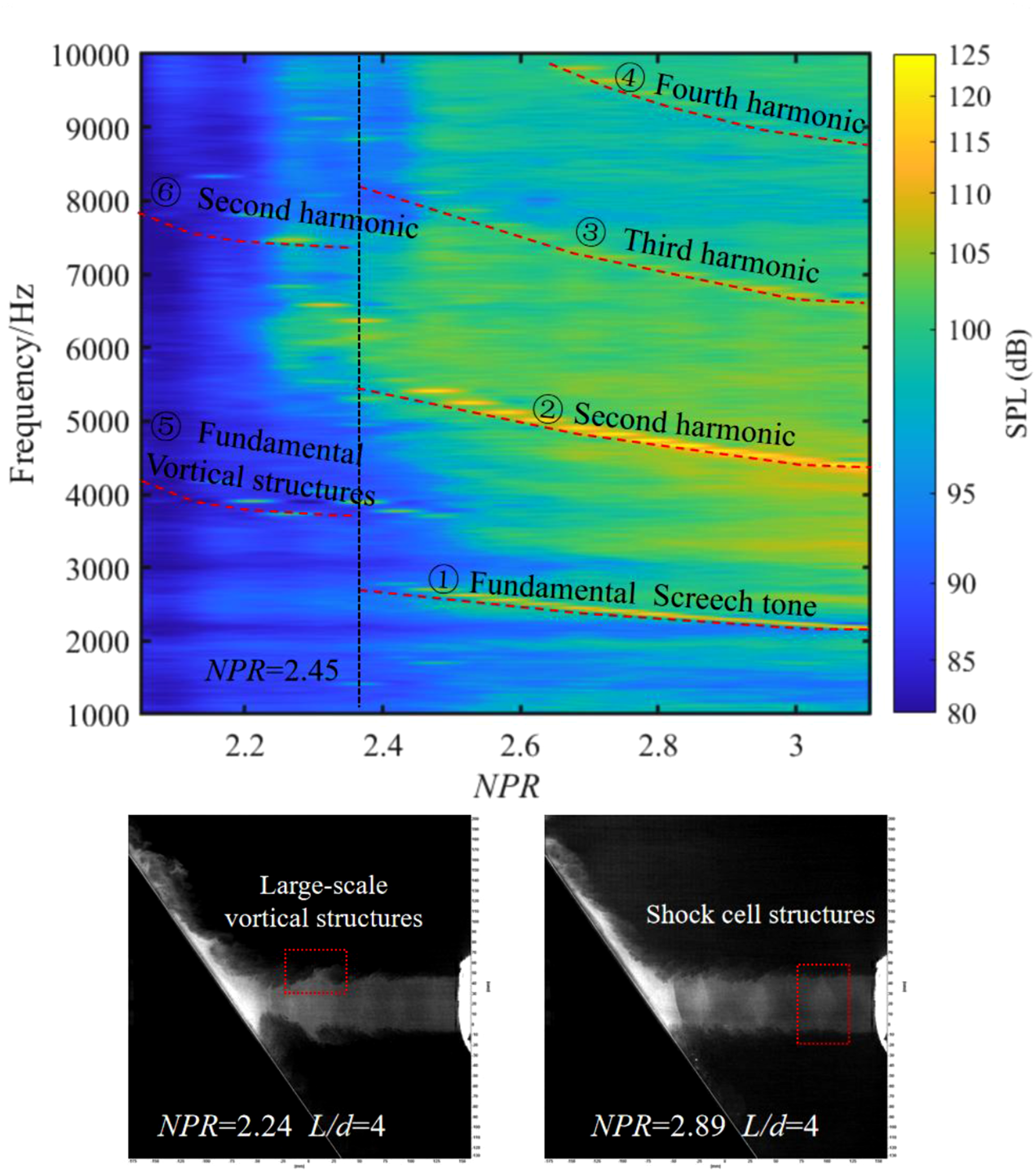
When NPR >2.45, the near-field noise spectrum of the free jet exhibits four discrete tones, which are identified as the fundamental frequency and its harmonics of the f = 2175 to 2700 Hz screech tone. Among these, the second harmonic of the screech tone is found to have the strongest acoustic radiation. As NPR increases, the spacing between shock cells (L s ) progressively expands, causing a corresponding gradual decrease in the screech tone’s fundamental frequency and its harmonics (Figure 10). Upon analyzing the vorticity field for an impinging jet at NPR = 2.89, there is evidence of low-frequency large-scale vortical structures within the shear layer, accompanied by a fully developed shock cell structure within the jet’s potential core, which notably interacts with these large-scale shear layer vortices. Therefore, it is inferred that the generation of the second to fourth harmonics of the screech tone is closely tied to the different stages of shock cell structure development and their interaction with the large-scale shear layer vortex pairs. Additionally, it is worth noting that the significant increase in noise radiation intensity observed at NPR = 2.45 in the OASPL trend of the near-field noise displayed in Figure 5(a) is largely due to the modal transition between these two discrete tone modes.
Figure 11 displays the variation of far-field noise spectrum characteristics in upstream, midstream, and downstream directions of a free jet with respect to the NPR, providing an in-depth examination of the directivity attributes of the screech tone’s fundamental frequency and its harmonics. The results indicate that the fundamental frequency and harmonics of the screech tone, occurring at f = 2175 to 2700 Hz, are distinctly observable in the far-field noise across all monitored directions, and altering the direction of far-field noise measurement does not affect the value of the screech frequency itself. Directional comparison of free-jet far-field noise spectrum characteristics under different NPR.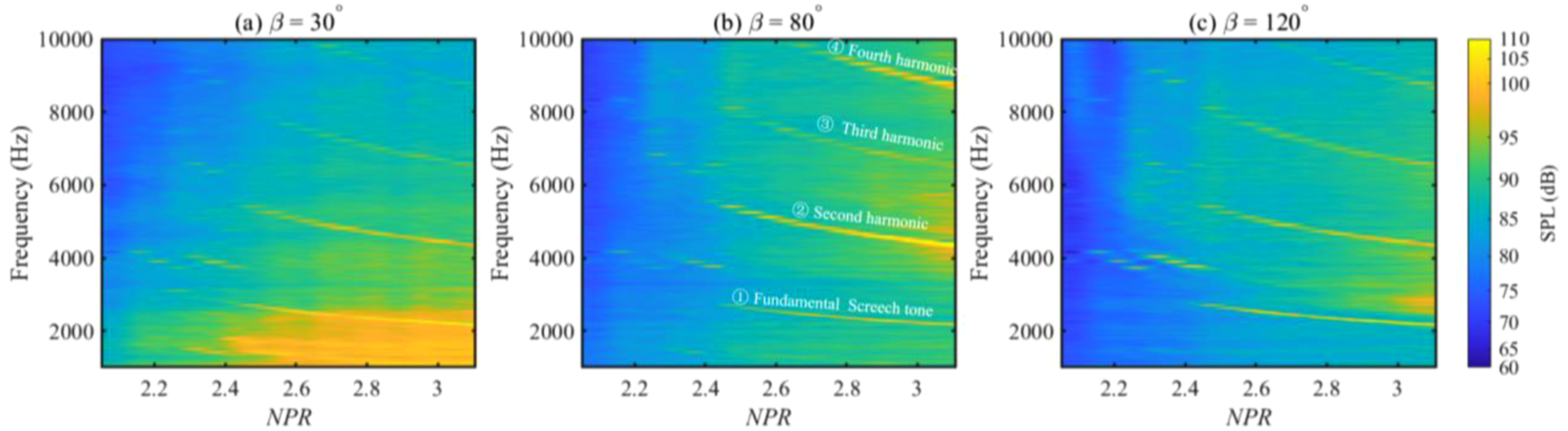
In the downstream far-field noise of the free jet, the noise intensity of the screech tone’s fundamental frequency is predominant, with the screech amplitude following the order: Fundamental > Second harmonic > Third harmonic > Fourth harmonic. The correlation with the vorticity field results from Figure 5(d) reveals that the observed decrease in the intensities of the screech tone’s fundamental and harmonic noise with increasing frequency corresponds to the diminishing vorticity strength at the upper and lower edges of the third to fifth shock cells within the jet’s potential core. In contrast, in the midstream direction, the far-field noise of the free jet is mainly governed by the noise intensity of second and fourth harmonics of the screech tone, both of which exhibit similar acoustic directivity, predominantly propagating along the midstream path. This finding elucidates the phenomenon illustrated in Figure 5(a), where the increase in the OASPL of the free jet noise in the midstream direction as NPR rises and ultimately becomes dominant is primarily due to the second and fourth harmonics of the screech tone mainly traveling in the midstream direction.
As shown in Figure 12, the spectral characteristics of far-field noise in upstream, midstream, and downstream locations for impinging jets are depicted as they vary with the NPR. The Screech tone in the free jet noise transforms into broadband noise with a frequency of 2000-3000 Hz in the upstream far-field noise spectrum of the impinging jet. Additionally, under different NPR, the noise radiation intensity in this frequency band is significantly enhanced. This strengthening is largely due to the enhanced screech feedback mechanism brought about by the presence of the impinging plate. Significantly, differing from free jets, the harmonic components of the screech tone are largely absent in the far-field noise of impinging jets, being supplanted by a series of discrete tones that predominantly propagate upstream. Directional comparison of far-field noise spectrum characteristics of impinging jet under different NPR (L/d = 4).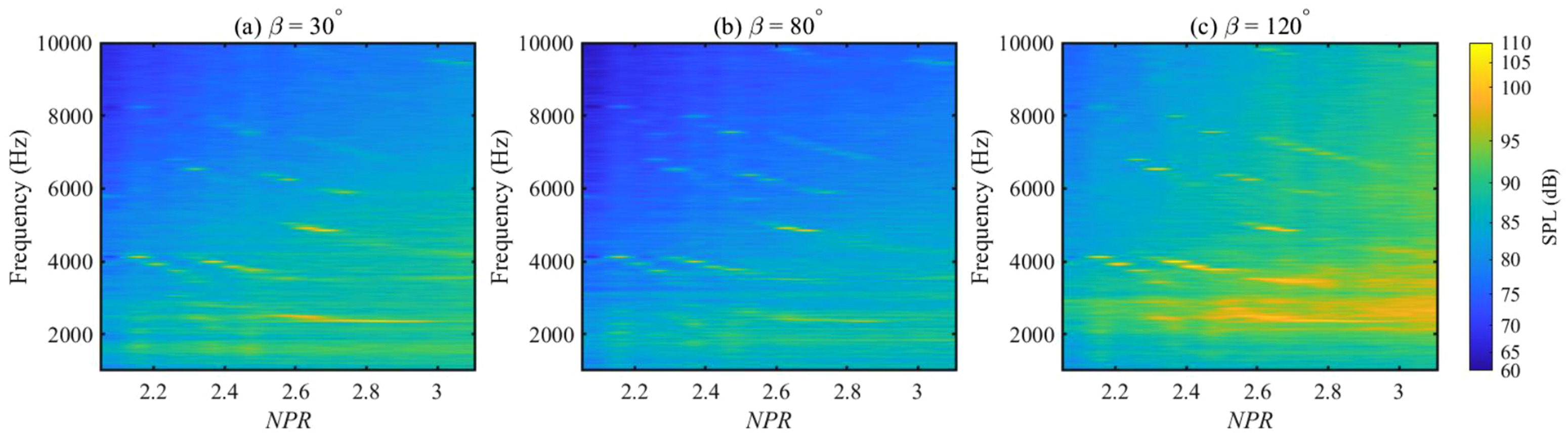
Spectrum characteristics of impinging jet at different L/d
At specific nozzle pressure ratios, NPR = 2.37 and NPR = 2.68, the near-field noise spectral characteristics of impinging jets as they vary with impingement distance have been intensively investigated. As displayed in Figure 13, with the increase of impact distance, the influence of impact inclined plate gradually weakens until L/d = 20 and its noise characteristics close to the free jet state. Two NPR values are fixed in this section, and the shock cell spacing in the potential core of the impact jet is basically unchanged. Therefore, in the process of L/d = 5∼20, the discrete tone frequency at positions ① to ⑧ shown in Figure 13 basically remains unchanged, and is consistent with the discrete frequency value under the corresponding NPR in Figure 10. Spectral characteristics of impinging jet near-field noise under different L/d.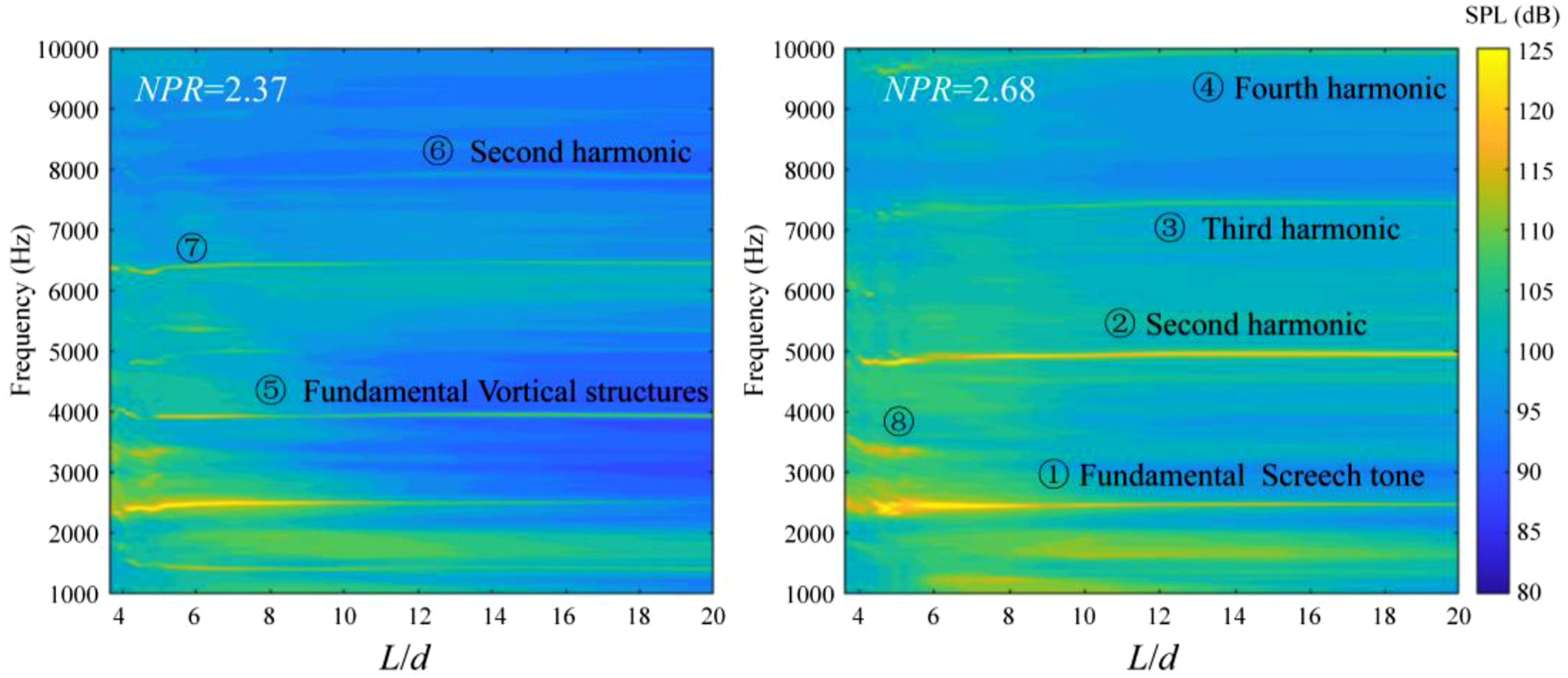
At NPR = 2.37, the shock cell structures within the jet’s potential core are not fully developed, resulting in less interaction between these structures and large-scale vortices in the shear layer. Therefore, the fundamental and harmonic frequencies of discrete tone generated by the large-scale vortical structures of shear layer are obvious at positions ⑤ and ⑥, and the harmonic frequency of screech tone does not appear. Conversely, at NPR = 2.68, the shock cells within the jet’s potential core are fully formed, leading to a persistent presence of screech tone harmonics at positions ① to ④, which arise from the interaction between the large-scale vortices and shock cells. Over the entire range of impingement distances, the screech amplitude is notably stronger for NPR = 2.68 compared to NPR = 2.37. Furthermore, both the amplitudes of the discrete tones at positions ① and ⑤ decrease with increasing impingement distance, correlating with the decline in the OASPL of the impinging jet noise with the increase of impact distance in Figure 7. It was also verified that the presence of the inclined plate significantly enhanced the screech feedback loop. It is worth noting that no matter how the impact distance changes, the second harmonic frequency amplitude of screech tone basically remains unchanged.
In narrower impingement distance ranges, specifically for L/d = 3∼5, there are variations in both the frequencies and amplitudes of these discrete tones. To further explore this phenomenon, a detailed examination of the evolution of these discrete tones at shorter distances, especially at positions ⑦ and ⑧ in Figure 13, would provide insight into the underlying mechanisms governing their formation at these close proximities.
Spectral characteristics of impinging jet noise influenced by shock cells
To substantiate the earlier hypothesis that the second to fourth harmonics of the screech tone are closely tied to the interactions among varying shock cell structures and large-scale vortices within the shear layer, this section focuses on cases where the shock cell structures are fully established (NPR = 2.68), ensuring that the shock cell spacing remains constant. By altering the nozzle-plate spacing distance over a range of 3∼5d, the study investigates the patterns of change in the fundamental frequency of the screech tone and its harmonics as the third to fifth shock cell structures are sequentially disrupted.
In Figure 14(a), at L/d = 3.86, the appearance of the second harmonic of the screech tone is notable at position ③. Figure 14(b) displays the vorticity field of the impact jet obtained by PIV technology at this impact distance. It clearly illustrates the amalgamation between the strong vorticity region on the side of the inclined plate along the flow direction (abbreviation as SVRiP-FD) and the strong vorticity region on the upper edge of the fourth shock cell. The observed distance d
s
= 0.041d is particularly significant, which is between the strong vorticity region at the upper edge of the third shock cell and the SVRiP-FD. This distance aligns with the spatial spacing D
s
of screech tone in Figure 14(a) when the fundamental frequency and the second harmonic of screech tone are initially observed. This alignment verifies that the primary sound source region for the screech tone is near the rear edge of the third shock cell, whereas the primary source region for the second harmonic is near the rear edge of the fourth shock cell. Effect of shock cells on impinging jet noise spectra under different L/d. (a) Spectrum characteristics at different L/d (b) Flow field structure characteristics of the impact jet at L/d = 3.86.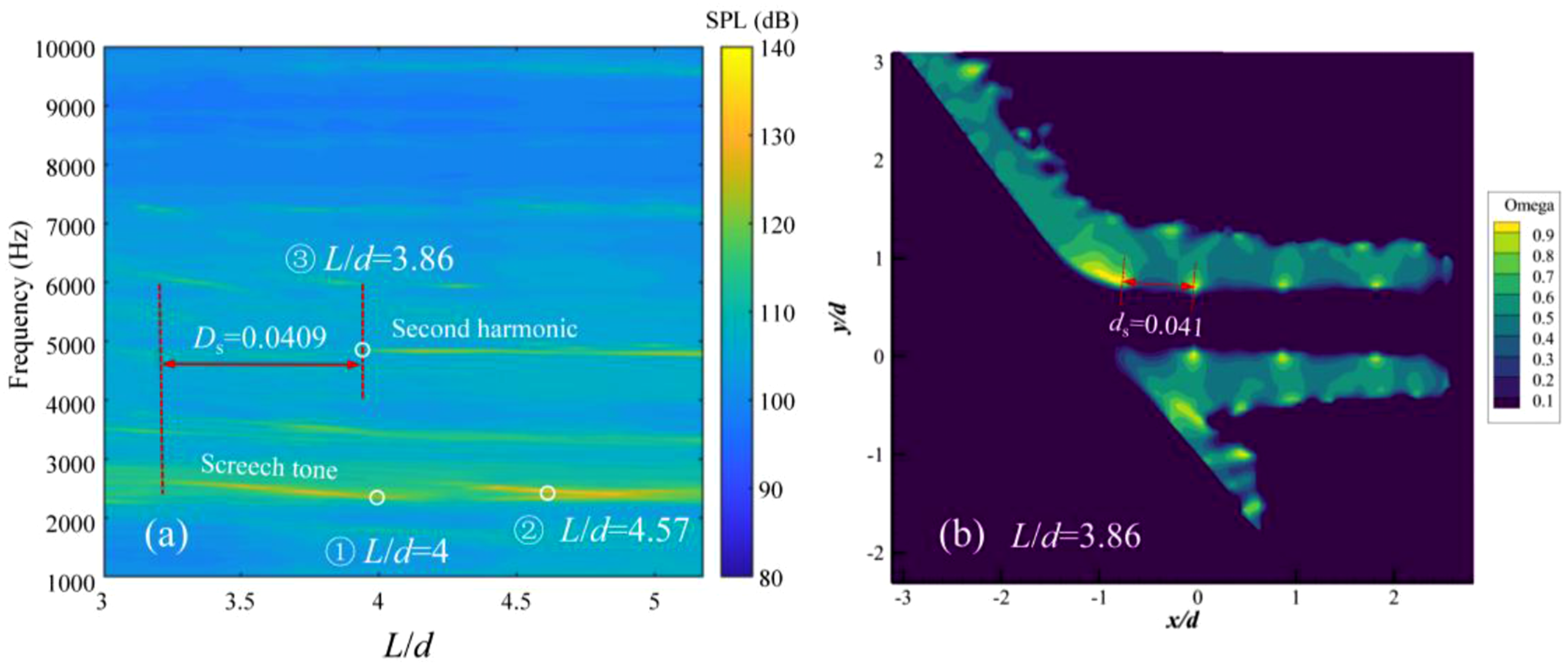
Further analysis reveals that the screech amplitude experiences a decrease followed by an increase as the impingement distance increases, with L/d = 4.28 acting as a turning point dividing the whole variation into two stages. Two specific impingement distances (L/d = 4 at position ① and L/d = 4.57 at position ②) are chosen for in-depth analysis (Figure 14(a)). At L/d = 4.57, as shown in Figure 15(a), the noise spectral results of the impinging jet exhibit a double-peak screech tone feature, while at L/d = 4 (Figure 15(b)), a single-peaked screech tone emerges. PIV vorticity fields corresponding to these distances shed light on the mechanisms: Figure 15(c) illustrates that the double-peak screech tone is due to an extrusion effect structure resulting from the interaction between the SVRiP-FD and the rear edge of the fourth shock cell (highlighted by the red dashed box). Conversely, Figure 15(d) demonstrates that the single-peak screech tone originates from vortex pairing structures formed by the interaction between the SVRiP-FD and the rear edge of the third shock cell (also highlighted by the red dashed box). Spectrum characteristics and flow field structure characteristics of two types of screech tone noises.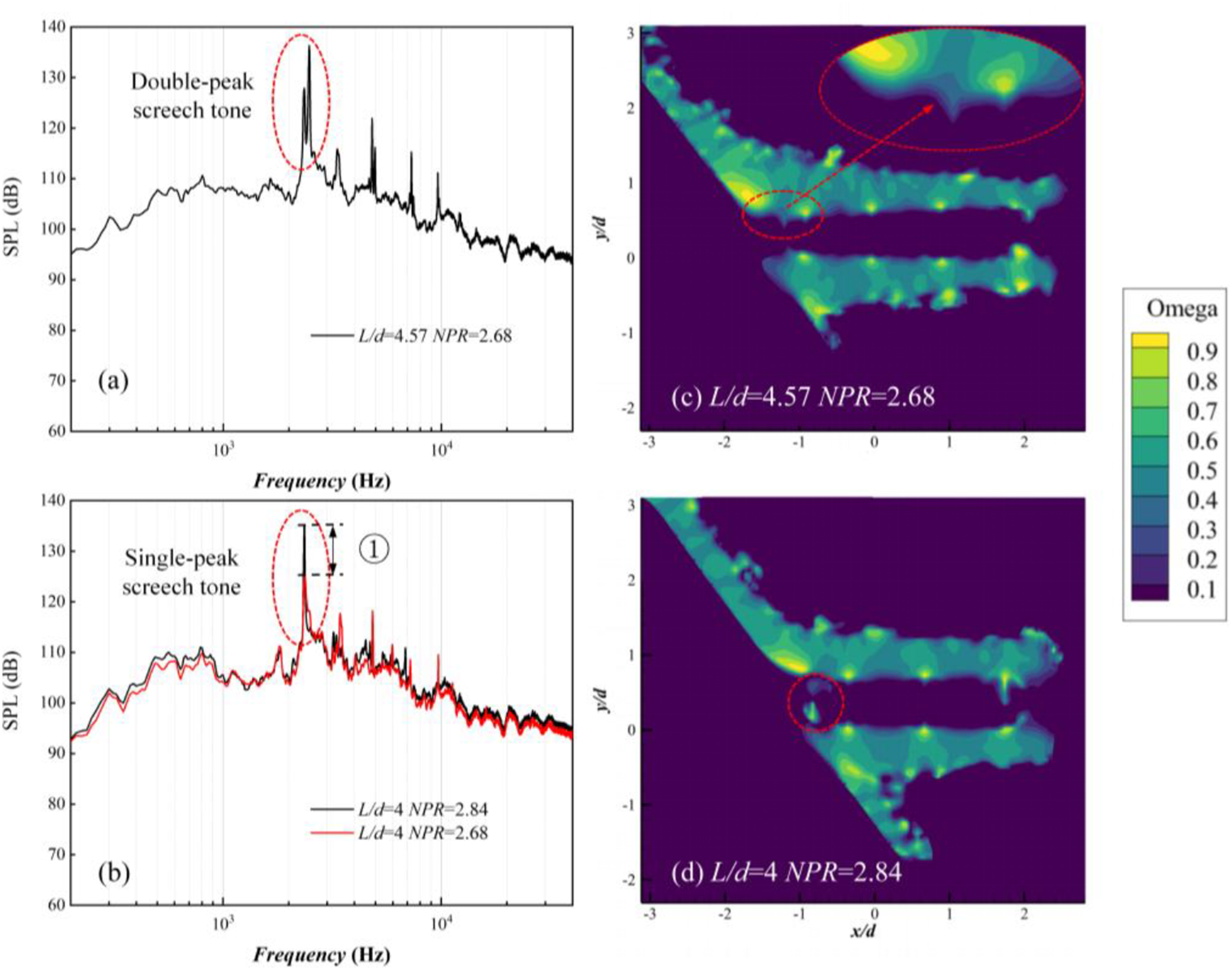
After comparing the Noise spectrum results of the impinging jet at two different NPR, NPR = 2.84 and NPR = 2.68, as shown at position ① in Figure 15(b), it can be found that they are the same discrete tone mode, with the screech amplitude being significantly higher for NPR = 2.84 compared to NPR = 2.68, and the associated flow field structures being more pronounced. Consequently, subsequent in-depth analysis will focus on the flow field structure at NPR = 2.84.
Spectral characteristics of impinging jet influenced by groove structure at different L/d
The study investigates the effect of grooved structures on the noise spectrum characteristics of impinging jets in the near field at varying impingement distance. As illustrated in Figure 16, it is evident that the grooved surface on the inclined plate significantly contributes to enhances noise control of the impinging jet. Near-field spectral characteristics of an impinging jet with and without a groove structure.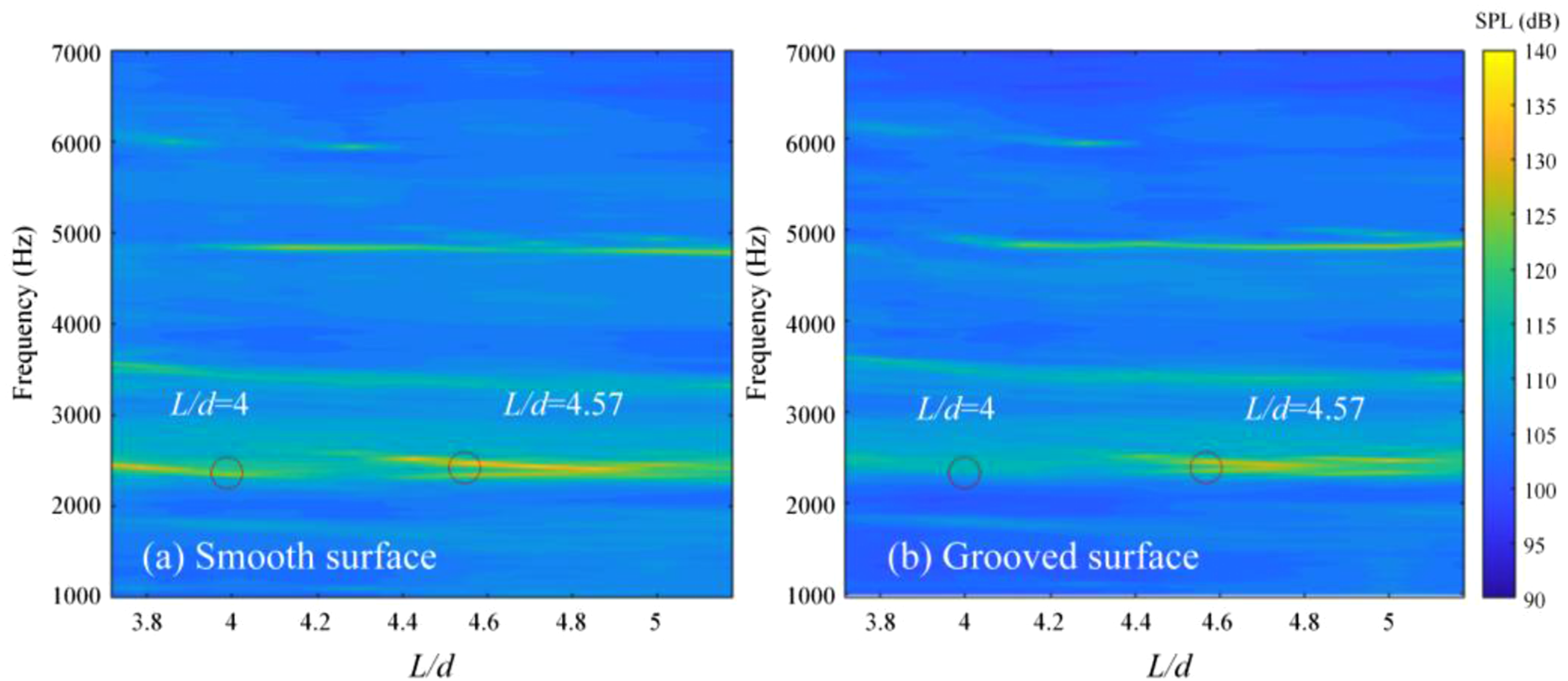
Upon contrasting Figure 16(a) and 16(b), it is revealed that the grooved plate surface effectively reduces the screech amplitude at f = 2437 Hz, especially demonstrating heightened noise reduction efficiency for single-peaked screech tones, achieving an average decrease in screech amplitude of 10 dB. This result confirms the primary reason why the groove structure on the inclined plate surface has good noise reduction effect on the far field noise of the impact jet in different directions when NPR = 2.68 and L/d = 3.7∼5.2 as shown in Figure 8. However, the noise intensity of other discrete tones does not exhibit obvious noise reduction effect. At the selected specific impingement distances of L/d = 4 and L/d = 4.57 in Figure 16, a comparative analysis was conducted on the vorticity fields of supersonic jets impinging on both smooth and grooved inclined plates. From Figure 17, it can be discerned that when L/d = 4, the vorticity intensity in the SVRiP-FD in the impingement area shows a slight diminishment, accompanied by a significant weakening of the vortex pairing structures within this region. This phenomenon constitutes a major contributing factor for why the grooved surface structure can effectively reduce the amplitude of the single-peak screech tone. Flow field structures of an impinging jet with and without a groove surface.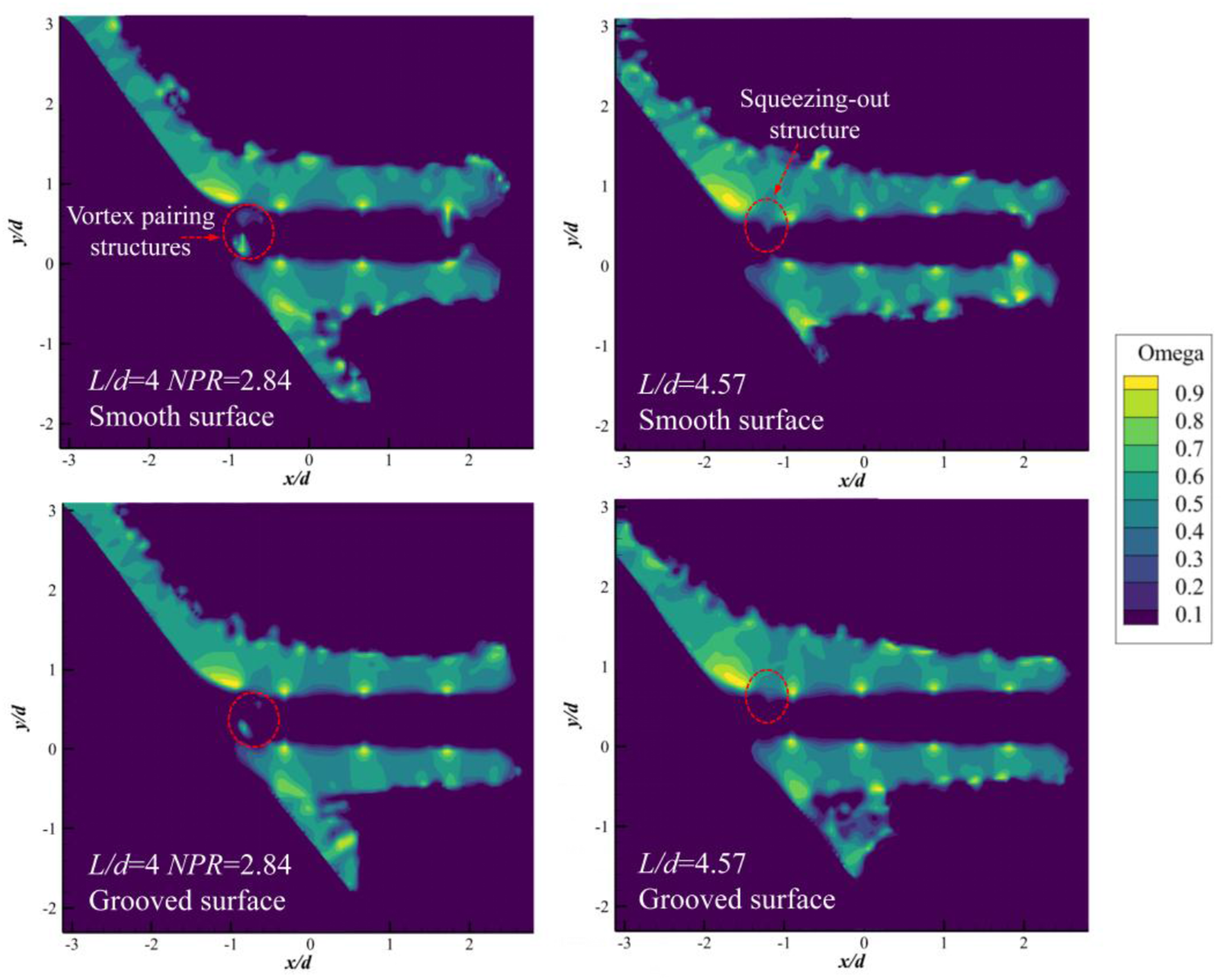
On the other hand, at L/d = 4.57, the vorticity strength of SVRiP-FD also diminishes, and the squeezing-out structure formed by the interaction between this region and the strong vorticity at the rear edge of the fourth shock cell is notably weakened. By integrating these findings, it can be confirmed that the principal sound source region of the screech tone is situated in close proximity to the rear edge of the third shock cell’s strong vorticity area. However, the vortex-pairing and squeezing-out structures that arise from interactions between the strong-vorticity regions at the rear edges of the third and fourth shock cells and SVRiP-FD act to increase the coherence and amplitude of the hydrodynamic disturbances within the shock-cell system, thereby strengthening the effective loop gain of the screech tone feedback mechanism. Introducing surface grooves on the inclined plate disrupts or weakens these coherent structures, reducing the upstream-traveling pressure feedback that excites the nozzle-lip shear layer. Consequently, the feedback loop is weakened and the screech tone is significantly suppressed, and it can be eliminated under specific operating conditions.
Interaction of shock cells and large-scale vortex in the impinging jet shear layer
This section elucidates how the spatial evolution of strong vorticity regions near specific shock cells (the third, fourth, and fifth) directly governs and modulates the generation and radiation of discrete tones (screech tone and its harmonics) in an impinging jet. By synchronously comparing PIV vorticity fields and far-field noise spectra under different NPR and L/d (Figure 18∼20), the following core physical connections are revealed:
As shown in Figure 18, as the NPR increases from 2.68 to 3.1, the strong vorticity region at the upstream edge of the third shock cell within the potential core gradually moves closer to the SVRiP-FD. Although the screech tone persists throughout this process, its amplitude exhibits a notable enhancement at NPR = 2.89 (marked as ① in Figure 18(e)). This anomalous peak is directly linked to the emergence of a prominent vortex pairing structure (marked as ① in Figure 18(b)) in the flow field. This vortex pairing process enhances the coherence of shear-layer disturbances, thereby amplifying the strength of the feedback loop and leading to the increase in the fundamental screech tone amplitude. This confirms that: (1) the primary source region of the fundamental screech tone is located at the edge of the strong vorticity region of the third shock cell; and (2) vortex pairing generated in the impingement region is a key amplification mechanism. Impinging jet flow characterized by interaction of its third shock cell with large-scale shear-layer vortices.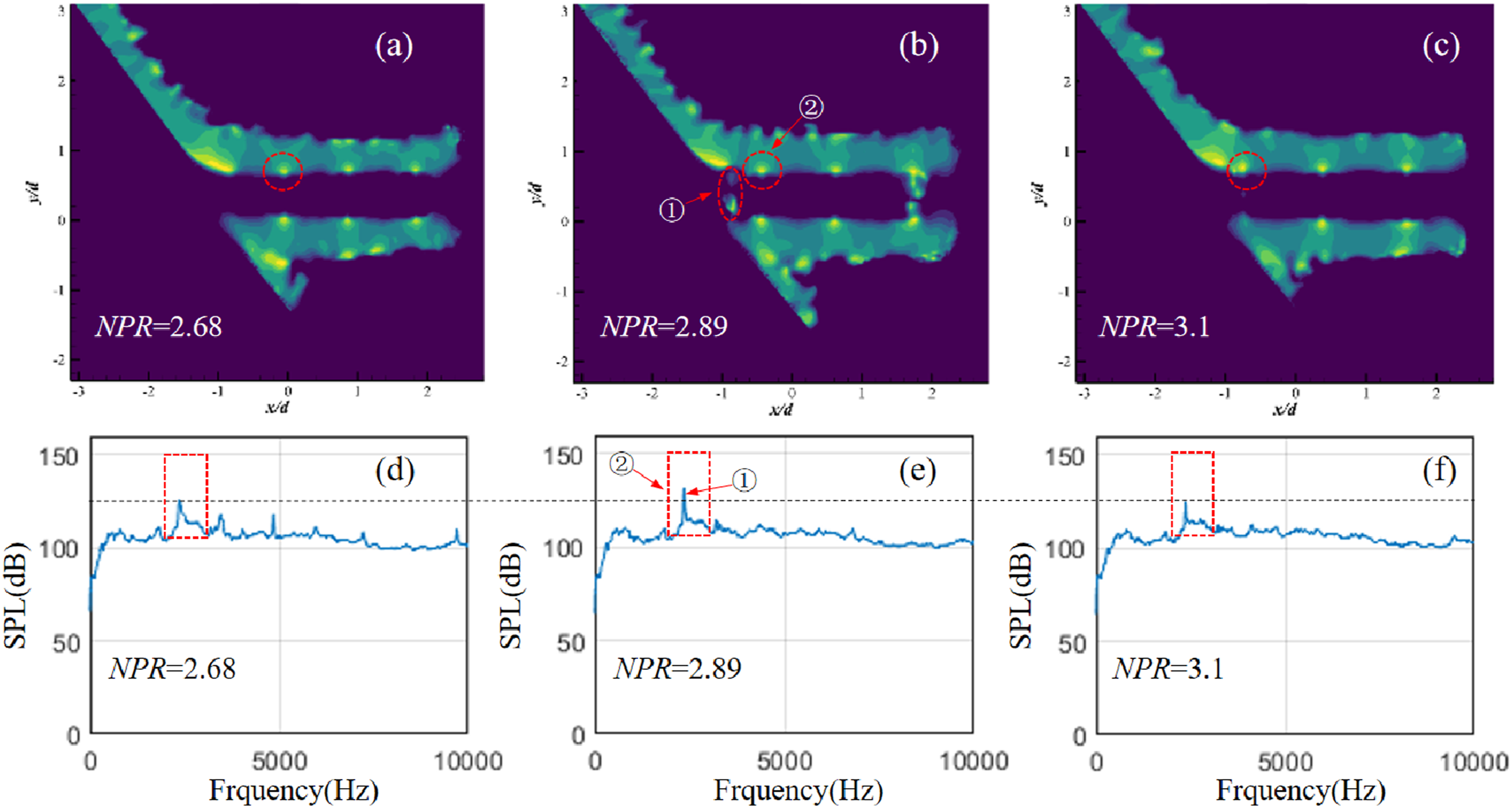
Figure 19 demonstrates the effect of the impingement distance (L/d). As L/d increases, the strong vorticity region at the upper edge of the fourth shock cell progressively separates from the SVRiP-FD (marked ③ in Figure 19(b)). This spatial separation is acoustically manifested as a monotonic increase in the amplitude of a discrete tone at f = 4980 Hz (marked ③ in Figure 19(e)). The amplitude of this tone peaks when L/d = 4.14 and the vorticity region is completely separated. Based on the frequency relationship, this tone is identified as the second harmonic of the screech tone. The observation that its amplitude strengthens with increased separation indicates that the relative spatial position between the vorticity region of the fourth shock cell and the SVRiP-FD directly governs the feedback efficiency of this harmonic source. The source region is precisely located at the upper edge of the strong vorticity region within the fourth shock cell structure. Impinging jet flow characterized by interaction of its fourth shock cell with large-scale shear-layer vortices.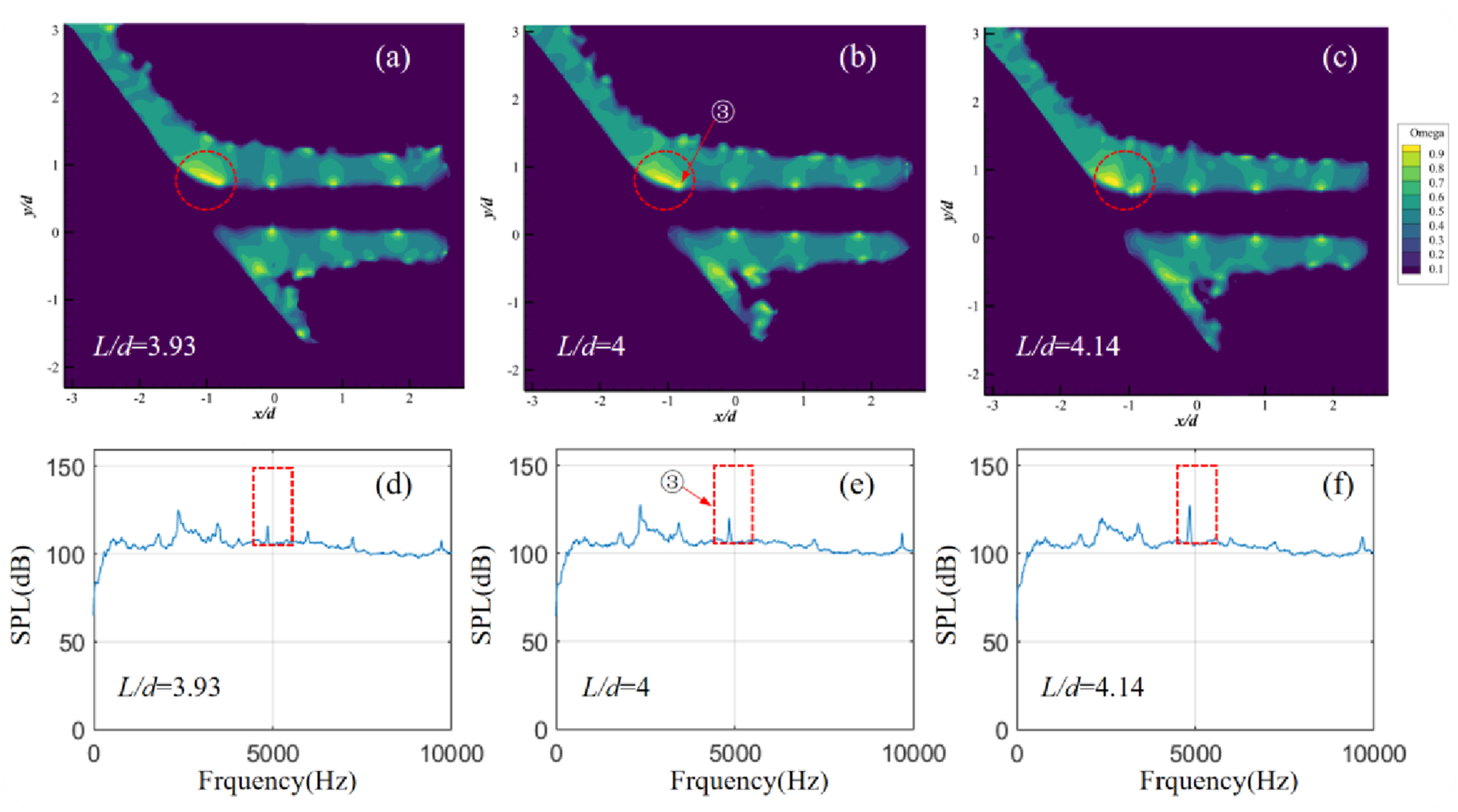
During the study of the noise characteristics of impinging jets under various NPR, as depicted in Figure 20, comparisons were made between the PIV vorticity fields and the corresponding noise spectra of the impinging jet at NPR values of 2.32, 2.37, and 2.42. Observations showed that as NPR increased, the strong vorticity region at the upper edge of the fifth shock cell in the impinging jet flow field gradually merged with the SVRiP-FD. This flow evolution induces synchronous modulation of two discrete acoustic tones: the amplitude of the tone at f = 3737 Hz increases in tandem with the merging process, whereas the amplitude of the tone at f = 6537 Hz continuously decreases and eventually vanishes upon complete merger. Spectral analysis confirms that the latter tone at f = 6537 Hz corresponds to the third harmonic of the screech tone, originating primarily from the pre-merger vorticity edge at the fifth shock cell (marked ② in Figure 20(c)). Conversely, the source of the tone at f = 3737 Hz is attributed to the new composite structure formed after the full merger (marked ① in Figure 20(a)). These observations demonstrate that the spatial merging of coherent vorticity structures can fundamentally alter the source distribution of higher harmonic components, leading to the suppression or elimination of specific tones. Impinging jet flow characterized by interaction of its fifth shock cell with large-scale shear-layer vortices.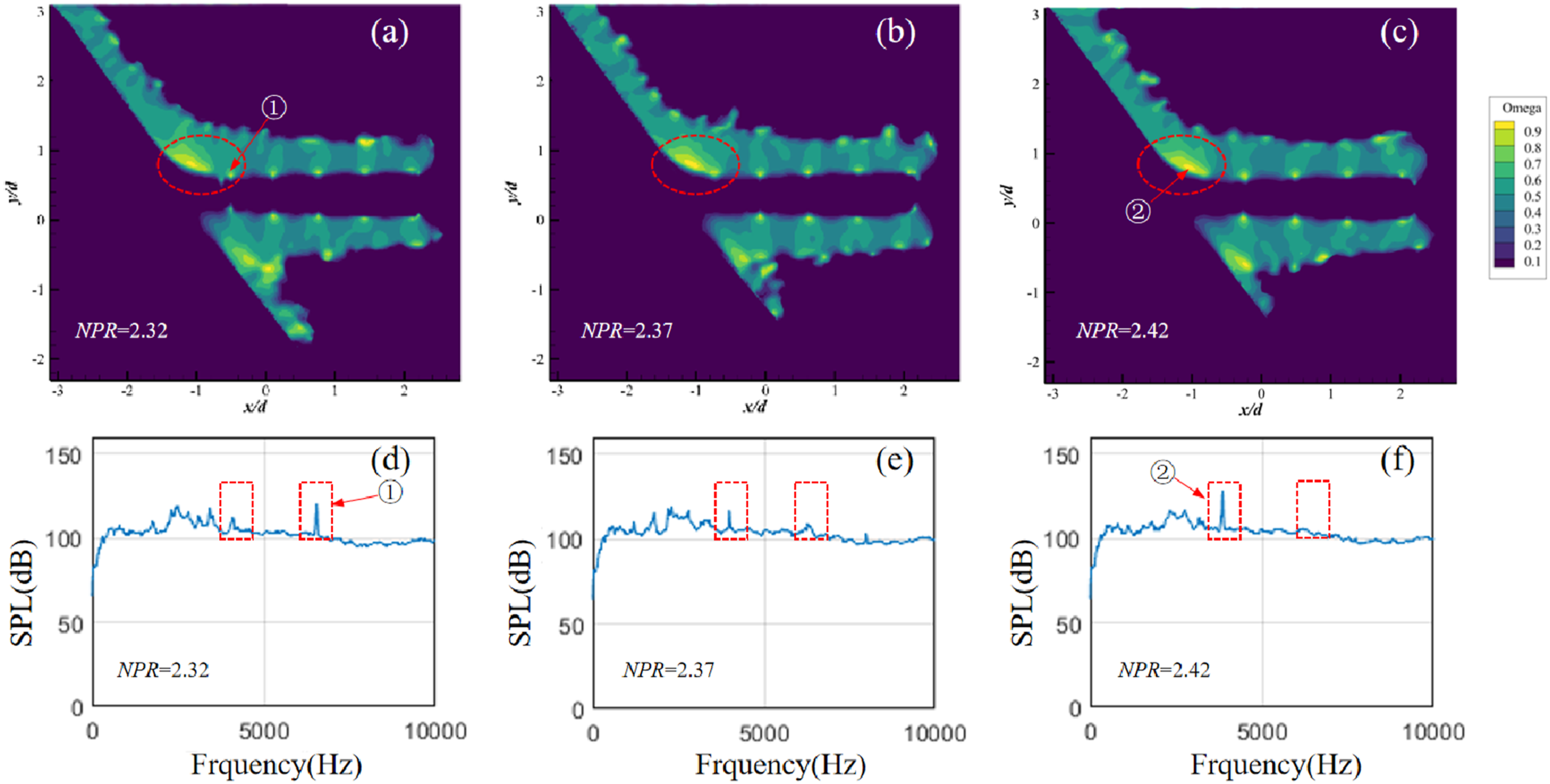
Conclusions
This study investigates the primary source regions of multiple discrete tone noises, their main propagation directions, and the effects of nozzle-plate spacing distance and nozzle pressure ratio on the noise characteristics of both free jets and impinging jets, using wind tunnel noise experiments.
For free jets, the results indicate that for 2.05 < NPR <2.84, far-field noise radiation in the downstream direction is significantly stronger than in other directions. However, when NPR >2.84, the OASPL in the midstream direction exceeds that in the downstream direction. This shift is primarily due to the attenuation of turbulent mixing noise (f < 3000 Hz) propagating downstream, while broadband shock-associated noise (f > 6000 Hz) in the midstream direction increases significantly. This behavior is attributed to changes in the flow field, including enhanced vorticity at the upper and lower edges of the first to fifth shock grids (broadband shock-associated noise), and a decrease in turbulent mixing vorticity within the shear layer.
The far-field noise OASPL in the upstream direction of the impinging jet is nearly identical to that of the free jet when 2.89 < NPR <3.1, while the far-field noise OASPL in the midstream and downstream directions significantly decreases. This change is primarily due to the inclined plate transforming the strong vorticity turbulent mixing region in the fifth and sixth shock cells of the free jet (broadband shock-associated noise) into two distinct regions. One region, located downstream of the inclined plate, generates noise that primarily radiates in the upstream direction, while the other is situated in the turbulent mixing zone of the wall jet.
When 2.05 < NPR <3.1, the free jet noise spectrum exhibits two main discrete tones and their harmonics. When NPR <2.45, the noise spectrum primarily shows the fundamental frequency and its harmonics of a discrete tone around f = 3725∼4037 Hz, which is mainly attributed to large-scale vortex structures in the shear layer of the jet. When NPR >2.45, the noise spectrum changes, displaying discrete tones and their harmonics around f = 2175∼2700 Hz, with the second harmonic producing the strongest acoustic radiation. The transition between these two discrete tones is mainly due to the gradual formation of shock cell structures in the potential core of the jet, interacting with the large-scale vortex structures.
The comparison of the spectral characteristics of the impinging jet noise with the corresponding vorticity field results reveals that the primary source region for the screech tone noise is located near the upper edge of the strong vorticity region at the third shock cell within the potential core of the impinging jet. The second and third harmonics of the screech tone primarily originate from the strong vorticity regions at the upper edges of the fourth and fifth shock cells, respectively. In contrast, the source region for the discrete tone at 3737 Hz corresponds to the position where the SVRiP-FD has fully merged with the upper edge of the strong vorticity region at the fifth shock cell.
When L/d < 4.43, the groove structure significantly contributes to reducing far-field noise in the middle and upstream directions of the impinging jet. For L/d > 4.43, the noise reduction effect becomes more pronounced in the midstream and downstream far-field regions. This is primarily due to the increasing impingement distance, which weakens the intensity of the screech feedback loop and reduces the amplitude of the screech tone. Additionally, for L/d = 4, a single-peak screech tone is observed, while for L/d = 4.57, a dual-peak screech tone appears. Dual-peak screech tone noise arises mainly from the extrusion structure formed by the interaction between the SVRiP-FD and the upper edge of the strong vorticity region at the fourth shock cell. Single-peak screech tone noise is associated with vortex pairing structures caused by the interaction between the SVRiP-FD and the upper edge of the strong vorticity region at the third shock cell. The groove structures on the surface of the inclined plate effectively reduce the screech amplitude by weakening both the extrusion structures and the vortex pairing structures.
Footnotes

Funding
The authors disclosed receipt of the following financial support for the research, authorship, and/or publication of this article: This study was funded by Project No. P2019J008 from the Research Fund of the Science and Technology Research and Development Program Project of China State Railway Group Co., Ltd.
Declaration of conflicting interests
The authors declared no potential conflicts of interest with respect to the research, authorship, and/or publication of this article.