






Abstract
Mode shape analysis by wavelet transform has been used effectively for vibration-based damage detection in plates. As an extension of previous studies, this study focuses on an improved method for damage detection in plates: scrutiny of operating deflection shapes by two-dimensional directional Gaussian wavelet transforms. With this method, the proposed two-dimensional directional Gaussian wavelet can characterize directional information about damage; moreover, the operating deflection shapes can be used to address the real-time dynamic characteristics of a plate. To identify damage, the local surface of the plate is scanned using a scanning laser vibrometer to generate the local operating deflection shape, which is interrogated by two-dimensional directional Gaussian wavelets for damage. The feasibility of the method is numerically demonstrated using a low-magnitude operating deflection shape of a two-sided clamped plate, incorporating white noise with signal-to-noise ratio of 40 dB. The applicability of the method is then experimentally validated by detecting a cross-like notch in a suspended aluminum plate with the operating deflection shapes measured by a scanning laser vibrometer. Numerical and experimental results show that the method is capable of revealing directional features of small damage with high precision and strong robustness against noise. It appears that this damage detection method is related only to the spatially distributed measurement of vibrational responses in local critical regions of the plate. With this local property, the method requires no numerical or physical benchmark models for the entire structure in question nor any prior knowledge of either the material properties or the boundary conditions of the structure. (The Matlab code performing directional Gaussian wavelet transform can be provided by the corresponding author as per request.)
Keywords
Introduction
Vibration-based damage identification of beam-type structures using one-dimensional (1D) wavelet transform has been widely investigated during the last decade.1–5 In contrast, vibration-based damage diagnosis of plate-type structures by means of two-dimensional (2D) wavelet transform is a relatively new area of research. In addition, the increasing applications of plates and the rapid prevalence of wavelet transforms support the development of wavelet transform–based damage detection of plate-type structures.
Existing wavelet transform–based methods for detecting damage in a plate can be categorized into two groups: (1) 1D wavelet transform is carried out on mode shape lines of a plate to identify damage.6–10 The mode shape lines are obtained by degrading the 2D mode shape of a plate in the length (x) and width (y) directions and (2) a 2D mode shape of a plate is directly analyzed by 2D wavelets to characterize damage in a three-dimensional (3D) scale-space domain.11–14
For the first group of methods, representative investigations are as follows. Wang and Deng 6 decomposed a 2D displacement surface of a plate into two sets of displacement lines in the x and y directions, each with a 1D Haar wavelet implemented to identify a through-thickness crack. The results showed that the 1D Haar wavelet was effective for locating the crack. Chang and Chen 7 examined local damage in a plate using a 1D Gabor wavelet 8 to deal with the mode shape lines of the plate. The results indicated that the damage could be effectively localized by the abrupt change in wavelet coefficients. Douka et al. 9 used a 1D Symlet wavelet to cope with the y-directional mode shape lines of a rectangular plate with a crack parallel to one edge. The location of the crack was identified by the abnormality of wavelet coefficients. Moreover, the depth of the crack was estimated with the Hölder exponent. 10 Essentially, this group of methods follows the regime of wavelet-based damage detection of a beam, where the 1D wavelet is utilized to handle the 1D mode shape. It is noteworthy that degrading a 2D mode shape into two sets of x- and y-directional mode shape lines can cause loss of modal information, such as the disappearance of diagonal modal features, possibly impairing the accuracy of damage detection.
For the second group of methods, typical studies are as follows. Loutridis et al. 11 constructed a separable-product 2D wavelet based on the 1D Symlet wavelet and applied this 2D wavelet to mode shapes of a plate for crack identification. They successfully located cracks of various depths. Rucka and Wilde 12 utilized a separable-product 2D wavelet arising from a 2D reverse biorthogonal wavelet to process the mode shapes of a cracked plate. The location and size of the crack were identified by steep changes in the modulus and the angle of wavelet coefficients. Kim et al. 13 employed the 2D Haar wavelet to solve damage index equations in a multi-resolution wavelet domain and proposed an index of damage via inverse wavelet transform. The numerical results showed the effectiveness of the index in characterizing damage in a plate. Fan and Qiao 14 proposed a 2D continuous wavelet-based algorithm using a family of wavelets derived from a 2D Gaussian function for damage detection in plates. This algorithm was shown to be effective in revealing damage from mode shapes of numerical and experimental cases. In general, this group of methods features direct characterization of damage using 2D wavelets to process 2D mode shapes. The consistency in dimensions in this group of methods is more advantageous than the methods of the first group for identifying damage in plates.
Most 2D wavelet transform–based methods for damage detection in plates have a common trait: mode shapes acquired by conventional contact measurement are processed by a 2D wavelet transform to depict damage. This trait exposes several limitations primarily resulting from the method of measurement: (1) the contact measurement easily imposes noise on the measured mode shapes, attributable to the complex linkage cables, additional masses due to sensors, sensitivity to variations in environmental factors such as temperature, humidity, and so on; (2) because of the difficulty in deploying dense sampling points, the spatial resolution of contact measurement is commonly low, incapable of satisfying the requirements for slight damage detection; and (3) to measure mode shapes of a plate using contact measurement, interrupting its normal running status is usually a precondition for setting up sensing devices. These limitations provide motivation for the use of an advanced measurement technique to acquire dynamical responses of a structure under inspection.
Currently, the scanning laser vibrometer (SLV) is being increasingly used in vibration response measurement for structural damage detection applications. Briefly, the merits of a SLV in acquiring dynamic responses are fourfold:15–21 (1) noncontact measurement greatly diminishes the adverse influence of measurement noise; (2) optical scanning affords the opportunity of real-time acquisition of dynamic responses; (3) a SLV facilitates high-resolution spatial measurement due to its facility of optically scanning a vibration surface; and (4) arbitrary harmonics scoped in a wide-frequency band can be acceptable excitations for a SLV. These features render a SLV suitable for measuring the operating deflection shapes (ODSs) of an in-service structure, greatly supporting online health monitoring. 16 In this study, an ODS represents a generalized dynamic deflection of a structure under harmonic vibration, possibly caused by active, ambient, or self-excitation. An ODS is dominated by a mode shape only when the vibration frequency is equal to one of modal frequencies, in which case a mode shape can be viewed as a particular ODS. Recently, ODSs have been used in structural damage detection by several researchers.17–19
In this study, a 2D directional Gaussian wavelet transform is expressly elaborated, differing from the conventional wavelet transform in the inclusion of a rotational parameter that allows description of the directional features of dynamic responses; moreover, processing ODSs by 2D directional Gaussian wavelet transform is explored with the aim of providing a sophisticated method for damage detection in plates.
This study is organized as follows: Section “2D directional Gaussian wavelet transform” formulates the 2D directional Gaussian wavelet transform, with particular emphasis on its characteristics for damage detection in plates. Section “Method demonstration in numerical simulations” presents numerically simulated cases to demonstrate the feasibility of applying 2D directional Gaussian wavelets to ODSs for damage detection. Section “Experimental validation” validates the applicability of the proposed method through an experimental program with the ODSs acquired by a SLV. Several conclusions are drawn in section “Conclusion.”
2D directional Gaussian wavelet transform
2D directional Gaussian wavelets
A 1D wavelet is defined as 22
which satisfies the wavelet admissibility condition
where
Analogous to a 1D wavelet, a 2D wavelet is defined as
where
To increase flexibility, a rotational parameter
with
where
For a 2D signal
where
In numerical implementation of the convolution in equation (6), border distortion may occur adjacent to the edges of the analyzed signal, signified by abrupt changes of wavelet coefficients. 23 This distortion is attributed to the finite size of the analysis signal and wavelets involved in numerical convolution. To present the wavelet analysis results clearly, a simple method of ignoring the subregions containing border distortions is adopted in this study. 14
The classical Gaussian function,
where
From
Similar to equation (5), a family of 2D directional Gaussian wavelets can be expressed as
It is known that conventional Gaussian wavelets have attractive properties for damage detection, such as symmetry, smoothness, differentiability, localizability, and explicit mathematical expressions.25–27 Besides these properties, the 2D directional Gaussian wavelets have the merit of characterizing directional features of damage. In what follows, a specific 2D directional Gaussian wavelet is selected for damage detection in plates.
Specific wavelets used for damage detection
In equation (7),
This mother wavelet is illustrated in Figure 1. From
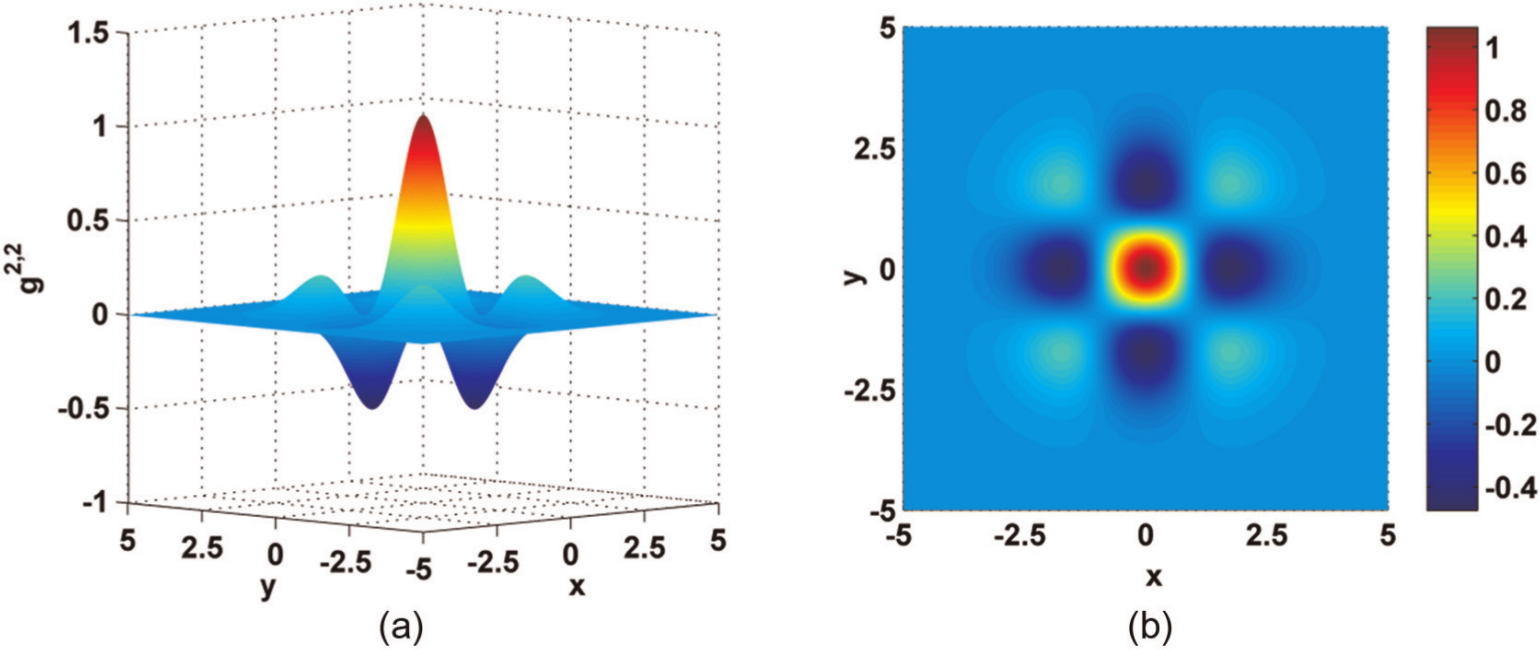
(a) 2D mother Gaussian wavelet and (b) its planform.
Four directional Gaussian wavelets with
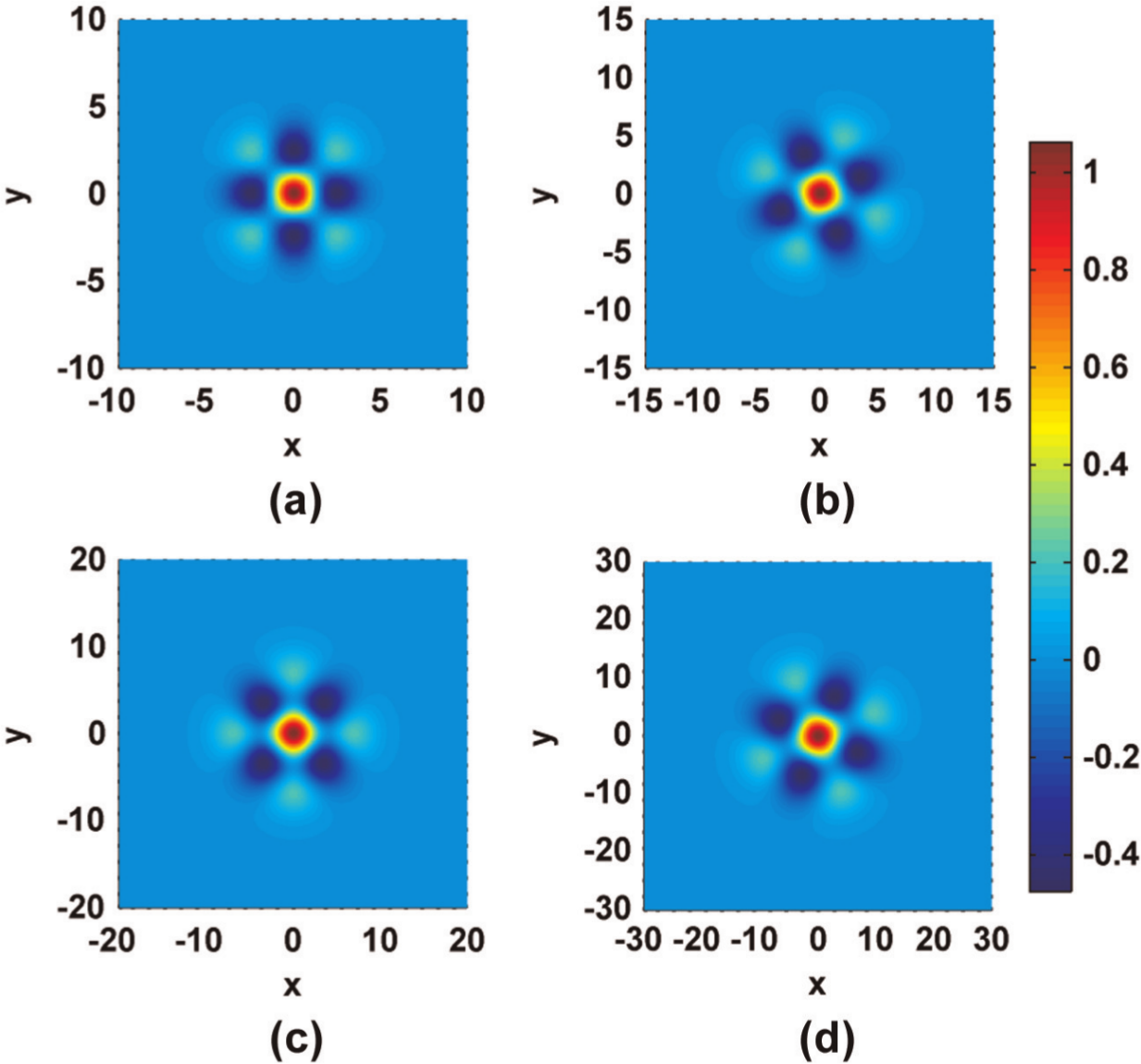
Planforms of 2D directional Gaussian wavelets: (a) s = 2, θ = 0; (b) s = 3, θ = π/8; (c) s = 4, θ = π/4; and (d) s = 6, θ = 3π/8.
The wavelet
Method demonstration in numerical simulations
The feasibility of using the 2D directional Gaussian wavelet to detect damage in plates is examined using 3D elastic finite element simulations. An aluminum plate, bearing a cross-like patch damage, clamped at its lower and right edges, is considered, as shown in Figure 3. The plate has the dimensions 450 mm length, 410 mm width, and 3 mm depth in the x, y, and z directions, respectively. Its Young’s modulus, Poisson’s ratio, and mass density are taken as 70 GPa, 0.33, and 2700 kg/m3, respectively. The cross-like patch damage is centered at x = 282 mm and y = 257.5 mm, with each branch containing five 10 mm × 10 mm × 1 mm pseudo (removed) cubes. A local surface of the plate, whose opposite counterpart covers the cross-like patch damage, spanning from 85 to 400 mm in the x direction and from 115 to 430 mm in the y direction, is taken as the measurement zone to generate the local ODS for damage identification.
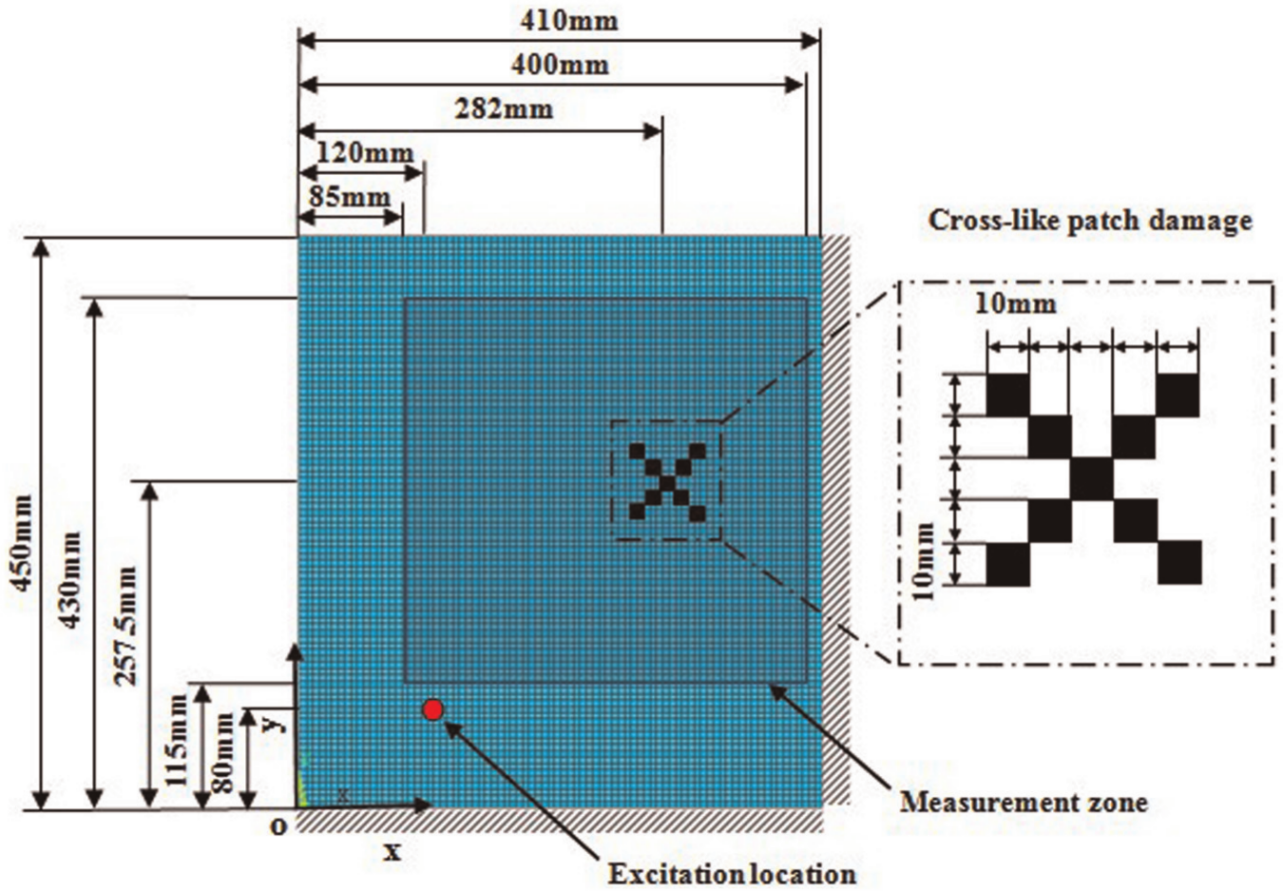
Finite element mesh of plate along with zoomed-in cross-like patch damage.
The numerical model of the plate is built with 20-node 3D structural solid elements (SOLID 95) using the commercial software ANSYS®. The measurement zone covers 63 × 63 elements, from which the ODS is acquired when the plate is subjected to a harmonic excitation located at the point of x = 120 mm and y = 80 mm (outside the measurement zone), perpendicular to the plate. Figure 3 illustrates the finite element mesh along with the zoomed-in cross-like patch damage in the plate.
ODSs
A preliminary analysis of the displacement frequency response function (FRF) using the sweep frequency method is performed to determine the basic dynamic property of the plate, with a particular subset of the obtained FRF, as illustrated in Figure 4. From this FRF profile, a lower valued frequency point of 1510 Hz is chosen as excitation frequency for generating a lower magnitude ODS, with the consideration that the smaller magnitude of ODS is helpful to justify the capabilities of the damage detection algorithm. Vibration of the plate subjected to this excitation is numerically simulated by the finite element model built above. The zoomed-in local ODS of the measurement zone is displayed in Figure 5(a) that is extracted from the global ODS of the plate, as shown in Figure 5(b). As a reference, the 29th and 30th mode shapes adjacent to the ODS are presented in Figure 6. Clearly, the global ODS (Figure 5(b)) has lower magnitude than the 29th and 30th mode shapes (Figure 6). This lower magnitude ODS at a non-modal frequency is of greater generality for reflecting the real-time dynamic characteristics of the plate.
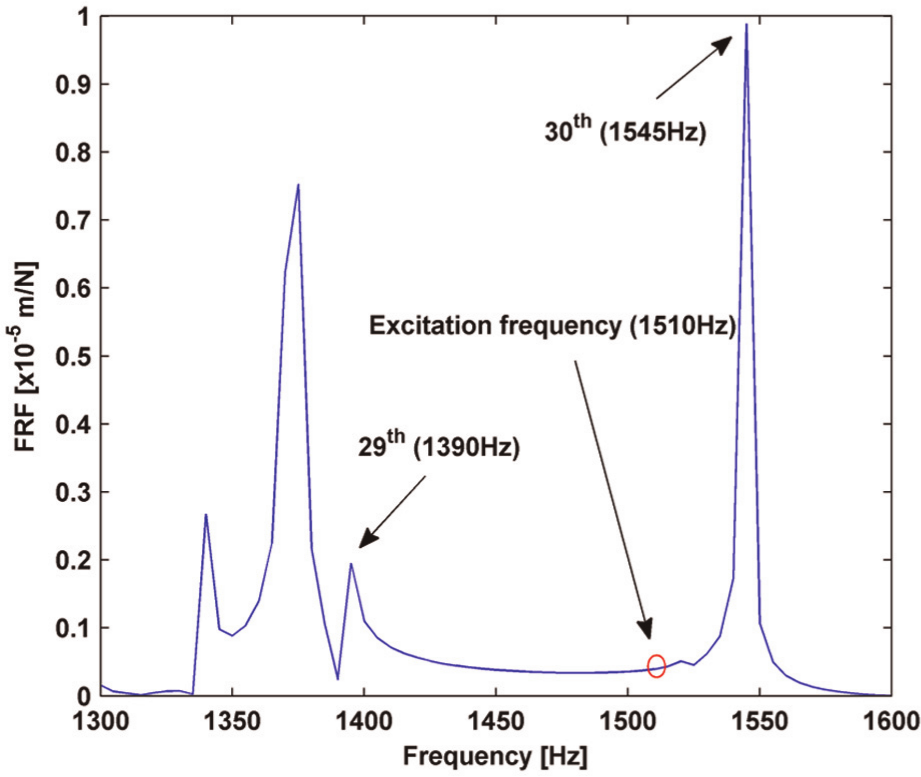
A subset of displacement FRF of plate.
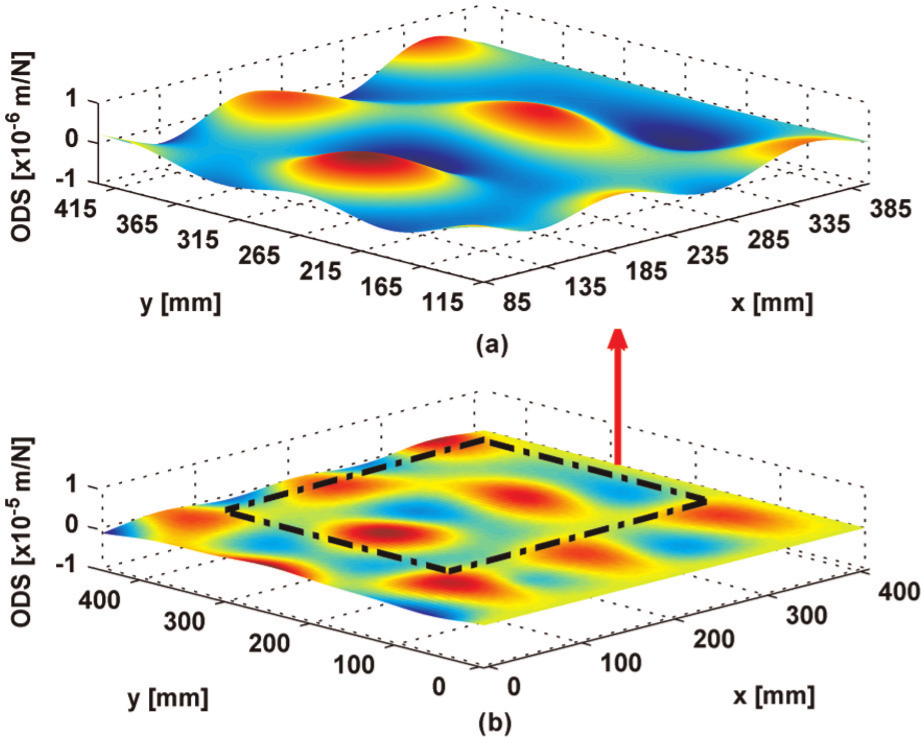
(a) Zoomed-in local ODS of measurement zone and (b) extracted from global ODS of plate.
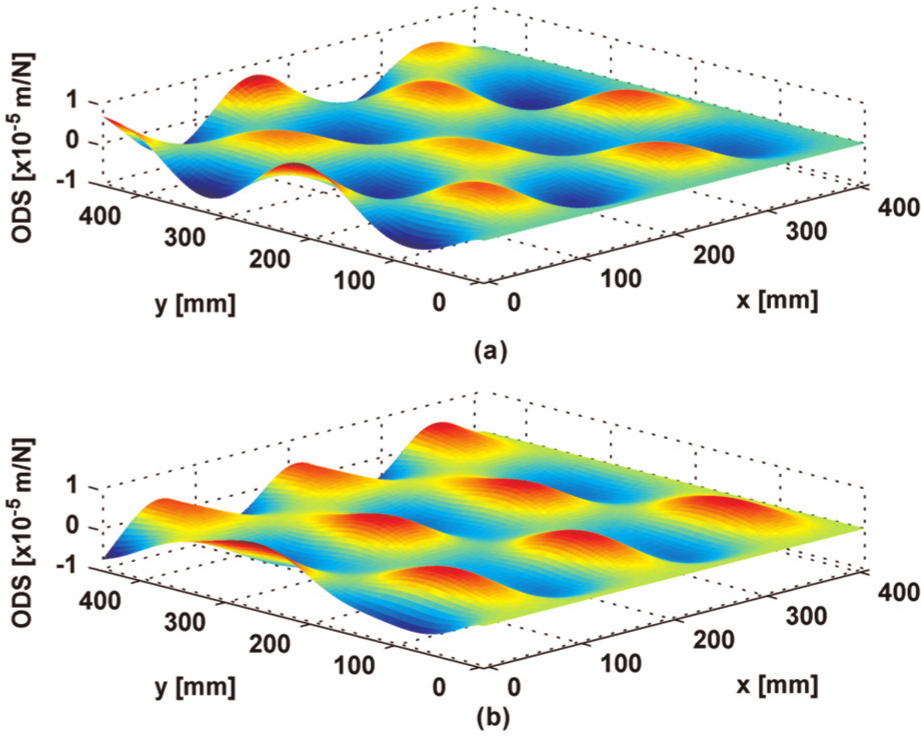
(a) The 29th and (b) 30th mode shapes of the plate.
Damage detection
The local ODS of the measurement zone is analyzed using the 2D directional Gaussian wavelets,
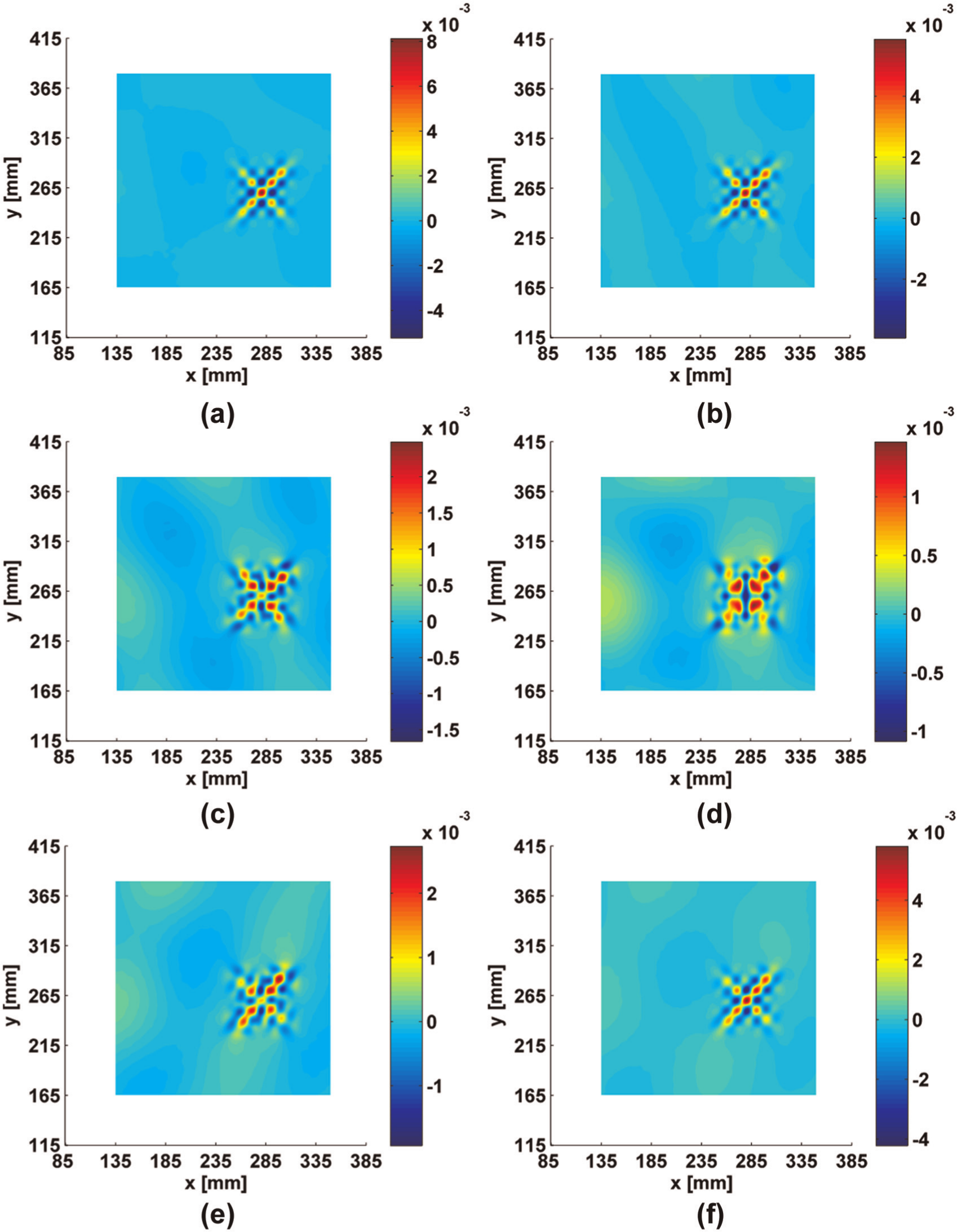
Effect of
Noise robustness
The 2D directional Gaussian wavelet can reveal damage under noisy environments due to its intrinsic multiscale property of suppressing noise and strengthening damage features.22,25 To demonstrate this trait, Gaussian noise with the relatively low signal-to-noise ratio (SNR) of 40 dB (the ratio of the root mean square (RMS) amplitude of noise to the RMS amplitude of signal is 1%) is added to the local ODS of the measurement zone (Figure 5(a)) to yield a noise-contaminated ODS. The ODS is processed by
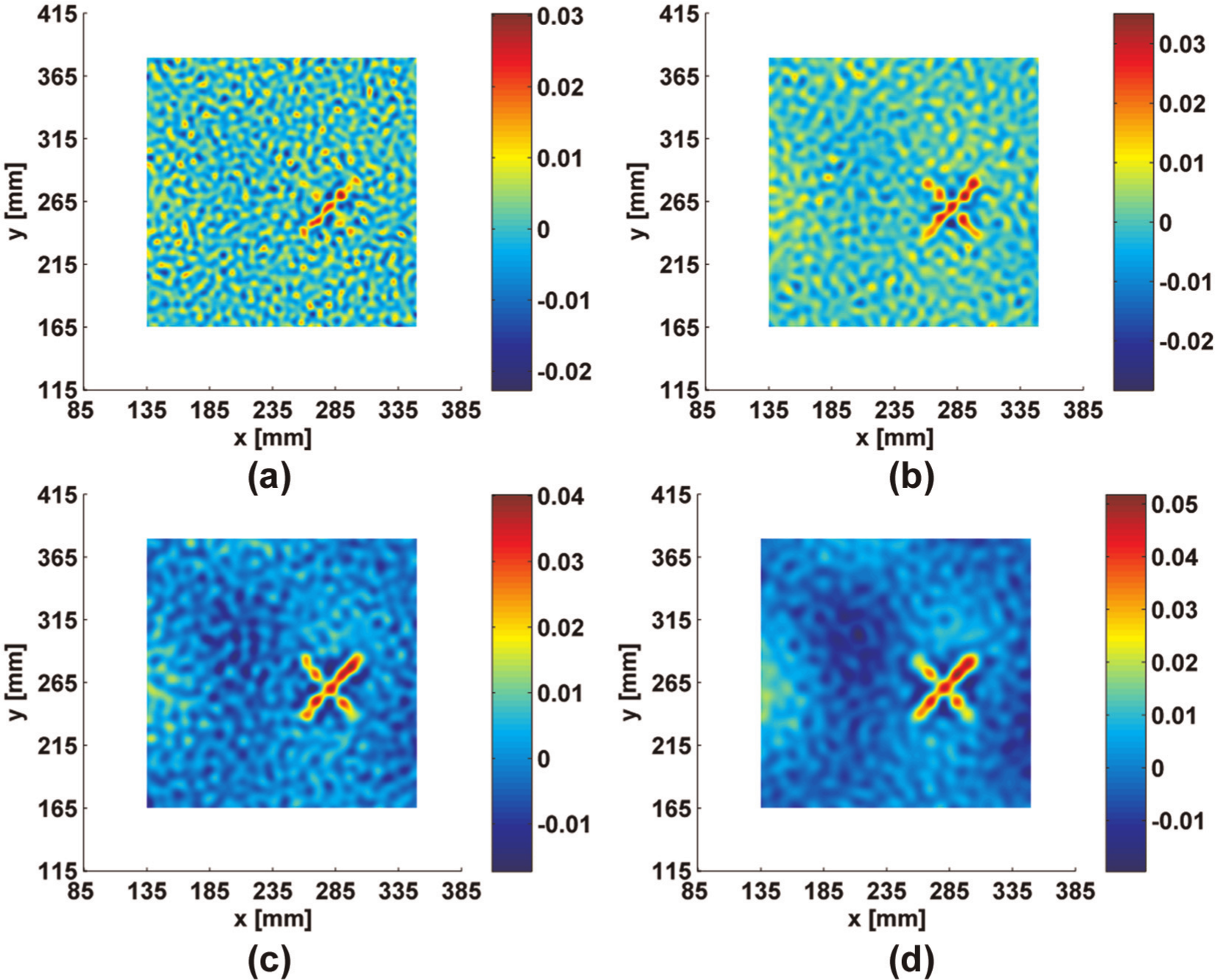
Illustration of noise robustness of
Experimental validation
The proposed method of applying 2D directional Gaussian directional wavelets to ODSs for damage detection in a plate is experimentally validated using a SLV to measure the ODSs of the plate.
Experimental setup
An aluminum plate of elastic modulus 70.5 GPa and material density 2680 kg/m3, with dimensions of 1000 mm × 1000 mm × 4 mm in the x, y, and z directions, respectively, is used as experimental specimen, as shown in Figure 9(a). The gray square in Figure 9(a) lying on the intact surface (the damage exists on the opposite surface) is taken as the measurement zone, with an area of 920 mm × 920 mm, that is, spanning from 40 to 960 mm in the x and y directions, respectively. This measurement zone contains cross-like notch damage shaped in an “X,” with each inclined branch being 40 mm long, 1 mm wide and 2 mm deep (2 mm reduction in depth away from the original surface). The cross-like notch is manually manufactured by gradually carving the plate using a hard, sharp tool. Figure 9(b) shows the magnified cross-like notch. A preliminary modal test shows that this notch causes insignificant change in natural frequencies.
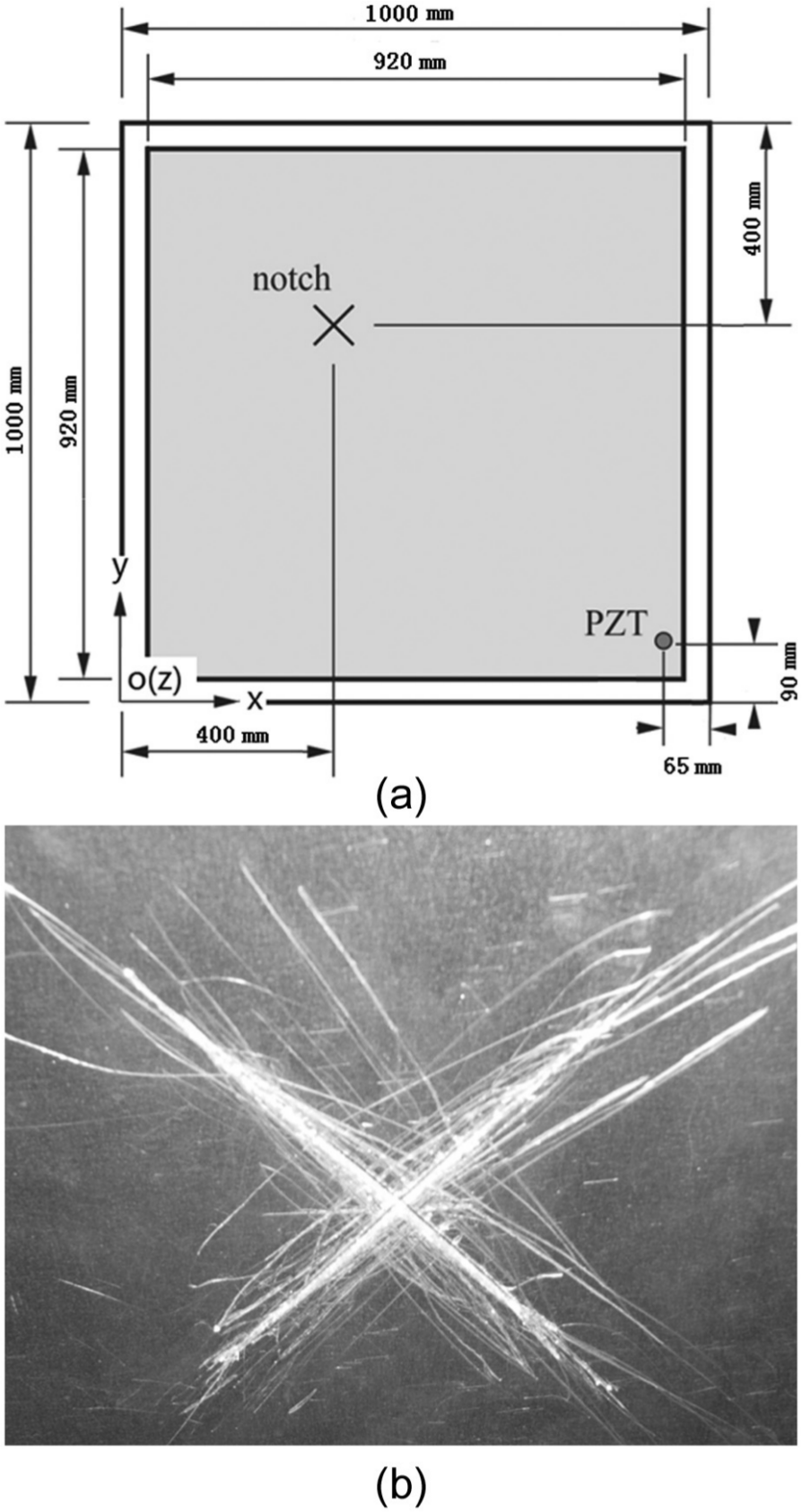
An aluminum plate with a cross-like notch: (a) measurement zone containing a cross-like notch and (b) zoomed-in cross-like notch.
Vibration of the plate is induced by a harmonic excitation exerted by a circular 10-mm-diameter smart piezoelectric lead zirconate titanate (PZT) actuator, 28 which is located at 90 and 65 mm from the lower and right edges of the plate, respectively. As the plate vibrates steadily, the measurement zone, as shown in Figure 9(a), is scanned by a SLV (Ploytec PSV-400) to generate the local ODS comprising 451 × 449 measurement points. The experimental setup is shown in Figure 10. The obtained local ODS of the measurement zone is processed by the 2D directional Gaussian wavelets to interrogate the damage in the plate.
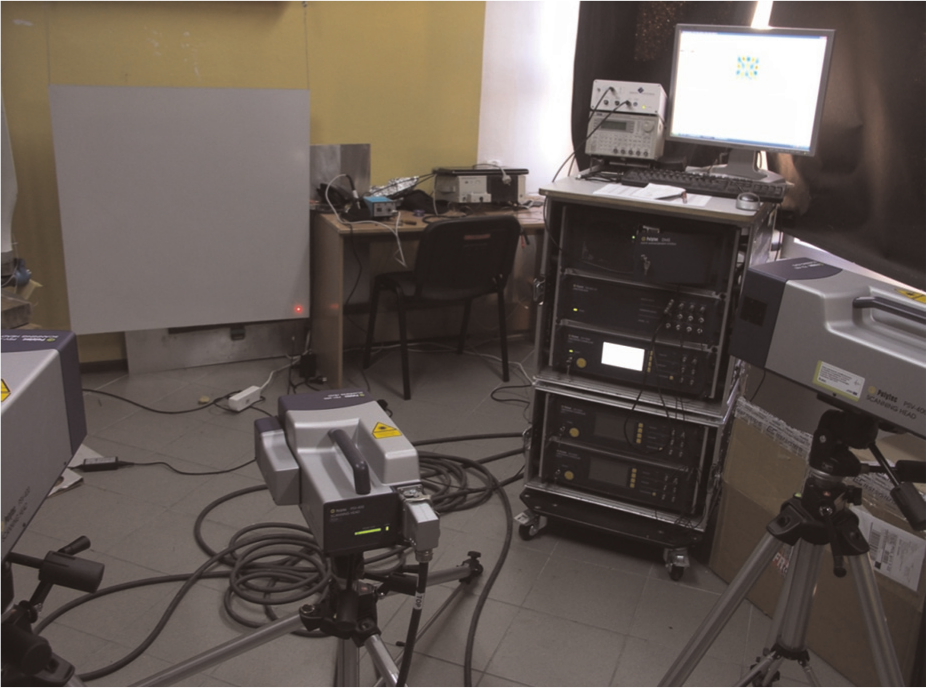
Experimental setup.
Results
When a harmonic excitation of 830 Hz is arbitrarily chosen, the local ODS of the measurement zone and its planform are shown in Figure 11(a) and (b), respectively. In Figure 11(b), the layout of the cross-like notch is indicated by a dashed circle. This local ODS is dealt with by the 2D directional Gaussian wavelet
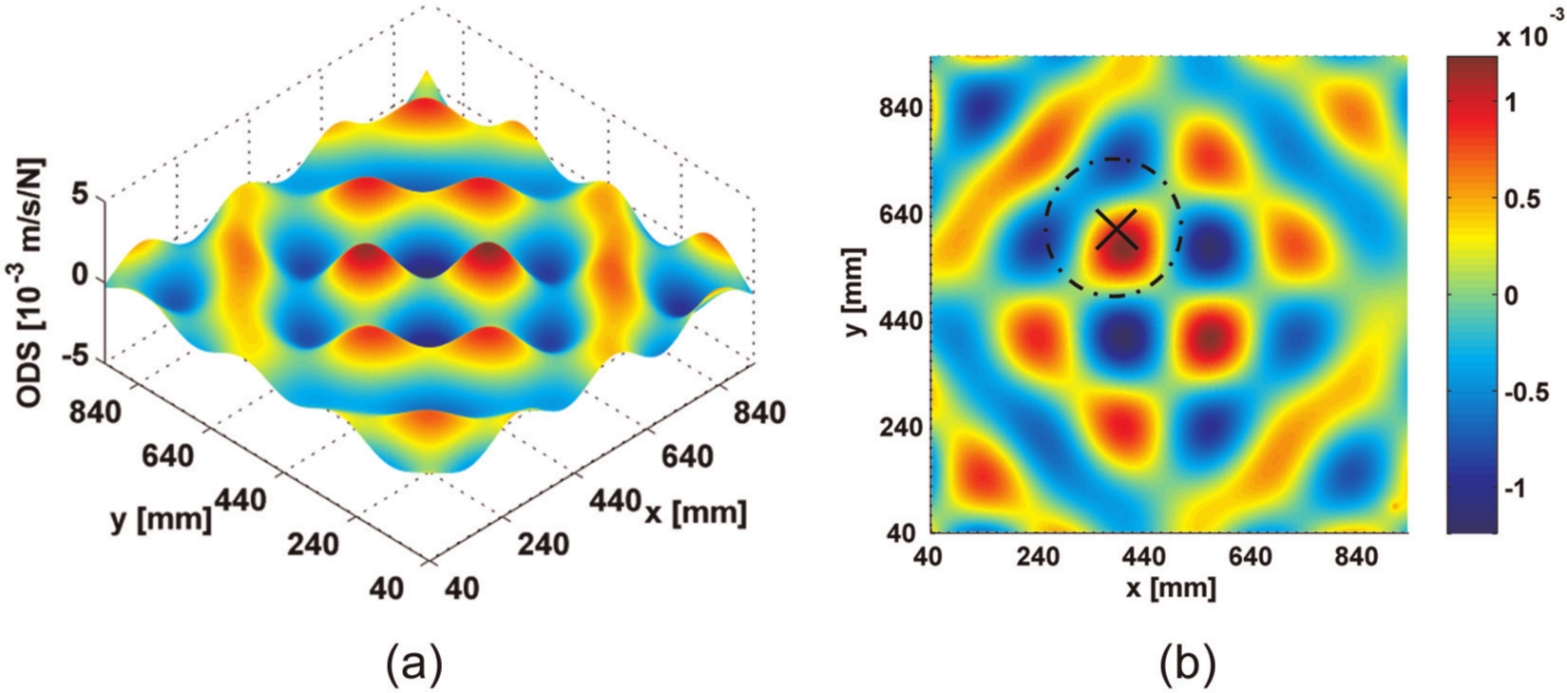
Local ODS at 830 Hz and its planform for the measurement zone: (a) local ODS at 830 Hz and (b) layout of cross-like notch.
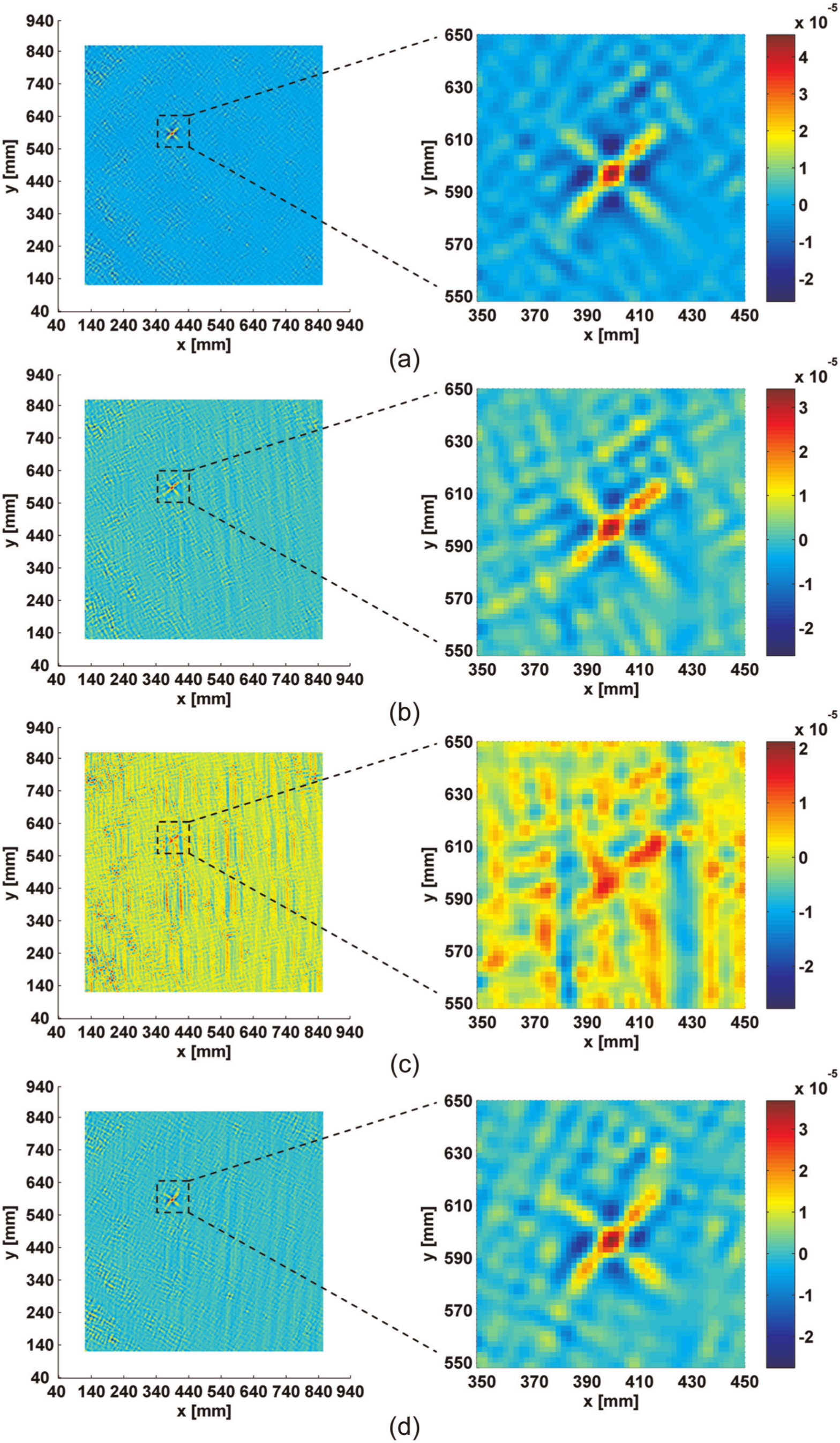
Identified cross-like notch using
For performance comparison, the conventional 2D Mexican hat wavelet,
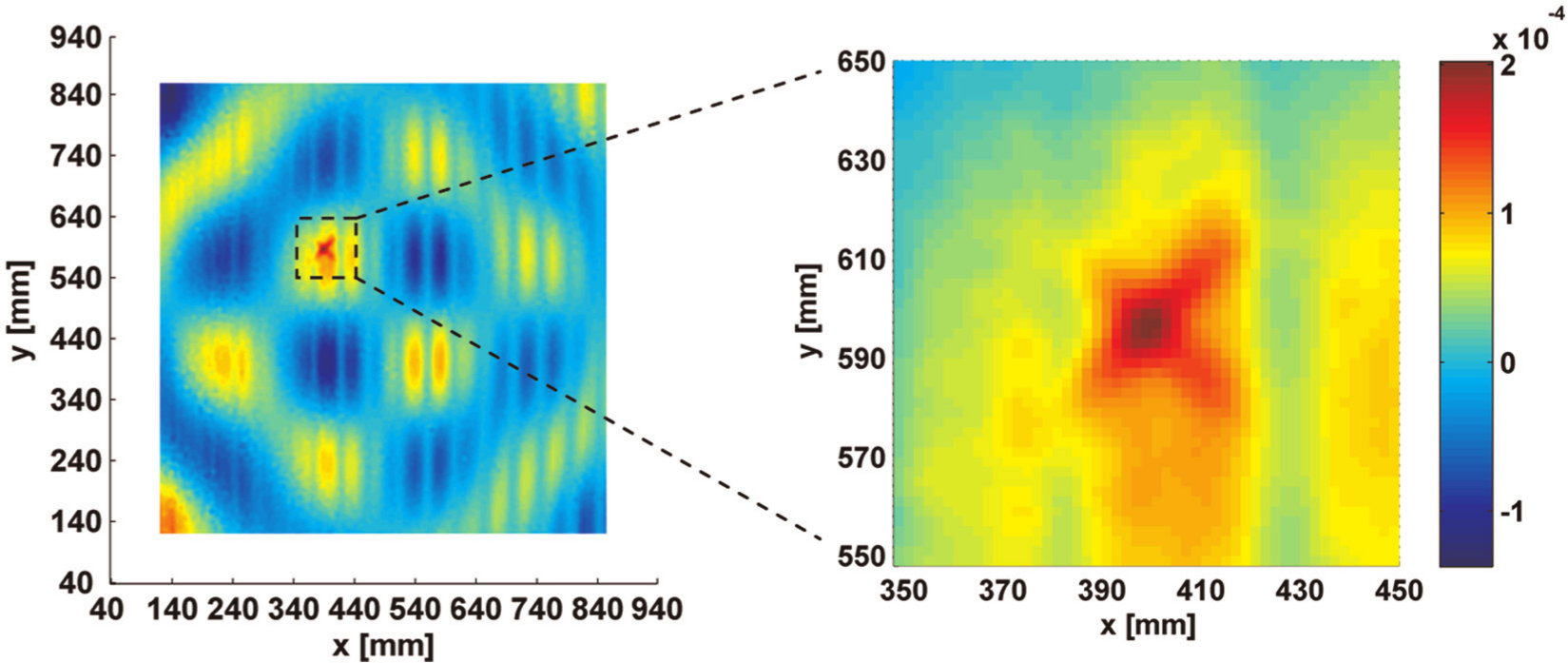
Identified cross-like notch using the Mexican hat Gaussian wavelet.
Conclusion
An efficient method of detecting damage in plates using 2D directional Gaussian wavelet transforms is presented in this study. With this method, a SLV-based noncontact measurement method is used to acquire the ODSs of a plate. The obtained ODSs are processed by 2D directional Gaussian wavelets for damage interrogation. The performance of the method is numerically demonstrated using the ODSs of a two-sided clamped plate, contaminated by noise; the applicability of the method is experimentally validated using an aluminum plate with a cross-like notch. From the study, the following are observed:
SLV-based noncontact measurement provides an advanced approach to acquiring vibration responses of a plate, with predominant features such as high spatial measurement resolution, greatly diminishing noise interference, suited to harmonic excitations within a wide-frequency scope, and without the need to interrupt the normal running of the structure under investigation.
Compared with mode shapes, the ODS obtained by the SLV can serve as a more practical quantity to depict the real-time vibration characteristics of an in-service plate-type structure.
The proposed 2D directional Gaussian wavelets have advantages over conventional Gaussian wavelets in characterizing the directional features of damage in a plate.
Processing the ODS of a plate using 2D directional wavelets is sophisticated in revealing the detailed configuration of the damage under a high-noise or practical measurement condition.
The proposed damage detection method requires no numerical and physical benchmark models for the entire structure under inspection nor any prior knowledge of either the material properties or the boundary conditions of the structure.
In practical applications, data fusion of wavelet coefficients for a set of ODSs at different excitation frequencies can be considered as an supplementary means to reduce the adverse effect of the ODS’ node lines on damage depiction and alleviate the interference of measurement noise.
These distinctive features make this proposed method a promising prototype for developing online health monitoring systems for plate-type structures.
Footnotes
Declaration of conflicting interests
The authors declare that there is no conflict of interest.
Funding
This study was supported by the Marie Curie Industry Academia Partnership and Pathways Grant (grant no. 251309 STA-DY-WI-CO) within the 7th European Community Framework Programme) (to M.C. and W.O.) and by the National Natural Science Foundations of China for Grants (no. 50978084 and 11172091) (to W.X.).