







Abstract
In recent centuries, millions of bridges have been constructed as vital infrastructure components. However, a significant proportion are operating beyond their intended service life, increasing their vulnerability to deterioration and natural hazards. Conventional inspection and maintenance practices, primarily based on manual observations and non-destructive testing, are often inefficient and incapable of providing continuous, real-time insights into structural performance. To address these challenges, Digital Twin technology has emerged as a transformative solution, enabling the creation of dynamic, data-driven virtual replicas of physical assets that facilitate intelligent, adaptive and predictive maintenance, real-time monitoring and infrastructure assessment. This study presents a comprehensive review of the application of Bridge Digital Twins for structural health assessment, consolidating the latest advancements in their conceptual frameworks, enabling technologies, sensory systems and real-world implementations. The paper presents a structured framework that maps the technological, analytical and operational layers of Bridge Digital Twins, identifying key performance indicators associated with resilience and adaptability. The review systematically examines the essential components of Bridge Digital Twins, maturity levels, classification schemes and model updating techniques, and critically discusses their limitations and practical challenges in real bridge applications. Critical challenges hinder large-scale adoption, data interoperability, standardisation, model validation and computational efficiency. Research gaps and future research directions are identified to guide the widespread adoption of Digital Twins in bridge infrastructure.
Keywords
Introduction
Bridges are lifelines of modern infrastructure, connecting communities, supporting commerce and sustaining economic growth. Their uninterrupted operation is essential; yet, these structures face constant threats from traffic loads, environmental forces and the natural ageing of materials. Even minor design flaws, construction errors or maintenance lapses can escalate over time, sometimes culminating in catastrophic failures with devastating social and economic consequences. The critical demand to monitor, evaluate and manage bridge performance has reached unprecedented levels, highlighting the significance of proactive solutions to guarantee safety, durability and resilience.
Many of the bridge failures in India have highlighted critical issues in constructed bridges, such as inadequate design, maintenance and load management. The Shetrunjay Bridge in Gujarat collapsed in 2009 when a gas turbine weighing 280 tonnes exceeded the bridge’s load capacity, leading to the snapping of bearings and mid-span failure. Similarly, the Ravi Bridge in Chamba, Himachal Pradesh, failed in 2017 due to overloaded vehicles, causing cantilever spans to tilt and collapse, injuring six people. Another catastrophic failure occurred with the Rafiganj Railway Bridge in Bihar in 2002, where derailment caused 14 train coaches to plunge into the river, resulting in over 200 fatalities. These examples underscore the need for robust design standards and regular inspections to mitigate risks associated with ageing infrastructure and overloading. 1
Nowadays, there is greater acceptance for implementing digitalisation through the applications of Digital Twins. These Digital Twins are virtual replicas of machinery or systems that are revolutionising many sectors by converting them into a digital world. The Digital Twin technology has significantly transformed the industry by replicating nearly all aspects of the product, process and services. The digital domain can accurately mirror all aspects of the physical world and provides engineers and their users with valuable insights from the digital world. This technology enables users to detect damage while providing insights quickly. Furthermore, using Digital Twin technology improved and optimised lifecycle management processes and performance. 2
Digital Twin technology in bridge engineering
The use of Digital Twins for managing bridge-resilient infrastructure has grown in popularity due to the increased interest in improving bridge functioning and administration via a Digital Twin of the whole physical bridge lifespan. 3 Digital Twins consist of a computerised model of bridges and a real synthetic world system used to monitor bridges while in operation. The system uses various data to regulate the operation of the bridges and improve their efficiency. 4 Digital Twins are also used for bridge maintenance by doing precise data analysis and providing proactive solutions to prevent potential failures. Despite substantial research on the idea and importance of integrating Digital Twins in bridge engineering, the present application of Digital Twins is still in its early stages.5,6 This leads to several categorisations of bridge data types from different viewpoints, such as the level of details, 7 maturity, 5 complexity 8 and data connectivity. 9 In addition, academics have proposed heterogeneous definitions of Bridge Digital Twin, which prevents the development of a holistic digital platform with smooth integration of new technologies.5,10 Bridge Digital Twins, as described in some literature, is a Bridge Information Model (BrIM) or Finite Element Model (FEM) update strategy that involves gathering data from various sensors, analysing the connections between the different datasets, accounting for uncertainties and forecasting about the safety and management of bridges in various scenarios.11–14 Digital Twin of Bridges manages intelligence, disaster prevention, mitigation and an early warning system for bridge structures.
Bridges are significant elements of civil infrastructure for transportation and safeguarding public safety. However, most bridges have surpassed their intended lifespan and design specifications, leading to increased deterioration and structural collapses. 15 This presents substantial difficulties for the maintenance and management of these bridges. However, the adoption of digitisation, especially intelligent technologies, has been progressing slowly in bridge structures. 16 The recent development of cutting-edge technologies like building information modelling (BIM), Big Data, artificial intelligence (AI), Internet of Things (IoT), virtual reality (VR), augmented reality (AR), extended reality (ER) and Digital Twins provides potential for the creation of digital, eco-friendly and intelligent bridges, signifying the future trend of bridge engineering.
Recent advancements in bridge engineering have increasingly leveraged Digital Twin technology to enhance infrastructure monitoring, maintenance and lifecycle management. Linear and nonlinear model updating techniques using earthquake data have been applied to bridge FE models to facilitate seismic fragility assessments. 12 The potential of Digital Twins to support facility management throughout a bridge’s life cycle has been demonstrated, combining structural testing with real-time data integration. 17 Integration of model-driven and data-driven methodologies has been explored for cable-stayed bridges to predict lifespan and evaluate structural performance, 18 while cyber-physical frameworks for load testing have emphasised establishing physical-to-virtual information flows for design, construction and administration. 14 Risk-informed maintenance strategies, rapid repairs and component material assessment have been implemented by mapping critical information onto three-dimensional (3D) models. 19 Moreover, sensor-based vibration monitoring coupled with machine learning enables early anomaly detection and maintenance prioritisation before visual inspection. 20 Non-destructive Digital Twin approaches employ 3D modelling, surrogate models and virtual sensors to represent structural performance accurately, 21 while Petri net-based frameworks facilitate AI-driven edge computing and cross-platform integration for operations and maintenance (O&M). 10 Fatigue evolution and lifecycle analysis are being enhanced by integrating FE models with BIM and fatigue analysis systems. 22 Finally, real-time monitoring, machine learning and proactive crisis management approaches highlight the necessity of transitioning towards condition-based maintenance while retaining human expertise at the core of decision-making. 23 Collectively, these studies underscore the growing significance of Digital Twin technology in revolutionising bridge monitoring, performance evaluation and lifecycle management.
Review methodology
This literature review follows a structured five-step approach: defining the research scope and objectives, performing a systematic literature search, screening and selecting relevant studies, extracting and analysing key information and synthesising the findings to identify trends, gaps and directions for future research. The literature search is primarily conducted using Google Scholar due to its extensive coverage of scholarly publications. Keywords about Digital Twins and bridge infrastructure are identified based on a bibliometric analysis using the Scopus database, as detailed in the ‘3D model reconstruction using the UAV-based method’ section. Studies published between 2017 and 2025 are prioritised to capture recent developments, while earlier foundational works and the related journal articles are considered in subsections where necessary. Selected studies undergo a rigorous screening to ensure relevance and adherence to inclusion criteria. A detailed content analysis is then performed to extract critical information, including research objectives, methodologies, key findings and conclusions. Insights obtained from this analysis guide the organisation and development of the review.
The paper is structured as follows: the second section presents an overview of Digital Twins; the third section discusses tools, technologies and sensory connections and the data acquisition system for Bridge Digital Twins; the fourth section elaborates on Bridge Digital Twin integrated layers, maturity levels and classifications; the fifth section outlines methods to build Bridge Digital Twin models and importance of model updating and its limitations; the sixth section presents the application of Digital Twins in bridge engineering; the seventh section presents the framework and the scalability of framework for Bridge Digital Twins; the eight section identifies research gaps, future research trends and challenges; the ninth section discusses the limitations; the tenth section discusses conclusions, followed by references.
Bibliometric analysis
To examine the publication trends of Digital Twins in bridge engineering, we conduct a bibliometric analysis using the Scopus database due to its extensive coverage in engineering and applied sciences, offering broader coverage and indexing of the articles. A systematic search strategy is applied to identify scholarly works whose titles, abstracts or keywords include Bridge, Bridge Digital Twin and Bridge Digital Twins. To ensure relevance, publications containing Healthcare, Heritage, Maritime, Shipboard, Environment and Air Quality are excluded, as these subjects are unrelated to Bridge Digital Twins. The dataset encompasses diverse sources, including journal articles, conference papers, reviews and scientific encyclopaedias, providing comprehensive insights. The search is restricted to publications in the English language and within the subject area of Engineering. Based on this dataset, annual publication trends (Figure 1) are plotted, and contributions are analysed by country and region (Figure 2). The emergence of Digital Twin research in bridge engineering is traced to 2017, after which the field has shown significant growth, reflecting its increasing importance and rising demand for research in this domain.
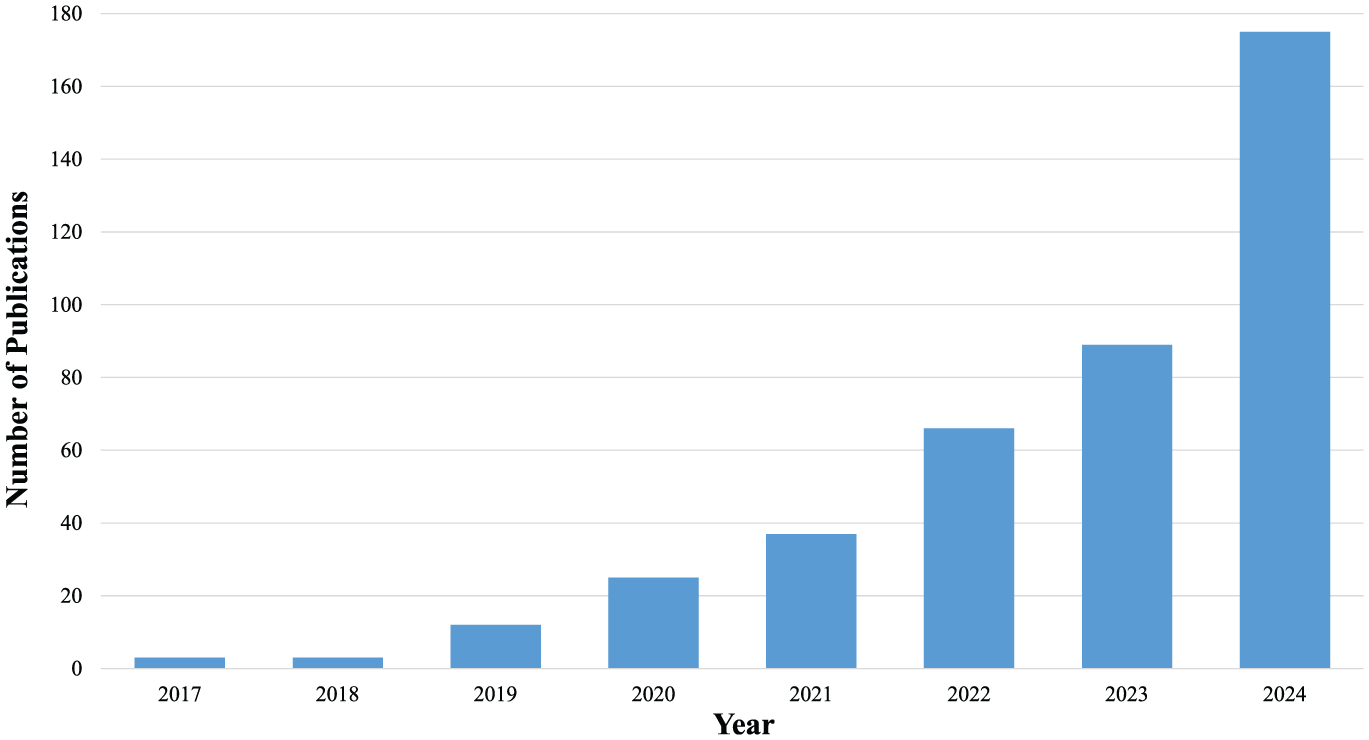
Digital Twins in bridge engineering – Scopus database (up to 2024).
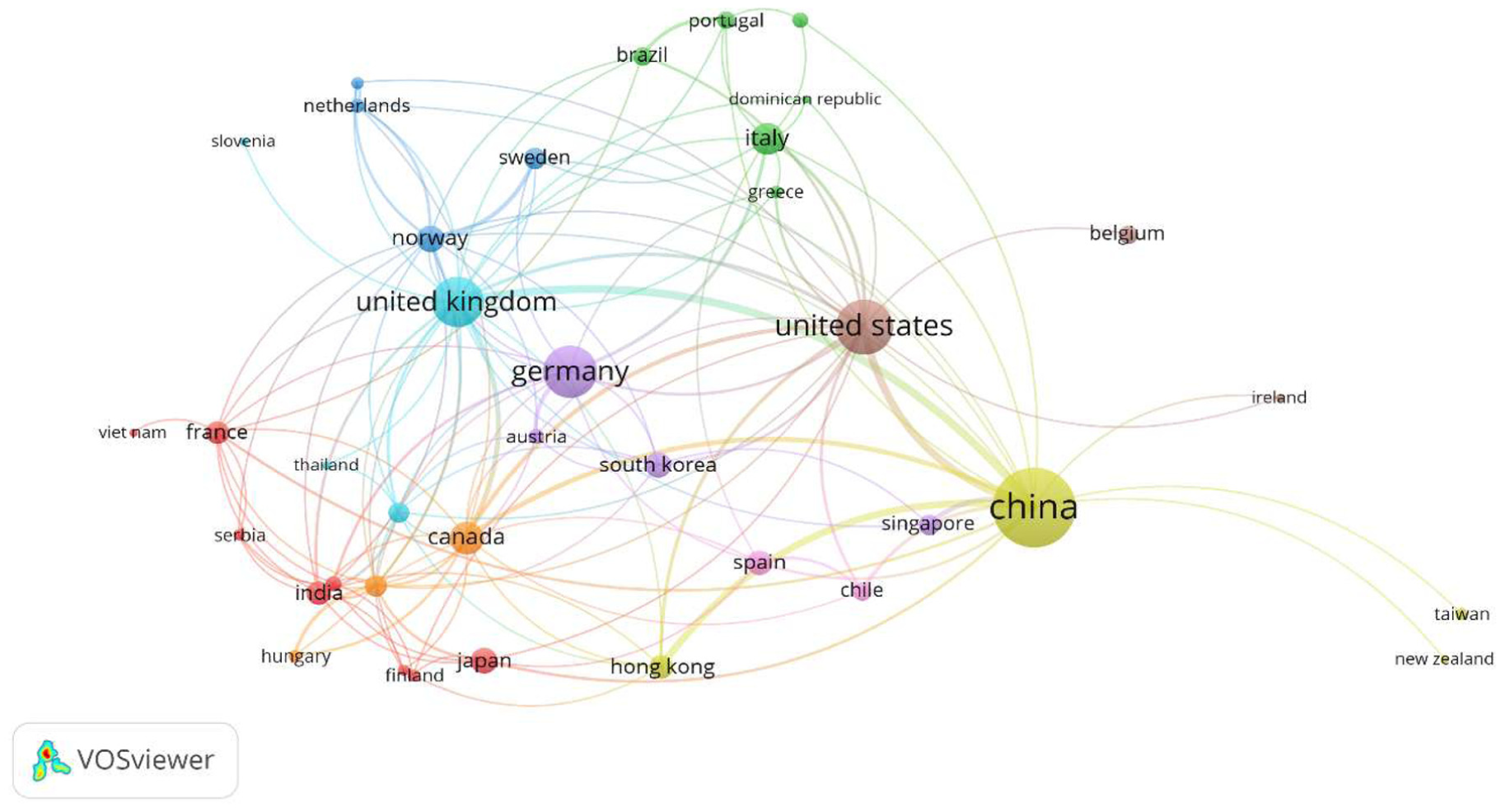
Digital Twins in bridge engineering – Scopus database (country/region).
Overview of Digital Twins
Definition of Digital Twins
Digital Twin technology is generally called a digital mapping or digital mirror. During a lecture on complete product lifecycle management, Prof. Grieves from the University of Michigan proposed the Digital Twins concept in 2003. Subsequently, the definition of this technology has undergone further development, with various scholars providing varied definitions.24–27 According to the Encyclopedia of Production Engineering, the concept of a Digital Twin refers to a depiction of an active and distinct product. This product can encompass several forms, such as real devices, objects, machines, services, intangible assets and even a system including the product and its related services. 28 In the Manufacturing industry, Digital Twins are defined, highlighting the significance of data integration between the real product and its virtual representation. 29 In general terms, the Digital Twins are described as virtual representations of physical entities throughout their lifespan. They are understood, acquired and analysed using real-time data, in which a model simulation gathers data from the environment and triggers the activity of physical entities.30,31 Digital Twin is characterised as the convergence of physical and digital products. 32 A virtual representation of a real-world asset is acquired using continuous data transfer, enabling the integration of the digital replica of the object alongside its actual counterpart. Fu et al. 33 conceptualised the Digital Twin as a real-time digital depiction of a physical entity.
Historical development of Digital Twins
From a technical perspective, Digital Twin is not an entirely new concept (Figure 3). An outstanding early implementation of Digital Twin technology took place in 1970 when National Aeronautics and Space Administration (NASA) engineers used a simulator, a replica of the command module, along with a separate replica of the module’s electrical system, to troubleshoot and recover the Apollo mission. This initial implementation of the technology proved commendable and has since experienced enhancements. Currently, NASA uses Digital Twins to advance the development of future vehicles and spacecraft. Michael Grieves suggested a notion called Digital Twin, which is a virtual depiction of physical phenomena, compared to the NASA Engineers’ Apollo program. In 2005, the concept of Digital Twins, virtual replicas of physical entities, was categorised into three subtypes of mirrored space models: geometric, functional and mirrored space models. Digital Twinning later refers to these subtypes as digital models, digital shadows and Digital Twins. 29 In 2014, Michael Grieves authored the first white paper on Digital Twin, which defined Digital Twin as the merging of physical and digital products. The NASA and the Air Force Research Laboratory introduced Digital Twin in 2010. It is subsequently listed as a key technology for the US Air Force. 34
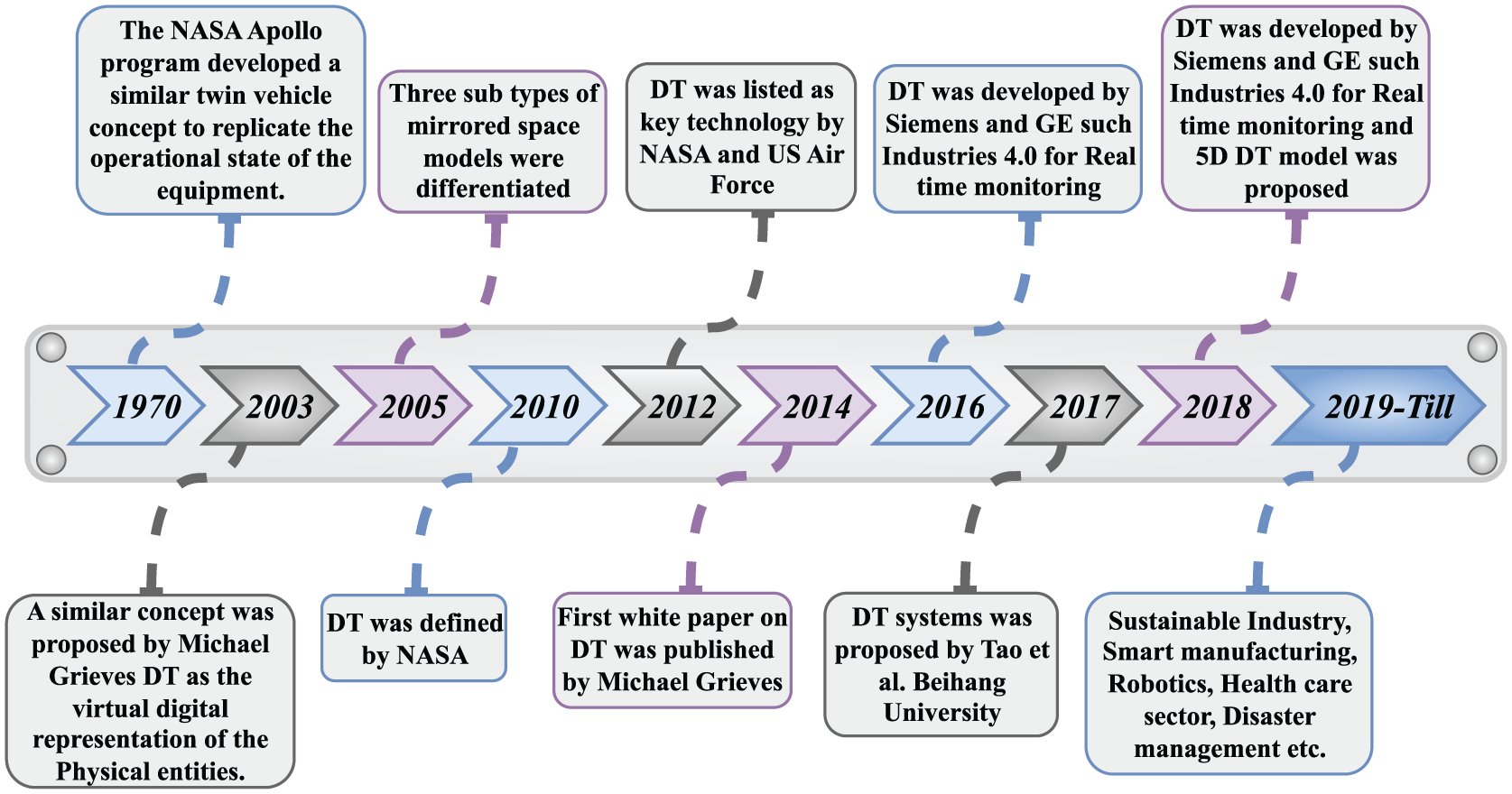
Significant historical development of Digital Twin.
In 2016, Siemens implemented Digital Twin within the framework of Industry 4.0. In 2017, Tao et al. 35 from Beihang University introduced the idea of Digital Twin and examined its features, composition, operation mechanism and essential technologies. Tao et al. aim to promote the broader application of Digital Twin in various fields, such as the 3D Digital Twin model initially developed by Grieves, which is widely used. 36 The development and use of Digital Twins led to new trends and demands, prompting the extension of the existing 3D Digital Twin model. Two more dimensions, namely Digital Twin data and services, have been introduced to provide a more comprehensive 5D Digital Twin model. In light of the expanded scope of Siemens and GE in the field of Industry 4.0, they have developed Digital Twins for real-time monitoring. 35 This trend spans various fields, such as disaster management, resilient infrastructures, health care, the push for sustainable industries and the progress in smart manufacturing and robotics. The continuous developments are shaping future work and transforming the Digital Twinning domain across multiple sectors. 37
Classification or dimensions of Digital Twin
Types of digital integration with physical entities and virtual entities
The classification of digital integration between virtual entities and physical entities is categorised into three distinct types. Kritzinger et al. 29 identified and explained three levels of integration: the digital model, the digital shadow and the Digital Twin (Figure 4). A digital model is a digital representation of a physical entity. It typically focuses on geometric aspects of the physical entities. Digital models are static representations and do not necessarily reflect the real-time data or the behaviour of the physical entities. They serve as a foundation for the deployment of Digital Twins. 38 A digital shadow is a digital depiction of a physical entity, characterised by a unidirectional flow of information that integrates real-time data and operational insights. In contrast to digital models, digital shadows exhibit a dynamic nature, continuously updated in a unidirectional flow to accurately represent the current state of the physical entity.
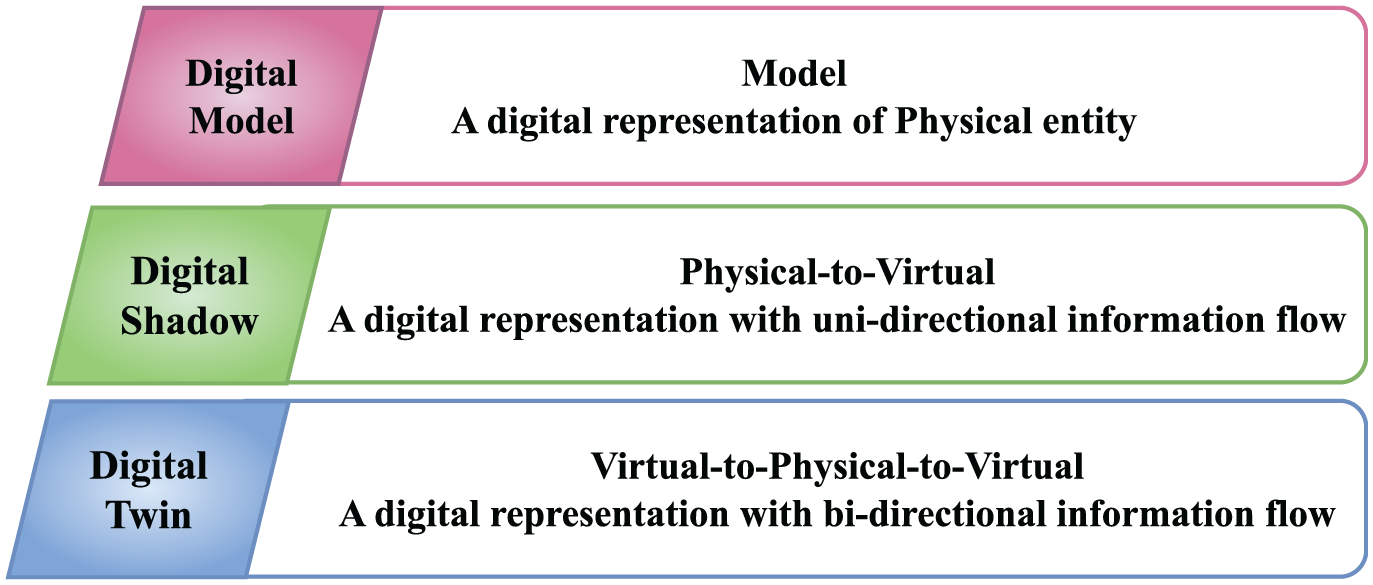
Types of digital integration with physical entities and virtual entities. 38
It typically focuses on the geometric and sometimes functional aspects, in which the numerical properties of physical entities are not interesting. The primary purpose of a Digital shadow is to visualise, monitor and optimise the corresponding physical entity. It gives users insights into operational efficiency, maintenance needs and potential risks. Digital shadows serve as a precursor to full-fledged Digital Twins, offering valuable visibility and control over physical assets without the complexity of a complete virtual replica. 39 Digital Twins are comprehensive digital representations of a physical entity (asset, system or process) with a bidirectional information flow that integrates geometric and numerical aspects with real-time data and analytics. It represents a holistic view of the physical entity and its behaviour in the virtual domain. They enable predictive maintenance and optimisation by simulating operating conditions and analysing potential outcomes. Digital Twins evolve dynamically as new data is collected and analysed, enabling continuous improvement and adaptation to synthetic environment conditions. 35
Types of Digital Twins
Digital Twins play an essential role in rapidly growing industries such as manufacturing, health care, medicine, construction, structural health monitoring and aerospace, which aim to replicate production processes and workflows, allowing firms to optimise operations and improve efficiency. When the twins deploy across various industries and integrate them, a continuous virtual depiction of their whole activities is achieved. These can be classified into four main types (Figure 5): Digital Twins of individual parts or components, Digital Twins of assets (consisting of two or more components working together), Digital Twins of whole systems and Digital Twins of systems involving processes and frameworks.
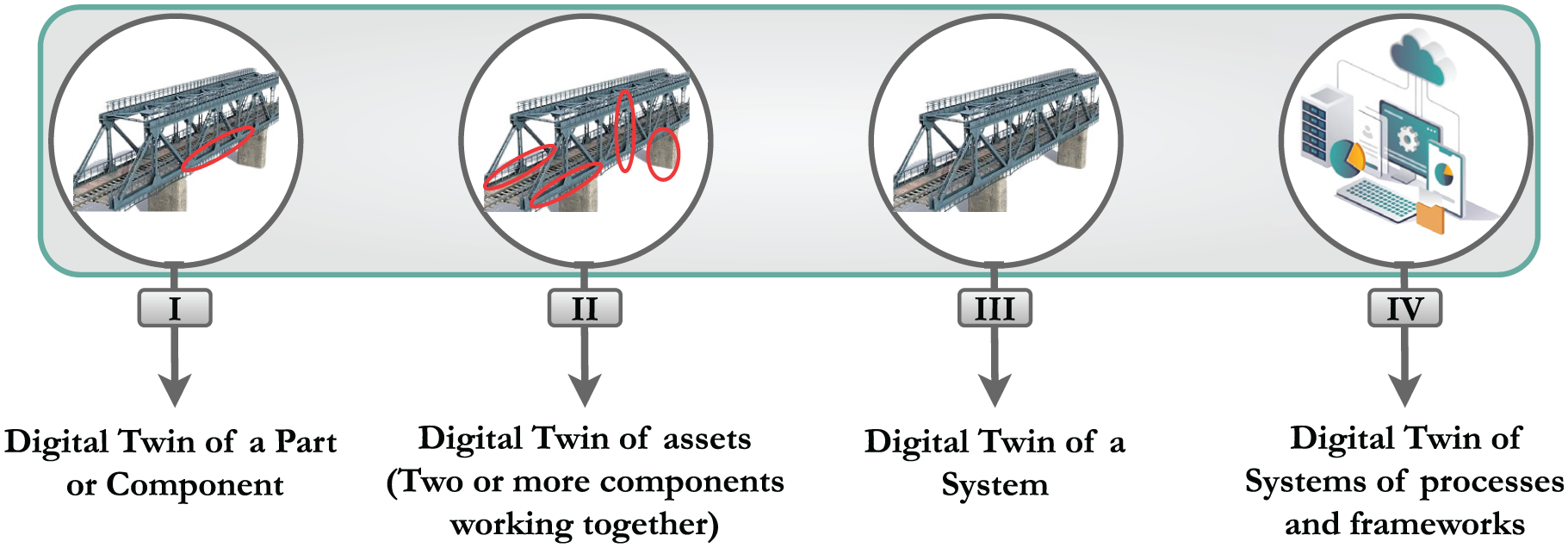
Types of Digital Twins.
Digital Twins of parts or components refer to virtual replicas of individual parts or components within a bridge, system or physical entity. These Digital Twins of an element are highly detailed and encompass various attributes such as geometry, material properties and functional characteristics using advanced modelling and simulation techniques derived from digital engineering modelling tools, focusing solely on a particular component or part of the physical entity. Digital Twins of parts or components accelerate physical entity development cycles, reduce costs and gain reasonable control over physical entities’ performance and lifecycle management. 17 Digital Twins of assets refer to virtual representations of two or more parts or components working together of a physical entity, collaborating to fulfil a specific function or achieve a common objective and taking control over the two components. By simulating the behaviour of these assets in a virtual environment, engineers can identify potential constraints, optimise performance and improve overall system performance. This enhances operational efficiency and continuously updates the behaviour of the physical entity for specific functions. 40
The Digital Twins of a system represent an entire system or physical entity that is comprised of all the interconnected parts and components. These Digital Twins thoroughly depict complete system behaviour, performance and functionality. 41 Engineers can utilise digital replicas of systems to recreate real-world situations, examine complex interactions and enhance the system’s overall performance. This improves operational effectiveness by simulating the complete system’s dynamic behaviour in a virtual environment, which promotes proactive decision-making and continuous improvement over the lifetime of bridges or physical entities. Digital Twins of systems of processes and frameworks represent the end-to-end processes, workflows and frameworks within the synthetic environment of physical and virtual entities. These Digital Twins enable engineers to model, simulate and optimise various systems, processes and workflows.10,42 This promotes efficient decision-making, encourages creativity and stimulates long-term growth. Moreover, when these various types of Digital Twins are integrated or combined, engineers can achieve seamless digital replicas of their entire operation. This holistic view includes complex cyber-physical systems and interactions between various subsystems, which enhance overall performance, and product lifecycle management monitoring systems by simulating different scenarios and identifying potential inefficiencies.
Levels of control in Digital Twins
Although many digitalisation and mathematical models possess certain features of Digital Twins, they do not fully satisfy all the requirements of the definitive Digital Twins. Therefore, it is essential to distinguish between distinct levels depending on their functionality, mathematical complexity and demands for digitalisation. To simplify this process, Udugama et al. 43 suggested five levels for deploying a comprehensive Digital Twin, which can be used as a base for bridging Digital Twins. Each level reflects a certain degree of progress towards achieving a Bridge Digital Twin with increasing complexity in mathematical operations or digitalisation. Digital Twins start as a simple model and gradually develop into an extensive, detailed replica of the physical entity with continuous improvement and refinement over time. At first, the Digital Twin includes simple physical models that depict stable situations. As the data collected and analysed increase and computational capabilities evolve, the Digital Twin model becomes more advanced. It can accurately capture and simulate the structure’s dynamic behaviour and provide valuable insights for maintenance, safety and performance optimisation. Based on the development, analysis, guidance and control for deploying the Digital Twin system, it is categorised into five levels (Figure 6).
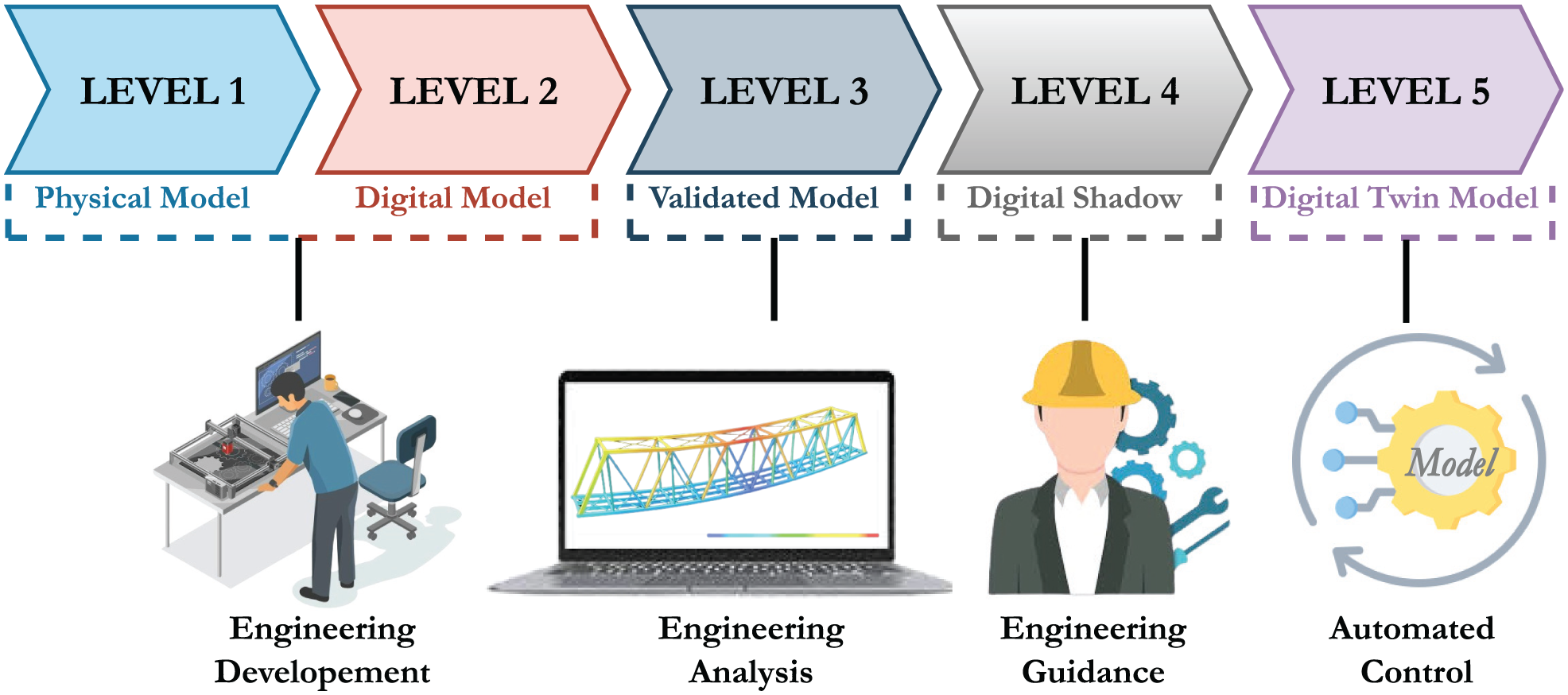
Levels of control in Digital Twins.
A physical model involves developing a physical representation or prototype of a physical entity, such as a bridge, usually at a smaller scale. Physical models are used to test and understand how the real-world system will behave under various conditions. A digital model represents a digital representation that focuses mainly on the geometric and material characteristics of the physical entity.44,45 Digital models are static computer-generated representations and do not reflect real-time data or behaviour, which can be made in any available software. Digital models are used for design, analysis and validation before developing a bridge’s actual, complete virtual entity. The physical model requires that to build it up for testing, a physical representation or the prototype structure, engineers play a pivotal role in building it up, and the same digital model requires engineering tools and the skill set to develop the model in any suitable software according to its purpose and availability.17,46,47 These physical and digital models are complete depending on engineering development. Validated models make the digital models even better. However, the digital model needs to be tested, and the analysis must be performed using data from a real physical process. This involves using different data-driven techniques and analysis methods to analyse and study a validated model, which is a model that has been confirmed by engineering analysis and model updating techniques. The model predictions match the real-time data well and are considered validated.48–50
A digital shadow represents a verified and functional model that works in real time, using automated input derived from data connections that involve the physical entity. The output of the digital shadow serves as an immediate depiction of the changes that occur in the physical entity. This includes integrating sensors, data reconciliation and communication protocols, allowing the model to receive real-time data from the physical entity. This encompasses creating and implementing innovative sensor technologies and sensors that offer data abundant in information and readily linked to pertinent state information.40,47,51 Developing and implementing a digital shadow necessitates guidance or direction from engineering expertise. A digital shadow is a virtual representation of a physical system or process, delivering virtual storage of past and live data, without active reasoning.
Digital Twins are a comprehensive digital representation of a physical entity (asset, system or process) with a bidirectional information flow that integrates geometric and numerical aspects with real-time data and analytics. It represents a holistic view of the physical entity and its behaviour in the virtual domain. They enable predictive maintenance and optimisation by simulating operating conditions and analysing potential outcomes. Digital Twins evolve as new data is collected and analysed, enabling continuous improvement and adaptation to changing circumstances.2,40,41,51 Digital Twins involve automated control using algorithms and processes to manage and update the Digital Twins based on real-time data inputs. Automated control allows the Digital Twins to autonomously update parameters, make decisions and optimise performance in the physical entity. This automation helps improve efficiency, accuracy and responsiveness in engineering and industrial applications.
Tools and technologies, Sensory connections for Bridge Digital Twins
The 5D Digital Twin model proposes that various tools and technologies are essential to supporting the multiple components of Digital Twins, encompassing the physical entity, virtual entity, Digital Twin data and their interconnections as a digital thread. A thorough comprehension of the physical entity is crucial for effectively implementing Digital Twins. This entails a comprehensive understanding spanning various disciplines, including dynamics, structural mechanics, geometrical and behavioural modelling and other pertinent areas. Integrating comprehensive expertise with advanced sensing and measurement technologies, physical entities and processes are linked to the virtual realm, thereby improving the models and aligning them more closely with reality. Within the realm of the virtual entity, a range of modelling tools and technologies is essential. Visualisation technologies are crucial in facilitating the real-time observation of physical entities and processes. The precision of virtual models directly impacts the efficacy of Digital Twins, highlighting the necessity for validation through various verification, accreditation, and optimisation tools and technologies and optimisation via optimisation algorithms. Moreover, simulation tools and technologies enable swift identification of quality defects and validation processes. Model evolution techniques and technologies are crucial to guaranteeing continuous model updating, as virtual models must adapt to constant modifications in the real world. 2
Modelling
Modelling is the process of developing a physical entity into digital representations that computers can update, analyse and control. This is a core element of Digital Twins, providing a means to represent information essential for activities such as design, analysis, computer numerical control, quality inspection and production management. Digital Twins-related modelling includes several categories, such as geometric modelling, physical modelling, behavioural modelling and rule modelling. These modelling techniques are essential in areas like engineering, computer science and design, each fulfilling distinct roles within the scope of modelling and simulation.2,52
Geometric modelling involves representing physical objects and their shapes using mathematical constructs. Geometric modelling is primarily concerned with describing the spatial relationships, dimensions and properties of objects in a virtual environment. It plays a crucial role in computer-aided design, computer graphics and visualisation, enabling the creation, manipulation and analysis of complex shapes and structures (Figure 7). Physical modelling focuses on simulating the physical behaviour and characteristics of real-world systems or phenomena within a computational framework. This type of modelling aims to replicate the dynamics, mechanics and interactions of physical entities. Physical models often involve mathematical equations, principles and experimental data to accurately simulate real-world phenomena and predict their behaviour under different conditions.
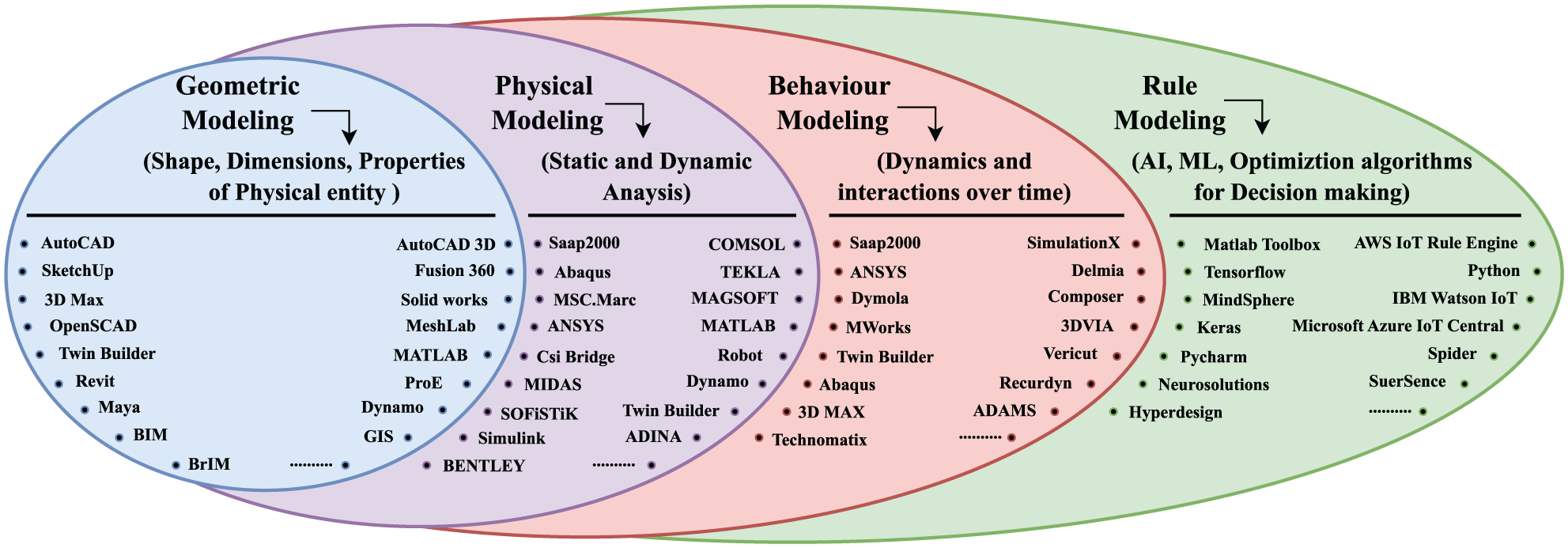
Modelling tools for Digital Twins.
Behavioural modelling concerns the representation of system behaviour, dynamics and interactions over time. It involves capturing systems’ functional aspects, processes and behaviour, including human behaviour, organisational dynamics and socio-technical systems. Behavioural models may utilise various techniques, such as agent-based modelling, discrete event simulation and system dynamics, to simulate and analyse the behaviour of systems and predict their performance under different scenarios. Rule modelling involves formulating and applying rules, dynamics and conditions to describe system behaviour, decision-making processes or regulatory constraints within a computational framework. This type of modelling often employs rule-based systems, expert systems or logical reasoning approaches to represent and automate decision-making process and enforce constraints within a system. Rule modelling is widely used in AI, expert systems and rule-based programming. 2 The following table (Table 1) presents various tools and technologies to construct Bridge Digital Twins. These modelling approaches collectively contribute to developing computational models that facilitate understanding, analysing and predicting complex systems and Digital Twin modelling phenomena across various domains.
Tools and technologies used in the Bridge Digital Twins.
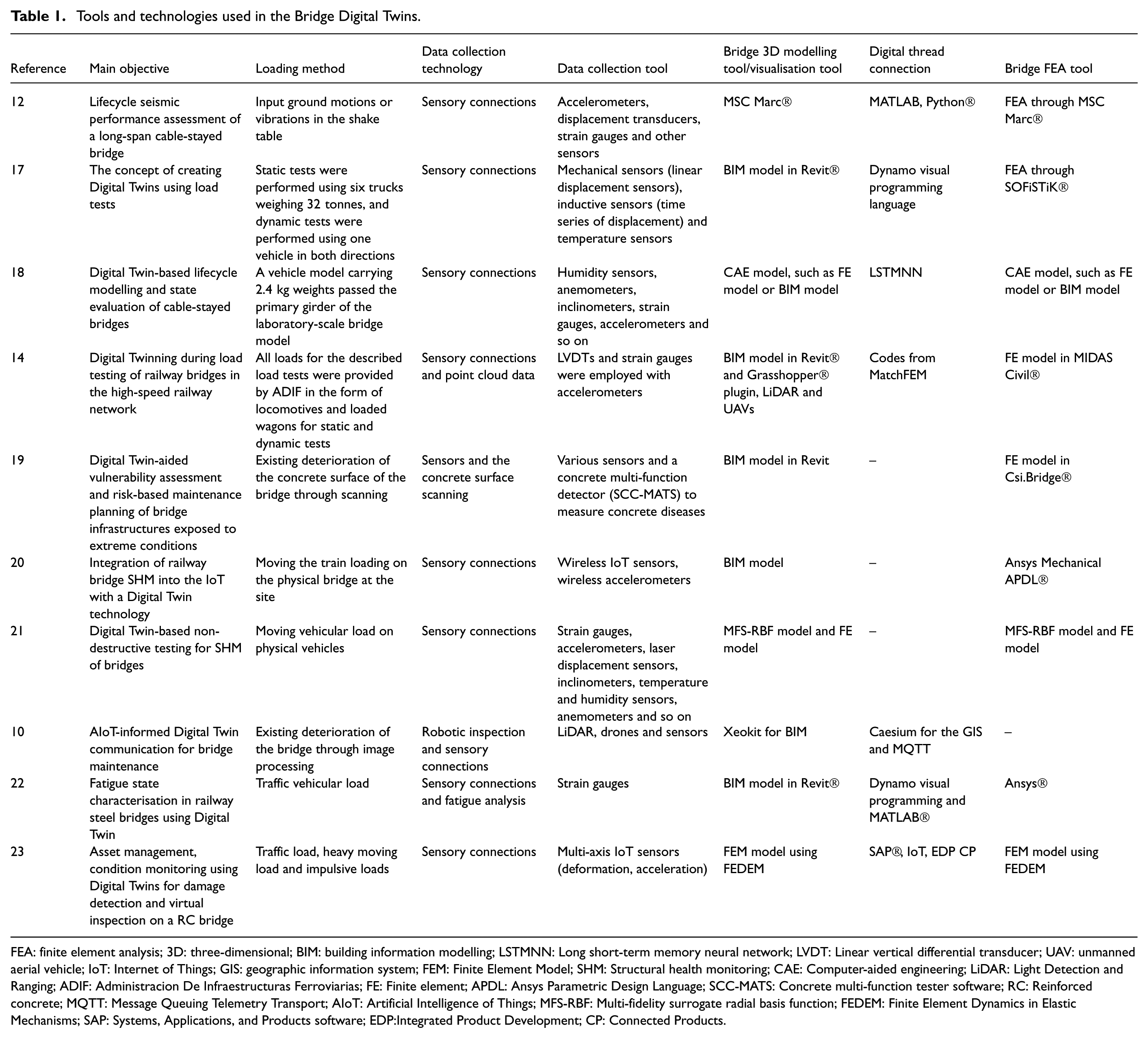
FEA: finite element analysis; 3D: three-dimensional; BIM: building information modelling; LSTMNN: Long short-term memory neural network; LVDT: Linear vertical differential transducer; UAV: unmanned aerial vehicle; IoT: Internet of Things; GIS: geographic information system; FEM: Finite Element Model; SHM: Structural health monitoring; CAE: Computer-aided engineering; LiDAR: Light Detection and Ranging; ADIF: Administracion De Infraestructuras Ferroviarias; FE: Finite element; APDL: Ansys Parametric Design Language; SCC-MATS: Concrete multi-function tester software; RC: Reinforced concrete; MQTT: Message Queuing Telemetry Transport; AIoT: Artificial Intelligence of Things; MFS-RBF: Multi-fidelity surrogate radial basis function; FEDEM: Finite Element Dynamics in Elastic Mechanisms; SAP: Systems, Applications, and Products software; EDP:Integrated Product Development; CP: Connected Products.
Sensory connections
Sensory connections for Digital Twins are integral to the broader Digital Twins architecture, enabling the seamless integration of physical assets and processes with digital replicas. These connections form the backbone of Digital Twins across various industries, including bridges, construction, manufacturing, transportation, health care, energy and more. These connections typically involve deploying multiple sensors that gather information about the state, behaviour and performance of the physical entities or processes. The quality and reliability of the sensory connections directly affect the accuracy and effectiveness of the Digital Twins. Therefore, careful consideration has to be taken for factors such as sensor placement, calibration, maintenance and data transmission protocols to ensure reliable and accurate data collection. 53
The sensors used in sensory connections are devices designed to capture specific physical parameters or environmental conditions and convert them into analogue or digital signals that can be processed and analysed digitally. These sensors come in various forms and types, each tailored to capture different aspects of the physical world. The sensory connections used in Digital Twins applications are diverse, ranging from simple temperature and pressure sensors to more complex devices such as cameras, LiDAR, accelerometers, gyroscopes, vibration sensors, proximity sensors and IoT devices. Moreover, advancements in sensory connections, including miniaturisation, wireless connectivity and energy efficiency, have expanded the capabilities of sensory connections, allowing for the deployment of sensors in diverse and challenging environments. The integration of edge computing and IoT platforms has facilitated real-time data processing and analysis at the sensor level, further enhancing the responsiveness and intelligence of sensory connections for Digital Twins.54,55
The data collected by the sensors serves as an input for the Digital Twins, where it is processed, analysed and utilised for various purposes such as monitoring, simulation, prediction and optimisation, allowing it to mirror the real-world system’s behaviour in a virtual environment. Engineers gain valuable insight into the system’s performance, spot abnormalities or errors, anticipate possible problems and optimise operations by continuously updating new sensor data to the Digital Twins. This allows the Digital Twins to offer real-time feedback, analysis and forecasts depending on the present condition of the physical entities or processes. 4
Once sensory connections are deployed, sensors continuously collect the data in real time, generating a constant stream of information about the physical system’s state, behaviour, condition and surrounding environment. Advanced analytics techniques, including statistical analysis, machine learning and AI, are applied to extract insights, identify patterns, trends, anomalies and correlations and predict future behaviour of the system.
Practical evaluation of sensory technologies for Bridge Digital Twins
The practical realisation of Bridge Digital Twins relies heavily on effectively integrating sensor technologies capable of capturing structural and environmental responses in real time. Various sensing technologies offer distinct advantages in terms of accuracy, cost, durability and scalability, directly influencing the maturity and functionality of the Digital Twin framework. The following table evaluates commonly adopted sensor technologies for bridges, highlighting their practical strengths and limitations. The assessment focuses on installation feasibility, maintenance requirements, data quality and interoperability with digital models. Understanding these factors is essential for developing a reliable and scalable Bridge Digital Twin system that supports predictive maintenance and lifecycle management. The following table (Table 2) presents the various sensory connections used for bridge health assessment and their practicality in Digital Twins.
Various sensory connections used in the bridge health assessment.
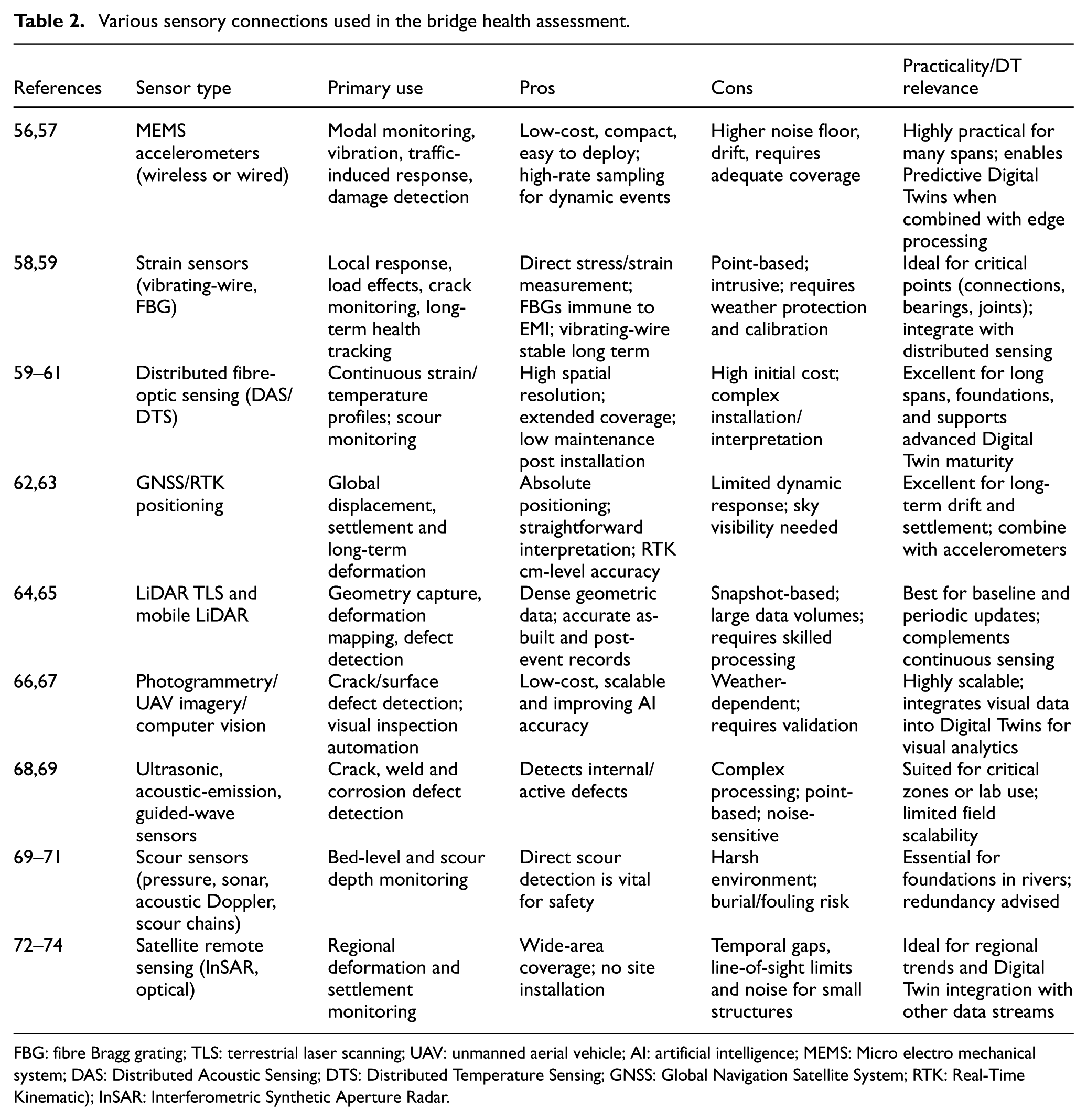
FBG: fibre Bragg grating; TLS: terrestrial laser scanning; UAV: unmanned aerial vehicle; AI: artificial intelligence; MEMS: Micro electro mechanical system; DAS: Distributed Acoustic Sensing; DTS: Distributed Temperature Sensing; GNSS: Global Navigation Satellite System; RTK: Real-Time Kinematic); InSAR: Interferometric Synthetic Aperture Radar.
Data acquisition system
A large amount of data is produced during the functioning of a Digital Twin. Advanced data analytics and fusion technologies are essential for interpreting this raw data. This process encompasses multiple stages: data collection, transmission, storage, processing, fusion and visualisation (Figure 8). A data-driven Digital Twin can sense, react to and adjust to alterations in its surroundings and operational circumstances. Data collection entails the acquisition of information from several sources, encompassing hardware, software and networks. This information covers static properties and dynamic status data acquired from technologies including barcodes, QR codes, cameras, sensors and IoT devices. 75 Data transmission technologies include both wired and wireless techniques, notably twisted-pair cable, fibre-optic transmission, ZigBee, Bluetooth, Wi-Fi, narrowband IoT, long-range radio and radio frequency identification. 76
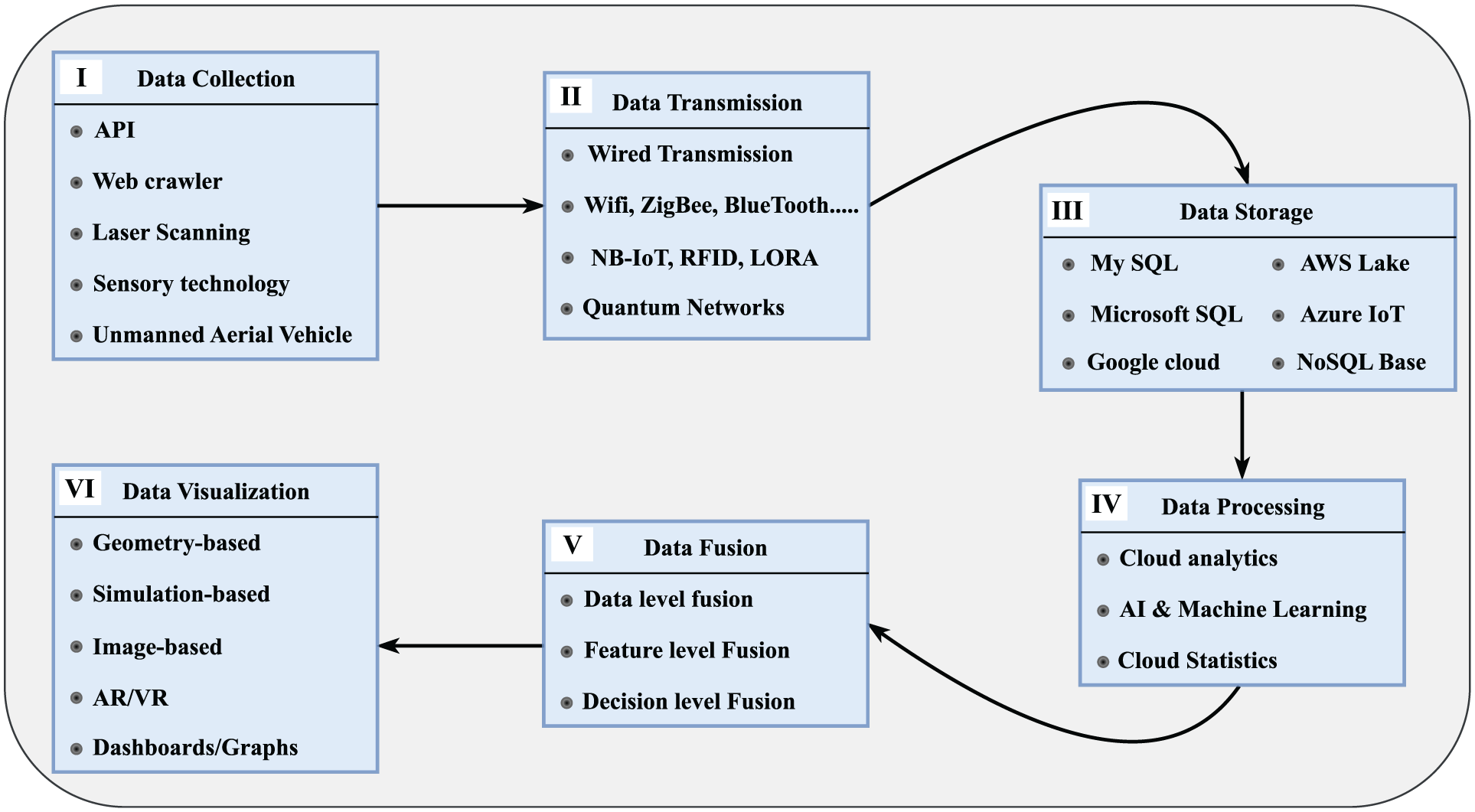
Data acquisition system for Digital Twins.
Data storage is essential for preserving information for subsequent processing, analysis and management. Due to the increasing number and complexity of monitoring data, conventional database technologies are being supplanted by big data storage solutions such as distributed file storage, SQL databases, NewSQL databases and cloud storage. 54 Data processing involves extracting required information from large volumes of raw data. This includes preprocessing to remove redundant and irrelevant data and analysis using statistical methods, neural network methods and database techniques. 77
Data fusion deals with integrating or combining data from multiple sources through filtering, synthesis and integration, including data-level fusion, feature-level fusion and decision-level fusion. 78 Data visualisation presents analysis results straightforwardly and interactively, using AR, VR, geometry-based, image-based, simulation-based, histograms, pie charts, line charts and dashboards. 79 Emerging technologies for object lifecycle management include developments in sensors, 5G technology for data transmission, MySQL for data storage, edge-cloud computing for data processing and AI for decision-level fusion, depending upon specific requirements.
Bridge Digital Twins: integrated layers, maturity levels and classification
Digital Twin technology significantly enhances bridge structural health monitoring (SHM) by developing an updated and dynamic digital representation of the physical bridge. Bridge Digital Twin refers to applying Digital Twin technology in bridge engineering. However, there is no commonly determined definition for a Bridge Digital Twin, which results in an unclear understanding of its features and responsibilities. The Bridge Digital Twins can be broken down into three components in a conceptual model: the physical bridge system, the virtual bridge system and the interconnected data thread or information, which is defined by the original Digital Twins idea.80–84 Another viewpoint considers the Bridge Digital Twin to create virtual bridge models, simulate their functionality, behaviour and performance, and analyse data for immediate evaluation and maintenance. 19 This technology includes collecting physical bridge data and the surrounding environment to create digital representations of physical bridges, facilitating immediate or near-immediate changes and modifications throughout the life cycle. Virtual bridges offer services similar to physical bridges, encompassing damage detection, real-time monitoring, dynamic analysis, forecasting and intelligent management. The defining characteristic of Bridge Digital Twin is the bidirectional connection between real and virtual bridges.
The physical bridge transmits sensor data to the virtual twin model to ensure synchronisation. The virtual bridge uses data, such as sensor data and simulation results, to make informed decisions about changes in monitoring components in the physical bridge. 85 The virtual bridge concurrently interacts with the service system, getting inputs like mission directions and expert knowledge, while transmitting outputs such as informational decisions and early warnings. The service system collects and combines data, which is subsequently used by the physical bridge to carry out several tasks, such as facilitating management decisions, modifying capacity and performing maintenance operations. The basic process involved in developing the Digital Twin of bridges is shown (Figure 9), and the detailed process framework involved in the Digital Twin of bridges is discussed in further sections. This comprehensive strategy of Digital Twin increases the dependability of SHM of bridges, optimises maintenance, decreases operational expenses and enhances bridge structures’ overall safety and durability. Bridge Digital Twins are a revolutionary advancement in bridge engineering and civil engineering that guarantees the improved and best level of maintenance for bridge structures.
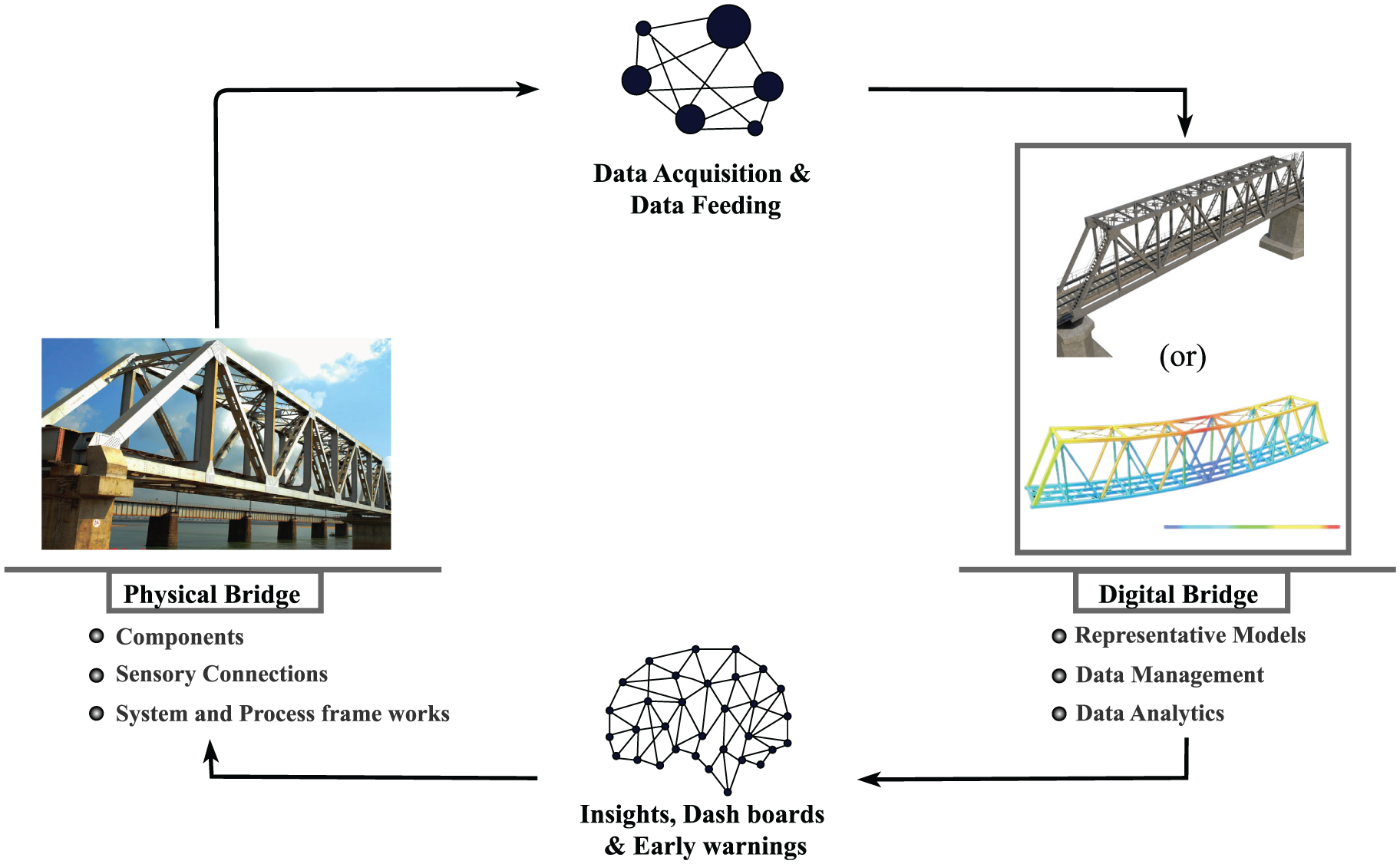
Digital Twin of bridges.
Integrated layers for the Digital Twin of bridges
Developing a Bridge Digital Twins is a complex process involving integrating various data layers and technological components. This layered approach ensures that the Digital Twins provide an accurate, real-time and comprehensive virtual representation of the physical bridge. These layers are categorised into development layers (Figure 10), which include numerical models, measurements, BrIM and standards. This integration enhances the accuracy and reliability of the Digital Twins and ensures a holistic and dynamic understanding of the bridge’s performance throughout its life cycle. Engineers and maintenance teams can achieve superior predictive analytics, proactive decision-making and optimised resource management by leveraging these interconnected data layers, ensuring bridge structures’ safety, longevity and efficiency.14,86
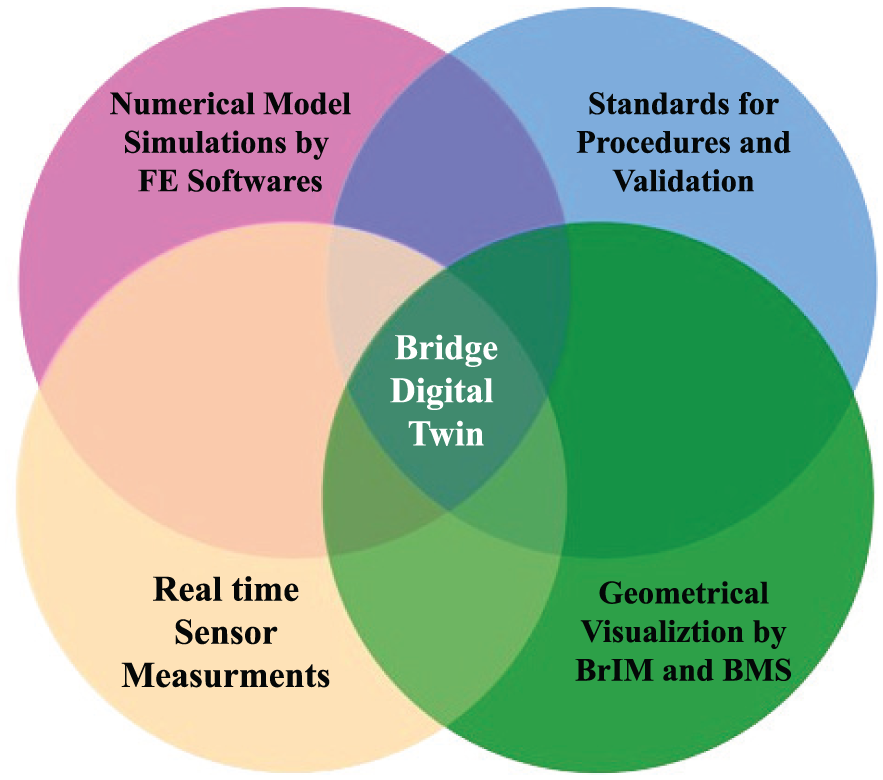
Data layers of a Bridge Digital Twins.
Numerical models simulate bridge behaviour under various conditions, like loads, temperature changes and environmental effects, using advanced techniques such as finite element analysis (FEA). These models predict structural responses to assess performance and identify potential issues. Measurements provide real-time data for validating and updating numerical models. Sensors installed on the bridge collect stress, strain, displacement, vibration and temperature data. Continuous monitoring ensures the Digital Twins accurately reflect the bridge’s current state. Standards ensure that the Digital Twins adhere to industry best practices and regulatory requirements. Engineering standards for the Digital Twin deployment procedures, validation and guidelines maintain consistency, safety and performance throughout the bridge’s life cycle. BrIM offers a 3D digital representation of the bridge, detailing its geometry, materials and construction processes. BrIM integrates design, construction and operations data into a unified model. As the foundation of the Digital Twins, BrIM enhances planning, design, maintenance and geometric visualisation activities by incorporating real-time data and analytical insights.
The technology layers comprising the physical environment, virtual environment and sensors (Figure 11) form the foundation of the layered Digital Twin framework. This structure helps dispel common misconceptions and enhances the understanding and functionality of bridge management systems (BMS) and Bridge Digital Twins. VR and AR focus on immersive visualisation. Direct linkage between the virtual environments and sensors ensures effective VR visualisation. Digital Twins combine the visualisation of physical objects and bridge information with real-time sensor data and analytical capabilities. This distinction ensures understanding of the practical applications of Digital Twins beyond mere visual representation. This comprehensive approach allows for ongoing structural integrity assessment, enabling early detection of issues and timely interventions. Direct linkage between the physical and virtual environments enhances visualisation capabilities, integrating BrIM, VR and AR. The virtual environment extends the capabilities of BrIM by incorporating the physical object. IoT sensors connected to physical objects and BMS can leverage real-time data for enhanced decision-making. Direct linkage between the physical object and sensors enables SHM, IoT integration and BMS. The SHM of bridge structures is achieved by integrating real-time sensor data with physical objects. This integration supports a more effective BMS. This connectivity ensures bridge operators monitor the performance, predict maintenance needs and optimise resource allocation.86,87
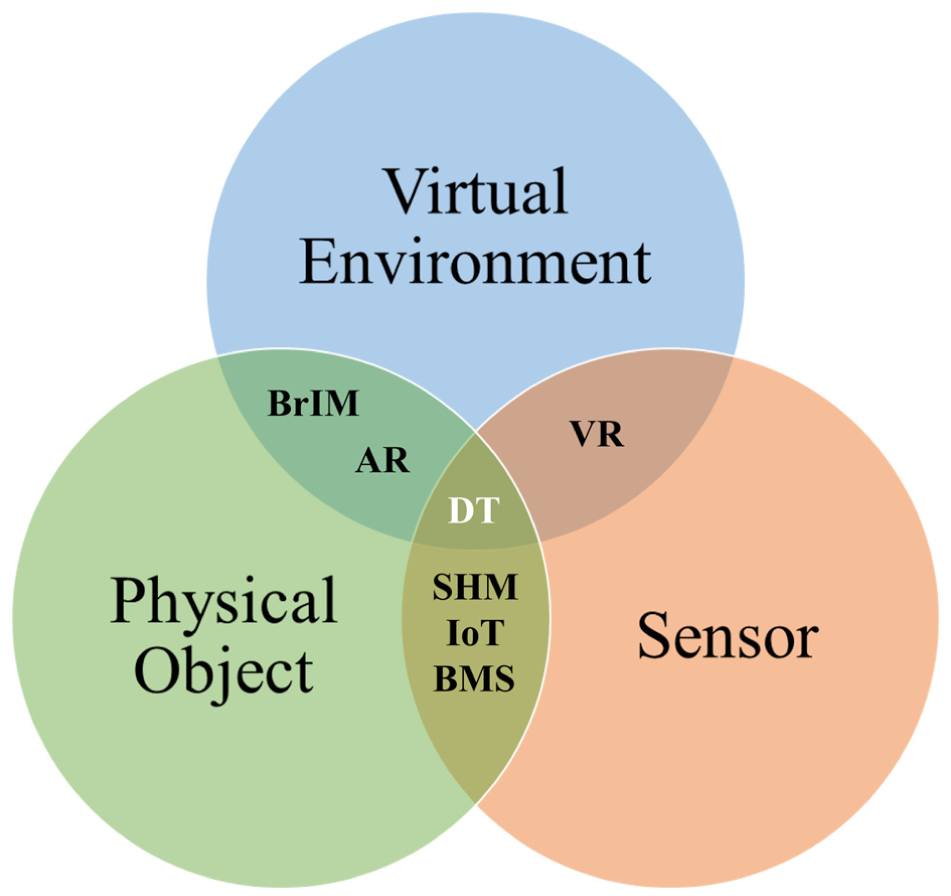
Technology layers of a Bridge Digital Twin. DT: Digital Twin; BrIM: Bridge Information Model; AR: augmented reality; VR: virtual reality; SHM: structural health monitoring; IoT: Internet of Things; BMS: bridge management system.
Maturity level of Bridge Digital Twins
According to the literature on Bridge Digital Twins for the built environment, and the rapid increase in Digital Twin technology and related studies leading to understanding the true essence of Digital Twins and the maturity of Digital Twins, the ETRI journal provided the information in a Characterisation of Digital Twins, on how reality is virtualised and twinned. Evans et al. 88 introduced a maturity spectrum that categorises Digital Twin maturity levels for built environments from 0 to 5, defining various principles and applications corresponding to each level. This categorisation is too simplistic to include breakdown criteria and may result in misconceptions regarding the definition of Digital Twins for O&M. A few investigations have concentrated on advanced technologies while neglecting functionalities from a lower level of maturity. Bridges involve complex data during their life cycle, requiring structured information, such as BrIM and Bridge Digital Twins, to use advanced technology. Therefore, higher maturity levels must encompass the functionalities of lower levels. From a capacity perspective within the built environment, a comprehensive Digital Twin maturity model for Bridge Digital Twins is proposed based on these concerns and the recommended maturity levels from multiple studies.
Gartner published a research document titled ‘Use the IoT platform reference model to plan your IoT business solutions’, which outlines the three tiers of Digital Twin deployment, as shown in Table 3. 89 The Function Bay defined Gartner’s maturity levels: ‘The distinction between levels 1 and 2 lies in the utilisation of online methods for data collection to be input into the model’. Employing offline data to do preliminary simulations, facilitating 3D visualisation, constitutes level 1. Level 2 includes models utilising online data acquired from sensors on physical items via IoT platforms. The thing and the model undergo identical experiences at this stage, rendering the genuine object and its Digital Twins a perfect 1-to-1 correspondence. Level 3 entails utilising input data and outcomes to forecast future results. 90 Gartner’s maturity model comprises three levels: levels 1, 2 and 3; however, the proposed maturity model (ETRI’s model) in Table 2 encompasses five levels, including levels 4 and 5. Levels 2 and 3 of all maturity models are identical; however, Gartner’s level 1 has a distinct perspective on ‘simulation’. The simulation is regarded as the most defining characteristic of a Digital Twin. It can determine the future of a simulated system based on various input parameters. A simulation must be evaluated from three perspectives: geometrical, structural and behavioural, as outlined in ‘Geometrical, structural, and behavioural simulations vs structural analysis’. Gartner’s level 1 simulation refers to geometric and structural simulations derived from 3D-rendered models. Gartner’s level 3 encompasses ‘analysis, prediction and optimisation’ through behavioural simulations derived from operational behaviour models. Consequently, simulation activities are conducted at both levels 1 and 3. Nonetheless, the ‘simulation’ of Gartner’s level 1 may mislead readers as it is exclusively presented at level 1. In addition, geometrical simulation only deals with shape, size and appearance. In contrast, structural and behavioural simulations deal with structural and dynamic behaviours, often correlated in a complex way like two sides of a coin, causing them to be challenging to distinguish from each other. The descriptions of each maturity level, as viewed through the perspective of the Bridge Digital Twins, are as follows:
Level 1: Visualisation and related data presented in 2D and 3D forms, similar to existing BIM.
Level 2: Data from current bridge maintenance methodologies and sensor data for real-time monitoring. The extraction of information for decision-making is primarily manual, with minor automation.
Level 3: Functions designed to safeguard data concerning structural behaviours through simulations and to enable proactive maintenance by integrating and analysing various related data.
Level 4: Highlights federated data interchange that considers interactions among various Digital Twins.
Level 5: Represents the automated performance of maintenance activities based on a predefined decision-making framework, facilitated by deploying technologies such as computerised robots.
Bridge Digital Twin maturity model levels from the perspective of Gartner and ETRI maturity models.
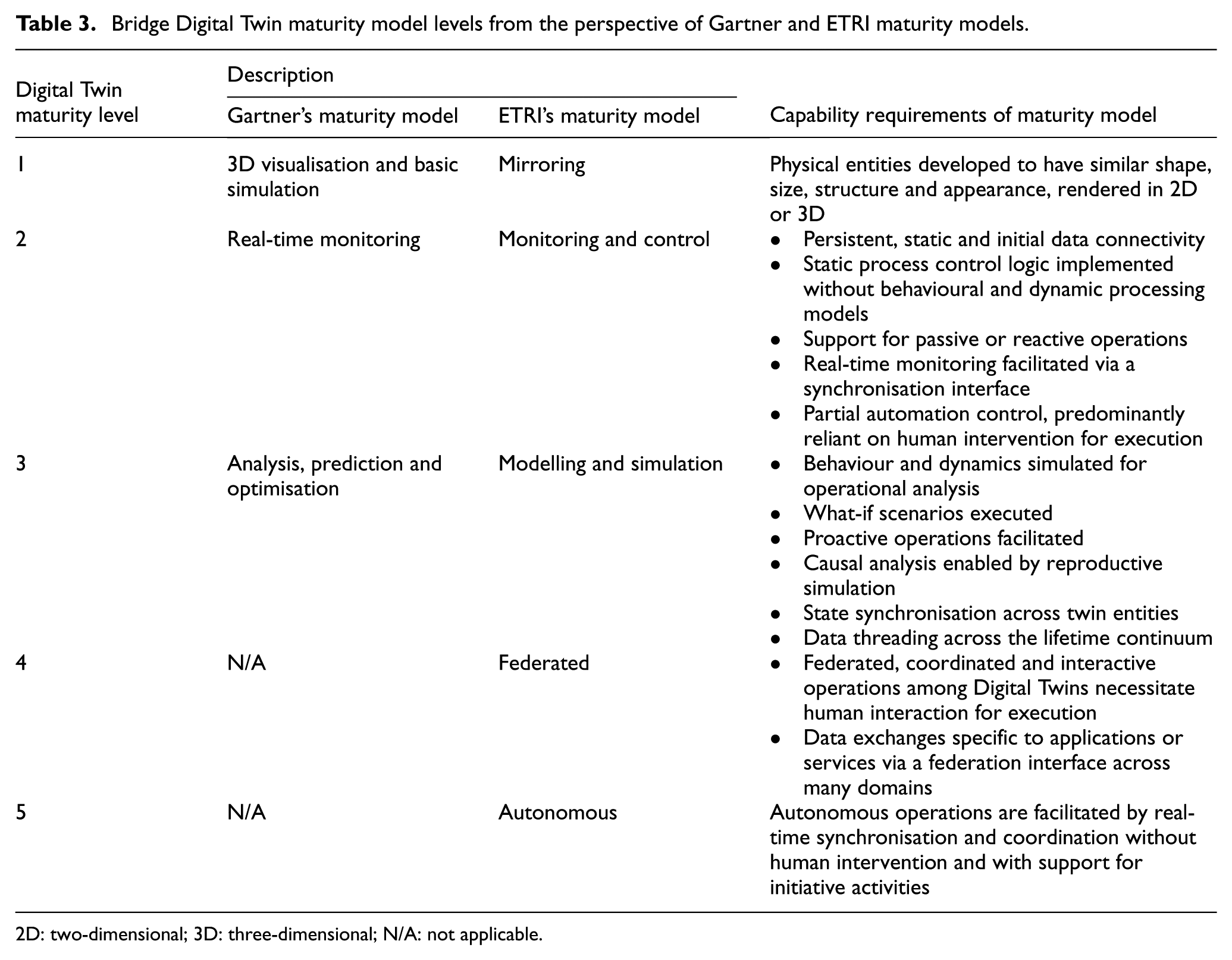
2D: two-dimensional; 3D: three-dimensional; N/A: not applicable.
Digital Twin technology for bridge maintenance does not directly manage physical assets through the digital model; instead, it informs managers of prompt modifications in the O&M plan. Consequently, subsequent research intends to create a Digital Twin that achieves maturity levels 4 and 5, while incorporating the functionalities of levels 1, 2 and 3. Similarly, Table 4 presents the recent studies of Bridge Digital Twins and the maturity level of the Bridge Digital Twin model and framework.
Review of research on Bridge Digital Twins for maturity model levels.
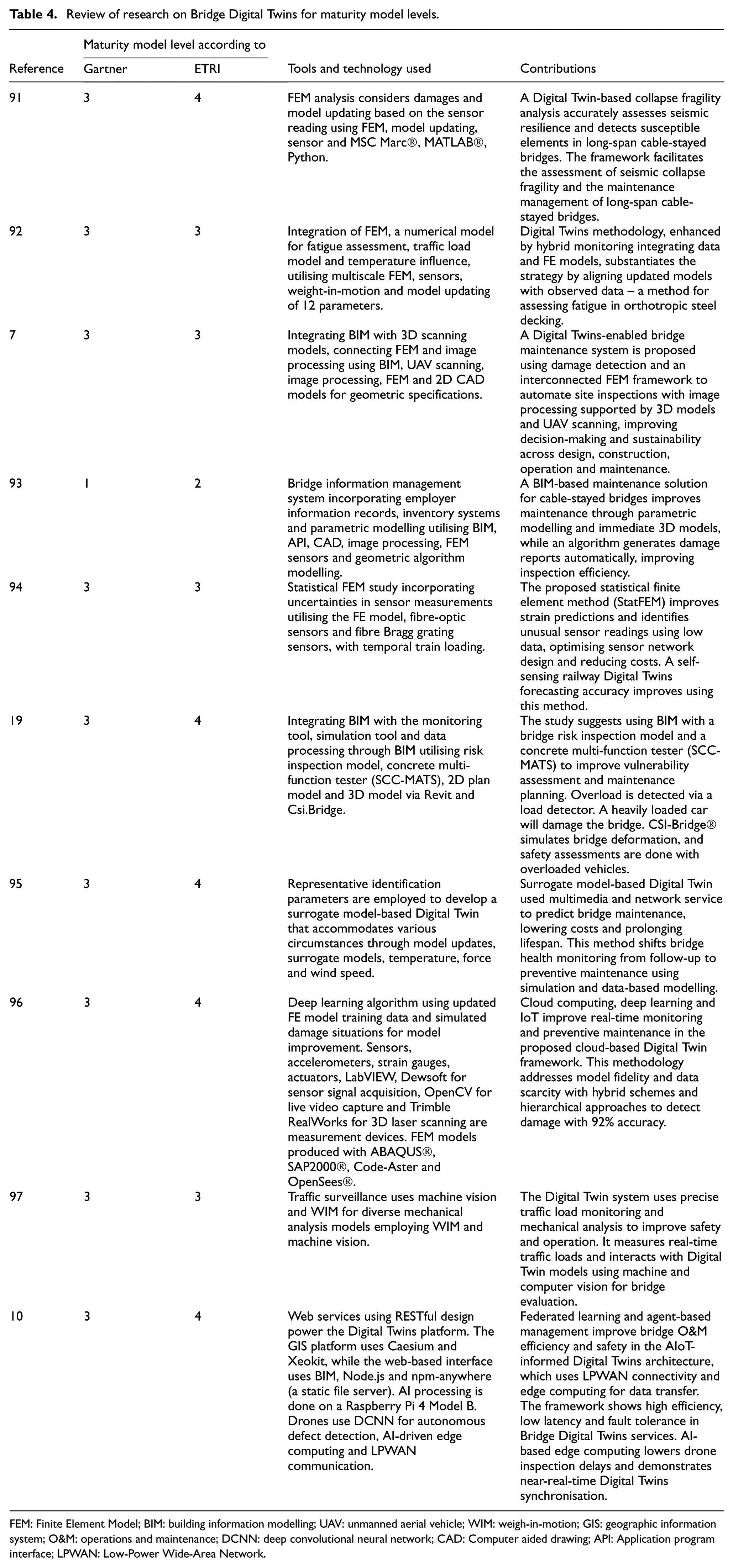
FEM: Finite Element Model; BIM: building information modelling; UAV: unmanned aerial vehicle; WIM: weigh-in-motion; GIS: geographic information system; O&M: operations and maintenance; DCNN: deep convolutional neural network; CAD: Computer aided drawing; API: Application program interface; LPWAN: Low-Power Wide-Area Network.
Major classification of Bridge Digital Twins
Researchers who formulated specific terms to designate unique technological applications within particular dimensions have established a framework for evaluating the classifications of Digital Twins in bridge engineering from various perspectives. There is often a lack of clarity and misunderstandings around the definition of a true Bridge Digital Twin and the particular outcomes it provides. In bridge engineering, researchers have examined many factors to categorise Digital Twins to ensure they represent actual Bridge Digital Twins correctly. Bridge Digital Twins are not limited to the capabilities of a BrIM or a simulated model created using the FEM to deliver real-time simulation results or real-time management data for BMS. These alone do not encompass the full scope of Digital Twins in bridge engineering. A comprehensive Bridge Digital Twins involves multiple dimensions and aspects, leading to better management and health monitoring of bridges. To address this challenging issue, this section examines the categorisation of Bridge Digital Twins (Figure 12) based on various key factors such as simplicity, key performance indicators (KPIs), integration with the IoT, visualisation and simulation capabilities, lifecycle phases, functional use and level of sophistication. The classification of Bridge Digital Twins according to these parameters highlights the interconnection and similarity in their function of enhancing the efficiency and reliability of bridge infrastructures.
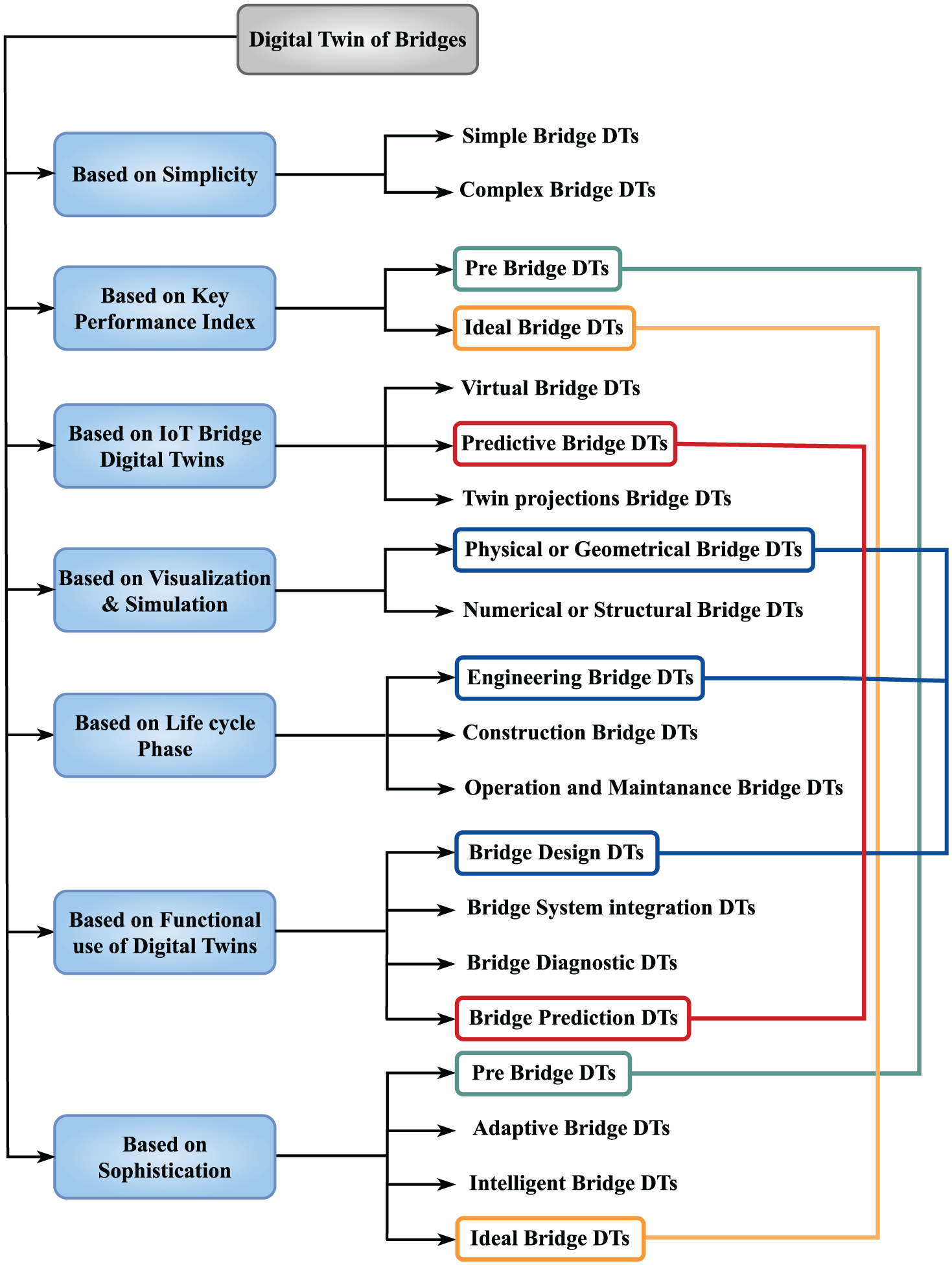
Classifications of Bridge Digital Twins.
Based on simplicity
Digital Twins involve a wide range of complexity, from basic to more advanced models. Simple Digital Twins are simplified replicas of physical models that concentrate only on a specific set of features. These models offer essential insights and data without complex integration or additional functionalities. Usually, they oversee a limited number of crucial variables, such as load, temperature and displacement, depending on a small set of data sources, such as a few sensors or manual inputs. Basic Digital Twins provide direct analysis and reporting without employing sophisticated algorithms or predictive models. The level of integration with other systems is limited, resulting in stand-alone insights that lack complete interconnectedness. The interface and usability are intentionally meant to be uncomplicated, ensuring accessibility for users without professional expertise. These are suitable for smaller bridges or constructions when broad surveillance is not required. 52
Complex Digital Twins are intricate models that offer a thorough and accurate representation of physical entities. These twins combine several data sources and utilise advanced analytics while providing a wide range of functionality. Complex Digital Twins use data from sensors, IoT devices, historical records and external systems. These technologies integrate machine learning, AI and predictive algorithms to offer profound insights and projections. Complex Digital Twins are crucial for expansive or intricate bridge constructions necessitating continuous monitoring and analysis. 98
Based on KPI
Pre-Bridge Digital Twins and ideal Bridge Digital Twins are the two phases of developing and implementing Digital Twin technology in bridge engineering based on KPIs. It is beneficial to comprehend these stages to evaluate the current capabilities of Digital Twins and establish objectives for future development. Pre-Bridge Digital Twins are the first step in applying Digital Twin technology to bridge engineering. They consist of early models and prototypes that offer fundamental insights and basic functions but do not have complete integration or advanced capabilities. The system combines data from several sensors to provide basic monitoring and simple analysis without utilising complex algorithms or predictive analytics. Data gathering in real time is restricted, frequently requiring human input and occasional updates. These models serve as self-contained systems, used in initial bridge projects to evaluate fundamental structural characteristics and viability with the partial data fusion technology at a high level. Partial automation is accomplished by gathering more real-time data, including surface damage models, point cloud scanning using BIM 3D models or using data-driven surrogate models to update FEM (Figures 13 and 14). 5
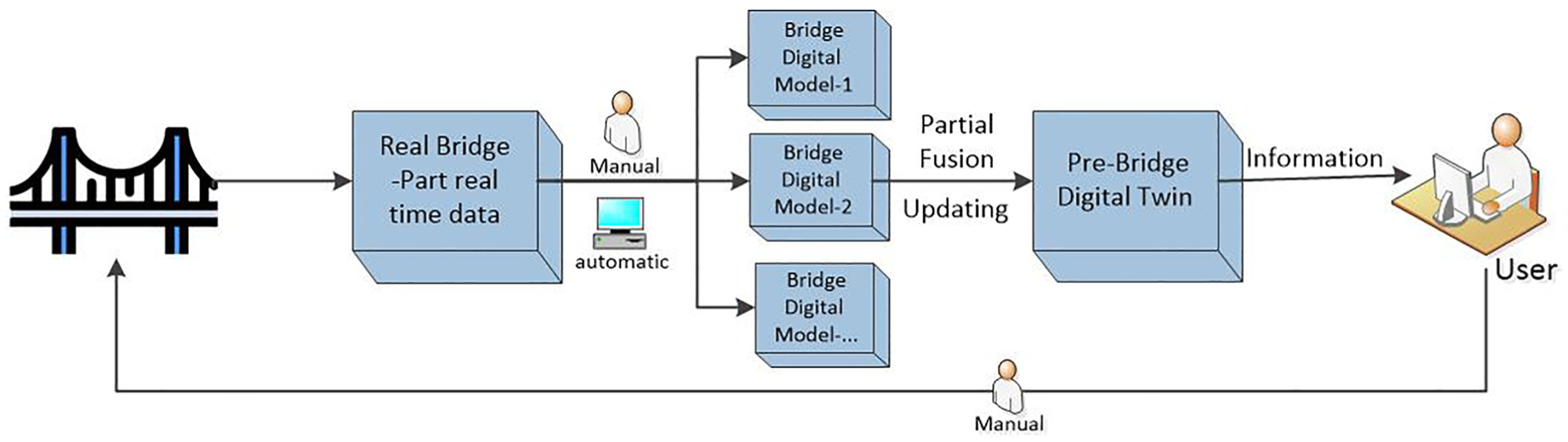
Pre-Bridge Digital Twins. 5
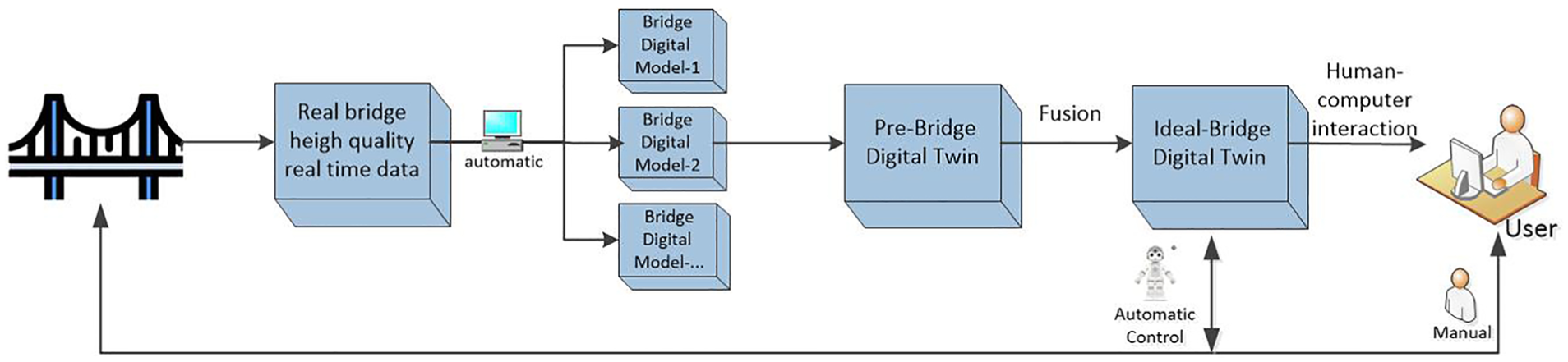
Ideal Bridge Digital Twins. 5
An ideal Bridge Digital Twin represents the pinnacle of Digital Twin technology in bridge engineering, featuring comprehensive integration, advanced analytics, real-time interaction and sophisticated visualisation. This sophisticated Digital Twin uses sensors, IoT devices, historical data and external systems to provide an in-depth understanding of the bridge’s condition. Human–machine interactions and autonomous Bridge Digital Twins control are developed using high-level data fusion technology, machine learning, AI and predictive algorithms. In Tao et al.’s 5D framework, physical entities, data, virtual models, users and connections are used to examine ideal Bridge Digital Twin KPIs and functions. 5
Based on IoT Digital Twin
Based on IoT implementation, Bridge Digital Twins are classified into three groups: virtual twins, predictive twins and twin projections. Each category uses distinct parts of IoT to generate distinctive functions and insights for the Bridge Digital Twins. Virtual Twins utilise Oracle’s Device Virtualisation technology to establish a digital replica of physical bridges in the cloud. The twins utilise a JSON-based framework that incorporates both observed and predicted parameters. The Virtual Twin provides a thorough digital duplicate that allows for continuous monitoring and analysis, guaranteeing that any alterations or irregularities in the bridge are promptly mirrored in its digital replica. Predictive twins employ machine learning methodologies to construct analytical or statistical models for prediction. In contrast to physics-based models, predictive twins are dynamic, intricate and can adjust to evolving surroundings autonomously, without requiring input from the original data. Twin Projections seamlessly incorporates predictions and analysis from the Bridge Digital Twins into the actual bridge operations. This integration converts IoT from a simple tool for collecting data into a crucial component of the bridge operational structure. Twin Projections improves decision-making processes and operational efficiencies by integrating predictive information into bridge activities. They guarantee that the data gathered from IoT devices serves instant decision-making and long-term corporate objectives. 99
Based on visualisation and simulation
In the field of Digital Twins in Bridge engineering, an essential factor in comprehending Digital Twins involves categorising them according to visualisation and simulation into physical or geometrical Digital Twins and numerical or structural Digital Twins. Physical or geometrical Digital Twins primarily aim to capture actual assets’ visual and spatial characteristics, offering intricate 3D representations that accurately reflect their real-world counterparts. These digital replicas demonstrate exceptional performance in architectural design, urban planning and product visualisation, providing immersive experiences and valuable spatial insights. At the same time, numerical or structural Digital Twins concentrate on mathematical modelling and simulation to forecast the behaviour and performance of physical assets. These Digital Twins utilise FEA techniques to replicate stress, strain and deformation, allowing for thorough structural study and accurate performance prediction. 100
Based on the life cycle
Based on lifecycle stages, Digital Twins can be categorised into three separate phases: the engineering twin, the construction twin and the operation and maintenance twin. This categorisation labels Digital Twins based on the different phases of the life cycle of a bridge and the extent of data they provide. The Engineering Twin indicates the first stage of the bridge life cycle. It comprises all documentation, models and data from the beginning of the product introduction, covering every product variation. This phase emphasises the design, simulation and engineering procedures, which involve creating a detailed digital representation that helps simulate, validate and improve the design before manufacturing starts. The Engineering Twin promotes synchronisation across design teams, guarantees seamless integration of all components and promptly detects and resolves possible difficulties throughout the development phase. The construction phase focuses on all aspects of building a bridge in real time. The system incorporates data and provides comprehensive information on the construction processes, including execution plans, quality control data and real-time construction process monitoring. The construction twin allows businesses to improve production processes, monitor performance and guarantee that the finished product meets design criteria. It is crucial for overseeing the industrial environment, enhancing productivity and diminishing production expenses. The last stage, Operation and Maintenance Twin, refines the data only to include what is necessary for the product to function and be maintained once it is in use. This phase encompasses operating data, sensor readings, maintenance records and performance statistics. This real-time digital depiction of the bridge’s operational stage and surroundings allows continuous monitoring, preventive maintenance and performance enhancement. 5
Based on functional use
Digital Twins, based on how they are used functionally, are categorised as design, system integration, diagnostics and prediction twins. Regarding Design Digital Twins, these digital replicas prioritise using simulation and visualisation techniques in the design process. They validate and inspect the comprehensive 3D design, ensuring the proper alignment of all components. At the system level, 3D visualisation assists System Integration Digital Twins validating restrictions, including physical connections and geographical footprints. They can replicate interactions by establishing connections with the Digital Twins of other components. This includes many features such as data transmission, control operations, mechanical and electrical activity and hypothetical situations. Diagnostic Digital Twins provide essential help for troubleshooting by offering 3D visualisation. Field personnel can utilise VR glasses to superimpose visual characteristics on genuine equipment. Simulations can incorporate data that cannot be directly observed, such as the temperatures of components that cannot be physically touched or the stresses experienced by materials. Prediction twins utilise historical and current operational and sensor data and predictive algorithms to offer valuable information on the state of equipment and the probability of various failure scenarios. 5
Based on sophistication
The features of Bridge Digital Twins are broken down into four distinct degrees of sophistication: pre-Digital Twins, Digital Twins, adaptive Digital Twins and intelligent Digital Twins. Each of these offers improved features. Pre-Digital Twins are the first level in the hierarchy of Digital Twins. Before the construction of the actual prototype, these models are created with the primary purpose of identifying and reducing technical risks, as well as resolving any issues during the pre-engineering stage. After the physical thing is formed, the model transforms into a Digital Twin. At this point, the virtual model is enhanced with the real entity’s performance, health and maintenance data. This digital representation enables efficient updates in large quantities and offers a thorough picture of the asset’s condition and operational state. Digital Twins allow for continuous monitoring and analysis, which helps to enhance maintenance methods and operating efficiencies.
An adaptive Digital Twin enhances this notion by combining a virtual representation of the physical thing with a user interface that can adapt and adjust. This high degree of complexity enables real-time data updates from the physical asset to the virtual model, improving the quality and relevance of the digital representation. Adaptive Digital Twins facilitate dynamic interaction between the physical and virtual realms, allowing for more responsive and accurate management of the asset’s O&M. The Intelligent Digital Twins, the most advanced level, enhance the adaptive model by integrating reinforcement learning and powerful machine learning techniques. This connectivity allows the intelligent twin to update digital and physical things in real time and independently learn and optimise its operations. Intelligent Digital Twins provide predictive insights and proactive decision-making skills, significantly improving the asset’s performance, lifespan and overall efficiency. 101
Methods to build digital model of bridges
The Bridge Digital Twin model is the core component driving the Digital Twin framework. It fully utilises data from the physical bridge, integrating analysis and management outputs to provide essential feedback to users and the physical structure. These components work simultaneously to create a robust and dynamic virtual model that mirrors the physical bridge and provides predictive and simulation capabilities. This comprehensive modelling approach is vital for Bridge Digital Twins because it ensures that the virtual model reflects the real-time state and needs of the bridge, making the adoption of Bridge Digital Twins in modern bridge engineering and management. The Bridge Digital Twin model is developed as an information model, a 3D surface model, a data-driven model, an FEM analysis model and a surrogated model. 5
The surface model is generated continuously through reverse engineering (photograph mapping and 3D scanning) and aligned parametric modelling during the bridge lifecycle O&M. The 3D Surface Model offers up-to-date information on the condition of the bridge’s surface point cloud, allowing for well-informed maintenance decisions. Providing a thorough and precise depiction of the bridge’s physical composition enables engineers to see and analyse the space effectively. This allows them to swiftly identify surface problems and efficiently arrange the required repairs or interventions.7,102 The FEA model assesses the bridge’s structural integrity by modelling its response to different parameters. The model yields essential structural analysis findings for forecasting future vulnerabilities and guaranteeing the bridge’s safety and longevity. Engineers can limit hazards by comprehending the distribution of stress and deformation patterns, allowing them to implement preventive measures.12,13
The data-driven model uses real-time data; this model provides a significant analysis of the bridge’s performance. It facilitates proactive maintenance techniques by detecting possible faults before they reach a critical stage, enabling timely solutions. Regular surveillance and examination aid in preserving the bridge’s peak condition and prolonging its operational lifespan.103,104 The surrogate model is specifically created to simulate the distinct behaviour of complex systems. It streamlines the analytical process, offering expedited insights and helping decision-making. The surrogate model requires minimal processing resources. It uses simplified models to estimate the system’s behaviour, hence minimising the requirement for costly calculations. The surrogate model utilises existing information to construct an approximate model. It frequently employs historical data, real-time monitoring data and simplified assumptions.
The surrogate model improves the Digital Twins by offering rapid analysis and predictive capabilities. It enhances the thorough examination provided by the FE model, allowing for a holistic approach to bridge management. The Surrogate Model investigates the underlying links in the data, offering speedy analysis of the bridge’s status for emergency reactions, forecasts and early warning systems. The surrogate model relies on AI technologies, such as machine learning, which can fully explore the relationship between data and are mainly used in the bridge maintenance stage.95,105 The information management model is accountable for thoroughly preserving and administering information during the bridge’s lifespan. It efficiently arranges extensive data, guaranteeing that all pertinent parties can obtain the essential information for proficient bridge administration. This paradigm facilitates decision-making by offering a consolidated and readily available repository of design, construction and maintenance information.93,106
The Bridge Digital Twin model’s description, characteristics, elements, offerings and standard operating procedures must be fully understood by academics and practitioners. In addition, it is essential to develop and validate the Bridge Digital Twin framework at key points to guarantee its seamless integration into bridge engineering. A major technological obstacle in implementing Bridge Digital Twins is the construction of virtual bridge models, which can be done in geometric and numerical or structural FE models (Figure 15). 3D model construction through BrIM, UAVs, laser scanning and photogrammetry can generate geometric Digital Twins for bridges; it is crucial to acknowledging their limits in terms of both quality and efficiency, particularly when dealing with complex structures. There is a lack of studies on establishing virtual linkages from the original design phase to guarantee seamless integration of Digital Twin technologies over the whole life cycle of the bridge. Moreover, it is crucial to update numerical or structural FE models to depict the structural attributes of bridges accurately. Still, the dependability of these revised models, particularly for nonlinear systems exposed to extreme situations such as earthquakes, requires validation. The introduction of uncertainties during FEM updates presents issues that restrict the precision of the process, particularly when updating geometric features. 100
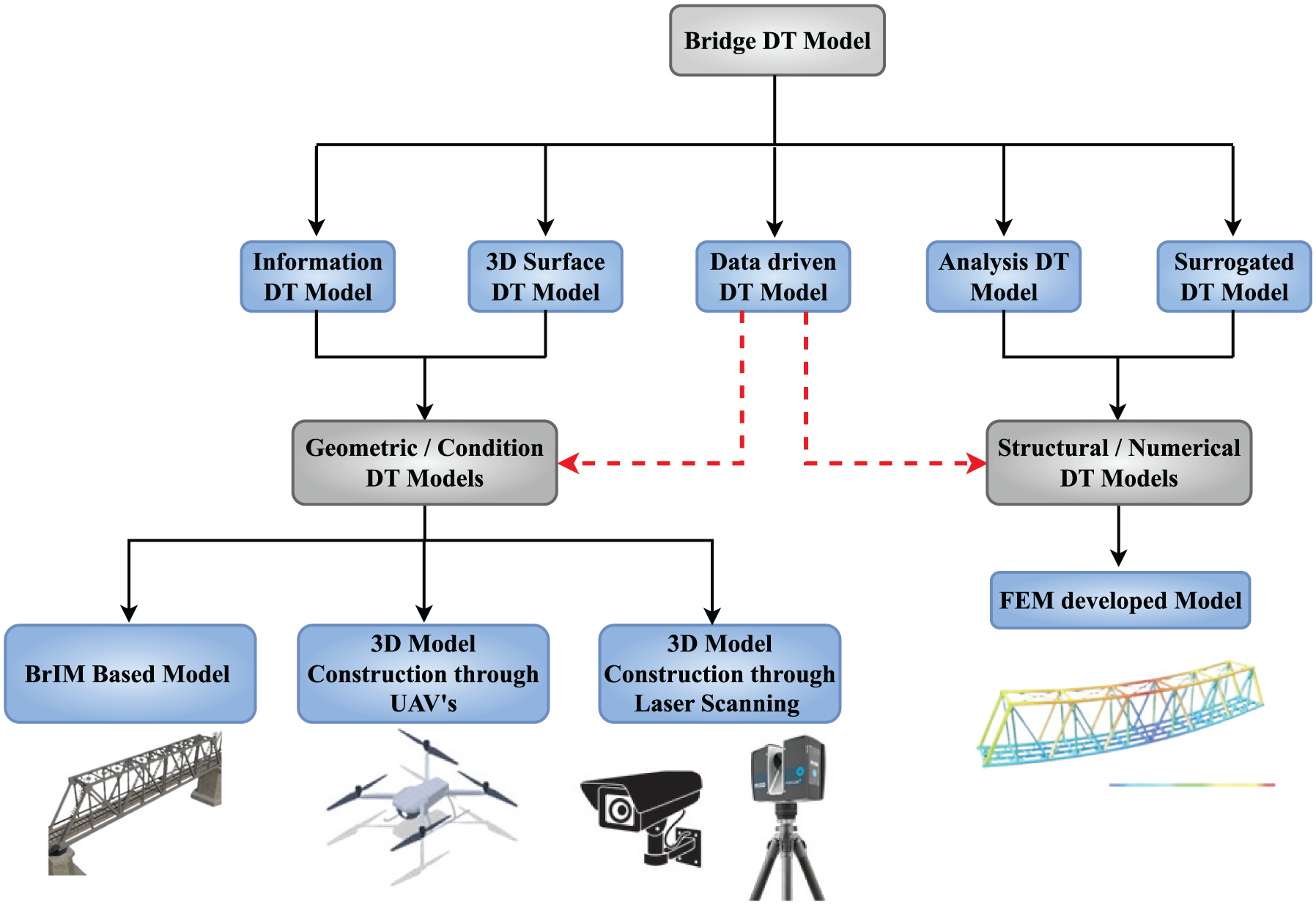
Methods to build Bridge Digital Twin model.
Researchers describe geometric models and FE models as synonymous with Digital Twins. Meixedo et al. 107 regarded the bridge FE model as the Digital Twins while verifying a damage detection methodology for rail bridges. 19 As part of the design process, bridges are often represented as CAD models in the form of Digital Twin models. 18 These models generally comprise two main types: the geometric Digital Twin, which replicates the physical geometric features of a bridge, and the numerical or structural Digital Twin, which simulates the actual structural behaviour and performs simulation studies using the FEM-based Digital Twin model. Generating geometrical Digital Twins involves gathering bridge point cloud data using BrIM and constructing a 3D model using UAVs and laser scanning. Subsequently, these models are categorised according to their geometric properties, and several efforts have been undertaken to enhance the accuracy and efficiency of generating geometrical Digital Twins from point cloud data.3,108
Geometric/conditioned Digital Twin model
BrIM-based model
The geometrical Digital Twins can be developed with BrIM. BrIM is a methodology that expands the principles of BIM, particularly in the field of bridge engineering. 109 BIM, also known as BrIM in bridge engineering, is becoming increasingly popular because of its capacity to depict information and synchronise various components graphically. 109 Kaewunruen et al. 19 introduced the term ‘Bridge Digital Twins’, or BrIM, which refers to the digital representation and information source for a bridge’s physical and functional components. 19 Although BIM, as defined by the International Organization for Standardization, entails a collaborative digital representation of building assets to facilitate decision-making, it is essential to recognising that BrIM and BIM possess unique structural components, data patterns and modelling methodologies designed for bridges and buildings, respectively. BrIM, as defined by the Federal Highway Administration, is a comprehensive digital depiction of a bridge’s physical and operational attributes.
Although the advantages of BIM and Digital Twin technologies in bridge engineering are recognised, the distinction between BrIM and Digital Twins concepts remains insufficiently delineated. ‘Digital Twins’ is often used interchangeably with ‘BrIM’ to represent and provide data on physical objects’ diverse physical and functional attributes. Standardised digital formats enable efficient digital activities and informed decision-making at every stage of the bridge’s lifespan. BrIM has seen substantial advancements, substituting conventional 2D CAD drawings with 3D parametric and visual design capabilities, resulting in improved productivity and quality. 110 Isailović et al. 111 created a BMS utilising BrIM to show bridges’ present state accurately. Although BrIM is highly proficient in displaying geometric data, integrating information and maintaining data, it encounters technological obstacles and functional restrictions across the whole life cycle of a bridge. BrIM facilitates cooperation among entities engaged in bridge construction, resulting in decreased time and expenses during the construction phases.
It promotes collaboration and communication in the building and assessment phases, minimising conflicts and allowing the simulation of construction scenarios in a 3D virtual environment to determine the most efficient designs.109,112 BrIM’s advanced 3D information, data sharing and information interchange capabilities improve bridges’ efficiency and proactive management during their operational and maintenance phases. 113 The transmission and sharing of information in BrIM present challenges that are further complicated using various data formats and protocols. The effectiveness, precision and capability of BrIM depend on the bridge model’s level of development. In addition, BrIM does not possess the ability to promptly send information or data to the bridge itself or offer automated adaptation, hence restricting its potential for bidirectional information exchange. 114
3D model reconstruction using the laser scanning method
3D laser scanning is a non-contact technique employed to effectively gather data points that characterise surface topography. Laser scanning systems are classified as airborne, mobile or terrestrial based on the location of the laser sensor during data acquisition. Terrestrial laser scanners hold significant potential for inspection operations relative to current methodologies, owing to their capacity for sub-millimetre precision, quick execution and cost-effectiveness. 115 A systematic approach for collecting accurate survey data involves integrating a terrestrial laser scanner with a total station. This technique involves developing a BIM model as the foundation for digital management. 116 This technique facilitates identifying and classifying damage to building and bridge exteriors, recognising anomalies from the original design during construction and detecting conflicts among various structures. 3
3D model reconstruction using the UAV-based method
Unmanned Aerial Vehicles, using the latest advances in camera sensing approaches, 117 can acquire high-resolution digital photographs and offer a potential method for creating virtual twins.118,119 The UAV’s flight plan is predetermined, detailing the required number of take-offs, the specific aspects of the civil infrastructure to be photographed, the assigned flight paths for the UAV and the exact angles for image capturing. Upon acquisition of the photographs, several image post-processing techniques are employed to convert these 2D images into 3D digital point clouds. Consequently, these 3D models digitally depict civil infrastructure, including bridges. Structural data is obtained, and quality assessments are performed utilising the reconstructed virtual 3D model. Although UAV photogrammetry offers significant benefits in the efficient and precise collection of extensive remote data, especially for the digital modelling civil infrastructures, a universally accepted standard for evaluating the accuracy, quality, integrity and geometric precision of the point clouds utilised in these 3D models remains absent. In areas where the UAV cannot capture images, human intervention is required to photograph the blind spots manually. 118
Structural/numerical Digital Twin model
The FEM-based model is widely used to deploy Digital Twins in civil infrastructure. It is a standard numerical approach for constructing the twin and obtaining mechanical or electrical responses in the virtual domain. 120 Commercial FEM software such as Ansys, SAP2000®, ABAQUS® and SOFiSTiK®, MSC Marc® are commonly used to develop the numerical model as its virtual counterpart. The parameters for the virtual twin are derived from the physical entity. Once the model is validated, it creates a large dataset using the FEM model. This dataset is then compared with actual measured data from the physical bridge. Aside from simply mechanical models, the FEM model may also create electro-mechanical models. These models may encompass data on mechanical properties, such as displacement or load, and analogue or digital outputs from sensors embedded inside the structure, such as charges or voltages. Researchers have developed multi-physics numerical models of structures and transducers in FEM software to simulate the propagation of guided waves in composite structures.121–123 This digital replica model can accurately detect and analyse structural degradation in real time. However, the existing FEM models require substantial computing resources and are limited by size and time step restrictions, rendering them inappropriate for real-time simulation scenarios.
The development of the structural Bridge Digital Twins remains in progress, although it still lacks a definitive description despite ongoing efforts. The absence of standardised protocols for connecting physical and digital bridges results in variable accuracy in virtual copies. Although proposals for frameworks focusing on specific elements, such as predicting fatigue life and executing proactive maintenance, have emerged, a comprehensive framework addressing a bridge’s entire lifecycle management remains desired. Developing a comprehensive technical architecture for Bridge Digital Twins is complex due to the integration of technologies and expertise from bridge engineering, computer science and communication engineering. Currently, Bridge Digital Twins’ services primarily focus on the operational and maintenance phases, with minimal engagement in the design and construction stages. Despite Bridge Digital Twins’ potential for application throughout a bridge’s life cycle, many obstacles impede its extensive implementation throughout the design and construction phases. 100
Digital Twins in bridge engineering: The initial definition of Bridge Digital Twins is unclear, and the uncertainty over BrIM in some publications interferes with the broad implementation of Digital Twins in bridge engineering. Modern technologies like BrIM and GIS facilitate the virtual design of bridges for new projects. Moreover, improving the techniques for generating geometric Digital Twins is essential to automating processes and ensuring precision for existing bridges. Ongoing research on intelligent algorithms and update approaches is crucial for enhancing the real-time performance and reliability of FEM updates. Combining FEM updating with geometric model construction is regarded as a potential strategy to address the shortcomings of both technologies.
Finite element modelling and model updating
FEMs remain the principal physics-based representation within Bridge Digital Twins, encoding geometry, material behaviour, loading scenarios and boundary conditions to predict structural response across service life. However, FE models developed from design data and laboratory characterisations are inherently idealised and subject to epistemic and aleatory uncertainties arising from material degradation, construction tolerances, boundary condition variability and environmental influences. To bridge the gap between the analytical skeleton and as-built behaviour, SHM systems comprising accelerometers, strain gauges, displacement sensors, temperature sensors and, increasingly, camera/vision and LiDAR systems supply continuous and event-driven measurements that enable inverse identification (model updating) of uncertain FE parameters. Model updating procedures adjust parameters such as element stiffness, damping, mass distribution and boundary condition representations to minimise discrepancies between measured and simulated responses. This transforms a static FE model into an adaptive Digital Twin reflecting the structural state. This hybrid, physics-informed, data-driven paradigm improves prediction fidelity for load effects, dynamic behaviour, damage detection and remaining life estimation, while enabling proactive maintenance and resilience assessment.87,124–127
Model updating methods span deterministic sensitivity-based optimisation, global optimisation (e.g. genetic algorithms), Bayesian inference, Kalman filtering and surrogate-assisted approaches for high-fidelity dynamic problems. For large or high-fidelity FE models where frequent updating is computationally expensive, model order reduction and surrogate modelling (response surfaces, support vector machines) are commonly used to enable near-real-time calibration. Bayesian frameworks and statistical updating exploit long-term monitoring data to quantify uncertainty. At the same time, stochastic approaches use statistical properties of ambient vibration to update static or dynamic FE models that are robust to environmental variability. Practical challenges include (i) separating environmental/operational effects (temperature, traffic, humidity) from damage-related changes; (ii) limited sensitivity of global modal quantities to local damage; (iii) sensor coverage and data quality and (iv) computational cost for full nonlinear/IDA analyses.105,126,128
Limitations of traditional FE model updating in Bridge Digital Twins
FEM updating has been central to the development of Bridge Digital Twins, enabling the calibration of analytical models based on measured responses. Despite its widespread application, traditional FE model updating approaches exhibit limitations restricting their scalability, automation and long-term reliability within operational DT frameworks. These limitations stem from assumptions embedded in conventional modelling techniques, computational challenges and the complex nature of real bridge behaviour.
High computational demand
Traditional FE model updating involves iterative optimisation between measured and simulated responses, often requiring repeated nonlinear analyses. This process becomes computationally intensive and time-consuming when applied to large-scale bridges with complex boundary conditions and thousands of elements.129,130 Using gradient-based or stochastic algorithms, such as genetic algorithms or particle swarm optimisation, further increases computation time, making real-time or near-real-time updating impractical for most operational bridges.
Sensitivity to measurement noise and environmental effects
Bridge responses are influenced by structural parameters and environmental and operational variations – such as temperature, humidity, wind and traffic patterns. Traditional FE updating methods assume that discrepancies between measured and simulated data arise primarily from modelling errors, neglecting environmental variability. This can result in false parameter adjustments and model drift.131,132
Limited sensor coverage and data sparsity
Most bridges are instrumented with sparse SHM systems due to cost and accessibility constraints. Traditional FE updating techniques rely on dense modal or static response data to identify parameter sensitivities accurately. When only a limited number of sensors are available, parameter identifiability becomes ill-posed and the updating process may yield non-unique or physically unrealistic solutions.133,134
Dependency on expert judgement and manual calibration
Conventional updating often depends heavily on engineering expertise for selecting sensitive parameters, defining objective functions and interpreting results. This manual intervention reduces repeatability and automation, preventing continuous synchronisation between the physical and digital bridge.44,130 As a result, model updating remains largely an offline process rather than an integrated feature of a live Digital Twin.
Difficulty capturing nonlinearity and damage evolution
Traditional FE models are primarily linear or quasi-linear representations calibrated to small perturbations around an undamaged state. Consequently, nonlinear behaviour, cumulative damage and deterioration mechanisms – such as cracking, corrosion and joint loosening – are inadequately represented. 135 This limits the use of updated models for damage prognosis or collapse prediction within a Digital Twin framework.
Lack of standardisation and interoperability
Existing FE model updating workflows are non-standardised and software-dependent, hindering interoperability with BIM, BrIM and SHM databases.136,137 The absence of unified data models and open interfaces makes it difficult to seamlessly integrate FE updating results into broader DT ecosystems or asset management systems.
Applications of Digital Twins in bridge engineering
Digital Twins applications’ primary focus in bridge engineering is the operational and maintenance phase, particularly with the dynamic behaviour of bridge structures during health monitoring. This enables the effective utilisation of the advantages offered by Bridge Digital Twins. Therefore, it is crucial to fully understanding the exact meaning of a Digital Twin in the field of bridge engineering, encompassing its application and its influence on the planning, building, functioning and upkeep of bridges across their entire existence. The study outlines the utilisation of Bridge Digital Twins in several aspects, such as framework development, model creation, operation and maintenance. The relevant information is found in Tables 5 and 6. Here, the ‘Development of the Framework’ refers to the design and architecture of the Digital Twin framework, which includes ready models but primarily focuses on the framework development, while ‘Model Establishment’ focuses on constructing and calibrating the numerical or computational models within that framework.
Digital Twins application in bridges.
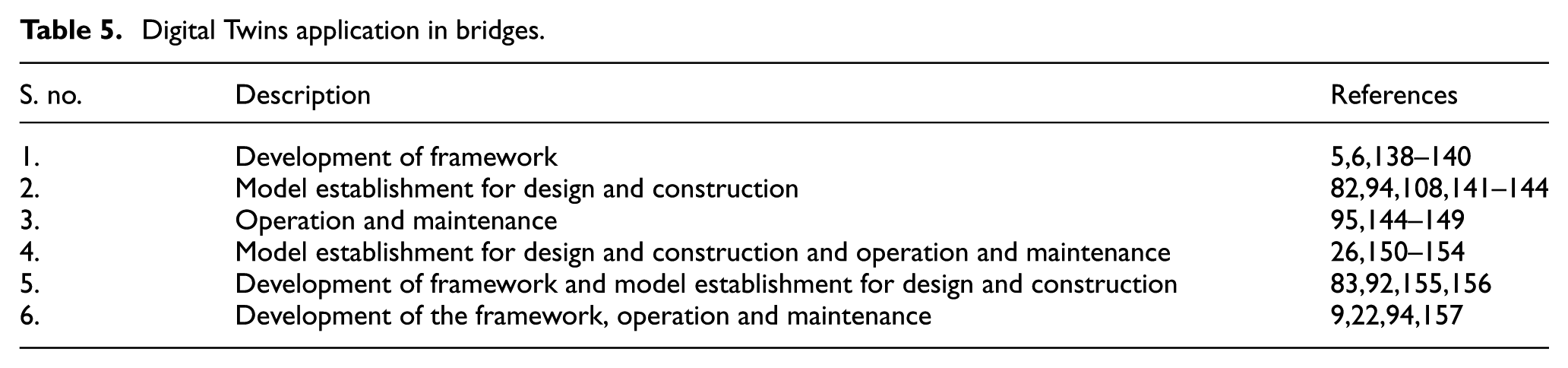
Review of research related to Digital Twins application in bridges.
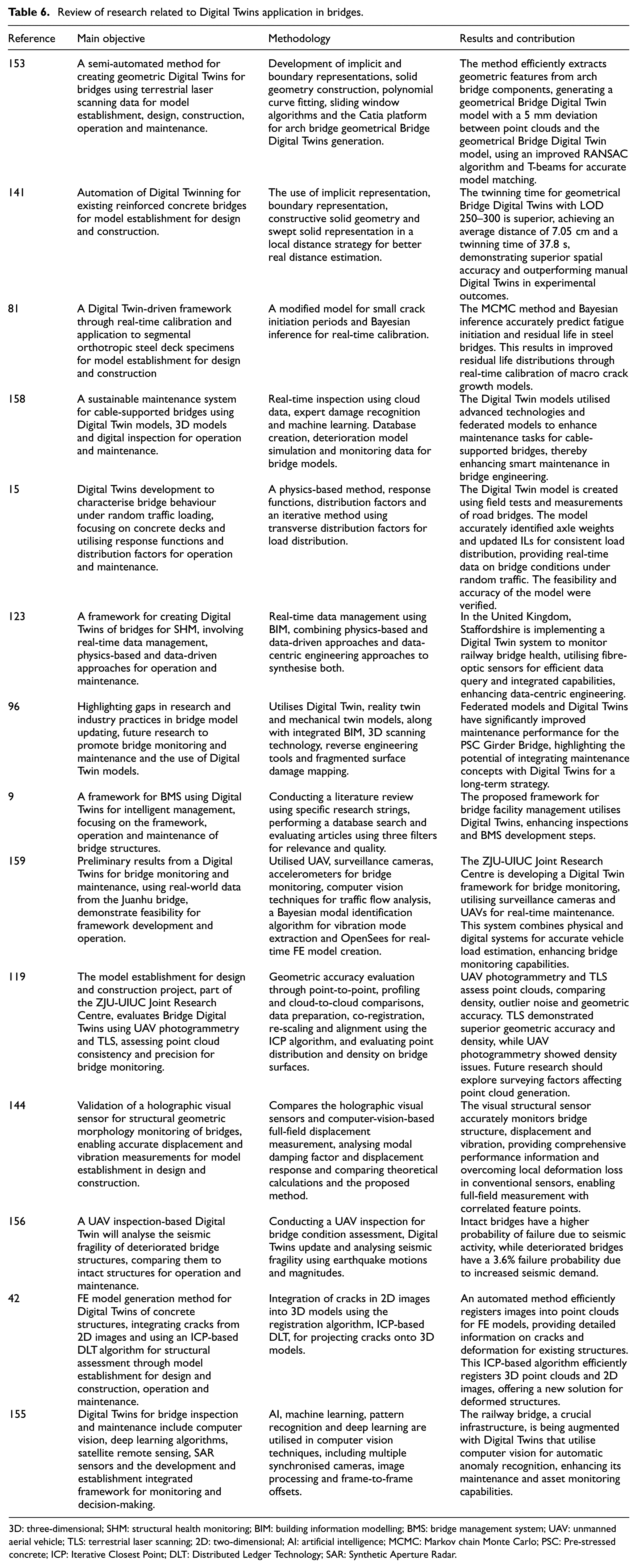
3D: three-dimensional; SHM: structural health monitoring; BIM: building information modelling; BMS: bridge management system; UAV: unmanned aerial vehicle; TLS: terrestrial laser scanning; 2D: two-dimensional; AI: artificial intelligence; MCMC: Markov chain Monte Carlo; PSC: Pre-stressed concrete; ICP: Iterative Closest Point; DLT: Distributed Ledger Technology; SAR: Synthetic Aperture Radar.
Framework and scalability of Bridge Digital Twins
Framework for Bridge Digital Twins
The architecture, process or framework of Digital Twins involves several key components and stages aimed at creating and utilising virtual representations of physical entities. To do this, we need to have a physical entity and a virtual entity in the form of a model that can be developed through the geometrical and behavioural data readily available in Bridge. In complex structure forms and modern digitisation, the objects that record the point cloud data of physical bridges, through which the 3D model can also be built, can be used. Then the physical entity and the virtual entity are readily available. Digital Twins often feature intuitive user interfaces and visualisation tools that allow stakeholders to easily interact with the virtual model and access relevant information. Visualisation aids in understanding complex data and insights generated by the Digital Twins. Digital Twins rely on continuous connectivity between their virtual and physical counterparts. This involves establishing robust communication channels to ensure real-time data exchange between digital and physical entities.
The process begins with collecting data from physical assets using various sensory connections like sensors, actuators and monitoring systems. These sensory connections, such as IoT sensors, can be wired or wireless, which is revolutionary in this modern era. Sensor data and robot data can be directly transferred to the data integration gateway tools without the intervention of a data acquisition system or cloud, data processing, data analytics and data cleansing, whether wired or wireless sensory connections. Similarly, the sensor data and robot data can be transferred to the data acquisition and data processing through the cloud, where the data acquisition processes involved, like data storage, data filtering, data processing, data fusion and so on, whether it may be wired sensory connections or wireless sensory connections, are processed and transferred to the data integration gateway tools. Once collected, the acquired data undergoes processing and integration to convert it into a usable format. This step involves cleaning, organising and integrating data from different sources to create a coherent dataset. The gateway tools involved data feeding for analysis, visualisation and model updating of a 3D model of a virtual entity. In both cases, the data can be transmitted through wired or wireless modules like ZigBee, Wi-Fi and so on.
The data flow to the virtual entity is used to develop a virtual model, visualisation and simulation of the physical entity. Specifically, the data flow to the 3D model for visualisation is processed to create a BrIM model, which is classified as a Geometrical Digital Twin. The data flow to the 3D model used for FEM updating was employed for data analysis to develop a simulated Bridge Digital Twin model, which is classified as a Structural or Numerical Digital Twin. Once the virtual model is connected to its physical counterpart, it continuously monitors and analyses data from the physical asset in real time and will get the findings from the analysis. Insights gained from monitoring and analysis provide feedback to the physical asset and its virtual counterpart. This feedback loop enables proactive decision-making, optimisation and control of the physical asset’s operations (Figure 16).
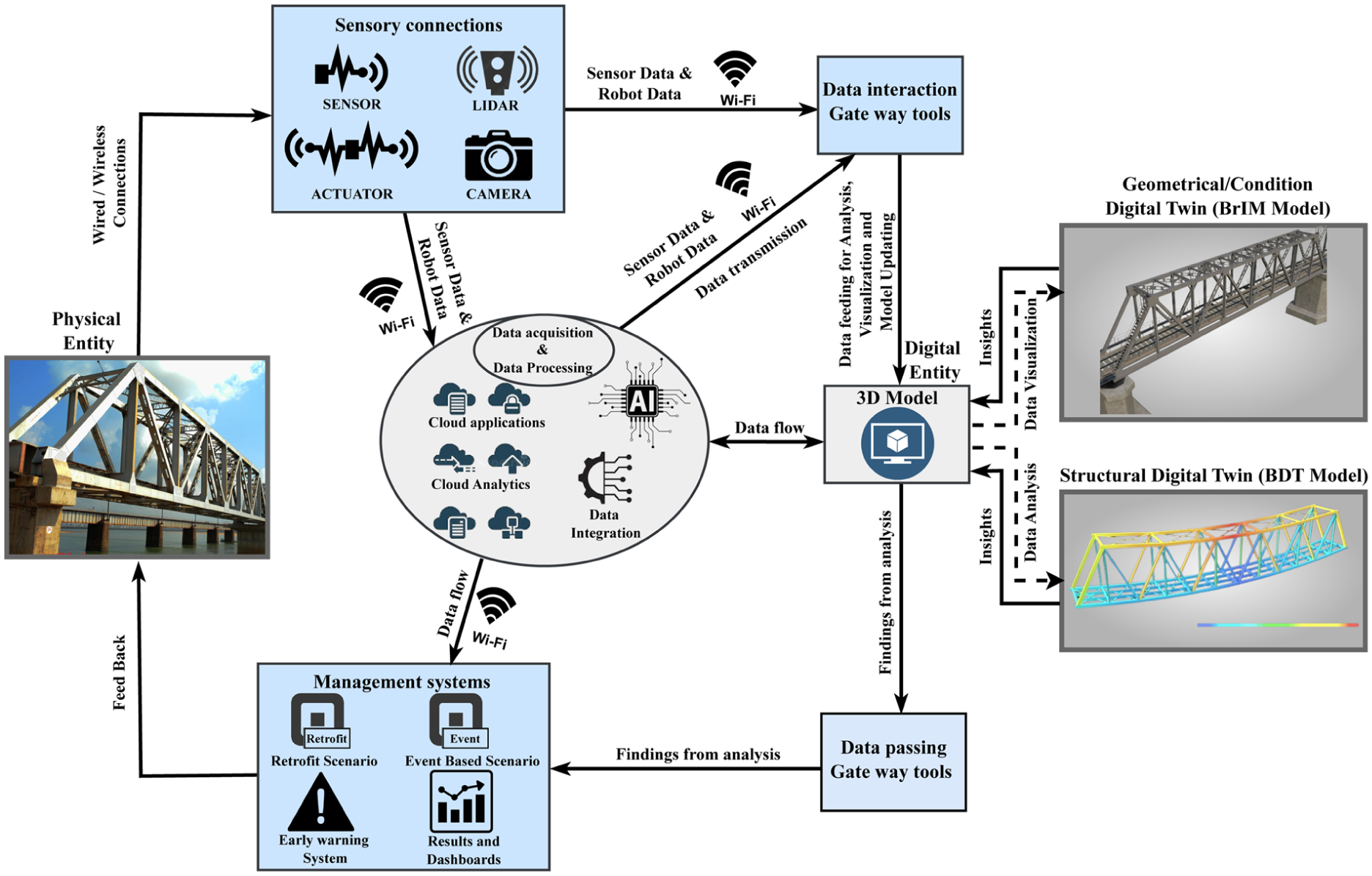
Framework for Bridge Digital Twins: geometrical/conditioned Digital Twins and structural Digital Twins.
This allows anomalies and performance deviations to be detected, and predictive analysis is performed to anticipate future behaviour. Insights gained from monitoring and analysis are used to provide feedback through the data-passing gateway tools to both the physical asset and its virtual counterpart. This feedback loop enables proactive decision-making, optimisation, retrofit scenarios, event-based scenarios, early warning systems, results and dashboard control of the physical asset’s operations. This aims to replicate the real-world asset’s behaviour, characteristics and functionalities as accurately as possible. Digital Twins evolve alongside their physical counterparts throughout the asset’s life cycle. Updates, modifications and improvements to the asset are reflected in the virtual model, ensuring that it accurately represents the real-world asset over time.
Given the sensitive nature of the data involved, robust security measures are essential to protecting Digital Twin systems from unauthorised access, data breaches and cyber threats, while ensuring data privacy and compliance with relevant regulations. In essence, the architecture or process involved in Digital Twins constitutes a complex ecosystem encompassing data acquisition, modelling, connectivity, analysis, visualisation and lifecycle management, all aimed at creating a virtual counterpart mirroring its physical counterpart’s behaviour and attributes.
Scalability of the framework for Bridge Digital Twins
Digital Twin technology has significantly transformed bridge management by providing real-time, data-driven insights into structural health and performance. However, scalability challenges emerge as applications expand from individual bridges to entire networks. These include managing vast data volumes, ensuring sensor reliability and integrating diverse systems. Addressing these challenges is crucial for the widespread adoption of Digital Twins in bridge infrastructure. Understanding and overcoming scalability barriers is essential for optimising long-term asset management and maintenance strategies.
Data volume and management: Bridges with numerous sensors generate vast amounts of real-time data, encompassing parameters such as strain, temperature, vibration and traffic loads. Managing this data across multiple bridges necessitates robust data storage solutions and advanced processing capabilities. Without scalable cloud or edge computing infrastructure, the effectiveness of Digital Twins diminishes, as highlighted by Mousavi et al., 160 who emphasised the importance of integrating advanced technologies to enhance the efficiency of Digital Twins implementations in bridges.
Sensor deployment and maintenance: The installation and upkeep of sensors on numerous bridges is capital-intensive and laborious. Sensors are susceptible to failures or calibration drifts over time, and scaling to many bridges exacerbates these challenges. Franciosi et al. 161 introduced a methodology for managing existing bridges through an adaptable Digital Twin, addressing some of these scalability concerns.
Interoperability and standardisation: Bridges often differ in design, materials and existing monitoring systems. Digital Twin frameworks frequently encounter difficulties integrating heterogeneous data sources, limiting scalability across diverse regions or agencies. Buuveibaatar et al. 162 developed an integrated Digital Twin system combining WebGIS, WebBIM and graph algorithms within a three-layer architecture to overcome interoperability challenges in bridge operation and maintenance.
Computational complexity: High-fidelity simulations and model updates, such as FET-based or AI-enhanced models, demand significant computational resources. Implementing these models across a large fleet of bridges can be impractical. Simplified models may compromise accuracy, presenting a trade-off between scalability and precision. Brighenti et al. 163 reviewed the key features of existing BMS, discussing the challenges in scaling computational models for bridge management.
Cost and resource constraints: Scaling Digital Twins to encompass numerous bridges requires substantial financial investment in sensors, cloud infrastructure and skilled personnel. Smaller municipalities or agencies may lack the budget to implement Digital Twins at scale. Nhamage et al. 22 conducted a systematic literature review on the current state of BrIM and its relationship with Bridge Digital Twins, highlighting the financial and resource challenges associated with scaling Digital Twins in bridge management. 164
Cybersecurity and data privacy: As Digital Twin frameworks scale, the risk of cyberattacks or data breaches increases. Ensuring secure and reliable communication across multiple bridges adds complexity. Iranshahi et al. 165 discussed recent advances and future directions in Digital Twins, emphasising the importance of addressing cybersecurity concerns in large-scale Digital Twins implementations.
Research gaps, future research direction and challenges.
Research gaps
Despite significant advancements in developing and deploying Bridge Digital Twins for infrastructure management, several critical research gaps impede the full realisation of their transformative potential.
Absence of universally accepted, standardised protocols for the holistic processes of data acquisition, integration and processing specifically tailored for Bridge Digital Twins. Establishing generalised guidelines is imperative to ensure interoperability, data usability and adherence to regulatory frameworks in engineering practice.
The integration of FEMU (Finite Element Model Updating) into operational Bridge Digital Twins calls for standardised validation strategies and benchmark cases to evaluate model updating accuracy, computational efficiency and robustness under realistic monitoring scenarios. Such benchmarks are critical for advancing FEMU methodologies tailored to Digital Twins applications.
A key challenge lies in the lack of comprehensive data exchange standards facilitating seamless interoperability between BrIM systems and Digital Twin frameworks. This encompasses semantic integration hurdles, synchronisation complications and, notably, the insufficient incorporation of non-structural and auxiliary components critical to comprehensive bridge health representation.
A principal challenge lies in the seamless integration of FEMU processes that support continuous or real-time updating of Bridge Digital Twins. Automated model correction based on incoming sensor data is essential to maintaining the Digital Twins’ structural representation accuracy amidst evolving environmental and operational conditions.
Current methodologies for constructing and updating Bridge Digital Twins predominantly rely on manual or semi-automated workflows, limiting scalability and responsiveness. There is an exigent need for research into robust, fully automated algorithms and processes that can support real-time or near-real-time Digital Twins lifecycle management.
Using UAVs and other robotic platforms for bridge inspection is promising but constrained by limitations in automated flight planning algorithms and a dependency on extensive prior geometric and environmental models. This reliance restricts operational flexibility and the efficiency of automated inspection missions.
Owing to the heterogeneity and uncertainty inherent in sensor data and the environmental variability, a robust FEMU framework integrated into Digital Twin must incorporate uncertainty quantification methods. This enables probabilistic model updates that enhance the predictive capability and resilience of the Digital Twin under varying conditions.
An inherent tension exists between acquiring high-resolution, large-scale datasets and maintaining computational efficiency in data processing and Digital Twin simulation. Practical strategies to optimise this balance remain underdeveloped and warrant focused investigation.
FEMU methods within Digital Twin implementations exhibit limited automation and scalability. Fully automated workflows capable of handling large-scale bridge systems with minimal human intervention are required. These workflows must support real-time data assimilation and rapid model updates to reflect structural changes accurately.
Digital Twins rely on iterative feedback mechanisms wherein updated FE models inform condition assessment, anomaly detection and predictive maintenance scheduling. Research is needed on methods that optimise these feedback loops, facilitate closed-loop Digital Twins operation and ensure the lifecycle optimisation of bridge assets.
Research integrating heterogeneous data sources such as optical imagery, LiDAR scans, vibration signals and thermographic maps to improve the accuracy of bridge condition assessment and prognosis remains nascent. Advancing methodologies for effective multi-modal data fusion is critical for the next generation of predictive Digital Twin models.
Exploring novel interaction paradigms enabled by large language models and multi-modal AI holds promise for intuitive and accessible Human–Digital Twins interfaces. Yet, their application within the context of Bridge Digital Twins remains largely unexplored.
Future research direction
Future research directions for Bridge Digital Twins are focused on leveraging automation and advanced digital technologies to transform bridge engineering. The increasing demand for automation across industries is driving the adoption of Digital Twins platforms, presenting untapped benefits to bridge management and safety. Digital Twins promise a significant impact on bridge infrastructure, despite ongoing challenges such as data quality, cybersecurity, power consumption and integration with systems. The scope of Bridge Digital Twins will broaden to encompass diverse use cases, integrating auxiliary technologies such as AR to enable immersive visualisation experiences and AI for enhanced insight and predictive analytics. The evolution of AI, IoT and cloud computing has laid a robust foundation for rapid growth in Digital Twins adoption in infrastructure sectors, including bridges.
AI-driven Bridge Digital Twins will leverage data from IoT sensors embedded in physical bridges to create dynamic models that operate in tandem with real-world structures. These models will autonomously analyse asset conditions, anticipate failures, optimise efficiency and support proactive maintenance and strategic decision-making. This automation reduces reliance on physical inspections and enables virtual validation of designs and operational strategies, minimising costly redesigns and accelerating time-to-market. Future research will also advance sensor technologies and sensor fusion techniques, refining the fidelity and granularity of digital bridge models, which are essential for higher-quality monitoring and control. Edge computing will play a pivotal role by processing data at the network’s edge, close to sensor sources, decreasing latency and data transfer loads and being critical for real-time safety and operational decisions in bridge monitoring.
Blockchain technology is expected to enhance data security and transparency in multiple collaborations by providing tamper-proof records, thereby raising confidence in the authenticity of Digital Twins data. Human–digital interaction through AR, VR and ER platforms will revolutionise user engagement by bridging Digital Twins, enabling real-time immersive interaction for training, monitoring and intuitive decision-making. Ethical and regulatory frameworks will ensure data privacy, consent, security and the responsible use of Digital Twin technologies in the civil infrastructure (Figure 17).
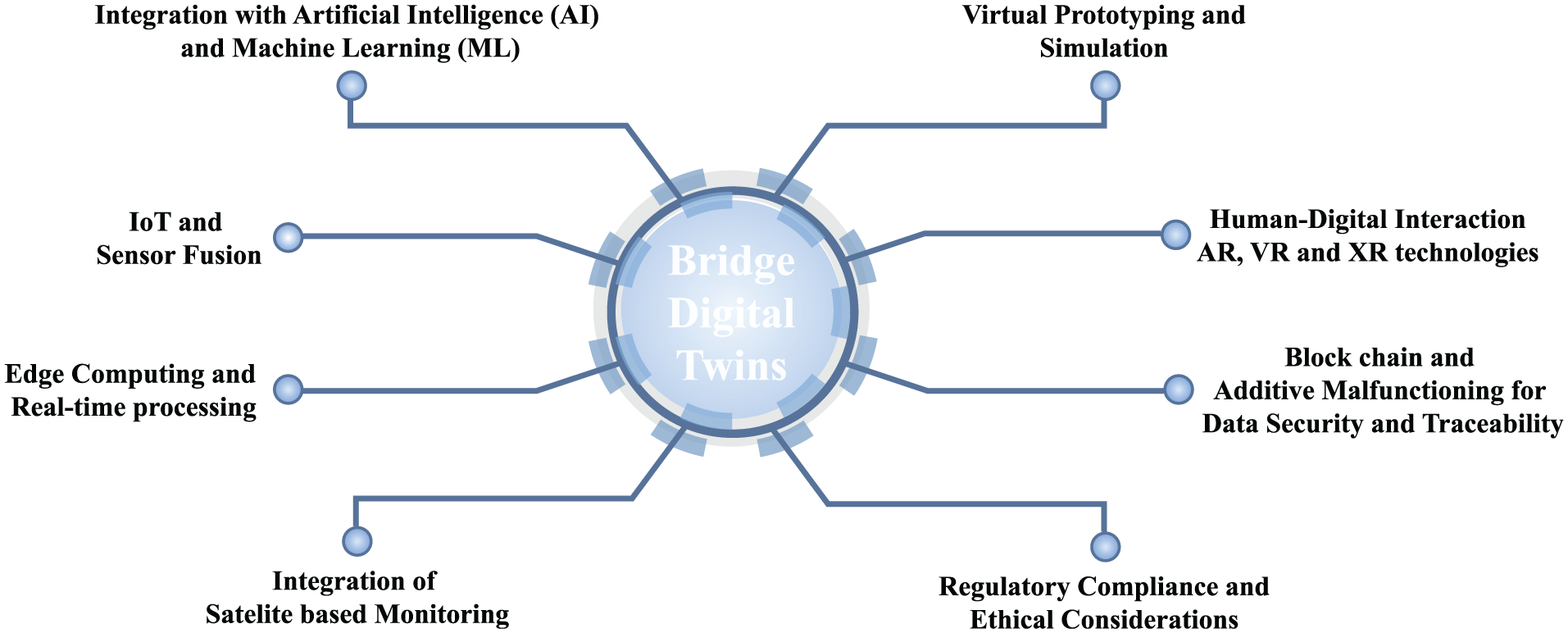
Future research direction for the Bridge Digital Twins.
Satellite-based monitoring is emerging as a key future trend in Bridge Digital Twins, enabling large-scale, non-contact observation of structural displacements and environmental impacts. Advancements in multi-frequency SAR constellations and high-resolution InSAR will allow near-real-time deformation tracking and early anomaly detection. Integrating satellite data with LiDAR, UAV and in situ sensors will enhance data fusion within Digital Twins for holistic bridge health assessment. Physics-informed and AI-based fusion models will improve interpretation accuracy and uncertainty quantification. Scour detection techniques are evolving as a vital future trend in Bridge Digital Twins to ensure foundation safety and resilience. Integrating in situ sensors such as sonar, vibration-based probes and fibre-optic systems with Digital Twin frameworks enables real-time scour depth monitoring. Advances in UAV photogrammetry, LiDAR bathymetry and remote sensing will support non-intrusive mapping of riverbed changes around bridge piers. Data fusion and AI-driven models will correlate hydraulic, structural and sensor data to predict scour progression under varying flow conditions.
There remains a critical need for unified platforms addressing interoperability challenges caused by disparate standards, protocols and data formats. Future initiatives will focus on integrating heterogeneous information and simulation models into trusted, functional digital replicas. This growing trust in predictions and analytics will underpin the broader adoption and effectiveness of Bridge Digital Twins.
Challenges
Integrating Digital Twin technology in bridge infrastructure has emerged as a transformative paradigm, offering real-time condition monitoring, predictive maintenance and data-driven decision support. Despite its clear potential, the practical realisation of Digital Twins in this domain is hindered by various interrelated challenges. Overcoming these constraints is critical for advancing the maturity and large-scale deployment of Bridge Digital Twins, as highlighted in recent state-of-the-art reviews.41,166,167
Challenges in data acquisition and data fusion
Ensuring continuous and reliable data streams from diverse sensing technologies remains one of the most pressing obstacles in establishing accurate Bridge Digital Twins. High-resolution sensor arrays and UAV-assisted inspection systems inevitably generate vast quantities of heterogeneous data that differ in format, sampling frequency and resolution. The manual intervention required for preprocessing and harmonising these datasets constrains automation and hinders real-time model updating. Additionally, the effective integration of real-time sensor inputs with periodic offline inspection data is constrained by synchronisation mismatches and accuracy losses, underscoring the need for advanced data fusion frameworks. 47
Challenges in data management and processing
The data-rich environment associated with Bridge Digital Twins demands scalable infrastructures for reliable storage, computationally efficient processing and advanced analytics. Although cloud- and edge-based computing architectures have been explored to address these requirements, persistent concerns regarding latency, cybersecurity and data integrity across heterogeneous platforms pose practical limitations. The datasets are scarce in bridge monitoring applications, restricting the development of robust predictive maintenance tools and risk assessment systems. 167
Challenges in virtual model integration and interaction
Developing dynamic and interactive virtual counterparts that stay synchronised with the physical bridge over its operational life cycle presents another layer of complexity. Fragmented datasets and inconsistent formats frequently hinder the integration of inspection records, sensor data and numerical simulations, thereby increasing the risk of data loss and compromising model accuracy. The lack of standardised data protocols limits interoperability and poses challenges for large-scale implementation. In addition, user interface design remains underexplored, despite its importance for supporting domain experts in making informed decisions.
Challenges in intelligent decision support
Integrating decision-support capabilities into Bridge Digital Twin frameworks is challenged by the inherent variability of sensor measurements and external environmental effects, compromising reliability in forecasting damage detection and deterioration. Furthermore, the design of transparent and interpretable human–machine interaction paradigms that foster expert trust while preserving oversight adds to the complexity of deploying Digital Twin-enabled decision-support systems in practice.
Challenges in immersive visualisation and user feedback
Emerging visualisation modalities such as VR and AR hold promise for enhancing the interpretability and decision-making potential of Bridge Digital Twins. However, their implementation faces significant barriers related to high computational demands, limited update frequencies and the challenge of representing complex structural responses without introducing cognitive overload for end users. Additionally, embedding expert feedback mechanisms into these visualisation environments is difficult, since incorporating human insight must occur without compromising real-time performance or system responsiveness.163,168
Limitations
While this paper provides a comprehensive state-of-the-art review of the health assessment of Digital Twins in bridge engineering, certain limitations should be acknowledged. The review is limited to studies published in English, which may have led to the exclusion of valuable research from non-English-speaking regions. Moreover, the literature search primarily focused on peer-reviewed journal articles and conference proceedings, potentially omitting relevant findings from other forms of technical reports or industry documents. Given the extensive volume of available literature, a selective citation approach was necessary, and, consequently, some pertinent studies within popular subtopics may not have been included.
Conclusion
The integration of Digital Twin technology into bridge engineering represents a paradigm shift from traditional, predictive maintenance towards proactive, intelligent and data-driven infrastructure management. This review synthesises the current state of research on Bridge Digital Twins, offering a structured framework that states the technological, analytical and operational layers. Through a comprehensive analysis of tools, technologies, sensory systems, data acquisition methods and model updating approaches, the study underscores the transformative potential of Bridge Digital Twins for real-time SHM, predictive maintenance and resilience enhancement. Despite remarkable progress, the widespread implementation of Bridge Digital Twins in bridge infrastructure remains constrained by challenges in data interoperability, standardisation, computational scalability and model validation under uncertain environmental and operational conditions. Bridging these gaps requires the development of unified frameworks and open data standards that facilitate seamless communication between heterogeneous systems, fostering interoperability across digital ecosystems. Moreover, advancing hybrid modelling approaches integrating physics-based, data-driven and AI-enhanced techniques will be crucial for achieving high-fidelity and self-evolving digital replicas capable of autonomous decision support. Future research should focus on establishing robust cyber-physical frameworks that integrate edge computing, IoT and cloud-based architectures to ensure scalability and real-time responsiveness. Collaborative efforts among academia, industry and government agencies are crucial for developing standardised protocols, lifecycle management strategies and validation benchmarks for BDT deployment at scale. The realisation of fully functional and interoperable Bridge Digital Twins will facilitate robust, sustainable and intelligent bridge infrastructures, marking a new era of digital engineering for asset management and infrastructure resilience.
Footnotes
Declaration of conflicting interests
The authors declared no potential conflicts of interest with respect to the research, authorship, and/or publication of this article.
Funding
The first author acknowledge the financial assistance received from the Ministry of Education, Government of India. The second author would like to thank the Sponsored Research and Industrial Consultancy of the IIT Bhubaneswar for providing financial assistance through SEED Grant (SP144) for the work presented in this manuscript.
