







Abstract
Through exposure to heterogeneous sources of knowledge, actors who broker between unconnected contacts are more likely to generate valuable output. We contribute to the theory of social capital of brokerage by considering the impact of field maturity. Using longitudinal data from the field of strategic management we find that the benefits of network brokerage are stronger during the early stages of field development and diminish as the field matures. The results of our study call for further research on the interplay between network structures and processes of field emergence.
Introduction
In network research, a brokerage position is characterized by the absence of ties between the contacts of a focal actor. Brokerage represents not only a source of competitive advantage for individuals but also a relevant concept for understanding the advancement of organizations and fields, especially in knowledge-intensive and creative settings. These characteristics provide strong motives for studying brokerage positions.
Extant research has shown that actors in brokerage positions are more likely than other actors to generate relevant and valuable innovations that are rewarded financially, through hierarchical promotions, or symbolically through public accolades and citations (see Burt, 2005, for an extensive review; Uzzi and Spiro, 2005; Zaheer and Soda, 2009). Direct ties to otherwise disconnected alters provide opportunities to exchange diverse knowledge, spot similarities between seemingly unrelated contents, synthesize apparently contradictory or irreconcilable points of view, and generate new ideas and test their robustness (Burt, 2004; Mizruchi and Stearns, 2001). Furthermore, individuals in brokerage positions have a timing advantage. They are not only more likely to be early recipients of information from diverse groups but also occupy a privileged position from which they can assess the relevance of new information (Burt, 1997, 2007). Therefore, in a competitive process in which timing is rewarded, a brokerage position may provide a crucial advantage.
Despite growing evidence about how brokers can deliver and receive recognition for performance, the context in which brokers operate remains under-researched. The relevance of context is raised by Burt (1997) in his article on the contingent value of the social capital of brokerage. Specifically, Burt shows that the return on brokerage accrues primarily to managers who work in highly uncertain settings. Lack of constraining established templates leaves brokers free to craft innovative solutions that benefit both themselves and their organizations (Burt, 2010; Hansen et al., 2001). Extending this point to the market level, Podolny (2001) argues that actors with brokerage networks are more likely to sort into market segments characterized by high egocentric uncertainty—that is, uncertainty about market opportunities and the ways by which the ego can seize those opportunities—because this type of context enables them to generate a higher return on brokerage.
Although these studies are critical for advancing our understanding of the relationship between brokerage and context, they address the context from a static perspective. Specifically, organizations and markets are treated as being in a sort of steady state, and the return on brokerage is analyzed by comparing between organizations or markets that have clearly defined characteristics. The strategic implication of conducting such an analysis is that actors are better off when they sort into markets and organizations that match their strength, where strength is a function of actors’ network. However, we know little about the strategic options faced by actors who remain within the same domain for an extended time because, as domains evolve, the structure of opportunities clearly changes. Touching on a similar issue, the interplay between networks and field evolution, Powell et al. (2005) note that because “analyses of fields and networks have been oddly disconnected” (p. 113), we do not have yet a good understanding of the co-evolution of fields and the structures of opportunities and constraints in fields. The implication of this disconnect for theories of social capital is that we still do not have an answer to the question: how does the return on brokerage change as fields evolve?
In this article, we aim to answer this question by investigating the relationship between field maturity and return on brokerage within the field of strategic management research. We build on prior research on the transition of strategic management research from an informal coalition of scholars to a discipline with a large membership and a significant institutional presence and recognition (Bowman et al., 2002; Hambrick and Chen, 2008; Pettigrew et al., 2002). We develop hypotheses about the link between the structural holes around an author or team of authors, which is our measure of brokerage, and the citation impact of their research output, which is our measure of return on brokerage, contingent upon the maturity of the field.
Our article is organized as follows. First, we examine the mechanisms that link structural holes to higher work recognition through citations. Second, we discuss how field maturity affects the link between brokerage and citation impact. We then analyze our data on the collaborative network of authors in the field of strategic management. Finally, we discuss the implications of our results for research on network brokerage and the study of field evolution and innovation.
Theory
The positive link between brokering across structural holes and performance is predicated by two related mechanisms: access to diverse information and timing (Burt, 2005: 16). The first mechanism, access to diverse information, emphasizes brokers’ innovative potential due to their exposure to different pools of information. When direct contacts are interconnected, they often draw from similar information pools and, thereby, provide redundant, self-reinforcing points of view. By contrast, unconnected direct contacts lead to different perspectives and pieces of information. Burt (2004) summarizes the argument: “brokerage across the structural holes between groups provides a vision of options otherwise unseen” (p. 349). When these options translate into concrete proposals and work projects, they become “good ideas” that are likely to receive greater accolades from peers (Burt, 2004). Furthermore, structural holes provide not only the opportunity to generate new ideas but also a site to test their robustness. Competing or contradictory perspectives help authors to identify early on the weaknesses of a new argument and thus make improvements before submitting it for public scrutiny (Burt, 2005; Mizruchi and Stearns, 2001).
The second mechanism, timing, emphasizes brokers’ timing advantage. From their position at the crossroads of information flows that originate in groups with diverse interests and expertise, brokers learn early about new ideas. Moreover, they are well positioned to understand the relevance of ideas circulating in the groups to which they are directly connected (Burt, 1992, 2005). In other words, brokers are not only more likely to generate good ideas but are also faster at generating these ideas. Time is an important aspect in the production of knowledge, as the valuation of a contribution is affected by the time at which it appears in the public domain. For example, the first publication of a novel argument tends, in general, to become a reference point and, consequently, receives more citations than subsequent papers, which are often seen as merely improvements of the initial argument.
Taken together, the two mechanisms of access to diverse information and timing suggest that because brokers are more likely both to produce novel ideas and to be faster than their peers in delivering the idea, we should expect brokers’ ideas to be cited more frequently than those of other actors. However, being at the crossroads of information flows becomes an advantage only to the extent that brokers have a deep understanding of what is communicated by the parties with whom they interact, which is more likely when brokers have close, strong relations with their contacts. This condition is met in many scientific fields, where it is generally true that researchers who collaborated in the past with a focal scientist represent a source of tacit knowledge (McFadyen et al., 2009). Their shared past experience, which also implies that the ego has already been exposed to the area of specialization of alters, makes it easier for the ego to solicit the relevant information necessary for developing a novel idea. Prior collaboration facilitates open discussion and honest advice, thereby enhancing the robustness of new ideas. Finally, discussions with trusted contacts can provide relevant insights into aspects of research that are not necessarily content related, but relate more to the presentation of an idea, the required time investment, or the venue that is more likely to welcome the new idea (see Zaheer and Soda, 2009, for a related argument in television production). Therefore, we expect that the information benefits of brokerage will hold for researchers in a scientific field.
In a knowledge field, research is produced both individually and in teams. For example, in strategic management, articles which are candidates for citation can be single-authored or have multiple authors. Building on previous research, we treat teams as unitary actors (Soda et al., 2004; Zaheer and Soda, 2009) that can also be brokers in an inter-team network. Figure 1 is a stylized graphical representation of our data. The nodes are papers written either by individual authors or teams of co-authors. For instance, papers P20 and P21 have two co-authors in common. Consequently, these two teams are connected.
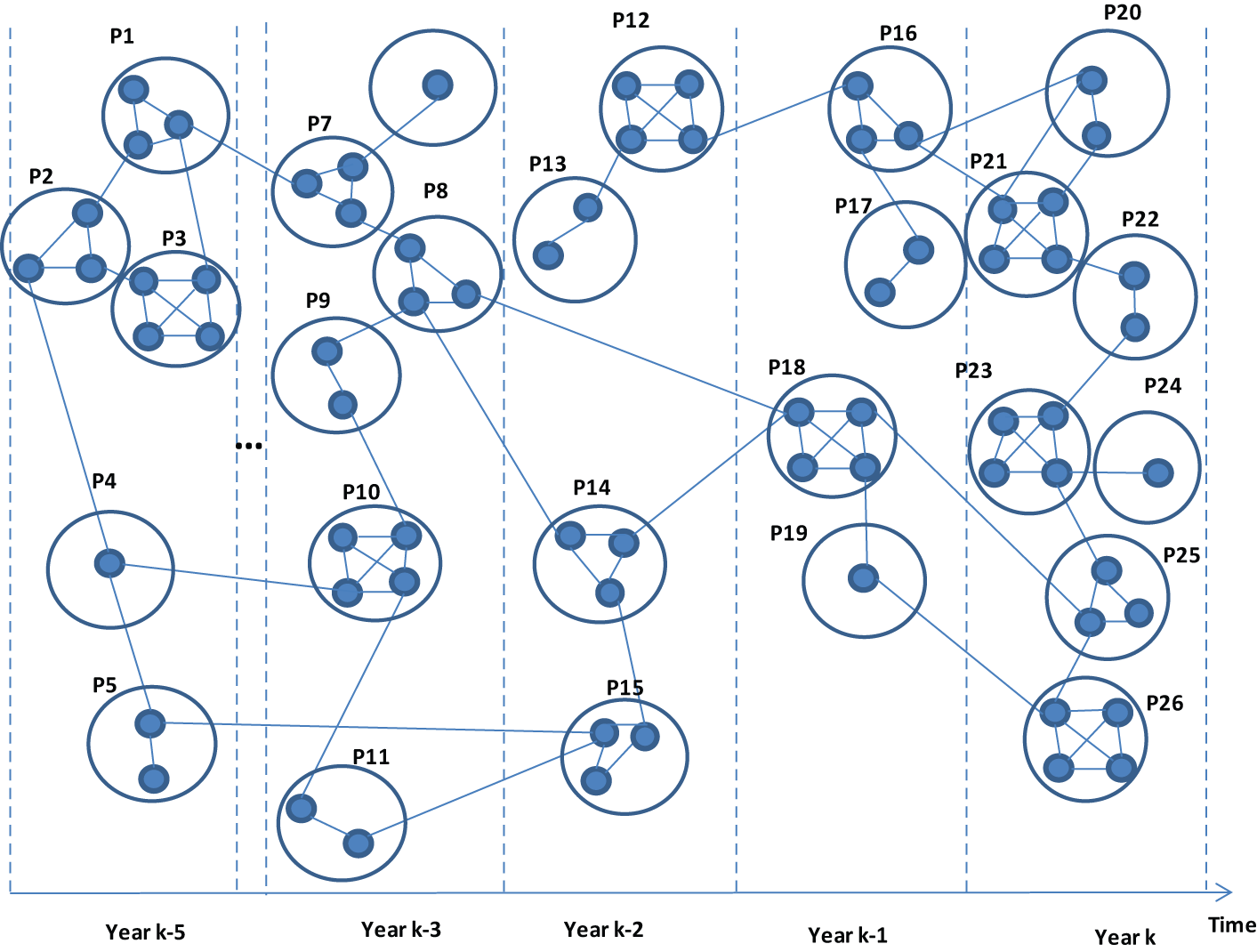
Network of teams over time.
Treating teams as brokers in their own right is not unusual in network research. However, because the transposition of the brokerage argument from the individual level to the team level is not automatic, two aspects need to be considered. The first aspect relates to the plausibility that an individual who works on two teams represents a connection and that information passed through this connection is relevant to team outcome (see assumptions of composition and contagion in Zaheer and Soda (2009)). The second aspect concerns the plausibility of a causal linkage between inter-team network structure and the production of new knowledge at the team level, independent from individual specific effects (Felin and Hesterly, 2007; Zaheer and Soda, 2009). Below, we discuss these two aspects in detail in the context of research conducted by small teams of scholars in strategic management.
First, in order for information to flow between two teams via an individual working on both teams and for this information to have an impact on team outcomes, there needs to be frequent interactions, communication, and collaboration among team members. This is likely to be the case for small teams of co-authors collaborating on papers. In this context, tacit knowledge relevant to the production of research output is not only likely to flow between teams via common co-authors but also to be discussed and analyzed by team members. Small team size and collaborative processes increase the likelihood that individual team members influence their teammates. Moreover, compared to typical work groups in which members only partially self-select, teams of co-authors agree to work together, an agreement that implies knowledge exchange and inter-personal influence.
Second, regarding the causality argument, two conditions need to be considered. First, ties need to be relevant for the research outcome. To the extent that ties between two scholars carry information regarding research ideas, theoretical frameworks, methodologies, experiences with various audiences, and other tacit knowledge relevant to the research output, our data meet the first condition. Second, the way in which specific advantages that accrue to individuals who compose a team aggregate at the team level needs to be spelled out. Put differently, the critical issue is whether, for instance, by discussing brokerage at team level we ignore differences in brokerage at the individual level (Felin and Hesterly, 2007; Klein et al., 1994). While it is true that the capacity to act as a broker belongs to the individual, the aggregation of individuals with different brokerage profiles at the team level results in teams with distinct profiles: from high brokerage teams, whose members are primarily brokers, to teams whose members are drawn primarily from a close structure. To the extent that having individual brokers on a team increases the chance that the members will draw from different information pools in a timely manner and because co-authorship teams are small and interactive it is plausible that there are advantages at team level due to differences in informational advantages at the individual level. 1
If these assumptions hold, it then is possible to argue that the non-redundant tacit knowledge obtained by a small and cohesive team of researchers through ties with other teams is similar to the knowledge received by individual researchers who broker among unconnected parties, and that this knowledge is likely to contribute to creating scientific outputs that receive recognition from peers, often measured by citations (Hirsch, 2005; Owen-Smith and Powell, 2003; Singh and Fleming, 2010; Wu, 2012). Thus, we expect the information and timing advantages associated with structural holes to yield high citation impacts:
Prior research has shown that returns to brokerage are higher when there is high egocentric uncertainty—that is, when uncertainty exists both about market opportunities and the way in which the ego can seize those opportunities (Burt, 2007; Hansen et al., 2001; Podolny, 2001). This positive association between returns to brokerage and egocentric uncertainty stems from the very argument that explains returns to brokerage in the first place. Brokers are able to create novel solutions quickly when those around them do not constrain their search and use of diverse information. Moreover, novel solutions proposed by brokers are likely to be perceived as valuable to the extent that those around them are unsure about how to solve specific problems. This point is illustrated by Burt’s analysis of managers in numerous settings: managers enjoy higher returns to brokerage when the organization exerts little control over how they conduct their work (Burt, 1997, 2010). Similarly, Hansen et al. (2001) show that teams with brokering networks solve problems quicker when these problems are complex, new, and therefore highly uncertain, as they are in explorative tasks. As soon as task predictability increases, such as for exploitative tasks, returns on brokerage diminish. At the limit, innovation becomes disruptive for people engaged in routine work and return on brokerage may become negative (Burt, 2010). Finally, Podolny (2001) reaches a similar conclusion at the market level, showing that high egocentric uncertainty favors firms with networks rich in structural holes.
High- and low-level egocentric uncertainty in different organizational and market settings is analogous to a comparison between earlier and later stages of field evolution. A field can be defined as collection of actors who “are attuned to and interact with one another on the basis of shared (which is not to say consensual) understandings” in terms of their common purpose, their relationship to other participants, and “the rules governing legitimate action” (Fligstein and McAdam, 2012: 9). During the emerging stages of a field, the roles and rules of engagement are still to be written and the purpose of the field may be unclear (Fligstein, 2001; Fligstein and McAdam, 2011; Powell and DiMaggio, 1983; Powell and Sandholtz, 2012). There is egocentric uncertainty regarding the goals to be pursued and how to achieve them. As the field matures, more stable roles and established norms regulate actions, thereby reducing egocentric uncertainty.
In the case of an emerging academic field, debates may emerge about what constitutes its central research questions and where the boundaries lie in terms of more established fields (Hambrick and Chen, 2008). The formal organizations that regulate the production of knowledge, such as professional associations and journal editorial boards, are still in the making. In the absence of well-established norms of control, actors are freer to generate new and original solutions and to take more entrepreneurial actions. Furthermore, research projects in an emergent field are, almost by definition, exploratory, as the reference points are few and the goals may be unclear. In such an environment, rich in egocentric uncertainty and short on codified knowledge, diverse and timely tacit knowledge acquired by brokers should yield high returns.
By contrast, in a more mature field, the rules of the game have become more stable. As more actors enter into the field, competitive pressure increases, and success is defined primarily by the actions of the majority. Formal structures such as editorial boards, professional bodies, and cohesive groups of scholars sort participants into distinct categories, discipline, and reward for conformity with the norms of the field (Frickel and Gross, 2005; Hambrick and Chen, 2008). Furthermore, an increasing number of textbooks contribute to the reduction in uncertainty regarding the specific problems studied by field participants (Kuhn, [1962] 1970). Structuration processes have been investigated by scholars interested in the social production of scientific knowledge in a variety of fields (Friedkin, 1998; Kuhn, [1962] 1970; Mizruchi and Fein, 1999). In his highly cited account of scientific production, Kuhn ([1962] 1970) argues that as a scientific field matures, its core paradigm offers the most legitimate way to frame and solve empirical puzzles, and therefore it attracts the majority of researchers. These points are in line with Burt’s (1997) general brokerage argument that competition and legitimacy pressures contribute to reduce egocentric uncertainty and, therefore, have a negative effect on the returns to brokerage. In other words, some of the work produced by researchers with brokerage networks can end up being less valued and therefore less cited.
In addition to making changes that could affect the production of new knowledge and thereby reduce its perceived value, more mature fields present difficulties to those who consider using novel work. First, independent of their own valuation of the work, authors who aim to use work that represents a significant departure from established templates may have anxiety about how their peers will perceive them. Second, incorporating novel ideas into an established framework demands cognitive and conceptual stretching, which is more difficult than the straightforward reuse of standard outputs that fall within established templates. Repeated exposure to homogeneous content may reduce the ability to deal with unconventional ideas. That is, in a mature field, the value of a brokerage position is diminished due a reduction in the level of egocentric uncertainty surrounding knowledge production and the diminished likelihood that peers will embrace novel ideas. Formally, we hypothesize as follows:
Empirical setting
In this study, we consider the emergence of the strategic management research field. Toward the end of the 1970s, several scholars coined the Strategic Management label (Channon, 1999). The Strategic Management Society (SMS) was founded in 1980, and it fostered the development of a community of scholars that expanded beyond the frontiers of smaller groups that already existed (Bowman et al., 2002; Hambrick and Chen, 2008; Pettigrew et al., 2002). The Strategic Management Journal (SMJ) was the flagship publication of the new field (Pettigrew et al., 2002). Strategy has since become a well-established research topic in major journals in the Management and Business category and at the Academy of Management, through its Business Policy and Strategy division (see Hambrick and Chen (2008: 38–40) for a detailed description). Many business schools have departments specializing in the discipline. Finally, the community of researchers working under the Strategy label has established a distinctive research agenda that differentiates them from other fields (Hambrick and Chen, 2008; Nag et al., 2007).
The field of strategic management is an appropriate empirical setting in which to test the relationship between field maturity and brokerage for several reasons. First, the rich evidence on the evolution of the field (discussed above) shows a gradual reduction in uncertainty regarding what strategic management is and what it means to do good research in strategic management. Second, strategic management researchers work both individually and in teams to advance knowledge in the field and, while interacting, they create a large collaborative network, comparable to those described in other settings (e.g. Powell et al., 2005; Zaheer and Soda, 2009). Third, citation impact is easy to measure and, in addition, represents a suitable indicator of the perceived value of a research output (Hirsch, 2005; Owen-Smith and Powell, 2003; Singh and Fleming, 2010; Wu, 2012).
Data
Outcomes of collaborative networks in a field can be accounted for in two ways. One approach is to first clarify the boundaries around a field and then to analyze the actors in their activity within these boundaries (e.g. Furrer et al., 2008; Moody, 2004). This approach is appropriate when analyzing a specific time period in the life of a field, but unsuitable when the origins of a field form part of the analysis, as we intend here. Strategic management as a research field did not appear as an isolated category, but through a process of differentiation and interactions with adjacent fields (Hambrick and Chen, 2008). In fact, its definition remained the object of debates 15 years after the founding of the SMS (Porter, 1996; Whittington, 1993). Consequently, determining who belongs to the field and who is outside the field may not be straightforward, especially during the early stages of field development. Restricting our network to a fixed set of articles coded as contributions to strategic management would also fail to capture collaborations with other disciplines, which was more intense in the early stages and has continued over time. Such collaborations contribute to study the effect of brokerage and should be included.
A second approach, tailored to our specific research question, is to include in the network all collaborations that have affected knowledge production. Therefore, our strategy is to construct our data set without predefining a list of journals or the time at which the field was born. We “seeded” our search with one journal that is considered to be central to the existing discipline — in this case, SMJ. However, critically, we do not restrict ourselves to the authorship relationships of articles published in this journal — instead, we set as the boundary to our network all journal articles that have ever been cited in this journal. This approach offers two advantages. First, the collaborative networks include co-authorships between scholars who may be in adjacent fields, but who, nonetheless, affect the production of knowledge in strategic management. Second, we do not set a time boundary on the formation of the field: because we allow all articles cited in the seed journal, we include co-authorship relationships that predate the founding of the seed journal. This inclusion is particularly significant as we are interested in capturing the evolution of a nascent field; if we instead restricted the start date to the founding of a journal, doing so would create bias due to left censorship in our analysis. Our network is thus constructed using all authors in SMJ and in all references cited in the SMJ with publication year up to 2002. 2 In total, our network comprises 20,903 articles and we test our hypotheses on our sample of 1192 SMJ articles. By considering only the flagship journal, we avoid issues related to weighting citation impact by the standing of a journal, especially considering that journal prominence also co-evolves with the field. 3 Furthermore, SMJ articles are institutionally recognized as contributing to strategy management by virtue of having being published in the main journal of the SMS. By contrast, establishing which articles were considered to be related to strategic management at the time of their publication in other outlets would require having information about the differentiated perception of actors across time.
For all its advantages, this approach has an obvious limitation. Because we “seed” in only one journal and test our hypotheses on articles published in this journal, unobserved variables may affect both inclusion in the sample and our dependent variable. Thus, a correlation between the error term and our explanatory variable may be induced if these unobserved variables affected the dependent variable, even if our explanatory variable was not endogenous (Sartori, 2003). The instrumental variable approach we present in the method section addresses this issue.
Methods
To test our hypotheses, we used an instrumental variable approach as applied in Zaheer and Soda’s (2009) study of collaborative networks among television production teams. This approach enabled us to deal with (a) unobserved variables that are correlated with our structural holes variable, both in the overall population of articles and in our sample or (b) unobserved variables that are uncorrelated with our structural holes variables in the overall sample variable but induce a correlation between the error term and the structural holes variable as a result of our sampling scheme (Sartori, 2003).
Our dependent variable is citation impact, measured by the number of citations received by an article. Citation impact measures the value and relevance of a research work as perceived by peer scientists in other studies (Hirsch, 2005; Owen-Smith and Powell, 2003; Singh and Fleming, 2010; Wu, 2012). Because the distribution of the number of citations is skewed, we take the logarithm of the number of citations as our measure of citation impact. 4
Our main explanatory variable measures the presence of structural holes in the network around a team, which, in some cases, comprises only one individual. Ties between teams are weighted by the number of common co-authors. Thus, in Figure 1, the weight of the relationship between P21 and P20 is two because these teams have two authors in common. By contrast, the strength of the relationship between P21 and P22 is one because they share a single co-author. To measure the presence of structure holes, we use Burt’s measure of ego-network efficiency (Burt, 1992; Zaheer and Soda, 2009), a ratio of the number of redundant ties to the total number of ties for a team i

where j and q index the teams to which team i is connected, piq is the proportional strength of the relationship that the focal team i has with team q, and mjq is the marginal strength of the relation between alter teams j and q, and Ci is a team’s total number of ties with other teams. More specifically, the strength of the relationship between two teams is given by the number of co-authors who jointly work on both teams, pi is the ratio of the strength of the relationship between i and q over the total weight of i relations, and mjq is the ratio of the strength of the relation between j and q to the maximum strength of any relation that j has with any other team in the ego network (see Burt, 1992: 51).
We treated as endogenous our main explanatory variable: current structural holes as measured by network efficiency. We used instrumental variables that are predictors of our current structural holes measure but have no effect on citation impact. Past network structure has no effect on current team performance because it has been replaced by the current network structure (Zaheer and Soda, 2009). However, the past network structure may have had an effect on the formation of current network structure. Figure 1 illustrates the difference between current network structure and past network structure. If we consider team P21 for year k, its current structural holes measure is calculated based on its ties to contemporary teams P20 and P22. P21 bridges the current structural hole between P22 and P20. By contrast, the past network structure for team P26 bridges the past structural hole between P18 and P19.
Construction of instrumental variables
Past network variables are used as instrumental variables to predict our endogenous variable: current structural holes. It is difficult to know for how long a past tie may be influential on current tie-formation processes. The publication of a paper signals that a tie exists at least from the moment the co-authors started to work on the paper and is likely to remain active sometime after publication even if no new project is started. We used a 5-year moving window, taking as a point of reference the year for the current network. 5 We then calculated past network measures around each team using the past network. Three network variables predict current brokerage. First, past structural holes are measured by the ego-network efficiency of each focal team in the past network structure. Second, past cohesion measures the intensity of relationship between team members in the past network. Past cohesion is measured by the ego-network density Di of focal team i in the past network

Ti is total the number of ties in the past ego network of focal team i, excluding ties to ego, and Ci the number of contacts that the focal team has in the past network. Finally, past degree centrality is also included as a predictor of i current network efficiency (structural holes).
Second-stage variables
In the second stage, our dependent variable of interest is the log of the number of citations to the article produced by the co-authors. We used a number of control variables in the model. In an instrumental variable regression framework, these variables should automatically be included, both in the first stage and in the second stage of the regression.
Field maturity
Our operationalization of field maturity is the size of the largest connected component as defined by Moody in his study on the structure of social science fields (Moody, 2004). A connected component is defined as a set of authors that can be reached through a chain of co-authorship links of arbitrary length. If one of these connected components is much larger than all the others, it is called the giant component. The size of the largest component is calculated relative to a random network with the same density and the same number of nodes. Many empirical networks are composed of distinct connected components that have no connection to one another. We calculate the relative size of the largest component over time, and the results show a clear transition from a fractioned community of scholars to a more interconnected community in which both a large component dominates all other groups and all authors are connected directly or indirectly. Figure 2 illustrates these results. We see that in the early 1980s, the largest component was less than 5% of the expected value of a random network. The network is a series of small disconnected components. Toward the end of the 1980s, these components started to connect, and in the mid-1990s, the relative size of the network had grown to as much as 35% of the random expectation, and remained stable thereafter.
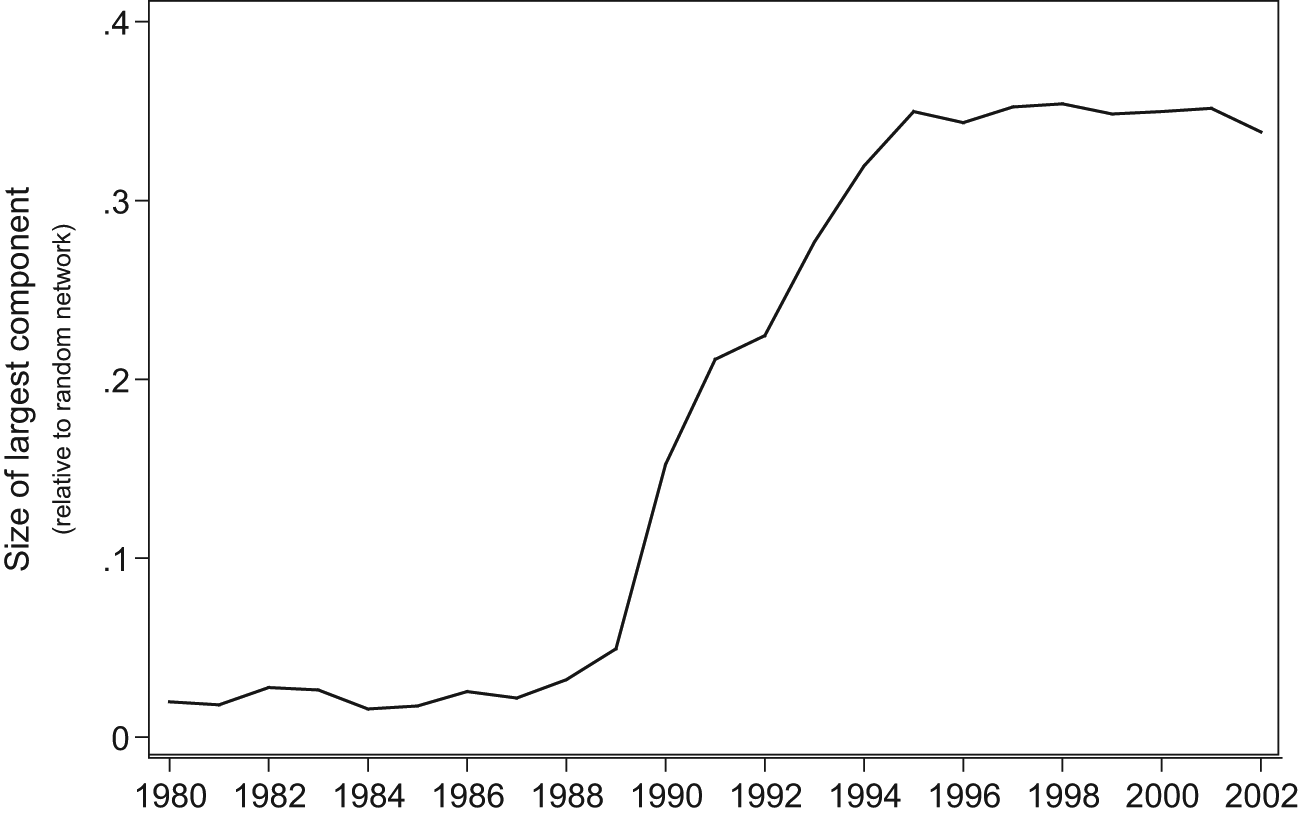
Size of the largest component.
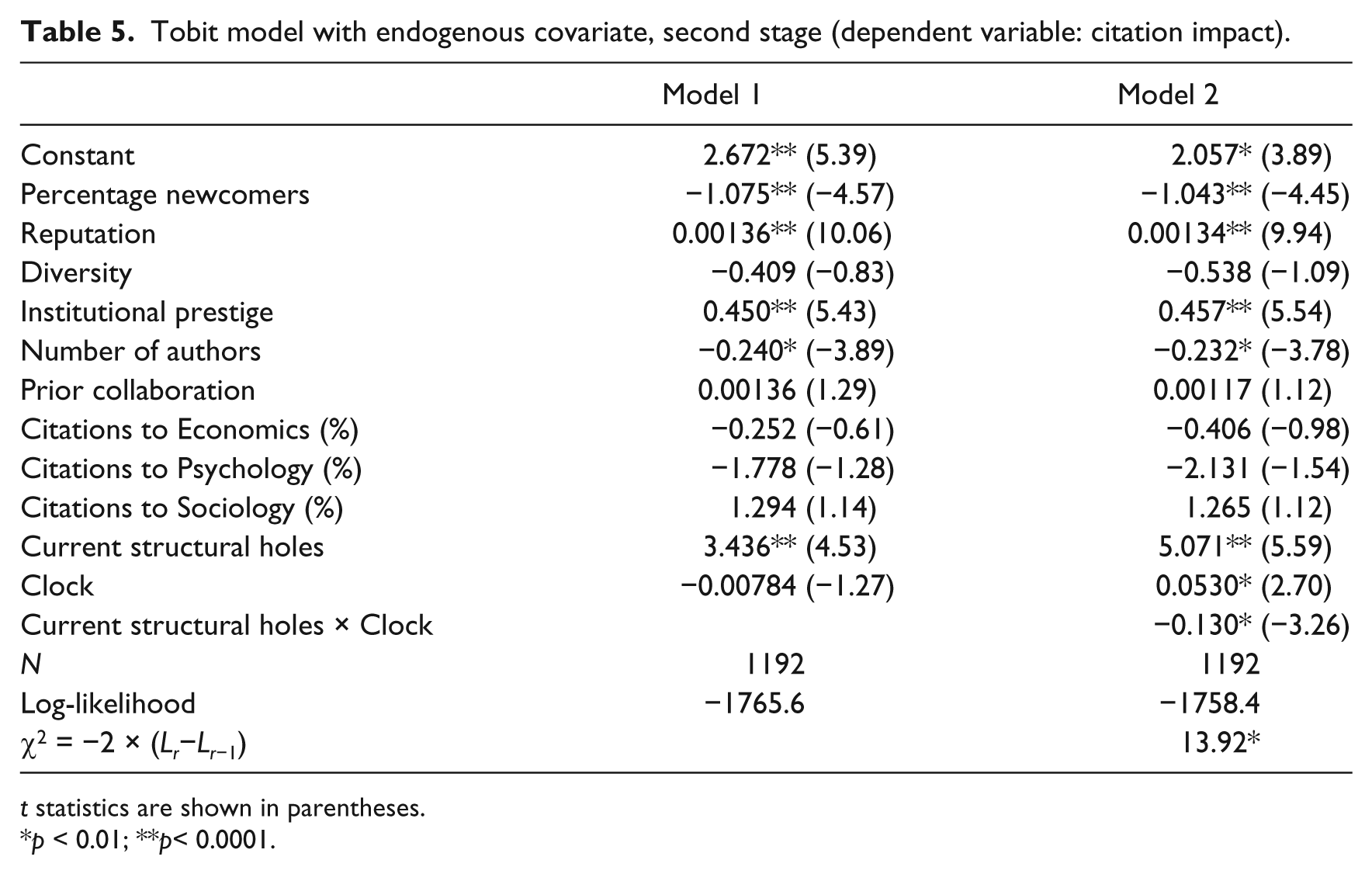
To validate our measurements, we consulted studies on the emergence of strategic management as a fully fledged academic field (Bowman et al., 2002; Hambrick and Chen, 2008; Pettigrew et al., 2002). Their accounts are consistent with our measure. To check the robustness of our results, we ran similar regressions using a simple clock that counts the number of years since the foundation of the SMJ in 1980s. The results of these regressions are reported in Appendix 1 Tables 4 and 5 and similar to results reported in Tables 1 and 2.
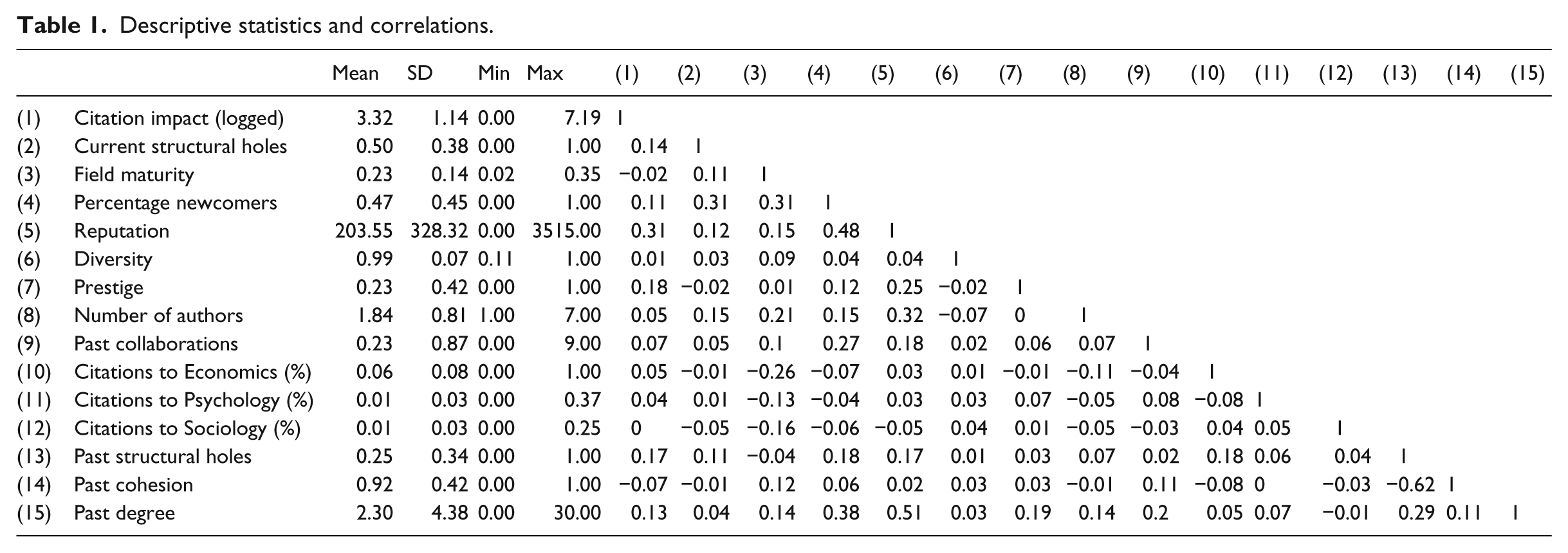
Descriptive statistics and correlations.
Tobit model with endogenous covariate, first stage (dependent variable: current structural holes).
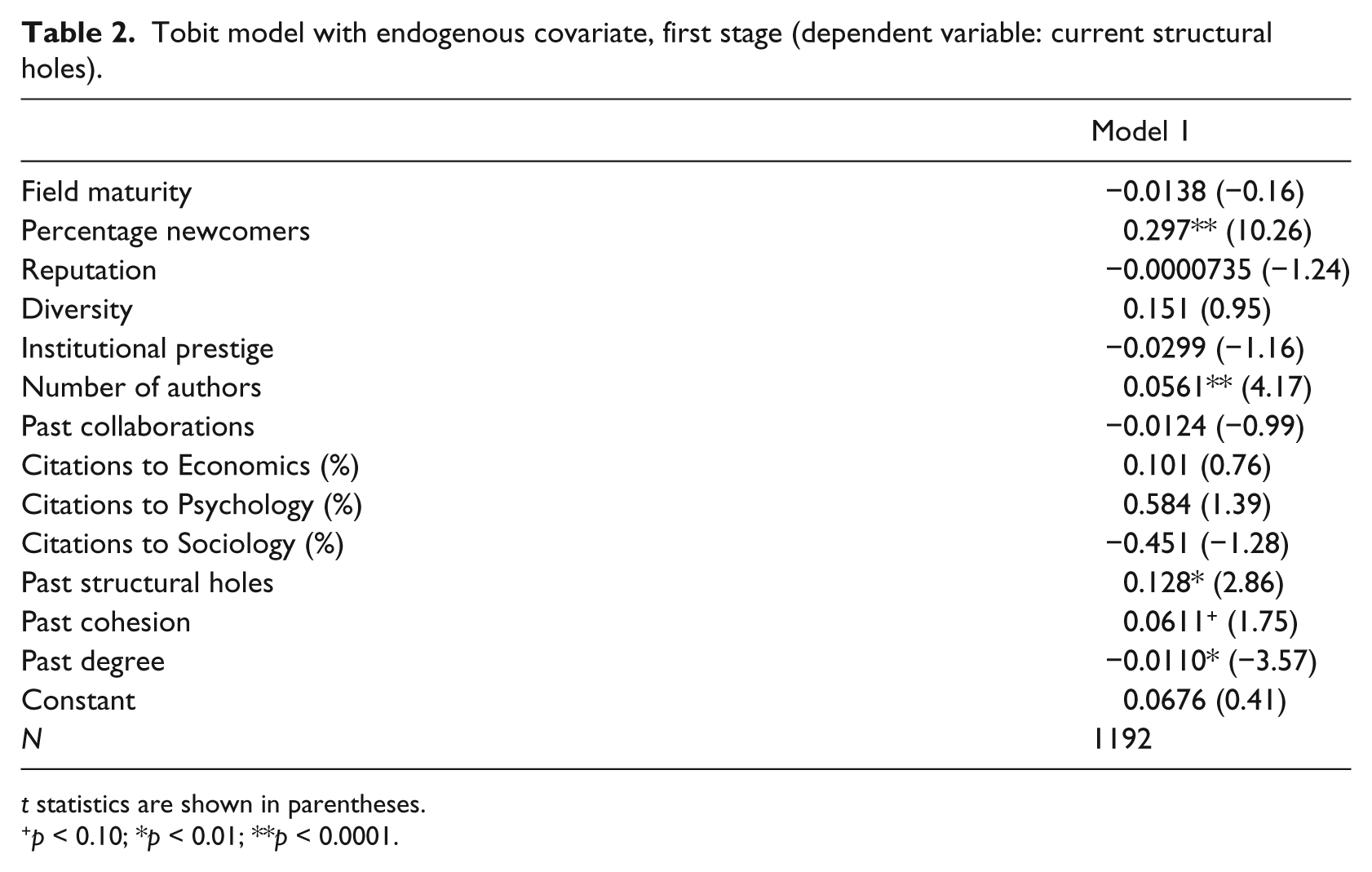
t statistics are shown in parentheses.
p < 0.10; *p < 0.01; **p < 0.0001.
Percentage of newcomers
Teams whose authors have already made contributions to the field of strategic management are at an advantage over teams that have never published articles relevant to the field. For each team, we calculated the percentage of authors who had never published an article whose relevance to strategic management research was signaled by a citation in our seed journal.
Team members’ reputation
Reputation is defined as the expected quality of an actor’s output based on past performance (Rhee, 2009). The individual reputation of each team member accounts for heterogeneity among the population of authors, which is important on two accounts: (a) in the first stage of our two-stage Tobit regression, the reputation of individual authors may be a significant factor in the formation of structural holes around a team; and (b) in the second stage of our regression, the presence of one or more high-reputation authors may attract considerable attention independent of the quality of the research output (Darby et al., 1999; Zucker and Darby, 1996). Thus, we calculate the reputation of the team as the sum of the reputation of its members and measure the reputation of each individual co-author as the number of citations to publications to which they have contributed.
Team diversity
Team diversity may have an effect on research output. For example, Reagans and Zuckerman (2001) show that teams whose members are distant from one another in organizational tenure produce more scientific papers, patents, and reports. Zaheer and Soda (2009) also show that the content of information is important for television production teams. Consequently, to measure the net effect of our structural holes variable, we need to control for team diversity. We constructed a diversity index DIV k for each team (Blau, 1977; Reagans and Zuckerman, 2001)

D is the number of disciplines in the Scopus journal–subject mapping. Pkd is the proportion of individuals from team k affiliated with discipline d. To affiliate an author to a discipline, we took the list of the journal articles cited within our seed journal and mapped the journal name to a discipline, using Scopus journal–subject mapping. We then mapped the author to the discipline with the maximum count.
Institutional prestige
The prestige of the institution to which a team member is affiliated accounts for some heterogeneity among the population of authors that is not measured by reputation. Prestige may also affect teams formation (e.g. homophily with respect to institutional prestige) and the attention paid to teams’ research output (e.g. more attention paid to articles written by co-authors from prestigious institutions). The position of an institution in a hierarchical social order can be defined as institutional prestige (Sine et al., 2003). We constructed an independent institutional prestige variable using Business Week’s US business schools’ rankings as proxy. Research on business school rankings shows that over time, variance at the top of rankings is very low. The top-rated institutions are typically large institutions that also excel at research (Dichev, 1999, 2001, 2008; Morgeson and Nahrgang, 2008). The low variance at the top of the ranking allowed us to use a fixed list. We took 1990’s top 10 rankings (Morgeson and Nahrgang, 2008; Wedlin, 2006) to construct a dummy variable that takes the value 1 if at least one co-author belongs to one of the following institutions: Chicago, Columbia, Dartmouth, Duke, Harvard, Michigan, Northwestern, Massachusetts Institute of Technology (MIT), Stanford, and Pennsylvania (Wharton). 6
Number of authors
Some studies suggest that the increasing complexity, scale, and cost of research leads to collaboration and find a positive association between the number of co-authors and the impact of articles (Wuchty et al., 2007). Thus, we include the number of authors as a control in our model.
Past collaborations
If a team of current co-authors also collaborated in the past, their accumulated experience may help them to work more efficiently on a new paper. We calculate the number of papers that the team members published together as a team in the past and include this measure as a control in our models.
Cross-disciplinarity
Strategic management studies and management research, more generally, do not cite articles only from their own field (Agarwal and Hoetker, 2007), especially during the early stages of strategic management research (Hambrick and Chen, 2008). We thus include cross-disciplinarity as a control variable for the following reason. Strategic management research that cites a large number of articles from another discipline, such as economics or sociology, may itself be cited more frequently because distinct audiences are interested in the output. Thus, we constructed three independent variables to measure the percentage of citations to Economics, Sociology, and Psychology, respectively, and a fourth category for other disciplines, using management as the baseline category.
Results
Descriptive statistics
Descriptive statistics are presented in Table 1. A relevant statistic is the mean number of authors per article, which, at 1.84, is small, indicating that authors have opportunities to share knowledge with all team members during the development and revision of a paper. In most cases, having co-authors implies in-depth interactions in terms of interpreting the content of prior research, deciding on content that may hold valuable material for a new project, and defining the lines of enquiry. Thus, one team may gain a good understanding of the work of another team through a co-author common to both teams. Furthermore, because of the small number of average authors per article, co-authors need to work together closely. Consequently, any information held by one author that relates to the work of any of the co-authors is likely to be shared and, thereby, influence the output.
Test of hypotheses
A Wald test of exogeneity shows that the structural holes variable should be treated as endogenous (χ2 = 16.04, p < 0.0001). Second, a Sargan test shows that the null hypothesis that the model is not over-identified cannot be rejected (χ2 = 0.13, not significant). Table 1 presents descriptive statistics of the variables included in our models.
In Table 2, we present the results of the first-stage regression with structural holes as a dependent variable. 7 All exogenous variables included in the second stage are entered in the first stage. In addition, we use three instrumental variables: past structural holes, past density, and past degree. First, we find that the greater the number of structural holes in the past network, the greater the number of structural holes spanned by a team in the current network, a result in line with prior research (Zaheer and Soda, 2009). Second, we find a weak positive effect of past density and a negative effect of past degree on current structural holes.
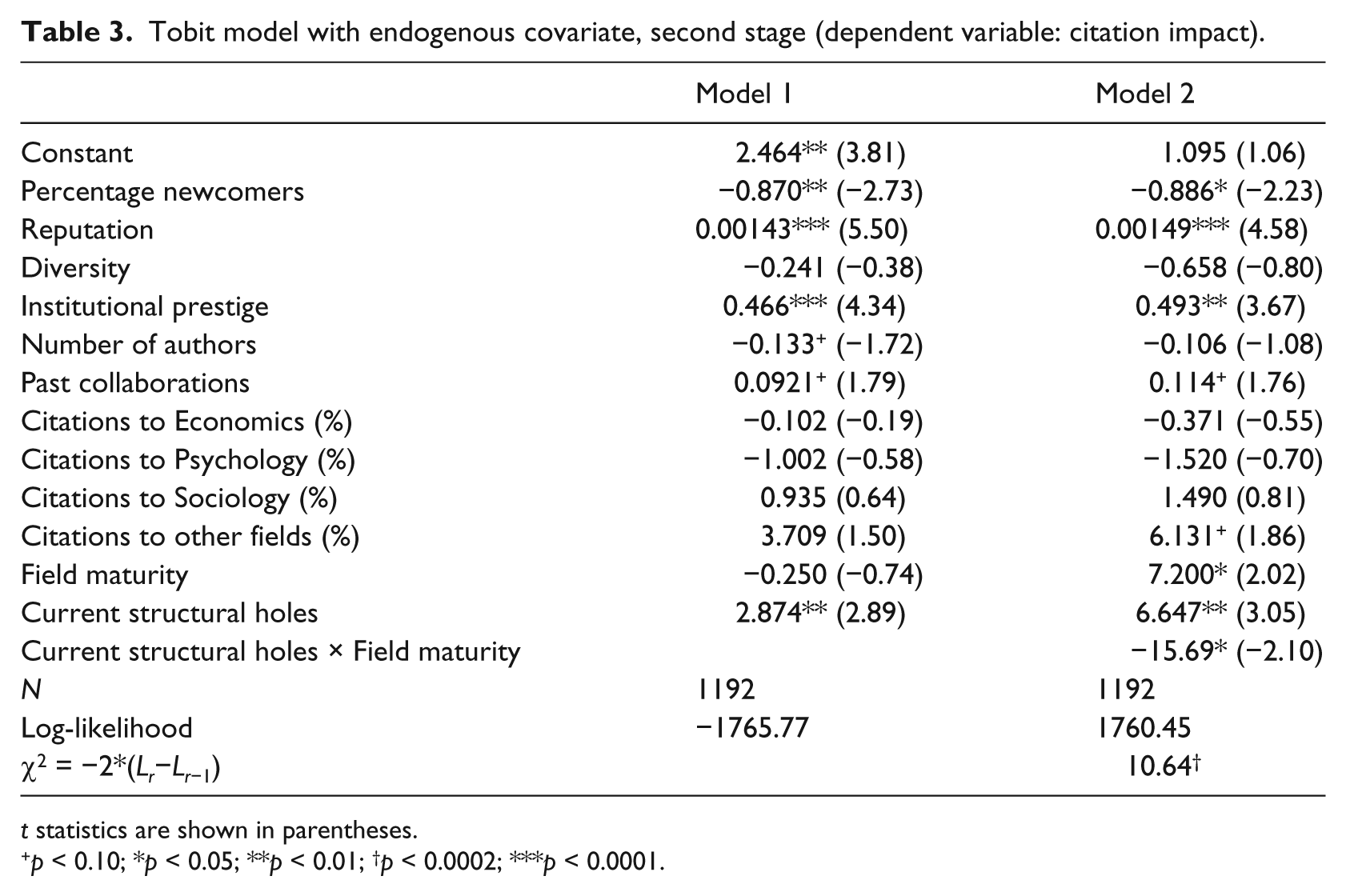
Table 3 presents the results of our second-stage regression. In this model, the dependent variable is citation impact, and the main explanatory variable is current structural holes. Model 1 is our baseline model. We find that having many new entrants in a team is negatively associated with citation impact. By contrast, reputation and institutional prestige are positively associated with citation impact. We also find that the number of authors is negatively associated with citation impact. In this first model, we find no positive association between the field maturity variable and citation impact. Finally, confirming Hypothesis 1, we find a positive association between structural holes and citation impact.
Tobit model with endogenous covariate, second stage (dependent variable: citation impact).
t statistics are shown in parentheses.
p < 0.10; *p < 0.05; **p < 0.01; †p < 0.0002; ***p < 0.0001.
In Model 2, we ran our full model, in which we introduced an interaction variable: current structural holes × field maturity. First, we observe that the main effect of current structural holes remains. Second, the interaction effect between current structural holes and field maturity is negative, thereby confirming Hypothesis 2, which states that the return on brokerage diminishes with field maturity. To give a better sense of the results, we calculated the marginal effect of the current structural holes variable at different levels of field maturity. The results are presented graphically in Figure 3, in which we plot the marginal effect of current structural holes for one standard deviation for all values of observed field maturity.
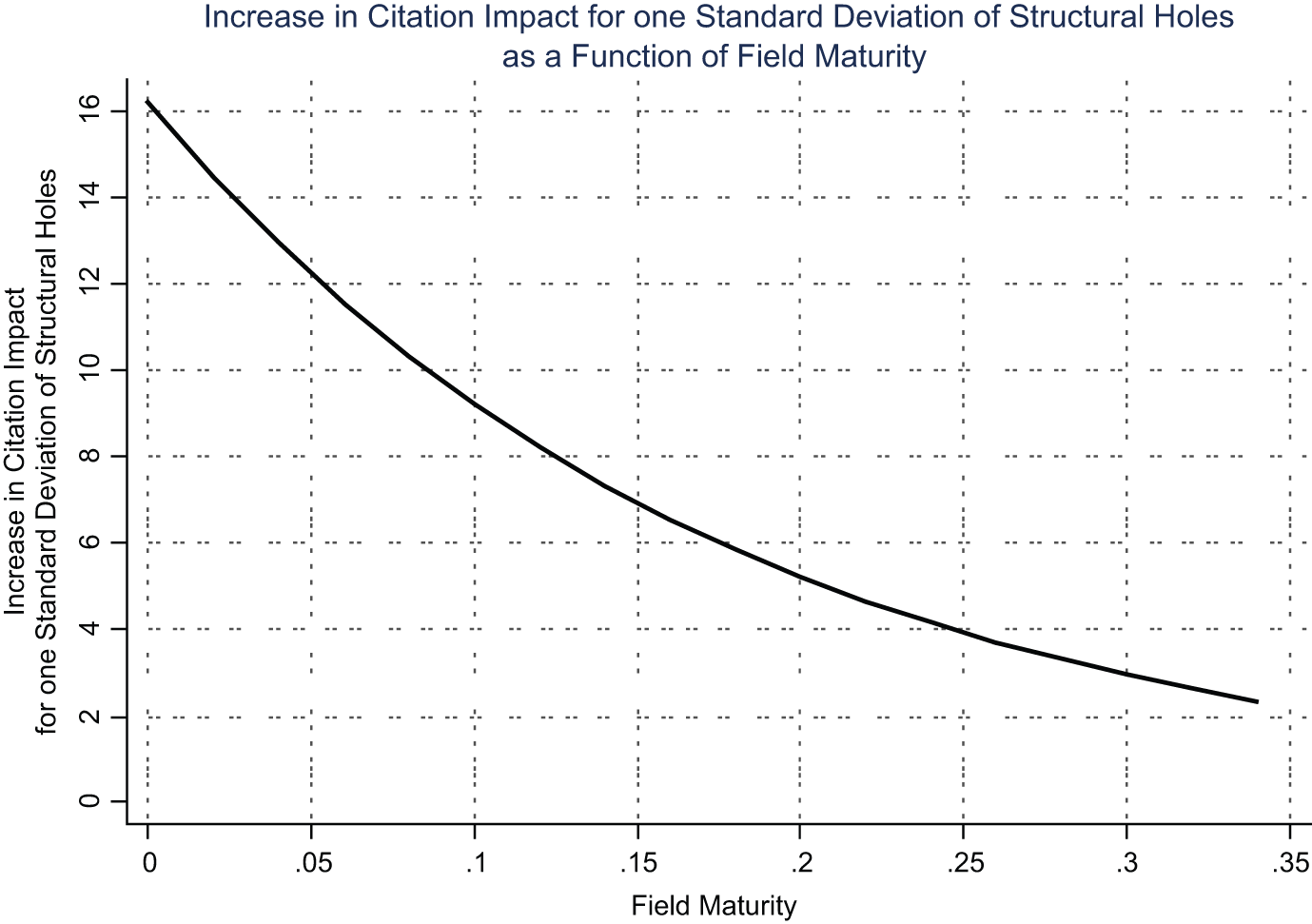
Contingent effects of structural holes.
First, current structural holes are seen to have a positive effect on citation impact at all levels of field maturity. Second, we observe that the effect of brokerage declines with field maturity. In the early stages of the development of the field, one standard deviation of the current structural holes variable increases the citation impact of an article, measured in terms of number of citations, by 16.21 citations. For the maximum value of our field maturity indicator, one standard deviation of the current structural holes variable increases the number of citations by only 2.36.
Supplementary analyses
The analyses presented so far support the argument that the impact of brokerage on citation is positive but diminishes with field maturity. Below, we provide the results of supplementary analyses designed to check the robustness of our results and better describe the structural context in which these results appear.
Robustness checks
We ran a number of tests to evaluate the robustness of our results. First, although we believe that the size of the largest component is a good indicator of the macro-properties of the field in which actors are embedded, we ran regression using a simpler measure of the maturity of the field: time. We set a clock to zero in 1980, the year in which our seed journal, SMJ, was founded. This clock variable increases by one unit per year. We report the results of the two-stage Tobit regression, which replaces our field maturity variable by this clock variable in Appendix 1 Tables 4 and 5. We find that the results are similar to the results discussed above. Although our data set stops 10 years after we measured the total number of citations, some papers may still receive frequent citations, thus biasing our measurement of citation impact for articles published toward the end of our observation period. Receiving citations after the 10-year window is most likely for high-impact articles. We confirmed that our results still held after Winsorizing (Barnett and Lewis, 1984) the dependent variable at the top two percentiles.
Structure of collaboration
In the argument that led to Hypothesis 2, we proposed that the primary cause of decreasing returns on brokerage is the reduction in uncertainty regarding what constitute legitimate problems, methods, and interpretations. The proposition that uncertainty decreases as the field matures also suggests that there might be changes in the structure of collaboration among scientists, such as increased cohesion in the field and consequently, changes in the structure of opportunities and constraints for brokers. We run a number of supplementary analyses to check for this type of changes.
First, to understand cohesion, we ran k-core decompositions in the network of authors derived from the bipartite author–paper network. A k-core is a maximal group of actors in which all actors are connected to at least k other actors (Butts, 2014; Seidman, 1983). The intuition behind using k-cores to account for cohesion is that influence and consensus formation does not require direct contact between all members. Furthermore, the higher the value of k, the more cohesive the structure and the harder it becomes for a single actor to join the group. We calculated the maximum k-core index and the size of the corresponding group for each year in our data. We find that the maximum k-core index increases from 4 to 7 between 1980 and 1992 and remains stable afterward. Second, we find that once the maximum k-core index reaches its maximum value in 1992, the size of the group of authors corresponding to the largest k-core index increases steadily between 1992 and 2002 from less than 10 to values above 80. We also observe that the size of lower order k-cores also grows at high rates. These results are consistent with the argument that a decrease in the level of uncertainty regarding legitimate problems, methods, and interpretations in a maturing field may be due in part to an increase in the level of cohesiveness in parts of the field.
Second, we investigate brokers’ opportunity structure over time. If cohesive groups form, brokerage opportunities among their members decrease. Thus, brokering teams may comprise more authors from outside these groups. To check this conjecture, we calculated the correlation between the sum of the eigenvector centrality of team members and the network efficiency (i.e. structural holes) of the team. Eigenvector centrality is a recursive measure that takes into account the network structure around contacts of the focal actors (Bonacich, 1987). Being connected to many well-connected actors yields a high vector centrality, which is consistent with the idea of cohesive groups with highly central individuals connected to other central individuals. We find that the correlation between the sum of eigenvector centrality and network efficiency decreases from a peak of nearly 0.2 to slightly less than 0.05 in 2002. The finding that as the field matures brokering teams have fewer actors coming from a cohesive group is consistent with the argument that brokers in mature fields find it difficult to promote their ideas to the cohesive groups and that the members of these groups find it more difficult to embrace brokers’ ideas.
Discussion
The presence of structural holes in the network of a focal actor is an important structural determinant of an actor’s success. Because actors with networks rich in structural holes create more novel ideas faster than their peers, their ideas are more likely to be rewarded. Our objective in this study was to contribute to social capital theory by showing how these rewards are contingent on macro-level properties of the field in which actors are embedded. We showed that as the field matures and as the level of egocentric uncertainty around brokers diminishes, the return on brokerage also diminishes. This finding has important implications for further research.
Co-evolution of micro-behavior and field-level properties
Our study contributes to the research that investigates the co-evolution of tie-formation processes and field-level/macro-network properties (Gulati and Gargulio, 1999; Powell et al., 2005). These studies show how field-level characteristics, including macro-network characteristics, inform and guide future behavior. As Powell et al. (2005) argue, the reason why, during boom years, biotechnology firms did not observe many of the well-known rules of social action, such as power attachment, homophily, and mimetism, but tended instead to follow a logic of forging alliances with diverse partners may be related to the fact that “as long as the technological trajectory continues to generate new discoveries and opportunities, expansion is possible” (p. 1190). Information about returns on brokerage in a field also represents information about opportunities. To the extent that brokerage generates high returns, actors are likely to continue engaging in brokerage and to expand the frontiers of knowledge. As the field matures, knowledge outputs are normalized and returns to brokerage diminish. Alternative strategies could emerge and have a field-level impact. Brokers who find that their ideas are too radical for the field may exit the field to form new disciplines or affiliate to neighboring fields. Yet, others could reframe their ideas in terms more acceptable to the discipline.
What strategy becomes predominant might vary with what is seen as the primary driver of field structuration. Field structuration could be driven primarily by a decreasing appetite for novelty or, by contrast, caused primarily by the difficulty to integrate novelty in the more clearly defined mature discipline. While both result in decreasing returns to brokerage as the field matures, the mechanisms behind the two are different and their long-term consequences are also different. A decreased appetite for novelty, due, for example, to an increasingly cohesive group that influences the field, would mean that the discipline has created a robust framework and will resist the introduction of new problems or novel interpretations of existing results. For example, to the extent that strategic management’s major goal is to understand “the relative importance of different sources of performance heterogeneity” (Felin and Hesterly, 2007), problems that cannot be easily framed as engaging with performance might be ignored. By contrast, integration difficulties may not be the result of major resistance, but rather reflect the effort required to link new problems and perspectives with a discipline’s existing commitments.
A decrease in the appetite for novelty may encourage brokers to leave the field, while integration difficulties may create the right framework for brokers to push the limits of the discipline, albeit at a slower pace than in the initial stages. Our data do not allow us to adjudicate between the two alternatives. Further analysis of the evolution of the structural properties of the collaboration network and an examination of the frequency with which new problems and interpretations are allowed in the field is needed. One way to engage with the question is to look at the themes proposed in the calls for papers for special issues in main strategic management journals and special sections at top conferences. If these events are not so rare, if the authors who contribute to these events are not marginal in the collaboration network and if papers produced for these events are subsequently cited, this might be indicative of a field that is still accepting innovation.
Another relevant aspect of the effect of macro-structural processes on returns on brokerage is the impact on network opportunities of sudden changes in a field, such as economic shocks or changes in regulation. In our model, the erosion of brokerage is gradual (Figure 3), and descriptive evidence (Bowman et al., 2002; Hambrick and Chen, 2008) suggests that the process of institutionalization in the strategic management field did not experience such a shock. However, in other settings, external shocks or actions by professional bodies that have a structuring role in the development of the field could force a dramatic new vision that either discourages or fosters brokerage.
From a methodological standpoint, investigating these micro–macro linkages is not straightforward. The co-evolution of micro-processes and macro-structures and opportunities is a complex phenomenon in the sense that, as Schelling ([1978] 2006) demonstrated, the aggregate effect of an alteration of micro-behavior on macro-structure cannot be easily inferred from effect size at the micro-level. As suggested by Hedström and others, the best suited models to investigate this type of problem may be agent-based simulations combined with empirical data (Hedström, 2005; Hedström and Ylikoski, 2010; Phelps et al., 2012). A starting point to investigate how return on brokerage may affect tie-formation strategies and eventually alter field structure may be extant models that investigate how small differences in tie-formation mechanisms among co-authors can result in network structures that are dramatically different, such as being fragmented versus cohesive (Guimera et al., 2005).
Macro-network structures and mobilization
Although the focus of our study was the moderating role of field maturity in the relationship between micro-network structures—that is, structural holes—and performance, field maturity may also be relevant to the relationship between macro-network structures and performance. We propose that field maturity may moderate the relationship between macro-network properties, such as network density, and performance outcomes due to the importance of mobilization processes during the early stages of field development. Extant studies usually invoke arguments of information benefits to investigate which macro-network structures may be most conducive to innovation. The evidence is mixed (Fleming et al., 2007; Guler and Nerkar, 2012; Uzzi and Spiro, 2005). For example, Uzzi and Spiro (2005) find that an optimal point exists at which a level of clustering and short path length enable information to circulate in the network without compromising diversity. However, Fleming et al. (2007) do not observe such a relationship, but find evidence that short path length and the size of the largest connected component have a positive effect on innovative output. Finally, Guler and Nerkar (2012) find that network global cohesion, or network density, has a negative effect on innovation output.
Networks are not, however, only pipes through which information is exchanged. They can also serve as mobilizing resources that are particularly significant in processes of field emergence (Frickel and Gross, 2005; Frickel and Moore, 2006; Hambrick and Chen, 2008). A dense network “provid[es] cohesion and enhanc[es] the carefully controlled dissemination of an incipient field’s purpose, philosophy and agenda” (Hambrick and Chen, 2008: 37). The ability to convey an easily recognizable, consistent message and to coordinate action may help to attract recognition during a project’s early phases of development. Finally, a cohesive network may also provide a vehicle for diffusing information regarding the costs and benefits of collective action (Hedström, 1994). Consequently, the relationship between innovation outcomes and macro-network properties may be moderated by the level of field maturity. During the early stages of development, a dense network may bring substantial mobilization benefits to its participants. The relevance of these mobilization benefits may then erode as the field matures, affecting the relationship between network density and performance outcomes.
In conclusion, this study advances our understanding of the influence of field evolution on the relationship between structural holes and the success of innovative output. We develop a contingent perspective on the value of brokerage by empirically examining how field maturity affects the relationship between structural holes and citation impact. The decrease in the level of egocentric uncertainty associated with field maturation leads to a concurrent decrease of the return on structural holes. These results are not only relevant to scholars interested in the effect of ego-network structures on innovation processes but also call for further research on how the evolution of the opportunity-constraint structures in which actors are embedded can lead to catalytic adjustments of micro-behavior that induce further changes at the field level. Finally, our findings suggest that research investigating the conduciveness of some macro-network structures to innovation needs to also pay attention to processes such as mobilization.
Footnotes
Appendix 1
Tobit model with endogenous covariate, second stage (dependent variable: citation impact).
| Model 1 | Model 2 | |
|---|---|---|
| Constant | 2.672** (5.39) | 2.057* (3.89) |
| Percentage newcomers | −1.075** (−4.57) | −1.043** (−4.45) |
| Reputation | 0.00136** (10.06) | 0.00134** (9.94) |
| Diversity | −0.409 (−0.83) | −0.538 (−1.09) |
| Institutional prestige | 0.450** (5.43) | 0.457** (5.54) |
| Number of authors | −0.240* (−3.89) | −0.232* (−3.78) |
| Prior collaboration | 0.00136 (1.29) | 0.00117 (1.12) |
| Citations to Economics (%) | −0.252 (−0.61) | −0.406 (−0.98) |
| Citations to Psychology (%) | −1.778 (−1.28) | −2.131 (−1.54) |
| Citations to Sociology (%) | 1.294 (1.14) | 1.265 (1.12) |
| Current structural holes | 3.436** (4.53) | 5.071** (5.59) |
| Clock | −0.00784 (−1.27) | 0.0530* (2.70) |
| Current structural holes × Clock | −0.130* (−3.26) | |
| N | 1192 | 1192 |
| Log-likelihood | −1765.6 | −1758.4 |
| χ2 = −2 × (Lr−Lr−1) | 13.92* |
t statistics are shown in parentheses.
p < 0.01; **p< 0.0001.
Funding
This research received no specific grant from any funding agency in the public, commercial, or not-for-profit sectors.