







Abstract
Alliances have been studied extensively in the past and various arguments have been suggested to explain their evolution and eventual termination. We argue that one important explanation of alliance termination has remained overlooked, one where the mechanism revolves around resource value and is independent of any mismanagement, opportunism, lack of trust, interpretive misunderstanding, or perceptions of inequity. In this explanation, we recognize explicitly that resources undergo transformation through an alliance, and this transformation reveals new previously imperfectly predicted costs to remain in the alliance as well as new opportunities outside the alliance. We apply the concepts of direct and indirect adjustment costs and inter-temporal economies of scope to explain these phenomena and demonstrate that, depending on the particular structure of incentive asymmetry between the two firms after alliance formation, the new circumstances may motivate a revised cost/profit sharing arrangement, a change in ownership of alliance resources, or a complete dissolution of the alliance. Some determinants of adjustment costs are explored in detail, covering resource characteristics, resource combination characteristics, and environment characteristics. Based on the economics of resource value, our argument has implications not just for alliance evolution and termination but also provides a distinct lens to explain the evolution of firm boundaries and the manner of transition of alliances into acquisitions.
Keywords
Introduction
Strategic partnering between firms has become an increasingly popular and integral aspect of firm strategy. Despite their popularity however, alliances are notoriously unstable and beset by high failure rates and premature termination (Kale and Singh, 2009; Madhok and Tallman, 1998), either getting disbanded or, in the case of joint ventures (JVs), frequently ending up with one of the parent firms (Bleeke and Ernst, 1995). The reasons for such instability are manifold and various explanations have been provided in the literature, concerned with either inadequate value creation potential, for example, insufficient resource complementarities, or inadequacies in realizing such potential. We argue that a view of alliance termination as the result of failure in value attainment is simplistic. From our perspective, the basic idea in the value creation argument that alliances simply leverage the value created by combining complementary resources is somewhat naive in that it implicitly assumes resource complementarity to be automatic, that is, without resource modification. In doing so, it fails to clearly make the distinction between potential and realized value through the alliance (Madhok and Tallman, 1998). Moreover, it does not explicitly recognize the relative value of the resource combination compared to other possible uses for those resources. A resource-based analysis of alliances involving resource combination has to be broad enough in scope to compare the uses of the resource both within and outside the alliance.
Based on an analysis grounded in the economics of resource value, we describe a process by which an alliance could lead to termination or reformation that is distinct from existing explanations in the literature. Specifically, the process does not depend on any mismanagement of the alliance, any lack of trust or opportunistic behavior, any interpretive misunderstandings, or feelings of unfairness or inequity (Ariño et al., 2002; Das, 2006; Doz, 1996; Ring and Van de Ven, 1994; Rond and Bouchikhi, 2004; White, 2005). Furthermore, in our perspective, an alliance is viewed as part of the broader strategic portfolio of a firm, and thus, the termination of an alliance is not necessarily viewed by one or both partners as a mark of failure.
Our argument in a nutshell is as follows. Firms allocate resources to an alliance because they estimate, ex ante, the overall expected value of deploying those resources in the alliance to be higher than the expected value of the currently available uses of those resources outside of the alliance. Due to uncertainty and bounded rationality, these estimates may turn out to be inaccurate ex post, in both negative and positive ways. Basically, the resources deployed in an alliance undergo transformation either intentionally in order to adapt to the alliance requirements or unintentionally as a result of co-evolution with the alliance. This transformation in turn reveals new costs and new opportunities to the resource owner. The result is a new incentive structure that may motivate a revised cost/profit sharing arrangement, a change in ownership of alliance resources, or a complete dissolution of the alliance. We illustrate this argument with a simple model and provide a detailed exploration of the sources of adjustment costs that determine the incentive structure after resource transformation.
The adjustment cost notion that we build on (Hatch and Dyer, 2004; Helfat and Eisenhardt, 2004; Reuer et al., 2002; Sakhartov and Folta, 2014a, 2014b) is concerned particularly with the costs of resource deployment and contends that, to enjoy the benefits of resource complementarity, partner resources need to be adjusted to fit one another, and the value of resource combination must always be compared to other possible uses of the resource. As we shall elaborate, adjustment costs have both direct and indirect components (Helfat and Eisenhardt, 2004). Direct adjustment costs are the costs of altering or modifying a firm’s resources so as to better align or fit with those of the partner within the context of the alliance. Indirect adjustment costs refer to the value of the opportunities foregone by a firm by limiting the use of its transformed resource to the alliance relative to alternatives. Adjustment costs are different from transaction costs in that they have little to do with opportunism. They are also different from coordinating costs in that coordination need not involve resource modification.
In brief, our article provides a distinct explanation for alliance evolution and termination. The argument is novel and contributes in at least four ways. First, it focuses on a different set of factors than what is typical in the literature, revolving around resource transformation, adjustment costs, and redeployment. Despite a steadily growing literature on these factors (Helfat and Eisenhardt, 2004; Sakhartov and Folta, 2014a, 2014b), our article is the first to apply this line of thinking in the context of resource value in alliances. Second, rather than just focus on what transpires within an alliance, the argument also encompasses factors external to the alliance, for instance, the unanticipated opportunities that spring up for a partner due to the resource transformation. This broader focus relaxes the commonly held assumption that alliance termination is always a negative outcome and alliance continuation is positive. Third, the application of the resource deployment argument to alliances provides a distinct lens to explain the evolution of firm boundaries as well as who might acquire whom. Finally, our arguments shed light on how alliance management capability (Schilke and Goerzen, 2010) fits into the broader capability set of a firm.
Alliance evolution and explanations of termination
Although alliances have become increasingly popular, they are also beset by high failure rates—estimates are typically over 50% (Kale and Singh, 2009; Koza and Lewin, 2000)—raising questions about why firms engage in alliances in the first place and how they can improve their management of these interfirm relationships. In light of this, the topic of alliance evolution and termination has attracted much attention from researchers in the last couple of decades.
One group of researchers is particularly interested in the evolution of the alliance, more so than on the actual outcome itself. Here, the focus of analysis is on process, the characteristics of which shape and impact the eventual outcome (e.g. Ariño and De La Torre, 1998; Faems et al., 2008; Ring and Van de Ven, 1994). Most of this research comprises longitudinal case studies. For instance, Doz (1996) models how alliances can follow an upward or downward spiral based on events that occur during the ongoing relationship.
In contrast, another group of researchers is more interested in the outcome rather than in the process. For this group, broadly speaking, the causes for such instability have been attributed to a wide range of factors at three distinct levels: environment, parent firm, and partnership (Cui et al., 2011; Makino et al., 2007; Reuer and Zollo, 2000). Environment attributes include external factors such as changes in government policy or in the market or competitive context (Ariño and Doz, 2000; Das and Teng, 1999; Reuer and Zollo, 2000). Parent firm or internal attributes include factors such as parent firm capabilities (Reuer et al., 2002), level of parent firm support (Steensma and Lyles, 2000), cross-cultural differences (Hennart and Zeng, 2002), competitive rivalry among the parents (Kogut, 1989; Park and Ungson, 1997), and prior partnering experience (Makino et al., 2007; Reuer and Zollo, 2005), both general and partner-specific. Alliance level or interfirm attributes include factors such as type of alliance, for example, scale or link (Dussauge et al., 2000; Hennart, 1988), related or unrelated (Cui and Kumar, 2012), scope of alliance (i.e. broad or narrow) (Reuer et al., 2002), extent of resource similarity or dissimilarity (Dussauge et al., 2000), and control structure (Faems et al., 2008; Malhotra and Lumineau, 2011; Steensma and Lyles, 2000).
From the above literature, there are two broad types of explanations for alliance termination. The first set of explanations attributes instability to errors in the decision to engage in the particular alliance in the first place, for example, a lack of fit due to inadequate scope for synergistic resource combination or a lack of partner compatibility (e.g. Geringer, 1991). Alliance partners may dissolve an alliance in such cases when it becomes clear that the alliance cannot fulfill its promise or the partner is unwilling or unable to deliver on their commitments (Dyer et al., 2008; Khanna et al., 1998). These explanations contribute to the normative goal of identifying which alliances to form and which not to.
Much of this literature has been criticized by Cui et al. (2011) for using cross-sectional study designs and static explanatory variables for analyzing what is essentially a dynamic phenomenon, attributing the reasons for terminations to initial conditions at formation. Additionally, note that whereas some of the above arguments do indeed point out the need for adaptation in the face of various challenges, they do not really focus on, or at least underplay, some of the challenges confronted by firms in the process of resource adjustment and modification.
In contrast, the second set of explanations is concerned with post-formation processes that shape the evolution of the relationship. These explanations, as mentioned, take a more process-oriented view of alliance evolution (Doz, 1996; Ring and Van de Ven, 1994) and pursue the normative goal of understanding how to manage alliances once they are formed. This perspective recognizes that things could go wrong due to imperfectly predictable changes, even if the decision to engage in the alliance in the first place was sound. These latter types of explanations can be broken down into the following categories.
Asymmetric bargaining power or dependence
This set of arguments emphasizes tensions created by asymmetric dependence and bargaining power across the partners, whether from the outset, for instance, size or resource asymmetry (Alvarez and Barney, 2001; Das and Teng, 2002; Gulati and Sytch, 2007; Pfeffer and Nowak, 1976), or during the process of the relationship, for instance, superior learning by one of the partners (Hamel, 1991; Inkpen and Beamish, 1997). This exacerbates the perceived level of vulnerability perceived by the more dependent party, thus making the alliance more fragile.
Mismanagement of governance mechanisms or safeguarding
This argument, rooted more in the logic of transaction cost economics (TCE), is based on the need for safeguarding against opportunism by the partner. For instance, where critical resources are not easily redeployable, disregarding this concern might leave a firm vulnerable to self-interested behavior by the partner (Hennart, 1988; Kogut, 1988; Williamson, 1985), thus rendering the alliance unstable (David and Han, 2004; Williamson, 1991), in particular where the grounds for trust have not been sufficiently created (Dyer, 1997; Ring and Van de Ven, 1992). On the other hand, too much emphasis on safeguarding may restrict the partners from attaining the value potential of the alliance (Kale et al., 2000). As argued by Ring and Van de Ven (1994), any significant imbalance between reliance on structural and formal mechanisms and reliance on trust and informal processes is likely to lead to alliance dissolution.
Failure of coordination
The argument here is that, even if there were no concerns about opportunism or asymmetric dependence, problems arise in efficiently performing joint actions and coordinating activities (Gerwin, 2004; Gulati and Singh, 1998; Monczka et al., 1998). For instance, Doz (1996) uncovers how initial differences in task definition, partner routines, interface structures, and partner expectations give rise to challenges in making the actions of the two sides mesh. This point was reinforced by Faems et al. (2008), who discovered that changes to some of the above factors removed obstacles to more efficient coordination. Effective coordination also requires effective processes for communication and conflict resolution, the absence of which is a significant contributor to alliance failure (Kale et al., 2002; Mohr and Spekman, 1994; Ring and Van de Ven, 1994).
Perceptions of inequity
The (in)equity argument suggests that alliances may terminate because of an imbalance in the perception of fairness between the two partners (Luo, 2008; White and Lui, 2005). This occurs when one partner perceives their cost–benefit ratio to be unfairly different from the other partner (Adams, 1963). The perceived level of inequity can change over time as partners observe each other’s behaviors and make judgments of them. The perception of inequity at best hampers cooperation and at worst leads to a complete termination of the alliance (Ariño and De La Torre, 1998; Rond and Bouchikhi, 2004).
Mismatched interpretations and sensemaking
This argument emphasizes the importance of socio-psychological processes and interpretive ambiguity within cooperative relationships. From this perspective, alliance performance is subject to social construction (Rond and Bouchikhi, 2004). As a result of idiosyncratic differences arising from their idiosyncratic history, various individuals in the partner firms may differ in their interpretations of the same observations and events (Das and Kumar, 2010; Maitlis, 2005). Individuals engage in sensemaking processes that help them confirm their expectations or deal with new information that seems to disconfirm their expectations by enacting new interpretations (Weick, 1995; Weick et al., 2005). In some cases, this may result in one partner being overly lenient with another, but in other cases such sensemaking and interpretive processes result in misunderstandings and conflict in alliance relationships that can lead to termination (Ring and Van de Ven, 1994). For example, while the initial negotiation of a pharmaceutical alliance was based on trust and thus loosely defined formal expectations, a new manager interpreted this open-endedness as the partner firm “using our money to do other things … basically they used us as seed money to grow their business” (Rond and Bouchikhi, 2004: 61).
Collectively from the above, it is worth underlining a couple of points. First, almost all discussions of alliance termination have traditionally viewed it as a negative outcome to be avoided. Here, the aforementioned mechanisms often trace the reason for alliance termination to some form of mismanagement. Moreover, they are based on what goes unexpectedly wrong within the alliance and disregard what may go unexpectedly well outside the alliance. Second, even if the alliance produces economically valuable results, there may still be (perceived) disaffection with respect to inequity, opportunism, unfair exercise of bargaining power, or plain misinterpretation of events. In the literature, arguments have been made that trust can smoothen such frictions associated with perceived vulnerability (Dyer, 1997; Madhok, 1995; Ring and Van de Ven, 1992), coordination issues (Mayer and Argyres, 2004; Mellewigt et al., 2007; Poppo and Zenger, 2002), as well as (mis)interpretation (Ring and Van de Ven, 1994).
However, while acknowledging the above, the explanation we provide for alliance evolution and termination in this article is distinct and is unlikely to be alleviated by trust. It is grounded mainly in the economics of resource value under uncertainty and describes a process by which an alliance could lead to reformation or termination despite (a) no perceived mismanagement of the alliance, (b) the presence of trust and little or no threat of opportunistic behavior among the partners, and (c) the termination not necessarily being viewed as a mark of failure by either or both partners. Needless to say, a complex combination of all these factors may be responsible for alliance dissolution in any given case. Our aim is to outline a distinct mechanism, revolving around adjustment costs, on the assumption that a better understanding of this one particular mechanism leads to a better understanding of any given case in which it is operative in driving alliance evolution and termination.
Resource transformation and adjustment costs
In this section, we develop a novel explanation of alliance evolution and termination using several theoretical devices. These devices involve the role of uncertainty (Knight, 1921) and two of its corollaries: the potential discovery of new opportunities and the potential appearance of unforeseen costs. These possibilities are in turn expanded upon using the notion of adjustment costs (Hatch and Dyer, 2004; Kor and Mahoney, 2000; Reuer et al., 2002) and particularly the direct and indirect adjustment costs associated with inter-temporal economies of scope (Helfat and Eisenhardt, 2004), also known as redeployment costs (Sakhartov and Folta, 2014a, 2014b). These ex ante unforeseen costs and opportunities (leading to indirect opportunity costs) are likely to arise in any alliance that intentionally or unintentionally produces a transformation of the resources originally combined to create it. The entire argument is illustrated through a simple model in the next section.
The outline of our argument is as follows: firms allocate their resources to an alliance or JV because they estimate, ex ante, the overall expected value (revenue minus cost) of deploying those resources in the alliance to be higher than the expected value of the currently available uses of those resources outside of the alliance. Both partners must expect such returns in order to create the incentive alignment necessary to engage in the alliance. Due to the existence of uncertainty, these estimates may turn out to be incorrect ex post, for better or for worse. In fact, any explanation of premature alliance termination must be based on a change in the ex ante estimates of any one partner or else the partners can only be expected to continue the alliance. Once engaged in the alliance, the resources deployed by each partner may—and often must—undergo transformations in order to adapt to the alliance. This transformation in turn reveals new costs and new opportunities to the respective resource owners. The result is a new value landscape and new incentive structure in which either one or both firms may find it no longer in their interest to continue using the resources in their current use in the alliance with the current payment structure.
Importantly, depending on the particular structure of incentive asymmetry between the two firms, the new circumstances may motivate a reformation based on a revised cost/profit sharing arrangement, a change in ownership of alliance resources, or a complete dissolution of the alliance. We elaborate on this argument by (a) exploring some of the ways in which unforeseen costs and opportunities may arise and change the incentive structure of the two partners, and (b) demonstrating how different incentive structure asymmetries can lead to three different outcomes—that is, revised profit distribution, ownership change, or termination—by illustrating the argument through a simple model.
The notion of adjustment costs has been widely adopted in the economics and finance literature (Gould, 1968; Kor and Mahoney, 2000; Penrose, 1959; Pindyck, 1982) and represents the idea that deploying resources to new uses is not automatic or costless. They can be divided into indirect and direct adjustment costs (Helfat and Eisenhardt, 2004). Direct adjustment costs are the costs of adapting resources to their use within the alliance. For instance, training is cited by Hatch and Dyer (2004) as a source of direct adjustment costs because of the costly processes of discovering and implementing the best matching of people with tasks and the learning and unlearning required to prepare those people for the new tasks. While the monetary and temporal costs of such resource adjustments may be predictable in routine cases, alliances often require non-routine learning of new knowledge, thus making direct adjustment costs also largely unpredictable. In the same way that Hennart’s (1993) conceptualization of transaction costs includes both the costs incurred to prevent shirking or cheating as well as losses incurred from failure to prevent them perfectly, one can consider direct adjustment costs as both the costs of resource adjustment to new commitments as well as losses from imperfections in those adjustments.
An example of such adjustment costs can be observed in the case of the JV between Nestlé and Coca-Cola to launch Nestea products worldwide (Ariño et al., 2002). Nestlé traditionally used a high-temperature mixing process that Coca-Cola’s bottlers were not capable of doing unless they made significant investments in the equipment. Hence, Nestlé agreed to adjust its resources to develop an alternative product formulation compatible with the low-temperature mixing process. Another example is detailed in Doz (1996) where an R&D firm partnering with a pharmaceutical company realized ex post that their technology needed much more application-specific development to be useful in the alliance and that this development would require a much more complex web of interaction and communication among the two firms than previously predicted.
Indirect adjustment costs, on the other hand, refer to the costs of resource deployment that result in foregone revenue and can be defined as the (unexploited) value of the best opportunity for deploying the resources outside of the alliance. Since future opportunities cannot be perfectly predicted ex ante, indirect adjustment costs may arise after the resource commitments have already been made. Moreover, since opportunities are often available only in limited windows, flexibility and agility resource redeployment is often necessary to take advantage of them.
A case of simultaneous direct and indirect adjustment costs is discussed by White (2005) in the partnership between Volvo and Mitsubishi. In this alliance, Volvo “incurred considerable and unexpected costs” (p. 1403) in order to adopt Mitsubishi’s design process and abandon its own. However, this was also accompanied by unexpected benefits applicable outside the alliance since Mitsubishi’s design process was more efficient, thus increasing indirect adjustment costs of staying in the alliance. In sum, there are direct and indirect adjustment costs of redeploying resources from one use in one period to another use in the next period, and these costs are largely unpredictable or at best imperfectly predictable before resource commitments are made.
Note that the concept of resource adjustment cost is distinct from the more familiar notion of transaction cost (Williamson, 1985, 1991). Although transaction costs also arise from uncertainty, they are mainly produced by opportunistic behavior. Since opportunism is the main source of transaction costs, the solutions provided for minimizing transaction costs usually involve contractual devices and other governance mechanisms (Oxley, 1997; Williamson, 1979). Resource adjustment costs, on the other hand, arise independently of opportunism and are unlikely to be mitigated by safeguarding efforts geared to preclude opportunistic behavior. We also avoid using the term “coordination cost” although effective coordination is needed to combine resources in an alliance (Grandori, 1997; Gulati and Singh, 1998). The word “coordination” implies that the resources themselves remain unchanged, whereas the word “adjustment” captures the idea that resources undergo transformation in the process of creating value in an alliance.
The idea that resources undergo transformations in an alliance that change their value in various uses available to the firm is vividly illustrated by the following comment of an informant in Mitsuhashi and Greve’s (2009) recent study on alliances in the global shipping liner industry:
The demerit of alliances is that they compromise our products. Our historical strength through uniqueness becomes watered out because it is now available to everyone in alliances, and we may also have to adjust it in ways that fit our alliance partners better than us. (p. 982; emphasis added)
Since our article is one of the first to apply the concept of adjustment costs to resource adjustments in alliances, it is pertinent to note the unique aspects of adjustment costs in this context. Although adjustment, and associated adjustment costs, is a general phenomenon that occurs when resources are shifted from one use to another, the issue becomes particularly challenging in an alliance setting. In a hierarchical setting, the firm needs to adapt its resources and routines, that is, its “way of doing things,” to a particular use, the extent of which depends on how different the latter is from the current use. Therefore, if a pharma company would like to apply its resources in the biotech industry, its “way of doing things” need to be modified in terms of say R&D, clock-speed, and so on. In the alliance setting however, besides the use-based adjustment, the firm needs to additionally adapt to the needs of a particular user, that is, the partner, who has its own distinct approach and way of doing things.
Resource deployment and inter-temporal economies of scope
The concept of economies of scope captures the idea that existing resources may allow a firm to efficiently enter new product markets that share resource requirements with its existing product markets (Panzar and Willig, 1981). However, these efficiencies typically arise intra-temporally through joint production of the previous and new products. Sakhartov and Folta (2014b) refer to this simply as synergy. Inter-temporal economies of scope on the other hand require the firm to exit its previous product market in order to enter the new one (Helfat and Eisenhardt, 2004). The notion of inter-temporal economies of scope describes the economic structure of profit opportunities that require redeploying resources from one use to another rather than resource sharing. Redeployment is necessary when a resource has non-scale-free properties (Levinthal and Wu, 2010) because scale-free resources can be leveraged in multiple uses simultaneously, thus benefiting from intra-temporal economies of scope (Sakhartov and Folta, 2014b). Applied to the context of alliances, opportunities to profit from inter-temporal economies of scope may explain why one or both partners may find themselves motivated to take critical resources out of an alliance, while still considering the decision to allocate those resource to the alliance in the first place to be sound.
We posit that in the context of alliances, the process of establishing and creating value through the alliance gives rise to resource transformations, which in turn gives rise to new redeployment opportunities for the transformed resources that could require exit from the alliance. It is important to note that this explanation of alliance termination does not imply that the partner firms would view the alliance retrospectively as a failure or mistake. Instead, the alliance may be viewed not as a mistake but as a necessary stepping stone to the opening of new, previously unavailable paths perceived to be more valuable than continuing the alliance in its current form.
An illustrative model of resource transformation in alliance evolution
We first consider the perspective of just one partner in an alliance. An example is depicted in Table 1. Here, we assume that the firm that owns resource A can either deploy this resource in an alliance with another firm (top right quadrant) or deploy this resource in two potential uses outside of the alliance (top left quadrant). The ex ante costs and revenues estimated by A’s owner are shown in Table 1 in time period 1 (T1). It can be seen that based on these estimates, forming the alliance is the best option (V(AB) = 10 > 5 > 0)). Once the alliance is formed, in T2 the resource is transformed (from A to A′) and new costs and opportunities are revealed, wherein the alliance (bottom right quadrant) is no longer the best option for A’s owner (V(A′2 = 12 > V(A′B = 8)), and thus this firm has incentive to terminate the alliance.
Resource transformation from the perspective of one partner.
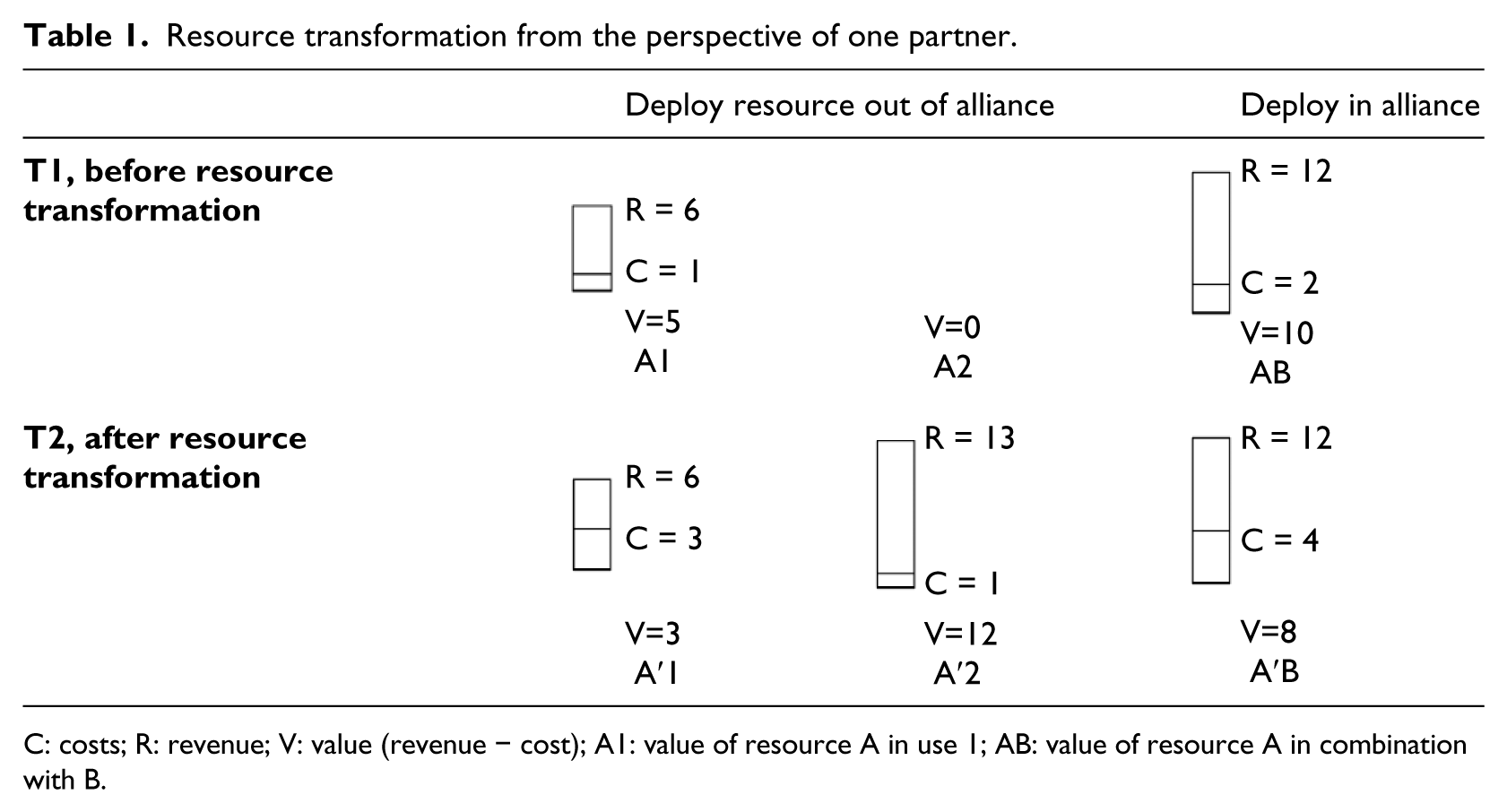
C: costs; R: revenue; V: value (revenue − cost); A1: value of resource A in use 1; AB: value of resource A in combination with B.
Bringing in the perspective of the partner firm gives us a more complete picture of the possible outcomes. Table 2 summarizes the information in Table 1 in the form of characteristic functions 1 resembling a cooperative game similar to those used by Lippman and Rumelt (2003) as well as Brandenburger and Stuart (2007), and adds to it the characteristic functions representing the perspective of the alliance partner, taken to be the owner of complementary resource B. For simplicity, we assume only A undergoes a resource transformation. Thus, in the second time period (T2), A’s owner may benefit from inter-temporal economies of scope. As can be seen from Table 2, although A’s owner has lost incentive to remain in the alliance in T2, B’s owner has incentive to revise the profit distribution by making side payments 2 to A’s owner in order to retain the alliance. Since A’s owner can now deploy the resource in a use outside the alliance expected to accrue 12 units of value, B’s owner must make the alliance at least worth 13 units to A’s owner in order to keep this partner incentivized to remain in the alliance. B’s owner can do so by offering side payments of 5 to A’s owner. Although this would reduce the profit of B’s owner from the alliance from 20 to 15, this is still better than all other options from the perspective of B’s owner.
Resource transformation summarized as characteristic functions from the perspective of both partners.
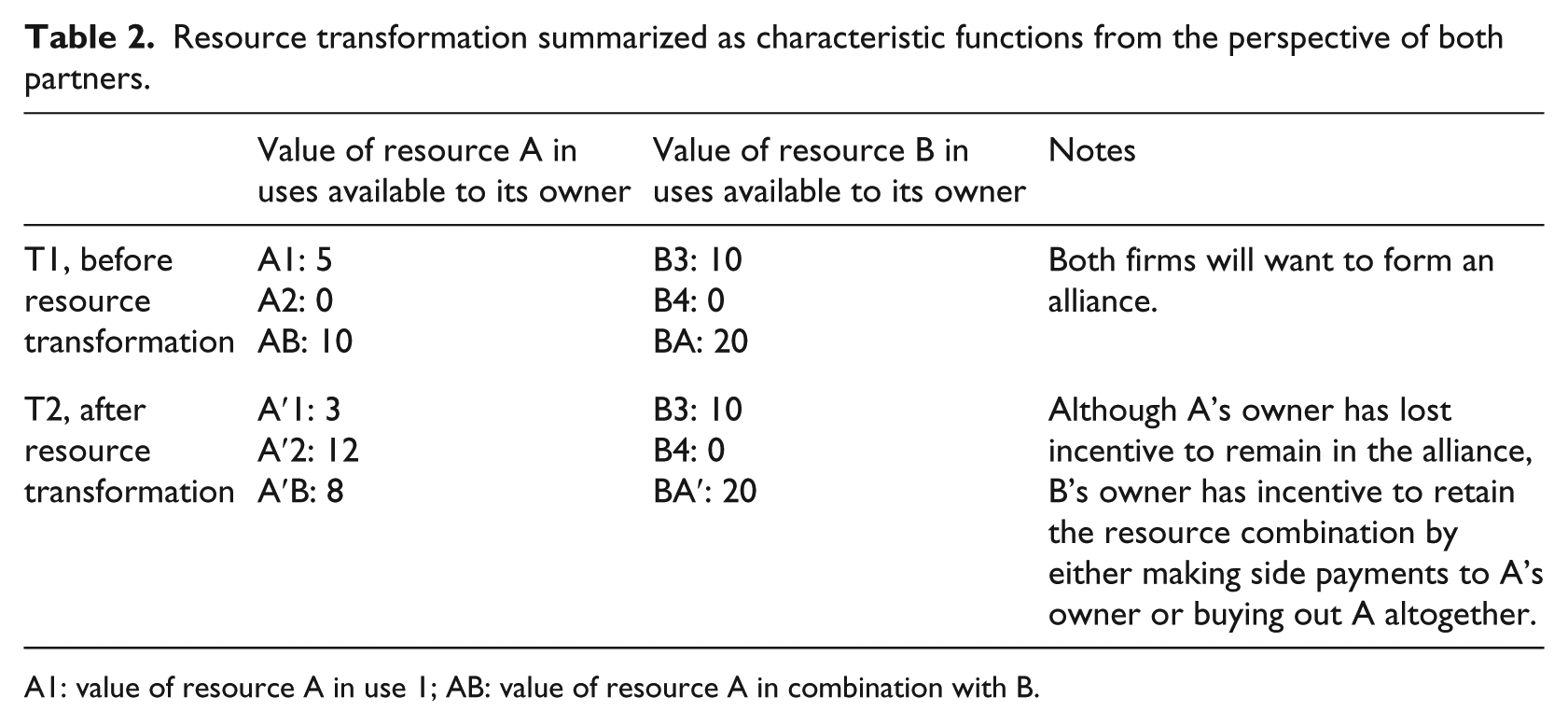
A1: value of resource A in use 1; AB: value of resource A in combination with B.
But side payments or a revised profit distribution is not the only solution available to B’s owner. The other option would be to buy out A′ from its owner altogether. This option is not depicted in Table 2, but we can calculate its value. A’s owner would accept any offer of 13 or higher. The value of this option for B’s owner can be calculated as follows:
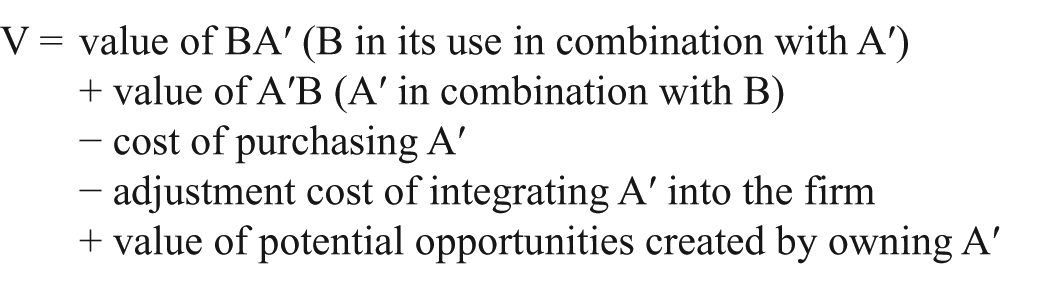
Given the values in Table 2, we know the value of all parameters in the above formula except for the last two

where V′ equals the value of potential opportunities created by owning A′ minus the adjustment cost of integrating A′ into the firm. As long as V is higher than 10 (the value of the next best option for B’s owner), then it makes sense for B’s owner to buy out A′ completely. Given the above calculations, if V′ is 0 or higher, then the buy-out option is as attractive as or more attractive than the side payment option. If V′ is negative, the side payment option is more attractive. And if the value structure of Table 2 was such that B had no incentive for making side payments, then alliance termination is the most attractive option.
This illustrative model demonstrates that resource transformations that give rise to unforeseen costs and opportunities may result in alliance termination, cost/profit redistribution, or a buy-out or resource acquisition. The argument derived from this model can be summarized as follows:
Once resource commitments are made and an alliance is formed, the resources deployed in the alliance must often be transformed in imperfectly predictable ways in order to adjust to the alliance.
This resource transformation reveals new costs (direct adjustment costs) and unexploited outside opportunities (indirect adjustment costs) associated with continued deployment of the resources in the alliance.
The newly revealed costs and opportunities will change the incentive structure between the two partners such that one of the following outcomes becomes the mutually acceptable option:
Continue the alliance if both players still find that the best use for their resources remains within the alliance in its current structure. Resource transformations may render the alliance even more attractive than before for one or both parties. If one partner now finds resource deployment options outside of the alliance more attractive, the second partner may create new incentives for the first partner to remain in the alliance by agreeing to a restructuring of the cost/profit sharing arrangement. The second partner will do this only if doing so is still perceived as the best available use of its resources. If one partner now finds resource deployment options outside of the alliance more attractive, the second partner may retain the resource combination by completely buying out the alliance resources of the first partner if doing so is perceived as the best available use of its resources. If both partners now find resource deployment options outside of the alliance more attractive than the existing alliance, any restructured version of it, or a buy-out by one partner, then the alliance will be terminated.
The particular outcome ultimately observed in any particular case will depend on the extent of resource transformation each partner experiences and the resultant incentive structure. In the special case where one firm perceives increased available opportunities outside the alliance and decreased value inside the alliance, but still finds a re-negotiated alliance arrangement attractive, the above analysis reduces to the bargaining power argument, as, for example, outlined by Inkpen and Beamish (1997). New arrangements based on changes in bargaining power are unlikely to be stable however, given that they are likely to be accompanied by an increased sense of inequity and vulnerability by the partner with less bargaining power (White and Lui, 2005).
The sources of adjustment costs in the context of alliances
Our main argument above hinges on two important assumptions: first, the value of combining firm resources with the resources of other firms more often than not cannot be fully realized by simply keeping those resources as is and unmodified. In other words, resources undergo transformation in order to adapt to an alliance for the purpose of attaining the anticipated value therein. Second, our argument is based on the assumption that these resource transformations may lead to revelations of previously unpredicted or imperfectly predicted direct and indirect adjustment costs. In other words, resource transformations reveal new costs and open new windows of opportunity. In order to better specify the scope of the applicability of our theoretical arguments, in this section we take a closer look at the aforementioned assumptions to identify the context that gives rise to them and the conditions under which they are likely to be operative in varying degrees. That is, we ask why and when resource transformation should be necessary for alliance partners and what conditions give rise to less predictable and more substantial adjustment costs as a result of this transformation.
The resource specialization dilemma
The earlier quote in Mitsuhashi and Greve (2009) highlights the difficult dilemma faced by firms due to resource specialization. In the search for rents, resources tend to become specialized to the context of a particular firm. Resource and capability-based scholars 3 contend that resources and capabilities constitute the basic means by which firms distinguish themselves from one another, and resource heterogeneity and immobility are fundamental to long-lasting performance differences among firms (Barney, 1991; Morgan et al., 2009; Peteraf, 1993). This stimulates firms to progressively specialize their resources and capabilities over time in the pursuit of rents. Basically, specialization is one of the major normative implications of the resource-based view (RBV), with resource-based scholars advocating specialization as an important means by which firms can increase the heterogeneity and immobility of their resources and capabilities (Sirmon et al., 2007; Teece et al., 1997).
Yet, although resource-based scholars recognize rents associated with specialization, specialization is a double-edged sword, since it can result in a burden of rigidity and lead to the well-known competency trap (Levinthal and March, 1993). Specialization typically augments customization of resources or knowledge to a particular use, increasing its context specificity and limiting its applicability elsewhere (Jacobides, 2008). Indeed, “firms committed to a particular resource trajectory will find it difficult to accommodate new resource variations” (Mathews, 2003: 129). As a corollary, since firm resources generally evolve to become more idiosyncratic to the firm over time and often become mutually co-specialized (Peteraf, 1993), perhaps even optimized, for a particular purpose and context, it becomes both more difficult and costly to leverage these resources and capabilities cost-efficiently across different settings (Combs et al., 2011).
In turn, firm specialization tends to go hand-in-hand with interfirm collaboration, since specialization creates interdependence with others who, likewise, are specialists in their respective and complementary domains (March and Simon, 1958). Yet, while specialization necessitates collaboration, it also makes collaboration more challenging due to demands for adjustment and integration with the resources of other firms (Brusoni, 2005; Heath and Staudenmayer, 2000; Kretschmer and Puranam, 2008). Thus, in the context of interfirm relationships, there is an inherent challenge associated with resource specialization: the more firms differentiate themselves by specializing around strategic firm-specific resources, the more adjustment and coordination challenges they face in attaining value through alliances with others. This dilemma has long been recognized as a fundamental problem of economic organization (Becker and Murphy, 1992; Grant, 1996; Kogut and Zander, 1996; Yang and Ng, 1998).
In the context of alliance strategy, this dilemma translates to a tension between relational rents from an alliance and resource-based rents outside of the alliance. The search for rents accrued to specialized resources renders those resources imperfect for deployment in alliances as is. The alliance context gives rise to the need for resource transformation in these relationships. For instance, in describing the Siecor alliance between Siemens and Corning, which aimed at integrating optical fiber in communication technologies, Rangan et al. (2000) suggested that the alliance “called for major changes in Corning’s strategy and operating practices” (p. 39). Likewise, the same authors discussed the alliance between Laura Ashley and Federal Express, suggesting that this relationship incited FedEx “to make some radical and discontinuous changes in the way it operated to exploit the opportunity afforded by the alliance” (Rangan, 2000: 39–40).
The determinants of adjustment costs
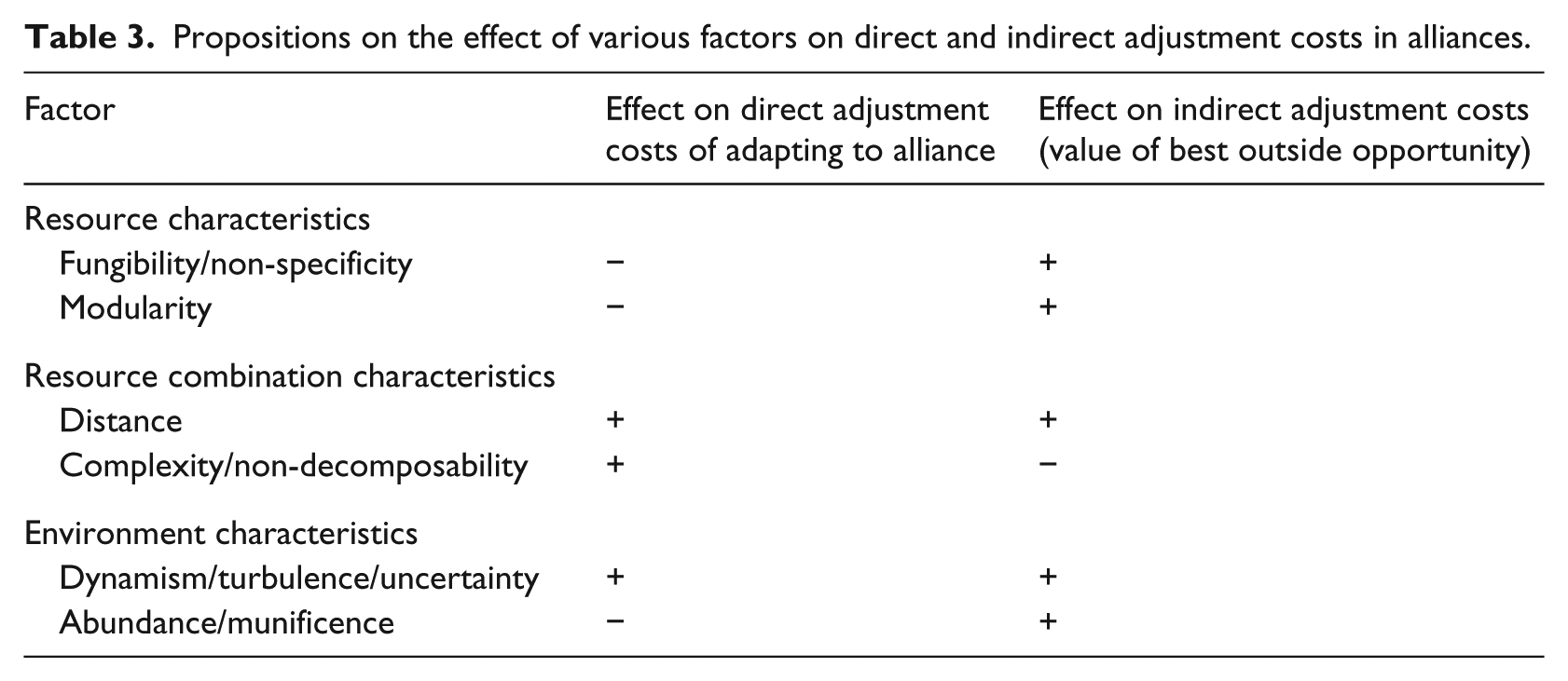
We now turn our attention to some of the factors that determine the extent to which a firm may experience imperfectly predicted adjustment costs in alliances. We categorize these factors into three general levels of analysis: (a) characteristics of the resources themselves, (b) characteristics of the resource combination at the dyad level, and (c) characteristics of the economic environment in which the partner firms operate. Table 3 summarizes our propositions regarding the effect of each factor on direct and indirect adjustment costs. For each factor, we discuss how that factor influences direct adjustment costs of deploying a resource within an alliance, and how that factor influences indirect adjustment costs which are benefits of redeploying a resource outside of an alliance in order to take advantage of inter-temporal economies of scope.
Propositions on the effect of various factors on direct and indirect adjustment costs in alliances.
Resource characteristics
A key aspect that differentiates firms in the collaborative context is the fungibility of the focal resources. Resource fungibility has been defined as the degree to which the value of the resource is preserved or diminished as it is leveraged and applied in settings more distant from the original context within which it was developed (Levinthal and Wu, 2010; Madhok, 1997; Montgomery and Wernerfelt, 1988; Vassolo et al., 2004). Intangible or information-intensive resources are usually considered more fungible because replicating and redeploying them often does not involve many of the costs associated with replicating and redeploying physical or tangible resources (Vassolo et al., 2004). This does not mean, however, that all fungible resources have scale-free properties (Levinthal and Wu, 2010). While some fungible resources like brand name do have scale-free properties, many intangible resources, for example, those based on knowledge and human capital, cannot be freely deployed to multiple uses simultaneously due to time and attention constraints.
Existing resources with fungibility attributes are more easily transformed and repurposed for use in or out of an alliance, provide greater flexibility in developing new capabilities required for such repurposing, and also lower the cost of trial-and-error efforts along the way (Sapienza et al., 2006). Supporting this argument, Anand and Delios (2002) find that firms deploying more fungible resources to an alliance are likely to experience lower adjustment costs for adapting to alliance needs and lower re-adjustment costs for redeploying resources outside of the alliance to take advantage of new opportunities. Also, Vassolo et al. (2004) find that firms deploying fungible resources in biotechnology alliances can better take advantage of the alliance’s synergy with the rest of the firm’s portfolio (i.e. super-additivity). In other words, fungibility can be expected to lower direct adjustment costs but increase indirect adjustment costs (the value of outside opportunities).
While fungibility is usually taken to be an inherent characteristic of the resource itself, there are ways in which firms can actively structure, package, and organize resource bundles that make them easier to deploy from one use to another. Some of these methods include knowledge codification, modularization, and standardization of routines (Brusoni, 2005; Grant and Baden-Fuller, 2004). Modularity refers to the intentional design of resource bundles in a loosely coupled manner such that the interdependencies between components and the requisite coordination processes between them are minimized (Sanchez and Mahoney, 1996). This is achieved by specifying standardized component interfaces that remain unchanged for extended periods of time. These stable interfaces provide an information structure that serves as a form of embedded coordination among resource components. Modularity of resources gives firms greater strategic flexibility in quickly and efficiently bundling together the chain of resources required for a given task (Sanchez, 1995).
Modularity generally reduces (but rarely eliminates) dependency on suppliers and alliance partners (Mikkola, 2003). Mudambi and Tallman (2010) argue that, in alliances for outsourcing knowledge processes, modularity allows lower interdependence, and thus less integration and lower transaction-specific investment. Bouncken et al. (2015) find several advantages of modularity for alliances which they attribute to factors such as the possibility of parallel work, increased responsiveness to market change, and more efficient learning processes. Thus, we expect modularity to lower adjustment costs of deploying resources within an alliance. But modularity can also be expected to lower the re-adjustment cost of redeploying resources again outside the alliance, thus increasing potential value of outside opportunities and therefore raising indirect adjustment costs.
Resource combination characteristics
Following White and Lui (2005), at the resource combination level we discuss the two dimensions of inter-partner diversity or distance and complexity. Specialization typically emerges over time through a path-dependent process, which not only engenders greater efficiency in the production of specific goods and services but also enhances the firm’s ability to identify and understand valuable information and relevant knowledge, as learning-by-doing creates deeper knowledge of a specific domain (Cohen and Levinthal, 1990; De Clercq and Dimov, 2008; Katila and Ahuja, 2002). From this logic, two firms specialized in particular knowledge domains will have differentiated knowledge bases, structures, and dominant logics (Lane and Lubatkin, 1998; Parmigiani and Mitchell, 2009; Sammarra and Biggiero, 2008). This differentiation among partner firms creates distance between them at the dyad level that in turn creates the conditions for unanticipated adjustment costs. Knoben and Oerlemans (2006) review the various dimensions of this distance or proximity in the context of interorganizational collaborations.
Bounded rationality may constrain the firm’s ability to predict the consequences of deploying resources to alternative domains, especially if the new domain is relatively unrelated or cognitively distant to the firm (Anand, 2004; Cyert and March, 1963; Nelson and Winter, 1982). Cognitive distance refers to differences in language and vocabularies, behavioral norms, divergent expectations, and lack of pre-existing common knowledge (Camerer and Knez, 1996; Lawrence and Lorsch, 1967; Nooteboom, 2000). In dealing with cognitively distant partners or problems through an alliance, a firm is commonly faced with a high level of ambiguity, that is, “situations where available information is scanty or obviously unreliable or highly conflicting; or where expressed expectations of different individuals differ widely; or where expressed confidence in estimates tends to be low” (Ellsberg, 1961: 660–661). Such conditions require extensive communication and collaboration among parties (Ghoshal et al., 1994; Gupta and Govindarajan, 2000; Levitt and March, 1988) and extensive efforts to resolve issues of equivocality (Daft and Lengel, 1986; Thomas and Trevino, 1993). A high level of cognitive distance also means a low level of shared knowledge which can impede the absorptive capacity of partner firms to learn from each other and adapt to each other’s needs (Cohen and Levinthal, 1990; Lane et al., 2006; Lane and Lubatkin, 1998). Therefore, a high level of cognitive distance between alliance partners is likely to require greater and more difficult resource transformations during the alliance and hence higher direct adjustment costs. Moreover, the nature and cost of these resource transformations will be more difficult to predict when the two partners are cognitively distant.
Inter-partner diversity does have its benefits however. Partnering with cognitively distant firms is a form of distant search that can help the firm escape local peaks in the fitness landscape (Levinthal, 1997; Rosenkopf and Almeida, 2003). Furthermore, alliances in distant domains can provide the firm with brokerage advantages in linking the distant domain to its own (Burt, 2004; Granovetter, 1973). Both these effects are likely to result in higher indirect adjustment costs by increasing the value of opportunities that are revealed to a firm through an alliance. In a highly cited study of optimal cognitive distance in technology alliances, Nooteboom et al. (2007) find support for the mixed effects of cognitive distance, pointing to the trade-off between the novelty value and the risk of misunderstanding that comes with choosing cognitively distant alliance partners. These trade-offs are corroborated in a more recent study of R&D alliances, which found that the innovation performance of an alliance peaks at moderate levels of technological distance (Lin et al., 2012).
In addition to distance, an important determinant of adjustment costs at the dyad level is the complexity of the resource combination. The complexity of a resource combination can be conceptualized in terms of the number of resource components involved; the timing, frequency, and number of interactions between them; and the degree of dependence of each component’s actions, behavior, and performance on others (Thompson, 1967; Victor and Blackburn, 1987). Hence, alliances with larger size (Robson et al., 2008) and broader scope (Reuer and Zollo, 2005) face more severe complexity burdens. Due to the many coordination problems it brings, complexity has been pointed out as one of the main causes of alliance failure (Park and Ungson, 2001). Corroborating this, Bidault and Salgado (2001) found that more complex alliances were more likely to diverge from their initial objectives.
Coordinating interdependencies is difficult because when a change occurs in a resource that is heavily interconnected with multiple other resources, all those other resources may need to be modified accordingly (Ethiraj and Levinthal, 2004; Zhou, 2011). As noted by Zhou (2011), the three elements of coordination identified by Marschak and Radner (1972), that is, communication, information processing, and joint decision-making, are all affected and made more difficult by complexity. Multiple interconnections result in more information generated by each change, requiring heavier communication bandwidth and increasing the chances of decision errors. Leiblein and Macher (2009) point out that alliances engaged in solving more complex and ill-structured problems require higher degrees of control and coordination and more hierarchical governance structures. Hence, we expect complexity to be associated with higher direct adjustment costs within an alliance.
Unlike distance however, we do not expect the complexity of an alliance’s resource combination to increase indirect adjustment costs. The more embedded and intertwined a set of resources is with the rest of the resource bundle, the more difficult it would be to disentangle and separate them out without loss of value (Madhok, 1996, 1997). In other words, complexity of the resource combination inside the alliance reduces decomposability of the resource structure (Simon, 1982) and hence makes it more costly to redeploy the resource components outside of the alliance. Therefore, we expect complexity to reduce indirect adjustment costs due to the diminished value of outside opportunities. However, it should be noted that if managed properly, heavy interdependencies are beneficial for achieving unique, valuable, and hard-to-imitate resource combinations (Barney, 1986, 1991) that generate relational rents from the alliance (Dyer and Singh, 1998). Therefore, although complexity may result in unanticipated costs of adapting to the alliance as well as barriers to deploying resources out of the alliance, it may increase the long-run value of the alliance itself. 4
Environment characteristics
The relative costs and benefits of continuing an alliance versus redeploying resources outside the alliance are not determined solely by factors endogenous to the partner firms and their relationship. To illustrate, we explore two environmental factors here. The level of environmental uncertainty in which the firms operate is an important determining factor. The transaction cost perspective on alliances has emphasized the importance of environmental uncertainty because it reduces the predictability of all contingencies (Lee et al., 2009). With a similar logic, environmental uncertainty reduces the predictability of future resource value under all contingencies.
In highly dynamic and unstable environments, relational rents, as with all other advantages, are more likely to be temporary (D’Aveni et al., 2010; Eisenhardt and Martin, 2000). The problem being addressed or the market being targeted by an alliance may undergo frequent changes, in turn requiring the partners to undergo frequent adjustment (Ariño and Doz, 2000). Artz and Brush (2000) found that environmental uncertainty directly increased coordination costs due to negotiating contract changes in an original equipment manufacturer’s strategic alliances with suppliers. Uncertain environments also strain decision makers with the need to gather more information and advice while at the same time affording them less time to do so, thereby increasing the possibility of miscalculation (Goll and Rasheed, 1997). Hence, there is reason to expect environmental uncertainty to be positively associated with direct adjustment costs.
However, with greater risks often comes greater rewards, the reward side of environmental turbulence and uncertainty being the emergence of new opportunities (Bingham and Eisenhardt, 2008; Sarasvathy et al., 2003). Uncertainty can be expected to increase indirect adjustment costs not only because of the appearance of new opportunities but also because of the more limited windows in which those opportunities can be exploited (Helfat and Eisenhardt, 2004).
Another aspect of the environment that has been studied in the literature is environmental munificence, defined as the extent to which an environment can support sustained growth (Castrogiovanni, 1991; Starbuck, 1976). Industries in the growth stage are normally considered to provide munificent environments where sources of financing, human resources, and interested partners are relatively abundant (McArthur and Nystrom, 1991). In contrast, March and Simon (1958) pointed out that in resource-scarce environments, competitive intensity and conflict are likely to rise due to the zero-sum nature of the economic landscape. Resource-scarce environments have been found to increase illegal acts (Staw and Szwajkowski, 1975), as well as the need for frequent personnel, administrative, and structural changes (Koberg, 1987; Yasai-Ardekani, 1989). Therefore, we expect environmental munificence to decrease direct adjustment costs within the alliance by reducing the need for adjustments and making it easier to deal with necessary adjustments.
Furthermore, environmental munificence can be expected to result in more valuable opportunities outside of the alliance, thereby increasing indirect adjustment costs. Munificent environments make it easier for firms to access resources and customers and reduce competition, thereby reducing the dependence of firms on alliance partners and increasing the availability of resource deployment opportunities outside of the alliance (Park and Mezias, 2005).
To sum up, we have identified a number of contingency factors at the resource, resource combination, and environment levels that give rise to heterogeneity among firms in the extent to which they experience imperfectly predicted direct and indirect adjustment costs through resource transformation in alliances. The propositions are summarized in Table 3.
Discussion and conclusion
Alliances are rarely expected to go on forever. Many dissolutions happen because an alliance has simply run its course. The likelihood of alliance termination is known to increase with alliance age (Hennart et al., 1998). Many alliances are intentionally temporary and may even have specific expiry dates. But as alliance researchers we still want to know why and how some alliances dissolve sooner than expected, and what happens to the resources involved once they do.
Our article builds on the notion of adjustment costs to provide a distinct explanation for alliance evolution and termination. We focus our attention on the resource transformation that occurs when a firm engages in collaboration with others and the implications thereof. Previous literature on the dynamics of alliance evolution and adaptation over time has pointed out that alliance partners continuously re-evaluate the efficiency of the alliance arrangement (Ariño and De La Torre, 1998). But there are many details that cause a change in the evaluation of efficiency over time. Previous research has focused on the dynamics of governance, coordination interfaces, administrative processes, changes in interpretations, goals, and task definitions, and so on, with comparatively little attention given to the transformation of the underlying value-creating resources themselves. An exception to this is the literature on learning in alliances (e.g. Doz, 1996), which is arguably a special case of transformation of knowledge resources (Grant, 1996). However, the objective of learning in this literature is almost always taken to be limited to the alliance itself, without consideration of the broader scope of resource deployment. This is despite the fact that many alliance researchers agree that learning for purposes beyond the focal alliance is a common motive to engage in the alliance in the first place. One line of research that has explored the role of learning for benefits both within and outside the alliance is the work on learning races (Hamel, 1991) and the private versus common benefits of learning alliances (Khanna et al., 1998). Our article brings a different—arguably less adversarial—perspective to alliance termination with the notions of resource transformation and adjustment costs and inter-temporal economies of scope.
While a steady stream of research has developed around the notions of resource deployment and adjustment costs (Hatch and Dyer, 2004; Helfat and Eisenhardt, 2004; Kor and Mahoney, 2000; Sakhartov and Folta, 2014a, 2014b), only one previous article has applied the concept of adjustment costs to alliances (Reuer et al., 2002), and that article has focused on governance adjustments rather than resource adjustments, which have nothing to do with inter-temporal economies of scope (Helfat and Eisenhardt, 2004). Our article is the first to apply the notions of resource adjustment costs and inter-temporal economies of scope to the context of alliances. 5 In doing so, we have been able to demonstrate a resource value mechanism that can contribute to alliance evolution and termination independent of any mismanagement, opportunism, lack of trust, interpretive misunderstanding, or perceptions of inequity.
While we argue that these features distinguish our explanation from previous ones, in reality the mechanism of resource value operates in a complex bundle alongside many of these other factors. For example, acquiring an alliance resource in the form of hiring a key scientist from your research partner may be based on entirely economic calculations, but in reality invokes feelings of a breach of trust and unwritten rules of a “gentlemen’s agreement” between partners. Similarly, terminating an alliance due to newly found outside opportunities is very likely to be interpreted as an opportunistic act by the alienated partner and may seem especially unfair if the new opportunities are a direct result of the collaboration. Both these examples are illustrated in the case of a pharmaceutical alliance described in Rond and Bouchikhi (2004). Also, although it may have been analytically useful for our model to assume unilateral decision-making, in an alliance one partner does not always have free rein over what it does and how it chooses to do so. In particular, in the case of JVs, the ownership structure, shared decision-making, and contractual limits on control and authority impose significant constraints in this regard, and differences between the two firms complicate joint action (Gulati and Singh, 1998).
Furthermore, since resource transformation through an alliance often involves learning and a convergence of capabilities, moving the partner firms “from being complementary to being undistinguished,” in the words of Ring and Van de Ven (1994, p. 108), it is not uncommon for the newly available outside opportunities of one partner to include competition with the other partner. This quickly turns a win-win situation into a zero-sum rivalry, again amenable to opportunism interpretations. According to a case study by Agrawal (2004), in 1991, Titan Industries Ltd, part of the well-known Tata group, offered a range of relatively high-end wrist watches in the Indian market in accordingly high-end retail locations. In that year, it engaged with United States’ Timex in an alliance to offer a range of low-end wrist watches in the Indian market. The alliance did not succeed because, among other things, Titan did not have the necessary retail penetration to reach the low-end customer segment. But once the alliance was terminated, Titan not only introduced its own low range watch series to compete with Timex in that segment but also established a new type of retail outlet to better reach the low-end market.
Our argument has implications for the literature on the evolution of firm boundaries. From the view of TCE, the prominent theoretical perspective on explaining firm boundaries, integration—in our context, of an alliance—within firm boundaries is largely driven by the level of transaction costs faced by the firm. In this regard, TCE has placed particular scrutiny on asset specificity as a driver of transaction costs and appropriation hazards (Williamson, 1985). In an important contribution, Grossman and Hart (1986) argued that just the question of organizational form (i.e. vertical integration) in itself is not sufficient and that an equally important question in this regard is who would integrate the transaction. They proffered the argument that the firm faced with a higher level of asset specificity vis-a-vis the other would do so. We contribute a distinct explanation for the evolution of firm boundaries as well as who might acquire whom or what portion of resources, where the argument is based not on transaction cost economics but on the economics of resource value.
Another view that explains which partner takes ownership of resources is that of the options view of alliances (Balakrishnan and Koza, 1993; Hennart et al., 1998; Reuer and Tong, 2005; Vassolo et al., 2004), according to which, for example, a JV may be thought of as an option to hedge bets against uncertainty. If the passing of time reveals net expected benefits in the JV for the option holder, they may exercise the option to acquire the JV, and if the passing of time reveals net expected costs, the partner may exercise the option to sell their shares in the venture. Our arguments are in line with the options view and demonstrate mechanisms through which option value may reveal itself, as well as shed light on our understanding of which partner may want to own the alliance resources after dissolution. Based on the option view, Hennart et al. (1998) argue that JV exits by sale of shares are not necessarily a sign of failure, but exit by liquidation likely is. However, according to our analysis, even exit by liquidation may not necessarily be failure.
On the flip side, an alliance can be considered successful although many opportunities were missed because of it (Doz, 1996). The broader scope of resource value espoused in this article frees us from the commonly held assumptions that alliance success is necessarily a positive outcome and alliance termination is necessarily a negative outcome. If the broad strategic objective of the firm is to extract maximum value given its resources, achieving the strategic objectives of an alliance is only secondary to this goal and may be changed or overridden by it. In this sense, our view is in line with a co-evolutionary perspective of alliances in which alliances are only one element of a firm’s strategic portfolio and co-evolve with it (Das and Teng, 2002; Koza and Lewin, 1998). The evolution of a firm’s resources and environment outside the alliance impacts the alliance, and the evolution of the alliance impacts the deployability of a firm’s resource outside the alliance.
As a concluding thought, given the broader focus on firm performance rather than just alliance performance in our argument, the question naturally arises as to whether or not systematic heterogeneity in the extent to which firms experience adjustment costs in alliances can lead to systematic performance heterogeneity. In other words, can the capability to deal with adjustment costs be a source of sustained competitive advantage?
We have achieved some initial insight into this question by enumerating some of the sources of adjustment costs. A firm allocating non-fungible resources to a complex partnership with a cognitively distant partner in an uncertain environment is much more likely to experience unexpected direct adjustment costs than a firm allocating fungible and modular resources to a simple partnership in a munificent environment with a partner whose business and technology are well known to it. So the former type of alliance is much less likely to undergo significant reformation or premature termination than the latter. But the former type of alliance is not necessarily less valuable than the latter nor is its termination necessarily less advantageous than the continuation of the latter. A firm would want to systematically increase alliance value, decrease direct adjustment costs, and increase indirect adjustment costs (outside opportunities), and doing so is no trivial matter because these objectives are frequently in conflict. Maximizing the value of an alliance often requires irreversible investments that commit the firm to the alliance and preclude it from taking advantage of opportunities outside the alliance. Doz (1996) illustrates two cases of such a dilemma. Firms that are systematically better able to optimally balance these sometimes conflicting objectives, however, can be said to enjoy a resource management capability. In this sense, this is a capability not unlike the notion of ambidexterity that requires a balancing and harmony of often conflicting capabilities of exploration and exploitation (Lavie et al., 2010; Raisch and Birkinshaw, 2008; Tushman and O’Reilly, 1996).
This capability is broader in scope than Schilke and Goerzen’s (2010) notion of alliance management capability, but it is not hard to imagine how their concept can be augmented with the type of resource management capability alluded to here. Schilke and Goerzen outline the elements of alliance management capability to include coordination, learning, sensing, and transformation, based on the broader definition of the dynamic capabilities of a firm (Helfat, 2007; Teece, 2007; Teece et al., 1997). But limiting these to alliance management to some extent defeats their purpose as organization-level capabilities that apply to a much broader set of issues than alliance management. These capabilities should not be in the service of any alliance in particular, but the broader strategic objectives of the firm. Khanna’s (1998) definition of alliance capability as “a firm’s ability to identify partners, initiate alliances, and engage in the ongoing management and possible restructuring and termination of these alliances” (p. 351) at least acknowledges that terminating alliances is an important capability. But from the perspective of the arguments set out in this article, we would also include the ability to identify and seize opportunities outside of an alliance while engaged in one, and to manage the alliance in ways that optimally balance the objective of maximizing the value of the alliance with minimizing the extent to which the alliance deprives the firm of outside opportunities. What this optimal balance is or should be is an open question.
Footnotes
Funding
This research received no specific grant from any funding agency in the public, commercial, or not-for-profit sectors.