







Abstract
The central argument of this article is that institutional theory is fundamentally concerned with the creation, distribution, and application of meaning. The field today only recognizes two of these three collective practices: what we term meaning-evangelizing, concern for how actors and institutions distribute and contest meanings; and meaning-applying, how and to what end actors apply existing, established categorical systems and logics to token objects, actors, organizations, and so on. This essay focuses on the third, less studied leg: meaning-making, the construction of the meanings that guide social actors. This essay offers a theoretical path for exploring meaning-making by discussing its actors, actions, and outcomes: the institutional actors who create meanings (such as curators), how they do it (social assembly), and what is made (social mashups, i.e., candidate meanings).
Keywords
We argue that institutional theory is fundamentally about the creation, distribution, and application of meaning. At its core are three collective practices. But the field today only recognizes two: what we term meaning-evangelizing, concern for how actors and institutions distribute and contest meanings, and meaning-applying, how and to what end actors apply existing, established categorical systems and logics to token objects, actors, organizations, and so on. The third leg is a precursor institutional practice: meaning-making, the construction of the meanings that guide social actors, is barely theorized and rarely treated directly.
To frame this problem, we quote from Roy Suddaby’s (2010) recent essay on the limitations of institutional theory:
In spite of this early work, however, the process by which categories originate and become reified has largely escaped the attention of institutional theorists … Important questions remain unaddressed. To what extent are categories intentionally created as opposed to a priori products of human cognition? What are the processes by which categories are socially constructed? (pp. 16–17)
Suddaby then proposes empirical arenas for future research instead of offering a theoretical path forward. Although we agree with Suddaby’s proposal for more empirical study, we argue for a reconceptualization of the underlying institutional theory as a three-legged proposition, rather than a two-legged proposition. We focus the reader’s attention to a theoretical consideration of meaning-making actors, actions, and outcomes: the institutional actors who create meanings (such as curators), how they do it (social assembly), and what is made (social mashup). We argue that this third leg is under-researched because it is under-theorized.
In Table 1, we display exemplar logics of meaning, including its three main practices (meaning-making, meaning-evangelizing, and meaning-applying), together with examples of common role incumbents practicing in each (creators and curators in meaning-making, evangelists and networkers in meaning-evangelizing, and signifiers and critics in meaning-applying; cf. signification in value creation, Ravasi et al., 2012).
Exemplar logics of meaning.
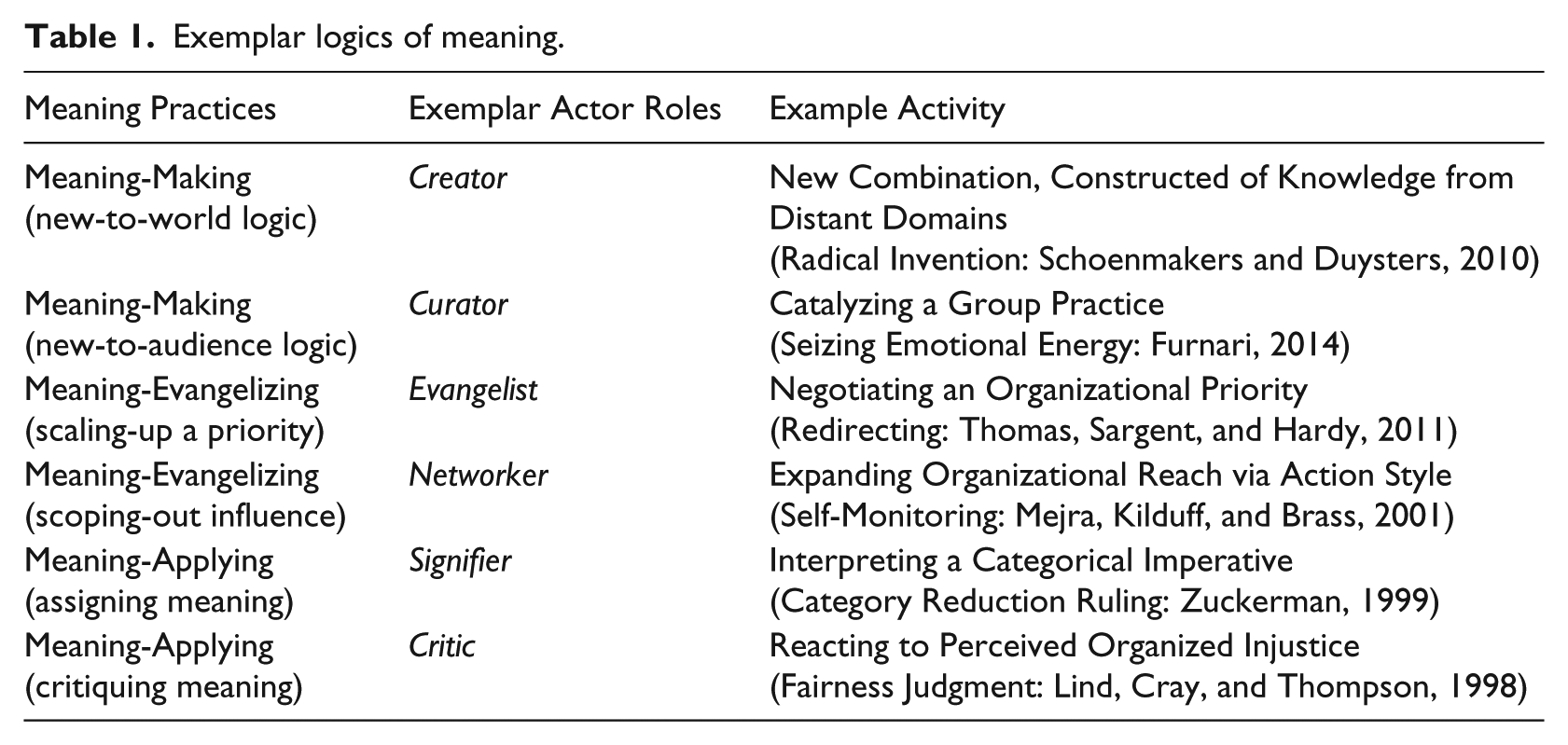
While this essay only expands on one exemplar actor role — the curator — we urge the reader to consider other high-level, generic actor roles that appear pervasively throughout institutional contexts. Five others are also offered in Table 1 simply as examples, not as an analytically complete set. Consistent with the aims of this soapbox essay, we suggest that one avenue of further research is to study the nature and types of actor roles across the meaning practices and their logics.
Scholars have systematically overlooked the first phantom leg of institutional theory—how new meanings are made. In the rush to talk about the second leg, meaning-evangelizing, scholars emphasized the imitation mechanisms that lead to isomorphism (DiMaggio and Powell, 1983), and how institutional entrepreneurs promote new meanings over others (DiMaggio, 1988). A more recent wave of scholarship engages the third leg of institutional theory, meaning-applying. Those authors jump right into analysis of categorizing behavior and how repetitive practices of applying categorical knowledge affect social reality (Lamont and Molnár, 2002; Vergne and Wry, 2014; see Rindova et al., 2011, on selecting and applying resources from the “cultural toolkits” of “industry registers”). As Suddaby observed, the origins of new meanings, and meaning-making activities and actors, are rarely considered. While there is substantive cognitive literature on the human capacity for meaning-making, as in the oft-borrowed literature on analogical transfer (Holyoak, 1996; Nadler et al., 2003), it has not been integrated into institutional theory.
We offer a path toward a theory of the third leg in organizational contexts—meaning-making—by introducing several high-level concepts: creators and curators (types of meaning-making actors), social assembly (meaning-making actions), and mashups (candidate meanings, embodied by new arrangements of facts). We argue that a diverse set of research questions is united into a general institutional model by these concepts (see Tables 1 to 3). Creators are actors who introduce (invent) new social and technical resources to social settings; these resources are to be understood as indeed novel, not just new to setting, and thus necessitate dedicated methods for explaining general functionality. But because of space constraints, we focus deeper attention on just one kind of actor here: Curators, the actors who utilize their social and technical resources to innovate meanings for their audiences. The meanings so introduced are new to setting, that is, customized to their audience’s backgrounds. Curators use social assembly activities to construct and lend credibility to mashups, candidate arrangements of facts that may warrant their own categorical explanation for an audience. Social assembly can involve such activities as engaging audiences with prototyping activities, offering verbal analogies, and offering testaments (statements asserting past, present, or future conditions; see Mitnick, 1999, 2000).
We begin the essay with overviews of the two more heavily studied legs of the stool, meaning-evangelizing and meaning-applying. We then propose our approach to meaning-making, considering its characteristic actors, actions, and outcomes. 1
Meaning-evangelizing
(Neo-)Institutional theory, especially work on “institutional logics” (Thornton et al., 2012; Thornton and Ocasio, 2008; cf. Scott, 2008), is perhaps the dominant paradigm in organizational theory. It explains such phenomena as institutional imperatives and coercion; the enabling of certain actions with institutional logics; negotiation over preferred meanings; how some actors successfully act in opposition to established meanings, beliefs, and logics; and so on. Ever since DiMaggio and Powell (1983) and DiMaggio (1988), institutional scholars have focused heavy attention to meaning-evangelizing activities because they concern how actors and institutions embody and promote contestable beliefs and meanings. Meaning-evangelizing includes institutional and social entrepreneurship (Battilana et al., 2009; Hardy and Maguire, 2008), institutional work (Lawrence et al., 2009; Lawrence and Suddaby, 2006), and legitimation/legitimacy research (Rao, 1994; Suchman, 1995).
Fligstein (1997) defines institutional entrepreneurs as “actors who have social skills, that is, the ability to motivate cooperation of other actors by providing them with common meanings and identities.” Let us stress the point: In this literature, “common meanings” are a persuasive spin on established ideas designed to rally allegiance and polarize camps of belief. This is not purposeful construction of new meanings but the drumming up of actor commitments. For example, Thomas et al. (2011) use a qualitative study to develop a list of actions that negotiating parties take when trying to promote one meaning over another and highlight the large impact of senior roles.
Meaning-applying
Some institutional theory scholars examine how meanings are practically assigned to token objects and situations—that is, how particular token facts are interpreted by actors as corresponding to a known categorical type. The core of it is categorization literature (Vergne and Wry, 2014), but it also includes sensemaking (Weick, 1995; however, sensegiving activities, as discussed in Gioia and Chittipeddi, 1991, fit better with meaning-evangelizing). We collectively call this meaning-applying research—the study of how and to what end actors apply existing, established categorical systems and logics to token objects, actors, organizations, and so on. For example, stock analysts use categories to assign companies to industries, which if done differently might differentially affect how investors evaluate firms (Zuckerman, 1999). Research on meaning-applying helps us to understand how the values and functions of objects and circumstances are made evaluable through assignment of them to definite categories. The usage of categories often simplifies a more complex reality, with positive and negative consequences. The categorical knowledge any particular actor or organization employs was established by prior meaning-making and meaning-evangelizing activities, but the results from applying of categories might alter perceived salience of categories.
The missing leg: Meaning-making
We propose an approach to meaning-making focusing on the actors, actions, and outcomes. We begin with the actions: social assembly.
Some mechanisms of social assembly
The lack of theoretical progress on meaning-making is disappointing. It has largely been overshadowed by the progress on other aspects of institutional theory. According to the classic definition: “lnstitutionalization occurs whenever there is a reciprocal typification of habitualized actions by types of actors” (Berger and Luckmann, 1966: 54). And yet, the habituated actions involved in construction—the social assembly—of novel meanings are largely overlooked.
Scholars who study the institutional causes and consequences of meaning-evangelizing and meaning-applying often skate past the institutionalization of meaning-making processes. These scholars do often borrow cognitive mechanisms for explaining the construction of meanings. The most popular of these is analogies (see Gavetti and Rivkin, 2005). Scholars have failed to note the institutional character of analogizing; analogizing, as a socially situated activity, should be seen as one of many possible mechanisms of social assembly.
Analogizing
Scholars dating back to Aristotle posited analogizing as a mechanism for constructing new categories. Analogizing, in its essence, compares two ideas in a fashion that reveals their common membership in a third, previously unknown category (Magee, 2005). New meanings are then made possible by a pattern of rational associations transferred analogically across domains. But not all analogies are created equal—some become institutionalized heuristics, while others are soon forgotten. A few recent institutional-cognitive studies have explored meaning-evangelizing and meaning-applying after categorical construction via analogy (Bingham and Kahl, 2013; Etzion and Ferraro, 2010), but the studies themselves really are about the shift of usage of one established category to another, likely a result of evangelizing. This work does not get far into the institutional character of analogizing practices themselves.
The rare work on institutional usage of analogies to make new meanings is exploratory. Take, for example, Rindova and Fombrun’s (2001) encouraging account of the use of analogy to construct a new business model. Starbucks leadership successfully performed analogical transfer across cultures, from Italy to the United States: They reframed coffee in the United States as a large beverage category, and evangelized their own “coffee bar” category of retail establishments. Still, they provide evidence that analogizing happens, not quite how analogizing itself succeeds on the basis of who does it, how they do it, or in what steps they lead audiences to acceptance of a new meaning.
Double-scope blending
For another mechanism of social assembly, consider the cognitive act of double-scope blending (Fauconnier and Turner, 2003)—the simultaneous transfer of multiple ideas into a new common frame by an actor’s creative superimposition of cognitive frames. It may be possible that some places, times, situations, and so on are more amenable to this sort of activity on purpose, such as at interstitial spaces purposefully designed to facilitate lots of cognitive blending (see Furnari, 2014) or structural folds in organizational networks (Vedres and Stark, 2010) that provide certain actors better access to disruptive ideas; yet, these theoretical strands have not been synthesized to explain how meaning-making actors and actions are versions of planned, organized aspects of institutional societies—the very starting point for an institutional theory of meaning-making.
The curator role: Curators as managers of meaning
While creators introduce new social and technical resources via inventive actions, curators construct meanings that are new to their audiences by manipulating available social and technical resources. But new meanings do not come about solely because there is a new arrangement of parts; they are brokered by the social actor who manages the rearrangement in context. The model requires a manager of meaning—a curator—who not only puts the pieces together but also tells users how to access the result and how to interpret its value.
For example, museum curators (Dallas, 2007) have many choices of how to array the myriad relics they preserve. The curator can cause visitors to perceive new juxtapositions as well as describe under-explored features of objects, even if visitors saw the same objects in previous visits to the museum. The dinosaur curator, for example, can arrange fossils, landscapes, and dinosaur models, in addition to written panels of explanation, to show that some dinosaurs are vegetation—rather than meat—eaters. Visitors observe displays and then form integrated beliefs that alter their previous perceptions of dinosaurs in context; they perceive new meanings regarding dinosaur roles and interactions. Curators might periodically change themes with the same set of fossils and focus one arrangement of the display to draw attention to how dinosaurs walk, as opposed to how they eat. Over time, they also may change how visitors interact with the displays. Visitors develop new meanings regarding dinosaurs, experience joy in learning unexpected things about dinosaurs, and attach value to that.
Curating mashups
The product of curatorial social assembly is a social mashup. Let us look deeper at double-scope blending as an institutional method of social assembly. Furnari (2014) explains interstitial spaces via the case of the infamous Homebrew Computing Club (HCC), an informal but large group from where emerged early Silicon Valley companies such as Apple. This club was geographically co-located with very powerful high-tech companies, such as Hewlett-Packard and Commodore, and universities, such as Stanford. It also benefitted from open technology and informal structure.
Furnari talks of social actors called “catalysts” that “de facto, with no designated social function” can sustain a new practice at the HCC by facilitating repeated social interactions. More formal curatorial actors are shunned in such places—Furnari describes how another leader failed in attempting to impose routines on the group. Catalysts, we are told, facilitate the repetition of new practices and ideas rather than directly guide their assembly. Once a peer-demonstrated practice garners “emotional energy” and “mutual attention,” catalysts ritually steer others into repeating these new practices.
Furnari, interestingly, does not speak of analogies. The “catalysts” accomplish facilitation in two other ways: first, by being “multivocal,” meaning they are careful to communicate so as to be coherent from multiple perspectives simultaneously; and second, by staying out of the earlier stage of idea generation processes! In our words, not Furnari’s, a catalyst at the HCC garners respect as a neutral party by waiting until the crowd of computing specialists (a community of creators, mind you) gets excited about something on their own first and then by swiftly encouraging new group structure to “stick.”
Furnari’s work is an example of a kind of curator socially assembling a mashup. The described actor qualities, conditions, and mechanisms are merely contingent on this kind of institutional space and the kind of meaning-making activities. Furnari has identified one special case—a constrained set of conditions for one important step of a meaning-making sequence specifically for an interstitial space. Furnari also did not identify that this catalyst is, in effect, encouraging a protracted collective process of double-scope blending. A heavier-handed manager would dramatically alter this collectivized creative process by formalizing. The structure and conditions the catalyst encourages seem isomorphic with micro-processes of double-scope blending. Other repeated approaches to social assembly of mashups (see Nadler et al., 2003, for a discussion of some alternatives) might fit other institutional conditions better.
Thus, the above “catalyst” actor, in our own words, is a special case of a curator role performing some late-stage tasks in social assembly, facilitating the transformation of a mashup into one specific kind of meaning, a practice. In the above case, even if the “catalyst” is not “official” at the HCC, this sort of actor uniquely helps new ideas become adopted in these special low-structure, high-talent environments. Might it be the opposite in high-structure, low-talent ones? How does audience interaction or cross-institutional meaning-making change the story? We do not know yet. Also, this catalyst, as described, is also only tasked with the last steps of meaning-making. In summation, a general institutional model of meaning-making activity, of which Furnari’s theory piece is but one interesting special case, is needed, starting with the description of the highest level constructs: actors, actions, and outcomes.
Credibility and social assembly: Making mashups meaningful
What leads to the acceptance of a mashup as meaningful? Consider a (mythical) lemonade dog as a mashup. It is a candidate category of dogs that is bred for the purpose of squeezing lemons. Now, there are not any examples of them or anything of close enough technical construction—consider that turn-spit (hot)dogs, sheepdogs, and guide dogs exist but are contingent on quite different biological traits. It seems technically meaningless. Furthermore, this knowledge does not appear valuable for future social activities—who cares? As such, this mashup will likely be rejected by audiences as meaningless. The social assembly of a prototype would help—a very clever and capable lemon-squeezing dog that challenges audience assumptions. Evidence of a well-made prototype constructed in the past is thus a mashup with higher credibility than a claim that lemonade dogs now exist, which in turn has higher credibility than the speculated idea that such dogs can be made in the future (cf. logic of the theory of testaments, Mitnick, 1999, 2000). Similarly, a demonstration of a new team-building exercise at work—a performance of an ostensive new work routine (Feldman and Pentland, 2003)—is merely an incidental mashup of behaviors and objects until sufficient social proof from curators with feedback from participants as audience confirms its meaningfulness for reuse. Social assembly thus involves the full set of interactions between the curator and the mashup, as well as the curator and the audience, which combined may lead to categorical innovation of artifacts, practices, and so on. The clever induction from mere incident to meaningful category (Holyoak, 1996) is an institutional challenge. It is also obvious that sometimes the curator role itself is decentralized and distributed throughout audiences, further affecting establishment of credibility. There is much social cognition literature on crowd biases that examines special cases of this general case condition. We are thus led to the problem of understanding how curators use certain types of assembly actions to generate different types of mashups in different contexts.
Curation modalities in management research
Take, for example, the social/enterprise settings exemplified in Table 2. In the case of open design communities such as Thingiverse, which features prosumerism/prosumption (Toffler, 1981) of artifacts, the roles of consumer and producer are, contrary to ordinary expectations, intermixed; sometimes, a site curator provides necessary steering and construction of new marketplace categories. In business at the base-of-the-pyramid (Kolk et al., 2014), as in the case of SELCO, local villagers participate with outside business firms in developing products special to local limitations and adapted uses (cf. co-production in public administration; Bovaird, 2007; Whitaker, 1980). A whole range of managerial and organizational literature is actually investigating special cases of a general case problem—the phantom third leg of institutional theory now becomes obvious.
Examples of curated social assembly.
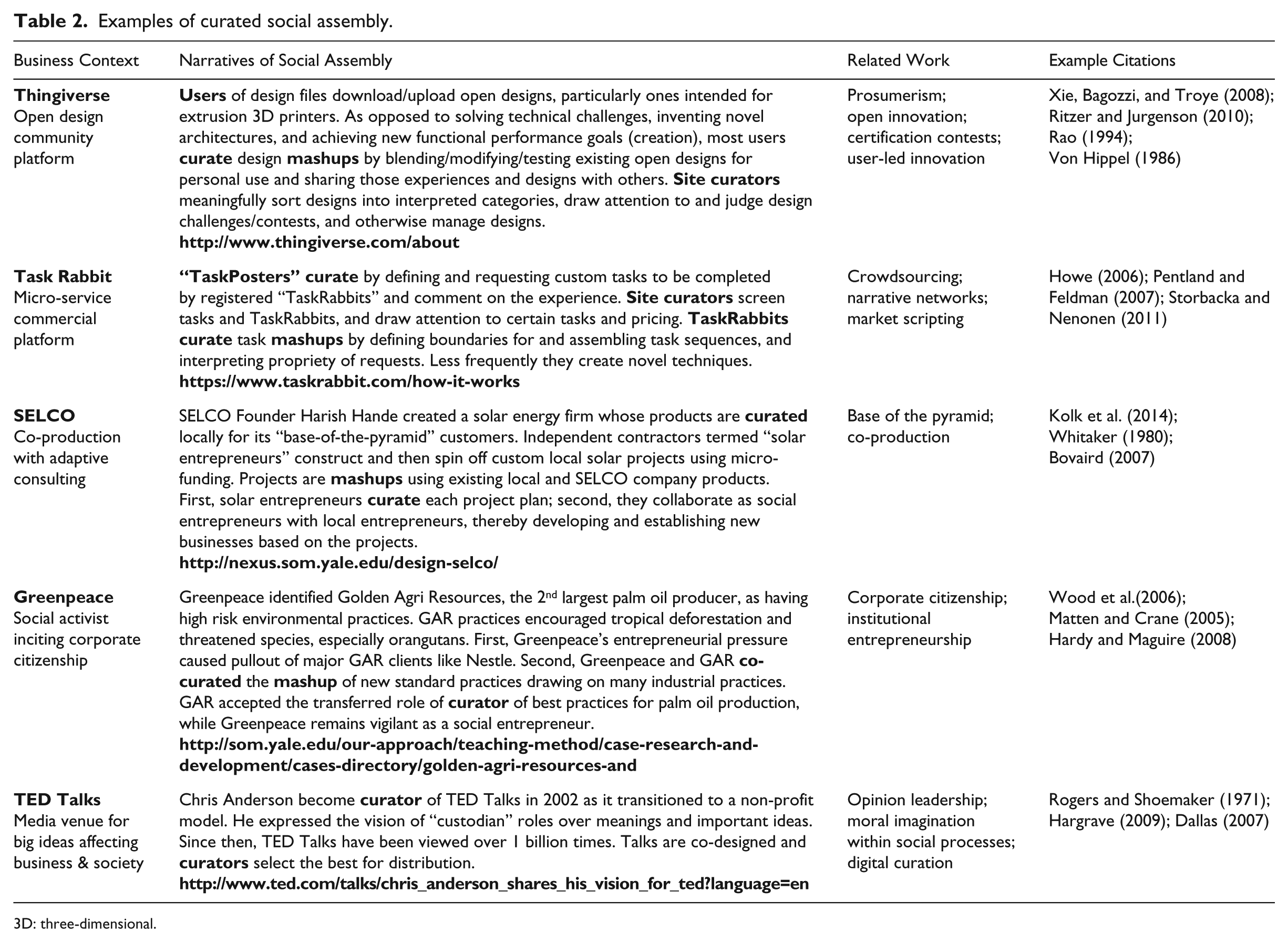
3D: three-dimensional.
In all these cases, there are sequences of deconstruction and reconstruction in which multiple actors participate, and in which either one or both of the actors or a third party provides additional steering or shaping or guidance for the outcomes and helps establish meanings for the outcomes. Surely, we should not treat each of these settings as irreducibly unique—what we see here is social assembly, and what we learn about one context should have high theoretical relevance for the others. Curation phenomena can occur in a highly hierarchical or flat environment, be formally (stage-gate product development) or informally (interstitial spaces) structured, be led by individual curators or co-curated, and so on.
Table 3 identifies some of the many managerial research questions suggested by this approach. The contingencies for curator activity are a hugely important phenomenon in our current economy. Consider, for example, user-driven innovation, the blurred lines in online prosumerism, the “maker” revolution that includes three-dimensional (3D) printing, curation in social media, the sharing economy and peer-to-peer economies, and many others. Our approach could also facilitate the integration of service-oriented logic in marketing (Vargo and Lusch, 2004) with social assembly.
Some research questions for the study of meaning-making.
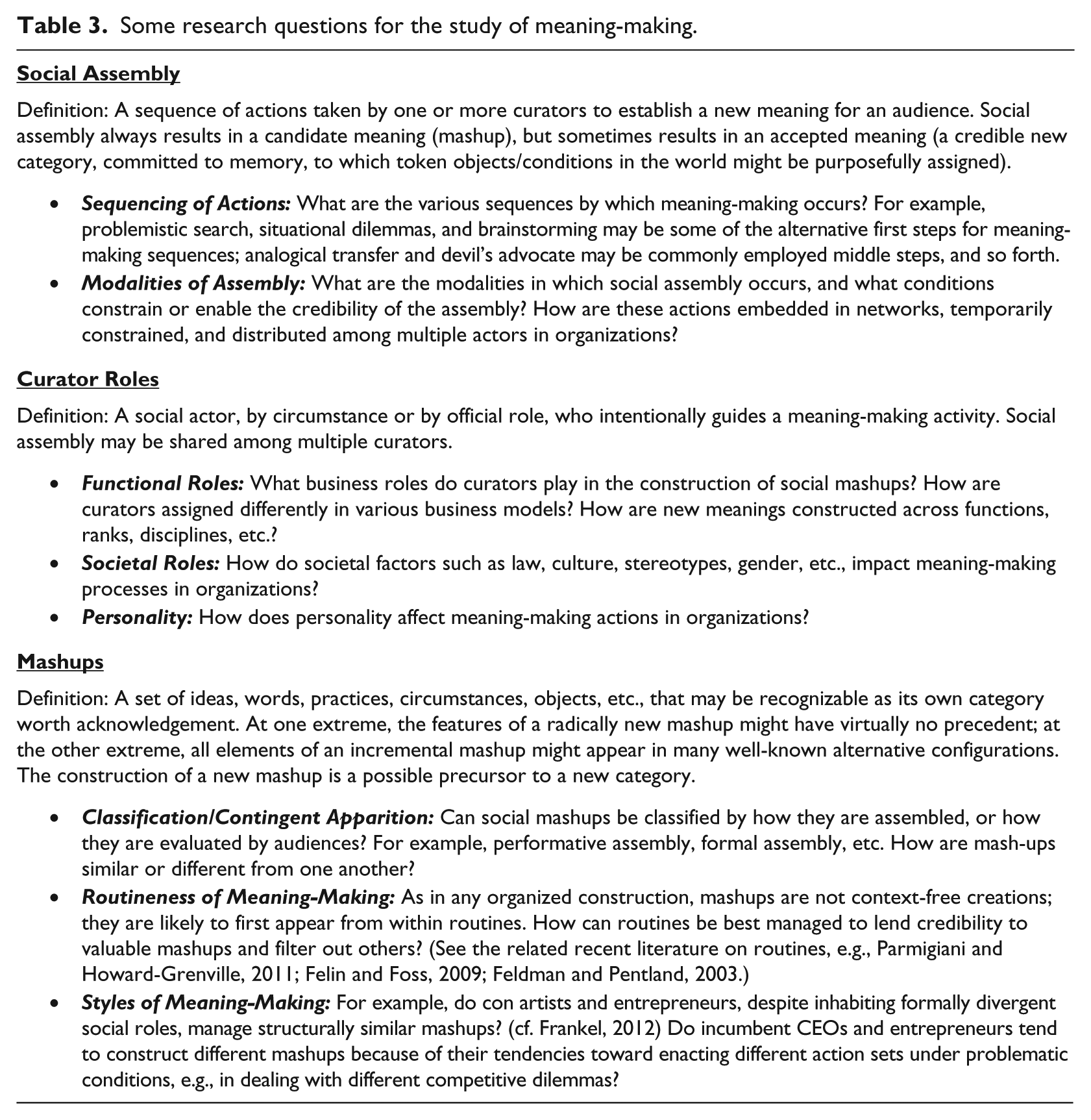
We have made a brief case for synergizing many streams of literature into the phantom leg of institutional theory. But we must start to see our task as the construction of a general model of how managers in organizations assemble and curate meaning. For example, we need this approach to explain the design-driven epiphanies of meaning (cf. Verganti, 2011) that happen in contemporary technological practices. Managers must frequently socially construct whole new categories of fact. To ignore the institutionalization of these activities is to perform a kind of epistemological sleight of hand, whereby meaning-making for institutions always already happened, and we find ourselves errantly discussing evangelizing and applying activities again.
Footnotes
Acknowledgements
Robert C Ryan wishes to thank the Berg Center for Ethics and Leadership at the Katz Graduate School of Business, University of Pittsburgh, for its partial support in research related to the topic of this article. The authors would also like to thank Tim Rowley and the other SO! Editors for comments that helped us significantly improve this article.
Funding
This research received no specific grant from any funding agency in the public, commercial, or not-for-profit sectors.