







Abstract
This study examines the influence of horizontal competition on interorganizational exchange. Interorganizational competition is a multidimensional construct that can influence exchange in multiple, sometimes countervailing ways. With an analysis of Major League Baseball player trades, we examine the influences of three components of competition—goal conflict, rivalry, and competitive interaction—on interorganizational exchange partner selection. We find that goal conflict reduces the hazard rate of exchange between organizations, but competitive interaction increases it. Moreover, we find evidence that prior exchange moderates the competition–exchange relationship by reducing the perceived risks and information benefits of exchange with a competitor. We do not find evidence that interorganizational rivalry shapes subsequent exchange behavior.
Competition between parties for a finite set of resources can discourage interorganizational relations by undermining mutual trust and commitment (Park and Russo, 1996). Yet, despite these apparent risks, numerous examples of relations between competitors exist when other less-competitive relational options are available (e.g. Novartis and GlaxoSmithKline’s 2015 patent trade, Sony and Phillips’ co-development of laser disk technology, Apple’s use of Samsung as an iPhone supplier, 10-barrel Brewing’s use of Anheuser-Busch distributors, and the Toyota–GM NUMMI co-production alliance). This growing prevalence of interorganizational partnerships between horizontal competitors begs questions about the influence of such competition on interorganizational partner selection.
Existing research attributes exchange between competitors to the special benefits that can only be provided by horizontal competitors (Gnyawali and Park, 2009; Lado et al., 1997; Zuckerman and Sgourev, 2006). Similarities in environment and structure among horizontal competitors can create opportunities to exchange resources and knowledge (Berk and Schneiberg, 2005; Gnyawali and He, 2006; Quintana-Garcia and Benavides-Velasco, 2004), develop economies of scale (Morris et al., 2007), and increase market power (Gomes-Casseres, 1994). Indeed, the survival rate and performance of competitors that engage in exchange with each other often exceed the survival rate and performance of competitors that do not (Gnyawali and Park, 2011; Ingram and Roberts, 2000). However, in each of these cases, competition and exchange are correlated, but not necessarily causally related. For example, the incentive for competitors to cooperate in an industry association or a research and development (R&D) alliance does not directly arise out of their competition, but rather out of their similar interests.
Although the special benefits that arise out of the similarities among competitors play an important role in facilitating exchange between competitors, competition can also directly influence the determinants of the partner selection decision in different, sometimes countervailing ways. That is, although competition could curtail exchange because exchange with a competitor can be riskier than exchange with a non-competitor, competition could also promote exchange because competitors pay closer attention to each other than to other prospective partners. Consequently, competitors may be more aware of potential exchange opportunities than non-competitors are. Given this theoretical tension and the growing prevalence of exchange among competitors, researchers have an interest in disentangling the direct effects of competition on interorganizational exchange.
To address this question, we draw on an input–process–outcome (IPO) framework to identify three forms of competition that could influence the likelihood of exchange: rivalry, competitive interaction, and goal conflict (Chen and MacMillan, 1992; Cosier and Rose, 1977; Kilduff et al., 2010). We hypothesize that goal conflict and rivalry decrease the hazard rate of exchange due to perceived risks; however, prior competitive interaction increases it due to the information effects of engagement. Moreover, to validate and extend this theory, we also hypothesize that competition does not equally influence interorganizational exchange behavior under all conditions. Specifically, we argue that prior exchange experiences between potential partners should reduce the positive and negative effects of competition by facilitating information sharing and the development of trust and social commitment (Gulati, 1995; Lawler and Yoon, 1996; Uzzi, 1996).
We test these hypotheses in the context of interorganizational asset trades. Asset trades between competitors, like the multibillion dollar intellectual property trade between GlaxoSmithKline and Novartis in 2015, are an important part of strategy. However, most research on exchange between competitors has been done in the context of ongoing co-opetitive relationships, such as R&D alliances or marketing alliances. In contrast to co-opetitive relationships, many asset trades with competitors offer no significant benefits beyond those available through trades with non-competitors. Using asset trades allows us to disentangle the direct effects of competition on partner selection from the indirect effects.
Specifically, we examine the population of player trades among Major League Baseball (MLB) teams between March 1985 and April 2003. Results of a Cox regression analysis of 6771 MLB team dyad-years provide support for our hypotheses. We find that goal conflict reduces the likelihood that teams will trade players and that competitive interaction increases it; however, we do not find evidence of rivalry’s influence. We also find that the inclusion of prior exchange ties as a moderating variable in the empirical model both validates and qualifies the theorized influences of competition. Prior exchange ties attenuate both the negative effect of goal conflict and the positive effect of prior competitive interaction.
With these results, we make three contributions. First, we respond to calls to examine the influence of horizontal competition on exchange (Yamagishi et al., 1988) by distinguishing the positive and negative direct effects of competition on exchange. In doing so, we reaffirm and extend the conception of competition and exchange as distinct constructs rather than opposite ends of a single continuum (cf., Chen, 2008; Lado et al., 1997). Second, by revealing the multifaceted direct effects of competition, this study contributes to the literature on relational embeddedness, which focuses on the strength of dyadic ties (Rowley et al., 2000). While positive exchange ties can enhance the mechanisms of relational embeddedness—mutual understanding, trust, and commitment (Barden and Mitchell, 2007; Moran, 2005)—in a directionally consistent way, this study suggests that negative exchange through competition can have countervailing influences by simultaneously increasing mutual understanding while undermining trust and commitment. Third, we identify prior exchange ties as an important boundary condition of competition’s effects, and this finding supports a relational information dependency perspective in which decision-makers only rely on information to the extent that other information from more benevolent sources is not available (Borgatti and Cross, 2003; O’Reilly, 1982). Together, these contributions inform important constituencies, including scholars, practitioners, and policy-makers.
Conceptual framework
Competition and exchange
Competition is featured in multiple theories and disciplines, including exchange theory (Yamagishi et al., 1988), population ecology (Baum and Singh, 1994; Carroll and Hannan, 1989), and strategic management (Cool and Dierickx, 1993; Smith et al., 1997). Common to these perspectives is recognition that competition involves the simultaneous pursuit of a limited pool of resources by two or more parties. Although competition may extend across vertical or horizontal relations (Netessine and Shumsky, 2005), this article focuses on horizontal competition. Like research on cooperation (e.g. Hackman, 1987) and control (e.g. Ouchi, 1980), extant research on competition suggests that an IPO framework offers a useful starting point for organizing theory about how competition could influence exchange behavior. Specifically, we focus on the effects of rivalry, competitive interaction, and goal conflict. Rivalry—subjective competition that entails psychological involvement independent of competition’s structural characteristics—reflects cognitive input into competition (Kilduff et al., 2010). Competitive interaction reflects the procedural experiences of actors from their prior attempts to gain advantage (Chen and MacMillan, 1992). Goal conflict—competition for payoffs—reflects the prospective outcomes that could arise from such interaction (Cosier and Rose, 1977).
How does horizontal competition between organizations influence exchange behavior between those same firms? Interorganizational exchange involves an interdependent, bilateral transfer of value. It can vary in form from relatively immediate, arm’s length transactions to extended, intimate cooperation (Cook, 1977; Ring and Van de Ven, 1992). Although exchange varies in form, all types of exchange involve a meeting of minds that requires a partner selection process. This meeting of minds requires each party to (1) anticipate a sufficient, potential gain in net value and (2) believe that other parties will reliably honor their commitments (Ring and Van de Ven, 1994). Both requirements play a role in the relationship between competition and exchange.
Received research on competition and exchange largely focuses on co-opetition—cooperation among competitors—and emphasizes distributive explanations that often take on a rational, game-theoretic character (e.g. Brandenburger and Nalebuff, 1996). Distributive explanations attribute exchange to participants’ assessments of the efficiency of prospective outcomes (Ring and Van de Ven, 1994). In this vein, exchange between competitors depends on the net influence of benefits and costs and on the alignment among potential exchange partners’ goals (Cook and Emerson, 1978). As previously noted, similarities among competitors can provide opportunities to exchange resources and knowledge, develop economies of scale, and promote social solidarity. However, competition can also have direct effects on the likelihood of exchange. We begin the development of our hypotheses with a discussion of goal conflict because it reflects the conventional understanding of competition and then discuss the roles of rivalry and competitive interaction. Throughout the development of our hypotheses, we buttress our theoretical arguments with examples from our empirical context, MLB.
Figure 1 summarizes our hypothesized model.
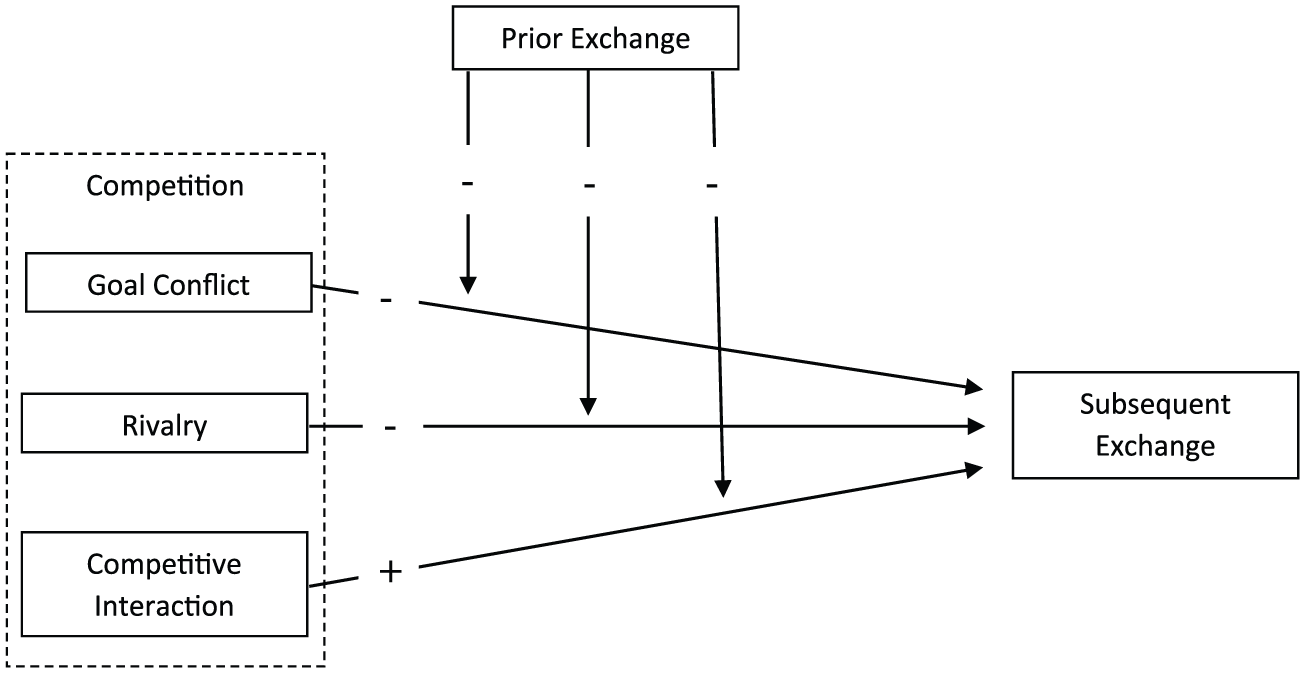
Hypothesized relationships among competition, exchange experience, and subsequent exchange.
Goal conflict
Competitors often believe their success depends on the failure of rivals (Sidanius and Pratto, 1999). In competitive environments with a limited number of customers or other resources, this zero-sum perception of competition is often warranted. Empowering a competitor through exchange may put that competitor in a position to win a larger share of resources than would otherwise be available. Likewise, empowering a competitor through exchange may deny the focal firm access to those same rewards. To the extent that payoffs are a function of relative ranking, like they are in the case of firms vying for corporate contracts or professional sports teams competing for championships and revenues from fans, concerns about strengthening a competitor will be particularly salient (Bothner et al., 2007). For example, hall-of-fame pitcher for the St Louis Cardinals, Bob Gibson, once lamented the competitive risks of trading with a competitor:
(Pitcher Steve) Carlton was obviously a great one, and delivering him to Philadelphia (in 1972) was a matter of depositing another two hundred-something victories into the account of one of our division rivals … It is virtually impossible to count the (division titles) that were kissed goodbye. (Neyer, 2006: 169)
Even when the potential upside advantage from exchange with a competitor can offset downside risk (Ghoshal and Moran, 1996), fears of potential losses often weigh more on the minds of decision-makers than the prospects of gains do (Kahneman and Tversky, 1979). Research suggests that this tendency to deviate from economic rationality exists because decision-makers often consider the non-economic psychological value of protecting self-image when making economic decisions (Josephs et al., 1992; Larrick, 1993). For example, in the context of MLB, Oakland As general manager Billy Beane hinted at the role that ego protection might play in executive decisions:
Do I have an ego? Sure. Who doesn’t? That’s why [White Sox general manager] Kenny Williams is still one of the best guys running the game, because of his experience playing the game. He’s got a certain swagger. It’s still a business, but it’s also a testosterone business. (Bryant, 2010)
By raising the stakes of exchange, goal conflict can also heighten fears of opportunism that can curtail exchange. Competitors can use exchange as a means of gaining undue advantage in ways that are detrimental to exchange partners because of the difficulty of contracting against every contingency (Williamson, 1981). In the absence of relational experience, potential exchange partners rely on the consistency of their goals to assess each other’s benevolence and trustworthiness (Williams, 2001). Indeed, when valuable resources are awarded based on relative ranking or to the winners of competitions, actors tend to behave more aggressively toward each other (Bothner et al., 2007). Thus, actors considering an exchange with a competitor may need to concern themselves with potential opportunism.
Opportunism in the context of interorganizational exchange can come in at least three forms. First, in temporally extended exchange relations characterized by unrecoverable investments, partners sometimes have opportunities to take advantage of each other by renegotiating contractual stipulations or by not meeting contractual expectations (Berk and Schneiberg, 2005; Williamson, 1975). Second, partners may face greater threats from fraud, particularly in arm’s length transactions. Arm’s length transactions can make gathering information about a potential partner and the resources to be exchanged more difficult (Granovetter, 1985). When it is difficult to know the true value of a resource, fear that the quality of resources to be exchanged is being disguised can inhibit exchange (Akerlof, 1970; Williamson, 1975). Indeed, when potential exchange partners perceive that one party would gain at the other’s expense, negotiations are more likely to involve deception (Schweitzer et al., 2005), and such deception can include both lies of commission—the strategic misrepresent of information—and lies of omission—the withholding of accurate information (Steinel and De Dreu, 2004). In fact, deception may be the greatest concern in the context of baseball player trades. For example, in 2016, MLB suspended Padres general manager A.J. Preller from executive duties without pay for 30 days for withholding medical information about a player involved in a trade with the Red Sox (Hagen, 2016). Finally, goal conflict can also heighten fears that a competitor will gain undue advantage by acquiring proprietary technical knowledge or other potentially damaging information during negotiations or after the completion of exchange (Berk and Schneiberg 2005, Oxley, 1997).
In sum, goal conflict piques perceptions of the zero-sum nature of competition. Actors may anticipate opportunistic behavior on the part of others competing for a fixed pool of rewards and fear strengthening a competitor seeking to gain an undue advantage (Pierce et al., 2013). Thus, competitive risks and opportunism risks undermine trust and commitment and discourage organization leaders from exchange with horizontal competitors.
Hypothesis 1a: Goal conflict reduces the hazard rate of interorganizational exchange.
Rivalry
Rivalry could also curtail exchange. Rivalry refers to a competitive relationship between actors that involves a heightened sense of psychological involvement, which increases the perceived stakes of competition (Kilduff et al., 2010). As a result, rivalrous actors assess their status and self-image relative to each other more so than they do relative to other competitors. By threatening decision-makers’ self-image and social status, rivalry can make the potential negative outcomes of competitive interaction and exchange seem even more significant than economic analysis would predict. Viewed this way, not all competitors are alike. Some competitors evoke higher levels of psychological involvement than others and heighten the perceived stakes of competition, independent of the structural characteristics of the situation. Moreover, such subjective feelings of rivalry can be collectively held at the level of an organization and its constituents (Gibson and Earley, 2007). Interorganizational rivalry focuses the attention of decision-makers on in-group and out-group boundaries (Ashforth and Mael, 1989; Sherif et al., 1961; Williams, 2001). In turn, such boundaries can become ends in themselves to be protected through subsequent competition and exchange behavior. Thus, fears of empowering a competitor may be particularly influential in the context of rivalry.
Fears of opportunism may also be particularly influential in the context of rivalry. Indeed, research suggests that rivals may be more likely to resort to deception or other unethical behavior to outperform each other (Kilduff et al., 2010). Across several studies, Kilduff et al. (2016) found that psychological rivalry predicts unseemly, deceptive, and unethical behaviors. In the context of MLB, one of the most infamous rivalries was the one between the Brooklyn Dodgers general manager Branch Rickey and the New York Yankees general manager Larry McPhail. In 1947, the rivalry came to a head when MLB fined Rickey because he made an unsubstantiated accusation that McPhail associated with gamblers (McKelvey, 2000). Rickey never traded with the Yankees during the remainder of his career. 1 Thus, potential exchange partners may anticipate rivals are more likely to withhold information and disguise the real value of assets to be exchanged. Combined, the heightened fears of empowering a rival and fears of opportunistic behavior on the part of rivals should reduce exchange.
Hypothesis 1b: Rivalry reduces the hazard rate of interorganizational exchange.
Competitive interaction
Horizontal competition can reveal opportunities for exchange by both providing information about potential partners and making it easier to interpret that information. Decision-makers face resource constraints that limit their ability to search for exchange opportunities, and cope with this limitation by relying on prior experiences (March and Simon, 1958). Consequently, they must rely on market knowledge developed through a recursive process of information gathering and integration (Berger and Luckmann, 1967; Weick, 1979). Competitive interaction shapes this process by drawing the attention of decision-makers. In the process of assessing and reacting to competitive threats, decision-makers develop knowledge about competitors by scrutinizing their characteristics, including their size, geographic location, product characteristics, customers, and suppliers (Porac et al., 1995; Porac and Thomas, 1990, 1994; Reger and Huff, 1993). Over time, decision-makers develop a reference group of closest competitors that narrows attention further and invites even more detailed scrutiny of competitors’ resources, capabilities, and actions (Baum et al., 2000). As competitors gain mutual awareness of each other’s resources, relative resource surpluses and deficiencies become more apparent. Where applicable, opportunities for mutually beneficial value creation and appropriation also become apparent. Because the search for exchange partners is costly (Geertz, 1978), organizational leaders use this information to economize on exchange partner search costs, and this in turn increases the likelihood of exchange between competitors. In his memoir, retired baseball executive, Syd Thrift, leant credence to the notion that greater competitive interaction among teams in the same league promotes player trades by making information available:
Some general managers feel more comfortable trading for players from their own league. Cleveland Indians president Hank Peters once told me that even if he had good scouting reports on a National League player, he always felt more comfortable if he was able to see the player for himself before he made the trade. (Thrift and Shapiro, 1990: 242)
Competitive interaction should also make information about exchange opportunities easier to interpret. In interorganizational settings, competitive interaction between organizations helps them develop common understandings (Abrahamson and Fombrun, 1994). In turn, these common understandings facilitate subsequent knowledge sharing because the possession of prior related knowledge makes the recognition and acquisition of new knowledge easier (Cohen and Levinthal, 1990; Lane and Lubatkin, 1998). Such shared understandings then increase the likelihood that competitors will recognize the value of each other’s resources and understand each other’s interests and motivations. This recognition, in turn, makes them more likely to identify opportunities for exchange.
Although competitive interaction promotes exchange through information sharing, its effects on exchange through fears of opportunism or competitive risks are more ambiguous. Indeed, competitive interaction may discourage subsequent exchange by producing lasting, residual resentments that can undermine trust and commitment (Fiske et al., 2002; Mullet et al., 2005). However, research highlights the multiplex nature of professional relationships such that competitive interaction may actually promote the development of professional friendship (Ingram and Roberts, 2000; Westphal et al., 2006). For example, MLB history contains multiple examples of interpersonal friendships that developed across interorganizational rivals. Former Mets executive Adam Fisher once described what it was like being friends with former division rival Braves executive John Coppolella:
You have friends on teams throughout the league. You root against the team, not that person. In fact, I have friends in the NL East on other teams. It’s a fraternity for us the same way it is for players. (Wilborn, 2017)
Such professional friendships among rivals may exist for at least three reasons. Professional friendships with competitors offer a means of managing competitive uncertainty. Moreover, heightened awareness of potential exchange opportunities among competitors can create an incentive to establish and maintain a positive social relationship. Finally, small acts of kindness and fair play in the context of competition may be particularly noticeable and affectively influential (Kuleshnyk, 1984). Thus, although there is some reason to think that previous competitive interaction could enhance fears of opportunism or competitive risks, there are other reasons to think the opposite is true. Considering this ambiguity, we predict that the positive information effect of previous competitive interaction dominates the effects on trust and social commitment.
Hypothesis 1c: Prior competitive interaction increases the hazard rate of interorganizational exchange.
The moderating role of prior exchange
Extant research suggests that prior exchange influences subsequent exchange. Indeed, successful prior exchange can provide information about potential partners and complementarities (Barden and Mitchell, 2007), foster trust through reciprocity and game-theoretic incentives (Gulati, 1995), and promote relational commitment through the development of emotional bonds (Lawler and Yoon, 1996) or habit (Putnam, 1995). Moreover, these effects of prior exchange tend to be interdependent (Hite, 2003), and such interdependence begs questions about how prior exchange experiences might interact with the effects of competition. In what follows, we argue that prior exchange reduces fears of competitive risks and opportunism and therefore both directly offsets and interactively reduces the negative effect of goal conflict and rivalry on subsequent exchange. Given prior research and the theoretical focus of our article, we discuss both direct and interactive effects to clarify the distinction, but we only articulate formal hypotheses about the interactive effects. Furthermore, we argue that prior exchange provides informational benefits that reduce the positive effects of competitive interactions on subsequent exchange.
By reducing the negative influences of goal conflict and rivalry, prior exchange experiences with a competitor can be particularly influential. As previously argued, goal conflict and rivalry can enflame concerns of empowering a competitor and increase the fears that a competitor might behave opportunistically. However, trust and commitment developed through prior exchange experiences can alleviate fears of opportunism in several ways. Prior exchange experiences directly reduce fears of opportunism by offering information about the reliability of potential exchange partners (Uzzi, 1997) and by setting up game-theoretic incentives to behave reliably due to the prospect of future exchanges (Gulati, 1995). Commitment developed through prior exchanges can also enhance the reliability and value of potential exchange partners (Lawler and Yoon, 1996). As actors in a dyad engage in exchange more frequently, they develop norms of equity and reciprocity, and engender feelings of mutual obligation (Blau, 1964). Interorganizational relations sometimes facilitate the development of interpersonal friendships and social capital among individual decision-makers that can offset competitive risks. Moreover, exchange can also promote the development and replication of ideological similarities that motivate subsequent exchange (McPherson et al., 2001). Together, these factors suggest that trust and social commitments developed through prior exchange directly promote exchange and offset the negative effects of fears of competitive risks and opportunism.
The robust trading relationship developed between league rivals Kansas City and New York during the late 1950s exemplifies the efficacy of prior exchange in the MLB context. Across multiple trades, the Kansas City Athletics and the New York Yankees exchanged 16 players, including home run champion Roger Maris. In describing the relationship, Yankees’ general manager George Weiss said, “We have tried unsuccessfully to trade with other clubs in both leagues. The Yanks and Kansas City have faith in each other.” Indeed, Kansas City owner, Arnold Johnson, and Yankee owners Dan Topping and Del Webb, had a business relationship that extended beyond baseball player trades to include, among other things, a legal tax avoidance scheme whereby Johnson purchased Yankee Stadium and leased it back to Topping and Webb (Neyer, 2006).
Prior exchange ties not only directly promote subsequent exchange, they also interactively reduce the negative effects of competition in at least two ways. First, positive relational information gained through prior exchange experiences may decrease the salience of negative contextual information, including rivalry and goal conflict by providing positive relational information. Indeed, exchange decision-makers cope with their limited ability to process information by allocating attention to the most salient cues and limiting attention to others (Kim, 2006; Ocasio, 1997). If exchange experiences distract exchange decision-makers from rivalry and goal conflict concerns, then relational experiences may foster exchange through both trust development and a reduction in opportunism fears. Second, positive affect developed through prior exchange experiences may moderate the attention to and processing of rivalry and goal conflict concerns during subsequent exchange decisions (Williams, 2001). Indeed, research suggests that perceived goal conflict and relational experience have both direct and interactive effects on trust such that the negative effect of goal conflict on trust is weakened by relational experience (Hill et al., 2009). In turn, these interactive effects of goal conflict and exchange experience on trust should ultimately influence subsequent exchange behavior.
Such interactive effects may be seen in the professional friendship between MLB’s John Holland and Bing Devine. Between 1958 and 2003, no two general managers completed more trades than John Holland and Bing Devine. The two completed 18 trades between 1958 and 1974, despite being general managers of the rival Cubs and Cardinals for most of that time. In fact, their trading relationship was most noted for the infamous Lou Brock–Ernie Broglio trade in 1964. Despite rumors that the Cardinals unethically knew they were trading an injured pitcher to the Cubs at the time, the two executives did not lose faith in each other and completed seven more trades over the next decade (Castle, 2014).
Hypothesis 2a: Prior exchange reduces the negative influence of goal conflict on the hazard rate of interorganizational exchange.
Hypothesis 2b: Prior exchange reduces the negative influence of rivalry on the hazard rate of interorganizational exchange.
The negotiation and execution of exchange also help actors develop mutual knowledge about each other’s resources and capabilities. Resources and capabilities not previously exchanged represent opportunities for future exchange should the need arise. Indeed, such mutual knowledge enables the calculative assessments underlying opportunity recognition, and ameliorates the cost of subsequently searching for exchange partners. If a need arises and a previous exchange partner can make a satisfactory offer, then the focal actor might choose to forgo the search for other potential partners, and immediately execute the exchange at hand. Knowledge developed through prior positive exchange moderates the positive effect of competitive interaction on subsequent exchange because the informational effects of prior exchange and competitive interaction can be redundant. Decision-makers will rely on questionable sources of information when better quality sources are not available, but will switch to sources developed through interpersonal relations when possible (Borgatti and Cross, 2003; O’Reilly, 1982). Consequently, competitive interaction may not offer useful information about potential complementarities or actor reliability if prior exchange enables the exchange of richer relational information. Thus, the information gleaned through prior interactions substitutes for the informational effects of competitive interaction and reduces the positive effect of competitive interaction on exchange.
Hypothesis 2c: Prior exchange reduces the positive influence of prior competitive interaction on the hazard rate of interorganizational exchange.
Method
Sample
We examine the joint effects of competition and prior exchange ties on the hazard rate of MLB player trades over the 17 years from April 1985 to March 2003. Because MLB teams own the rights to their players, and players are a key resource determining the quality of teams, player trades between teams constitute an important means by which managers improve and renew the organization’s resources (Sirmon et al., 2008). During this time, there were 30 teams, 435 dyads, 6771 dyad-years and 1636 trades.
The MLB player trades studied here constitute an appropriate sample for our study for three reasons. First, MLB employs a league and division system that creates identifiable differences in competitive intensity, and those differences are believed to be influential on trading behavior. Teams in the same division play more games against each other than teams in the same league, and teams in the same league play more games against each other than teams in different leagues. Teams also compete within divisions to qualify for playoff contention more than they do across divisions and leagues. Consequently, baseball analysts note that it is rare to see intense competitors strike significant deals (e.g. Keri, 2014), and this begs questions about the viability of intradivision trades (McPhail, 2010).
Second, player trades are arm’s length transactions that do not depend on opportunities that tend to be disproportionately available to competitors. Prior research on exchange between competitors tends to focus on cooperative activities, like joint research and development, co-production, and lobbying efforts by industry associations. Consequently, prior research is unable to distinguish the information effects of competitive interaction from the influence of competitor-specific opportunities. In contrast, player trading almost exclusively involves the exchange of private benefits where each side of a transaction must give up what the other side obtains. In other words, on average, teams gain no special benefit from trading with competitors, although idiosyncratic advantages of trading with some competitors may exist.
Third, the relevance of prior exchange—the developments of mutual knowledge, trust, and commitment—can be observed in this setting. Although teams employ player scouts to collect information on players on other teams, the sheer volume of players (750–800 MLB players and 4000–5000 minor-league players) and the variation in their values due to injuries and development makes an accurate cross-sectional assessment of all players impossible. Trust, which can alleviate concerns about competitive risks and opportunism, is an important consideration for managers in a player trade. Many factors affecting the value of a player in a trade, including player health and professionalism, are not easily observable outside organizational boundaries and enhance the risk of fraud in trade negotiations. Players who get traded to other teams can also disseminate information about the weaknesses of their former teams.
Dependent variable
Within team dyad-years, teams can execute multiple, distinct trades; however, anecdotal evidence and our quantitative analysis suggest that temporally proximate trades are interdependent. Given the risk of assuming that the count of trades within a team dyad-year is an outcome of multiple, independent Bernoulli trials, we conservatively restrict the outcome of interest to a dichotomous variable that equals “1” if a trade occurred between two teams in a given year, and “0” otherwise. Less than 3% of team dyads had more than one trade in a given year, and removing instances of multiple trades from the analysis does not substantively change the results of the hypothesis tests. We rely on a Cox regression model to predict the hazard rate of a player trade between dyad teams. Like other forms of event history analysis, Cox regression accommodates right censoring of the data; however, it also offers the benefit of flexibly estimating the base hazard rate across the at-risk period (Tuma and Hannan, 1984). Cox models are mathematically related to pooled logistic regression (D’Agostino et al., 1990; Langholz and Richardson, 2009), but Cox regression produces less biased results (Ngwa et al., 2016). These advantages help explain why Cox regression is commonly used to model interorganizational exchange (e.g. Barden and Mitchell, 2007; Kim and Higgins, 2007; Reuer and Tong, 2010).
Independent variables
Competition
This study examines the effects of three aspects of competition: goal conflict, rivalry, and prior competitive interaction. As previously noted, goal conflict exists when an organization’s intended operations negatively affect the performance of others through the pursuit of similar inputs or outcomes. Rivalry represents subjective feelings of competition that raise the stakes of competition, independent of economic outcomes or competitive contact.
Competitive interaction reflects interorganizational contact that could facilitate the development of mutual knowledge.
In this study, we identify two potential determinants of goal conflict: dyad teams’ membership in the same division and dyad teams in the same geographic region. Goal conflict among division foes stems from two sources. First, teams play the largest portion of future games against teams in the same division. As a point of reference, in 2013, of a team’s 162 games, 76 were played against their four division rivals (19 each), 66 were played against 10 teams in the same league but in a different division (six or seven each), and the remaining 20 games were played against teams in the other league. Second, division foes directly compete for division-specific playoff spots. Moreover, financial performance is significantly influenced by playoff appearances and victories (Silver, 2006). A team that financially benefits from winning and making the playoffs does so at the expense of another team that does not make the playoffs. Consequently, the degree of zero-sum competition is greatest among division rivals because one team’s success more directly relates to another’s poor performance. Thus, we create an indicator called same division, and code it as “1” if a particular team dyad is in the same division, and “0” otherwise.
Prior research identifies geographic proximity as a source of competition (Kilduff et al., 2010). Organizations in the same geographic region often compete for resources, such as fans in the case of professional sports teams. Moreover, geographic proximity makes competitors more salient to each other (Porac et al., 1995). Indeed, local media provide greater coverage and make more comparisons between MLB teams in the same geographic market. We, therefore, use a binary variable called same market, which we code as equal to “1” when teams exist within 100 miles of each other (e.g. the New York Mets and Yankees, the Chicago Cubs and White Sox), and “0” otherwise. Using a continuous variable does not substantively alter the results.
We include two variables associated with rivalry. First, we use dichotomous variable indicating historical rivalries. A review of popular online media lists 2 of MLB rivalries revealed only three rivalries that are common across all lists—the Yankees and Red Sox, the Cubs and Cardinals, and the Dodgers and Giants. Although most lists are journalists’ subjective judgments, these three rivalries top Reddit Baseball’s fan survey 3 and appear in Fangraph’s Google hits study. 4 Second, we included a dichotomous variable indicating whether teams played each other in the playoffs in the previous season. Our inclusion of a separate variable equal to the number of games played in the previous season should disentangle the potential effects of competitive interaction from those of rivalry.
Prior competitive interaction creates opportunities for teams to learn about each other’s resources and about potential trading opportunities. We measure prior competitive interaction using the total number of games played between two teams in the previous year. We include in this measure both regular season games and playoff games to disentangle the effects of competitive interaction from rivalry and goal conflict. Particularly intense competitive interaction can produce rivalry. However, two factors suggest that this is not an issue in our study. First, the study’s results do not suggest that historical interorganizational rivalry or rivalry from recent playoff matches influences exchange behavior. Thus, we do not have good reason to think that less-intense competitive interaction generates influential rivalry. Second, any residual rivalry from competitive interaction that exists in our sample makes the results from our test of Hypothesis 1c more conservative, and yet we find statistically significant effects that support the hypothesis.
Prior exchange ties
We argue that prior exchange moderates the effect of competition on the likelihood of exchange. Existing studies use prior exchange ties to indicate the developments of knowledge sharing, trust building, and relational commitment (e.g. Barden and Mitchell, 2007; Gulati, 1995; Gulati and Gargiulo, 1999). Consistent with this approach, we use previous player trades because player trades have a direct influence on the development of these mechanisms. Although trust violations are a meaningful concern among baseball team general managers (Thrift and Shapiro, 1990), reports of post-trade disputes are rare. Thus, we assume that the majority of trades were satisfactorily executed and the results of this study support that assumption.
We operationalize exchange ties in two steps. First, we count the number of players traded in a particular dyad in the previous 3 years. In step 2, we apply a linear decay function to the count derived in step 1 to account for the effects of changes in organizations’ administrative personnel, administrator memory loss, and changes in player rosters. This 3-year decay function produces a better overall model fit than 1-, 2-, 4-, 5-, and 7-year linearly decayed and undecayed windows, and all produce similar hypothesis test results.
Control variables
We use several control variables to account for alternative reasons MLB teams exchange players. First, extant research suggests organizations with complementary assets are more likely to engage in exchange, thus we control for three sources of asset complementarity: skill differences between dyad teams, payroll differences, and in-season performance differences. Skill differences are important for understanding exchange because teams with a surplus of pitchers may tend to trade with teams with a surplus of hitters, and vice versa. We operationalize team skill differences as the normalized sum of a dyad’s differences in pitching and batting, which we update each season

where SD AB,t is the skill difference between teams A and B in year t; Z t (RPI A,t ) is team A’s standardized runs per inning in year t, which is a measure of team A’s offensive capabilities and Zt(ERA A,t ) is team A’s standardized earned run average in year t, which is a measure of a team A’s pitching capabilities. A robustness test using fielding independent pitching (FIP) and weighted runs created (wRC) 5 (Tango et al., 2006) instead of ERA and RPI does not substantively alter the results of the hypothesis tests. We also control for the difference in payrolls for each dyad because wealthier teams tend to acquire expensive veteran players in exchange for less expensive, younger players. Finally, we control for in-season performance differences. Team performance differences are important for understanding player trading because high-performing teams have an interest in acquiring useful players during the latter part of each season to improve their chances of success in the playoffs. In contrast, poorer performing teams with little chance of qualifying for the playoffs have an interest in cutting losses by trading away expensive players in the final years of their contracts. Consequently, teams with similarly strong or weak in-season performance tend to have less interest in trading players with each other. Therefore, we use a control variable equal to the difference in teams’ winning percentages in each dyad-year.
Teams with more opportunity for interaction are better able to glean insights on others’ resources, and those insights might increase the likelihood of exchange. Because each employee of a team represents a potential point of contact for other teams, we control for dyad total employment, which we operationalize as a count of the number executives, scouts, and administrative personnel. We collected these data from the Sporting News Official Baseball Guide series. We did not include players in that count. Because dyad members’ exchange with common third parties could be an important structural source of embeddedness, we included a measure of third-party ties when we entered the measure of relational embeddedness in the analysis. We measured third-party ties by creating network matrix cross-product sums using UCINET 6 (Borgatti et al., 2002). Including variables that capture the interactive effect of competition and third-party ties does not significantly improve the statistical fit of the model. Because new general managers tend to reshape teams, we control for the presence of a new general manager in the dyad, operationalized as a “1” if either team in the dyad has a new general manager in the current year, and “0” otherwise. During the sample frame, MLB created four new teams: the Colorado Rockies and Florida Marlins in 1993; and the Arizona Diamondbacks and Tampa Bay Devil Rays in 1998. These teams faced a different market for resources than existing teams (e.g. they were permitted to select players from existing teams) that might influence the likelihood they make player trades. We therefore include a control variable for the number of expansion teams in the dyad, linearly decayed over 3 years.
Several factors common to all MLB teams, such as macroeconomic conditions and the general availability of free agent players, can influence patterns of exchange over time. To account for these factors, we control for year fixed-effects. We also introduce team fixed-effects for both teams in each dyad to control for unobserved team characteristics that affect the propensity to trade players and account for the non-independence of dyad-years.
Results
Table 1 reports the descriptive statistics and bivariate correlations of the variables used in the final analysis.

Correlations with absolute values above .023 are significant at p < .05.
N = 6771.
Table 2 reports the results of the Cox regression analysis predicting the hazard rate of player trades. Model 1 estimates the effects of the control variables on the hazard rate of exchange. Statistically significant coefficients in model 1 offer validity checks. The statistically significant coefficient on skill difference suggests that teams with a relatively strong portfolio of offensive players tend to trade with teams with a relatively strong pitching staff. The statistically significant coefficient on payroll difference suggests that wealthy teams might tend to trade with poorer teams; however, the coefficients on this variable in models 3 and 4 are not statistically significant. The statistically significant coefficient on in-season performance difference suggests that teams with a chance of making the playoffs have an interest in acquiring relatively expensive players from poor performing teams; however, the coefficients on this variable in models 3 and 4 are not statistically significant. Consistent with research on networks (Shipilov et al., 2014), the statistically significant coefficients on the total employment variable and third-party ties suggests that larger organizations with more employees appear more likely to find attractive exchange opportunities. Consistent with research on structural inertia of organizations (Barden, 2012), the coefficient on general manager (GM) change suggests that leadership changes spur other organizational changes. Likewise, the coefficient on average team performance suggests that poor performance spurs organizational changes.
Results of Cox regression analysis predicting interorganizational exchange.
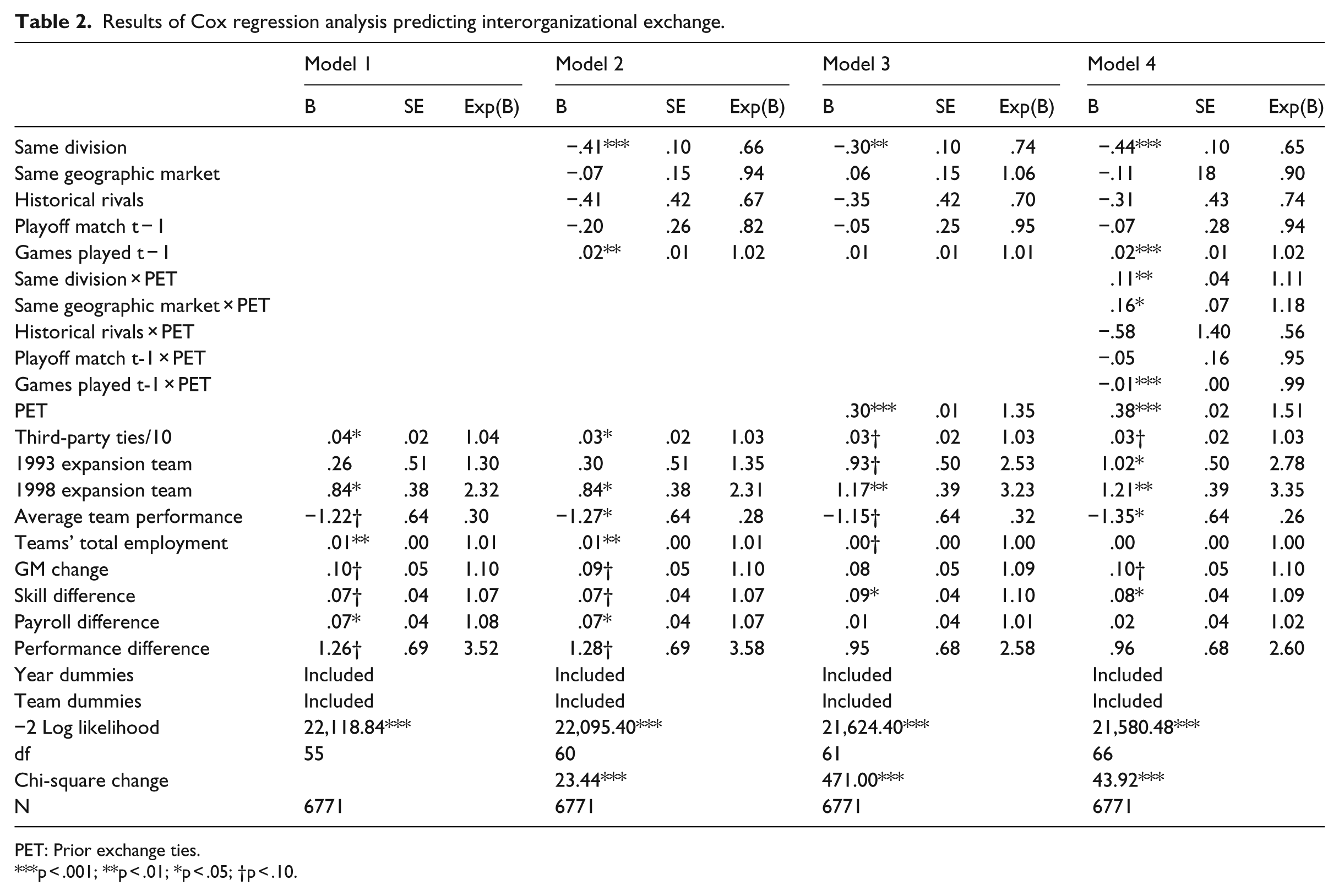
PET: Prior exchange ties.
p < .001; **p < .01; *p < .05; †p < .10.
Models 2 and 3 test hypotheses 1a, 1b, and 1c. Hypothesis 1a suggests that goal conflict reduces the hazard rate of subsequent exchange. Results of models 2 and 3 provide partial support for hypothesis 1a. Both models suggest that being in the same division appears to decrease the hazard rate of subsequent exchange between dyad teams (p < .001). Specifically, the exponent of the coefficient in model 3 suggests that being in the same division generally reduces the hazard rate of exchange between two teams by 26%. The coefficients on the same geographic market variable are not statistically significant in models 2 and 3. Thus, models 2 and 3 offer partial support for hypotheses 1a. Hypothesis 1b states that rivalry reduces the hazard rate of subsequent exchange. None of the coefficients on the historical rivalry and playoff match variables are statistically significant. Thus, hypothesis 1b is not supported. Hypothesis 1c suggests that prior competitive interaction increases the hazard rate of subsequent exchange. The coefficient on the games played t − 1 variable is statistically significant in model 2 (p < .01); however, it is not significant in model 3 where the prior exchange ties variable is included. Thus, hypotheses 1c is not supported.
Model 4 tests hypotheses 2a, 2b, and 2c, which predict that prior exchange ties have a moderating effect. Hypothesis 2a suggests that prior exchange ties reduce the negative effects of goal conflict on the hazard rate of subsequent exchange. In model 4, the coefficients on each of the three of interaction variables between goal conflict and exchange ties are statistically significant (p < .05) and in the predicted direction. Results suggest that when exchange ties over the previous 3 years do not exist, being in the same division decreases the hazard rate of exchange between team by 35%. However, in the presence of high prior exchange ties—1 SD above the mean—being in the same division only reduces the hazard rate of exchange between team by 2%. Results suggest that when exchange ties over the previous 3 years do not exist, being in the same geographic market decreases the hazard rate of exchange by 10%. However, in the presence of high prior exchange ties, being in the same geographic market increases the hazard rate of exchange by 43%. Together, these two results support hypothesis 2a. Hypothesis 2b suggests that prior exchange ties moderate the influence of rivalry on subsequent exchange. The coefficients on the rivalry-related interaction variables—historical rivals and playoff match—are not statistically significant. Thus, hypothesis 2b is not supported. Finally, results of model 4 also show a significant, negative interaction between prior competitive interaction—games played in the prior season—and exchange ties (p < .001). When exchange ties over the previous 3 years do not exist, mean competitive interaction increases the hazard rate of subsequent exchange by 13%. However, in the presence of high prior exchange ties, mean competitive interaction decreases the hazard rate of subsequent exchange by 7%. Thus, the analysis supports hypothesis 2c.
Discussion
This study contributes to the literatures on competition and interorganizational exchange. Early explanations of interorganizational partner selection emphasize the roles of resource distribution (e.g. Pfeffer and Salancik, 1978) and prior exchange (e.g. Baker, 1990; Uzzi, 1996). Drawing on numerous examples of co-opetition and other forms of exchange between competitors, recent interorganizational research highlights the seemingly paradoxical role of horizontal competition. Existing research explains this relationship between horizontal competition and exchange by highlighting the determining role of benefits that can only be provided by exchange with horizontal competitors (Lado et al., 1997). For example, similarities among competitors can motivate the establishment of industry associations, technical standards bodies, and R&D alliances. We go beyond this explanation by studying the influence of horizontal competition on interorganizational exchange when those benefits are, on average, not available, and we do so by examining three important aspects of competition: goal conflict, rivalry, and competitive interaction.
We find evidence that goal conflict decreases the hazard rate of exchange, especially in the absence of prior exchange ties. This evidence suggests that intense competition among division foes might curtail exchange by heightening fears of opportunism and competitive loss. Competitors may avoid engaging each other due to concerns that a competitor will misrepresent the value of the resources and capabilities being exchanged (Akerlof, 1970). In addition, competitors must consider the risk of intellectual property leakage (Oxley, 1997). In the context of baseball, players traded to division rivals may leak advantageous insider knowledge of former teammates’ hitting or pitching tendencies. Competitors may also avoid exchange due to concerns that a poor decision could be detrimental to future performance and reflect badly on decision-makers (Larrick, 1993). Future research could tease apart the relative influences of these mechanisms. We do not find evidence that teams’ geographic market overlap has a direct effect on subsequent exchange. This finding suggests that either geographic market overlap is not a significant concern or that any negative effects of geographic market overlap are masked by other factors. Indeed, it is possible that local media coverage or other local social network connections between organizations increase the likelihood that geographically proximate teams will discover trading opportunities, and that this information effect of geographic proximity overwhelms any negative effect of competition for local fans.
We do not find evidence that rivalry influences trading behavior in the context of baseball player trading. This lack of evidence could indicate that team executives are less influenced by rivalry than fans are. However, limitations in our measures of rivalry could also obscure the effects of rivalry. Rivalry is a cognitive construct and there is no way to retroactively measure cognition in a direct way. Thus, we rely on proxies for rivalry that may not accurately capture cognition.
In model 2, we find some evidence that competitive interaction between organizations increases the hazard rate of exchange between them; however, this effect is not apparent in model 3 where the prior exchange ties variable is included. Combined with the results of model 4, this implies that the positive effect of competitive interaction can, under certain circumstances, increase the chance of interorganizational exchange by promoting mutual awareness and lowering search costs. Consistent with cognitive models of competition (Porac et al., 1995), these results suggest that competitive interaction focuses attention in a way that may give competitors a better chance of noticing each other’s portfolio of resources and capabilities. Familiarity developed through competitive interaction may also facilitate exchange opportunity recognition by increasing the ability of potential partners to make sense of information about each other’s resources and capabilities. Future research could tease apart the relative influences of these mechanisms.
Finally, the results of model 4 validate and extend the study’s findings by demonstrating the moderating influence of prior exchange ties. Received research on prior exchange ties in interorganizational relations suggests that prior exchange ties facilitate the development of trust and social commitment among decision-makers. If so, then prior exchange ties may generally offset concerns about the risks of exchange with a competitor. However, consistent with prior research (Hill et al., 2009), this study’s results suggest that prior exchange ties also interactively reduce the negative influence of goal conflict on exchange. As previously argued, this moderating relationship could reflect shifting attention and the substitution of relational information for goal-related information in the decision process (Kim, 2006; Ocasio, 1997). Alternatively, it could also reflect the moderating influence of relationship-based affect on calculative determinants of exchange (Williams, 2001). Future research could examine the relative influences of these mechanisms. Prior exchange ties also appear to moderate the effect of geographic market overlap in the predicted direction, although results do not demonstrate a statistically significant direct effect. This finding might support our previous suggestion that multiple countervailing mechanisms link geographic market overlap to exchange. However, it is also possible that geographic proximity facilitates the positive effect of prior exchange ties on exchange because such proximity facilitates communication. Finally, prior exchange ties appear to negate the positive effect of competitive interaction on exchange. This finding suggests that prior exchange ties and competitive interaction are redundant sources of information about exchange opportunities, and that the informational benefits associated with prior positive exchange appear to substitute for the informational benefits owing to competition. Consistent with a relational information perspective (Borgatti and Cross, 2003; O’Reilly, 1982), exchange-related information about competitors through competitive monitoring may not be useful when that information can be gathered through direct exchange.
Together, these findings reinforce a key assumption underlying research on exchange between competitors. Competition and exchange are not simply opposite ends of a single continuum (Chen, 2008). Competition is a multifaceted construct that can be positively related to exchange under certain circumstances. Moreover, the positive relationship between competition and exchange cannot just be attributed to the existence of special benefits that are uniquely available to competitors. By studying a context where there is, on average, no advantage to exchange with competitors, we distinguish the positive influence of competitive awareness from outcome-related motivations. For academics, these findings offer a more nuanced theory of exchange among competitors. Given that cooperation can be conceptualized as a temporally extended form of exchange, this study could also offer useful insights to the co-opetition literature. For practitioners, the findings serve as a reminder that competition is both an opportunity and a threat. For policy-makers, the results illustrate a mechanism by which industry structure takes shape.
For researchers, the findings also offer an interesting contribution to the literature on relational embeddedness. Relational embeddedness reflects closeness between parties that is developed through prior exchange. Received research on relational embeddedness emphasizes the role of positive exchange experiences in developing mutual understanding, trust, and commitment (Barden and Mitchell, 2007; Moran, 2005; Rowley et al., 2000). However, competitive interaction can also be considered a form of exchange that increases mutual understanding but threatens trust and commitment. Can the closeness that develops over time between competitors be considered relational embeddedness? If so, scholars should consider elaborating the concept of relational embeddedness and treating its components—mutual understanding, trust, and commitment—like independent constructs rather than like a unitary construct.
We believe the results of this study regarding the effects of competition on exchange and how prior exchange ties shape this relationship are generalizable to a wide range of interorganizational settings. Nonetheless, the degree of generalizability of the findings remains an open question. Three factors—dyad characteristics, exchange characteristics, and context characteristics—could play a role.
First, MLB organizations are relatively small with less than 1000 personnel, including players. Scouts, analysts, and executives responsible for formulating and executing player trades typically number in the dozens. With exceptions, leadership in baseball organizations also tends to change frequently with the on-field fortunes of the teams from year to year. The cognitive processes of larger or less dynamic organizations may differ, and that could alter the effects of competition and prior exchange on subsequent exchange behavior. For example, larger organizations may be inherently more political and more risk averse in dealing with competitors. Organizations with lower employee turnover may have longer organizational memory, so the effects of prior exchange ties are stronger.
Second, differences in the nature of the exchange could alter the effects of competition and prior exchange ties. Our results are probably most applicable to moderately complex, arm’s length transactions. Due to their complexity, the value of human resources, including baseball players, can be difficult to assess. Sales of patents or other complex intellectual property might demonstrate similar characteristics. Exchanges of simpler resources, such as after-market sales of raw materials, may entail less risk of opportunism, and therefore may be less influenced by competition or prior exchange ties. Temporally extended cooperative exchange, like R&D alliances, may or may not be more influenced by competition or prior exchange ties. On one hand, the complexity of an ongoing exchange relationship might make competition and prior exchange ties more important, but the ongoing nature of alliances might also reduce the relevance of competition and prior exchange ties because the shadow of future exchange can set up game-theoretic deterrents against opportunism (Gulati, 1995). Future research should assess the way organization characteristics, dyad characteristics, and exchange characteristics condition the relationships found by this study.
Third, differences in context could alter perceived rivalry or risk in ways that influence exchange decisions. For example, a threat from a third party could reduce the perceived rivalry between competitors, and make a trade between those competitors more likely. Also, patterns of resource munificence and scarcity could increase or decrease the perceived risk of a particular exchange, making it more or less likely.
Our study also does not fully consider the effects of interpersonal relations. Rather, the focus of the present study is the interorganizational level. Organizations are inherently complex and multiplex interpersonal ties constitute the relations between them. Particular interpersonal relationships or patterns of interpersonal relationships could influence interorganizational exchange in different ways. Indeed, research suggests that managers at competing organizations readily form interpersonal friendships (Ingram and Roberts, 2000; Westphal et al., 2006), and future research could examine how the structure and content of interpersonal relations influence interorganizational relations among competitors.
In sum, we find that horizontal competition has a complex relationship with interorganizational exchange. We contend a paradox of competition exists whereby mutual awareness among competitors promotes exchange but the threats of competition can inhibit it. Our results show that goal conflict reduces exchange, but prior competitive interaction increases it. Furthermore, the knowledge, trust, and commitment built through prior exchange both alleviate concerns associated with goal competition and substitute for the informational benefits of competitive interaction.
Footnotes
Acknowledgements
The authors thank editor Tim Rowley and the anonymous reviewers for Strategic Organization for their helpful comments and suggestions.
Declaration of Conflicting Interests
The author(s) declared no potential conflicts of interest with respect to the research, authorship, and/or publication of this article.
Funding
The author(s) received no financial support for the research, authorship, and/or publication of this article.