







Abstract
This study focuses on the role of intrinsic speed capabilities, which refer to the ability to execute investment projects faster than competitors, in the attractiveness and selection of alliance partners. We predict that intrinsically faster firms have a higher likelihood of being selected as alliance partners due to the potential of accelerating the realization of future revenue streams of an alliance project as well as of preempting slower competitors. We also expect that intrinsic speed capabilities substitute for deficiencies in alliance experience and firm innovativeness. Using data on construction projects in the global Liquefied Natural Gas industry, we find empirical support for our theoretical expectations. Our results suggest that firm speed plays an important role in alliance partner selection and has the potential to facilitate the generation of future growth options for firms due to greater partner attractiveness in the market for alliance partners.
Keywords
Introduction
Partner selection has been emphasized in the corporate strategy literature as a critical component of firms’ alliance strategies to obtain needed resources or capabilities (Ahuja, 2000; Barney, 1999; Rothaermel and Boeker, 2008). Following this resource- and capability-based logic, existing research on partner selection indicates that prospective partners are attractive and likely to be selected if they possess skills, competencies, and/or capabilities that are useful to a focal firm (Hitt et al., 2000, 2004; Luo, 1997). Significant evidence has accumulated in the partner selection literature for a wide range of specific resources and capabilities that make firms attractive as alliance partners, and these resource-based drivers therefore represent important considerations for firms that wish to elevate their attractiveness on the market for alliance partners.
While this body of literature gives us a good foundational understanding of the resource- and capability-based drivers of firm attractiveness on the market for alliance partners, one broader puzzle that remains is how firms with deficiencies in these attributes can get selected for alliance opportunities. Many firms do not possess above-average endowments of the aforementioned resources and capabilities, and the literature taken at face value seems to imply that these firms might find it difficult or impossible to engage in partnerships. We thus know less about ways in which firms might address deficiencies in certain resources and capabilities that influence alliance partner selection and thereby enhance their attractiveness on the market for alliance partners.
In this article, we fill this gap by focusing on one particular firm-specific attribute, the intrinsic speed capabilities of the firm, that has not been subject to theorizing and analysis in the partner selection literature, yet may enable firms to address deficiencies in other well-known capabilities that drive alliance partner selection. By intrinsic speed capabilities of the firm, we mean the ability of firms to execute investment projects faster than average at the same cost (Hawk et al., 2013; Pacheco-de-Almeida et al., 2015). We ask two main research questions: First, are firms more likely to select intrinsically fast partner firms for their collaborations? Second, can the speed capabilities of potential partners also substitute for other determinants of partner selection?
Our goal is to develop and empirically test nuanced theory about the role of intrinsic speed capabilities of partner firms in the alliance partner selection process. Our starting premise is that intrinsically fast firms should be more desirable alliance partners and have a higher probability to be selected in the alliance partner selection process. An intrinsically fast partner can help focal firms enter markets more quickly, leading to realization of future revenue streams sooner while at the same time securing a better chance of preempting competitors. In addition, we expect intrinsic speed capabilities to substitute for other well-known drivers of partner attractiveness on the market for alliance partners. Specifically, we expect that partner firm intrinsic speed capabilities can substitute for both alliance experience and firm innovativeness by creating temporal slack that may make up for delays associated with coordination issues resulting from alliance inexperience or from less adaptable and innovative human capital. Thus, our theory suggests that intrinsic firm speed is a means by which firms can make up for deficiencies in other important resources and capabilities that would otherwise make a firm less attractive on the market for alliance partners. We test and find support for these ideas from a unique dataset of collaborative projects in the global liquefied natural gas (LNG) industry.
Our study provides several contributions to the corporate strategy literature and to managers engaged in external corporate development activities. In broad terms, we join together the literature on alliances with the literature on firm speed that originates in competitive strategy research. This enables us to build upon and extend the partner selection literature by demonstrating that a firm’s intrinsic speed capability is an important driver of a firm’s attractiveness as an alliance partner, both as a direct effect and as an indirect effect inasmuch as it substitutes for other important drivers of partner selection (i.e. alliance experience, firm innovativeness). We also join research on alliance formation motives, which has routinely invoked if not studied speed considerations, with the partner selection literature, which has emphasized other capabilities as this empirical stream of research has developed (e.g. Diestre and Rajagopalan, 2012; Geringer, 1991; Hitt et al., 2000, 2004; Hoetker, 2005; Li et al., 2008; Luo, 1997; Mowery et al., 1998). We argue and show that speed capabilities affect partner selection in a subtle and complex way, and we also demonstrate that speed capabilities alter already-studied resource and capability-based drivers of firm attractiveness on the market for alliance partners. For executives, we also provide insights into intrinsic firm speed as an additional avenue of potential value creation via the generation of additional potential growth opportunities due to being a more attractive potential alliance partner. Our arguments and evidence demonstrate that a firm’s intrinsic speed can be particularly important as a way for firms to substitute for deficiencies in other capabilities in markets for alliance partners.
Theory and hypotheses
In order to develop our theoretical infrastructure and predictions, we first review background theory on speed capabilities from the competitive strategy literature and then review the literature on partner firm attractiveness from the corporate strategy and alliances literature. This background is helpful to set up our integration of theoretical concepts that have developed separately in the competitive strategy and corporate strategy literatures, respectively. As we will discuss, this integration is made possible by the fact that the literature on partner selection has drawn on resource-based theory, as has the literature on firm speed, in particular the foundational concept of time-compression diseconomies. After this background discussion, we then develop our theoretical predictions.
Speed in resource accumulation and intrinsic speed capabilities
A large body of research in competitive strategy has underscored the importance of the resource accumulation process and resources and capabilities more broadly (Barney, 1986, 1991; Wernerfelt, 1984). While resources are often the sources of competitive advantage for firms, a reality that firms face is that the resource accumulation process takes time (Dierickx and Cool, 1989). Firms may face substantial time lags to develop new resources that enable them to deliver products or services to markets (Cohen et al., 2000; Koeva, 2000; Pacheco-de-Almeida et al., 2008; Salomon and Martin, 2008). Resource accumulation is also likely to be subject to time-compression diseconomies, a theoretical phenomenon in which costs tend to escalate as project development is accelerated (Dierickx and Cool, 1989). There are several theoretical drivers underlying time-compression diseconomies, such as diminishing returns associated with allocating more resources and people to accelerate a project, information loss associated with parallel processing, and cost escalation from trying multiple approaches to locate the optimal approach for acceleration (Graves, 1989; Hawk and Pacheco-de-Almeida, 2018).
Given these temporal considerations, speed in resource accumulation plays a fundamental role in competitive strategy. Importantly, the ability of firms to execute investment projects speedily has a direct impact on the future performance of firms. For instance, faster development of resources enables firms to realize future revenue streams sooner from completed investment projects. Faster execution of investment projects may also enable firms to preempt competitors and enter a promising market sooner, which may yield benefits in terms of having an earlier pick on potential sites and relationships with suppliers and consumers. Faster execution of investment projects may also make firms more responsive to changes in market conditions, enabling the firm to be more adaptable and responsive to external changes. These fundamental dimensions of speed in strategy have important implications for numerous streams of research in strategy, such as time-based competition (Stalk, 1988; Stalk and Hout, 1990), dynamic capabilities (Dykes et al., 2018; Eisenhardt and Martin, 2000; Helfat et al., 2007; Teece et al., 1997; Wollersheim and Heimeriks, 2016), new product development (Smith and Reinertsen, 1998), and first mover advantages (Lieberman and Montgomery, 1988, 1998).
Given the heterogeneity in capabilities, firms are also likely to differ in their ability to move quickly and execute investment projects faster than the competition. Some firms may possess intrinsic speed capabilities, which refer to the ability of firms to execute projects faster than competitors at the same cost and resource requirements (Hawk et al., 2013; Pacheco-de-Almeida et al., 2015), and stem from better managerial capabilities at coordinating and communicating internally to deploy resources and people to execute investment projects. A variety of organizational factors may be related to intrinsic speed capabilities such as the firm’s project management culture and processes, firm-specific experiences, and capabilities stemming from skilled teams of engineers and other human capital. For these firms, the theoretical drivers underlying time-compression diseconomies are lower, enabling the firm to compress time at a lower marginal cost and execute investment projects faster than competitors. Firms possessing intrinsic speed capabilities are likely to have several advantages in resource accumulation. Most fundamentally, intrinsically fast firms are able to complete investment projects sooner, accelerating the realization of subsequent revenue streams and ultimately enhancing firm performance. Intrinsically fast firms may also be able to beat slower competitors to market, yielding benefits from preemption such as an earlier pick on locations and relationships with suppliers and consumers. Conversely, many other firms may have deficiencies in the capability to move quickly and be systematically slower than competing firms. For these intrinsically slow firms, they may face disadvantages and impaired performance due to delayed realization of future revenue streams, a later pick on sites and relationships with suppliers and customers, and less adaptability in investment decisions. As a result, firm heterogeneity in intrinsic speed capabilities is likely to have an impact on how firms formulate and execute their growth strategies.
While firm speed has received considerable attention in the competitive strategy literature as outlined above, the role of firm speed heterogeneity in the alliance literature and in the corporate strategy literature more broadly has been relatively understudied. In this article, we thus take a partial step to fill this gap by examining the role of firm speed capabilities in partner attractiveness and selection in the market for alliance partners.
Resource and capability based drivers of firm attractiveness on the market for alliance partners
When a firm elects to engage in an alliance, it must choose an alliance partner. Previous research establishes that this selection process is driven by a firm’s motivations to access resources and capabilities possessed by prospective partner firms. Considerable research on partner selection has established that firms select partners in order to access a wide range of potential resources and capabilities (Dekker and Van den Abbeele, 2010; Diestre and Rajagopalan, 2012; Geringer, 1991; Hitt et al., 2000, 2004; Li et al., 2008; Mowery et al., 1998). For instance, partnering with a talented firm can enable firms to exchange knowledge and learn from the partner firm (Hamel et al., 1989). Beyond learning and knowledge exchange, a fundamental benefit from partnering with a talented firm is that the abilities of the partner firm can be deployed to the particular investment project associated with the alliance (Grant and Baden-Fuller, 2004). This deployment of partner firm capabilities to the project at hand has the potential to increase the probability of a successful outcome of the investment and can lead to beneficial performance outcomes for both partners. As noted above, the literature has emphasized many different resources, capabilities and competencies of partner firms that make them more desirable alliance partners, and these can include various technological, managerial, complementary, and unique capabilities as well as intangible assets (Hitt et al., 2000, 2004). In Table 1, we summarize prior studies in corporate strategy on the numerous characteristics that have been found to drive alliance partner selection.
Overview of partner selection studies in prior strategy literature.
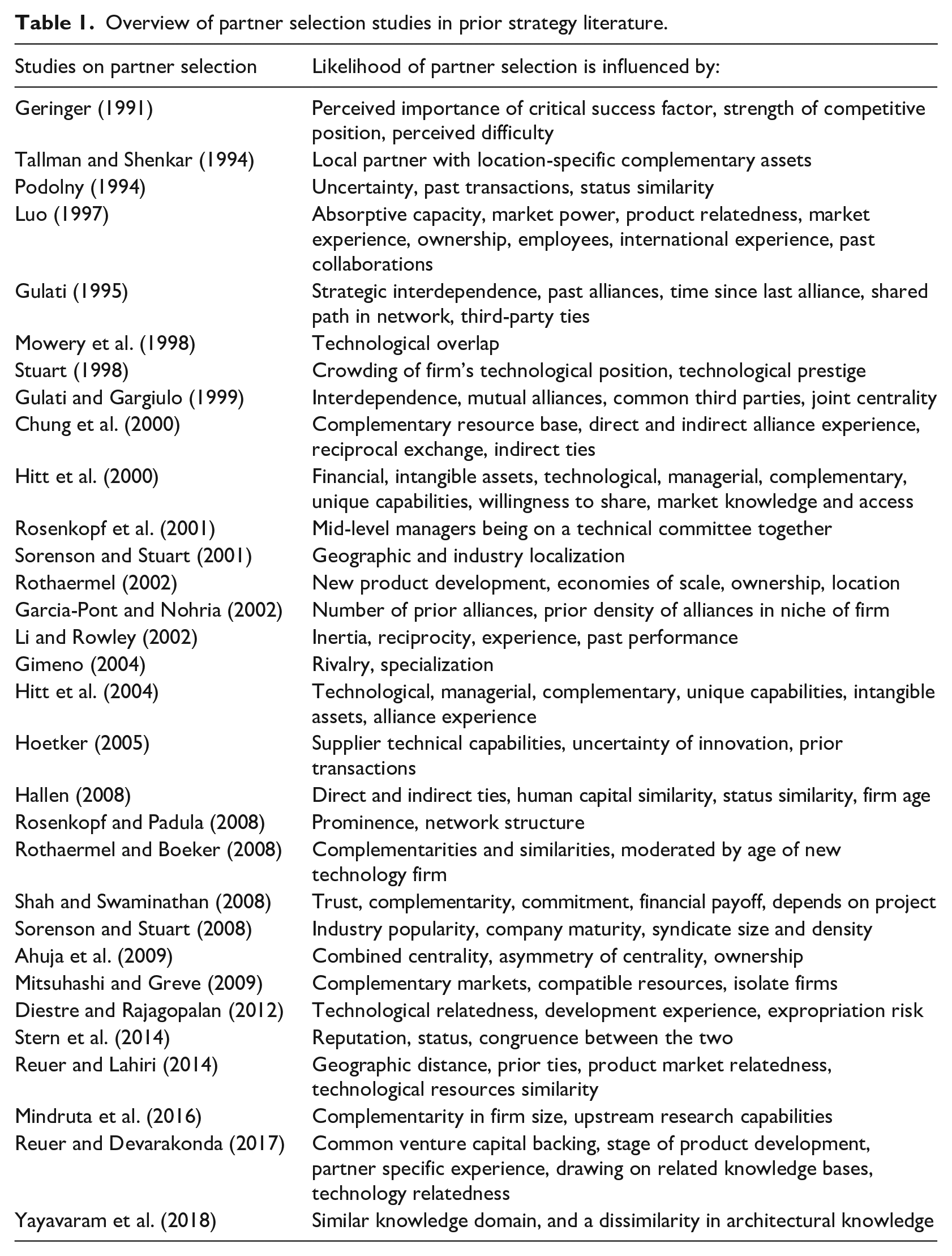
Specific resources and capabilities of potential partner firms that increase the likelihood of being chosen include alliance experience generally as well as with specific firms (Chung et al., 2000; Gulati, 1995; Hitt et al., 2004; Li and Rowley, 2002; Luo, 1997; Podolny, 1994) and firm innovativeness, technology, and absorptive capacity (Diestre and Rajagopalan, 2012; Luo, 1997; Mowery et al., 1998; Yayavaram et al., 2018), among others. Implicit in the partner selection literature is the existence of a market for alliance partners. A focal firm enters the market for alliance partners and assesses potential partners based on their relative endowment of traits desirable for the focal project. Thus, by identifying and unpacking these traits, the literature provides us with a picture of what it takes for firms to be an attractive potential alliance partner and have a greater probability of being selected for a partnership opportunity. The literature thus identifies many levers firms can use to generate future potential growth opportunities that may enhance their future performance. By possessing such characteristics, firms can generate interest and attract other firms for potentially successful partnership opportunities.
While we know a lot about the potential drivers of partner attractiveness, one remaining puzzle in the literature is what firms can do to be selected for alliances if they have deficiencies in the resources and capabilities listed in Table 1. Taken at face value, the large set of econometric results underlying the partner selection literature suggests that if firms are weak on drivers of partner selection, they in turn have a lower probability of being selected for a potential partnership opportunity. For these firms, we thus lack prescriptive advice about how to overcome these deficiencies and still be selected. Our basic premise is that important interdependencies likely exist between well-known drivers of partner selection that may enable firms to substitute for their specific shortcomings on the market for alliance partners. In particular, we advance one particular form of firm heterogeneity, the intrinsic speed capabilities of the firm, that may serve a substitutive role in the partner selection process. We next integrate ideas about firm heterogeneity in speed capabilities with ideas from the partner selection literature to help address this puzzle to develop our theoretical predictions.
Research hypotheses
Speed capabilities and firm attractiveness on the market for alliance partners
We set up our theoretical framework by conceptualizing the partner selection literature as a decision problem in the market for alliance partners. A focal firm has a potential collaborative investment project and enters the market for alliance partners to select a partner firm. This decision problem is then a function of the firm’s assessment of prospective partners’ endowments of desirable resources and/or capabilities that could benefit the focal project. The focal firm thus approaches the partner selection problem with an underlying utility function based on a vector of partner firm attributes relative to the focal firm. Firms with greater relative endowments of desirable resources and/or capabilities thus have a higher probability of being selected for a potential partnership opportunity.
We first advance a baseline hypothesis on the direct impact of intrinsic speed capabilities on alliance partner selection. Our expectation is that, all else equal, intrinsically faster firms are likely to be desirable alliance partners and thus have greater attractiveness on the market for alliance partners. A collaboration between two firms in an alliance represents an opportunity for both partners to benefit from each other’s complementary resources and capabilities for the advancement of the focal project, and the intrinsic speed capabilities of a potential partner can potentially enhance the performance of an alliance and in turn benefit the focal firm in many ways. As discussed above, intrinsic speed capabilities of a firm can enable faster realization of revenues streams and enable firms to potentially preempt other competitors. An intrinsically fast partner firm can potentially bestow these benefits of speed to an alliance by deploying its capabilities to the focal project, potentially sidestepping time-compression diseconomies and/or reducing resource accumulation lags associated with the development of the focal project. This acceleration of project development can thus enhance the performance and benefit the focal firm. Besides deploying its capabilities to the focal project, a fast partner firm also may offer learning opportunities for the focal firms, where the fast partner firm might teach and convey better project development processes which could lead to speed capability development in the focal firm (Grant and Baden-Fuller, 2004). In other words, partner firms with endowments of superior intrinsic speed capabilities may have greater attractiveness on the market for alliance partners due to a greater likelihood of speed capability access and acquisition, which in turn benefits the focal project and focal firm.
To elaborate on this logic, consider a focal firm approaching the market for prospective alliance partners. Within the choice set of alliance partners, there exists a speed capability distribution of prospective partners, where some firms are intrinsically faster than average and other firms are intrinsically slower than average. Our reasoning suggests that intrinsically faster partner firms increase the likelihood of high alliance performance via the acceleration of revenue streams and additional benefits from preempting slower competitors. These benefits of speed would be achieved via the deployment of the partner firms’ capabilities to the focal project as well as potential learning benefits for the focal firm. If the focal firm realizes higher utility from higher expected performance from the alliance, we can expect a greater likelihood that intrinsically faster firms will be selected for alliances relative to slower firms in the alliance partner choice set. This logic suggests the following hypothesis, which we intend as a baseline prediction that we will build upon in examining how firm speed is interdependent with other firm resources and capabilities in the partner selection process:
Hypothesis 1. Intrinsically fast firms are more likely to be chosen as an alliance partner.
Speed capabilities, alliance experience, and partner selection
Not only can firm speed make a partner firm more desirable at the margin, but it can also play an important role in the broader context of the other resources and capabilities that a prospective partner brings to a collaboration, which have been subject to extensive research in the prior literature. We therefore suggest that firm speed needs to be viewed alongside other, potentially interdependent resources and capabilities that can also shape the benefits of a prospective collaboration. Doing so helps us unpack the direct and various indirect effects that firm speed can have on the partner selection process.
We start by developing the idea that speed could play a substitutive role in the effect of alliance experience on partner selection. As summarized in Table 1, numerous studies have indicated that more alliance experience generally as well as with specific partners tends to increase the likelihood of alliance partner selection (Chung et al., 2000; Gulati, 1995; Hitt et al., 2004; Li and Rowley, 2002; Luo, 1997; Podolny, 1994). More alliance experience makes a firm a more attractive partner for several reasons. Firms with more alliance experience are more accustomed to working with other organizations in partnerships. Accumulated alliance experience helps firms to develop a capability set where the firm becomes better able to effectively cooperate and coordinate with alliance partners (Heimeriks and Duysters, 2007). While separate concepts, alliance experience provides an important input for firms to develop alliance capabilities, or the internalization of knowledge and skills related to managing alliances (Eisenhardt and Martin, 2000; Heimeriks and Duysters, 2007; Kale et al., 2002). More specifically, collaboration in alliances requires both cooperation, meaning the commitment and alignment of interests of alliance partners, and coordination, meaning the alignment and adjustment of the actions and operations of both partners to realize mutual gains (Gulati et al., 2012; Gulati and Singh, 1998; Heimeriks et al., 2015; Hoang and Rothaermel, 2005). More experienced firms may be more effective at designing and implementing incentive alignment, monitoring of activities, and effective coordination and deployment of resources and capabilities of alliance partners, potentially yielding better performance outcomes of the alliance.
While greater alliance experience increases the attractiveness of a potential firm for an alliance, an open question is how firms can substitute for deficiencies in this important capability on the market for alliance partners. Firms with deficiencies in alliance experience and the associated alliance capabilities developed via experience are at a disadvantage and may be less likely to be chosen as a partner since they do not have these experiences and well-developed capabilities related to partner coordination. We advance the expectation that the intrinsic speed capabilities of partner firms may serve as a substitute for alliance experience as a particular capability that prospective partners bring to a collaboration. Intrinsic speed capabilities of partner firms can give firms a temporal advantage in project development under these conditions. Most fundamentally, intrinsically fast firms can move quickly, adapt, and deploy resources and people at a greater pace. Because intrinsically fast firms can execute investment projects faster than average at the same cost, the ability to move quickly can yield temporal slack in project development, which may give firms added time to adapt coordination with alliance partners. If a partner firm is deficient in well-developed skills at coordinating with other firms, this ability to move quickly can enable the partner firm to adapt and make up for a deficiency of experience: with such temporal slack, even though the firm is less experienced with coordination, the firm has more time to adapt and refine coordination processes in order to collaborate effectively with an alliance partner. Thus, intrinsic firm speed is likely to serve as an effective substitute for coordination capabilities from alliance experience. In a similar manner, a deficiency of cooperation experience can give rise to incentive misalignments and potential conflicts that must be addressed by the partners, and the temporal slack that intrinsic firm speed creates can provide a buffer to reduce adverse collaborative outcomes and provide partners opportunities to make adjustments to the incentives and controls supporting the alliance as needed. We therefore suggest that intrinsic firm speed capabilities substitute for alliance experience in the partner selection process as follows:
Hypothesis 2. Intrinsic firm speed capabilities reduce the positive effect of alliance experience on partner selection.
Speed capabilities, firm innovativeness, and partner selection
Paralleling the foregoing logic, we also suggest that intrinsic firm speed capabilities could similarly affect the role of firm innovativeness and work as a substitute for this capability in the partner selection process. As previous research on alliance partner selection would emphasize, more innovative firms may have a higher likelihood of being selected as an alliance partner (Diestre and Rajagopalan, 2012; Luo, 1997; Mowery et al., 1998; Yayavaram et al., 2018). More innovative firms may have better technology, which could be useful for the focal firm. More broadly, firm innovativeness may suggest higher quality human capital that can interpret and digest unexpected events in project development and adapt the trajectory of the project appropriately.
While more innovative firms may be more adaptable due to high-quality technology and human capital and thus represent a more attractive potential partner for alliances, a remaining question is how firms can substitute for deficiencies in firm innovativeness in the market for alliance partners. Following the logic above, we posit that the intrinsic speed capabilities of partner firms can substitute for such deficiencies. Less innovative firms may be able to rely in part on their intrinsic speed capabilities to help overcome their deficiencies in technology and high-quality human capital. Consider a scenario of a less innovative firm that is intrinsically fast at project development. While this firm may not offer high levels of R&D development or high-caliber engineers with the best ability to develop a project, the firm has a temporal advantage due to the ability to execute investment projects faster than average at the same cost. As we have suggested above, this ability to move quickly is likely to yield temporal slack in project development, giving the firm additional buffer time to receive, interpret, and digest signals from the market or project and adapt the trajectory of the project. This additional time can then enable the intrinsically fast partner firm to adapt project development accordingly and enhance project development for the partnership. Following this logic, temporal slack from greater intrinsic firm speed can then replace and substitute for a deficiency in firm innovativeness. We therefore hypothesize the following:
Hypothesis 3. Intrinsic firm speed capabilities reduce the positive effect of firm innovativeness on partner selection.
Method
Data and sample
To study the role of intrinsic speed capabilities in partner firm attractiveness on the market for alliance partners, we focused on partnerships in investment project development in the global LNG industry. This industry represents an appropriate and interesting setting to test our theory for a variety of reasons. Investment projects in LNG are high-commitment investments requiring substantial capital outlays and a long time-to-build in project development. LNG facilities come in two main types that form a “chain” that spans from export markets to import markets when these two markets are separated by large bodies of water, making traditional pipeline impractical (Chandra, 2006). In export markets, LNG investment projects are typically liquefaction facilities, which are massive facilities that cool and purify natural gas to a liquid form for transport (via specialized LNG tanker ships) and often cost over US$1 billion and often take more than 5 years to build. In import markets, LNG investment projects are typically gasification facilities, which are large LNG receiving and processing facilities that receive the transported LNG and reheat LNG to gaseous form for distribution in the import market. These gasification facilities often cost over US$500 million and take over 2 years to build (Chandra, 2006; Tusiani and Shearer, 2007). Given the large costs and lengthy project development time for both liquefaction and gasification facilities, firm speed is likely to be an important determinant of project success in this empirical setting. In addition, LNG investment projects often are developed as joint ventures, creating a setting where partner selection is likely to be an important consideration for firms.
To appropriately study how intrinsic speed capabilities affect the likelihood of a firm being chosen as a partner and substitute for other drivers of partner selection, we needed to consider a set of partnerships and incorporate in our analysis potential pairs of firms that were unrealized as well as realized partner dyads. As a result, we set up our research design by including LNG joint venture projects and constructing a choice set of potential partner firms as all firms that have engaged in an LNG project at some point in our sample, creating a set of realized and unrealized dyads between the focal firm and potential partner firms. We obtained our data on LNG project development from the Oil and Gas Journal from 1997 to 2015. We set up the decision problem of partner selection from the perspective of the focal firm. We repeat the decision problem from the perspective of each partner firm. After cleaning and merging data for needed covariates, our final sample used in analyses comprised 5854 potential partnerships associated with 107 partner selection choices.
Variables
In order to estimate the likelihood of alliance partner selection, we construct our dependent variable as a dummy variable
Regarding our explanatory variables, we conceptualize the partner selection decision problem as an assessment by the focal firm of the strength of a prospective partner’s resources and capabilities relative to those of a focal firm. For instance, it may be the case that relatively better intrinsic speed capabilities than the focal firm may increase the probability of being chosen by that firm for a particular alliance. A relative advantage of intrinsic speed capabilities may also substitute for a relative weakness in other drivers of partner selection as well. The use of dyadic variables may also further increase the complementarity and comparability of our results to the prior literature. The alliance literature has had a long history of emphasizing the importance of dyadic relationships between partner firms, and prominent theory such as the relational view (e.g. Dyer et al., 2018; Dyer and Singh, 1998; Lavie, 2006) has emphasized the importance of the dyad as a critical unit of analysis for collaborative strategies. Furthermore, many of the partner selection papers summarized in Table 1 use dyadic variables to capture relationship-specific capability differences and potential complementarities between the focal and partner firms.
Accordingly, based on each variable discussed below, we construct a set of dyadic variables capturing capability differences by taking the partner firm capability measure minus the focal firm capability measure. Thus, positive values indicate the scenario where the partner firm has a greater value than the focal firm, and greater values indicate a greater capability endowment of the prospective partner relative to the focal firm. We standardize these capability gap measures to improve the comparability across results and reduce multicollinearity concerns.
An additional consideration is our selection of variables to include in our empirics. Our theoretical focus is on the intrinsic speed capabilities of the firm as well as firm alliance capabilities and firm innovativeness. Accordingly, we articulate the construction of these focal independent variables below. As an additional consideration, the partner selection papers summarized in Table 1 articulate a wide variety of factors corresponding to the broad theoretical diversity in this stream of work. Empirically, we also appreciate that there are likely a number of independent drivers of partner selection operating at different levels of analysis. Given that our focus is on capabilities, we wanted to focus on variables that we thought would be subject to omitted variable bias concerns. We also wanted to be sensitive to features of our empirical context. Given these considerations, we selected our set of controls and supplemented with several empirical strategies to further address omitted variable bias concerns. Specifically, we supplement these controls with a variety of fixed effects to further account for potential time invariant heterogeneity that may affect our estimates. We then use a variety of robustness checks to further address omitted variable bias concerns such as using alternative econometric specifications (i.e. random-effects probits, conditional fixed effect logits) and variable definitions. Our objective thus is to present a set of results that make a compelling case that omitted variable bias is adequately addressed and our results as a whole represent a convincing test of our theory. We elaborate on our set of variables and empirical approaches below.
Our central independent variable is

If we were to construct our measure of the intrinsic speed capabilities of the firm using LNG projects, we would face a series of endogeneity concerns such as firms selectively speeding up or slowing down LNG projects based on their partnership decisions or firm partnership strategies impacting our realized speed measure. To avoid these endogeneity concerns, we follow Hawk et al. (2013) and instrument for the intrinsic speed capabilities of the firm within LNG using projects unrelated to LNG. The logic of this approach is that a firm’s projects unrelated to LNG worldwide are unlikely to be correlated with a particular partnership selection decision for a given LNG project. However, the estimate of the intrinsic speed capabilities of the firm based on unrelated projects should be correlated with the intrinsic speed capabilities of the firm within LNG given the common project development processes and cultures within oil and gas firms (Hawk et al., 2013). With this setup, our measure of the intrinsic speed capabilities of the firm should have less of an endogeneity problem. We thus use a set of 4656 construction projects from the Oil and Gas Journal unrelated to LNG (comprised of gas processing, petrochemical, pipeline, refining, and sulfur projects) in order to construct our measure for the intrinsic speed capabilities of the firm. In this regression for equation (1), the subscripts correspond to facility
We then take the residual
We also have two other key measures of firm capabilities corresponding to our hypotheses 2 and 3. For hypothesis 2, as discussed in the theory section, alliance experience serves as an input for firms to develop capabilities related to managing alliances (Eisenhardt and Martin, 2000; Heimeriks and Duysters, 2007; Kale et al., 2002). Accordingly, we selected alliance experience as an appropriate proxy for the alliance capabilities of the firm. We thus define
For our measure of firm innovativeness, in our empirical context of the oil and gas industry, R&D has been found to be an important component of firm heterogeneity and capability development and may reflect important incremental and applied innovative activities that have the potential to be a firm specific source of competitive advantage (Helfat, 1994, 1997). Several recent papers on the oil and gas industry have also used R&D intensity as a proxy for firm innovativeness (Hawk and Pacheco-de-Almeida, 2018; Pacheco-de-Almeida et al., 2015), and many papers in strategy, international business, and finance have used R&D intensity as a proxy to capture the innovative intangibles of the firm (e.g. Dowell et al., 2000; Morck and Yeung, 1991, 1992). Accordingly, we selected
In addition, we also include a set of control variables. In case larger or older firms systematically choose alliance partners differently from smaller or younger firms (Hallen, 2008; Hitt et al., 2000, 2004; Rothaermel and Boeker, 2008), we use
Analytic approach
To test our theoretical predictions, our empirical objective is to estimate the impact of potential partner firm intrinsic speed capabilities on the probability of being selected as an alliance partner in the market for alliance partners, and we also wish to investigate the interdependencies between partner firm intrinsic speed capabilities and other partner firm capabilities known to impact alliance partner selection. We thus needed to select an analytic approach that allows us to control for the characteristics of the focal firm and prospective partner in the selection process. This approach then yields an estimate of the impact of relative assessments of partner firm capabilities on partner firm attractiveness. We also needed an analytic approach that allows us to study interaction terms between partner firm characteristics to evaluate the interdependencies of different partner firm characteristics on alliance partner attractiveness. We also needed to tailor our empirical approach to address concerns regarding omitted variable bias, simultaneity, and/or reverse causality.
We therefore use several analytic strategies to estimate the impact of partner firm intrinsic speed capabilities on the probability of alliance partner selection on the market for alliance partners. Our first approach focuses on dyadic measures of capability differences between the focal firm and prospective partner firms. Partner selection may be driven by a process whereby focal firms pick partners based on relative capability assessments. Dyadic measures enable us to see whether a prospective partner being relatively faster than a focal firm drives alliance partner selection. We thus construct a series of measures of capability differences by taking the partner firm attribute minus the focal firm attribute, yielding measures that are positive and increasing as the prospective partner becomes relatively more capable than the focal firm. We then use a probit model to estimate whether these relative capability difference measures support our theoretical predictions.
We also incorporate several features of our approach to address potential concerns regarding omitted variable bias, simultaneity, and/or reverse causality. First, as discussed above, we instrument for the intrinsic speed capabilities of the firm in LNG using projects unrelated to LNG. This feature helps us reduce concerns regarding simultaneity and/or reverse causality for several reasons. Specifically, it is unlikely that a given partner selection decision for one LNG project would affect the intrinsic speed capabilities of the firm across all of the unrelated oil and gas projects of the firm worldwide. In addition, our measure of the intrinsic speed capabilities of the firm has a lagged temporal structure of completed projects relative to each partner selection decision for an LNG project starting in a given year, which further reduces concerns regarding simultaneity and/or reverse causality. This setup also reduces potential correlation with the error term associated with omitted variable bias. For instance, if firm differences in expectation regarding the LNG market are in the error term and are correlated with both partner selection decisions and our measure of the intrinsic speed capabilities of the firm, we would have a concerning endogeneity problem. By using projects unrelated to LNG to construct our measure of the intrinsic speed capabilities of the firm, we break this potential correlation with the error term. Second, we use an extensive vector of control variables suggested by the partner selection literature to minimize omitted variable bias. Third, we conduct a series of robustness checks where we adjust the vector of control variables or constructions of the controls to further address concerns of omitted variable bias. Fourth, we run robustness checks using alternative model specifications such as a conditional (fixed effects) logit model and a random effects probit model to further account for possible time invariant omitted firm heterogeneity.
We then conduct several additional approaches to further address potential concerns. For instance, it may be the case that absolute measures of our variables drive partner selection rather than relative assessments that are captured in our dyadic measures. We thus rerun our analysis using vectors of variables for both the focal firm and the partner firm rather than using our dyadic measurement. In addition, it may be the case that our event of interest, the selection of an alliance partner out of a larger choice set, constitutes a rare event. We thus use a penalized logit proposed by Firth (1993) to reduce concerns of potential biases from rare events. We then conduct a series of additional robustness checks regarding variable construction and other considerations that may affect alliance partner selection.
Results
We report descriptive statistics and a correlation matrix in Table 2. Our summary statistics incorporate information for both realized and nonrealized dyads in our analysis. For our capability measures, the summary statistics reported reflect the un-standardized version of the variables. In order to assess potential collinearity concerns, we checked variance inflation factors (VIFs) and found them to be at acceptable levels below 10 with a max and mean VIF value of 4.22 and 1.91, respectively. Correlations reported in the table generally support prior findings of the resources and capabilities that drive partner selection. Being chosen as a partner is positively correlated with possession of alliance experience and firm innovativeness (R&D Intensity). These correlations also suggest that intrinsic speed capabilities are positively associated with partner selection, yet we proceed to our multivariate analysis to more adequately account for potential omitted variable bias and obtain more precise estimates. In addition, as a robustness check we removed Firm Size Gap, Firm Age Gap, and Project Experience Gap from the probit regression equations due to the high correlations with Alliance Experience Gap and continued to find results similar to our main findings.
Descriptive statistics and correlation matrix.
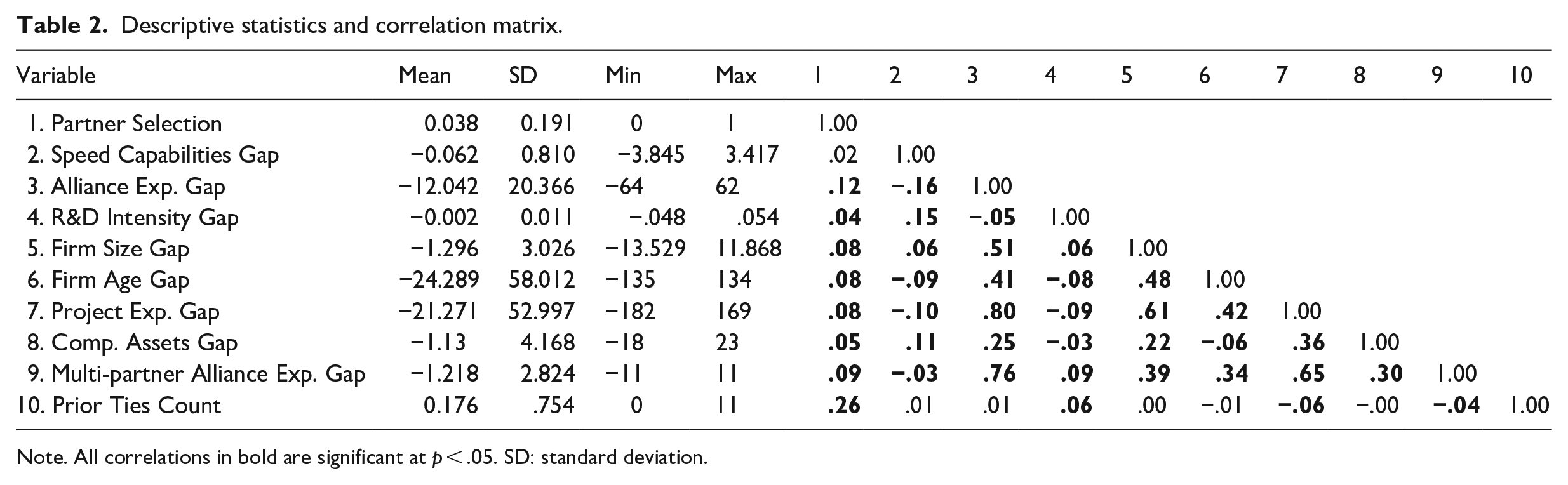
Note. All correlations in bold are significant at p < .05. SD: standard deviation.
Estimation results reported in Table 3 provide evidence supporting the role of intrinsic speed capabilities in partner selection. In Column II, the coefficient on the speed capability gap measure (partner speed capabilities minus focal firm speed capabilities) is positive and significant. A 1 standard deviation increase in the speed capability gap between the partner firm and the focal firm is associated with a 12.8% increase in the probability of being selected as an alliance partner. We then introduce the individual interaction terms in Columns III and IV, and the full model appears in Column V. The interaction terms between the speed capabilities gap measure and the alliance experience gap and R&D Intensity gap measures all are significant (p < .01 for the speed capability gap measure interaction with the alliance experience gap measure, p < .05 for the speed capability gap measure interacted with R&D Intensity gap measure) with the expected sign.
Probit estimation results for partner selection.
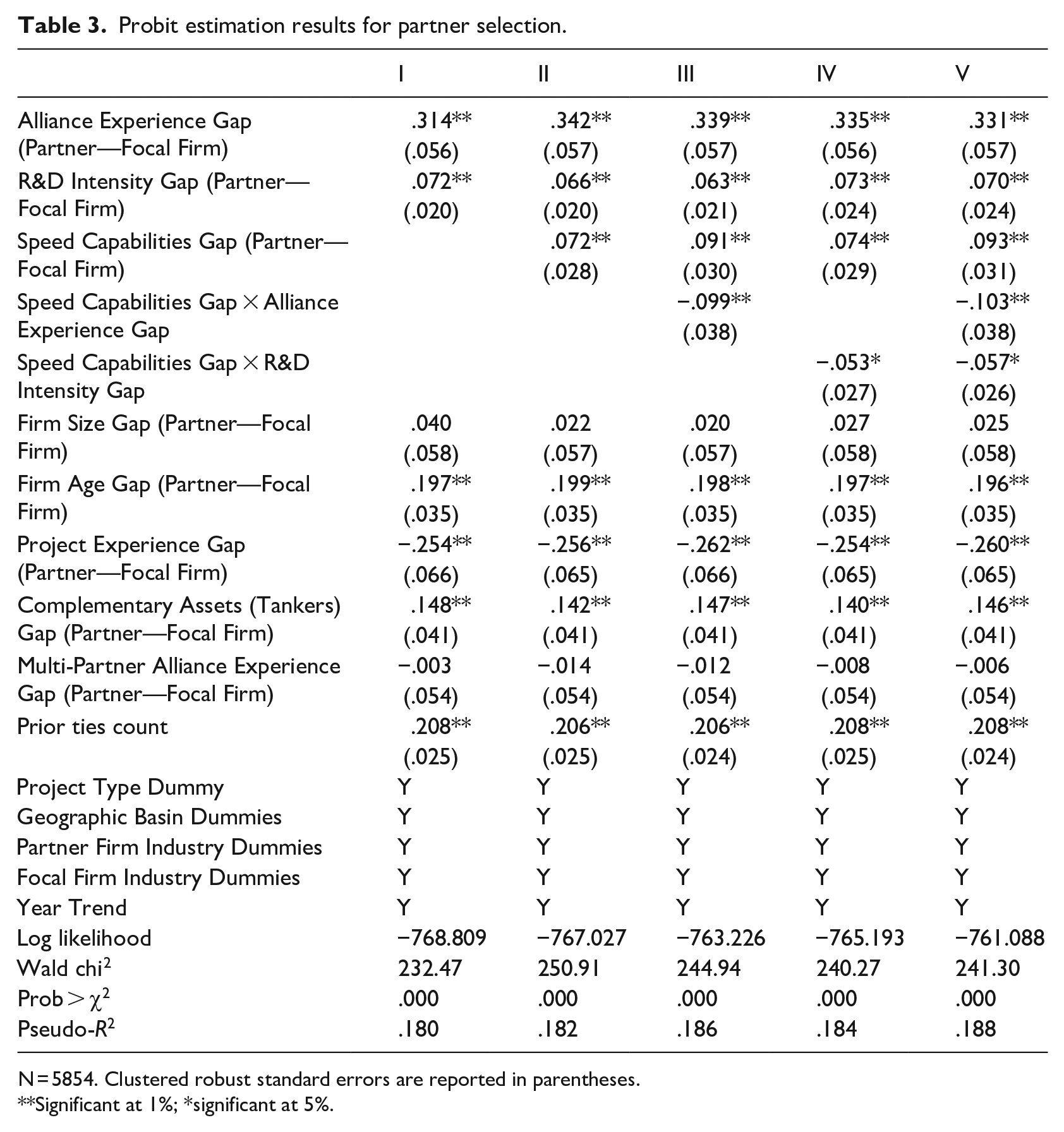
N = 5854. Clustered robust standard errors are reported in parentheses.
Significant at 1%; *significant at 5%.
To facilitate interpretation of these marginal effects and to accommodate the nonlinearity of probit models that affect interpretation of interaction effects, we follow the best practices in interpreting marginal effects in nonlinear models (Hoetker, 2007; Zelner, 2009) and graph the marginal effects used to test hypotheses 2 and 3 along with 95% confidence intervals across a variety of levels of our intrinsic speed capabilities gap measure (see Figure 1). We also present the corresponding marginal effects in tabular format in Table 4 along with their significance levels. In Figure 1, the marginal effects of partner firm alliance experience, and partner firm innovativeness are plotted for different values of partner intrinsic speed capabilities. In the graph, partner firms are intrinsically faster moving right along the x-axis and intrinsically slower moving left along the x-axis. All firm capability measures have been standardized in order to facilitate interpretation and comparisons across the different capability measures. As a result, a change in 1 unit along the x-axis corresponds to a change of 1 standard deviation in partner speed capabilities.
Marginal effects of alliance experience and firm innovativeness (R&D intensity), varying by intrinsic speed capabilities.
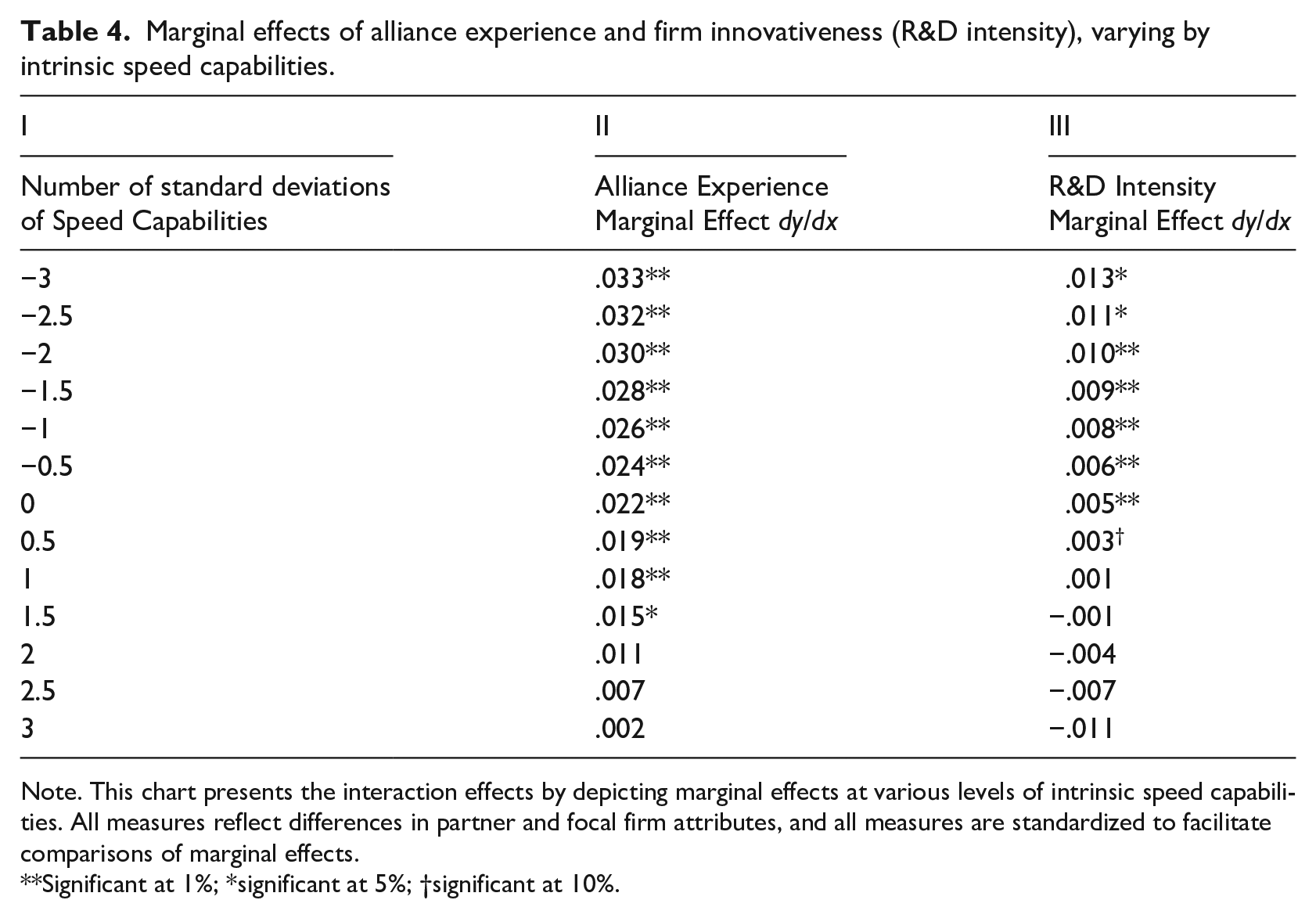
Note. This chart presents the interaction effects by depicting marginal effects at various levels of intrinsic speed capabilities. All measures reflect differences in partner and focal firm attributes, and all measures are standardized to facilitate comparisons of marginal effects.
Significant at 1%; *significant at 5%; †significant at 10%.
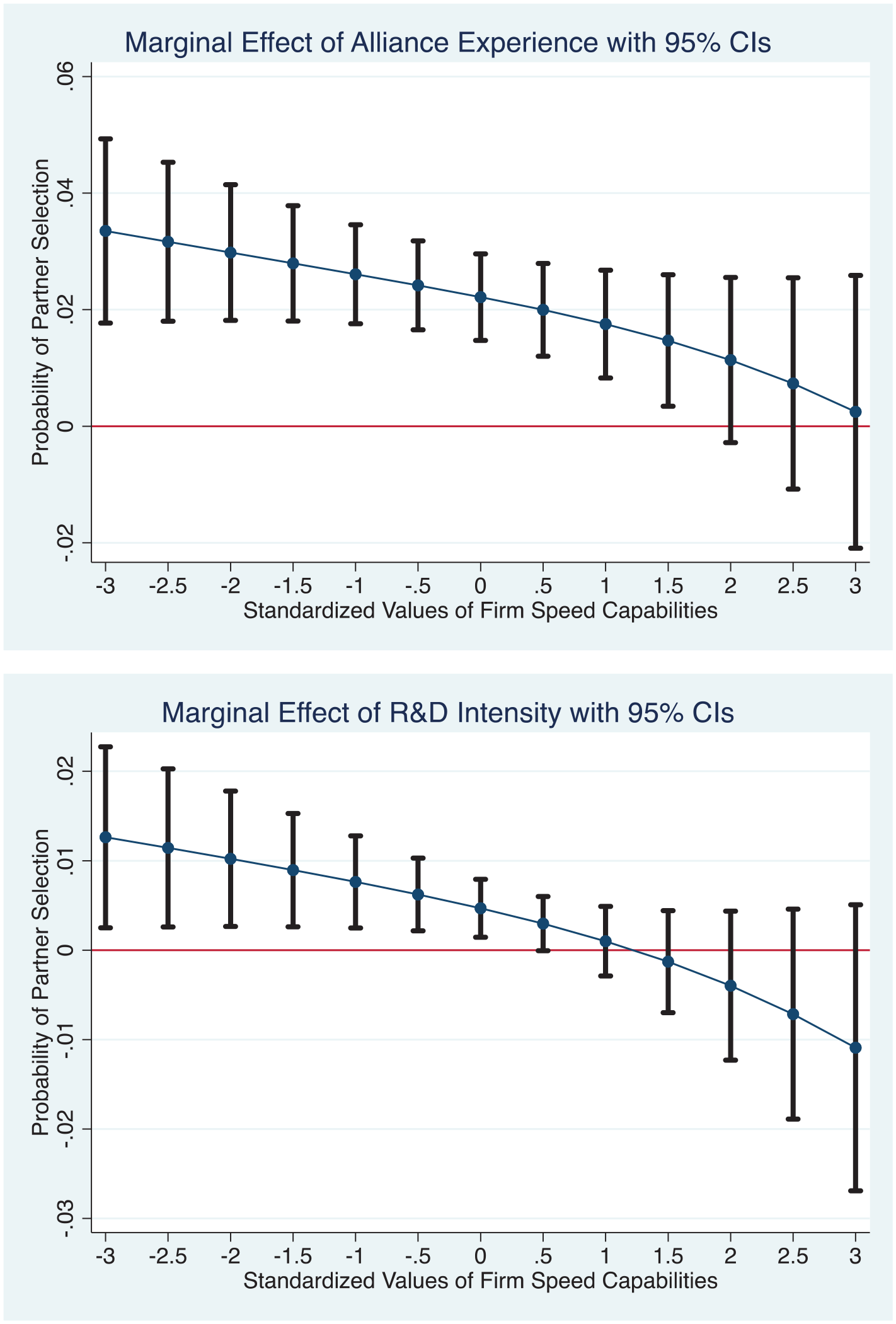
Marginal effects of alliance experience and firm innovativeness (R&D intensity), varying by levels of speed capabilities.
As Figure 1 and Table 4 indicate, our theoretical expectations are confirmed graphically for hypotheses 2 and 3. Our theoretical expectation that the intrinsic speed capabilities of the firm can substitute for alliance experience and firm innovativeness implies that the marginal benefits of alliance experience and firm innovativeness decline with increasing levels of intrinsic speed capabilities. As both Figure 1 and Table 4 demonstrate, the positive marginal effects for both partner firm alliance experience and firm innovativeness decrease with greater values of partner firm intrinsic speed capabilities. In fact, both Figure 1 and Table 4 show that the marginal effects of partner firm alliance experience and firm innovativeness both turn insignificant at higher levels of the intrinsic speed capabilities of the partner firm (at intrinsic speed capabilities held 2 standard deviations above the mean, the marginal effects of alliances experience turn insignificant; at intrinsic speed capabilities held 1 standard deviation above the mean, the marginal effects of R&D intensity turn insignificant). These results confirm the intuition that partner firm speed can substitute for alliance experience and firm innovativeness in partner selection, thus supporting hypotheses 2 and 3. The findings therefore demonstrate that well-known determinants of alliance partner selection become insignificant at high value of intrinsic firm speed capabilities.
Additional robustness checks
We conducted several additional robustness checks for these results. First, we investigated several alternative econometric specifications. We estimated a penalized maximum likelihood estimation logit model proposed by Firth (1993) using the Stata command firthlogit to account for the possibility that rare events could cause biases in estimation, and we found results similar to our main results. Using a conditional (fixed effects) logit model as well as a random-effects probit model to further account for focal firm omitted heterogeneity, we also found comparable results (results available from the authors upon request).
Next, we conducted multiple robustness checks regarding our data structure. To begin with, we also randomly picked different sets of unrealized dyads (10 or 5 per realized dyad) rather than using the full choice set, and we found similar results. As a further check regarding the construction of nonrealized dyads, we created matched samples of unrealized dyads based on firm size, firm age, and both, and we reran our main results using these alternative sets of counterfactual observations. Across these approaches, we continued to find results similar to our main findings, and the interpretations presented above continued to hold.
As an additional analysis, we tried several alternative constructions of our explanatory variables. For instance, we used multiple alternative constructions of our speed capability measure to accommodate different time windows (using moving averages for 2 and 3 years rather than 4 years), and we found results consistent with our main findings. We also tried alternative formulations of alliance experience (e.g. using 3-year and 5-year measures), R&D intensity (dividing by total assets rather than total sales), and firm size (using total assets and total employees rather than total sales), and we obtained very similar results. In addition, we estimated models using vectors of absolute values of focal firm and partner firm attributes rather than difference scores as well as demeaned versions of these variables and continued to find results consistent with our main findings.
In addition, we also ran a series of robustness checks where we incorporated additional control variables. For instance, we ran checks incorporating measures of project cost in both the first stage and second stage regressions, and we found results consistent with our main findings using these smaller subsamples with cost data availability. An additional possible concern is whether our measure of the intrinsic speed capabilities of the firm based on the residual in our first stage regression also reflects potential overspending and suboptimal project acceleration. To address this concern, we follow a similar approach as Pacheco-de-Almeida et al. (2015) and incorporate measures of corporate governance as a control for this possible suboptimal behavior. Using institutional blockholding as an additional control, we found results similar to our main results. Finally, in case differences in firm quality affect our estimates, we incorporated measures of return on assets and free cash flow as additional controls and found results consistent with our main findings.
Discussion
Contributions and implications
In this study, we show that the intrinsic speed capabilities of the firm matter in alliance partner attractiveness in two main ways. First, we find that firm speed has a direct effect in partner selection. Faster firms have a higher likelihood of being selected as an alliance partner. Second, we find that firm speed also affects other well-known relationships in the literature on partner selection. Past research has indicated that alliance experience and firm innovativeness are important drivers of the alliance partner selection process. We find that partner firm speed mitigates the positive effect of alliance experience and firm innovativeness in alliance partner selection, suggesting the ability of firm speed to substitute for deficiencies in alliance experience and firm innovativeness. The ability to move quickly can enable firms to obtain temporal slack in alliance project development, enabling partner firms extra time to adapt, adjust and correct errors even though they may be less experienced in coordination and monitoring in alliances or have less innovative or high-quality human capital. Our evidence also suggests that alliance experience and firm innovativeness—well-known determinants of partner selection—become insignificant when partner firms have substantial intrinsic speed capabilities.
This article contributes in several ways to academic research on interfirm collaboration as well as alliance practice. First, we extend the partner selection literature by arguing and finding that intrinsic firm speed is an important determinant of alliance partner attractiveness in the market for alliance partners. Past empirical research on partner selection has identified a rich set of drivers that create a profile of an attractive alliance partner (as summarized in Table 1). However, this research has neglected firm speed, despite the fact that scholars as well as academics have often mentioned speed considerations in a long-standing literature on alliance formation motives (e.g. Bleeke and Ernst, 1991; Hamel et al., 1989; Ohmae, 1989). We join together these literatures to not only suggest that firm speed matters for partner selection, but this capability matters in a subtle and complex way. Intrinsic firm speed capabilities captures the ability of firms to move faster than competitors at the same cost, and this fast-moving ability is desirable on its own. However, speed as a firm capability can also work together with other firm characteristics in such a way that firm speed capabilities can help firms overcome and substitute for their deficiencies (e.g. when they are lacking in alliance experience and innovativeness compared to others). Future research could therefore investigate multiple partner firm capabilities simultaneously and look at how managers rank order different firm capabilities relative to firm speed as well as examine the factors that change managers’ preferences and rank ordering in partner selection (e.g. Hitt et al., 2000, 2004). Future research could also examine other potential interdependencies between firm speed and other drivers of partner selection identified in the partner selection literature such as firm trust, status, network position, and location. In could be that the ability to move quickly could make up for particular deficiencies or enhance other strengths of prospective firms on the alliance partner market. For instance, it might be interesting to see if firm speed complements network position, enabling firms to act quicker on information gained from direct and indirect ties. It could also be that other firm capabilities could substitute for firm speed capabilities in partner selection such as firm capabilities at information processing and collection (Mata et al., 1995) that could also create temporal slack that is valuable to alliances that are otherwise subject to cooperation and coordination failures. In addition, our approach of examining the interdependencies between different kinds of firm capabilities in driving partner attractiveness could be useful in extending the partner selection literature. Past research on partner selection has looked at many contingencies in drivers of partner selection such as interactions of focal firm and partner firm capabilities (Mindruta et al., 2016), interactions with venture age (Rothaermel and Boeker, 2008), characteristics of investment settings (Sorenson and Stuart, 2008), firm dissimilarity and decomposability (Yayavaram et al., 2018), or structural differentiation (Gulati and Gargiulo, 1999) among others, but the literature might be enriched by studying how partner firm characteristics complement and substitute for each other in driving partner firm attractiveness in markets for alliance partners.
Second, we contribute to the alliance literature more broadly by explicitly investigating the role of intrinsic firm speed capabilities. While speed and the ability to move quickly is frequently invoked by both managers and researchers as a reason to engage in alliances, the role of firm speed in alliances has been understudied. Our theory and findings shed light on the importance of firm speed capabilities in alliance partner selection. We contribute empirically by showing that firms select alliance partners based in part on the intrinsic firm speed capabilities of prospective partners. Firms thus try to access other firms’ speed capabilities via partnerships. In addition, firm speed capabilities can be beneficial to potential partner firms by enhancing their attractiveness in the alliance partner selection process. If firms have the ability to move quickly, they increase their likelihood of being selected as an alliance partner and may be able to substitute for other characteristics in partner selection depending on their particular resource and capability profile. Importantly, we contribute to the strategy literature by not focusing on the best and strongest firms and instead considering strategies for firms with weaknesses and deficiencies in important resources and capabilities. Our article suggests that intrinsic speed capabilities may provide temporal slack for firms that may provide a means by which firms with weaknesses can make up for deficiencies in collaborations.
Third, we contribute to the corporate strategy literature more broadly. The literature on corporate strategy has extensively studied numerous methods that firms can use to pursue growth and expand firm boundaries, such as alliances, acquisitions, and organic growth (Capron and Mitchell, 2012). Separately, the literature in business strategy has featured studies that examine speed as a firm capability (Hawk et al., 2013; Pacheco-de-Almeida et al., 2015). Our study demonstrates that there is an opportunity to connect these two separate streams of literature and have them speak to each other. For instance, we would argue that the temporal aspects of firm expansion mode decisions remain understudied in broad terms. The ability of firms to move quickly can add value by giving a dynamic perspective to analyzing expansion mode decisions such as alliances, acquisitions and organic growth by examining how the ability to move quickly plays a role in and interacts with other well-known determinants of these decisions. It would be valuable to consider other opportunities to connect research on speed in competitive strategy with corporate strategy research on firm boundary choices and organizational scope.
Fourth, we also contribute to past studies in competitive strategy that have emphasized intrinsic firm speed capabilities (e.g. Hawk et al., 2013; Pacheco-de-Almeida et al., 2015) by showing an additional avenue that intrinsic firm speed can create value for firms. Being intrinsically fast may help firms attract other firms to pursue potential collaboration opportunities. This attractiveness has the potential to generate numerous growth options for a firm, where other firms seek their help and collaboration in potentially lucrative projects. Greater attractiveness stemming from intrinsic firm speed in the partner selection process thus can facilitate firm growth and potentially yield enhanced performance from a richer set of partnership opportunities available to the firm. Our results also have potential implications for the broader resource and capability perspectives (Barney, 1991, 1999) in competitive strategy research as a whole by highlighting an interesting tension between firm capabilities elevating alliance partner attractiveness while at the same time increasing broader access to firm capabilities via partnerships. Firm capabilities may make a firm more attractive in the market for alliances and provide the firm more growth opportunities via partnerships, but these collaborations may in turn result in firm capabilities diffusing across the industry more rapidly, resulting in the undermining of a potential source of sustainable competitive advantage. An interesting research extension could be whether competitive advantages from intrinsic speed capabilities persist over time and whether the duration of competitive advantage is contingent on collaborative behaviors at the firm level and in the industry as a whole.
Limitations and future research directions
Our study has several limitations which may suggest promising extensions to this research. To begin with, our study is restricted to the LNG industrial setting. A natural question, therefore, is how our results generalize to other industrial contexts. We would expect to see similar findings in industries with similar resource development characteristics such as large, high-commitment capital investments that take a long time to build, making firm speed an important consideration for how firms choose alliance partners. It would be interesting to examine other industrial contexts with faster resource development cycles or faster rates of technological obsolescence such as fast-moving high-technology environments. Intrinsic firm speed could facilitate realizing revenue as quickly as possible before technology regimes change, suggesting that quick firms may be particularly desirable alliance partners in these contexts. Alternatively, it may be the case that there is no substitute for firm innovativeness in high technology industries. If partnering is more focused on access to proprietary technology, it may be that partner selection processes may be dominated by intellectual property considerations over other firm capability considerations. Future work in additional industrial contexts could provide interesting insights about the conditions under which an intrinsically fast partner firm might be particularly attractive for a collaboration.
We would also emphasize that our study focuses on alliance partner selection, but it is ultimately silent on actual project execution in alliances. Additional work could be done on the execution implications of firm speed in partnership-based project development. In particular, past research indicates that firms exhibit a substantial amount of time inefficiency in project development as well as variance in such inefficiency, and the time–cost tradeoff is influenced by a variety of factors such as firm capabilities, incentives, and internal and external constraints (Hawk and Pacheco-de-Almeida, 2018). It would be interesting to explicitly study whether partnering with an intrinsically fast firm indeed reduces the time inefficiencies of firms, decreases time-compression diseconomies, and accelerates project development overall. It would also be insightful to examine whether successful project acceleration is contingent on particular coordination or monitoring considerations within the partnership. It may be the case that specific kinds of interdependences between partners such as pooled, reciprocal or sequential (Gulati and Singh, 1998; Thompson, 1967) may be more successfully executed by partnering with a fast firm. A further question is the optimal governance structure when partnering with a fast firm and whether there are efficiency gains possible by structuring the partnership so that the fast firm takes the lead in execution. These research extensions could provide insights into the best implementation practices to realize the full benefits of partnering with an intrinsically fast firm. An additional research extension could be examining the role of intrinsic firm speed in alliance dynamics, renegotiations and terminations over time (Makino et al., 2007). It could be that partnering with an intrinsically fast firm enables the partnership to reach completion sooner, leading to faster termination and the ability to move on to other partnership opportunities more rapidly. It would be interesting and valuable to adopt longitudinal research designs that would enable research on the temporal aspects of specific alliance processes (e.g. negotiations, due diligence, and so on) or even the speed of the partner selection process itself. Such research could explore how firms’ speed capabilities are enhanced or degrade over time as a function of their collaborative strategies and evolving portfolios of relationships as well as other factors that affect the development of firm speed capabilities over time. These speed implications might be conditioned by the organization of firms and their alliance activities (e.g. whether the firm has a dedicated alliance function), so it would be valuable to obtain more fine-grained activities on firms’ capabilities and structures in future research. Relatedly, it could also be interesting to see if partnering with an intrinsically fast firm affects the nature of the collaboration over time, including investigation of proximate collaborative outcomes such as the fostering of partner trust, cooperation and learning over time as well as the nature of strategic and organizational fit (e.g. Duysters et al., 1999) between the focal and partner firms.
Relatedly, our study does not examine the subsequent performance implications of partnering with an intrinsically fast firm. It would be interesting to explicitly examine whether project-level and firm-level performance is enhanced from partnering with an intrinsically fast firm and whether these performance effects are contingent on particular kinds of relationships between firms. For instance, the performance realization of a slow firm partnering with an intrinsically fast firm could change based on the capability difference between the firm. It could be interesting to see if partnering with a marginally fast firm is as beneficial as a dramatically faster firm. It might also be interesting to examine potential downsides from partnering with an intrinsically fast firm. For example, it could be that intrinsically fast firms might be in high demand given their capabilities, giving them strong bargaining power relative to the focal firm. It could also be that intrinsically fast firms may become spread thin across multiple partnerships due to their high levels of attractiveness on the alliance partner market, and the resulting divided attention of the intrinsically fast firm might even mitigate performance benefits from partnering with them. Future research examining these contingencies would give a richer understanding of the optimal situations in which to select an intrinsically fast partner firm.
In addition, our study does not distinguish between partnerships focused on capability access versus capability acquisition via learning (Grant and Baden-Fuller, 2004). For each approach, there may be ways to manage or mismanage the processes to obtain the desired benefit. It is likely the case that there is much more to achieving either goal than just choosing the right partner. Perhaps particular kinds of firms facilitate teaching and learning of speed capabilities due to prior experiences and established trust, whereas other firms may be suitable just for capability access. The motives for capability access and capability acquisition from learning are qualitatively different, and it would be interesting to dig deeper into how partner selection may differ based on these alternative partnership motives. A further contingency worth exploring is to look at whether organizational or cultural fit or other softer considerations may affect firms’ ability to learn or access firm speed capabilities from partnerships.
Another limitation is that our study uses a very aggregate measure of intrinsic firm speed based on execution of large investment projects. Given that our interest is on project development of large liquefied natural gas facilities, our task-focused aggregate measure is appropriate. However, our aggregate measure may have some limitations that present promising future research possibilities. For instance, potential differences in the quality of individual projects may affect realized speed in a given project. While the industry is highly regulated, which may mitigate the extent of quality heterogeneity at the project level, we anticipate that industry regulation is likely imperfect. A more fine-grained study of project quality heterogeneity at the individual project level, perhaps via fieldwork and observations from case studies, would give additional nuance to our findings. It is also plausible that different facets of intrinsic firm speed may matter in alliance partner selection. In future research, it would be interesting to develop alternative measures of intrinsic firm speed that are more disaggregated, perhaps focusing on different kinds of value chain activities or specific governance or administrative activities related specifically to alliances. It could be that speed of manufacturing versus speed of operations or distribution may affect the partner selection calculus, where different firms meet the needs for different kinds of intrinsic speed contingent on the scope and project requirements of the focal collaboration. It might also be interesting to further unbundle whether different kinds of intrinsic firm speed in particular country institutional environments translate well to the focal project at hand, or if the implementation of firm speed capabilities is contingent on the institutional experience base of the focal firm and prospective partner firm. Research in directions such as these would help to join recent developments in competitive strategy and collaborative strategy and enrich understanding about the interplay of intrinsic firm speed and other capabilities that matter for interfirm collaborations.
Footnotes
Funding
The author(s) received no financial support for the research, authorship, and/or publication of this article.
