







Abstract
The “entrepreneurial ecosystem” has become the dominant metaphor in theories explaining how location-specific forces influence entrepreneurship. Despite the progress made by scholars studying entrepreneurial ecosystems, in this essay we contend that the ecosystem metaphor has created an implicit tendency in entrepreneurship theory to emphasize macro-, ecosystem-level dynamics rather than the causal and mediating mechanisms linking entrepreneurs and their local ecosystems. To accompany the macro-dynamics focus in entrepreneurial ecosystem theory, we call for a micro-foundations approach that emphasizes the bidirectional connections between entrepreneurs’ strategizing and organizing activities and their ecosystems. We offer an agenda of theory development opportunities at the intersection of strategic organization and entrepreneurial ecosystems.
Introduction
Entrepreneurship theory increasingly acknowledges that entrepreneurial activity does not occur in a contextual vacuum but is place-based, location-specific, and embedded in entrepreneurial ecosystems (EEs)—the interconnected factors that support entrepreneurship within local communities (Nair et al., 2020; Spigel and Harrison, 2018; Stam and Van de Ven, 2021). EE research studies how entrepreneurial activity is influenced by complex systems of actors (e.g. startup employees, investors, incubators, accelerators, mentors, government officials, universities, co-working spaces, maker-spaces, local customers) and socioeconomic forces (e.g. values, norms, institutions, narratives) in entrepreneurs’ immediate environments and that extend beyond organizational and industry boundaries (Roundy et al., 2018; Thompson et al., 2018). In the past decade, the “entrepreneurial ecosystem” has become the dominant metaphor in theories explaining how cities and regions, such as Silicon Valley, Bangalore, and Stockholm, enable high levels of entrepreneurial activity (Adams, 2020; Goswami et al., 2018; Kuckertz, 2019). Despite the substantial progress made by scholars studying EEs, in this essay we contend that the ecosystem metaphor has created an implicit tendency in EE theory to focus on macro-, ecosystem-level dynamics and not explain the micro-foundations of EEs.
The espoused benefit of the ecosystem metaphor is that it spurs researchers to create a more complete picture of entrepreneurship by expanding the lens of theorizing beyond the entrepreneur and venture (Brown and Mason, 2017). However, in embracing the ecosystem metaphor, we argue that EE theory has become focused on explaining the system-level dynamics of ecosystems (i.e. ecosystem emergence, elements, and outcomes) and has underemphasized entrepreneurs and their connections to EEs. As a result, EE research has not theorized the specific causal and mediating mechanisms linking entrepreneurs and ecosystems, which is contributing to criticisms that EE research is “undertheorized” (Cantner et al., 2021: 407) and that there is “no universal agreement about [. . .] the causal links within the system” (Alvedalen and Boschma, 2017: 887).
We generally agree with these assessments of EE theory and assert that the most significant implication of the macro-dynamics tendency in EE research is that it is not clear how EEs influence entrepreneurs’ capabilities, organizational structures, competitive advantages, and performance, and, in turn, how these factors influence EE dynamics. Thus, fundamental questions related to how entrepreneurs strategize and organize in EEs and how these activities are connected to EE functioning remain unanswered and undertheorized.
To expand the predominantly macro-dynamics focus in EE theory, we call for a micro-foundations approach to EE research that embraces the strategic organization perspective. We contend that the breadth of EE theory can be enriched by considering both macro-dynamics and micro-foundations and, in fact, that EE theory will have difficulty explaining the activities and organization of ecosystems and their participants if it does not seek to explain the causal mechanisms connecting entrepreneurs and their ecosystems. Indeed, although the main insight of EE research is that “where entrepreneurship occurs matters,” we assert that it has become critical to ask, “where is the entrepreneur in EE theory?”
In making our case for the opportunities created in ecosystems theory by considering the micro-foundations and strategic organization of EEs, our essay proceeds as follows. First, we seek to understand the evolution of EE theory by exploring how the emphasis on ecosystem-level, macro-dynamics has manifested. Next, we describe the implications of the macro approach and argue that, despite its strengths, it does not address core questions about the specific mechanisms linking entrepreneurs and their ecosystems. Finally, we offer recommendations for how, by leveraging a micro-foundations approach, EE theory can embrace a unique aspect of EEs: the interplay between the micro-dynamics of entrepreneurs and the meta-organizational characteristics of the local ecosystems in which they are embedded.
The emergence of ecosystem theorizing in entrepreneurship
Entrepreneurship research has historically placed entrepreneurs, their ventures, and opportunities at the center of theorizing (McMullen et al., 2021). However, the “contextual turn” in organization studies (Johns, 2006) and, more recently, in entrepreneurship (Welter, 2011) draws attention to the forces in entrepreneurs’ local environments and contends that these forces should not be relegated to generic boundary conditions (e.g. “environmental munificence”). The burgeoning interest in entrepreneurs’ contexts has been informed by concepts that preceded EEs, including entrepreneurial environments (Gnyawali and Fogel, 1994), systems (Lichtenstein and Lyons, 2001), infrastructure (Van de Ven, 1993), the Triple Helix (Leydesdorff, 2012), and the closest conceptual forerunner to EEs, entrepreneurial communities (Lyons et al., 2012). The history of these concepts is found in earlier work on agglomeration effects in industrial districts, clusters, regional innovation systems, and economic gardening (cf. Cooke, 2009).
The “entrepreneurial ecosystem” metaphor first appeared in Iansiti and Levien (2004) and soon became the central concept in studies adopting a systemic and place-based approach to entrepreneurship. Entrepreneurship’s use of the metaphor is inspired by work on business ecosystems (Moore, 1993) and the subsequent proliferation of “ecosystem” concepts in business research (e.g. platform-, innovation-, services-, and sales-ecosystems; Scaringella and Radziwon, 2018). The EE concept was legitimized further by the practitioner popularity of using the ecosystem metaphor to describe regional entrepreneurship (e.g. Feld, 2020 [2012]; Isenberg, 2010).
How EE theory developed a macro-dynamics focus
The ascendance of EEs as the prevailing metaphor for describing the location-based forces that influence entrepreneurship has been coupled with a growing focus in entrepreneurship theory on explaining macro-level dynamics: the connections between ecosystem characteristics and ecosystem (or regional) outcomes. We refer to this emphasis as a “macro-dynamics focus” because it aims to explain how macro-level attributes influence aggregated ecosystem- and territory-level outcomes. Studies taking this approach often seek to explain how an EE’s system-level factors (e.g. the ecosystem’s regulatory institutions, culture, or market infrastructure) influence its overall levels of entrepreneurial activity and/or aggregate regional (or national) economic performance (e.g. Content et al., 2020; Hechavarría and Ingram, 2019; Iacobucci and Perugini, 2021; Mikic et al., 2021; Nicotra et al., 2018; Szerb et al., 2019; Xie et al., 2021). We posit that EE theory’s tendency to focus on macro-dynamics has multiple origins: the proclivities of EE scholars, the ecosystem metaphor, and data availability.
First, an obvious driver of the macro-dynamics focus is EE scholars’ academic backgrounds. EEs are studied by researchers with eclectic orientations, including economic geography, community development, public policy, regional studies, and rural sociology. Many of these disciplines build on intellectual traditions that do not prioritize theorizing strategic, managerial, and organizational dynamics. A less apparent factor contributing to the macro-dynamics focus is the prominence of the ecosystem metaphor. The metaphor’s vividness and popularity has made EE theorists increasingly inclined to emphasize the “ecosystem” rather than the “entrepreneurial” aspect of EEs. Finally, empirical issues have also fueled macro-EE research. Collecting rich, primary data at the entrepreneur- and venture-levels is more time-intensive than using secondary data, often collected by governments and economic development agencies. This practice creates challenges because, as Spigel et al. (2020) argue, much of the most important data [used in EE research] are only available at national levels, while ecosystems function predominantly at the sub-national (e.g. city, city-region, regional) scale. Nation-level data hide a great deal of variation between and within city-regions, which makes it difficult to understand the reality of the situation on the ground. (p. 485)
Relying on aggregated, secondary ecosystem data has conceptual implications. Theories based on such data tend to emphasize ecosystem-level elements, such as territory-level entrepreneurial activity, because data measuring these elements are readily available.
In sum, the ecosystem metaphor has brought much-needed attention to how entrepreneurs are embedded in interconnected, local, and place-based forces and how ecosystem attributes can influence important aggregated entrepreneurial outcomes. However, we contend that the individual-environment “pendulum” in EE theory has swung too far from entrepreneurs and their ventures, which has created opportunities to expand the field’s explanatory power in the ways summarized in the next section.
The consequences of the macro-dynamics focus in EE theory
EE scholars’ disciplinary and empirical tendencies and the ecosystem metaphor have produced theories that, primarily, explain ecosystem-level characteristics, processes, and outcomes. The predominant macro-dynamics focus has not sought to explain the specific, cross-level connections between ecosystems, entrepreneurs, and their ventures, which raises issues that, we later explain, can be addressed by considering the micro-foundations and strategic organization of EEs.
Issue 1: the uniqueness of EEs and their participants are often obscured
Macro-dynamics EE research has generally created and adopted theories that treat EE actors as homogeneous within categories and has not incorporated within-group heterogeneity among EE actors by considering different types of entrepreneurs, investors, support organizations, and EE leaders (Brydges and Pugh, 2021). Yet, entrepreneurs, for example, vary by skill level (Lyons et al., 2020), which suggests that all participants in an ecosystem that support entrepreneurs (e.g. incubators) could also vary by their capability to address the needs of skill-segmented entrepreneurs. Furthermore, by treating EE participants as homogeneous, theories have not acknowledged that EE actors may have wide-ranging motivations for participating in ecosystems (cf. Sperber and Linder, 2019, for an exception). For instance, while participants may become involved in an EE primarily to improve the success of their entrepreneurial activities, EE participants may also have non-instrumental motivations for interacting with an ecosystem (e.g. the desire to help revitalize an economically depressed neighborhood; Roundy, 2019). Ultimately, although it is a truism that theories must abstract from the phenomena they explain, a focus on purely ecosystem-level dynamics without considering how EE forces interact with participant heterogeneity (and homogeneity) obscures how EEs influence different types and aspects of entrepreneurship and makes EEs simply a novel context for exploring system dynamics and the non-specific properties of complex systems—a noble pursuit but not the driving purpose of entrepreneurship theory.
Issue 2: the macro–micro linkages of EEs are undertheorized
The prominence of EEs is based on a widely held belief in academic and practitioner circles that vibrant ecosystems stimulate entrepreneurial activity and improve entrepreneurial performance (Acs et al., 2017). Based on this belief, vibrant ecosystems are expected to produce not only high levels of entrepreneurship but higher performance outcomes than for entrepreneurs in less-vibrant ecosystems (Cunningham et al., 2019; Tsvetkova et al., 2019). An untheorized and largely untested assumption is that entrepreneurs who are more attuned to their ecosystems, who make greater efforts to get “plugged into” (Stephens et al., 2019) their EEs, and who leverage their EEs for resources will perform better than entrepreneurs who are more oblivious to their surrounding ecosystem (Spigel and Harrison, 2018). However, the macro-dynamics focus in EE theory has not addressed how—exactly—differences in entrepreneurial actions produce differences in entrepreneurial performance because of interactions with EE-level characteristics. Thus, the specific causal, mediating, and facilitating mechanisms underlying the linkages between entrepreneurs and their EEs are expressed in imprecise terms (e.g. “increasing entrepreneurship”) or left untheorized.
Issue 3: the practical implications of EE research for entrepreneurs are often unclear
The macro-dynamics focus in EE research has generated valuable insights for economic development practitioners and policymakers (e.g. Hannigan et al., 2021) but has not produced the same richness of insights for entrepreneurs. Because the connections between EEs and entrepreneurs are unstated in theory, they are often untested. As a result, EE research has struggled to generate concrete, theory-informed, and empirically validated recommendations for entrepreneurs beyond vague suggestions akin to “locate in a vibrant EE” or “take advantage of your EE.” The specific strategies entrepreneurs should use to leverage, draw resources from, and become embedded in their EEs are less clear than the recommendations for how governments and support organizations can support EEs (e.g. Hernández-Chea et al., 2021).
So, what now? The micro-foundations and strategic organization of EEs
Although the origins of EE research have ties to strategic management and the business ecosystem concept (Acs et al., 2017), the macro-dynamics focus has put EE theory at risk of coming untethered from entrepreneurship, management, and other organizational disciplines. To address the issues identified in the previous section, we submit that EE scholarship can benefit from incorporating a micro-foundations approach. We contend that the field of strategic organization is uniquely positioned as a starting point for such research because issues at the intersection of strategy and organization theory are at the heart of EEs but conspicuously absent from current theory. In calling for theory that addresses the micro-foundations of the linkages between ecosystems, entrepreneurs, and their ventures, we offer a framework and research questions that set an agenda for the future.
Before we describe our framework, we acknowledge that importing any primarily non-entrepreneurship theory into an entrepreneurship context is potentially problematic (Arend, 2020). With a novel (but not new) phenomenon, like EEs, the temptation exists for scholars to look to adjacent fields for theoretical insights. However, analyzing EEs through the complementary lenses of micro-foundations and strategic organization is an approach that has strong resonance with the unique characteristics of entrepreneurship phenomena (cf. Arend and Chen, 2012; Foss and Lyngsie, 2014).
A micro-foundations approach to EE theorizing
The micro-foundations approach to strategic management and organization theory was born from trends similar to the ones we have identified in EE theory: tendencies had developed for scholars to focus on collective constructs, characteristics, and outcomes (e.g. organizational performance, industry composition, institutional factors) without examining how macro-level, phenomena influenced and were influenced by the actors comprising them (Felin and Foss, 2005). Organizational micro-foundations research builds on Coleman’s call in sociology for work that teases apart the linkages between the micro-level characteristics of individuals and macro-level social structures (Coleman, 1990). The micro-foundations approach does not assert that collective constructs are inconsequential, but that more attention be paid to multi-level issues and, specifically, to how collectives influence individuals (Figure 1, arrow 1) and how individual action “collectivizes” to create social processes and outcomes (arrows 2 and 3) (Felin et al., 2015). The micro-foundations approach cautions against theories that focus exclusively on macro-to-macro linkages (arrow 4) (cf. Abell et al., 2008).
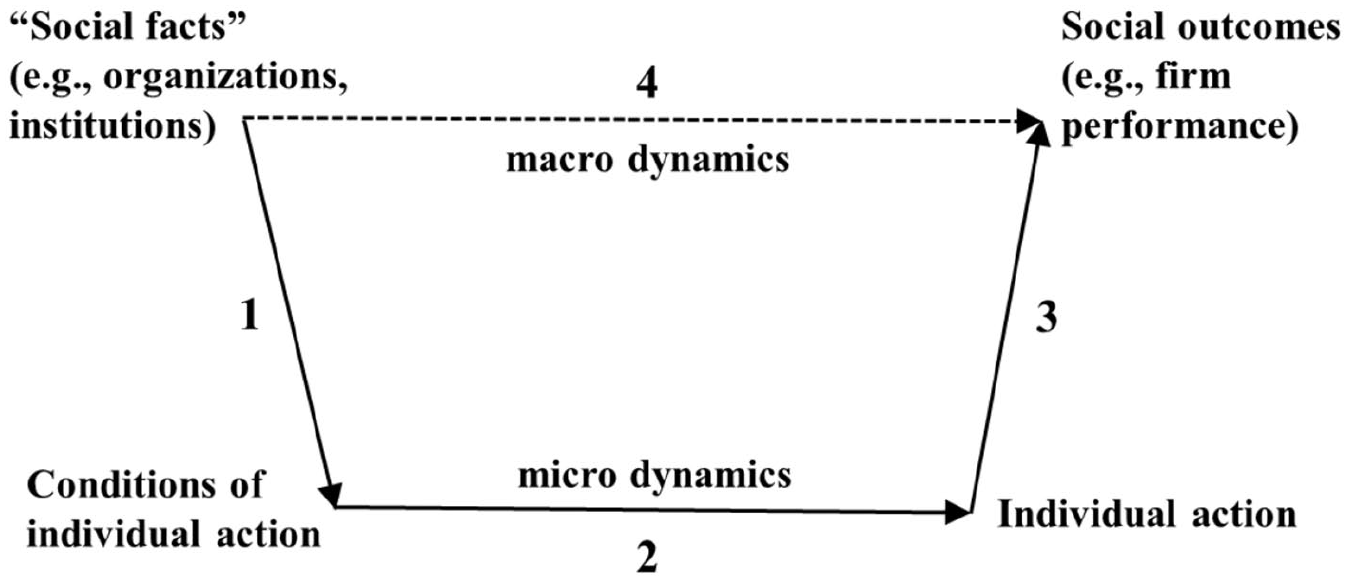
Micro-foundations and strategic organization.
It is in the spirit of Coleman’s arguments and those of other proponents of micro-foundations (Aguinis and Molina-Azorín, 2015) that we argue EEs are consequential as a collective construct but that the tendency to focus on ecosystem dynamics and systemic conditions has shifted EE theory away from explaining the phenomenon’s micro–macro linkages. By contrast, a micro-foundations approach to EE theory would consider how EEs influence entrepreneurs’ characteristics (e.g. skills) and the conditions of entrepreneurial activity (e.g. access to resources) (Figure 2, arrow 1). Such an approach would also consider how entrepreneurs’ characteristics and conditions influence their actions (e.g. venture creation) (arrow 2), and, in turn, how entrepreneurial actions influence ecosystem characteristics (e.g. EE resilience) (arrow 5) and EE outcomes (e.g. regional entrepreneurial activity) (arrow 3). As a rare example of this micro–macro interplay, Markley et al. (2015) identified a community development strategy that combined increasing a community’s capacity for supporting an EE with implementing a coaching system that prepared entrepreneurs to effectively use the EE by developing their skills.
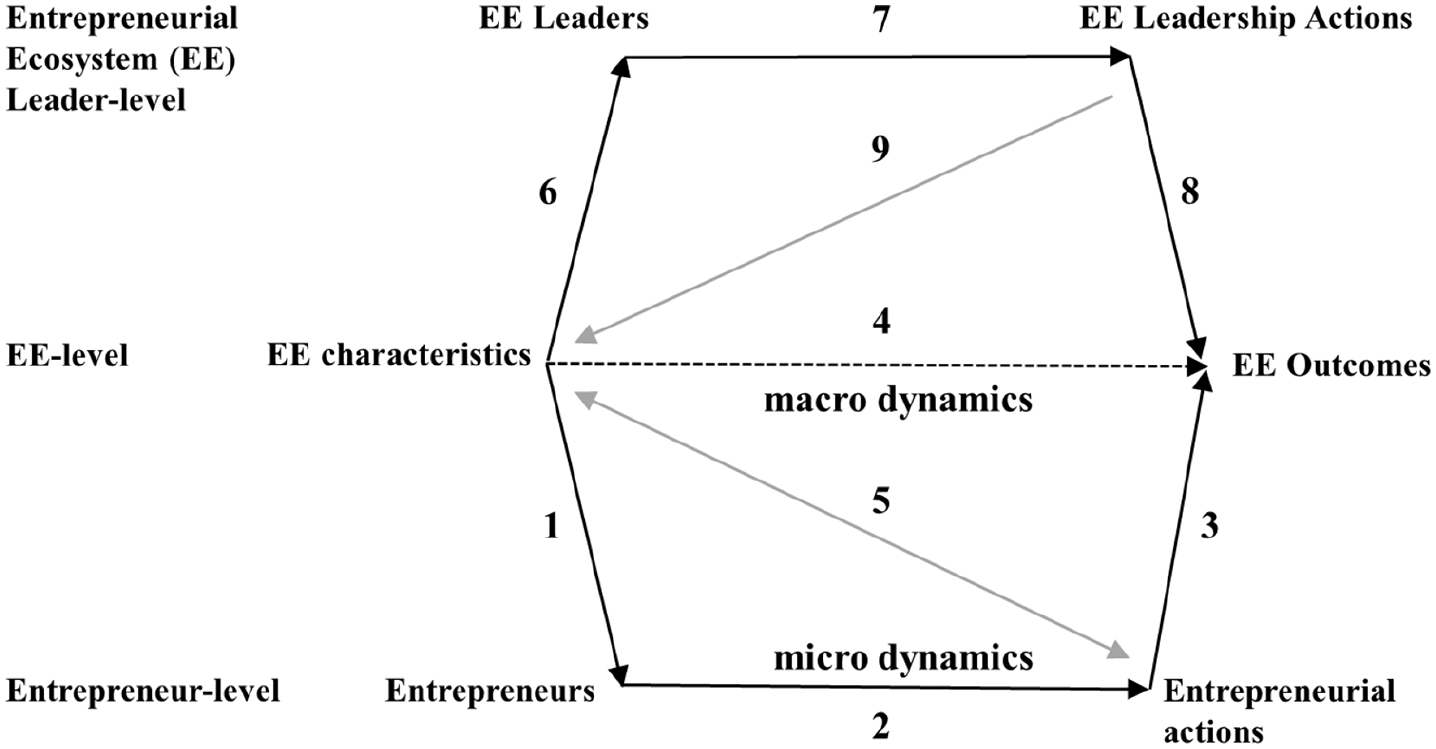
The micro-foundations and strategic organization of EEs.
We acknowledge that the micro-foundations perspective is not a unified approach but can manifest in at least three forms: “ideas of which level of analysis is the correct one for specifying a theoretical explanation, which mechanism is allowable in a theoretical explanation, and which social unit should be given actor-hood within the basic behavioral units in the theory” (Greve, 2013: 103). Given the variety of interpretations of “micro-foundations” (cf. Power, 2021), to clarify, we are arguing that more theoretical explanations in EE research need to take individual ecosystem participants (entrepreneurs) as the focal level of analysis; give the individual, not the ecosystem, “actor-hood” when parsing the behavioral units of EE theory; and emphasize the mechanisms linking entrepreneurs and their ecosystems.
An agenda for theorizing the strategic organization of EEs
Existing at the interface of strategic management and organization theory, strategic organization is concerned with precisely the levels of analysis underemphasized in EE theory and is, thus, a starting point for understanding the micro-foundations of EEs. Extending Coleman’s diagram to three levels of analysis (Figure 2), we identify three critical sets of questions that could be addressed if our approach is adopted and explain how answering these questions would enrich EE theory.
How do EEs influence entrepreneurs’ strategizing and organizing?
The most neglected area of micro-foundations theory in EE research is the connections between EE characteristics, entrepreneurs, and their strategizing and organizing activities (Figure 2, arrows 1 and 2). Specifically, work is needed that teases apart the facilitating mechanisms explaining how EE functioning directly and indirectly influences entrepreneurs’ characteristics and conditions (arrow 1), which, in turn, influence their venture development strategies and accompanying organizational decisions (arrow 2).
For example, a commonly promoted advantage of locating in a vibrant, high functioning EE, such as Silicon Valley, is that it gives entrepreneurs access to community-orchestrated local resources (talent, mentorship, investment, networks); for this reason, EEs are often conceptualized as collective “resource allocation systems” (cf. Cao and Shi, 2021). A benefit of receiving EE resources is that entrepreneurs do not have to coordinate or produce the resources intra-organizationally, which reduces entrepreneurs’ costs and allows them to devote resources to other aspects of entrepreneurship (Roundy and Burke-Smalley, 2021). However, entrepreneurs differ in their ability to tap into their EEs for resources (Stephens et al., 2019), which stands to create important differences in their strategic positioning (e.g. their ability to generate entrepreneurial, relational, and other forms of rent; Chadwick and Dabu, 2009; Madhok et al., 2015) and influences decisions related to organizational design (e.g. the degree to which ventures rely on the “visible hand” of the entrepreneur or the “crowd” of the EE; cf. Kornberger, 2017). Micro-foundations research may reveal that being able to “outsource” certain resources, capabilities, and organizational functions to entrepreneurs’ local EEs is, potentially, a source of competitive advantage because it allows some entrepreneurs to implement more flexible, fluid, and open organizational structures than those who do not have access to such collective resources. EE-provided resources may be especially helpful to resource-strapped, early stage ventures for which flexibility is at a premium (Brinckmann et al., 2019).
In contrast, unlike what is known about the effects of other types of environmental munificence on entrepreneurial decisions (Hoehn-Weiss and Barden, 2014), extant EE theory cannot explain how entrepreneurs strategize and organize their ventures differently if located in unmunificent, peripheral, and resource-poor EEs that do not provide easy access to local knowledge, mentors, and investment (Xu and Dobson, 2019). Beyond the effects of differences in ecosystem munificence (Spigel and Harrison, 2018), a micro-foundations approach could reveal valuable insights into how other forms of macro-level, inter-ecosystem heterogeneity (e.g. differences in EE coordination, integration, resilience; Iacobucci and Perugini, 2021; Roundy et al., 2017) influence entrepreneurs’ strategies and, in turn, the actions they take in designing and operating their ventures.
How do entrepreneurs tailor their strategies and organizations to leverage EEs?
In addition to explaining how entrepreneurs’ strategies and organizations are influenced by being in vibrant (or struggling) EEs, a micro-foundations approach could allow EE theory to explain how entrepreneurs actively develop strategies to leverage their EEs. One set of questions for EE scholars—described in the previous section—corresponds to how EE characteristics influence entrepreneurs, irrespective of entrepreneurs’ actions and outlook toward their EEs. That is, an EE’s forces (e.g. culture, institutions, coordinating effects) can influence entrepreneurs even if entrepreneurs do not acknowledge the EE. However, we add another linkage (arrow 5) to the Coleman “bathtub” diagram that connects EE characteristics and entrepreneurial actions and represents how, as a direct and purposive response to EE characteristics, entrepreneurs can engage in specific strategies that tailor their organizational decisions to utilize their EEs.
For instance, micro-foundations-focused EE research could shed light on how entrepreneurs strategically manage the tension between relying on their EEs for organizational functions (e.g. the recruitment and provision of human capital; Stam and Van de Ven, 2021) and performing the same functions intra-organizationally, which are decisions that represent a unique type of make or “buy” dilemma (Felin et al., 2017). Such theorizing could also address fundamental questions about why some entrepreneurs are more attuned than others to their EEs and more likely to have an “ecosystem mindset” (Pekkarinen et al., 2020: 1515) rather than preferring a go-it-alone approach (Baum et al., 2000) to venture development.
Entrepreneurs receive resources based, in part, on reciprocity (Loots et al., 2021) and their contributions to their local EEs (Roundy, 2019). Nevertheless, there is not yet a theory to explain how differences in entrepreneurial and social-psychological characteristics (e.g. the propensity to engage in prosocial inter-organizational behaviors; Ni et al., 2014) influence entrepreneurs’ involvement in their EEs. Studies of how entrepreneurs cooperate and compete in their general business ecosystems (e.g. Hannah and Eisenhardt, 2018) might help to illuminate how entrepreneurs navigate their EEs; however, while entrepreneurial and business ecosystems are both meta-organizations (Gulati et al., 2012), EEs are unique in that they are geographically concentrated, industry agnostic, and focused on supporting entrepreneurial activities and opportunity pursuit, which makes it unclear how much of the theory derived from business ecosystems is applicable to understanding the strategic organization of EEs. Finally, arrow 5 in Figure 2 is double-sided to reflect that a micro-foundations approach would help EE theory to explain how EE characteristics co-evolve with changes in entrepreneurs. For example, as entrepreneurs develop their skills, and support providers adapt to the resultant changes in demand for their services, EEs may change to reflect this bottom-up shift by developing support niches at certain skill levels and organizing themselves to provide a seamless system that facilitates strategic referrals and delivers support at all skill levels (Lyons et al., 2020).
How do EE leaders’ strategies influence how EEs are organized?
The primary focus of our essay has been drawing attention to the unexamined connections between entrepreneurs and EEs; we would be remiss, however, not to acknowledge that there is another set of largely unexplored micro-foundations in EEs: the linkages between EEs and EE leaders—that is, individuals who engage in deliberate activities aimed at developing an ecosystem and improving its functioning (Miles and Morrison, 2020). EE leadership is a form of collective and distributed community leadership (cf. Eva et al., 2021) that any participant in an ecosystem—including entrepreneurs—can step into (or out of). Incorporating the effects of EE leadership requires a further modification of the traditional Coleman micro-foundations diagram. A second “bathtub” is needed depicting how EEs influence EE leaders (Figure 2, arrow 6), how EE leaders’ characteristics and conditions influence their actions (arrow 7), and how these actions, in turn, influence EE characteristics and outcomes (arrows 8 and 9).
Although the general topic of EE leadership has received more attention than the linkages between EEs and entrepreneurs, the strategic organization of EE leadership is largely untheorized. A micro-foundations approach could generate insight into how EE participants work—alone and in groups—to manage different identities in their dual roles as entrepreneurs and ecosystem strategists (Mantere and Whittington, 2020) and develop strategies that not only influence the trajectory of their ventures but also shape an EE’s meta-organizational structures (e.g. EE leaders crafting regional discourse focused on a particular set of technologies or influencing the design of an EE’s entrepreneurship support subsystem by organizing themselves to articulate their needs). Ultimately, theory addressing issues of EE leadership would help to explain how the work of developing EEs is accomplished (Whittington, 2003) and how the individuals who comprise ecosystems play an agentic role in shaping the emergence and outcomes of EEs.
Conclusion
The EE literature has been described as a “laundry list of relevant [ecosystem] factors without clear reasoning of their cause and effect” and as offering “no consistent explanation of their interdependent effects on entrepreneurship” (Stam and Van de Ven, 2021: 810, emphasis added). We elevate such criticisms but contend that the issue facing EE scholars is not that the EE literature is entirely “undertheorized” (Colombelli et al., 2019) or “atheoretical” (Spigel and Harrison, 2018) for there is a fertile stream of theory explaining ecosystem macro-dynamics. The main opportunity facing EE theory is that the micro-foundations of the phenomenon have been neglected. As a result, the micro–macro linkages in EEs and the complex interplay between the characteristics and actions of EE participants and an ecosystem’s factors have been largely ignored to the detriment of theory being able to offer granular explanations of EE dynamics.
In asking, “where are the entrepreneurs?” in EE theory, we are not urging EE scholars to abandon macro-theorizing and accept an exclusively micro perspective but, instead, to consider that both the micro-foundations of EEs and the interdependence between micro- and macro-dynamics are essential for developing theory that fully exemplifies an ecosystem perspective. Fundamental to ecosystems theory is considering not just the connections among system-level components but cross-level effects (Theodoraki and Messeghem, 2017). Thus, micro-foundations thinking, rooted in explanations of multi-level connections, is necessary to realize the full potential of an ecosystem approach to entrepreneurship.
We have argued that strategic organization is uniquely suited for exploring the micro-foundations of EEs and addressing the macro-dynamics tendency in EE theory because it draws explicit attention to who does the formal—and mostly informal—work of organizing and strategizing in EEs and how this work is accomplished. Without such a focus, EE researchers are at risk of becoming like a mechanic who has developed an acute understanding of the competitive dynamics of the auto industry’s global supply chain but has yet to figure out how an automobile’s engine works. Our call is for EE scholars to “lift the hood” of EEs and develop theories to explain how the work of building entrepreneurial ventures in EEs and building EEs themselves is actually done.
Footnotes
Acknowledgements
The authors are grateful for Paula Jarzabkowski’s editorial insights and guidance and the valuable feedback from two anonymous reviewers.
Funding
The author(s) received no financial support for the research, authorship, and/or publication of this article.
