







Abstract
While organization theorists have established the importance of typicality, most studies examine situations where producers and audiences dwell within the same category system (e.g. a country, industry, or market). However, much less attention is paid to the role of typicality when products are introduced from one system to another. Since defining what is typical is commonly system-specific, typical products in one category system may be perceived as being atypical in others. It is therefore important to understand how typicality shapes market exchanges when products traverse category systems. To shed light on this, we introduce two key concepts—home typicality and host typicality—and examine specifically how they affect the performance of products distributed across countries. By analyzing a large sample of films, we find that films are more successful in international markets, when they are more typical of their home countries and/or more atypical of their host countries.
Introduction
Market exchanges are largely shaped by-product typicality, that is, the extent to which a product adheres to codes specified in its category system (Goldberg et al., 2016; Koçak et al., 2014; Smith, 2011). On the one hand, products benefit from being typical, which makes it easier for audiences to understand, compare, and evaluate. If not, when atypical products defy the prevailing social categorization, they may risk being ignored, misunderstood, or devalued (Hsu et al., 2009; Zuckerman, 1999). On the other hand, however, atypicality is often the source of innovation and, hence, attracts audiences who seek such features (Leahey et al., 2017; Lo and Kennedy, 2015; Paolella and Durand, 2016; Pontikes, 2012). Whether beneficial or harmful, existing research has mostly examined situations where producers and audiences reside within the same category system (e.g. the same place or market). However, limited attention is paid to the role of typicality when products are introduced from one category system to another, such that producers and audiences may hold very different views in respect of what is typical and what is not.
This ignorance is unfortunate for at least two reasons. First, cross-system exchanges, or cross-country transactions, in particular, are one of the most common practices in the modern economy. Indeed, products such as films and video games are frequently distributed across borders (Cox, 2008; Kim and Jensen, 2014); services such as finance, law, and digital platforms are introduced to a wide range of marketplaces (Chen et al., 2019; Cumming et al., 2017). Second, and more importantly, countries (or places) vary substantially in terms of knowledge, tastes, and preferences (Bourdieu, 1984; Reinecke et al., 2012), such that their views on product typicality can be very different. The same products can thus be typical in one country but atypical in another. A typical US film, for instance, may be too atypical for audiences in culturally distant countries (Craig et al., 2005); an atypical restaurant in San Francisco (Kovács and Johnson, 2014) may be just run-of-the-mill in São Paulo.
Such heterogeneity necessitates extension of the typicality research to cross-country market exchanges. At least two questions merit attention. First, it is important to explore whether typical products in one country will be appealing in other countries. While the performance implications of typicality have been extensively discussed (Goldberg et al., 2016; Hsu et al., 2009; Litov et al., 2012), most studies focus on a single country (i.e. home country) where producers and audiences share the same category system. When products traverse into a different country (i.e. host country), however, audiences may have very different typicality lens, with which they evaluate those products. If so, does it still matter whether products are typical or atypical according to the category system of home country? Drawing upon recent literature on authenticity (Carroll, 2015; Lehman et al., 2019), we argue that products that are highly typical of home country (i.e. high home typicality) demonstrate greater authenticity and are therefore more appealing to audiences in host countries.
Second, and relatedly, we also aim to understand whether and how audiences in a host country employ their local typicality lenses to evaluate “foreign” products traversing from other countries. Product evaluation is naturally shaped by evaluative schemas embedded in audiences’ own category system (Hsu et al., 2012). When evaluating films, wines, restaurants, and hedge funds, for instance, audiences will compare them against categorical codes in local systems (Kovács and Hannan, 2015; Negro et al., 2010). Prior research has established that while audiences usually prefer typical products from local producers, they sometimes favor local products with atypical offerings (Goldberg et al., 2016; Pontikes, 2012). It remains, however, unclear whether and how audiences apply local typicality lenses to “foreign” products. We conjecture that foreign products are less appealing to local audiences if they are typical according to the local category system of host country (i.e. high host typicality), because such products may struggle to claim novelty from domestic production.
We test our hypotheses in a sample of films distributed internationally. This is a suitable empirical context for several reasons. First, much of prior theory on typicality has been established in the film setting, as cultural products are largely subject to category-based evaluative schemas (Hsu, 2006). Second, films are frequently distributed across countries, which allows us to compare their appeal in different places in terms of films’ import likelihood and box offices (Kim and Jensen, 2014). Finally, countries have quite distinctive systems of film production, exchange, and consumption (Peterson and Anand, 2004). This leads to heterogeneity in terms of tastes and preferences (Bourdieu, 1984), such that countries can be very different in defining typical and atypical films. The results lend general support to our hypotheses about how film distributors and end consumers are subject to home and host typicality.
Theory and hypotheses
Categories and typicality
Markets are commonly organized as category systems, through which producers and audiences communicate and engage in exchanges (Boghossian and David, 2021; Hannan et al., 2019). 1 Category systems are useful as they help define product typicality, which largely facilitates the evaluation of market audiences (Goldberg et al., 2016; Zuckerman, 2004). Products are considered typical when they conform to categorical codes and stay close to categorical “centroid” within a system (Smith and Chae, 2016). Hedge funds, for instance, gain typicality by shifting toward market-average investment categories (Smith, 2011); firms become more typical when adopting an industry-centroid strategy (Litov et al., 2012).
Typical products usually enjoy advantages in exchanges, because they are easier for audiences to recognize and understand. Typicality allows audiences to establish criteria of legitimacy and merit, thereby enabling search, appraisal, and selection among products (Carroll et al., 2010). By conforming to categorical codes, producers can also signal their capability and commitment, which often results in favorable audience evaluation (Hsu et al., 2009). By contrast, atypical offerings that deviate from established codes are often difficult for audiences to understand, as it is hard to find clear comparables (Bowers, 2015). Audiences may also doubt the specialty or commitment of atypical producers that eschew legitimate codes (Phillips et al., 2013; Zuckerman, 1999).
Recent studies, however, have started to uncover several benefits of being atypical. Atypicality, for instance, may be less detrimental or even favorable if products (or producers) are able to deliver greater performance (Sgourev and Althuizen, 2014; Smith, 2011). Atypicality can also be a source of novelty and innovation (Leahey et al., 2017; Lo and Kennedy, 2015), which is appealing to audiences seeking such criteria. Prior research finds, for instance, that venture capitalists who are market-makers in fact will likely invest in atypical startups (Pontikes, 2012) and corporate clients who have complex cases tend to hire atypical law firms (Paolella and Durand, 2016).
Meanwhile, scholars have also emphasized the importance of considering typicality in a multidimensional space (Beck et al., 2019; Cattani et al., 2017). Products are usually subject to categorical codes in various dimensions at the same time, such that they may comply with codes in one dimension while deviating in others (Durand and Kremp, 2016). A film, for instance, may be typical in terms of genre assignments, but have an atypical composition of actors. Such a perspective is important, because it may be more beneficial for products to be typical in some dimensions but atypical in others (Barlow et al., 2019; Kacperczyk and Younkin, 2017).
Typicality across countries
While the consequences of typicality have been extensively explored, most studies concentrate on a single-category system (e.g. a marketplace or country). Hsu et al. (2009), for instance, analyze the ratings of typical films in the US market; Bowers (2015) discusses how markets react to organizational atypicality among US public firms; Pontikes (2012) develops her theory on atypical startups by analyzing the US software market. It is natural for scholars to focus on one single category system because defining what is typical is commonly system-specific. Indeed, the common approach to operationalize typicality is to identify important categories in a system, develop a hypothetical role model representing the centroid of the category system, and then benchmark a product against the role model (Durand and Kremp, 2016; Litov et al., 2012; Smith, 2011). 2
The one-system approach overlooks, however, situations when products traverse across category systems in general, or across countries in particular. Cross-country market exchanges are a prevalent feature of the modern economy. Products are not only present in their home country where they are produced but are also frequently introduced to other countries. For instance, automobiles from Germany, Japan, and South Korea are introduced into the US market (Chae et al., 2021), films are widely distributed across different countries (Kim and Jensen, 2014), and even professional law and finance services frequently penetrate across borders (Cumming et al., 2017).
Cross-country exchanges deserve attention because countries usually differ in defining what is typical and what is not (Bourdieu, 1984; Carroll et al., 2010). Countries tend to specialize and develop along their unique paths (Reinecke et al., 2012). Each country has its own history, cultural endowments, and institutional factors, so that they often develop products with idiosyncratic patterns representing distinctive expressions (DiMaggio and Powell, 1983; Peterson and Anand, 2004). Such differences lead to heterogeneity in their categorical centroid or “de facto norms” (Miller and Chen, 1996). As a result, what is typical in one country could be highly atypical in another. For instance, typical Bollywood films from India may be considered atypical according to categorical codes in France or Italy; a typical two-tier model of corporate governance in Germany may be perceived as an anomaly from the viewpoint of the United States (Block and Gerstner, 2016).
If so, when products are introduced from one country to another, they are subject to two different typicality lenses. On one hand, products can be evaluated based on the categorical centroid of home country where they are produced. They gain a higher score of home typicality when adhering to their home categorical centroid, as indicated by the horizontal dimension in Figure 1. On the other hand, they may be evaluated according to the category centroid of host country where audiences are based. They have a higher score of host typicality when being closer to host categorial centroid, as depicted by the vertical dimension in Figure 1. For instance, in our sample, the film Brooklyn is a romantic drama which is less typical of its home country UK according to our measure. At the same time, those genres are more typical in host countries like India. Hence, it is assigned with low home typicality and high host typicality. Conversely, the film 20,000 Days on Earth is a drama/documentary film which is more typical in the UK than in India. The question then is how home and host typicality affect the market appeal of these products.
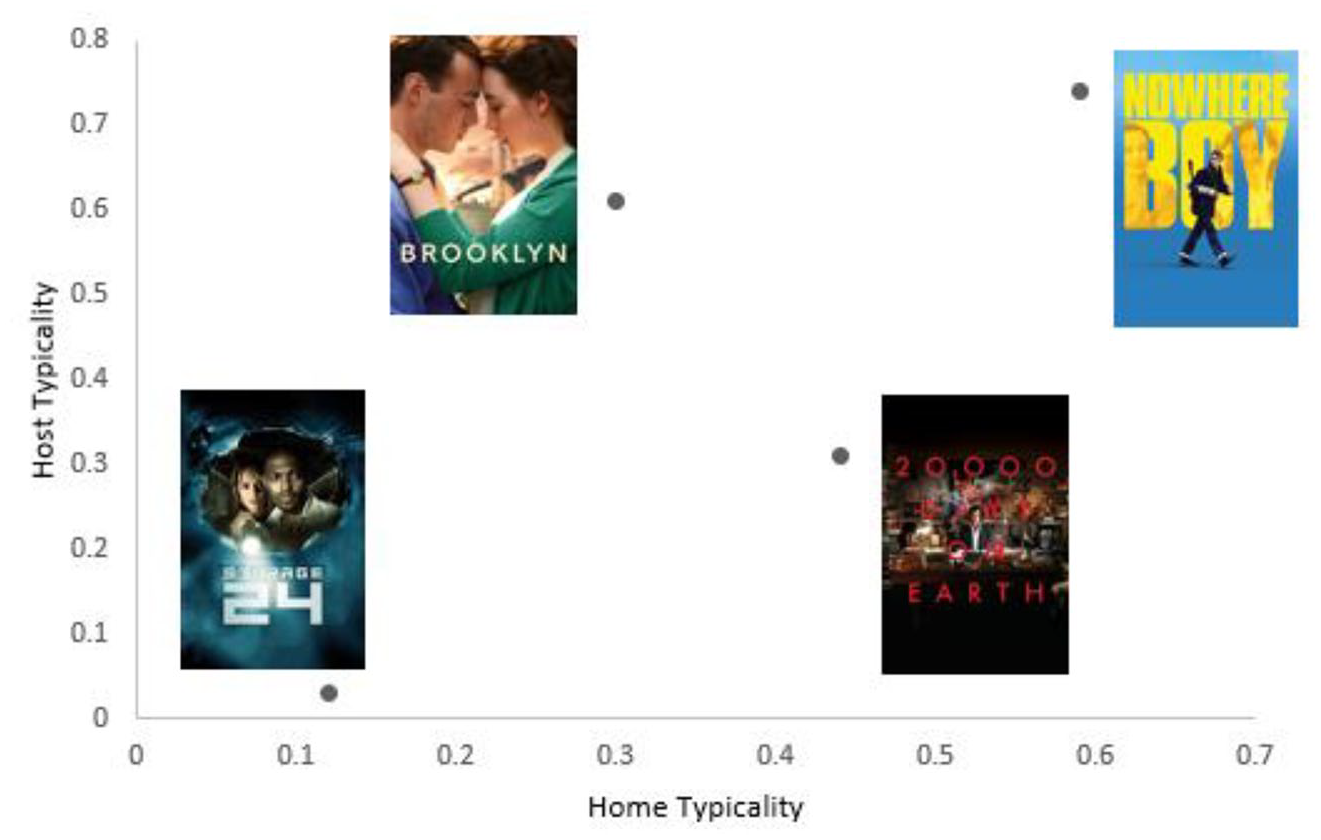
Example films.
Home typicality: origin-based authenticity
We first argue that when products traverse countries, they are more appealing if they possess greater home typicality. Home typicality indicates the extent to which products stay close to the categorical centroid in their home country. If France concentrates on producing drama films, for instance, a drama film made in France is considered to have a high level of home typicality. Products are usually associated with their origins when they are introduced to a different country (Roth and Diamantopoulos, 2009). Being typical of home allows products to establish a connection that can work as a signal of authenticity (Lehman et al., 2019). When products are strongly associated with their origins, they are considered to have greater authenticity because they meet the criteria for inclusion in their home type (Carroll, 2015). As such, these products are able to use their home country as a wellspring of authenticity (Gieryn, 2000). Indeed, Beck et al. (2019) show that the distance of Bavarian breweries from the geographical industry center affects their appeal. Breweries are considered more prototypical or “pure” when located closer to the center. In other words, products appear more authentic when they are more meaningfully connected to a particular place. 3 When products traverse between countries, this sense of connection provides an anchor of identification to guide audiences’ sense-making and selection. If products conform to their home country’s categorical centroid, they can cultivate an image of origin-based authenticity (Lehman et al., 2019), which helps enhance audience evaluation in host countries (Kovács et al., 2014).
Moreover, countries have different specializations (Becker, 1974; Peterson and Anand, 2004), such that they establish commitment, mastery, and legitimacy within certain types and categories (DiMaggio and Powell, 1983). Specialization enhances production efficiency and inertia (Hannan and Freeman, 1984), which reinforces a distinctive productive output. As such, products typical of home countries are more likely to leverage their home’s production expertise and capability, and are hence better able to develop products appealing in the international market. In contrast, products that deviate significantly from categorical codes in their home country are less likely to take advantage of authenticity. When failing to adhere to the home categorical centroid, atypical products may elicit concerns regarding their producers’ commitment and capability (Phillips et al., 2013; Sgourev and Althuizen, 2014). Commitment concerns may lead to a perceived lack of sincerity or authenticity (Lehman et al., 2019), whereas capability concerns could undermine the quality expectations of audiences (Hsu et al., 2009). As a result, products that are atypical according to their home countries are likely to be perceived as less authentic and less appealing in host countries.
Accordingly, we argue that home typicality enhances how products are received by international market audiences. There are two types of audiences that are important in cross-country exchanges: intermediary audiences and end consumers (Kim and Jensen, 2014). It is usually a two-step process. Intermediaries (e.g. international film distributors) decide whether to introduce products to a different country, and then end consumers (e.g. film goers) in a host country decide whether to consume the introduced foreign products. We expect to observe the positive effect of home typicality on both types of audiences. First, products with high home typicality are more appealing to intermediaries and consumers, as both of them are likely to seek authenticity. Second, intermediaries and consumers may influence each other in the evaluation process. On the one hand, intermediaries monitor closely the demand of end consumers, to whom they need to promote the imported products (Cabral and Natividad, 2020). Intermediaries are hence likely to introduce products with high home typicality, if anticipating end consumers’ tastes and preferences for it. On the other hand, as intermediaries choose to import certain products to a country, they also shape consumers’ perception of home typicality. Such mutual influence will drive intermediaries and consumers to converge in terms of how they receive home typicality. Taken together, we formulate our first hypothesis:
One underlying assumption for this hypothesis is that host audiences are aware of a product’s home typicality. This assumption is not unreasonable for the following reasons. First, given their experience and expertise in international markets, intermediaries are usually exposed to a wide set of products from a particular country, so that they are likely to be aware of the country’s categorical codes and typicality. Second, end consumers may also make sense of home typicality, because of exposure to products introduced to their country in the past. Certainly, this process will be contingent on the amount and types of imported products, which we will investigate in our extensional analyses. Third, distributors and media tend to highlight the home typicality of foreign products in their promotion process. For instance, a Norwegian mainstream media Aftenposten writes “My Golden Days: A very French Journey” when introducing this film (Lismoen, 2016). 4 Such type of activity also helps enhance end consumers’ awareness of home typicality.
Host typicality: novelty vis-à-vis host centroids
We further discuss how host typicality—the extent to which a “foreign” product is typical according to potential host country—affects its market exchange. Foreign products are generally disadvantaged compared to domestic products in host country (Zaheer, 1995; Zeugner-Roth et al., 2015). Domestic producers possess superior social and cultural skills to better accommodate local audiences (Fligstein, 1996). They also enjoy superior network positions, which help them exert influence on local normative or regulatory institutions (Cattani et al., 2014). Competing head on with entrenched domestic products is therefore difficult for foreign products. Foreign products, by contrast, may be better able to attract favorable attention and evaluation by offering novelty and variety. That is, foreign products can fare better if they are somehow different from local products, tapping into niches that are underserved by domestic producers (Mezias and Mezias, 2000). By highlighting atypicality with regards to the local categorical centroid, foreign products appear more novel, useful, and appealing (Zhao et al., 2017).
Indeed, foreign and domestic products assume different roles, to which local audiences attach different expectations (Biddle, 1986). Audiences expect foreign products to offer something unique or new that they cannot easily obtain from domestic offerings. Hewing too close to host country centroid would engender scrutiny in the eyes of local audiences. To become more appealing, foreign products should therefore exhibit deviation from domestic production (Edman, 2016). In other words, audience appeal is greater when foreign products are atypical of the host country, which is more congruent with the audience expectation of “foreignness” (Phillips, 2011). Otherwise, foreign products that resemble domestic production will be less desirable as audiences may disregard them as weak clichés (Brannen, 2004). 5 Meanwhile, while domestic products are largely constrained by host country codes, foreign products have greater leeway to challenge the codes and deviate from typical centroids (Shi and Hoskisson, 2012). This allows foreign products to tap into niches that are difficult to reach by domestic products without incurring nonconformity repercussions (Zuckerman, 1999). Consequently, foreign products will have a better chance of attracting local audiences if they are atypical of host country.
We therefore expect that market audiences prefer foreign products with low host typicality. Specifically, intermediaries are less likely to introduce products to a country if the products are typical according to its category system. Such products, if introduced, will also be less appealing to end consumers in the country.
Empirics
Empirical setting and sample: international cinema
We test our hypotheses in the context of international cinema. International cinema constitutes a major industry with global box office revenues amounting to over 42 billion USDs in 2019 (Statista, 2021). While film producers historically focused on domestic markets, international markets have become increasingly important. In 2016, for instance, 71% of US films’ revenues came from foreign markets (Motion Picture Association of America, 2016). Hence, as a prominent channel of cross-cultural communication, international cinema serves as a suitable avenue to understand cross-country exchanges of cultural products (Brannen, 2004; Fligstein, 1996; Kim and Jensen, 2014). 6 Despite their connectedness, however, film markets are still distinct among countries as each country has its own set of film producers, end consumers, and distributors.
Films, like other cultural products, are notoriously uncertain in terms of the market appeal (Caves, 2000). The appeal cannot be ascertained ex ante as a film must be consumed before its quality can be evaluated. To aid selection, audiences often refer to film genres (Altman, 1999; Hsu, 2006). 7 Genres are categories that enable consensus to form about films’ content and stylistic features (DiMaggio, 1987). They are related to universal emotional and cognitive states, such as comedy (mitigation of negative events and humiliation), romance (love), tragedy (communal coping with sadness and loss), and action (struggle and survival) (Grodal, 2009). Genres are thus prevalent across countries as part of institutional framework for film producers and audiences (Neale, 2000). As a result, genres constitute categorical codes of film markets, facilitating communication between producers, distributors, and audiences in the international cinema context (Hsu and Hannan, 2005).
We rely on three complementary sources of data: The Movie Database (TMDb), The Numbers, and UNESCO Film and Cinema. To our knowledge, TMDb is the most comprehensive registry of international movie data based on community-generated contents. To enhance data consistency, TMDb provides extensive guidelines to content contributors. We gather information from TMDb on films’ production countries, years, and genre assignments, which are used to construct typicality measures in different countries. For this purpose, we track over 71,000 films from 2003 to 2017. We also collect information on film directors from this source. To ensure accuracy, we manually inspect a number of entries.
We complement TMDb with information from The Numbers. 8 The Numbers is a unique, proprietary source that collects data on international distribution and box offices of films. We focus on films produced and released from 2008 to 2017 as earlier records are less comprehensive. Not all countries report exhibition, distribution, and revenue information for all movies. To mitigate concerns about incomplete data, we omit from our analysis countries that reported less than 100 film imports over 10 years. Most of these are very small countries. We also omit countries that produced less than three films in any single year of the sampling period. Their production is so sparse that it arguably makes little sense to consider film typicality. To construct our sample, we merge the two data sources based on a common identifier. We then add several country-level indicators from the UNESCO Film and Cinema database. In the end, we have complete information on 8416 unique films 9 from 44 countries (or regions) that are introduced to 40 different countries (or regions). 10
Dependent variables
Following prior research (e.g. Kim and Jensen, 2014), we construct dependent variables to reflect both the likelihood of a film being introduced to a foreign country and the subsequence market performance in a foreign country if introduced. Specifically, we create a dummy variable of film import taking a value of 1 if film i is imported to foreign country j in year t, and 0 otherwise. If films are released more than once in the same country, we only consider their very first entries. We use the logged box office revenues of film i in foreign country j to measure subsequence market performance.
Independent variables
Independent variables are home typicality and host typicality. Typicality is defined as the extent to which a product adheres to a categorical centroid. In line with prior studies (Smith, 2011), we calculate home typicality in two steps. First, we establish a hypothetical role model representing a categorical centroid in a country. For each country each year, we count the number of domestically produced films in each genre over the five preceding years, 11 and then divide it by the total number of films produced in the country. Multi-genre films are counted once for each genre. The resulting vector across all genres reflects the hypothetical centroid for that country. For instance, a country producing a large proportion of comedy films will have a high score for the comedy genre in its vector. Figure 2 displays categorical centroids for selected countries. While each country is unique in this regard, given its idiosyncratic culture and production history, there are also similarities among them. Some genres (e.g. Drama) are common in many countries, whereas others (e.g. Action) are only prevalent in a small number of countries.
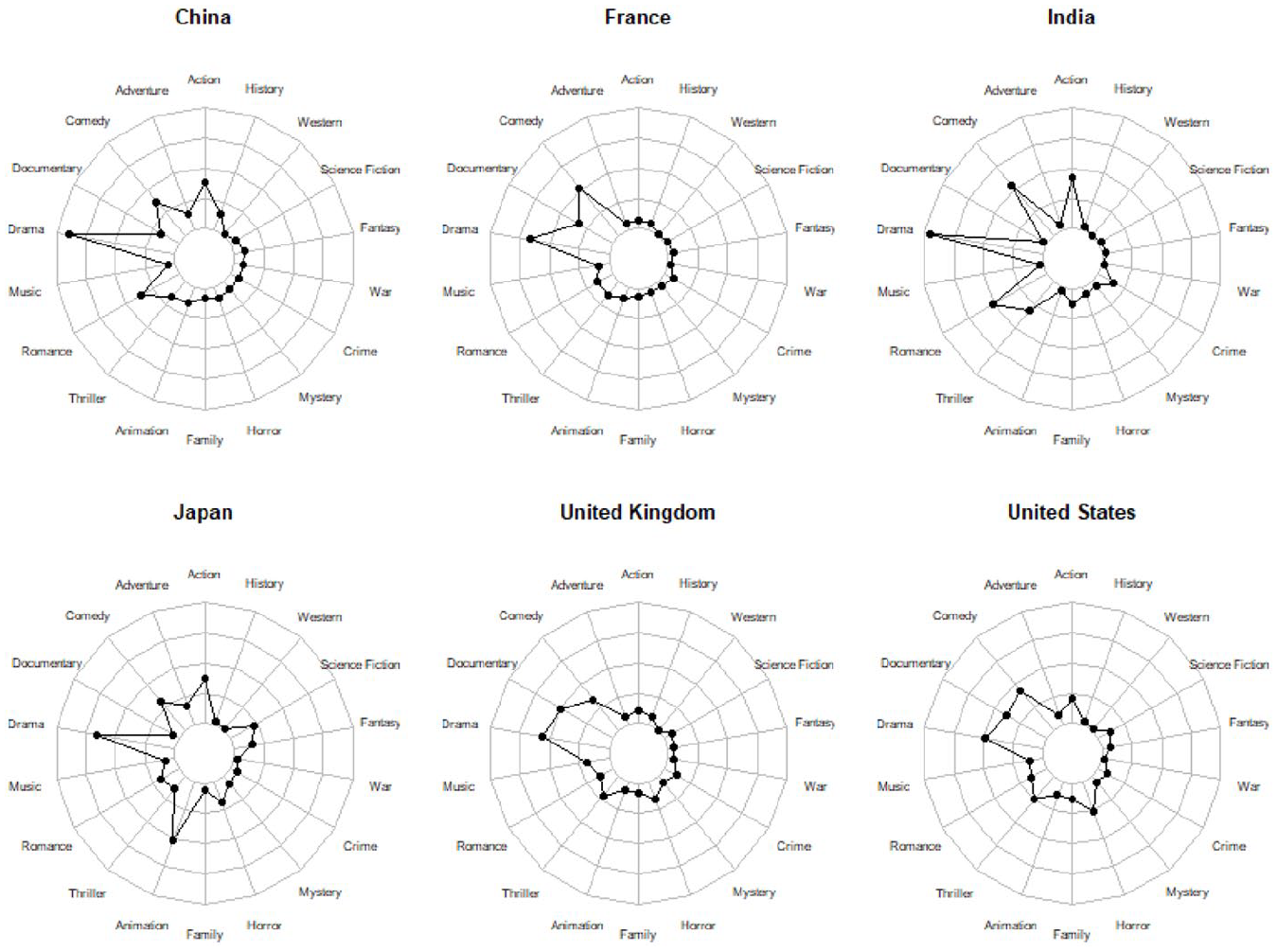
Genre concentration for major film-producing countries.
Second, we compute the similarity between a film and categorical centroid in its home country. More specifically, we apply the Dice coefficient (Smith, 2011) to calculate typicality:

where a and b are vectors of the focal film and its home centroid, respectively. Vector elements for the centroid range from zero to one, whereas vector elements for the focal film are binary, with a value of 1 if the film has membership in a particular genre. This results in a home typicality score between zero and one that reflects the degree to which a film adheres to the genre-based centroid of its home country. 12 According to this measure, films within the same genre (e.g. drama) may have different home typicality if they are produced in different countries. That is because centroids are different across countries as shown in Figure 2. For instance, if France is heavier in the drama production than South Korea, a drama film made in France will gain a higher score of home typicality than a drama made in South Korea.
We compute host typicality in a similar way, only replacing the filmmaking centroid with one in each of potential host countries each year. Accordingly, host typicality reflects the extent to which a film adheres to genre-based centroid in a potential host market. Figure 3 displays binned scatterplots for the two independent variables, which are not completely orthogonal. This is because, as mentioned, certain genres are common across countries. For example, a drama film made in France has a high home typicality score since dramas are prevalent in France. At the same time, the film will also have high host typicality scores in other countries that produce a large proportion of drama films. To further understand the distribution of home and host typicality, we split the sample into four quadrants by the median scores of home and host typicality each year. As shown in Figure 4, while films are disproportionally distributed in the first and third quadrants, there are still many films located in the off-diagonal areas. It is worth noting that while the measures of home and host typicality focus on the genre-based centroid of filmmaking in each country, we could not capture within-genre feature heterogeneity across countries. For instance, while drama films produced in different countries may vary in their inherent features, our measures cannot distinguish between them.
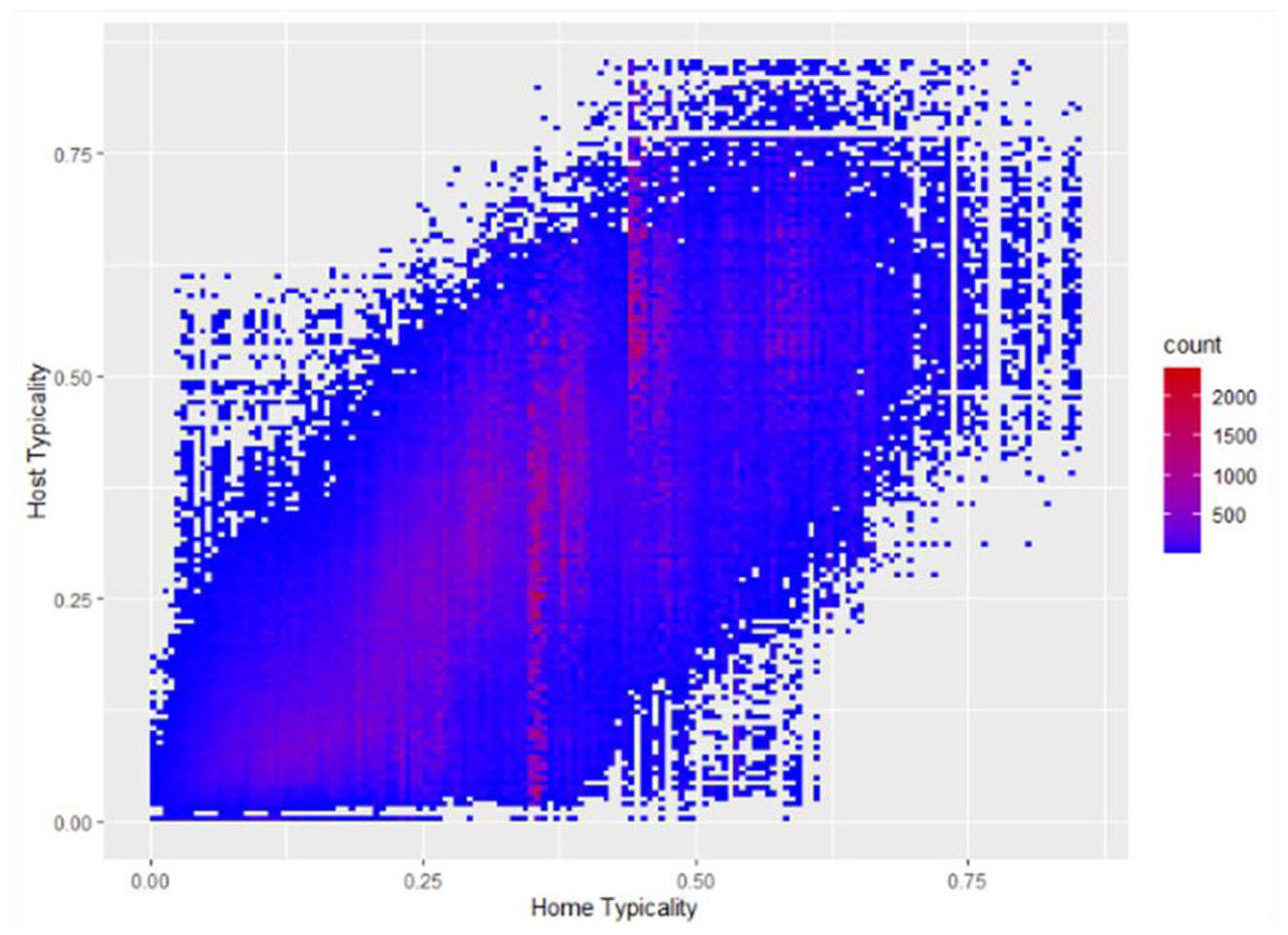
Binned scatterplot of home and host typicality.
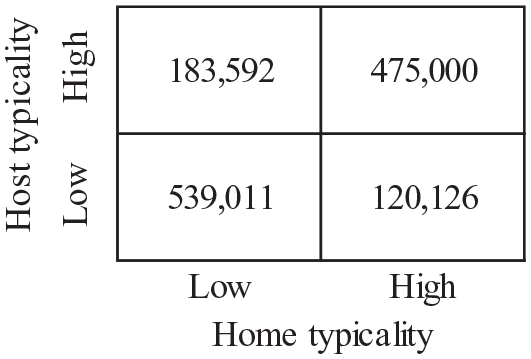
Median-split distribution.
Control variables
We include a wide range of control variables. First, we control for system distance, the degree to which two countries differ in their filmmaking systems (Peterson and Anand, 2004). Two countries are more similar when they emphasize the same set of film genres. Greater system distance indicates different cultural tastes and preferences, which may undermine cross-country affinity and sentiments (Zaheer, 1995). This is important since being typical or authentic may be not beneficial when sentiments are negative. We compute system distance as Euclidian distance between two countries:

where x and y are the country-level genre-based centroids as explained above.
We also add cultural distance reflecting the overall distance between two countries in social norms and values. Collecting data from the GeertHofstede site, we use the measure with six dimensions (Hofstede et al., 2010) and compute cultural distance as Euclidian distance between each pair of countries after normalizing scores by variance in the respective dimension. Cultural distance is also helpful to account for sentiments between countries (Bove and Gokmen, 2017) that may influence film import and box offices. 13
We also include genre spanning, calculated as the logged number of genres for each film (Hsu, 2006). We control for budget in film production as films with larger budgets are usually more successful in international markets. Unfortunately, budget information is only available for approximately 43% of films in our sample. This is common since many producers do not disclose such information (Keuschnigg and Wimmer, 2017). To keep as many observations as possible, we impute average budgets for films whose budget information is missing. To identify and control for these cases, we add a dummy variable of budget information taking a value of 1 if budget information is present and 0 otherwise (Singh, 2008). 14
We add Hollywood major to indicate whether any major Hollywood studios are involved in film production. It assumes a value of 1 if one of the following studios is involved: 20th Century Fox, Columbia Pictures, Paramount Pictures, Universal Pictures, Walt Disney Pictures, and Warner Brothers Pictures (Zuckerman and Kim, 2003). We also include a dummy variable, sequel, to indicate sequel film production. Typicality may be less important for films that are already familiar to audiences (Zhao et al., 2013).
We control for language match because language is important for cross-border exchanges. It takes a value of 1 if a film’s home country shares the same official language with a potential host country. We also add the number of tickets sold (admission), the number of visits per capita (attendance per capita), and the average ticket price (ticket price) in a host country. Larger markets are usually more attractive and can yield larger revenues. We add previous entry, the logged number of films introduced from a particular home country over the past 2 years.
We include director genre focus and director experience. 15 While we emphasize the typicality-based audience evaluation, films also differ in production quality. To account for the producer-side effect, we try to control for the expertise of directors who are key principals for film production (Sorenson and Waguespack, 2006). More specifically, director genre focus is computed as the ratio of prior films produced by the same director that fall in the same genre(s) as the focal film. When a film has more than one genre, we use its mean ratio. Director experience is computed as the logged number of films made by a film’s director.
In estimating box offices, we extend the set of controls to include the logged number of opening weekend theaters. For some films, this information is missing. We assign an average value to those films and add a dummy variable of opening theaters missing with a value of 1 to indicate the missing cases. Finally, we run all models with year and genre fixed effects (FE), which help account for temporal and genre variation, respectively. Some genres (e.g. comedy) are usually culture-specific, such that films within those genres cannot travel well across countries, regardless of typicality. Adding genre FE is thus helpful to account for such heterogeneity. Table 1 displays descriptive statistics and correlations.
Descriptive statistics.
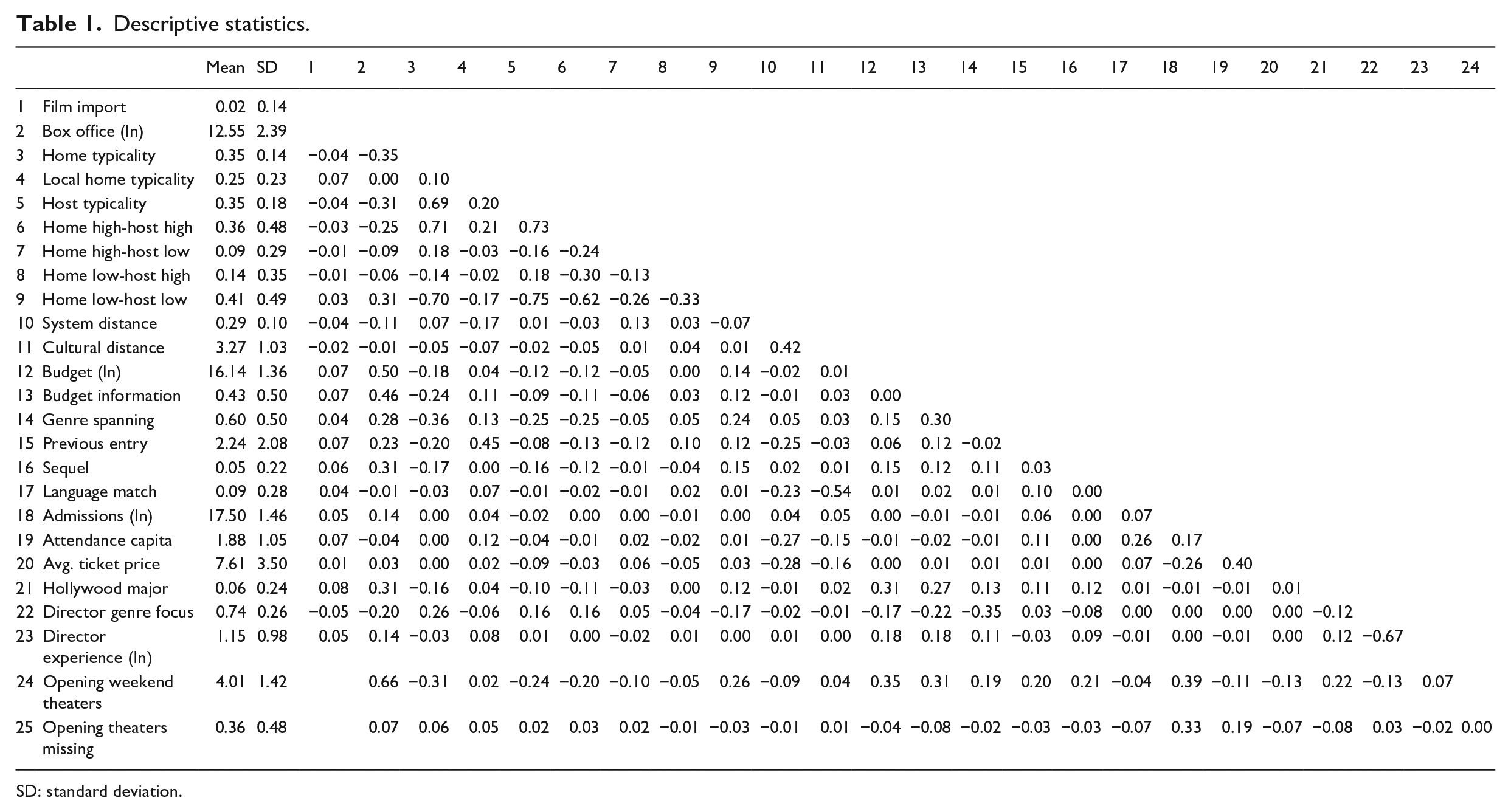
SD: standard deviation.
Estimation approach
In analyzing film import, our data have a survival panel structure where each film, following its initial release, is at the risk set of being released in any foreign country each year. Once a film is released in a foreign country, it leaves the risk set for that country. To estimate the probability of release in a particular foreign country, we apply piecewise exponential hazard models (Carroll and Hannan, 2004). This model is appropriate since our independent variable and the estimated effects change over time. Specifically, we implement the piecewise model as a Poisson regression with time interval dummies using R (Laird and Olivier, 1981; Rodriguez, 2021). 16 Because each film appears multiple times in our sample, we cluster standard errors at the film level.
In analyzing market performance, we employ OLS regressions to estimate box offices (Kim and Jensen, 2014; Zuckerman and Kim, 2003). To account for potential non-random selection (Bascle, 2008), we first compute Inverse Mills Ratio (IMR) for each observation based on our survival models, and then include IMR as a control in OLS regressions. We use language match for identification. Countries sharing common languages tend to have specific historical and cultural ties, which increases the likelihood of film export/import (relevance criterion). However, language translations may alleviate the impact of foreign languages on end consumers in host countries. Thus, we expect languages to have a much lesser impact on box offices (exclusion criterion). 17
Results
The main results are shown in Table 2. Models 1–4 report the results of film import analysis. Model 1 includes only control variables. Language match is significant across all models, thus providing adequate relevance for identification. System distance is negative across all models, consistent with our intuition. Genre spanning is positive, suggesting that films spanning more genres are more likely to be imported and achieve greater box offices. 18
Main regressions results.
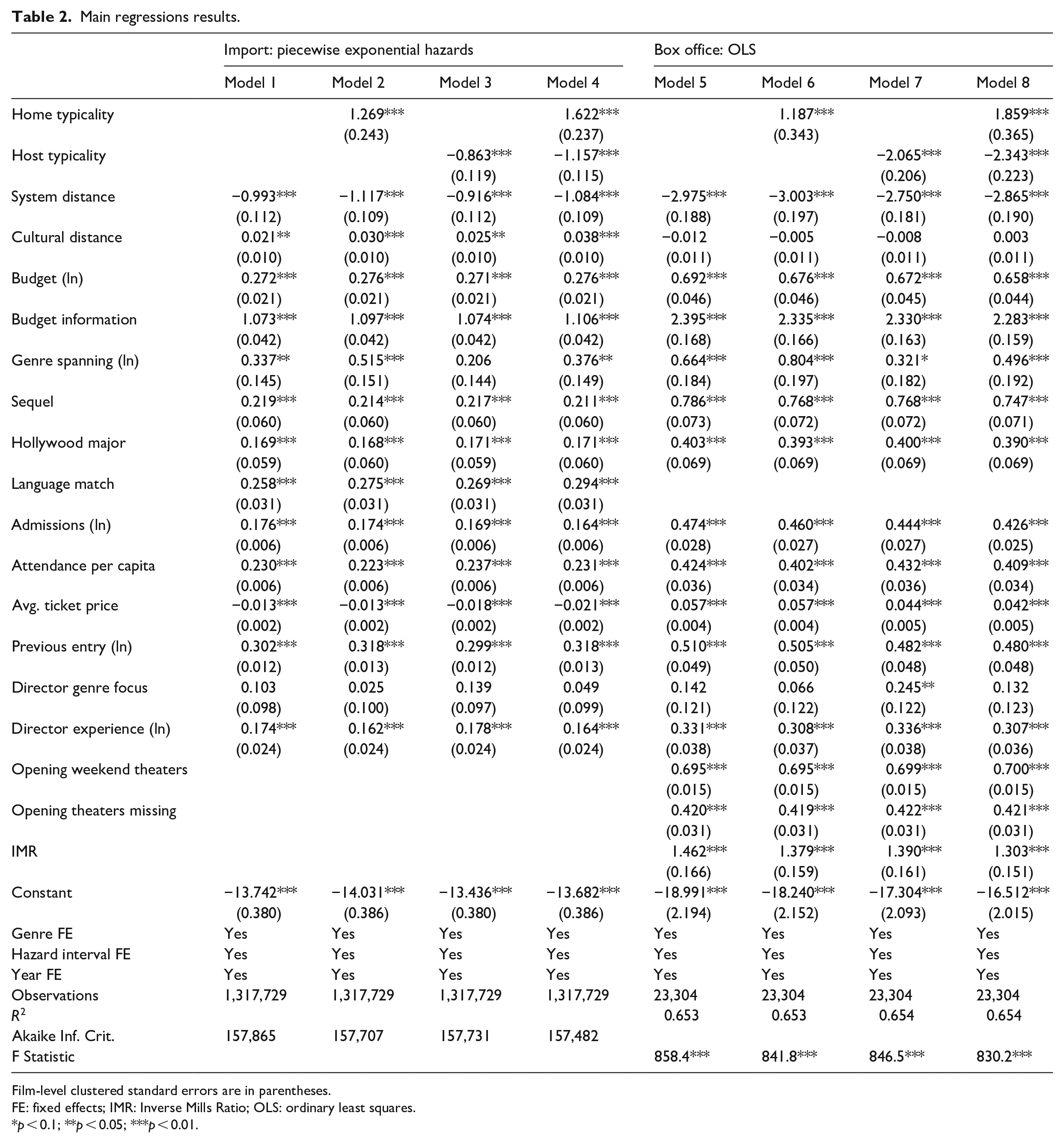
Film-level clustered standard errors are in parentheses.
FE: fixed effects; IMR: Inverse Mills Ratio; OLS: ordinary least squares.
p < 0.1; **p < 0.05; ***p < 0.01.
In Model 2, we introduce home typicality, which has a significant and positive coefficient (β = 1.269; s.e. = 0.243). This suggests that greater home typicality enhances the likelihood of film import, consistent with our
Models 5–8 report the results on box offices. IMR is significant, suggesting that it helps account for non\random selection. Model 5 includes only controls. In Model 6, we add home typicality, which is positive and significant (β = 1.187; s.e. = 0.343). This supports our
Extensional analyses
We conduct several important extensional analyses that relax our key assumptions, validate the main results, and explore the data.
Audience heterogeneity in awareness and exposure
In theorizing home typicality, we make an implicit assumption that audiences in host countries could recognize a typical film from a particular country. However, the awareness of home typicality may vary across host countries. To probe this issue, we relax the assumption in the following ways. First, while host audiences may not have a precise image of home typicality, their awareness will be enhanced when being exposed to more films from a particular country. In other words, when many of country Z’s films are imported to country X, audiences in X are likely to have a more precise perception of Z’s home typicality. By contrast, if X imports only a small proportion of Z’s films, audiences in X may not perceive Z’s home typicality well. 21 If so, one would expect the effect of home typicality to increase with the number of films imported from a particular country. To test this, we interact home typicality and previous entry. The interaction is indeed positive and significant on film entry in Model 1 in Table 3, albeit positive and nonsignificant on box offices in Model 4. These results thus lend partial support to the awareness conjecture.
Audiences awareness.
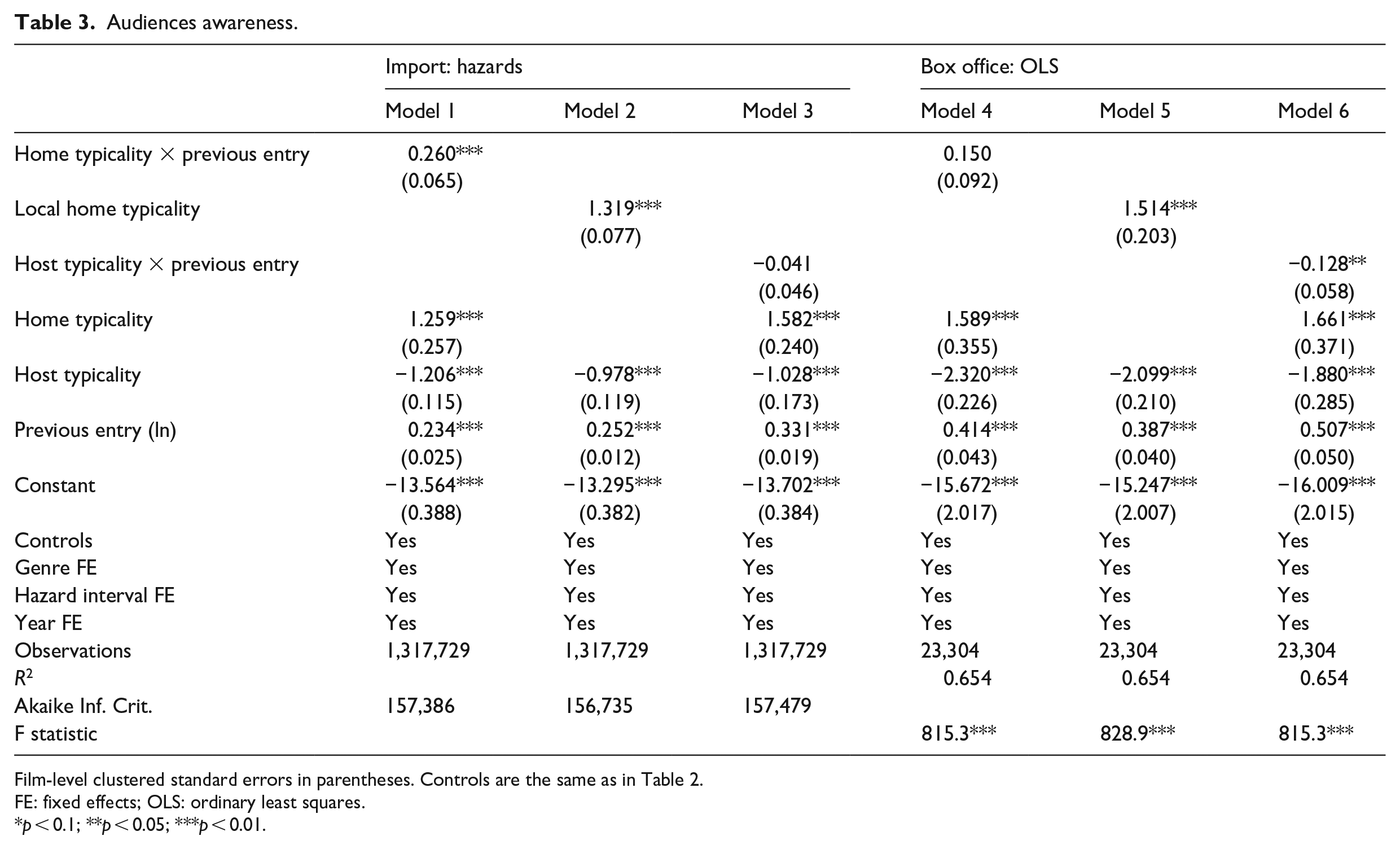
Film-level clustered standard errors in parentheses. Controls are the same as in Table 2.
FE: fixed effects; OLS: ordinary least squares.
p < 0.1; **p < 0.05; ***p < 0.01.
Second, we highlight that host countries may have different perceptions on home typicality of a particular country. For instance, audiences in countries X and Y could have different perceptions of country Z, if X imports more action films and Y imports more comedy films from Z. In other words, while our main theory assumes that there is an absolute home typicality that all host audiences observe, we relax the assumption here and emphasize that audiences may form different perceptions (Carroll, 2015). More specifically, we consider that the “perceived” typicality of local audiences may be contingent on what they have been exposed to. As such, we develop an alternative measure of local home typicality for every host country X. This variable is based on the set of films that are produced in home country Z and actually released in host country X from t – 1 to t – 5, instead of all films produced in Z. By building this measure, we emphasize audience heterogeneity in their awareness and exposure to a home country production. In Models 2 and 5 in Table 3, we repeat analysis using local home typicality and find results that are largely consistent with our core claim.
Moreover, we also examine how exposure may shape the effect of host typicality. Audiences in a country that is more exposed to foreign products may act differently than those with little exposure. In Model 6 in Table 3, we see that the interaction between host typicality and the previous entry is negative. It suggests that when filmgoers are more exposed to certain foreign films, they are more in favor of foreign films that are atypical of their local production. However, in Model 3 the interaction is nonsignificant on film import, suggesting that film distributors may be less subject to such exposure concerns when considering host typicality.
Film and distributor FE
While we control for many important factors, films are also idiosyncratic in terms of quality and features (e.g. star actors, awards, and prominent franchises). There may also be substantial within-genre feature heterogeneity between countries. For example, a Chinese action film may be quite different from an action film produced in Norway. To address concerns that those unobservables may influence results, we rerun the analysis with film FE. This provides a quasi-experimental setup to estimate both the effect of home typicality that varies across time, and the effect of host typicality that varies across time and host countries. 22 Film FE also absorbs variation associated with a film’s home country. This analysis mechanically omits all time-invariant film-level controls such as budget, genre spanning, sequel, and Hollywood major. Results are displayed in Table 4, which are consistent with our main findings above.
Film and distributor FE.
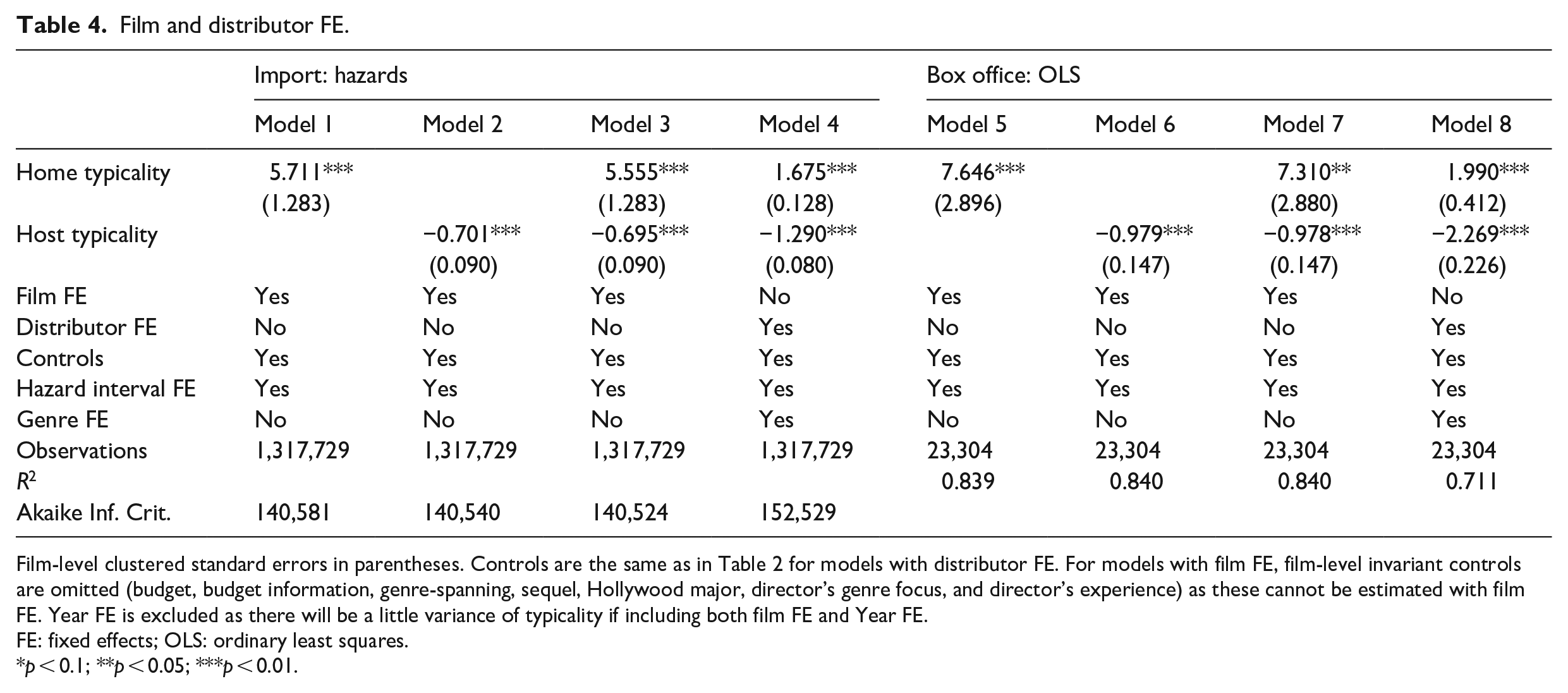
Film-level clustered standard errors in parentheses. Controls are the same as in Table 2 for models with distributor FE. For models with film FE, film-level invariant controls are omitted (budget, budget information, genre-spanning, sequel, Hollywood major, director’s genre focus, and director’s experience) as these cannot be estimated with film FE. Year FE is excluded as there will be a little variance of typicality if including both film FE and Year FE.
FE: fixed effects; OLS: ordinary least squares.
p < 0.1; **p < 0.05; ***p < 0.01.
Moreover, distributors are key for films’ promotion, and they may have different expertise in anticipating the potential of a film in a host country. To address concerns about distributor heterogeneity, we collect information on film distributors from The Numbers. Distributor information is missing for 33% of films in our sample. However, where not missing, distributors and producers are the same for 47% of the cases. Hence, we consider producers a fair replacement for distributors and impute this for the 33% missing cases. We end up with 1912 unique distributors. In Models 4 and 8 in Table 4, we include distributor FE and find consistent results.
Sampling bias and country heterogeneity
Our measures of typicality are based on TMDb, which may not represent the whole population of films. To address this concern, we compare TMDb with UNESCO in terms of the number of films reported from each country each year (2003–2017). The UNESCO database is, to our knowledge, the most reliable source of country-level film production. Across sampled countries, the median ratio between the number of films in TMDb and UNESCO is 73%. Hence, reporting between the two databases appears to be fairly consistent. As a further check of robustness, we rerun estimations after excluding the countries with a ratio below the median. In other words, we exclude the 20 countries for which TMDb is most likely to underreport. 23 The results are reported in Models 1 and 4 in Table 5, where we see consistent results.
TMDb bias and country FE.
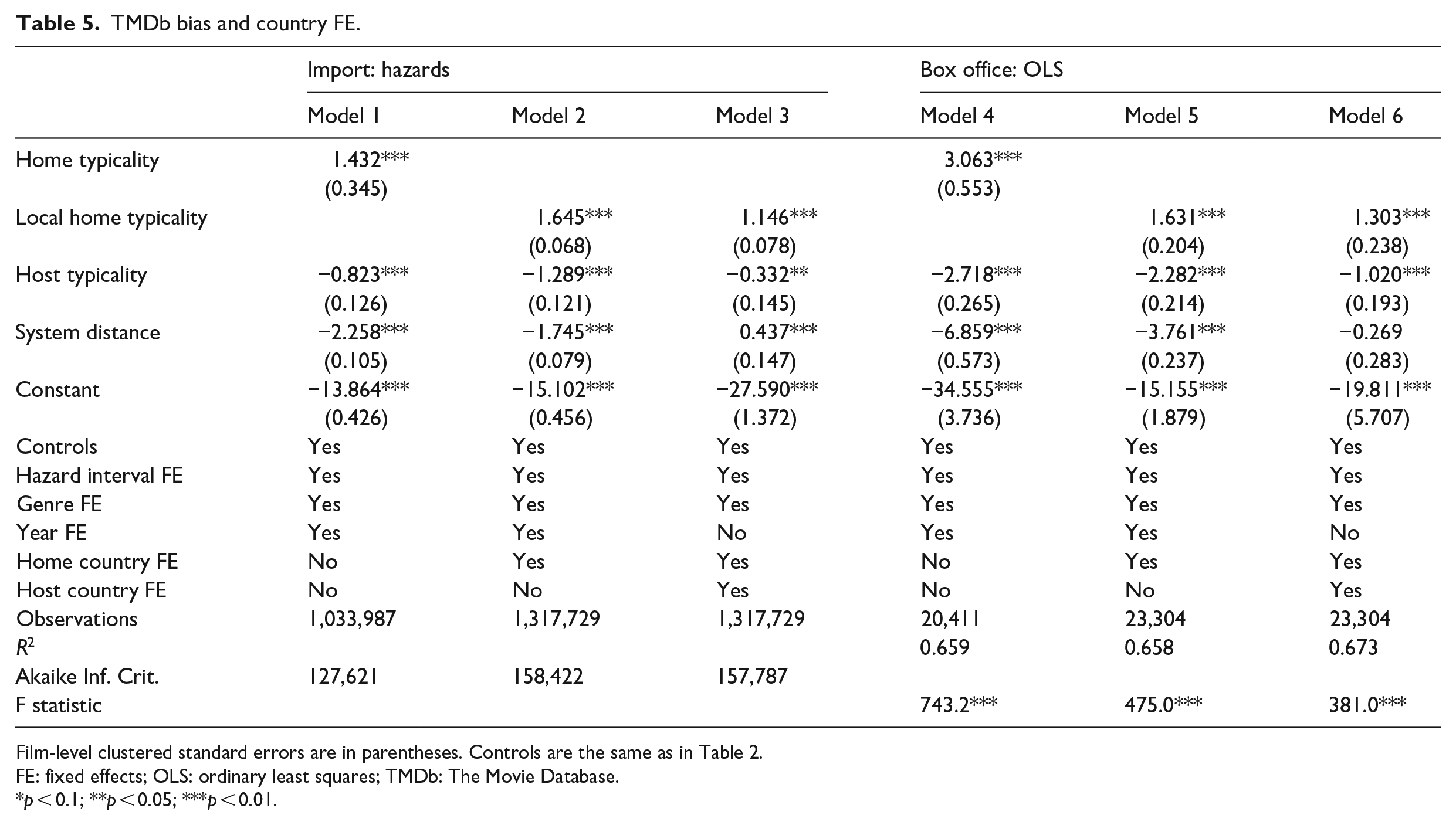
Film-level clustered standard errors are in parentheses. Controls are the same as in Table 2.
FE: fixed effects; OLS: ordinary least squares; TMDb: The Movie Database.
p < 0.1; **p < 0.05; ***p < 0.01.
To further account for country-level heterogeneity, we include home country FE in Models 2 and 5 in Table 5, and include host and home country FE in Models 3 and 6. The results are largely similar to our main analysis. Note that in Models 3 and 6, year FE are excluded because including them would lead to a little variance of home and host typicality.
System distance
While we control for system distance, it may be an important contingency factor for the effects of home and host typicality, as suggested in prior studies (Chua et al., 2015). Audiences’ perception of authenticity is likely to be contingent on the degree of cultural affinity or sentiments. To explore this, we interact home and host typicality with system distance. Results are reported in Table 6. In Models 1 and 3, the interaction between home typicality and system distance is negative. It suggests that when two countries are more distant from one another, the benefits of home typicality are undermined. In other words, system distance weakens the effect of home typicality, as it does not “translate” well across systems (Brannen, 2004). In Models 2 and 4, the interaction between host typicality and distance is negative. This suggests that host typicality is even more detrimental when countries are more distant. In other words, when a product is introduced from a distant country, audiences expect it to be more atypical of their local production.
System distance interactions.
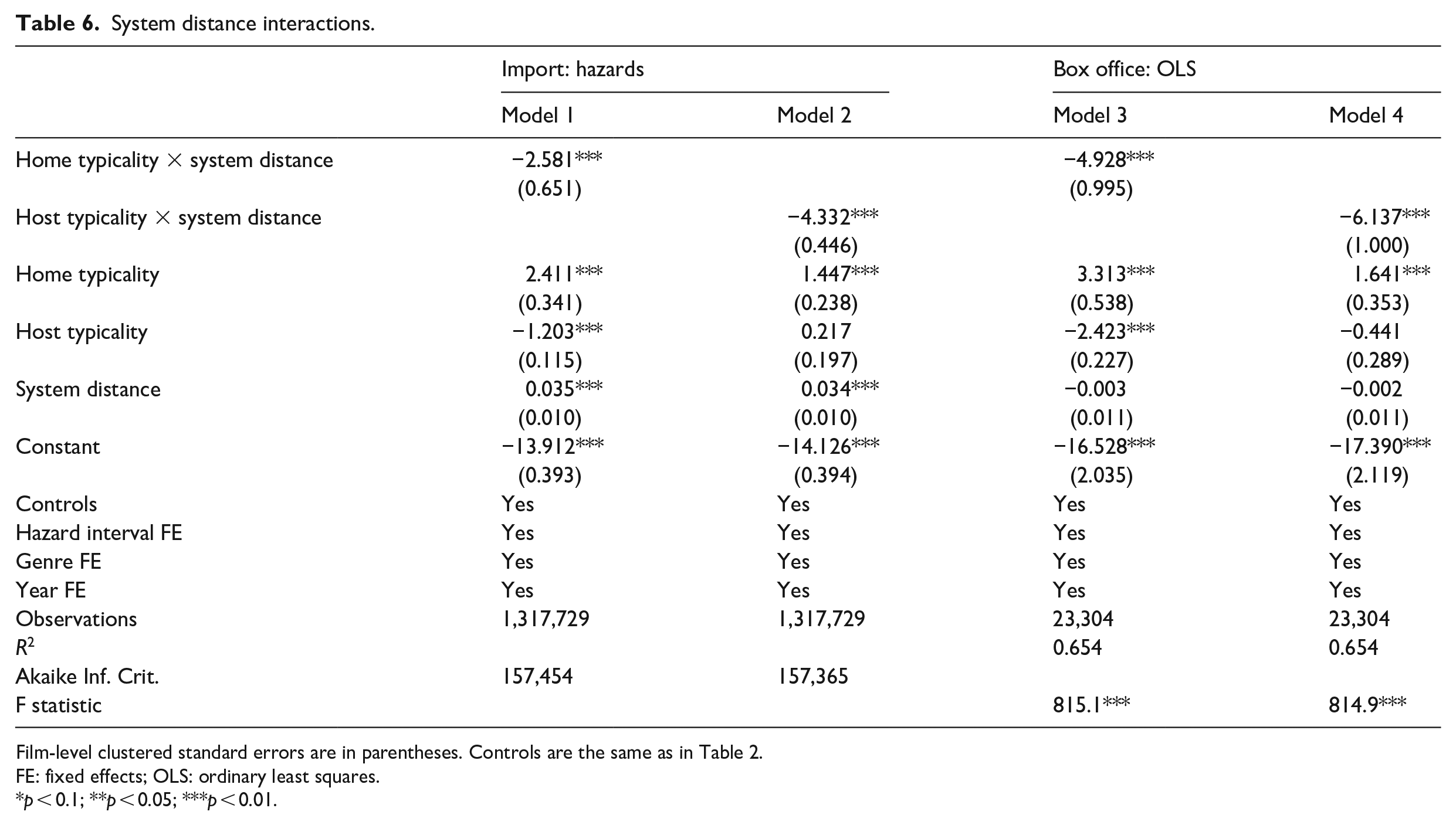
Film-level clustered standard errors are in parentheses. Controls are the same as in Table 2.
FE: fixed effects; OLS: ordinary least squares.
p < 0.1; **p < 0.05; ***p < 0.01.
Foreign vs domestic films
Our main framework focuses on exploring how foreign products perform in host markets. We also take the opportunity to compare foreign and domestic products from the perspective of typicality. Specifically, we collect additional data on domestic films and compare the market performance of foreign vis-à-vis domestic films. Results are presented in Table 7. The effect of foreign is significantly negative in Models 1 and 2, suggesting that foreign films generate lower box offices than domestic films. That is, foreign films are at a competitive disadvantage when facing competition from domestic products. More interestingly, the interaction term between host typicality and foreign in Model 3 has a negative and significant effect. It suggests that host typicality is detrimental to foreign films in attracting local audiences. This corroborates our arguments that foreign films are more successful if they tap into atypical niches in host countries.
Domestic vs foreign films.
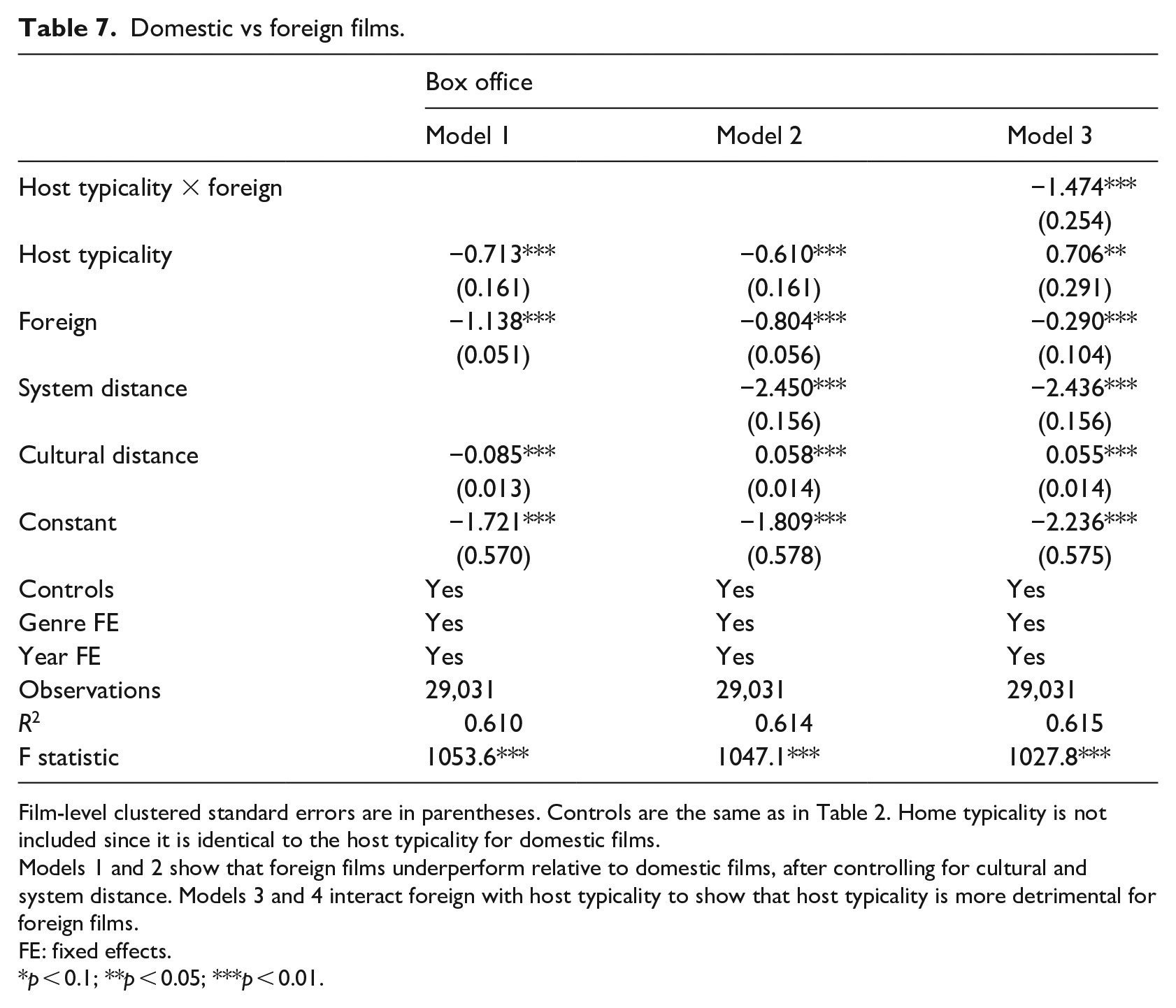
Film-level clustered standard errors are in parentheses. Controls are the same as in Table 2. Home typicality is not included since it is identical to the host typicality for domestic films.
Models 1 and 2 show that foreign films underperform relative to domestic films, after controlling for cultural and system distance. Models 3 and 4 interact foreign with host typicality to show that host typicality is more detrimental for foreign films.
FE: fixed effects.
p < 0.1; **p < 0.05; ***p < 0.01.
Combination of home and host typicality
In the last extension, we conduct a median-split analysis. Specifically, according to Figure 4, we assign all films within each year into four quadrants by the median scores of home and host typicality: high home-high host, high home-low host, low home-low host, and low home-high host. This approach helps not only address concerns about the high correlation between home and host typicality, but also explore the potential interaction between them. We then rerun the analysis using home low-host high as the reference group. Results in Table 8 show that films in the home high-host low group are significantly more likely to enter foreign markets and generate significantly greater box office revenues, compared to films in other groups. Such findings corroborate our core claims.
Combination of home and host typicality.
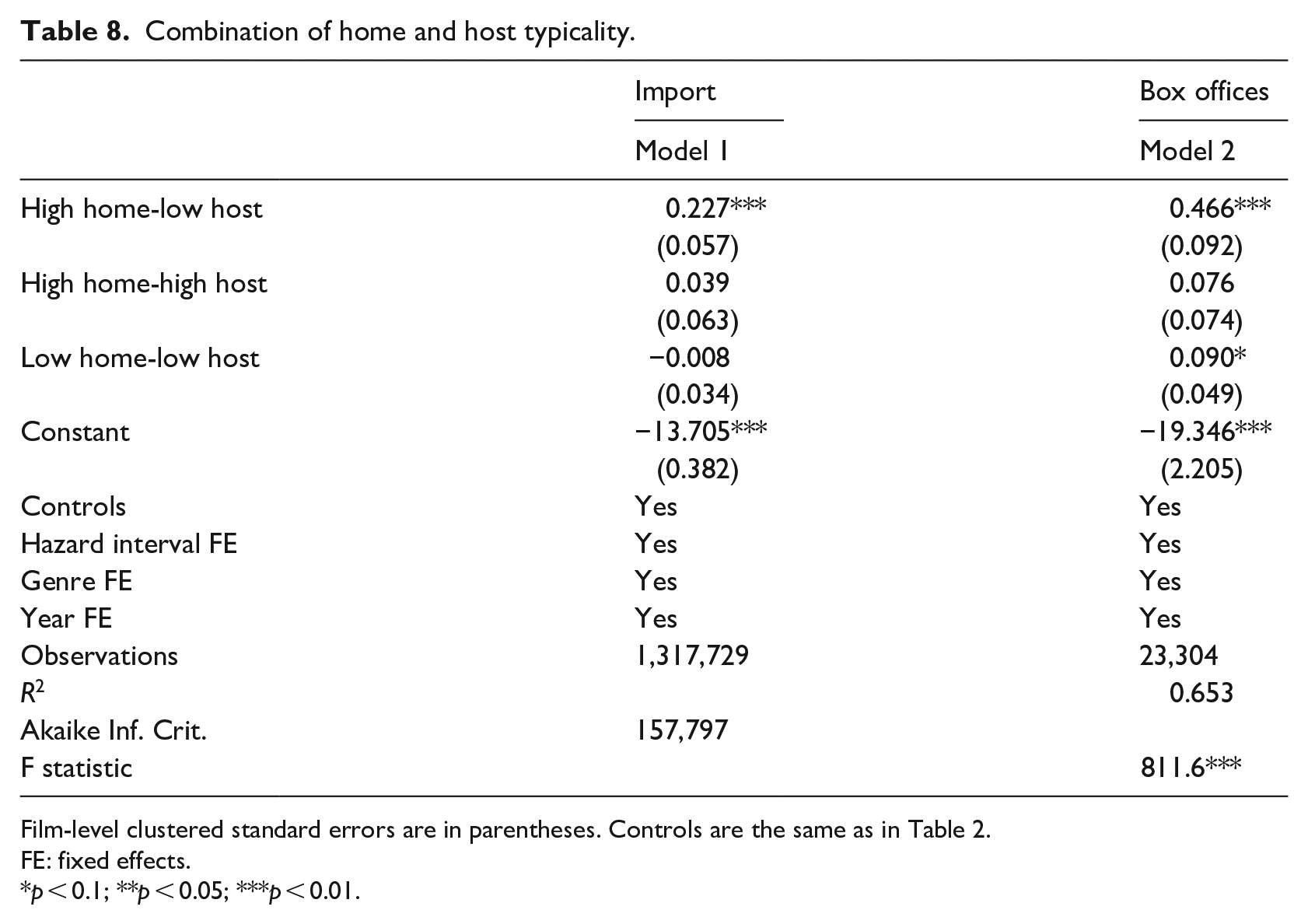
Film-level clustered standard errors are in parentheses. Controls are the same as in Table 2.
FE: fixed effects.
p < 0.1; **p < 0.05; ***p < 0.01.
Discussion
We extend research on typicality to market exchanges that traverse category systems, where audiences and producers reside in different countries. We emphasize that because defining what is typical is usually category system-specific, products may be typical in one country but atypical in another. It is therefore important to consider both home and host typicality when products diffuse across countries. Analyzing international film markets, we find that products are more successful in cross-country market exchanges when they are typical of their home countries (i.e. greater home typicality) and/or atypical of host counties (i.e. greater host atypicality). In doing so, our study contributes to current research in several ways.
First, we draw attention to the role of typicality when products traverse category systems. While research on typicality has proliferated over the past few years, most studies focus on single-system contexts where producers and audiences reside within the same category system and share the same lens defining typicality (Bowers, 2015; Pontikes, 2012). We emphasize the overlooked phenomenon of cross-system market exchanges by analyzing cross-country film markets. Since categorical codes that define typicality are system-specific, typical products in one country can be very atypical in another. As a result, when products traverse countries, they are subject to different category systems and typicality lenses. We introduce the concepts of home and host typicality to shed light on this complex process. Our analysis of international cinema shows that home and host typicality exert opposite effects on products’ international market success. While the home typicality of films enhances their international success in terms of market entry and box office revenues, their host typicality undermines their performance.
Second, the role of home typicality highlights the “origin” value—it is beneficial for cross-country products to adhere to their origin category systems (Roth and Diamantopoulos, 2009). This may be driven by two different mechanisms. On the one hand, categorical codes that are consistent with a product’s origin country are useful to enhance its authenticity and overcome the liability of foreignness (Edman, 2016; Lehman et al., 2019). Audiences in host countries prefer a product that can better represent the authentic flavor of their home county. On the other hand, countries are specialized in different product categories (Peterson and Anand, 2004). Products that are close to their home country’s centroid are more likely to have high inherent quality because they can better leverage the expertise of their origin. While we are unable to precisely identify the exact mechanism(s), our analysis demonstrates the significance of home typicality after accounting for many factors on the producer side. This suggests the existence of the authenticity-based mechanism, though the more direct examination is needed to tease out the mechanisms.
Third, we highlight that audiences seek atypicality from products that are introduced from a different country. Recent literature emphasizes the importance of identifying contingencies for the typicality-evaluation relationship. Existing studies have mostly focused on audience heterogeneity, such that different groups of audiences may have very different preferences about product typicality (Kim and Jensen, 2011; Pontikes, 2012). Our research draws attention to heterogeneity in the product origins: The same audience group may have different typical expectations for local products and “foreign” products from a different country. While audiences prefer more typical local products, they expect foreign products to be atypical, deviating from the local categorical centroid. As a result, cross-country product exchanges act as a way of introducing distinctiveness and nonconformity (Scott and Davis, 2007).
Finally, this study can also be linked to research on cultural distance. While extensive research has been done to explore cultural differences across countries, most studies focus on general cultural dimensions (e.g. uncertainty avoidance and power distance) (Chua et al., 2015; Hofstede et al., 2010). Our analysis indicates that countries differ substantially in the categorical systems they use to define what is typical. The two streams of studies may be better combined. On the one hand, heterogeneity in typicality can be considered as one concrete reflection of cultural differences. In other words, analyzing and comparing patterns of product typicality provides an alternative angle to explore cultural characteristics in a particular industry or organizational field (Carroll et al., 2010). On the other hand, classic cultural dimensions (Hofstede et al., 2010) may be an important antecedent for typicality differences. That is, cultural distance may lead to heterogeneity in categorical codes, which further shapes cross-country market exchanges. While this falls beyond the scope of our single study, we expect future studies to explore how they interact with each other.
Boundary conditions and limitations
It is important to understand the scope conditions and limitations of our framework. First, we have tested our theories in a single setting of international cinema. This setting is largely subject to category-based evaluation (Hsu, 2006). In other contexts where products are devoid of typicality beyond pure utility (e.g. commodities and raw materials), our framework may be less useful. Put differently, our theory is contingent on the extent to which market evaluation is subject to category systems. While category systems are more pronounced in culture industries, they are found to be prevalent in much broader contexts (Lo and Kennedy, 2015; Pontikes, 2012).
Second, it is useful to consider different conceptualizations and operationalizations of typicality. Specifically, we follow the tradition to focus on category-based typicality (Hsu et al., 2009; Smith, 2011). However, we have downplayed heterogeneity within categories. That is, films within the same genre from the same country may still exhibit different levels of home typicality, because of their inherent features or characteristics. While our data do not allow us to zoom into this, exploring film features (e.g. through text or image analysis) will provide a finer-grained understanding of typicality. To do so, scholars may first use film features to construct the “role model” for each country (within or across genres) and then compute film typicality. In addition, we see potentials to operationalize typicality in alternative ways. For instance, while our study employs genre-based film typicality, future work may consider typicality with regards to storylines, actors, and/or directors.
Third, our theory requires that countries (or category systems) differ in how they define what is typical and what is not. While countries are all different, globalization also causes countries to converge toward each other. When practices are largely diffused across countries, they may become so similar that there is little distinction between home and host typicality.
Fourth, while we theorize about cross-system exchanges in a general way, the theory is tested on specific cross-country imports and exports. Category systems in our theory are not only defined by geographic locations (e.g. countries and regions) but can also be organizational fields and market segments (DiMaggio and Powell, 1983; Fligstein and McAdam, 2012; Miller and Chen, 1996). As such, it would be interesting to examine typicality when products traverse across fields, segments, and other types of category systems.
Moreover, while we focus on product-level outcomes, more attention is needed to flesh out system-level dynamics (Fligstein and McAdam, 2012). Our core findings suggest that products typical of their home countries are more successful in cross-country exchanges. This may encourage specialization and homogeneity within countries but heterogeneity between countries. However, the flow of products between countries could also lead to global convergence (Strang and Meyer, 1993). Future studies may explore how countries evolve in terms of their categorical centroids.
Finally, future studies may explore the distinction between intermediaries and consumers as market audiences. Our study treats them as two types of representative audiences that are similarly subject to typicality concerns. However, intermediaries and consumers may be different in their evaluation and consumption processes, as hinted by our extensional analyses. It is thus interesting to explore whether and under what conditions they respond differently to product typicality.
Conclusion
In this study, we explore how typicality affects market exchanges when products traverse discrete category systems. We emphasize that because defining what is typical is system-specific, those products will be subject to both home and host typicality lenses. Analyzing a large sample of films, we find broad evidence that both home and host typicality influence the performance of films in international markets but in different ways. While home typicality enhances films’ international success, host typicality undermines it. This implies that market audiences seek foreign products that are typical of their home country and/or foreign products that are atypical according to the categorical codes of host countries.
Footnotes
Appendix 1
Appendix 2
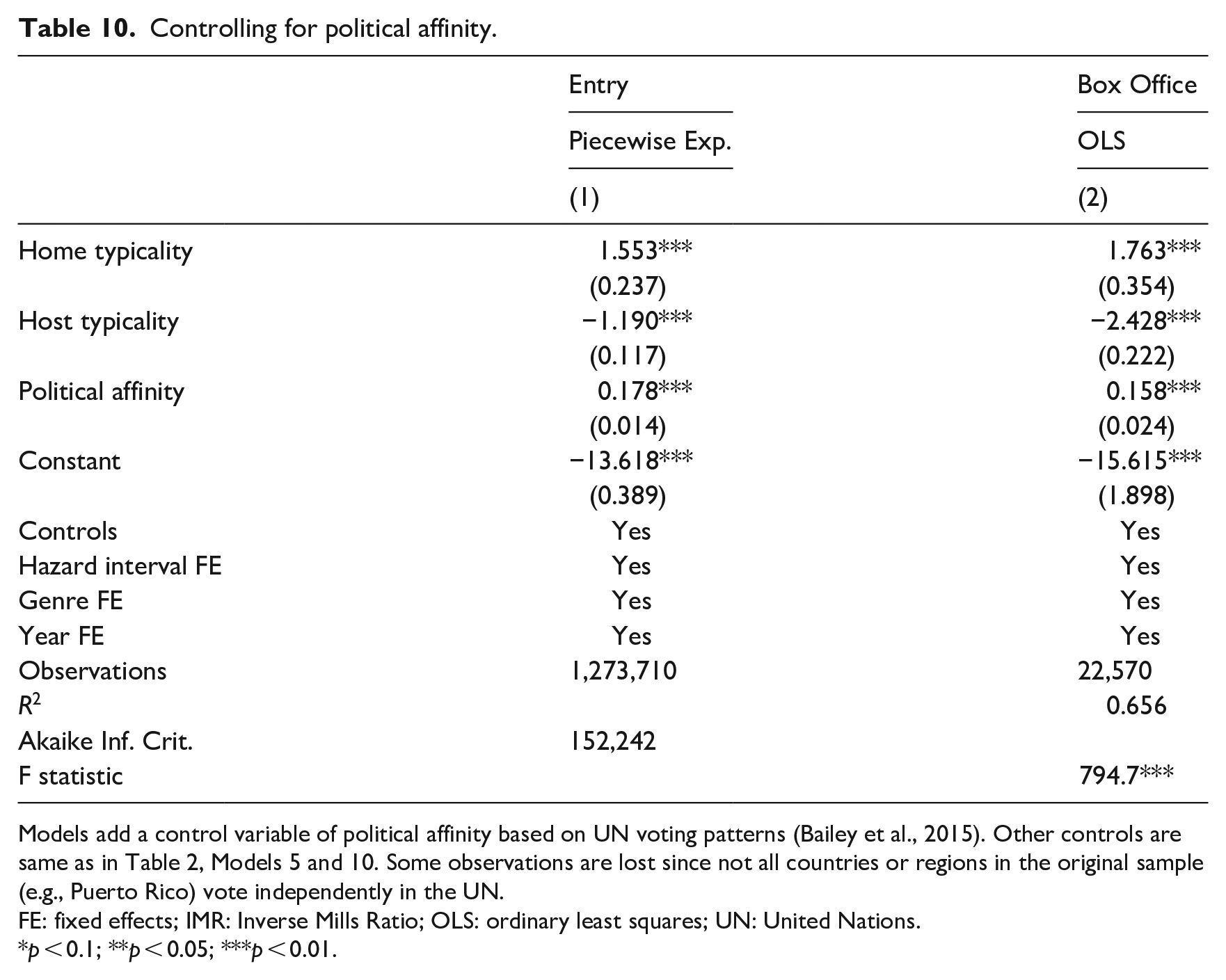
Controlling for political affinity.
| Entry | Box Office | |
|---|---|---|
| Piecewise Exp. | OLS | |
| (1) | (2) | |
| Home typicality | 1.553*** | 1.763*** |
| (0.237) | (0.354) | |
| Host typicality | −1.190*** | −2.428*** |
| (0.117) | (0.222) | |
| Political affinity | 0.178*** | 0.158*** |
| (0.014) | (0.024) | |
| Constant | −13.618*** | −15.615*** |
| (0.389) | (1.898) | |
| Controls | Yes | Yes |
| Hazard interval FE | Yes | Yes |
| Genre FE | Yes | Yes |
| Year FE | Yes | Yes |
| Observations | 1,273,710 | 22,570 |
| R 2 | 0.656 | |
| Akaike Inf. Crit. | 152,242 | |
| F statistic | 794.7*** |
Models add a control variable of political affinity based on UN voting patterns (Bailey et al., 2015). Other controls are same as in Table 2, Models 5 and 10. Some observations are lost since not all countries or regions in the original sample (e.g., Puerto Rico) vote independently in the UN.
FE: fixed effects; IMR: Inverse Mills Ratio; OLS: ordinary least squares; UN: United Nations.
p < 0.1; **p < 0.05; ***p < 0.01.
Acknowledgements
We would like to thank the Editor Robert David and three anonymous reviewers for constructive comments in the review process. We also received very useful feedbacks from Erik Aadland, Elisa Operti, Richard Haans, and participants at the EGOS 2020 Subtheme 56: “The Emergence, Evaluation, and Legitimation of Novelty and Novel Ideas.”
Funding
The author(s) received no financial support for the research, authorship, and/or publication of this article.
