







Abstract
Downsizing often triggers economic disruptions in affected communities, leading to scrutiny of and resistance toward downsizing firms. Despite potential repercussions, the influence of local community pressure on downsizing decisions remains underexplored. This study advances the downsizing literature by demonstrating how the local community, as an institution, influences these decisions. We show that while market logic justifies downsizing based on declining performance, community logic pressures firms to reduce the scale of downsizing to preserve community welfare. We find that although firms increase the scale of downsizing across their subunits in response to declining performance, the scale at each subunit is shaped by the strength of community logic in each locale. This strength is influenced by community characteristics, such as ethnic diversity, labor union membership, social capital, and political ideology. Our findings suggest that the tension between market and community logics guides firms in determining where and to what extent to downsize.
Keywords
Introduction
Downsizing has become a common strategy for firms. By purposefully and systematically reducing the organizational workforce (Cameron, 1994; Nixon et al., 2004), downsizing often serves as a corporate strategy to improve financial performance, primarily by reducing organizational slack or operational costs (Chan, 2024; Gandolfi and Hansson, 2011; Love and Nohria, 2005). Most studies indicate that economic or market-based motives drive firms to downsize (Cascio et al., 2021; Gandolfi and Hansson, 2011; Steel and House, 2024). This strategy is often initiated to alleviate financial pressure in response to performance downturns during financial crises or economic recessions (Amato et al., 2023; Datta et al., 2010; Jung and Lee, 2022; Schulz and Wiersema, 2018). Moreover, in competitive markets that force price reductions, downsizing is often used as a cost-reduction strategy (Boubaker et al., 2022).
While progress has been made in understanding the motivations behind firms’ downsizing decisions (Amato et al., 2023; Boubaker et al., 2022; Jung and Lee, 2022), these decisions are often implicitly assumed to have been made in isolation from the potential opposition of local communities affected by downsizing. Several studies document that corporate downsizing inevitably raises multiple issues in the affected local communities, adversely affecting the economic conditions of the regions and the health and welfare of the affected workers, their families, and local communities (Andreeva et al., 2017; Grunberg et al., 2001; Sullivan and Von Wachter, 2009). Consequently, the affected workers and communities may initiate collective actions such as strikes, boycotts, and legal actions against their previous employers, which could severely tarnish firms’ reputations and undermine their performance (Cavico and Mujtaba, 2017; Jung, 2017; Jung and VanHeuvelen, 2023).
Despite the negative consequences that may arise from local opposition, studies have not adequately examined the tension that firms experience between the need to downsize and the expected opposition from local communities that deters them from downsizing. To date, only a few studies have addressed this issue. Greenwood et al. (2010) were among the first to demonstrate that the local community surrounding a firm can shape its downsizing decisions. In their study of Spanish manufacturing firms, they found that firms with a high concentration of operations in a single region were less likely to implement layoffs. The strong presence of the local community in corporate operations subjected the firms to greater scrutiny from local governments, regional elites, and the media, thereby pressuring them to limit downsizing despite experiencing financial pressures. Nevertheless, existing literature has not thoroughly examined how firms’ downsizing decisions are influenced by localized pressures from community residents who are most likely to be affected by downsizing events.
To fill this gap in the literature, our study examines how firms respond to the tension between internal pressures to increase downsizing (due to setbacks in financial performance) and external pressures to minimize downsizing (due to potential resistance from local community residents) from the perspective of institutional complexity (Greenwood et al., 2011; Kodeih and Greenwood, 2014; Vermeulen et al., 2016). One of the foundations establishing firms’ institutional environment is institutional logics, referred to as the “master principles of society” and social prescriptions that “constitute appropriate behavior” (Thornton, 2004: 70). Institutional logics have been documented as shaping firms’ interpretations of reality and the actions they take to succeed. Firms often face multiple logics when making strategic decisions, and institutional theory has long sought to explain the divergence in firm strategies as an outcome of conflicting institutional logics (Greenwood et al., 2011; Kodeih and Greenwood, 2014; Vermeulen et al., 2016). Following this, the central question of this study is how firms respond to the conflicting institutional logics arising from financial imperatives and local community expectations, and how this tension shapes variation in firms’ downsizing decisions across facilities embedded in different local communities.
We argue that the conflict between market and community logics shapes firms’ downsizing decisions. We posit that market logic becomes prevalent when firms’ performance falls below their aspiration levels, compelling them to engage in corporate-level downsizing as a solution to their declining performance (Schulz and Wiersema, 2018; Shi et al., 2023). Consequently, firms would extend workforce reductions across multiple local facilities during periods of underperformance. Building on this, we predict that the extent of downsizing announced at each facility may vary depending on the strength of community logic—the pressure from local community residents to organize actions to protect their interests against firm decisions (Almandoz et al., 2017). We argue that the strength of community logic is determined by the following local community characteristics: ethnic diversity, labor union membership, social capital, and political ideology. These characteristics would shape firms’ expectations of potential local community responses and, ultimately, their actual decisions to downsize local facilities.
We examine this tension between market and community logics in corporate downsizing, using facility-level downsizing data of US firms. Our analysis includes 1,413 business facilities across 114 firms in various US counties from 2011 to 2021. The results indicate that the effects of negative performance feedback on downsizing announcements are more pronounced in local environments with greater ethnic diversity, a characteristic that tends to weaken community logic. Conversely, downsizing announcements are smaller in environments where labor union membership and social capital are higher and the political ideology of the residents is more liberal, factors that strengthen community logic. Overall, these findings support our key argument that firms’ downsizing announcements are a function of two countervailing institutional logics: market and community. The relative strength of these logics guides firms’ decisions on where and to what extent to downsize.
Our study makes the following theoretical contributions. First, we contribute to the understanding of how the conflict between institutional logics (Friedland and Alford, 1991; Greenwood et al., 2010, 2011) shapes corporate downsizing decisions. Research has emphasized managerial motives for financial performance improvements or sociopolitical factors at the macroeconomic level, overlooking the local community characteristics that closely affect corporate operations. We extend this stream of research by theorizing and empirically demonstrating how corporate downsizing decisions are shaped by the institutional complexity created by the tensions between market and community logics. Second, we contribute to the downsizing literature by examining how firms internally allocate layoffs across local subunits. Our fine-grained facility-level analysis extends the corporate-level perspective predominantly employed in downsizing studies (Datta et al., 2010; Kammeyer-Mueller et al., 2001; Love and Kraatz, 2009). This facility-level approach provides a nuanced understanding of how downsizing announcements vary due to local community characteristics. Third, our findings contribute to research on the performance feedback model by identifying the underexplored boundary conditions that lead firm decisions to deviate from conventional expectations derived from the behavioral theory of the firm (BToF) (Greve and Gaba, 2017; Kotiloglu et al., 2021; Posen et al., 2018). We expand scholarly discussion in this area by providing evidence that local community characteristics represent a previously overlooked contingency that shapes firms’ strategic responses to performance feedback.
Theory and hypotheses
Institutional complexity and corporate downsizing decisions
Corporate downsizing, defined as “planned eliminations of positions or jobs” (Cascio, 1993: 95), has become a prevalent strategy for firms seeking to improve operational efficiency (Cameron, 1994; Datta et al., 2010; Jung and Lee, 2022; Schulz and Wiersema, 2018). A key complication of downsizing is that the decision often has negative consequences, especially concerning antagonistic responses from community residents in the surrounding local environments. By adversely impacting not only local economies but also the health and welfare of community residents (Grunberg et al., 2001; Sullivan and Von Wachter, 2009), downsizing can cause firms’ relationship with their surrounding local communities to become antagonistic, thereby increasing the likelihood of collective action from community residents (Cavico and Mujtaba, 2017; Jung, 2017; Jung and VanHeuvelen, 2023). Thus, although corporate executives may have legitimate internal reasons to downsize their firm’s workforce, the adverse responses they expect from local community stakeholders are non-negligible factors in making the decision to downsize.
This study examines the tension around corporate downsizing decisions by drawing on the institutional logics perspective (Friedland and Alford, 1991; Thornton and Ocasio, 1999). As a theoretical framework that interprets society as a composition of different institutional orders, institutional logics prescribe “a pattern of beliefs, practices, values, assumptions, and rules that determine what is meaningful and legitimate in that context” (Almandoz et al., 2017: 191). In alignment with the framework proposed by scholars, we view the tensions faced by firms in their downsizing decisions as a conflict between two distinct institutional logics (Greenwood et al., 2011; Kodeih and Greenwood, 2014): market logic (driven by motivations to achieve operational efficiency) and community logic (driven by concerns about potential resistance from local communities). This conflict epitomizes the concept of institutional complexity, wherein dissimilar institutional logics coexist in a social arena and their relative strengths guide firms’ strategic decisions and actions (Greenwood et al., 2011; Kodeih and Greenwood, 2014; Vermeulen et al., 2016).
We begin by establishing a baseline hypothesis (H1) that outlines how market logic is expected to influence downsizing decisions. This baseline hypothesis provides the foundation for subsequently examining the conflict between market and community logics.
Market logic: impact of negative performance feedback on downsizing
Studies have documented that firms often resort to downsizing as a strategic response to declining financial performance (Jung and Lee, 2022; Schulz and Wiersema, 2018; Shi et al., 2023). Although downsizing can sometimes be driven by non-financial factors, including institutional pressures (Budros, 1997; Mckinley et al., 2000) and imitative behaviors among executives (De Witte, 2022; Muñoz-Bullón and Sánchez-Bueno, 2014), firms have often been found to pursue workforce reductions with the expectation of financial benefits, including improvements in profitability and stock market performance (Cascio, 1993; Jung and Lee, 2022; Schulz and Wiersema, 2018). Firms that hoard their labor and are reluctant to downsize in response to adverse economic conditions may experience declines in their short-term profitability and productivity, given that high payroll costs subject them to financial pressures (Giupponi and Landais, 2023; Katz and Meyer, 1990). The literature, however, also acknowledges that downsizing can have negative consequences. For instance, downsizing can undermine firm performance by damaging corporate reputation and eroding stakeholder trust, potentially offsetting its intended benefits (Datta et al., 2010; Love and Kraatz, 2009).
Nevertheless, the dominant scholarly view remains that economic and market-based motives are the primary determinants of corporate downsizing (Cascio et al., 2021; Gandolfi and Hansson, 2011; Steel and House, 2024). This perspective is also evident in practice, as downsizing has commonly been adopted by organizations to achieve performance turnarounds. Concerning the sharp increase in layoff announcements among US employers in 2023 (a total of 270,416 workers, which is nearly a fourfold jump from the previous year), experts noted that firms’ motives to reduce operational costs and satisfy the interests of financial investors represented some of the main underlying factors driving such decisions (Challenger, Gray & Christmas Inc, 2023; Chan, 2024).
Given the anticipated financial benefits of downsizing and its practical motivations, we predict that firms facing pressure to boost their financial performance in response to negative performance feedback would be more likely to downsize their organizations to address internal problems. Research on the BToF resonates with this reasoning, documenting that performance shortfalls drive firms to seek solutions in local search domains, which leads them to choose familiar solutions with more apparent short-term outcomes (Gavetti and Levinthal, 2000; Greve, 2003).
Thus, the clear short-term benefits of corporate downsizing are more rationally appealing to corporate decision-makers when firms are exposed to greater financial performance failures (Mentzer, 1996). Financial performance shortfalls instill greater principles and assumptions onto firms aimed at maximizing profits in alignment with the interests of financial investors and capitalist markets; sociologists and management scholars label this influence as market logic (Thornton and Ocasio, 2008). Therefore, when a firm’s financial performance fails to meet aspirations, market logic that emphasizes profit maximization exerts greater influence, leading the firm to plan larger downsizing at the corporate level. This may result in larger downsizing announcements at each local facility. Based on this rationale, we propose the following hypothesis:
Community logic: impact of local community characteristics on downsizing
This section conceptualizes community logic and discusses its impact on downsizing decisions. Our core premise is that local community characteristics will determine the strength of community logic in the region, exposing firms to varying degrees of institutional complexity (Greenwood et al., 2011; Kodeih and Greenwood, 2014). We build our arguments around the relationship between negative performance feedback and downsizing announcements, which would depend on contingencies at the local community level.
Community logic refers to the institutional logic that guides actors in prioritizing their actions and seeking legitimacy within the local community context (Almandoz, 2012; Almandoz et al., 2017; Georgiou and Arenas, 2023; Thornton et al., 2012). In its geographic form, community logic is anchored in a particular locale, such as a city or region, where residents, businesses, and institutions develop social ties and a collective identity due to their proximity (Almandoz et al., 2017; Marquis and Battilana, 2009). 1 Membership in such a local environment comes with expectations of mutual support and accountability, with locally embedded firms being expected to act as good neighbors by upholding local norms and contributing positively to communal well-being (Marquis and Battilana, 2009; Thornton et al., 2012). These local norms that emphasize enduring relationships (Almandoz, 2012), trust, and reciprocity (Georgiou and Arenas, 2023; Thornton et al., 2012) may exert normative pressure on firms, which often contrasts with the impersonal, efficiency-oriented emphasis of market logic (Lee and Lounsbury, 2015; Marquis and Battilana, 2009; Marquis and Lounsbury, 2007). For example, firms with a strong community logic tend to experience pressures to maintain local employment and engage in community-oriented activities, such as philanthropy (Greenwood et al., 2010; Lee and Lounsbury, 2015; Marquis et al., 2011; Tilcsik and Marquis, 2013).
Conforming to community logic benefits firms in various ways by conferring legitimacy to local stakeholders and enabling them to mobilize community resources (Almandoz et al., 2017). For example, in the context of banking ventures, Almandoz (2012) observed that founding teams guided by community-oriented logic articulated missions focused on serving their community rather than pursuing quick profits. These community-oriented behaviors fostered stakeholder trust and facilitated the mobilization and integration of critical local resources into emerging ventures.
By contrast, firms that deviate from community logic often encounter legitimacy challenges and local resistance. Community logic tends to spark residents’ resistance to institutional practices that conflict with the local norms, particularly those driven by market logic, which emphasizes efficiency and contradicts community values (Georgiou and Arenas, 2023; Thornton et al., 2012). For example, Marquis and Lounsbury (2007) found that local communities in the United States resisted the 1990s wave of US bank mergers by portraying these nationwide acquisitions as undermining local community values. According to the study, local community members viewed new national banks as intruders that were likely to extract local wealth out of the area, prompting them to run campaigns urging other residents to bank locally instead of entrusting their savings to these outside institutions (Marquis and Lounsbury, 2007). This backlash spurred the rise of community banking ventures as an effort to regain local control over the banking sector. Similar examples of community logic and residents’ resistance to market-driven practices are also found in local grassroots movements in the United States against large-chain retailers (Ingram and Rao, 2004; Ingram et al., 2010).
Downsizing as a pivotal event and the moderation effects of local community characteristics
The literature on community logic suggests that its influence can be augmented in conjunction with “pivotal events” in the local environment (Almandoz et al., 2017: 201). Almandoz et al. (2017) defined pivotal events as major events affecting local communities, such as natural disasters and economic and environmental shocks, which disrupt the status quo of communities and reinforce community logic, thereby galvanizing collective community responses. Local stakeholders may “take advantage of these pivotal events to appeal to community motivations and attain resources needed for their ends” (Almandoz et al., 2017: 202).
In the local community, downsizing announcements by local businesses can be considered pivotal events that create economic shocks that reverberate throughout the affected regions. Large-scale job cuts may disrupt local economies and negatively impact the welfare of local stakeholders, including the affected workers, their families, and broader community members (Fedrau, 1984; Grunberg et al., 2001; Sullivan and Von Wachter, 2009). Thus, local residents may consider downsizing as a threat to their community’s stability and welfare. This can result in the formation of an antagonistic relationship between the downsizing firm and the surrounding local community, thereby increasing the likelihood of collective action from community residents (Cavico and Mujtaba, 2017; Jung, 2017; Jung and VanHeuvelen, 2023).
In response to downsizing, community logic may incite various forms of collective resistance, such as strikes, boycotts, and legal actions, which lead to significant social and economic costs for firms (Jung, 2016; Zatzick et al., 2009). Anticipating these adverse reactions may lead firms to consider curtailing or halting layoffs to preserve local legitimacy and support, thereby potentially aligning their practices with the expectations of community stakeholders (Greenwood et al., 2010; Jung, 2016). Thus, although firms may have financially reasonable motives to downsize their workforce, well-mobilized and strongly adverse responses from local community stakeholders are expected to change how they interpret their failing performance and approach the execution of downsizing. For instance, in their study of Spanish manufacturers, Greenwood et al. (2010) observed that firms that are prominently visible within their local communities tended to face increased scrutiny and community-driven pressures, which prompted them to prioritize local socioeconomic stability over market-driven imperatives when making operational decisions.
In this study, we argue that the community logic underlying the institutional complexity faced by downsizing firms is contingent upon the idiosyncrasies of local communities. In particular, we argue that the strength of community logic, which may shape firms’ predicted risks of community resistance and legitimacy crises, depends on the following local community characteristics: ethnic diversity, labor union membership, social capital, and political ideology. These local community characteristics can affect the ability of community residents to mobilize collective action against downsizing firms (Edwards and Gillham, 2013; Edwards and Kane, 2014), thereby making downsizing announcements in certain communities more or less challenging. Therefore, when pivotal events such as downsizing occurs, these local community characteristics are likely to affect the strength of community logic and the associated level of institutional complexity, which in turn may shape how firms approach downsizing in response to performance shortfalls.
Moderation effects of local ethnic diversity
When announcing downsizing, firms are likely to encounter responses from local stakeholders, particularly employees who are directly affected by the decision. When employees respond to downsizing announcements by initiating collective actions such as strikes, boycotts, or lawsuits, it is in the best interest of the firm to resolve these issues (Appelbaum et al., 1999). For example, in June 2022, two former Tesla employees sued the company for abruptly laying off over 500 workers at a factory in Nevada as part of its nationwide workforce reduction. The federal court ruled that Tesla had failed to comply with the regulations concerning adequate notices and severance grants (Corrigan, 2022). In another case in 2023, IBM had to defend itself and settle issues related to litigations filed by workers who were laid off as a result of its mass downsizing decision (Atkinson, 2023). These examples suggest that substantial legal risks are associated with large-scale downsizing announcements, exposing firms to potential retaliation claims from affected workers.
We propose that the extent to which employees undertake collective action against downsizing firms may vary based on the ethnic diversity within the local community. Large protests or intense legal actions by employees are less likely to occur in ethnically diverse regions than in ethnically homogeneous regions. This is because in more ethnically diverse regions, residents tend to have a weaker sense of shared identity owing to homophily, which leads individuals with greater similarities to like and associate with one another (McPherson et al., 2001). The us-versus-them mentality among different groups within a local community (Ashforth and Mael, 1989) mitigates the sense of shared identity among community residents, weakening their ability to join forces and undertake collective action against downsizing firms. In various national contexts, a wealth of research has reported that ethnic (or racial) diversity significantly undermines the sense of community in local environments, including social cohesion, interpersonal interactions, and trust (Alesina and La Ferrara, 2002; Koopmans and Schaeffer, 2016).
Moreover, in cases where ethnically diverse local communities include multiple ethnic minority groups, rather than a single, homogeneous minority population, the likelihood of local residents launching collective actions against downsizing firms would be lower. Research has found that individuals’ demographic characteristics, including age, gender, education, and ethnic background, influence their propensity to engage in litigation (Miller and Sarat, 1980; Pleasence et al., 2004). When plaintiffs are ethnic minorities (e.g. African Americans in the US context), they have a greater likelihood of filing lawsuits without a lawyer, given the existence of discrimination among lawyers when it comes to selecting their clients (Myrick et al., 2012). Consequently, plaintiffs who are ethnic minorities tend to have an inaccurate understanding of the legal issues at play, which worsens their litigation outcomes (Myrick et al., 2012). In another study employing a field experiment, individuals with names indicative of an ethnic minority group (i.e. African American) received fewer callbacks from lawyers in their requests for legal representation. This finding further corroborates the suggestion that ethnic minorities have an inferior standing in protesting or taking legal action against their employers (Libgober, 2020). Thus, in ethnically diverse regions with multiple ethnic minorities, local community residents affected by downsizing announcements may lack a shared identity and possess fewer resources to mobilize collective actions, thereby weakening community logic in the local environment (Almandoz et al., 2017; Greenwood et al., 2010).
Thus, from the standpoint of corporate decision-makers, adverse reactions from community residents are projected to be less intense when firms announce downsizings in ethnically diverse regions. As greater ethnic diversity in the local community generally counters residents’ tendency toward homophily and undermines community logic, corporate downsizing will gain greater institutional legitimacy in the region, allowing firms to announce larger downsizings under market logic. Conversely, in regions with less ethnic diversity, where community cohesion is stronger, firms are likely to announce downsizing on a smaller scale due to the anticipated adverse reactions from local communities and the increased strength of the community logic at play. Based on these insights from the literature and anecdotal evidence, we propose the following hypothesis:
Moderation effects of local labor union membership
Labor union membership in the local community is another important local characteristic that can impact firm downsizing. Research indicates that labor unions serve as a source of effective community governance by facilitating coordinated collective actions (Almandoz et al., 2017). As a form of community capital, institutions such as labor unions and philanthropic organizations establish procedures for communication and coordination, enabling residents to transcend personal interests and engage in collective action (Almandoz et al., 2017). In the context of downsizing, employee resistance to layoffs is more likely to materialize with the support of labor unions (Jung, 2016, 2017). Thus, in local regions where labor union membership is greater, corporate employees and community residents are more readily capable of organizing collective actions against downsizing firms by initiating boycotts or litigations.
Moreover, greater labor union membership in the local environment enables community members to access the social–organizational resources embedded in labor unions, including the unions’ infrastructure, social relationships, and formalized decision processes (Edwards and Gillham, 2013). With these resources supported by unions, community members are better positioned to mobilize actions against firms’ downsizing plans. Thus, labor union membership in the local environment strengthens community logic, which opposes the market logic driving firms’ large-scale downsizings (Greenwood et al., 2010, 2011).
A key purpose of labor unions is to negotiate the process of downsizing after announcements (Jung, 2016); this aims to prevent conflicts between workers and employers. In negotiating with firms on various downsizing terms, such as size, speed, and the benefits provided to the affected workers (Montgomery, 1991), labor unions have been commonly found to represent the interests of the affected employees. While labor unions typically negotiate layoff decisions under established protocols, if negotiations take a turn for the worse, they may engage in confrontational resistance against firms by organizing union strikes in support of and in collaboration with community members. For example, in 2019, 50,000 auto workers in the United States, supported by the United Auto Workers Union, engaged in a strike against General Motors, fueled by disagreements over the firm’s plans to shut down local facilities and relocate jobs abroad (Boudette, 2019). Accordingly, local communities’ resistance toward downsizing is more likely to materialize in environments where labor union membership is greater (Jung, 2016, 2017), given that communities and labor unions share a common interest in increasing employee benefits.
Considering the role and influence of labor unions, firms’ downsizing announcements for local facilities during performance shortfalls may vary depending on the presence of labor unions in the local communities. In local communities with higher labor union membership, corporate employees and residents are more likely to be motivated and capable of organizing collective action against downsizing firms, thereby facilitating the materialization of community logic in resistance to downsizing announcements. In such an environment, firms will downsize less, considering the antagonistic reactions expected from local stakeholders. Based on this rationale, we propose the following hypothesis:
Moderation effects of local social capital
Under negative performance feedback, social capital among community residents may affect firms’ downsizing announcements. Within this context, social capital comprises two fundamental dimensions: social networks and cooperative norms among community residents (Rupasingha et al., 2006). Social networks indicate the density of associative interactions and communication among members of a local community, while cooperative norms refer to non-religious social values and beliefs that emphasize cooperative behavior among individual members (Coleman, 1988; Putnam, 1993; Woolcock, 1998). The social capital of a local community is not necessarily tied to its ethnic diversity. Ethnically diverse regions can exhibit weak or strong social capital depending upon particular contextual conditions, such as historical background and institutional design (e.g. Putnam, 2007).
Research has reported that cohesive social networks among residents increase their identification with the local community by building trust, cooperation, and a sense of pride (Boyd and Nowell, 2014; Greenwood et al., 2010). Moreover, scholars have documented that when residents identify closely with their community, they are more likely to be influenced by the particular norms, values, and practices prevalent within that local community, thus providing greater support for initiatives aligned with community expectations and needs (Almandoz et al., 2017). Extending this line of thought, we argue that community logic would be stronger in local environments with greater social capital, guiding firms to announce less downsizing in pertinent regions following negative performance feedback.
In a local community with greater social capital, social norms that promote cooperation discourage opportunistic and self-serving behaviors among residents, creating a distinct business environment for firms compared to regions with weaker social capital. Strong social capital in the local community is likely to enforce trust (Almandoz et al., 2017) and foster residents’ moral resources, enabling them to better manage collective actions against corporate downsizing (Edwards and Gillham, 2013; Edwards and Kane, 2014). Given that such effects strengthen community logic (Almandoz et al., 2017; Greenwood et al., 2010), firms are likely to announce smaller downsizings in these regions. Moreover, in the aftermath of pivotal events such as corporate downsizing, employees who remain in these firms are likely to face greater psychological costs such as guilt and shame (Elster, 1989; Higgins, 1987), especially in light of the notion that employee layoffs are misaligned with the social norms guided by local social capital. These anticipated costs are likely to weaken the institutional legitimacy of downsizing decisions within the local community, resulting in firms opting to downsize less in the region. Prior research on social capital supports this view, as findings indicate that greater social capital reduces firms’ engagement in opportunistic behaviors such as those related to debt contracting (Hasan et al., 2017) and self-seeking option grants that unduly favor chief executives (Hoi et al., 2019). Based on this discussion, we suggest that firms facing negative performance feedback would announce smaller downsizings in local communities with greater social capital. Thus, we propose the following hypothesis:
Moderation effects of local political ideology
Finally, we examine how the dominant political ideology, situated on the liberalism–conservatism continuum, affects firms’ downsizing announcements within the local community. Political ideology has been conceptualized as “a set of beliefs about the proper order of society and how it can be achieved” (Erikson and Tedin, 2003: 64), serving as a cognitive schema for interpreting the environment and guiding individuals’ political lives (Ball et al., 2016; Denzau and North, 1994). Political psychological studies typically distinguish between liberalism and conservatism based on two major aspects: advocacy for societal changes and acceptance of social inequality (Jost et al., 2003, 2009). Studies have found that conservatives tend to favor social traditions and hierarchical orders based on meritocratic principles, driven by an aversion to societal ambiguities and a preference for avoiding individual losses (Skitka and Mullen, 2002). Furthermore, conservatives prioritize shareholder value, the maximization of productivity, and the optimization of resource use, thus placing less emphasis on the interests of secondary stakeholders, such as employees (Chin et al., 2013; Gupta et al., 2018). By contrast, liberals are more inclined toward societal changes aimed at social equality (Anderson and Singer, 2008).
While both liberal and conservative communities may accept firms’ downsizing decisions, liberal communities marked by motivations such as a commitment to equality, social responsibility, and employee well-being (Chin et al., 2013; Jost et al., 2003) are more likely to mobilize community resistance against downsizing and increase the strength of the community logic countering such decisions. By contrast, conservative motivations make it less likely for communities to mobilize resistance because downsizing is viewed as more acceptable to ensure productivity and maintain a free market system. Following this, the potential resistance of residents to pivotal events, such as corporate downsizing, will be lower in conservative communities, as conservative motivations align more closely with the market logic that drives downsizing decisions.
Hence, in local environments where community residents are oriented more toward liberalism than conservatism, mass downsizings are more likely to evoke the collective actions of local stakeholders. Residents may express dissatisfaction and psychological discomfort with downsizings through boycotts, social protests, and legal actions (Briscoe and Rheinhardt, 2020). In addition, large-scale downsizing announcements in politically liberal regions can increase the sense of social inequality among residents (Jost et al., 2009), eliciting a desire for greater societal change. Thus, we argue that a liberal ideology in local environments serves as a moral resource and an enforcement mechanism for trust among community residents (Almandoz et al., 2017), enabling them to organize collective actions more effectively against downsizing firms (Edwards and Gillham, 2013; Edwards and Kane, 2014). This will strengthen community logic in the respective regions (Almandoz et al., 2017; Greenwood et al., 2010), pressuring firms to decrease the size of downsizing announcements in local facilities.
Findings from recent research support this logic, revealing that firms are less likely to downsize in local environments where governors or legislatures are more oriented toward liberal political ideologies (Jung and VanHeuvelen, 2023). This corporate behavior is primarily attributed to the local government’s supportive stance toward worker-friendly policies, including minimum wage, fair employment practices, and workplace safety (Volscho and Kelly, 2012). Conversely, firms’ concerns about potential collective actions from residents are significantly lower in politically conservative local communities, given that conservative individuals tend to pay less attention to civic affairs (Jost et al., 2009). Thus, we suggest that firms facing negative performance feedback would be more likely to announce smaller downsizings when the local community is politically more liberal, given that downsizing announcements have less institutional legitimacy in the region. Based on this rationale, we propose the following hypothesis:
Methods
Sampling strategy
To test our hypotheses, we constructed an initial dataset of publicly traded firms included in the Standard and Poor’s (S&P) 500 as of 2022, covering the 11-year period from 2011 to 2021. We merged this firm-level data with the US Environmental Protection Agency’s (EPA) greenhouse gas emissions data, which are disclosed annually at the level of firms’ operational facilities. This sampling strategy was based on the assumption that firms reporting to the EPA operate large business facilities in their respective local communities and employ large groups of residents as their workforce. This assumption stems from the mandatory requirement for facilities to report to the EPA if they produce 25,000 metric tons (or more) of greenhouse gases. Therefore, our sample of business facilities comprised those owned and operated by firms in the S&P 500 and those that reported their greenhouse gas emissions to the EPA in compliance with the 2010 Mandatory Reporting of Greenhouse Gases Rule. The firm-level financial data obtained from Compustat were merged with the downsizing data offered by S&P Capital IQ’s Key Developments Data Registry and the Worker Adjustment and Retraining Notification (WARN) database (https://layoffdata.com/). Our final sample included 1,413 business facilities across 114 firms, with 4,660 observations.
Variables
Dependent variable
The dependent variable, the ratio of downsizing announcement, was measured as the number of workers affected by downsizings at the firm facility scaled by the total number of employees at the firm in the respective year when the announcement was made. Employee counts per year were obtained from Compustat, and the resulting ratio was multiplied by 100 to facilitate interpretation. We identified firms’ downsizing announcements and the number of workers affected by the decisions by hand-collecting data from S&P Capital IQ (Guenzel et al., 2023; Shi et al., 2023). We read each of our sample firms’ development entries posted in the S&P Capital IQ’s Key Developments Data Registry, which includes announcement dates, short headlines, summaries of the events, and sources of information, mostly obtained from national- and regional-level newspaper articles. We then complemented this information with the firms’ downsizing announcements contained in WARN. Based on the federal WARN Act, large employers in the United States are required to provide notice of layoffs to state governments and affected workers at least 60 days before implementation. We filled in the missing data points by comparing the WARN data with the data from the S&P Capital IQ data registry.
During the measurement process, we only counted the number of affected workers when they were permanent employees of the firm. Downsizings announced by a firm’s business contractors, associates, or partners were excluded from the measurement, as were announcements by firms that were acquired (or merged) by the focal firm before the event dates of their mergers and acquisitions.
In our sample, firms announced downsizings that ranged from 0 to 8,528 employees, with an average of 4.259 and a standard deviation of 115.249. The dependent variable exhibited high zero inflation, with 98.2% of the observations reporting no downsizing events during the research timeframe.
Independent variables
The primary independent variable was negative performance feedback. We followed the work of Audia and Greve (2006) and Gaba and Joseph (2013) and calculated the difference between a firm’s performance (return on assets) and its organizational aspirations measured in a given year. Following Harris and Bromiley (2007) and the finding of Kotiloglu et al. (2021) that firms react to historical and social performance feedback to a similar extent, we measured a firm’s organizational aspirations by taking the average of its historical and social aspirations, giving equal weight to each. A firm’s historical aspiration (HA) was defined as
The first moderating variable was the ethnic diversity of the local environment. This variable was measured by calculating Simpson’s (1949) diversity index, using information on the population sizes of different ethnic groups living in each county in the United States. These ethnic groups included White, Black (African American), Hispanic, Asian, American Indian or Alaska Native, Native Hawaiian or other Pacific Islander, and those belonging to multiple races. We calculated the squared ratio of each ethnic group and subtracted the value from 1, which resulted in the diversity measure varying between 0 and 1. A greater value of this variable indicated greater ethnic diversity within a pertinent US county. Simpson’s diversity index was measured based on the population sizes of ethnic groups from the US Equal Employment Opportunity Commission (EEOC) database (https://eeoc.gov) under the assumption that the ethnic diversity of working people within each county represented the ethnic diversity of the residents in the entire corresponding region.
The second moderator was the labor union membership of businesses in the local environment. This variable was measured at the county level by calculating the percentage of labor union membership among businesses operating in each county, using data from the Union Membership and Coverage Database (Macpherson and Hirsch, 2023). The database is sourced from the monthly household Current Population Survey, which provides resources on labor union membership, coverage, and density estimates for the private and public sectors (https://unionstats.com).
The social capital of the local environment was the third moderator. This variable was measured by counting the number of tax-exempt nonprofit organizations in each US county, scaled by the region’s population (Hoi et al., 2019). The number of nonprofit organizations in the local environment reflects residents’ trust in their fellow community members, their interest in civic affairs, and their willingness to collaborate and contribute to local society (Ataullah et al., 2023; Gu et al., 2024). These data were obtained from the National Center for Charitable Statistics, the national clearinghouse for data on the nonprofit sector in the United States (https://nccs.urban.org/).
The final moderator was the politically liberal ideology of the local environment. We measured this variable by taking the average score of the political ideologies of community residents in each county, using survey data from the Cooperative Congressional Election Study (CCES). As a large-scale academic project to study congressional elections, the CCES has administered surveys of various items to US citizens since 2006 (Schaffner et al., 2023). We utilized data on respondents’ political ideologies measured on a 5-point Likert-type scale (1 = very conservative, 2 = conservative, 3 = neutral, 4 = liberal, and 5 = very liberal) and averaged the data at the county level. Following previous studies that utilized CCES data (Hoi et al., 2019), we backfilled the missing data points. The initial data were obtained from the Harvard Dataverse.
Control variables
A vector of control variables was included at the firm, industry, and county levels, given their potential to affect the dependent variable. At the firm level, we controlled for firm size, the log-transformed value of a firm’s total assets, and firm age, proxied as the year the firm first appeared in the Compustat database, subtracted from the data year of interest. Cash holdings and financial leverage were included as controls under the assumption that a firm’s slack resources and the qualities of its financial conditions affect its strategic decisions (Chen and Miller, 2007). As organizational financial performance affects a firm’s strategic changes (Souder and Shaver, 2010), earnings per share (EPS) and Tobin’s Q were included as controls. Positive performance feedback was also controlled to account for the effect of performance above aspirations on a firm’s propensity for strategic change (Vidal and Mitchell, 2015). The prior downsizing of a firm conducted within a county can impact its future downsizing decisions. Thus, facility time-lapse from prior downsizings, operationalized as the time interval (in years) between a firm’s current and most recent downsizing announcements in a given county, was controlled for.
Various local county-level controls were included in this model. Population density in the county was included as a control because a firm’s downsizing announcements may vary depending on the county’s overall population density. Using data from the US Census Bureau (www.census.gov), we divided each county’s population estimate by its square kilometers of land area. We used data from the US Bureau of Labor Statistics (www.bls.gov) to retrieve each county’s unemployment rate (unemployment rate in the county), which was also included as a control. We also included the number of firms in the county as a control to account for the effects of total business activities in the local community on a firm’s downsizing announcements. We used data provided by the US EEOC for this measurement. These local community-level variables were log-transformed due to their skewed distributions.
At the industry level, we incorporated industry munificence and industry dynamism as control variables, as industry conditions can influence the extent to which firms engage in strategic change (Dess and Beard, 1984). Industry munificence refers to the availability of resources within an industry that support firm growth (Dess and Beard, 1984; Keats and Hitt, 1988). We included industry munificence to account for the degree to which an industry is experiencing expansion momentum because these conditions can influence the growth potential of the focal firm and its downsizing announcements. Industry dynamism captures the volatility of industry revenue and represents the degree of instability or unpredictability in an industry, thereby reflecting the uncertainty surrounding a firm’s performance outcomes (Dess and Beard, 1984; Keats and Hitt, 1988). Higher industry volatility and unpredictability may influence downsizing decisions by prompting stringent employment management. We calculated industry munificence and dynamism in two stages (Malhotra and Harrison, 2022). The natural logarithm of total sales of the three-digit SIC industries was regressed against an index variable of years over 5 years. We aggregated the yearly revenues of the firms listed in the Compustat database for each SIC. Munificence was operationalized as the average growth in industry sales. The antilogs of the regression coefficients were used to capture industry growth and the availability of resources to support environmental growth. Dynamism was operationalized as the instability of industry revenue. The procedure used to calculate munificence was also applied here; however, instead of using the regression coefficients, we used the antilogs of the standard errors of the regression coefficients. These antilogs captured the variability of industry growth rates.
For the supplementary analysis, we also constructed a variable measuring the distance between the headquarters (HQ) and the firm facility below the median, using information on the distance between a firm’s HQ and its local facilities. The addresses of each firm’s HQ were compiled from the Compustat database and entered into Google Maps to obtain precise latitudinal and longitudinal coordinates. The addresses of each firm’s local facilities, along with their subsequent latitudinal and longitudinal coordinates, were obtained from the EPA’s Greenhouse Gas Emission Database (www.ghgdata.epa.gov). We then calculated the Euclidean distance between each facility and the corresponding firm HQ. When the distance was below the median of the entire sample in a given year, we coded the variable as 1; otherwise, we coded it as 0.
Statistical model
Our research design was at the firm facility-year level, estimating the effects of firm-level performance feedback and local community-level characteristics on facility-level downsizing announcements. Our data followed a panel structure that included variables at multiple levels, including those at the facility, firm, and local environment levels. In such nested data, where observations of smaller units are clustered within larger units, facilities operating under the same firm are expected to demonstrate more similar behavior than those operated by different firms, violating the assumptions of homoscedasticity and independence among observations (Certo et al., 2017; Lee and Lounsbury, 2015).
To address heteroscedasticity and the violation of the independence assumption for the observations, we employed the panel generalized estimating equations (GEEs) regression. The GEEs allow researchers to specify the correlation structure for nested observations (Liang and Zeger, 1986), using both between- and within-firm variances. We used Stata 17’s xtgee command with an identity link function for the Gaussian distribution of the dependent variable and an exchangeable within-firm correlation structure to obtain the estimation, following previous research analyzing nested data using the GEE approach (Certo et al., 2017; Huang, 2022). All models included year-, industry- (at three-digit SIC levels), state-, and downsizing type-level fixed effects (e.g. facility closure and partial layoff). The types of downsizing depended on the reasons driving the firms’ downsizing announcements, as manifested in the details of media releases and WARN notifications. Of the downsizing announcements, 43.3% were driven by a partial workforce reduction at the facility level, whereas 30% and 26.7% of the announcements were due to entire facility closures and other reasons that were not identifiable in the public announcements, respectively. These fixed effects were included in the models to control for unobserved heterogeneous effects varying by year, industry sector, state location, and type of downsizing announced at firm facilities.
Results
Table 1 reports descriptive statistics and pairwise correlations among the variables used in our analyses. Of particular concern is the correlation between EPS and the performance feedback variables (Positive PF and Negative PF). To diagnose potential multicollinearity, we estimated models alternately including and excluding EPS across all specifications related to our hypotheses (Kalnins, 2018). The consistency in the signs, magnitudes, and significance levels of the coefficients across these specifications suggests that multicollinearity does not materially affect the validity of our results.
Summary statistics and pairwise correlations.
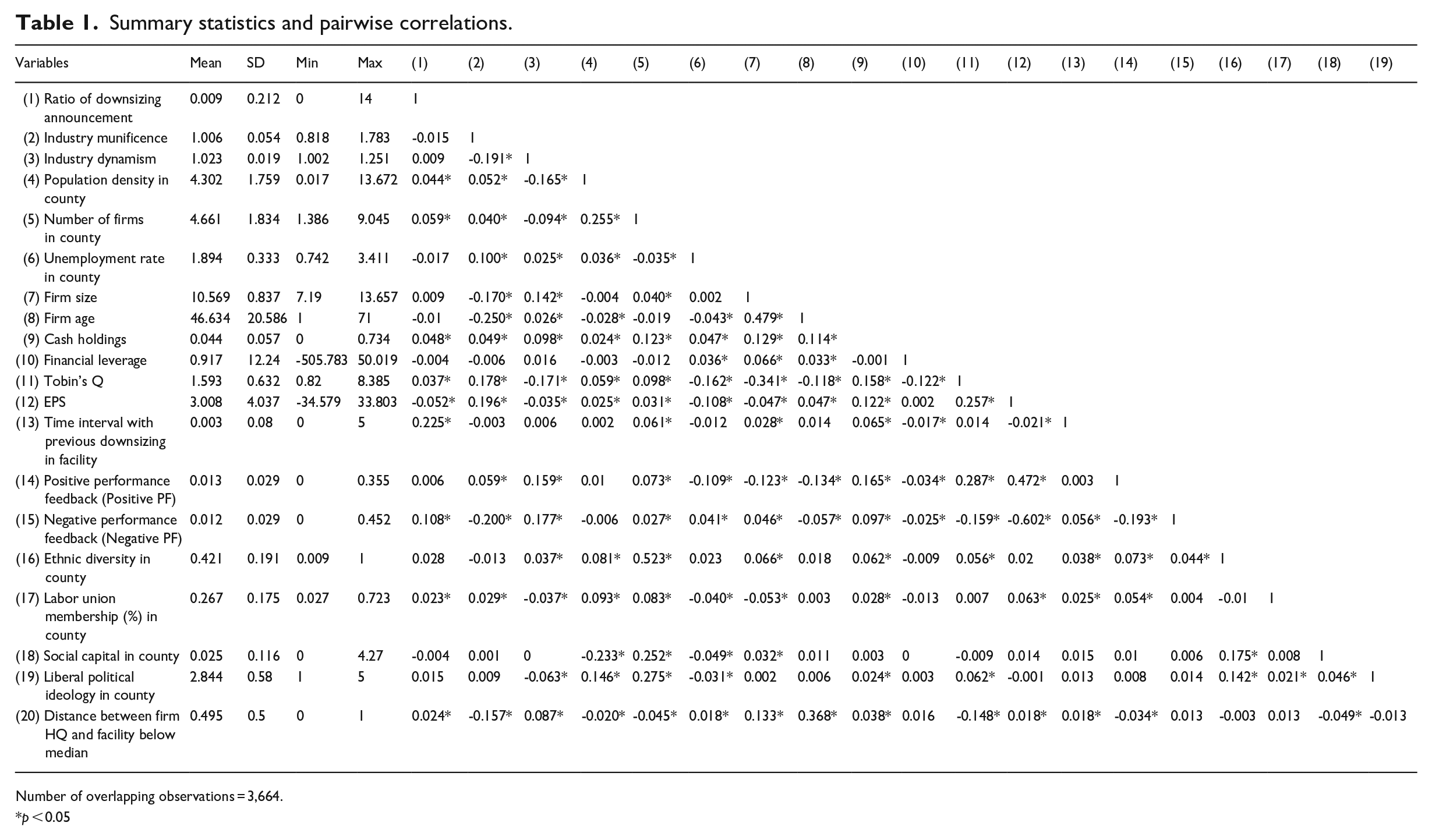
Number of overlapping observations = 3,664.
p < 0.05
Table 2 reports the results of the panel GEE estimations of firm downsizing announcements. Model 1 contains only the control variables, and Model 2 tests the main effect of negative performance feedback. Models 3–10 examine the interactions between negative performance feedback and local community characteristics, and Model 11 is the full model, including all research variables.
Results of panel GEE analyses predicting the ratio of downsizing announcements.
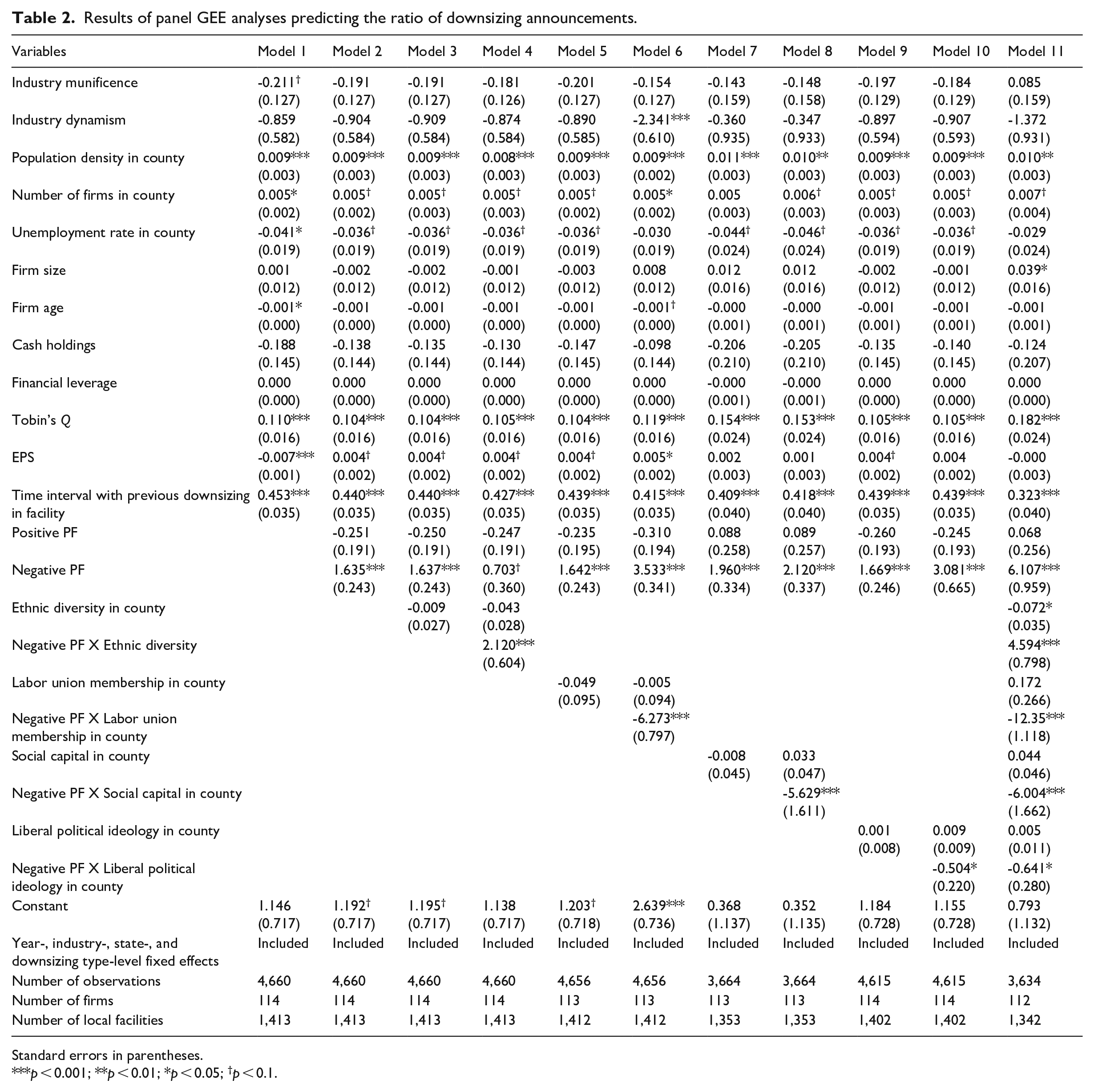
Standard errors in parentheses.
p < 0.001; **p < 0.01; *p < 0.05; † p < 0.1.
Hypothesis 1 predicted that the higher a firm’s negative performance feedback, the larger its overall ratio of downsizing announcements in local facilities. Supporting this prediction, the results in Model 2 of Table 2 show that the effect of negative performance feedback on the ratio of downsizing announcements is positive and significant (
Hypothesis 2 predicted that the baseline relationship between a firm’s negative performance feedback and downsizing announcements in local facilities would become more pronounced when the local community had greater ethnic diversity. Supporting this prediction, the results in Model 4 of Table 2 indicate that the baseline relationship is accentuated by the level of local ethnic diversity (
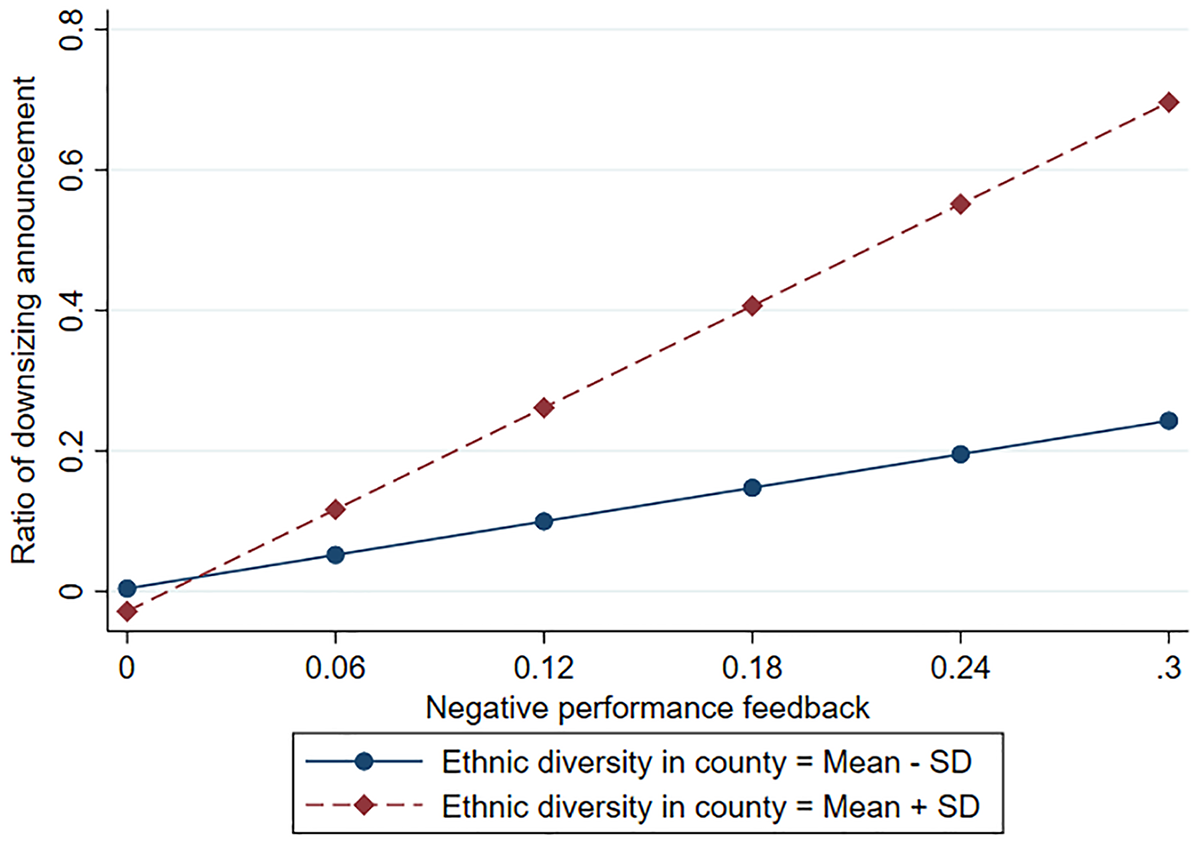
Interaction effect of negative performance feedback and local ethnic diversity on downsizing announcement.
Hypothesis 3 proposed that the baseline relationship between a firm’s negative performance feedback and downsizing announcements in local facilities would be attenuated when labor union membership in the local community is greater. Looking at the results in Model 6 of Table 2, we found that the baseline relationship was weakened by the level of the local community’s labor union membership (
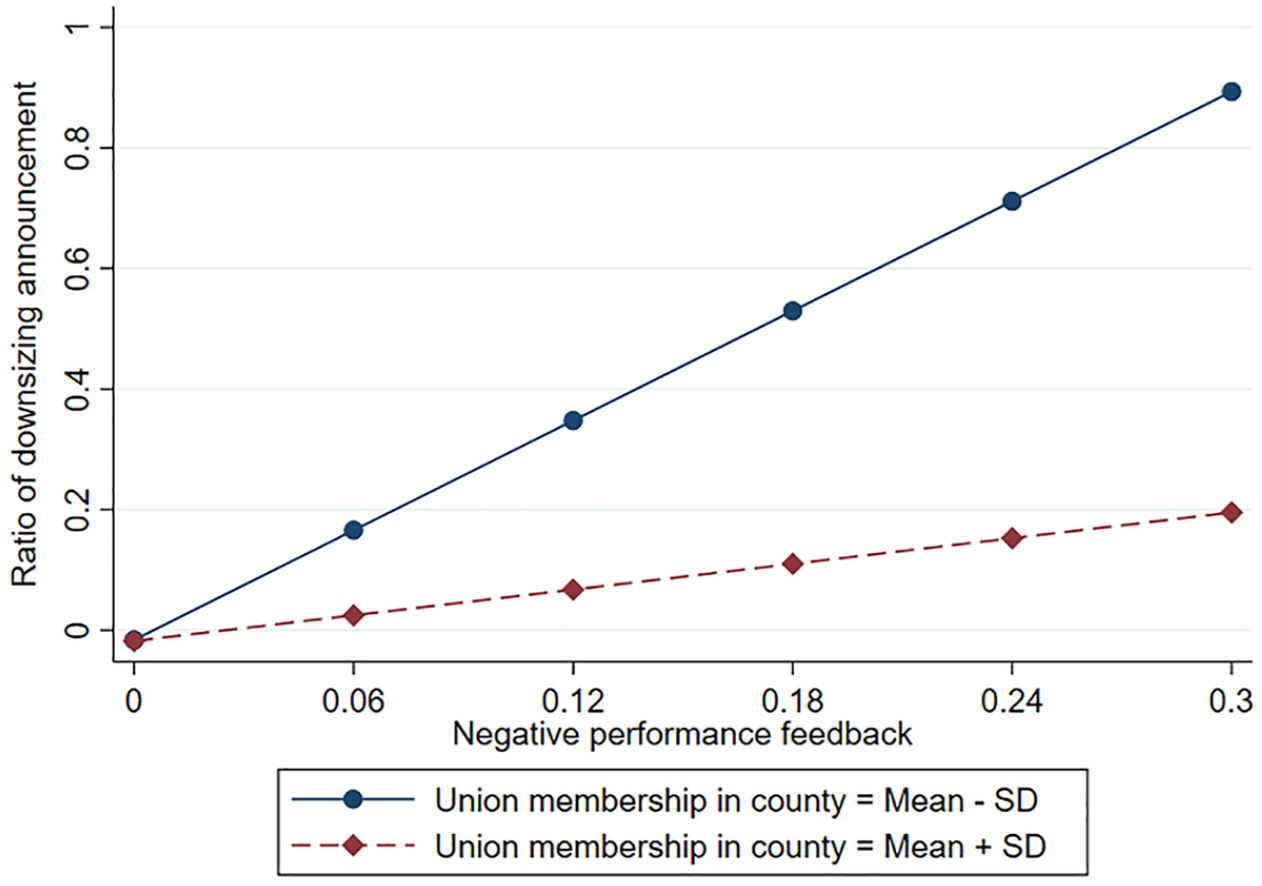
Interaction effect of negative performance feedback and local labor union membership on downsizing announcement.
Hypothesis 4 stated that the baseline relationship between a firm’s negative performance feedback and downsizing announcements in local facilities would be attenuated when the social capital in the local community is greater. The results in Model 8 of Table 2 support this prediction, indicating that the baseline relationship becomes significantly weaker when the local social capital is greater (
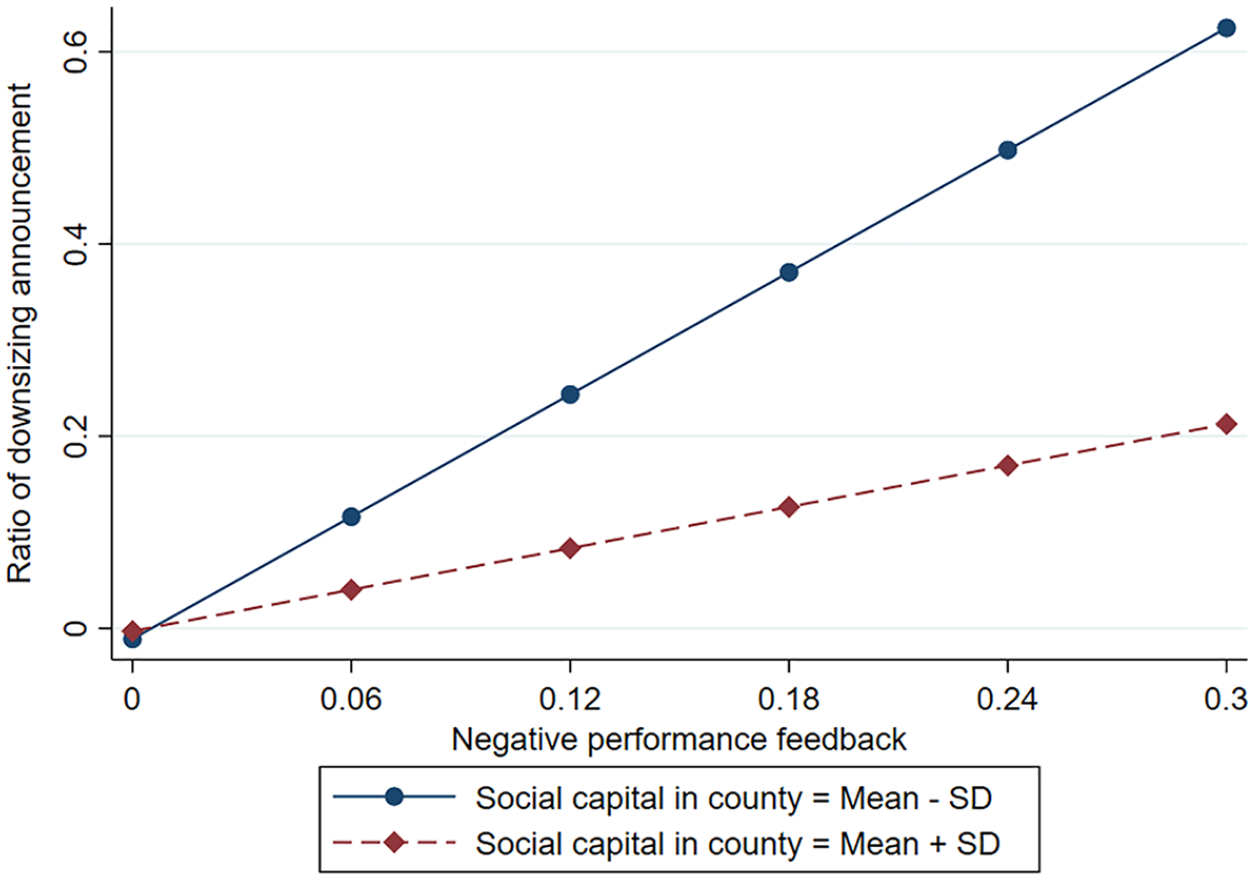
Interaction effect of negative performance feedback and local social capital on downsizing announcement.
Hypothesis 5 predicted that the baseline relationship between a firm’s negative performance feedback and downsizing announcements in local facilities would be attenuated when the political ideology among residents in the local community leans more toward liberalism. The results in Model 10 of Table 2 support our hypothesis, indicating that the baseline relationship becomes significantly weaker when the local community’s political ideology leans more toward liberalism than conservatism (β = −0.504, p < 0.05). Figure 4 illustrates the interaction between negative performance feedback and the local community’s liberal political ideology, which affects the downsizing ratio announced by firms at local facilities.
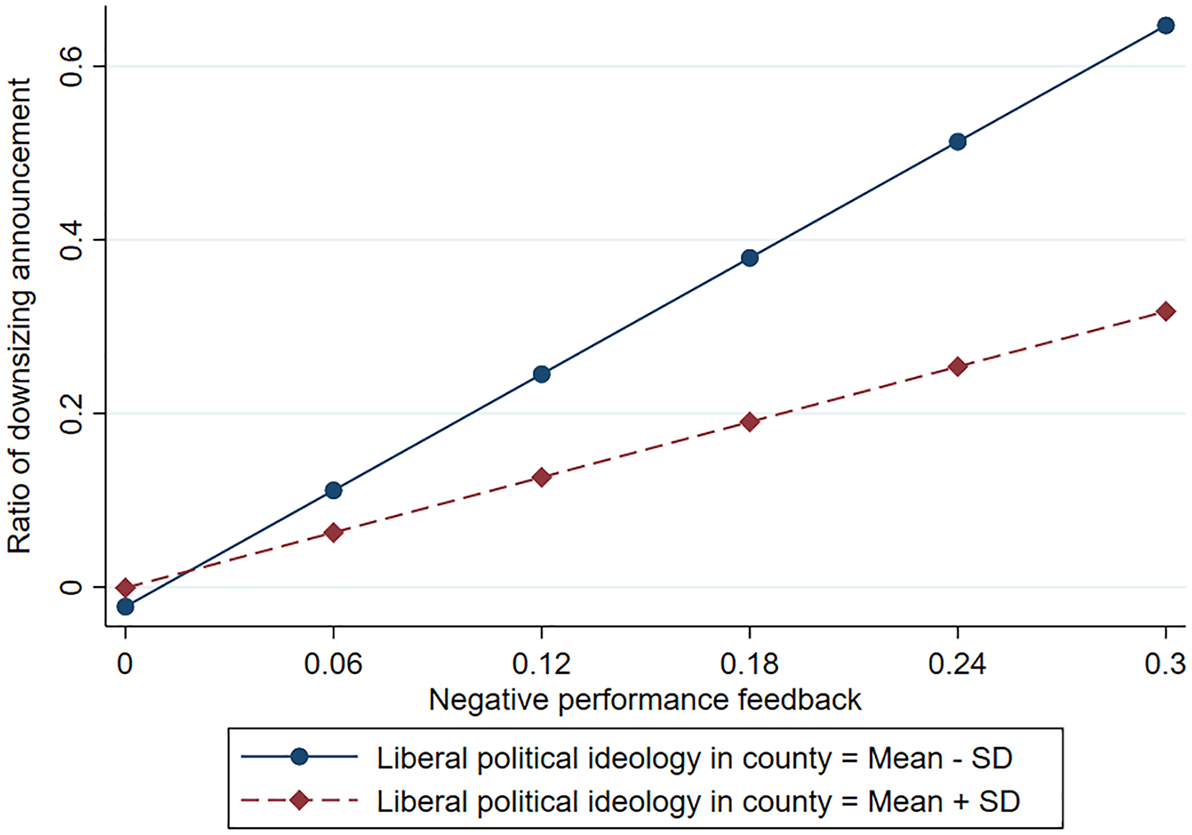
Interaction effect of negative performance feedback and liberal political ideology in the local community on downsizing announcement.
Supplementary analyses
Moderation effects of headquarters–facility distance
As an additional analysis, we examined whether the geographical distance between local facilities and parent firms’ HQ affected the strength of our findings. This was based on the assumption that a firm’s HQ, which often attracts considerable attention from the media and the general public, responds more sensitively to evaluations from external stakeholders who are geographically closer, potentially influencing downsizing announcements in nearby facilities.
Using the geographical location data of firms’ headquarters and local facilities, we generated a binary variable indicating whether the Euclidean distance between a firm’s HQ and its local facility was more proximate than others (below the median in the entire sample in a given year). We used this variable to generate three-way interaction terms for inclusion in the regressions. Our results (not reported here due to space constraints) indicated that the moderation effects of all local community characteristics became significantly stronger when the local facility was geographically closer to the firm’s headquarters. Overall, these results suggest that when facing negative performance feedback, firms incorporate local community characteristics into their downsizing decisions to a greater extent, particularly when the local facilities are geographically closer to the firm’s headquarters. This suggests that firms with facilities close to their headquarters, which tend to draw the bulk of attention from the media and the general public, are more keenly attentive to pressures and evaluations from local stakeholders. This may be because such stakeholders exert greater influence on a firm’s reputation and performance (Barnett et al., 2020). Consequently, we deduced that firms are more keenly attentive to local community concerns when incorporating local environmental characteristics into their facility downsizing announcements, particularly when local facilities are geographically closer to their HQ.
Moderation effects of the inflation rate
In an additional analysis, we examined whether the macroeconomic inflation rate influenced the strength of our findings. This attempt was based on the assumption that, under a higher inflation rate in the macroeconomic environment, the market logic a firm experiences, driven by its negative performance feedback, will intensify. Studies have indicated that worsening macroeconomic environments, such as higher inflation rates, amplify firms’ concerns about their financial performance, leading to workforce reductions (Coibion et al., 2020).
Using the data on inflation rates in the United States gained from the US Bureau of Labor Statistics, we generated a binary variable indicating whether the annual average macroeconomic inflation rates (not seasonally adjusted) were higher (above the median) than in other years within the timeframe of our data. We then used the variable to generate the three-way interaction terms to be included in the regressions. Our results (omitted from this manuscript due to space constraints) indicated that all moderation effects of local community characteristics were significantly weaker or non-significant in years when inflation rates were higher. This implies that for firms whose financial performance falls below aspirations, unfavorable macroeconomic conditions render them less responsive to local community influences when making downsizing announcements.
Robustness of the regression model
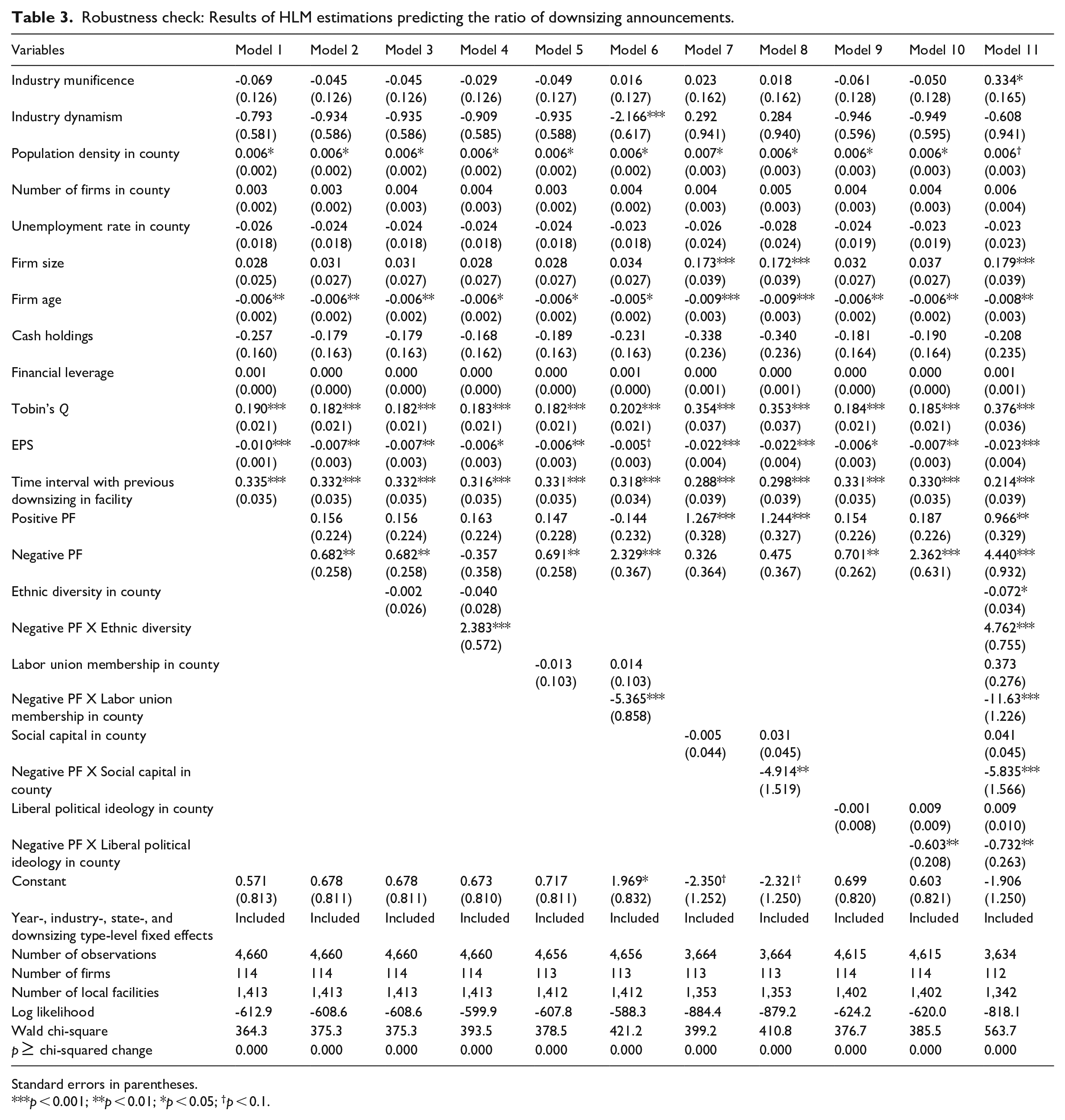
In addition, we conducted a robustness test on the regression model by testing our hypotheses using various models. We used hierarchical linear models (HLMs or multilevel models) with mixed effects, which are widely accepted for analyzing multilevel data (Raudenbush and Bryk, 2002). Our mixed-effects model estimated a fixed-effects regression coefficient at the facility level, whereas between-firm variability was estimated using random intercept terms. Following the approaches of other multilevel management studies that utilized the HLM (Certo et al., 2017; Meyer-Doyle et al., 2019), we used Stata 17’s mixed command with the maximum likelihood method to obtain the estimates. As shown in Table 3, the HLM approach generated results that were qualitatively identical to our current findings, providing additional support for our predicted relationships.
Robustness check: Results of HLM estimations predicting the ratio of downsizing announcements.
Standard errors in parentheses.
p < 0.001; **p < 0.01; *p < 0.05; † p < 0.1.
Discussion
This study examined how the tension between organizational performance shortfalls and the local community in which the firm operates affects corporate downsizing decisions. Upon examining the data from 1,413 business facilities across 114 firms in various counties within the United States between 2011 and 2021, we found the following results. While negative performance feedback, resonating with market logic, prompted firms to announce larger downsizing in local facilities, the size of the downsizing varied depending on the attributes of the local communities that govern the strength of community logic. Based on these findings, we propose the following theoretical implications.
First, our study contributes to understanding how local communities, as sources of institutional logic, affect corporate downsizing decisions. The long-standing downsizing literature suggests that managerial motives for quickly improving financial performance are the primary drivers behind corporate downsizing (Datta et al., 2010; Jung and Lee, 2022; Schulz and Wiersema, 2018). To complement this view, a growing body of research has taken a different approach by examining the sociopolitical causes of downsizing. However, research in this direction has left a notable gap by taking either a macro perspective, focusing on the clash between different economic systems (Ahmadjian and Robbins, 2005; Budros, 1997), or an organization-level perspective, focusing on the conflicts of interest between intra-firm stakeholders such as senior executives, employees, and labor unions (Jung, 2017; Jung and VanHeuvelen, 2023). This raises the question of how mid-level conditions between macroeconomic systems and organizations, such as local community characteristics, shape corporate downsizing.
In this study, we addressed this gap by theorizing and providing empirical evidence that corporate downsizing announcements are a function of the tension between distinct institutional logics: one from the market realm (market logic) and the other from the nonmarket local community realm (community logic). Our findings suggest that firms with geographically dispersed subunits are simultaneously embedded in multiple communities, each exerting varying degrees of influence over downsizing decisions, governed by the strength of community logic. While market logic may pressure firms to downsize, community logic imposes countervailing pressures to preserve local employment and maintain community welfare. This interplay generates varying levels of tension across locales, leading to heterogeneous yet patterned downsizing responses across subunits. In particular, we find that downsizing is more extensive in locales where community logic is relatively weak (e.g. those with higher ethnic diversity) and less extensive in locales where it is relatively strong (e.g. those with greater labor union density, higher social capital, and liberal political orientations). These findings illustrate how specific community characteristics can modulate the strength of community logic. In doing so, we respond to the call of prior research to develop a more precise understanding of “how community influence [over firms’ strategies] varies with community characteristics” (Marquis and Battilana, 2009: 296). By identifying these attributes, our study contributes to a deeper understanding of how communities, as sources of institutional logics, shape firm behavior.
Second, we contribute to understanding how firms internally determine where and to what extent to downsize. Most prior downsizing research has adopted a firm-level approach, treating layoffs as uniform events that affect an entire organization (Cameron, 1994; Datta et al., 2010; Nixon et al., 2004). This predominant focus may explain why “current research has overlooked the socio-spatial conditions underlying downsizing decisions” (Amato et al., 2023: 215). Little attention has been paid to locational variations in downsizing within firms (e.g. differences across local subunits, facilities, or plants), thus obscuring how local contextual factors shape downsizing decisions. Moreover, this limited attention to local contexts has likely contributed to a broader neglect of stakeholder influence beyond organizational boundaries. In particular, Kammeyer-Mueller et al. (2001: 317) remarked that the local community (i.e. stakeholders outside organizational boundaries) remains “one of the least researched stakeholder groups” in downsizing research. However, community stakeholders, including local consumers, residents, and advocacy groups, are likely to exert a particularly salient influence on firms’ strategic decisions because downsizing events are often perceived as pivotal and have substantial implications for community welfare.
This study addressed these limitations by analyzing downsizing at the facility level of multi-establishment firms in the United States rather than treating workforce reductions as uniform, corporation-wide events. Our fine-grained approach demonstrated that layoffs are often unevenly distributed across organizational subunits. We found that this variation is largely driven by local contextual factors through which community members may express collective resistance based on their shared motivations and interests. Firms tend to avoid or limit workforce reductions in communities where strong resistance and scrutiny are anticipated, and disproportionately allocate layoffs to regions where community resistance is expected to be weaker. Our research shows that the strategic allocation of downsizing across corporate facilities depends on the relative strength of community logic in the regions where these entities are located.
Third, our findings contribute to the literature on the BToF. In particular, we contribute to the stream of research examining the contingencies that cause firms to deviate from the decision-making outcomes predicted by the performance feedback model (Cyert and March, 1963; Greve, 2003). The performance feedback model is notable for its mechanistic perspective on organizational behavior and decision-making (Posen et al., 2018) and for the common assumption that organizations unambiguously interpret and respond to performance feedback (Greve and Gaba, 2017). Recognizing these limitations, recent research has increasingly focused on identifying the contingencies of the model that engender variations in firm responses to performance feedback. These include internal factors, such as firm size and structure (Audia and Greve, 2006; Gaba and Joseph, 2013), as well as external contingencies, such as regulations, industry dynamism (Desai, 2014; Schimmer and Brauer, 2012), and various cultures and institutions across countries (Lewellyn, 2015; Lin, 2014). Despite the progress, theoretical development on the contingencies that shape strategic decisions triggered by performance feedback remains insufficient, particularly with respect to the influence of the local community.
This study addresses this gap by examining how local community idiosyncrasies shape firms’ strategic reactions to negative performance feedback. Our main finding—that firm responses to performance feedback can vary substantially depending on the institutional complexity shaped by local community characteristics—enriches the ongoing discussion among BToF scholars, who posit that the subjective interpretation of performance feedback “serves as an intermediate link between performance assessment and the search for solutions” (Greve and Gaba, 2017: 328). In this ongoing discussion, we emphasize how firms’ subjective interpretations of performance feedback, viewed through the lens of institutional logics, generate important variations in corporate decision-making (Joseph and Gaba, 2015; Shi et al., 2023). Specifically, our findings demonstrate that the institutional complexity created by the tension between market and community logics can lead firms to engage in self-enhancing responses, so that external stakeholders (e.g. local community residents) view the firms in the most positive light (Audia and Brion, 2007; Blagoeva et al., 2020). This self-enhancing orientation obscures the effects of a problem-solving orientation, which is intended to detect and remedy organizations’ internal problems through the problemistic search (Cyert and March, 1963). We advance the recent BToF literature to a novel terrain by proposing that local community characteristics can trigger firms’ self-enhancement orientation, making them reluctant to execute large-scale downsizings in certain regions despite the impending necessity to close their profitability gap. In this sense, our study resonates with the suggestion of Audia and Greve (2021: 31) that “variations in environmental influences,” including those engendered by the institutional complexity, can “alter the degree of ambiguity of environmental demands and in doing so enable or constrain [top managers’] self-enhancing responses to multiple goals.” We invite future scholars to explore in greater depth the influence of local community characteristics on organizations’ pursuit of multiple goals (e.g. profitability and stakeholder management), from the specific vantage point of the behavioral theory.
Limitations
Our study has several limitations that offer new avenues for future research. First, we did not identify the various internal processes within firms that manage institutional complexity when making downsizing announcements. We made only implicit assumptions about the internal processes that underlie downsizing decisions, including the social and psychological dynamics among senior managers and the decision-making teams, as well as the sense-making processes governed by their values and expertise. Future research can provide a deeper understanding of the internal processes of organizations and the experiences of their managers in coping with institutional complexity during downsizing announcements. Recent research has elucidated these processes; for example, by leveraging the state-level expansion of unemployment insurance coverage in the United States, Keum and Meier (2023) found that CEOs’ experience of moral costs becomes a significant antecedent to their layoff decision. Another study by Guenzel et al. (2023) revealed that CEOs’ social preferences, or psychological tendencies to prioritize employees’ welfare, negatively affect downsizing decisions. As Jung (2016: 367) noted in his research, “to implement downsizing, top managers must muddle through highly contested terrain, where investors’ interest in profit maximization collides with workers’ interest in job security.” Further research is needed to discover the complex internal processes and sociopsychological mechanisms underlying executives’ downsizing decisions.
Second, as our study focused on large, established US firms listed on the S&P 500, the applicability of our findings to different types of organizations, industrial environments, and national contexts may be limited. As Greenwood et al. (2010: 536) noted, understanding institutional complexity in corporate downsizings necessitates greater attention to the “cultural and historical contexts” and requires engaging “in comparative work so that the scope conditions of these influences may be determined.” For instance, our findings regarding the influence of community political leanings on firms’ downsizing decisions should be generalized with caution, as they are specific to a certain timeframe and predominantly reflect the US context. In countries such as Japan, where conservatism and traditional values are prevalent, permanent employment is more widespread, and downsizing is not as readily accepted by stakeholders as in the United States (Ahmadjian and Robinson, 2001; Lee, 1997). Unlike their US counterparts, the Japanese tradition of lifetime employment, along with the unique governance structures and employment policies (Lee, 1997), may limit the strategic flexibility of Japanese firms in responding to performance downturns by downsizing. This discussion highlights how the institutional, regulatory, and historical contexts of various cultures can influence corporate downsizing patterns, as well as the intensity of community responses and resistance to these changes. Future research should attempt to reveal the diverse patterns of corporate downsizing behavior by incorporating these country-specific variations.
Third, another limitation arises from the lack of data on facility-level performance and employee counts. This gap prevented us from calculating an accurate normalized ratio of layoffs per facility. Consequently, our analysis could not robustly compare how firms proportionately distribute layoffs across various facilities based on each facility’s employment size. Moreover, the lack of detailed performance data at the facility level meant that we could not identify performance disparities among facilities; some may have outperformed others despite the overall firm performance downturn. Future studies equipped with facility-specific performance and employee metrics can deliver a more precise assessment of how local community characteristics influence firms’ downsizing decisions at a fine-grained level. These data can enrich our understanding of the dynamics between local communities and corporate downsizing.
To conclude, our article builds on the institutional logics perspective by examining how local community characteristics influence firms’ downsizing announcements in response to performance shortfalls. We hope our findings can help stimulate further discussion on the interplay between corporate strategies and local community contexts, thereby contributing to a deeper understanding of the coevolution of business corporations and local communities.
Footnotes
Author contributions
All authors contributed equally to this work.
Funding
The authors received no financial support for the research, authorship, and/or publication of this article.
