







Abstract
Innovation-oriented public–private partnerships are central to collaborative innovation, yet we know little about how governmental involvement reshapes firms’ organizational learning. This article develops a multilevel framework explaining how governments—as collaborators and institutional rule makers—shape firms’ learning behavior. We argue that governmental participation operates through three governance mechanisms: changes in appropriability incentives, constraints on feasible governance instruments, and information credibility. These mechanisms shape learning across organizational, interorganizational, and population levels. Governments shift firms toward exploitation within public–private partnership domains while encouraging exploration beyond them, favor knowledge accessing over acquisition, and strengthen complementarities between experiential and vicarious learning. These effects are moderated by knowledge diversity, public–private knowledge overlap, and institutional quality. By integrating organizational learning with governance perspectives, this study explains how public institutions systematically configure firms’ learning in collaborative innovation.
Keywords
Introduction
The contemporary world faces a range of dynamic “grand challenges” that call for close collaboration between governments and private firms (Bruce et al., 2019; George et al., 2024; Kivleniece and Quelin, 2012; Mahoney et al., 2009; Rangan et al., 2006). Among public–private partnerships (PPPs), innovation-oriented PPPs—designed to advance social and technological innovation—are particularly learning intensive. For example, private firms in electric vehicles and renewable energy industries have received extensive governmental support to accelerate technological development and adoption. Prior research has examined the government’s role in monitoring and coordinating collaborative efforts (Bruce et al., 2019; Faerman et al., 2001) and firms’ access to knowledge and financial resources through PPPs (Conti, 2018; Quelin et al., 2019). Yet organization studies have not systematically examined how public actors shape private firms’ organizational learning (OL), despite the centrality of public–private collaboration for innovation policy and firm capability development.
Strategic alliance research has extensively studied OL in private R&D collaborations (e.g. Inkpen and Tsang, 2007; Mowery et al., 1996), but the distinct attributes of government partners limit the applicability of this literature to PPP contexts. In much of the strategic alliance literature, private collaborations are typically modeled as rent-seeking and arm’s-length arrangements, whereas governments in PPPs pursue knowledge spillovers for public benefit (Arrow, 1962; Lerner, 1999), exercise institutional authority, and operate under disclosure and accountability mandates (Kelman, 2007). These distinctions influence firms’ motivations, opportunities, and abilities to learn (Argote and Miron-Spektor, 2011; Cohen and Levinthal, 1990). Accordingly, this article develops a theoretical framework explaining how governmental involvement influences firms’ learning decisions in innovation-oriented PPPs.
Our framework operates within institutional environments that define the governance conditions of collaborative innovation. PPPs are embedded in regulatory and administrative infrastructures that organize, monitor, and evaluate collaboration (Quelin et al., 2017; Rangan et al., 2006). Institutional features such as disclosure mandates, procurement transparency, reporting standards, and accountability mechanisms structure how knowledge is generated, shared, and interpreted within these arrangements (Ménard, 2004; Scott, 2013). Through these infrastructures, firms face varying degrees of spillover exposure, interact through more formalized interorganizational interfaces, and rely on information of differing reliability across collaborative networks (Gulati, 1998; Williamson, 1985). As a result, institutional governance structures do not merely constrain collaboration; they actively channel firms’ learning by reshaping appropriability conditions, delimiting feasible governance mechanisms, and shaping how firms evaluate and use information (Argote and Miron-Spektor, 2011; Cohen and Levinthal, 1990; Teece, 1986).
We define OL as experience-based change in a firm’s knowledge and routines (Argote and Miron-Spektor, 2011). Learning may derive from a firm’s own activities, interactions with partners, or observation of other organizations. Firms can purposefully structure learning processes by allocating attention and search effort—for example, by emphasizing exploitation versus exploration or selecting interorganizational routines for knowledge accessing versus acquisition. Because OL unfolds through processes within firms, across collaborative relationships, and through exposure to broader informational environments, we develop our framework across organizational, interorganizational, and population levels.
At the organizational level, governmental involvement shapes how firms allocate attention between exploitation and exploration by influencing the conditions under which different learning activities generate value within and beyond PPP-related domains. At the interorganizational level, it affects how firms organize their learning relationships with partners by shaping the feasibility and attractiveness of alternative modes of knowledge exchange, such as accessing external knowledge versus pursuing deeper integration. At the population level, it influences how firms learn from the broader environment by affecting the reliability and interpretability of information about other organizations’ actions and outcomes. We further argue that these multilevel effects vary systematically with knowledge diversity, public–private knowledge overlap, and institutional quality.
This theory is developed with a specific class of PPPs in mind—namely, innovation-oriented PPPs operating in relatively formalized institutional environments characterized by public accountability, disclosure requirements, and rule-based procurement processes (Ménard, 2004; Quelin et al., 2017). In such settings, governments act simultaneously as resource providers and rule makers, but typically do not exercise direct ownership or residual control rights comparable to private acquisitions (Oxley, 1997; Williamson, 1985). These features distinguish PPPs from both arm’s-length market exchanges and fully integrated hierarchies (Williamson, 1991). By contrast, the framework is less directly applicable to contexts where public actors hold equity stakes, exercise discretionary control over resource allocation, or operate within weakly institutionalized environments characterized by limited transparency or high political embeddedness (North, 1990; Peng, 2003). In such cases, the boundary between public and private roles may blur, and alternative governance and learning dynamics may emerge.
This article sits at the intersection of three research streams. OL research has generated rich insights into experience-based adaptation (Argote and Miron-Spektor, 2011; March, 1991), but has focused primarily on intraorganizational settings or private alliances. Interorganizational learning scholarship has examined knowledge exchange across private collaborations (Gulati, 1998; Inkpen and Tsang, 2007) but has paid limited attention to partners embedded in public mandates and administrative constraints. PPP research, in turn, has examined governance and performance outcomes (Quelin et al., 2017; Rangan et al., 2006), while underexploring how governmental participation affects firms’ learning decisions. Taken together, these gaps call for an integrative framework that theorizes how public governance structures shape firms’ learning decisions across levels.
Building on these gaps, this article makes three contributions. First, it connects research on innovation-oriented PPPs with OL by explaining how governmental participation shapes firms’ learning patterns across multiple levels, including learning trajectories, interorganizational routines, and cross-level complementarities. Second, it extends interorganizational learning theory beyond private alliances by specifying how institutional authority orchestrates incentives, feasible governance instruments, and the information environment for knowledge exchange. Third, it advances PPP research by theorizing private firms’ strategic learning responses—how they adapt their learning strategies within and beyond the PPP domain in anticipation of spillovers, compliance demands, and longer-run capability development.
Public–private versus private–private collaborative innovation
We draw on OL as our primary behavioral lens to explain how firms search for, interpret, and utilize knowledge in PPP contexts, while leveraging transaction cost economics (TCE) to clarify how governance structures condition the feasibility, efficiency, and risks associated with alternative learning strategies. In this sense, TCE complements rather than substitutes for OL by specifying how appropriability hazards, coordination costs, and information asymmetries shape the relative efficiency of alternative learning behaviors. OL provides the core behavioral lens, focusing on how firms allocate attention, search, and knowledge integration across domains and relationships. TCE complements this perspective by specifying how governance structures—through their effects on appropriability hazards, coordination costs, and information asymmetries—shape the feasibility and relative efficiency of alternative learning strategies. In innovation-oriented PPPs, governmental participation systematically alters these transaction characteristics: spillover mandates reshape appropriability incentives, administrative constraints limit feasible governance instruments, and institutional infrastructures influence the credibility of information. These governance-induced changes do not merely affect costs; they reconfigure the conditions under which learning is feasible and efficient, thereby directing learning behavior across organizational, interorganizational, and population levels. By embedding OL within a transaction cost logic of governance, we develop a coherent theoretical account of how public institutions structure firms’ learning decisions in collaborative innovation.
Distinctive features of public–private collaboration
We first clarify what is distinctive about learning in innovation-oriented PPPs relative to private–private collaborative innovation. In purely private alliances, partners typically negotiate governance instruments with considerable discretion, and learning dilemmas often stem from appropriability concerns and “races to learn” (Hamel, 1991; Khanna et al., 1998). In PPPs, however, the government is not merely another partner. It participates while also carrying public mandates and administrative constraints, and it can shape the broader rules and information environment in which learning unfolds. These features shift the core learning problem from “how do we learn faster than the partner?” to “how do we learn effectively under public goals, procedural requirements, and disclosure obligations?”
To clarify this distinction, we separate three elements that are often conflated: (1) goals are what actors seek (e.g. profit, political support, mission outcomes); (2) capabilities are what actors can do (e.g. provide technical expertise, broker networks, enforce rules); and (3) learning refers to experience-based change in knowledge and routines (Argote and Miron-Spektor, 2011; Levitt and March, 1988). Goals and capabilities structure learning by influencing firms’ incentives, attention allocation, and the conditions under which knowledge is accessed and interpreted. Governmental goals primarily condition firms’ learning incentives, whereas governmental capabilities—together with administrative constraints—structure the available coordination mechanisms and the information environment in which learning occurs.
Governmental goals and incentive structures
Governmental goals in innovation-oriented PPPs are not “an organizational goal to pursue policy mandates directed toward collective or societal outcomes” in any simple sense. Rather, public agencies operate under mandates to pursue policy objectives (e.g. diffusion of technology, regional development, safety, resilience) and to justify actions to multiple principals (legislatures, oversight bodies, voters, courts). A key implication for learning is that PPPs often embed explicit expectations for dissemination and spillovers (e.g. open standards, reporting, knowledge sharing requirements). This increases the likelihood that knowledge created in the PPP becomes available to third parties, thereby changing the private firms’ appropriability calculus and its preferred learning trajectory.
Governmental participation shapes firms’ learning not because public agencies themselves “learn differently,” but because their policy mandates and accountability structures reshape the incentive environment within which private firms operate. This perspective keeps our focus on firm-level learning while highlighting how public goals condition the appropriability logic underlying firms’ learning choices.
Governmental constraints and information conditions
Governmental influence on learning is also configured by governance arrangements that structure both the feasible actions available to firms and the information environment in which learning occurs. While the previous subsection emphasizes incentives, here we focus on how governance structures constrain learning actions and condition how firms interpret information within PPP collaborations.
Governmental influence is partly rooted in rule-making capabilities: agencies can (within legal bounds) set or enforce rules that transform partners’ behavior—through procurement requirements, eligibility criteria, disclosure mandates, and monitoring systems. These governance arrangements enable coordination, define project architectures, and standardize interaction processes, thereby structuring how knowledge is generated, shared, and interpreted. However, because such authority operates through administratively structured procedures, it can also limit flexibility in designing and adapting collaborative coordination. As a result, firms’ learning choices are not only incentive-driven but also conditioned by the governance arrangements within which they operate.
We draw on transaction cost reasoning to further characterize how these governance mechanisms shape learning in PPPs. Ex ante, standardized procurement and contestability requirements may reduce certain partner-selection hazards while increasing formalization and administrative burden. Ex post, public accountability, limited discretion to renegotiate, and audit requirements can raise adaptation and monitoring costs relative to private alliances (Spiller, 2010; Williamson, 1991). These governance features influence learning not merely by increasing costs but by constraining feasible learning actions. For instance, rigid contracting and reporting interfaces may favor knowledge accessing routines that rely on codified exchanges, while limiting deeper knowledge acquisition mechanisms such as equity participation, personnel mobility, or proprietary technology integration. Thus, transaction-cost structures influence how interorganizational learning can be organized and enacted within PPP collaborations.
Governmental participation is also characterized by constraints on acceptable behavior (Kelman, 2007), including requirements for procedural fairness, transparency, and auditability; limits on ownership of outputs and equity stakes; and reputational and ethical expectations. These constraints narrow the set of admissible governance and learning instruments, reinforcing the formalization of collaborative processes. For private firms, the practical consequence is that purposeful learning decisions—such as how to structure search, what knowledge routines to develop with partners, and how to leverage government-brokered information—must be made within a rule-bound environment. Importantly, these governance arrangements not only constrain feasible actions but also influence the reliability and interpretability of information generated within PPP collaborations, as formal reporting, disclosure requirements, and standardized interfaces can channel how firms evaluate and learn from observed outcomes.
Institutional governance structures in PPP collaboration
Whereas the preceding discussion focuses on governance mechanisms at the level of collaboration, we now shift to institutional governance structures that shape these mechanisms at a broader level. Institutions do not merely provide background conditions for collaboration; they structure incentives, governance arrangements, and information conditions (North, 1990; Scott, 2013). In PPP contexts, these governance arrangements are particularly salient because public actors operate under legal mandates, accountability requirements, and policy objectives that differentiate them from private partners (Kivleniece and Quelin, 2012; Mahoney et al., 2009). These institutional influences operate through the same governance-conditioned mechanisms introduced above—appropriability incentives, constraints on permissible governance forms, and the reliability of signals circulating among actors—which manifest differently across organizational, interorganizational, and population levels.
Building on this multilevel perspective, we conceptualize institutional governance not as a uniform background condition but as a set of level-specific causal pathways that operate through distinct mechanisms. At the organizational level, institutions shape firms’ learning by altering the conditions under which different learning activities generate value, thereby influencing how firms allocate attention between exploitation and exploration. Disclosure requirements, spillover expectations, and accountability mandates reduce firms’ ability to appropriate returns from knowledge (North, 1990; Scott, 2013), compressing the time horizon over which learning outcomes can be privately captured. From a transaction cost perspective, such constraints increase appropriability hazards and alter the comparative efficiency of alternative learning investments (Teece, 1986; Williamson, 1985). This compression changes the relative efficiency of alternative learning activities: investments in long-horizon, uncertain knowledge development become harder to justify under heightened appropriability hazards, whereas activities that enable rapid refinement and deployment of existing knowledge offer more reliable returns within the shortened payoff window. Consequently, firms shift attention toward exploitative learning within PPP domains, as such learning better aligns with the appropriability constraints imposed by institutional governance.
At the interorganizational level, institutions shape how firms organize learning with partners by structuring the feasibility and efficiency of alternative coordination and knowledge integration mechanisms. Procurement rules, administrative procedures, and contractual constraints define the set of governance arrangements available to firms, limiting the extent to which learning can rely on deep knowledge acquisition versus more arm’s-length accessing routines (Kivleniece and Quelin, 2012). From a transaction cost perspective, these institutional constraints limit governance alignment and increase the coordination and adaptation costs associated with integrative arrangements (Williamson, 1991). As a result, knowledge acquisition—which requires closer alignment and more intensive coordination—becomes less efficient relative to accessing under such constraints. Consequently, firms are more likely to organize interorganizational learning through accessing arrangements that allow them to utilize external knowledge without incurring the higher coordination and integration costs required for deeper internalization.
At the population level, institutions shape how firms engage in vicarious learning by influencing the reliability and interpretability of information about other organizations’ actions and outcomes. Regulatory transparency, bureaucratic capacity, and rule-of-law protections determine whether observed outcomes can be attributed to underlying capabilities or are distorted by political or institutional noise (Acemoglu and Johnson, 2005; Henisz, 2000). From a transaction cost perspective, these institutional conditions affect the extent of information asymmetry and the cost of interpreting external signals under bounded rationality (Williamson, 1985). By shaping signal noise and information asymmetries, institutions alter the uncertainty and cost of drawing inferences from others’ experiences. When signals are more credible, firms can more confidently interpret external observations and integrate them with their own experience; when signals are noisy or distorted, firms face greater uncertainty in inference and rely less on vicarious learning. As a result, firms’ use of vicarious learning reflects not only the availability of external information but also the institutional conditions that shape its reliability and interpretability.
Taken together, our framework highlights how PPPs reshape learning dynamics across multiple levels by altering both the incentives for knowledge search and the governance conditions under which learning occurs. By integrating OL with transaction cost considerations and embedding both within institutional contexts, we provide a more comprehensive account of how firms learn in hybrid organizational forms that combine elements of hierarchy, market, and state coordination.
Implications for OL
OL as a multilevel process
OL is a multilevel process operating both within and outside an organization. Internally, knowledge flows span individual, group, and organizational levels (Crossan et al., 1999); externally, knowledge is transferred at the interorganizational level between partners and may be influenced by population-level actors (e.g. technology or safety standards set by industry associations can shape routines across an organizational population; Madsen and Desai, 2018; Miner and Haunschild, 1995). Governmental involvement affects a focal firm’s learning at these levels: at the organizational level, governmental purpose and capability shape learning motivation and opportunity; at the interorganizational level, decision rights and information exchange constrain the feasible set of coordination and knowledge integration mechanisms, thereby shaping how learning can be organized between partners (Bruce et al., 2019); at the population level, governments provide broad information about other organizations’ actions and outcomes, shaping the firm’s learning environment (Madsen and Desai, 2018).
The focal firm faces distinct challenges at each level. At the organizational level, knowledge created in collaboration risks rapid spillover due to governmental pursuit of externalities, creating pressure to internalize experience into proprietary competencies. At the interorganizational level, public agencies are constrained from appropriating proprietary rents—through statutory mandates, ethics requirements, and public accountability—making exchange less a competitive learning race and more task-focused knowledge accessing aimed at project delivery (Kelman, 2007; Quelin et al., 2019). At the population level, firms must integrate knowledge from government-mediated networks with their existing knowledge base. These heterogeneous challenges require differentiated learning strategies across levels. Accordingly, we focus on three dimensions: (1) exploitation versus exploration, (2) knowledge accessing versus acquisition, and (3) integration of experiential and vicarious learning. Across levels, firms’ learning behavior is shaped by a consistent set of governance-conditioned mechanisms: changes in appropriability incentives, constraints on available coordination mechanisms, and the credibility of information used for learning. We now elaborate on each dimension.
Organization level: Exploitation versus exploration
Since OL is a process of knowledge change following encoded experience, learning can be directed either toward refining and deepening existing knowledge or toward expanding experiential variety by developing new knowledge elements (March et al., 1991; Holmqvist, 2004). The OL literature captures these directions through the twin concepts of exploitation and exploration (Levinthal and March, 1993; March, 1991; March and Simon, 1958). We adopt the classic definitions: exploitation refers to refinement, efficiency gains, incremental improvement, and deepening of existing competencies, whereas exploration denotes search, experimentation, novel alternatives, and recombination of diverse knowledge elements (March, 1991). Firms’ trajectory choices may therefore reflect distinctions between public and private partners.
A key consequence of governmental pursuit of positive externalities is that innovation outputs from joint efforts are more readily diffused, lowering their private value to the focal firm (Bloom et al., 2013). Unlike private alliances, where firms deploy protective mechanisms to preserve proprietary knowledge, public–private projects are designed for broader dissemination. Even when patentable, knowledge elements are more likely to diffuse given the relatively transparent processes surrounding government participation. Consequently, if firms seek to capture value from temporary technological advantages, exploiting the limited time lead (Lieberman and Montgomery, 1988; Nelson, 1989) is more viable than investing in knowledge isolation. From a transaction-cost perspective, these spillover risks reduce the returns to safeguarding knowledge through isolation while increasing the relative value of rapid deployment, thereby shifting firms toward exploitative learning within PPP domains. Governmental goals thus encourage firms to emphasize exploitation to sustain existing technological advantages. Because spillovers shorten the effective appropriability window, firms face pressure to capture value quickly, which makes exploitative refinement of existing knowledge more attractive than longer-horizon exploratory investments.
Public administration research further suggests that government agencies operate under heightened behavioral constraints, where avoiding failure often outweighs achieving ambitious goals (Kelman, 2007). Such constraint environments foster conservatism, favoring less risky and less controversial options (Nutt, 2005). In learning terms, exploration—requiring significant resource commitments and novel departures—becomes less attractive. Consistent with this orientation, government-sponsored R&D often targets domains with strong follow-on potential rather than radical novelty (Azoulay et al., 2019).
Taken together, these mechanisms imply that governmental involvement tends to shift firms toward exploitative learning within PPP-supported domains. At the firm level, managers anticipate that knowledge generated within PPPs will be subject to disclosure requirements and spillover expectations, reducing the duration over which proprietary advantages can be sustained. In response, they prioritize learning activities that enable rapid refinement, deployment, and commercialization of existing knowledge, as these actions allow the firm to capture value within a shortened appropriability window.
Yet, early positive feedback on knowledge creation (e.g. technological advantage) may generate path dependence (Arthur, 1994) that shapes subsequent strategic choices, rendering exploitation a double-edged sword in PPP contexts. Exploitative trajectories represent self-reinforcing search patterns that can lead to overspecialization in innovation activities (Leonard-Barton, 1992; Levinthal and March, 1993). Resource dependence theory further suggests that reliance on external resources shapes firms’ internal strategies (Pfeffer and Salancik, 1978). Recent work shows that benefits from government contracting may draw firms toward government priorities at the expense of alternative market opportunities (Abdurakhmonov et al., 2021). From a process perspective, industrial policy may also induce myopic problem-solving and constrained search (Lazzarini, 2015; Levinthal and March, 1993), hindering resource renewal—particularly under the high uncertainty characteristic of innovation-oriented PPPs.
Facing these potential downsides alongside government-enabled resource access, firms’ anticipatory cognition (Gavetti and Levinthal, 2000) allows them to consider multiple strategic responses. Spillover risks encourage deeper commitment to leading PPP knowledge domains, yet such specialization can produce technological core rigidities (Leonard-Barton, 1992) that motivate alternative search. In other words, as PPP participation concentrates attention and resources within supported domains, firms face an increased risk of technological lock-in, which motivates exploration outside the PPP domain to maintain flexibility. Accordingly, managers recognize that sustained focus within PPP-supported domains may increase the risk of technological lock-in and dependence on government-defined trajectories. To preserve strategic flexibility, they redirect exploratory search toward domains outside the PPP scope, where knowledge can be developed and appropriated under less constrained conditions. We therefore argue that firms extend their search beyond PPP knowledge fields, producing ambidextrous knowledge development (Duncan, 1976; Tushman and O’Reilly, 1996).
Empirical evidence suggests that inventions spanning broader technological areas are more likely to be commercialized (Nerkar and Shane, 2007), and exploratory search supports innovation in emerging markets (Tushman and O’Reilly, 1996). Broadening knowledge development thus helps mitigate overspecialization and encourages firms to extend innovation beyond the focal PPP domain.
Although PPPs often emphasize compliance and reliability, exploration may still arise under specific institutional arrangements. Mission-oriented programs, milestone-based contracts, and high technological uncertainty can create conditions under which broader search is feasible and aligned with governmental objectives (Kattel and Mazzucato, 2018; Laffont and Tirole, 1993). These conditions do not alter the underlying incentive logic but may reinforce or enable exploratory responses.
Overall, governmental involvement generates dual motivations for firms: maintaining technological advantage while avoiding overspecialization. These dynamics create incentives for firms to extend search beyond PPP domains, producing a differentiated learning pattern across domains. Importantly, our argument does not imply that PPPs universally discourage exploration. Rather, when knowledge spillovers are expected, firms allocate learning efforts across domains—exploiting within the focal PPP domain while exploring outside it to avoid technological lock-in. This compensatory exploration is more likely when firms possess sufficient resources, longer planning horizons, and the strategic awareness to recognize dependency risks associated with concentrated PPP-driven learning. The resulting pattern reflects domain differentiation rather than a simple exploration–exploitation trade-off.
These propositions (1a and 1b) are conditioned by the focal firm’s strategic orientation and the institutional and contractual features of the PPP. Proposition 1a applies most strongly when the PPP’s knowledge domain is clearly specified, performance metrics emphasize reliability and compliance, and governmental expectations prioritize incremental improvement. Conversely, proposition 1b is more likely to be observed when PPPs are structured in ways that enable or reinforce exploratory responses, such as mission-oriented programs, milestone- or stage-gate contracts, or projects designed to broaden technological search.
Interorganizational level: Knowledge accessing versus knowledge acquisition
At the interorganizational level, the focal firm faces the core challenge of what and how to learn from its partner (i.e. the government). In private–private collaborations, alliance research distinguishes two learning patterns: knowledge accessing and knowledge acquisition (Grant and Baden-Fuller, 2002; Lubatkin et al., 2001; Mowery et al., 2002). Alliances enable firms to access partners’ knowledge without necessarily integrating it into their own operations (Inkpen and Tsang, 2007). Firms may pursue complementary specialization while maintaining their own expertise rather than acquiring partner capabilities (Mowery et al., 2002). This arrangement allows efficient knowledge utilization while avoiding destabilizing “competition for learning” (Grant and Baden-Fuller, 2002; Hamel, 1991). These distinctions provide a useful lens for examining learning responses in PPPs.
Under public–private collaboration, governmental pursuit of knowledge externalities and associated transparency requirements reduce the feasibility of competitive learning races. Government agencies operate under mandates that limit appropriation and favor co-specialization rather than capability internalization. For private firms, governmental expertise is often policy-oriented—serving coordination and supervisory purposes rather than direct commercial application (Cabral et al., 2010, 2013)—which constrains its applicability for internalization. In this sense, the government’s role is less as a source of proprietary knowledge and more as a broker that structures access to distributed knowledge across participating organizations.
In addition, knowledge acquisition typically requires governance mechanisms that enable deep integration of partner capabilities—such as equity participation, personnel mobility, or proprietary technology transfer—yet these mechanisms are often constrained in PPP settings due to public accountability requirements and institutional mandates. From a transaction-cost perspective, limited knowledge overlap increases the costs of acquisition: absorptive capacity depends on prior related knowledge (Cohen and Levinthal, 1990), and integrating nonoverlapping expertise is difficult, particularly when knowledge diffuses rapidly under transparent conditions. Because accountability and transparency requirements limit the feasibility of deep integration and restrict the use of proprietary governance mechanisms, firms are more likely to rely on arm’s-length access to external knowledge rather than pursuing its full acquisition. Together, these features make knowledge acquisition less feasible in PPP collaborations.
Carrying forward this logic, institutional constraints that shape governance feasibility also condition the depth and form of interorganizational learning, influencing whether firms rely on knowledge accessing or pursue deeper knowledge acquisition. Public–private collaboration can generate certification effects that attract third-party investment (Howell, 2017) and enhance social legitimacy in focal domains. While partnerships with prestigious firms also confer legitimacy (Lieberman and Asaba, 2006), public legitimacy is distinctive because the pursuit of public benefit carries prima facie credibility (Rangan et al., 2006). Diffusion of government-endorsed outputs and standards may further reinforce these effects. As a result, firms may rely less on direct capability internalization and instead engage in learning through accessing complementary knowledge via government-brokered networks (McDermott et al., 2009).
In this sense, when structuring learning relationships with government partners, managers evaluate the feasibility and costs of different knowledge integration mechanisms. Given the constraints on equity participation, personnel mobility, and proprietary control, they favor accessing arrangements that allow the firm to utilize external knowledge without incurring the coordination costs and risks associated with deep integration.
Although we analytically distinguish learning dynamics across organizational, interorganizational, and population levels, these processes are inherently interdependent. OL orientations shape the types of interorganizational routines firms adopt, while those routines in turn reinforce or redirect firms’ subsequent learning trajectories. For example, firms emphasizing exploitative, within-domain learning are more likely to rely on stable, codified accessing routines that economize on coordination costs. By contrast, firms pursuing exploratory learning outside their existing domains may derive greater value from deeper knowledge acquisition (Gupta et al., 2006; Khanna et al., 1998)—particularly when sufficient knowledge overlap reduces integration barriers. These interdependencies suggest that learning behaviors and governance structures co-evolve, with each level both shaping and being shaped by the others.
Population level: Integration of experiential learning and vicarious learning
OL at the population level refers to systemic changes in routines arising from collective experience within a population of organizations (Miner and Haunschild, 1995). PPPs often create structured opportunities for cross-firm information exposure through mechanisms such as government-sponsored consortium meetings, standardized reporting and disclosure requirements, technical review panels, and centralized project databases. These institutionalized interfaces increase the visibility of firms’ activities and outcomes, enabling other firms to observe, interpret, and learn from their peers’ experiences without direct interaction. In innovation-oriented PPPs, these government-bridged networks expose firms to a broad set of external information sources spanning industries, technologies, and organizational contexts. These environments create opportunities for firms to integrate experiential learning—derived from their own activities—with vicarious learning gained from observing peer collaborations.
Because public agencies must maintain neutrality in market competition, they are constrained from directly processing knowledge on behalf of firms. Instead, they facilitate institutional linkages and information recombination among relevant actors (Baum and Oliver, 1991; McDermott et al., 2009). Importantly, these governance arrangements improve the reliability of signals circulating within PPP networks by standardizing disclosure, reducing selective reporting, and limiting politically distorted signals. This networking role produces two learning benefits. First, enriched external information helps firms identify alternative solutions and evaluate their efficacy (Posen and Chen, 2013). Second, such information provides a reference frame for interpreting internal performance feedback (Schwab, 2007). Crucially, the value of such vicarious information depends on its credibility: when signals about others’ actions and outcomes are perceived as reliable rather than distorted by political or institutional noise, firms can more effectively integrate external observations with their own experience. Higher information reliability reduces noise in performance signals and improves firms’ ability to attribute observed outcomes to underlying capabilities rather than institutional distortions. This, in turn, enhances the accuracy of inference from others’ experiences and strengthens the integration of vicarious and experiential learning. Together, these mechanisms enhance both experiential and vicarious learning by improving how firms interpret and integrate information from multiple sources. From a transaction-cost perspective, improved information reliability reduces uncertainty in evaluating external signals, lowering the costs of interpreting and integrating vicarious knowledge with firms’ own experience.
The interaction between the two learning modes may be substitutional or supplemental (Haunschild and Beckman, 1998; Schwab, 2007). In PPP contexts, we expect a supplemental relationship for three reasons. First, government-enabled networks reduce information search costs, enabling firms to combine internal and external knowledge more effectively. Second, exposure to diverse external signals mitigates learning myopia and core rigidities that may arise from organizational experience (Leonard-Barton, 1992; Levinthal and March, 1993). Third, governmental partner-screening procedures increase the likelihood that participating firms possess sufficient subject-matter experience, strengthening absorptive capacity and the ability to assimilate external knowledge (Cohen and Levinthal, 1990; Feldman and Kelley, 2006). Although improved information availability could, in principle, substitute for direct experience, in PPP contexts it more often complements experiential learning because firms continue to rely on internal experimentation to interpret and apply externally observed knowledge.
Taken together, governmental involvement strengthens complementarities between experiential and vicarious learning by improving the reliability of external signals, broadening interpretive frames, and enhancing firms’ absorptive capacity. Managers interpret information from government-brokered networks by assessing both its availability and its credibility. When institutional arrangements improve the reliability of external signals, managers are more willing to combine these observations with their own experience, using external information to refine internal interpretations rather than replacing them.
Contingencies shaping governmental impact on OL
Both governments and private firms operate within context-specific organizational circumstances. Accordingly, governmental influence on the focal firm is shaped by such conditions. Because contexts vary across levels, these influences are moderated by level-specific contingencies. In our theorizing, a contingency must satisfy two conditions to shape the proposed relationships. First, it must influence OL by shaping the focal firm’s motivation, ability, or opportunity to learn. Second, this influence must operate by attenuating or strengthening the effects of public–private heterogeneity. Based on these criteria, we identify (1) the focal firm’s knowledge diversity, (2) public–private knowledge overlap, and (3) institutional quality as contingencies shaping governmental impact on learning at the organizational, interorganizational, and population levels, respectively.
Knowledge diversity
A focal firm’s knowledge diversity refers to the degree to which the knowledge held by the firm is dispersed across many technological areas or, conversely, is concentrated in a few (Carnabuci and Operti, 2013). Knowledge diversity represents an integrated metric of both scope and spread of the firm’s knowledge configuration (Harrison and Klein, 2007), which in turn embodies the firm’s distribution of resources and innovative experience across technological areas.
Knowledge diversity shapes firms’ learning responses by influencing both their capacity for recombination and their need for boundary expansion, but these effects differ across domains. Within PPP-supported domains, greater knowledge diversity enhances firms’ absorptive capacity, allowing them to more effectively recombine existing knowledge and capitalize on domain-specific opportunities, thereby reinforcing exploitation. By contrast, when considering exploration outside PPP domains, high knowledge diversity may reduce the marginal value of expanding into entirely new areas, as firms already possess a broad set of alternative knowledge bases. Moreover, expanding beyond this base entails increasing coordination and integration costs. As a result, knowledge diversity simultaneously strengthens within-domain exploitation while attenuating incentives for outside-domain exploration.
First, a diverse knowledge base increases a firm’s local absorptive capacity (Cohen and Levinthal, 1990), enabling it to integrate PPP-related inputs more effectively and thereby strengthening incentives for exploitation within the PPP domain. High knowledge diversity may enhance the firm’s ability to innovate through novel approaches that combine different technologies. Hence, knowledge diversity reflects the likelihood of the firm’s awareness of alternative knowledge solutions to encountered problems. Consistent with this argument, the organizational change literature has demonstrated that awareness of alternatives leads to lower competitive inertia (Miller and Chen, 1994). Conversely, firms with lower knowledge diversity are more likely to view the exploration of technological combinations outside the firm’s existing repertoire as an unnecessary risk (Carnabuci and Operti, 2013), leading to more inertia. At the organization level in our PPP context, because the constraints imposed on the government induce it to act more conservatively, relatively higher risk of myopia (Levinthal and March, 1993) and rigidity (Leonard-Barton, 1992) is attached to the exploitative learning behavior. A diverse knowledge base alleviates concerns about myopia and rigidity, thereby reinforcing firms’ incentives to pursue exploitative learning.
Beyond shaping absorptive capacity, knowledge diversity also influences the marginal returns to learning within a focal domain. Compared with a firm whose knowledge is already concentrated in a few narrowly specified areas, the firm with higher knowledge diversity would have a better chance to gain incremental specialization in that area. In other words, learning in a particular area will generate a higher “marginal effect” of learning for the firm with higher knowledge diversity. Because diverse knowledge bases create more combinatory possibilities within a focal domain, incremental refinement within that domain yields larger marginal integration benefits. In our PPP context, when the firm is under time pressure to maintain its technological lead through exploitation in the prospect of quick spillover, such marginal returns to learning increase the firm’s incentive to specialize in that area.
Therefore, managers in firms with diverse knowledge bases perceive greater opportunities to recombine existing knowledge within PPP domains, increasing the expected returns to refinement and specialization. As a result, they intensify exploitative learning efforts where recombination benefits are the highest. We hence propose as follows:
By contrast, on the exploration side of ambidextrous learning, the need to broaden the firm’s knowledge portfolio to hedge against overspecialization diminishes when the firm already possesses high knowledge diversity. Firms with broad knowledge bases are less dependent on PPP-enabled resources (Pfeffer and Salancik, 1978), reducing the perceived need to expand search beyond the focal domain. At the same time, innovation-oriented PPPs impose substantial compliance, reporting, and milestone-monitoring requirements (Laffont and Tirole, 1993), increasing coordination demands. For firms already managing diverse knowledge portfolios, adding new exploratory domains raises integration costs and absorption burdens (Leonard-Barton, 1992), making external-domain exploration less attractive. Moreover, mission-oriented and performance-based PPP structures require alignment with government-defined technological objectives (Bruce et al., 2019; Mazzucato, 2018), further encouraging concentration on PPP-relevant domains rather than expansion. Under the high technological uncertainty characteristic of many PPPs (Lazzarini, 2015), the marginal benefit of expanding the search breadth is also lower for firms that already command diverse technological alternatives (Carnabuci and Operti, 2013).
Taken together, knowledge diversity acts as a contingency that dampens the exploratory tendency otherwise induced by PPP participation. Managers in highly diversified firms perceive diminishing marginal benefits from expanding into entirely new domains, as their existing knowledge portfolio already provides alternative search options. This reduces the incentive to engage in additional exploratory search outside the PPP domains. Therefore, we propose as follows:
Public–private knowledge overlaps
At the interorganizational level, we argued that focal firms are more likely to access knowledge through governmental brokerage than acquire knowledge directly from the government. Yet, an important contingency of this relationship is the type of knowledge the focal firm shares with the government. Such knowledge overlaps may affect the strength of the firm’s tendency toward knowledge accessing or knowledge acquisition with the government.
Although governmental knowledge is often oriented toward public policy rather than commercial application, agencies still possess subject-matter expertise relevant to collaborative innovation. Such expertise—developed through prior projects and technical oversight—facilitates coordination, risk allocation, and task design in PPPs (Iossa and Martimort, 2012; Quelin et al., 2019). Prior familiarity with this expertise enhances firms’ absorptive capacity by enabling them to internalize applicable technical knowledge more effectively, thereby supporting knowledge acquisition from the collaboration.
By contrast, procedural knowledge overlap operates through a different mechanism. Governmental knowledge is heavily embedded in procedural requirements governing appropriate conduct, decision processes, and coordination routines. Firms familiar with these procedures gain insight into how to engage public partners, improving the amount and quality of information accessed (Agrawal and Knoeber, 2001) and strengthening collaborative relationships (Abdurakhmonov et al., 2023). Procedural familiarity enables firms to navigate institutional structures, identify relevant contacts, and interpret communication more accurately, thereby enhancing their ability to access complementary expertise.
Procedural knowledge thus functions as coordination meta-knowledge that reduces cognitive distance and facilitates interpretation across organizational boundaries (Kelman, 2007). Rather than expanding firms’ technological knowledge directly, procedural overlap increases the efficiency of knowledge accessing by stabilizing meanings, improving communication, and clarifying which aspects of governmental expertise are most relevant. Consequently, subject-matter overlap primarily supports knowledge acquisition, whereas procedural overlap strengthens knowledge accessing through reduced coordination costs.
When firms share subject-matter expertise with government partners, managers perceive lower integration costs and greater absorptive capacity, making deeper knowledge internalization more feasible and valuable. By contrast, when firms possess familiarity with governmental procedures, managers are better able to navigate institutional interfaces and interpret interactions, enhancing their ability to access and utilize external knowledge without requiring full internalization.
As the two types of knowledge overlap differ in their functioning on the firm’s learning pattern, we propose on these contingent effects separately, as follows:
Institutional quality
Institutional conditions broadly shape the environment in which PPPs operate, influencing contractual hazards, incentive alignment, and the availability of credible information (Lubatkin et al., 2001). However, in this article we theorize the role of institutional quality most explicitly at the population level, where its effects on the credibility, accessibility, and interpretability of externally observable information are most direct. High-quality institutional environments—characterized by strong rule of law, bureaucratic capacity, intellectual property protection, and transparency—enhance the reliability of signals generated through PPP activities, thereby facilitating vicarious learning across firms. By contrast, weaker institutional environments reduce signal credibility and increase noise, limiting the effectiveness of such learning mechanisms. While institutional conditions may also influence organizational and interorganizational dynamics more broadly, focusing on their population-level effects allows us to isolate their role in shaping information environments without conflating them with other governance or coordination mechanisms.
Institutions are the “humanly devised constraints that structure political, economic, and social interaction” (North, 1990: 97). Weak institutional protection indicates loosening constraints on the government and higher potential of abused authority. The public goal of knowledge externality is also distorted toward private rent-seeking by the public actors (Spiller, 2010). In PPPs, what knowledge firms can acquire, and the costs of such learning are highly related to the institutional quality. For example, weak institutional safeguards increase private firms’ contractual hazards that stem from government opportunism (Quelin et al., 2019). Government opportunism may cause more government-controlled resources to be granted to firms that are more politically connected with the government (Ahuja and Yayavaram, 2011).
In our framework, institutional quality refers to the predictability, transparency, and credibility of governmental actions, reflected in contract enforcement, bureaucratic capability, intellectual property protection, and corruption control (Henisz, 2000; North, 1990). While institutional quality broadly shapes PPP environments, we theorize its effects explicitly at the population level, where it most directly influences the credibility and usability of vicarious learning signals. Strong contract enforcement and rule-of-law contexts make information transmitted through government-brokered networks more reliable and less distorted by political favoritism (Acemoglu and Johnson, 2005), reducing uncertainty in interpreting others’ actions and enabling firms to combine vicarious observations with experiential knowledge more effectively. In weaker institutional environments, causal ambiguity increases as firms struggle to distinguish market-based success from politically mediated advantage (Mauro, 1995). Bureaucratic capacity and procurement professionalism further enhance the quality of information generated within PPPs by improving documentation, performance evaluation, and communication consistency, thereby strengthening the interpretability of vicarious learning signals. Intellectual property protection expands firms’ confidence in using experiential knowledge to evaluate and integrate vicarious information while safeguarding proprietary returns (Maskus, 2000). Finally, lower corruption reduces noise in observed outcomes, strengthening the alignment between vicarious signals and experiential interpretation. Across these dimensions, institutional quality enhances learning by improving the reliability of signals and reducing ambiguity in interpreting both internal and external information.
In practice, managers rely on institutional signals to assess whether observed outcomes reflect underlying capabilities or are distorted by political or informational noise. In high-quality institutional environments, greater confidence in the credibility of external information increases managers’ willingness to integrate vicarious learning with their own experience. In weaker institutional contexts, by contrast, managers discount external signals and rely more heavily on internal experience, weakening the complementarity between the two learning modes.
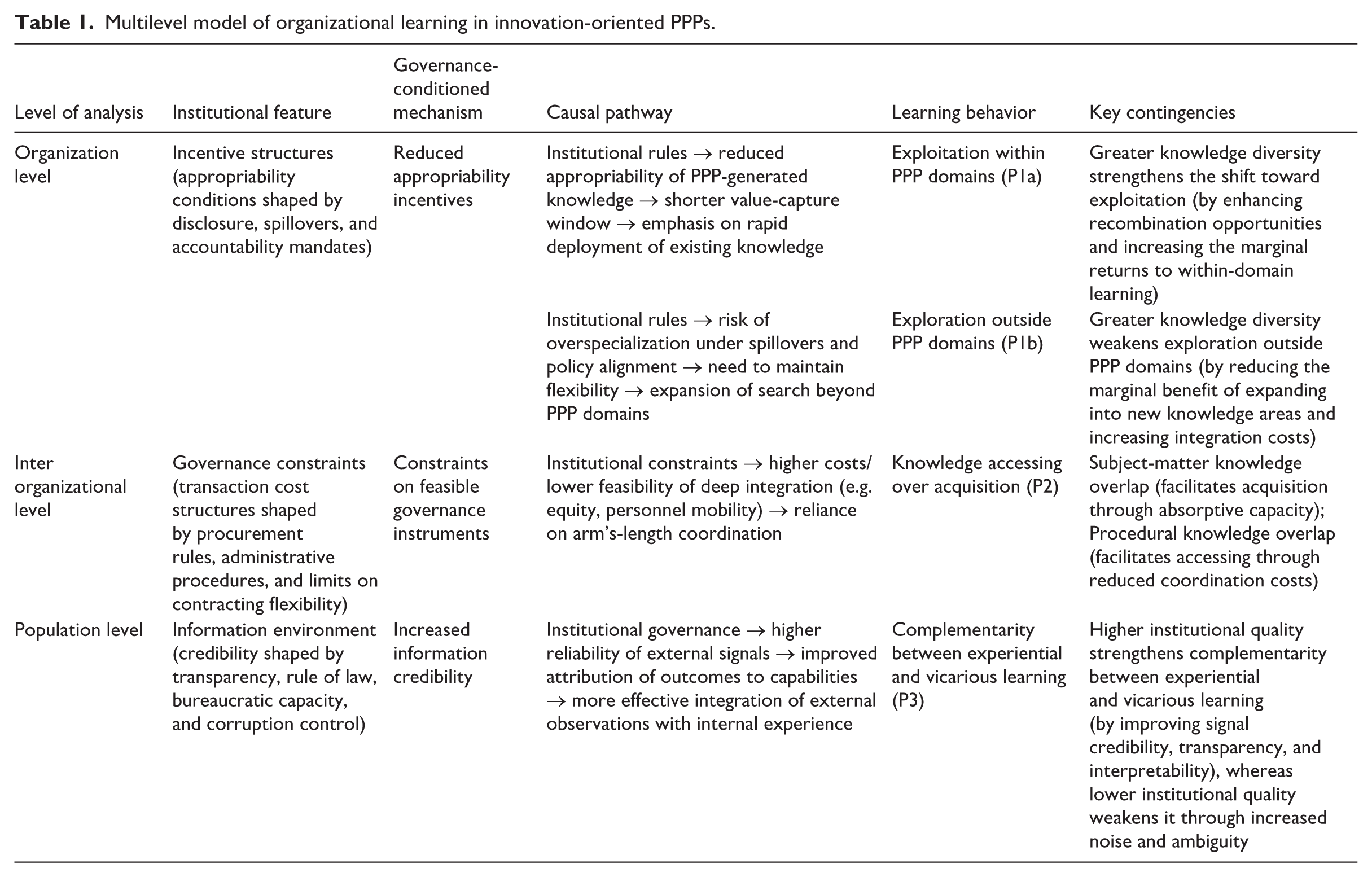
The preceding arguments develop an integrated multilevel theoretical model of OL in innovation-oriented PPPs. Governmental governance mechanisms shape firms’ learning processes through a consistent set of governance-conditioned mechanisms across levels. Table 1 summarizes the core learning outcomes at each level as well as the key contingencies that condition these effects, highlighting how each contingency strengthens or attenuates the governance-conditioned mechanisms underlying firms’ learning behavior.
Multilevel model of organizational learning in innovation-oriented PPPs.
Discussion
Innovation-oriented PPPs have become a central organizational form for addressing complex technological and societal challenges, yet strategy research has only begun to theorize how public actors shape private firms’ learning. This study develops a multilevel framework explaining how governmental participation—through its dual role as collaborator and institutional rule maker—systematically reshapes firms’ learning behavior. Our core argument is that institutional governance structures influence learning through three distinct but interrelated mechanisms—appropriability incentives, constraints on feasible governance instruments, and information credibility—which operate differently across organizational, interorganizational, and population levels.
A multilevel view of OL under public governance
Our first contribution is to OL theory. Prior research has largely examined learning within firms or across private alliances, often treating the institutional environment as a background condition (Argote and Miron-Spektor, 2011; March, 1991). By contrast, we conceptualize institutions as active, multilevel governance structures that shape learning through distinct causal pathways.
At the organizational level, institutional governance primarily operates through appropriability incentives. Public mandates for disclosure, accountability, and spillover generation alter the returns to innovation, thereby reshaping how firms allocate attention between exploitation and exploration. This perspective shifts the focus from learning as an internally determined process to one that is systematically conditioned by externally imposed value-capture constraints.
At the interorganizational level, institutional governance operates through constraints on feasible governance instruments. Procurement rules, administrative procedures, and limits on contractual discretion restrict the set of coordination and integration mechanisms available to firms, thereby structuring how learning between partners can be organized. As a result, learning is not only driven by firms’ intentions or capabilities but also by the governance architectures within which interorganizational relationships are embedded.
At the population level, institutional governance operates through information credibility. By shaping the transparency, reliability, and interpretability of information circulating across organizations, institutions influence how firms learn from the experiences of others. This highlights that vicarious learning is not merely a function of information availability but depends critically on the institutional conditions that determine whether such information is credible and actionable.
Taken together, this multilevel perspective extends OL theory by showing that learning processes are not only experience-based but also institutionally structured, with different mechanisms governing what firms learn, how they learn, and from whom they learn across levels.
Extending interorganizational learning through institutional embeddedness
Our second contribution is to interorganizational learning research. Existing studies have emphasized appropriability hazards, absorptive capacity, and governance choices negotiated between private partners (Hamel, 1991; Lane and Lubatkin, 1998). We extend this literature by theorizing institutional authority as a defining partner attribute that shapes learning dynamics.
In PPP contexts, governmental actors operate under administrative constraints, disclosure mandates, and accountability requirements that fundamentally alter the governance of collaboration. These institutional features constrain the feasibility of deep integration mechanisms—such as equity participation or proprietary knowledge transfer—while favoring more formalized, arm’s-length coordination. As a result, firms are more likely to rely on knowledge accessing rather than acquisition, not simply because of strategic choice, but because of institutionally bounded governance feasibility.
This perspective shifts interorganizational learning from a purely relational or contractual problem to one that is institutionally embedded, where the structure of learning is shaped by rules and constraints external to the focal dyad.
Reframing PPPs as learning environments
Our third contribution is to research on PPPs and nonmarket strategy. Prior work has primarily examined PPPs in terms of resource provision, contracting efficiency, or innovation outcomes (Brinkerhoff and Brinkerhoff, 2011; Quelin et al., 2019). We extend this literature by reframing PPPs as institutionalized learning environments that systematically shape firms’ capability development.
Specifically, we show that governmental participation does not merely provide resources but reconfigures firms’ learning trajectories. At the organizational level, firms adjust their search strategies in response to altered appropriability conditions. At the interorganizational level, they adapt their learning routines to governance constraints that limit integration. At the population level, they rely on institutional infrastructures that enhance the credibility of external information. In this sense, PPPs function not only as collaborative arrangements but as governance systems that structure how firms search, learn, and build capabilities over time.
Boundary conditions and cross-level coherence
Our framework also clarifies the boundary conditions under which these mechanisms operate. We identify level-specific contingencies—knowledge diversity (organizational level), public–private knowledge overlap (interorganizational level), and institutional quality (population level)—that shape how governance-conditioned mechanisms translate into learning behavior.
Importantly, while these contingencies are analytically associated with specific levels, they also reinforce the coherence of the multilevel framework. For example, institutional quality most directly affects the credibility of population-level information but can also influence interorganizational governance feasibility and organizational-level incentives. This highlights that although institutional effects are level-specific in their primary mechanisms, they remain interdependent across levels, reinforcing the integrated structure of the framework.
Future research directions
Building on this multilevel perspective, several avenues for future research emerge. First, empirical studies could examine how variation in institutional environments—across policy domains or national contexts—shapes the relative strength of the three mechanisms. Second, longitudinal research could explore how repeated participation in PPPs influences firms’ learning trajectories and capability development over time. Third, micro-foundational work could investigate how managers interpret governance-conditioned signals, particularly how they respond to trade-offs between appropriability, governance constraints, and information credibility. Such work would deepen our understanding of how institutional structures are translated into firm-level learning behavior.
Limitations
Finally, we acknowledge potential selection-bias concerns in our theorizing. The government does not randomly select private firms into PPP projects. In the United States, for example, some industries such as the bio-pharmaceutical sector and the energy and clean technologies are more likely to be selected by the government for policy considerations (Aspen Institute, 2023). Firms might also self-select to participate in PPPs for endogenous reasons that might explain their learning patterns as suggested in this article. Being aware of this bias, our theory focuses on a comparison between the focal firm and “firms in private-private collaborative innovations” (propositions 1a, 1b, 2, and 3), indicating a counterfactual scenario (i.e. what the focal firm would do in its learning behavior if it had only collaborated with a private partner). Yet identifying such endogeneity may be more challenging in the empirical settings. We suggest subsequent research into relevant topics to pay special attention to these potential biases.
Conclusion
This article develops a multilevel theoretical framework explaining how governmental involvement reshapes private firms’ OL in innovation-oriented PPPs. By theorizing governments as both collaborative partners and rule makers, we show how public mandates, disclosure obligations, and governance infrastructures recalibrate firms’ learning trajectories, structure interorganizational learning routines, and condition complementarities between experiential and vicarious learning. We further identify how these dynamics depend on firms’ knowledge diversity, public–private knowledge overlap, and institutional quality. Taken together, the framework positions PPPs not merely as resource arrangements but as governance environments that systematically shape how firms search, learn, and develop capabilities. By integrating OL, alliance research, and PPP scholarship, this study advances understanding of how public governance structures influence firm learning in collaborative innovation settings.
Footnotes
Acknowledgements
The author thanks Caterina Moschieri for her thoughtful guidance and support throughout the review process. The author is also grateful to the three anonymous reviewers for their constructive and insightful comments, which substantially improved the clarity and development of this manuscript. Any remaining errors are the author’s own.

Funding
The author received no financial support for the research, authorship, and/or publication of this article.
Declaration of conflicting interests
The author declared no potential conflicts of interest with respect to the research, authorship, and/or publication of this article.
Data availability statement
No new data were created or analyzed in this study.