






Abstract
Scholarly work has offered mixed findings regarding whether female leaders are more likely to be dismissed, which suggests that there may be important contingencies that affect how female leaders are assessed. We draw on leadership categorization and role congruity theories and supplement them with transference theory to examine whether the likelihood of dismissal for female senior managers is affected by the organization having previously been led by a woman. Using a sample of women’s college basketball coaches, we find that a female senior manager is less likely to be dismissed when her immediate predecessor was a woman (gender transference effect). We further find that the likelihood of dismissal for the current female leader is lower when the female predecessor performed well compared to when the male predecessor performed well. Finally, we provide evidence that the number of years in which the current female leader’s tenure was preceded by men in the senior position is positively associated with her likelihood of dismissal (interrupted gender transference effect). We discuss the theoretical and practical implications of these findings.
Keywords
Introduction
Prior scholarly work has examined whether women in senior managerial roles are more likely than male senior managers to be dismissed. While there have been notable examples of women holding the top leadership position for substantial periods at major companies, including Mary Barra at General Motors, Safra Catz at Oracle, and Vicki Hollub at Occidental Petroleum, scholarly work has offered mixed findings regarding the likelihood of female senior manager dismissal. On one hand, Glass and Cook (2016) provide evidence that female chief executive officers (CEOs
These conflicting findings suggest that there might be important contingencies that affect how female senior managers 1 are viewed and treated by their organization’s evaluators 2 and their subsequent chances of being dismissed. It is a well-established view that female leaders do not exist in a vacuum, and the context in which they operate should affect how they are perceived by evaluators (see for review, Mah et al., 2023). One such context is the organization’s previous experience with female leaders. For example, the presence of a prior female leader may change an organization’s perceptions of female leaders, which may subsequently affect the likelihood of female senior manager dismissal (e.g. Andersen and Baum, 1994; Andersen and Berk, 1998).
To examine this question, we draw on several theories. Leadership categorization (LCT) and role congruity theories serve as a foundation of perceived “occupational inappropriateness” biases faced by female leaders (Hill et al., 2015; Yoder, 1991). LCT argues that evaluators create cognitive prototypes of successful leaders (Lord and Maher, 1993). Men, who are often perceived to possess traits that match these leadership prototypes (Dwivedi et al., 2018; Schein, 2007), are evaluated positively; in contrast, women, who are often viewed as lacking the necessary traits for successful leadership, tend to receive less-favorable evaluations (Jeong and Harrison, 2017; Lee and James, 2007; Mui and Hill, 2024). Role congruity theory contends that female senior managers are unfairly evaluated based on normative expectations of feminine behavior and face challenges because their gender conflicts with perceptions that align leadership with masculinity (Eagly and Karau, 2002; Gupta et al., 2020; Jeong and Harrison, 2017; Mui and Hill, 2024). Yet, a woman previously leading the organization may change stereotypes and perceptions, with evaluations of the current female leader being based on her skills (see Ragins et al., 1998) rather than on biases associated with a view that only masculine traits can lead to effective leadership. To build the theoretical logic behind this argument, we utilize transference theory to posit that biases against female leaders may change based on stakeholders transferring perspectives about one leader to the successive leader (Preston and Carton, 2024; Ritter and Lord, 2007). Thus, while female senior managers have been found to experience stereotyping, as well as greater monitoring and scrutiny (Gupta et al., 2020; Kanter, 1977), we argue that the recent presence of another female senior manager in the same role may alleviate these negative attitudes. Stated differently, female senior managers could benefit from their female predecessors overcoming gender bias challenges and paving the way toward more equal treatment and greater job security for women in the organization’s upper echelons.
We explore this line of inquiry by examining whether the likelihood of dismissal for female leaders is affected by the organization having previously been led by a woman. We first investigate cases in which a female senior manager directly replaced another female senior manager. In this scenario, we argue that evaluators’ recent experience with a female senior leader reduces biases and behaviors associated with LCT and role incongruity, which subsequently reduces the likelihood of a female successor manager being dismissed. We then investigate whether the number of years since an organization has been led by a woman affects the likelihood of a female senior manager being dismissed. In this scenario, we posit that the period in which evaluators have not experienced and interacted with a woman in the senior role (and instead have experienced and interacted with a man in the senior role, which we term as “interrupted gender transference”) might reintroduce biases and stereotyping behaviors. Finally, we examine how predecessor performance moderates these two main effects and posit that it is an important contingency that affects gender bias and the subsequent likelihood of female senior manager dismissal.
To examine the likelihood of successor female senior managers being dismissed in these scenarios, we use the context of National Collegiate Athletic Association Division 1 women’s college basketball (hereafter referred to as women’s college basketball) coaches. There are multiple reasons this is a highly relevant context for this examination. First, as sport coaches are ultimately responsible for strategy, resource usage, talent acquisition, and retention (Fainshmidt et al., 2017), they are like CEOs and other senior managers in that they hold the greatest responsibility for performance and are accountable to various stakeholders (Allen et al., 2022; Aversa et al., 2025; Obenauer and Langer, 2019; Wangrow et al., 2023). Second, unlike business and male sport contexts, far more women hold the senior manager role in women’s college basketball. Whereas 10.4% of Fortune 500 firms were led by women in June 2024 (up from 8.2% in 2021 and 6.6% in 2019; see Ascend Global Leaders, 2021; Hinchcliffe, 2024), approximately 70% of the coaches in women’s college basketball from 2004 to 2022 were female. This enables a more extensive evaluation of scenarios relevant to female senior manager dismissal that is not yet possible in contexts where women represent a smaller portion of the population of senior managers.
We aim to make several contributions to the literature. First, we contribute to research on female leader turnover by outlining factors and contingencies that can reduce gender bias. Thus, we address calls for “research to examine the conditions that alleviate the reasons why women leave their organizations” (Dwivedi et al., 2023: 1263; see also Krishnan, 2009). We provide empirical evidence that having a female predecessor is an overlooked but critical factor for reducing gender stereotyping and the associated likelihood of dismissal for female senior leaders. Second, we extend transference theory by offering a more nuanced understanding of transference effects. While prior research has applied the theory to hiring decisions among racial minorities (Preston and Carton, 2024), to our knowledge, this is the first study to theorize on transference effects in the context of senior female manager dismissal. As a result, our article is different from this prior research in several key ways. First, our study identifies a novel effect of interrupted gender transference when female leadership is interrupted by periods of male leadership. Thus, we show that an organization’s evaluators’ attitudes toward women serving in senior positions can swing both ways. Second, dismissal is uniquely different from hiring decisions, as appointment decisions consider snapshots of forward-looking information about leadership (mis)fit (Datta and Guthrie, 1994), while dismissal decisions utilize ongoing assessments of (mis)fit that are attributed to current and prior performance (Pitcher et al., 2000). Thus, our study provides evidence of the enduring nature of transference effects in leadership assessment decisions. Third, we examine gender-based biases instead of race-based biases. The latter focuses on structural mechanisms creating stereotypes about competence, while the former tap into cultural considerations for (mis)fit (Smith, 2002). 3 Thus, our findings extend prior research on the applicability of transference effects to different sources of bias. Finally, given the large gap in female presence between entry-level positions and top manager positions in organizations (Krivkovich et al., 2025) and the importance of research to examine “problems that . . . are relevant to society” (Tihanyi, 2020: 329), we offer several steps and recommendations that organizations might take to confront biases and foster greater fairness and equality for female leaders.
Theory and literature review
Extensive theorizing over the last several decades has attempted to explain why a woman’s rise to an organization’s most senior position is limited; the challenges that women face if they ascend to the senior position, and whether those challenges increase the likelihood of adverse outcomes (e.g. dismissal) for female senior managers (Mah et al., 2023). Gender stereotypes have been shown to prevent women from advancing to leadership positions (Koenig et al., 2011), with women considered by an organization’s key stakeholders to be deficient in leadership-essential attributes, such as agentic qualities (e.g. aggressiveness, competitiveness, and assertiveness; Carli and Eagly, 1999; Oakley, 2000). The previously mentioned increase in women holding the CEO position in Fortune 500 firms suggests that misconceptions regarding women in the senior role may have declined, with some scholars finding that greater female representation on boards has been a catalyst for this change (e.g. Matsa and Miller, 2011). Yet, scholars continue to highlight barriers that can prevent the advancement of female leaders, including exclusion from informal networks (Biggerstaff et al., 2024; Ragins et al., 1998), benevolent sexism (Oliver et al., 2018), and implicit bias that may never be consciously acknowledged by evaluators (Gabaldon et al., 2016; Jost et al., 2009).
Dismissal, the most adverse outcome for organizational leaders, is a form of turnover—as opposed to retirement, leaving for a more prestigious position, or other reasons for separation—that involves a retrospective account of how organizational leaders have fulfilled their job. While dismissal is often driven by poor organizational performance (Boeker, 1992), prior research has also utilized a psychological lens (Weber and Wiersema, 2017), with evaluators’ expectations being an important factor in dismissal decisions (Fredrickson et al., 1988; Friedman and Singh, 1989). Evaluators form expectations about performance and the ability of top management to affect it (Fredrickson et al., 1988). Senior managers who exhibit prototypical leader behaviors and attributes—that is, male senior managers—are often perceived as fitting the leadership profile and face a lower probability of dismissal (compared to female senior managers) since strong performance is credited to their skills and capabilities and poor performance is blamed on external factors (Park and Westphal, 2013). In contrast, female senior managers are viewed as misfits (Eagly and Karau, 2002) because they lack prototypical leader characteristics and behaviors and, thus, are more likely to be dismissed even if they perform similarly to their male counterparts (Gupta et al., 2020). On the whole, the dismissal process, in which evaluators seek accountability for performance, assess (mis)fit as a reason for performance, and make judgments about the ability of the leader to impact future performance, favors male senior managers over female senior managers.
In the next sections, we discuss how LCT and role congruity theory inform perceptions of (mis)fit based on female leader traits and norms about female behaviors.
LCT theory
Among the theories that attempt to explain why and how female senior managers are treated differently from male senior managers, LCT posits that individuals rely on schemas (i.e. prototypes) from their belief system that categorize leaders using self-determined features that distinguish good leaders from bad leaders (Lord et al., 1982, 1984; Scott and Brown, 2006). Van Quaquebeke et al. (2011) argued that leader categorization stems from individuals’ perceptions when comparing their leaders to an “ideal leader,” in which the traits of an ideal leader range from demographic traits to self-perceptions to benchmarks associated with successful leaders in business, politics, and sports (see also Lord et al., 1984). Stereotypes regarding women are pervasive and widely held by both women and men (Nye and Forsyth, 1991), with women typically thought to be interpersonally sensitive and concerned with the welfare of others (Scott and Brown, 2006; Williams and Best, 1990). Men, on the other hand, are believed to be agentic and instrumental, more task-oriented, ambitious, competent, and competitive—traits that evaluators are more likely to associate with their prototypes of effective leaders (Eagly and Karau, 2002; Lord and Maher, 1993; Scott and Brown, 2006). Thus, women are seen as a categorical misfit for senior positions, affecting their ability to advance to the senior position and be considered legitimate if they do advance.
Evaluators’ attribution of good and bad performance is central to LCT. When leaders are perceived to fit the leadership stereotype—that they possess the necessary skills and competencies expected of a leader—positive outcomes are attributed to their leadership abilities regardless of the validity of a causal relationship (Wangrow et al., 2023). However, when they are not perceived to fit the leadership stereotype, causal relationships between their abilities and positive outcomes are discounted. Furthermore, leaders who do not fit the leadership stereotype are more likely to be penalized for poor performance or missing expectations (via dismissal, reduced compensation, etc.) than those who fit the stereotype (Obenauer and Langer, 2019). For female leaders, this is especially noteworthy, as prior research has shown that the likelihood of female leaders being considered more effective leaders than men is only greater when they are in roles that are perceived to be salient to their gender (e.g. nursing and flight attendants; Hogg et al., 2006).
Prior research supports LCT’s relevance to female leader stereotypes. Heilman et al. (2004) found that women who are successful are less liked and face greater negative reactions than men, especially in roles that are considered to be distinctly masculine. This suggests that evaluations of successful women are subject to stereotypes, even when these women have demonstrated competence and achieved positive outcomes (Heilman et al., 2004). Relatedly, Scott and Brown (2006) found that perceptions of female leaders continue to be based on stereotypes even when they exhibit more agentic and instrumental behaviors, providing further support that female leaders are categorized instead of being evaluated by their behaviors, actions, and outcomes.
Role congruity theory
Eagly and Karau (2002) proposed the role congruity theory as an extension of the social role theory of gender differences and similarities (see also Eagly, 1987), which further explains how individuals categorize leaders. It has been argued that prejudice occurs when the gender of an actual or proposed occupant of a leadership role is incongruous with key stakeholders’ views of leadership (see Del Carmen Triana et al., 2024, for a review). When women are in roles viewed to be incongruous by evaluators and other key stakeholders, prejudice against them manifests itself in two forms: (1) less-favorable evaluation of their leadership ability because they are not consistent with stereotypes and (2) less-favorable evaluation because behaviors deemed necessary for leadership are more acceptable from men than they are from women (Eagly and Karau, 2002; Johnson et al., 2008). Less-favorable evaluation from prejudice in either form is likely to lead to reduced opportunities for advancement, lower compensation, and a greater likelihood of dismissal (Del Carmen Triana et al., 2024). Eagly and Karau (2002) note that role congruity theory is most applicable at senior managerial levels since highly agentic qualities (e.g. acting as a change agent, managerial courage, and results-oriented) are deemed necessary for senior managers to be successful.
Subsequent studies have offered evidence of how role incongruity may disadvantage women in the workplace. Gupta et al. (2020) found that, while controlling for performance, female CEOs of publicly traded firms are more likely to be dismissed than male CEOs. While some studies do not find a significant relationship between a CEO’s gender and the likelihood of dismissal (e.g. Elsaid and Ursel, 2018), this finding is noteworthy because it points to potential contexts in which female senior managers may be more likely to be dismissed. Dwivedi et al.’s (2021) study of new female CEOs suggests that leadership endorsements (usually from the board of directors) of past achievements and competence penalize new female CEOs, resulting in shorter tenures unless the endorsements are for a new insider female CEO 4 or the firm has a substantial number of female leaders. Dwivedi and colleagues theorized that stakeholders’ view of the new female CEO through a stereotypical lens is reinforced because the endorsements run contrary to the stereotypes they hold.
Scholars have also found that role incongruity problems can extend to investor perceptions of mature firms (Del Carmen Triana et al., 2024). Lee and James (2007) found that investor reactions to CEO appointments are significantly more unfavorable when the new CEO is female, while Cook et al. (2024) provided evidence that female CEOs are more likely to be dismissed when performance is poor and that firms are rewarded by investors when they replace them with white men. Other studies found that investor expectations of firm growth (Yacus et al., 2019) and shareholder returns (Jeong and Harrison, 2017) are lower in firms led by women. Further, challenges associated with role incongruity can extend to women in other leadership roles. For instance, Lee and Huang’s (2018) findings suggest that entrepreneurial ventures led by women may be perceived less favorably than ventures led by men because of incongruity between expectations of female and entrepreneurial roles, while other studies show that incongruity between expectations of gender and founder may negatively impact an entrepreneurial venture’s commercialization (Uzuegbunam et al., 2021), financing (Eddleston et al., 2016), and funding (Cowden et al., 2021). Overall, these studies suggest that female leaders, including senior managers, can suffer from prejudice because their gender does not match stereotypes held by evaluators and other key individuals, which likely leads to negative outcomes (e.g. less support, lower compensation, reduced tenure, and greater likelihood of dismissal) for female senior managers than their male counterparts.
Hypotheses
A context that is likely to affect biases faced by female leaders is the organization’s past experience with other female leaders. Such experience can alter preferences and expectations for how female leaders should behave (Burgoon and Hale, 1988), with prior (especially recent) experience with a female leader likely impacting perceptions and views of current female senior managers as congruous with their roles (Andersen and Baum, 1994; Andersen and Berk, 1998; Chen, 2001). In particular, we examine how directly succeeding a female leader, as well as the time one or more men served in the senior manager role between two female senior manager tenures, affects the likelihood of dismissal for a current female leader.
Direct succession of a female senior manager (leader transference)
The premise of LCT and role congruity theory in gender research—that all female leaders are viewed and treated the same by their organization’s evaluators—is built on the assumption that evaluators who form perceptions of current female leaders likely have had no prior experience with women in senior leadership roles. However, if the predecessor leader has been a woman, “evaluators are likely to view the predecessor as a highly relevant point of comparison . . . because this person occupied the same role” as the current female leader (Preston and Carton, 2024: 332). The predecessor is highly salient because psychological processes imprint the most recent observations as key reference points (see Tversky and Kahneman, 1973), and evaluators tend to overemphasize recent observations when judging the next observation. Prior research has shown that when evaluators focus on a known person, stereotypes and prototypes are less likely to affect judgment (Andersen and Baum, 1994; Andersen and Berk, 1998; Chen, 2001). As a result, evaluators are less likely to be affected by preconceived biases and stereotypes about female leaders and, instead, are likely to employ the process of transference. Ultimately, this process should impact how evaluators assess and treat the current female leader, which could ultimately affect the likelihood of her dismissal.
Leader transference is a psychological process where evaluators falsely assume that two leaders who share a common characteristic, such as gender, are also similar in other ways. In such cases, evaluators make assumptions about the success of the leader based on transferring the traits of the predecessor (Kelley and Michela, 1980). As evaluators come to know the female predecessor and obtain concrete information about her skills and behaviors, they are likely to prioritize this information (Napier et al., 2018; Rim et al., 2013) and use it to make comparisons between the predecessor and current female leader (Smith and Zarate, 1992). Furthermore, as the female predecessor represents the most recent experience imprinted on evaluators, their episodic memory is likely to affect their judgment (Tulving, 1972, 1984) and lead them to generalize that the current female leader has similar skills and competencies (Ritter and Lord, 2007). Prior research provides evidence that similarity between a current leader and a predecessor is positively related to generalizations that other characteristics of the two leaders are also similar (Preston and Carton, 2024).
Translating these arguments to our context, we expect to observe a transference process based on gender. Evaluators could use gender similarity between the current female leader and her female predecessor to perceive other similarities between them (Andersen and Berk, 1998; Chen and Andersen, 1999). For example, the appointment of the predecessor to a senior manager position serves as evidence that she has overcome “more barriers than men on their way up” (Gupta et al., 2020: 563) and is “particularly gifted and/or especially good at learning and/or dealing with adversity” (Gupta et al., 2018: 2039). Evaluators are likely to ascribe these skills and competencies of the female predecessor to the current female leader. Such attributions should significantly reduce or even overcome inherently held biases and stereotypes on the incongruity between a woman and the senior position (Andersen and Baum, 1994; Andersen and Berk, 1998). Thus, evaluators are more likely to view the current leader as a strong fit (or less of a misfit) for the position. This reduced bias should lead to a lower probability of mistreatment and discriminatory behavior toward the current female leader, resulting in a lower likelihood of dismissal. Formally stated,
Female senior manager tenures separated by male leadership (interrupted gender transference)
The underlying argument in our first hypothesis is that an organization’s evaluators change their perceptions of women in leadership roles when they are familiar with the woman who previously served in the senior role. Here, we consider cases where one or more men served as the senior leader between female senior manager tenures, which may reintroduce LCT, role incongruity bias, and stereotyping.
Regardless of the performance and perceptions of the woman who most recently served in the senior leadership position, a few factors point to the potential reintroduction of gender bias and stereotyping when one or more men served in the senior role between female senior manager tenures. First, the accepted status quo of the senior position may, over time, revert back to a man serving in the senior position. One or more years of a man at the organization’s helm can generate recency bias, where evaluators overemphasize recent experiences and overlook more distant experiences (Tversky and Kahneman, 1973). As the observation of and interaction with the male leader represent the most concrete and relevant information for evaluators, his skills and behaviors are likely to become imprinted on evaluators’ minds and judgments (Tulving, 1972, 1984). As a result, memory of the legitimacy and leadership skills of the female predecessor may erode with longer periods of male leadership and be replaced with more recent impressions of the male leader. With longer periods, evaluators’ ability to observe and interact with the female predecessor, an essential part of reducing gender bias, declines (Dovidio et al., 2017). Thus, gender stereotyping may resurface among evaluators, leading to enhanced perceptions of a misfit between a woman and the senior manager position. Second, as more time elapses since the female predecessor was in charge of the organization, there is a greater chance that the organization’s evaluators and other key stakeholders will change, with new individuals likely lacking contact and experience with the female predecessor. In such a case, it is more likely that a new female senior manager will be considered incongruent for the leadership role and evaluated less favorably.
Ultimately, we posit that the presence of male leadership between female senior manager tenures can undermine gender transference effects and lead to what we term as “interrupted gender transference.” In particular, as the time between female senior manager tenures lengthens, during which one or more men lead the organization, the gender transference effects are likely replaced by the reintroduction of gender bias and stereotyping that results in an increased probability of dismissal for the current female leader. We therefore offer the following hypothesis:
Boundary conditions of female senior manager dismissal
Given that senior managers do not exist in a vacuum, it is important to examine contingency conditions that are likely to impact their likelihood of dismissal. We focus on predecessor performance, as performance serves as a valid indicator of senior managers’ skills and reflects their ability to handle complex and challenging situations (Hubbard et al., 2017; Wiersema and Zhang, 2011), and predecessor performance is a critical factor affecting gender bias and stereotyping (e.g. Gupta et al., 2020).
Performance triggers cognitive processes of evaluating leaders’ accountability and role congruity (Weber and Wiersema, 2017). In line with research on attribution and inference-based approaches to leadership (e.g. Calder, 1977; Kelly and Michela, 1980; Meindl et al., 1985), a female predecessor’s strong (weak) performance can instill (reduce) confidence among evaluators regarding her competence and effectiveness as a leader. Furthermore, strong (weak) performance can weaken (strengthen) inherent biases that a woman is a misfit for a senior manager position. Favorable predecessor performance should lessen misfit evaluations, attribute the source of performance to the current female leader instead of external factors, and instill that the current female leader is capable of performing as her female predecessor. In contrast, when a male predecessor performs well (poorly), evaluators’ gender biases could increase (decrease), leading to a higher (lower) probability of dismissal for the current female leader. As a result, a female predecessor who led the organization to strong performance compared to a male predecessor who generated strong performance should increase transference effects and ultimately lower the probability of dismissal for the current female senior manager. Thus,
For situations when one or more men serve as senior managers between female senior manager tenures, we argue that strong performance of the male senior manager(s) can enhance recency bias (Tversky and Kahneman, 1973) and ultimately gender bias. For example, if one or more of these male leaders were successful in the senior position, evaluators are likely to disproportionately attribute positive performance to their skills (e.g. Park and Westphal, 2013), strengthen their inherent beliefs that men are better leaders than women, and forget or ignore the legitimacy and leadership skills of the female predecessor. These resurfaced biases should lead evaluators to unfairly cast blame on current female leaders for poor performance and diminish expectations of the female leader’s ability to secure future performance. The longer that successful male leaders have served in the senior position, the stronger the gender bias against them and the higher the likelihood of dismissal for the current female leader. In contrast, when one or more of these male leaders performed poorly, evaluators are less likely to perceive men as superior leaders compared to women. In these cases, evaluators are more likely to reflect on the leadership competence and expertise of the female predecessor, resulting in a lower likelihood of gender bias toward the current female senior manager.
We argue that the male predecessor’s strong performance confirms male-centric biases, such that the strong performance may suggest a male leadership advantage and supplant information about the prior female leader’s effectiveness. The result strengthens interrupted gender transference, reducing favorable evaluator judgments toward female leaders and increasing the likelihood of their dismissal. Formally stated,
Methods
To examine whether the dismissal of female senior managers is influenced by the gender of their predecessors, we created data comprised of women’s college basketball coaches from all teams in the 12 major conferences (American Athletic, Atlantic Coast, Atlantic 10, Big East, Big 10, Big 12, Conference USA, Pacific 12, Missouri Valley, Mountain West, Southeastern, and West Coast) for each season from 2003–2004 to 2021–2022. The context of women’s college basketball was chosen for two reasons. First, substantial data is available that can be used to build models to test our study’s hypothesized relationships. Second, few, if any other, contexts offer substantial numbers of men and women serving in senior manager roles. Of our sample’s 413 coaching tenures, 288 are associated with women, and 125 are associated with men.
Our database was constructed in a manner that allows for covariates to vary in models during a coach’s tenure (Benner and Tripsas, 2012). Each coach’s tenure was divided into annual spells that correspond with each season an individual led a team, in which the coach is at risk of being dismissed during each annual spell. The data spans 2548 spells involving 413 coaching tenures. 5 One-hundred and seventy-three tenures ended with dismissal, while the remaining 240 tenures were voluntarily discontinued, discontinued due to death, or continued into the 2022–2023 season.
A variety of sources were used to collect data for this study. The primary source for official historical women’s college basketball statistics regarding teams, coaches, and players was the commercial website: http://www.sports-reference.com/cbb/. Other data sources include https://www.ncaa.org/, annual filings from the US Department of Education Equity in Athletics Disclosure Act (EADA) database (https://ope.ed.gov/athletics/#/), and university websites. Articles found through searches of websites and media reports were used to determine each coach’s gender and racial/ethnic affiliation, as well as whether he or she was dismissed.
Dependent variable
For each season (i.e. spell) in which a coach was dismissed or forced to resign, Dismissal was assigned “1.” If the coach continued into the following season, voluntarily resigned or died, Dismissal was assigned “0.” Causes of voluntary resignation include retirement, poor health, leaving to coach a Women’s National Basketball Association (WNBA) team, leaving to serve as a WNBA executive, or leaving to coach another Women’s NCAA college basketball team.
As organizations generally do not publicly disclose reasons for dismissing senior managers, it is difficult to determine the cause of turnover (Shen and Cannella, 2002). To assess and determine the cause of each turnover in our sample, one of the authors and a research assistant independently reviewed press releases and media reports associated with each turnover event. Such methods have been previously used to distinguish dismissals from other types of turnover (e.g. Shen and Cannella, 2002; Wangrow et al., 2018). The author and research assistant agreed on 310 of the 330 turnover events (93.9%), which yielded 0.878 for Cohen’s kappa and suggested strong alignment between the two raters (McHugh, 2012). For the 20 turnover events in which they disagreed, the two researchers discussed the university and media reports surrounding each turnover and reached an agreement on whether each of these events were associated with dismissal.
This method was repeated, with an almost perfect level of agreement (i.e. Cohen’s kappa greater than 0.90, see McHugh, 2012), for the following variables: Gender, Prior Coach Gender, Person of Color, Prior Coach Dismissed, and Prior Coach Person of Color.
Independent variables
The binary variable, Gender, was assigned “1” if the current coach was a woman and “0” otherwise. Approximately 66% of the spells were associated with female coaches. 6 Prior Coach Gender is a binary variable that was assigned “1” if the prior coach was a woman and “0” otherwise.
Female Coach Gap is the number of years following a prior female coach’s departure that one or more men served as coach before the current female coach. For example, at the University of Illinois, a female coach (Nancy Fahey) was preceded by a male coach (Matt Bollant) who coached for six seasons. Matt Bollant was preceded by a female coach (Jolette Law). Female Coach Gap is coded “6” for each season in which Nancy Fahey was the coach. This variable is set to “0” when the current female coach replaces a female coach. For example, at the University of Minnesota, a female coach (Lindsay Whelan) replaced a female coach (Marlene Stollings). Female Coach Gap is coded “0” for each season in which Lindsay Whelan was the coach.
Prior Coach Winning Percentage (for testing H3) is the percentage of total games that the team won during the prior coach’s tenure. This variable also serves as a control variable for tests of H1 and H2, as it can be an indicator of a glass cliff scenario in which the female coach was hired during a period of crisis (Ryan et al., 2007; Ryan and Haslam, 2005). Prior Male Coaches’ Winning Percentage (for testing H4) is the combined winning percentage of all male coaches during the period between the beginning of a female coach’s tenure and the end of the tenure of the most recent prior female coach. For example, at the University of Oklahoma, two male coaches (Burl Plunkett and Gary Hudson) held the position between the current coach (Sherri Coale) and the team’s most recent female coach (Valerie Goodwin-Colbert). The combined winning percentage of these two male coaches, 52.9%, is assigned for each season in which Sherri Coale was the coach.
Control variables
We controlled for additional variables at the individual, team, and university levels that might affect coach dismissal. The binary variable, Person of Color, was assigned “1” if the current coach represented a non-White racial or ethnic group and “0” otherwise. Approximately 18% of the observations are associated with non-White coaches. Binary variables were included for whether the current coach was a Former Division 1 Player and whether he or she was an Alumnus of the university whose team they led. Previous Head Coaching Experience is the number of years the current coach led other NCAA Division 1 teams prior to beginning his or her tenure as the focal team’s coach. Years Assistant at School is the number of years that the current coach served as one of the team’s assistant coaches earlier in his or her career. We also included two variables associated with a coach’s reputational capital and power. Following prior research (e.g. Allen et al., 2022), we counted each time the current coach had achieved the following accomplishments: reaching the Women’s NCAA Final Four, winning the Women’s NCAA national championship, recognition as the conference’s coach of the year, and recognition as the Naismith National Coach of the Year. Prestige when Hired is a coach’s cumulative accomplishments prior to being hired, while Prestige at School is a coach’s cumulative accomplishments since beginning their tenure as the team’s coach.
University-level control variables account for a university’s structural or institutionalized norms as sources of potential bias. Private University was coded “1” if the university was privately owned. New Conference was coded “1” if, for that season, the team was competing in a different conference than the prior year. We also included a binary variable, AD Change, that was coded “1” if the current athletic director was different than the athletic director who hired the current coach. Financial Support was obtained from the US EADA database (https://www2.ed.gov/finaid/prof/resources/athletics/eada.html) and is the total dollars spent (in millions) by the university for that season’s women’s basketball program. 7
Three variables account for expectations or challenges prior to a season. Preseason Ranking is a team’s ranking in the Associated Press’ Top 25 prior to the season, with a team ranked number one assigned 25, a team ranked number two assigned 24, and so on. Teams not included in the preseason rankings were assigned 0. Draft Value measures the team’s cumulative talent level for a season (e.g. see Wangrow et al., 2023). For each player who eventually played in the WNBA, the variable is incremented by 4 if the player was drafted in the first round, 3 if drafted in the second round, 2 if drafted in the third round, and 1 if not drafted. Scandal or Sanctions is a binary variable that was coded “1” if there was an ongoing scandal during the season or if the NCAA had penalized the team in some way for that season.
Winning Percentage (t) is the percentage of total games that the team won during the most recent season, while Winning Percentage (t − 1) is the percentage of total games that the team won during the prior season. As prior research has shown that the relationship between performance and dismissal is nonlinear (e.g. Wangrow et al., 2018), the linear and squared terms of these variables are used in the analysis models.
Three additional variables associated with the prior coach are included. Prior Coach Dismissed was coded “1” if the prior coach had been dismissed. Prior Coach Person of Color was assigned “1” if the prior coach represented a non-White racial or ethnic group. Prior Coach Tenure is a count variable representing the number of years the prior coach led the team.
For models 1 through 6 in our analysis, 19 dummy variables were included for year. All models included 12 dummy variables for the conference in which the team competed. 8
Analysis
We used a Cox Proportional Hazards event-history model (Cox, 1972) to examine whether the likelihood of dismissal for a female coach was affected by whether the coach had succeeded a female or male coach. A Cox model estimates the hazard rate h(t), which represents the probability of dismissal following a season, in which a season is a distinct period (i.e. spell) in which the coach is at risk of being dismissed (see Wangrow et al., 2023, for an example). A Cox model was chosen because it does not assume the hazard function’s characteristics but instead uses data to determine the underlying hazard function (Benner and Tripsas, 2012; Blossfeld et al., 2007). In addition, as many variables change during a coach’s tenure, Cox models are ideal for this analysis because they allow for time-varying covariates and, thus, can handle fluctuations of variables over a coach’s tenure (Blossfeld et al., 2007; Box-Steffensmeier and Jones, 2004). Further, this study’s analysis method needed to effectively prevent right-censored data from biasing parameter estimates since many coaching tenures end voluntarily or extend into the 2022–2023 season. Cox models are appropriately suited for this.
Results
Table 1 provides descriptive statistics and correlations. To verify that collinearity is not a problem, we determined the variance inflation factor (VIF) for each independent variable in each model. For models 1 through 6, as VIF did not exceed 3.6 for any variable, multicollinearity was not indicated, and all variables were included in the models (VIF < 10; see O’Brien, 2007). For model 7, which uses a small subset of the main sample, collinearity was indicated, and three variables (New Conference, Scandals or Sanctions, and Preseason Ranking) were removed from this model to eliminate collinearity issues.
Descriptive statistics and correlations.
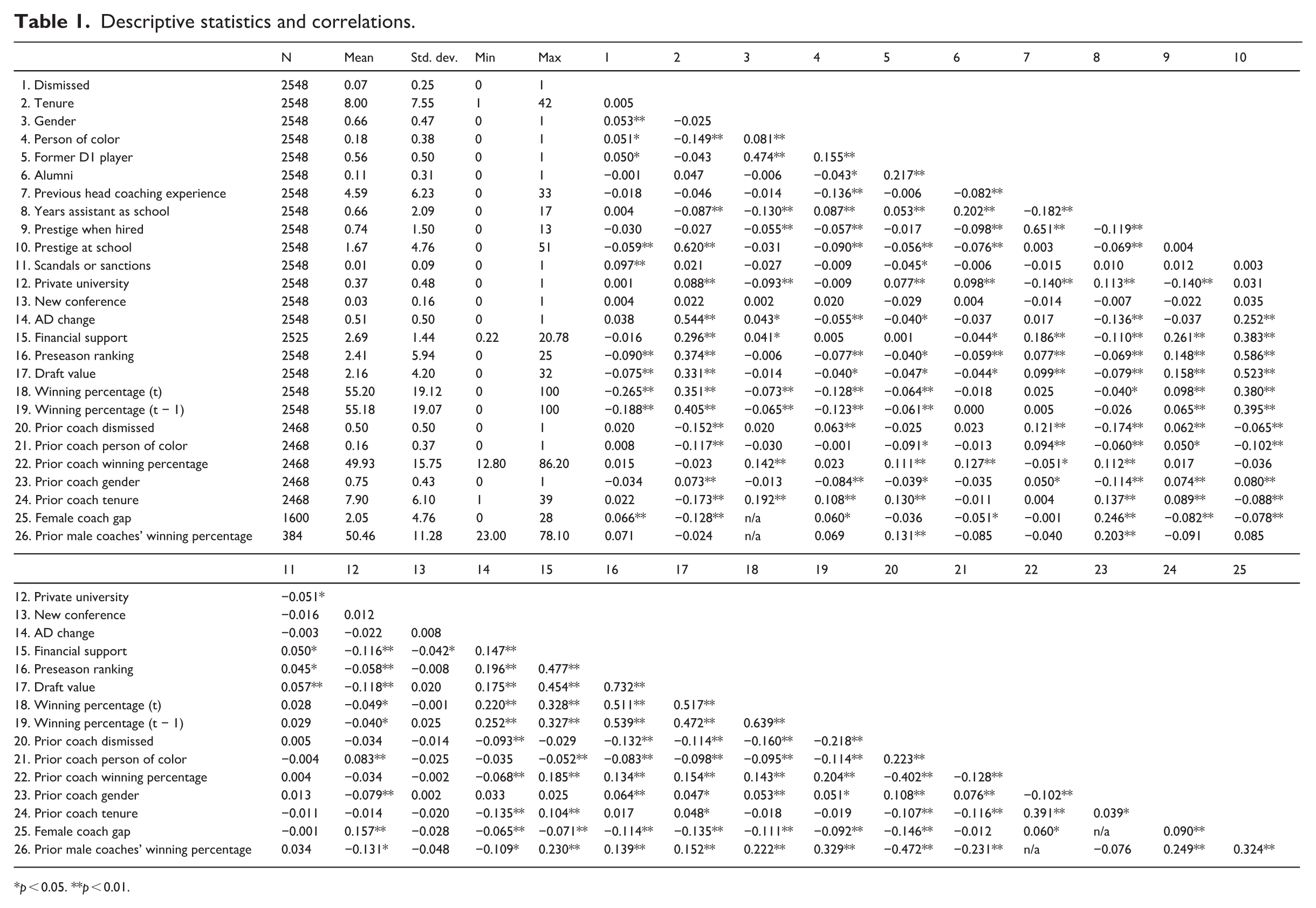
p < 0.05. **p < 0.01.
Table 2 provides results from the event-history analysis. Exponentiated hazard coefficients are shown, with a significant and positive (negative) coefficient indicating that the likelihood of a coach being dismissed increases (decreases) as the associated variable increases. A variable’s numerical effect on dismissal is determined by taking the exponential function of the coefficient (i.e. numerical effect = exp(exponentiated hazard coefficient)). For example, model 1 of Table 2 reports a significant hazard coefficient of 0.263 for Financial Support. Since exp(0.263) equals 1.301, the results suggest that, with other factors held equal, the likelihood of any coach in the sample being dismissed increases by 30.1% for each additional million dollars of annual spending by the university on its women’s college basketball team.
Cox survival hazard models.

Dummy variables for conference and year are included in models 1 through 6. Year dummies are not included in model 7, as multiple years do not have dismissals. Robust standard errors in parentheses. For model 7, New Conference, Scandal or Sanctions, and Preseason Ranking were collinear with the failure variable and were removed from the model.
p < 0.05, **p < 0.01, ***p < 0.001, +p < 0.10050010001.
Model 1 of Table 2 reports results for the entire sample. Prior Coach Gender is negatively and significantly related to the likelihood of dismissal (p = 0.001). The exponentiated hazard coefficient for Prior Coach Gender is −0.468, which suggests that the likelihood of any coach being dismissed when the prior coach is female (with all other factors held equal) is reduced by 37.4%. We also note that, for the entire sample, we do not find a significant relationship between the current coach’s gender and the likelihood of dismissal.
H1 argues that a senior female manager will be less likely to be dismissed when she succeeds a female in the senior position. To test this hypothesis, we divided our sample into male and female coaches and repeated the analysis from model 1. As shown in model 2 (male coaches only), Prior Coach Gender is not significantly related to the likelihood of dismissal. However, model 3 (female coaches only) shows a negative and significant relationship between Prior Coach Gender and the likelihood of dismissal (p = 0.002). The exponentiated hazard coefficient for Prior Coach Gender in model 3 is −0.516, which suggests that the likelihood of a female coach being dismissed (with all other variables held equal) is reduced by 40.3% when the prior coach is female. H1 is supported.
H2 argues that the number of years that one or more male senior managers succeeded a female senior manager prior to the current female senior manager beginning her tenure is positively related to the likelihood of the current senior female manager being dismissed. To test this hypothesis, we replaced Prior Coach Gender with Female Coach Gap. As shown in model 4, Female Coach Gap is positively and significantly related to the likelihood of dismissal (β = 0.038; p = 0.004), which can be interpreted as each year that one or more male coaches succeeded a female coach is associated with a 3.9% increase in the likelihood of the current female coach being dismissed. 9 H2 is supported. 10
H3 argues that the likelihood of dismissal for female senior managers will be smaller when a prior female senior manager performed well compared to a prior male senior manager who performed well. To test this hypothesis, we again used our subsamples of male and female coaches. Model 5 shows that, for male coaches, the interaction of Prior Coach Gender and Prior Coach Winning Percentage is not significantly related to the likelihood of dismissal. However, model 6 shows that, for female coaches, the interaction of Prior Coach Gender and Prior Coach Winning Percentage is significantly and negatively related to the likelihood of dismissal (β = −0.041; p = 0.006).
Using methods from Lamina et al. (2012) and Wang and Ware (2013), this significant interaction is illustrated in Figure 1. If the prior coach had a winning percentage of 67.2% (one standard deviation larger than the mean for all prior coaches), the increase in the likelihood of dismissal for the current female coach was 107.1% if the prior coach was male. However, the increase was only 8.2% if the prior coach was female, suggesting that, when performance during the prior coach’s tenure was strong, the increase in the likelihood of the current female coach being dismissed is 98.9% less if the prior coach was female compared to the prior coach being male. Alternatively, if the prior coach had a winning percentage of 35.5% (one standard deviation less than the mean for all prior coaches), the decrease in the likelihood of dismissal for the current female coach was 51.7% if the prior coach was male and 7.6% if the prior coach was female. This suggests that, when performance during the prior coach’s tenure was weak, the decrease in the likelihood of the current female coach being dismissed is 44.1% less if the prior coach was female compared to the prior coach being male. To further validate our findings, we conducted simple slope tests. For male predecessors, the regression line is upward sloping and significant (p = 0.004). This indicates that male predecessors with strong performance (one standard deviation above the mean for all prior coaches) lead to a higher likelihood of dismissal for current female coaches compared to male predecessors with poor performance (one standard deviation below the mean for all prior coaches). However, for female predecessors, the regression line is slightly upward sloping, but not significant (p = 0.312). This result indicates that there is no significant difference in the likelihood of dismissal for current female coaches regardless of the female predecessor’s performance. Collectively, these empirical findings indicate that gender transference effects are stable and not dependent on the performance of the prior female coach. H3 is supported.

Effect of prior coach winning percentage by gender on the likelihood of dismissal for female coaches.
H4 argues that when one or more men serve as a senior manager between two female senior manager tenures, the positive relationship between the number of years these men have served in the senior position and the likelihood of the current female senior manager being dismissed will be strengthened under stronger performance by these men. To test this hypothesis, we used a subsample comprised of the 71 female coaches in our main sample who had one or more male predecessors following the tenure of the team’s most recent female coach. As shown in model 7, the interaction of Female Coach Gap and Prior Male Coaches’ Winning Percentage is positive but not significant. H4 is not supported.
Supplemental analyses
To test whether our models violated the proportional hazards assumption, we executed two tests (see stata.com/manuals14/ststcoxph-assumptions.pdf; also, Allison, 2014; Garrett, 1997). First, Kaplan-Meier plots were generally parallel for different instances of the main effect in each model. Second, STATA’s phtest indicated that all variables in each model were not significant for violating the assumption. Thus, we are confident that our models did not violate the proportional hazards assumption.
We replaced the performance measure used in our primary analyses, Winning Percentage (linear and squared terms for the current and prior year), with Conference Winning Percentage (linear and squared terms for the current and prior year) and repeated our analyses. There were no meaningful differences in the results. We then repeated our analyses using two alternative measures of performance: a binary variable indicating whether the team made that year’s NCAA tournament and a count variable of the number of wins in that year’s NCAA tournament. Again, there were no meaningful differences in the results.
Given the possibility of a quadratic relationship between the number of years in which one or more men served as coach between the current and most recent female coach and the likelihood of dismissal, we repeated our H2 analysis using linear and squared terms for Female Coach Gap. The squared term for Female Coach Gap in this model was not significant.
As a coach may depart for a variety of reasons not associated with dismissal, we followed methods from Gentry et al. (2021) and completed a supplemental analysis using a subsample that excluded the 17 coaching tenures that ended with retirement, illness, or death. University announcements and media reports were used to determine if a coach’s tenure ended with illness or death, while a coach was assumed to have retired if he or she voluntarily left the position without taking another position at the age of 65 years or older. The results from this supplemental analysis did not meaningfully differ from the primary results. 11
We completed a supplemental analysis using an alternative measure of the prior coach’s experience as a control variable. The primary results did not meaningfully change when Prior Coach Age at Departure replaced Prior Coach Tenure in the models.
To test whether an omitted variable may be influencing our results (see Bliese et al., 2020, for a review), we used STATA’s konfound command to assess the strength necessary for an omitted variable to invalidate our results (Frank, 2000). For the explanatory variable, Prior Coach Gender, at least 591 observations would need to be excluded due to bias to invalidate the results. For the explanatory variable, Female Coach Gap, 492 observations would need to be excluded due to bias to invalidate the results. For the explanatory variable, Prior Coach Winning Percentage, 712 observations would need to be excluded due to bias to invalidate the results. For the explanatory variable, Prior Male Coaches’ Winning Percentage, used only in model 7, 200 observations would need to be excluded due to bias to invalidate the results. As our models have a suitable and large set of control variables, the substantial number of cases needed to sustain an inference of omitted variable bias suggests that the results are not influenced by one or more omitted variables (Hubbard et al., 2017; Wangrow et al., 2023).
To examine whether the effects found in our analysis were consistent over time, we split the sample into two time periods (2004–2013 and 2014–2022) and repeated our analysis. 12 Models 2 and 6 in Table 3 show that Prior Coach Gender is negatively and significantly associated with the likelihood of dismissal for female coaches for both periods (model 2: β = −0.635, p = 0.034; model 6: β = −0.773, p = 0.007). This suggests that, for the period of 2004 to 2013, immediately succeeding a female coach reduced the likelihood of dismissal for the current female coach by 47.0%, while, for the period of 2014–2022, immediately succeeding a female coach reduced the likelihood of dismissal for the current female coach by 53.8%. Models 3 and 7 in Table 3 show that the Female Coach Gap is positively and significantly associated with the likelihood of dismissal for female coaches for the two time periods. For the period from 2004 to 2013, the coefficient for Female Coach Gap is 0.057 (p = 0.042), while the coefficient for the Female Coach Gap is 0.038 (p = 0.022) for the period from 2014 to 2022. This suggests that the likelihood of female coach dismissal for each year in which one or more male coaches preceded a female coach increased by 5.9% during the period from 2004 to 2013 and by 3.9% during the period from 2014 to 2022. While model 4 in Table 3 shows no significant interaction, model 8 shows a significant interaction of Prior Coach Gender with Prior Coach Winning Percentage (β = −0.045; p = 0.025) for the period from 2014 to 2022. 13
Supplemental results with the sample split into two periods.

Dummy variables for conference and year are included in each model. Robust standard errors in parentheses.
p < 0.05, **p < 0.01, ***p < 0.001, +p < 0.10050010001.
Finally, as this study examines transference’s relationship with the likelihood of dismissal, we considered a subsequent question of whether transference is associated with future performance. This supplemental analysis found that, for new female coaches, the prior coach being female (i.e. Prior Coach Gender) was significantly and positively related to performance (i.e. winning percentage) in the first year (β = 5.171; p = 0.035). This supplemental analysis further found that, for new female coaches, the number of years in which one or more men served as coach prior to a female coach beginning her tenure (Female Coach Gap) was significantly and negatively related to performance in the first 3 years of her tenure (year 1: β = −0.395; p = 0.050; year 2: β = −0.433; p = 0.080; year 3: β = −0.504; p = 0.044). These results offer some evidence that stereotyping and bias may be reduced under transference. It is possible that transference may also facilitate a more favorable environment (i.e. more supportive) for incoming female leaders that fosters success early in their tenure. However, perceptions of a senior female manager’s performance and her actual performance may diverge. Research has found that women may need to outperform their male counterparts to be viewed as competent, and such attributions can lead to evaluators and other key stakeholders providing less support to female leaders (Cowen et al., 2022; Ma et al., 2022). However, this prior literature does not take into account transference effects or prior experience with women in senior positions. We encourage future research that delves deeper into performance consequences and also examines other outcomes from transference, such as turnarounds and the ability to access, develop, and retain human capital.
Detailed results from the supplemental analyses are available from the authors upon request.
Discussion
Our study draws on theories of LCT, role congruity, and transference to examine how the gender of predecessor senior managers affects the likelihood of dismissal for female senior managers. Utilizing a sample of women’s college basketball coaches, we find support for our theorizing as the likelihood of dismissal for a female coach is reduced by 40.3% when the prior coach is female. In addition, we find that the likelihood of a female coach being dismissed increases by 3.9% for each season that a male coach held the position following the most recent former female coach’s departure. We further find that, when the prior coach’s performance was strong, the likelihood of dismissal for a current female coach who directly succeeded a female coach is far less than if she succeeded a male coach.
While our findings are consistent with ideas of categorization, bias, and stereotyping of female senior managers, they also introduce organizational and evaluator acceptance of women as a new facet to prior theorizing. Findings from our first hypothesis suggest that female senior managers are less at risk of dismissal when their organization was recently led by another woman. In this scenario, a transference process (see Ritter and Lord, 2007) seems to reduce negative views of female leaders because of recent firsthand experience and perceived similarities with a former female senior manager. Thus, gender bias and subjective stereotypes (e.g. less competitive, less ambitious, too interpersonally sensitive; see Lord et al., 1982, 1984; Scott and Brown, 2006) appear to be replaced by a transference process in which evaluators expect the current female senior manager to possess similar skills and exhibit similar behaviors to her female predecessor. Our theorizing and findings extend the broad literature on female turnover and show that, beyond CEO gender-inclusive behaviors (Dwivedi et al., 2023, 2018), the mere presence of female predecessors in leadership positions could reduce the likelihood of dismissal for current female senior managers.
Findings from testing our second hypothesis point to an underexplored and novel condition—interrupted gender transference—that can reverse the decreased risk of female senior manager dismissal associated with a female predecessor. We suggest that interrupted gender transference can undermine reductions in bias and stereotyping against female leaders and that an organization’s evaluators’ and other key stakeholders’ acceptance of a woman in the senior position is not a permanent outcome. Instead, bias, stereotyping, and doubt about female senior managers can reemerge over time as evaluators’ and other key stakeholders’ experience with female senior managers is interrupted by one or more men holding the senior position. There are several reasons these views and behaviors can reemerge. First, a man who is highly successful in the senior position may foster renewed mental models of effective leadership, with a man again perceived as a “good leader” and a woman as a “bad leader” (Lord et al., 1982, 1984; Scott and Brown, 2006). This reasoning extends prior cognitive theory that people develop heuristics and, in turn, biases from relevant and recent instances that are more likely to come to mind (Gigerenzer and Gaissmaier, 2011; Tversky and Kahneman, 1973) regarding women and other occupational minorities in senior roles. Second, there likely will be some degree of evaluator turnover during the period between two female senior managers. If a significant number of new evaluators have not experienced or interacted with the predecessor female senior manager, there may be a sufficient number of new evaluators with biases and stereotypes against women in senior roles to restore prior heuristics that negatively view female leadership. While such bias and stereotyping may be implicit (Gabaldon et al., 2016; Jost et al., 2009) or may stem from individuals being unable to alter their beliefs even when they are presented with details that positively highlight the prior female senior manager’s tenure (see Hilbert, 2012), a new evaluator majority can reinstitute doubts regarding a woman’s ability to lead. Overall, interrupted gender transference suggests that problems associated with LCT and role congruity may not be “solved” in many organizations but instead are only mitigated for a period of time. In no way does this finding suggest that male predecessors intentionally undermine female successors’ chances for success in an organization. Instead, this result is indicative of the potential reemergence of gender bias on the part of evaluators and external constituents. To prevent this negative consequence, it may be valuable for organizations and male predecessors to remain cognizant that gender bias could reoccur and consider proactive measures (e.g. gender-inclusive leadership development) that may facilitate female leaders’ future success (Dwivedi et al., 2023, 2018). The effects of such measures may be enhanced by a strong gender egalitarian culture inside the firm and across society, gender-diverse corporate boards, and mandatory government regulations.
Our supplemental analyses offer several noteworthy findings. First, our findings suggest that the likelihood of female coach dismissal for each year in which one or more male coaches preceded a female coach may have declined over time. Such a decline may be driven by overarching societal changes in attitudes toward women. The growing number of female leaders in business and politics (Ascend Global Leaders, 2021; CAWP, 2026; Hinchcliffe, 2024) has likely increased stakeholders’ familiarity with them and led to reduced gender bias and stereotyping. We encourage future research that examines how biases regarding women and occupational minorities from heuristics (see Gigerenzer and Gaissmaier, 2011; Tversky and Kahneman, 1973) may be declining across various contexts. Our results also suggest other differences across the two time periods. For instance, our results suggest that performance and prestige developed while serving in their current position have become stronger predictors of female senior manager dismissal. Future research could explore some of the causes for these effects and further examine whether assessment criteria of women and other occupational minorities in senior positions have evolved over time.
Another area where we see a future research opportunity is examining the interaction of senior manager gender and other minority characteristics, such as race, foreign origin, or sexual orientation. Such research could add to the findings of our study and recent studies examining occupational minorities (e.g. Preston and Carton, 2024; Wangrow et al., 2023) by ascertaining whether there are additive or complementary deleterious effects from bias, stereotyping, and categorization associated with multiple levels of diversity. In a similar vein, it would be interesting to examine whether evaluator bias is driven by the joint impact of internal and external referent perceptions. For example, evaluations of the internal predecessor could be complemented or negated by external group stereotypes or entitativity effects (c.f., Dixon-Fowler et al., 2013).
Finally, we believe our findings on gender transference effects could speak to the glass cliff literature. Given that recent research has focused on contingencies surrounding glass cliff effects (e.g. Morgenroth et al., 2020; Reinwald et al., 2023), it would be interesting to examine whether a female predecessor alleviates the precariousness of the position to which a subsequent leader is appointed.
Practical implications
Our study’s findings point to situations that can increase or decrease career disadvantages associated with gender bias and stereotyping. Hence, we offer some guidance to practitioners on potential strategies to ensure gender equality in organizations, with recommendations for potential remedies that can prevent career disadvantages for female leaders. First, boards and other governance bodies should be cognizant that while appointing women to leadership positions could foster reductions in subsequent gender bias in organizations, this is not a permanent remedy, and gender bias can reemerge (via appointment of a male successor). Thus, succession from one female senior manager to another can be viewed as a long-term and intentional process toward gender equality. Second, when boards and other governance bodies (in this study’s context, a university’s president and its board of trustees) select their new members, they could consider whether candidates have recent experience and interaction with women in senior positions. While these candidates should be assessed by their potential to effectively provide counsel and support as well as monitor the organization and its leaders, boards and other governance bodies could also assess candidates’ motivations, abilities, and experiences to support the advancement of high-potential leaders from all demographic groups. Such support would be evident if candidates, within their current or former organizations, have continuously engaged with and supported women who led key businesses and functions. Third, organizations could continuously support a managerial pipeline, in which high-potential female leaders (as well as high-potential candidates from other occupational minority groups) are given opportunities to lead essential businesses, functions, and initiatives within the firm. As part of this initiative, organizations could ensure that the work of high-potential female leaders is visible and that they are given access to evaluators and other key stakeholders (Mah et al., 2023). Relatedly, evaluators and key stakeholders could seek closer relationships with these women to find similarities and common ground, as this will foster the female leaders being part of the in-group (Zhu et al., 2014). Beyond the value of this initiative to high-potential female leaders, it may also reinforce to all stakeholders that women can effectively fill leadership roles in the organization. Finally, organizations could ensure female presence in leadership roles by including successful female predecessors on search and hiring committees tasked with finding the organization’s next leader (Dwivedi and Paolella, 2024), especially in cases of interrupted gender transference. These predecessors could actively promote and advocate for future female leaders and thus facilitate greater gender equality across the upper echelons of organizations.
Limitations
It is important to note that our findings are in a context, women’s college basketball, that differs from the typical male-dominated corporate setting. While the sports context has been successfully utilized in prior research to examine leader bias (e.g. Carton and Rosette, 2011; Obenauer and Langer, 2019; Wangrow et al., 2023) and enabled empirical testing of our article’s hypothesized relationships, we acknowledge that the extent and intensity of gender stereotypes for female basketball coaches may be different than what female leaders experience at the upper echelons of organizations. We believe that, as the number of women in top corporate positions continues to increase, it is necessary for future research to examine the applicability of gender transference effects in upper echelon contexts. While weaker effects (than our findings) would suggest the continued existence of bias and hurdles that women face when trying to reach upper echelons, stronger effects could point to reductions in gender bias and more equitable conditions for women.
This study utilizes a variety of archival data sources to develop measures for our variables, and we acknowledge limitations from this approach. For example, Draft Value is a measure of human capital strength that is derived from whether a team’s players in a given season were later drafted into or played in the WNBA. Methods, using a combination of surveys, interviews, and quantitative performance assessments, could assess a wider range of players’ capabilities, experience, and knowledge. In addition, as prior studies that include prestige as a measure of reputational capital and power have suggested, “future research could examine truer values of reputation . . . and examine how reputational capital from major accomplishments may decline over time” (Wangrow et al., 2018: 345; see also Allen et al., 2022). Further, Financial Support measures a university’s annual expenditures on its women’s college basketball program but does not include capital spending (e.g. for new or remodeled facilities)—data that is not made available by most universities. Future research that includes all forms of spending may offer further insights into contexts associated with female senior manager dismissal.
We model dismissal as the dependent variable. Like CEOs, many coaches’ contracts include bonuses for excellent performance and buyout clauses in which they receive substantial payments for several years after dismissal. Future research that includes contractual terms associated with bonuses and buyouts may provide greater nuance for understanding the dismissal of both male and female senior managers.
Our sample was based on US data. We encourage future research to examine whether our findings are generalizable to international settings. As countries vary in gender parity scores and female access to business employment and empowerment (Hausmann et al., 2012), a cross-national study could compare which countries exhibit less (greater) bias toward female senior managers and provide the most favorable (unfavorable) conditions for retention of female leaders in organizations.
While the focus of this article was on behavioral and not structural elements influencing dismissal, the coach’s gender and the number of years between female coaches could be impacted by internal practices (e.g. selection, training, development, and promotion policies; Oakley, 2000) that foster stereotypes or serve as barriers to promotion within the organization. Biases could be inherent in these internal practices and influence evaluators’ dismissal decisions. Future research could examine how these internal practices interact with behavioral explanations to impact succession decisions. For example, in cases of interrupted gender transference, it would be interesting to examine how gender-inclusive behaviors by male predecessors (Dwivedi et al., 2018) and internal diversity practices (e.g. diverse search committees; see Kazmi et al., 2022) jointly impact leader gender succession.
Finally, the underlying mechanism in our theorizing was built on the assumption that evaluators exhibit gender bias and stereotyping toward female senior managers. Yet, we do not directly measure bias and stereotypes, as research designs using archival and secondary data can only proxy for and infer perceptions and cognitive evaluations. We encourage future research that uses surveys and experimental approaches for directly assessing how and why evaluators develop and exhibit stereotypes.
Conclusion
In this study, we drew on three theories, LCT, role congruity, and leader transference, to consider whether a female senior manager’s likelihood of dismissal is influenced by whether she was directly preceded by another female senior manager or whether her tenure was preceded by tenures from one or more male senior managers. Using a sample of women’s college basketball coaches, we found that a female senior manager is less likely to be dismissed when her immediate predecessor was also female. In addition, we found support for interrupted gender transference, as the number of years between the previous female senior manager’s departure and the beginning of the current female senior manager’s tenure, in which the position was held by one or more men, is positively related to the likelihood of the current female senior manager being dismissed. We further found that the reduced likelihood of dismissal from a female senior manager when her immediate predecessor was also female was increased when organizational performance was strong during the female predecessor’s tenure. We hope that our study encourages further scholarly examination of factors that foster or reduce disadvantages faced by female senior managers.
Footnotes
Acknowledgements
The authors gratefully acknowledge Evan Schwartz and Charlie Ambrose for their research assistance, as well as our editor and two anonymous reviewers for their help and suggestions. Any errors or omissions belong solely to the authors.

Funding
The authors received no financial support for the research, authorship, and/or publication of this article.
Declaration of conflicting interests
The authors declared no potential conflicts of interest with respect to the research, authorship, and/or publication of this article.