






Abstract
Open Strategy (OS) aims to make strategy-making more inclusive. Yet its focus on breadth (engaging many voices) often neglects depth (ensuring those voices count), risking tokenism that undermines durability. To address this deficit, we juxtapose the broad-but-shallow approach of OS with the deep-but-narrow practices of traditional workplace democracy (TWD). From this, we develop a two-by-two framework that reveals four archetypes of inclusion in strategy-making. The framework positions most OS practices as Consultative Strategizing (high breadth, low depth) and TWD as Negotiated Strategizing (low breadth, high depth). To overcome its depth deficit, we propose mechanisms that embed depth in OS without sacrificing breadth, such as the formalization of roles and the delegation of decision rights. Such a synthesis allows moving toward more effective and resilient forms of inclusion, including Co-Governed Strategizing (high breadth, high depth), thereby ensuring that inclusion in strategy-making is both meaningful and durable.
Introduction
Is Open Strategy (OS) an enduring paradigm for 21st‑century organizing, or a short‑lived fad? Since its emergence, OS, a label for practices that challenge the secretive and exclusive nature of classical, top-down strategy-making (Hautz et al., 2017; Whittington et al., 2011), has benefited from widespread enthusiasm for organizational openness and adaptation (Tkacz, 2012). Its promise was clear: tapping into diverse knowledge, boosting creativity, and building commitment (Chesbrough and Appleyard, 2007; Mantere and Vaara, 2008; Stieger et al., 2012). Today, however, OS faces growing headwinds from cost-cutting pressures and a political climate increasingly skeptical of expansive corporate initiatives, exemplified by the current rollback of diversity, equity, and inclusion (DEI) programs. OS’s vulnerability grows when organizations use it primarily for impression management (Gegenhuber and Dobusch, 2017) or openwashing (Heimstädt, 2017). We argue that OS faces a critical test: it must move beyond merely soliciting voices to genuinely heeding them, or risk being dismissed as a superficial and ultimately disposable tool.
Conceptually, OS rests on two pillars (Seidl et al., 2019; Whittington et al., 2011): transparency and inclusion. Operationalizing transparency involves practices that determine which documents, data, or meetings are made accessible (Malhotra et al., 2017), although these decisions are often not purely voluntary but complex outcomes of stakeholder pressures (Ohlson and Yakis-Douglas, 2019). Inclusion is conceptually more demanding. Building on participation research (Quick and Feldman, 2011), OS scholars state that inclusion requires that those involved in strategy-making become an ongoing, empowered part of the process. This means shaping agendas, deliberating options, and influencing outcomes (Hautz et al., 2019; Mack and Szulanski, 2017; Seidl et al., 2019). Crucially, this definition distinguishes inclusion from the weaker notion of participation, which is concerned merely with “gathering of stakeholders’ input in terms of ideas and information” (Seidl et al., 2019: 11).
However, both scholarship and practice have often quietly conflated inclusion with mere participation (Hautz et al., 2019; Mack and Szulanski, 2017). Case studies routinely celebrate the breadth of actors involved, such as the sheer number of voices in a digital “jam” or the large crowds at a public idea contest. Yet these studies pay scant attention to the depth of their inclusion. This conceptual slippage can easily breed tokenism: organizations consult, then ignore, creating expectations they fail to meet and thereby eroding trust (Mantere and Vaara, 2008). When tokenism persists, repetitive initiatives without visible impact can drain participants’ energy, eroding engagement and fostering a sense of black box fatigue (Mantere and Vaara, 2008). Ultimately, this can fuel counter-mobilization. Disillusioned participants and skeptical executives may cite these shallow exercises as proof of superficiality and press to recentralize strategic authority (Appleyard and Chesbrough, 2017).
To illustrate how depth can be operationalized, we turn to a very different set of well-established practices that OS scholars have largely ignored: traditional workplace democracy (TWD). Its core mechanisms include codetermination statutes, works councils, and board-level employee representation that have shaped corporate governance across continental Europe for many decades (Addison et al., 2004; Jäger et al., 2022). TWD is directed at a single stakeholder class, employees, yet grants their elected representatives formal information, consultation, and even veto rights. It thus constitutes a narrow but significantly deep form of inclusion that aligns normatively with many ideals central to OS. Importantly, TWD has proven to be persistent. Its practices have survived regime changes, economic crises, and globalization waves. Moreover, the European Commission’s current initiative to strengthen the European Works Council Directive underscores a renewed commitment to guaranteeing employees a genuinely meaningful voice (European Commission, 2024).
This essay leverages TWD to advance the OS debate in three ways. First, we problematize the conflation of participation with inclusion and illuminate why tokenism shadows many OS initiatives. Second, we propose a refined conceptualization of inclusion by disaggregating it into the distinct qualities of breadth and depth, which are mapped into a two-by-two matrix illustrating different archetypes of inclusion in strategy-making. This provides OS scholars with a straightforward framework to render inclusion more conceptually tangible and understandable. Third, drawing on TWD’s long-lasting practices, we outline concrete mechanisms for embedding depth into OS without sacrificing its hallmark breadth. In doing so, we highlight pathways for strengthening the depth of inclusion and, consequently, rendering OS practices more enduring. In other words, we reframe the future task for OS scholars and practitioners not as achieving more participation, but as asking how and in what ways strategy-making should be open.
OS’s breadth fixation and the shadow of tokenism
While prior research has addressed the challenge of operationalizing inclusion in OS (Hautz et al., 2019; Langenmayr et al., 2024; Seidl et al., 2019), the concept’s core components remain ambiguous. This is underscored by the interchangeable use of the terms participation and inclusion (Hautz et al., 2019). To provide greater clarity and an easy-to-use conceptual lens, we propose a framework that disaggregates the concept of inclusion into two distinct, orthogonal dimensions: breadth and depth.
Breadth refers to the scope of inclusion, meaning whom an organization involves in its strategizing. Following Hautz et al. (2019: 88), we can assess breadth through three indicators: the selection of actors (which stakeholder categories are included), their origin (internal vs external actors), and the sheer number of individuals involved. Breadth thus captures the horizontal dispersion of voices without making a claim about the influence those voices exert.
Depth, in contrast, describes the vertical degree of influence that included actors wield within the strategy process. Our conceptualization of depth synthesizes the work of Seidl et al. (2019), who identify four subdimensions of inclusion. We assign their first subdimension (number/range of participants) to our concept of breadth. We then bundle their remaining three subdimensions (qualitative depth of interaction, decision-making rights, and procedural openness) into a single, comprehensive dimension of depth. Accordingly, an inclusion arrangement possesses greater depth to the extent that actors involved (1) engage in continuous and dialogic strategic discussions (qualitative depth; Hautz et al., 2019; Quick and Feldman, 2011); (2) hold binding or co-decision rights over strategic content and resources (decisional depth; Adobor, 2020; Dobusch et al., 2019); and (3) can co‑determine or alter the rules of transparency and inclusion themselves (procedural depth; Dobusch et al., 2019).
Drawing on Quick and Feldman (2011), practices that address only breadth qualify as participation, while inclusion in strategy-making is only achieved when both qualities of breadth and depth are present. Viewed through this lens, OS has been overwhelmingly a story about breadth. Many case studies seem to validate the promise of openness through sheer scale. IBM’s famous “Innovation Jam” drew in tens of thousands of contributors (Bjelland and Wood, 2008); the LEGO Ideas platform enabled crowd selection of user-submitted product concepts (Dahlander et al., 2023); and the Wikimedia Foundation placed its strategic plan online for anyone to edit (Dobusch et al., 2019). Each vignette displayed an unmistakably high degree of breadth, vastly widening the circle of included actors beyond traditional strategy teams and top management.
Breadth became the dominant metric and a convenient proxy for OS. However, a critical asymmetry is at play here. On one hand, breadth is alluring because it is inherently visible and countable. OS literature sometimes treats crowd size almost talismanically; big numbers signal momentum, modernity, and legitimacy to editors, consultants, and executives alike (Gegenhuber and Dobusch, 2017). As digital metrics expanded, quantifying breadth became ever easier. On the other hand, achieving breadth is often technically and politically less demanding than achieving depth. Inviting comments on a wiki takes effort, but it does not challenge power structures. Granting those same people influence over decision-making, however, involves redistributing authority, a politically fraught process often resisted by traditional strategists who fear losing control, slowing decisions, or compromising strategic coherence (Hautz et al., 2017).
For managers, the asymmetry between breadth and depth makes a focus on the former a tempting proposition. Achieving high involvement numbers is a communicable success, whereas fostering depth is a fraught internal process. This risks tokenism: the illusion of inclusion without the transfer of actual influence (Arnstein, 1969).
Sherry Arnstein’s (1969) now-classic “Ladder of Citizen Participation” (see Figure 1) offers a prescient diagnostic for this phenomenon. Arnstein arranged different inclusion practices on eight rungs of ascending influence. The lower rungs represent non-participation (“Manipulation,” “Therapy”), while the top rungs signify genuine power (“Partnership,” “Delegated Power,” “Citizen Control”). Critically, the middle rungs (“Informing,” “Consultation,” and “Placation”) are what Arnstein labeled degrees of tokenism. Here, stakeholders are heard, but management retains the exclusive right to decide, creating an illusion of influence without the “assurance of changing the status quo” (Arnstein, 1969).
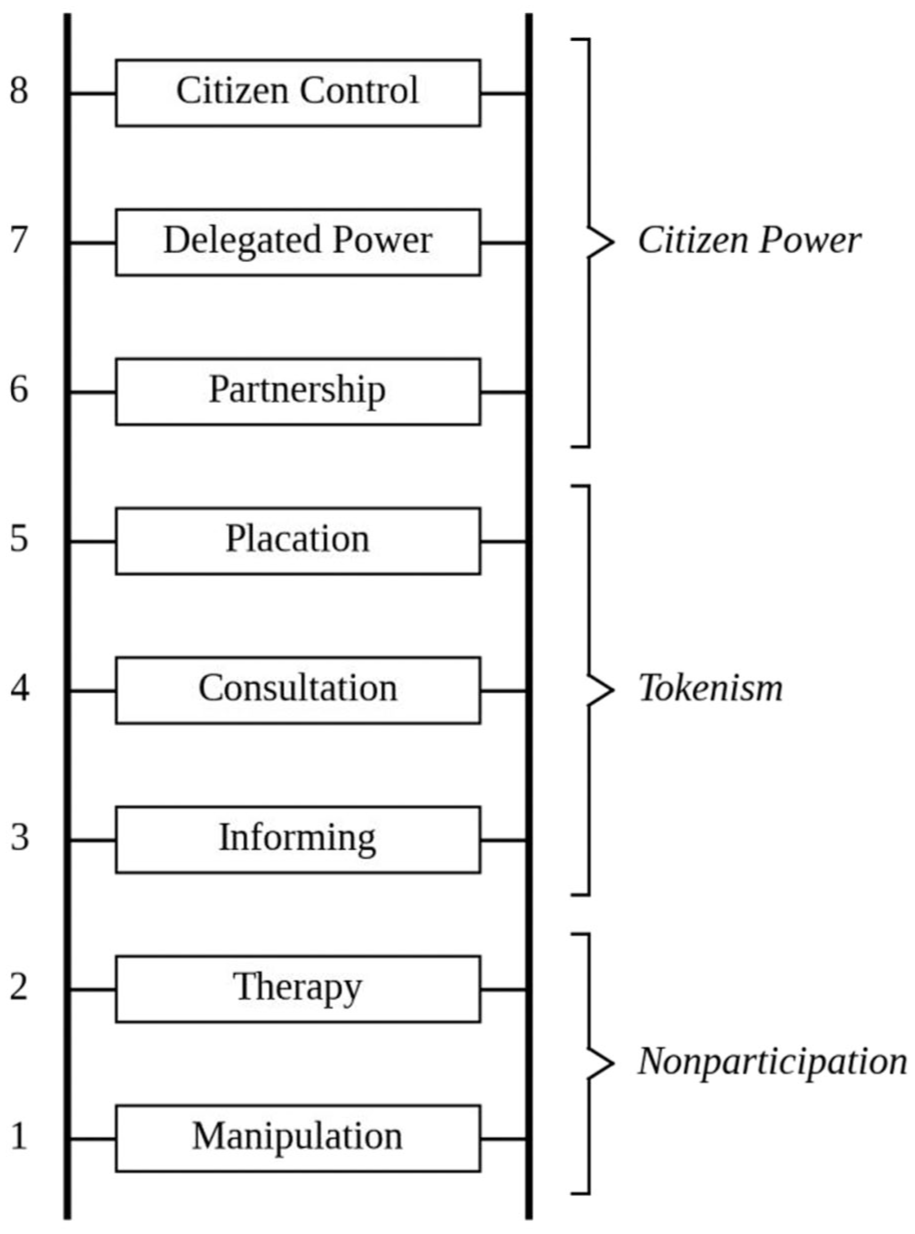
Arnstein’s ladder of citizen participation (Arnstein, 1969).
Placed on Arnstein’s ladder, many OS initiatives cluster on these tokenism rungs. Corporate wikis, global idea jams, and public crowdsourcing contests often sit between informing and placation. The initial examples confirm this diagnosis: IBM’s jam yielded only 10 projects selected by executives from tens of thousands of posts (Bjelland and Wood, 2008); on LEGO Ideas, achieving 10,000 crowd votes only qualified an idea for a final decision by an internal review panel (Dahlander et al., 2023); and Wikimedia’s board retained ultimate discretion over all edits (Dobusch et al., 2019). In each case, breadth is real, yet depth remains rationed.
While moving from non-participation to tokenism constitutes an advance on Arnstein’s ladder (and most OS practices can be read as such), this step is not without its own perils. Tokenism easily violates principles of procedural justice, as participants realize their solicited input has been ignored or filtered through an opaque black box (Bies and Shapiro, 1988). Participants who perceive this can grow frustrated and disengage, which can harden into cynicism and reduce willingness to engage in strategy-making in the future (Mantere and Vaara, 2008). This dynamic can create a feedback loop. As newly involved participants disengage, managers treat it as evidence that OS does not work and cede even less control. Critics then point to these superficial exercises as proof that openness is inefficient, fueling a push to recentralize strategy. Tokenism thus hints at a potential dark side of OS, where practices designed to foster inclusion risk eroding the organizational capacity for it over time.
Recognizing the tokenism trap that comes from prioritizing breadth over depth is a crucial step. OS has had considerable success in inviting more voices into the room. However, the next challenge is to ensure those voices genuinely count by embedding mechanisms of depth into its practices. To understand how to embed such depth, it is instructive to examine an institutional model where depth, not breadth, is the defining characteristic.
TWD: Depth of inclusion without breadth
In contrast to OS’s often voluntary, broad‑but‑shallow approach, TWD offers a narrow-but-deep model of inclusion in strategy-making. In this essay, we focus specifically on TWD as manifested in legally mandated practices of employee inclusion in corporate governance, such as codetermination laws and statutory-works councils prevalent in various forms in many continental European countries. These practices differ from OS in their underlying logic. TWD rights are grounded in laws or binding collective agreements and reflect normative arguments about industrial democracy and the balance of power between labor and capital, whereas OS initiatives are generally voluntary and driven by functional aims such as accessing knowledge, fostering innovation, or enhancing legitimacy (Jäger et al., 2022; Whittington et al., 2011). This contrast points to different institutional foundations: TWD is rooted in national legal traditions, while OS can be seen as an expression of globally diffused cultural scripts about what counts as a modern, legitimate organization (Goldenstein and Walgenbach, 2019). At the same time, the voluntary character of OS is not the only route to openness, since open practices may also arise from the bottom up and gradually “infiltrate” an organization’s strategy process (Stjerne et al., 2024). Underlying these differences is a tension between normative and epistemic logics of inclusion (Habermas, 1984): should actors be included because they hold a formal entitlement to speak, as in TWD, or because they can contribute substantively to strategic discourse, as OS typically assumes? While this tension cannot be easily resolved, we use it as a lens for examining how TWD institutionalizes depth in practice. Consider the German system, which operates on two levels:
While the German model is a prominent example, it is important to note that TWD practices manifest in various forms across Europe and are also found in other parts of the world, such as Japan and Korea, often involving more informal mechanisms (Kuruvilla and Erickson, 2002). Examples within Europe include the strong role of unions and cooperative bodies in Nordic countries or the rights embedded within the Comité Social et Économique (CSE) in France. Despite distinct national histories, these systems share a core principle: legally mandated employee inclusion. In these TWD systems, the inclusion of employee representatives in strategy-making is not reliant on managerial discretion or ad hoc initiatives. It is structurally hardwired into the organization’s governance through law. Employee representatives wield formal power derived from statute, enabling them to influence, negotiate, and sometimes veto management decisions within their legally defined remit (Gorton and Schmid, 2004). This institutionalized power means that employee perspectives are formally considered and often shape strategic and operational outcomes, moving this form of inclusion decisively toward the upper rungs of Arnstein’s ladder (Partnership, Delegated Power). The existence of formal rights, however, does not always guarantee substantive influence in practice. Implementation varies, and rights can sometimes be enacted ceremoniously or navigated strategically by management (Strauss, 2006). Nonetheless, the legal foundation provides a basis for a depth of inclusion far exceeding typical OS consultations.
This depth, however, comes at the cost of breadth. TWD mechanisms, as defined here, primarily empower one specific stakeholder group: employees, typically acting through elected representatives or union officials. They generally do not extend inclusion rights to other stakeholders like customers, suppliers, or community groups. Even within the employee category, direct influence is concentrated in the hands of representatives, not exercised by the entire workforce directly. Compared to the potentially vast and diverse audiences targeted by OS (e.g. global jams, public crowdsourcing), TWD is considerably narrower in scope. Its focus is predominantly internal. Moreover, the representatives themselves may not mirror the diversity of the workforce, with studies indicating that these positions are often held by long-serving, male employees from the ethnic majority (Budde et al., 2024; Korkmaz, 2021).
What are the consequences of this depth without breadth? On the positive side, TWD effectively minimizes the danger of tokenism for the included group of employees. Their representatives possess real leverage, potentially leading to more balanced decisions that consider workforce stability and well-being alongside financial goals. Some research suggests TWD can foster trust and information-sharing, potentially contributing to stability, particularly in coordinated market economies (Freeman and Lazear, 1995; Jäger et al., 2022). However, the limited breadth inherent in TWD creates potential challenges. One significant risk is parochialism. With strategic deliberations strongly influenced by employee interests, decisions might become overly focused on internal concerns like job security and wages, potentially at the expense of responsiveness to external market shifts, customer needs, environmental concerns, or disruptive innovation (Gorton and Schmid, 2004). Empowered employee representatives may understandably resist changes perceived as threatening their core interests, potentially leading to strategic conservatism or inertia (Grund et al., 2024). Furthermore, the formalized power structures of TWD can give rise to entrenched bargaining dynamics (Strauss, 2006). The strategic process can resemble a negotiation between distinct camps, such as management and labor representatives, each defending established positions. While representing significant depth of inclusion for employees, this can sometimes lead to adversarial relationships, political maneuvering, or compromises that prioritize internal peace over strategic boldness or agility (Strauss, 2006). Decision-making processes can become slower and more formalized as agreements require negotiation and consensus between parties with potentially conflicting interests.
Acknowledging these potential downsides is crucial; TWD is not presented as an unqualified ideal. Its value lies in demonstrating how depth can be institutionalized through formal rights and representation, offering concrete examples from which OS can draw lessons. The inherent trade-offs, which involve solving tokenism for employees but risking parochialism and rigidity, underscore the tension between breadth and depth. Just as OS could benefit from TWD’s mechanisms for depth, TWD practices might theoretically benefit from incorporating broader perspectives characteristic of OS. The two models occupy distinct positions on the inclusion landscape, providing a valuable comparative basis for exploring pathways toward combining breadth and depth, which we illustrate in the following framework.
Configuring inclusion: A breadth‑depth lens on inclusion in strategy-making
Building on the distinction between breadth and depth, this section introduces a framework for mapping the resulting configurations of inclusion in strategy-making. Plotting the two dimensions against one another yields a two-by-two matrix (Figure 2) that reveals four archetypal patterns of practice: Exclusive, Consultative, Negotiated, and Co-Governed Strategizing. These quadrants are configurations rather than rigid ideal types, recognizing that practices often exist on a spectrum between these archetypes. We detail each configuration below, highlighting its advantages and the characteristic trap that can undermine it.
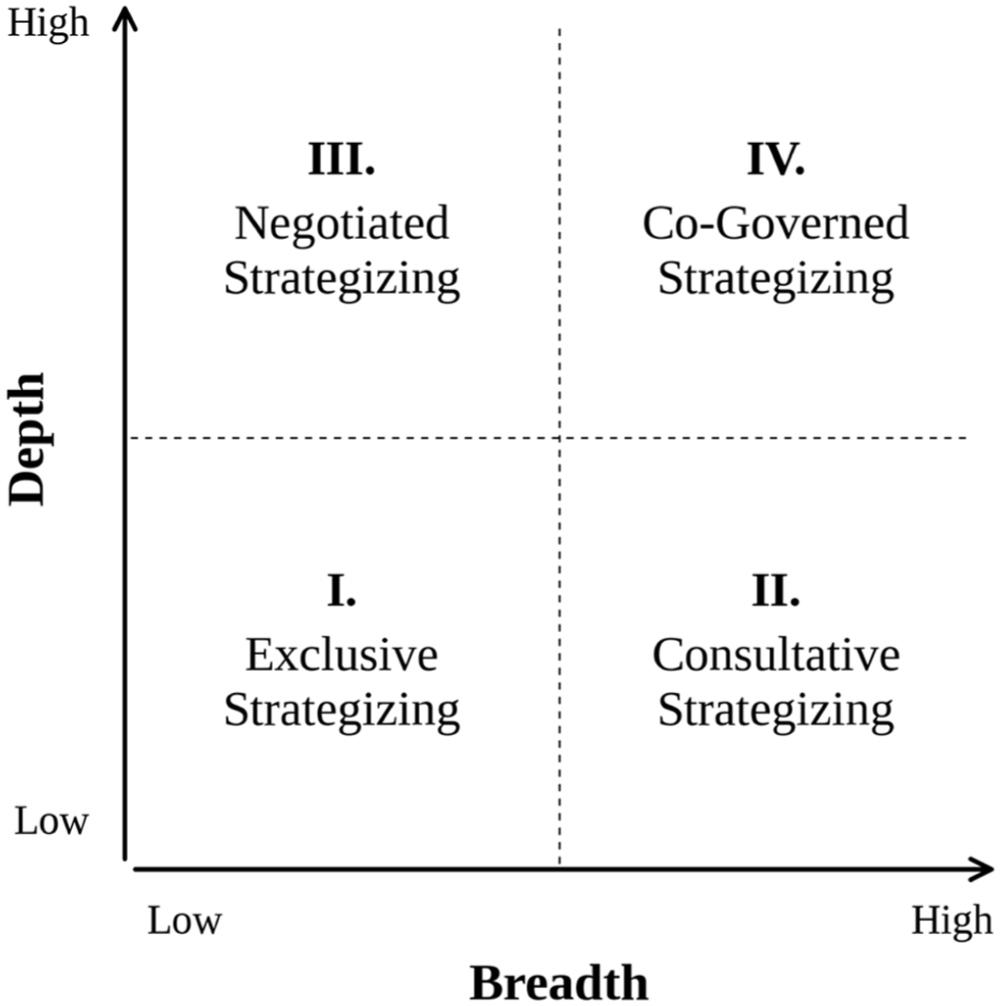
The breadth-depth matrix of inclusion in strategy-making.
Situated in the lower-left quadrant, Exclusive Strategizing (low breadth, low depth) takes place in camera, typically within an inner circle of senior executives and trusted advisers. Such exclusivity can expedite decision-making and protect sensitive information, making it potentially effective in stable environments or when speed and confidentiality are paramount, such as during crises or hostile takeover bids (Staw et al., 1981). Yet it risks the Blind Spot Trap: strategic myopia arising from limited information inputs and legitimacy challenges in contexts that prize stakeholder engagement and transparency (Hautz et al., 2017; Stadler et al., 2021).
The lower-right quadrant captures Consultative Strategizing (high breadth, low depth), the configuration in which most contemporary OS initiatives reside. Organizations involve a wide array of actors through jams, wikis, or crowdsourcing platforms, yet the influence these actors wield remains minimal. Decision-making authority is retained centrally, and involved actors’ input is treated as advisory, to be selectively adopted or used mainly for legitimation (Gegenhuber and Dobusch, 2017). This setting gives rise to the Tokenism Trap: The initial enthusiasm gives way to consultation fatigue when contributors realize that having a voice does not translate into having a say. While risking tokenism, this configuration holds strategic value as a tool for environmental sensing (Poetz and Schreier, 2012) and legitimation (Gegenhuber and Dobusch, 2017), allowing organizations to explore a wide range of possibilities and signal responsiveness while retaining ultimate strategic control.
The upper-left quadrant characterizes Negotiated Strategizing (low breadth, high depth), a pattern long institutionalized in TWD (Addison et al., 2004). Here, elected employee representatives possess formal information, consultation, or veto rights, anchoring deliberation in structured negotiation between labor and management. While this arrangement eradicates tokenism for the included group, it risks the Parochialism Trap: strategic choices may become overly focused on insider concerns, leading to conservatism, inertia, and neglect of wider market or societal perspectives (Faleye et al., 2006). Classic examples include union environments where strategic change requires lengthy bargaining, or the German codetermination system that balances capital and labor interests.
The upper-right quadrant houses Co-Governed Strategizing (high breadth, high depth), an aspirational configuration in which diverse stakeholders, both internal and external, hold genuine influence over strategic content and process. Such co-governance relies on voting, consensus protocols, or delegated authority to representative bodies. Although rare in conventional corporations, this structure appears in cooperatives (e.g. Mondragon), stakeholder partnerships (e.g. the historical John Lewis Partnership), certain nonprofits, and citizens’ assemblies with binding recommendations (Fung, 2006; Smith, 2009). The potential benefits include high legitimacy, deep commitment, access to heterogeneous knowledge, and alignment with stakeholder values. Yet the configuration faces the Complexity Trap: coordinating many empowered voices, managing conflict, ensuring accountability, and preserving agility can prove exceptionally demanding (Ansell and Gash, 2008), especially when stakeholders are not merely diverse but also ideologically driven and potentially opposed (Barron and Coulombel, 2024). Co-Governed Strategizing is therefore neither universally desirable nor feasible for all organizations or all types of strategic decisions. This configuration becomes most valuable in highly dynamic settings or for addressing “grand challenges” where co-creation with a broad set of empowered stakeholders is essential for generating legitimate and sustainable solutions (Ferraro et al., 2015; George et al., 2016), while contexts requiring speed, confidentiality, or tight fiduciary control may warrant more centralized approaches.
Organizations can move within the matrix over time, progressing or regressing. Indeed, organizations need not occupy a single quadrant at any given time; they may apply different configurations to different types of strategic decisions or contexts. The rise of TWD, driven by labor movements throughout the 19th and 20th centuries, largely represents a historical shift from Exclusive Strategizing (I) toward Negotiated Strategizing (III), institutionalizing deep but narrow employee influence. In contrast, the more recent OS movement embodies a move from Quadrant I toward Consultative Strategizing (II), prioritizing broad involvement without commensurate depth. While these represent common trajectories, diagonal leapfrog movements directly from I to Co-Governed Strategizing (IV), which would simultaneously achieve high breadth and depth, are conceivable but remain rare in practice. Such paths might be seen in organizations intentionally adopting principles of radical decentralization and self-management, like certain holacratic implementations (Lee and Edmondson, 2017; Puranam et al., 2014), where broad autonomy and deep influence were designed in from early stages. Importantly, these pathways are not unidirectional; regression (such as returning to I from II) is always possible (Appleyard and Chesbrough, 2017). Such shifts can be triggered by failed initiatives, changing organizational priorities, or broader political and societal shifts, as arguably observed in the context of the recent pushback against DEI programs.
Avoiding the tokenism trap: Grafting depth onto OS practice
The analysis thus far suggests that OS, frequently situated in the Consultative Strategizing quadrant (II), risks falling into the Tokenism Trap due to insufficient depth. To deepen inclusion and, where appropriate, move toward practices of Co-Governed Strategizing (IV), OS can benefit significantly by drawing on the principles of TWD. Specifically, we argue that OS initiatives should couple their characteristic breadth with mechanisms that graft depth. We outline five such mechanisms, which fall into two broad categories: (1) redesigning the formal structures of inclusion and (2) improving the procedural management of inclusion.
First, formalize roles and structures for inclusion. Instead of relying solely on ad hoc goodwill or unstructured forums, OS initiatives can gain depth by establishing defined roles, joint committees, or councils with clear mandates within the strategy process (Addison et al., 2004; Müller-Jentsch, 2008). For instance, an organization could create a strategy advisory council composed of representatives from various stakeholder groups with specified consultation rights, obliging management to formally respond to recommendations. This mirrors the logic of works councils and embeds inclusion structurally, not as a one‑off event. Such formalization signals seriousness, clarifies responsibilities, channels input systematically, and creates accountability, thereby increasing the likelihood of deeper forms of inclusion while moving toward Arnstein’s partnership rung.
Second, delegate decision rights in bounded domains. A powerful way to inject depth is to transfer actual decision-making authority for specific, clearly demarcated strategic areas to groups with delegated authority, moving toward Arnstein’s “Delegated Power” rung. TWD demonstrates that even partial power-sharing can be transformative (Mohrenweiser, 2022; Müller-Jentsch, 1995). In an OS context, an organization might empower an employee task force to design the internal culture component of a strategy, with budget and implementation authority, while management focuses elsewhere. Another approach involves using participatory budgeting techniques for strategy, allocating a portion of strategic investment funds for employees or stakeholders to vote on which initiatives to pursue. This grants involved actors tangible control over resource allocation, directly countering tokenism by giving inclusion real muscle (see Burgelman, 1994, on Intel’s bottom‑up resource reallocation and strategic reorientation from memory chips to CPUs).
Third, enhance transparency with reciprocal accountability. While OS champions outward transparency (Hautz et al., 2017; Whittington et al., 2011), deepening inclusion requires coupling this with accountability for how inputs are handled. This means not only sharing information openly (Heimstädt and Dobusch, 2018) but also transparently accounting for how contributions from involved actors are handled. A practical mechanism, inspired by TWD’s structured communication and Arnstein’s (1969) higher rungs, is a “responsive dialogue,” a formal management response that maps input to decisions. After an OS initiative like crowdsourcing (Malhotra et al., 2017), the strategy team should publish a summary report explaining which themes were heard and how they are (or are not) reflected in the final strategy, with justifications. This opens the black box, fosters procedural justice (Kim and Mauborgne, 2003), and makes power dynamics explicit and contestable (Hardy and Phillips, 2004), mitigating feelings of tokenism even when suggestions are not adopted. In essence, it moves beyond simple disclosure toward a “push and pull” dynamic, where stakeholders have structured channels to both provide and receive strategic information (Ohlson and Yakis-Douglas, 2019).
Fourth, explicitly manage trade-offs and boundaries. To avoid tokenism arising from mismatched expectations, and to acknowledge that OS faces inherent dilemmas (Hautz et al., 2017), organizations aiming for deeper inclusion must communicate the scope, limits, and trade-offs involved. Rather than pretending inclusion is limitless, leaders should specify which strategic areas are opened up for co-creation and which remain executive prerogative (e.g. due to confidentiality or fiduciary duties), and why. For example, a tech company might state upfront that while employee input is sought on product strategy, decisions on potential mergers will be handled differently due to legal constraints. Such honesty about boundaries preserves credibility (Dirks and Ferrin, 2001) and allows organizations to deepen inclusion progressively within defined spaces, managing the evolving scope of inclusion (Appleyard and Chesbrough, 2017).
Fifth, experiment with hybrid models and co-governance. No single blueprint exists for deep and broad inclusion; context matters (Seidl et al., 2019). Therefore, organizations should actively experiment with novel practices that blend breadth with depth, drawing inspiration from TWD and political science. This could involve piloting a “strategy jury” modeled on citizens’ juries (Fung, 2006; Smith, 2009), where a representative group deliberates and makes binding or heavily weighted recommendations. Another approach is to formally incorporate diverse stakeholder representatives (e.g. elected employees, customer advocates) into core strategy teams with meaningful voting rights (Ansell and Gash, 2008; Gold and Waddington, 2019; Jäger et al., 2021). Such hybrid models, if well-executed, can push OS toward greater depth by creating contained spaces for genuine power-sharing and learning.
By integrating these mechanisms, OS can evolve along its depth dimension. It can retain its advantages in harnessing broad intelligence (Von Krogh and Geilinger, 2019) and fostering buy-in (Lines, 2004) while gaining the legitimacy that comes from enhanced depth of inclusion (Mantere and Vaara, 2008). Empowering involved actors signals trust and respect (Dirks and Ferrin, 2001), potentially driving higher engagement and creating strategies that are more robust and also command stronger commitment from those tasked with their execution.
Conclusion: Toward durable openness through deeper inclusion
OS emerged with the compelling promise to transform strategy-making through greater transparency and inclusion. Yet, as this essay has argued, the prevalent focus on breadth, which involves engaging many voices, has often overshadowed the critical dimension of depth, which ensures those voices wield genuine influence (Seidl et al., 2019). This imbalance fuels the risk of tokenism, where a semblance of participation, uncoupled from a meaningful transfer of influence, breeds cynicism and undermines the very goals OS seeks to achieve (Hautz et al., 2017; Mantere and Vaara, 2008).
The juxtaposition of OS’s characteristically broad yet shallow practices against the narrow yet deep practices of TWD serves to delineate concrete pathways for rectifying this depth deficit. While TWD has its own limitations, its mechanisms for institutionalizing depth offer valuable lessons. Our two-by-two matrix (Figure 2), mapping inclusion along breadth and depth, provides a diagnostic tool to understand different configurations, from Exclusive Strategizing and Consultative Strategizing to Negotiated Strategizing and the aspirational state of Co-Governed Strategizing.
The core contribution of this essay is threefold, aimed at advancing the OS debate beyond celebrating participation toward ensuring meaningful inclusion. First, we problematized the conflation of participation with inclusion, diagnosing tokenism as a key pathology arising from the neglect of depth (Mack and Szulanski, 2017). Second, to resolve this ambiguity, we offer a refined conceptualization of inclusion through the orthogonal dimensions of breadth and depth (Hautz et al., 2019; Seidl et al., 2019). Third, we proposed practical mechanisms inspired by TWD principles to help practitioners and scholars graft depth onto OS initiatives, strengthening them and facilitating movement toward forms of Co-Governed Strategizing (Quadrant IV). These mechanisms include formalizing roles, delegating bounded rights, ensuring reciprocal accountability, managing boundaries, and experimenting with hybrids.
Addressing the depth dimension is vital for both the effectiveness and durability of OS. Unlike legally anchored TWD systems, which have shown remarkable persistence, the voluntary nature of OS initiatives renders them particularly susceptible to managerial retrenchment, shifting political headwinds, or consultation fatigue. If OS practices remain confined to Consultative Strategizing, where the peril of tokenism and the erosion of engagement are most acute, they risk being dismissed as a short‑lived fad, particularly amid shifting political or organizational climates. For OS to last, it must move beyond symbolic gestures and demonstrate substantive impact through genuine inclusion. The mechanisms outlined offer ways to build this resilience.
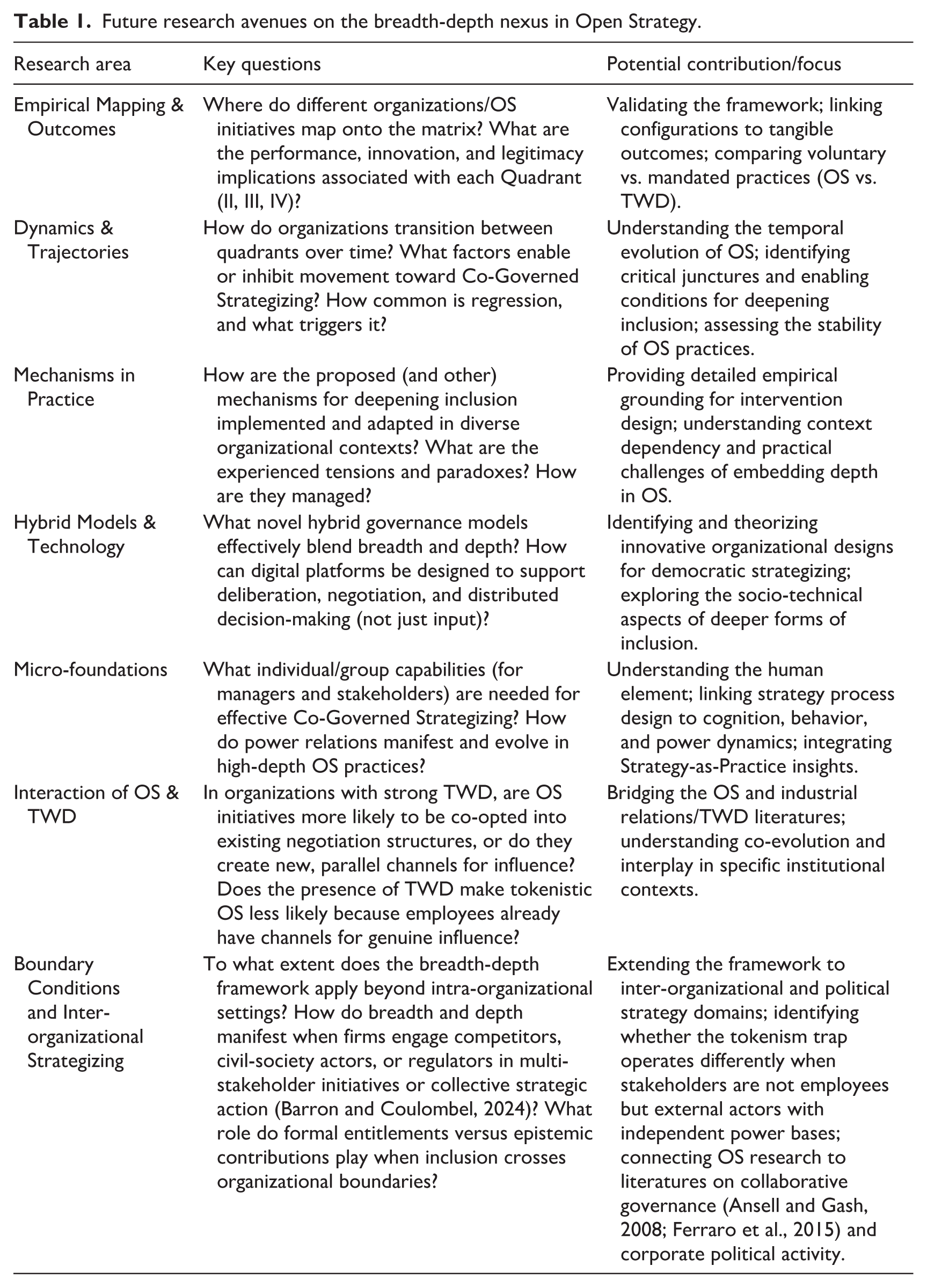
This analysis points to a rich agenda for future research, exploring the complexities of combining breadth and depth in strategy-making. Key avenues are summarized in Table 1.
Future research avenues on the breadth-depth nexus in Open Strategy.
In essence, this essay calls for a critical evolution within the OS field. The initial focus on expanding inclusion breadth was a necessary first step, but fulfilling the promises of OS requires tackling the challenge of inclusion depth. Moving beyond Consultative Strategizing necessitates conscious design choices, informed by lessons from enduring practices, aimed at embedding real influence for involved actors. It demands that scholars and practitioners shift the focus from simply counting voices to ensuring voices genuinely count. This endeavor is key to making OS not just an appealing concept, but a resilient and truly impactful paradigm for contemporary and future strategy-making.
Footnotes
Acknowledgements
We thank our colleagues David Seidl (University of Zürich), Maximilian Heimstädt (Helmut Schmidt University), and Laura Dobusch (WU Wien), as well as the participants of the EGOS 2024 sub-theme “Diversity and Inclusion in Strategizing: Integrating TMT and Participation Research” for their valuable comments on earlier versions of this manuscript.

Funding
The authors disclosed receipt of the following financial support for the research, authorship, and/or publication of this article: This work was supported by the Hans Böckler Foundation (Hans-Böckler-Stiftung) [grant number P-2025-599-2].
Declaration of conflicting interests
The authors declared no potential conflicts of interest with respect to the research, authorship, and/or publication of this article.