







Abstract
Research in the early years places increasing importance on participatory methods to engage children. The playback of video-recording to stimulate conversation is a research method that enables children’s accounts to be heard and attends to a participatory view. During video-stimulated sessions, participants watch an extract of video-recording of a specific event in which they were involved, and then account for their participation in that event. Using an interactional perspective, this article draws distinctions between video-stimulated accounts and a similar research method, popular in education, that of video-stimulated recall. Reporting upon a study of young children’s interactions in a playground, video-stimulated accounts are explicated to show how the participants worked toward the construction of events in the video-stimulated session. This article discusses how the children account for complex matters within their social worlds, and manage the accounting of others in the video-stimulated session. When viewed from an interactional perspective and used alongside fine grained analytic approaches, video-stimulated accounts are an effective method to provide the standpoint of the children involved and further the competent child paradigm.
Keywords
Research in the early years places increasing importance upon a child’s say in matters regarding their own life. Children’s accounts of their own lives and a child’s standpoint (Mayall, 2002) are matters to which more research projects are attending. Playing extracts of video-recording of interactions to the participants is a research method that enables the elicitation of children’s accounts. During a video-stimulated session, participants watch a video-recording of a specific event in which they were involved, and then account for their participation in that event. Using an interactional perspective, this article draws distinctions between video-stimulated accounts (Pomerantz, 2005), and a similar research method, popular in education, that of video-stimulated recall. Current approaches to research in the early years are outlined, in the interest of showing how video-stimulated accounts attend to a participatory view. Extracts from a video-recording of children’s playground interaction, and the video-stimulated accounting session that followed, are then explicated. In so doing, this article shows how video-stimulated accounts, when combined with fine-grained analysis of original video data, can highlight the complex nature of interactional matters that arise as young children account for their actions in front of peers.
Eliciting video-stimulated accounts is similar to a popular research method used in studying sports coaching, teacher training and second language learning commonly known as video-stimulated recall (Allison, 1987, 1990; Calderhead, 1981; Dunkin et al., 1998; Gass, 2001; Gass and Mackey, 2000; Keyes, 2000; Stough, 2001). The similarities arise as both approaches involve the playing back of an extract of video-recording to the participants who were involved in the video-recording. However, when a video-stimulated session is used in conjunction with a talk-in-interaction perspective (Sacks, 1992), three methodological differences can be drawn. These methodological differences make a clear distinction between video-stimulated accounts and video-stimulated recall. These differences involve the emphasis on recall in video-stimulated recall, how the context in which the accounts are produced is regarded, and the treatment of the accounts that result from participants viewing video-recorded extracts.
First, where video-stimulated accounts attend to interactional matters as accounts are produced, video-stimulated recall emphasizes the participants’ recall of events. Typically, it is an approach used by researchers to discover specifically what participants were considering or thinking about at the particular time of the incident or to test their recall of an event. In other words, of interest is how their recall matched or correlated with the events on the video-recorded extract. For example, two Australian studies by Clarke (2003) and Pirie (1996) explored what primary school children had learnt in mathematics lessons. Using video-stimulated recall, Pirie’s (1996) study described how video-recordings of the classroom were watched by the children, and stopped by the researcher to ask the participants what they were thinking at that particular moment. In Clarke’s (2003) study, the students were asked to comment on events of personal importance. Clarke (2003) asserts that the video-recordings provide specific and immediate stimulus that lead to effective recall by the participants of their feelings and thoughts at the time of the video-recorded event. It is the emphasis on recall in video-stimulated recall which generates a number of reservations from researchers.
The emphasis on recall in video-stimulated recall raises questions about validity. There is a concern that participants, particularly young children, could be influenced by the researcher with the resulting accounts a distortion or a misrepresentation of participant views. Pirie (1996) suggests children might provide, what they perceive to be, the ‘right’ answer, rather than what is a true version of events. Typically, young children are thought as not being reliable informants on their own lives (Farrell et al., 2004). This is due to a common belief from a developmental view that children lack skills needed to communicate, understand and respond clearly to questioning by adults (Scott, 2000).
Scepticism about the validity of the recall of video-stimulated recall is compounded by the amount of time that lapses between the video-recorded interaction taking place and the time of the interview. Lyle (2003) suggests the time delay and prompts from the researcher influence children’s thinking, and ability to accurately remember. In other words, a reconstructed version of their thoughts may be created rather than an accurate record of their thoughts during the recorded moment (Lyle, 2003).
Video-stimulated accounts, however, do not aim to assess recall. The interactional focus on video-stimulated accounts means the accounts produced are regarded as complex interactional resources that participants draw upon to manage their interactions with others as the video-recording is viewed. Video-stimulated accounts are considered as ‘practical phenomena rather than as theorists’ devices’ (Hester, 2000: 198). In other words, accounts are co-constructed by the participants within a particular situation of interaction (Hester, 2000).
Discussion of the context in which the video-stimulated accounts were produced needs to be taken into consideration (Pomerantz, 2005) and is the second methodological point and difference between video-stimulated accounts and recall. A video-stimulated session is in the context of an informal interview. However, this context is viewed as an interactional event itself, as the video-stimulated accounts are co-constructed by the participants: the researcher and the children. From an interactional perspective, the session is influenced both by the questions asked and the responses of all those participating. Baker (1997, 2004) outlines three points in the use of interview to which this article aligns: first, an interview is a joint, interactional accomplishment of the participants. The interviewer and interviewee use their local understandings and draw upon what they may consider to be expected codes of behaviour in the interview. Second, the interview becomes a way to understand how participants frame, for the other participants, what can be spoken about, and how these issues are discussed. Third, the interview is seen primarily as a collection of accounts of participants interacting with each other. In other words, in a video-stimulated accounting session, responses are treated as accounts specific to that interactional context and not as reports of the participants’ thoughts and motives that may or may not have been occurring at the time that the observed video-recording took place.
The third methodological difference between the two approaches lies in the treatment of the comments produced in the video-stimulated session. Where video-stimulated recall treats the statements as a true record of the participants’ experience, emphasizing the recall and ‘truth’ facets of the accounts, video-stimulated accounting regards the statements as interactional accounts. The interactional focus of the video-stimulated accounts means the talk is regarded as a resource that participants draw upon to manage their interactions with others. Using an interactional viewpoint, a video-stimulated accounting session is understood as an event occurring within a specific moment in time and therefore is not considered a constant construct. According to Pomerantz (2005), video-stimulated accounts enable researchers to identify what participants orient to as they view their interactions with each other. In her study that collected video-recordings of medical interactions as well as audio-recorded video-stimulated comments, the research team found the comments enabled them to focus on events in the interaction that otherwise would have been overlooked (Pomerantz, 2005). In so doing, video-stimulated accounts can ‘gain access to the thoughts, feelings, concerns, interpretations, reactions etc.’ that are found to be of interest to the participants as they replay the event (Pomerantz, 2005: 96). Researchers then have a place of interactional interest from which to start fine-grained analysis of video-recorded data (Pomerantz, 2005). In a similar way, Tobin’s study of preschool in three countries (Tobin et al., 1989), and his study of immigrant children in early childhood settings in five countries (Tobin, 2005), shows the replaying of video-recordings of children’s interactions as an effective catalyst for discussion in order to gain the perspectives of parents and teachers of preschool settings, rather than as stimulus for recall.
Video-stimulated accounting places the standpoint of children as a main contributor for adults to understand the construction of their social worlds. This consideration follows a shift in adult–child relations and takes into account the views and opinions of young children (Mayall, 2002). Increasingly in early years research, the importance of involving young children has been emphasized. A view of children as competent participants has come largely from theoretical perspectives of the ‘competent child’ and the sociology of childhood (Corsaro, 2005; Danby and Farrell, 2004; Hutchby and Moran-Ellis, 1998; Mayall, 2002; Prout and James, 1997; Waksler, 1991). Alongside these perspectives are the Child Rights movements, resulting from the signing of United Nations Convention on the Rights of the Child (UNCRC) (United Nations, 1989). These movements and views have influenced how children are positioned; responded to and viewed ensuring children’s rights and entitlements are considered in early years arenas today. Current approaches to research in the early years are now outlined, in the interest of showing how eliciting video-stimulated accounts attends to a participatory view.
Participatory approaches in research in the early years
Young children are given more opportunities to be active participants in research projects and such a focus acknowledges children as being ‘competent commentators on their own lives’ (Prout, 2002: 68). Creative methods promote authentic participatory research with children (Kellett, 2010). Children’s input in research has been provided for in a variety of ways including map making and drawings (Einardsdottir, 2007; Schiller and Einarsdottir, 2009); charts and stickers (O’Kane, 2000); photographs (Cook and Hess, 2007; Einardsdottir, 2005); and time lines (Christensen and James, 2000; Danby and Farrell, 2004). In these studies, the artefacts produced were not taken as complete depictions of children’s lives (Cook and Hess, 2007), but rather, were thought of as a way to build understanding through discussions with, and explanations by, the children. As O’Kane (2000) concludes, participatory research enables children to express those matters of interest to them. Researchers who work with children play a key role in advocating for and designing participatory approaches in their studies (O’Kane, 2000).
Careful consideration by researchers of children’s interests is needed during the interpretation of children’s input. Dockett et al. (2009) suggest those studies that offer opportunities for children to be actively involved in the interpretation phase of the analysis gain a more genuine understanding of children’s perspectives. By asking children to comment as they watch a video-recording of their interactions, video-stimulated accounting position children as experts in reporting on their lives. In so doing, children are able to take the lead in interpreting interactions that occurred in their everyday lives. For example, matters of interest during video-stimulated accounts give rise to more detailed investigation of original video-recorded interaction. In so doing, the children’s accounts and the complexity of matters of interest to them in their everyday lives can be further explored and understood.
A research method such as eliciting video-stimulated accounts acknowledges children as ‘competent informants’ (Farrell et al., 2004: 3), helps with the process of building knowledge in research (Kellett, 2010) as children are able to construct and account for what is taking place as they interact with others in their daily activities. Similarly, recent studies demonstrate children’s competence in reporting on their daily experiences and in the process of knowledge creation. For example, Thorpe et al.’s (2004) study of the views of Australian Preparatory year children, suggest that consulting with young children is critical because it uncovers matters that are important to children, but which may be disregarded by adults. MacNaughton et al. (2007) report on children’s involvement in policy formation. Their findings reinforce the growing message about children’s capabilities in expressing their views. These studies suggest that children operate with a high level of competence that involves skilful negotiations and shared local understandings. Similarly, video-stimulated accounts enable children to inform the interpretation of data.
In sum, eliciting video-stimulated accounts is a participatory research method that promotes a child’s standpoint and furthers the competent child paradigm. Using an interactional perspective in conjunction with fine-grained analytic approaches, video-stimulated accounts of young children’s playground interactions show how the participants competently worked toward the construction of events in the video-stimulated interview. Interactional details are now demonstrated through the explication of a video-recorded interaction and the following video-stimulated accounting session that occurred after children’s play activities in the school playground were captured in video-recording. In so doing, it is evident how complex interactional matters can be accounted for and discussed by young children in front of their peers.
The study
Data presented here were collected from a study that explored young children’s interactions in a school playground at an inner-city government school in south-east Queensland, Australia. Details about the participants and data collection process are now outlined.
Participants and data collection process
The research participants were Preparatory (Prep) year children, aged four to six years. Prep is a full-time, yet voluntary, program for children in the year before they attend compulsory schooling. The group consisted of 24 children, 18 boys and six girls.
The data collection process took place early in the school year. Data were collected in two phases, Phase A and Phase B. Phase A involved video-recording children’s day-to-day interactions within the Prep playground. Phase B involved inviting children to participate in a small group video-stimulated accounting session to view and comment on the video-recording. The video-recorded extracts were used as a catalyst for discussion in the session, and not used as a tool to test the recall of the children about the event. The children involved in the video-recording were asked to make comments on what was occurring in these extracts. On a separate occasion the teacher was asked to view extracts of the video-recordings and comment on the events recorded. These video-stimulated accounts were audio-recorded and are viewed in this article as rich interactional events in their own right.
The study recognized children as competent, social agents and encouraged them to have a participatory role on a number of levels (Danby and Farrell, 2004; James et al., 1998; Mayall, 2002; Prout and James, 1997). First, the children were asked to indicate their consent or non-consent to participate before the data collection took place (Danby and Farrell, 2004). Children did this by marking a happy or sad face after the study was explained to them by the researcher. Children’s ongoing consent was gained during the course of video-recording and interviewing, by asking for example, ‘Is it okay for me to watch you with my camera?’ and ‘Are you happy to talk with me about what you are doing in the video?’
Second, the study’s research design involving children accounting for their social interactions after viewing a video-recording of themselves, presented young children with an opportunity to be active in the analyses of their own social encounters. Very often, questioning young children is thought of as ‘less effectual given the age of the participants’ (Church, 2007: 4). The analysis presented in this article, shows that the accounts of children can be integral in giving a place for starting fine-grained analysis and close examination of the original video-recorded interaction.
Data analysis
The study is informed by sociological perspectives that acknowledge the study of the organization of social action (Garfinkel, 1967) – ethnomethodology and conversation analysis. Ethnomethodology asserts strength in the close examination of participants engaged in everyday talk and interaction. Conversation analysis is an analytic method that shows the fine-detail of participants’ actions and responses (Sacks, 1992). An ethnomethodological approach takes the everyday and uncovers the often unnoticed features in interactions to exemplify how members competently produce and manage their social interactions. These interactions are considered within the context in which it is carried out.
The next section first presents analysis of the extracts from the initial video-recorded interaction (Phase A). This analysis is informed by close examination of the children’s accounts from the video-stimulated accounting session (Phase B). Second, the children’s accounts of the video-stimulated session (Phase B) are explicated using conversation analysis to show how the participants work to construct and frame the video-stimulated accounts. For example, at particular points during the session, participants diverge from the actual events in the video-recording or drew attention to issues within the interaction and, in so doing, are successful in orienting the researcher to other matters.
Please note: in the following extracts, punctuation marks depict the characteristics of speech production, not the conventions of grammar. Please refer to the Appendix for notes on transcription. To protect identities, pseudonyms are used throughout this article in place of participant names.
Phase A: Video-recorded extracts of interaction in the playground
Setting the scene: A dispute over ‘whose idea’ – The ice-cream truck
It is the beginning of outdoor time, a time during which the Prep children go into the playground and choose from items and activities to create their own games. Items such as balls, hoops, material, cushions and buckets, are wheeled out on trolleys from the shed, by the designated daily outdoor helpers (two of the children). The children select items from these trolleys to use in their games. Meanwhile, the teacher stands back and observes from afar as the children make decisions about what they will use, who they will play with, where and how they will use the items. As they interact, the teacher moves around the groups of children observing and asking questions about their games. In this episode, Paddy and Becky are on top of the stairs that lead to the bottom part of the playground. They have chosen plastic cones (witches hats), a large tunnel and some tennis balls.
Paddy and Becky take the cones and place them in a line along the top of the stairs. As they take turns to lay out the cones, they appear to be working in unison. Paddy places the tennis balls on top of the cones. He announces these are ice-cream cones and he has made an ice-cream truck. Becky’s response is not audible. Gathering the other items, Becky tries to open the tunnel. Paddy helps her; however, they are unable to untie it. Becky takes the tunnel to the teacher for help.
While Becky is gone, Paddy continues with the idea of the ice cream cones, calling loudly, ‘Wh-want the ice-cream cone? They are ice-cream cones. Th-th these are ice-cream cones. Ice-cream cones, pick your ice-cream cones.’
On Becky’s return, Paddy repeats his idea to her. Paddy’s talk here ‘maps’ out to Becky the game he has established while she was gone (Sacks, 1992). In so doing, Paddy here lays claim to the game he has made.
Extract 1: ‘This is an ice-cream truck’
An
No it’s the school ((continue to drag tunnel with Paddy, down the stairs; Matt looks on)
It’s the school. (.) that’s the way down ((points down the stairs
This is (.) This is the ramp (.) put balls through there
By outlining the game, Paddy lays claim to ownership of the game. In so doing, the notion of the ‘next expectable event’ arises (Sacks, 1992: 497). It follows that the next expectable event would be that Becky becomes a player in that game.
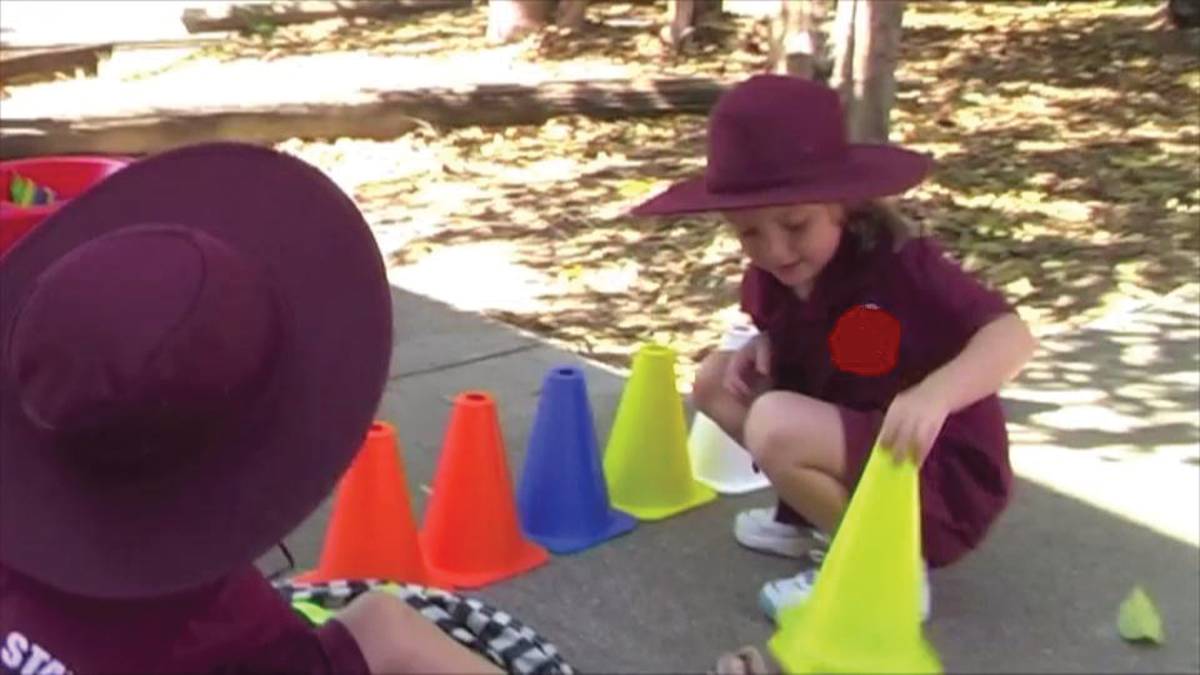
Setting up – Paddy (left) and Becky (right) place cones in a line
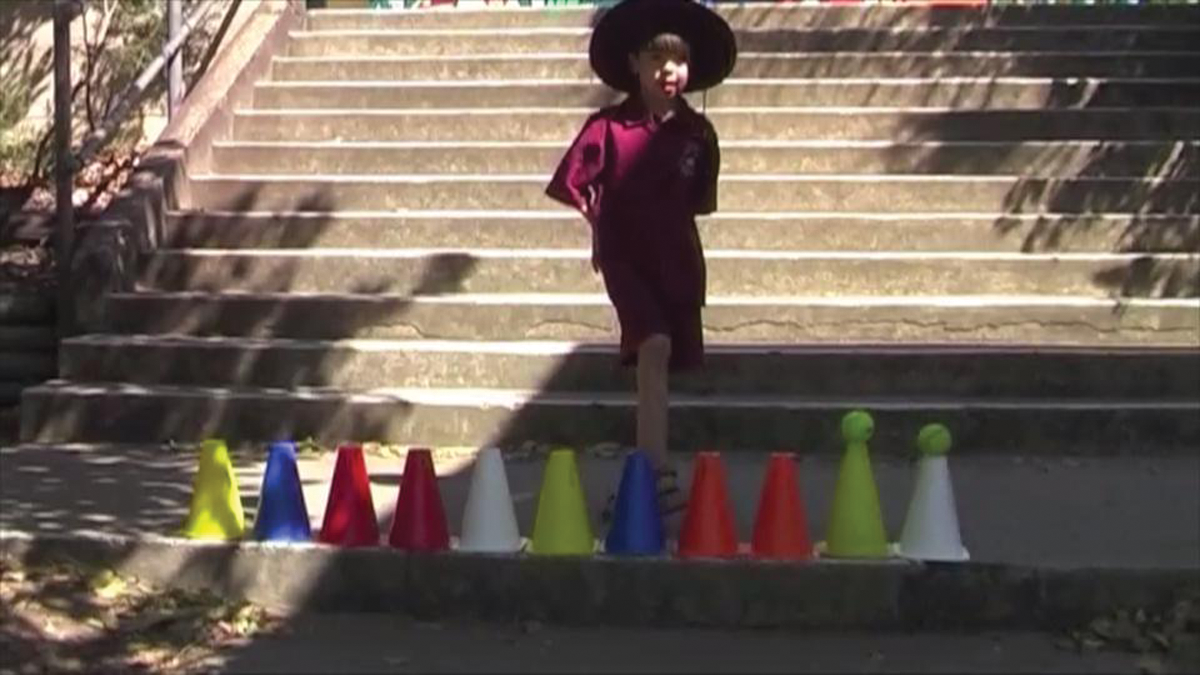
This is the ice-cream truck (Paddy calls out)
Becky takes up this claim of idea for the game and replies with a change in topic; ‘No it’s the school’. In Becky’s turns, she recycles her position and her idea for the game at hand, ‘It’s the school. That’s the way down, This is the ramp put balls through there’. This exchange becomes a dispute. The dispute is advanced as Becky’s change in idea for the game is met with opposition from Paddy.
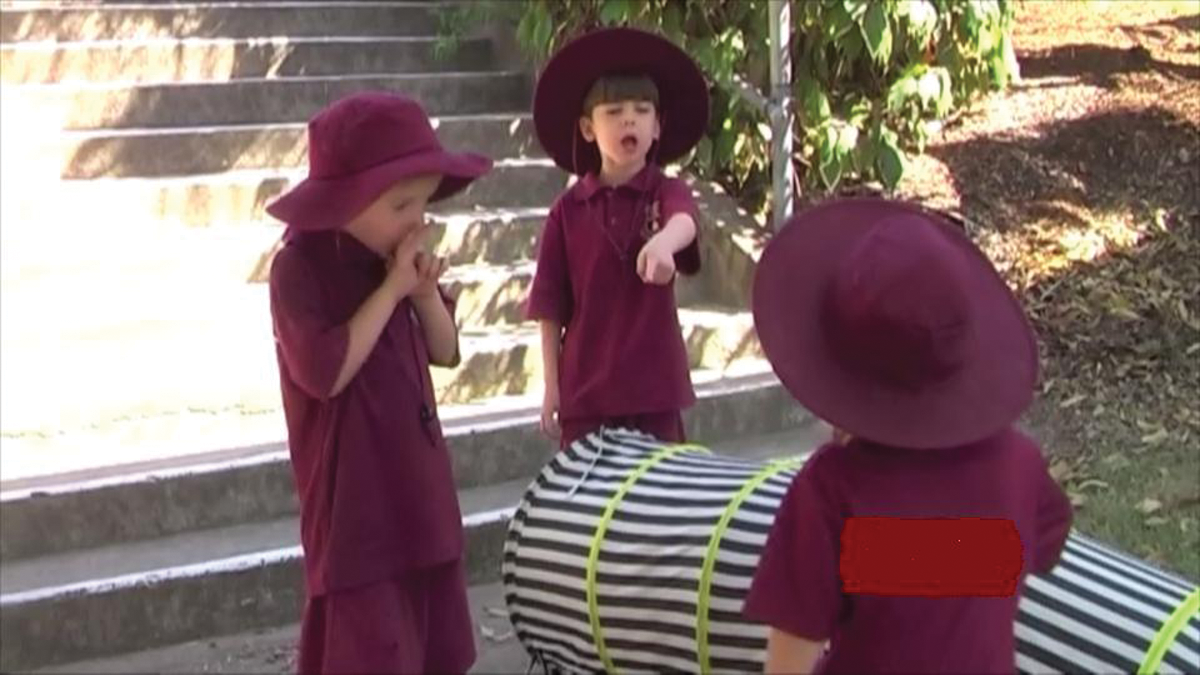
This is the ice-cream truck (Paddy points)
Extract 2: ‘But I made this up’
Yes
This is the ice-cream truck
No-no-but-no-no but [I] ((points to Becky))
[But] I made this up ((raises hands and places them apart))
Either
Paddy recycles his position on the idea for the game, repeating, ‘this is the ice-cream truck’. Becky’s disagrees with an elongated, ‘no’. Paddy continues to hold his position in the dispute replying simply ‘is’. Becky responds again, this time emphasizing the ‘no’.
Becky overlaps her next talk with Paddy, and uses his own words. Her following statement, ‘But I made this up’, is a bid for first ownership of the idea, providing justification for her position in the dispute. Paddy then takes up Becky’s line of arguing in the next turn and uses it to formulate his own argument and justification, ‘Either I put those balls on so I made those up’. His turn is framed in the same way as Becky. He refers to the balls which he set out in the opening set up sequence, and provides these as evidence for his ownership of the game. What follows is Becky’s continued line of argument in this dispute over topic and ownership of the game, ‘Yeah I made this whole thing up’.
Extract 3: ‘I made this whole thing up’
Yeah I made this
Becky’s claim to ownership has been upsized. Now, as well as the tunnel being her idea, Becky claims that the entire game is her idea.
Paddy makes a counter argument that is more extreme than Becky’s claim of ownership of the ‘whole thing’. He draws on ownership of the idea, ‘That’s my idea too so’. By explicitly claiming ownership of the idea, he makes claim to making the idea up, matching Becky’s assertion of making the whole thing up. At this point, Jack interrupts the dispute by asking for balls to use for his game.
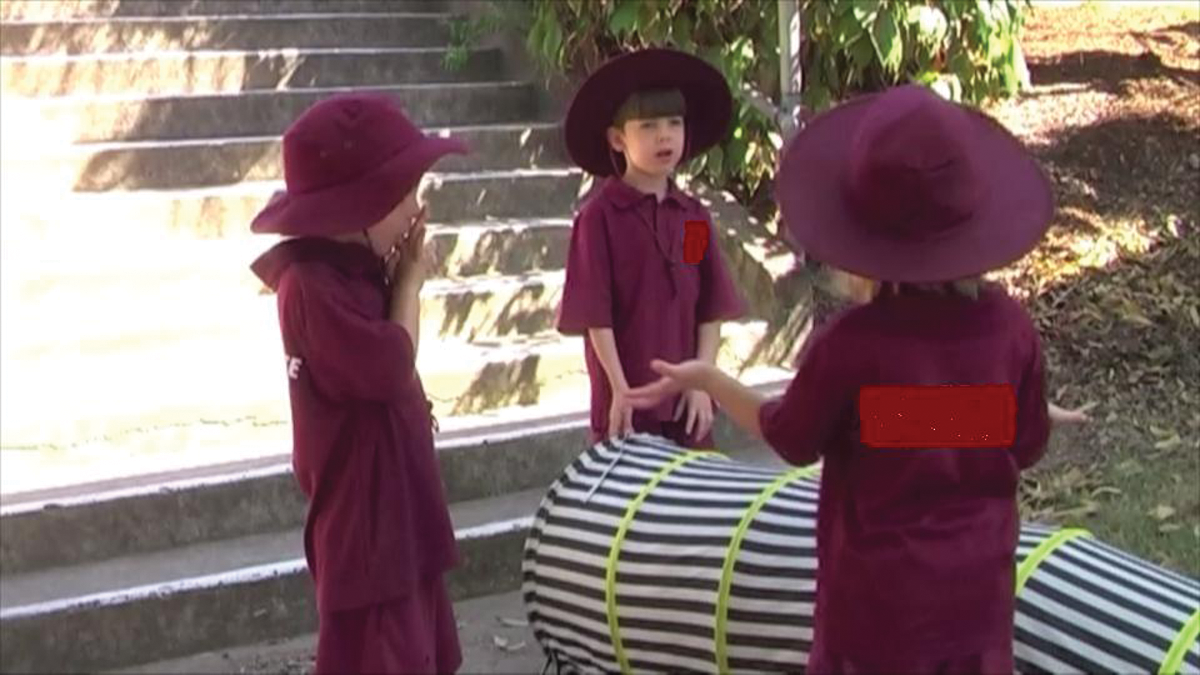
I made this whole thing up (Becky points to all items)
Extract 4: ‘Can I have a tennis ball?’
Can I have a tennis ball? ((Jack runs up stairs and comes over next to Becky; Becky takes balls))
Wh::y?
Oh
((shakes head))
How about we get two
But-but-but
If you made (.) mine ((Paddy hands Jack one ball))
It’s a bowling? thing.
Well this is my school ((Becky kicks tunnel away and moves away))
With the arrival of a new member, Paddy and Becky initially align with each other, and both resist giving Jack any balls. A moment ago Paddy and Becky were in dispute, and now, the arrival of a third party means the social order of the group is reorganized. Paddy says, ‘if you made mine’, which suggests that he has an idea for the game. Paddy’s next move, however, indicates a possibly different alignment now taking place. He takes this opportunity to change the topic or idea for the game, ‘It’s a bowling thing’. This change of topic from truck to bowling could be interpreted as mediating with the new member, Jack, to find a possibly agreed upon topic for the game. Becky then recycles her idea for the game, ‘well this is my school’. She sees her position weakened by this new alignment of Paddy and Jack as Paddy gives Jack a ball. She kicks at the tunnel and walks away in an apparent display of defeat.
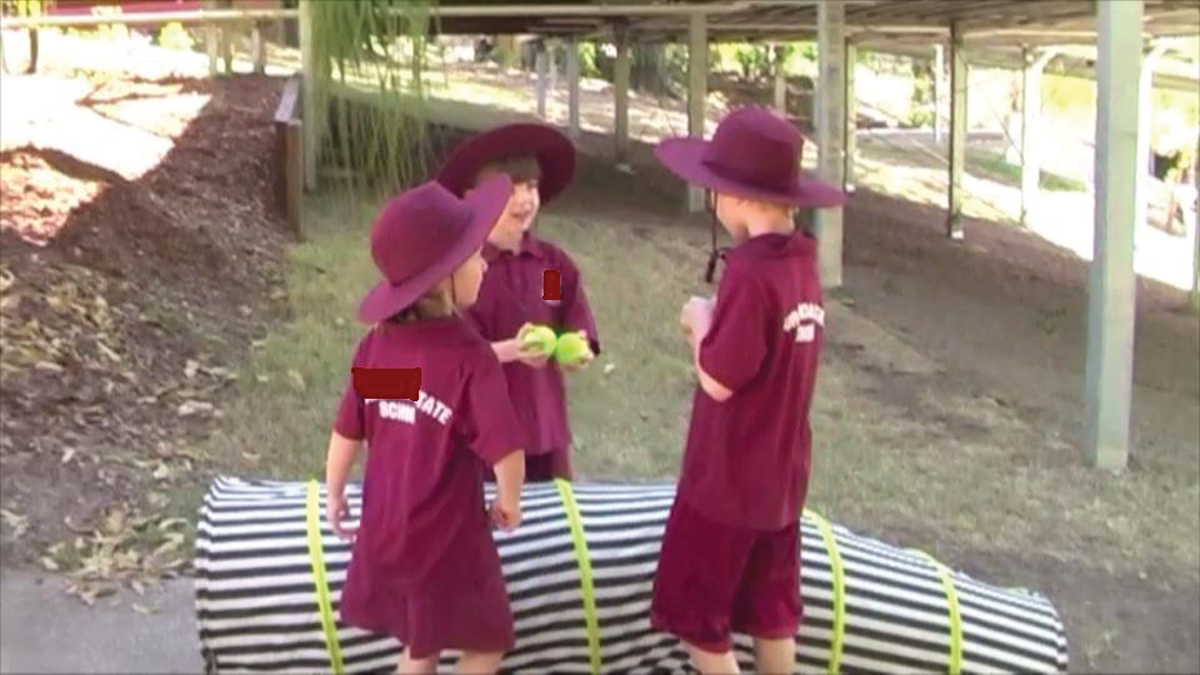
Can I have a tennis ball? (Jack approaches)
Extract 5: ‘How about we do this?’
No?
oh
and and=
=and it goes down
Ye?:::ah.
Yeah
I got an
What?
I’ll put these on the side so it won’t fall off?
Ye:ah ((Becky moves up next to tunnel and joins in))
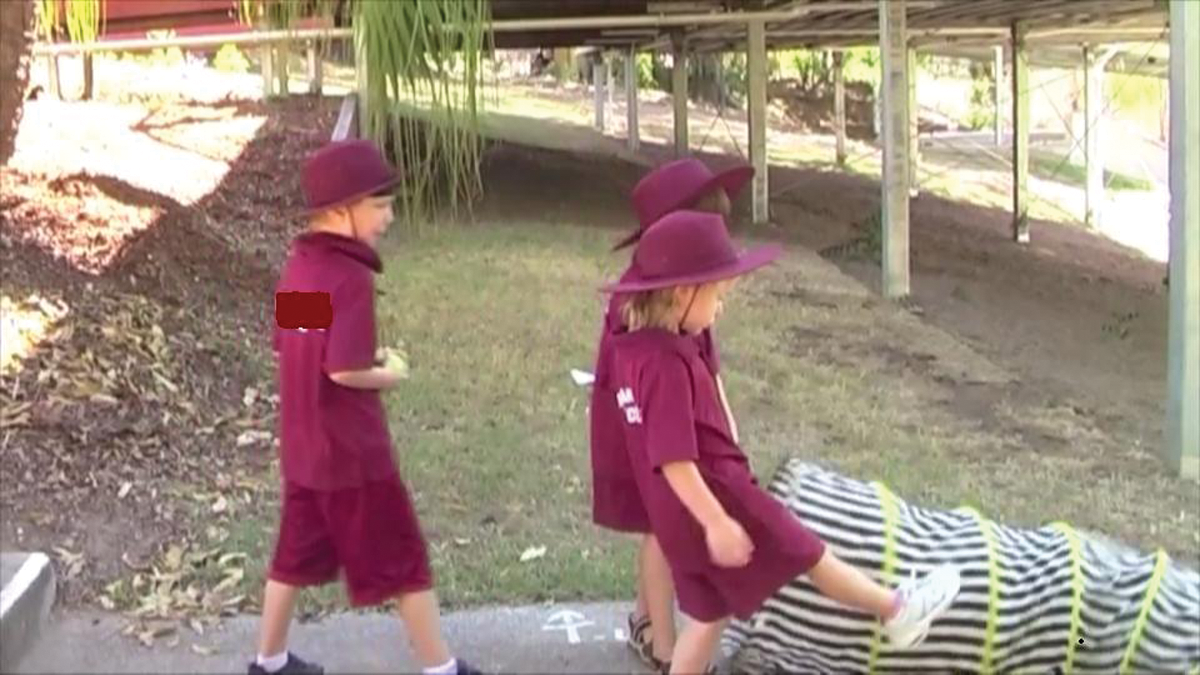
Becky kicks the tunnel
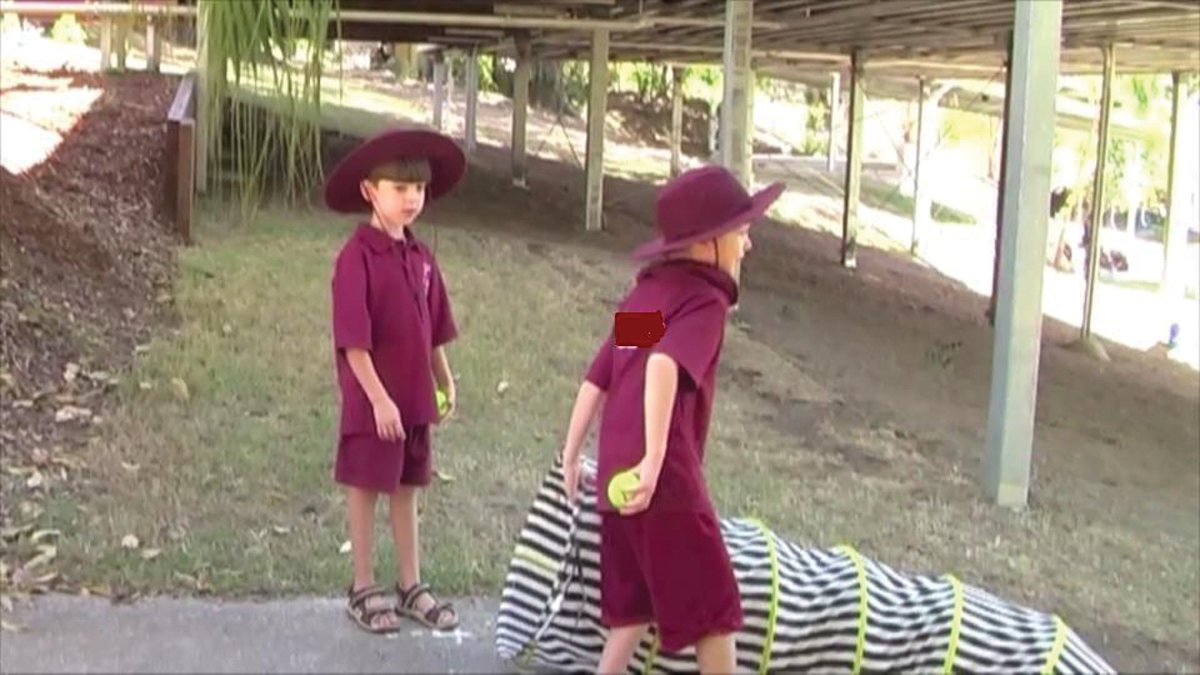
How about we do this? (Jack moves tunnel down stairs)
Jack takes this moment of weakening in the alignment of Paddy and Becky to put forward his idea. He gains the attention of Paddy and Becky by saying, ‘No how about-how about we do this’. At this point, Jack offers an alternate suggestion of what to play, ‘I’ve got a good idea what we could do with the rolling ball, it goes down there’. Jack has chosen a point in time when two parties are in dispute to change the topic and offer his own idea for a game.
Understanding what happened in the video-recorded extract provides a context for the next phase of data analysis when the three participants in the game, Paddy, Becky and Jack, watched the extracts from the video-recording and commented on it. The video-stimulated accounts of Phase B were used to inform the analysis presented here in Phase A.
Phase B: Accounting for sensitive issues in the video-stimulated session
In Phase B, the participants in the game, Paddy, Becky and Jack, watched an extract from the video-recorded episode of interaction. The purpose of this informal video-stimulated session was to gain the children’s accounts of the events of the video-recorded interaction. This section presents five accounts of the children as they watched the video-recorded extracts linked with the analysis in Phase A. Examination of these accounts show the children’s specific orientation to the topic of ideas for the game during the video-stimulated accounting session. As well, it is evident that ‘whose idea’ is used for the game, is the subject of contestation among the children. This contestation highlights the intricate negotiation and realignments within the children’s social interactions.
When the children’s accounts in Phase B and the actual events of Phase A are examined, discrepancies in reporting are apparent. Particular points in Phase B are found to include careful reporting on the video-recorded events in Phase A. These points are Accounts one and two, when Paddy strategically reports on the events in the video-recorded extract; Account four, when Becky suggests that Paddy did not play as he indicates; and Account three and five, when Jack’s idea is oriented to by Paddy. One reading of this is that the children were not able to correctly recall events. However, an interactional viewpoint shows another reading. An interactional frame suggests that these are moments of interactional interest within the original video-recorded interaction. These particular moments are worthy of closer investigation.
[Video plays]
Account 1: ‘We’re talking’: Paddy sets the agenda
Oh what’s
That was jus me and Becky os-we both are talhh-weumboth are tahh-aahhh, I?
You were
Paddy’s opening remarks in the video-stimulated session can be seen as a ‘commentary’ on the discussion between Becky and himself in the video-recording (Pomerantz, 2005: 104). Paddy refers to the topic of whose idea it was for the game. Paddy provides a justification for why they played the game, the Ice-cream Truck. First, he did not want to have this idea, and second, Becky wanted him to do that idea. In this account, Paddy is validating his actions as observed in the video-recording.
As can be seen in Phase A, Extract two, this exchange of ideas between Becky and Paddy is actually a dispute. Paddy, however, describes this interaction as, ‘that was jus me an Becky os-we both are talhh-we umboth are tahh-aahhh’ which is understood to mean talking. The use of ‘jus’ (just) downplays the interaction. Paddy presents his exchange with Becky, not as a dispute but as though he was carrying out a common every day event, such as talking.
Account 2: ‘It was Becky’s idea’: Paddy names Becky as owner of idea
So it was your idea, then what happened?
It was Becky’s idea.
Becky had an idea, and then what happened?
Then we just made it like that.
Paddy now names Becky as the owner of the idea for the game. He implies that he acted in a reasonable manner by following Becky’s idea. Paddy says, ‘we just made it like that’. Paddy puts forward actions that can be viewed as ‘friendly’, ‘fair’ and as accommodating Becky’s wishes. In so doing, Paddy’s description works to place him in the category of ‘good class member’.
However, the video-recording shows that Becky’s idea was not followed. It became a point of contestation between the children. Using an interactional frame, Paddy’s accounting and divergence from the events in the video-recording suggests that this moment of the original video-recording warrants closer investigation. As we can see in the extract detailed in Phase A, this exchange of ideas between Becky and Paddy was actually a dispute.
Account 3: ‘I did this new idea – Jack’: Paddy introduces Jack
You did Becky’s idea did you, how did you decide-
Then I did this new idea – Jack
Jack, oh you had another idea, what was your idea Jack?
Well we have the line of witches hats at the side. At the side we have bowling of the tunnel, and then at the front of the tunnel we have just one witches hat. We hit it off and then it goes down the tunnel.
Following my comment, ‘you did Becky’s idea did you, how did you decide’, Paddy interrupts my talk and introduces Jack into the video-stimulated session, saying, ‘then I did this new idea – Jack’. Strategically, Paddy does not respond to my question, rather introduces a new participant, Jack. I am now oriented to Jack’s position within the game, ‘what was your idea Jack?’. In so doing, Paddy has successfully glossed over the occurrence of the dispute between himself and Becky and I have followed this divergence.
Account 4: ‘I had my idea first’: Becky orients to the dispute
How did you decide to change what you were doing?
I had my idea first.
You had an idea first. What was your idea?
I think I would make it a school.
And you were going to make it a school.
But then Paddy came along and he says let’s make an ice-cream truck, and I said no, it’s a school. I made this idea up.
Now oriented to Jack’s idea, I move the conversation on and focus on the change from Paddy’s idea to Jack’s idea saying, ‘How did you decide to change what you were doing?’. However, at this point, Becky speaks for the first time. Her explanation highlights that Paddy has misrepresented the events. Becky implies that what Paddy just said was incorrect. She says, ‘he says let’s make an ice-cream truck, and I said no, it’s a school. I made this idea up’. In this commentary, Becky makes it clear to everyone in the interview that, contrary to what he just indicated, Paddy did not let her make it a school. By outlining her version of events, Becky successfully orients me back to the trouble she sees in the interaction between herself and Paddy. This provides me with evidence that this is another point of interest within the video-recorded extract (Phase A) that could be more closely examined.
Account 5: ‘Jack came’: Jack’s idea is oriented to by Paddy once again
Oh, and what happened then? How did you work it out?
Jack came.
Jack came along.
Yeah changed the game.
And you went on for his game did you?
and played it
I next ask how they worked out their problem. At this point, Paddy moves the conversation on, saying, ‘Jack came’ (line 32) taking away the focus from the dispute between Becky and Paddy and brings attention back to Jack’s idea.
Observing the way Jack’s idea was oriented to in this video-stimulated account indicates to me that Jack’s arrival in the interaction may be a crucial point in time in the original interaction (Phase A). Following my question ‘and you went on for his game did you?’ (line 35), Paddy confirms they played Jack’s game. When examining the original video-recorded extract (Phase A), Jack’s arrival is fundamental in pausing the dispute between Becky and Paddy. It was a strategic move for Jack to present a new idea at that point in time, because it was a time when the social order of the group was being negotiated. However, in this interview, Jack chooses not to discuss his entry and I ask another child a question which closes this line of discussion.
Accounting for interactional matters
The data explicated above show how children account for their interactions in front of others during video-stimulated accounts. Three points of significance are evident from the analysis. First, the video-stimulated accounting session provided opportunities to gain a child’s standpoint and inform interpretation of the data. Second, the video-stimulated accounting session provided an opportunity for rich interaction and last, by positioning young children as competent in accounting for interactional matters, the complex organization of children’s social worlds is highlighted.
A child’s standpoint
Using a talk-in-interaction approach, this article demonstrated the value of including video-stimulated accounts in research with young children. In taking a child’s standpoint (Mayall, 2002), the moments that are of consequence to young children at the time of the video-stimulated session are identified and used to inform further interpretation of the data. A child’s standpoint identifies to adults elements of young children’s peer relationships that are of importance to them. Taking into account children’s views enables adults to discover how children understand their social positioning and what is the social order at play in their interactions in situ (Mayall, 2002). By following points of interactional interest made evident in the video-stimulated accounts, I was provided with a starting place for detailed analysis. A closer reading revealed that complex matters were at play. These complex matters were evident within the video-stimulated accounts and in the original video-recorded interaction.
Rich interaction
The children employed their accounts as interactional resources to present themselves in particular ways to their peers and to manage the reporting of the events by others. Accounting on events has many purposes for participants (Sacks, 1992). When giving an account, participants relate the way they perceive an activity. Dependent on who is accounting, several versions can be gained from the same interactional event. The accounts presented in the article showed divergence and contestation by the children on the events of the video-recording. One way to interpret this divergence is to suggest that the children lacked competence or the ability to recall the events correctly. An interpretation of this kind is typical when children’s comments are not thought of worth taking into account.
The aim of this analysis, however, was not to compare the accounts presented here with the actual events that occurred, uncover truths or test the recall of the participants. An analytic approach of this kind assumes that the participants’ accounts were given in a ‘social vacuum’ (Antaki, 1988: 72). In other words, that the social situation and interaction between participants in the session in which the accounts were produced is not taken into consideration (Pomerantz, 2005). Rather, the analysis presented in the article gave a closer reading to the social interactions of the participants in the video-stimulated accounting session using a talk-in-interaction perspective (Sacks, 1992). The accounts produced from the video-stimulated session were understood to have developed from the joint interaction of the participants (Baker, 1997, 2004). The video-stimulated accounting session was itself co-constructed by the participants: myself as the researcher, and the children. The video-stimulated accounts were influenced by the questions asked and the responses of others.
The complex organization of children’s social worlds
How social order is built and maintained is evident in the children’s accounts, as they watched a video-recording of a dispute in which they were involved. Analysis of the children’s management of the interaction within the context of an interview demonstrates how a small group of children can strategically account for interactional matters in front of their peers and an adult. Within the interview, the children (Paddy, Becky and Jack) employed their accounts as interactional resources to present themselves in a particular way to their peers and to manage the reporting of the events by others. Each account influenced the trajectory of the next social interaction.
Consideration of accounts as interactional devices assists in identifying critical moments of interactional interest in the original video-recorded event. As discussed, the analysis of the video-stimulated accounts in Phase B highlighted specific moments of interactional interest for instance a dispute or arrival of a new member to the interaction. These are in Accounts one and two, when Paddy carefully reports the events in the video-recorded extract; in Account four, when Becky suggests that Paddy did not play as he indicated; and in Account three and five when Jack’s idea is oriented to by Paddy. Closer examination of the video-recorded interactions revealed moments in time when the children were involved in complex negotiation of their social order. The children can be seen aligning and re-aligning with others in order to organize their own social agenda.
The children used their comments in the video-stimulated accounting session in strategic ways. In so doing, they can be seen to be carrying out interactional ‘work’ (Silverman, 1987: 240). For example, the accounts drew the other participants of the interview, including myself, away from current events and toward other happenings, such as the arrival of a new member to the interaction. A question to ask here then is, ‘what work is the account doing?’ Viewed from an interactional perspective, the accounts can be treated as strategic ‘conversational devices’ (Gill, 1998: 344). By asking, ‘what do they (the participants) achieve socially in this interaction?’ it is clear that the accounts display the children’s focus on the contestation of their social rights as they interact with one another.
The analysis presented above shows that a sensitive matter is problematic for children to account for in front of others. The video-stimulated accounting session was used as a resource by its participants, the children, to frame and construct what can be spoken about in front of others. Some matters may be deemed, by the participants, inappropriate matters for discussion in a group context. For example, the original video-recorded interaction showed Paddy and Becky in dispute over ownership of the game. As discussed, Paddy’s account on this dispute was that it was an everyday, ordinary event of talking. This description enabled the events that followed to be viewed as something extraordinary. In so doing, Paddy successfully moved my attention away from this dispute as he introduced Jack into the interview (Phase B, Account 3).
Disputes between children typically are seen by adults as not favourable, and involvement in a dispute may be seen as unsuitable behaviour for a class member. Paddy, as a participant of the dispute, may have drawn attention away from his dispute with Becky in front of me, because of how this may implicate his behaviours to an adult. My role in the context of the Prep class was unclear. I was not a teacher, yet as an adult I was in a position of authority.
Conclusion
Video-stimulated accounting sessions enable children to inform interpretation of data and presents as a useful method when combined with fine-grained analytic approaches. When the video-stimulated session is treated as a jointly constructed set of interactions, it exposes how participants worked toward the construction of events in the video-stimulated accounts. Video-stimulated accounts were shown to reveal complex social order and interaction. Both what was said and what was strategically avoided or glossed over provided interesting points from which to start more detailed analysis. Attending to what participants orient to in their video-stimulated accounts helped me, as researcher, to identify subjects of interest to the participants and view more closely the complex matters involved in the organization of children’s social worlds. With recent understanding that ‘social life for children often appears differently from how it looks from an adult perspective’ (Prout, 2002: 68), the empirical evidence provided reveals aspects of the social worlds of children to adults.
The analysis showed how video-stimulated accounts, whilst similar to a popular research method, video-stimulated recall, differs in three methodologically significant ways. These differences are the focus of the video-stimulated session, the consideration of the context of the interview, and how the resulting accounts are treated. Where issues arise in the emphasis on the recall of an event in video-stimulated recall, video-stimulated accounts do not aim to assess recall. The interview situation is considered in video-stimulated accounting session as an interactional event in its own right. The interactional focus of a video-stimulated accounting session means the accounts produced are regarded as complex interactional resources that participants draw upon to manage their interactions with others as the video-recording is viewed.
Gaining young children’s accounts on the events in which they were involved illustrates their unique standpoint and highlights matters that are of interest to them at the time. Detailed examination of video-stimulated accounts enable the researcher to consider to what the children focused on when the video was played back to a small group of participants (Pomerantz, 2005). Studies that ask young children to comment on their own lives help adults to consider what children understand of their own childhood and enables adults to appreciate how children attend to being a member of the social world (Mayall, 2002).
Footnotes
Acknowledgements
A version of this article was presented at the Australian Association for Research in Education (AARE) International Education Research Conference, Brisbane, 2008. The author would like to thank the reviewers for their helpful comments.
Appendix: Transcription system
Conversational data in the video-recorded extracts of Phase A was transcribed using the system developed by Gail Jefferson and described in Psathas (1995). The following notational features were used in the transcript for Phase A.
The following punctuation marks depict the characteristics of speech production, not the conventions of grammar. (Please note, these are for Phase A only. The audio-recorded accounts of Phase B were transcribed using punctuation marks for the conventions of grammar.)
did. a full stop indicates a stopping fall in tone
here, a comma indicates a continuing intonation
hey? a question mark indicates a rising intonation
together! an exclamation mark indicates an animated tone
( ) the talk is not audible
(house) transcriber’s guess for the talk
(0.3) number in second and tenths of a second indicates the length of an interval
So:::rry colon represents a sound stretch
Dr-dirt a single dash indicates a noticeable cut off of the prior word or sound
hhh indicates an out-breath
.hhh a dot prior to h indicates an in-breath
[ indicates overlapped speech
((walking)) annotation of non-verbal activity
= break and subsequent continuation of a single utterance or no interval between turns
((angry)) indicates a change in normal speech production and the description of it
< > speech is delivered slower
>< speech is delivered faster