







Abstract
Developing partnerships with families is critical in childcare services. However, families and early childhood educators bring to settings different cultural backgrounds, experiences and expectations of their role and the role of the childcare service. These differences can impact the family–educator partnership. This article examines some issues that arise when there is a disparity in understanding of expectations, which can result when educators are attempting to provide continuity of care-giving practices and families are hesitant about sharing their home practices. This study explores communication processes and expectations of continuity of care between home and early childhood setting. A social constructivism approach using qualitative methods of data gathering explored family and educator perceptions of continuity between home and setting. A cycle of misunderstanding is explained that ascribes characteristics of possible family educators’ responses as a result of a poor understanding between roles. The discussion draws together the need to ascertain processes for negotiating with families and exploring practices that support the building of partnerships between families from culturally and linguistically diverse backgrounds and educators in childcare settings.
Childcare services 1 within Australia are representative of the local and wider global community. Increasingly, young children are being placed into centres at a very young age. The proportion of children in Australia from culturally and linguistically diverse backgrounds using long day care was reported as 11.6 per cent in 2004, and 12.3 per cent in 2006 (Australian Government Department of Education Employment and Workplace Relations. Office of Early Childhood Education and Care, 2008). While continuity of care between childcare service and home is regarded as important for children’s development and well-being (Van Ijzendoorn et al., 1998; Wise and Sanson, 2000), there has been little discussion of the challenges involved in achieving such continuity. This article aims to analyse issues surrounding communication and the concept of continuity of care for culturally and linguistically diverse families 2 with young children.
Family–educator partnerships: a component of continuity within childcare services
The importance of working in partnership with families has been well documented in the literature (Hand and Wise, 2006; Knopf and Swick, 2007; Li, 2007). Of particular note are two Australian studies that address issues of continuity between home and the early childhood setting. Ebbeck and Glover (2000) investigated immigrant families’ expectations compared with early childhood teacher expectations of childcare services in South Australia. They identified differences in expectations between parents and teachers in terms of involvement and maintenance of culture and home language in the centre. Findings identified differing levels of expectations for involvement with families placing less value on home–centre consistency than teachers (Ebbeck, 2001; Ebbeck and Glover, 2000).
The second study explored the effect of continuity and discontinuity of practices on developmental outcomes for young children (Wise, 2002, 2003; Wise and Sanson, 2000). Findings showed that influences on children were diverse, with discontinuity between home and the early childhood setting having a negative impact on child development. This was particularly evident in behaviour, social, language and motor skills of the child. The recognition of partnerships between family and educators in early childhood settings is significant. Australia has long been considered a multicultural nation, and with recent increased levels of migration (Australian Bureau of Statistics, 2006), it is timely to consider continuity between home and early childhood settings taking into consideration culture and developing partnerships.
Towards an understanding of culture
The term ‘culture’ refers to the particular shared and learned behaviours exhibited by a group of people that incorporates their beliefs, values, attitudes, norms, technology and way of life (Edwards, 2003; Fleer et al., 2006). Culture involves interactions with others, which determines responses and relevant information (Portes, 2000; Rogoff, 2003). Human beings are embedded in their culture whether they are consciously aware of it or not (Shore, 2002). Cultural values guide their life and influence daily behaviours, shaping development and attitudes. Culture is fluid and can be affected by time and changes in society. Keller et al. (2005) note that culture can change and be influenced by the environment. Additionally, these changes can be affected by the integration of two or more cultures, through cohabitation, marriage or immigration to a new country. The implications of this are significant. Two people from the same cultural background can often function in very different ways.
The development of culture in young children is influenced by the interconnectedness of the immediate and external environment (Bronfenbrenner, 1979, 1986; Rogoff, 2003). Human behaviour is influenced by the cultural and social context in which it takes place (Edwards, 2003). Culture is important because it offers shared meaning between individuals and furnishes a sense of belonging to the group (Rogoff, 2003). Therefore, belonging to a cultural group provides this security and ascertains the behaviour to be displayed by the individual (Leventhal and Brooks-Gunn, 2000).
Culture is not innate. It is transmitted from one generation to the next through learned experiences. Parents’ daily interactions with their young children can be a direct result of what is dictated by their culture (Farver et al., 2002; García Coll and Magnuson, 2000; Keller et al., 2005; Portes, 2000; Super and Harkness, 2002). Child-rearing practices therefore are a fundamental component of each individual’s culture. They lay the foundation for perpetuation of family and group practices (Putnam et al., 2002). The home and family as the focal point of the infant’s early experiences with their culture set the patterns for future conduct as adults (Keller et al., 2005). From the first day of life, infants are becoming familiar with and learning the manner in which these practices will be implemented with them, which forms the basis of their early cultural learning experiences.
Therefore, culture can be enacted by individuals on two levels (De Gioia, 2009):
Micro culture: The individual operates on an unconscious level, guided by cultural beliefs, norms and values. This includes the manner in which parents interact with and respond to their children occurs automatically without thought or reflection.
Macro culture: This is a broader facet of culture and is tied into ethnic identity and or country of origin. It includes practiced symbolic behaviour, rituals, customs and traditions, for example, Chinese New Year or Ramadan.
The essence of micro and macro culture challenges educators to realize that families have group tendencies and individual idiosyncrasies in their child-rearing practices. However, educators will also bring their own micro and macro cultural practices that will impact their relationship with children and families accessing early childhood settings.
Families moving into a new culture and accessing childcare services
Bourdieu (1989) theorised the importance of ‘capital’ as a ‘power’ resource for individuals. He attached this notion to macro culture and the role that the school system plays in reinforcing and reproducing the culture of the dominant cultural group within society (Bourdieu, 1973). Success in the school environment can be seen as a product of the type and amount of macro cultural capital a family possesses in the dominant culture. This capital overshadows individual accomplishment (Bourdieu, 1986). Early childhood institutions could be deemed to play the same role as the schools in relation to Bourdieu’s theory (Fleer, 2000a). For the majority of families in Australia, early childhood settings constitute the first institutions that children attend without their families (Hayden and Macdonald, 2000). Attitudes and practices take place in early childhood institutions long before children attend public school systems. Of particular relevance to this study are two of Bourdieu’s states of macro cultural capital. These are described as follows.
Macro cultural capital as an embodied state
Macro cultural capital is amassed in the early years of life. It involves the family and other relevant individuals (such as educators in childcare settings) socializing the young child into the appropriate macro cultural characteristics (Bourdieu, 1989). Language and linguistic capacity is also deemed as a form of embodied cultural capital (Bourdieu and Passeron, 2000). This is because it is a significant component of macro culture, which develops in the early years of life and is considered fundamental in communication processes and interactions within the dominant macro culture and in continuing on this macro culture.
Bourdieu’s concept of the school setting reinforcing and rewarding dominant macro cultural values can be applicable to families and very young children who use early childhood settings. The dominant macro culture may be reflected throughout the curriculum and the pedagogical practices associated with early childhood education; for example, it has been recognized that stages of child development are macro culturally contextual (Fleer, 2000b; Okagaki and Diamond, 2003). The notion of developmental ‘norms’, used by early childhood teachers in Organization for Economic Co-operation and Development (OECD) countries to determine curriculum outputs and define appropriate stages through which young children are seen to travel, may not take into account development that is specific to micro and macro culture of individuals. Furthermore, the development of first and second languages can be supported or constrained by the educators in the early childhood setting depending on whether they reflect the dominant macro culture of Australia (English language) or the macro culture and therefore languages of families accessing the setting.
Macro cultural capital in an institutionalized form
Macro cultural capital in an institutionalized form refers to the educational credential system. Accessibility of higher education is widely viewed as an appropriation of societal status (Bourdieu, 1985). Families ‘buy into’ higher education so that their children can gain the rewards and ‘fit’ into the dominant culture later in life. Early childhood settings can be seen to serve as an induction to the dominant language and ‘schooling’ discourses determined by government, thereby increasing opportunities for children to be deemed ‘school ready’ (Bennett, 2009).
Working in partnership with families is seen as a critical component of service delivery in early childhood settings and fits within Bourdieu’s (1985) notion of macro cultural capital in an institutionalized form. Literature from OECD countries reinforces that partnerships are expected to move beyond tokenistic offerings by families to include the need to empower families and involvement in decision-making within the curriculum (Brown et al., 2002; Hughes and Mac Naughton, 2002; Lubeck and DeVries, 2000). In many macro cultures represented in Australia, families do not see their role as involvement in childcare settings but rather defer to the teacher as ‘expert’ to make decisions while in that environment (Ebbeck and Glover, 2000); however, partnerships are institutionalized as expected practices, which parents are to subscribe to.
The research study
This study aims to investigate communication processes and expectations of continuity of care between home and early childhood setting. A social constructivism approach was employed to make meaning from family and educators perceptions associated with continuity of practice between home and setting (Lincoln and Guba, 2000). The investigation involved six childcare centres from macro culturally diverse parts of metropolitan Sydney, New South Wales, Australia. This article reports on findings from a segment of the study.
Semi-structured interviews
Family members of children below 3 years and educators working with these children in three childcare centres were invited to participate in this phase of data gathering. A total of nine educators agreed to be interviewed. This included the total cohort of educators working with children below 3 years in these centres. Qualifications of educators varied from untrained staff to university-trained teachers.
Discussions were held with Directors in each centre to determine the most effective means for communication with families. In one centre, information was translated into Vietnamese and Mandarin prior to circulation. This was arranged by the researcher. In another centre, family members were predominantly learning English and had requested that information be in English as part of their learning. English was also selected as the most appropriate form of written communication in the third centre where families were more predominately second-generation Australians. The researcher offered to provide interpreters for all interviews. Four family members requested an interpreter prior to interview.
A total of 13 mothers, 4 fathers and 1 older brother (19 years of age) all with children/a sibling below 3 years of age agreed to a semi-structured interview. These families represented migrants from Pakistan, India, Iraq, the Philippines, China and Samoa and second-generation Greek and Spanish families. The interview questions elicited information in relation to the transmission of information between family members and educators and issues relating to continuity of micro and macro cultural practices. Questions were focused particularly around practices associated with sleep and feeding as these two care-giving practices were deemed by the researcher to be consistent across all macro cultures; however, the way in which they were carried out were likely to vary.
Semi-structured questionnaires
Semi-structured questionnaires were sent to three additional centres in New South Wales. Each centre was selected due to the ethnicity or variety of ethnicities within the community they serviced, the diversity of educators in the centre and because the location of the community differed from those where centres had been previously accessed. Again, family members of and educators working with children below 3 years were invited to participate. Translation of the questionnaire was offered to Directors for families, but they all identified English as appropriate.
The semi-structured questionnaire was developed and implemented after analysis of the interview data to clarify and validate the preliminary findings. Questions differed from the semi-structured interview schedule and particularly addressed areas of communication processes between educators and family members pertaining to specific care-giving practices.
The data were coded and analysed with the assistance of QSR N6, a qualitative data analysis software program to elicit themes and categories (QSR N6). To ensure rigour throughout the research, strategies of peer debriefing, applicability, maintenance of an audit trail and coding reliability were employed (Lincoln and Guba, 2000; Richards and Morse, 2007).
Limitations of this study
The following limitations were identified for this study. Some centre Directors identified parents with home languages other than English utilizing their services but did not believe that there was a need for translated information to be available. It is possible that there were parents who did not receive information about the study but may have agreed to participate if the literature was made available in their home language. In the centre where parents identified that they would use the semi-structured interviews to practice their English skills, this may have reduced the depth in which they responded to the questions. While an interpreter was offered, it was the right of the parents to choose how they wanted the interview conducted with the least amount of discomfort. Every effort was made by the researcher to ensure that the responses they made were clarified and repeated back to the parent to ensure that they were comfortable with their reply.
Findings
Findings are described in the following in terms of the aims of the study, investigation of communication processes and expectations of continuity of care.
Communication processes
Oral communication
Beyond the enrolment form as a means of communication, the importance of oral communication was recognized. Oral communication refers to verbal information sharing between parents and educators about a child. Of the 48, 36 documents recorded a coding to oral communication. The majority of staff and parents acknowledged the importance of oral exchanges of information about the child’s day at the centre or about home routines that need to be shared with centre staff. Comments elicited from parents tended to relate to receiving information from staff: … When I just come in they tell me about what Jaye did … (Alice, Mother, 7 1 2/22-22) … Main thing is they [staff] can talk to the parent about how their kid develops in the child care, … well I can’t expect [this] every day but at least once a week or something they can talk to the parents about how your kid behaves this week or about anything new he or she learned in the child care. (Maggie, Mother, 7 1 2/18-18)
Parents also noted oral exchange as a means for providing information pertaining to concrete child-rearing practices. Hetti described oral instructions she had provided staff with in relation to her daughter: I told the staff to wrap her [for sleep] … (Hetti, Mother, 7 1 2/1-2)
Comments from staff regarding daily communication tended to relate to two issues: the importance of acknowledging families and the importance of providing information to families: Greet the parent on arrival and ask how the child’s morning has been, make the effort to speak to all parents. (Felicity, Staff Person, 7 1 2/2-2) [It is important to] Communicate to the parents; tell them how their children’s day is and things like that. (Jane, Untrained Staff Person, 7 1 2/20-20) [Important for] carers talking to parents [about their child’s day]. (Adelaide, Staff Person, 7 1 2/1-2)
Seeking information about routine child-rearing practices through the use of oral communication was also mentioned. Bess, (Director) stated, We ask for the foods, and any special occasions or events that they celebrate or they don’t celebrate, and then basically what we do is the primary care giver will follow up as well with the family, and ask them things along the way and we find out, in special events that’ll be going by, somebody might mention something and so we sort of pick into those cues … (Bess, Director, 7 1 2/2-3) Jane [referring to educator who also worked with the children] and I sort of ask them, like you know, do you do this? (Margaret, Trained Staff Person, 7 1 2/9-10)
Both family members and educators identified communication as the most effective measure for coping with inconsistencies. Effective communication emerged as a consistent theme from the data. Successful communication was described as talking together in order for decisions to be made about individual children. One parent stated, What I wanted them to do was to come and speak to me so that we could talk about it together and then decide what was best for Olivia so that I could follow through with it at home as well. (Hetti, Mother, 9 18/35-35)
Translation/interpreting information
The use of interpreting and/or translating information was recognized as having a twofold purpose. It allows for (1) information flow for/from staff or parents and (2) information flow for/from children.
While interpreting and translating were valued, the ability to organize translation/interpretation for the families who used the childcare centres was not consistent. Bess (Director) noted the difficulty of not speaking the same language as parents and acknowledged the value of having educators to support the languages that families use: I don’t have the language to communicate first hand, and so going through the translator [service], I think it loses something, whereas when you’ve got the two [staff] when they can talk and then the information can be fed back to me, then I feel sometimes that’s a lot more comfortable for the families. (Bess, Director, 7 1 3/9-9)
Kath (untrained staff person) described her dual role for parents due to her ability to speak with parents in a language other than English: Sometimes the parents don’t speak English; sometimes they’re not confident to talk to the teacher because [the] teacher has high standing [due to her role in the community] and all the information [and knowledge] about [the] education [of the children]. … Sometimes we talk [about the child’s development or the program in] the home language so that they can feel more confident to interact with the teacher. (Kath, Untrained Staff Person, 7 1 3/16-16) … the other staff can’t speak the language … [when the staff] come and ask my help, as interpreter or [to translate written information to send home to parents]. then I’m very happy to do that, to help the staff member … (Fran, Untrained Staff Person, 7 1 3/23-23)
One centre that did not have staff to fulfil this role sought an alternative method to give information to parents. Judy stated, … [we] ask for them [parent] to bring in someone to interpret. (Judy, Trained Staff Person, 7 1 3/9-9)
Only one parent of the entire cohort of parents interviewed stated a preference for the staff to speak her home language. She identified that this was important so that she could access information about the child’s experiences in the centre. Through the interpreter, Teresa stated, She prefer for staff to speak to her in Cantonese so she can understand what is happening in the centre with her child. (Theresa, Mother, 7 1 3/5-5)
Staff recognized the need for children from non-English-speaking backgrounds to have language processes in the centre so that they were able to understand and meet the children’s needs on a daily basis. This was a pertinent issue particularly for Centre A because the total cohort of staff in this centre spoke English only, while 60 per cent of the families stated that their home language was other than English. The two strategies staff identified as effective were (1) the use of keywords and phrases for communication, which were provided by parents, and (2) encouraging of older children to translate for other children and the parents. Staff stated, The language of course we try and do that with keywords from the parents that we can use to try and settle them in. (Andrea, Director, 7 1 3/30-30) … well we pick up a few words just to talk to the kids, like Daniel, just sit down, and the basic words we try and learn them too, so they can understand, because some kids come here and they don’t know any English and so we have to learn a few words just to help them get settled. (Jane, Untrained Staff Person. 7 1 3/11-11) It is really valuable that we have a number of children from the same culture and we encourage them to talk to each other. (Lila, Trained Staff Person, 7 1 3/9-9) We had a new child start at the centre in the under 3 room and he only spoke Urdu. I asked one of the 4 year olds to speak to him and offer words of comfort … (Andrea, Director, 7 1 3/36-36) We need to be making sure that they come and they are new that we help them learn key words … if the parents [can’t speak English] asking for them to bring in someone to interpret. (Judy, Trained Staff Person, 7 1 3/8-9)
Continuity of care
Educators felt comfortable with carrying out concrete practices that were routine in the home environment. Jane (untrained staff person) described parent requests in relation to settling children for sleep: … for example David; he always had to be wrapped up because that’s the way they used to do it at home, so we used to wrap him up at the same so he could go to sleep, and like Leslie she’s got a red dog, and so she’d have her red dog and if she got upset we’d give her that. Andre he had a security blanket, so we just used to give him his security blanket so it would make him feel more at home. (Jane, Untrained Staff Person, 9 14/4-5)
Lena acknowledged the importance of respecting parent requests relative to individual differences in patterns: I think that they are all important to be brought from home to here. If that is what they are used to at home, then if the parents have said ‘Please don’t do this … ’ then I think we should do it that way … Things that are important to them at home should be important to us as well. (Lena, Centre A. 9 13/8-11)
Findings showed that all educators recognized the need to negotiate practices associated with sleep and eating, which did not fit into centre routines. Andrea (Director) also highlighted negotiation as a strategy when home practices could not be carried out in the centre: So in relation to any of their practices, beliefs and values, so if it doesn’t conflict with our philosophy then we more than happily do that [follow up the request]. (Andrea, Director, 9 13/8-8)
Discontinuity of care
English language acquisition
Families actually wanted the childcare centre to implement some practices that were different from those experienced in the home environment. While English language acquisition was not the focus of this study, it came through as a common theme of discussion from families. Their expectations differed from educator expectations in relation to English language acquisition. Parents described the importance of the centres fulfilling this role because (1) they were unable to provide for these in the home environment and (2) parents perceived these differences were an important component of integrating the child into the wider context of Australian society. One parent noted her hesitation in speaking her home language to her child for fear of confusion with learning English and the relationship to school: I was avoiding to teach [child] my own language because I don’t want … [her] to have confusion when she went to school, between English and my language … my husband doesn’t want [me to teach her my language] not really, but … he wants to teach her when she’s grown up. (Alison, Mother, 9 16/3-3) She thinks she can teach her son Chinese and she would prefer her son to learn English in the centre. (Theresa, Mother, through an interpreter, 9 16/10-10) Language wasn’t that much of a big deal because we thought it would be better if she was at the child care centre it would probably be better for her if she could speak more English rather than if the people spoke to her in our language or a number of Chinese languages. (John, Father, 9 16/3-3) … and in child care we ask her to speak English all the time, … because she can learn our language from home but it’s very hard for her right now to speak English because she doesn’t speak [it] at all. (Keith, Father, 9 16/15-16) … well in terms of language, I always thinking English is more important for the kids because I mean you live in Australia, everything you do is in English. (Maggie. Mother, 9 16/6-6) … they [staff] ask us, what does mean in Arabic and we tell them we stick to English because we want him to speak English, not Arabic. (Nate, Father, 9 16/14-14)
Educators who conversely spoke of the need to maintain home language in the childcare centre struggled to understand family requests for English learning. They had not explicitly had this conversation with families and reinforced their own values about the situation: … especially with the younger ones so they don’t forget their home language because I think that it is very important that because the English will come but the home language is what they forget really easily. (Judy, Trained Staff Person, 9 16/3-3) Like it’s really bizarre, because the way that they say it is that they come here to learn English. They like the staff to speak their languages so that they know what their child has been doing through the day. … We’ve got people saying that we don’t want our home language always spoken, we want English, we want our children to learn English. (Bess, Director, 9 16/12-14) I think that a lot of parents tend to concentrate so much on fitting in that they don’t want them to speak their home language here, they rather they try and learn English as quickly as possible. (Judy, Trained Staff Person, 9 16/17-17)
Negative implications
Negative implications can be viewed as an act of disempowerment. This term refers to a loss of control, unwillingness or discomfort in sharing information or knowledge. Disempowerment was noted to affect families and young children when inconsistency in practices between the home and centre was carried without prior discussion.
Staff described incidents whereby children suffered disempowerment as a direct result of inconsistency of practices. Andrea (Director) conveyed the following example, which highlights the child’s disempowerment of language usage: We had a new child start at the centres in the under 3 room and he only spoke Urdu. I asked one of the 4 year olds to speak to him and offer words of comfort. He replies ‘I can’t I only speak English’ I knew quite well that he could speak Urdu; I had heard him with other children. When I asked him about this he told me that his Dad had said that he was only to speak English outside the home. The Dad has never mentioned this to us before and brushed off the conversation when I tried to approach him about it. (Andrea, 9 17/36-36)
A staff person described an incident where they had made a decision about moving children from drinking with a bottle to using a cup: Babies, they’re starting to hold the bottle and then later on we encourage them to hold it with their hand and then usually the parents say oh she’s still drinking from the bottle and we say oh she can drink with a cup now, or she can drink without a lid now … (Maggie, 9 17 13-14)
One parent described feelings related to disempowerment that highlighted practices carried out by staff (described above) in opposition to practices they had requested of staff.
… she [daughter] just started off taking the bottle, because she was used to taking a bottle to go to sleep, but now that she’s got older we’re just dropping those things bit by bit [I spoke to staff when I picked her up] ask[ed] them about her when I came, you know, did she have her bottle and they’d say no, she was too tired, she just slept … so I would ask about it daily to see how she’s going … (Muriel, Mother, 9 17/11-11)
When staff implemented practices without parent consultation, or ‘hid’ the new practice, the outcome for parents was disempowering. They adapted their practices to those used in the centre.
Adapting to Australian macro culture
Family member expectations for home–centre consistency were not the same as those of childcare centre educators. When family members described what they perceived as the role for the childcare centre, they identified that the centre role involved assistance with integration of their children into the dominant macro culture. Integration in this instance implies combining home macro culture with the dominant culture, as opposed to assimilation that refers to individuals taking on the dominant culture and discarding their own macro culture. The author uses integration in this instance because parents believed that the home environment was the ideal place for maintenance of home macro culture. They did not describe practices associated with shedding their macro culture entirely to take on the dominant culture.
Australian macro cultural practices (e.g. feeding practices and putting children to sleep) were seen by family members to be different from those being implemented at home but were nonetheless valued by families. All participants perceived that exposure was necessary for successful functioning in Australian society. This was further justified and supported by the need parents expressed for their children to speak English.
Families tended to report that the centre was providing a vehicle for becoming familiar with Australian macro culture and that they were not seeking a replication of home micro and macro culture practices: … so far, they [centre educators] are really good actually, because … my opinion is that I don’t like them [educators] to teach Minnie [daughter] my own culture … (Halaria, Mother, 9 15/3-3)
Exposure to ‘Australian’ macro cultural practices through the early childhood setting was seen by participating families as an entry point to the wider community. Parents described their desire for their child to develop an understanding and acceptance for differences within Australian society. Families articulated that they themselves were ‘experts’ in their own macro and micro cultures and felt associated learning occurred in the home.
Discussion
Macro culture as an embodied state
Childcare services as integration vehicles reflects Bourdieu’s theory of cultural capital (Bourdieu, 1973, 1985, 1986, 1989). Families in this study deliberately chose a service that does not reflect their own macro and micro culture because they believed that their child will benefit from learning traits of the dominant macro culture of society. They were not explicit to educators in terms of this notion. Parent choice of childcare service and comments elicited from them demonstrated an integrative approach with their macro and micro culture (Berry et al., 1988, 1989; Farver et al., 2002; Phinney et al., 2001), ‘integrative’ being the process of combining a home micro and macro culture from a differing ethnicity into Australian micro and macro culture. The family determines appropriate characteristics to keep and carry out in the home environment and those to adopt from the Australian micro and macro culture via the childcare centre (Berry et al., 1988, 1989). Parents want the childcare centre to act as a facilitator for English language development and to expose their child to ‘Australian’ macro cultural practices, practices that reinforce Bourdieu’s theory of macro culture in an embodied state (adapted from De Gioia, 2003).
Furthermore, findings from families in this study identified a desire for childcare services to reflect mainstream Australian society. Family members did not value meticulous attention to home practices occurring in the childcare centre, particularly in relation to language learning. This misunderstanding in some instances resulted in an unbalancing of the partnership between family members and educators and raises the possibility of con-commitment anxiety and insecurity in the child (McBride, 1999; McKim, 2000; Sims and Hutchins, 2001). This is further explored through the Cycle of Misunderstanding (Figure 1), which is explained as follows:
Beyond enrolment forms, families and educators use oral communication processes to discuss daily activity in the early childhood setting. Families may have chosen to access the centre for their children to learn specifically about Australian society (dominant macro culture), but educators are not aware of this.
Miscommunication creates misunderstanding. Through not understanding family goals for attendance at the centre, communication processes (particularly flowing from educators to families) do not move beyond daily information giving, which may result in frustration and disinterest. Families may misunderstand the importance of maintaining home micro and macro culture and remain reluctant to share this. Educators become frustrated with the lack of information and may appear disinterested to family members.
Family–educator partnership is devalued. Families feel disempowered. Educators feel resentment, and concealed activities may occur. Educators carry out activities or practices with children without consulting families. Family members find out through their child or indirectly from educators when asking about the child’s day. Family members may feel their role with their child has been devalued.
Implications for family–educator partnerships. The ability to develop trust relationships is significantly hampered, and lack of communication about home–centre practices creates discontinuity and disempowerment.
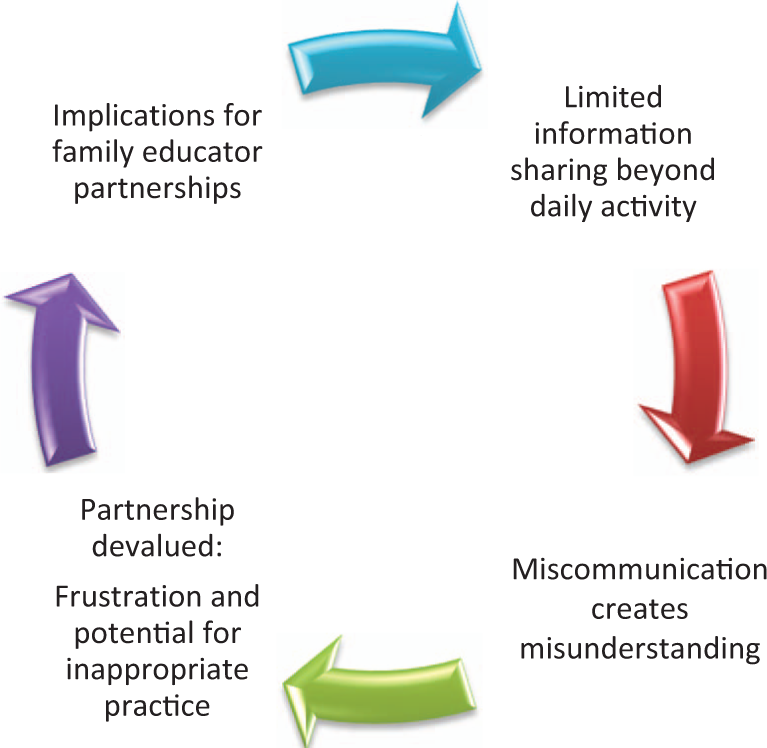
Cycle of misunderstanding.
In order to move beyond a cycle of misunderstanding, the implication for educators in early childhood settings requires rethinking the processes and purpose of oral communication. While this is valued by families, it is important to consider strategies for two-way communication and ensure parent goals for their child in the centre are articulated, recognized and respected. This is likely to require a shift in thinking for early childhood educators in terms of the type of questions they ask families.
Macro cultural capital in an embodied state: language learning
The maintenance of home language is acknowledged as a common goal for the early childhood field (Long, 2004). Respecting the home language and continuing its development is seen as crucial not only for communication between the child, parents and extended family but also in order to show respect and value of the macro culture. However, Beller (2008) states, Various authors have undertaken meta-analyses designed to answer the question of whether institutional encouragement of the first language improves the acquisition of the second language (Greene 1998; Rossel and Baker 1996; Slavin and Cheung 2005; Söhn 2005a). Söhn (2005a) concludes from the inconsistency of the research findings that, firstly, the fostering of the first language has no negative effects on [second language] acquisition and secondly, no consistent positive effect could be proven. (p. 15)
Educators in this study reported that they value the maintenance of home language and are willing to minimize the learning of English as a centre goal of their programme. In contrast, families are shown to be far less concerned about maintaining home language. English language learning was a particularly strong desire of parents for their child, even though this issue was seldom, if ever, made explicit to educators. English language was seen as important by parents for successful community functioning. Families in this study however, do value educators in the centre who speak their home language as a means of access to information about their child’s progress and development. It was not seen to be important for educators to use home languages to communicate with the children. Educators in early childhood settings see their attempts to reflect the child’s macro culture as a way of fostering identity and self-esteem and maintaining cultural heritage (Cavallaro, 2005; Donghui and Slaughter-Defoe, 2009).
This has significant implications. Perhaps it is time to separate English language learning from overarching macro cultural practices and look for ways to maintain cultural heritage beyond English language acquisition. The findings from the study do not aim to promote disregard for home micro and macro cultural practices or maintenance of home language. Rather, the research emphasizes respect for the values and expectations of families and the need for greater dialogue and attempts to be integrative of all macro cultures according to the capacity of each situation. Token macro or micro practices do not achieve anyone’s goals.
Shared dialogue, shared understanding
In order to move beyond a cycle of misunderstanding, educators in childcare centres need to rethink their partnerships and communication processes with families from culturally and linguistically diverse backgrounds. While Bourdieu’s theory of cultural capital was reinforced in this study by family decisions, it is time to reflect on the role of childcare services in terms of family expectations. Whose needs are we furthering? How are we ensuring that we are opening dialogue to have the ‘hard’ conversations with families? Educators need to find processes for being direct in questioning parents about their expectations; ensuring that silences do not result in discontinuity and misunderstanding but rather sharing and negotiating to meet the needs of all parties, particularly children.