






Abstract
In all, 26 Turkish early childhood educators were asked to describe a moral dilemma they faced in their classroom, the circumstances that made the situation a dilemma, and why it was a moral dilemma. The dilemmas described arose from conflicts between teachers and children, teachers and parents, and teachers and administrators. Dilemmas described by experienced teachers did not differ from those of described by inexperienced teachers. Dilemmas between teachers and students reflected teachers’ caring for students, while dilemmas between teachers and parents, and teachers and administrators reflected power struggles. When asked why the dilemmas were moral in nature, the teachers’ responses were categorized into five areas of concern. These are a concern for children’s development, children’s needs, children’s feelings, fairness, and honesty. Results are compared with studies conducted in the West. Implications for future research are presented.
Introduction
Teachers are the main protagonists of the moral stories in schools. They make many moral decisions because the practical life in a classroom may include a variety of specific situations that require teachers’ active moral thinking. However, contemporary teacher education programs usually focus on the technical aspects of teaching, and the knowledge and skills required. This is because teaching has been conceived mostly as an “instrumental activity” both in Western cultures (Carr, 2000, 2003; Hansen, 2001a; Jackson et al., 1993) and in Turkish culture (Kurtulan, 2007; Yetimoglu, 2000). Although Turkish researchers have discussed issues of morality in areas such as the violation of privacy in media and corruptions in politics (Tepe, 1998), there have been few studies in Turkey on the moral dimensions of teaching (Aksoy, 1999; Kurtulan, 2007).
Currently, in Turkey, there is much discussion of ethical and moral issues in science, law, politics, and educational management; however, Turkey does not yet have an official ethical code of practice for teachers. The National Early Childhood Education Curriculum developed by the Turkish Ministry of National Education (hereafter MNE) has a brief chapter concerning the moral issues that preschool teachers may encounter (MNE, 2006a, 2006b), but this document does not include any discussion of moral issues in the field, nor information for how teachers might resolve such issues. As a result, teachers are often unaware of the moral aspects of classroom life, or if cognizant of them, may not know effective ways of resolving the moral dilemmas they face.
This study had three purposes. The first purpose was to ask Turkish early childhood teachers to describe a classroom situation that presented them with a difficult moral dilemma, what made that situation difficult, and finally, why the dilemma was of moral significance. The plan was to engage teachers in conversations about dilemmas they encountered and that they would label as moral dilemmas. The second purpose was to compare the descriptions of experienced teachers with those of inexperienced teachers to see if the number of years of teaching influenced the teachers’ perception of the moral dimensions of their practice. The third purpose was to compare the data from the Turkish teachers with those from studies conducted in the United States and Western Europe. In doing so, we wanted to examine the influence of culture on teachers’ views of what constitutes a moral dilemma.
Our overriding goals were to draw a picture of morality that exists in early childhood classrooms based on teachers’ self-accounts on how they perceived the moral dilemmas they faced in their classrooms and then make comparisons to studies with teachers in the West.
In the next section, we present the framework of our study. Here, we review the literature on the moral dimensions of teaching and how teachers come to imbue some teaching dilemmas with moral significance. In the following section, we review the studies of Turkish teachers. As noted above, much of the research on how teachers view the moral dimensions of teaching has been conducted in Western countries: the United States (Hansen, 2001a; Jackson et al., 1993), the United Kingdom (Carr, 2000; Carr and Landon, 1998), Israel (Elbaz, 1992), Finland (Husu, 2001, 2004; Husu and Tirri, 2003; Tirri, 1999; Tirri and Husu, 2002), and Sweden (Colnerud, 1997), but a few studies have been undertaken in Turkey (Aksoy, 1999; Kurtulan, 2007; LePage et al., 2011). In section “Results and discussion,” we describe how our data were gathered and analyzed. Finally, in section “Conclusion,” we present a discussion of the results and their implications for teacher education and future research.
The moral dimensions of teaching
There is much agreement that morality is highly related to the culture and history of societies (Haidt and Kesebir, 2010; Shweder et al., 1987, 2008). Culture is based on a set of widely agreed upon values, which undergird the rules, customs, celebrations, and clothing, among other aspects of a group’s shared experience. As such, culture influences individuals’ values, beliefs, and behaviors (Fiske, 1992). People from different cultures may understand and react to specific situations differently (Miller, 1994; Vasquez et al., 2001). Most studies on teachers’ resolution of their moral dilemmas have been conducted in Western societies (Buzzelli and Johnston, 2001; Campbell, 2003a, 2003b; Colnerud, 1997; Husu, 2001, 2004; Husu and Tirri, 2001, 2003, 2007; Tirri, 1999; Tirri and Husu, 2002). This study was conducted in Turkey, a non-Western society, and it contributes to the literature on how teachers from a different culture define, describe, and propose strategies to resolve the moral dilemmas they encounter in their classrooms.
Recent research describes the ways teaching is imbued with moral significance (Buzzelli and Johnston, 2001, 2002; Campbell, 2003a, 2003b; Carr, 2000, 2003, 2006; Fenstermacher et al., 2009; Hansen, 1999, 2001a, 2001b; Kansanen, 2003; Sanger, 2001; Sockett, 1993, 2012; Strike and Soltis, 1988; Tom, 1984). Hansen (2001b) notes that teaching is a moral activity not because of some specific external factors, but rather teaching is inherently a moral activity because it pertains to human actions and relations. Carr (2003, 2006), like Hansen, notes that teachers intentionally try to influence children in a positive way. They do so when they choose one course of action over another based on beliefs about what is fair, right, just, or virtuous. Teachers’ actions convey moral meanings, for example, when establishing classroom rules and daily routines or making decisions about curriculum and teaching methods (Buzzelli and Johnston, 2001; Fenstermacher, 1990; Jackson et al., 1993; Tom, 1984).
Moral dilemmas in the practice of teaching
As outlined above, the moral pervades many aspects of teaching. However, a significant challenge to teachers is addressing the dilemmas that arise when their beliefs and values clash with those of parents, administrators, colleagues, and the larger society. Granted, dealing with dilemmas is a part of teachers’ professional lives, yet many of the dilemmas teachers encounter are moral in nature (Campbell, 2008; Cuban, 1992; Lyons, 1990). Teachers are expected to consider many private and public concerns related to professional, personal, organizational, and societal values while teaching (Husu and Tirri, 2003). Since teaching always involves relations between people (Buzzelli and Johnston, 2002; Clark, 1990; Johnston, 2006; Noddings, 2002; Tom, 1984), moral conflicts often take place between teachers and students, parents, administrators, and colleagues (Campbell, 1996, 2008; Colnerud, 1997; Husu, 2001, 2004). Moral conflicts also exist within individual teachers who care for their students and want to make the right and just decisions. Campbell (2008) notes that such dilemmas could include risking ostracism for reporting a colleague’s harmful behavior toward a student, or misrepresenting a student’s poor academic or behavioral performance in an effort to prevent a parent’s harsh punishment, among others.
Such situations, and others, require that teachers consider the welfare of their students as well as the expectations of them held by society (Berlak and Berlak, 1981). Teachers also must consider their own moral beliefs, the reactions of others, and the consequences of their choices in each circumstance (Strike and Soltis, 1988). While resolving dilemmas, teachers at times must compromise their principles, which they may perceive as undermining their moral beliefs and their own feelings of professional autonomy (Campbell, 2008; Carr, 2000, 2006).
There are some generally agreed upon values and principles that guide teachers’ search for possible resolutions for their dilemmas. These principles include teachers’ desire to be honest and fair to students and their families, to protect students as needed, and to be respectful toward all (Clark, 1990). However, making decisions considering these principles can be challenging for many teachers. Uncovering teachers’ perceptions of the moral dimensions of teaching and how they define a moral dilemma can provide insights into how teachers identify this aspect of their work (Campbell, 1996; Colnerud, 1997; Husu, 2001, 2004; Joseph and Efron, 1993; Tirri, 1999; Tirri and Husu, 2002). Additionally, investigation of moral dilemmas illuminates how teachers perceive moral questions and moral conflicts in their work and how they describe and understand moral dimensions in teaching.
Moral dilemmas in the early childhood classroom
We studied early childhood teachers for several reasons. First, we are both early childhood educators who have taught young children for a number of years. Likewise, we are both early childhood teacher educators who have worked with preservice and in-service teachers. Thus, we both have encountered, firsthand in our own classrooms, and in conversations with our preservice and in-service teachers, many moral dilemmas. Second, as early childhood educators, we are well aware of specific aspects of teaching young children that present teachers with moral dilemmas unique to early childhood settings. Third, in our review of the literature, we found few studies conducted with early childhood teachers (Husu and Tirri, 2001), although we did find a number of studies done with teachers of older children (Husu and Tirri, 2003; Tirri, 1999).
In their study, Tirri and Husu (2002) asked Finnish kindergarten and elementary teachers to “Describe a situation in your work in early education in which you have had difficulty deciding what would be the right thing to do from a moral point of view” (p. 365). The teachers were asked questions about the context of the event and their choices of methods to solve the dilemma. The dilemmas fell into three categories: conflicts between teachers and parents, conflicts between teachers and colleagues, and cultural conflicts. Analysis of the teachers’ stories found that all the moral dilemmas were relational in nature and involved the teachers acting to protect the “best interest of the child” (p. 372). In doing so, teachers faced the competing interests of parents and colleagues. Another source of moral conflict was the tension among their values and those of the profession and society at large. The authors found that teachers rarely reported arriving at a positive solution. Rather, many dilemmas were left unresolved. They note that teachers often felt forced to make a choice even if “nobody could ‘win’ by choosing and acting” (p. 374). The authors conclude that developing the ability to resolve moral dilemmas comes about through opportunities to engage in moral “argumentation” with other teachers in which dilemmas can be addressed from multiple viewpoints. They acknowledge that for teachers to learn how to resolve real-life moral dilemmas, they need to engage in moral discourse practices through their work as teachers in schools.
Studies of Turkish teachers
We found two studies conducted with Turkish teachers (Aksoy, 1999; Kurtulan, 2007), which examined teachers’ views on ethical dilemmas and neither included early childhood educators. Aksoy (1999) surveyed 129 elementary school teachers using a Likert-type scale. The survey measured attitudes of teachers toward a set of teacher behaviors which exemplified ethically problematic situations and were drawn from the Western research literature. The survey included items such as “making negative comments in the classroom about other teachers,” “telling a student’s private information and problems to her/his classmates,” and “discriminating among students based on their economic status” (Aksoy, 1999). Results indicated that Turkish teachers viewed the ethically problematic situations in the same way and to the same degree as did Western teachers.
In the other survey study, Kurtulan (2007) asked 132 Turkish special education teachers about their views of ethical issues in their professional lives. Teachers were asked to provide their level of agreement on several issues involving various classroom relationships with students with special needs. Based on survey data, Kurtulan found that 97 percent of the special education teachers agreed with most statements that exemplify positive attitudes toward children with special needs and the same percentage disagreed with negative statements such as “I do not need to make special arrangements for a student who cannot join group activities due to his special needs.” This study also found that special education teachers encounter morally challenging situations and dilemmas that result in them feeling unsatisfied with their job. For instance, 28 percent of the teachers stated they had encountered unethical situations in their work environment, while another 32 percent stated that they faced a situation that was ethically questionable.
These two studies provide a very limited understanding of Turkish teachers’ thoughts and attitudes toward the moral issues they face in school. However, the studies do not probe for the reasons teachers give or the criteria they use in determining if a situation is of moral significance. In this study, our goal was to hear from teachers which particular aspects of a dilemma that they encounter imbue it with moral significance.
Methodology
This study was conducted with teachers who taught in eight private preschools in Ankara, the capital of Turkey. The preschools serve children from middle- and high-income families and were located in the suburbs of Ankara.
Participants
The first author (K.K.) contacted principals of 11 preschools who arranged meetings with teachers. From the meetings, a total of 50 teachers comprised the initial pool of subjects. Of these, 26 agreed to participate in the study. The 26 teachers taught in eight different preschool programs. Since we were interested in the possible differences between inexperienced and experienced teachers, the 15 of the 26 teachers with 4 or more years of classroom teaching formed the experienced group, and the remaining 11 teachers with 1–3 years of classroom experience were the inexperienced group. Teachers with less than 12 months of experience were not included in the study because brand new teachers are overwhelmed with adapting themselves to their new environments and the daily routines and thus may not be very reflective (Flores, 2006).
Procedure
Each teacher was individually interviewed. The interviews lasted about 25–30 minutes. All interviews were recorded using a digital audio recording device and later transcribed. A semi-structured interview technique was used (Holstein and Gubrium, 1995; Kvale, 1996), and a protocol was prepared which included the following: “Please describe a classroom situation that presented you with a difficult moral decision” “What made the situation difficult for you?” and “Why do you think it was a moral decision?”
Data analysis
This qualitative study was guided by grounded theory methodology (Charmaz, 2006; Strauss and Corbin, 1998). Grounded theory is best used to illuminate a subject about which little is known (Dey, 1999). Considering the fact that this study will be one of the first studies exploring the moral dimensions of Turkish teachers’ professional lives, grounded theory was chosen to explore the data. In grounded theory, no categories are given, but they are created. The researcher “builds rather than tests theory” (Strauss and Corbin, 1998: 13) by reading the data multiple times, looking for patterns in the data, connecting diverse pieces within the data, and forming a theory based on these connections. Thus, grounded theory allows researchers to derive the theory from the data. This method utilizes theoretical coding, multiple perspectives, and theory-directed sampling (i.e. the aim of the sampling is theory construction rather than population representativeness). Additionally, comparing and contrasting participants’ responses to the researcher’s questions helped form the categories (Charmaz, 2006; Colnerud, 1997).
Charmaz (2006) identified two main stages of grounded theory coding: initial and focused coding. Initial coding involves naming the actions, feelings, and thoughts present in the data. This process includes considering the details existing in each segment of the data and coding with the words that reflect the details. Following Charmaz’s procedures, in the first step, K.K. began data analysis by reading the entire data set, listening to the recordings, and taking note of the details existing in each segment of the data. She then coded all transcripts utilizing incident-to-incident coding and assigned a word or a phrase reflecting the content of each incident. This formed the basis of an initial view of the moral issues raised in preschool classrooms. Individual actions and episodes (i.e. incidents) were assigned a word or a phrase reflecting the content of the incident. These codes became the initial foundation of a theory explaining the nature of the moral dilemmas encountered by the teachers. Following this initial stage, K.K. looked for similarities and differences in the incidents and formed the most common categories.
Charmaz (2006) described the second stage of coding, focus coding, as “using the most significant and/or frequent earlier codes to sift through large amounts of data” (p. 57). Charmaz (2006) also notes that researchers need to decide upon and select initial codes that are most appropriate for the analysis when grouping the data. In this stage, files of common categories were created, such as “complaining about families,” “empathy,” “fairness,” and “happy at school.” Therefore, after listening to all the recordings and reading the transcripts a second time, a table was prepared summarizing each participant’s answers to the interview questions. The analysis continued with a constant comparison for similarities and the differences in the incidents described by the interviewees.
For reliability purposes, a professor in a School of Education at an American university, who is very familiar with Turkish culture, served as a second coder. He went through 60 percent of the transcripts and coded them using the codes developed by K.K.. An 80 percent level of agreement was found between both coders. The 80 percent agreement between coders is considered a high level of intercoder agreement. Both coders met to discuss and resolve their disagreements. After reaching the 80 percent level of intercoder agreement, the first coder finished coding the rest of the data.
Trustworthiness of the data
Member checking, reliability coding, and peer debriefing were used to ensure the trustworthiness of the data (Lincoln and Guba, 1985; Miller et al., 2009). K.K. worked with two peer debriefers: a professor in Early Childhood Education Program at a public university in Ankara and a professor of education at a university in the United States. In both cases, K.K. met with the debriefer to discuss the issues raised while collecting and analyzing the data, and while preparing the summary tables for each interview. She summarized each interview, and they discussed the possible categories, the cultural issues that might have influenced the moral issues raised in the classrooms, and teachers’ solution strategies. They also discussed each step of the processes of coding, analyzing, and presenting the data. K.K. had to explain her point in doing certain actions and rationalize her coding.
In order to improve trustworthiness of the data, the member checking process was used following the preparation of the interview summaries. For this purpose, K.K. met with seven participants. In the meetings, each participant was given a copy of their own transcribed interview and interview summaries, and asked if they agreed with the transcription and the description of the dilemma. During the meetings, K.K. also let each participant look at the summary of the interview. All of the seven participants stated that the summaries corresponded with their descriptions of the moral dilemmas they had made in the first meetings. A few of them added some more comments. This process helped to ensure that the data were accurate.
Results and discussion
While we expected the descriptions of moral dilemmas of the experienced teachers to be different from those of the inexperienced teachers, we found that years of teaching experience did not influence the main findings in any way. For both groups, all of the moral dilemmas emerged from relationships with children, parents, administration, or a colleague. In each case, the teachers expressed feeling the need to make the right decision for the well-being of children.
One possible reason for the lack of differences is that neither group received opportunities to reflect upon the moral dimensions of teaching in their teacher preparation programs. Also, it is unlikely that moral reflection would be a topic for professional development activities. Thus, a teacher with 15 years of teaching experience and another teacher with 2 years teaching experience would not differ regarding their professional preparation and ongoing professional development on how to deal with moral dilemmas in teaching. Since we did not find other studies comparing experienced and inexperienced teachers’ reflections on moral dilemmas encountered in their classrooms, we believe our results represent a first attempt at comparing these two groups.
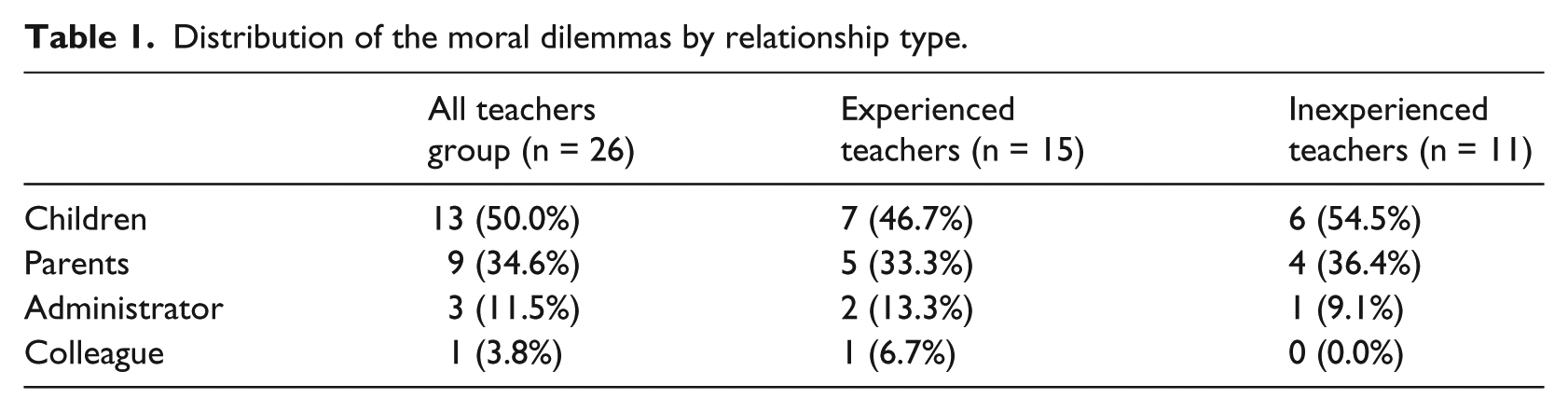
All teachers reported a moral dilemma that occurred within a relationship with one of the four groups of individuals: children, parents, administrators, or a colleague. The majority of the dilemmas (13 out of 26; 50% of all) dealt with relationships between the teachers and children, the remaining dilemmas were conflicts with either parents (nine dilemmas) or administrators (three dilemmas), or a colleague (one dilemma). Moral conflicts between teachers and children or teachers and parents accounted for 85 percent of all reported dilemmas. Only 3 of the 26 teachers reported moral dilemmas in their relationships with an administrator and only one in a relationship with a colleague (Table 1).
Distribution of the moral dilemmas by relationship type.
These findings are consistent with studies conducted in the United States and Europe (Campbell, 2008; Colnerud, 1997; Hansen, 2001a; Husu, 2001, 2004; Lyons, 1990; Sanger, 2001, 2008). As with previous research, we found that moral dilemmas arose from differences of opinion over which practices are in the best interests of children. While these results, in general, confirm previous observations about morality in teachers’ relationships (Campbell, 2008; Colnerud, 1997; Hansen, 2001a; Husu, 2001, 2004; Lyons, 1990; Sanger, 2008), some specific findings are new to the literature.
First, like Joseph and Efron (1993) and Husu (2001, 2004), we found that teachers confronted dilemmas when they did not share the same values and beliefs with parents who did not respect the teachers’ perspective. This same pattern was found in relationships between teachers and administrators (Campbell, 1997; Joseph and Efron, 1993). In both types of relationships, teachers felt helpless when they were not permitted to act in a way consistent with their beliefs of what was good for supporting children’s growth and development.
Second, previous studies indicated teachers commonly experience ethical dilemmas in their relationships with colleagues, particularly due to witnessing a colleague’s unethical behavior (Campbell, 1997, 2003a, 2003b; Colnerud, 1997; Husu, 2004. Teachers in Campbell’s studies (1997, 2003a, 2003b) reported that conflicts with colleagues, particularly about colleagues’ unethical behavior, were the source of their most difficult and troubling moral dilemmas. Colnerud (1997) found that conflicts with colleagues were a prevalent theme in moral dilemmas reported by teachers in Sweden. Husu (2004) reported similar findings. However, in our study, only one teacher reported a dilemma related to her relationship with a colleague. This finding may not indicate the absence of collegial conflicts among Turkish early childhood teachers, rather, it may indicate that teachers were more eager to share their dilemmas related to their relationships with children, parents, or administrators. The nature of collegial relationships among Turkish teachers, and whether or not they experience more or fewer conflicts than their European or American colleagues should be a topic of future research.
Characteristics of the moral dilemmas: caring versus power relationships
Whereas the first analysis focused on the other person involved in the dilemma, our second analysis sought to examine the nature or content of the relationship. The analyses found that dilemmas involving a child or a colleague were related to issues of caring and those dilemmas between the teacher and a parent or administrator centered on issues of power. Again, there were no differences between the experienced and inexperienced teachers. Of the 15 experienced teachers, 7 (46.7%) described dilemmas related to caring, while 8 (53.3%) talked about issues related to power. Likewise, of the 11 inexperienced teachers, 6 (54.5%) described an incident related to caring, while 5 (45.5%) discussed incidents having to do with power.
Caring relationship dilemmas
Literature suggests that feelings and intentions are crucial components of a caring relation (Held, 2004, 2006; Mayeroff, 1990; Noddings, 1984). Feelings and intentions can illuminate the moral content of dilemmas and also manifest the complexity and situation-specific content, thus highlighting the moral features of teaching. Therefore, when analyzing this part of the data, we focused on the teachers’ awareness and recognition of the moral features of the situation in which they were involved.
In considering the care category, we drew on the work of Mayeroff (1990), Noddings (1984), and Held (2004, 2006). For Mayeroff (1990), caring is not simply about “wishing well, liking, comforting and maintaining, or simply having an interest in what happens to another” (p. 1). Rather, the caring teacher is committed to helping students grow and develop in their own way.
For Noddings, two qualities describe how the one-caring engages with the one-cared for: engrossment and motivational displacement. Engrossment is the state of being fully receptive of the other’s reality in order to meet his or her needs. Motivational displacement, on the other hand, is “the sense that our motive energy is flowing toward others and their projects” (Noddings, 1984: 16) as we incline to help others. These two qualities distinguish the one-caring from someone with a simple interest in others’ needs. Caring for Noddings (1984) “is a way of being in relation, not a set of specific behaviors” (p. 17).
Held (2004, 2006), like Mayeroff and Noddings, underlines the importance of the emotions, ideals, and attitudes that accompany a caring act since all make significant contributions to caring relations. Held notes that emotions and relational capabilities are valuable components of care that allow a morally sensitive person to identify what would be best in a specific context. Caring persons endeavor to support the growth and personal development of those in their care.
Like Mayeroff, Noddings, and Held, our view of a caring relation emphasizes the obligation to act in ways that best support the one-cared for and that this is rooted in the teachers’ relationship with the children. In remarks about their dilemmas, the teachers expressed their concerns for children’s well-being and the feeling that they should act on behalf of the children even in the face of various restrictions or competing demands. Thus, the moral dilemmas described by the teachers arose from situations, which required choosing among the competing demands to care for one or more individuals, or in situations where caring placed one value in conflict with other competing values. In the case of Begum, quoted above, her moral dilemma is a conflict between providing the semi-structured art activities she believes promote her students’ creativity and the limited amount of time she has for such activities. Time limitations mean she cannot do what she believes is best for the children. Her concern for the children’s well-being is rooted in her relationship with them. For the teachers, as for Begum, the relationship with the children, as outlined by Mayeroff, Noddings and Held, is central to their care for them.
Power relationship dilemmas
Power relationship dilemmas arise when two parties have conflicting perspectives regarding what is best for the child and when one party seeks to exert authority over the other. Like Joseph and Efron (1993) and Husu (2001, 2004), our teachers confronted dilemmas when they did not share the same values and beliefs with parents. The same is true in the relationship between teachers and administrators (Campbell, 1997; Joseph and Efron, 1993). The teachers’ descriptions of moral dilemmas with administrators and parents were based on feeling pressure to carry out or comply with their wishes. Teachers reported feeling helpless and could not act in ways consistent with what they thought was good, right, and virtuous in supporting children’s learning and personal growth.
The data indicate, that the dilemmas arose out of conflicts about whose ideas were more important. The teachers reported that such conflict situations created moral dilemmas for them. Although the dilemmas that emerged from power relationships are no doubt about caring for children, they were a direct result of the conflict between the teacher and others.
Teachers’ explanation of the moral
When asked why the dilemmas were moral in nature, the teachers’ responses were categorized into five areas of concern. These are a concern for children’s development, children’s needs, children’s feelings, fairness, and honesty. These five concerns are similar to the moral issues in classrooms as documented by Jackson et al. (1993), yet differ in some ways from recent research focusing on categories of moral incidents (Shapira-Lishchinsky, 2011). Of significance though is the fact that for some of the teachers, it was the interplay and conflicts among these concerns that accounted for the moral nature of the dilemmas. Even though the teachers referred to more than one concern as key to the moral nature of their dilemma, we discuss each concern separately. Because teachers sometimes raised several concerns rather than a single concern, the number of concerns mentioned exceeds the total number of teachers interviewed.
Children’s development
In all, 12 teachers (seven experienced and five inexperienced) stated that their dilemma was moral because children’s development was at stake. The teachers’ expressed concerns across a wide range of development, including self-confidence, self-sufficiency, self-control, increasing self-awareness, intellectual development, social development, and creativity. For example, two experienced teachers, Esra and Begum, indicated that due to time limitations, they had to stop following daily classroom practices that promote children’s individual development.
1
To save time, Esra helped children wash their hands rather than letting them do it by themselves, but the moral tradeoff was the loss of opportunities for nurturing children’s self-confidence. She comments on her dilemma, First I teach them how to wash their hands and encourage them to wash their hands by themselves, then a couple of hours later or the following day I attempt to wash their hands. On the one hand, I have to follow my daily schedule, but on the other hand children should gain self-confidence.
Thus, Esra was torn between opposing choices, saving time, or enhancing children’s self-confidence. She has strong interest in their personal development; however, she acted against her beliefs to maintain her daily schedule. Similar concerns were expressed by inexperienced teachers.
Children’s needs
For 11 teachers (7 experienced and 4 inexperienced), responding to children’s needs created the moral dilemma. While these teachers acknowledged the different types of children’s needs, such as the need for respect, a quality education, or being alone, they also showed concerns about children’s development, children’s feelings, fairness, and honesty, as well as children’s needs. Thus, as noted above, it was not just a concern for children’s needs that created the moral dilemma but rather the interplay and conflict with a second area of concern.
Gulay, an inexperienced teacher, believed that children should have the freedom to talk during lunch. She does not think children should be forced to remain quiet, yet, the administration wants her to keep them quiet. She comments, It is very hard for me to force children to do something. Children want to talk when they are eating. They do not finish their lunch at the same time, so they do not want to wait the ones who are not done with their meal. This sounds right to me because it is how I grew up. But, I was told that they should not talk and leave the lunchroom at the same time. I do not see any meaning in it, so I do not want to force my students.
Accordingly, Gulay does not agree with the administration and does not want to act against her beliefs. She feels that children need more freedom and flexibility, but she is asked to use her authority to enforce the rules. Her conflict with the administration on how to treat children is the source of her moral dilemma concerning children’s needs and well-being.
Children’s feelings
The fact that children’s feelings could be hurt created moral dilemmas for six of the teachers. Four of these teachers, Gul and Begum (both experienced) and Ayse and Sevgi (both inexperienced), described caring relationship dilemmas, whereas, two other teachers, Rana (experienced) and Gulen (inexperienced) expressed power relationship dilemmas. These teachers also mentioned concerns about parents’ wishes and administrators’ pressures as adding to the moral nature of their dilemmas. As with the other concerns, the teachers had to consider more than one variable as constituting their moral dilemmas. Both Buzzelli and Johnston (2002), and Sockett (1993), note that the complexity of teaching is one of the major factors that make it a moral endeavor.
In the caring relationship dilemmas, the teachers talked about the difficulty they experienced when making a decision that might hurt children’s feelings or hinder their development. For example, Begum described considering multiple variables to find an immediate solution to a complex issue. She had to follow her daily plan, support children’s creativity and individual development, be consistent in her professional practice, and make children happy. For her, it presented a challenging problem to solve.
Rana, an experienced teacher, reported a power relationship dilemma in which she felt that parents’ and administrations’ wishes created potential threats to children’s feelings. Rana notes, “This should not be the goal. It is not for the benefit of children. It is only a show for the parents. The goal of early childhood education is not to make show for the parents.” Rana believed that the administrators’ desire to host a children’s art exhibit for the parents placed the creation of the art ahead of concerns for the children’s well-being. Rana points out that the administrators’ focus has shifted dramatically from children’s well-being to creating numerous art activities for display at an open house, and she finds it quite disturbing. Because she places the children as her top priority, the administration’s request for all the art activities conflicts with the children’s well-being.
Fairness
Fairness was cited as a moral concern by six participants, four experienced and two inexperienced teachers. Of the six teachers, five moral dilemmas involved caring relationships with the remaining one being a power relationship. The teachers believed that all children should receive fair and equal treatment, such as equal amounts of attention, regardless of individual need. It was this view that led to their moral dilemmas.
Among the five teachers with caring relationship dilemmas, Nihau and Belkis, experienced teachers, and Ilke, an inexperienced teacher, described a moral dilemma based on their relationship with a child with special needs. Ilke says, It seems to me that taking him outside is a better solution since he calms down and stops crying relatively easily when we go outside of the classroom. Also, I do not want him to disturb other children. On the other hand, I believe that staying in class is more beneficial for Tuna (also with autism) because if he goes out, he will not get used to being with his friends and will not be socialized. This is my dilemma.
All these teachers felt that a child with special needs required additional attention or created circumstances that may be unfair to the other children. The teachers wanted to meet needs of individual children, yet they also acknowledged the fact that other students waited for and needed their attention. Thus, their moral dilemmas were about the fair allocation of their time and how best to help individual children who need extra time and care yet, not deprive other children of their time and attention.
Honesty
The final and the least frequently cited moral concern is honesty. Three teachers, Hale and Serpil, both experienced teachers, and Canan, an inexperienced teacher, acknowledged honesty as the factor that made their dilemmas moral. All three said their dilemmas emerged because they felt pressure from parents and administrators:
Canan acknowledged the conflict she felt over pressure from the administration to make sure parents were happy with the program. The pressure created a conflict with the administration which to avoid she said “Although you want to be honest all the time, you sometimes have to change the truth in your interactions with children, parents and administration. We occasionally tell white lies. This creates a moral dilemma. We sometimes make our decisions momentarily.” For Canan, the “white lies” are the heart of her moral dilemma. She regrets being dishonest but it was for her a way to avoid conflict.
Conclusion
Our findings both support results of previous research conducted in the Western countries (Campbell, 2008; Colnerud, 1997; Hansen, 2001a; Husu, 2001, 2004; Lyons, 1990; Sanger, 2008) and make new contributions to the literature. As with previous research, we found that moral dilemmas do not arise in choices between right or wrong, or good or bad courses of action. Rather, the moral dilemmas these teachers encountered were rooted in choices between competing goods or among alternatives each having the possibility of a positive outcome (Hansen, 1998, 2001a). Such choices reflect the values and beliefs of those involved in the conflict (Johnston, 2003; Johnston et al., 1998; Sanger, 2008).
The results indicated that the teachers’ dilemmas were about two types of relationships: a caring relationship or a power relationship. The caring relationship dilemmas emerged from the teachers’ relationships with children or a colleague. The power relationship dilemmas occurred in the teachers’ relationship with parents and administrators over what was in the best interest of the children. Thus, while the persons with whom the teachers’ had their dilemmas were different, the cause of both types of dilemmas was the same, namely, the teachers’ caring about what is in the children’s best interest.
For Hansen (2001a), teachers’ concern for the best interests of those under their tutelage is a crucial aspect of what makes teaching a moral activity. This concern, says Hansen, means that teachers must be intellectually and morally attentive to their students. Being intellectually attentive “means getting as close to students’ responses to subject matter as time and opportunity afford” (Hansen, 1999: 175). It also means “teachers’ being alert to aspects of student conduct that influence students’ engagement with subject matter. Such aspects include those that enable and support students in using their minds—concentration, signs of emerging confidence, and persistence” (Hansen, 1999: 175–176). As noted above, both Begum and Esra demonstrated intellectual attentiveness to their students’ engagement in activities that nurtured their “emerging confidence” in their intellectual and expressive abilities.
Hansen (1999) describes moral attentiveness as having two components: “alertness to the development of their students’ character, and awareness of their own regard for and treatment of students” (p. 180). The first component speaks to the importance of recognizing that each student “incarnates a distinctive and evolving set of capacities, inclinations, dispositions, and attitudes” (Hansen, 1999: 180), or put differently, recognition of and respect for the unique personhood of each student. An awareness of how one treats students is the second aspect of moral attentiveness. Respect, dignity, understanding, and patience, among others should be afforded students. Yet, Hansen (1999) is quick to say that the expression of these, and other virtues, “can be enacted in many different ways that depend heavily on the particular context” (p. 181).
While the teachers’ intellectual and moral attentiveness imbues their teaching with moral significance, for these teachers, caring for their students is of primary importance. Noddings’ description of care reflects meanings similar to Hansen’s two types of attentiveness. Noddings (1984) says, Apprehending the others’ reality, feeling what he feels as nearly as possible, is the essential part of caring from the view of the one-caring. For if I take on the others’ reality as possibility and begin to feel its reality, I feel, also, that I must act accordingly; that is I am impelled to act as though in my own behalf, but in behalf of the other. (p. 16)
As noted above, caring “is a way of being in relation, not a set of specific behaviors” (Noddings, 1984: 17). Regarding findings new to the literature, in our study, the majority of the teachers’ moral dilemmas were in relationships with parents, not with administrators or colleagues. Previous studies (Campbell, 1996; Colnerud, 1997; Husu, 2004) found teachers commonly experience ethical dilemmas related to their relationships with colleagues. The fact that only one teacher in our study reported a dilemma with a colleague may not indicate the absence of collegial conflicts among Turkish early childhood teachers. Rather, it may indicate that teachers were more eager to share their dilemmas related to their relationships with children, parents, or administrators. The nature of collegial relationships among Turkish teachers and whether or not they experience more or fewer conflicts than their European or American colleagues should be a topic of future research.
Other suggestions for future research include the following. Since this study was conducted in Ankara, a large, metropolitan city, future studies should interview teachers in smaller cities and rural settings where there is a broader range of quality in early childhood programs. Differences in program quality could influence the ways teachers think about moral dilemmas. Second, in this study, all the participants taught in private programs. Given that in Turkey the socioeconomic background of the parents in public programs is more diverse than in private institutions, it is possible that the kinds of the dilemmas encountered and described by teachers in public programs could differ from the ones reported in this study.
Finally, including classroom observations along with interviews could be valuable additional data. Observations of teachers’ interactions with children during moral dilemmas followed by discussions with the teachers can provide researchers with a better understanding of how teachers respond in moral dilemma situations and how their behaviors during the dilemmas might align with their perceptions of the dilemma as moral.
Footnotes
Acknowledgements
This article is based on a dissertation submitted by the first author, “Moral Dilemmas in Early Childhood Settings: Turkish Teachers’ Accounts.”
Declaration of Conflicting Interests
The authors declare no potential conflicts of interest with respect to the authorship and/or publication of this article. All authors approved of the final version of this article.
Funding
The authors received no financial support for the research and/or authorship of this article.