







Abstract
This study used a family-centered ecological lens to examine predictive relations among fathers’ and mothers’ language acculturation, parenting practices, and academic readiness in a large sample of Mexican American children in preschool (N = 880). In line with prior early childhood research, parent language acculturation was operationalized as fathers’ and mothers’ English proficiency and primary language used in the home. Parenting was operationalized as fathers’ and mothers’ participation in home learning stimulation (e.g. shared book reading). Analyses showed that, after controlling for demographics, fathers’ and mothers’ primary language in the home predicted children’s reading achievement and fathers’ and mothers’ English proficiency predicted children’s math achievement. Furthermore, maternal home learning stimulation made a unique contribution to children’s reading achievement after the influence of parent language acculturation was accounted for, underscoring the importance of home learning stimulation for strengthening Mexican American children’s reading skills prior to school entry.
Keywords
IntroductionHispanic families are the largest and most rapidly growing ethnic minority group in the United States. Furthermore, Hispanic children represent the second largest group of children enrolled in public elementary schools after Whites (Cabrera et al., 2012; Castro et al., 2012; Garcia, 2009). The growing number of Hispanic children entering American classrooms each year has implications for early childhood programs (e.g. Head Start) that strive to increase the academic readiness of linguistically diverse students. To achieve this, it is important to understand how home environments contribute to the academic skills that children bring to school. Numerous studies have shown that parenting is an important way to enhance child achievement at school entry (Baker et al., 2012; Baker and Iruka, 2013; Burchinal et al., 2008; Cabrera et al., 2012). In fact, Brooks-Gunn and Markman (2005) found that when researchers measuring academic readiness statistically controlled for differences in parenting practices (e.g. maternal home learning stimulation), racial gaps in kindergarten reading and math narrowed by 25–50 percent.
Findings from the aforementioned study advance research on families by documenting the importance of mothers, while raising new questions about the role of two understudied contributors to child achievement, namely, fathers and culture. This is especially important because the majority of Hispanic children in the United States are of Mexican descent (i.e. 64%) and many reside in two-parent families with fathers and mothers who speak English as a second language (Cabrera and Bradley, 2012; Crosnoe, 2006). Yet, few studies have sought to understand whether cultural-ecological factors (e.g. parent language acculturation) are related to parenting and child achievement during the earliest years of school. Research with African American and Caucasian, monolingual families has shown that fathers and mothers who engage in consistent home learning stimulation have children who enter school with more advanced cognitive skills even in the presence of multiple risk factors (Baker et al., 2015; Burchinal et al., 2008). But studies have rarely assessed whether this pattern of findings persists in Mexican American families where many fathers and mothers have limited English skills or speak Spanish as their primary language in the home. The present study extends prior research by examining associations among parent language acculturation, parenting practices, and academic readiness in Mexican American families.
Theoretical and empirical foundations
Ecological theory posits that home environments represent the most salient and enduring context for child development. Within the family context, processes related to language acculturation (e.g. parents’ English proficiency) and parenting (e.g. home learning stimulation) can enhance or impede opportunities for optimal academic achievement (Bronfenbrenner and Morris, 1998). According to sociocultural theory, family processes are influenced by cultural values, beliefs, and skills; and didactic interactions with parents are necessary for children to acquire new skills (Vygotsky, 1987). In relation to preschool achievement, sociocultural theory argues that early learning is a socially determined process, in which children depend on assistance from parents to master new cognitive challenges (Vygotsky, 1987). Because the family is the primary socializing agent during early childhood and children acquire their first cognitive skills from their parents, understanding associations among parent language acculturation, parenting, and child achievement in Mexican American families is imperative. Therefore, the present study used an ecological and sociocultural lens to investigate academic readiness in Mexican American families.
Parent language acculturation and children’s academic readiness
Parent language acculturation (in Hispanic families) refers to the change that occurs when a person who speaks Spanish as his or her primary language comes into consistent contact with people who speak English as their primary language (Deyo et al., 1985). It does not imply, however, that persons will adopt, learn, or become proficient in English (Salamonson et al., 2008). Prior research points to the salience of two dimensions of parent language acculturation, namely, English proficiency and primary language in the home, as important for children’s academic success (Liu et al., 2009; Quiroz et al., 2010; Tsai et al., 2012). For example, Liu et al. (2009) found that Asian American mothers who were more proficient in English (defined as how well mothers could read, write, speak, and understand English) had middle school children with better reading and math scores than mothers who were less proficient in English. In a more recent study of Hispanic families, Quiroz et al. (2010) found that children in families where mothers reported having stronger English proficiency had higher English vocabulary scores than children with mothers who reported having limited English proficiency.
Although very few studies have examined parent language acculturation and academic readiness exclusively in Mexican American families, one recent study demonstrated that Mexican American mothers who were more proficient in English had children with higher reading and math scores in preschool compared to Mexican mothers who were less proficient in English (Baker, 2014). Given the data pointing to the importance of parents’ English proficiency for children’s academic achievement, it is somewhat surprising that all of the aforementioned studies focused exclusively on mothers, rather than mothers and fathers. Although research on fathers has been meager, recent studies point to the importance of improving our understanding of how ethnically diverse fathers support their children’s early academic achievement (Lamb, 2010, 2013). This study represents a first step toward understanding whether and how fathers’ and mothers’ English proficiency influences Mexican American children’s academic readiness in preschool.
Fathers’ and mothers’ primary language in the home has received little attention in the extant literature. The limited research that exists has yielded mixed results. For example, Hammer et al. (2009) examined mothers’ language use in the home (defined in their study as whether mothers used English vs Spanish to communicate with their children) in relation to children’s vocabulary and emergent literacy skills during preschool and kindergarten. They found that mother-reported increases in English use in the home were not related to children’s English vocabulary or emergent literacy skills. In contrast, Colon-Papazoglou (1999) used a small sample of Puerto Rican families to examine relations between mothers’ language use in the home (e.g. English language use and familiarity) and children’s academic outcomes. She found that mothers’ language use in the home was related to children’s vocabulary scores, but not math in grades 1 through 4.
In a study that included both fathers and mothers, Pearson et al. (1997) linked Hispanic mothers’ and fathers’ primary language in the home (i.e. English vs Spanish) to bilingual infants’ lexical learning. Their findings also indicated that parents’ primary language in the home was related to the amount of English vocabulary children acquired during their second year of life. In sum, prior studies provide some evidence for direct links between two dimensions of parent language acculturation (i.e. English proficiency and primary language in the home) and children’s academic outcomes. However, studies are inconsistent and inconclusive, have rarely focused on Mexican American families, and scant research has included both fathers and mothers. The first goal of this study was to strengthen our understanding of associations among fathers’ and mothers’ language acculturation and academic readiness in Mexican American families.
Parenting practices and children’s academic readiness
Parenting in the form of home learning stimulation has long-term benefits for children’s academic achievement and success (Hart and Risley, 1995). Home learning stimulation, in particular, allows parents to demonstrate concern for their children’s early learning by engaging in a variety of home-based teaching activities. In recent studies, children have been found to be more prepared to succeed in school when their fathers and mothers participate in frequent shared book reading, singing songs, telling stories, and provide a variety of children’s books in the home (Cabrera and Bradley, 2012; Caspe, 2009; Farver et al., 2006). For example, Lahaie (2008) found that mother-reported home learning stimulation was positively related to kindergarten language and math skills in an immigrant sample that included a significant number of Hispanic children.
Duursma et al. (2008) found that more frequent father–child reading was related to more advanced cognitive skills at 36 months, particularly for low-income, Hispanic children whose fathers read to them daily or weekly. In a nationally representative study of fathers, mothers, and their preschool children, Baker (2013) found that fathers and mothers who engaged in more frequent home learning stimulation across the toddlerhood period had children with more advanced reading and math skills during the transition to preschool, even after controlling for poverty and demographic risks. Taken together, these studies suggest that fathers’ and mothers’ participation in home learning stimulation matters above and beyond demographic characteristics (e.g. poverty). What is less well understood is whether these practices matter above and beyond cultural-ecological factors (e.g. parents’ language acculturation).
Demographics and children’s academic readiness
Empirical studies have shown that older parents with higher incomes and more years of formal education typically have children with more advanced academic skills (Brooks-Gunn and Markman, 2005; Crosnoe and Kalil, 2010; Mollborn and Dennis, 2012; Mollborn and Lovegrove, 2011). In addition, Kalil and Crosnoe’s (2009) conceptual model of immigrant education suggests that parents’ immigration status represents a unique demographic consideration in studies with Mexican American families. According to their research, increased contact with American cultural norms (e.g. education systems) tends to enhance parenting practices, supporting healthy family functioning and child achievement. Consequently, the present study controlled for several demographic characteristics that have been linked to child achievement in prior research, including family income, mothers’ and fathers’ education, mothers’ and fathers’ age, mothers’ and fathers’ immigration status, child age, and child gender.
The Study Methodology
Research Questions
Two specific research questions were examined after controlling for demographics: (1) what are the associations between fathers’ and mothers’ language acculturation and children’s academic readiness? and (2) Do fathers’ and mothers’ parenting practices (i.e. home learning stimulation) predict children’s academic readiness above and beyond parents’ language acculturation? Based on prior research and theory, it was hypothesized that parents’ language acculturation would be positively associated with children’s academic readiness. Specifically, parents with stronger English language skills who also spoke English as their primary language in the home would have children with more advanced reading and math scores in preschool. It was also hypothesized that fathers’ and mothers’ parenting practices (i.e. home learning stimulation) would predict academic readiness above and beyond parents’ language acculturation.
Method
Participants
Data for this study are from the Early Childhood Longitudinal Study–Birth Cohort (ECLS-B), a nationally representative sample of approximately 14,000 children born in 2001. Because of the restrictive nature of the ECLS-B data set, exact locations of participants cannot be given to protect the identity of the participants. The ECLS-B examines children’s health, development, care, and education during the formative years from birth through kindergarten entry. The study was developed under the sponsorship of the US Department of Education’s National Center for Education Statistics and includes information about children, their parents, their child care providers, and their teachers. To select a nationally representative probability sample of children born in 2001, births were sampled within a set of primary sampling units, including race/ethnicity, metropolitan area status, region, and income (Bethel et al., 2005). Children were mostly sampled through registered births from the National Center for Health Statistics vital statistics. All children were sampled except children born to mothers younger than 15 years of age, children who died before the 9-month assessment, or children who were adopted prior to the 9-month assessment. More information about the ECLS-B can be obtained from the ECLS-B’s psychometric report (Najarian et al., 2010).
Analysis sample
The sample for the present study consisted of (N = 880) children whose mothers and fathers reported that their race/ethnicity was Mexican American. Children who only had one Mexican American parent were not included in this study. Notably, the children of Mexican mothers and fathers made up the largest portion of the Hispanic families from the ECLS-B (i.e. more than 80%). The average age of children during the reading and math assessment (collected during the 48-month wave) was 53.67 (in months) or 4.48 (in years). In addition, 51 percent of the children in the study were male. During the 24-month data collection wave, 44 percent of the Mexican American children in the sample lived in homes below the poverty threshold. The average age of mothers was 26.16 years (standard deviation (SD) = 5.91 years), and the average age of fathers was 28.52 years (SD = 6.46 years). The majority of fathers (i.e. 52%) had less than a high school education. Similarly, 47 percent of mothers had less than a high school education. Table 1 presents descriptive information for all variables in the study, and the scales for all of the variables in the study are described below.
Descriptive statistics for study.
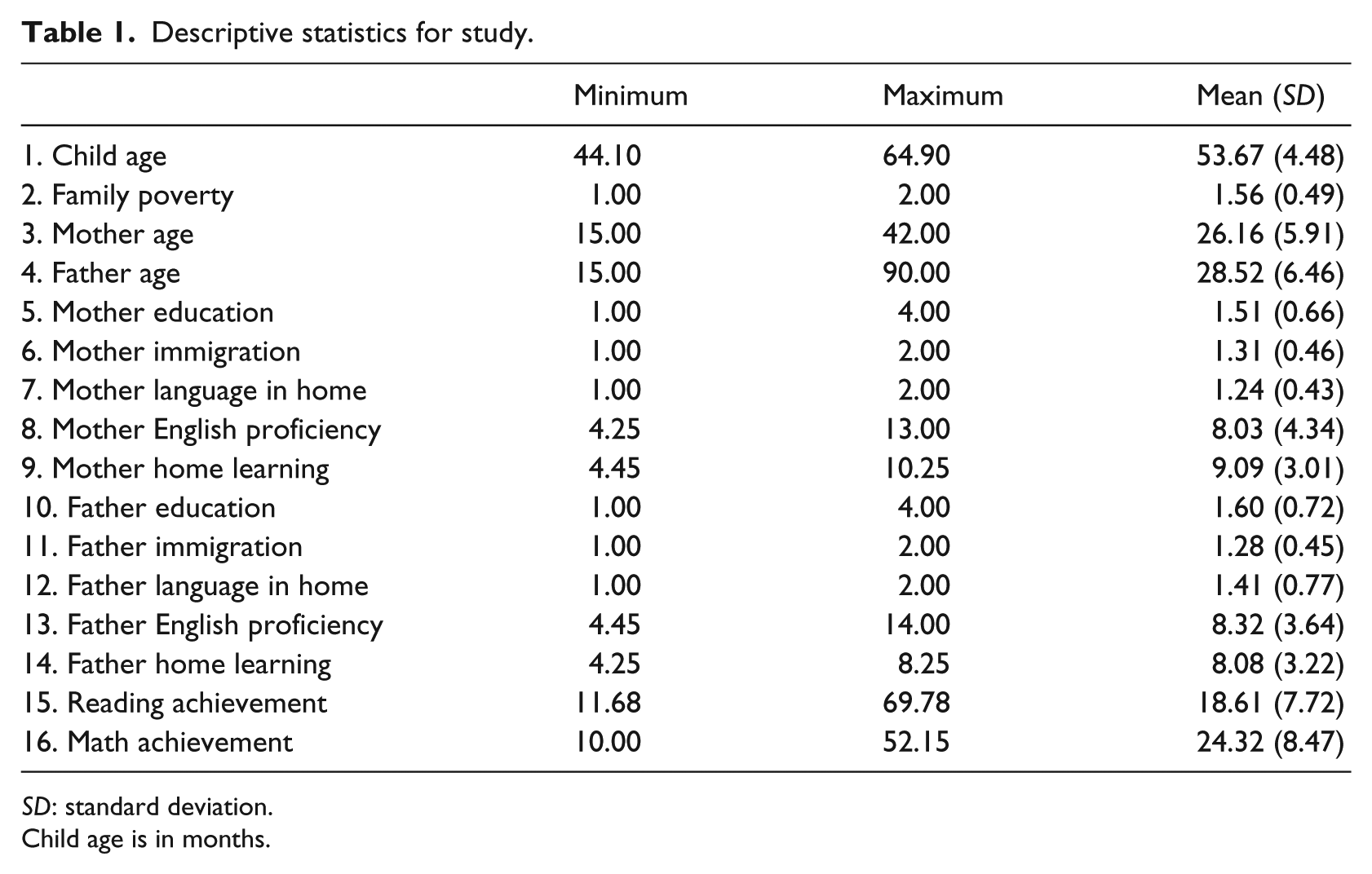
SD: standard deviation.
Child age is in months.
Measures
Dependent variables: early reading and math
Preschool reading and math scores were measured using individually administered tests that lasted approximately 35 minutes for each child. The reading test assessed children’s reading and emergent literacy development in six specific areas: (1) English language skills/oral language, (2) phonological awareness, (3) letter/word sound knowledge, (4) print conventions, (5) word recognition, and (6) vocabulary (both receptive and expressive). The reading assessment developed for the ECLS-B contained 37 items. The reliability for the entire sample was α = .81 (reliability is not available by race/ethnicity). The math test assessed children’s math achievement in four specific areas: (1) number sense, properties, and operations skills; (2) measurement which involved understanding the attributes of objects (e.g. length and volume); (3) simple identification of geometric shapes; (4) recognizing patterns, algebra, and functions. The math assessment developed for the ECLS-B contained approximately 28 items. The reliability for the entire sample was α = .88 (reliability is not available by race/ethnicity). Notably, the ECLS-B conducted preliminary language screenings to determine whether children should be tested in Spanish or English; children who were proficient in English in this sample (89%) were administered the pre-K reading and math tests in English. Children who were not (11%) were given the reading and math tests in Spanish.
Independent variables: parent language acculturation
During the 9-month data collection wave, mothers and fathers were asked to respond to questions about their language acculturation. First, mothers and fathers responded to four questions about their English proficiency. The four items included (1) how well do you speak English? (2) how well do you write English? (3) how well do you read English? (4) how well do you understand English? Responses ranged from 1 (not very well at all) to 4 (very well). The final English proficiency score was the mean of the four responses calculated separately for each parent (reliability estimates for mothers and fathers were α = .99 and .95, respectively). Higher scores indicate more English proficiency. Second, mothers and fathers were also asked to report their primary language in the home (1 = Spanish, 2 = English). Similarly, fathers were asked to report their primary language in the home (1 = Spanish, 2 = English). Higher scores indicate more frequent English language use in the home. Notably, data on these language acculturation variables were only collected during the 9-month data collection wave and the ECLS-B does not include a formal acculturation scale.
Parenting practices: home learning stimulation
During the 24-month data collection wave, fathers and mothers were asked to report the frequency (1 = never to 4 = everyday; α = .72 and .65 for fathers and mothers, respectively) of their participation in a number of home learning activities, including parent–child reading, singing songs, and telling stories. Parents also provided information about the provision of educational materials in the home (i.e. number of children’s books in the home). In the present study, mothers’ and fathers’ home learning stimulation was the mean of these four items (calculated separately for each parent). Number of books in the home was standardized so that parents with 1–10 books in their homes received a 1, parents with 11–20 books in the home received a 2, parents with 21–30 books in the home received a 3, and parents with 30 or more books in the home received a 4. An example of a specific item is “In the past week, how often have you read to your child?” Higher scores indicate more frequent home learning stimulation.
Demographics and covariates
Nine demographic characteristics and controls were included in the regression models. Poverty level was a binary variable with a value of (1 = below the poverty line or 2 = at or above the poverty line). Mother age and father age were continuous variables. Child gender was a binary categorical variable (1 = male and 2 = female). Mother education and father education were ordinal variables (1 = less than High school education, 2 = High school diploma/some college, 3 = Bachelor’s degree, 4 = Graduate school degree). Mothers’ and fathers’ immigration status were binary variables (1 = Mexico or outside US through 2 = US). All demographic information except child age during the pre-K assessment was collected at 24 months.
Analytic approach
Using guidelines from Peugh and Enders (2004), a multi-step approach was used to select the analytic sample, to deal with missing data, and to complete the appropriate analyses. First, only child and parent data collected during the 9-month, 24-month, and 48-month waves were used in the analyses. Second, missing data analyses were conducted in SPSS 19.0 to identify patterns of missing data in the sample. Third, to maximize the sample and prevent biased estimates due to list-wise deletion, multiple imputation procedures were used to deal with missing data and to maximize the likelihood of producing the observed sample. To address the research questions, means, standard deviations, and bivariate correlations were examined. Hierarchical regression models were also tested to determine whether fathers’ and mothers’ provision of home learning stimulation predicted children’s academic readiness above and beyond demographics and parent language acculturation. Specifically, demographics were entered into Step 1 as controls, parent language acculturation was entered into Step 2, and parent home learning stimulation was entered into Step 3 (discussed further below).
Findings
Bivariate correlations were examined for the main study variables (see Table 2). Results indicate mothers and fathers in this study were more likely to engage in home learning stimulation if they were proficient in English (r = .38, p < .01; r = .37, p < .01, respectively) and fathers’ primary language in the home and English proficiency were positively related to children’s reading achievement (r = .15, p < .01; r = .18, p < .01, respectively). There is also a positive correlation between mothers’ home learning stimulation and children’s reading and math scores (r = .16, p < .01; r = .12, p < .05, respectively). These positive correlations encourage further analyses of the predictive relations in this study.
Correlations among parent language acculturation, parenting practices, and child outcomes.
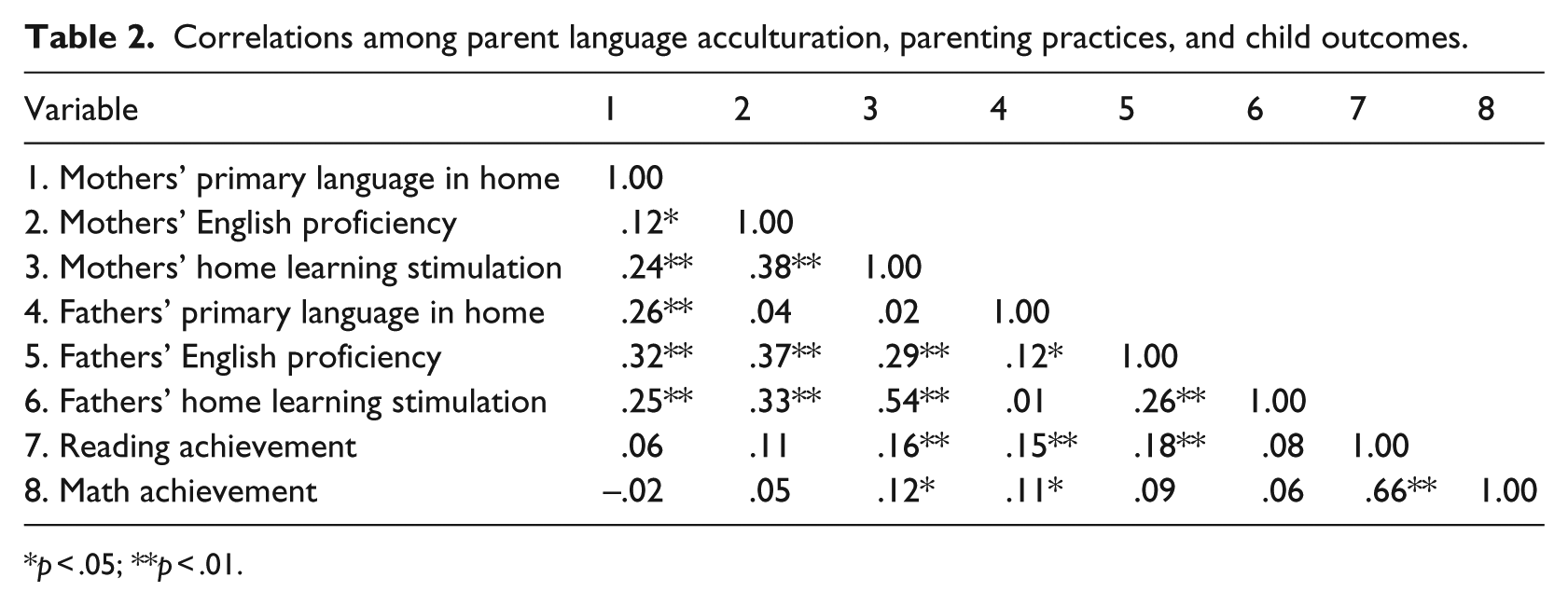
p < .05; **p < .01.
Hierarchical regression analysis predicting reading achievement
In the hierarchical regression analysis predicting preschool reading achievement, demographics were entered into Step 1. Child age (β = .21, p ⩽ .01), mother education (β = .20, p ⩽ .01), and fathers’ immigration status (β = .09, p ⩽ .05) were positively associated with children’s reading achievement. Parent language acculturation variables were entered in Step 2 and significantly contributed to the model (ΔR2 F = 9.70, p < .0001). Specifically, mothers’ primary language in the home (β = .13, p ⩽ .05), fathers’ primary language in the home (β = .12, p ⩽ .05), and fathers’ English proficiency (β = .19, p ⩽ .01) were positively associated with children’s reading achievement. Parenting practices were entered in Step 3 and significantly contributed to the model (ΔR2 F = 7.80, p < .0001). Mothers’ home learning stimulation was positively associated with children’s reading scores (β = .25, p ⩽ .01). The full model, including all predictors, accounted for 22 percent of the variance in children’s preschool reading achievement (F = 18.58, p < .01; see Table 3).
Summary of hierarchical regression analysis predicting preschool reading achievement.

SE: standard error.
p < .05; **p < .01.
Hierarchical regression analysis predicting math achievement
In the hierarchical regression analysis predicting preschool math achievement, demographics were entered into Step 1. Child age (β = .35, p ⩽ .01), mother education (β = .23, p ⩽ .01), father education (β = .08, p ⩽ .05), and family income (β = .08, p ⩽ .01) were positively associated with children’s math achievement. Parent language acculturation variables were entered in Step 2 and significantly contributed to the model (ΔR2 F = 10.41, p < .0001). Specifically, mothers’ English proficiency (β = .11, p ⩽ .01) and fathers’ English proficiency (β = .13, p ⩽ .01) were positively associated with children’s math scores. Parenting practices were entered in Step 3 and did not significantly contribute to the model. The full model, including all predictors, accounted for 22 percent of the variance in preschool math achievement (F = 29.01, p < .01; see Table 4).
Summary of hierarchical regression analysis predicting preschool math achievement.
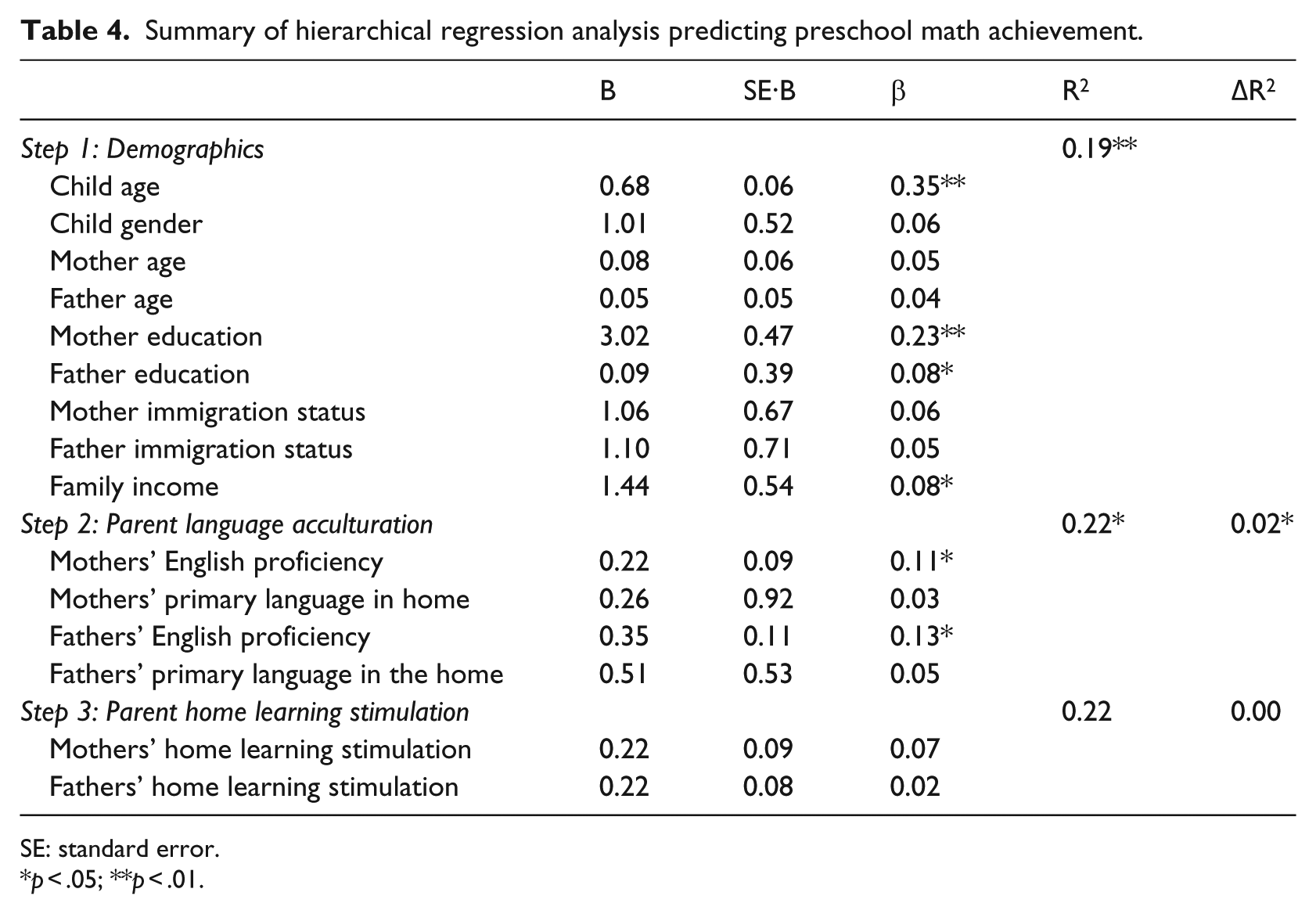
SE: standard error.
p < .05; **p < .01.
Discussion
The primary aim of this study was to understand predictive relations among fathers’ and mothers’ language acculturation, parenting practices, and Mexican American children’s academic readiness. Two novel findings emerged from this study. First, fathers’ and mothers’ language acculturation predicted children’s reading and math achievement after controlling for demographics. Second, mothers’ home learning stimulation predicted children’s reading achievement above and beyond parents’ language acculturation. The remainder of this discussion explores the implications of these findings as well as how the pattern of results differs across the two indicators of academic readiness (i.e. reading and math).
Parent language acculturation, parenting practices, and children’s academic readiness
The first key finding in this study was that fathers’ English proficiency predicted children’s reading and math achievement. These findings are consistent with prior research that has focused exclusively on Mexican American mothers. For example, Baker (2014) found that Mexican American mothers who were more proficient in English had children with higher reading scores in preschool compared to Mexican American mothers who were less proficient in English. One possible explanation for the present finding is that fathers with stronger English language skills are more likely to pass these skills along to their children, which may strengthen children’s reading and math skills during early childhood. In addition, fathers with stronger English skills may be more effective teachers of key cognitive skills that are needed to succeed on American standardized tests. However, more research is needed to fully understand these findings.
The second key finding in this study was that fathers’ and mothers’ primary language in the home predicted children’s reading achievement, but not math. These findings are consistent with prior longitudinal research that has focused on mothers of older Hispanic children. For example, Colon-Papazoglou (1999) found that Hispanic mothers’ primary language in the home was related to children’s vocabulary scores, but not math in grades 1 through 4. The present findings are also consistent with ecological theory, which emphasizes the importance of home language environments for children’s literacy-related skills prior to school entry (Bronfenbrenner and Morris, 1998). One possible explanation for the present finding is that fathers and mothers who speak English as their primary language in the home may also teach new cognitive skills in English, which increases children’s familiarity with English and strengthens their language and literacy-related skills. Increased exposure to English in the home may also increase children’s use of English prior to preschool. It is possible and quite likely that Mexican American children who are required to use English to communicate with their fathers and mothers in the home will enter preschool with stronger English language skills, which could translate into higher reading scores. Therefore, it is not surprising that children in this study who had more frequent exposure to English (from both fathers and mothers) outperformed children with less exposure to English on preschool reading tests.
The third key finding in this study was that maternal home learning stimulation made a unique contribution to children’s reading achievement after the influence of parent language acculturation was statistically accounted for. To my knowledge, this is the first study to demonstrate that maternal home learning stimulation matters above and beyond parent language acculturation in Mexican American families. These findings are in line with theoretical and empirical work, which suggest that the social transmission of knowledge from parent to child is especially salient prior to school entry when parents serve as the primary teachers of their young children (Baker& Rimm-Kaufman, 2014; Bronfenbrenner and Morris, 1998). Developmental theorists argue that parents who provide appropriate scaffolding and work within the child’s zone of proximal development during home learning activities (e.g. shared book reading) can enhance learning and development in a variety of cognitive domains (Vygotsky, 1987). Data from this study provide some support for these suppositions and suggest that mothers’ provision of home learning stimulation may be an important way to strengthen Mexican American children’s academic readiness.
Somewhat surprisingly, mothers’ home learning stimulation predicted children’s reading achievement, but not math. These results imply that working with numbers to complete math problems requires a different and unique set of skills that are not usually acquired during parent–child literacy activities. Thus, future research with Mexican American families should investigate a broader set of home learning activities (e.g. playing counting games) that may promote children’s math-related development during preschool. Notably, the lack of findings for Mexican American fathers’ home learning stimulation stands in contrast to recent research that has focused on African American and Caucasian fathers. For example, Baker (2013) linked African American and Caucasian fathers’ participation in home learning stimulation to children’s reading and math scores after controlling for demographics. Data from this study suggest that these findings are not completely generalizable to Mexican American fathers. Finally, it is important to note that demographic characteristics also contributed to children’s academic readiness. In particular, child age and maternal education were the strongest and most consistent predictors of children’s reading and math achievement (as evidenced by the effect sizes). These findings advance ecological models of child development that suggest that who parents are (maternal education) as well as what they do (maternal home learning stimulation) have a powerful influence on child achievement during the early childhood years.
In sum, data from this study support the premise that parent language acculturation matters for child achievement in Mexican American families. These findings also highlight the need for more culturally responsive research with linguistically diverse families. Future research with Mexican American families should explore the role of fathers’ and mothers’ language acculturation in shaping their children’s developmental trajectories over time (i.e. across middle childhood and adolescence). One promising avenue for future research involves examining whether and how fathers’ and mothers’ language acculturation is associated with ethnic identity development and social emotional skills across middle childhood.
Implications
Two important implications may be drawn from this study. First, the findings from this study suggest that fathers’ and mothers’ language acculturation is an important consideration in Mexican American families. Yet, language support services are often missing from early interventions with linguistically diverse families. Moreover, interventions too often focus on mothers and ignore fathers. Data from this study suggest that programs and policies that target Mexican American families should implement strategies that strengthen fathers’ and mothers’ language skills while increasing the amount of English language exposure that Mexican American children have prior to school entry. Second, maternal home learning stimulation predicted children’s academic readiness above and beyond parents’ language acculturation. Thus, family literacy programs may be an important way to enhance Mexican American children’s academic readiness. These programs should provide support to parents by way of resources (e.g. children’s books) and programs (e.g. school sponsored literacy initiatives). This could be an opportunity for families and schools to collaborate and build lasting connections that will reinforce each other’s commitment to improving children’s early achievement and success.
Limitations and future directions
Given the paucity of focused research on Mexican American families, the results from this study provide much needed information. However, some limitations require mention. First, this study did not include a formal measure of language acculturation, and information on parent language acculturation was only collected during the 9-month wave. It is possible that unmeasured acculturation variables contributed to child achievement. It is also possible that parents’ language acculturation could have changed between 9 and 24 months data collection. Second, parenting was limited to parent-reported home learning activities. This narrow conceptualization does not provide a comprehensive picture of what mothers and fathers do with their children prior to school entry. Relatedly, parent-report measures likely differ from information that would have been obtained from trained, unbiased observers, and these measures often reflect social desirability. Third, this study utilized a cross-sectional design. Future research with Mexican American families should utilize a validated measure of acculturation, focus on multiple dimensions of parenting, and examine whether key findings persist over time.
Footnotes
Declaration of Conflicting Interests
The author(s) declared no potential conflicts of interest with respect to the research, authorship, and/or publication of this article.
Funding
The author(s) received no financial support for the research, authorship, and/or publication of this article.