







Abstract
In 1998, Sturrock and Else introduced the Play Cycle which has been integrated into both playwork theory and practice. An online survey with 157 responses found that playworkers’ understanding Play Cycle varied to how they were first introduced to the theory. In addition, understandings of the six elements of the Play Cycle were significantly different from the original author’s definitions. To provide a more consistent use of the Play Cycle in both future research and practice, this article offers new definitions for each element of the Play Cycle based on the results from this study. This has implications for any childhood setting where the Play Cycle is used, including playgroups, nurseries and out of school provision catering for primary-aged children.
Introduction
In 1998, the late Gordon Sturrock and the late Perry Else presented a theoretical paper at the International Play Association Conference in Colorado, USA. The paper was titled ‘The playground as therapeutic space: playwork as healing’ and it introduced the Play Cycle to playwork theory. Else (1999) stated ‘pscyholudics, the study of the mind at play, is an attempt to describe the process of play so that it can be more easily understood for training and research purposes’ (p. 121
It is evident the Play Cycle has contributed to childhood play through playwork theory, practice and research, for example, Brown and Taylor (2008), Russell et al. (2007) and Besse-Patin et al. (2017). However, there is no empirical evidence on whether or how the Play Cycle is understood by playwork practitioners in respect to any childhood provision. This article provides the first empirical study on playworker’s understanding of the Play Cycle with respect to their current playwork role, years of playwork practice and highest playwork qualification. This exploratory study is in two parts. The first asked playworkers how they were introduced to the Play Cycle and the second finds out playworker’s understanding of the six components of the Play Cycle.
Methodology
This study was granted ethical approval by the ethics committee within the College of Human and Health Science at Swansea University. An online survey was developed using the Qualtrics® questionnaire tool and was piloted with two playwork teams in Wales in August 2017. After minor modifications, the survey was made available between September and December 2017 and was circulated through a range of methods including databases, local and national playwork networks and social media. The survey was open to all playworkers currently working in playwork worldwide. This included playwork practitioners, playwork trainers, playwork lecturers and volunteers. The total number of participants completing the online survey was 157, where 41 of the respondents were practitioners, 2 were volunteers, 9 were students, 21 were playwork trainers, 17 were playwork development officers, 57 were playwork managers and 10 worked either in further education or higher education.
The survey was divided into three main components:
Demographics. Current playwork practice; years of service and level of qualification;
Understanding of the Play Cycle. How playworkers were introduced to the Play Cycle and their current understanding of the components of the Play Cycle (meta-lude; play cue; play return; play frame; loop and flow and annihilation);
Potential influence of the Play Cycle. This included the adult role in the Play Cycle and if the theory has influenced playwork practice.
This article focuses on the second area of investigation, the understanding of the Play Cycle. First, playworkers were asked to tick a box on how they were first introduced to the Play Cycle from a list of responses and provide specific details through an open-ended question. The responses were analysed using descriptive statistics and undertaken a thematic analysis developed by Braun and Clarke (2006), which has been used in other qualitative playwork studies, for example, King and Waibel (2016). Second, playworkers were asked to also explain what they thought each component of the Play Cycle meant without referring to any playwork text or website. No definitions were provided, just a box enabling playworkers to type their response for each element of the Play Cycle.
The second part of the study involved a content analysis as outlined by Cole (1988) to determine how playworkers understood the individual elements of the Play Cycle. Elo and Kyngas (2007) describe a content analysis as ‘a research method for making replicable and valid inferences from data to their context’ (p. 108). The numerical count enables quantitative analysis from qualitative data as outlined by Bernard and Ryan (2010). Elo and Kyngas (2008) identify two types of content analysis: inductive and deductive. This study used the deductive content analysis as outlined by Marshall and Rossman (1995), which enables the testing of categories from a categorisation matrix. Elo and Kyngas (2008) explain how a categorisation matrix uses themes or categories which are then used to code the data. A categorisation matrix was developed from the review of the Play Cycle literature. In addition to the content analysis, Pearson’s chi-square test for association, based on Ugoni and Walker (1995), was used to investigate any relationship between the components of the Play Cycle with years of practice and highest playwork qualification. The third part of the survey relates to what playworkers had read about the Play Cycle.
Part 1: how playworkers were first introduced to the Play Cycle
Playworkers were asked to state where they first heard of the Play Cycle and this is shown in Graph 1.
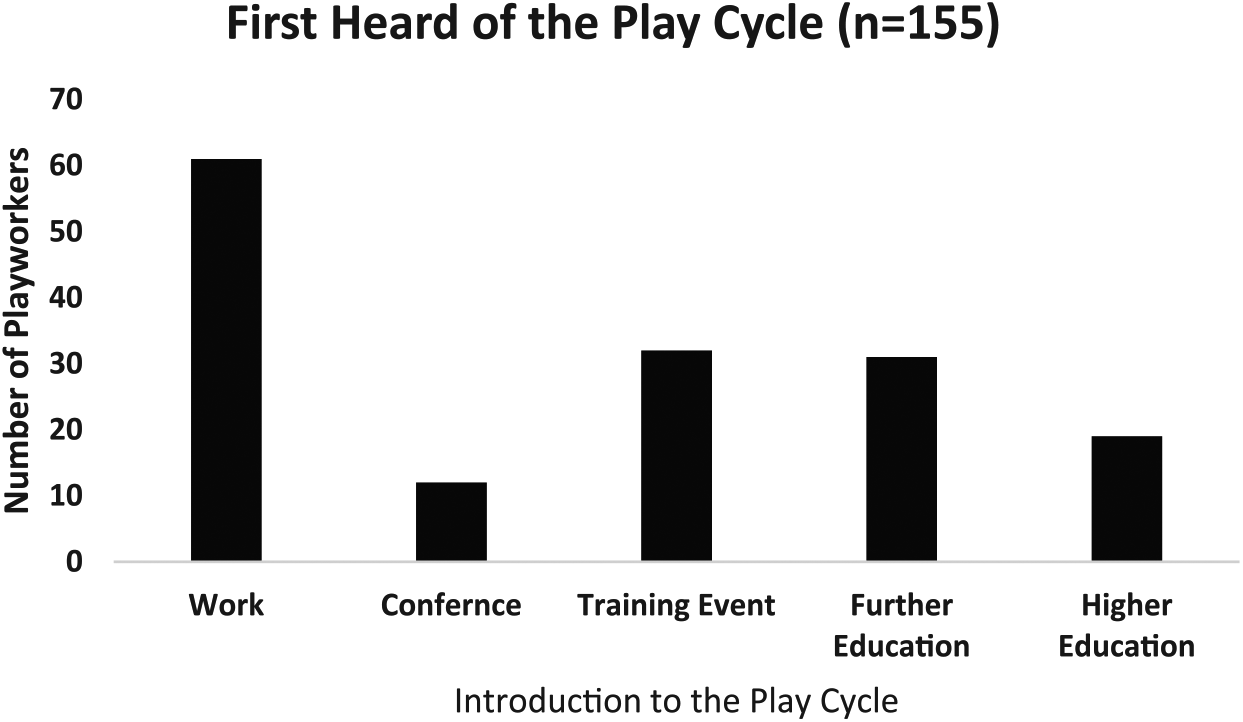
Playworkers and how they first heard of the Play Cycle.
Most playworkers had first heard of the Play Cycle through work, followed by attending a training event or studying a further education course. In addition, playworkers were asked to provide more details of their first introduction to the Play Cycle, which were coded and analysed using the framework by Braun and Clarke (2006). The initial data were read through by one of the researchers and initial codes were generated. The initial codes were then re-read and joined together to form themes and sub-themes. The next stage involved the second researcher who independently read through the responses and coded using the themes generated, as well as identifying any new initial codes or themes. If the second researcher felt the themes were not relevant, or needed adjusting and changing, then the process of developing themes was repeated by researcher 1. Once this was finished, then researcher 2 reviewed the themes. This process continued until agreement of themes was reached.
When the themes were agreed, a final coding of the data was undertaken independently by both researchers to get a comparative frequency count for each theme. This is not to be confused with inter-rater reliability (see later), but to compare how often each researcher coded for each theme. The equation used was the number of scores for the theme/total number of scores × 100 and the percentage score for each researcher was compared. If the comparative frequency percentage was wide apart (greater than 10%), then the data were re-analysed and re-coded. When an agreed comparative frequency for each theme was less than 10 per cent different, then an inter-rater reliability using Cohen’s Kappa (k) statistical test was undertaken. Initial inter-rater reliability, or what Shenton (2004) terms ‘member checks’ (p. 68) is a like for like statistical test comparing a like for like score for each participant response.
Cohen’s Kappa (k) inter-rater reliability statistical test compares scores from two independent researchers. Unlike finding out a comparative frequency score when compiling the themes, Cohen’s Kappa (k) compares each researcher coding for each response to see if they agree or disagree. It therefore enables a like for like comparison between two independent raters. McHugh’s (2012) account of Cohen’s Kappa (k) describes a score from −1 to +1 is obtained, where +1 is a perfect agreement between each rater. Landis and Koch (1977) provide a guide to Cohen’s Kappa value, where <0 is a poor agreement, 0.0–0.20 is a slight agreement, 0.21–0.40 is a fair agreement, 0.41–0.60 is a moderate agreement, 0.61–0.80 is a substantial agreement and 0.81–1.00 is an almost perfect agreement.
Results
The thematic analysis on how playworkers were first introduced to the Play Cycle began when 126 participants had completed the online survey. Nineteen initial codes were initially identified and these were placed within 10 themes. However, a comparative frequency check for each theme between both researchers showed a huge variation for each theme. After going back to phases 2, 3 and 4 of Braun and Clarke’s (2006) framework, five new themes were developed: in-house training; external training; coursework; self-initiated and none. From the 126 responses where the thematic analysis and Kappa inter-rater reliability was undertaken, the remaining 31 responses were placed within the five themes that were generated. No new codes or themes emerged, suggesting that the data had reached saturation point. The comparative frequency for each theme per researcher along with the sub-themes is shown in Table 1.
Comparative frequency count for themes.
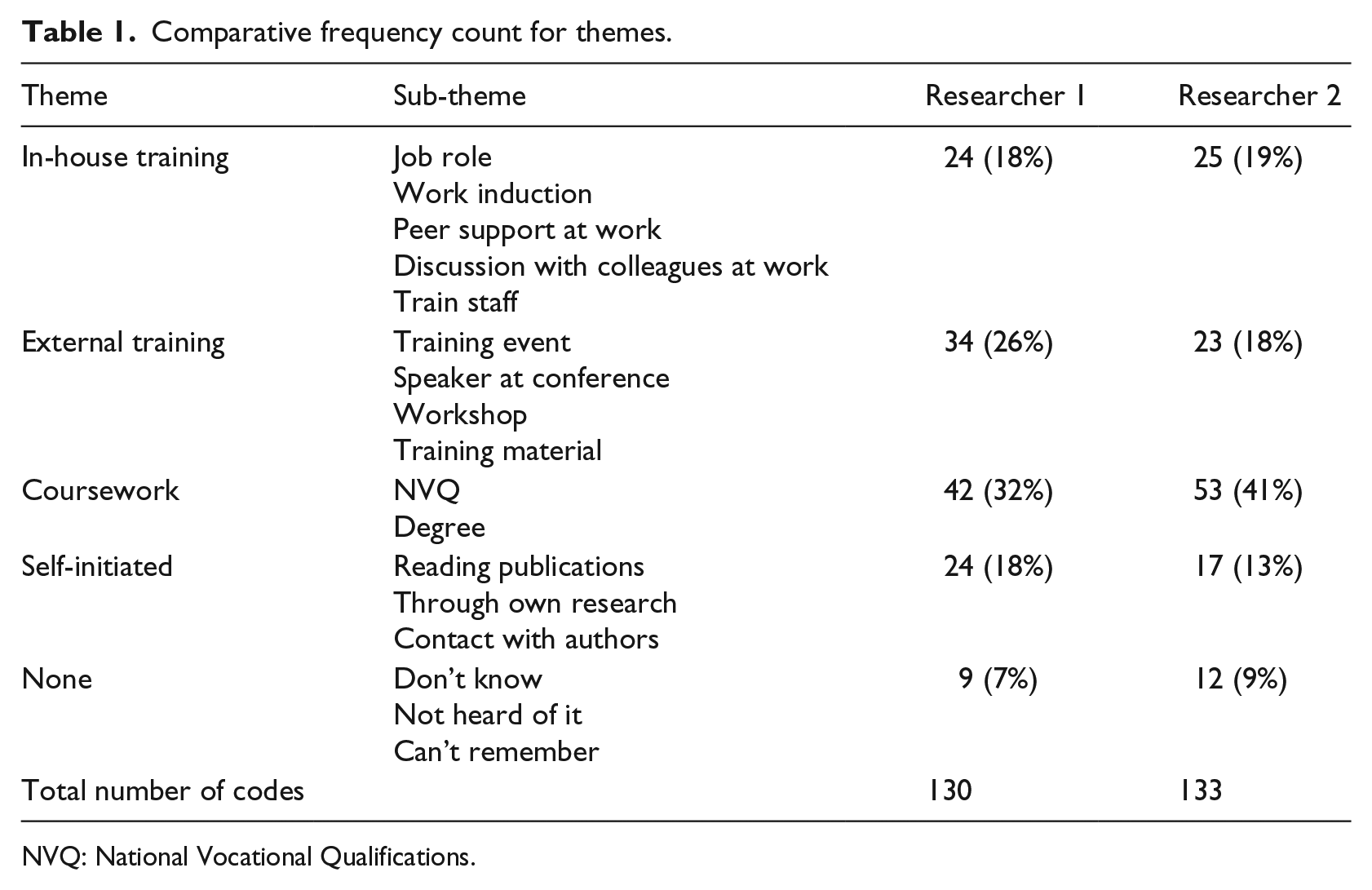
NVQ: National Vocational Qualifications.
As this was not an inter-rater reliability test, but a frequency check on how often each theme appeared by both researchers, inter-rater reliability tests were then undertaken. For inter-rater reliability, Cohen’s Kappa (k) statistical test was undertaken for responses that could be placed in single themes. The inter-rater reliability for the two raters was found to be Kappa = 0.85 (p < 0.001), 95 per cent CI (0.78, 0.92), which suggests a near-perfect agreement.
The most commonly stated introduction to the Play Cycle was in-house training through work, and participants reported several different methods, including being part of the job role, part of the induction process, peer support at work and discussion with colleagues or those responsible for delivering training to staff. External training was another way in which playworkers were introduced to the Play Cycle. Participants reported various delivery methods, such as formal training events, reading training material, attending workshops or listening to speakers at conferences, including those delivered by the authors of the Play Cycle. The Play Cycle was also first introduced through coursework studies at levels 2 or 3 (National Vocational Qualifications (NVQ)) or level 4 and above on a university course. One final theme is ‘self-initiated’, which related to playworkers learning about the Play Cycle through their own interest, rather than being compelled to do so to meet work or study requirements.
Part 2: playworkers’ understanding of the Play Cycle
The Play Cycle consists of six components: meta-lude; play cue; play return; play frame and annihilation as outlined in Sturrock and Else’s (1998) ‘The Colorado Paper’. The main aspect of each part of the Play Cycle is:
Meta-lude. Higher form of play and moment of reverie (daydreaming);
Play cue. The signal for the world to engage with the child’s developing sense of self and reality;
Play return. The return is a response to the child’s play intentions;
Loop and flow. The play is ‘processed’ back into the internal play space;
Play frame. A child initiated, non-material, constraint or boundary that helps define and give meaning to play;
Annihilation. The play frame has lost meaning.
Many of these terms have existed in published text prior to the ‘Colorado Paper’, for example, play cues and play frames (Bateson, 1955, 1972); and flow (Csikszentmihalyi, 1975). For a more detailed account of published theories and research related to each aspect of the Play Cycle, see King and Sturrock (2019).
A literature review of playwork-related textbooks and training resources was undertaken on how the six components of the Play Cycle were explained. Nineteen sources were consulted, including separate papers by the original authors both before and after the ‘Colorado Paper’, training programmes, for example, Stobart (1998), playwork books supporting NVQ, for example, Farrow et al. (2003), books supporting playwork practice such as Kamen (2005), books on play, for example, Else (2009, 2014); and Howard and McInness (2013), Kilvington and Wood’s (2010) book on ‘Reflective Playwork Practice’ and Conn’s (2016) textbook on ‘Play and Autism’. These texts contained 12 different explanations of the meta-lude, 16 for the play cue, 13 for the play return, 15 for the play frame, 15 for loop and flow and 10 for annihilation.
When comparing these different explanations of the six components to the original definitions provided in the Colorado Paper, similarities were found between the secondary sources to the extent that they could be divided into two main groups (variations 1 and 2), as shown in Table 2.
Two variations on the original explanations of the six components of the Play Cycle.
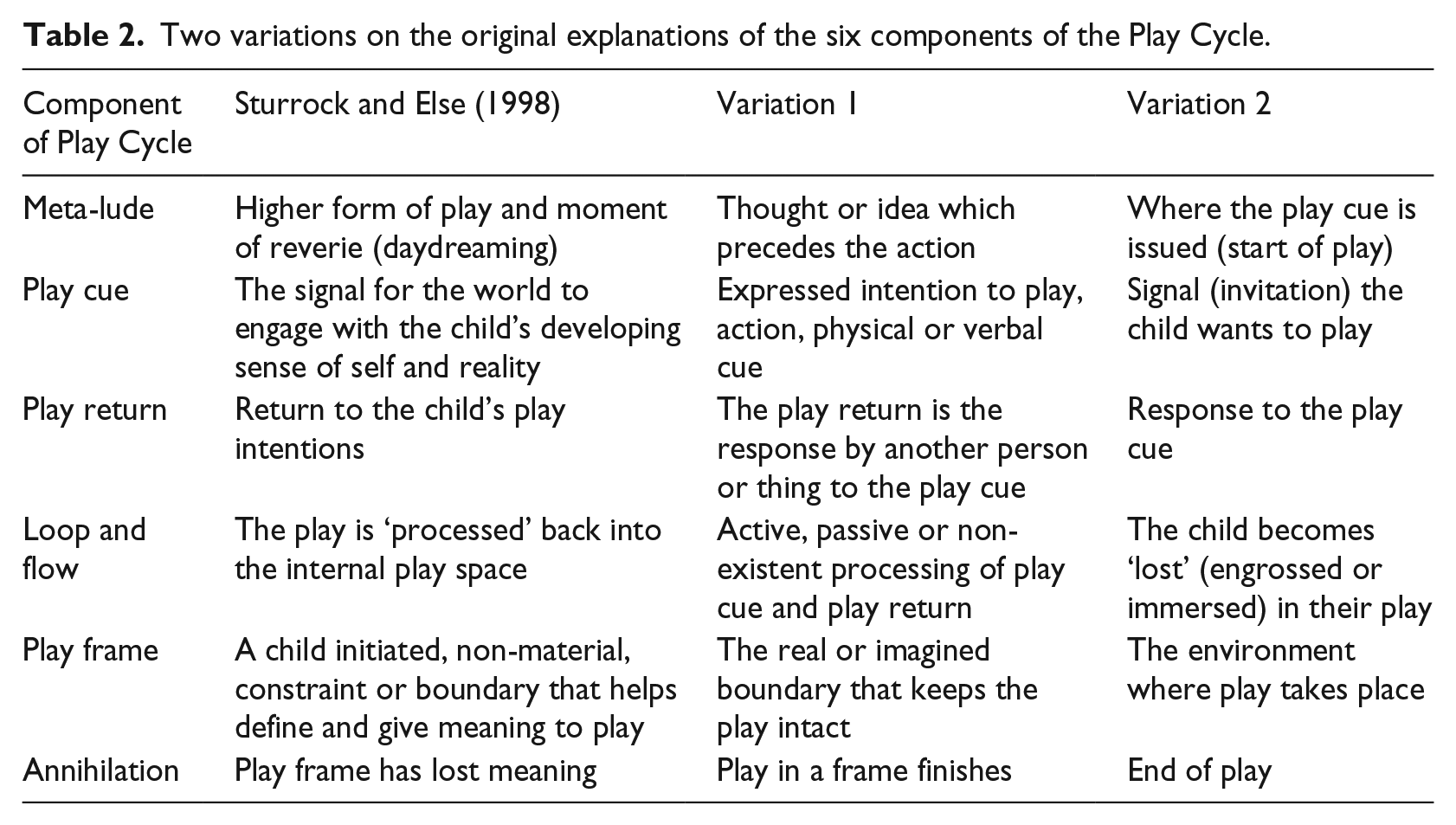
For the content analysis for each part of the Play Cycle, a fourth column was added to this table to produce a categorisation matrix. The categorisation matrix consisted of three explanations for each component of the Play Cycle: original (from the ‘Colorado Paper’), variation 1 and variation 2. The additional column of ‘None’ was added for any responses that did not fit into any of the other categories.
Results
For each component of the Play Cycle, the responses were read independently by the two researchers and coded using the relevant categorisation matrix so that a content analysis could be undertaken by obtaining a numerical count for each definition within each component of the Play Cycle. Once this was completed, the coding of the data to the categorisation matrix was compared for inter-rater reliability using Cohen’s Kappa statistical test.
The inter-rater reliability for the two coders for each element of the Play Cycle was:
Meta-lude. Kappa = 0.58 (p < 0.001, 95% CI (0.46, 0.70)) indicates a moderate inter-rater agreement;
Play cue. Kappa = 0.76 (p < 0.001, 95% CI (0.66, 0.86)) indicates a substantial inter-rater agreement;
Play return. Kappa = 0.61 (p < 0.001, 95% CI (0.50, 0.72)) indicates a moderate inter-rater agreement;
Play frame. Kappa = 0.79 (p < 0.001, 95% CI (0.70, 0.88)) indicates a substantial inter-rater agreement;
Loop and flow. Kappa = 0.74 (p < 0.001, 95% CI (0.63, 0.85)) indicates a substantial inter-rater agreement;
Annihilation. Kappa = 0.60 (p < 0.00195% CI (0.468, 0.735)) indicates a moderate inter-rater agreement.
From Cohen’s Kappa results, the remaining 31 responses were coded into the categorisation matrix. All 31 responses were coded and no anomalies were present. The coded responses for the elements of the Play Cycle showed:
Most playworkers did not know or provided a different definition of the meta-lude;
Playworkers’ understanding of the play cue was either in variations 1 or 2, rather than the original definition;
Most responses for the play return were coded as variation 2;
Most playworkers did not know or provided a different definition for the loop and flow;
Responses were either coded for variation 1 or did not know what the play frame was;
Most playworkers’ understanding of the annihilation fell into variation 2.
It was also found that there was clear variation both within and between the six aspects of the Play Cycle. Over half the responses understanding of the loop and flow did not fit into any of the four categories within categorisation matrix.
Chi-square analysis
Once the coding within the categorisation matrix had been agreed for each component of the Play Cycle, quantitative data analysis was undertaken using Pearson’s chi-square analysis of association for each component of the Play Cycle. Three nominal groups were used for the chi-square cross tabulations: years of practice where two nominal groups were used of 0–7 years and 8+ years; current role with three nominal groups of playwork practitioner, playwork educator and management and development and highest playwork qualification. Three nominal groups were used: no playwork qualification; up to level 3 and between levels 4 and 8. Using the nominal (categorical) variables developed for years of practice, current playwork role and highest playwork qualification and the three categories from the categorisation matrix (variation 1, variation 2 and none), the following chi-square tests were undertaken for each component of the Play Cycle:
Meta-lude and years of practice, current playwork practice and highest playwork qualification;
Play cue and years of practice, current playwork practice and highest playwork qualification;
Play return and years of practice, current playwork practice and highest playwork qualification;
Play frame and years of practice, current playwork practice and highest playwork qualification;
Loop and flow and years of practice, current playwork practice and highest playwork qualification;
Annihilation and years of practice, current playwork practice and highest playwork qualification.
When undertaking Pearson’s chi-square test for association, the expected count for each cell must have a count or score of 5 or more per category. If more than 20 per cent of all the categories expected are values less than 5, then the chi-square test is violated and the test is invalid. Each of the six components of the Play Cycle had very low scores in the original category (observed count) and when undertaking the chi-square, each of the six components had cells with more than 20 per cent of a value were less than 5. It was decided to remove the original category, and run the chi-square with variation 1, variation 2 and none categories only. This resulted in a chi-square for the categorisation matrix and years of practice (3 × 2 table), current playwork role (3 × 3 table) and highest playwork qualification (3 × 3 table) were undertaken.
The effect size for each Pearson’s chi-square test was obtained using Cramer’s V test. The effect size was small up to a value of 0.2, medium up to 0.3 and large if 0.5 or over. In addition, post hoc adjusted residue analysis was also undertaken. Residue analysis ‘identifies those specific cells making the greatest contribution to the chi-square test result’ (Sharpe, 2015: 2), where ‘A residual is the difference between the observed and expected values for a cell. The larger the residual, the greater the contribution of the cell to the magnitude of the resulting Chi-Square obtained value’ (p. 2). A residual value above 2.0 or below −2.0 indicated which nominal (categorical) variables have the strongest relationship.
From the series of chi-square analysis undertaken, there was no significant difference with respect to current playwork role and any element of the Play Cycle. However, there was a significant difference between years in practice and the meta-lude; highest playwork qualification and the play cue and years working in playwork and the play frame.
Years in playwork and the meta-lude and the play frame
There is a significant relationship between understanding of the meta-lude and years in playwork, χ2 (2, N = 150) = 8.33, p < 0.015. Post hoc analysis indicates that playworkers working between 0 and 7 years are less likely to code the meta-lude to variation 1 (adjusted residue −2.7), whereas they are more likely to not know what the meta-lude means or provide a different interpretation (adjusted residue 2.8). Playworkers working more than 8 years, were more likely to code the meta-lude to variation 1 (adjusted residue 2.7) but less likely to not know or provide a different interpretation (adjusted residue −2.8). Cramer’s V is 0.24 and has a small size effect.
There is a significant relationship between understanding of the play frame and years in playwork, χ2 (2, N = 150) = 9.01, p < 0.011. Playworkers with 0–7 years of playwork practice are less likely to define the play frame to variation 1 (adjusted residue −2.9), while playworkers with 8 years or more experience were more likely to define to variation 1 (adjusted residue 2.9). Cramer’s V is 0.24 and has a small size effect.
There is a significant relationship between understanding of the play cue and highest playwork qualification, χ2 (4, N = 156) = 15.34, p < 0.04. Playworkers with no playwork qualification are less likely to define the play cue to variation 1 (adjusted residue −2.4), but more likely to have either no understanding or provide a different definition (adjusted residue 3.1). Playworkers with up to level 3 qualification, they are more likely to define the play cue to variation 1 (adjusted residue 2.2), while playworkers up to level 8 qualification were less likely to have no understanding or provide a different definition of the play cue (adjusted residue −2.3), where Cramer’s V is 0.22 and has a small size effect.
Part 3: playwork publications and the Play Cycle
The final question on the survey asked if any of the playworkers had read any published work on the Play Cycle. The responses from the participants can be placed into the following groups:
The original ‘Colorado Paper’, or publications that replicated the original paper, for example, ‘Therapeutic Playwork Reader 1’ by Else and Sturrock (2006) or ‘Reflective Playwork’ by Kilvington and Wood (2010);
The published NVQ/Scottish and National Vocational Qualifications (SNVQ) course books, for example, Farrow et al. (2006);
Theoretical playwork books or books on play that feature the Play Cycle, for example, Brown (2002), Else (2008) and Hughes (2002);
Training material such as ‘Take 10 for Play’, for example, Stobart (1998);
Nothing had been read.
Other sources such as websites (e.g. Oxford Play Association) or online magazines (e.g. IpDiP) were also mentioned.
Results
The chi-square analysis showed no relationship with current playwork role with any of the six elements of the Play Cycle. For this reason, a count of publications read was only undertaken in relation to years of practice and with highest playwork qualification with the meta-lude and play frame was found for the former, and with the play cue for the latter. These are shown in Tables 3 and 4.
Publications read in relation to the Play Cycle and years of playwork experience.
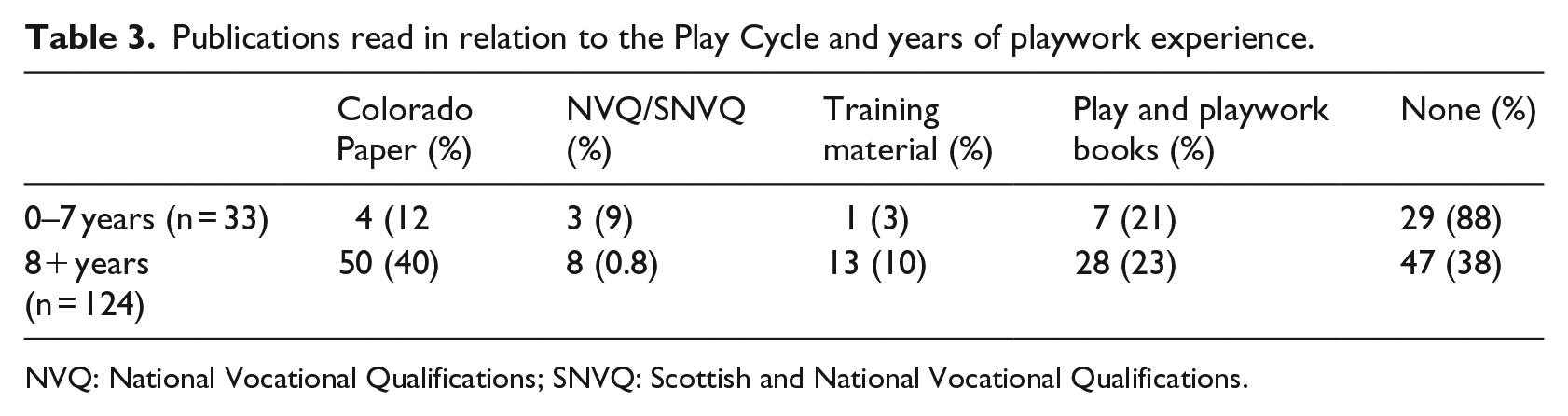
NVQ: National Vocational Qualifications; SNVQ: Scottish and National Vocational Qualifications.
Publications read in relation to the Play Cycle and years of highest playwork qualification.
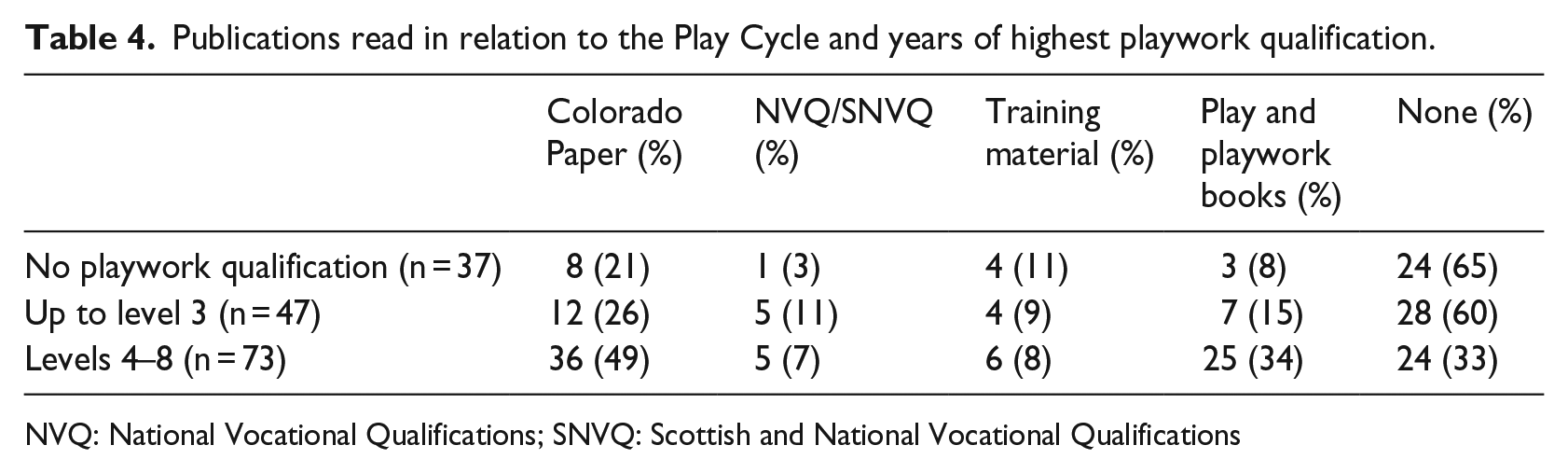
NVQ: National Vocational Qualifications; SNVQ: Scottish and National Vocational Qualifications
Table 3 shows from the publications cited, playworkers with 0–7 years of experience, 88 per cent of respondents (n = 33) had not read anything on the Play Cycle or more likely to have read the Play Cycle in a secondary text in conjunction with the ‘Colorado Paper’. Playworkers with 8+ years of experience (n = 124), 40 per cent and read the ‘Colorado Paper’ compared with 38 per cent who have not read any published text. In addition, again in conjunction with the ‘Colorado Paper’, many playworkers had read secondary texts as well.
Table 4 shows that playworkers with levels 4–8 qualification are more likely to have read the Colorado Paper, or at least a published text which covers the topic. This would reflect the use of the ‘Colorado Paper’ in both undergraduate and postgraduate degree courses, using supporting texts such as ‘Playwork: Theory and Practice’ (Brown, 2002) and ‘Making Sense of Play’ (Else, 2008). Playworkers with either no playwork qualification or up to level 3 qualification are more likely not to read any published texts.
Tables 3 and 4 indicate that playworkers with 8+ years of playwork experience and who have studied a level 4 or above playwork qualification are more likely to have read the ‘Colorado Paper’, than a play/playwork-related textbook which could relate more to a higher education course, compared with specific NVQ-related texts which are more focused to further education courses. However, as shown with the development of the categorisation matrix from the published text, there is variation in explanation across all six aspects of the Play Cycle. This was summed up by one comment submitted on the online survey, ‘The list is pretty hard to define as every playwork publication has their own take on the play cycle’.
Discussion
The statistical analysis showed that there is a clear link between the way in which playworkers have learnt about the Play Cycle theory and their understanding of it. The fact that so many responses had not read the ‘Colorado Paper’ or any published texts on the Play Cycle reflected the lack of coding for each of the components of the Play Cycle to the original definitions. Playworkers with 0–7 years of playwork experience and/or no playwork qualification were more likely to have no, or a different interpretation of the meta-lude. Playworkers with 0–7 years of experience were more likely to understand the play frame in relation to variation 2, compared with 8+ years of experience understanding is more linked to variation 1, while playworkers with 8+ years of experience is less likely to have no understanding of the play cue, although nearly an equal number of playworkers in this group had read the ‘Colorado Paper’ compared with those who had read no published texts. Understanding of the components of the Play Cycle relating to variations 1 and 2 for the play cue and the play return may reflect the playworkers who have read the Play Cycle in secondary texts either in conjunction with the ‘Colorado Paper’ or with other published texts (e.g. NVQ/SNVQ or training material).
The statistics demonstrate the effect of a relatively new theory entering its second generation of application. When the Play Cycle was first introduced some 20 years ago, both authors frequently presented their work. However, the current generation of playworkers is more likely to be introduced to the theory at second or perhaps even third hand, rather than from contact with the authors themselves. This study demonstrates that the translations have deviated from the original definitions and created a variety of understandings of one of the central theories of playwork (or in some cases, no understanding at all). This could result in different applications and practices in the future, creating further contradictions in an already inconsistent emerging profession. This is summed up by Lester and Russell (2008), where they state ‘there is a need for more rigorous research into playwork practice and its relationship to theory’ (p. 38).
To provide consistent terminology on which to develop playwork training, research and practice, updated definitions of the Play Cycle were developed and discussed with the surviving author of the ‘Colorado Paper’. These revised definitions are based on the original definitions from the ‘Colorado Paper’, interpretations found within the published texts and training materials and the responses to the online survey (Table 5). The following definitions therefore reflect the original theoretical perspective as presented in the ‘Colorado Paper’ and playworkers’ current understandings and applications of the Play Cycle theory. Two significant changes are rather than using the words meta-lude and loop and flow, pre-cue and just the word flow are used.
Revised definitions of the meta-lude; play cue; play return; play frame; loop and flow and annihilation.
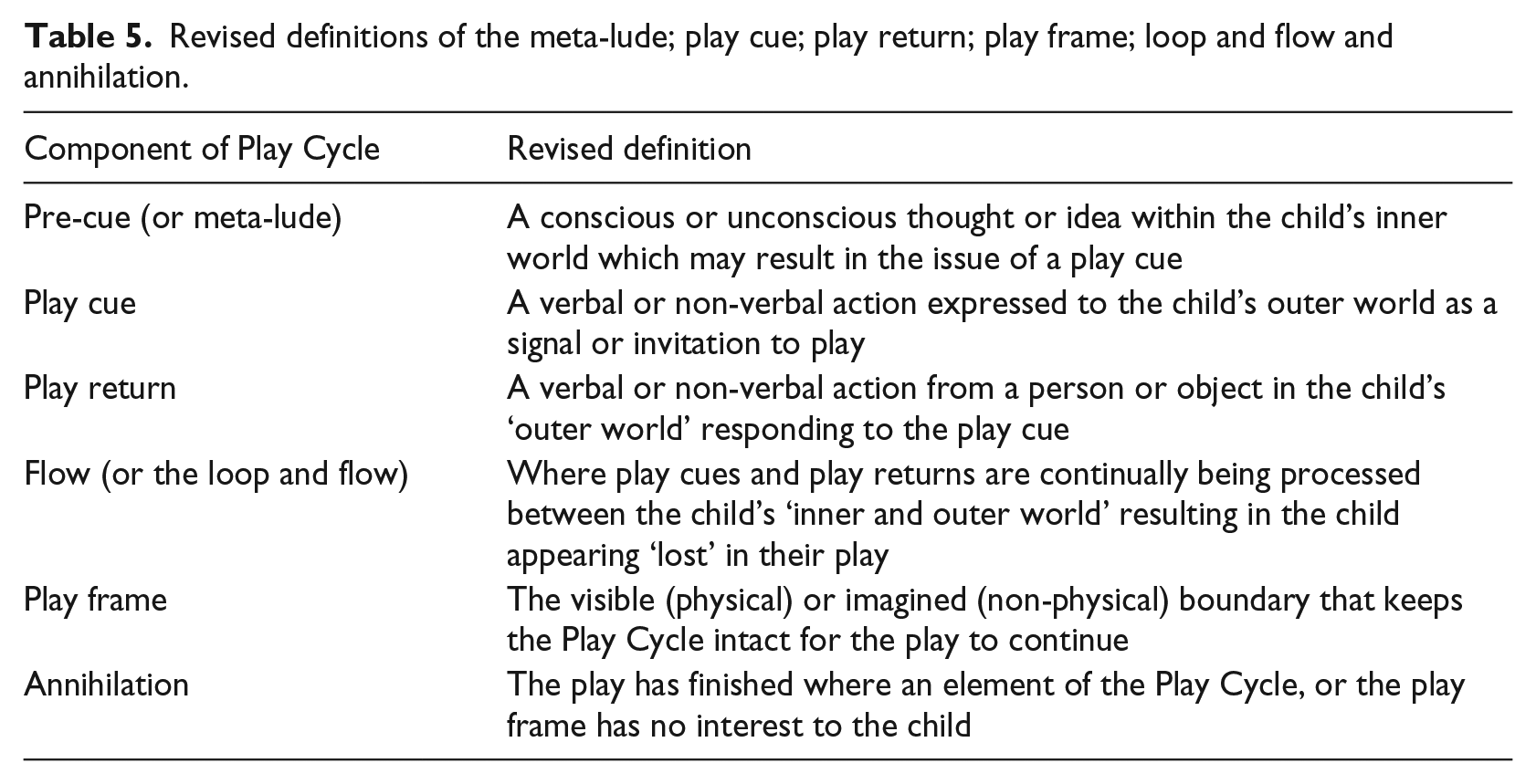
The development of a shared language and a consistent playwork lexicon has been an on-going battle for the playwork field for the last 70 years (Newstead, 2018). This study has shown how not only the Play Cycle theory itself, but also many of its constituent parts, have been re-interpreted and misinterpreted by those familiar with the work. The introduction of these revised definitions of the six elements of the Play Cycle some 20 years after the first publication of the ‘Colorado Paper’ could stimulate a re-engagement with the definitions of the observable elements of children’s play and enable playwork practitioners to develop a more coherent and consistent narrative about what they see when children play. This is particularly important at a time when the playwork field is struggling to define itself as a unique approach to working with children within the broader children’s workforce (King, 2015). A shared approach to defining and describing the playwork form of play, often characterised as ‘play for play’s sake’, would distinguish the playwork approach to children’s play from other more adult-centric approaches to describing play, such as play as learning or play as development.
Conclusion
Else (2014) stated, ‘A full explanation of the play cycle would take a book by itself’ (p. 68). This study is the first empirical study in relation to the Play Cycle and provides a contribution to playworkers’ understanding of it. Three aspects were considered: playworkers’ first introduction to the Play Cycle; playworkers’ understanding of each of the six components of the Play Cycle and what published texts had playworkers read on the subject. The statistical analysis showed that there is a clear link between the way in which playworkers have learnt about the Play Cycle theory and their understanding of it. New definitions which combine the original definitions developed 20 years ago, with contemporary playwork understandings and applications were developed. It is hoped that these definitions may be useful for developing consistent understandings and applications of the Play Cycle theory in future playwork practice, training and research. This would also apply to any setting where the Play Cycle is being used as an observation method, for example, playgroups and nurseries, as well as out of school provision catering for primary-aged school children. A clear understanding and interpretation of the Play Cycle can only improve professional practice.
