







Abstract
Informal caregivers (family, friends, and neighbors) spend many hours each week with the children in their care and can have a significant impact on the children’s social-emotional and academic development. Unfortunately, many informal caregivers lack the knowledge of how to do so. We conducted a qualitative 2-year study to investigate informal caregivers’ motivations, assets, and needs. The caregivers received text messages to help them support child development. In Year 1, we used interviews to better understand the needs of informal caregivers and potential opportunities to scaffold their interactions with the children. In Year 2, we expanded the program and invited informal caregivers to complete a survey to extend what we learned in Year 1. Both kin and non-kin informal caregivers are highly motivated to support children’s social and academic development and have adequate material resources to provide enriching educational environments for the children. However, we find that informal caregivers often lack information on useful practices to support child development. The text messages helped informal caregivers to overcome both informational and behavioral barriers to caregiving and supporting child development.
Introduction
Over 60 percent of the more than 20 million children under the age of 5 in the United States regularly receive non-parental care. Informal care (child care provided by family, friends, or neighbors (FFN)) is the most common type of child care arrangement (Douglass et al., 2017). Estimates of the number of children under the age of 5 who are in informal care range from 33 to 53 percent (Susman-Stillman and Banghart, 2008), and children from lower income families are more likely to have informal caregivers (Gordon et al., 2013; Shulman and Blank, 2007; Susman-Stillman and Banghart, 2008). In California, approximately 40 percent of children under the age of 5 are cared for by informal caregivers (Alarcon and Sangalang, 2015). The high rate of informal child care is a worldwide phenomenon. (Goulet, 1990) Despite the large number of informal caregivers, little is known about who they are, why they care for children who are not their own, and what their child care practices and routines are. Because they spend so much time with children, these caregivers have potential and opportunity to support young children’s social and early academic development (school readiness). This potential may not be met if they lack knowledge regarding how to provide high-quality, enriching experiences through their interactions with the children in their care.
Informal care differs from formal care in both positive and negative ways. On the positive side, informal caregivers are primarily family members (usually grandmothers or aunts) who offer more scheduling flexibility than formal care (Thomas et al., 2015a; Wheelock and Jones, 2002). They are trusted by the parents and have a shared cultural background and language (in California, primarily Spanish) with the parents and children (Porter and Kearns, 2005; Thomas et al., 2015a). These caregivers provide care with low caregiver-to-child ratios (often 1:1 or 1:2) and have warm, supportive relationships with the children (Bassok et al., 2016; Susman-Stillman and Banghart, 2011). On the negative side, children in informal care often develop more slowly than their counterparts in child care centers or at home with their parents (Layzer et al., 2006; Susman-Stillman and Banghart, 2011; Tout and Zaslow, 2006). Parents, staff at organizations that support children and families, and even informal caregivers themselves are concerned about the quality of care in informal care (Chang and Velazquez, 2015). Compared to formal caregivers, most informal caregivers have lower levels of education (Thomas et al., 2015b) and the quality of care provided by informal caregivers is frequently low (Bassok et al., 2016; Baxter et al., 2016; Porter et al., 2010; Thomas et al., 2015a, 2015b). For example, compared to children in formal programs, children in informal care tend to be read to less frequently, do fewer reading and math activities, and play fewer games or puzzles; instead, they tend to watch more television (Bassok et al., 2016). The current article describes informal caregivers’ responses to an intervention intended to help them support children’s early literacy and social-emotional skills as well as caregiver–child engagement.
Given the cumulative nature of virtually every aspect of human development—from brain development to the capacity for empathy—the quality of care children receive can have significant impact (Shonkoff and Phillips, 2000). Indeed, the current definition of school readiness includes children’s readiness and eagerness to learn upon kindergarten entry as well as parents’ and other caregivers’ attitudes toward children’s learning and development and their readiness to support it (Britto and Limlingan, 2012; High, 2008). This definition of school readiness provides a wholistic view of a child’s readiness with attention to the social relationships of caregivers, distinct from the school-readiness definitions and practices across the world, which have been critiqued for their limited view and ascription to child attributes (Pretti-Frontczak et al., 2016). Nonetheless, young children who do not experience responsive and stimulating care tend to score lower on assessments of motor, social, emotional, literacy, and numeracy skills than those who do (Bradley et al., 2001; Melhuish et al., 2008). These same children enter kindergarten with significant gaps in their social and academic skills (Cunha et al., 2006; Heckman and Carneiro, 2003). Such gaps put children at a significant disadvantage in school and beyond and are difficult to overcome later in life (Heckman, 2006).
At least five factors may contribute to the low quality of informal care. First, caregivers tend to see themselves as supporting the parents rather than as being responsible for teaching the children. As a result, they are strongly guided by the parents’ wishes and caregiving style (Chang and Velazquez, 2015), and many parents do not expect or encourage informal caregivers to help their children develop school-readiness skills such as literacy and social-emotional skills. Although many caregivers raised their own children, they often do not believe that they should make decisions regarding the care of children who are not their own and, as a result, may not seek out new information or ideas on child care (Chang and Velazquez, 2015). Second, many resources (such as webpages and library books) are available only in English, making them inaccessible for caregivers who do not read English (Chang and Velazquez, 2015). Third, caregivers may not understand the importance of developing early learning skills or know productive caregiving practices to support development. Lack of information and education (Bassok et al., 2016; Susman-Stillman and Banghart, 2008, 2011) may combine to limit the quality of caregiver–child interactions and to reduce (or eliminate) the educational activities that caregivers undertake. Fourth, supportive caregiving involves substantial decision-making around what to do and how to do it with the children in their care. Such vast choice creates substantial cognitive demand and can lead informal caregivers to default to activities with which they are most comfortable. As a result, informal caregivers are less likely to seek new opportunities to develop strong learning environments for children (Baxter et al., 2016; Iyengar and Lepper, 2000; York et al., 2018). Finally, high-quality caregiving requires consistent attention over a long period of time which can be difficult to sustain, especially when the benefits are not immediate. For example, when a caregiver reads a book to a child, the growth in the child’s literacy skills is not evident. In general, this kind of delay in gratification makes these kinds of activities less appealing to people and they engage in them much less than activities which provide more immediate rewards (Thaler and Sunstein, 2008). Also, the extrinsic rewards of providing informal care for the child of a friend or relative are often minimal. Most informal caregivers are paid little or nothing for the care they provide (Baxter et al., 2016; Thomas et al., 2015a).
The importance of early childhood development, the prevalence of informal caregivers, and the barriers these caregivers face to providing high-quality learning environments for children create a need to provide better resources for informal caregivers. Recommendations from recent research include providing support not linked to licensing requirements, empowering caregivers to see their role in children’s skill development by expanding or enhancing caregivers’ strengths, and incorporating everyday activities and routines in the caregiving experience (Alarcon and Sangalang, 2015; Chang and Velazquez, 2015; Thomas et al., 2015b). In addition, support needs to cover a wide variety of topics and take into account the low levels of education that is typical for many informal caregivers (Susman-Stillman and Banghart, 2011).
Our team designed the TIPS by TEXT-Informal Caregivers intervention to meet these recommendations by providing information and helping to overcome behavioral barriers that may prevent caregivers from acting on that information. The text messages, available in English or Spanish in Year 1 and in English, Spanish, Chinese, or Arabic for an expanded sample in Year 2, offer information about school-readiness skills that are important for children to develop as well as specific activities that help develop these skills and increase caregiver–child engagement. The specificity of the recommended activities, as well as the fun and ease of implementing them, helps overcome the barriers informal caregivers face in having to make many decisions and having to sustain attention on multiple activities over time. The text messages also emphasize the importance of the caregiver’s role in teaching children and include appreciation for the caregiver’s work, potentially providing some immediate gratification that may otherwise be lacking. Finally, because the program is not a one-time inoculation (like workshop-based interventions, for example), the intervention sustains interaction with the caregiver over multiple months or even years (at only a small cost), which may make it easier for caregivers to adopt the suggested caregiving activities over time. The TIPS by TEXT-Informal Caregivers curriculum was based on a similar program for parents of preschoolers. The parenting intervention helped parents overcome the behavioral barriers to parenting by providing small bits of information over the school year. The changes led to significant increases in parents’ at-home learning activities and children’s early literacy and math development (Doss et al., 2018; York et al., 2018).
The goal of this study was to better understand informal caregivers’ motivations, assets, and needs to help these caregivers overcome the barriers to providing high-quality learning environments for the children in their care. The texting curriculum provided a platform to learn about informal caregivers’ motivations, assets, and needs around providing child care. Participants received the text messages for free in both Year 1 and Year 2. In Year 1, they were invited to participate in three interviews (intake, midpoint, exit) over the 6 months of the program; in Year 2, participants were invited to complete an anonymous online survey at the end of the program.
Methods
The TIPS by TEXT-Informal Caregivers intervention sends participants three text messages each week. The intervention focused on the Big 5 Target Practices developed by the Early Learning Lab (Atkin et al., 2015): literacy (Read or Tell Stories), social-emotional skills (Use Positive Guidance), and adult–child engagement (Build on Interests and Provide Learning Opportunities, Respond Promptly to and Extend Verbal and Nonverbal Communication, Scaffold Development for Growth and Learning). The scope and sequence of the texts were based on California’s and other states’ early learning standards. The curriculum begins with simple skills and builds to more complex ones (e.g. for literacy, it began with conversations and built to reading routines). Furthermore, the scope and sequence of texts provide an explicit focus on developing the school readiness of the whole child, beyond the standardized, tested skills and instructional practices, and focus on developmentally appropriate activities (Pretti-Frontczak et al., 2016).
Informal caregivers received three texts each week at 9:00 a.m. The frequency of the texts was based on a similar program in which parents received three texts each week (Doss et al., 2018; York et al., 2018). The time was selected to provide the information and activities early in the day so that the caregivers could incorporate it into their daily routines. On Mondays, “FACT” texts provided information to build caregivers’ knowledge and motivation by highlighting the importance of a practice or skill. On Wednesdays, “TIP” texts reduced the cognitive load associated with providing stimulating care by suggesting fast, fun, and easy activities for caregivers related to the practice or skill of the week and built on the things that caregivers are already doing with children (e.g. mealtimes, playtime, outdoor activities). On Fridays, “GROWTH” texts provided caregivers with encouragement and reinforcement for the activities they had already done as well as a follow-up tip. An example of 1 week of texts intended to support children’s early literacy skills is as follows:
FACT: Many children learn to write their name before K. Name writing can help kids develop reading, writing, and fine motor skills. TIP: On a piece of paper, show children how to write their names. Ask them to try. Praise their effort—they will get better with practice. GROWTH: Keep helping with name writing to prepare for K! Have each child draw a picture with her or his name. Hang it on a wall. They will love it!
Year 1 program
In Year 1 of the study, we partnered with a family resource center in San Jose, California, that is embedded within a low-income, Spanish-speaking, immigrant community. The family resource center has an established outreach program for parents and caregivers. We recruited 21 caregivers through two informational meetings at the family resource center followed by a door-to-door to recruitment effort by the center staff. Participants had to meet two criteria to be included in the sample: (1) take care of children other than their own and (2) at least one child had to be between the ages of 2 and 5 years and not attending preschool. Table 1 provides the descriptive characteristics of our sample.
Demographic characteristics of informal caregivers.
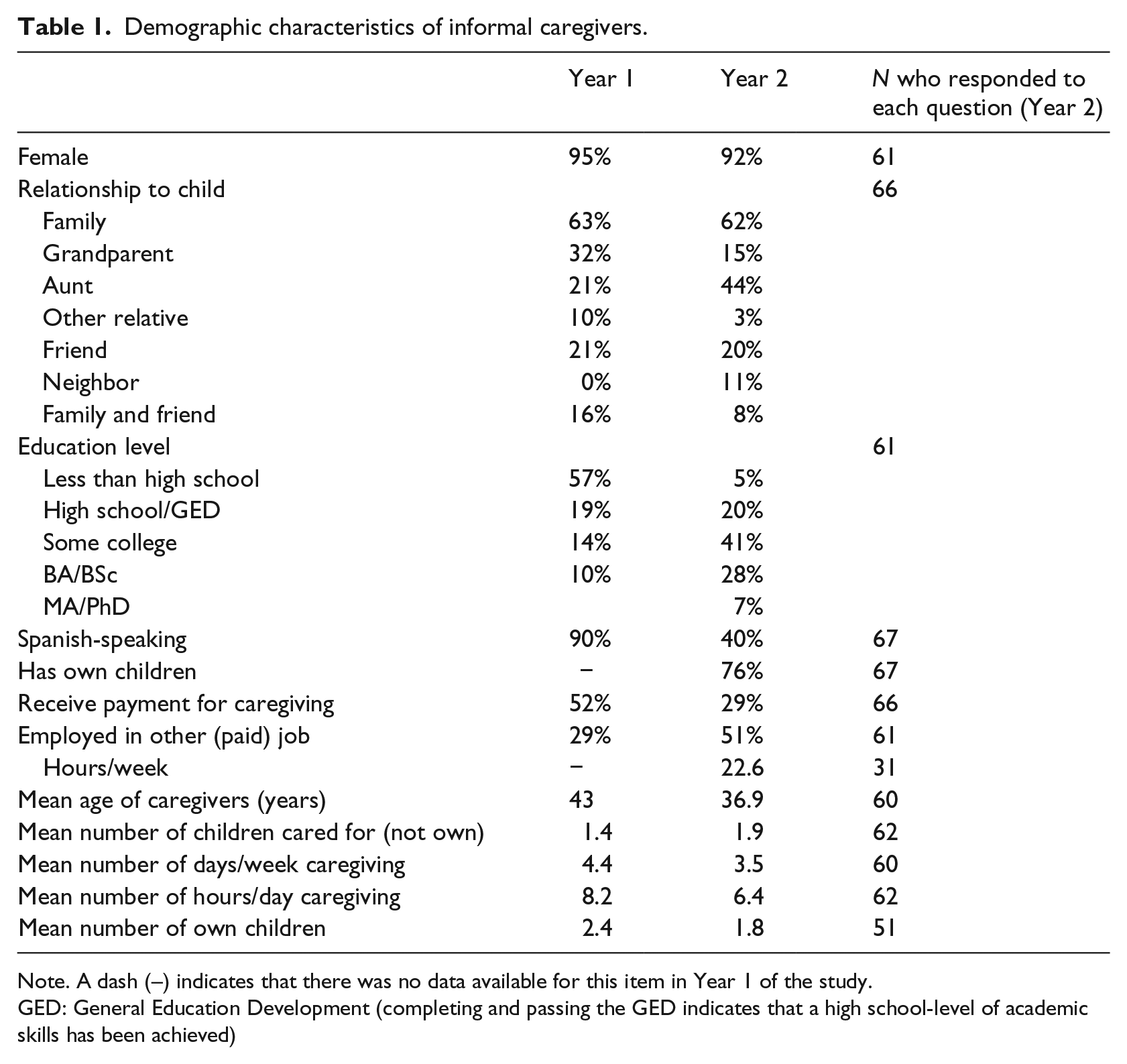
Note. A dash (–) indicates that there was no data available for this item in Year 1 of the study. GED: General Education Development (completing and passing the GED indicates that a high school-level of academic skills has been achieved)
The informal caregivers participated in up to three interviews, conducted in the participant’s primary language (Spanish or English). During the intake interview, participants answered questions that assessed their baseline knowledge and beliefs about child development, current behaviors with the child, and health and safety measures. During the midpoint interview in early June 2016, participants discussed their experiences with TIPS by TEXT and provided more detail about their daily routines and motivations. During the exit interview, questions from the intake interview were revisited and caregivers reported their experience with the intervention. The interviews lasted 35 to 60 minutes, with an average of 40 minutes. The intake interview was a pen-and-paper survey that the interviewer completed on-site. We recorded the midpoint and exit interviews. The interviews began with a specified set of questions asked of all caregivers. From there, we asked follow-up questions to trace new themes as each interview progressed. Interviews conducted in Spanish were translated into English, and all interviews were transcribed. Participants received US$50 for signing up and doing the intake interview and US$100 for each subsequent interview.
We analyzed the interviews using Dedoose, an application that allows for collaboration and interrater reliability of codes. Our coding was developed deductively based on the interview protocol and inductively from recurring and emergent themes in the data. Two raters coded all the midpoint and exit interviews. Each rater coded independently and then, for any disagreements, the coders discussed any differences in coding until a consensus was reached. All caregivers and the children they cared for are presented under pseudonyms to protect anonymity.
Year 2 program
Year 2 was identical to Year 1 except as noted. Texts were available in four languages: English, Spanish, Chinese, and Arabic. In addition to the topics included in the Year 1 texting program, the Year 2 program included (1) spiral weeks every fifth week of the program; these weeks covered a variety of the skills addressed in the prior weeks in the context of a single, common routine (e.g. at the park, at lunch time), (2) additional weeks early in the program on reading to young children (these weeks helped caregivers to match reading activities to the child’s level), and (3) early math skills (shapes, counting, and number recognition).
We partnered with 27 community groups. The organizations included family resource centers (including our Year 1 partner), other community resource centers, public libraries, and a family child care licensing program; 20 of 27 partners were in California. Sixteen partner organizations enrolled between 5 and 327 participants each; the remaining 11 organizations expressed interest in the program but enrolled fewer than five participants each. We provided our partners with flyers in English, Spanish, Chinese, and Arabic (as needed by each partner) to promote TIPS by TEXT. The flyers provided information about the TIPS by TEXT program and instructions on how to text in a code to receive the text messages. Enrollment was anonymous: by texting in a code, caregivers provided their phone number, identified the organization they were affiliated with, and the language in which they wanted to receive the text messages; no other identifying information was collected at enrollment.
Based on partner feedback, in Year 2, we enrolled informal caregivers and also parents who cared for their children at home. These parents also need support and including them made the recruitment process easier for our partners. In total, 607 people enrolled in the program. Over the 10 months of the program, 98 people (16%) opted out of the program. Although this opt-out rate is higher than in the parenting TIPS by TEXT programs (York et al., 2018), it is still low compared to workshop-based parenting programs in which the drop-out rate can be as high as 50 percent (Prinz and Miller, 1994). Due to the enrollment process, it is not possible to tell whether the people who opted out were informal caregivers or parents.
At the end of the program, all participants were invited to complete an anonymous online survey for which they were paid a US$50 Target e-gift card. Most questions on the survey were 4-point Likert-type scales (e.g. not at all, a little, somewhat, very; not helpful, a little helpful, helpful, very helpful); others had a yes–no response format or were open-ended. In total. 305 participants (50.2%) completed the online survey, 283 of whom lived in California. Of the 283 Californians, 67 (23.7%) were informal caregivers and are the focus of the Year 2 analyses (216 were parents who did not take care of other children, 14 were licensed caregivers). Table 1 provides the descriptive statistics for these 67 caregivers. All caregivers responded in either English or Spanish. Because participants were not required to respond to all questions on the survey, the N varies (between 58 and 66) with the question.
The survey had four parts. The first section established whether participants were informal caregivers (FFN), their relationship to the child or children (other than their own) in their care, the number of children they cared for, the number of days/week, hours/day, and their motivations for caring for children. The second section assessed the participants’ sense of responsibility for providing a safe environment, helping children to learn, and helping them develop social-emotional skills, and their resources and activities. The third section assessed participants’ reactions to the text messages and whether the texts had changed their literacy, math, and social-emotional activities with the children. The fourth section collected demographic information. The survey took an average of 11.6 minutes to complete.
Results
Caregiver motivations for caring for children
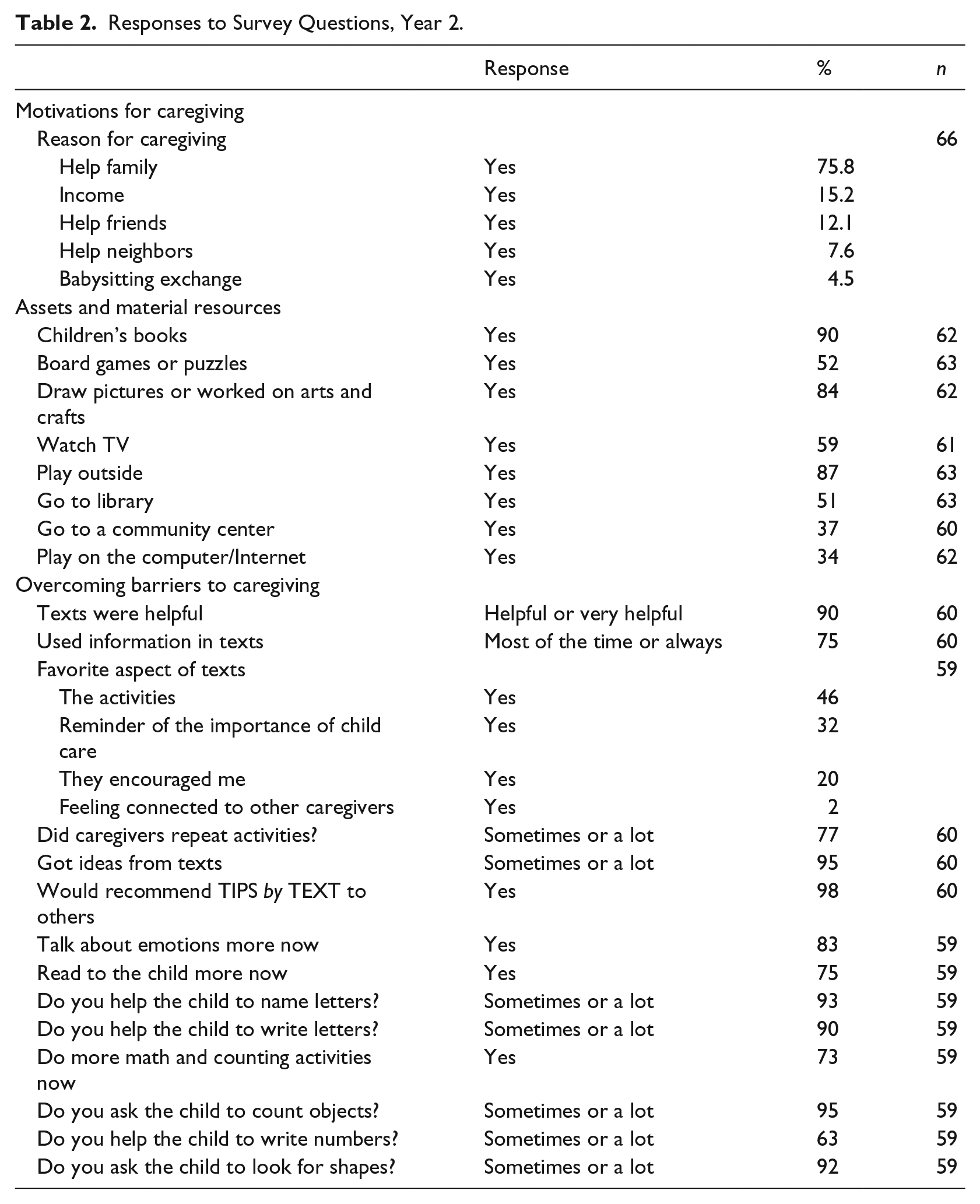
The results from the Year 1 interviews and Year 2 survey supported prior research that describes informal caregivers’ motivations (Chang and Velazquez, 2015; Thomas et al., 2015b). On the survey (Table 2), participants could select more than one motivation for providing care. The primary motivation that caregivers selected was to help family; income, help friends, help neighbors, and babysitting exchange trailed far behind. Nine of the 11 participants who selected more than one motivation for caring for children selected helping family. In the interviews, helping family was also the most common reason provided for caring for children. Among non-kin caregivers, the main motivation was helping friends or neighbors, which also provided a kind of social capital.
Responses to Survey Questions, Year 2.
The cost of child care leaves many low-income Californian families unable to afford formal day care or preschool. In California, preschool for 4-year-olds costs an average of US$8230/year (US$686/month) and it is even higher for younger children and infants (Economic Policy Institute, 2017; Fernandes, 2016). And, of course, that amount multiplies by the number of children in care. As a result, reaching out to family or friends for help may be the only child care option available for some parents. Victoria put it succinctly: “. . . she works at a day care but it’s very expensive. And I’m not working, so it’s something they can give me” (Aunt, age 36). Emilia explained, “Sometimes it’s very difficult to pay someone to take care of your children or put them in a program” (Other relative and friend, age 41). Some caregivers had determined that it made more financial sense for them to stay at home to care for their own children. This decision allowed them to care for other children as well. As Alma explained, “And [my sister] sees I’m fully dedicated to my children. I do have more available time and she sees I’m better prepared and more reliable” (Aunt, age 39).
Trust of family
Despite evidence that formal care was financially out of reach, the caregivers focused more on the trust instilled in them as the primary reason they cared for young children. Many of the informal caregivers were grandmothers or aunts to the children in their care. Trust among family members is an important bond that facilitates the caregiving relationship. Perhaps reflecting the filial bond and connection between most of the caregivers and the children in their care, caregivers who completed the survey indicated that they felt a strong responsibility in their roles. All caregivers indicated that they felt somewhat or very responsible for providing a safe environment for the children. In addition, 87 percent said they felt somewhat or very responsible for helping children learn social and emotional skills and 83 percent for helping children to learn other skills.
In parallel to the trust in family, caregivers also described distrust in non-kin as a motivating factor for informal care arrangements. Kalena noted the importance of trust in her motivation for caring for her 3-year-old granddaughter:
My daughter [is] distrustful. Like, she thinks that if she takes her to a place where they take care of other children, they’re going to hit her [the granddaughter], or that if they do something to her, she won’t know. (Grandmother and friend, age 57)
Kalena’s daughter works at a formal child care program. Even with a firsthand experience of the setting, this family distrusted formal child care options. Several other caregivers also discussed trust of family and distrust of others in their motivations for caring for children. Cecelia recounted,
[The child’s parents] say they feel at ease with me watching them. They say, “No one’s going to take care of them the way you do. If we leave them with someone that isn’t part of the family, we don’t know how well they’ll take care of them.” (Aunt, age 36)
Caregivers contrasted the care they could provide to that of non-kin. Julia’s sister had recently separated from her husband. She and her three children had moved in with Julia. Rather than burdening Julia with additional child care (Julia has four children ages 7–17), her sister initially paid a neighbor to care for her 3-year-old son. Julia described how she came to care for her nephew. She said,
You’re paying them over there [the neighbor] and you have your sister right here. I’m not going to hurt him because he’s my nephew. How could I? But other people would take your money and they will not treat him well. (Aunt, age 39)
Caregiving as social capital
Although kin caregivers emphasized the importance of trust among family members, some of the caregivers in our sample were not related to the children they cared for. These non-kin caregivers made up a smaller portion of our sample (Table 1) and often they cared for other children in addition to those to whom they were related. Their primary motivation for caring for children was a desire to help others. Danna has a degree in elementary school education from Mexico but is concerned about finding work due to her legal status. Instead, she focuses on caring for her 4-year-old daughter and two other children—a friend’s and a relative’s. Danna explained, “And since I already took time off to take care of them, I decided I had more options and could take care of others outside the family” (Other relative and friend, age 43).
Living in an immigrant community fosters a caregiving ecosystem that also provides social capital. Emma is embedded in a community where she believes someone may return the gesture. As Emma notes,
Since I can stay home with my kids, that allows me, I can help other parents. I do it not so much for the money, no. Because I tell them, “You know what? Right now, I can help you.” Later on, I don’t know, it may be my turn. (Aunt and friend, age 36)
Assets and material resources
At the beginning of this intervention, it was unclear what resources might be available for the children of this low-income population. Prior reports had found that informal caregivers had few toys or other resources for the children in their care (Layzer et al., 2006; Susman-Stillman and Banghart, 2011; Thomas et al., 2015a; Tout and Zaslow, 2006). Through the interviews and survey, we learned that the caregivers in our sample had a variety of toys with which the children played, allowed the children to play with their own possessions, and took advantage of the outdoors for both play and learning opportunities. In the intake interview, caregivers listed the toys and other resources they had for the children, including dolls, stuffed animals, cars, coloring supplies, and outdoor toys. On the survey (Table 2), at least half of the caregivers had children’s books, board games or puzzles, televisions, and arts and crafts materials. Fewer indicated that they had computers.
In the interviews, all the caregivers indicated that they had at least some toys for the children to play with. Kalena describes the resources she has available for her grandchildren and a friend’s child:
I let them play with my things, like my hats, my makeup. Or toys. We set up a little shop here or a garage. We start shopping, making believe we’re exchanging money, and so on. (Grandmother and friend, age 57)
The toys that caregivers had were often those they already owned for their own children. Sometimes children brought toys from home. Caregivers also engaged in activities like singing, dancing, or arts and crafts. Emilia described the activities in which she engaged the children:
[The children] like dogs and birds a lot . . . I tell them what bird it is and what bird—which ones they like. They like the ones that are more colorful. So, I tell them, “Okay, draw them, honey.” I put their colors and papers on the tables and they draw birds with three or four wings. (Other relative and friend, age 41)
In addition, several caregivers mentioned regular visits to the library with the children: “He loves going to the library and he grabs two or three books and he wants me to read them to him” (Sofia, grandmother, age 54). Indeed, going to the library was so common that most mentions of it were among lists of regular activities the caregivers did with the children: “From there I take them to the farm or to the park or the library” (Emilia, other relative, age 41). The library was used both as an activity (e.g. story time) and as a resource to borrow age-appropriate books for the children.
Overcoming informational and behavioral barriers to caregiving
The caregivers reported that their caregiving behaviors had changed while in the program. On the survey (Table 2), the majority of caregivers said that the texts were helpful or very helpful and that they used the information in the texts most of the time or all of the time. Almost half of caregivers said that their favorite aspect of the text messages was the activities, followed by being reminded of the importance of their role as caregivers, and the encouragement that the texts provided; only 2 percent selected feeling connected to other caregivers. In addition, supporting our goal of increasing caregiver–child engagement, the majority of caregivers reported that they repeated the activities either sometimes or a lot and got ideas from the texts sometimes or a lot. Almost all of the caregivers said that they would recommend the program to others.
Compared to before joining the program (Table 2), caregivers reported that they talked about emotions more, read to the children more, and helped them to name and write letters. In addition, caregivers reported that they did more math and counting activities and that they practiced counting, writing numbers, and identifying shapes.
Overcoming informational barriers
In both the interviews and the survey, caregivers indicated that they had learned helpful information from the text messages. In particular, caregivers found the information about social-emotional skills helpful in their interactions with children. The caregivers said that the texts helped them to manage their own emotions as well as those of the children they cared for: “It is a very good tool, because it gives you more—how to help them, how to be more patient . . . For example, when you get angry, what you can do, because sometimes the children are difficult” (Isabella, aunt, age 46). Another caregiver recalls,
At first, he was really young and wanted everything and he would scream all the time, so I didn’t know how to calm him down, so that would make me mad. And, yes, it [the text messages] did help calm me down and know how to help him. (Olivia, aunt, age 35) I saw the results and I also see the results in my son. Now that I’m getting the text messages, he’s a little bit calmer and better behaved compared to the past, because in the past he would scream, and I would scream but not anymore. (Olivia, aunt, age 36)
Maintaining attention on caregiving
Caregivers also reported that the texts helped them maintain attention on caregiving and to do more and different activities with the children in their care. Some caregivers mentioned reviewing the texts for activities they might have forgotten: “I have them all and I go back and look them over because sometimes there are things you forget and it helps a lot because it reminds you of things you no longer remembered” (Natalia, friend, age 32). Others said that they did a lot of the suggested activities: “Basically we did . . . most of the activities in the messages” (Lucia, grandmother, age 45).
Several caregivers mentioned that they made an active effort to talk to the children more than they did before getting the text messages. Mia described helping her grandson learn new words: “I said to him, ‘What is this?’ and he didn’t know. ‘Apple juice’, I said, and he said ‘Apu youse’. He was so happy that he learned how to say that” (Grandmother, age 53). Danna described how she asked and answered questions when they were driving. She would ask the child:
“What’s this? What color is this? What do you see there?” Because the boy does start to talk now. “What’s this? And what’s this?” He sees a car next to us, “What’s that?” I tell him, “It’s a truck.” “And what’s this?” “It’s a bus.” (Friend, age 43)
Others mentioned reading activities they did with the children:
So, I say, “OK, Joe.” And Joe is all ready with whatever we’re going to do, an alphabet book to start. And then he starts with the letter A. “Alligator.” Or what else starts with A? “Apple.” (Emma, aunt and friend, age 36)
Emma also talked about learning to name emotions with the children:
The messages have helped me a lot. “I know that you’re frustrated, angry. Talk to me, use your words. You have to use your words.” I tell Joe, “Are you angry or happy?” Joe is very talkative. So, he says, “No, I’m happy.” And he likes it a lot. (Emma, aunt and friend, age 36)
Reduced cognitive load
The suggestions of specific activities each week helped to reduce the cognitive load related to deciding what to do with the children thereby helping caregivers engage children in a variety of learning opportunities. In the interviews, some of the most frequently mentioned activities were singing songs, making hand washing fun, practicing the alphabet, and noticing the child’s interests. Some caregivers indicated that the messages gave them helpful guidance on what to do with the children. Emma described her response to some of the texts: “. . . when I get the texts, sometimes I say, ‘Wow, I hadn’t thought of that.’” (Aunt, age 36). Sofia reported, “Yes, they [the texts] gave me more ideas. They gave me more options . . . they did help me and gave me a lot of options and I liked that” (Grandmother, age 54).
The caregivers also gave more specific examples of the activities that they found particularly helpful. Reading and literacy activities were mentioned frequently. The caregivers’ reports suggested that they actively engaged the children in the suggested literacy activities.
I liked the ones that we got that suggested that we talk about the ABCs and to look around with the child [for letters] . . . because sometimes we forget that at home or on the street we have multiple opportunities to do it, to talk, and to have the kids learn, right? (Sofia, grandmother, age 54) Ever since I started using the texts I say, “What color is your shirt?” and he says, “Red! Red!” “Yes, Miguel, it’s red.” (Mia, grandmother, age 53)
The caregivers also learned to interact with the children during their regular routines. For example, several caregivers mentioned learning to use routines such as laundry time to help children learn:
When we’re going to do the laundry, I tell her that I’m going to hang clothes. I tell her, “Okay, give me the blue shirt.” To see if she will know. “Yes. Okay, give me something white.” And she does. (Emilia, grandmother, age 56) Because what they tell you in the texts is very good. You learn a lot about—if they want to help you do something—“No, no, go away because you’re just bothering me.” It’s true, that’s what I used to say to my daughter . . . I learned from the texts that it’s not like that. If your child wants to help you set the table, “Okay, you can help me.” (Camila, other relative, age 26) One day, the message advises to talk to them at dinner time. “What color is that?” To ask them if they like the food . . . (Natalia, friend, age 32)
And the children also enjoyed doing the text activities: “I think they feel good when they’re doing the activities. What they think, I still don’t know, but I know they feel better and have more fun” (Alma, aunt, age 39).
An additional advantage to the texts was that they provided some gratification to caregivers. Sofia said, “[The texts] also reaffirmed the little that I was doing, so I figured I was doing well” (Grandmother, age 54). And seeing the children learn new skills also affirmed the caregivers’ efforts. Isabel talked about how the texts helped her think of new activities to do with the children and recognized that the texts were effective: “So they take a stick and start drawing the letter A. And I think, ‘Look! It works’” (Aunt, age 34).
Helping caregivers to see their role as teachers
Prior research suggested that helping caregivers to see their role as children’s teacher would help them to seek out more opportunities to help children learn (Alarcon and Sangalang, 2015; Chang and Velazquez, 2015; Thomas et al., 2015b). Participating in the program provided the support that caregivers needed in this regard. Lucia said, “I think the messages are very positive, very useful, and then it is up to us whether we put them into practice” (Grandmother, age 45). Others reported that the texts reminded them of the importance of their job: “They [the text messages] basically helped me with everything. As a person, as a grandmother, and . . . to understand children when they are this age” (Lucia, grandmother, age 45). Emma reflected on the importance of choosing activities that would help children learn: “. . . if you’re going to be taking care of them and you sit them in front of a TV, they won’t learn” (Emma, aunt, age 36). Sofia explained that when she was raising her own children, she had to “learn along the way” but lacked the experience of a formal education or job in child care. She commented, referring to the program, that if “someone helps you, it’s even better.” She said that the program “guide[s] those of us that care for children, people who haven’t studied like those who have, like kindergarten teachers or people who are licensed in childcare” (Grandmother, age 54).
Discussion
Our findings support and extend prior research on informal caregiving in California specifically, in the United States, and internationally. Consistent with prior research (Backett-Milburn et al., 2008; Baxter et al., 2016; Chang and Velazquez, 2015; Thomas et al., 2015b; Wheelock and Jones, 2002), we found that most of the caregivers in our sample are related to the children in their care and were motivated by that filial connection to care for the children and to help them to learn social and academic skills in preparation for kindergarten. Non-kin caregivers were equally motivated to support the social and academic development of the children in their care out of a desire to help their friends and neighbors.
One difference between the current study and prior findings was in the material resources the informal caregivers could provide the children in their care. Caregivers have been reported to have limited material resources in terms of toys, books, and other learning materials for the children for whom they care (Susman-Stillman and Banghart, 2011; Thomas et al., 2015a). In contrast, the caregivers in our study, despite being low income, reported having a variety of age-appropriate materials for the children (e.g. toys, arts and crafts materials, library books) and also let the children play with their own personal belongings (e.g. for dress-up, to stage plays). In addition, they spent a lot of time outdoors and also visited the local public library regularly with the children.
While informal caregivers had both the motivation and resources to support the social and academic development of the children in their care, they often lacked the knowledge of how best to support children’s social and academic development. The lack of information on useful practices to support child development prevented the caregivers from overcoming behavioral barriers created by the substantial cognitive load and sustained attention needed to help children learn. As a result, the educational opportunities for children in informal care were limited far more by caregivers’ informational and behavioral needs than by their lack of positive goals for the children, the time to spend interacting with them, or having toys and other material resources.
Consequently, the TIPS by TEXT-Informal Caregivers text messaging program proved to be an effective intervention. The texts helped caregivers to overcome these behavioral barriers by providing small amounts of information over time. In addition, the caregivers found the recommended activities to be fun and easy, further helping to overcome the behavioral barriers. Finally, the text messages also emphasized the importance of the caregiver’s role in teaching children and included appreciation for the caregiver’s work, providing some immediate gratification, which in turn helped motivate them to provide enriching learning opportunities for the children in their care. The caregivers report that the text messages were helpful specifically because of the information they provided, which reduced the burden of finding and choosing activities. They also appreciated that the text messages regularly reminded them to engage with the children in their care.
By providing information and recommending specific, easy-to-implement activities, this text messaging program has the potential to give informal caregivers the knowledge and skills to prepare the children in their care for school. The TIPS by TEXT intervention leveraged the power of text messages. Social media, blogs, and websites may also provide a strong venue for providing information and activities to informal caregivers to help them support children’s school-readiness skills. Future research on this kind of intervention would benefit from direct measures of the children’s skills to assess whether the intervention does indeed increase children’s school readiness. In a similar intervention for parents of preschoolers, children of parents who received the text messages scored higher on a measure of early literacy skills than children whose parents did not receive the texts (Doss et al., 2018; York et al., 2018). Thus, there is reason to hope that a long-term, light-touch intervention could also improve children’s skills in an informal care setting.
Footnotes
Acknowledgements
The authors thank Christina Huber and Irene Kim for their help with coding the interviews. They also thank Sarah R. Bardack, Hans Fricke, Kalena Cortes, Erika Byun, and Rocio Hernandez for their comments and input on the manuscript.
Declaration of conflicting interests
The author(s) declared no potential conflicts of interest with respect to the research, authorship, and/or publication of this article.
Funding
The author(s) disclosed receipt of the following financial support for the research, authorship, and/or publication of this article: This research was supported by funding from the David and Lucile Packard Foundation.
