







Abstract
The purpose of this study was to describe the daily activities of Canadian children outside of school. Participants were parents of N = 189 children (90 boys, 99 girls) in grades 1 to 3. The What Your Child Did Today parental telephone interview protocol was developed as a daily log of both the type and social context of children’s activities. Among the results, children spent almost half of their waking time in unstructured activities (e.g. free play), compared to 14 percent of on-screen, and 6 percent in structured activities (e.g. sports). Children spent about two-thirds of their time in the company of family followed by peers (22%), and only 10 percent of time was spent alone. Some gender differences were also noted (e.g. boys engaged in more screen time) and parental education was related to time spent in structured activities. Results are discussed in terms of implications for children’s socio-emotional development.
Participation and engagement in extracurricular activities have been positively associated with social competence, self-esteem, and academic success and negatively associated with behavior problems (e.g. Aumètre and Poulin, 2018; Daniels and Leaper, 2006; Dimech and Seiler, 2011; Donaldson and Ronan, 2006). Much of the research to date has focused on structured activities, such as organized sports and performing arts (e.g. Archbell et al., in press; Aumètre and Poulin, 2018; Ilari, 2016), with much less known about unstructured activities, such as free play (Coplan et al., 2009; Ferrar et al., 2012). Furthermore, researchers studying children’s outside-of-school activities (Engelen et al., 2015; Hofferth and Sandberg, 2001) typically have not considered the social contexts for these experiences (e.g. is the child alone, with family, or with friends?), which also impact children’s socio-emotional outcomes (Larson and Verma, 1999; Spagnola and Fiese, 2007). Finally, most of these researches have been conducted with older children (e.g. Daniels and Leaper, 2006; Donaldson and Ronan, 2006; Mata and Van Dulmen, 2012). Accordingly, the primary aim of the current study was to examine young children’s daily experiences of structured and unstructured activities across different social contexts. To accomplish this goal, we developed a telephone interview protocol with parents to assess both the content and social context of young children’s activities beyond the formal schooling environment.
Studies that examine children’s activities in naturalistic settings often utilize parental daily logs or diaries, in which parents record what their child was doing at certain times of the day (e.g. Coplan et al., 2009; Hofferth and Sandberg, 2001; Parmar et al., 2008). Daily logs have become more commonly used to obtain estimates of time children spend in different activities, as questionnaires/surveys may be subject to social desirability bias and can overlook infrequent activities (e.g. Hofferth, 1999; Hofferth and Sandberg, 2001; Marini and Shelton, 1993). Moreover, Juster and Stafford (1991) speculate that questionnaires concerning daily measurements of time grossly overestimate time spent in specific activities, as respondents appear to more readily recollect days when the activity in question was particularly prominent, and proceed to treat that as an average day.
There are only a handful of studies that have investigated how young children spend their time outside of school (Coplan et al., 2009; Parmar et al., 2008). In one of these few studies, Engelen et al. (2015) reported that 5- to 7-year-old children spent approximately 7 percent of their time in organized sports activities. Hofferth and Sandberg (2001) found that children under the age of 13 years spend 18 percent of their time in organized sports, church, and other classes. Estimations of time spent in unstructured activities (e.g. active free play, building activities and crafts, or imaginative play) in early childhood range from 29 percent to 38 percent (Engelen et al., 2015; Hofferth and Sandberg, 2001). When assessed, young children are engaged with a screen 16–24 percent of the time (Engelen et al., 2015; Ferrar et al., 2012; Hofferth and Sandberg, 2001).
Although these studies provide frequencies of structured and unstructured activities, they fail to take into account a broader social context for each activity (i.e. alone, with peers, with family). Such details are needed to draw concrete conclusions about the benefits of outside of school activities. For example, the negative effects of excessive screen time on children’s development are well documented (e.g. Digital Health Task Force, 2017; Lin et al., 2015; Linebarger and Vaala, 2010). However, engagement in screen time as a family may help to mitigate negative outcomes. Indeed, research suggests that coviewing TV can enhance family functioning and bonding, facilitate social interaction, and can be used as an educational tool (Latomme et al., 2018; Solomon-Moore et al., 2018).
Thus, it is important to examine with whom children spend their time, as different social contexts of children’s activity participation may present distinct developmental benefits (Pearce et al., 2014). For example, time spent with both family (e.g. Spagnola and Fiese, 2007) and peers (e.g. Coplan and Arbeau, 2009) uniquely contributes to positive socio-emotional and academic outcomes in early childhood. Although less studied, children’s engagement in outside-of-school solitary behaviors is also thought to positively impact children’s self-reflection and concentration (Galanaki et al., 2015).
Recent methodologies used to investigate activities outside of school do not capture a holistic view of the social context of children’s unstructured activities (e.g. Engelen et al., 2015; Hofferth and Sandberg, 2001). Previous research either focused on children’s formal and informal peer activities (Coplan et al., 2009; Ladd and Hart, 1992; Schneider et al., 2000), or time spent with family (Spagnola and Fiese, 2007; Wheeler, 2014), but studies investigating multiple social domains appear to be limited (Parmar et al., 2008).
The present study
The goal of this study was to describe young children’s daily experiences of structured and unstructured activities across different social contexts. Drawing upon the extant literature, we expected that children would spend more of their waking time in unstructured (e.g. play, screen) than in structured activities (e.g. sports, clubs) (e.g. Engelen et al., 2015; Hofferth and Sandberg, 2001), as well most of their time with family, followed by peers, and then alone (e.g. Coplan et al., 2009; Wheeler, 2014). We were also interested in exploring how children’s engagement in different unstructured activities (e.g. play vs screen time) might be linked to their social experiences. Finally, we examined associations of activity experiences with parental education and child gender. We speculated that children from families with higher parental education would spend more time in organized activities than would children with less educated parents (Aumètre and Poulin, 2016; Schneider et al., 2000), and that boys would engage in more screen time and less time with peers compared to girls (e.g. Ferrar et al., 2012; Larson and Verma, 1999).
Method
Participants
Participants were parents of N = 189 children (90 boys, 99 girls) in Grade 1 (n = 67, Mage = 6.13 years, SD = .35), Grade 2 (n = 63, Mage = 7.13 years, SD = .34), and Grade 3 (n = 59, Mage = 8.07 years, SD = .26). Children attended public elementary schools located in suburban and rural areas in southeastern Ontario, Canada. The sample was predominantly White (93%) and from two-parent households (83%). The participating school board did not permit collection of additional demographic information (e.g. parental employment, family income).
Procedure
Following clearance from the University Research Ethics Board and the participating school board, consent forms and demographic questionnaires were completed by interested parents and returned to their children’s school. Consenting parents were then contacted via email to arrange suitable times and dates for telephone interviews. The majority of telephone interviews were conducted at the end of the day (i.e. after 8:00 p.m.). Phone interviews were conducted on three different weekdays and two weekend days over 4 months. There was no parental compensation for participating in this study.
Daily log of children’s activities outside of school
Adapting previous measures (e.g. Coplan et al., 2009; Hofferth and Sandberg, 2001; Ladd and Golter, 1988; Parmar et al., 2008), we developed the What Your Child Did Today (WYCDT) protocol as a telephone interview daily log of children’s activities outside of school. Parents reported on their child’s daily activities between the hours of 6 a.m. and 8 p.m., in 2-hour intervals. For example, parents were asked about their child’s activities from 6-8 a.m., 8-10 a.m., etc. Specific queries pertained to a description of the activity (e.g. playing, watching TV), the location of the activity (e.g. at the park, at home), and the social context (e.g. child alone, with peers).
Drawing upon conceptualizations from previous studies (e.g. Coplan et al., 2009; Engelen et al., 2015; Schneider et al., 2000), a coding scheme was developed to categorize parental responses across all interview questions. For this study, we focused on codes pertaining to children’s predominant activity and social context for each 2-hour time interval. Activity codes included the following: (1) informal unstructured play (e.g. imaginary play, playing outside); (2) informal unstructured screen time (e.g. watching TV; playing a video game); (3) informal semi-structured activity (e.g. birthday party, family picnic); (4) formal structured sports (e.g. organized soccer, organized hockey); (5) formal structured arts (e.g. dance class, guitar lessons); (6) formal structured clubs (e.g. scouts, girl guides); and (7) daily routine (e.g. completing chores, eating dinner). Social context codes included the following: (1) alone; (2) with peers (i.e. friends; same-aged neighbor); and (3) with others (i.e. parents, siblings, activity leaders). 1 Times where both peers and others were present were coded as peers.
Approximately 25 percent (n = 50) randomly selected daily logs were independently coded by two trained research assistants. Another 25 percent of the daily logs were then coded by one of the previous research assistants and another research assistant. Inter-coder reliability (using Cohen’s Kappa) ranged from .94 to .98 across research assistant pairs. Minor discrepancies were resolved via discussion.
Results
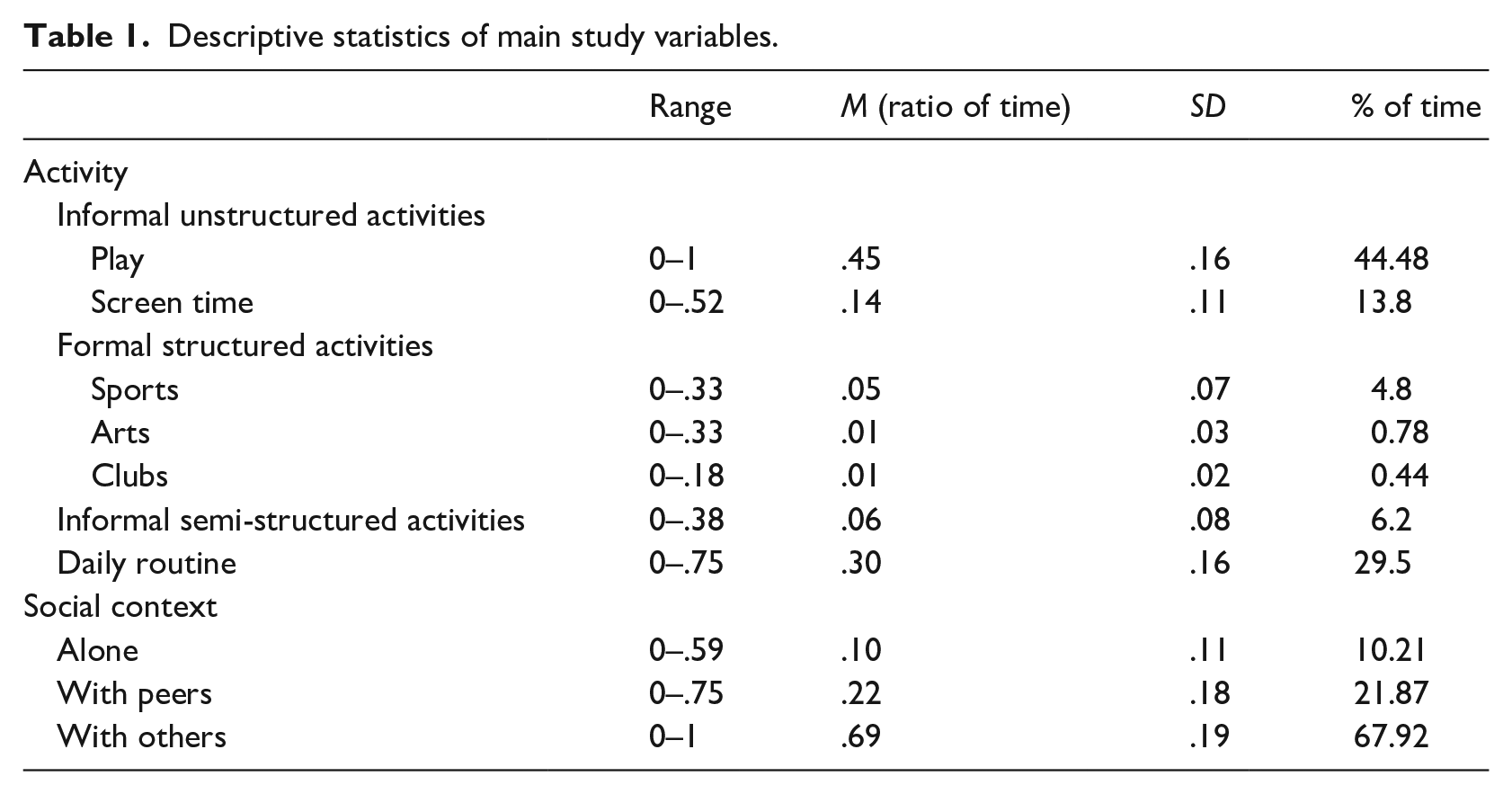
Proportion scores were created by dividing the tallies for each relevant code by the sum of all codable blocks for each child. This also served to control for the number of codable blocks (which varied across participants from 7 to 35). 2 Subsequent analyses utilized these proportion scores. Descriptive statistics for WYCDT variables are provided in Table 1, Figures 1 and 2. Of note, children spent the most time engaged in unstructured play, followed by daily routine, unstructured screen time, informal activities, and then structured activities. Children also spent most of their time with others, followed by with peers, and then alone.
Descriptive statistics of main study variables.
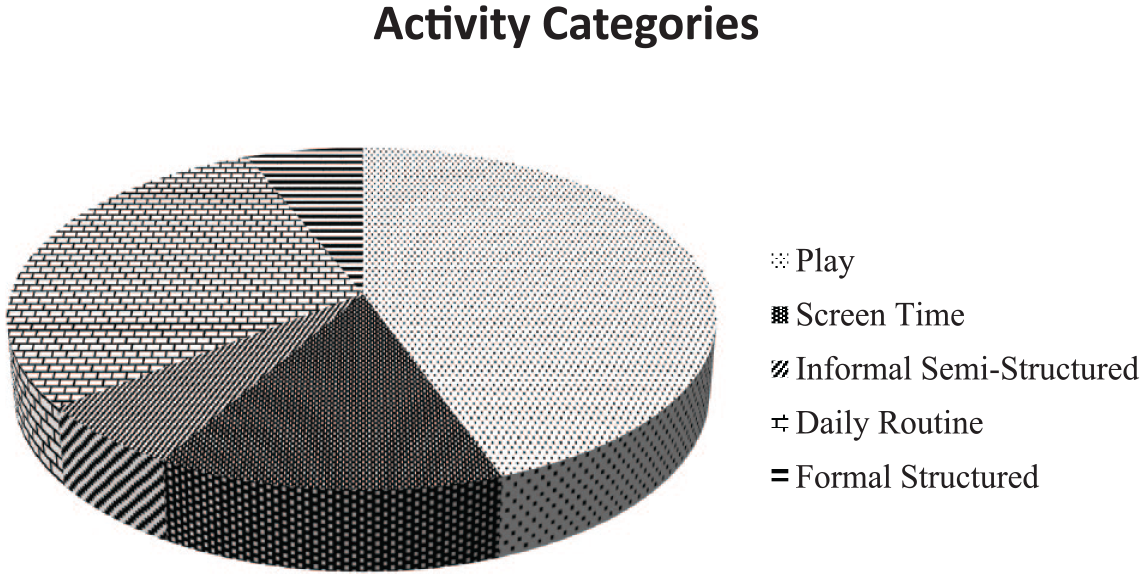
Proportions of time that children spend in various outside of school activities.
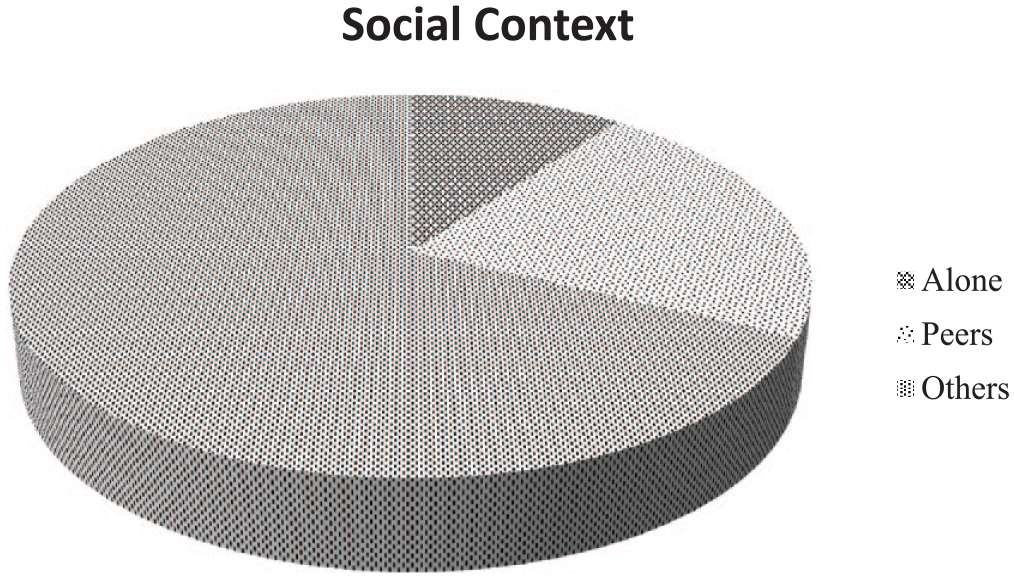
Proportions of time that children spend by themselves, with peers, and with others (i.e. family members, other adults).
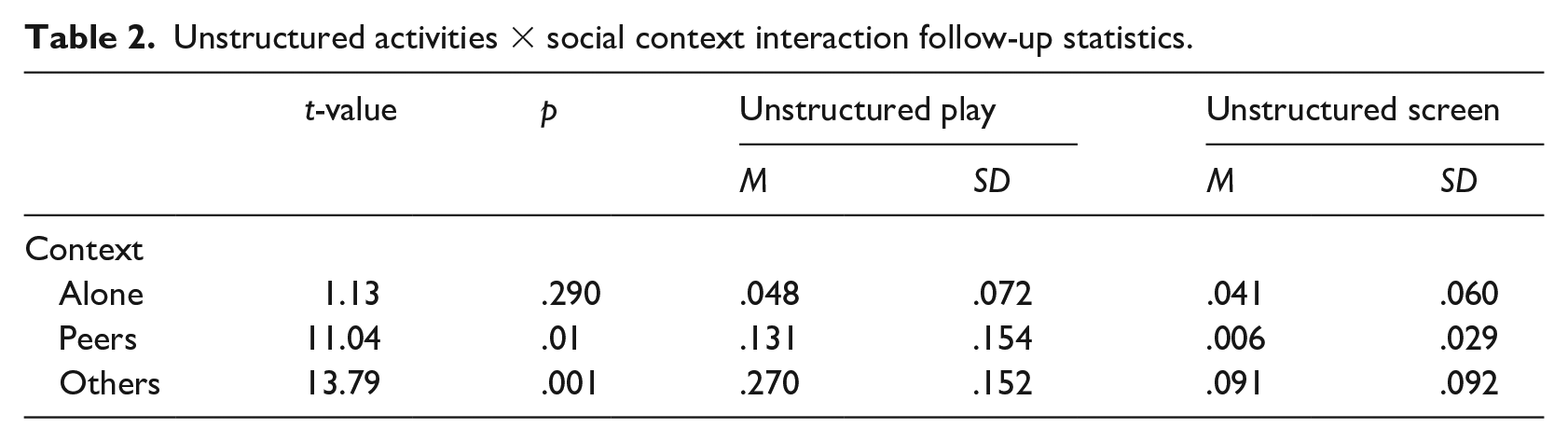
When in structured activities, children spent most of their time in the presence of peers. An analysis of variance could not be conducted to further examine structured activities due to relatively low frequencies of participation in sports, arts, and clubs. We next sought to examine whether different types of unstructured activities were linked to social contexts. A 2 × 3 doubly repeated measures multivariate analysis of variance (MANOVA) was conducted with unstructured activity type (play, screen time) and social context (alone, peers, others) serving as within-subject variables. Results indicated significant main effects of activity, F(1, 88) = 362.85, p < .001, partial η2 = .659, and social context, F(2, 187) = 150.53, p < .001, partial η2 = .617. However, these main effects were superseded by a significant activity × social context interaction, F(2, 187) = 99.98, p < .001, partial η2 = .517. Results from follow-up simple effects analyses (paired t-tests) are displayed in Table 2. Children spent significantly more time with others/family and with peers when engaged in informal play as compared to screen time (with no significant difference in time spent alone).
Unstructured activities × social context interaction follow-up statistics.
To examine effects of demographic variables, a 2 × 5 multivariate analysis of covariance (MANCOVA) was conducted, with child gender (boy, girl) and grade (1, 2, 3) serving as independent variables, parental education serving as a continuous covariate variable, and with activity categories (unstructured play, screen time, informal semi-structured activities, structured activities, 3 daily routine) included as dependant variables. For activities, results indicated a significant multivariate main effect of child gender, F(5, 172) = 2.72, p = .022, partial η2 = .073, but not grade, F(5, 173) = 1.73, p = .128, partial η2 = .028. There was a significant effect of parental education, F(5, 172) = 2.94, p = .014, partial η2 = .079, but no significant child grade × child gender interaction, F(5, 173) = 1.39, p = .230, partial η2 = .039.
Follow-up univariate analyses indicated no significant gender differences for unstructured play, F(1, 187) = .462, p = .498, partial η2 = .002, informal semi-structured activity, F(1, 187) = 1.77, p = .185, partial η2 = .009, or structured activities F(1, 187) = 2.06, p = .153, partial η2 = .011. Significant univariate effects for gender were found for screen time, F(1, 187) = 3.74, p = .05, partial η2 = .020, with boys (M = .155, SD = .113) spending significantly more time on screens than girls (M = .120, SD = .109), and for daily routine, F(1, 187) = 5.37, p = .021, partial η2 = .028 with girls (M = .326, SD = .178) spending more time engaged in daily routines than boys (M = .270, SD = .140). Follow-up analyses also indicated that parental education was significantly and positively associated with time spent in structured activities (r = .157, p = .033) and informal semi-structured activities (r = .148, p = .044), but not significantly correlated with other activity categories (unstructured play: r = –.033, p = .650; screen time: r = .053, p = .472; daily routine: r = –.125, p = .089).
Next, a 2 × 3 MANOVA was conducted, with child gender (boy, girl) and child grade (1, 2, 3) serving as independent variables, and social contexts (i.e. alone, peers, others) as dependant variables. Results indicated a significant multivariate main effect of child grade, F(3, 176) = 2.91, p = .009, partial η2 = .047, but not child gender, F(3, 179) = .747, p = .525, partial η2 = .013. The covariate effect of parental education approached significance, F(3, 175) = 2.45, p = .066, partial η2 = .040. Finally, there was no significant child grade × child gender interaction, F(3, 179) = 1.36, p = .228, partial η2 = .022.
Follow-up univariate analyses revealed a significant effect of grade for time spent alone, F(2, 177) = 4.915, p = .008, partial η2 = .053, and time spent with others, F(3, 177) = 3.023, p = .05, partial η2 = .033, but not time spent with peers, F(3, 179) = .021, p = .886, partial η2 = .001. Results from post hoc comparisons (Tukey) indicated that children in Grade 3 (M = .139, SD = .126) spent significantly more time alone than children in Grade 1 (M = .080, SD = .105) (but no significant differences between either of these grades and children in Grade 2, M = .092, SD = .099). Similarly, children in Grade 1 (M = .723, SD = .164) spent significantly more time with others (i.e. family members, adults) than children in Grade 3 (M = .636, SD = .193) (but no significant differences between these grades and children in Grade 2, M = .689, SD = .212).
Discussion
There is growing research demonstrating the impact of activities outside of school on children’s development, with a particular focus on benefits of extracurricular activities (e.g. Aumètre and Poulin, 2018; Dimech and Seiler, 2011; Pearce et al., 2014). However, there has been virtually no previous research in early childhood exploring children’s time spent in a wide range of activity types (e.g. unstructured vs structured), while also assessing the social contexts (e.g. alone, with peers) of these activities. Accordingly, in the present study, we examined how young children spent their time outside of school, with whom they spent their time, and also explored links between these activities and demographic characteristics. To accomplish this goal, we developed a new telephone interview protocol (WYCDT) to provide a snapshot of children’s daily activities outside of school.
Our results indicated that children in grades 1 through 3 spent almost half of their waking hours outside of school (approximately 45%) engaged in unstructured play activities. This proportion is somewhat higher than has been previously reported in samples of similarly aged children (e.g. 38.1%: Engelen et al., 2015; 29%: Hofferth and Sandberg, 2001). It is possible that the increased time observed in unstructured play in the current sample resulted from differences in coding schemes (e.g. what constitutes unstructured play). For example, Hofferth and Sandberg (2001) coded many activities individually (i.e. playing, time outdoors, hobbies, unstructured arts activities), while we included all of the above under a broader category.
Another explanation for this discrepant finding may be sample composition. For example, children in the current sample resided in suburban and rural areas, which may limit their participation in structured activities (Parke and Ladd, 1992), and subsequently increasing frequency of unstructured activities. Families living in rural neighborhoods may find it particularly difficult to have children involved in structured activities (i.e. sports, arts, clubs) due to travel requirements. Notwithstanding, this bodes well, as young children develop important skills during unstructured activities, such as initiative, self-regulation, and social competence (Larson and Verma, 1999).
Parents reported that children spent approximately 14 percent of their outside-of-school time on-screen, which is at the low end of the time range previously reported in studies (Engelen et al., 2015; Hofferth and Sandberg, 2001), and over half of this time was with others (family and siblings, 60%; peers, 1%; alone, 30%). Although it is currently unknown what amount of screen time is optimal, there remains evidence to suggest that there are negative costs associated with excessive screen time for young children’s school readiness, cognitive development, and physical health (Digital Health Task Force, 2017; Lin et al., 2015; Linebarger and Vaala, 2010). The American Academy of Pediatrics recommends limiting daily screen time to 1 hour or less, and suggests shared use between children and parents to promote enhanced learning and greater interaction (AAP Council on Communications and Media, 2016).
Social context can have a great impact upon screen time–related experiences (Collier et al., 2015). For example, when children engage in screen time with others, adults and older siblings may actively mediate media consumption (i.e. discussions about content and characters). Active mediation can positively impact young media users (e.g. Barkin et al., 2006) by increasing consumption of informative and prosocial programming (St. Peters et al., 1991), reducing the amount of violent content (Linder and Werner, 2012), and may foster the development of critical viewing skills among children and adolescents (Collier et al., 2016). In our sample, others were present over half the time children spent engaged in screen time. Depending on the coviewing behavior (i.e. type of mediation), this may serve to buffer some detrimental effects of prolonged media exposure.
Of note, during unstructured activities, children spent less time with others (family, sibling, peers) when on-screen as compared to free play. This decreased social exposure may be developmentally limiting, given that theorists from multiple perspectives agree that social interactions provide a mechanism for children to acquire social, language, and cognitive competencies (Coplan and Arbeau, 2009).
Children engaged in organized activities (mostly sports) about 6 percent of the time, which is comparable to previous findings from a sample of 5- to 7-year-olds (Engelen et al., 2015). The link between participation in organized activities and development of social skills, wellbeing, and academic functioning in middle childhood and adolescence is well documented (e.g. Aumètre and Poulin, 2018; Daniels and Leaper, 2006; Dimech and Seiler, 2011; Donaldson and Ronan, 2006). Therefore, encouraging young children to participate in structured organized activities may support positive development. However, it should also be noted that frequency of participation in organized activities is not the only predictor of indices of socio-emotional functioning. For example, young children’s psychological engagement and experiences of stress in the context of organized activities may also be important factors to consider (Archbell et al., in press).
In terms of social participation, children were found to spend about two-thirds (68%) of their waking time outside of school with others/family, just over one-fifth (22%) of the time with peers, and only one-tenth (10%) alone. This was in keeping with the findings of Wheeler’s (2014) study, which examined children’s weekend activities and reported children engage in many/most activities with their family present. This result might reflect a relative lack of autonomy among young children, as well as their need for assistance, support, and facilitation. Consistent with this notion, we found that children in Grade 3 spent significantly less time with others and more time alone than did children in Grade 1. It has been speculated that spending time alone may be beneficial for children, as solitary play may reflect developmental strengths (Katz and Buchholz, 2006). The ability to be alone has been associated with positive adjustment, more autonomy, and less dependency (Youngblade et al., 1999).
Previous research has demonstrated gender differences in outside-of-school activities. For example, compared to girls, boys in late childhood and adolescence spend more time on-screen and less time being social (Ferrar et al., 2012; Larson and Verma, 1999). Our investigation extends these findings to younger children. This may not bode well for young boys, as more time on-screen has been linked to obesity, attentional problems, and problematic behavior (e.g. Christakis et al., 2004a, 2004b; Wake et al., 2003). Moreover, they may be missing out on the unique benefits of peer experiences (Coplan and Arbeau, 2009). However, since boys spend more time on-screen than girls, they may be at an advantage in terms of digital literacy. There is research suggesting that boys demonstrate greater computer competencies, interest, and confidence as compared to girls (Ertl and Helling, 2011).
Children’s demographic characteristics also appeared to impact participation in activities outside of school. As hypothesized, our findings revealed that parental education (used here as a proxy for socio-economic status (SES)) was positively linked to participation in formal structured activities (i.e. organized sports, performing arts, and clubs). The impact of parental characteristics on children’s activities has similarly been documented in other studies (e.g. Aumètre and Poulin, 2016; Mata and Van Dulmen, 2012). Schneider et al. (2000) reported that children from lower SES households participated less than their higher SES peers in community groups and extracurricular activities. The authors suggest that formal sports and arts activities attract a disproportionate number of higher SES children. The inverse relation between SES and organized activity participation may result from the resources (financial, time commitment, transportation) needed for activity participation, as well as social class differences in the perceived value of activities for their children’s development (Dearing et al., 2009; Lareau, 2000). Therefore, parents from lower SES may benefit from educational programming highlighting the positive correlates between extracurricular activities and child and adolescent development (Busseri et al., 2006; Dimech and Seiler, 2011; Mata and Van Dulmen, 2012), as well as assistance in exploring activities that are subject to government subsidies. In this vein, information regarding subsidized programming may need to be more widely publicized.
Finally, some caveats and limitations must be taken into consideration in the interpretation of these findings, with an eye toward future research. For example, participants were located in rural and suburban neighborhoods in southeastern Ontario. The population density of urban neighborhoods may afford greater peer exposure and play opportunities. The location of children’s residences can enable or restrict access to social interactions and contacts (Parke and Ladd, 1992). Future research may benefit from drawing participants from a more diverse sample in order to accurately generalize findings. In terms of methodology, although daily logs are thought to be accurate in estimates of time (e.g. Hofferth, 1999; Hofferth and Sandberg, 2001), they may still be subject to social desirability bias. However, it is important to note that we compared our results with studies that employed different methodological approaches (e.g. experience sampling, Engelen et al., 2015) with similar results, supporting accuracy of our findings.
In future studies, it would also be beneficial to have more detailed information on the types of interactions that typically occur within specific activity contexts, given that participation in different activities may have differential developmental impacts (e.g. Hansen et al., 2003). For example, when children engage in screen time with others, they likely benefit more from an experience with active mediations during a program (i.e. discussion about the characters, content, stereotypes), compared to passive program viewing. In addition, examining specific types of play during unstructured activities (e.g. parallel, associative, cooperative play) may be beneficial in drawing clear conclusions.
Furthermore, researchers should examine links between children’s outside-of-school activities and indices of socio-emotional and academic functioning. Ideally, such assessments should also come from additional sources (e.g. self-report, peer-nominations, coach/instructor reports). For example, previously research finds that time engaged in reading activities outside of school (via daily logs) was strongly associated with scores on standardized achievement tests (Hofferth and Sandberg, 2001). Notwithstanding, we hope that these initial findings provide a preliminary snapshot of what young children do each day outside of school and with whom they spend their time. The current findings can serve to jumpstart future research examining the benefits and correlates of unstructured activities, as well as social experiences outside of school.
Footnotes
Acknowledgements
The authors wish to thank Danielle Baldwin, Emily Beaudoin, Laura Cater, Sarah Gardiner, William Hipson, Alison Kirkpatrick, Emily Klyszynski, Gabriella Nocita, Laura Ooi, Noelle Strickland, Jamie Thompson, Ekaterina Totina, Heather Woods, and Bowen Xiao for their help in the collection and coding of data.
Declaration of Conflicting Interests
The author(s) declared no potential conflicts of interest with respect to the research, authorship, and/or publication of this article.
Funding
The author(s) disclosed receipt of the following financial support for the research, authorship, and/or publication of this article: This research was supported by a Social Science and Humanities Research Council of Canada grant (435-2012-1173) to authors Coplan and Rose-Krasnor.
