







Abstract
Intergenerational playgroups purposively bring older people, young children and their caregivers together to engage in play and develop reciprocal relationships. Intergenerational research focuses on the benefits for participants, with much less known about how these programmes sustain. This paper discusses and explores programme sustainability through the examination of two playgroups established through Playgroup Queensland’s Ageless Play programme. Through qualitative interviewing with playgroup practitioners and participants we aimed to understand how each of these playgroups had sustained beyond 3 years. The findings included the importance of mutual benefit for stakeholders, knowledge and skills of the playgroup facilitator and use of strategies to ensure ongoing interaction and engagement within the group. These findings are important for ensuring the continuation of intergenerational playgroup programmes.
Introduction
Many people are familiar with the adage that ‘it takes a village to raise a child’ yet we are often segregated based on our age. Retirement homes and residential care facilities, childcare centres and schools (Cortellesi and Kernan, 2016; Rosebrook, 2002) are clear avenues of age-based separation but there are other examples including holiday tours, movie screenings and social clubs. In addition to institutional segregation, children may be more likely to be living away from grandparents and other family than in the past (Davis et al., 2002; Feldman et al., 2003; Williams et al., 2012). Age segregation can lead to ageism (Hagestad and Uhlenberg, 2005), limiting the engagement of older people in society, which in turn can contribute to an unfulfilling later stage of life and increased feelings of loneliness (Hagestad and Uhlenberg, 2006; Uhlenberg and de Jong Gierveld, 2004) and/or social isolation (Gualano et al., 2018).
Age segregation is not just a problem for older people. Parents with young children may also experience isolation. A study conducted in the United Kingdom found that over half of parents surveyed experienced feelings of loneliness (Huffington Post, 2017). Isolating generations from each other also creates barriers for intergenerational learning. Older generations ‘pass down’ wisdom, while younger generations can contribute to updated knowledge (Uhlenberg and de Jong Gierveld, 2004). To combat the forces that separate generations from each other, there is a movement towards age-integrated societies. Intergenerational playgroup programmes contribute to this movement.
Intergenerational programmes seek to address age segregation by purposively bringing multi-generations together to improve social unity (Airey and Smart, 2015). These programmes ‘make possible meaningful, productive, and frequent contacts’ (Lowenthal and Egan, 1991: 364) between generations. Reciprocity is a central aim of intergenerational programming, creating opportunities for people of different ages to learn from each another (Cartmel et al., 2018; Kernan and Cortellesi, 2019) and build relationships of mutual benefit and enjoyment. Despite their potential, intergenerational programmes are not yet overly common in Australia (Fitzgerald et al., 2018). The Royal Commission into Aged Care Quality and Safety (2021) has recommended fundamental changes underpinned by research and innovation to provide high quality services for older people. Intergenerational programmes are one such innovation.
Research demonstrates a variety of benefits for older people participating in intergenerational programmes including: improvement in self-esteem (Airey and Smart, 2015), reduction in stress for people living with dementia (George, 2011), and improved mood and freedom of movement (Airey and Smart, 2015). Children who have spent time with older people in intergenerational programmes develop greater empathy for others, greater capacity for self-regulation (Femia et al., 2008) and the potential for increased levels of literacy (Airey and Smart, 2015; Cartmel et al., 2018). As values are developed early in life, intergenerational playgroups may also provide opportunities to positively influence children’s attitudes towards the elderly and ageing (Femia et al., 2008; Heyman et al., 2011; Holmes, 2009). Furthermore, Whitten et al. (2017) suggest that intergenerational programmes may be an important early intervention, promoting the development of social skills.
There are few published studies featuring intergenerational playgroups. One study conducted in New South Wales, focussed on the benefits for older people attending a playgroup in an aged care setting. All ages, however, may have benefitted through the opportunity to develop multi-aged friendships (Skropeta et al., 2014). Another study, based in Victoria, found that older people who engaged in the playgroup benefitted through enjoyment, opportunity to recall childhood experiences, attitudinal change and increased communication between different ages (Williams et al., 2012). From this research, several recommendations were made for practice: include older people when setting up the playgroup, ensure the safety of all participants and provide training in ‘working with older people’ for the playgroup facilitators, and for the aged care staff members provide training in ‘running playgroups’ (Williams et al., 2012: 258). A South Australian study also found that participation in an intergenerational playgroup promoted reminiscence and social connections (Rosa Hernandez et al., 2020).
In 2017 Playgroup Queensland collaborated with Catholic Healthcare to develop the Ageless Play programme (Stanley et al., 2019). The programme joins three generations: older people living in residential aged care homes, young children, and their parents/carers to meet at a weekly playgroup. Ageless Play playgroups are hosted by residential aged care services and facilitated by an aged care employee, typically a Diversional Therapist or Lifestyle Manager employed by the aged care home. The playgroups meet weekly, for 1.5 hours and are attended by young children (aged birth to 5 years), their parents and/or adult caregivers, and residents of aged care homes. 1 A core aim of the Ageless Play programme is to facilitate the development of relationships between community members of varying ages, through shared play. Play is beneficial for people at any age: ‘shared play experiences are a good way to build mutually beneficial relationships among younger and older generations, and these interactions contribute to cognitive growth, improved social skills, physical development, and emotional well-being’ (Davis et al., 2002: 42). The model was piloted using an action research approach and informed by a review of intergenerational programmes in Australia and elsewhere.
To support the playgroup, Ageless Play seeks to build capacity with participants and the playgroup facilitator. This is achieved through intensive targetted support through mentoring and nurturing the skills of the facilitator and playgroup members in person, over the phone, and via online resources. Parents and/or adult caregivers provide an important element to the programme, helping to connect generations together. Parents also build capacity by learning new skills, gaining confidence in interacting with different generations and have opportunity to model empathy and respect to their children. Parents report that they feel intrinsically connected, with some expressing a desire to continue attending beyond their paternity leave or change in circumstances.
These playgroups are valued by older people, who look forward to these sessions each week. Thorough conversations with older people and their carers we heard that older people enjoy seeing the families each week, at times refusing other invitations if it was ‘playgroup day’. With knowledge that playgroups were highly valued by those who attend, we sought to understand how these playgroups are sustained.
Having established the potential benefits of intergenerational programmes, it is disheartening that many ‘face the challenge of sustainability common to all community-based programmes’ (Jarrott et al., 2006: 73). Sustainability is defined as the ‘capacity of programmes’ to respond to the needs of communities and create meaningful change and/or provide ‘benefits’ for participants (Mancini and Marek, 2004: 339). Engaging people in a programme only to withdraw a short while later can be disappointing to both participants and those involved in programme delivery. Jarrott et al. (2006) and others outline several challenges including: activities and programmes that are not suitable, minimal organizational support, staffing changes (Deutchman et al., 2003; Hayes, 2003; Salari, 2002), lack of planning and a miscalculation of the amount of work required to sustain intergenerational programmes (Hayes, 2003). Despite recognition of the challenges research into the sustainability of intergenerational programmes is limited (Azevedo and Sánchez, 2019).
Playgroup Queensland was interested in the challenges of sustaining intergenerational programmes. Since 2017 Playgroup Queensland has met several challenges with sustaining Ageless Play playgroups in aged care homes. A key challenge is the fluidity of participants. Staffing changes at the aged care home and with the supporting organization Playgroup Queensland have the potential to affect the playgroup and dynamics of the session. Likewise, illness for older people and changes in family life such as returning to work, children starting school, and/or moving to a new house, are also challenging for programme sustainability as a changing body of people attending the playgroup can make it difficult for meaningful intergenerational relationships to form.
Research design
The research team involved in this project was gathered through a partnership between Griffith University and Playgroup Queensland. Two Playgroup Queensland practitioners involved directly with the development and delivery of the Ageless Play programme, two academics and two undergraduate students from the School of Human Services and Social Work, collaborated to examine the sustainability of intergenerational playgroups.
The aims of this project were to:
1. Assess the sustainability of Playgroup Queensland’s intergenerational model by examining two intergenerational playgroups that had sustained beyond 3 years;
2. Examine the perceived benefits of the programme by each stakeholder group: parents/adult caregivers, older people, aged care staff, Playgroup Queensland staff and young children.
The research design included the use of Scharmer’s (2009) Theory U to examine the circumstances when two organizations come together. This theory was used by the researchers to consider how the playgroups for young children could operate in a residential aged care facility. The bringing together of generations to develop a new model for working requires a process that begins with sensing, connecting and then operating, and uses questions such as What are we doing here? What is our work? What seems to emerge as a future? (Scharmer, 2009) to expose the processes used within the programme. A deeper understanding of the processes has the potential to ensure the sustainability of the intergenerational playgroup programmes.
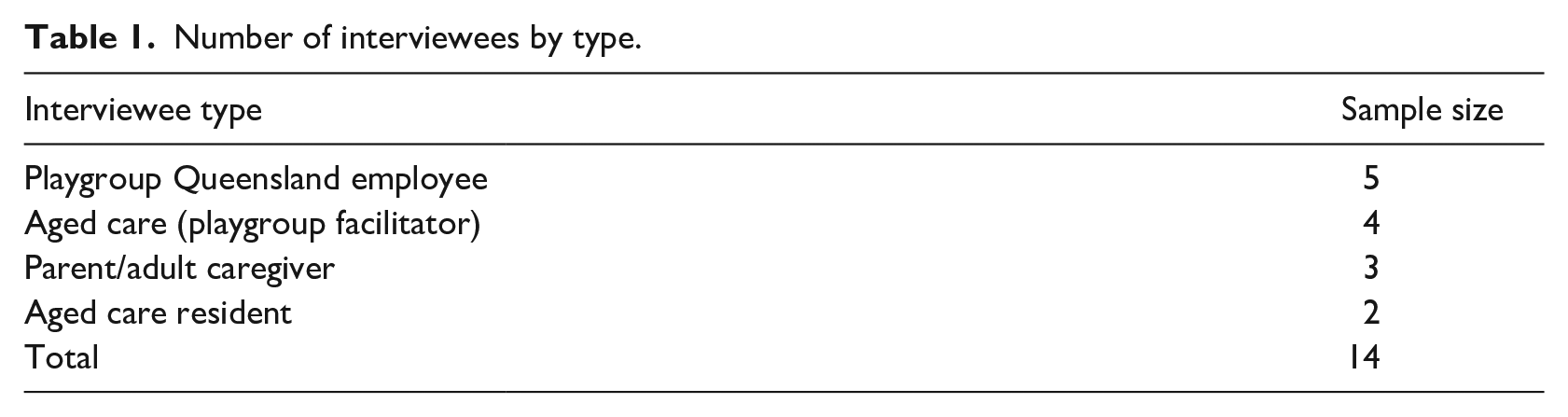
Two intergenerational playgroups established at least 3 years prior to the start of the study were invited to participate in the research. Both playgroups were hosted by residential aged care homes providing care for people with medium to high care needs. Participants in the study included five Playgroup Queensland employees involved with the intergenerational programme Ageless Play. These employees participated in 45-minute semi structured interviews. Four playgroup facilitators (two from each case study) agreed to participate in 30-minute semi structured interviews. These playgroup facilitators were all paid employees of the aged care facility, with qualifications in diversional therapy or similar. We also invited parents and aged care residents who were participants in the playgroup for a shorter interview of 20 minutes. We interviewed three parents and two aged care residents.
We were unable to recruit young children as intended and the number of aged care residents was smaller than the other types of participants, indicating low representativeness of the two primary groups such programmes are designed for and their reported perceived benefits. However, as the focus of the study was on programme sustainability, the total sample size of 14 is more robust for addressing the project’s two aims. Table 1 summarizes the final number of interviewees by type.
Number of interviewees by type.
Recruitment of those living in aged care and parents attending the playgroup was aided by the playgroup facilitators who had existing relationships with the families and residents. Gatekeepers can be a potential barrier to research (Bartlett and Martin, 2002) but in the case of this project were essential to recruiting participants in addition to being participants in the research themselves. The study received ethical approval from the Human Research Ethics Committee (HREC) at Griffith University (GU Ref No: 2019/502).
Interview questions were adapted from Mancini and Marek (2004) model of programme sustainability which includes the following elements: effective collaboration, staff involvement, strategic funding, leadership, demonstration of programme impact, understanding the community and programme responsivity. This framework allowed us to evaluate the programme in terms of the known components associated with programme sustainability. We were interested in developing an understanding of specific qualities of intergenerational playgroups that had sustained beyond what is already known about sustaining programmes.
Interviews were transcribed using an online transcription service. All interviews were reviewed for accuracy prior to analysis. Analysis, including the initial step of developing a code book was guided by the work of DeCuir-Gunby et al. (2011) who describe the analysis of interview data as a ‘multistep sense-making’ endeavour (DeCuir-Gunby et al., 2011: 137). As we had used themes developed by Mancini and Marek (2004) to develop the semi-structured interview questions, these themes were also the starting point of theory-driven codes for the code book. These codes were further refined on repeated reading of the data.
The first reading of the transcripts examined the material for suitability of the draft codes, while also examining the text for data-driven codes. The researchers divided up the interviews, coding these using the code book. After coding of the interviews was complete, the researchers met to discuss which aspects of sustainability resonated strongly with practice.
Findings
There were three key findings that emerged from the data analysis. The reciprocity or mutual benefits of the playgroup, the skills and knowledge of the facilitator, and interaction and engagement of all those involved were critical to sustaining the playgroup over the period of 3 years. In the following sections each of these findings will be discussed in conjunction with examples from the data.
Mutual benefit
The perception of benefit is integral to the sustainability of an intergenerational programme. Parents and children, older people and aged care professionals return each week because they perceive benefits to themselves and/or others. Interviewees described various motivations for attending; some were aligned with benefits to themselves or their children, others described altruistic intentions for attending the playgroup. Parents spoke of the desire to enable their children to have older people in their children’s lives: We live in quite an isolated world, we’re all 30 something year-old professionals with or without young kids. So, for us it was really just being around other people and having our daughter exposed to another generation . . . [Playgroup member – Interview 5].
Attending the playgroup also provided opportunities for adults to meet and form friendships. One interviewee described going out for coffee with other parents after the playgroup had finished. Social connection and peer support are recognized benefits of attending playgroup for families with young children (McLean et al., 2014; Strange et al., 2016). Attending playgroup can also contribute to the development of parent knowledge regarding child development (Berthelsen et al., 2012) and increase parental confidence (Urbis Social Policy, 2012). Playgroups can also be an important source of peer support for parents (Jackson, 2011), assisting parents to build social networks (Hancock et al., 2015). Playgroups are also places for children to learn and develop skills and friendships. Using Australian Early Development Census (AEDC) data, research conducted by the Telethon Kids Institute found that ‘children who attend playgroups during early childhood have significantly better child development when they start school . . .’ (Gregory et al., 2016: 2).
Intergenerational playgroups provide additional opportunities for those attending and the broader community. Families can develop relationships with older people, some of whom may have already raised families. Intergenerational playgroups may reduce the isolation that people living in residential aged care and people who are at home caring for young children can experience: You’ve got the social interaction for the parents and the nannies. They get to socialise with an older generation too. And they form bonds with the residents [Aged care professional – Interview 10].
Several of the interviewees touched on feelings of joy and enjoyment as they described relationships forming. Here, a parent describes the experiences of her daughter and an older person: I can see joy on both sides . . . My daughter’s. I can see the joy that [she] takes from it as well as the residents. . . . one doesn’t remember [my daughter’s] name but she knows that [she] runs a lot. She says, “here’s the little runner” [Playgroup member – Interview 11].
These findings align with previous research on intergenerational playgroups, which show that ‘enjoyment appears to be a significant benefit of involvement’ (Williams et al., 2012: 257). There was also a sense of happiness that hosting a playgroup brings to the residential aged care setting. One playgroup practitioner described the impact of the playgroup on aged care employees not directly involved in the playgroup: Hearing the child’s laugher and the joy in hearing the residents laugh as they’re engaging with the children, is just beautiful. It lifts the outer circle staff, lifts their spirits up [Playgroup practitioner – Interview 10].
One interviewee from Playgroup Queensland felt that some aged care employees not directly involved with the playgroup were intentionally visiting the group to observe the playgroup in action: I saw her sneak in earlier, because they have music time and singing time at the end . . . she was coming down earlier and earlier each week to get her resident because she wanted a dose, of that short music time . . . It’s their wanting something that’s a little bit joyful in their week that they might not find elsewhere [Playgroup practitioner – Interview 1].
Enjoyment and joy are essential to the sustainability of the playgroup. Families and older people are motivated to attend each week for the enjoyment it brings them and for the happiness they see on the faces of others. As one of the residents expressed: I love seeing them enjoy themselves. It’s lovely they got those sorts of things to play with that they don’t have at home [Playgroup member – Interview 8].
Intergenerational playgroup facilitator
Playgroups typically fall under two model types: community or supported. Community playgroups are community-led, whereas supported (also known as facilitated) playgroups are facilitated by a paid worker. Ageless Play is a supported playgroup, with a transition ‘twist’. Playgroup Queensland facilitators provide extensive support to start the playgroup, including facilitation of the playgroup for the first four weeks, with the aim of transitioning the group to be led by a paid staff member, usually the diversional therapist of the aged care facility.
To support this transition the Ageless Play programme includes a four-week ‘nurturing period’ which aims to provide aged care support workers with the tools needed to assist families and residents to settle into the playgroup and support ongoing opportunities for relationship building. The intensive nurturing period was included in the programme to ensure the intergenerational playgroup activities and routines reflect the needs and interests of playgroup members. As members of the playgroup get to know one another, an experienced facilitator can assist to facilitate ongoing conversation and ensure the playgroup is inclusive of the needs of all participants (Stanley et al., 2019).
The model is an enduring support playgroup model, recognising there is need for a facilitator who has knowledge of the needs of residents and who, with training and support from Playgroup Queensland staff, can facilitate and help to sustain the playgroup. The importance of the playgroup facilitator was acknowledged by our interviewees: It takes the right kind of person to be doing that role as the facilitator, because it’s hard. It would even be hard for someone from the early years space, because they’ve got to understand the residents and understand the children . . . That person really makes or breaks the group. [Playgroup practitioner – Interview 9].
The passion and commitment of the diversional therapist is crucial; they are the ‘glue’ between the families and residents. It is important the playgroup facilitator has highly developed interpersonal skills. When families and older people feel welcome and connected, they are more likely to continue attending the playgroup. Playgroup Queensland staff highlighted that there are opportunities to lead and also moments to step back and watch from the sidelines, as indicated in Theory U. The gift of spontaneity is also worthy of note, moving the facilitator away from a task focussed role into a relational role, helping to nurture and empower participants to build relationships.
The importance of the facilitator is noted within the literature regarding playgroups (Williams et al., 2016), and more specifically that which explore intergenerational playgroups (Williams et al., 2012). It is not enough to simply bring generations together; those employed to assist, facilitate, or lead have an important role to support meaningful interaction (Sánchez et al., 2014). A commonality between both playgroups’ sites in this research, is that there was more than one aged care employee supporting this work and at times the playgroups also welcomed volunteers: interested community members, students on placement, and/or the families of the older people attending.
In addition to the skills required by intergenerational programme practitioners, playgroup facilitators also work with a third generation—the parents and/or adult caregivers of the children attending. One playgroup facilitator explained their initial apprehension at working with families and young children: It’s very daunting I found for myself to interact with strangers. So how do you say to a parent or a nanny “Is it okay to pick up your child? to interact with your child?” What is the social norm? What is the etiquette involved with that? [Playgroup practitioner – Interview 10].
Intergenerational facilitators also need to be resilient; some weeks work better than others. Groups are dynamic, participants bring with them a range of experiences and expectations and have varying motivations for attending. One interviewee summarized intergenerational playgroup facilitator attributes as the following: I think it’s about relationship, it’s about commitment, it’s about passion, and I think it’s about being innovative. It’s also about being resilient. If that didn’t go very well, let’s try something else [Playgroup Practitioner—Interview 1].
In addition to the skills required to facilitate we noted the role of the playgroup facilitator as a champion. Fitzpatrick (2019) notes that as intergenerational practice is ‘still largely an optional approach in ECE [Early Childhood Education] and older adults services’ (Fitzpatrick, 2019: 53–54), these programmes rely on champions to support these projects. Champions need to understand the benefits for each of the stakeholders and share the values of intergenerational work, including an understanding of the importance of reciprocity to demonstrate the value of this work. There was some evidence that the playgroup facilitators ‘championed’ the intergenerational playgroup, with playgroup participants and also those external to the group: A playgroup is relatively easy to establish, but I think that you always have to have your ambassador. Once you set a playgroup up and you reach the level where it’s functioning well, that it can sustain itself, but I don’t think that is true for Intergenerational Playgroups. You need to have someone to nurture it. I think that, perhaps the challenge for me, is how do I make sure that that legacy continues? [Playgroup practitioner—-Interview 4].
Interaction and engagement
Meaningful interaction between ages is fundamental to intergenerational programming but the degree to which an intergenerational programme promotes meaningful engagement varies widely (Jarrott and Smith, 2011). We make the assumption here that intergenerational programmes with high levels of interaction between ages have increased perceived enjoyment and benefit. It is therefore important to examine how the programme promotes interaction and supports engagement. Both playgroups employ several common strategies with families to create a sense of belonging, which we hypothesize leads to commitment from families to attend each week. Several of these strategies also appear to promote deeper levels of interaction and enjoyment between the ages. For example, residents and families are encouraged to get involved with the group by reading stories, leading the group at music time and/or suggesting activities for mutual enjoyment.
The specific strategies identified as important to sustaining family engagement included: welcoming families (particularly important when families are new), using name badges, and setting expectations by providing information to families prior to their first attendance. In both playgroups, families were also in regular contact outside of the playgroup via email or social media. Strategies were also employed to ensure intergenerational interaction was responsive to the skills and interests of members, choice of activities and physical layout of the room.
The parents and playgroup facilitators we interviewed recognized that attending a new group can be daunting for some people. Families were provided with practical information specific to the aged care home. Many aged care homes have security features to ensure the safety of residents, but this can create a barrier, albeit easy to overcome with information:
I’d been talking to them leading up, I really wanted them to feel welcome. I wanted them to feel comfortable because it was a different environment. It wasn’t a normal playgroup environment. It was a little bit different. There’s this door, there’s that swiper thing, there’s maybe some residents saying different things or doing different things potentially . . . [Playgroup practitioner—Interview 1].
Practical information about accessing the playgroup was supplemented with information to manage the expectations of families in terms of their role and the purpose of the playgroup. These boundaries were important, both to support families to participate in the group and ensure the safety of all participants. For example, families were reminded to refrain from attending if they or their children were unwell for infection control, particularly important as both children and older people are vulnerable populations.
Ensuring a welcoming environment was also taken on by other members of the playgroup. Here, one parent explains how they supported others to attend: They were parents who were in my various other playgroups and I just talked about it nonstop. One of them said “I’ll come, but can I come with you?” So I walked to their house and then we walked there together . . . [Playgroup member – Interview 5].
One playgroup facilitator explained the importance of name badges, identifying that this was particularly important for members of the group living with dementia: I would say nine times out of 10, we try to have the name badges, especially for the families. When we have residents with dementia, that could be the difference between them saying someone’s name or just not choosing to interact at all because they just can’t remember that person or they’re embarrassed to ask [Playgroup practitioner—Interview 4].
Interviewees also shared tips regarding the physical layout of the room. Chairs of varying sizes, with room for prams, beds, and/or wheelchairs in a U-shape were considered better than a circle, enabling more movement and ease of access. The capacity of the programme to respond to the needs of the participants is recognized as an important consideration within the literature on programme sustainability (Mancini and Marek, 2004). The following definition aligns nicely with the principles of high-quality playgroups, stating that playgroups should be ‘flexible, responsive, and adaptive to the needs of carers and children and the local community’ (Commerford and Hunter, 2017). From the interviews it was clear that parents were expected to be involved with the general planning of the group: “Next week we’ll do this” or “What do you think about that?” So there’s an opportunity there to give feedback and look at whatever does or doesn’t work [Playgroup Practitioner – Interview 1].
It is important to note that the work of responsivity is ongoing. Involving and including parents, older people and children in decision making requires consistent commitment and ingenuity. Our research illustrates that aged care providers were aware of the importance of including the broader community in the playgroup celebrating community events and welcoming visitors.
We used the work of Mancini and Marek (2004) as a starting point to examine the programme in relation to elements of sustainability central to social programmes generally. We then focussed our attention to other factors nuanced to the delivery of the Ageless Play programme. Our research indicates two challenges to the issues of sustainability. One is a structural challenge within the playgroup that relates to the frequent changes within playgroup membership. The second are organizational structures that pertain to shared values between stakeholders.
A key challenge to the sustainability of intergenerational playgroups is frequent changes to playgroup membership. It is important to note that playgroup membership will continue to experience attrition regardless of the level of benefit or enjoyment as adult caregivers return to work and children grow older. The normalization of membership flux may encourage host organizations to formalize recruitment policies and activities so that these become sustainable practices. Sustainable practices are practices that ‘become part of the habits and routines of the host organizations and communities’ (Stirman et al., 2012: 2). Once recruited to the playgroup the focus shifts to engaging new families into the group. Ageless Play has an emphasis on welcoming and belonging which allows for strong connections and passion to form which in turn supports sustainability.
Implications for practice
Structural challenges
Fluctuation in playgroup membership is a potential barrier to the development of meaningful relationships between playgroup members. Recognising this, Playgroup Queensland developed an online course for Ageless Play facilitators to support the development of skills and attributes. The aim of this course, in addition to ongoing support provided by the Ageless Play team, is to build capacity within aged care homes for intergenerational practice. As a result of training and support, anecdotal feedback from Ageless Play facilitators suggests a shift from a task focussed mindset to a people focussed mindset. The Ageless Play programme encourages playgroup facilitators involved to think outside the square and learn through the process and not just be focussed on the product. This enables facilitators to ‘be in the moment’ and enjoy the journey of building relationships and strengthening skills across generations. The need to be spontaneous and responsive throughout the sessions is also a key element as it enables participant and community contribution, allowing space for belonging, and witnessing a representation of the community.
Organizational structures
The commitment of the facilitator and their manager are key to programme sustainability. It is evident that if management of the aged care service does not support the programme, the programme will not continue. An aim of the Ageless Play programme is to support knowledge, commitment, and passion for intergenerational practice. Feedback from parents indicates that if the management and facilitator are not passionate about the programme, they are hesitant to return, thus affecting the longevity of the programme and outcomes for participants.
What are we doing here? What is our work? What seems to emerge as a future? (Scharmer, 2009). Participants stated the value of the intergenerational playgroups to social relationships. Further, leadership by individuals such as the playgroup facilitator and the support of organization is critical. Theory U supports the examination of everyday social interactions. However more information is required to understand the nuances of the work in intergenerational programmes. The core process of Theory U provides seven ways of attending to and co shaping the world (Scharmer, 2009). Using this process will give future researchers deeper knowledge about each of the structural aspects of the sustainability from the perspective of leadership capacities. These features of the seven essential leadership capacities of Theory U as they apply within an intergenerational programme have the potential to provide knowledge about the innovations that are required to sustain the societal changes needed for age integration.
Conclusion
Shortly after we completed our interviews, all Ageless Playgroups were temporarily closed due to COVID-19 restrictions. The social isolation of children, families and older people throughout this pandemic further highlights the necessity for innovation and research into intergenerational playgroups.
Although we do not have direct data, our study shows from the voices that are represented, that intergenerational programmes appear to be effectively meeting the needs of families with young children and older people. The value of the programme also lies in the ability to organize and maintain the execution of the programme. This paper has drawn from stakeholder interviews key features such as mutual benefits, the role of the playgroup facilitator and interactions and engagement, that are critical to the sustainability of programmes. This was a small study and even though the findings cannot be generalized it has raised proposals for future research.
The ongoing status of the pandemic illustrates the importance of future research and practice to integrate with the commentary about the health difficulties inherent in intergenerational playgroups. In order to develop further understanding of the efficacy and sustainability of intergenerational playgroups, it will be important to ensure opportunities for older people and young children to participate more fully in the research.
