







Abstract
The use of multimodal approaches to articulate young children’s perspectives are evident in a wide range of recent research. This paper explores the creation of multimodal map-texts as a strategy to engage with young children and articulate their perspectives. It describes the development of a flexible map-based approach that was used in home, early years and community settings with children aged 4 to 5 years in England. Illustrative examples are included in which children represented and shared their views on the image-based texts they encountered within their everyday lives through the creation of a multimodal map-text. In this approach to research, children are viewed as competent message creators whose engagements encompass a range of modes and media. Consideration was given to young children’s multimodal meaning-making practices throughout the act of mapping, as well as the resulting text. Taking this approach revealed knowledge, perspectives and contextual information which may otherwise have been overlooked. The paper concludes by identifying the contribution that children’s map-texts can make when building a picture of young children’s experiences, and appraises the advantages and limitations of map-making as a strategy for engaging with young children in research.
Keywords
Introduction
This article presents an account of map-making, as a methodological approach, for articulating young children’s perspectives on their everyday lives. Illustrative examples are presented in which children aged 4-to-5 years created multimodal map-texts to convey their knowledge and experiences of the image-based texts they encounter within the familiar environments of the home, community and early years setting in England. The research is informed by social semiotic theory (Halliday, 1978; Kress, 2010), and recognises the multimodal nature of communicative practices. Multimodal texts may combine image, sound, gesture, movement, animation and written language to convey an intended message (Jewitt, 2006; Kress, 2003). As a result, throughout this article reference is made to the ‘text’ as a cohesive unit of meaning in communication, rather than as a synonym for the printed word.
Given the social and cultural influences of meaning-making (Halliday, 1978), map-texts are viewed as a way of linking young children’s experiences to the contexts in which they occur. Clark (2010: 315) notes that map-making is ‘an active process of meaning-making which can occur as children assemble the maps’, thus the focus is on the acts that take place through map-making in addition to the map-text as the ‘end product’. Previous studies which feature multimodal map-texts have relied upon the researchers’ construction of the final map-text (see Cowan, 2020; Yamada-Rice, 2013). In contrast, this paper outlines a methodology, which is also a pedagogical approach, that positions young children as competent message-creators and attends to the choices they make as they assemble their multimodal map-text. Slowing down observation, looking closely at texts and paying attention to modal choices is argued to elicit knowledge and experiences which may otherwise be overlooked (Gowers, 2019).
This paper outlines the three stages which form the map-based approach and indicates how thematic analysis may be used to support analysis of multimodal texts. Illustrative examples demonstrate the use of map-making in three different environments in answering the research question, ‘How may multimodal map-making, as a methodological approach, be used to articulate young children’s perspectives?’
Mapping young children’s experiences
A growing number of studies utilise map-making to capture children’s perspectives and engagements. Within the multi-method Mosaic Approach, Clark (2017) demonstrates that maps are particularly well suited to eliciting young children’s ideas regarding their environment and informing change. Both Powell (2016) and Sewell et al. (2019) present examples of children and young people using maps as a means of communicating knowledge about their local communities. In addition, map-based approaches have been used to elicit children’s perspectives across a range of topics including computer usage (Mavers, 2003), multimodal texts (Kervin and Mantei, 2017), home ICT practices (Stephen et al., 2008) and the images encountered in familiar environments (Gowers, 2020; Yamada-Rice, 2014).
Multimodal map-texts
A map-text may be described as multimodal when it combines two or more communicative modes to convey meaning. Consequently, map-texts may combine writing, image, gesture, movement and sound including speech to communicate knowledge, ideas and experiences.
Social semiotics recognises the social and cultural influences of meaning-making, therefore in exploring young children’s experiences, an initial step is to identify the contexts for these. Although map-texts are commonly conceptualised as a visual means for recording the physical location of buildings, landmarks, routes and geographical features, additional layers of meaning can be communicated. Lynch (1960) describes map-making as a tool to represent how persons perceive the relationships between space, place, social and physical features of the physical and built environment. This notion is extended by Powell (2010) who describes the act of mapping as a ‘multisensory research method’ due to its ability to evoke relationships between place, lived experience and community. As a result, I propose that multimodal map-texts provide a link between young children’s meaning-making practices and the environments in which they occur.
In common with other multimodal texts, individual agency is present within the production of map-texts, allowing for flexibility, transformation and creativity (Kress, 2003). Rather than simply replicate the physical environment, individual choices are made in the creation of a map-text that ‘simplifies, selects and schematizes the original’ (Burbules, 2004: 175). The map-based approach requires the researcher to slow down observation, look closely at the choices made and attend to the full range of modes used by the message creator to communicate meaning. Certain choices are made whilst others are not because they allow the individual to represent aspects which are meaningful and of personal significance to them. Jewitt (2009a) identifies that meaning is orchestrated through both the choice and configuration of modes, with the interaction between modes being significant to the overall message conveyed. It is the process of looking closely that shifts the focus away from ‘what’ is communicated to also consider ‘how’, whilst recognising the possibility of a range of modes being present which contribute to the overall meaning. Consequently, through attending closely to modal choices it is possible to articulate perspectives and emerging understandings which are not always visible.
The role of children in constructing a multimodal map-text
In developing the methodological approach, I drew upon existing research which used multimodal map-texts to investigate young children’s perspectives and engagements. As I will identify further in this section, a key difference in my approach is the role of young children in constructing the map-text. This reflects my dual positioning of young children as message receivers in engaging with the texts they encounter in their everyday lives, and competent message creators in their multimodal meaning-making practices. Furthermore, my professional role as a practitioner led me to seek a methodology which is also a pedagogical approach that could be replicated within early years settings. A key criterion was that all equipment and materials used must be readily available within the early years setting, whilst having the flexibility to be taken into the child’s other familiar environments, including the home and community settings.
Yamada-Rice’s (2013, 2014) research explores young children’s experiences of the visual mode within the Japanese urban environment. Within the study, an innovative combination of child-led photography, video recording and interviews was used during walks around the local area. It was found that young children’s comprehension of the visual mode is drawn from their knowledge and engagement with the physical environment. This reflects the assertion that young children’s communicative practices are frequently grounded in the embodied and non-verbal (Hackett and Yamada-Rice, 2015). Although maps formed a component of the data collection process in Yamada-Rice’s study, map-texts were not created by children and this is an area where I argue my approach extends existing research. Whilst the use of child-led photography and interviews feature in both approaches and provides a valuable insight into young children’s engagements, the creation of a map-text by children provides an additional layer of meaning. This is particularly significant when considered alongside assertions that a map-text allows subjective experiences and feelings to be conveyed (Clark, 2011; Powell, 2016).
Other authors have sought to use map-texts as a means of recording young children’s multimodal engagements and the spaces in which they occur. Hackett (2014) used hand drawn line maps to record the zigging and zagging movements made by young children around a museum in relation to objects of interest, arguing that such movements are in themselves an act of communication. This view is supported by Thiel (2015) and Daniels (2019) who note that movement supports young children’s meaning-making practices within a range of environments, including the early years setting. Cowan (2020) on the other hand, used computer generated maps to create multimodal transcriptions of young children’s running play. In transcribing video recorded episodes of children’s play, attention was given to the complexity of meaning-making across multiple modes with the completed maps recording the movements children made in and around the space. Both Hackett and Cowan’s work demonstrate the value of slowing down observation and attending to the full range of communicative modes used. Within my methodological approach, the use of map-texts is further adapted to focus on young children’s self-recognition of the context and locations in which their engagements take place and their awareness of their movements in relation to these.
Theoretical framework
The methodological approach outlined in this paper is guided by social semiotic theory (Halliday, 1978; Kress, 2010) and the metafunctions of text (Jewitt, 2009b). This recognises the multimodal nature of contemporary communicative practices, with the map-text constituting a cohesive unit of meaning in communication.
In articulating young children’s perspectives, I draw upon the pre-existing knowledge and skills they use within their multimodal practices. Modes are the ‘content’ of communicative practices and include writing, image, gesture, movement and sound including speech. Multimodality, on the other hand, refers to the ways such modes are combined in different ways. Jewitt (2009a: 14) identifies that multimodality marks a shift beyond the linguistic to approaches which consider the ‘full range of communicational forms that people use . . . and the relationships between them’. Young children are able to combine modes in complex ways to construct and communicate meaning as social and active meaning makers (Marsh, 2004). Examples of this are found across their everyday engagements as they combine talking, drawing, gestures, facial expressions and movement (Yelland et al., 2008). From a social semiotic perspective, these acts are interwoven with layers of meaning derived from the use and integration of multiple modes (Jewitt, 2008).
Positioning maps in line with social semiotic theory as ‘texts’ (Halliday, 1978) allows exploration of the three metafunctions of text which operate simultaneously to make meaning: (1) the ideational, (2) the interpersonal and (3) the textual (Jewitt, 2009b). The ideational component refers to the overall subject matter whilst the interpersonal component reflects the approach taken to convey experiences and ideas. The textual component refers to the creation of coherence across text as a whole. Within a map-text this is achieved through composition, modality and framing, as elements are configured to present the world and events in specific ways (Jewitt, 2009a). Viewing map-texts in this manner reflects the positioning of children as message creators and acknowledges that meaning drives the approaches taken by children in creating their map-texts. Furthermore, slowing down observation and looking closely at the choices made in relation to each component, marks the distinction between the map-text as a tool to capture information, and the methodology which is also a paedagogical approach in which map-texts feature.
The map-based methodology
My approach to map-making with young children consisted of three core components: task orientation, map-making and conversation. Although designed to be carried out in sequence, the three components can be divided flexibly into separate sessions.
Task orientation
Young children are introduced to the concept of mapping through the sharing of existing map-based images. I found the children’s picture book ‘My Map Book’ by Fanelli (2006) to be particularly suitable as it presents a range of hand–drawn maps which demonstrate the ‘multisensory’ nature of maps and their potential to represent physical environments, activities and feelings (Powell, 2010). Kervin and Mantei (2017) adopt a similar story-based introduction to mapping, whereas Sewell et al. (2019) provided a poster template with prompts as an initial stimulus.
Map-making
A range of mark making materials are provided, along with large, plain paper to allow children to create individual map-texts. Whilst other researchers have successfully used technology including stop-motion cameras (Yamada-Rice, 2014) and computerised map transcriptions (Cowan, 2020), these are not used within this approach due to their lack of availability within the early years setting. There is scope to incorporate a range of visual media within the maps including photographs (Gowers, 2020), drawings (Sewell et al., 2019), computer-generated images (Kervin and Mantei, 2017) and stickers (Stephen et al., 2008). When using photography to capture images, objects or events of interest, the role of the adult is to provide the tools to make the task achievable whilst it is the child who engages in knowledge building (Clark, 2017).
Conversation
The creation of the paper-based map-text is accompanied by conversation to form an overarching multimodal text which combines spoken, visual and written modes. Such conversation takes the form of task-based utterances, storytelling and questioning through focused conversation (Clough and Nutbrown, 2012). This represents an amalgamation of existing approaches which use maps alongside conversation or storytelling (Clark, 2017; Gowers, 2020; Kervin and Mantei, 2017; Sewell et al., 2019; Yamada-Rice, 2014). Attending to children’s task-based utterances as well as their responses to focused questions, recognises children as competent and knowledgeable meaning-makers, without privileging their use of particular terms or vocabulary.
Approach to data analysis
The approach to data analysis is informed by social semiotic theory (Halliday, 1978; Kress, 2010), with the positioning of maps as ‘texts’ allowing them to be interpreted in terms of the metafunctions they comprise (Jewitt, 2009b). Visual data from the paper-based map is collected alongside audio data drawn from conversation and task-based utterances, with the two data sources seen as complementary components in common with the Mosaic approach (Clark, 2017).
Thematic analysis supports the identification of themes and patterns of meaning across the map-texts, with attention paid to the three metafunctions of text. Braun and Clarke (2013: 81) identify thematic analysis as a highly flexible approach to analysing data which can be used within different theoretical frameworks to examine how ‘events, realities, meanings, experiences . . . are the effects of a range of discourses operating within society’. This stance allows for the social and cultural context of communicative practices and, as such, can be used within the framework of social semiotic theory (Halliday, 1978). Flick (2014: 423) asserts that thematic analysis is ‘founded on analysing subjective viewpoints’, a factor which reflects the central aim of the methodological approach to articulate young children’s perspectives on their everyday lives and engagements.
Given the grounding of this study in social semiotic theory (Halliday, 1978) the three text metafunctions (see Jewitt, 2009b) are used to guide the identification of themes and support reflection upon whether the audio or visual data collected relates to either the ideational, the interpersonal or the textual component of the map-text. Each map-text is initially viewed as a whole, before noting the initial features that are prominent. Following this, thematic analysis is applied to the audio and visual data sets. In relation to the ideational component, the images and photographs recorded within the map-text can be noted to determine the overall subject-matter. The interpersonal component may be observed through the use of photographs and other annotations within the map-text to convey their experiences and ideas. Finally, the overall coherence across the map-text may be considered in relation to the textual component.
The audio and visual data may then be brought together, looking for patterns across the two data sets. In line with Braun and Clarke’s (2006: 82) approach to thematic analysis, the presence of a ‘patterned response or meaning’ can be explored for each child’s map-text before comparisons are drawn across the group of children who participate. For example, a child might verbally refer to seeing signs or posters within their environment whilst the map-text produced by another child may feature photographs of posters within their environment. The themes from across the visual and audio data may then be compiled and reduced to determine the main themes.
Making maps with young children
In this section, I detail the application of the core map-based methodological approach with young children in answering the research question, ‘How may multimodal map-making, as a methodological approach, be used to articulate young children’s perspectives?’ In doing so, I present illustrative examples to demonstrate the approach in practice; this is aided by the inclusion of images and conversational excerpts drawn from the map-texts.
Introducing the illustrative examples
The illustrative examples are drawn from a larger study involving a group of four children aged 4–5 years which explored young children’s conceptualisation of the image-based texts they encounter within familiar environments, see Table 1. All of the children who participated attended the same Foundation Stage class within an English urban primary school.
Overview of the participants.
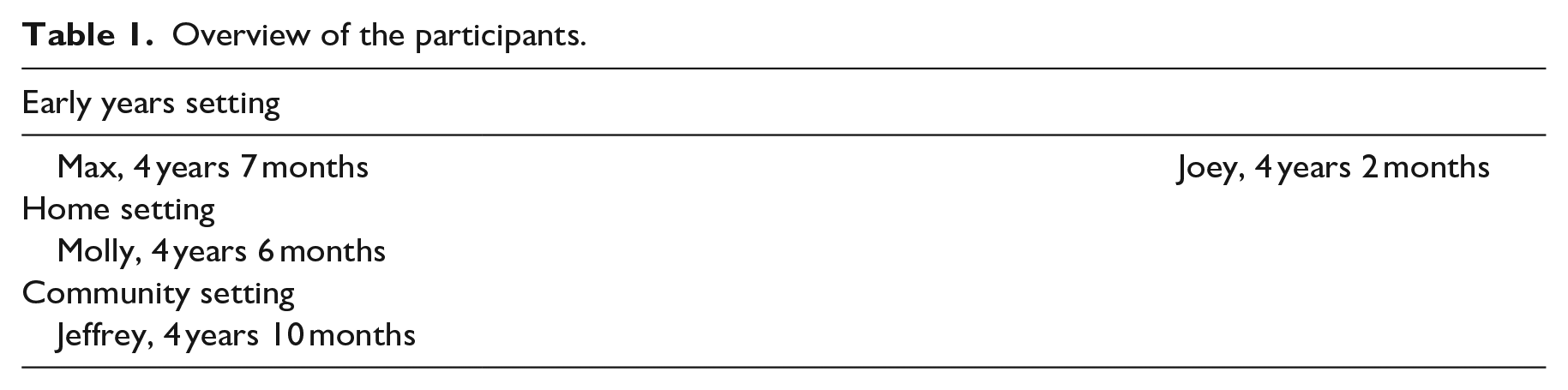
Data collection took place with each child individually at one of the three locations of the school, home and community leisure centre as familiar environments. The researcher met with the children on two separate occasions, within a 7-day period to avoid changes taking place to the image-based texts present in the environment, for example through different displays, texts, media or toys being made available in the three settings. During the first session, the children completed the task orientation activity and used a digital camera to take photographs of the image-based texts they engaged with in the environment. The researcher returned in the second session with printed copies of the child’s photographs to support the completion of the map-making and conversation components. Audio recordings were made of the conversations which took place and later transcribed.
Ethical considerations
Consideration was given to the British Educational Research Association (2018) ethical guidelines in addition to institutional ethics and integrity processes. After gaining consent from gatekeepers, including the school setting, educators and parents, the children were informed about the study’s aims, what participation might involve and their right to withdraw (Dockett et al., 2012). Prior to engaging in the study, children attended an informal meeting at the end of the school day with their parents. At the start of each session the children made the decision on whether to participate, in recognition of their status as reliable informants in their own experiences (Christensen and James, 2008). In concurrence with Thomas and O’Kane (1998: 339) I view this position as seeking the children’s ‘active agreement’ on top of the parents’ ‘passive agreement’. Throughout the data collection process, I took account of children’s verbal and non-verbal cues, interpreting these to ensure that their assent was ongoing and genuine. The children chose pseudonyms to anonymise their identities.
Findings
Physical meaning-making practices
A primary concern for the children was in creating a map-text which communicated the physical nature of their engagements. This can be illustrated by looking at the contrasting map-text created by Jeffrey in the community setting and Joey in the early years setting.
One approach was to use verbal place and locations names to refer to the images within the map-text, as synonymous with the image itself. Joey’s map-text representing his early years setting is shown in Figure 1, alongside his commentary. An individual piece of paper was used for each area of the setting before joining these together; ‘Apples’ is the name of the classroom, whilst ‘The Orchard’ is a creative area and ‘The Barn’ is a covered outdoor area. Joey used the place names spontaneously to refer to the images throughout the map-making component, using the same place names were used repeatedly to identify multiple images. Images of similar appearance were distinguished between through the use of a place or locational name.
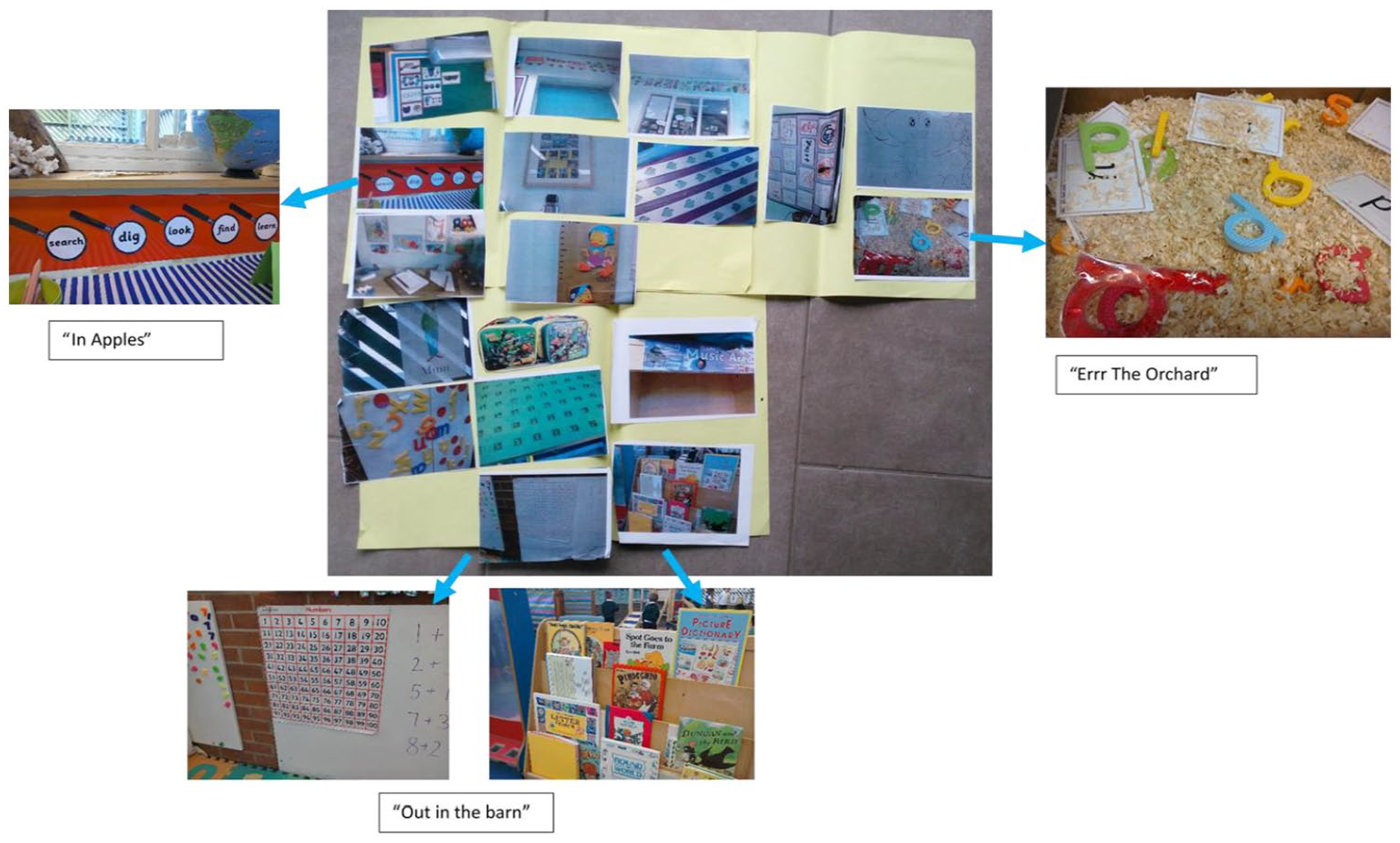
Joey’s early years setting map.
The type of sorting and classifying Joey engaged in reflects Mackey’s (2010) proposal that we continuously seek to turn the space around us into the kind of place which is familiar and meaningful. Using locational names presented a quick and efficient means for children across all three settings to identify their photographs as known the known places in which their engagements occurred. It also marks the difference within the map-text between the ideational component, which refers to images as the subject matter, and interpersonal component, which refers to children’s ideas and experiences in relation to these. For Joey, the photograph of letters in sawdust were very much tied to the experience of being in ‘The Orchard’ area of his setting.
Paying attention to the textual component of the map-text revealed alternate approaches to convey physical experiences. Meaning may be realised in the visual mode through composition, framing and modality (Jewitt, 2009a). Jeffrey used composition in arranging the images on his map-text to represent their physical location relative to one another, and the sequential order they would be encountered in if you were to visit his community setting as shown in Figure 2. Jeffrey was keen to demarcate the edge or bounds of his map which presented just one part of the wider community setting, telling me, ‘my map shows the image of the roller arena from the entrance as far as you can see in the picture, all the way up to the rink’. In common with Lynch’s (1960) conceptualisation of map-making, the space left between images on Jeffrey’s map signifies a pathway whilst the images he has selected to form his map may be thought of as landmarks along the route to the skating rink.
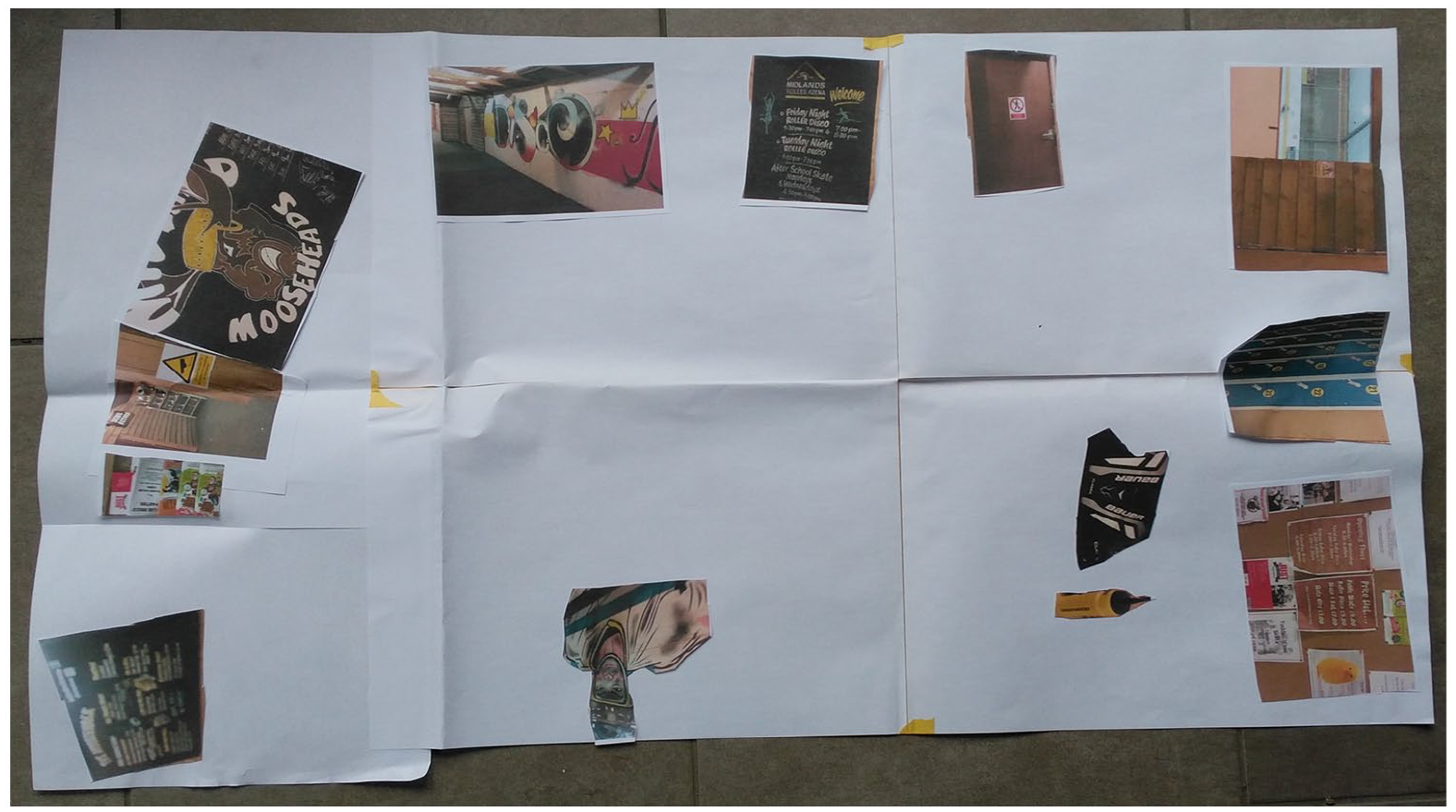
Jeffrey’s community setting map.
Communicating knowledge through map-making
Using a map-based approach allowed children to make modal choices and articulated knowledge that may not so easily be put into words. The children were able to demonstrate their knowledge of image-based texts, as message receivers, in the ways they edited their own photographs and presented these within the map-text as message creators. The need to slow down observation and attend to children’s modal choices is illustrated when viewing Max’s map-text of the early years setting.
In arranging the images on his map-text Max adopts conventions more commonly associated with the written mode, see Figure 3. He arranged his photographs from left to right, working down the page in same manner one would for a written text. Max further emphasises the content of his images, including classroom displayboards, by presenting the photographs on his map in a very similar manner. Whilst the dissimilarity between Max’s map-text and those of the Jeffrey and Joey may suggest that he did not understand the task or has less knowledge of the visual mode, specific consideration of the textual component reveals Max’s use of composition and framing at the point the photographs were taken.
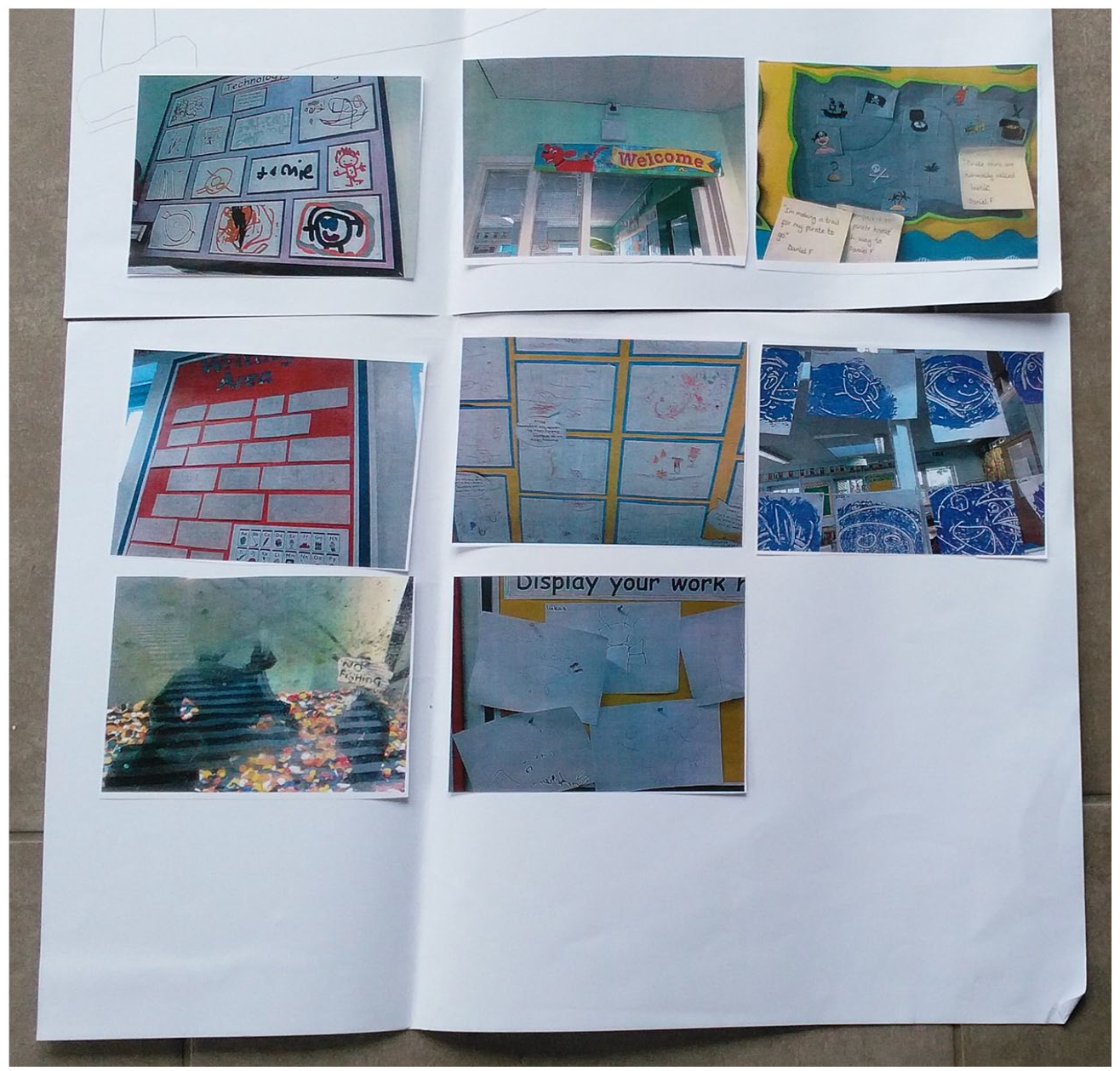
Max’s early years setting map.
Looking closely at the photograph of a pirate map in Figure 4a, Max has chosen to zoom in so that the map fills the entire frame. This act of framing disconnects the pirate map from the other work presented on the displayboard. Looking next at the fishbowl in Figure 4b, Max has again zoomed right in, this time to pick up on a small sign within the water which was of interest to him, reflecting the ideational component. The way the photograph has been taken presents the sign within the fishbowl context which is tied to its meaning. The elements of the sign, water and fishbowl accessories are arranged within the image in a certain way as an act of composition, whilst their proximity to one another in the absence of other features marks an act of framing which indicates a connection between them.
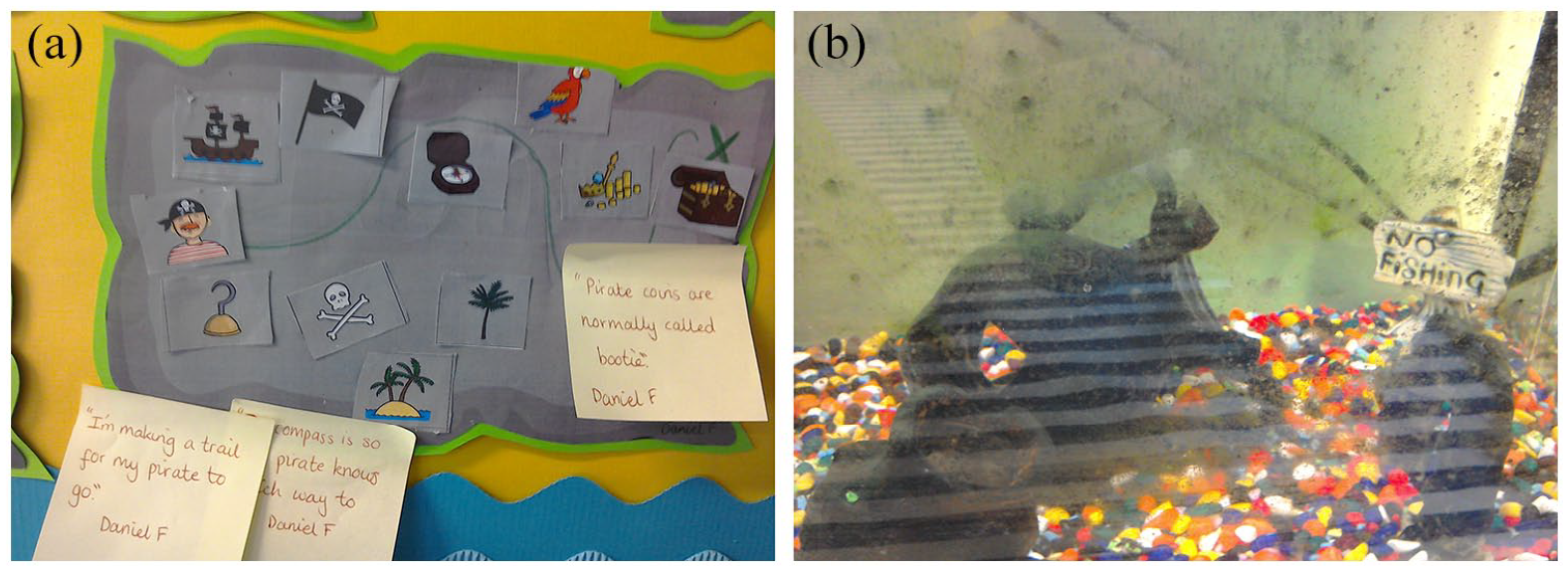
Close up images from in Max’s early years setting map (a) Pirate map and (b) Fishbowl.
Focused conversation revealed that children were aware that different texts were used to communicate meaning to audiences other than themselves. Key questions were posed to elicit children’s knowledge of the message conveyed by the image-based texts depicted in their photographs. These included questions relating to the producer, production methods and purpose, drawing upon Yamada-Rice’s (2013) approach. Referring to the fishbowl image in Figure 4b, Max suggested the no fishing sign was for ‘Well, daddies and mummies because all they’ll think is maybe it’s for fishing but because of the fish they will not see the sign and the teacher will be angry’. Whilst Max had a very literal understanding of the sign, his comment also indicated his knowledge of signs being configured to convey information to visitors or people unfamiliar with an environment. In spite of this knowledge, neither Max nor the other children who feature in the illustrative examples were able to pinpoint verbally how image-based texts had been configured to convey meaning nor explain how they themselves achieved this through their map-text. This is suggestive of a disparity between what children are themselves are able to do, in creating and editing a map-text to convey meaning, and their ability to express such acts in words.
Eliciting contextual information
The map-texts communicated information about young children’s experiences across the range of texts they encountered within their familiar environments. Combining map-making with conversation elicited substantial contextual information regarding previous textual experiences and interactions with family members.
The children were highly sensitive to the images they noted as existing in more than one location, and made links between these. In the early years setting, Max was drawn to a sign featuring the caption ‘Welcome’ alongside a picture of Clifford the dog. In conversation with Max, it became apparent that his interest was not in the literal message being conveyed through the caption, or the positioning of the sign over the door to his classroom. Max’s interest in this particular image stemmed from his knowledge of Clifford as a familiar cartoon character. Max described his experiences of watching Clifford on the television and also of playing with a physical toy version of a dog at home. This demonstrates that relying solely on the children’s photographs or attending to the ideational component alone is insufficient in articulating children’s perspectives.
A similar observation was made in the home setting, this time in relation to screen-based media. Whilst Molly was completing the map-making component, a Lego television programme started playing on the television in her lounge. Molly’s interest in this particular programme had been identified in the first session when she used the digital camera to capture an image of the programme displayed on the television screen. In common with Max, Molly related the image she could see on the television screen to its physical representation in a toy belonging to her older sibling. In both instances the toy was not present in the setting, or seen by the researcher, however the children were readily able to recall knowledge of the toys and link these to the image we were discussing.
Discussion – What contribution does map-making make to articulating young children’s perspectives?
Maps are a powerful means of conveying detailed information about a place or physical environment (Powell, 2010). The illustrative examples demonstrate the use of map-texts to articulate young children’s perspectives regarding image-based texts. A number of examples were found where the map-based approach made visible knowledge and experiences which may otherwise have been overlooked. In the subsequent discussion section, I answer the question, ‘How may multimodal map-making, as a methodological approach, be used to articulate young children’s perspectives?’
Articulating young children’s perspectives by looking closely
The methodological approach provides opportunity to consider the metafunctions of text (Jewitt, 2009b) by slowing down observation, looking closely at texts and paying attention modal choices children make as message creators. Within the illustrative examples, the map-texts included photographs, drawings and oral stories which revealed information regarding the children’s interests and engagements with image-based texts, reflecting the ideational component. This complements existing research which identifies young children’s engagements with multimodal texts in home (Yamada-Rice, 2010) and urban environments (Yamada-Rice, 2013).
Looking closely at the photographs children selected for their maps and listening to their narratives and conversations provided information in relation to the interpersonal component which conveyed their experiences and ideas. Children described and depicted their engagements, the contexts for these and the presence of other people. The children were confident that the texts they encountered in familiar environments had been created with an audience in mind, and identified groups of people that they felt were the target audience. On the other hand, focused conversation revealed that, in common with Yamada-Rice’s (2010, 2013) studies, children were not able to pinpoint verbally or show visually how the texts had been configured to convey meaning.
Finally, in considering the textual component attention was paid to the ways the children edited and adapted their photographs within the overall map-text to highlight aspects of their experiences or draw attention to the most salient details. This supported analysis of the map-text as it indicated to the researcher what aspect of an image was of interest to the child, and providing a starting point for further conversation that was responsive to the individual child. The textual component also provided evidence of children’s underlying knowledge of the visual mode and its affordances. These observations are important as they signal the aspects of the map-based methodology which are necessary in order to truly capture young children’s perspectives. Looking solely at unedited photographs and discussing these in conversation with the children captures one perspective, however looking at the ways children utilise images to communicate their own meaning as evidenced within the mapping task provides an additional layer of meaning in making children’s perspectives visible that does not rely solely on verbal communication.
Showing young children as competent message creators
The map-based approach can support children to express the knowledge and experiences they have which may not so easily be expressed in words. It is unlikely that young children would be able to describe in words what is meant by the terms ‘framing’ or ‘composition’ and yet instances were found within the illustrative examples of children using elements of these with some skill and confidence. This may have been overlooked were pre-prepared images used (see Stephen et al., 2008). Furthermore, use of such conventions demonstrates that children are able to apply their pre-existing knowledge and experiences within the context of a map-text, in common with Sewell et al.’s (2019) observation of children sharing their play experiences through mapping. This supports the use of a map-based approach to convey meaning as a method which reflects children’s preferred means of responding (Smith et al., 2005) and which resonates with their existing engagements (Christensen and James, 2008). Whilst previous studies have demonstrated the power of photography to capture young children’s interactions and knowledge of the visual mode (Yamada-Rice, 2013), the map-based approach demonstrates the potential of the visual mode to articulate children’s perspectives on other topics which are difficult to express in words.
Capturing the everyday
The map-based methodology provides a means for representing engagements within a familiar environment. The ways young children represented the existence of images in the space around them in the illustrative examples, is noteworthy when considered in relation to the circular maps created in the Mosaic approach (Clark, 2011, 2017; Clark and Moss, 2011). The Mosaic approach maps feature a circle to situate children at the centre of their environment, whereas within my approach, children are able to use media and materials flexibly to assemble a map after engaging in a task orientation activity in which they see examples of other maps in a storybook. This is a potential limitation as children may be unsure of what to include or where to start when creating a map-text or may attempt to replicate the maps shown in the storybook, however the illustrative examples demonstrate children’s ability to make use of their photographs and annotations to situate their audience and acquaint them with their familiar environment. Jeffrey’s map for example, provides a fixed boundary to the places which he inhabited within his community setting whilst Molly’s map identifies a range of pathways through her home setting. This suggests that rather than having the materials for data collection adapted to them, as seen in the Mosaic approach, the children were more concerned with adapting the finished map-text to use images to convey information about the physical features of their familiar environments and that the balance between orienting the child to the task and providing opportunity to communicate their ideas is appropriate.
The methodological approach outlined in this paper made visible children’s own views regarding the physical nature of their engagements. Within the illustrative examples, the ways children conceptualised images reflected the physical nature of meaning-making previously identified by Hackett (2014) and Yamada-Rice (2013) with reference to Mackey’s (2010) work. For example, children verbally used place and locational names as synonymous with the texts depicted in their photographs, and signalled landmarks and boundaries within their environment through the placement and arrangement of images on the map text. Whilst previous studies have used alternate methods, including the use of body cameras and adult observation of movement (see Cowan, 2020; Hackett and Yamada-Rice, 2015), the map-based approach described in this paper extends existing methods in capturing children’s perspectives on the role and importance of familiar environments and movement in their meaning-making practices.
A key feature of the map-based approach is the flexibility it can offer to researchers and practitioners. Inherent in the creation of a multimodal map-text is the ability to draw upon a range of modes and media. Within the illustrative examples, young children used visual, spoken and written modes with confidence through the use of photography, annotations, conversation and storytelling. Whilst this is beneficial as it allows children to use their preferred means of responding in communicating their knowledge and perspectives on a given topic, it can also present a challenge when interpreting the map-texts. Across the illustrative examples, there was no homogenous approach to mapping which can make apparent similarities and differences between cases harder to discern as first glance. In spite of this, slowing down observation and looking closely at the range of communicative modes young children use during map-making led to the identification of children’s self-identification of the physical nature of their meaning-making practices, their perspectives on a focus topic and a wealth of contextual information regarding their engagements beyond the physical environment being mapped.
Conclusion
This article has presented a map-based methodological approach to articulating young children’s perspectives on their everyday lives. In focusing on the active nature of map-making (Clark, 2010), attention is drawn to meaning-making as it occurs rather than considering a static text as an end product. This is an approach which requires slowing down and looking closely in order to learn more.
The use of map-texts recognises the diversity of young children’s multimodal communicative practices and the opportunity attending to these presents in articulating their views. Engaging in map-making allows young children to take an active role in constructing texts as message creators with the flexibility of the map-based approach facilitating children to make apt modal choices to convey meaning. The act of mapping stimulates children to make links to other areas of their lives, generating additional contextual information about their engagements and locations for these. With reference to the Mosaic Approach, Clark (2011) describes map-texts as ‘multi-layered artefacts’ which provide a starting point for dialogue. In this paper, the case is presented for further examination of the range of multimodal practices young children engage in during map-making as communicating perspectives on their everyday lives.
One of the limitations of the methodological approach outlined in this paper is the limited application with groups of children on a range of topics to date. As indicated in the illustrative examples, the approach has so far been applied to investigate young children’s conceptualisations with texts in familiar environments. Although this allowed rich, detailed data to be gathered regarding how the individual children engaged with the map-based approach, wider generalisations about its utility among different groups cannot yet be drawn. Whilst both Kervin and Mantei (2017) and Sewell et al. (2019) demonstrate the ways map-making and storytelling can be combined in alternate contexts, there is further scope for exploration of this map-based approach to capture children’s perspectives on other topics. Given the apparent potential of the map-based approach to invoke communication about prior experiences which took place in other environments, a further area for future research or application by practitioners lies in the use of the map-based approach to investigate children’s experiences in settings which the researcher may not be able to directly access.
The illustrative examples reported have provided insights into the ways in which a map-based methodology may be used to make young children’s perspectives visible. Slowing down observation, looking closely at map-texts and paying attention to modal choices is demonstrated to elicit knowledge and experiences which may be otherwise overlooked. Considering the map-texts with reference to social semiotic theory (Halliday, 1978; Kress, 2010) and the metafunctions of text (Jewitt, 2009b) reflects the positioning of children as message creators and acknowledges that meaning drives the approaches taken by children in creating their map-texts. Furthermore, important contextual information is gained by considering the full range of representational forms which young children use with confidence to express their knowledge and experiences, whilst the physical nature of their meaning-making practices is foregrounded. Young children’s active meaning-making engagements are multimodal in nature and reflect the wider communicative practices in society. Therefore, it is imperative that approaches which seek to listen to and represent their views reflect such practices if they are to bring young children’s perspectives to the fore.
